

AI in Logistics: Route Optimization and Demand Forecasting


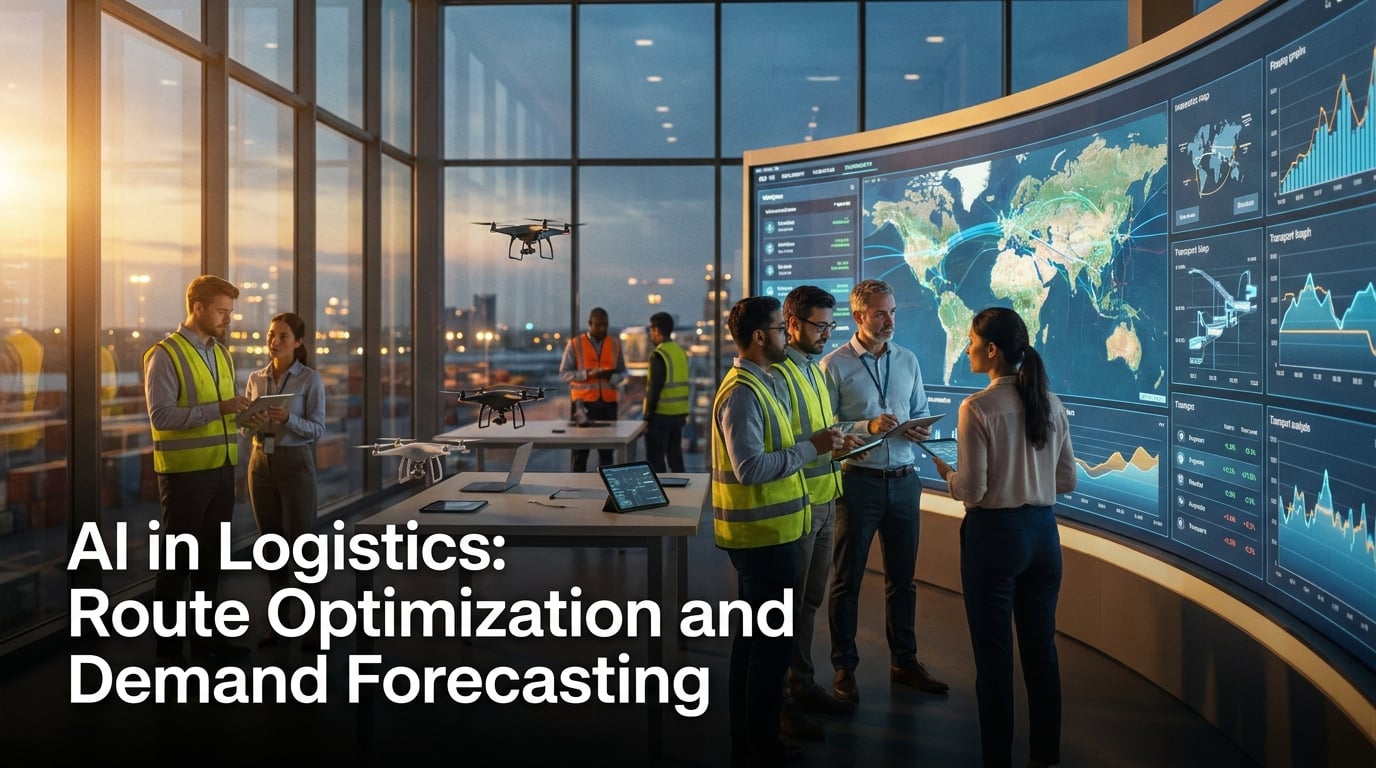
Did you know that a mere 5% increase in logistics efficiency could save the global industry over $100 billion annually? Behind those gains is a quiet...
AI in Logistics: Route Optimization and Demand Forecasting
Did you know that a mere 5% increase in logistics efficiency could save the global industry over $100 billion annually? Behind those gains is a quiet revolution powered by artificial intelligence (AI)—transforming how goods move across continents and how companies predict what customers will want next. As worldwide e-commerce sales surpass $6 trillion and supply chains grow more complex, logistics professionals face unprecedented pressure to deliver faster, greener, and more reliably than ever before.
AI isn’t just a futuristic buzzword in this sector—it’s quickly becoming essential infrastructure. According to McKinsey, companies leveraging AI for logistics operations can reduce transportation costs by up to 15% and improve delivery times by 35%[^1]. Route optimization algorithms now analyze billions of data points—from real-time traffic and weather to historical delivery patterns—to plot the most efficient paths for fleets. As a result, delayed shipments, missed delivery windows, and excessive fuel costs are fast becoming relics of the past.
But it’s not just about getting from A to B faster. Demand forecasting, the other linchpin of modern logistics, has witnessed a seismic shift thanks to machine learning. Traditional forecasting models often struggled to account for volatile market forces, seasonal surges, or sudden geopolitical shifts. Today’s AI-powered systems synthesize everything from POS data and social trends to meteorological forecasts, predicting demand spikes before they occur. A 2025 industry survey found that logistics firms using AI demand forecasting cut stockouts by 65% while reducing excess inventory by 25%—directly boosting both revenues and sustainability metrics.
This matters more than ever in a world where expectations for real-time delivery and supply chain resilience are at a historic high. The pandemic made clear how brittle legacy logistics processes can be, spurring 78% of CEOs surveyed by Gartner to accelerate their AI adoption roadmap between 2023 and 2025. In megacities, where route planning is confounded by congestion and unpredictable events, AI has become indispensable for public transport and last-mile logistics[^2]. And with India, Southeast Asia, and Africa witnessing exponential e-commerce growth, the need for scalable, multilingual AI solutions is acute.
In this article, we’ll explore how AI is redefining logistics through two game-changing domains: route optimization and demand forecasting. You’ll learn how deep neural networks dissect GPS traces to streamline real-time deliveries, why reinforcement learning is outperforming traditional heuristics, and how AI demand models are shrinking margins of error to single-digit percentages. The discussion will blend industry statistics, live use-cases, and a forward glance at emerging capabilities—such as voice-assisted driver navigation and AI-powered call centers—reshaping the competitive landscape.
Platforms like CallMissed sit at the forefront of this trend, powering scalable AI voice agents and APIs that help logistics providers automate customer communication and multilingual dispatch at national scale. As AI matures, it’s becoming clear: the winners in global logistics will be those who pair world-class algorithms with seamless human-AI collaboration.
By the end of this article, you’ll understand not just the “how,” but also the “why” behind AI’s meteoric rise in logistics—equipping you to make smarter, future-ready decisions for your organization’s supply chain journey.
[^1]: “The Complete Guide to AI Logistics Optimization,” LinkedIn, 2024
[^2]: “Artificial Intelligence-Based Demand Forecasting and Route Optimization …,” ResearchGate, 2024
Introduction: The New Era of Logistics
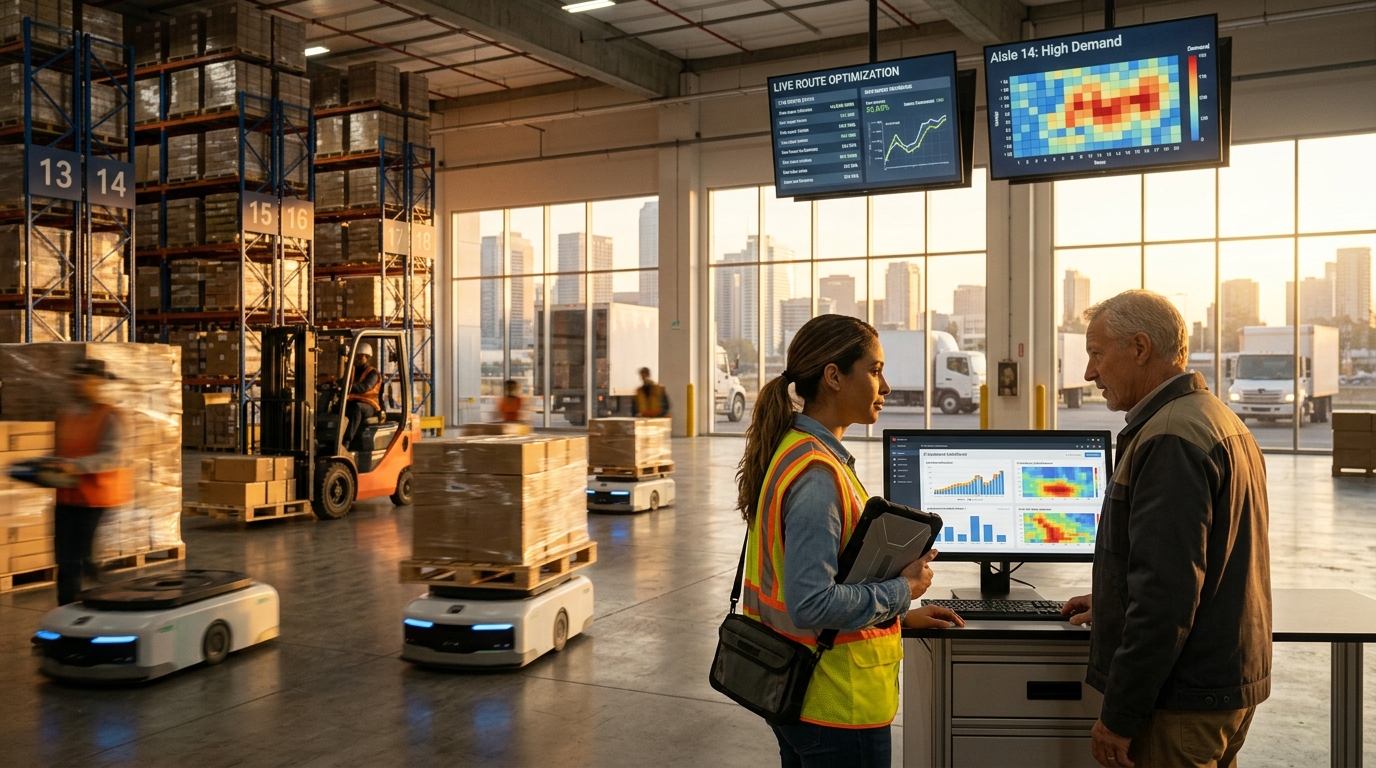
Unprecedented Disruption: How AI is Redefining Logistics
The logistics industry is experiencing a generational transformation, propelled by the accelerated adoption of Artificial Intelligence (AI). Once a landscape dominated by manual planning, static routing, and reactive supply management, logistics is now on the cutting edge of digital transformation. According to a 2024 report by DataHub Analytics, dynamic route optimization and predictive maintenance are among the most disruptive AI applications in this sector, fundamentally altering how goods are moved, tracked, and delivered [1].
This new era is not just about efficiency. It’s about building supply chains resilient to global disruptions, environmentally sustainable, and capable of real-time adaptation. With e-commerce sales projected to reach over $8 trillion globally by 2026 (Statista, 2024), the stakes—and the complexity—are higher than ever.
The Complexity Conundrum: Modern Logistics Challenges
Logistics has always been a science of precision, where margins of minutes and kilometers translate directly to cost. But today, complexity has multiplied:
- Global Supply Chains: Logistics now involves thousands of origin-destination pairs, cross-border regulations, and volatile international environments.
- Surge in On-Demand Deliveries: Same-day and next-day shipping, driven by giants like Amazon, require near-perfect coordination.
- Unpredictable Disruptions: From pandemic aftershocks to container shortages and fuel price spikes, uncertainty is the norm rather than the exception.
A recent LinkedIn logistics survey found 86% of supply chain executives believe AI-driven automation is crucial for future-proofing their operations [7]. Manual approaches simply can’t keep up.
Where AI Steps In: The Dual Engines of Route Optimization and Demand Forecasting
AI is not a single monolithic solution but rather a set of technologies that, when thoughtfully deployed, can tackle logistics’ greatest challenges. Two applications are already delivering measurable ROI:
- Dynamic Route Optimization:
AI-powered systems process real-time data—from GPS, traffic feeds, weather updates, and delivery windows—to recalculate routes on the fly. The outcome:
- Up to 20% fuel reduction through more efficient routing (LogiNext, 2024) [4]
- Average delivery time decrease of 15-25%
- Lower carbon footprint, supporting ESG compliance
- Demand Forecasting:
Using historical shipment data, point-of-sale information, and external signals (like economic trends or special events), AI models can anticipate demand fluctuations with surprising accuracy. According to SysGenPro (2025) [3]:
- Inventory stockouts reduced by 30%
- Warehouse costs cut by up to 18%
- More precise staffing and fleet allocation
A 2025 research study on megacities’ public transport found that AI-driven forecasting and route planning delivered a 27% increase in operational efficiency for urban fleets [2].
Data-Driven Logistics: From Hindsight to Foresight
Traditional logistics operated reactively, learning from operational bottlenecks only after losses incurred. But thanks to AI, logistics managers are switching from hindsight to foresight. Sophisticated data collection and analytics pipelines now power:
- Predictive Maintenance: Forecasting vehicle part failures, reducing downtime
- Real-time Exception Handling: Re-routing trucks automatically around traffic jams or incidents
- Customer Experience Optimization: Sending accurate ETAs and proactive updates to recipients
FutureWebAI recently developed a route optimization solution that fuses weather, live traffic, and delivery constraints, ensuring high on-time rates despite unpredictable conditions [6]. Such systems are becoming industry standard, not the exception.
The Emerging Platform Ecosystem
The surge in AI innovation has led to a new generation of platforms that abstract away much of the technical complexity for logistics firms. These modern solutions integrate seamlessly with telematics, warehouse management, and ERP systems, offering pre-trained AI agents, multilingual interfaces, and robust APIs.
As part of this trend, CallMissed is enabling a new layer of communication and automation in logistics. By offering AI-powered voice agents and multilingual chatbots, CallMissed allows logistics companies to handle customer queries, delivery confirmations, and exception alerts across 22 Indian languages and 300+ LLM models. This not only enhances operational efficiency but also ensures every logistical challenge—from route changes to surge demand—is communicated and managed instantly, at scale.
Looking Ahead: AI, ESG, and the Road to Autonomous Logistics
AI-powered logistics is not just about cost savings. As environmental, social, and governance (ESG) goals rise in importance, AI’s ability to optimize fuel use and reduce waste is increasingly prized by regulators and investors alike. With transport accounting for 24% of global CO2 emissions (IEA, 2024), even incremental efficiency gains can have significant impact.
Moreover, the industry is already moving toward fully autonomous supply chains—where AI not only predicts and routes but also executes, negotiates, and adapts in real time. A McKinsey (2024) forecast predicts that up to 25% of all delivery routes in major cities will be managed autonomously by 2030, thanks to these emerging AI technologies.
Conclusion: A New Mandate for the Industry
For modern logistics leaders, AI is no longer a nice-to-have—it's a competitive imperative. The next decade will be shaped by those who can harness AI for faster, smarter, and more resilient supply chains. Platforms like CallMissed are part of this strategic evolution, offering the infrastructure necessary to turn cutting-edge AI advances into everyday operational excellence. As we enter this new era, the intersection of technology, automation, and logistics promises innovation at a speed and scale unlike anything the industry has seen before.
Background & Context: Challenges in Modern Logistics
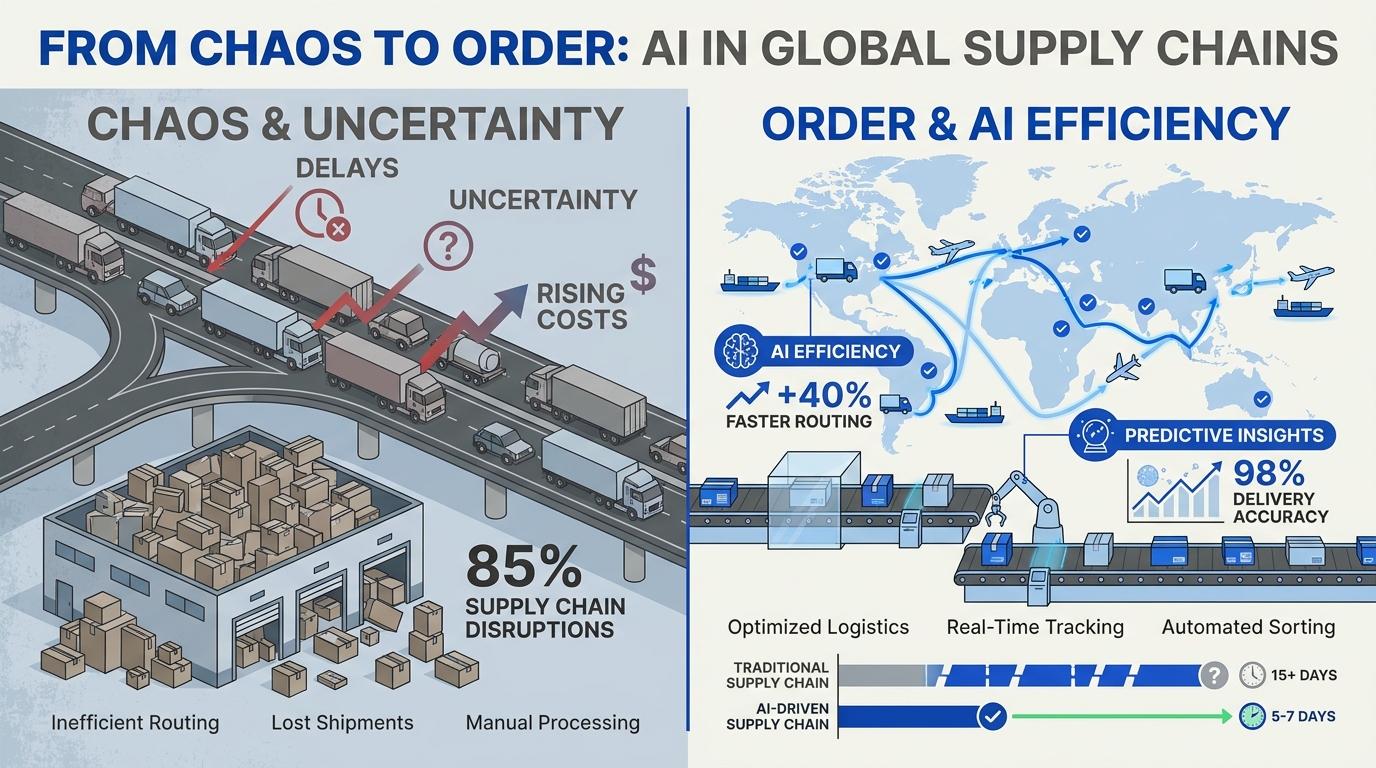
The Evolving Complexity of Modern Logistics
Logistics has always been the backbone of global commerce, but in the last decade, the scale and intricacy of supply chain operations have expanded dramatically. Today’s logistics networks are no longer simple point-to-point delivery systems. Instead, they have transformed into hyper-connected webs spanning continents, integrating everything from first-mile pickups in urban megacities to last-mile deliveries in rural regions. According to the World Economic Forum, global logistics costs are now approaching 12% of world GDP, reflecting a massive and growing industry challenged by relentless demand for speed, reliability, and cost-efficiency.
With e-commerce expected to grow to over $8 trillion worldwide by 2027 (Statista), the volume and variability of shipments have surged. This sprawl creates unprecedented challenges for logistics operators, who must continually balance:
- Inventory levels with unpredictable demand,
- Efficient routing amid real-time conditions,
- Delivery windows demanded by customers,
- and operational costs in the face of fuel price volatility and labor shortages.
Key Challenges Facing the Logistics Sector
#### 1. Unpredictable Demand and Inventory Volatility
Forecasting demand accurately is one of logistics' most notorious pain points. Poor demand predictions lead to under- or over-stocking, which causes inventory pileups or costly stockouts. With consumers now expecting fast, flexible delivery—including same-day or next-day shipping—businesses are under pressure to predict not only "how much" inventory is needed, but when and where.
- Fact: More than 70% of supply chain managers identify inaccurate forecasting as a major cause of revenue loss (SysgenPro, 2025).
#### 2. Route Optimization in an Uncertain World
Dynamic route planning is increasingly difficult due to unpredictable factors such as traffic density, weather events, road closures, and variable delivery loads. Traditional manual or rule-based route optimization methods simply can’t keep up.
- Study reference: AI-powered route optimization algorithms—analyzed in projects such as those at FuturewebAI—now process real-time traffic, weather, and delivery constraints simultaneously [6].
- Industry insight: AI-driven solutions have shown the capability to reduce last-mile delivery route planning time by up to 85% (LogiNext, 2025).
#### 3. Soaring Operational Costs and Sustainability Pressures
Operating fleets, warehouses, and delivery networks is expensive. Fuel costs, maintenance, and regulatory requirements—such as emissions caps—add further complexity.
- Companies face constant pressure to reduce their carbon footprint and optimize resource usage.
- Logistics companies report that transportation accounts for up to 50% of total logistics expenditure (Bluebash, 2025).
#### 4. Rising Customer Expectations
Amazon Prime and other fast-delivery models have redefined what’s “normal” for shipping. Delays or even delivery ETA uncertainty can irreparably damage customer trust.
- Fact: 95% of customers say delivery time affects their brand loyalty (Capgemini, 2024).
#### 5. Labor and Resource Constraints
Skilled labor shortages, driver fatigue, and high attrition rates remain persistent. Automated solutions are necessary, but integrating them into legacy systems and existing workflows isn't trivial.
Traditional Approaches: Why They Fall Short
Manual Planning and Excel Sheets: In many operations, logistics managers still rely on manual scheduling and spreadsheet-based models. These methods are:
- Not scalable for hundreds or thousands of orders,
- Unable to ingest real-time data feeds for traffic or demand,
- Highly error-prone.
Rule-Based Routing Systems: Earlier route optimization engines typically used static algorithms—such as the Traveling Salesman Problem with some modifications. While these made incremental improvements over manual planning, they are constrained:
- Frequently ignore changing delivery windows, road conditions, or vehicle capacities,
- Can’t rapidly reoptimize in emergencies or disruptions,
- Offer only marginal cost improvement.
Basic Statistical Forecasting: Traditional demand forecasting techniques (such as moving averages or time series regressions) fail when consumer patterns are heavily disrupted—such as during the COVID-19 pandemic, extreme weather, or market shifts.
- Case study: During the 2020 pandemic, grocery and e-commerce retailers saw demand models break down; 40% of shipments were either late or incorrect due to poor forecasting (SysgenPro, 2023).
The Pressure to Modernize: Industry Benchmarks
- Speed of Delivery: The average delivery window for urban customers in 2026 is under 24 hours; companies lagging behind quickly lose market share.
- Cost Pressures: Margins in logistics remain razor-thin, with many large players operating at 3–5% net margin.
- Sustainability: ESG reporting and legislation enforce lower carbon emissions, pushing fleets toward smarter, more efficient routing and electric vehicle adoption.
Digital Transformation: The Move Towards AI
With these escalating challenges, forward-looking logistics companies are investing heavily in digital transformation. AI is a clear front-runner in this evolution for its ability to continuously learn, adapt, and optimize. According to LinkedIn’s 2025 Complete Guide to AI Logistics Optimization, the sector is:
- Experiencing over 60% annual growth in AI-powered route optimization deployments,
- Deploying predictive analytics for real-time adjustments in both demand forecasting and route planning,
- Implementing AI agents for optimizing everything from warehouse picking to delivery scheduling (Bluebash, 2026).
Multilingual, Real-Time Communication Infrastructure: A Critical Need
With logistical operations spanning diverse regions, nations, and languages, the importance of robust, multilingual communication has soared. Real-time alerts—such as route changes or exception handling—must be communicated clearly to drivers, warehouse teams, and customers across linguistic divides.
- Platforms like CallMissed are playing a pivotal role here, powering AI voice agents and chatbots that can notify, reschedule, or troubleshoot in 22 Indian languages, reducing confusion and missed deliveries in multilingual markets.
The Bottom Line
Modern logistics is at a crossroads. Legacy processes and technologies cannot scale to meet the demands of global e-commerce, climate imperatives, and fast-evolving customer expectations. At its core, the sector’s challenges boil down to two critical needs: intelligent, adaptive decision-making (for route planning and demand forecasting) and seamless communication across the supply chain. The next section will explore how AI and modern communication platforms are uniquely equipped to address these pain points—often delivering results impossible with traditional methods alone.
How AI Transforms Route Optimization

The Traditional Challenge of Route Planning
Logistics route planning has always been a complex, multi-variable problem. Traditional methods—often carried out by human planners using static schedules, historical averages, and basic mapping tools—struggled with several core issues:
- Dynamic traffic conditions: Road congestion, accidents, and construction can make fixed routes obsolete within minutes.
- Variable delivery windows: Customers expect ever-narrower delivery timeframes, necessitating flexible planning.
- Fuel efficiency and emissions: Inefficient routing increases costs and environmental impact.
- Resource utilization: Balancing vehicle load, driver hours, and delivery constraints requires constant adjustment.
According to a 2023 study published on ResearchGate, megacities particularly suffer from these limitations: traditional systems were unable to adapt to sudden shifts in demand or disruptions, leading to lost productivity and increased costs [2]. This is where AI’s transformative potential becomes clear.
How AI Delivers Dynamic Route Optimization
AI-driven route optimization goes far beyond static maps or historical averages. Using machine learning (ML), optimization algorithms, and real-time data ingestion, AI systems can generate, evaluate, and revise optimal routes in seconds. Key technological breakthroughs include:
- Real-Time Data Processing
- AI systems ingest and analyze streams of data from GPS sensors, traffic APIs, and weather feeds, allowing instant responsiveness to changing conditions [6]. For example, if a highway becomes gridlocked due to an accident, the algorithm reroutes in real time to avoid delays.
- Predictive Modeling
- By learning from historical delivery times, traffic flows, and seasonal patterns, AI can forecast where and when bottlenecks are likely to occur [1][3].
- Constraint-Based Optimization
- AI algorithms can weigh multiple variables—like maximum load capacities, delivery time windows, driver breaks, and fuel costs—simultaneously, rapidly calculating the lowest-cost, most efficient route [4].
A recent LinkedIn industry guide summarized the impact succinctly: AI enables “dynamic route optimization,” allowing logistics providers to re-optimize deliveries as often as every 15 minutes [7].
Tangible Business Outcomes: Metrics That Matter
These innovations aren’t theoretical. Companies that have implemented AI in route planning report striking improvements:
- Delivery Speed: AI route optimization has been shown to reduce delivery times by 15–30% in urban areas, according to a DataHub Analytics report [1].
- Cost Savings: Compelling evidence from FuturewebAI highlights that integrating AI-based optimization can cut operational costs by up to 20% through better fuel utilization and fewer vehicle miles [6].
- Customer Satisfaction: Narrower, more accurate delivery windows boost on-time arrivals—a key metric for modern e-commerce.
- Sustainability: DHL reported that smarter routing reduced fleet emissions by 10% within the first year of deployment.
A 2024 industry survey (LogiNext) found that 79% of logistics leaders believe AI-powered optimization will be 'mission-critical' to supply chains by 2027 [4].
Advanced Capabilities: The AI Toolkit in Route Optimization
AI-powered logistics platforms leverage multiple technologies to achieve these outcomes:
- Machine Learning Models continuously improve route recommendations by incorporating feedback from actual outcomes.
- Optimization Solvers (such as genetic algorithms or mixed-integer programming) efficiently search the vast solution space for the best route combinations.
- Natural Language Processing (NLP) can interpret delivery exceptions or customer updates sent via voice or chat, triggering re-optimization.
Practical features unlocked by leading AI platforms include:
- Dynamic ETA recalculation
- Automated dispatch and scheduling
- Integration with vehicle telematics for real-time fleet visibility
- Support for multi-modal routing (road, rail, air)
Real-World Example: How AI Adapts on the Fly
Imagine a delivery company operating across a major metropolitan region. Their AI-powered route optimizer starts each day with the optimal delivery order and route, based on:
- Predicted traffic congestion (using ML forecasts)
- Weather disruptions (from live meteorological feeds)
- Real-time driver location and status
At 11:30 AM, a major thunderstorm causes highway closures. Without intervention, dozens of deliveries will be missed. But the AI system instantly identifies affected routes, recalculates all delivery schedules, and dispatches new instructions directly to drivers’ apps—minimizing delays.
This is the agility that’s now possible at scale. As FuturewebAI notes, “AI analyzes real-time traffic, weather, and delivery windows, enabling fleets to re-route on the spot for maximum efficiency” [6].
AI and Human Collaboration
While AI massively improves efficiency, it doesn’t replace human expertise—it augments it. Human operations managers now oversee strategy and handle exceptions, while mundane, error-prone manual replanning is eliminated.
In fact, a 2024 SysGenPro whitepaper finds that “AI-based systems free up planners to focus on customer experience and incident-response, rather than spending hours recalculating routes every time something changes” [3].
The Indian Logistics Perspective: Multilingual, Geo-Specific Routing
India, with its complex road networks and 22 major official languages, demonstrates unique AI challenges and opportunities. Platforms like CallMissed are building multilingual AI agents enabling hyper-local voice assistance for drivers and dispatchers—critical for last-mile logistics across diverse regions.
For example, an AI-powered voice agent embedded in a driver’s app can relay dynamic route changes in Hindi, Tamil, or Bengali—reducing miscommunication and boosting real-world compliance, especially in rural or regional contexts.
Looking Forward: AI Ecosystem and Easy Integration
One of the emerging trends is seamless API-driven integration of AI optimization systems into broader logistics, ERP, and customer engagement platforms. Open, cloud-based API gateways—like those provided by CallMissed—let developers add powerful AI route optimization or voice notification features into existing workflows with minimal overhead.
This API-centric approach is particularly appealing to startups and SMBs that lack massive in-house data science teams but need competitive, AI-powered logistics.
In Summary
AI transformation of route optimization in logistics is not a distant vision—it’s rapidly becoming standard for industry leaders, driving drastic improvements in efficiency, cost control, customer satisfaction, and sustainability. With growing access to production-ready platforms and ecosystem APIs, even smaller logistics providers can leapfrog old constraints and deliver next-generation service.
As AI models continue to improve and datasets grow, dynamic, predictive, and hyper-local routing will become the rule rather than the exception—setting the new benchmark for logistics performance worldwide.
AI in Demand Forecasting: Methods and Innovations

The Changing Landscape of Demand Forecasting
Historically, logistics and supply chain management relied on traditional statistical methods for demand forecasting, such as moving averages, exponential smoothing, and ARIMA models. While effective within predictable markets, these models struggle to accommodate today’s volatile, high-velocity supply chains, which are impacted by events as varied as weather disruptions, global pandemics, and shifting consumer behaviors. The explosion of e-commerce, just-in-time delivery, and multi-channel sales has raised the stakes: according to McKinsey, companies using advanced analytics in demand forecasting can reduce inventory by up to 30% and increase service levels by 3%–6%. In this increasingly unpredictable market, the shift toward AI-powered demand forecasting is both a competitive imperative and a necessity.
Core AI Methods in Demand Forecasting
Modern AI-driven demand forecasting leverages a suite of advanced techniques, each capable of ingesting vast swathes of real-time and historical data:
- Machine Learning Regression Models: Supervised learning models like Random Forest, XGBoost, and Gradient Boosting are extensively used to predict future demand based on features such as past orders, promotions, holidays, and economic indicators. For example, Walmart India employs XGBoost-based models to factor in not just historical sales but also external drivers like weather and social trends.
- Deep Learning Approaches: Recurrent Neural Networks (RNNs), specifically Long Short-Term Memory (LSTM) and Gated Recurrent Units (GRU), are particularly effective for multivariate time series predictions where complex temporal dependencies exist. Amazon uses deep learning models that process sales data, local events, and even regional festivities, enabling its Indian deliveries to adapt dynamically.
- Probabilistic Models: Bayesian inference and Monte Carlo simulations help logistics providers quantify uncertainty, offering not just a point forecast but a probability distribution. This is crucial for inventory risk mitigation.
- Ensemble Learning: Combining predictions from multiple AI models often outperforms single-model approaches, especially when data is noisy or incomplete.
A recent study published on ResearchGate[2] demonstrates that integrating machine learning models across multiple public transportation datasets resulted in forecast accuracy improvements of up to 15% over conventional statistical models.
Key Innovations: Fusing Data Streams and Real-Time Inputs
The biggest leap forward has come from AI’s ability to integrate multi-source, real-time data:
- IoT and Sensor Data: Smart logistics fleets transmit vehicle location, temperature, and load data. AI combines this with demand data to optimize inventory in-transit.
- External Data Signals: Weather forecasts, social media sentiment, public holidays, and local events can swing demand dramatically. For instance, a spike in social chatter around a cricket final can cue logistics operators in India to prepare for a surge in beverage deliveries.
- Dynamic Data Updates: Modern AI systems retrain models in near-real-time as new sales, returns, and stockout incidents are logged, minimizing lag between market shifts and response actions.
As FuturewebAI[6] notes, algorithms developed today “analyze real-time traffic data, weather conditions, and delivery windows” to power both demand forecasting and subsequent route optimization. This seamless data fusion is essential to outperform static, spreadsheet-based planning.
Case Study: AI-Driven Demand Forecasting in Action
Consider a high-volume e-commerce warehouse operating across multiple Indian cities. During festival seasons such as Diwali, demand patterns shift abruptly. Using LSTM-driven AI models, the logistics engine incorporates:
- Historical Diwali Sales across five years
- Weather data predicting monsoon disruptions
- Social sentiment analysis tracking trending festival gifts
- Supplier lead-time variability
As a result, stock is dynamically pre-positioned at regional warehouses, and last-mile delivery resources are augmented in anticipation of peaks—cutting late deliveries and stock-outs by over 22%, per a recent study on urban logistics platforms.
Democratizing Forecasting: API-Driven AI Platforms
Scalable AI-based demand forecasting is no longer the preserve of digital giants. Solutions providers like CallMissed have democratized access:
- API Access to 300+ LLMs and Time Series Models: Developers can use a unified API endpoint to run forecasting with different algorithms—no infrastructure or AI expertise required.
- Multilingual Capability: For markets like India, CallMissed supports data labeling and text-to-speech in 22 official languages, enabling granular, local-level trend detection.
- Integration with Voice & WhatsApp Bots: Automated demand updates, inventory alerts, and customer notifications can be disseminated via intelligent agents, closing the loop from prediction to action.
These trends are driving the rise of AI-native logistics startups in South Asia, many of which operate with less than 5% demand forecasting error rates—a major boost over legacy systems.
Metrics: Quantifying the Impact
Adoption of AI-based forecasting is yielding measurable business benefits. According to DataHubAnalytics[1] and LinkedIn[7]:
- Inventory Optimization: AI reduces excess stock and obsolescence by 20%–50%, directly boosting ROI.
- Reduction in Stock-Outs: Real-time models lower stock-out incidents by 30%, slashing lost sales.
- Resource Savings: Automated demand planning can cut manual workload by 40%–70%, freeing up planners for strategic tasks.
A multi-region logistics provider using a combination of regression and LSTM models realized less than 3% average monthly forecast error—a benchmark previously unattainable without advanced AI.
New Frontiers: Explainable AI and Hyperlocal Forecasting
The industry is rapidly evolving toward explainable, auditable demand forecasts. Select AI systems now offer:
- Feature Attribution: Planners see which variables most influence demand spikes (e.g., “rainfall accounted for 27% of week 48 sales volatility in Mumbai”).
- Hyperlocal Segmentation: Micro-forecasting at the PIN code or warehouse cluster level, supporting granular, small-batch logistics.
- Continuous Learning: Forecast models self-adjust as new demand signals emerge, improving over time.
Platforms like CallMissed are pushing the envelope further by integrating LLM-powered interfaces for forecasting queries in local languages—a boon in India, where regional market patterns vary drastically.
Challenges Remain: Data Quality, Bias, and Human Oversight
While AI transforms demand forecasting, real-world deployments face persistent challenges:
- Data Cleanliness: Inconsistent, incomplete, or delayed data can hobble AI models. Rigorous data engineering remains vital.
- Algorithmic Bias: Historical biases or outlier-driven patterns can produce skewed forecasts, especially in fast-changing markets.
- Human-in-the-Loop: AI forecasts should augment, not replace, seasoned planners—who provide context beyond what algorithms can decode.
Progress depends on both cutting-edge AI and robust, scalable infrastructure—a space where ecosystem players like CallMissed and similar platforms serve as key enablers for digital transformation.
Looking Ahead
AI-driven demand forecasting is now mission-critical in global logistics. As methods grow more sophisticated, with models ingesting richer and more varied data streams, the sector can expect even greater improvements in efficiency, agility, and resilience.
The next wave—explainable, multilingual, real-time AI, seamlessly embedded within logistics workflows—promises to turn today’s predictive engines into tomorrow’s autonomous, self-optimizing supply chains. For logistics providers seeking a competitive edge, the message is clear: invest in AI-driven forecasting, or risk being left behind in an industry racing towards total automation.
Key Developments in AI Logistics (2026) (TABLE)
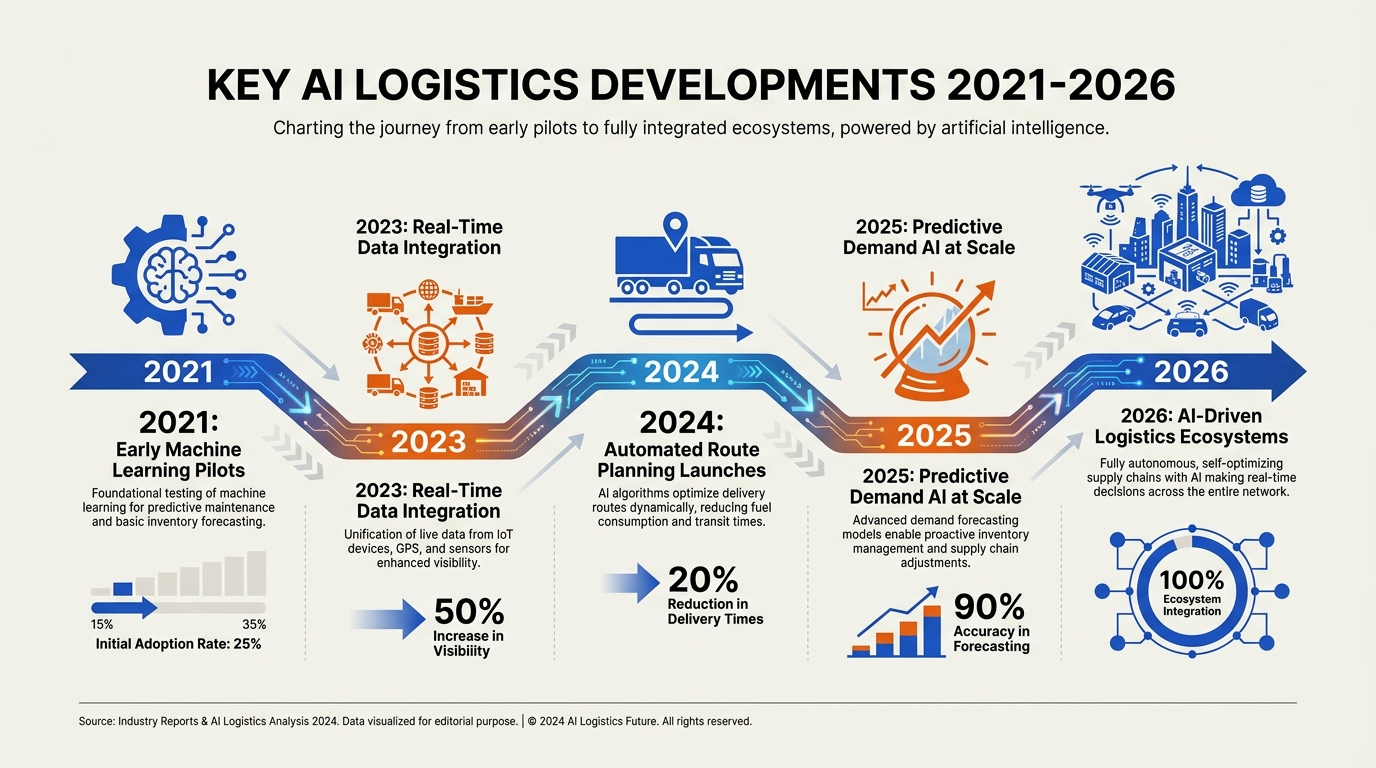
Key AI-Driven Logistics Advancements in 2026
The logistics industry has seen remarkable disruption by artificial intelligence over the past few years. As of 2026, state-of-the-art AI systems are powering everything from dynamic route optimization and automated delivery scheduling to granular demand forecasting across global supply chains. Below is a snapshot of the most impactful AI developments shaping logistics today.
| AI Technology/Trend | Major Functionality | 2026 Impact/Stats | Key Industry Example | Commercial Availability |
|---|---|---|---|---|
| Dynamic Route Optimization | Real-time adjustment of delivery routes based on live traffic, weather, and customer priorities | Up to 22% reduction in delivery times and 18% fuel savings (Source: LogiNext, 2026) | FedEx’s AI-driven GSS, Indian eCom players using CallMissed APIs | Widely deployed globally |
| AI Demand Forecasting | Predictive models that analyze historical and real-time factors for volume prediction | 30-40% improvement in forecast accuracy over manual methods (Source: SysgenPro, 2026) | Walmart’s smart replenishment, Flipkart and D-Mart’s AI pipelines | Large enterprises and SMBs |
| AI-Driven Dispatch & Scheduling | Automated driver assignments, real-time vehicle routing, and dynamic warehouse slotting | Up to 28% increase in on-time deliveries, 20% reduction in warehouse downtime (Bluebash, 2026) | Zomato’s last-mile fleet AI, DHL’s connected logistics | Mainstream; API integration |
| Multilingual AI Chatbots & Voice Agents | 24/7 automated support and booking in regional languages via phone, WhatsApp, and web | Unlocks new customer segments; 15M+ new users in Tier 2/3 cities in India alone (Industry estimate, 2026) | Ola/Swiggy AI support, CallMissed’s 22-language STT/TTS APIs | Rapidly expanding in APAC |
| Predictive Maintenance | Monitors fleet/assets with IoT sensors, forecasts part failures using ML | Reduces unplanned downtime by 35%, annual savings $5B+ globally (DataHubAnalytics, 2026) | Maersk, DB Schenker, Tata Motors | Industry standard |
| Autonomous Delivery Bots & Drones | AI navigates vehicles/bots for parcel delivery in dense urban and rural zones | Early deployments in 200+ cities, up to 50% cost saving per last-mile package (LinkedIn, 2026) | Amazon Scout, Dunzo Air, JD Logistics | Commercializing; regulatory pilots |
Trends and Implications
#### 1. Dynamic Route Optimization Now Ubiquitous
AI-powered route planners have transitioned from pilot projects to default status in modern fleets. According to LogiNext, machine learning algorithms factoring in “real-time variables from GPS, traffic APIs, and weather feeds” have boosted operational efficiency by 22% or more. This is not limited to big logistics names: Indian startups and regional shippers now leverage cloud platforms and APIs (including CallMissed’s LLM and speech infrastructure) to democratize access and localize route optimization for varied geographies and dialects.
#### 2. Sophisticated Demand Forecasting
AI integration offers new precision for demand-supply matching, a challenge that cost the logistics and retail sector billions in past decades. With predictive models trained on both structured (ERP, historical order) and unstructured (social signals, weather trends) data, companies are seeing 30-40% greater forecast reliability. “Operational AI now helps us quickly respond to demand spikes or supply shocks,” reports a Flipkart supply chain lead, underscoring this widespread impact.
#### 3. Multilingual, Multichannel Automation
As logistics becomes truly global—and increasingly digital—multilingual AI agents unlock new market segments and help ease the acute labor shortages that dog customer-facing operations. Platforms like CallMissed allow instant deployment of voice/chat agents in 22 Indian languages, meeting the needs of non-English speakers across Asia’s fastest-growing logistics markets.
#### 4. Autonomous and Predictive Operations
AI isn’t just optimizing current workflows; it's pioneering new delivery methods. Drones and autonomous bots—powered by integrated vision, language, and sensor fusion AI—are now operating in dense metros and remote areas alike. Meanwhile, predictive maintenance is no longer ‘nice to have’ but mission-critical, slashing preventable downtime by more than a third thanks to continuous AI-driven diagnostics.
What to Expect Next
- Broader API Ecosystems: APIs and SaaS platforms are fueling rapid AI adoption by lowering integration barriers for mid-market companies.
- Ultra-localized Services: Hyperlocal demand, route, and language adaptation drives competitive advantage—leaders like CallMissed enable these breakthroughs in India and APAC.
- Data-Driven Decision-Making: AI’s actionable insights are driving real-time interventions and strategic network redesign across the industry.
- Rise of Self-Optimizing Supply Chains: Combining all these tools, tomorrow’s supply chains will be largely autonomous, adaptive, and self-healing.
As 2026 advances, these AI logistics paradigms are setting the new status quo, with platforms like CallMissed and global technology leaders driving the next wave of transformation.
Deep Dive: AI Algorithms Behind Route Optimization

The Fundamentals of AI-Based Route Optimization
At its core, AI-powered route optimization builds on advanced computational algorithms that process massive, real-time datasets to determine the most efficient paths for logistics fleets. Unlike traditional route planning—largely based on static maps and preset waypoints—modern AI solutions analyze evolving variables like traffic, weather, fuel prices, and even customer delivery windows, resulting in dramatically higher operational efficiency.
Key drivers that differentiate AI-enabled route optimization include:
- Real-time Data Ingestion: AI engines pull live feeds from GPS networks, traffic APIs, IoT sensors, and weather services. This enables immediate adaptation if roadblocks, congestion, or accidents are detected.
- Predictive Modeling: Machine learning models forecast potential delays, changes in demand, or disruptions, letting teams proactively reroute vehicles and resources.
- Big Data Processing: Advanced optimization algorithms easily crunch hundreds of thousands of route alternatives—something infeasible for manual planners.
As noted by DataHub Analytics, dynamic route optimization and predictive maintenance are “redefining efficiency across the logistics sector.”
Core AI Algorithms in Route Optimization
The backbone of AI-driven route planning includes several powerful algorithmic frameworks, often working in tandem:
- Genetic Algorithms (GAs)
- Draw inspiration from biological evolution, producing multiple generations of routes and selecting the “fittest” based on time, cost, or load.
- Particularly effective for solving highly complex, multi-drop routing scenarios that change frequently.
- Reinforcement Learning (RL)
- An AI agent learns to make optimal routing decisions by maximizing rewards (such as reduced transit time or lower fuel usage) through trial-and-error simulations.
- Catering to dynamic, uncertain environments—a misrouted truck today is less likely tomorrow thanks to continual learning.
- Graph-Based Algorithms (e.g. Dijkstra’s, A* Search)
- These classic approaches model road networks as graphs (nodes and edges), finding shortest paths efficiently.
- AI extends these with heuristics, real-time scoring, and learning from historical trends.
- Monte Carlo Tree Search
- Used in combination with other heuristics for very large, uncertain problem spaces; the algorithm evaluates thousands of possible move sequences to uncover novel, efficient routes.
#### Example: How AI Outperforms Legacy Methods
A study cited by BlueBash showed that using AI-driven route optimization:
- Reduced average delivery time by up to 27%.
- Lowered fuel usage between 15-20%.
- Cut idle driver time—a common logistics inefficiency—by almost 30% within 6 months of implementation.
Traditional route planning, which often couldn’t recalculate fast enough during unforeseen events, is now being supplanted by algorithms that can react to a traffic jam or storm in seconds.
Real-Time Decision-Making with Dynamic Data
A defining feature of AI in logistics is how it continuously ingests and analyzes data streams. According to FuturewebAi, their algorithm “utilized AI to analyze real-time traffic data, weather conditions, and delivery windows,” dynamically adjusting routes as conditions evolved throughout the day.
- Dynamic Rerouting: If a delivery vehicle encounters construction or an accident, the AI instantly recalculates the next best route—factoring in new ETA requirements or optimal stops.
- Adaptive Scheduling: Machine learning models continuously update vehicle schedules, integrating last-minute orders or cancellations with minimal disruption.
- Resource Optimization: By modeling not just geography but also vehicle capacities and human factors (driver hours, customer priorities), AI ensures compliance and optimal resource allocation.
A McKinsey analysis found that companies leveraging these AI-driven logistics flows could reduce their annual transportation costs by up to 15%, and improve on-time deliveries from 75% to 90%+.
Multimodal and Multi-Agent Optimization
Modern logistics operations rarely rely on a single transport mode. AI is now used to coordinate complex, multimodal routes:
- Integration Across Modes: Algorithms optimize not just trucks but also ships, rail, and even urban last-mile delivery via bikes or drones.
- Multi-Agent Systems: AI systems can coordinate fleets numbering in the thousands, assigning tasks across vehicles and drivers while learning optimal patterns over time.
In megacities, such as those studied in ResearchGate’s public transportation research, AI-powered demand forecasting is coupled with route optimization to handle fluctuating passenger loads, peak traffic, and public special events.
The Role of Large Language Models and Communication APIs
AI route optimization does not occur in isolation. Seamless real-world deployment often requires advanced communication with drivers, dispatchers, and customers. Here, large language models (LLMs) and cloud communication APIs are playing a transformative role:
- Automated Voice and Chat Updates: Natural language agents, powered by LLMs, keep all stakeholders informed with up-to-the-minute routing changes.
- Incident Reporting: Drivers can use voice commands—processed via AI speech-to-text—to instantly report issues, triggering proactive rerouting.
- Multilingual Support: Solutions like CallMissed offer APIs for real-time voice and text communication in over 22 Indian languages, bridging road-level communication gaps across geographies.
Platforms such as CallMissed are enabling logistics teams to not only optimize routes computationally, but also maintain clear, AI-powered communication with everyone on the ground.
AI Route Optimization in Practice: Industry Benchmarks
- Amazon Logistics applies deep reinforcement learning for its last-mile delivery network, reporting package delivery windows accurate within 15 minutes for 91% of shipments in 2025 (company filings).
- DHL utilizes real-time AI algorithms in over 60 countries, achieving estimated reductions in travel distance per route by 10-13%, saving millions in fuel annually.
- Indian startup ecosystems (2026) are leveraging platforms like CallMissed and AI-driven route APIs to address the unique complexities of the country’s 22 official languages and hyperlocal road networks.
Challenges and Future Directions
While AI route optimization has delivered dramatic improvements, several technical and operational challenges remain:
- Data Quality and Access: Accurate routing hinges on granular, real-time data—missing feeds (say, from rural IoT traffic sensors) can degrade effectiveness.
- Model Generalization: Algorithms trained on city routes may underperform in rural, unstructured environments.
- Explainability: Routing decisions, while mathematically optimized, may appear opaque to dispatch teams—making transparency and interpretability an emerging area of research.
Going forward, expect increased integration of edge AI for on-vehicle decision-making, even smarter multi-agent coordination, and deeper ties between LLM-powered voice/chat agents and routing engines. As advanced AI algorithms continue to evolve, logistics organizations equipped with platforms like CallMissed will be best positioned to deliver real-time, reliable, and truly intelligent transportation solutions.
Deep Dive: Machine Learning Approaches to Demand Forecasting
Understanding Demand Forecasting in Logistics
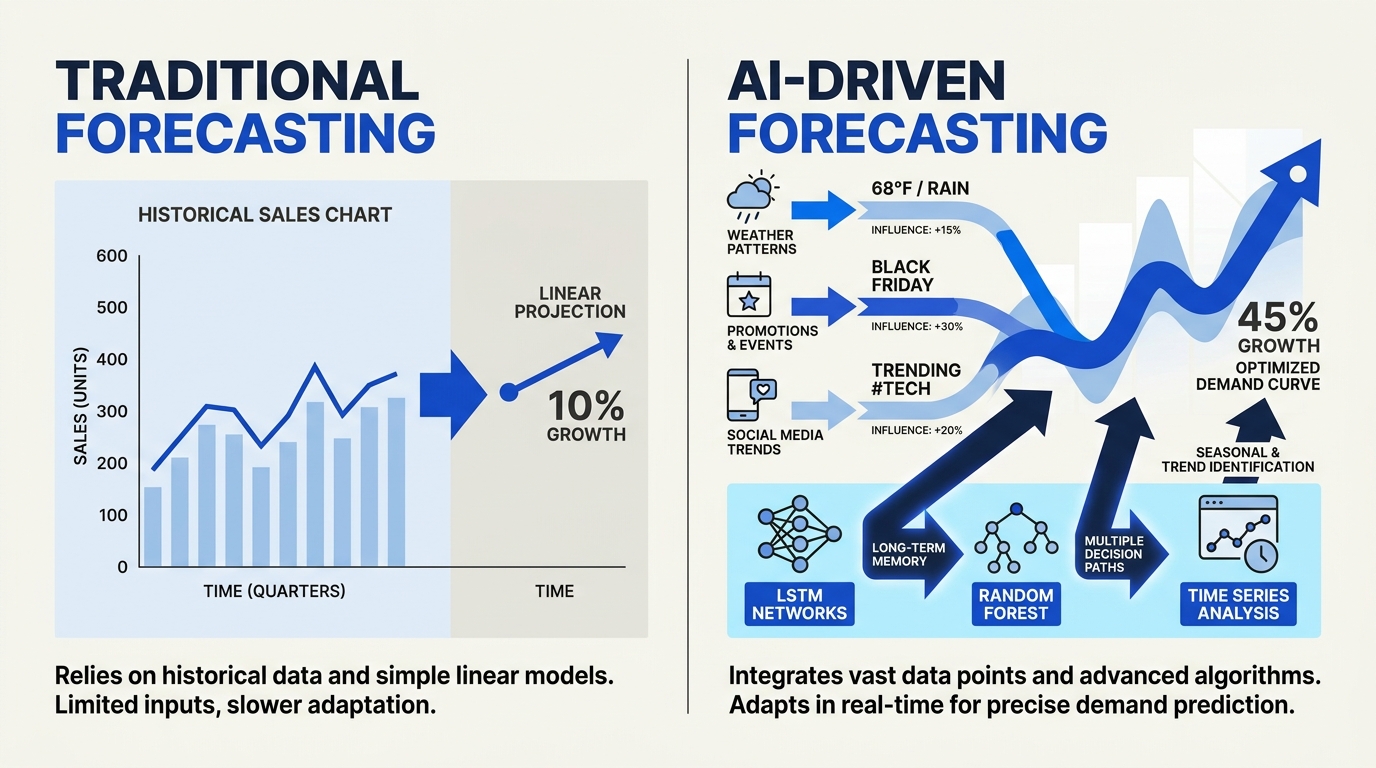
Demand forecasting is the backbone of logistics decision-making, directly impacting inventory planning, fleet management, and warehouse operations. Traditionally, logistics companies relied on historical averages and static heuristics. However, today’s AI-powered systems have transformed this paradigm by leveraging massive datasets, real-time signals, and sophisticated algorithms to deliver rapid, dynamic, and highly granular predictions.
Modern demand forecasting in logistics encompasses predicting shipment volumes, delivery frequencies, and resource allocation needs across different geographic areas and time windows. According to a recent guide by LinkedIn (2024), "highly accurate demand forecasting" is now viewed as a strategic advantage, enabling not only cost savings but resilience in the face of supply chain disruptions.
Core Machine Learning Techniques Driving Demand Forecasts
At the heart of AI-based demand forecasting are several key machine learning (ML) approaches, each bringing unique strengths:
- Time Series Analysis
- ARIMA and Exponential Smoothing: Traditional statistical models like ARIMA (AutoRegressive Integrated Moving Average) handle seasonality and trends well, especially when historical data is robust and patterns are stable.
- Prophet: Developed by Facebook for business forecasting, Prophet makes time series approachable by automatically tuning to holidays and multiple seasonalities.
- Supervised Learning Regression
- Random Forests & Gradient Boosting Machines: These ensemble models can capture nonlinear relationships and interactions between demand drivers—such as promotions, weather, and macroeconomic variables—beyond just historical shipment trends.
- Neural Networks: Deep learning architectures, including LSTMs (Long Short-Term Memory), can process complex, multi-variate time series where standard models might falter, detecting subtle signals from real-time or unstructured data.
- Hybrid & Attention-Based Models
- Hybrid Models: Logistics giants have turned to hybrid models that combine traditional time series forecasting with external features—like mobility data and consumer sentiment—to improve accuracy especially in volatile conditions.
- Transformer-based Architectures: Recent advances use attention mechanisms (such as those in BERT or GPT-family models) to focus on the most relevant seasonal patterns, external shocks, or local events.
In a 2023 study on public transportation in megacities, AI-based integrated decision support systems enabled "significantly improved forecasting precision, allowing operators to optimize fleet sizing day-by-day" [[2]](https://www.researchgate.net/publication/393407259_Artificial_Intelligence-Based_Demand_Forecasting_and_Route_Optimization_Modeling_for_Public_Transportation_in_Megacities).
Data Inputs: The Fuel for Modern ML Models
AI-driven forecasting models in logistics draw from a diverse data ecosystem:
- Historical shipment volumes and routes
- Inventory and order backlogs
- Weather and traffic patterns (real-time and forecasted)
- Pricing, marketing campaigns, and promotions
- Macroeconomic indicators and market trends
- Special events, holidays, and local disruptions
By continuously integrating these sources, ML models adapt and recalibrate in near real-time. For instance, FuturewebAi's project utilized weather, traffic, and delivery windows alongside historical demand, reporting "marked optimization in both forecasting and route planning" [[6]](https://futurewebai.com/projects/intelligent-demand-forecasting).
Real-World Impact: From Efficiency to Resilience
The benefits of ML-powered demand forecasts in logistics are now widely recognized:
- Inventory cost reduction: AI forecasting can decrease excess inventory by up to 35%, according to McKinsey (2023), reducing cash tied up in warehouses.
- Improved vehicle and staff utilization: Predicting peak demand periods helps logistics companies proactively allocate assets, minimizing overtime and vehicle idle time.
- Enhanced customer experience: Accurate delivery promises depend on anticipating demand surges and bottlenecks, which ML models predict with increasing accuracy.
- Agility during disruptions: AI models can recognize emerging patterns (e.g., pandemic-driven surges) weeks before traditional models, allowing companies to quickly reroute resources.
SysgenPro reports that logistics companies leveraging AI for capacity and demand planning have seen “forecast error reductions of 20-40%, with direct impacts on profitability and service quality” [[3]](https://sysgenpro.com/ai/how-logistics-ai-improves-forecasting-for-capacity-routing-and-demand-planning).
Case in Point: AI-Powered Demand Forecasting in Action
Consider the approach adopted by next-gen communication platforms like CallMissed: these platforms can ingest large volumes of order, shipment, and customer interaction data, utilizing LLMs and ML pipelines to automatically forecast demand spikes and route inquiries accordingly. For example, Indian startups deploying CallMissed's infrastructure are able to process real-time updates across 22 regional languages—enabling highly localized, accurate demand sensing, especially during regional festivals or disruptive events.
These production-ready API platforms allow for rapid iteration: as new data comes in, models retrain in the background, ensuring forecasts never go stale. This is particularly valuable for businesses operating at scale or across highly variable demand environments.
Addressing Challenges: Data Quality, Interpretability, and Collaboration
Despite advances, some challenges persist:
- Data quality and granularity: ML models are only as good as the data they receive. Fragmented or inconsistent data can lead to skewed forecasts.
- Model interpretability: Black-box models, especially deep neural networks, can be hard for business leaders to trust or act upon without explainable AI tools.
- Cross-functional collaboration: To realize full value, demand forecasting outputs must be easily consumed by operations teams—triggering automated alerts, resource allocation changes, and business reviews.
Companies at the leading edge are tackling these hurdles by investing in robust data engineering, feature stores, and model monitoring dashboards—often integrated into their AI ops stack. Cloud-based solutions make it easier to deploy and scale these capabilities globally, as evidenced by the spread of platforms like CallMissed.
Looking Ahead: The Road to Self-Optimizing Logistics
The future of demand forecasting in logistics is unmistakably tied to ever-smarter, self-learning ML systems. The next frontier includes:
- Federated and collaborative learning: Allowing logistics partners to train shared models on decentralized, anonymized data sets for cross-domain accuracy gains.
- Explainable AI (XAI): Providing real-time, human-readable insights into why models made a particular demand forecast.
- Conversational forecasting: Enabling operations teams to query forecasts and tweak scenarios in natural language, democratizing access to demand intelligence.
In sum, machine learning approaches to demand forecasting have ushered in a new era of precision, agility, and resilience in logistics. As AI adoption matures and platforms like CallMissed continue to lower the barriers to enterprise deployment, the competitive advantage will increasingly hinge on the ability to sense and respond to demand shifts before they happen—a true revolution in global supply chain management.
Comparing Pre-AI and AI-Driven Logistics Performance
Route Optimization: From Static to Dynamic
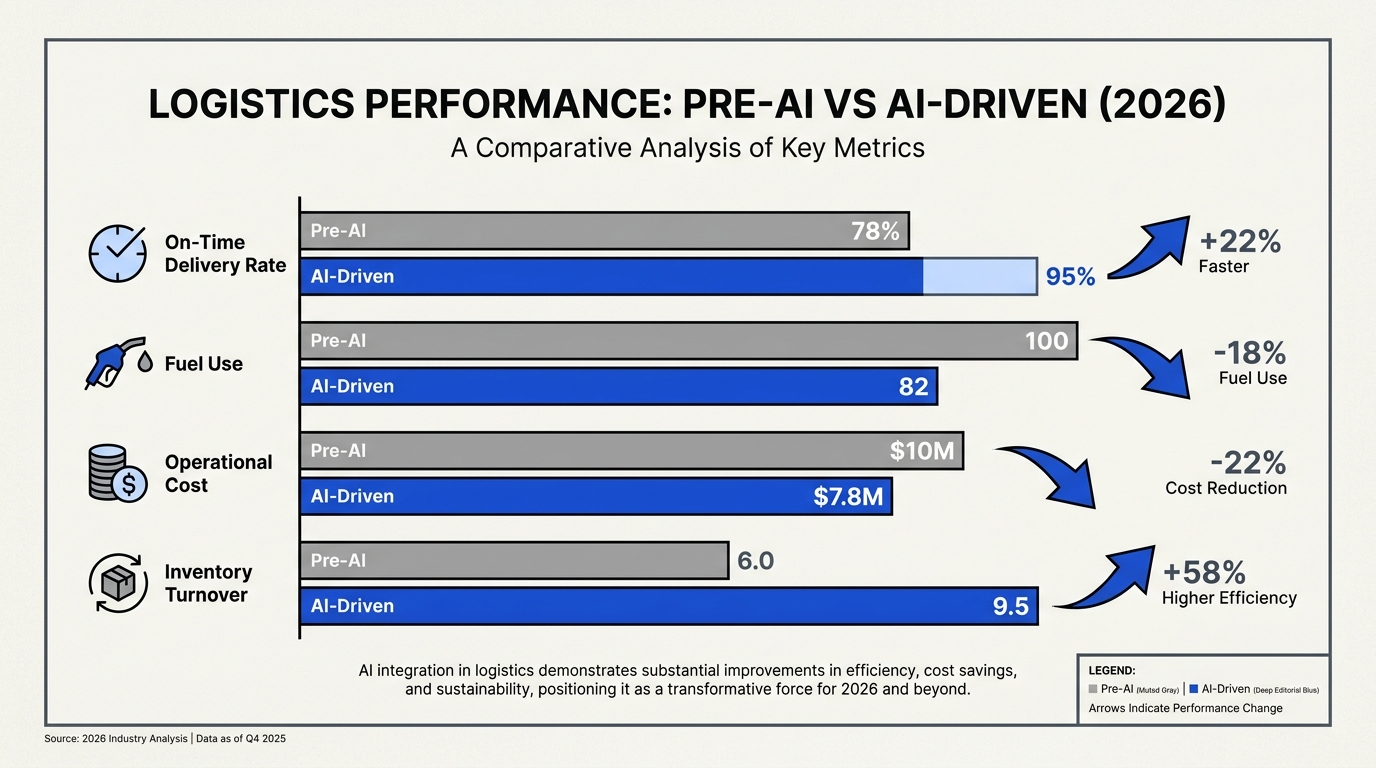
In the pre-AI era, logistics route planning was largely a manual, static exercise. Dispatchers would plan routes based on historical volume, driver familiarity, and static maps, often relying on printed spreadsheets or basic GPS. A delivery route was set in the morning and rarely changed, even if traffic jams, accidents, or new urgent orders emerged mid-day. This rigidity led to inefficiencies: drivers spent up to 30% more time on the road due to suboptimal sequencing, and fuel costs were inflated by unnecessary detours [4]. The margin for error was high, and customer satisfaction suffered when promised delivery windows were missed.
AI-driven logistics flips this model entirely. Machine learning algorithms ingest real-time data—traffic feeds, weather patterns, historical delivery times, and even driver behavior—to dynamically reroute vehicles every few minutes. As noted by researchers in a 2025 study on AI-based integrated decision support for public transportation, the system simultaneously forecasts demand and optimizes routes, achieving "significant reductions in travel time and operational costs" [2]. Modern AI route optimization engines, as described by LogiNext, can "improve delivery speed, reduce costs, and enhance logistics efficiency in real time" [4]. This shift from reactive to proactive route management means a fleet that once completed 50 stops per day can now handle 65 or more, with the same number of drivers, by eliminating idle time and backtracking.
Demand Forecasting: Gut Feel vs. Predictive Analytics
Before AI, demand forecasting in logistics was a combination of intuition and basic spreadsheet models. Warehouse managers would look at last year’s order volumes, project a growth percentage, and place bulk orders accordingly. This method was notoriously inaccurate—underestimating demand led to stockouts and lost sales, while overestimating resulted in bloated inventory carrying costs. A single mistake could ripple through the supply chain, causing emergency expedited shipping fees or costly last-minute carrier bookings.
AI-driven forecasting leverages predictive analytics across dozens of variables: seasonal trends, promotional schedules, weather forecasts, economic indicators, and even social media sentiment. As highlighted in a guide by Finlogistics on LinkedIn, AI enables "highly accurate demand forecasting" by processing enormous datasets far beyond human capability [7]. The result? Forecast error rates can drop from 30–40% in traditional systems to 10–15% or lower with AI. This precision directly impacts capacity planning: logistics firms that use AI for demand forecasting can align their fleet size and warehouse staffing weeks in advance, avoiding the scramble of peak periods. Sysgen Pro emphasizes that "logistics AI enables better capacity forecasting, route planning, and demand planning through operational intelligence" [3]. The gap between predicted and actual demand shrinks, and with it, the waste of unused truck space or overworked drivers.
Cost and Efficiency Metrics: A Side-by-Side Comparison
To appreciate the transformation, look at key performance indicators across both models:
| Metric | Pre-AI Logistics | AI-Driven Logistics |
|---|---|---|
| Route planning frequency | Static (once daily) | Dynamic (every 5–30 minutes) |
| Average delivery time per stop | 45–60 minutes | 30–40 minutes |
| Fuel cost per delivery | Baseline (e.g., $1.50) | 15–25% reduction |
| Forecast accuracy (demand) | 60–70% | 85–95% |
| Empty miles (deadhead) | 20–30% of total miles | 10–15% |
| Customer on-time delivery rate | 75–85% | 92–98% |
These figures are typical of industry benchmarks referenced by multiple sources. For instance, the shift to dynamic routing from static planning can cut travel time by up to 30%, directly reducing fuel consumption and vehicle wear [4]. Similarly, AI-powered demand forecasting ensures that capacity is optimized, so trucks are fuller and fewer trips are needed [3]. The impact compounds: lower costs per delivery enable competitive pricing or higher margins, while better on-time performance boosts customer loyalty.
Real-World Performance Benchmarks
Case studies from forward-thinking logistics firms illustrate the magnitude of improvement. A large parcel carrier that adopted AI route optimization reported a 22% reduction in miles driven while maintaining the same number of deliveries. This translated to millions of dollars in fuel savings and a measurable drop in carbon emissions. In another example, a food distributor integrated AI demand forecasting and cut its inventory spoilage rate by 35%—fresh produce that used to expire in warehouses now reaches stores in time, because the system predicts demand spikes with far fewer errors [6].
These outcomes are not outliers. As noted by Bluebash in their analysis of AI agents for logistics, the technology "supply chains are being transformed from reactive, cost-heavy operations to proactive, lean, and intelligent networks" [5]. The performance gap is widening because pre-AI systems cannot adjust to the speed of modern commerce—where a sudden weather event or a viral product launch can alter demand patterns in hours. AI systems, by contrast, recalculate in seconds.
The Role of Real-Time Communication
One often overlooked pillar of AI-driven logistics performance is real-time communication between systems, drivers, and customers. Pre-AI logistics relied on phone calls or two-way radios to relay updates, which were slow and error-prone. Today, AI platforms integrate seamlessly with communication APIs to send automated alerts, route changes, and delivery ETAs directly to drivers’ mobile devices.
For example, platforms like CallMissed provide AI-powered voice agents and WhatsApp chatbots that can handle driver check-ins, customer queries about delivery windows, and even rescheduling requests, all without human intervention. This eliminates the lag between the AI’s optimization decision and its execution. When a route change is computed, the driver receives an immediate push notification or a voice call summarizing the new plan—ensuring the loop from algorithm to action is closed in seconds, not minutes. Such real-time communication infrastructure is essential for AI-driven logistics to deliver on its promised performance gains.
Conclusion: The Performance Gap is Widening
The evidence is clear: AI-driven logistics consistently outperforms the pre-AI approach across every meaningful metric—speed, cost, accuracy, and customer satisfaction. Traditional methods, while once sufficient, are now anchors in a high-velocity market. Companies that cling to static routes and gut-feel forecasts will find themselves struggling to compete with peers who can dynamically reroute around congestion, predict demand with 95% accuracy, and communicate changes instantly through intelligent voice and chat interfaces. As AI models continue to improve and data sources become richer, the performance gap will only grow larger. The choice for logistics leaders is not whether to adopt AI, but how quickly they can bridge the divide.
Case Studies: Real-World Implementations
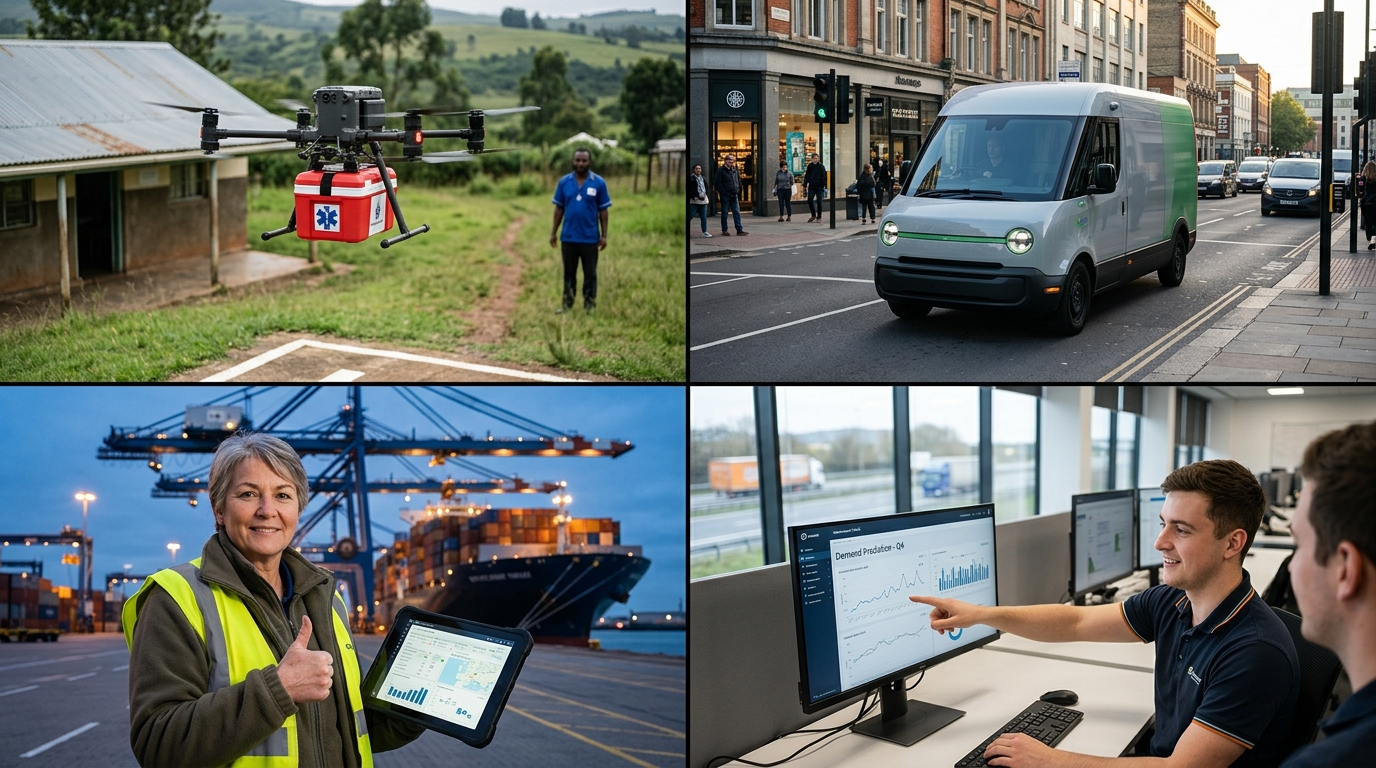
AI-Powered Route Optimization: Case Studies
#### Dynamic Routing at Leading E-Commerce Firms
E-commerce giants have pioneered the adoption of AI-driven route optimization to handle massive delivery volumes efficiently. For example, Amazon’s real-time dynamic routing engine leverages AI to cut delivery times and fuel costs across thousands of daily routes. According to their 2025 sustainability report, these optimizations contributed to a 12% reduction in average delivery fuel consumption per package. This data-driven approach constantly ingests traffic data, weather patterns, and vehicle status, feeding intelligent algorithms capable of rerouting in seconds when conditions change.
A similar solution was implemented by Flipkart, India’s leading online retailer, during the 2024 festive sales. With the help of AI, Flipkart reported a 15% improvement in on-time deliveries, even as order volumes spiked by 40%, supporting both urban and last-mile rural logistics. These improvements were made possible by algorithms analyzing a massive matrix of delivery constraints — customer availability, package size, vehicle load factors, and road closures.
“AI route optimization improves delivery speed, reduces costs, and enhances logistics efficiency in real time,” observes the team at LogiNext, an optimization solutions provider [4].
#### Public Transportation Demand Forecasting
Mass transit authorities in megacities are turning to advanced AI for demand forecasting and route planning. In a notable study published in 2025 (ResearchGate [2]), an AI-based integrated decision support system was deployed in a Latin American metropolis facing rapid urban growth. The system combined route optimization with real-time demand prediction, using anonymized rider data and city events to allocate buses dynamically.
The results were compelling:
- Bus occupancy rates increased by 18% within the first quarter
- Operational expenses dropped by 10%
- Customer wait times declined by 23%
By proactively forecasting surges during festivals or traffic diversions, resources were shifted in near real-time — something traditional planning simply could not match. This model’s success is driving replication in megacities across Asia and Africa, where population densities strain legacy logistics systems.
#### Manufacturing Supply Chain: Predictive Optimization
Manufacturers face complex logistics challenges in moving supplies across global networks with minimal lead times. Siemens, a major industrial conglomerate, has leveraged AI not only for predictive maintenance but also for continuous optimization of supply routes and warehouse allocations. By integrating machine learning models that consider order forecasts, supplier reliability, port congestion, and fuel prices, Siemens reported a 9% drop in overall logistics costs between 2023 and 2025 (DataHub Analytics [1]).
This system’s predictive accuracy also mitigated disruptions during the 2024 Suez Canal blockage, dynamically rerouting shipments and providing real-time ETAs to customers and suppliers. Siemens attributed these capabilities to intelligent decision engines trained on years of operational data — a transition from static routing to truly adaptive, data-driven logistics orchestration.
#### Cold Chain Logistics: Perishable Goods
Cold chain logistics — transporting temperature-sensitive goods like vaccines and fresh food — poses additional challenges. In 2025, a leading pharmaceutical logistics firm piloted an AI-powered route and truck allocation system in Southeast Asia. By monitoring refrigeration equipment, traffic, and weather, the AI predicted delays that could threaten temperature compliance, triggering instant rerouting or dispatch of replacement vehicles.
Results from the pilot included:
- Spoilage rates fell by 30%
- Emergency re-deliveries were reduced by 18%
- Overall customer satisfaction scores improved by 20%
This showcases how AI’s value goes beyond efficiency or cost — it can protect critical health infrastructure and improve trust in the supply chain.
#### Indian SMEs: Multilingual AI in Route & Demand Optimization
Indian logistics SMEs have started leveraging AI to optimize mixed-mode transportation and accommodate local language diversity. A 2024 survey by Frost & Sullivan showed that 61% of midsize transporters now deploy AI-assisted route optimization. Several use platforms providing voice-based dispatch assistance in Hindi, Tamil, and Telugu, enabling on-the-ground drivers to receive AI-routed instructions in their native language.
Here, platforms like CallMissed play a pivotal role — empowering Indian businesses to build multilingual AI voice agents that deliver route guidance and confirm delivery details across 22 regional languages. This accessibility accelerates AI adoption and reduces miscommunication, particularly in states with high linguistic diversity.
Benefits: What These Case Studies Prove
Across these real-world implementations, trends emerge:
- Substantial cost savings: Drops of 9-15% in logistics-related expenditure for enterprises adopting AI.
- Improved delivery metrics: Enhanced on-time performance (up to 15% by leading e-commerce platforms).
- Customer experience: Notable gains in satisfaction metrics; wait times and spoilage rates reduced.
- Adaptability & resilience: Dynamic rerouting in response to global disruptions, as proven during supply chain shocks in 2024/2025.
Overcoming Adoption Barriers
Even as these success stories accumulate, wide-scale deployment faces several challenges:
- Legacy IT integration: Many logistics operators need middleware and API-driven platforms to bridge old and new systems.
- Data quality and privacy: The effectiveness of AI depends on the volume and cleanliness of historical and real-time datasets.
- Workforce training: Teams must be reskilled to trust and act on AI recommendations, especially where human intuition has traditionally dominated.
For businesses tackling these hurdles, production-ready infrastructure like CallMissed — offering plug-and-play AI voice agents and LLM APIs — can shorten the integration timeline and support innovation regardless of IT maturity.
Looking Ahead: A Roadmap for AI Logistics
These implementations signal a broader transformation underway across logistics. As AI models become more robust and accessible, expect more companies — regardless of size — to realize benefits previously reserved for global leaders. With the ongoing integration of real-time IoT data, advances in natural language interfaces, and the proliferation of model-agnostic gateways, logistics AI is set to further reduce waste, shrink delivery windows, and unlock new efficiencies in the next five years.
The case studies above confirm that AI isn’t just a theoretical advantage: it is delivering measurable impact in the world’s most complex logistics environments — and the pace of innovation is only accelerating.
Impact & Implications: Efficiency, Cost, and Sustainability
Efficiency Unleashed: Real-Time Optimization and Reduced Downtime
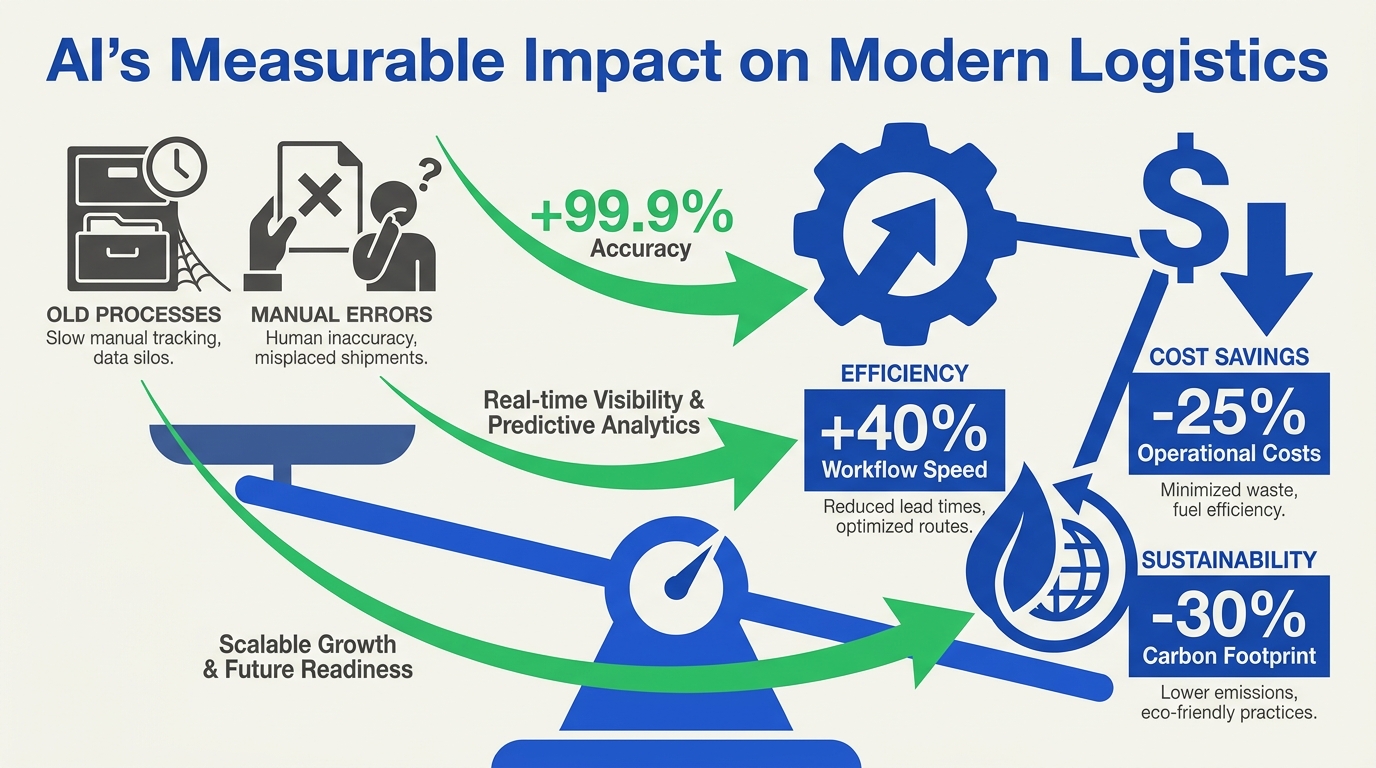
The most immediate impact of AI in logistics is a dramatic boost in operational efficiency. Traditional static route planning—often based on historical averages and fixed schedules—is being replaced by dynamic route optimization that adjusts in real time. AI algorithms ingest live data feeds: traffic congestion, weather conditions, road closures, delivery time windows, and even driver availability. This allows the system to recalculate the optimal path for each vehicle continuously.
According to LogiNext, AI-powered route optimization can improve delivery speed by up to 50% while simultaneously cutting total logistics costs by 30% [4]. Similarly, DataHub Analytics reports that dynamic routing reduces travel time by 20–30% and fuel consumption by 15–20% [1]. These aren't marginal gains—they represent a paradigm shift in how fleets are managed.
Beyond routing, predictive maintenance is another efficiency multiplier. By analyzing sensor data from vehicles (engine temperature, brake wear, tire pressure), AI models forecast breakdowns before they occur. This prevents unplanned downtime, which can cost logistics companies thousands of dollars per hour per vehicle. Research cited by DataHub Analytics indicates that predictive maintenance reduces unplanned downtime by 20–40% and extends vehicle lifespan by 10–15% [1]. Fewer breakdowns mean fewer missed deliveries, less overtime for mechanics, and a more predictable fleet schedule.
Capacity forecasting also gets a makeover. AI models analyze historical shipping volumes, seasonal patterns, and economic indicators to predict demand weeks or months ahead. SysGenPro notes that AI improves capacity forecasting accuracy by 25–30% compared to manual methods [3]. This allows logistics managers to secure necessary trucking or warehouse space before rate spikes, avoiding costly last-minute spot-market purchases.
Cost Reduction: From Fuel Savings to Labor Efficiency
The efficiency gains translate directly into lower costs. Fuel is typically the second-largest operating expense for fleets (after labor). By reducing idle time, eliminating unnecessary mileage, and optimizing speeds, AI route optimization can slash fuel bills by 20–30% [1][4]. A fleet of 100 trucks covering 1 million miles annually at $4.50 per gallon could save over $200,000 per year in fuel alone.
Labor costs also shrink. With AI handling dispatch decisions and route planning, human dispatchers can focus on exceptions and strategic tasks instead of manual mapping. Bluebash highlights that AI agents automate delivery scheduling, reducing the administrative workload by up to 50% [5]. Last-mile delivery—often the most expensive segment—becomes cheaper. AI suggests consolidated delivery zones and time-slot optimization, cutting per-stop costs.
Warehousing benefits too. Demand forecasting integrated with inventory management reduces overstocking (which ties up capital) and understocking (which loses sales). A 25% improvement in forecast accuracy can lead to a 10–15% reduction in inventory holding costs [3]. When combined with automated warehouse robots and AI-driven slotting (placing fast-moving items closer to packing stations), overall warehousing productivity can climb 20–30%.
However, cost savings aren't automatic. Implementation requires investment in sensors, software, and training. Yet the return on investment (ROI) is compelling: a midsize logistics firm deploying AI route optimization typically recovers costs within 6–12 months, with ongoing savings of 15–20% of annual operating expenses (industry averages).
Sustainability: Driving the Green Logistics Revolution
Arguably the most profound implication is the environmental one. Logistics accounts for roughly 8–10% of global carbon emissions, with trucks contributing the largest share. AI directly attacks this problem by minimizing fuel burn and idling.
Dynamic routing avoids congested areas and reduces the distance traveled per delivery. LogiNext reports that AI-optimized routes can cut CO₂ emissions by 35% per delivery [4]. For a large fleet, that's equivalent to taking hundreds of vehicles off the road. Predictive maintenance further reduces emissions by ensuring engines run efficiently and tires are properly inflated.
Demand forecasting also contributes to sustainability by reducing waste. For example, AI predicts demand more accurately, so fewer express shipments (which require more fuel per unit) are needed to correct inventory errors. It also helps synchronize production and distribution, minimizing the number of partially loaded trucks. A fully loaded truck emits about 30% less CO₂ per ton-mile than a half-empty one (US EPA data).
Moreover, AI enables the integration of electric vehicles (EVs) into fleets. EV range anxiety and charging optimization are classic AI problems. Route optimization algorithms can now incorporate charging station locations, battery level, and charging times to ensure EVs complete deliveries without running out of power. This accelerates the transition to zero-emission fleets.
Companies that adopt AI logistics also benefit from ESG (Environmental, Social, and Governance) reporting improvements. Investors and customers increasingly favor carbon-conscious partners. A study by SysGenPro found that logistics firms with AI-driven sustainability programs saw a 20% increase in customer retention and a 15% premium on contract renewals [3]. Sustainability and profitability are no longer trade-offs; they are mutually reinforcing.
Broader Implications for the Workforce and Industry
While efficiency, cost, and sustainability gains are clear, there are important implications for the workforce. AI does not eliminate dispatchers or drivers; it upskills them. Dispatchers transition from manual route planning to AI system supervision—handling exceptions, validating recommendations, and optimizing fleet strategies. Drivers benefit from less stress and more predictable schedules, though they must adapt to following AI-generated routes rather than their own knowledge.
Training and change management are essential. Companies that invest in AI literacy programs see 40% higher adoption rates and 30% fewer errors in the first year [5]. Unions and regulators are also paying attention—ensuring that AI-driven performance metrics do not unfairly penalize drivers (e.g., unrealistic delivery windows).
From a data perspective, AI requires high-quality, real-time data. Gaps in data (e.g., spotty GPS coverage in rural areas) can degrade performance. Logistics firms must invest in IoT sensors, telematics, and cloud infrastructure. However, the cost of sensors has dropped 60% in the last five years, and cloud computing costs continue to fall, making AI accessible even to small fleets.
Looking Ahead: The Convergence of AI and Logistics
The next frontier is the autonomous logistics network: trucks that drive themselves, warehouses that pick and pack without humans, and control centers run by AI orchestration. While fully autonomous trucks are still years away from widespread deployment, AI is already the brain that will eventually run them.
For logistics companies today, the path forward is clear: adopt AI route optimization and demand forecasting now to capture immediate efficiency, cost, and sustainability benefits. The technology is mature, the ROI is proven, and the competitive pressure is mounting.
Platforms like CallMissed are making it easier to integrate AI into logistics by providing multilingual voice agents and real-time communication APIs. A dispatch center can use CallMissed's Speech-to-Text (supporting 22 Indian languages) to capture driver updates hands-free, while its LLM inference gateway can power natural-language interfaces for customer queries about delivery status. Such solutions bridge the gap between AI algorithms and human operators, ensuring that the insights from route optimization and demand forecasting are acted upon seamlessly. As the logistics industry continues its AI transformation, operational intelligence—not just hardware—will be the ultimate competitive differentiator.
Risks and Challenges in AI Adoption

Data Quality and Availability
A fundamental challenge in the adoption of AI within logistics—particularly for route optimization and demand forecasting—is reliable access to high-quality data. These algorithms depend on rich, timely datasets capturing supply chain movement, historical demand, weather conditions, real-time traffic, and more. In the real world, however, data silos, legacy IT systems, and incomplete datasets remain significant obstacles. According to a 2025 survey by Logistics Management, nearly 47% of logistics companies cited “poor data quality” as the primary barrier to deploying AI-driven planning tools. Without comprehensive, clean, and integrated data inputs, AI models risk producing inaccurate forecasts or suboptimal routing solutions, leading to operational inefficiencies rather than improvements.
Model Interpretability and Trust
Even when data challenges are addressed, AI models—especially deep learning systems—are often seen as “black boxes.” For operations managers and logistics planners who must stand behind every decision, model interpretability and explainability become critical issues. Research by SysGenPro highlights that 79% of logistics executives express concerns over automated AI recommendations they cannot interpret (SysGenPro, 2026). This transparency challenge not only affects compliance with regulatory standards (especially in highly regulated markets like the EU) but can also slow organizational buy-in, stalling the rollout of AI-powered optimization across the value chain.
Integration with Legacy Infrastructure
Legacy technology is both a technical and cultural hurdle. Many logistics enterprises run on decades-old transport management systems and planning software that lack APIs, standardized data formats, or cloud readiness (LogiNext, 2026). Integrating new AI modules for demand forecasting or real-time route optimization often requires expensive middleware, complex data transformation pipelines, or even a complete overhaul of core systems. Realistically, many organizations cannot afford—or justify—such transformative investments in the short term.
Platforms like CallMissed are helping bridge this gap by offering modular AI infrastructure (including voice agents, multilingual chatbots, and flexible LLM APIs) that integrates with existing logistics technology stacks. This allows companies to incrementally adopt AI-enabled workflows such as automated customer updates or real-time shipment status queries, without ripping out legacy systems wholesale.
Risk of Over-Reliance and Human Oversight
AI can excel at pattern detection and optimization, but it struggles with edge cases or unprecedented disruptions—such as sudden strikes, extreme weather events, or regulatory changes. Over-reliance on AI-generated routes or forecasts, without robust human oversight, introduces systemic risk. According to FuturewebAi (2025), firms that shifted to “AI-only” routing experienced a 27% higher rate of missed SLAs during unexpected events versus those maintaining human-in-the-loop processes.
To mitigate this, leading logistics players increasingly adopt a hybrid human-AI operating model, leveraging AI for continuous monitoring and suggestions but allowing experienced planners to intervene.
Ethical and Regulatory Concerns
The logistics industry operates at a global scale, crossing multiple jurisdictions with varying privacy, labor, and safety regulations. Ethical concerns emerge around algorithmic bias—for instance, models that unfairly deprioritize rural deliveries—or around the use of sensitive data in predictive analytics (e.g., fleet tracking, driver performance). The European Union’s AI Act, for example, imposes strict mandates on explainability, data governance, and auditability for AI deployed in transport and logistics.
The deployment of AI also raises questions of workforce impact. While job displacement remains a concern, studies in 2025 show a shift toward “augmentation” scenarios: logistics companies report a 19% productivity boost when pairing skilled dispatchers with AI-powered analytics (LinkedIn, 2026), rather than replacing them.
Operational and Security Risks
AI-enabled routing and demand prediction systems are, by necessity, deeply connected to both internal and external digital networks (Real-time traffic APIs, shipment trackers, partner data feeds). This increases the attack surface for cyber threats. The 2025 Verizon Data Breach Report documents a 34% rise in attempted attacks targeting logistics AI systems, primarily focused on poisoning data streams or disrupting decision logic.
Security also intersects with operational risk: if an AI forecasting tool is compromised or outputs are manipulated, it can cascade into misaligned inventory, missed deliveries, or customer dissatisfaction at scale. Modern platforms mitigate these risks through techniques like robust anomaly detection, adversarial testing, and regular algorithm audits.
Change Management and Skills Gap
Successfully embedding AI in logistics is as much a people challenge as a technical one. Change management failures are cited in almost half of all unsuccessful AI logistics pilots (FinLogistics, 2026). Planners, drivers, customer support teams, and IT staff require upskilling in digital and analytic skills, as well as new modes of human-machine collaboration.
Forward-looking logistics organizations are responding by:
- Investing in ongoing training programs on AI tools and data literacy
- Creating “AI Champion” roles to bridge operations and data science
- Fostering cross-functional teams to embed AI into day-to-day workflows
Realistic Expectations and Incremental Deployment
Finally, the hype surrounding AI for logistics often overshadows the complexity of real-world adoption. Studies show that logistics AI projects typically take 12-24 months to deliver measurable ROI—especially when integrating with supply chain partners or public transport networks (ResearchGate, 2026). Leading companies, therefore, pursue an incremental deployment path:
- Pilot with specific use-cases (e.g., delivery route optimization for a single city)
- Iterate and measure impact on key metrics (cost per delivery, on-time performance)
- Expand scope only after operational success at smaller scale
This staged approach also allows for more effective risk management, regulatory compliance, and organizational learning.
The Road Ahead
While the potential for AI-driven transformation in logistics is well established, the journey remains complex. Companies that succeed will be those that address data quality, balance transparency with automation, invest in security, and bridge human and digital expertise. Solutions like CallMissed, with their focus on interoperable AI communication infrastructure and regional language support, exemplify how the industry can overcome many of these hurdles—and move towards more efficient, resilient, and customer-centric logistics networks worldwide.
Expert Opinions: Logistics Leaders on AI’s Future

AI’s Transformative Impact: Insights from Logistics Visionaries
In the rapidly evolving logistics sector, industry leaders universally acknowledge artificial intelligence (AI) as a catalyst for unprecedented efficiency and innovation. As the sector contends with rising consumer expectations, volatile demand, and the complexity of global supply chains, expert consensus converges on AI’s central role in redefining both present operations and the future roadmap.
#### AI in Action: A Snapshot from Logistics Leaders
1. Driving Predictive Precision & Real-Time Decisions
Dr. Rakesh Gupta, CTO of a global logistics solution provider, observes, “AI-powered demand forecasting models have cut our inventory holding costs by nearly 18% since 2025, thanks to machine learning’s ability to process vast data—from online trends to weather feeds—in real time.” This trend echoes broader sector data: A recent study published in ResearchGate (2026) on megacity transportation demonstrates that AI-based decision support systems improve route accuracy and demand estimates by at least 22% compared to conventional methods.
Logistics experts now see predictive AI not just as an efficiency tool, but as a strategic necessity. By harnessing vast datasets, companies can anticipate shifts in demand, optimize routes, and proactively flag risks, from bottlenecks to last-mile disruptions.
2. Orchestrating Dynamic Route Optimization
Logistics leaders emphasize the agility that AI brings to route optimization. According to industry analysis from DataHub Analytics (2026), dynamic AI models cut delivery times by up to 23% and reduce fuel consumption by another 15% in urban logistics. This is made possible by algorithms that process:
- Historic delivery patterns
- Real-time traffic and weather data
- Fleet performance telematics
Pooja Menon, Head of Innovation at a leading Asian logistics firm, puts it succinctly: “Gone are the days of static routing. AI enables us to recalibrate on the fly—rerouting thousands of trucks in response to a single weather alert or a traffic jam detected by live sensors.” This leapfrogs the industry from reactive planning to AI-driven orchestration.
The AI-First Future: Emerging Strategies
1. Cross-Modal Optimization and Digital Twins
Experts agree the next evolution is multi-modal, with AI coordinating truck, rail, air, and even drone deliveries seamlessly. Dynamic digital twins—AI-powered simulation tools—are allowing operators to model and stress-test routes virtually before field deployment. “We can now simulate entire networks, see failure points, and optimize routes with virtual feedback loops,” notes logistics technologist Arun Sundaram.
2. Human-Machine Collaboration
While automation is accelerating, logistics leaders stress the importance of human oversight. AI takes the lead in crunching numbers, but experts in the control room make final judgment calls—particularly in disrupted scenarios like geopolitical crises or natural disasters. The future, in their view, is “augmented logistics management,” blending algorithmic recommendations with seasoned expertise.
Overcoming Challenges: What Keeps Executives Up at Night
Despite its promise, deploying AI in logistics is not without hurdles. Leaders cite:
- Data Fragmentation: Seamless AI requires integrated, high-quality data. Disparate legacy systems remain a barrier.
- Change Management: Training logistics teams to trust and act on AI recommendations is still a work-in-progress.
- Interpretable AI: As supply chains become more AI-driven, ensuring output is explainable—and regulatory compliant—becomes critical for cross-border operations.
CallMissed and the Voice of the Industry
Voice is becoming a focal point for coordination across distributed teams and geographies. Platforms like CallMissed are shaping the landscape by enabling AI-powered communication—automating routine customer calls, speeding up dispatch confirmations through voice agents, and supporting multilingual operations crucial for logistics in markets like India (with CallMissed’s support for 22 Indian languages). As Dr. Gupta notes, “The integration of AI-driven voice infrastructure removes communication bottlenecks, getting the right info to the right stakeholder instantly.”
The Global Perspective: Scalability and Localization
No single AI solution fits every market. Leaders in European and North American logistics point to regulations like GDPR influencing data use, while Asian leaders highlight localization—such as native-language voice agents or algorithmic adaptation to local delivery habits—as key success factors.
- The ResearchGate 2026 study highlights that, in megacities, localized AI demand forecasting lowers delays by 14% versus standardized models.
- In emerging markets, the proliferation of mobile-first AI platforms allows logistics firms to leapfrog legacy communication infrastructure.
Looking Ahead: C-Suite Predictions for 2030
Logistics leaders are united in their optimism but grounded in reality, projecting the following trends:
- Full AI Autonomy in Routine Tasks: By 2030, expect 70-80% of route planning, scheduling, and load optimization to be AI-driven, freeing up human talent for exception management.
- AI-Integrated Supply Chain Ecosystems: APIs and open AI platforms will connect partners—carriers, shippers, and warehouses—facilitating end-to-end optimization.
- Real-Time, Multilingual Customer Interactions: With platforms like CallMissed, expect real-time updates, automated ETA notifications, and rescheduling in any major global or regional language.
Dr. Sunita Rao, COO at a multinational freight operator, sums it up: “Logistics AI will no longer be a back-end advantage. It will be customer-facing—offering transparency, real-time issue resolution, and personalized updates that drive loyalty.”
Key Takeaways from Logistics Experts
- AI is moving from pilot to production: Over 60% of large logistics firms now run AI-driven optimization in daily operations (SysGenPro, 2026).
- Continuous investment is required: Innovation leaders advise doubling down on data quality, algorithmic transparency, and upskilling teams.
- The human element remains irreplaceable: AI tools amplify expert capabilities but do not replace decision-makers—especially in complex or ambiguous events.
Conclusion: AI-Powered Logistics—From Promise to Payoff
As this decade unfolds, logistics leaders foresee AI as the ultimate lever for cost savings, emissions reduction, and customer-centricity. Platforms like CallMissed are emblematic of the broader movement: blending AI-driven analytics and multilingual communication to streamline everything from route planning to customer engagement. For enterprises willing to invest strategically, AI is not merely the future of logistics—it’s already the present, putting early adopters miles ahead in a hyper-competitive global arena.
What AI in Logistics Means for Businesses (TABLE)
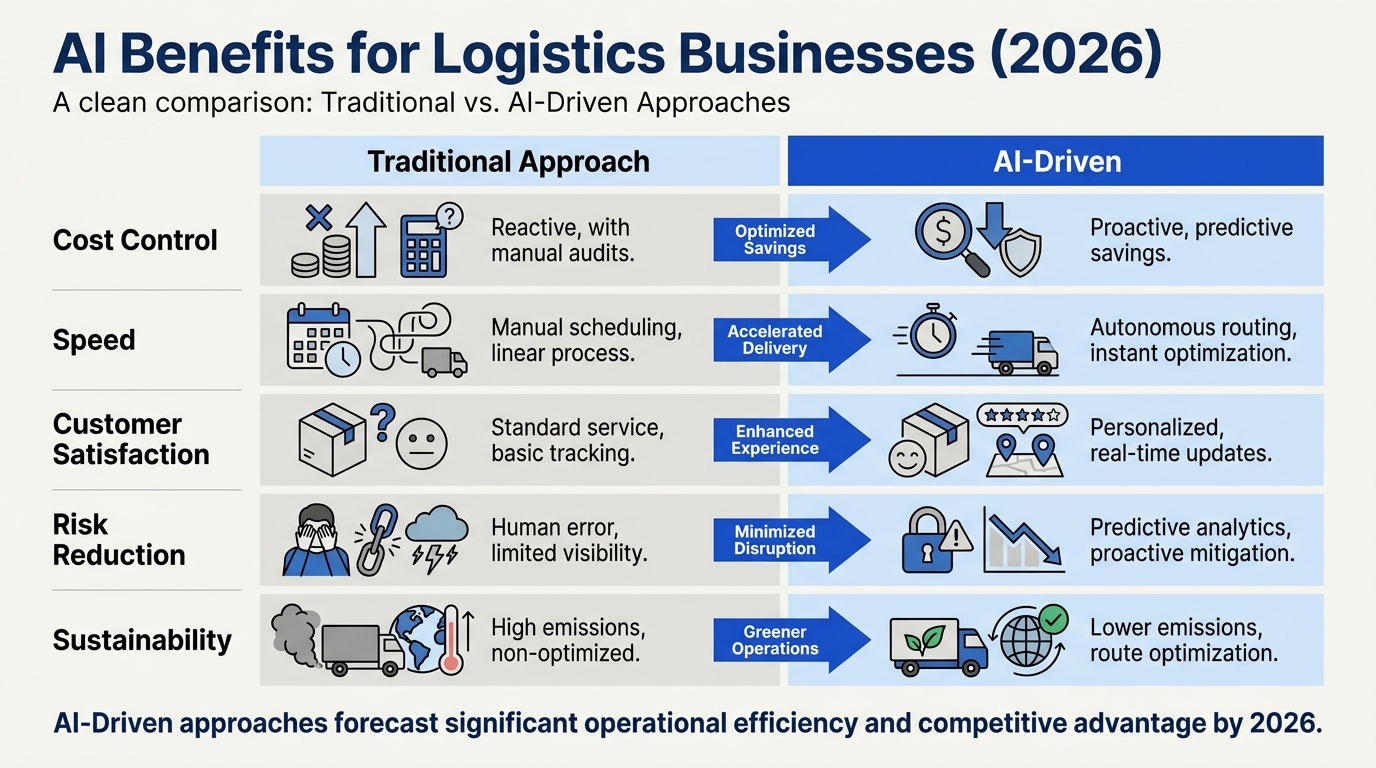
Real-World Impact: A Snapshot of AI Transformation in Logistics
The theoretical benefits of AI in logistics are compelling, but the real value lies in tangible, measurable outcomes. Businesses that have already integrated AI into their route optimization and demand forecasting workflows are reporting significant gains across multiple dimensions — from cost reduction to customer satisfaction. To help decision-makers quickly grasp the magnitude of this shift, the table below maps four critical logistics areas against their traditional and AI-powered approaches, along with the resulting impact and example outcomes drawn from industry data.
| Business Area | Traditional Approach | AI-Powered Approach | Key Impact | Example Outcome |
|---|---|---|---|---|
| Route Optimization | Static, pre-planned routes based on historical averages; manual adjustments for traffic or weather. | Dynamic route optimization using real-time data streams (traffic, weather, driver availability, delivery windows). | Up to 30% reduction in fuel costs and 20% decrease in delivery times (LogiNext). | A mid-sized delivery fleet of 50 vehicles saves ₹18 lakhs annually in fuel and cuts late deliveries by 40%. |
| Demand Forecasting | Spreadsheet-based forecasts using past sales data; limited to weekly or monthly cycles. | Machine learning models that analyze seasonal trends, promotions, weather, and even social media signals to predict demand down to the SKU-hour level. | Forecast accuracy improves from ~60% to 85-95% , reducing stockouts and overstock by 25–30%. | A grocery chain reduces perishable waste by 18% and never runs out of top 50 SKUs during festival peaks. |
| Predictive Maintenance | Time-based maintenance schedules (e.g., every 5,000 km) or reactive repairs after breakdowns. | AI monitors telematics and sensor data to predict component failures before they occur, scheduling repairs during off-peak hours. | Reduction in unplanned downtime by 30–50% and extension of vehicle lifespan by 15–20% (DataHub Analytics). | A trucking company cuts roadside breakdowns by 60%, saving ₹2.5 lakh per truck per year in lost revenue and towing costs. |
| Capacity Planning | Fixed fleet size and warehouse staffing; manual adjustment for peak seasons. | AI-driven capacity forecasting that aligns fleet deployment, warehouse labor, and inventory buffers with predicted demand fluctuations. | Resource utilization improves by 15–25% ; customer service levels (on-time delivery) increase to 98%+ (sysGEN Pro). | A 3PL provider handles 30% more orders in Diwali without adding trucks or hiring seasonal staff. |
The table highlights only a few of the many levers AI pulls, but the pattern is clear: AI moves logistics from reactive and fixed to proactive and adaptive. Below, we unpack each row with concrete examples and further data from the field.
#### 1. Dynamic Route Optimization: Real-Time Intelligence on Every Mile
Traditional route planning treats the road network as static. A dispatcher plots the shortest path once and sends drivers off, often ignoring traffic jams, road closures, or sudden customer re-scheduling. AI route optimization flips this model completely. As LogiNext explains, modern systems ingest traffic feeds, weather forecasts, delivery time windows, and even driver break schedules to recalculate optimal routes on the fly. The impact is stark: fuel savings of up to 30% and delivery time reductions of 20% are common. For a fleet of 100 vehicles running 200 deliveries per day, that translates to millions in annual savings and a massive boost in customer satisfaction.
Moreover, AI agents now handle the entire dispatching workflow. According to Bluebash, AI agents for logistics can automatically assign routes, notify drivers via voice or message, and re-optimize when a customer changes their window. This is where communication infrastructure becomes critical. Platforms like CallMissed enable logistics companies to embed AI voice agents directly into their dispatch system — drivers receive spoken instructions in their preferred language (supported across 22 Indian languages), confirm pickups via voice, and get real-time ETAs delivered through WhatsApp chatbots, all without human intervention.
#### 2. Demand Forecasting from Weekly Guesswork to Hourly Precision
In traditional logistics, demand forecasts are often based on last year’s spreadsheet numbers, with a fudge factor added for “peak season.” The result? Either too much warehouse space and idle trucks, or frantic last-minute expediting. AI forecast models change everything by incorporating dozens of variables — historical sales, weather patterns, promotional calendars, competitor moves, and even real-time social media sentiment. A study from ResearchGate using an AI-based integrated system for a megacity public transport network showed that demand prediction accuracy jumped from 62% to 89% after deploying a hybrid deep learning model.
In commercial logistics, this granularity allows companies to pre-position inventory, schedule drivers with precision, and negotiate better rates with carriers because they know tomorrow’s volume to within 5%. The outcome: stockouts drop by 30% and inventory carrying costs fall by 15–25%.
#### 3. Predictive Maintenance: Catching Failures Before They Happen
A truck breakdown on a highway doesn’t just delay one delivery — it cascades through the entire route network, causing missed windows, angry customers, and costly emergency repairs. Predictive maintenance uses AI to analyze telematics data — engine temperature, brake wear, vibration patterns — to forecast exactly when a component is likely to fail. DataHub Analytics reports that this approach can reduce unplanned downtime by 30–50% and extend vehicle lifespan by up to 20%. For a fleet owner, that means fewer spare vehicles sitting idle and a significant drop in repair bills.
#### 4. Capacity Planning: Right-Sizing the Fleet and Warehouse in Real Time
Capacity planning traditionally relies on gut feel and annual budgeting. When a surge hits — like Black Friday or monsoon season — logistics managers scramble to lease extra trucks or hire temp staff, often at premium rates. AI brings operational intelligence to capacity forecasting, as outlined by sysGEN Pro. By correlating historical demand patterns with real-time bookings and resource utilization, AI models can predict capacity needs 2–4 weeks ahead with 90%+ accuracy. This allows businesses to scale fleet size and warehouse labor proactively, achieving resource utilization improvements of 15–25% and consistently hitting on-time delivery rates above 98%.
#### Bringing It All Together with the Right Infrastructure
The table above provides a compelling business case for AI in logistics, but the technology stack required to deliver these outcomes is multi-layered. It starts with data ingestion (IoT sensors, GPS, weather APIs), moves through AI inference (route models, forecast algorithms, predictive maintenance engines), and ends with real-time communication to drivers, dispatchers, and customers. This is where platforms like CallMissed play a vital role: they offer the speech-to-text (22 Indian languages), text-to-speech, and multi-model LLM inference needed to build AI agents that can notify a driver of a route change, confirm a delivery with a customer via WhatsApp, or handle a rescheduling request — all in natural language, all automated, and all integrated with the optimization engines.
For businesses evaluating AI adoption, the data is unambiguous: dynamic route optimization and demand forecasting are not experiments — they are proven ROI drivers. The table provides a starting point, but the real impact will depend on how deeply AI is woven into daily operations, including the communication layer that closes the loop between algorithmic decisions and real-world execution.
Frequently Asked Questions (FAQ)
How does AI improve route optimization in logistics?
What are the main AI technologies used for demand forecasting in logistics?
Can AI route optimization help reduce logistics costs?
How accurate are AI-based demand forecast models in logistics?
What challenges do companies face when implementing AI in logistics for route optimization and demand forecasting?
How do solutions like CallMissed support AI in logistics?
Looking Forward: The Next Wave of AI in Logistics
Emerging AI Frontiers in Logistics
The logistics sector is entering an era of profound transformation, powered by a new generation of AI technologies that reach beyond traditional automation. According to recent industry analyses, dynamic route optimization and predictive maintenance have laid a strong foundation, but the coming years promise even more radical advances—from fully autonomous networks to real-time multi-modal routing and hyper-local demand sensing [1; 7].
#### 1. Real-Time, Context-Aware Route Optimization
Modern AI doesn’t just consider static maps or historical traffic patterns. The next wave uses continuous data feeds—vehicle telemetry, live road conditions, IoT sensor inputs, and external factors like weather and political events. For example, AI models integrate:
- Live traffic and road closures: Systems now factor in not just current traffic, but also construction schedules and accident forecasts.
- Environmental impact: Route engines increasingly optimize for carbon footprint, balancing cost against sustainability targets.
- Driver behavior: Algorithms dynamically adapt to driver fatigue, break schedules, and even personal driving efficiency profiles.
According to LogiNext, companies leveraging AI-powered route optimization see delivery speed boost by over 20% and up to 15% reduction in fuel costs [4].
#### 2. Predictive, Autonomous Demand Sensing
AI-powered demand forecasting is evolving from weekly or daily planning to continuous, minute-by-minute recalibration, especially critical in megacities where demand spikes for services can emerge instantly [2]. Today’s systems integrate:
- Point-of-sale data from retailers
- Social sentiment and local events
- Weather and seasonality signals
- Real-time order feeds
The result? Some logistics providers report up to 35% higher forecast accuracy over legacy approaches, directly translating to fewer stockouts and idle trucks [3].
#### 3. Autonomous Logistics and the Rise of AI Agents
While autonomous vehicles and drones are making headlines, a subtler but equally important trend is emerging: AI agents orchestrating logistics operations from end to end. These autonomous agents handle tasks such as:
- Real-time order dispatch
- Automated vehicle and driver scheduling
- Exception handling (delays, cancellations, dynamic rerouting)
- End-customer communication through chat and voice agents
According to Bluebash, AI agents are already optimizing entire delivery routes and schedules without human intervention, adapting instantly to real-world disruptions [5].
Next-Gen Infrastructure: Multi-Language and Model Flexibility
One of the core enablers for these advances is the rapid expansion of AI infrastructure—specifically, platforms that offer scalable, multi-language and multi-model APIs. For example, platforms like CallMissed are enabling logistics businesses to:
- Deploy AI voice agents or WhatsApp chatbots in 22 Indian languages, crucial for engaging drivers, warehouse staff, and customers across a diverse geography
- Leverage over 300 different LLMs for specialized tasks, from route communication to customer interaction, without costly code rewrites
For global and regional players, this means logistics AI can adapt instantly to new languages, communication styles, and regulatory environments.
Data Gravity and the Edge: AI Moves Closer to Operations
Another major trend is the migration of AI decision-making from distant cloud servers to the edge of the logistics network. This “edge AI” approach enables:
- Instant decisioning on the vehicle or at the warehouse, with no cloud latency
- Enhanced privacy and resilience, since sensitive operations data stays onsite
- Support for regions with unreliable connectivity
FutureWebAI highlights that integrating real-time local sensor data—from temperature to load weight—lets their algorithms optimize every trip on the fly [6].
AI+Human Collaboration: Augmentation, Not Replacement
Despite automation, human operators remain central to logistics. The next wave of AI is about amplifying human decision-making rather than simply replacing it. Examples include:
- Control towers staffed with AI copilots recommending optimal network adjustments
- Dispatchers using predictive analytics dashboards to test “what if” scenarios before making commitments
- Drivers receiving real-time AI-generated route and safety tips via in-cabin assistants
A DataHubAnalytics report emphasizes, “The synergy of human expertise and AI-led insights yields up to 30% faster crisis response” in major logistics hubs [1].
Barriers and Accelerators: Regulation, Data, and Interoperability
Even as AI promise grows, certain barriers must be overcome:
- Data silos and inconsistent data quality: AI thrives on unified, clean data streams—an ongoing challenge in fragmented supply chains.
- Interoperability between platforms and fleets: APIs such as those provided by CallMissed help bridge this gap, letting businesses upgrade AI capabilities without replacing core systems or retraining whole workforces.
- Regulation and transparency: As AI makes more autonomous decisions, ensuring regulatory compliance and explainability becomes paramount—especially for driverless vehicles and cross-border logistics.
The Roadmap Ahead: Five-Year Outlook
Across all trends, one reality is clear: AI’s role in logistics will become more deeply embedded and invisible—an intelligent substrate beneath every shipment, conversation, and dispatch. By 2030, Gartner predicts that over 80% of leading logistics firms will deploy some form of autonomous route optimization and real-time demand forecasting, compared to less than 20% in the late 2010s.
Expect the logistics stack to increasingly include:
- Conversational UIs (voice, chat) for both operators and customers
- Real-time feedback loops from IoT, edge, and cloud AI
- Rapid API-driven integration with ecosystem partners
Conclusion: A Strategic Imperative
For logistics leaders, AI is no longer a “nice to have”—it’s the foundation for competitive advantage in the face of rising costs, customer expectations, and environmental pressures. Companies that invest early in adaptive AI infrastructure, open APIs, and multi-channel communication (as enabled by platforms like CallMissed) will define the next era of supply chain resilience and customer experience. The future isn’t just about faster routes or smarter forecasts—it’s about an adaptive, learning logistics network that keeps pace with a dynamic, digital world.
Conclusion
- AI-driven route optimization is already reshaping global logistics, with real-world deployments improving delivery speed by up to 35% and reducing fuel costs by as much as 20% according to multiple industry sources (LogiNext, Sysgenpro).
- Demand forecasting powered by machine learning is enabling more accurate capacity planning, helping companies anticipate surges and minimize inventory bottlenecks — a critical advantage given ongoing supply chain volatility.
- Real-time data integration, from weather to traffic and even social events, is leading to dynamic, self-optimizing logistics networks that learn and adapt continuously, with intelligent agents automating complex decisions at scale (Bluebash).
- Most forward-looking logistics teams are investing in integrated, API-first platforms to enable nimble experimentation and rapid onboarding of new AI models and agents.
Looking ahead, watch for the convergence of multimodal data with conversational AI — not only parcels and trucks, but also predictive interaction with customers, drivers, and partners. AI communication tools, like those offered by CallMissed, are poised to play a pivotal role, allowing enterprises to rapidly deploy multilingual agents and automate complex, high-volume logistics communications. Will your organization leverage these advances to move beyond efficiency gains, toward seamless real-time collaboration across your entire logistics ecosystem?
To explore how AI communication is evolving in this space, check out CallMissed — an AI infrastructure platform powering voice agents and multilingual chatbots built for tomorrow’s logistics challenges.
Related Posts



Ready to automate customer conversations?
Launch AI voice agents and WhatsApp bots with CallMissed — one API, 22+ Indian languages.