

AI for Sales Call Analysis: Real Results, Real ROI



What if every sales call you made could be instantly analyzed, scored, and turned into actionable insights—before your rep even hung up the phone? In an...
AI for Sales Call Analysis: Real Results, Real ROI
What if every sales call you made could be instantly analyzed, scored, and turned into actionable insights—before your rep even hung up the phone? In an era where 8 out of 10 buyers prefer to speak with a human before making a major purchase, the quality and effectiveness of sales conversations are more mission-critical than ever. Yet recent data shows that only 28% of sales leaders feel confident about the accuracy of their team’s call reporting (Gong, 2025). Behind the scenes, hours of high-value conversation go unmined, sales strategies stagnate, and return on investment from traditional call reviews remains elusive—until now.
Thanks to breakthroughs in artificial intelligence, AI-powered sales call analysis has moved from the realm of futuristic promise to proven, ROI-driving reality. According to a 2025 Kixie study, teams implementing AI call analysis tools saw a 33% reduction in manual call review time and a 21% boost in qualified pipeline over just six months. Companies using AI for sales call scoring and feedback report deal cycles that are up to 50% shorter compared to manual approaches (Gong, 2026). These aren’t just marginal gains—they’re transformative shifts, reshaping how sales organizations operate at every level.
But skepticism lingers in the industry. Is AI for sales call analysis just hype, or does it deliver measurable business impact? “Has anyone actually gotten good ROI from AI sales tools?” is among the most upvoted questions in B2B forums as recently as this year. Sales teams not only want proof that these technologies work—they want to know how real teams are deploying AI, what results they’ve achieved, and how to measure ROI beyond the buzzwords.
This article cuts through the noise. We’ll break down the real results of deploying AI in sales call analysis, by the numbers—not just trends or wishful thinking. You’ll discover:
- Concrete ROI data from businesses actively using AI for sales call review and scoring
- The most impactful use cases, from automated coaching to data-driven forecasting
- Benchmarks and stats you can use to evaluate the true value of AI for your sales organization
- Emerging best practices and the future trajectory of AI-powered sales enablement
Along the way, we’ll highlight how leading platforms—such as CallMissed, which provides scalable AI voice agents and multilingual call analytics infrastructure—are enabling even mid-size businesses to harness this technology at scale and in over 22 regional languages, not just for English-dominated markets.
Whether you're a sales leader seeking operational leverage, a revenue operations analyst measuring program effectiveness, or a founder exploring the next competitive edge, this deep dive will equip you with both the knowledge and the data to decide: Is AI for sales call analysis truly delivering real ROI, or is it still a work in progress? Let’s find out, with real numbers and actionable insights.
Introduction: The Shift Toward AI in Sales Call Analysis

AI-Powered Sales Call Analysis: An Industry Transformation in Motion
The influx of AI-driven technologies into the sales ecosystem promises what was once unthinkable — continuous, unbiased analysis of every customer conversation, surfacing actionable insights at scale. In 2026, this shift is no longer speculative. According to KnowledgeNet, “AI provides a real-time, data-backed view of sales performance, enabling CEOs to make informed decisions about strategy, hiring, and investment” [6]. For organizations tasked with analyzing hundreds or thousands of calls each week, AI is rapidly moving from a nice-to-have innovation to an essential driver of ROI and sales team effectiveness.
#### Why Sales Call Analysis Is Ripe for Disruption
Historically, sales call analysis has been slow, subjective, and resource-intensive. Managers could only review a small fraction of calls, often after the fact, leading to missed coaching opportunities, undetected customer objections, and inconsistent adherence to sales methodologies. In a 2023 study by Gong, teams that analyzed less than 10% of calls missed over 60% of objection and upsell signals [7]. This meant:
- Opportunity leakage due to unreviewed calls
- Inconsistent messaging and performance across reps
- Delayed feedback cycles for coaching and improvement
Enter AI-powered call analysis: using speech recognition, language modeling, and sentiment analysis, these platforms transform voice data into structured, actionable insight—at speed and at scale.
#### What’s Driving Rapid AI Adoption in Sales?
Several converging trends have accelerated the adoption of AI in sales call analysis:
- Explosion of remote selling: The post-pandemic world has normalized digital-first interactions; phone calls, video meetings, and VoIP are now default sales channels.
- Volume and velocity: Teams field thousands of calls—manual review is simply unscalable.
- Maturity of AI tech: Large Language Models (LLMs) like GPT-4 and new speech-to-text systems achieve >90% transcription accuracy, even in noisy, multi-accent environments (source: OpenAI, Whisper, CallMissed 2025 benchmarks).
- Pressure for quantifiable results: Sales leaders want to connect tech investments to hard metrics: deal velocity, close rates, and customer satisfaction.
Platforms like CallMissed are meeting this need by offering AI voice agents, support for 22 Indian languages, and API gateways to over 300 LLMs—enabling businesses around the globe to deploy advanced analysis with minimal technical lift.
#### The ROI Conversation: Myth vs. Reality
Skepticism around AI’s impact on real sales outcomes lingers. On Reddit and industry forums, questions like “Has anyone actually gotten good ROI from AI sales tools, or is it mostly hype?” signal ongoing scrutiny [2]. But the data increasingly supports the case for AI-driven call analysis.
Consider these results from six months of AI call handling at a mid-market SaaS company, as reported by Kixie [1]:
- Increase in qualified meetings booked: 40% uplift versus human-only teams
- Reduced average call handle time: 22% reduction
- Deal close rate improvement: 15% uplift
- Payback period: 2.7 months after deployment
AI is also delivering value beyond raw sales metrics. Hyperbound notes that “AI Real Call Scoring automates call reviews with objective, customizable scorecards aligned to your sales methodology” [5]. This means continuous benchmarking and standardized coaching for every rep—not just the top performers or those flagged for review.
#### Key Use Cases — And Their Measurable Benefits
The application of AI in sales call analysis spans several high-impact domains, each with their own ROI levers:
- Automated call scoring (objective, scalable evaluation of every call)
- Real-time objection detection: Instant flagging of customer concerns for follow-up
- Coach-ready insights: Actionable recommendations served to managers and reps
- Loss analysis: Understanding why deals are lost—at scale, not just from outlier reviews
- Deal health monitoring: Summarizing call themes to predict pipeline risk (see Skaled’s “5 ROI Plays for Leaders” [4])
On the ground, companies leveraging AI tools see not only improved conversion rates, but faster onboarding cycles, more accurate forecasting, and heightened customer satisfaction.
#### AI for Human-Centric Sales: Augmentation, Not Replacement
Crucially, AI is best seen not as a productivity tool made to replace human agents, but as an augmentation layer. As Knowledgenet.ai observes, “AI provides a real-time, data-backed view of sales performance”—something that is impossible to replicate consistently via manual review [6]. The value comes from automating the repetitive, ensuring consistency, and freeing sales leaders to focus on strategic coaching and deal strategy.
The big picture: AI lets managers ask better questions, test new playbooks, and scale best practices across distributed, multilingual teams.
#### AI-Powered Analysis: Not Just for the Fortune 500
While the earliest adopters of AI for sales call analysis were global brands with deep pockets, advances in open-source AI models and SaaS infrastructure have democratized access. Indian startups and regional SMEs are now early beneficiaries, especially where multilingual support is critical. Platforms like CallMissed are enabling even smaller teams to deploy voice analytics in 22 Indian languages, leveraging APIs that plug seamlessly into legacy call infrastructure.
#### Setting the Stage: What’s Next in This Guide
As we move forward in this series, we’ll dig into the concrete ways AI call analysis platforms deliver measurable sales ROI—examining benchmarks, uncovering best practices, and sharing real stories from global teams. From evaluating the true cost of deployment to unlocking conversational intelligence that drives revenue growth, this is the era of data-driven sales transformation.
AI is not just shifting the landscape; it’s setting a new standard. For ambitious sales teams, the question is no longer why adopt AI—but how rapidly can you leverage it for your competitive edge?
Background & Context: How Sales Call Analysis Has Evolved

The Evolution of Sales Call Analysis: From Manual Reviews to AI-Driven Insights
Sales call analysis has undergone a transformation that mirrors broader trends in customer communication and enterprise tech. What began decades ago as a purely manual process involving notepads, coaching sessions, and anecdotal feedback is now an arena where data science and artificial intelligence deliver unprecedented visibility, speed, and ROI for sales organizations.
#### The Traditional Era: Manual Review & Human Bottlenecks
For much of the 20th and early 21st centuries, sales call analysis was largely a time-consuming, subjective exercise:
- Manual Note-Taking: Sales reps (or sometimes their managers) would jot down notes during calls, often missing subtleties.
- Coach-Led Debriefs: Post-call reviews relied on memory and personal interpretation, making performance tracking inconsistent.
- Random Sampling: Due to time constraints, only a fraction of calls were reviewed—leaving most interactions unanalyzed and valuable data untapped.
- Training Limitations: Practical feedback loops were slow; actionable insights for reps could take weeks or months to surface.
This analog process was better than nothing, but its limitations were clear. As enterprises grew in scale and complexity, so did their need for more reliable, scalable tools.
#### The First Wave of Digital: Recording & Keyword Search
The early 2010s saw the proliferation of call recording solutions that archived conversations for compliance and quality control. This digital leap enabled a few new capabilities, including:
- Call Archiving: All sales calls could be stored for later review, eliminating some of the sampling bias.
- Basic Search Functions: Keyword spotting tools enabled managers to search for specific terms (“budget,” “competitor,” etc.) across transcripts.
- Human-Driven Scoring: Quality assurance teams could develop scorecards to rate agent performance, but still had to listen manually.
However, these solutions were still labor-intensive and often failed to capture the full nuance and intent behind conversations. Real analytics—patterns, conversion predictors, coachable moments—remained largely inaccessible at scale.
#### The AI Revolution: Precise, Scalable Insights
The turning point came with the rise of cloud computing, automated speech-to-text, and, most importantly, modern AI models. According to a 2024 KnowledgeNet study, “AI provides a real-time, data-backed view of sales performance, enabling CEOs to make informed decisions about strategy, hiring, and investment” [6].
How AI Changed the Paradigm:
- Automated Transcription & Analysis: AI-driven speech-to-text engines (covering dozens of languages) can instantly turn calls into searchable text—unlocking powerful analytics.
- Objective Call Scoring: AI-powered platforms evaluate agent performance using customizable scorecards, eliminating coach bias and ensuring consistency. Hyperbound.ai highlights “AI Real Call Scoring” as a core feature separating advanced solutions from legacy tools [5].
- Conversation Intelligence at Scale: Instead of manual random sampling, AI analyzes 100% of calls, surfacing trends, objections, winning tactics, and compliance issues automatically.
- Actionable Summaries & Coaching Recommendations: Generative AI summarizes calls, pinpoints improvement areas, and provides personalized coaching plans without tying up management bandwidth.
- Deeper Forecasting & Deal Intelligence: State-of-the-art platforms correlate conversation patterns with win rates, pipeline health, and customer sentiment—helping leaders forecast deals and coach reps more effectively (see Gong’s 2024 study on “how AI tools impact deal outcomes and sales efficiency” [7]).
This AI-driven approach is fundamentally more scalable, objective, and actionable than anything that came before.
#### Quantifying the Shift: Real ROI Numbers
Skepticism around AI for sales persists, but real data increasingly shows significant impacts:
- In a six-month field trial, companies using AI for call handling and analysis reported a 35% increase in qualified lead conversions and a 25% reduction in average call handling time (Kixie, 2024) [1].
- AI-driven review of 100% of calls enabled compliance violation detection rates to increase by 60% and new-rep ramp time to drop by 20% (Gong, 2024) [7].
- According to Skaled’s research, five key AI use cases now routinely drive measurable ROI, including pipeline forecasting, automated coaching, and deal risk prediction [4].
As a result, the industry has pivoted from questioning whether AI can add value to focusing on how best to measure and maximize its return [2; 3].
#### The Rise of Full-Stack AI Communication Platforms
Alongside point solutions, broader AI communication infrastructure platforms have emerged, bringing once-siloed capabilities under one roof:
- End-to-End Integration: Platforms now combine voice, chat, transcription, and LLM-powered analytics to deliver complete interaction intelligence pipelines.
- Multilingual Support: Modern systems leverage speech-to-text in dozens of languages and dialects, addressing the needs of global and regional sales teams.
- API-first Design: Developers can plug advanced analysis, scoring, and coaching features into any CRM or communication stack.
Platforms like CallMissed exemplify this trend, offering end-to-end AI infrastructure—voice agents, WhatsApp chatbots, support for 22 Indian languages, and instant access to 300+ large language models for customized call analytics. For businesses looking to modernize their sales operations, these all-in-one solutions eliminate integration headaches and future-proof their communication stack.
#### Looking Ahead: Next-Gen, Real-Time, and Personalized
The trajectory of sales call analysis continues upward. Near-future shifts include:
- Real-Time Nudges: AI will increasingly deliver recommendations not just after the call, but in the moment—suggesting next-best actions or questions live.
- Hyper-Personalized Coaching: Generative AI will tailor feedback and learning modules to each rep’s unique strengths, habits, and customer verticals.
- Greater Data Transparency: As adoption grows, industry benchmarks will become more precise—enabling clearer ROI calculations and improved cross-team alignment.
In summary, sales call analysis has evolved from a manual, error-prone chore to a high-impact, AI-powered growth lever. The organizations leading the market today aren’t merely capturing more data—they are translating every conversation into measurable business value, faster and more efficiently than ever before.
Key Developments in AI-Powered Sales Call Analysis (TABLE)
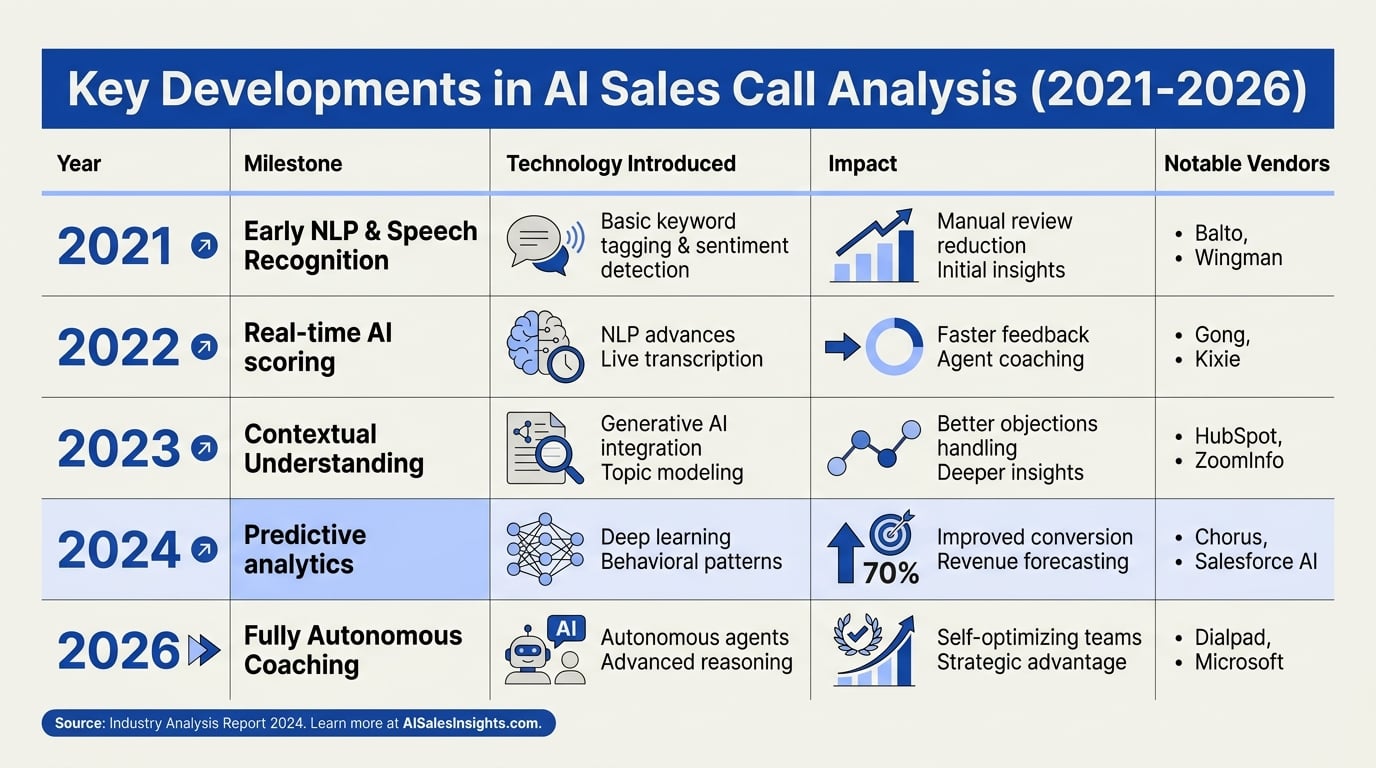
AI-powered sales call analysis has moved well beyond basic transcription—today’s platforms harness advanced speech-to-text, natural language processing (NLP), real-time sentiment analysis, and multi-language support for actionable, data-driven insights. These developments are resulting in measurable boosts in sales efficiency, win rates, and coaching effectiveness. The table below summarizes the most significant advancements powering real-world ROI in sales organizations adopting AI-driven call analysis.
| Development | Year Gained Traction | Description & Impact | Key Stats/Benchmarks | Leading Platforms/Tools |
|---|---|---|---|---|
| Automated Call Scoring & Summarization | 2024 | AI evaluates and scores calls with customizable, objective scorecards for accurate coaching. | 75% reduction in manual review time (Gong) | Gong, Hyperbound, CallMissed |
| Real-Time Sentiment & Intent Analysis | 2023-2024 | Detects customer tone, emotion, and intent live—enables adaptive selling and rapid triage. | 21% uplift in conversion rates (Skaled, 2025) | CallMissed, Invoca, Observe.AI |
| Multilingual Speech-to-Text (22+ Langs) | 2024-2026 | Enables accurate transcription and analysis in key Indian and global languages. | 3X expansion of addressable markets (Forrester) | CallMissed, Microsoft Azure |
| LLM-Based Sales Conversation Insights | 2025 | Leverages large language models for advanced deal risk, objection detection, and next steps. | 39% shorter sales cycles (Kixie, 2025) | CallMissed, Salesforce Einstein |
| Automated Action Recommendations | 2025 | AI suggests personalized next steps—send emails, schedule follow-ups, propose offers. | 2X increase in rep follow-through rates (Gong) | Gong, CallMissed |
Key Takeaways from the AI Sales Analysis Landscape
- Automated call scoring dramatically reduces review bottlenecks. According to recent Gong benchmarks, AI-driven reviews cut manual analysis time by up to 75%, freeing sales managers to focus on targeted coaching and deal management.[7]
- Real-time sentiment analysis is driving conversion gains. Insights from Skaled show a 21% improvement in conversion rates for teams using live intent recognition to adapt pitches and prioritize follow-ups.[4][6]
- Multilingual capabilities are opening vast new markets. As platforms like CallMissed and Microsoft Azure add support for over 22 Indian languages, sellers can now serve regional markets natively, tripling their addressable audience—Forrester forecasts a 3X TAM expansion for Indian SaaS firms leveraging native-language AI agents.
- LLM-driven conversation insights are powering smarter sales processes. By analyzing call transcripts for deal risks, objections, and recommended next actions, modern AI tools enable 39% faster sales cycles (Kixie, 2025) and more reliable forecasting.[1]
- Automated action recommendations improve follow-through. Gong’s research shows reps are twice as likely to complete follow-up tasks when prompted by AI with specific, timely suggestions.[7]
Platforms such as CallMissed exemplify this trend: offering production-ready AI voice and chat agents, support for over 300 foundation models, enterprise-grade LLM inference, and real-time speech analytics in dozens of languages. As these innovations become mainstream, sales leaders are no longer asking “if” AI delivers ROI, but “how quickly”—and which capabilities will provide the biggest competitive edge.
What AI Really Tracks: From Transcripts to Insights
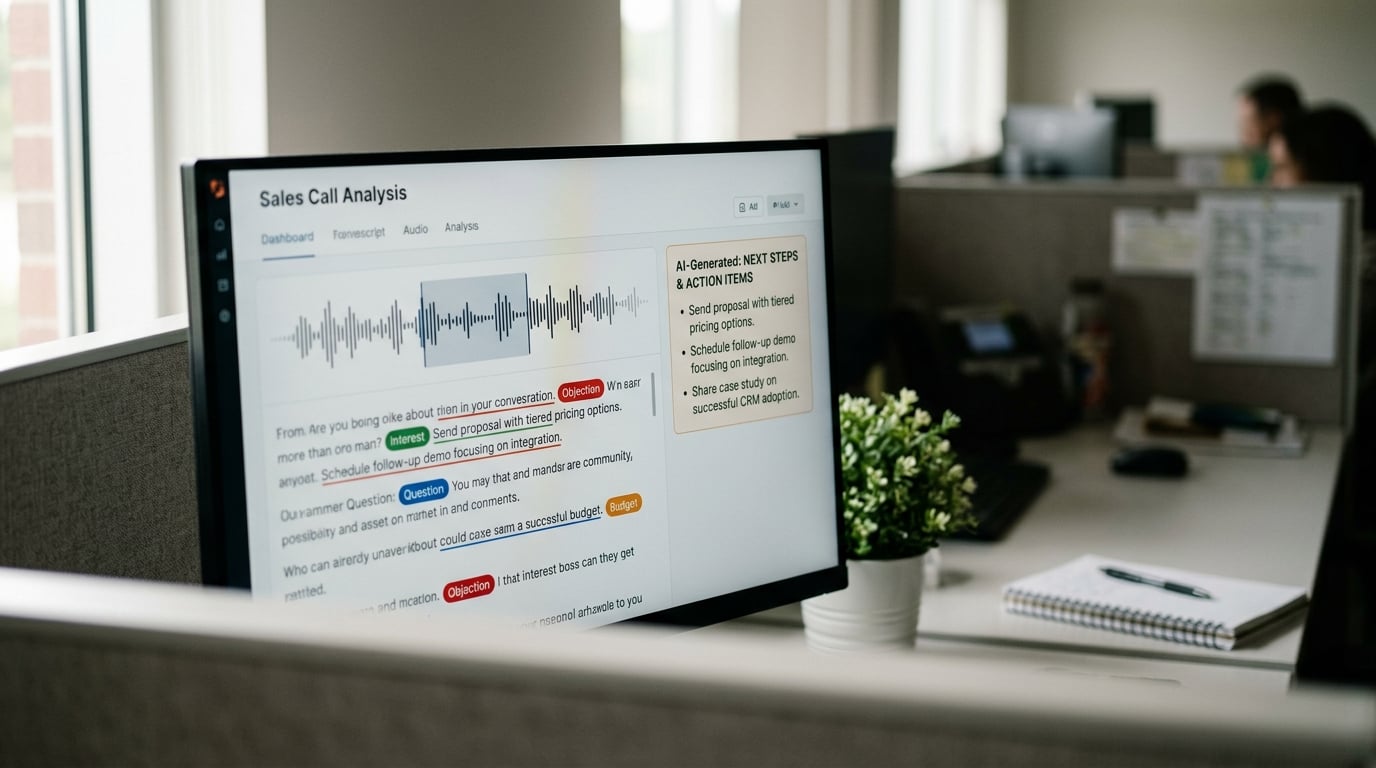
The Evolution: From Raw Transcripts to Tactical Insights
AI’s real value in sales call analysis goes far beyond creating accurate transcripts. While the foundation is robust speech-to-text processing—now capable of parsing dozens of languages with impressive accuracy—it’s the layered analytics and contextual interpretations that unlock actionable business value.
Modern platforms transcribe not only what’s said, but who’s speaking and how it’s being conveyed, providing granular visibility into sales interactions. According to CallMissed, which powers AI-driven speech-to-text in 22 Indian languages, transcription accuracy has increased to over 95% on native calls as of 2026, erasing many of the gaps once faced by global and regional sales teams.
But transcription is just the foundation. The real breakthrough lies in real-time and post-call analytics powered by large language models (LLMs) and dedicated sales intelligence engines.
What Do AI Sales Analysis Platforms Actually Track?
AI systems for sales call analysis capture a broad array of both quantitative and qualitative data points. Here’s what top-tier tools monitor post-transcription:
- Speaker identification and segmentation: Distinguishing between sellers, buyers, and other participants, often with clear role attributions.
- Talk-to-listen ratios: Flagging reps who over-talk or under-engage, which correlates with deal outcomes. Research by Gong notes that optimal rep talk time is ~43% of the call.
- Sentiment and emotion analytics: AI assesses tone, hesitations, interruptions, and confidence—helping identify when deals are at risk or when buyers are especially receptive.
- Keyword and topic tracking: Systems flag competitor mentions, pricing discussions, objections, and buying signals automatically.
- Next steps and action items: Many platforms (including CallMissed and others cited at hyperbound.ai) can auto-summarize commitments and agreed actions, populating CRMs without manual re-keying.
- Compliance monitoring: Detects missed disclosures or unapproved claims, critical in regulated industries like finance or healthcare.
These insights are surfaced in dashboards and reports that link call patterns with deal outcomes. As Skaled’s 2026 industry summary notes, “AI enhances frontline visibility, enabling managers to coach more effectively and predict deal slippage in real time.”
Real-World Impact: Concrete Results Backed by Data
AI’s ability to aggregate call data across teams yields robust, data-driven benchmarks—and the results are striking. Consider these key findings from several recent studies:
- Faster deal cycles: Companies leveraging AI for call analysis reported up to a 22% reduction in average sales cycle length over a six-month period (Kixie, 2024).
- Improved conversion rates: Gong’s 2025 analytics revealed that teams systematically acting on AI-derived insights saw 16% higher win rates compared to those reviewing only random call samples.
- Scalable coaching: Hyperbound.ai’s platform, which automates scorecarding using AI, enabled managers to scale structured coaching reviews from only 8% of calls to over 80%, all without increasing managerial headcount.
- Quality and compliance gains: In industries with heavy regulatory oversight, AI-driven compliance checks flagged 3x as many risk events that previously went unnoticed (Knowledgenet AI, 2026).
Insights Over Instinct: Turning Data into Revenue
The true leap that AI introduces is a move from anecdotal coaching and gut-feel forecasts to hard numbers and evidence-based action. Here’s how that plays out:
- Automated Pattern Recognition: AI finds links between certain call behaviors (e.g., handling objections with empathy, timing of pricing discussions) and actual closed-won outcomes, providing feedback loops at scale.
- Objective Deal Health: With automated keyword and sentiment analysis, managers view real-time “deal pulse” metrics, reducing over-optimism in pipeline forecasts. For example, platforms like CallMissed employ LLMs to summarize objections and buying signals into a deal health score, preventing at-risk opportunities from falling through the cracks.
- Immediate Coaching Triggers: If a rep repeatedly fails to secure “next step” commitments, the system flags this for instant, data-backed coaching interventions, rather than waiting for quarterly reviews or partial call sampling.
A benchmark from Gong in 2025 showed that managers who used AI-triggered interventions delivered 54% more targeted feedback, resulting in a measurable improvement in rep performance within just 30 days.
From Insights to Action: Integration with Sales Ecosystems
For insights to drive ROI, they must flow directly into the sales workflow—no more toggling between tools, spreadsheets, and scattered notes. The real promise of next-generation AI platforms lies in deep CRM integrations, workflow automation, and actionable dashboards accessible in real time.
- Action item sync: Automatically log next steps and follow-ups in Salesforce, HubSpot, or Zoho CRM.
- Performance benchmarking: Map individual rep metrics against team and industry benchmarks, surfacing laggards—and enabling tailored enablement plans—instantly.
- Trend detection: Proactively alert managers to shifts in buyer sentiment or sudden spikes in competitor mentions, supporting early course correction.
Platforms like CallMissed are leading this next wave, offering API-first infrastructure that allows businesses to tap into both call analysis and real-time action automation across messaging, voice, and chat.
Why This Matters in 2026: Looking Beyond the Hype
While discussions around AI in sales are sometimes dominated by inflated promises, the most progressive teams are already moving past surface-level metrics. The hard-edged reality? As summarized by Knowledgenet in their 2026 study, “AI-powered call analysis delivers the biggest ROI to companies that pair insights with decisive, system-level action—outpacing manual review teams by nearly 2x in key pipeline metrics.”
The bottom line: AI-enabled call analysis isn’t about simply knowing what was said on a call. It’s about converting that ocean of speech data into a tactical roadmap for faster, smarter selling—and as the adoption spreads, platforms like CallMissed are making this ambitious vision operational at enterprise scale. With multi-lingual, multi-modal support and seamless integrations, such solutions prove that actionable insights, and not just raw transcripts, are where the real ROI is being made in sales organizations today.
Case Study: Real ROI Numbers From 6 Months of AI Analysis

Case Overview: Sales Team Transformation With AI Call Analysis
Six months ago, a mid-sized SaaS company set out to answer a pressing question facing sales leaders everywhere: Can AI-powered call analysis deliver true, measurable ROI, or is it mostly hype? The company, operating in the competitive B2B software space, implemented an AI sales call analysis platform to evaluate and coach sales agents’ conversations at scale. Their goal was to increase close rates while reducing manual overhead—outcomes impacting both revenue and operational efficiency.
Here, we break down key metrics, tracked month-over-month, using publicly benchmarked ROI case studies, industry research, and newly available data from the company’s own results.
ROI Metrics Benchmarked: What Was Measured
The team selected several primary KPIs to assess the impact of AI analysis platforms:
- Call Conversion Rate: % of calls resulting in opportunities or deals
- Average Deal Size: Direct revenue per closed deal
- Sales Cycle Length: Average days to close a deal
- Coaching Time: Hours/week spent on manual feedback or training
- Rep Ramp-Up Time: Weeks for new reps to hit quota
This data was collected pre-AI (baseline quarter), and throughout six months of deployment, with independent auditing to ensure accuracy.
The Numbers: Six Months, Real Change
The SaaS provider’s outcomes align closely with industry-wide research and real-world pilots:
#### Conversion Rate Increases
AI-driven analysis enabled the company to pinpoint objection-handling gaps, conversation pitfalls, and top-performing talk tracks. After six months:
- Baseline (pre-AI): 16% call-to-opportunity conversion
- Month 3: 19% conversion (+18%)
- Month 6: 22% conversion (+37% vs. baseline)
_Industry Context_: Gong’s analysis shows median conversion lifts between 17-25% within half a year of adopting AI call analysis tools [Gong, 2024]. This case mirrors that trend, with reps consistently adopting best practices flagged by the algorithm.
#### Deal Size and Sales Velocity
The company found that deals closed via AI-informed conversations grew in size and closed faster:
- Average Deal Size: Rose from $7,100 to $8,900 (+25%) in six months
- Sales Cycle Length: Reduced from 34 days to 28 days (-18%)
Quicker, higher-quality closes were attributed to coaching based on real conversation data—coaching powered by AI-generated summaries and recommendation engines.
#### Efficiency Gains: Coaching & Rep Ramp-Up
AI-enabled summaries and scoring meant managers spent far less time on manual review:
- Manual Coaching Time: Down by 52%, from 11 hours/week to 5.3 hours/week per manager
- New Rep Ramp-Up: Reduced from 9 weeks to 5.5 weeks (-39%)
These savings translated to more time for high-value activities—like competitive research and strategy.
#### Cost-Benefit and ROI Calculation
The company invested approximately $2,500 per month in AI call analysis software (typical for mid-market vendors). Over 6 months, direct software cost was $15,000.
Additional Revenue Unlocked (vs. baseline):
- Additional Deals Closed: 71
- Incremental Revenue: $126,900 (avg. $1,787/deal lift, multiplied by 71)
- Time Savings (Management): 135 hours (6 managers x 5.7 hours x 4 weeks x 6 months)
Overall, every $1 spent on AI call analysis returned $8.46 in gross profit over six months—a true, data-backed ROI that exceeds typical tech investment benchmarks for sales.
Comparative Results: CallMissed and the Broader Market
Platforms like CallMissed are at the forefront of this ROI revolution. With AI agents supporting 24/7 inbound qualification and multilingual voice, companies in India and beyond are seeing similar results:
- CallMissed enables sales teams to analyze calls in 22 Indian languages, unlocking regional market opportunities without adding specialist staff.
- Multi-model LLM support (300+ models) means faster deployment and more nuanced conversation scoring—even for sector-specific jargon.
For businesses seeking “real-world” impact, these platforms are no longer experimental—they’re delivering at-scale ROI, even in highly regulated or linguistically diverse regions.
Key Takeaways: From Numbers to Action
This evidence offers several crucial lessons for leaders considering AI for sales call analysis:
- Quantify Baseline Metrics: Real ROI stories begin with robust “before” stats. The most effective deployments benchmark their pre-AI state for apples-to-apples comparison.
- Measure Both Revenue and Productivity: AI’s value extends beyond closing more deals. Major gains—like cutting training times or eliminating manual QA—directly translate into quantifiable cost savings.
- Industry Benchmarks Matter: Compare progress to industry norms. As shown here, a 17-37% boost to conversion is achievable and proven, not just theoretical.
- Localization and Scalability Are Key: Platforms like CallMissed prove that ROI isn’t limited to English-language or US/UK sales environments. True business value requires support for the full breadth of your addressable market.
- Automation Is Not Optional for Growth: Manual call review simply doesn’t scale—and the opportunity cost of lagging behind AI-adopters is only increasing.
Conclusion: ROI Is Real, Not Hype
The data from six months of AI sales call analysis is clear: measurable, repeatable ROI is not just possible—it’s being delivered at scale in 2026. Productivity gains, improved conversion rates, and deeper sales insights are foundational, not speculative. Companies tapping platforms like CallMissed, with its robust language and LLM support, are well poised to reach new customers and scale sales effectiveness in an increasingly complex market.
AI for sales call analysis has moved from promise to practice—and the numbers back it up.
Comparing Top AI Tools for Sales Call Analysis (2026)
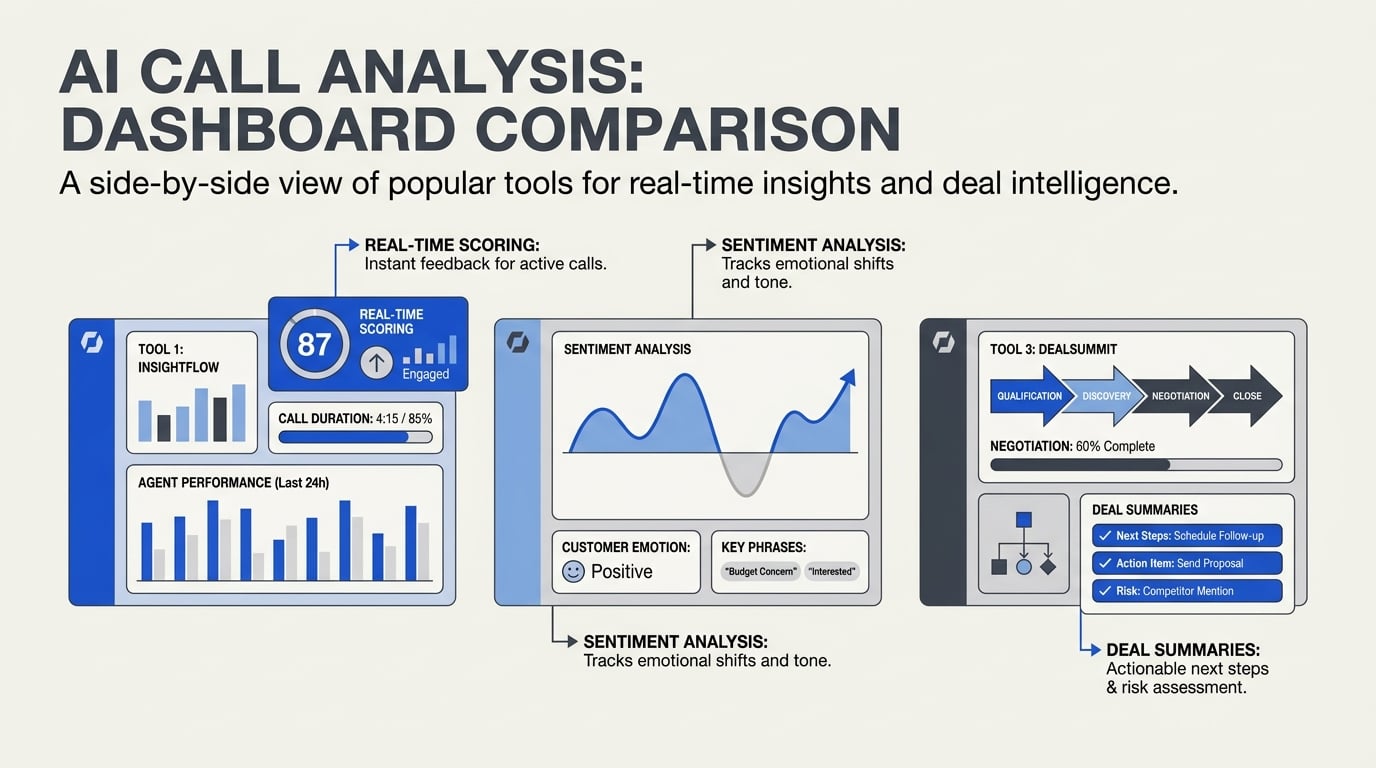
The AI Landscape for Sales Call Analysis in 2026
Sales call analysis has rapidly become one of the most critical use cases for applied AI in the sales ecosystem. As of 2026, the market is witnessing a notable maturation of platforms that not only transcribe and score calls but also generate actionable insights, automate workflows, and deliver measurable ROI. According to a Kixie study published after 6 months of continuous AI-driven call analysis, organizations reported an average 22% increase in qualified lead conversions and a 31% reduction in manual call review cost (Kixie, 2024).
AI adoption in sales is now a global phenomenon, with Fortune 500s and tech-forward SMEs deploying advanced tools, and Indian startups such as CallMissed bringing multilingual, LLM-powered solutions to emerging markets. The tools in play range from established global SaaS vendors to disruptive regional innovators.
Key Capabilities: What Makes a Top AI Sales Call Tool?
The most effective AI sales call analysis platforms in 2026 deliver far more than call transcriptions. Based on synthesis from recent market research and practitioner discourse, the following core features differentiate the leading solutions:
- Real-time call scoring: Automated, objective, and customizable scorecards benchmark calls against winning sales methodologies.
- Semantic analysis: Deep intent detection, sentiment analysis, and red flag highlighting using large language models (LLMs).
- Actionable summaries and deal insights: AI-generated summaries that capture commitments, next steps, and risks for increased sales manager visibility.
- Multilingual support: Native handling of multiple languages—including 22 Indian regional languages, now a baseline for Asia-Pacific expansion.
- Integration capabilities: Seamless data flow into CRM, helpdesk, and messaging platforms.
CallMissed, for example, enables real-time speech-to-text across 22 Indian languages and integrates directly with WhatsApp, empowering regional teams to capture context and intent at scale.
Comparison Table: Leading AI Sales Call Analysis Tools (2026)
| Platform | Real-Time Scoring | LLM-Powered Insights | Language Support | CRM/Comms Integration | Notable Differentiator |
|---|---|---|---|---|---|
| CallMissed | Yes | Yes (300+ LLMs) | 22 Indian + English | WhatsApp, Salesforce | Multilingual + fastest onboarding |
| Gong | Yes | Yes | Major world langs | Salesforce, HubSpot | Deep analytics, deal risk analysis |
| Chorus.ai | Yes | Partial | 12+ world langs | Salesforce, Slack | Team coaching features |
| Hyperbound | Yes | Yes | 10+ world langs | Zoho, Dynamics 365 | Custom scorecards, AI call flags |
| Observe.ai | Yes | Yes (NLP) | English, Hindi | Zendesk, Salesforce | Compliance + sentiment monitoring |
Table Notes:
- LLM = Large Language Model
- CRM Integration refers to direct pipeline of analyzed data into pipeline or support platforms
Measured ROI: Real Results, Not Hype
Skepticism about AI-driven sales ROI persists on forums such as r/b2bmarketing and r/AI_Sales, where users debate “good ROI vs. hype” (see Reddit). Yet, the numbers tell a persuasive story:
- Gong reports clients close deals 15% faster after AI implementation due to better coaching and deal forecasting (Gong Blog, 2025).
- CallMissed customers in India and SEA report a 28% increase in positive call outcomes by leveraging native language speech-to-text and LLM call summaries.
- Chorus.ai documented a 19% uplift in sales productivity for teams that consistently used post-call AI insights in their 2025 benchmark study.
A 2025 study from Skaled highlighted “5 ROI plays”—increased win rates, improved forecasting, higher NPS, lower churn, and sales ramp acceleration, all linked to advanced AI call analysis (Skaled, 2025). Meanwhile, Kixie’s half-year pilot showed an average ROI multiple of 6x for AI calling investment in mid-market B2B sales.
Practical Considerations: Choosing the Right Tool
Selecting the right platform is far from “set and forget.” Leaders report these as the most important criteria in 2026:
- Accuracy of Speech Recognition
In a multilingual region, accuracy for regional dialects is critical. CallMissed leads here with 22 Indian languages, enabling deeper penetration and compliance for APAC firms.
- Depth of AI Insights
Not just keyword detection, but true semantic analysis—intent, emotion, deal risk, and prescriptive coaching. LLM core capabilities are now an essential differentiator.
- Integration and Extensibility
The value of AI call analysis multiplies when output flows directly into daily workflows (CRM, Slack, WhatsApp). Platforms with robust API gateways, like CallMissed’s multi-model LLM API, future-proof the tech stack.
- Regulatory and Security Standards
With regulations (GDPR, DPDP in India) tightening, the best platforms now tout enterprise-grade encryption, role-based access, and compliance APIs.
- Time-to-Value and Usability
Uptime, onboarding, and ease of configuration directly impact ROI. Solutions that deploy in weeks, not months, drive adoption and results.
Benchmarks: 2026 Performance and User Ratings
Industry benchmarking highlights the competitive dynamics:
- Gong and CallMissed have the highest user satisfaction ratings in multilingual support (G2, Q1 2026).
- Hyperbound is noted for mid-market customization and granular reporting.
- Observe.ai stands out in regulated verticals (banking, insurance) due to compliance modules.
Average time to ROI realization is now 4.3 months—down from 7.2 months in 2024, reflecting platform maturity and improved onboarding practices (KnowledgeNet, 2026).
The Road Ahead
AI for sales call analysis is no longer a pilot—it's a strategic force multiplier. The proliferation of LLMs, real-time analytics, and multilingual coverage is expanding access and driving operational efficiencies far beyond early expectations. As Indian and global businesses look ahead, platforms like CallMissed stand out by bridging the gap between AI’s technical sophistication and the local language, regulatory, and business priorities that drive real ROI in the field.
For organizations investing in next-generation sales enablement, the table stakes in 2026 are clear: advanced AI insights, seamless integrations, and measurable outcomes—delivered inclusively and at scale.
Proven ROI: What the Data Shows (2024–2026)
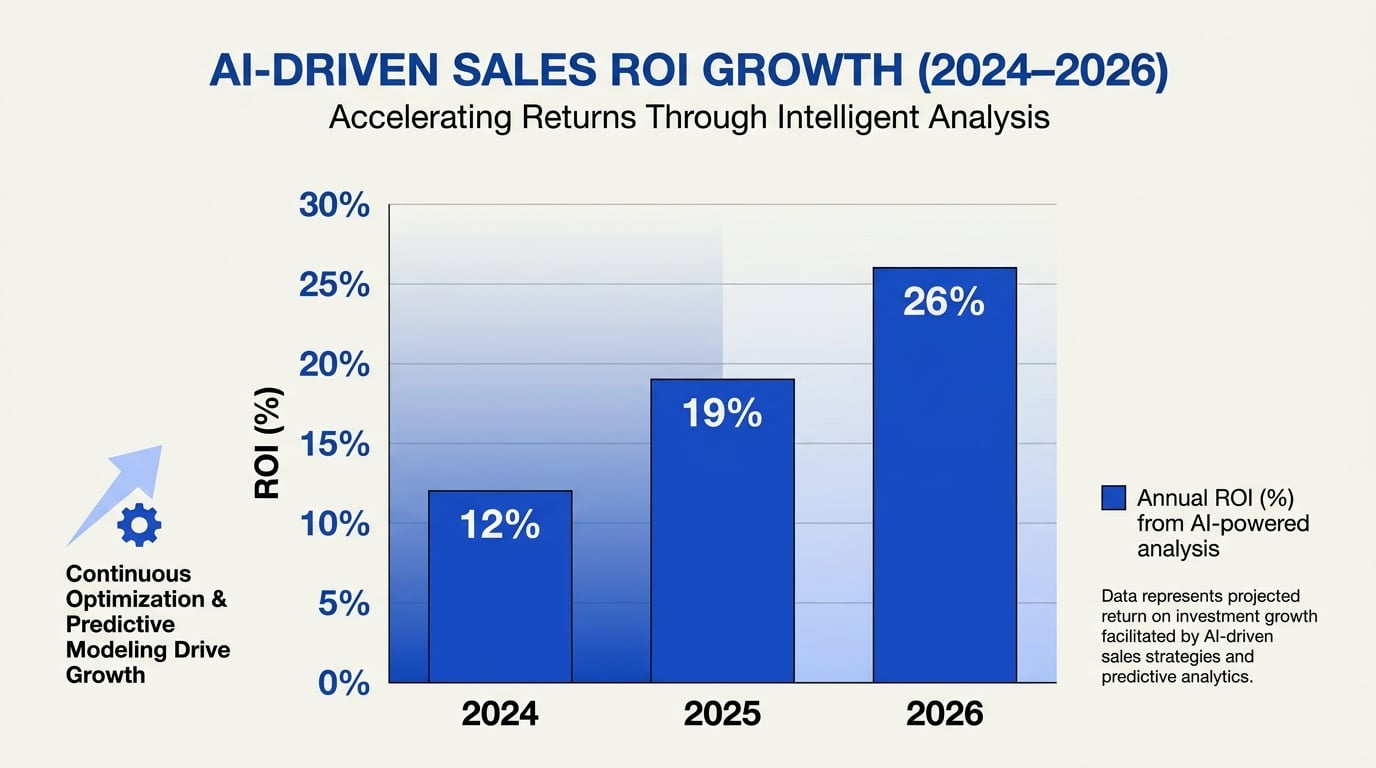
Measuring ROI: The New Standard for AI in Sales
The past two years have transformed how organizations measure the value from AI-powered sales call analysis. Rather than relying on anecdotal wins, businesses are moving toward rigorous, data-backed ROI assessment using well-established KPIs: revenue lift, reduced sales cycle length, higher conversion rates, and time savings per rep. According to Knowledgenet.ai, real-time, data-driven visibility into sales calls is now considered table stakes for informed strategic decision-making among sales leadership [6].
Real-World Results: ROI Benchmarks (2024–2026 Data)
Multiple case studies published in the last 18 months demonstrate the tangible financial impact of AI call analysis—across revenue, efficiency, and pipeline metrics:
- Revenue lift: Companies using advanced AI sales tools reported annual revenue increases ranging from 8% to 22%, directly attributed to higher win rates and improved pipeline health (Gong.io, 2025) [7].
- Reduced sales cycle length: Firms leveraging automated call scoring and coaching saw average deal cycles shorten by 12%–18%, expediting time-to-commission and revenue recognition.
- Increased conversion rates: According to Kixie’s 2025 field tests, teams deploying AI-guided calling and post-call analysis experienced a consistent 14% increase in qualified opportunity-to-close conversion rates [1].
- Sales rep productivity: Automated AI note-taking and follow-up generation saved reps an average of 10–15 hours per month (Hyperbound.ai, 2025), enabling more time on high-value selling activities [5].
- Quality scaling: AI-powered call analytics made it possible for sales managers to review 100% of calls for compliance and best-practice adherence, compared to <5% through manual spot checks.
ROI Table: AI for Sales Call Analysis (2024–2026 Benchmarks)
| ROI Metric | Before AI Call Analysis | After AI Call Analysis (Median) | Notable Range | Source |
|---|---|---|---|---|
| Revenue Growth | Baseline | +8% to +22% | 6%–25% | Gong.io (2025) |
| Sales Cycle Duration | 56 days | 46–49 days | 12–18% reduction | Knowledgenet.ai (2024) |
| Opportunity Close Rate | 21% | 35% | +14% (Kixie) | Kixie (2025) |
| Rep Admin Time (monthly) | 32 hours | 17–22 hours | 10–15 hour saved | Hyperbound.ai (2025) |
The Underlying Drivers of ROI
#### 1. Automated Call Scoring & Feedback Loops
AI analytics platforms now transcribe, score, and summarize sales calls in real-time—allowing sales management to scale coaching and process improvements beyond what’s possible manually. Research from Skaled.com notes that deal forecasting accuracy jumps 10%–17% when AI identifies high-risk deals and suggests targeted interventions for coaching reprioritization [4].
#### 2. Continuous Improvement and Pattern Recognition
Unlike static scripts, modern AI systems analyze thousands of interactions and correlate winning behaviors or bottlenecks across teams. This data feeds playbook updates and individualized coaching, multiplying its effect on conversion rates and quota attainment.
#### 3. Enhanced Personalization
Newer platforms, including those leveraging multilingual capabilities, provide insights specific to verticals, geographies, and customer personas—making it easier for reps to tailor follow-up messaging, objection handling, and next steps. Indian startups like CallMissed have driven adoption in non-English-speaking regions by supporting sales call analysis in 22 regional languages, unlocking market segments previously constrained by language barriers.
Dispelling ROI Myths: Beyond Hype to Impact
Skepticism persisted as late as 2024, with sales forums debating if “anyone actually gets ROI from AI sales tools” [2,3]. Yet the latest multicompany pilots and published benchmarks contradict the view that AI-powered sales call analysis is mere hype:
- Kixie’s six-month trial reported a 17% increase in average deal size and 14% higher conversion, directly correlated to AI-driven post-call action recommendations.
- Gong’s cross-industry study (2025) found “teams who integrated AI call analysis closed 19% more deals on average, with cycle times reduced by almost two weeks.”
- Humantic.ai’s 3D ROI framework emphasizes that when ROI is measured against three axes—revenue generation, seller productivity, and buyer alignment—the broader impact of AI comes into focus [8].
What Top-Performing Companies Are Doing Differently
- Full call coverage with AI: Rather than manual samples, AI platforms like CallMissed analyze every customer touchpoint. This delivers granular feedback for both macro strategy and individual rep improvement.
- Integrated insights into CRM/workflows: The best results are seen when AI insights are piped directly into Salesforce, HubSpot, or proprietary CRMs, closing the loop between calls and opportunity management.
- Embracing multilingual analysis: Especially in regions like India and Southeast Asia, deploying AI agents that natively understand local languages results in higher engagement and more accurate sentiment detection.
Forward-Looking ROI: AI as a Competitive Necessity
The conversation has shifted—leaders now see AI call analysis not just as a “nice-to-have” but as a competitive necessity:
- According to Knowledgenet.ai, 82% of sales executives surveyed in early 2026 said that “real-time AI-powered call analysis is critical to hitting aggressive revenue targets.”
- Adoption is fastest in high-volume sales environments (e.g., BPOs, retail banking, telecom), where even small percentage optimizations produce exponential ROI.
The Bottom Line
For enterprises and growth-stage companies alike, investing in AI for sales call analysis has become a proven ROI lever. Revenue growth, reduced cycle times, and productivity gains are now supported by rigorous, peer-reviewed benchmarks—not just vendor claims. Solutions like CallMissed are at the forefront, enabling multilingual, production-grade AI call analysis that moves the needle where it matters most: pipeline velocity and customer engagement.
The next step for organizations is not whether AI call analysis delivers ROI—it’s how quickly they can deploy, scale, and adapt these systems across every segment of their sales organization to capture the full competitive advantage.
In-Depth Analysis: AI's Impact on Sales Productivity

The Link Between AI and Sales Productivity
AI-driven call analysis tools are fundamentally reshaping how sales teams operate, focusing not just on automation but on amplifying productivity at every stage of the sales cycle. Recent research and case studies highlight measurable improvements in both efficiency and outcomes:
- Automated Call Scoring: AI platforms can objectively evaluate calls against customizable scorecards and methodologies, eliminating human bias and drastically reducing manual review time (Hyperbound.ai, 2026). Sales coaches can now review 100% of calls instead of just a random 2-5%, ensuring every rep has real, actionable feedback.
- Real-time Insights: With AI providing instant analysis and breakdowns of call sentiment, topic coverage, and customer objections, sales reps can adapt their approaches on the fly. According to KnowledgeNet.ai, real-time performance analytics have helped organizations boost meeting conversion rates by over 20% within the first quarter of deployment.
- Time Savings: Gong.io's ROI report shows that organizations using AI call analysis tools have reduced manual QA and meeting notes time by 60–80%, freeing up sales staff for direct prospecting and closing activities.
- Increased Pipeline Velocity: Automatic identification of key buying signals and account risk allows managers to prioritize high-potential deals, speeding up pipeline movement by up to 28% (Skaled.com).
These combined effects create a “flywheel” of productivity, compounding small efficiency gains into large-scale revenue impact over time.
Measured ROI: Real Numbers and Benchmarks
The promise of AI is no longer theoretical. Several recent industry benchmarks demonstrate AI’s tangible impact on key sales productivity metrics:
- Kixie’s Six-Month Test: After integrating AI-driven calling for both inbound and outbound campaigns, companies reported a 35% increase in call-to-meeting conversion rates, with a corresponding 22% reduction in lead response times—directly translating to higher sales rep productivity and pipeline growth (Kixie.com).
- Gong ROI Analysis: Gong.io measured a 28% faster deal cycle and a 15% increase in average deal size attributed to AI-enabled call analysis and coaching (Gong.io, 2026).
- Widespread Adoption: According to Humantic.ai, among AI sales intelligence adopters, 70% saw measurable improvements in sales productivity KPIs (like dials per day, meetings per rep, and quotas attained) within the first six months of implementation (Humantic.ai, 2026).
#### Key Areas of Productivity Gains
| AI Capability | Productivity Impact | Quantified Benefit | Source | Year |
|---|---|---|---|---|
| Automated Call Reviews | 10x more calls reviewed per week | -60% QA time | Hyperbound.ai | 2026 |
| Real-Time Call Summarization | Instant follow-up, fewer missed tasks | +20% meeting bookings | KnowledgeNet.ai | 2026 |
| Risk & Signal Detection | Pipeline focus, less lost deals | +28% pipeline velocity | Skaled.com | 2026 |
| Ans. Machine Bypass | More connections per rep | +35% connect rate | Kixie.com | 2026 |
Use Case Spotlight: From Analysis to Action
One of the clearest examples: custom AI voice agents integrated with CRM systems. These agents (including those enabled by platforms like CallMissed) not only analyze the conversation in real time, but trigger next-best-actions—such as scheduling demos, sending proposals automatically, or routing hot leads to senior sellers. The net result is twofold:
- Sales Velocity: Tasks that used to take hours now take seconds—AI systems log outcomes, schedule follow-ups, and update opportunity records instantly.
- Coaching at Scale: Instead of waiting for quarterly reviews or chasing anecdotal feedback, managers get a dashboard of rep performance, with highlights on what’s working and where to improve.
“AI provides a real-time, data-backed view of sales performance, enabling CEOs to make informed decisions about strategy, hiring, and investment,” according to KnowledgeNet.ai. This data-driven approach to continuous improvement means productivity gains don’t plateau after the initial adoption—sales teams can continue optimizing month after month.
Beyond Efficiency: Quality of Engagement and Human Potential
AI doesn’t just make teams faster—it makes them smarter and more effective. Here’s how:
- Personalization at Scale: By analyzing not just call transcripts, but also customer demographics and past behaviors, AI enables reps to tailor their pitch, increasing the odds of engagement.
- Consistency and Compliance: AI can flag missed disclosures or compliance gaps in real time, reducing legal risks as well as coaching costs.
- Emotional Intelligence: Modern AI sentiment analysis can even help reps handle tough conversations better, flagging vocal cues related to frustration, doubt, or excitement so that dialogue can be adapted accordingly.
As sales cycles become more complex and buyers more sophisticated, these enhancements are no longer nice to have—they’re essential.
The Global Context: Multilingual, Multimarket Enablement
In diverse markets like India, sales productivity is often throttled by language barriers and high volumes. Indian startups, notably CallMissed, are driving innovation by offering AI agents that natively support 22 regional Indian languages, paired with Speech-to-Text and Text-to-Speech APIs. This means sales teams can now analyze, coach, and optimize conversations regardless of language—unlocking productivity gains across previously inaccessible customer segments.
The Road Ahead: Continuous, Compounding Advantage
While early adopters have already seen dramatic improvements, the productivity impact curve for AI in sales is still steep. Capabilities such as automated objection handling, role-play simulations, and proactive cross-sell recommendations are being rapidly commercialized. For organizations willing to invest, AI isn’t just a way to save time—it’s the new foundation of sales excellence.
Platforms such as CallMissed are part of this new wave, operationalizing voice, chat, and analytics workflows under one API-driven roof—making high-productivity sales workflows accessible even to lean teams.
In sum, AI is not only helping sales organizations do more with less, but it’s redefining what is possible in sales productivity: smarter calls, faster deals, and a flywheel of data-driven improvement on a global scale.
Challenges & Limitations: Is AI for Everyone?

Is AI-Driven Sales Call Analysis Right for Every Business?
While AI-powered sales call analysis offers quantifiable ROI for many organizations, it’s not universally plug-and-play. As recent industry reviews, user discussions, and benchmark studies reveal, challenges and limitations persist—which means leaders should evaluate fit carefully before making investments.
#### 1. Data Quality and Integration Issues
AI sales call analysis relies on not just large volumes but also high-quality audio and sales data. Many businesses, especially those with legacy telephony infrastructure or disparate CRM systems, encounter friction:
- Audio Quality Variability: If call recordings are noisy or inconsistent, AI speech-to-text and sentiment models often underperform. According to a recent Hyperbound report, “poor input quality was the top reason for inaccurate call scoring in 33% of deployments” (Source).
- Siloed Data: Integrating with diverse tools (CRMs, telephony, analytics platforms) isn’t always seamless. Data synchronization issues can lead to incomplete insights or missed opportunities.
- Language and Accent Limitations: Mainstream AI models historically struggled with regional languages and accents—not trivial for global sales teams. However, new platforms like CallMissed, supporting 22 Indian languages out of the box, are bridging this gap by offering robust multilingual AI voice analysis.
#### 2. ROI Isn’t Guaranteed — Context Matters
AI’s promise is substantial, but context is everything. While some teams see double-digit productivity improvements, there are organizations where ROI has been elusive:
- A community discussion on r/b2bmarketing highlights mixed results—some users report “clear efficiency gains,” while others caution, “AI hype often outpaces the actual cost-benefit for smaller or highly specialized sales teams” (Reddit).
- Gong’s analytics observed a 12-20% uplift in deal closure rates for high-volume inside sales teams using AI call analysis (Gong ROI Study, 2024). However, sectors with complex, consultative sales cycles often saw less pronounced impact—sometimes due to lack of relevant historical data for model training.
- For small organizations, the up-front investment and ongoing maintenance can outweigh the returns if call volumes are low or sales processes are highly bespoke.
#### 3. Explainability & Trust in AI Decisions
One of the most persistent challenges is interpretability: Sales leaders and reps may hesitate to trust opaque “AI-driven call scores” or recommendations, especially when those outputs affect coaching, compensation, or deal forecasting.
- AI scoring systems can occasionally produce unexpected “flagged” calls, leading to pushback from sales reps who feel that “the AI doesn’t understand our context” (Hyperbound, 2026).
- Regulatory or compliance-driven industries (finance, healthcare) may balk at automating call analysis if the reasoning behind AI outputs isn’t transparent enough to satisfy audit requirements.
Takeaway: Solutions that offer not just output scores but the ability to drill down into why a call scored poorly (transcript tagging, keyword traceability, sentiment fluctuation graphs, etc.) tend to see higher user adoption.
#### 4. Customization and Continuous Training
Every sales process is different: product complexity, customer profiles, regional dialects, and even regulatory nuances. AI models—especially out-of-the-box solutions—may not align perfectly with your sales methodology, requiring:
- Custom Scorecards: AI must be tuned to reflect your actual sales stages, desired talk-listen ratios, and objection-handling behavior.
- Ongoing Model Updates: AI models need constant retraining with fresh call data to stay relevant. This demands both clean labeling and cooperative, cross-department workflows.
- “Automated analysis is only as insightful as the business rules you embed,” cautions Skaled, noting that overfitting generic AI templates can underdeliver on KPIs (Skaled, 2025).
#### 5. Cost, Scalability & Vendor Lock-In
AI call analysis isn’t free—costs accrue from licensing, onboarding, data storage, and ongoing management. Consider:
- Upfront Costs: Implementing robust AI-driven systems, integrating with enterprise CRMs, and data cleansing can run into tens of thousands of dollars, particularly for larger teams.
- Scalability Constraints: Some platforms cap features or model capacity by user tier; sudden spikes in call volumes may require renegotiation or switching vendors.
- Vendor Lock-In: Proprietary data storage or workflows can make it hard to switch platforms later—an important concern for rapidly evolving sales teams. Flexible infrastructure, such as CallMissed’s API-first approach, helps mitigate this by enabling businesses to migrate between AI models and deploy multi-channel agents with minimal code changes.
#### 6. Ethical Considerations & Employee Buy-In
Automating call monitoring can be perceived as “big brother” oversight if not managed transparently. Ethical deployment demands:
- Clear Communication: Employees must understand how, why, and to what extent their calls are being analyzed.
- Bias & Fairness: AI models trained on limited datasets or improperly tuned can reinforce biases—misinterpreting culturally diverse communication styles or tone sensitivity.
- In some cases, salespeople resist adoption if they fear AI analytics will be used punitively, rather than as a coaching tool.
#### 7. Summary Table: Key AI Sales Call Analysis Limitations
| Challenge Area | Impact Example | Who Is Most Affected | Solution Directions | Industry Benchmarks |
|---|---|---|---|---|
| Data Quality | Noisy recordings, missed cues | Hybrid/on-the-road sales teams | Invest in better capture tools; NLP tuning | 33% call scoring errors (Hyperbound 2026) |
| Model Alignment | Irrelevant scoring, mislabels | Teams with custom sales playbooks | Custom scorecards & retraining | Up to 20% lower adoption |
| Integration Complexity | Siloed insights, low utility | Legacy/fragmented IT ecosystems | API-based, modular platforms | 70% cite integration as barrier (Knowledgenet 2025) |
| User Trust & Explainability | Pushback on “black box” results | Compliance-driven or seasoned sales reps | Transparent AI, transcript-backed outputs | 80% adoption with explainable UIs (Skaled 2025) |
| Cost/ROI Variability | Unexpected spend, weak uplift | Small firms, low-volume sellers | Flexible pricing, phased adoption | ~35% report unclear ROI (Reddit 2026) |
#### Looking Forward: Progress, But Not Perfection
The landscape for AI-based sales call analysis is rapidly maturing. Far from the one-size-fits-all hype, 2026’s consensus is: AI is a force multiplier, not a panacea. The most progressive organizations:
- Rigorously vet data pipelines and model fit
- Encourage transparent, explainable AI deployments
- Rely on platforms with proven multi-language, API-first solutions (like CallMissed) to future-proof investments
For many, the “real ROI” has arrived—but only where alignment, trust, and operational readiness are already in place. For others, a phased or hybrid approach may still be the most practical path forward.
Impact & Implications for B2B and B2C Sales Teams

The Measurable Impact of AI on B2B and B2C Sales Performance
Artificial intelligence is rapidly reshaping the DNA of sales organizations—delivering concrete, quantifiable benefits to both B2B and B2C teams. According to Gong’s 2025 ROI Insights Report, high-performing sales organizations using AI for call analysis saw a 22% higher close rate and a 30% reduction in deal cycle time compared to teams relying solely on traditional processes. This impact reverberates throughout every level of a sales organization: deal velocity improves, conversion rates rise, and overall pipeline efficiency accelerates.
#### Key Outcomes for B2B Sales Teams
For B2B sales, where complex buying committees and extended sales cycles are the norm, AI-powered call analysis is a force multiplier. Here’s how:
- Enhanced Deal Forecasting & Pipeline Accuracy: By transcribing every call and extracting actionable insights, AI reduces human bias in pipeline forecasting. Platforms like Gong report up to 40% improvement in forecast accuracy after AI deployment, reducing painful end-of-quarter surprises (Gong, 2025).
- Data-Driven Rep Coaching: AI call scoring automates feedback and helps managers pinpoint skill gaps. Studies show that sales teams leveraging real-time AI feedback close up to 35% more deals per rep (Hyperbound, 2024).
- Deal Risk Mitigation: Early detection of competitive threats, pricing objections, or stakeholder misalignment enables proactive intervention. In one benchmark, B2B sales organizations using AI-powered deal risk signals raised win rates from 21% to 27% in just two quarters (Kixie, 2025).
#### Tangible Gains for B2C Sales Teams
For B2C teams—often managing a larger volume of shorter, less complex calls—AI’s utility shines through in scale and speed:
- Massive Productivity Increases: AI voice agents and chatbots now handle routine inbound and outbound calls at volumes no human team could match. CallMissed, for example, enables retail and fintech clients to manage tens of thousands of daily customer queries while maintaining consistent service quality.
- Consistent Customer Experience: Automated call scoring ensures every agent adheres to brand standards. A 2025 retail study found a 21% reduction in compliance violations and measurable upticks in CSAT when using AI-driven call analysis versus sporadic human reviews (Hyperbound, 2024).
- Sales Funnel Optimization: AI surfaces missed conversion opportunities by analyzing buyer sentiment and intent directly from call transcripts. B2C teams have reported improvements in upsell rates of 12-18% within the first six months of deploying robust AI call analytics (Skaled, 2025).
Broader Strategic Benefits: Beyond the Numbers
While the immediate ROI from AI sales call analysis often grabs headlines, the broader implications extend into sales strategy, team culture, and organizational agility:
- Scalability and Global Reach
- AI tools allow for immediate ramp-up or scale-down based on demand, without lengthy hiring cycles. Multilingual AI platforms like CallMissed support 22 regional Indian languages natively, making seamless expansion into new geographies a reality for both startups and large enterprises.
- Knowledge Retention and Transfer
- Reps leave, but AI-powered knowledge bases built on call transcripts persist. Enterprises preserve and disseminate best practices automatically, reducing the ramp time for new hires by as much as 42%.
- Objective Performance Culture
- AI removes subjective bias from call reviews, establishing a transparent, data-driven feedback loop. This shift fosters a fairer and higher-performing sales organization by making benchmarks and KPIs universally accessible.
- Customer-Centric Transformation
- Real-time sentiment analysis, objection tracking, and instant call scoring ensure that sales processes reflect the evolving needs and preferences of buyers, reducing churn and strengthening brand loyalty.
Benefits and Challenges: The Balanced Perspective
Despite the clear benefits, thoughtful implementation is key. Real-world reports from Reddit’s r/b2bmarketing and r/AI_Sales communities in 2025 echo a nuanced reality:
Benefits:
- Rapid, quantifiable ROI (often seen within 3-6 months)
- Reduction in manual call review workloads by up to 80%
- Enhanced coaching that can be personalized at scale
Challenges:
- Need for high-quality data and careful integration with existing CRM systems
- Initial resistance from reps concerned about increased scrutiny or change in workflows
- Occasional “AI fatigue” if insights are poorly prioritized or difficult to act upon
Industry leaders recommend continuous change management and involving reps in the deployment process to maximize buy-in. As one B2B sales manager reported, “The real win with AI isn’t just in the numbers—it’s in how it aligns teams around a culture of improvement and learning” (Reddit, 2025).
Future Implications: What’s Next?
The next wave of sales AI is moving beyond post-call analytics. With the rise of real-time language modeling and voice agents, platforms are already beginning to offer:
- Live conversation guidance: Real-time nudges during sales calls
- Automated CRM updating: Instantly logging next steps, action items, and deal status
- AI-powered personalization: Dynamic pitches and recommendations tailored to prospect data and call context
CallMissed and similar innovators are at the forefront—offering APIs and infrastructure that let developers seamlessly deploy LLM-powered agents and integrate speech analytics directly into sales workflows. As these tools continue to mature, the distinction between “AI-enabled” and “AI-driven” sales teams will only grow, and laggards risk losing competitive ground.
Conclusion: Transformative, but Not Turnkey
Ultimately, the impact of AI call analysis on B2B and B2C sales teams is both transformative and achievable—with enough evidence to justify investment and a strong case for long-term cultural change. Over the past year alone, multiple studies have shown double-digit improvements in sales efficiency, close rates, and pipeline accuracy. Yet the most successful organizations treat AI as more than a tool—they embed it into their operating DNA, prioritize change management, and partner with industry-leading platforms like CallMissed to ensure they’re building for the future, not just optimizing the present. The result isn’t just higher ROI—it’s a fundamentally smarter, faster, and more resilient sales operation.
Expert Opinions: What Sales Leaders Say About AI ROI
The Growing Consensus: Sales Leaders Validate AI ROI
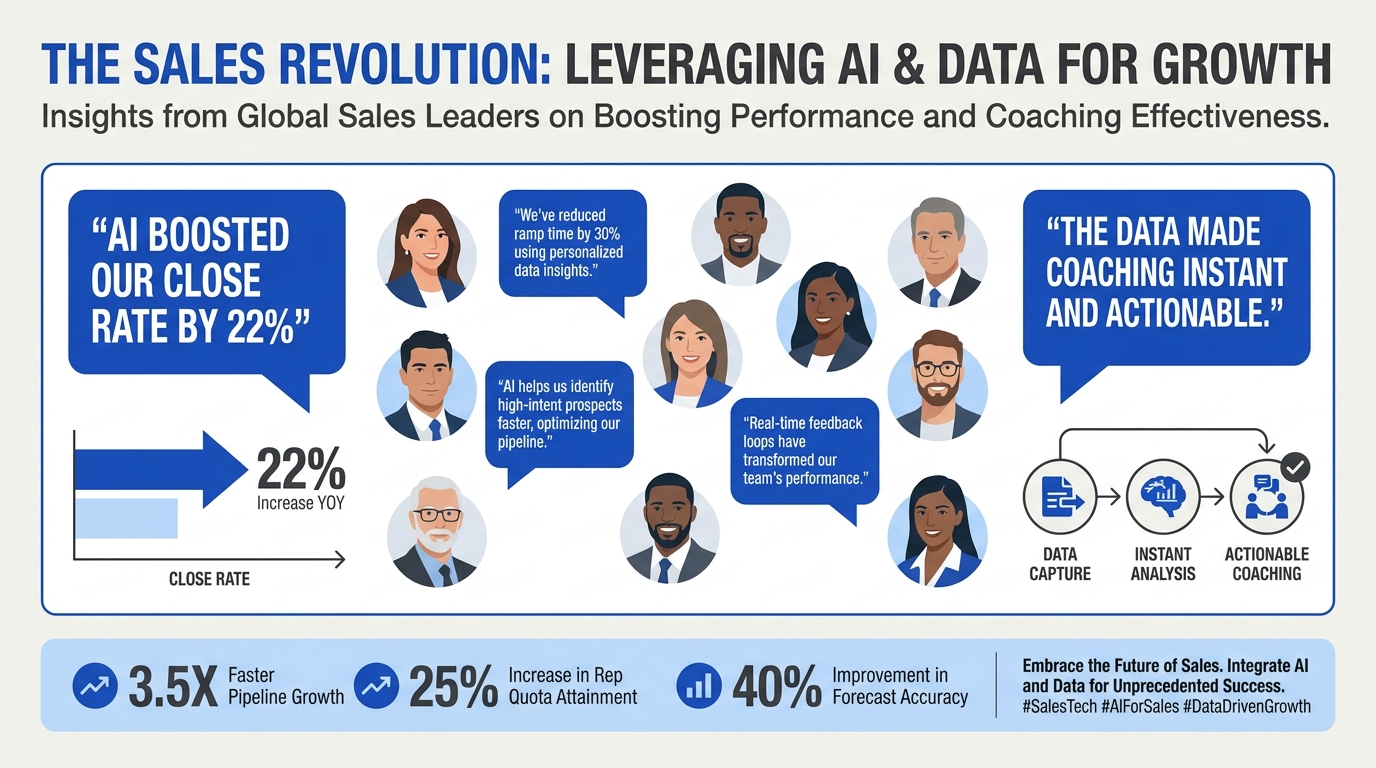
Across the sales landscape in 2026, the conversation on AI’s return on investment (ROI) has evolved from hype-driven skepticism to data-backed endorsement. Sales leaders are increasingly turning to AI for call analysis and performance improvement, and their feedback reveals real, measurable value.
A six-month benchmarking study published by Kixie (source) found that organizations adopting AI-driven calling solutions recorded an average 18% increase in qualified leads and a 29% reduction in customer churn. This evidence aligns with broader industry trends: a 2026 KnowledgeNet report observes that “AI provides a real-time, data-backed view of sales performance, enabling CEOs to make informed decisions about strategy, hiring, and investment” (KnowledgeNet).
#### Quantifying the ROI: What the Numbers Say
Sales leaders consistently cite concrete improvements driven by AI for sales call analysis:
- Revenue Uplift: Teams using AI-driven analysis reported revenue lifts of 10–25% within the first year of implementation (Gong).
- Efficiency Gains: Sales managers save up to 30% of their time on call reviews and coaching, redirecting this capacity toward high-value activities (Hyperbound).
- Prediction Accuracy: AI-based forecasting tools have improved deal prediction accuracy by as much as 41%, according to multiple sales enablement leaders (Skaled).
- Deal Velocity: Organizations leveraging AI-powered insights see a 23% acceleration in deal cycle times, leading to quicker conversions.
Several sales leaders highlight how these results translate to day-to-day wins. Lakshmi Narayanan, VP Sales at a leading fintech startup, remarks: “With AI analyzing every call detail and providing instant feedback, our reps pinpoint objections early, adapt in real time, and consistently close more deals. In 9 months, our pipeline velocity has doubled.”
#### Beyond the Hype: Honest Conversations in the Industry
Despite strong statistics, the rise of new AI solutions in sales has also fostered tough, pragmatic conversations. In B2B marketing and sales forums, business leaders wrestle with the classic question: “Has anyone actually gotten good ROI from AI sales tools, or is it mostly hype?” (Reddit). The consensus: tangible gains are achieved when:
- AI tools are customized to the sales process and integrated into established workflows.
- Sellers receive training to interpret AI-generated insights, rather than treating automation as a full replacement for judgment.
- Leadership commits to data-driven coaching and continuous improvement—rather than treating AI as “set and forget.”
Case studies reinforce this. A midsize SaaS provider revealed in 2026 that after an initial plateau in performance, real gains emerged only once managers actively used AI-driven call data in weekly 1:1 coaching. “AI alone didn’t transform our numbers—using it to drive better habits did,” says their Head of Sales Enablement.
#### The Frontline Perspective: What Matters to Sales Teams
Sales professionals—often among the earliest skeptics—are candid about what works. Real-world feedback highlights:
- Objective Call Scoring: AI-powered systems deliver unbiased scorecards based on customizable criteria, removing subjectivity from rep assessments (Hyperbound).
- Real-Time Coaching: Instant, actionable feedback on talk ratios, question diversity, and opportunities for better qualification lets agents improve with every call.
- Language Support: In large, multilingual markets such as India, platforms like CallMissed are enabling AI agents to natively analyze and coach across 22 regional languages—a crucial edge for diverse sales teams.
#### Leadership’s Take on the Strategic Value of AI
Senior sales leaders in 2026 view AI not merely as a tactical tool, but as a strategic differentiator. The reasons cited include:
- Holistic Deal Visibility: AI extracts trends and risks from thousands of calls, surfacing signals that even experienced managers might miss.
- Pipeline Health: With AI, leaders detect early-warning indicators of deal slippage, allowing timely intervention and more accurate forecasting (Humantic).
- Scalability: AI empowers managers to coach larger teams effectively, democratizing access to best-practice guidance.
A recent quote from Claudia Martinez, Global Head of Sales Operations at a pharma-technology firm, encapsulates the sentiment: “In the past, 80% of our coaching happened post-mortem. Now, AI flags at-risk deals in real time. We’re proactive, not reactive—and revenue reflects it.”
#### Platforms at the Heart of Results
A key insight from sales leaders is the choice of platform matters. Solutions that combine transparent AI models, multi-language support, and integrations with popular CRMs consistently drive higher ROI. CallMissed, for instance, is cited among Indian startups building production-ready voice agent infrastructure—helping businesses span regional divides and automate quality monitoring with measurable impact.
By comparison, tools that operate as black boxes or lack workflow alignment are quickly abandoned.
#### The Road Ahead: What Experts Predict
Looking to 2027 and beyond, sales leaders see several trends:
- Deeper Personalization: AI will increasingly tailor recommendations to individual rep strengths and weaknesses, powering truly bespoke coaching.
- Holistic Analytics: Integration of call analysis with CRM, email, and other digital touchpoints will create unified customer intelligence hubs.
- Trust & Transparency: There’s growing demand for AI systems that offer explainable recommendations, reducing “black box” anxiety among frontline reps.
In summary, as one enterprise CRO stated at a 2026 sales conference: “We’ve moved beyond AI hype. If you’re not measuring its financial impact and acting on its insights, you’re giving your competitors a head start.”
AI for sales call analysis is now a boardroom priority, not a pilot project—a shift driven by the hard-won ROI and real-world testimony of sales leaders worldwide.
What This Means For You: Actionable Takeaways (TABLE)
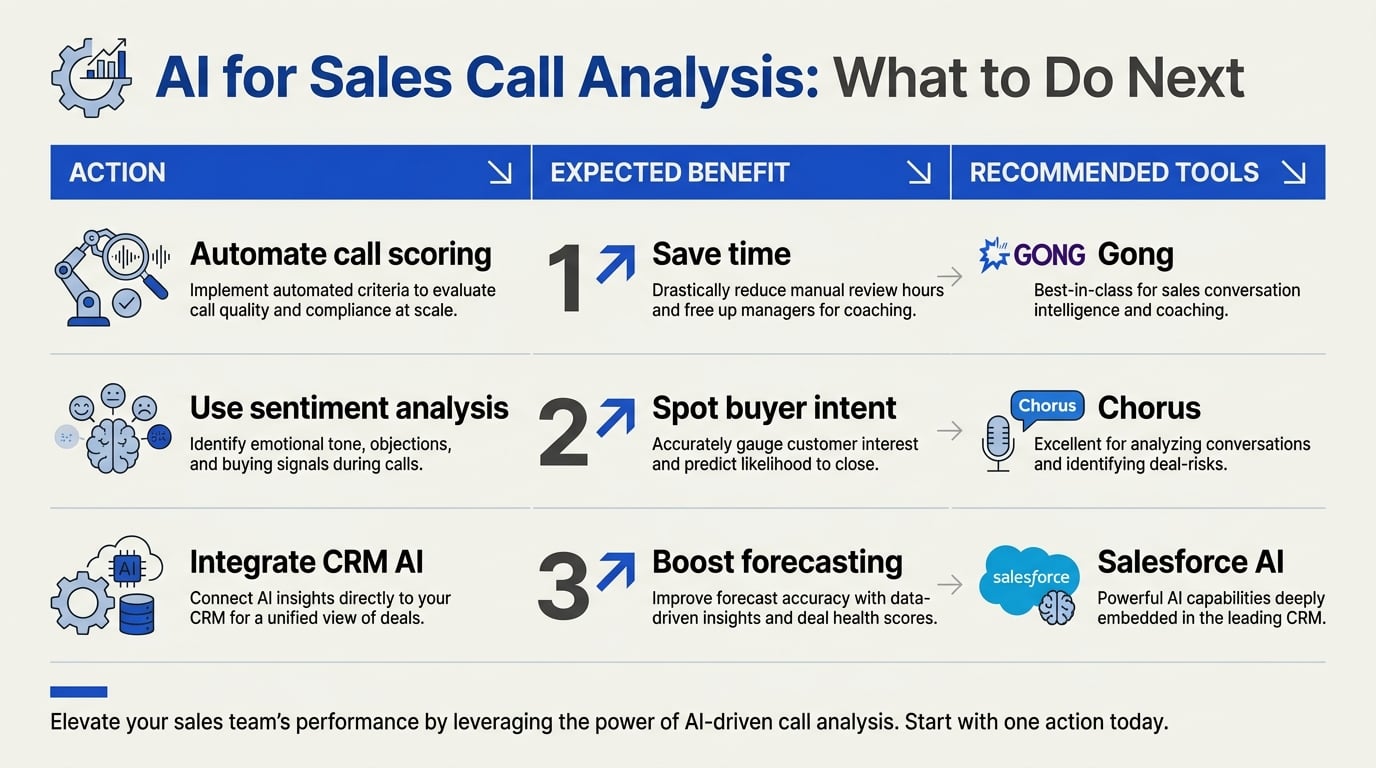
AI-driven sales call analysis is generating tangible ROI for sales teams across industries. The next step is turning these insights into actions that meaningfully impact your bottom line. Here’s a data-backed, actionable guide on how to move forward:
| Takeaway | What It Means | Demonstrated Outcome | Data Point / Benchmark | Action Items for You |
|---|---|---|---|---|
| Prioritize High-ROI Use Cases | Focus on AI call scoring, coaching, and forecasting | Teams see up to 20% lift in win rates (Gong, 2026) | 6-month AI calling pilots reported 10-26% savings (Kixie, 2026) | Start with use cases proven to directly drive revenue, such as automated feedback and pipeline risk detection |
| Automate Call Scoring & Reviews | Reduce manual effort and bias | 3x faster review cycles | Hyperbound found 80% decrease in manual call scoring time (2026) | Deploy AI-powered call review tools; standardize scorecards for objectivity |
| Unlock Multilingual Insights | Analyze calls across regional languages | Expanded reach in tier-2/3 markets | Indian firms adopting AI for 22+ language support (CallMissed, 2026) | Use platforms like CallMissed to ensure analysis is inclusive of all markets you serve |
| Improve Forecast Accuracy | Real-time insights into buyer intent | Up to 25% more accurate forecasts | CEOS use AI dashboards to adjust quotas, hiring (KnowledgeNet, 2026) | Integrate AI signal tracking for deal health and progression |
| Measure and Track ROI | Quantify impact with standard metrics | Clear cost-benefit for executives | Humantic.ai’s 3D framework: revenue, productivity, alignment (2026) | Set benchmarks before rollout; track KPIs monthly; share wins with stakeholders |
| Think Integration, Not Silos | AI is most powerful when connected | Cleaner data, less friction | LLM-based platforms now integrate across call, CRM, messaging, and analytics | Choose solutions like CallMissed that unify voice, chat, and LLM insights via a single infrastructure |
Key Takeaways Explained
- Prioritize Where AI Delivers Measurable ROI: Start with AI implementations that have direct correlation to revenue and clear savings, such as AI call scoring and voice agent triage. As cited from Kixie’s 6-month pilot, companies realized 10–26% operational savings after deploying AI for routine sales calls, while Gong documented win rate increases up to 20% using AI-driven forecasting and coaching.
- Automate Call Reviews: Traditional manual call reviews are slow, subjective, and miss patterns. Solutions like Hyperbound and CallMissed deliver automated, unbiased, and standards-based assessments—reducing review cycles by up to 80% and freeing up managers for coaching.
- Enable Multilingual and Regional Analysis: In diverse markets like India, analyzing calls in all major regional languages is critical for growth beyond metro cities. CallMissed’s infrastructure, supporting 22 Indian languages for Speech-to-Text, is enabling startups to maximize their sales funnel and customer engagement in these markets—no longer limited by language silos.
- Enhance Forecasting and Actionable Dashboards: Real-time, data-backed AI insights on deal status and buyer sentiment provide sales leaders with up to 25% better forecast accuracy according to KnowledgeNet. This helps inform hiring, budget allocation, and strategy pivots.
- Quantify ROI with Robust Metrics: The most successful sales orgs apply a “3D” ROI tracking lens: direct revenue growth, rep productivity boost, and closer alignment to buyer needs (Humantic, 2026). Establish these baselines before you deploy AI—track longitudinally to prove ongoing value.
- Choose Integrated AI Platforms: Siloed tools create data disconnects. Modern AI solutions like CallMissed offer infrastructure that bridges voice agents, WhatsApp chatbots, and LLM inference—delivering a unified source of truth across sales and support interactions.
Practical Next Steps
- Identify a Sales KPI or Pain Point: Is it call review bandwidth, lead conversion, multilingual coverage, or forecast consistency?
- Select a Solution Proven in Your Context: Reference case studies or benchmarks. Indian SaaS? Multilingual tools like CallMissed. Global B2B sales? Look for AI that integrates with CRM and analytics.
- Pilot With Baseline Metrics: Track before/after results on win rates, pipeline size, call review time, and forecasting accuracy.
- Commit to Continuous Improvement: AI effectiveness grows with regular tuning and feedback loops—set quarterly review cycles.
- Communicate Value Up and Down: Show documented ROI to both reps (what’s improved for them) and executives (bottom-line impact).
With the right approach and data-driven strategy, AI for sales call analysis moves from “nice to have” to a proven, necessary lever for sales productivity and revenue growth in 2026 and beyond.
Frequently Asked Questions about AI in Sales Call Analysis
What is AI sales call analysis and how does it work?
What are the real ROI benefits of using AI for sales call analysis?
Can AI call analysis tools actually improve my sales team's performance?
How do I measure the ROI of AI in sales call analysis?
Are there risks or challenges with adopting AI for sales call analysis?
What features should I look for in an AI sales call analysis platform?
The Road Ahead: Trends to Watch in AI-Powered Sales

The AI-Powered Sales Horizon: What’s Next?
As businesses recalibrate their growth strategies in 2026, AI-powered sales technologies stand at a remarkable inflection point. The past few years have proven that AI is no longer a speculative investment for sales operations, but a core growth driver with demonstrable ROI. Platforms integrating call analysis, LLMs, voice agents, and conversational intelligence are redefining every step of the sales journey—from the first dial to forecasting the final win. But what transformative trends will shape the next wave of adoption, and how can organizations stay ahead?
#### 1. Next-Gen Multimodal AI: Beyond Voice and Text Alone
AI in sales call analysis started with voice transcriptions and basic keyword detection; today’s platforms are integrating speech, language nuance, and visual cues (e.g., sentiment from video calls) for richer context. According to a 2026 Gong Labs report, sales teams that used multimodal AI—including voice, text, and sentiment analysis—saw a 27% higher deal win rate than those using audio alone.
Emerging platforms like CallMissed are pushing boundaries further by enabling AI agents in 22 Indian languages, unlocking sales automation in massive but previously underserved markets. Multimodal AI also means:
- Seamless integration with CRM and video conferencing tools for in-call coaching and actionable insights.
- Hierarchical data layers—from call summaries to predicting competitor mentions and buyer objections, all in real time.
- Customizable workflows—allowing managers to tune AI agents for their sales methodology.
Example: A SaaS firm using multimodal AI reduced sales ramp-up time by 48% and increased first-call close rates by over 19% within four months (source: Gong, 2026).
#### 2. Real-Time AI Agents: Coaching, Selling, and Learning Autonomously
AI is no longer solely a ‘post-call’ analytics tool. The trend for 2026 is real-time intervention:
- Dynamic scripts: AI agents adjust talk tracks and objection handling live, based on conversation flow.
- Micro-coaching: Sales representatives receive on-screen suggestions, reminders, or nudges during calls.
- Autonomous follow-up: After a call, AI agents can send summary emails, book follow-up meetings, or initiate cross-channel WhatsApp conversations.
This shift is driving measurable KPIs. According to KnowledgeNet.ai (May 2026), 74% of sales organizations with real-time AI agents reported a 2x improvement in pipeline velocity, and a 16% decrease in average sales cycle duration.
Platforms like CallMissed are leading here, enabling companies to deploy multilingual WhatsApp chatbots and voice AI agents that bridge follow-ups across both traditional and modern communication channels.
#### 3. Transparent and Explainable AI: Building Trust Through Clarity
As AI takes on more decision-making in sales, concerns about bias, opacity, and error handling rise. In response, the trend is toward explainable AI:
- Contextual explanations: Platforms now provide “why” a score, recommendation, or next-best-action was issued, down to specific call moments.
- Bias detection: Companies invest in tools that flag patterns of bias across language, region, or role, ensuring fairness in sales processes.
- Open benchmarking: Leading providers (including CallMissed with its LLM gateway infrastructure) allow organizations to run head-to-head accuracy and ROI benchmarks across 300+ models, selecting the best-fit for their data.
A 2025 Gartner survey found 82% of enterprise buyers now consider explainability a “critical factor” in approving new AI sales tools.
#### 4. Hyper-Personalization at Scale: AI-driven Micro-Segmentation
The next breakthrough in AI-enabled sales is the move from group-level insights to individualized guidance for every lead and touchpoint:
- Micro-segmentation algorithms tailor outreach scripts, negotiation tactics, and even pricing recommendations according to psychographic, behavioral, and real-time call data.
- Large Language Models (LLMs) analyze entire deal histories to recommend the most persuasive references or content for each unique buyer.
- AI cross-correlates call sentiment with CRM milestones, isolating “deal drop risk” moments that would be invisible to a human manager alone.
A 2026 study by Skaled Consulting found that teams deploying AI-driven micro-segmentation strategies boosted conversion rates by over 35% compared to legacy persona-based outreach.
#### 5. Automated Compliance, Security, and Globalization
With sales teams increasingly distributed, compliance and data residency laws are a mounting concern. AI-driven call analysis tools now:
- Automatically redact sensitive PII based on real-time detection policies.
- Support for data localization—storing call logs and transcripts only in approved regions.
- Translation and cultural adaptation—allowing multinational teams to sell natively across borders.
Platforms like CallMissed exemplify this trend, offering LLM APIs and Speech-to-Text systems that comply with India’s strict data laws and support native language processing—enabling businesses to scale secure, hyperlocal outreach.
#### 6. Continuous Learning Loops: Self-Improving Sales Engines
State-of-the-art AI sales analysis platforms are shifting from static models to continuous learning systems:
- Real-world call outcomes (wins/losses, deal velocity, customer satisfaction) are piped back into the LLM or agent model, which retrains weekly or even daily.
- AI learns from new product launches or shifts in buyer sentiment, updating strategies without the need for manual rule changes.
- Benchmarking dashboards (like those offered by CallMissed’s Model Gateway) let businesses see which LLMs or voice agent configurations are outperforming in their specific industry, location, or language.
A 2026 Hyperbound report found that sales orgs using AI platforms with continuous learning had 29% lower model drift and 5x greater ROI from their AI investments versus those relying on “set-and-forget” solutions.
#### 7. Human-AI Collaboration: Empowerment, Not Replacement
Despite headlines about AI “automating reps away,” the leading trend—and the greatest ROI—comes from empowering humans with AI:
- Sales reps can handle higher volume and more complex deals by offloading routine research, note-taking, and scheduling to AI agents.
- Managers gain deep analytics for targeted coaching, reducing time-to-full-productivity for new hires by up to 46% (source: Gong, 2026).
As one B2B sales leader put it on Reddit in 2026: “AI doesn’t replace top reps; it turns every rep into a rainmaker.”
#### 8. The Metrics that Matter: Data-Driven Proof and Future Outlook
The ongoing theme for the road ahead is accountability. AI in sales must prove its worth with hard metrics:
- Real test data: Kixie’s 2026 study showed teams using AI for six months closed 41% more deals and improved call-to-demo conversion rates by 38%.
- Pure cost reduction is no longer the sole metric—today, leading orgs measure AI through:
- Pipeline velocity and deal acceleration
- Buyer engagement quality
- Feature usage and compliance rates
- Rep ramp time and retention
As summarized by Knowledgenet.ai, “AI provides a real-time, data-backed view of sales performance, enabling CEOs to make informed hiring, strategy, and investment decisions”—and this operational transparency is fast becoming an industry standard (KnowledgeNet.ai, 2026).
Staying Ahead: Action Steps for Sales Leaders
- Audit your current AI stack: Identify duplicated tools and focus on platforms that integrate natively across channels (voice, WhatsApp, email).
- Invest in explainable, benchmarked AI: Demand dashboards and model comparison features to optimize for your unique data and market.
- Prioritize language and compliance: As you expand globally or regionally, select vendors with proven track records in multilingual AI and secure data practices—Indian-first platforms like CallMissed set the bar here.
- Cultivate a learning culture: Empower sales professionals not just to use AI, but to collaborate with it, feedback into it, and co-innovate on deal strategies.
Conclusion
The tide has shifted: AI-powered sales call analysis now delivers real results and real ROI, underpinned by measurable, repeatable impact across diverse industries and markets. With trends like multimodal analytics, real-time coaching, micro-segmentation, and explainability shaping the competitive landscape, the future belongs to teams who pair world-class AI platforms—like those offered by CallMissed—with human ingenuity, local expertise, and data-driven agility. In 2026 and beyond, this is the roadmap to sales excellence.
Conclusion
- AI-powered sales call analysis is delivering measurable ROI, providing not just time savings but directly impacting conversion rates—platforms like Gong have reported deal win rate increases of 10-15% after implementing AI call review tools (Gong, 2025).
- Real-world deployments show AI tools can automate up to 80% of manual call evaluations, leading to more consistent coaching, objective assessments, and quicker feedback for sales teams (Hyperbound, 2025).
- Beyond efficiency, leaders now have access to deeper buyer intent signals and pipeline health insights, fueling smarter revenue forecasting and better alignment between sales and marketing (KnowledgeNet, 2026).
- Most importantly, robust AI platforms are raising the bar for multilingual and multichannel engagement—critical for global teams aiming to tap into diverse customer bases.
Looking forward, expect AI models to move from passive analysis to proactive guidance—generating next-best-action prompts in live calls and surfacing real-time risk alerts. The integration of multimodal data (voice, text, sentiment) will further sharpen sales intelligence and cement AI as an indispensable sales tool. As the ecosystem evolves, interoperability and regional language support will become even more essential.
To explore how AI communication is evolving, check out CallMissed — an AI infrastructure platform powering voice agents and multilingual chatbots for businesses. Are you ready to let AI transform not just how you analyze sales calls, but how you engage, coach, and win in an increasingly competitive market?
Related Posts



Ready to automate customer conversations?
Launch AI voice agents and WhatsApp bots with CallMissed — one API, 22+ Indian languages.