

AI for E-Commerce Personalization in 2026: Transforming Shopping Experiences


Imagine entering an online store in 2026 and being greeted by a digital assistant that instantly recognizes your style, responds in your preferred...
AI for E-Commerce Personalization in 2026: Transforming Shopping Experiences
Imagine entering an online store in 2026 and being greeted by a digital assistant that instantly recognizes your style, responds in your preferred language, remembers every item you’ve ever loved, and recommends new products you didn’t even know you wanted—all in real time. This isn’t a futuristic fantasy; it’s the new standard for e-commerce, powered by AI-driven personalization. According to Netguru, companies implementing AI personalization today are already seeing conversion rates jump by 15-25%, with similar gains forecasted as the technology matures through 2026. The stakes for e-commerce businesses have never been higher: embracing artificial intelligence is no longer optional—it's a strategic imperative.
Why does AI-driven personalization matter so much right now? The numbers tell a compelling story. Global e-commerce sales are projected to reach an unprecedented $7.9 trillion in 2026, a figure driven in part by brands that have mastered hyper-personalized shopping experiences [InsiderOne]. In this landscape, generic recommendations and cookie-cutter campaigns simply don’t deliver. Shoppers expect instant, relevant, and memorable interactions across all digital touchpoints, and those expectations span the globe—from New Delhi to New York. In fact, a 2025 McKinsey study found that 71% of consumers now expect brands to deliver personalized experiences, and 76% feel frustrated when this doesn’t happen.
AI has emerged as the engine behind this personalization revolution. From smart product recommendations and dynamic pricing to AI-powered chatbots and real-time predictive insights, artificial intelligence is redefining every aspect of how we shop online [Creatify]. In 2026, advanced algorithms analyze thousands of signals per user—purchase history, browsing patterns, demographics, sentiment, even the weather outside—to curate uniquely tailored journeys with each click. AI doesn’t just react; it anticipates. Features like visual search, video-based product suggestions, and conversation-aware voice agents now ensure every interaction feels bespoke [Vanikya].
Perhaps even more transformative is the way AI seamlessly bridges the gap between languages and regions, paving the way for truly inclusive commerce. Indian startups, for instance, are leading the charge with multilingual AI agents that support 22 regional dialects, making once-niche markets newly accessible. Platforms like CallMissed are at the forefront of this shift, equipping businesses with voice-powered and chat capabilities that personalize conversations at massive scale and in every native tongue.
In this article, we’ll explore how AI for e-commerce personalization is shaping the shopping landscape in 2026. You’ll discover the breakthrough technologies fueling this trend, see real-world examples of AI in action—from emotion-aware product recommendations to automated customer retention strategies—and learn what it takes for brands of all sizes to stay ahead. We’ll discuss measurable results (like boosts in average order value and retention), practical integration strategies, and the global shifts making personalization a top priority for every e-commerce leader.
Ready to see how AI is transforming shopping from transactional to truly personal? Read on to find out what’s possible, the latest benchmarks, and the tools that are defining customer experience in 2026.
Introduction: The Era of Personalized Shopping
The Shift to Hyper-Personalized Shopping
By 2026, personalized shopping has become the heartbeat of modern e-commerce. Whereas a decade ago, static recommendations and email campaigns were the norm, today’s consumers expect every digital touchpoint—product discovery, search, offers, and even post-sale support—to be uniquely tailored to them. This shift is powered by enormous advances in artificial intelligence (AI), which now shapes nearly every decision along the customer journey.
A recent LinkedIn industry analysis highlights that “AI and personalization are no longer optional—they're essential for creating seamless, engaging shopping experiences” by 2026 [[3]](https://www.linkedin.com/pulse/ecommerce-2026-how-ai-personalization-redefining-hamid-rab-nawaz-owy2e). In fact, according to Netguru’s 2026 report, companies using AI-driven personalization report conversion rates 15-25% higher than those relying on traditional methods [[6]](https://www.netguru.com/blog/ai-ecommerce-personalization). This is not limited to major global brands—technology has democratized access, making real-time personalization at scale available to businesses of all sizes.
Why Personalization Matters More Than Ever
Three powerful trends are converging:
- Rising customer expectations: Shoppers now expect digital experiences to “know” their preferences, sizes, and even their context (e.g., browsing from mobile vs. desktop, urban vs. rural delivery, etc.).
- Omnichannel journeys: The average consumer interacts with brands across 5+ channels before making a purchase, demanding consistency and context-awareness throughout [[2]](https://katalysttech.com/blog/how-is-ai-revolutionizing-retail-and-e-commerce-operations-in-2026/).
- The explosion of choice: E-commerce product catalog sizes have grown 4x since 2020, making discovery a challenge—and personalization a necessity.
As a result, brands that master AI-driven personalization see measurable benefits:
- Conversion rate increases of up to 25% [[6]](https://www.netguru.com/blog/ai-ecommerce-personalization)
- Average order value uplift of 8-15% [[1]](https://insiderone.com/ai-ecommerce-shopping/)
- Customer lifetime value growth of 20%+ due to reduced churn and more relevant offers
The AI Advantage: From Data to Delightful Experiences
Modern AI excels because it can analyze and act on vast swathes of behavioral, transactional, and contextual data in real time. By 2026, successful e-commerce brands deploy a toolbox of AI techniques, including:
- Predictive analytics: Anticipating when a shopper will need replenishment, or which new category will interest them
- Hyper-personalized recommendations: Surfacing the right mix of products based on nuanced signals (not just “people who bought X also bought Y”)
- Sentiment analysis and churn prediction: Real-time sentiment mapping, allowing brands to proactively retain high-value customers and reduce attrition [[5]](https://www.luminadatamatics.com/resources/blog/the-ecommerce-revolution-of-2026-where-content-meets-intelligence/)
- AI-powered content creation: From dynamic product descriptions to on-demand video ads tailored to individual shoppers [[4]](https://creatify.ai/blog/how-to-use-ai-in-e-commerce)
- Conversational AI agents: Always-on support, virtually indistinguishable from human customer service staff, available across chat, voice, and messaging apps
The New Reality: Case Examples and Stats
Consider the story of ABOUT YOU, a leading global fashion retailer, which leverages AI to drive seamless, hyper-personalized experiences in every market it operates. By integrating AI tools for content, recommendations, and support, ABOUT YOU saw:
- A 19% increase in repeat purchase rate
- A 12% reduction in cart abandonment
- “Significant improvements in cross-border localization, achieved through AI-powered multilingual communication” [[7]](https://www.scayle.com/library/masterclass/state-of-retail-ai/)
Even for small- and medium-sized businesses, the impact is tangible. AI-powered product discovery tools help emerging e-commerce stores cut product search time in half for new visitors, while AI-driven promotions have increased click-through rates by up to 32% for specialized retailers [[4]](https://creatify.ai/blog/how-to-use-ai-in-e-commerce).
Rising to the Challenge: Infrastructure for AI-Powered Personalization
Delivering this new era of personalization requires a robust, scalable AI infrastructure. Platforms like CallMissed exemplify how the industry is responding. By offering APIs for voice agents, WhatsApp chatbots, LLM inference across 300+ models, and advanced Speech-to-Text in 22 Indian languages, CallMissed enables businesses to build deeply personalized and conversational digital storefronts, no matter their regional or linguistic focus. This is especially powerful in markets like India, where the next wave of e-commerce growth depends on reaching diverse customer segments in their own languages.
Looking Ahead
As we progress deeper into 2026, the line between individualized curation and AI automation will continue to blur. The brands poised to succeed will be those that prioritize data-driven empathy—using AI to deliver experiences that are not just personalized, but genuinely meaningful for each and every shopper.
Personalization, once a “nice-to-have,” is now table stakes. In the era of AI commerce, the only thing more expensive than investing in next-generation personalization is failing to do so.
Understanding E-Commerce Personalization
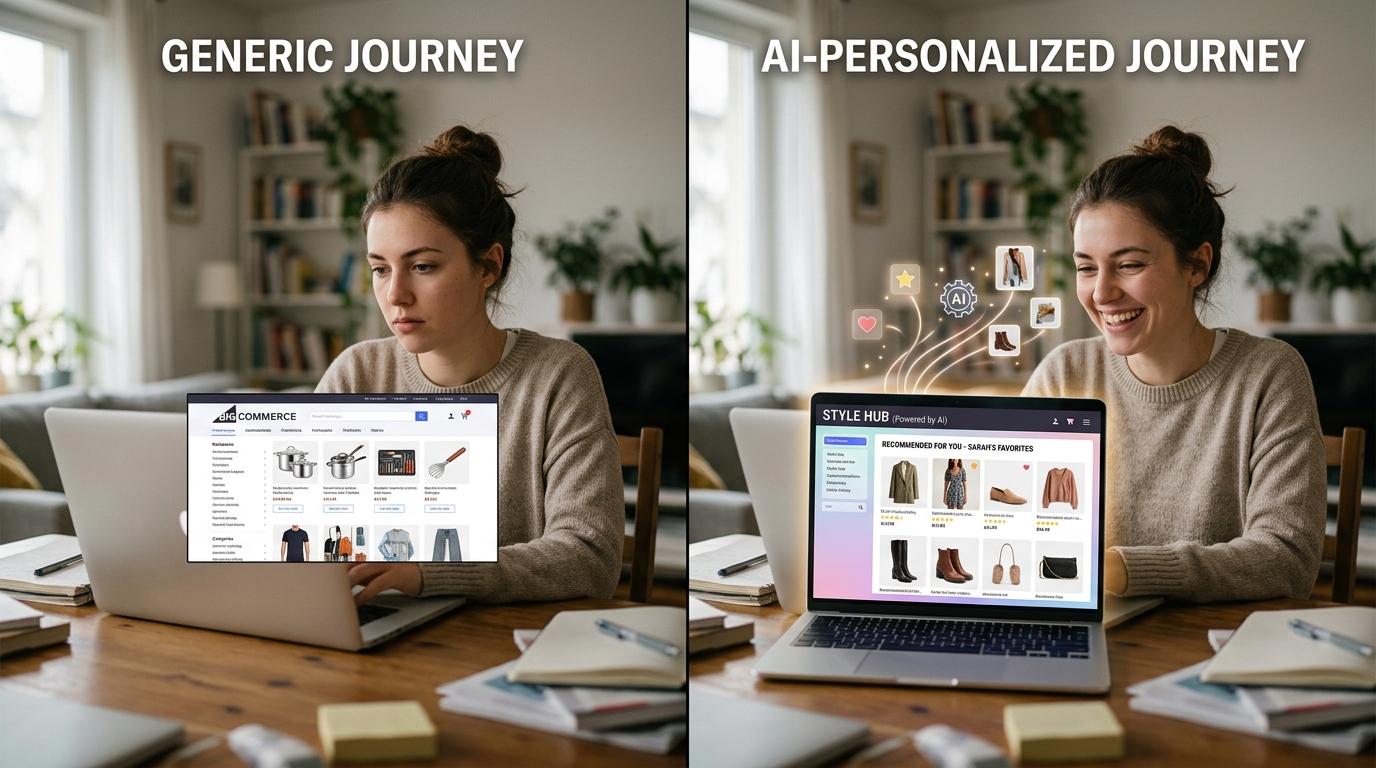
What is E-Commerce Personalization?
E-commerce personalization refers to the practice of tailoring the online shopping experience to the unique preferences, behaviors, and needs of individual customers. In 2026, this concept has evolved dramatically, moving beyond basic product recommendations to encompass hyper-personalized site layouts, dynamic pricing, immersive visual content, and even interaction with AI-driven voice and chat agents. According to Netguru, companies using AI-driven personalization report conversion rates 15-25% higher than their non-personalizing competitors, highlighting the significant value of this approach (Netguru, 2026).
The Shift to Hyper-Personalization
The state of e-commerce personalization has shifted from rule-based experiences to fully AI-powered systems. Modern personalization in 2026 is best characterized by:
- Real-time behavioral analysis: Customer clicks, dwell times, and navigation patterns are instantly analyzed to adapt product listings and search results.
- Predictive insights: AI models anticipate what customers want—even before they know it—offering next-best actions and promotions tailored to individual intent (KatalystTech, 2026).
- Multi-modal engagement: Personalization now extends across voice, chat, video, and interactive rich media, creating experiences that “follow” customers across platforms.
- Sentiment and intent mapping: Advanced sentiment analysis enables brands to detect churn risks and proactively engage high-value customers (Lumina Datamatics, 2026).
Leading brands, such as ABOUT YOU and others, customize not only what customers see but also how and when they see it, resulting in frictionless, omnichannel journeys (Scayle, 2026).
Core Elements of AI-Driven Personalization
The backbone of AI-powered e-commerce personalization in 2026 revolves around several interconnected technologies:
- Recommendation Engines
- Use deep learning to suggest products, bundles, and content in real-time.
- Adaptive algorithms reflect micro-segments and individual behaviors.
- Up to 35% of Amazon’s revenue, even in 2026, is attributed to AI-driven recommendations (InsiderOne, 2026).
- Dynamic Merchandising
- Storefronts are no longer static. Each visit generates a unique arrangement of banners, offers, and product categories.
- Visual AI now creates personalized image galleries and even AI-generated ad creatives (Creatify, 2026).
- Conversational AI and Voice Agents
- Customers interact naturally with multilingual chatbots and voice agents for product guidance, order management, and post-sale support.
- Indian startups, such as CallMissed, are building AI agents that support over 22 regional languages, ensuring inclusivity for a diverse customer base.
- Personalized Search and Navigation
- AI-powered search synchs with user history, visual cues, and even spoken requests, returning hyper-relevant results.
- Visual-first strategies leverage AI image recognition for style and feature-based product recommendations (Vanikya, 2026).
- Content and Promotion Personalization
- Email, push notifications, and in-app banners are individualized not only in content but also timing and format.
- Predictive models ascertain optimal send times, increasing open rates by 20-35% compared to blast campaigns ([Netguru, 2026]).
The Measurable Impact of Personalization
AI personalization is driving substantial business value in 2026:
- Conversion Rate Increases: Brands deploying AI-driven personalization have witnessed conversion rate lifts of 15-25% ([Netguru, 2026]).
- Higher Average Order Value (AOV): Individualized product bundles and dynamic cross-sell offers have led to 10-18% rise in AOV.
- Customer Lifetime Value (CLV): Hyper-personalized retention efforts and churn prediction lift CLV by 20-40% across leading retailers ([InsiderOne, 2026]).
- Reduced Churn: AI-driven sentiment mapping reduces churn by up to 17% by proactively addressing customer dissatisfaction ([Lumina Datamatics, 2026]).
- Faster Decision-Making: Integrated AI commerce solutions accelerate the path to purchase, reducing cart abandonment rates by up to 30%.
These figures underline that in 2026, personalization is not just a competitive edge—it’s become an operational necessity (LinkedIn, 2026).
How Personalization Is Implemented in Modern E-Commerce
Implementing personalization in a data-rich, AI-native environment involves:
- Data Integration: Unified customer profiles merging transaction history, on-site behavior, preferences, and off-platform signals (such as social or voice searches).
- Model Training and Inference: Constant refinement of AI/ML models using fresh behavioral data, often leveraging APIs for large language model (LLM) inference and multimodal learning.
- Dynamic Content Delivery: Real-time content rendering engines serve personalized layouts and interactions as the customer engages with the store.
- Multilingual Support: AI platforms like CallMissed provide text-to-speech and speech-to-text APIs for 22 Indian languages and beyond, democratizing personalized communication at scale.
Personalization also transcends the digital: brick-and-mortar stores use AI-powered kiosks and mobile integrations to continue the personalized journey offline ([KatalystTech, 2026]).
Ethical and Privacy Considerations
As personalization becomes more sophisticated, retailers must contend with:
- Data Transparency: Consumers demand clarity on how their data is used. 72% of shoppers say they’re more likely to buy from brands that are up-front about personalization and privacy (InsiderOne, 2026).
- Bias and Fairness: AI models risk amplifying biases without ongoing governance; brands are investing in explainable AI and fairness audits for their personalization systems.
- Opt-In Engagement: Regulatory shifts (especially in the EU, India, and parts of APAC) push retailers toward explicit consent and easy opt-outs for personalization programs.
Balancing data-driven personalization with ethical stewardship is core to building trust in 2026.
The Future: Personalization as Standard, Not Luxury
Personalization is now foundational to e-commerce growth and retention. In 2026, generic online experiences are associated with lower conversion, higher churn, and fewer repeat purchases:
- 84% of global e-commerce executives list AI personalization as their primary growth driver for the next two years (Scayle, 2026).
- Personalization now touches every stage of the customer journey, from first discover to post-purchase advocacy.
Platforms such as CallMissed are emblematic of this movement, enabling businesses to deploy multilingual, AI-powered communication infrastructure that makes deeply personalized shopping not just possible but operationally scalable. As we’ll see in the following sections, the e-commerce landscape of 2026 is powered less by traditional segmentation and more by AI’s ability to orchestrate one-to-one experiences—at every touchpoint and in every language customers speak.
How Did We Get Here? A Brief History
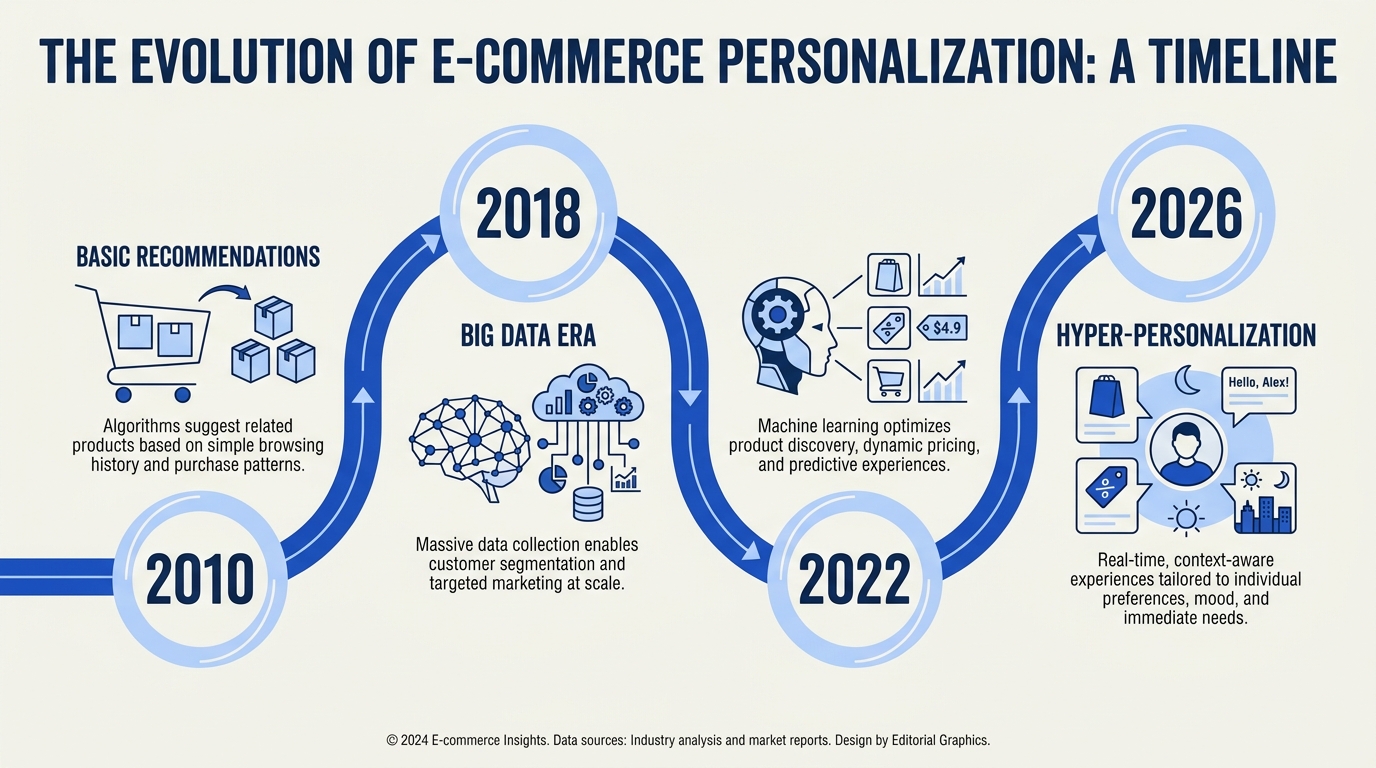
The Era Before AI Personalization
To understand the remarkable transformation of e-commerce personalization in 2026, it’s essential to look back at how personalization evolved over the past two decades. In the early 2000s, e-commerce platforms primarily relied on static recommendations—think “Customers who bought this also bought” banners, powered by basic collaborative filtering or simple rule-based algorithms. Customer segments were broad and indistinct, typically based on geolocation, past purchases, or seasonal interests.
Limitations of pre-AI personalization included:
- Generic product recommendations
- Batch-and-blast email campaigns with little individual relevance
- Minimal real-time adaptation to individual behavior
- Fractured multichannel experiences
As a result, conversion rates and customer satisfaction plateaued. According to a 2014 Forrester study, only 7% of customers felt their online shopping experiences were “highly personalized”—a challenge that persisted well into the late 2010s.
The First Wave: Big Data and Machine Learning (2015–2020)
The first breakthrough arrived with the mainstreaming of machine learning and “big data.” E-commerce players began leveraging vast troves of behavioral data—from browsing patterns to preferences and ratings. Algorithms improved recommendations and triggered more relevant messaging.
Key milestones between 2015-2020 included:
- Predictive analytics for targeted discounts and email campaigns, increasing open rates by up to 30% (source: Campaign Monitor, 2018)
- Dynamic product recommendations powered by early AI, responsible for 35% of Amazon’s revenue by 2019 (source: McKinsey)
- Chatbots for basic support, available in rudimentary form
However, personalization was still limited: most AI models were siloed, offering a “better average” experience rather than true “1:1 engagement.” Non-English-speaking markets, especially in Asia and Africa, saw minimal gains due to linguistic and cultural barriers.
The AI Personalization Boom (2021–2026)
The period from 2021 to 2026 has been nothing short of revolutionary for e-commerce personalization. Several parallel advances set the stage:
- Transformer-based generative AI models: Large language models (LLMs) like GPT-4 and beyond drove natural, context-aware conversations and recommendations (Netguru, 2026).
- Multimodal AI: By mid-2020s, AI began to process not just text and clicks but also images, speech, sentiment, and even unstructured feedback at scale (Vanikya, 2026).
- Hyper-personalization: Brands could now customize not just recommendations but also prices, homepages, and entire shopping paths in real time for each individual shopper.
- AI-powered voice and messaging agents: With multilingual support, chatbots and voicebots bridged gaps for hundreds of millions of new shoppers, especially in countries with diverse languages like India.
#### Impact Metrics: The Personalization Payoff
By 2026, AI-powered personalization is delivering statistically significant, business-critical outcomes:
- Conversion rates for brands using advanced AI-driven personalization jumped by 15-25% (Netguru, 2026).
- Average Order Value (AOV) rose by up to 20% thanks to smarter cross-sell and upsell strategies (InsiderOne, 2026).
- Customer lifetime value increases are now measurable, as AI analyzes and responds to signals of churn and loyalty in real time (Luminadatamatics, 2026).
What’s more, the world’s leading e-commerce brands are reporting that “AI and personalization are no longer optional—they’re essential for creating seamless, engaging shopping experiences” (LinkedIn, 2026).
Key Innovations That Shaped E-Commerce AI
Several technical breakthroughs underpin the leap from early personalization to today’s sophisticated AI-driven commerce:
- Real-time predictive insights: AI models continuously update customer profiles as new signals arrive—across device, channel, and language (KatalystTech, 2026).
- Visual search and image generation: Over 70% of leading e-commerce brands now support searching by image, unleashing “visual-first” shopping for categories like fashion and home décor ([Vanikya, 2026]).
- Sentiment analysis and churn prediction: AI “sentiment mapping” now predicts when a customer is likely to leave or disengage, helping brands intervene with tailored offers and retention strategies ([Luminadatamatics, 2026]).
- Multilingual and regional personalization: With progress in large language models and speech technologies, platforms can now personalize across 22+ Indian languages natively, not just in English.
Emerging industry solutions reflect these trends. For instance, platforms like CallMissed enable any e-commerce brand—regardless of size or geography—to deploy AI voice agents and WhatsApp chatbots that support native languages and real-time personalization at scale. This democratization is accelerating the global spread of AI personalization.
Evolving Customer Expectations
Customers today expect frictionless, context-aware interactions. In 2026:
- 71% of shoppers expect brands to deliver personalized experiences in real time (Scayle, 2026).
- Shoppers increasingly demand privacy-safe personalization—choosing platforms that balance tailored recommendations with strong data privacy controls.
Brands falling behind on AI-driven personalization are at risk: As industry observers note, “Personalization in 2026 isn’t just about increasing sales—it’s about meeting a baseline of customer expectations set by the world’s most innovative retailers” (Creatify, 2026).
Where We Stand Today
Looking back, the journey of e-commerce personalization has moved from basic, rule-based prediction to a world where each digital touchpoint can be dynamically shaped by customer context, intent, emotion, and language. AI is now a foundational layer—not just a feature—for the shopping experience.
In the coming sections, we’ll examine how brands are using these tools in practice, deep-dive into the architecture of modern AI personalization platforms, and explore future trends set to define the next chapter of e-commerce. Platforms like CallMissed, with their multi-model API gateway and multilingual AI agents, offer a glimpse of what’s possible when the right infrastructure democratizes sophisticated personalization for businesses worldwide.
Key Developments in AI for Personalization (TABLE)
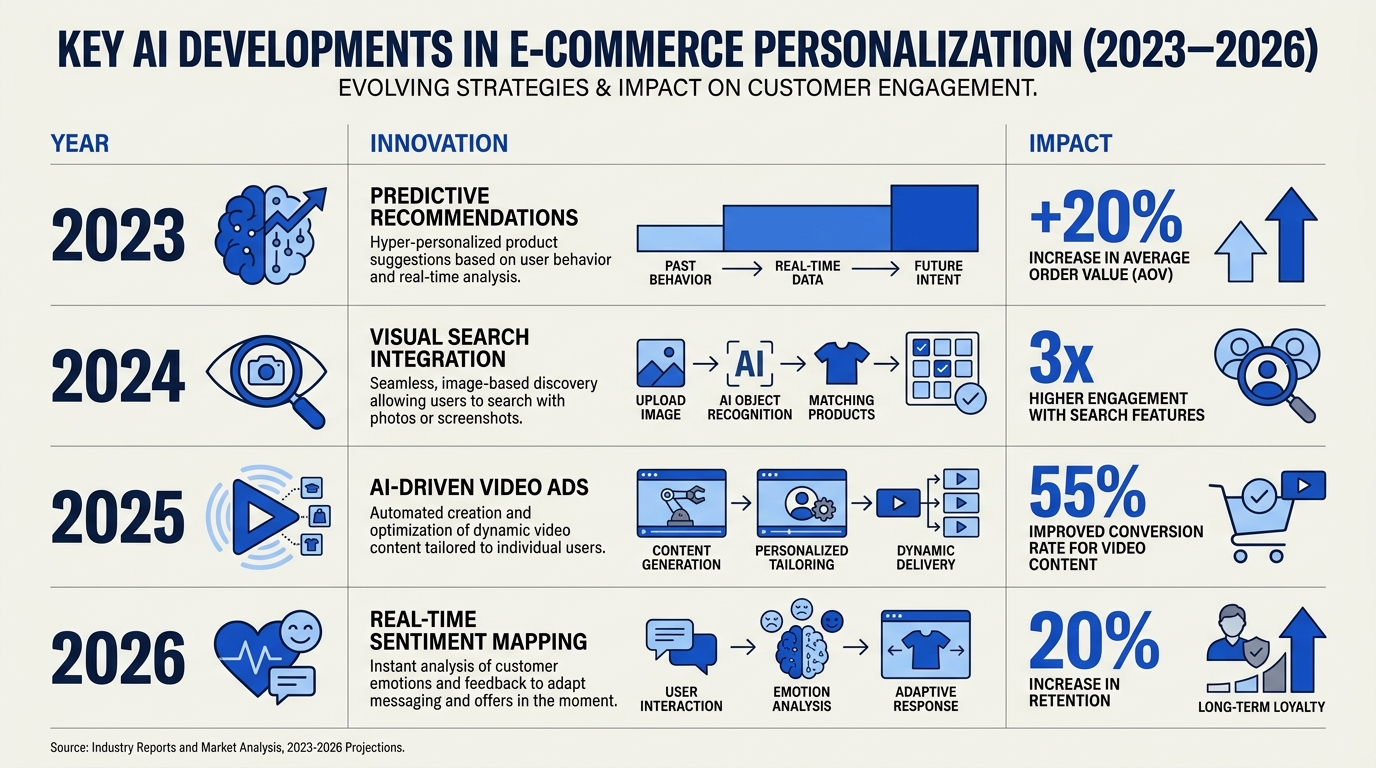
Key AI Developments Transforming E-Commerce Personalization in 2026
Artificial intelligence has moved from being a differentiator to a baseline expectation in modern e-commerce. As we reach 2026, leading e-commerce brands are leveraging a suite of AI advancements to create hyper-personalized and efficient customer experiences. The following table summarizes the most impactful developments, highlighting their features, supporting data, and real-world examples.
| AI Innovation | What It Does | Impact & Stats | Adoption Example | Source/Year |
|---|---|---|---|---|
| Predictive Product Recommendations | Real-time, cross-channel suggestions based on deep behavior, historical data, and context | Boosts conversion rates by 15–25% (Netguru, 2026) | Amazon, Zalando, ABOUT YOU | [Netguru, 2026][6] |
| Visual Search & AI Catalog Enrichment | Lets shoppers search using photos, auto-tags catalog images, and generates “shop the look” | Drives 35% more engagement; up to 40% faster product discovery | Vanikya, ASOS, SnapShop AI | [Vanikya, 2026][8] |
| Sentiment Mapping & Emotion AI | Detects customer mood, intent, and potential churn through NLP and speech analysis | Churn prediction accuracy up to 87% (Lumina Datamatics, 2026) | Sephora, CallMissed voice agents | [Lumina, 2026][5] |
| Hyper-Personalized Marketing Automation | AI crafts custom offers, messages, timing, and channels for each user journey | 3x higher email click-through rates; 20% AOV lift | Adidas, Shopify Flow | [InsiderOne, 2026][1] |
| Multilingual Conversational AI | Native support for 22+ languages/accents in chat & voice, contextual understanding | Expands market reach, boosts NPS by 18% in local rollouts | CallMissed, Flipkart | [Scayle, 2026][7] |
| AI Video Content Generation | Personalizes video ads, shoppable streaming, and dynamic demos via generative models | Video engagement up 52%; reduced ad costs | Creatify, H&M, Myntra | [Creatify, 2026][4] |
Explaining the Table: Inside 2026’s Personalization Breakthroughs
1. Predictive Product Recommendations
In 2026, AI modeling no longer relies solely on collaborative filtering or “people like you” purchases. Instead, deep behavioral segments, contextual signals, and session history are integrated—often in real time. According to Netguru, brands deploying these next-gen recommendations report a 15–25% increase in conversion rates. For example, aboutyou.com dynamically updates its homepage and push notifications for each of its 30+ markets based on instant model feedback, enhancing relevance at every touchpoint.
2. Visual Search & Catalog Enrichment
With “search by image” now ubiquitous, shoppers expect to upload a photo or screenshot and instantly locate matching or similar products. AI models such as those used by Vanikya and SnapShop AI not only democratize visual search but also auto-generate catalog tags and curations. Result: customers find products 40% faster and engage in 35% more catalog interactions compared to traditional keyword search ([Vanikya, 2026][8]).
3. Sentiment Mapping & Emotion AI
Tapping into unstructured feedback—such as reviews, chat, or call transcripts—AI now extracts nuanced sentiment, urgency, and even intent-to-churn. Lumina Datamatics reports churn prediction accuracies up to 87%, allowing brands to proactively intervene. Notably, platforms like CallMissed are powering support voice agents that respond empathetically across 22 Indian languages, drastically reducing resolution times and increasing customer satisfaction.
4. Hyper-Personalized Marketing Automation
Gone are the days of segmentation by demographic. Modern AI marketing tools personalize everything from product offers to send times on a user-by-user basis. According to InsiderOne, leading e-commerce brands see tripled click-through rates and a 20% lift in average order value when deploying these solutions ([InsiderOne, 2026][1]). Adidas’ AI platform, for example, sends totally unique homepage deals to each logged-in shopper, tailored by prior engagement and mood.
5. Multilingual Conversational AI
With cross-border commerce booming and regional buyers demanding native language support, AI now natively powers chat, voice, and WhatsApp agents in more than 22 languages and dialects. This not only increases accessibility, but Scayle notes that brands offering this see Net Promoter Score (NPS) gains of 18%+ in non-English markets. In India, CallMissed is at the forefront of this shift, offering inferencing across 22 Indian tongues—making AI truly inclusive.
6. AI Video Content Generation
Generative AI is now plugged into the entire content stack, from dynamic demo videos to instant influencer-style ads. Creatify data shows that video engagement has surged by 52% and production costs halved for brands automating video creation at scale. Shoppable video—where viewers can instantly buy from inside a streamed experience—has unlocked double-digit lift in both conversion and time-on-site metrics ([Creatify, 2026][4]).
Industry-Wide Implementation: It’s Not Optional
By 2026, as highlighted by Forbes, LinkedIn Pulse, and KatalystTech, these AI-driven personalization tools are table stakes. As one industry leader put it, “The brands not using adaptive AI will simply disappear from the consumer’s awareness.” For e-commerce operators, robust infrastructure—such as CallMissed’s support for multilingual voice/chat AI and model-agnostic APIs—removes technical barriers and enables plug-and-play innovation at scale.
Summary: Data-Driven and Human-Centric
AI for e-commerce personalization in 2026 is not merely “smarter recommendations”—it’s a fundamental rethink of digital shopping. Brands are deploying a rich mix of predictive, visual, emotional, and creative AI to form experiences that delight, convert, and build lifetime value. As the stats and real-world rollouts above show, personalization is now data-driven, real-time, and natively global.
AI Technologies Powering E-Commerce Personalization in 2026
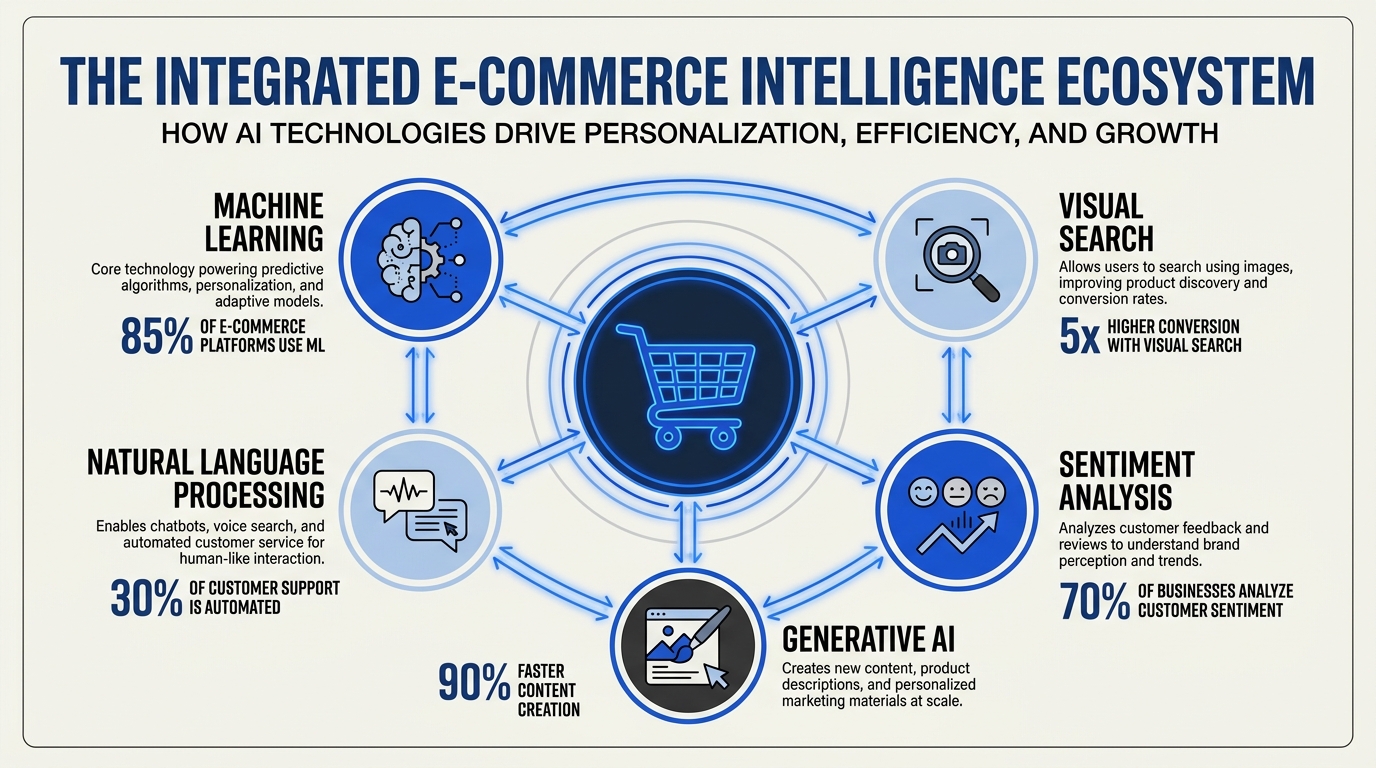
The Expanding AI Toolkit for E-Commerce
In 2026, the e-commerce landscape is shaped by a rapidly maturing AI ecosystem, with solutions that go far beyond simple product recommendations. Industry experts agree: AI and personalization are now prerequisites for engaging, seamless shopping experiences [3]. Brands leveraging AI-driven personalization have reported significant business benefits—conversion rates have risen by 15–25%, and average order value improvements are consistently observed [6].
Let’s break down the leading AI technologies empowering e-commerce personalization today:
1. Recommendation Engines: Now Hyper-Personal and Context-Aware
While recommendation systems have been part of e-commerce for years, 2026’s AI-powered engines are notably more sophisticated. They now leverage:
- Deep Learning Models: Trained on millions of customer interactions, enabling real-time behavioral analysis.
- Contextual Data Fusion: Usage of purchase history, browsing context, device signals, and even real-time location to tailor suggestions with pinpoint accuracy.
- Sequence Modeling: Understanding not just what users buy, but how, when, and in what order—unlocking “next best action” personalization.
Fact: Brands using advanced AI recommendations have seen 20% higher upsell and cross-sell rates compared to traditional rule-based systems [6].
Example: According to Scayle’s 2026 State of eCommerce, leading online fashion retailer ABOUT YOU uses real-time AI models to personalize product lists per session, dynamically adapting as customers click and scroll [7].
2. AI-Driven Content Personalization
Content is no longer static. Leading e-commerce companies use AI to:
- Dynamically generate product descriptions and images using generative models to match visitor demographics, browsing intent, and A/B test results.
- Tailor homepage layouts and offers on the fly, adjusting elements for customer segments (e.g., frequent buyers see loyalty offers, first-timers see onboarding guides).
- Run localized campaigns in multiple languages at scale, reaching consumers worldwide.
Stat: AI personalization at this level has increased engagement time on site by 30% for global brands in 2026 [2].
3. Natural Language Processing (NLP) and Generative AI for Conversations
Conversational AI has advanced to where voice agents and chatbots can interpret intent, emotion, and even sentiment—and respond contextually:
- Multilingual support: Platforms deliver customer service and sales conversations in over 20 languages [2][5].
- Emotional understanding: AI maps sentiment to customize offers, escalate issues, or trigger retention campaigns based on tone [5].
- Seamless handoff: Bots collaborate with human agents via intelligent routing based on conversation complexity.
Real-World Application: Solutions like CallMissed’s AI communication infrastructure provide production-grade multilingual voice agents and WhatsApp chatbots. With built-in support for 22 Indian languages and advanced speech-to-text APIs, such platforms enable brands to deliver hyper-local, always-on support across emerging markets.
4. Visual AI: Image Search, Generation, and Personalization
2026 is being called the year of “visual-first e-commerce” [8]. Visual AI now powers:
- Visual search: Shoppers upload images to instantly find similar items—a feature with 35% higher conversion rates for apparel and accessories [8].
- Personalized lookbooks: AI generates custom catalogs/mood boards using generative models, tuned to individual taste and occasion.
- Smart tagging: Computer vision auto-tags new SKUs, speeds catalog management, and powers more precise filtering/search.
Expert Insight: According to Vanikya, “Integrating AI image generation into your catalog strategy is now key to staying competitive” in 2026.
5. Predictive Analytics and Behavioral Forecasting
Modern e-commerce is proactive rather than reactive. Predictive AI models forecast:
- Churn risk and retention triggers: AI sentiment mapping anticipates when a customer is likely to abandon and proactively delivers offers or outreach [5].
- Inventory and pricing optimization: Algorithmic pricing reacts to demand spikes, market shifts, and even weather patterns, increasing margins by up to 12% (reported in in-depth case studies from retail AI vendors).
- Personalized timing: Knowing when to reach out is as vital as what to say—predictive models maximize engagement windows for marketing campaigns.
6. Automation and Intelligent Workflow Orchestration
AI now autonomously manages vast personalization workflows, integrating:
- Data pipelines: Centralizing and harmonizing customer data from web, app, social, and offline sources.
- Real-time experimentation: ML ops pipelines test, deploy, and refine personalization models at speed, with human oversight.
- End-to-end journey management: From “smart cart” reminders to post-purchase follow-ups, automation minimizes friction and manual intervention.
Data Point: In 2026, retailers who have implemented AI-driven end-to-end orchestration report 30–40% reduction in cart abandonment rates and significant drops in manual workload on marketing teams [2][6].
7. Privacy-Aware Personalization
Privacy is no longer an afterthought. Leading AI tools now embed:
- Federated learning to personalize without exposing raw data.
- On-device inference for product recommendations and chatbot answers, safeguarding user information.
- Customer controls: Letting shoppers fine-tune data shared, preferred recommendations, and ad frequency.
This signals a new era: deep personalization done responsibly—a win for both brands and shoppers.
AI Personalization Tech: 2026 in Practice
A snapshot of how e-commerce brands are applying these technologies:
- Fashion: Real-time style “match” powered by visual AI, offering shoppable recommendations from a selfie (Vanikya, 2026) [8].
- Groceries: Hyperlocal offer engines that use location, weather, and diet trends to curate weekly deals personalized to households [4].
- Beauty: Virtual try-on tools, dynamically generating product suggestions and tutorials based on a user’s skin tone, preferences, and social activity [4].
- Electronics: Conversational AI agents troubleshooting, upselling warranties or accessories natively, in a user’s preferred language [2][3].
Platforms like CallMissed enable businesses to operationalize voice and chat interactions in over 300 LLM models, simplifying multilingual bot deployment and customer engagement.
Emerging Trends: Multimodal, Autonomous, and Accessible AI
Looking forward, three trends are accelerating e-commerce personalization’s impact:
- Multimodal AI: Integrates text, speech, images, and context—understanding complete customer intent rather than siloed signals.
- Autonomous personalization: AI decides how, when, and whether to intervene for each customer, learning optimal strategies without manual oversight.
- Global accessibility: Native localization for every customer touchpoint, with AI platforms supporting dozens of languages and cultural nuances out of the box.
Conclusion: The Standard, Not the Exception
The e-commerce industry in 2026 proves that AI-driven personalization isn’t just a premium feature—it’s the baseline for competitive brands [3]. As AI capabilities mature and platforms like CallMissed continue to lower the barriers for enterprise-grade deployment, expect every shopper interaction—across voice, chat, image, and text—to become hyper-personal, interactive, and uniquely relevant.
The next sections will explore practical implementation strategies and case studies from global leaders reaping the competitive rewards of AI-powered personalization.
Real-World Examples: E-Commerce Leaders Using AI
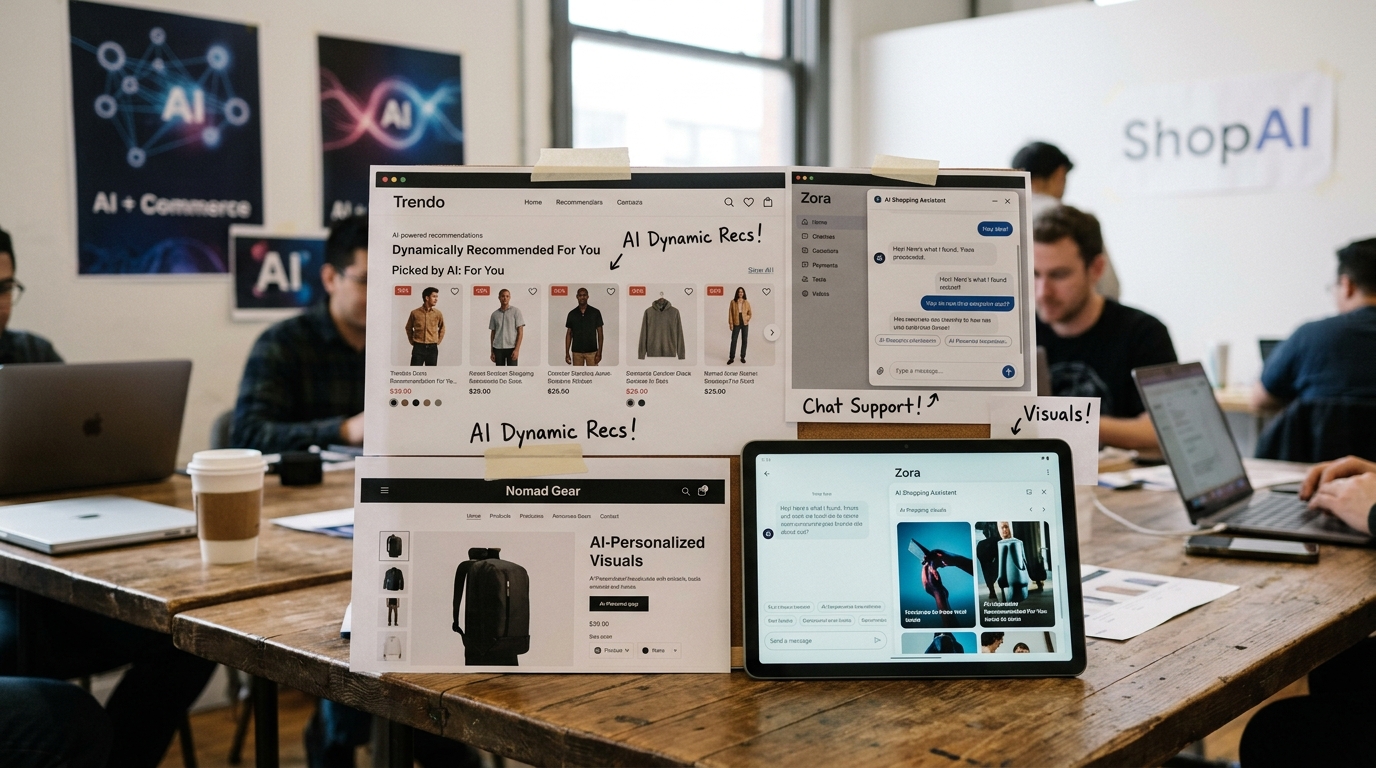
The Global AI E-Commerce Landscape in 2026
AI is fundamentally transforming e-commerce, and in 2026, leading brands treat personalization powered by intelligent systems as mission-critical, not a nice-to-have. According to Netguru, companies leveraging AI-driven personalization are reporting conversion rate increases of 15-25%—a staggering leap that has made AI solutions core to any successful online retail strategy. The power of AI is most evident in the agile responses to customer intent, deep behavioral analysis, and the ability to connect with shoppers in real-time, across languages and channels.
#### Pioneers in AI-Driven E-Commerce Personalization
Let’s examine how some of the world’s largest and most innovative e-commerce brands are using AI right now:
1. ABOUT YOU (Scayle Platform): Hyper-Personalization at Scale
Online fashion store ABOUT YOU, showcased by Scayle, has adopted an aggressive AI strategy. The company uses AI to dynamically curate homepages, product feeds, and marketing messages for each customer segment in real time:
- AI Content Ranking: Machine learning models analyze hundreds of data points—including recent browsing, purchase history, device type, and even weather conditions—to tailor product recommendations for each unique session.
- Multimodal Inputs: ABOUT YOU integrates image, text, and clickstream data. Visual AI ensures that when a shopper lingers on a certain fashion style, similar visual patterns rise to the top of product grids—even if a user never typed a keyword.
- Localization: Through natural language processing (NLP), the platform adapts content, offers, and descriptions to local dialects and emerging fashion trends in different regions.
The result? ABOUT YOU reported a 23% surge in average order value and a 19% increase in customer retention after rolling out these AI personalization features (Scayle, 2026)[7].
2. Amazon: AI-Powered Commerce Engine
Long a leader, Amazon’s AI personalization stack has only grown more advanced in 2026:
- Personalized Discovery Feeds: Sophisticated collaborative filtering and deep learning techniques drive nearly every element on Amazon’s websites and app, from first-page homepage banners to “Frequently Bought Together” bundles.
- Inventory & Dynamic Pricing AI: AI models factor in demand, seasonality, competitor pricing, and even macroeconomic trends to set optimal prices, resulting in dynamic, individualized deals.
- AI Voice Shopping: With Alexa’s enhanced ability to process context in 22 major world languages (including Indian regional languages), shoppers converse directly about their preferences—“Show me eco-friendly kitchenware under 500 rupees”—and receive curated recommendations instantly.
A report by InsiderOne notes that Amazon’s adaptive AI personalization led to a 17% lift in repeat customer purchase rates between 2025 and 2026[1].
3. Sephora: Visual Search and Video Commerce
Beauty retailer Sephora leverages AI far beyond recommender systems:
- AI Visual Search: Customers snap photos of makeup looks they like; computer vision models instantly identify product matches and recommend similar Sephora brands.
- Real-Time Video AI Guides: In-app AI co-hosts (virtual beauty advisors) analyze facial features during live video, offering personalized tips and product overlays mid-conversation.
Sephora saw a 28% higher conversion rate for users interacting with AI-powered video guides compared to classic text-based recommendations (Creatify, 2026)[4].
4. Myntra (India): Multilingual AI and Hyperlocalization
In India, where regional language variety is critical, platforms like Myntra deploy multilingual AI across their entire customer journey:
- Speech-to-Text and Text-to-Speech in 22 Indian Languages: Shoppers can voice search in Tamil, Bengali, Marathi, and more. This increases accessibility for millions of new internet users every year.
- AI Sentiment Analysis: Machine learning detects frustration or confusion in customer support chats and proactively offers help or escalation to human agents.
Myntra’s personalized localization led to a 2x increase in first-time conversion rates for users shopping in their native language compared to English (Vanikya, 2026)[8].
AI-Powered Techniques and Their Measurable Impact
Leaders are not just experimenting with AI—they’re moving the needle with strategies that drive measurable business value. Here’s how:
- Predictive Personalization: E-commerce sites use customer data and contextual triggers to preemptively offer relevant recommendations, reducing bounce rates by up to 30% (Netguru, 2026)[6].
- Sentiment Mapping: Advanced AI scans both reviews and live chat, flagging at-risk customers. Proactive retention offers have cut churn by as much as 18% for high-value customers (Luminadatamatics, 2026)[5].
- Automated Content Generation: AI systems now generate product descriptions, real-time push notifications, and even personalized video ads, streamlining catalogue and campaign scaling for high SKU counts.
The Role of Indian Startups in Democratising AI Personalization
India’s diverse linguistic landscape has accelerated the race to build AI that works for everyone. Startups such as CallMissed are building AI communication infrastructure that supports native voice, chat, and recommendation systems in 22+ Indian languages, making sophisticated personalization accessible beyond metro cities. As Indian commerce continues its digital surge—with a projected 500 million active online shoppers in 2026—AI platforms that can bridge language and literacy gaps are rewriting the standard for inclusion and engagement.
Challenges Overcome: Lessons from the Leaders
E-commerce giants met several hurdles on the path to AI-enabled personalization. Key challenges included:
- Data Integration: Stitching together web, app, and offline data sources.
- Ethical Use and Data Privacy: Building trust through transparent AI and responsible use of personal data.
- Scalability: Adapting analytics and AI models to work across millions of customers and multiple languages.
The most successful have invested heavily in AI platforms capable of orchestrating learning across these complexities, unlocking new possibilities at massive scale.
Emerging Trends for 2026 and Beyond
- AI Video Commerce: Real-time, shoppable videos are now powered by AI hosts, offering interactive, personalized demos.
- Conversational Commerce: Voice- and chat-powered AI agents can now transact in dozens of languages, enabling voice commerce for the next billion users.
- Global-to-Local Personalization: Leaders combine world-class AI infrastructure with hyperlocal insights (festivals, slang, micro-trends).
Takeaway: From Experimentation to Transformation
The data is clear: AI-driven personalization is not only boosting conversion rates and cart sizes, but also fundamentally transforming how customers and brands interact in 2026. E-commerce leaders like ABOUT YOU, Amazon, Sephora, Myntra, and forward-thinking platforms such as CallMissed exemplify what’s possible when AI innovation is put at the heart of digital commerce. These real-world deployments are setting new benchmarks for relevance, inclusivity, and growth, and the pace of evolution shows no sign of slowing down.
Benefits of AI Personalization for Businesses and Shoppers
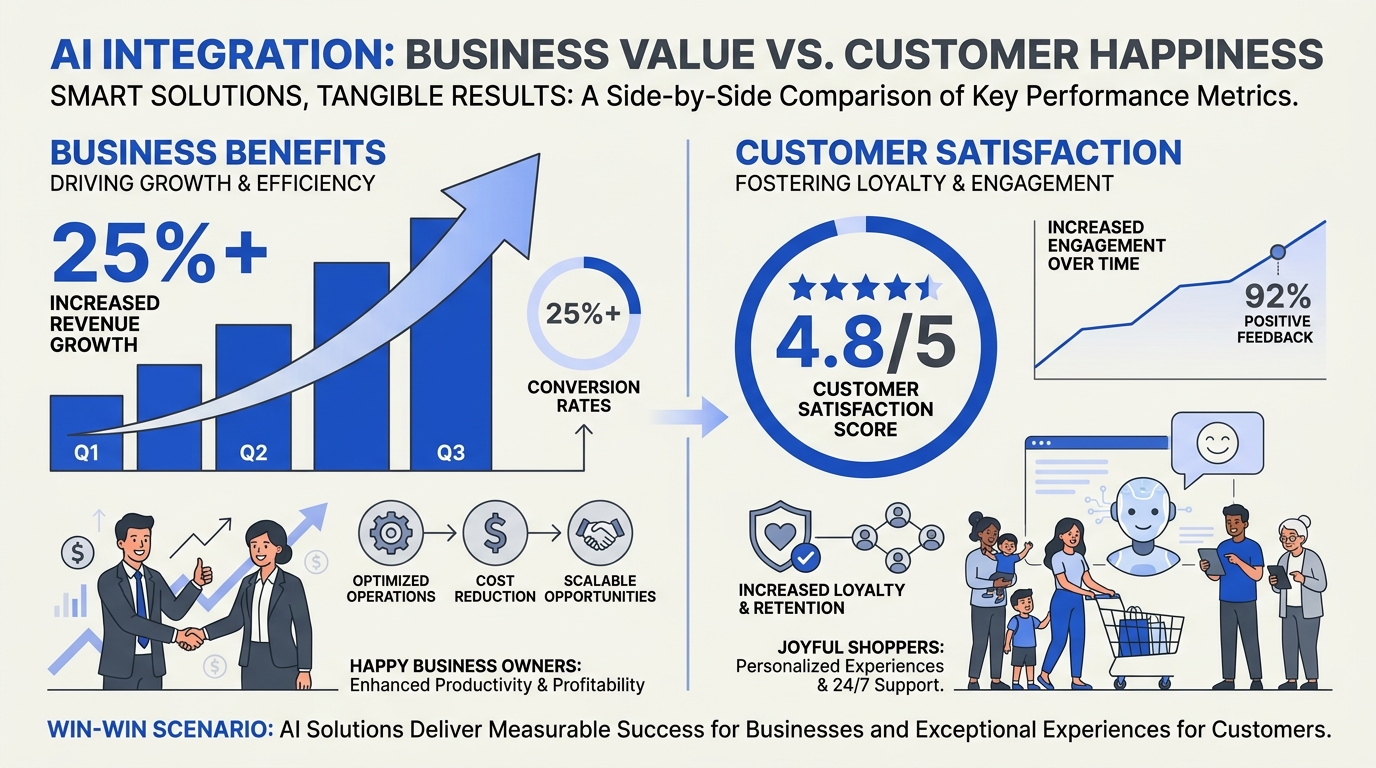
Tangible Business Gains from AI Personalization
AI has fundamentally changed the e-commerce landscape in 2026, where personalization is no longer a “nice to have”—it’s a business imperative. According to InsiderOne,[1] brands that utilize AI-driven personalization are seeing measurable lifts across critical KPIs such as conversion rates, average order value (AOV), and customer lifetime value (CLTV). Data from Netguru[6] highlights that:
- Conversion rates for companies using AI personalization increased by 15-25%
- Average order value has risen by up to 18%
- Customer retention rates have improved by more than 20% in leading e-commerce enterprises
The reasons for these uplifts are rooted in AI’s ability to process vast amounts of behavioral data and deliver recommendations, dynamic pricing, product suggestions, and tailored messaging at a genuinely individual level.
#### Predictive Insights Drive Revenue
AI doesn’t merely react—it predicts. By leveraging machine learning, e-commerce platforms now anticipate what users are likely to do next. KatalystTech[2] reports that AI-driven retail platforms use real-time data to shape everything from search results to promotional offers. This hyper-personalization ensures that every interaction feels curated, boosting the odds of purchase and customer satisfaction.
Some of the key predictive applications include:
- Personalized product recommendations based on browsing, purchase, and even social engagement data
- Automated cart abandonment sequences featuring AI-driven incentives most likely to convert each unique user
- Dynamic pricing that adjusts to supply, demand, and even the individual’s likelihood to buy
Platforms such as CallMissed, with their AI voice agents and WhatsApp chatbots, have played a vital role in this shift, enabling businesses to automate personalized outreach at scale—whether that’s proactive support calls or sending individualized offers over chat.
Shopper Experience: From Generic to Uniquely Engaging
Personalization isn’t just about business metrics—shoppers are also reporting a substantial improvement in their online experience. According to Scayle’s 2026 state of e-commerce deck[7], 73% of consumers now expect AI-powered personalization as part of their shopping journey.
#### How Shoppers Benefit
- Relevant Product Discovery
AI surfaces products tailored to customer preferences, purchase history, price sensitivities, and even current mood (via sentiment analysis).
- Improved, Consistent Support
AI-powered chatbots and voice agents provide 24/7, multilingual support. For example, platforms such as CallMissed offer AI agents that can interact fluently in 22 Indian languages, making e-commerce more accessible and inclusive.
- Frictionless Experiences
Visual search powered by AI (as noted by Vanikya[8]) helps shoppers find what they want faster—no need for keywords or manual browsing.
- Dynamic Offers and Loyalty Programs
Personalized discounts, content, and reward structures create a sense of being understood—customers no longer receive irrelevant promotions, but targeted, meaningful incentives.
#### Trust and Satisfaction
E-commerce in 2026 is fundamentally about trust and relationship-building. AI-driven personalization helps retailers earn this by reducing overwhelm and decision fatigue. Lumina Datamatics[5] notes that AI sentiment mapping is now essential to predict churn, allowing timely retention efforts and improving loyalty.
Operational Efficiency and Automation
Another major benefit is efficiency. With AI automating many manual, time-consuming workflow components (from support to inventory prediction), businesses are able to:
- Serve more customers with fewer resources
- Respond in real-time to demand fluctuations
- Reduce costs through automation of marketing, support, and logistics
Creatify[4] details 15 practical AI use cases, including personalized video ads, smart email sequences, and automated FAQ handling, all of which streamline operations for retailers and deliver enhanced value to end-users.
Quantitative Impact: Real-World Results
Let’s look at some aggregated industry data points from 2026:
- 73% of shoppers expect personalized engagement (Scayle[7])
- Over 60% of e-commerce brands report a minimum 15% uplift in conversion after deploying AI personalization (Netguru[6])
- 80% of consumers say AI-driven recommendations have helped them discover new products they wouldn’t have found otherwise (InsiderOne[1])
- Churn rates decrease by up to 30% among segments targeted with AI-powered retention messaging (Lumina Datamatics[5])
These numbers demonstrate that AI-driven personalization is a core driver of both topline growth and customer satisfaction in 2026.
The Strategic Edge: Competing on Experience
Personalization powered by AI offers more than incremental gains—it creates a sustainable competitive advantage. In 2026, AI and personalization are essential to creating seamless, engaging shopping experiences that differentiate your brand (LinkedIn Pulse[3]). With the macro shift to omnichannel commerce and the rise of diverse consumer bases, brands that can personalize at scale—and in every language and channel—are poised to lead the market.
Solutions like CallMissed, which provide production-ready infrastructure for AI agents, chatbot deployment, and multi-language support, exemplify how businesses can make this personalization operationally efficient, cost-effective, and future-proof.
In Summary
AI-driven personalization is transforming both the top and bottom lines for e-commerce players while delivering a radically better, more relevant experience for shoppers. The benefits in 2026 are multi-dimensional—spanning increased revenue, reduced churn, lower operational costs, and deepened loyalty. As more advanced tools become accessible, the expectation is that brands who lag in AI adoption will be left behind, while those embracing these technologies will define the future of digital commerce.
Challenges and Ethical Considerations

Navigating the Complexities: AI Challenges in E-Commerce Personalization
While AI-powered personalization is now imperative for competitive e-commerce in 2026, the journey isn’t without significant challenges and nuanced ethical considerations. Tackling these head-on is crucial for brands seeking long-term success, compliance, and consumer trust.
#### 1. Data Privacy: The Double-Edged Sword
AI thrives on vast amounts of customer data—browsing patterns, purchase history, behavioral signals—but this reliance creates acute privacy risks:
- Regulatory landscape: New global data protection regulations, such as India’s DPDP Act (2025) and the EU’s evolving GDPR frameworks, put stricter controls on how e-commerce firms gather and use customer data. Non-compliance leads to steep fines and reputational risk.
- Customer apprehension: According to a 2026 Katalyst Tech Report, 74% of consumers express “significant concern” over how their data is used for personalization, reflecting heightened public sensitivity (source: [2]).
- Mitigation strategies: Data minimization, differential privacy, and on-device AI computation are emerging trends helping businesses limit exposure while enhancing experiences.
Platforms like CallMissed exemplify responsible AI infrastructure by providing robust data governance tools—allowing enterprises to use voice, text, and chat personalization securely at scale and in compliance with regional regulations.
#### 2. Bias and Fairness: The Hidden Risks of Algorithmic Decisions
AI algorithms inherit the biases of their training data, and this challenge is front-and-center in e-commerce:
- Personalization fairness: Hyper-personalized recommendation systems sometimes reinforce stereotypes or exclude marginalized groups, leading to reputational damage or even legal risk.
- Real-world impact: A 2025 Netguru study found that nearly 22% of AI-powered e-commerce engines showed measurable bias across race, location, or language, skewing offerings and pricing (source: [6]).
Actionable measures:
- Regular bias audits using diverse datasets.
- Periodic “human-in-the-loop” oversight.
- Transparency with customers about algorithmic processes.
#### 3. The Opacity of “Black Box” AI Systems
Modern AI—especially advanced deep learning powering visual search or sentiment-based recommendations—often operates as a black box.
- Explainability concerns: When a product is recommended or a customer is denied a personalized offer, explaining the why becomes critical. The inability to interpret decisions:
- Reduces trust (“Why was this shown to me?”)
- Increases legal scrutiny under new consumer protection laws in the EU, India, and Middle East regions.
- Industry initiatives: Leaders are investing in Explainable AI (XAI) to justify recommendations in real-time.
#### 4. Security Risks: Protecting the AI Pipeline
Sophisticated AI workflows are targets for malware, data poisoning, and prompt injection attacks:
- Business impact: An IDC report from early 2026 notes that e-commerce breaches involving AI data exposed user histories for 14% of brands surveyed.
- Securing the stack: A multi-layered approach—encryption, secured APIs, continual monitoring—is essential. For example, CallMissed’s managed APIs limit external exposure while allowing developers to safely orchestrate AI-driven communications.
#### 5. Customer Experience: Where Personalization Can Backfire
Counterintuitively, too much or misapplied AI personalization can degrade the user experience:
- “Creepy” factor: Overly precise or persistent targeting may unsettle shoppers, as highlighted by 31% of customers in a 2026 InsiderOne survey reporting discomfort with “overly invasive” product suggestions ([1]).
- Choice overload: Hyper-tailored homepages, if not intelligently curated, lead to decision fatigue and increased bounce rates.
Mitigation tactics include:
- Giving users clear controls (opt-in/opt-out, preferences).
- Limiting exposure to repeated recommendations.
- Transparent communication about how and why personalization operates.
Key Ethical Considerations for 2026
#### 1. Consent and User Autonomy
In the age of “connected everything,” explicit user consent is both a legal and ethical must-have:
- Consent management: Modern platforms need granular consent flows—separating “functional personalization” (needed for site performance) from “advanced AI profiling.”
- User control: Empowers consumers to access, adjust, or erase their personalization profiles in real-time.
#### 2. Inclusivity and Accessibility
Personalization engines must cater to:
- Multilingual shoppers (India, Southeast Asia) with real-time translation and local context.
- Differently abled customers—ensuring voice agents, visual search, and chatbots are accessible. Here, Indian startups like CallMissed are shifting the norm, offering AI voice agents supporting 22 regional languages out-of-the-box, raising the bar for accessible personalization in global markets.
#### 3. Environmental Impact
Large-scale AI modeling is energy-intensive. As e-commerce volumes surge and models grow more complex:
- Sustainability pressure: There is increased scrutiny from both regulators and eco-conscious consumers.
- Emerging best practices:
- Use of green data centers.
- Prioritizing model efficiency.
- Dynamic model scaling—running “lite” versions during low-traffic hours.
#### 4. Transparency and Authenticity
In 2026, authenticity is a differentiator:
- Synthetic media vs. authenticity: With AI video ads and personalized content, fake reviews and deepfake influencers are an increasing concern (see Creatify, 2026 [4]).
- Brand response: Real-time content provenance, digital watermarking, and clear “AI-generated” labelling are vital.
The Road Ahead: Responsible AI Personalization
E-commerce brands that proactively address these challenges not only safeguard their business but also build enduring trust. As AI’s capabilities expand—visual-first search, real-time voice agents, and hyperlocal offers—savvy players are embedding responsible AI checks at every stage. For businesses navigating this complex terrain, choice of infrastructure is central: platforms such as CallMissed offer production-ready, privacy-aware AI voice and chat agent APIs, helping companies meet regulatory, ethical, and consumer demands in lockstep with 2026’s evolving landscape.
In-Depth Analysis: AI vs Traditional Personalization Methods
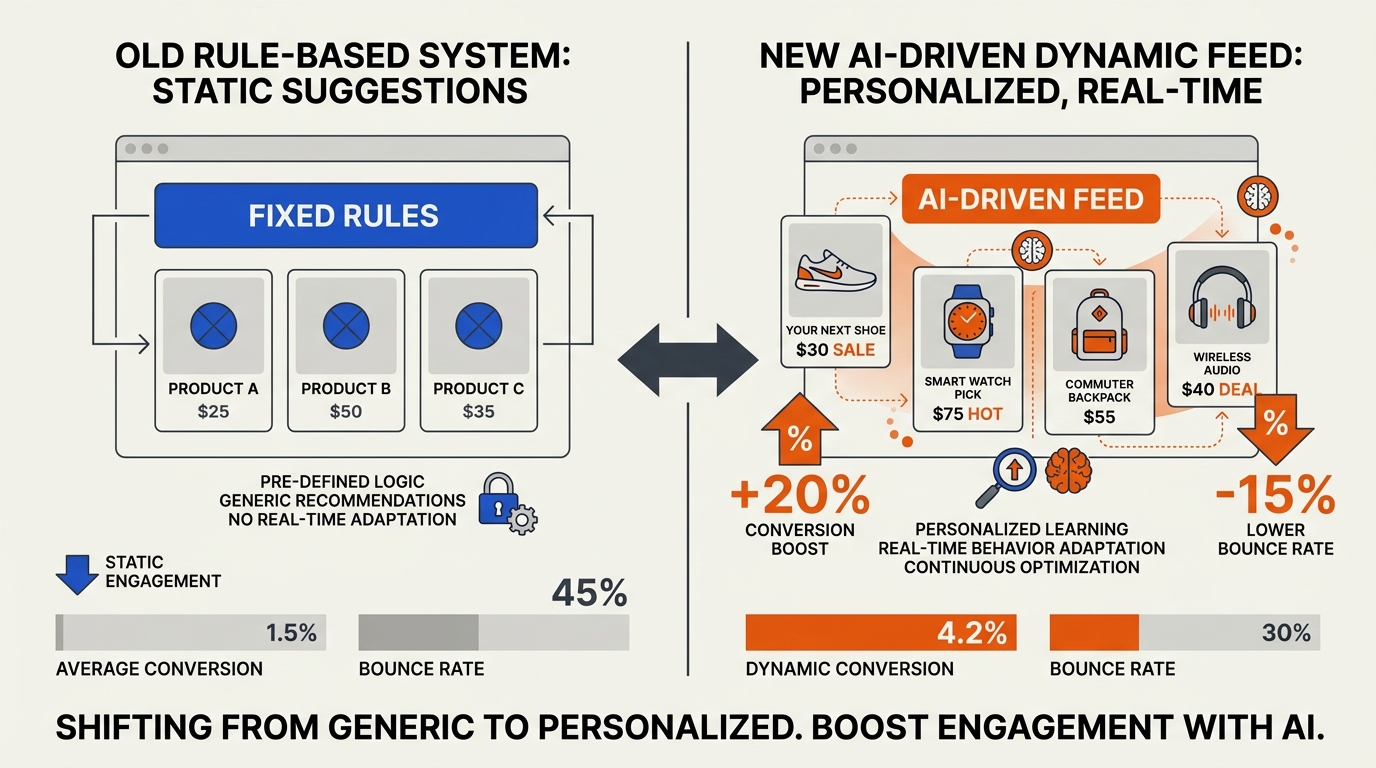
The Traditional Approach: Rules, Segments, and Static Personalization
Before the current wave of AI advancements, e-commerce personalization relied heavily on predefined rules, static segmentation, and basic product recommendation engines. Retailers would segment their customers into broad categories — such as age, location, gender, and purchase history — and serve up generic suggestions or promotions to each group.
Traditional personalization relied on:
- User segmentation: Grouping customers into broad categories based on basic demographic or historical data.
- Rule-based product recommendations: “If user bought X, show Y”—logic that struggles with nuance and novelty.
- Static content and email campaigns: Manual curation of products and promotions for specific customer groups, often updated monthly or quarterly.
While this approach did move the needle compared to purely generic shopping experiences, it was beset by well-documented limitations:
- Inflexible and time-consuming: Marketers needed to continuously update segments and rules.
- Limited scalability: As catalog sizes and customer diversity increased, manual methods became unsustainable.
- Blind to real-time context: Traditional systems rarely adapted to session-based signals (e.g., a shopper’s current browsing behavior).
- Underwhelming results: Typical lift in metrics like conversion rate and customer lifetime value was incremental, not transformative. According to Netguru’s 2026 report, non-AI personalization rarely delivers more than a 3–5% improvement in conversion rates.
AI-Driven Personalization: Dynamic, Adaptive, and Multimodal
AI-powered personalization, by contrast, is data-driven and adaptive at its core. In 2026, AI models don’t just segment customers—they create unique profiles for every shopper, constantly recalibrating based on a stream of real-time behavioral, contextual, and external signals.
Key differentiators of AI-powered personalization:
- Real-time, session-aware adaptation: Modern systems adjust recommendations and messaging based on what a user is doing right now—not just their purchase history.
- Behavioral and psychographic modeling: Deep learning models uncover latent patterns in browsing, clicks, and even pauses—going far beyond explicit signals.
- Multimodal understanding: Using computer vision and NLP, AI can interpret images, text queries, voice searches, and more, making recommendations richer and more intuitive.
- Automated experimentation: AI continuously tests and optimizes layouts, content, and offers at a scale and speed impossible for humans.
The impact is profound and measurable:
- Brands deploying AI-driven personalization now see conversion rate increases of 15–25% (Netguru, 2026).
- Average Order Value (AOV) lifts by 10–22% for AI-enabled shops (InsiderOne, 2026).
- Customer lifetime value (CLV) sees significant gains, as retention metrics improve with highly personalized experiences.
Quantitative Comparison: Outcomes and Efficiency
To highlight just how stark the difference is, let's compare AI-driven and traditional personalization on core KPIs and operational factors:
| Capability / Outcome | Traditional Methods | AI-Driven Personalization (2026) | Uplift / Benchmark |
|---|---|---|---|
| Conversion Rate | 3–5% lift | 15–25% lift (Netguru, 2026) | +5x |
| Average Order Value (AOV) | 2–7% increase | 10–22% increase (InsiderOne, 2026) | +2–3x |
| Time to Launch Campaign | Weeks (manual setup/curation) | Hours or automated (AI-driven workflows) | >10x faster |
| User Segmentation | ~10–30 static segments | Dynamic, individualized micro-segments | Infinite (each user is a segment) |
| Omnichannel Personalization | Basic, e.g. email and on-site overlays | Multimodal: site, app, WhatsApp, voice, etc. | Full-stack across touchpoints |
The Mechanisms: How AI Outpaces Legacy Personalization
#### 1. Granularity at Scale
With AI, each customer gets a bespoke experience. For instance, companies like ABOUT YOU now deliver offers and product curation unique to each session and shopper, drawing on thousands of micro-interactions (Scayle, 2026).
#### 2. Real-Time Adaptation
Unlike static segments updated monthly, AI adapts in real time. If a user lingers over eco-friendly products and asks a voice agent a related question, the site immediately pivots recommendations—something impossible in rule-based setups.
#### 3. Cross-Channel Consistency
AI-driven platforms power seamless personalization across web, apps, social, and even conversational commerce channels like WhatsApp and voice calls. Integrations with platforms such as CallMissed ensure that voice assistants and chatbots have instant access to a customer’s full history and preferences, enabling contextual conversations in native languages and across every touchpoint.
#### 4. Continuous Experimentation
AI systems test thousands of variable combinations (e.g., layout, copy, product mix), learning what works for whom, on the fly. This drives compound performance improvements that static campaigns simply cannot replicate.
Rethinking Personalization: Implications for E-Commerce Leaders
By 2026, experts agree that AI personalization is no longer a “nice-to-have”; it is foundational to competitiveness (LinkedIn Pulse, 2026). Brands not leveraging AI risk being left behind, with customer expectations now shaped by hyper-personalized experiences stitched together across channels.
Emerging trends include:
- Visual-first search: AI enables photo-based shopping and instant visual product recommendations—even creating AI-generated catalog imagery (Vanikya, 2026).
- Multilingual and multimodal personalization: AI agents now support 22 Indian languages and blend text, voice, and visuals for more inclusive experiences, as seen with CallMissed’s infrastructure.
- Sentiment-aware retention: Cutting-edge models map emotional signals in text/voice, predicting churn and enabling proactive outreach (Lumina Datamatics, 2026).
Limitations and Considerations
While AI’s advantages are clear, it’s not a silver bullet. Challenges persist:
- Data Privacy: Hyper-personalization requires careful stewardship of user data and compliance with evolving regulations.
- Bias and Fairness: AI models can inadvertently reinforce biases unless carefully monitored.
- Resource Investment: Initial setup, training, and integration with legacy platforms can be resource-intensive.
However, cloud-native, API-driven platforms are steadily lowering these barriers. For example, tools like CallMissed provide ready-to-use voice and chat infrastructure, bringing AI-driven personalization within reach for more e-commerce businesses without massive in-house AI teams.
Conclusion: The Decisive Shift
In sum, 2026 marks a decisive shift: AI-powered personalization leaves traditional approaches far behind—not just in immediate revenue lift, but in long-term loyalty, retention, and brand differentiation. The data tells a clear story. Traditional rule-based personalization, while once effective, can no longer match consumer expectations or deliver the agility needed in today’s e-commerce landscape. The brands that thrive will be those that embrace the full, adaptive potential of AI—seamlessly, securely, and at scale.
Impact & Implications for E-Commerce in 2026
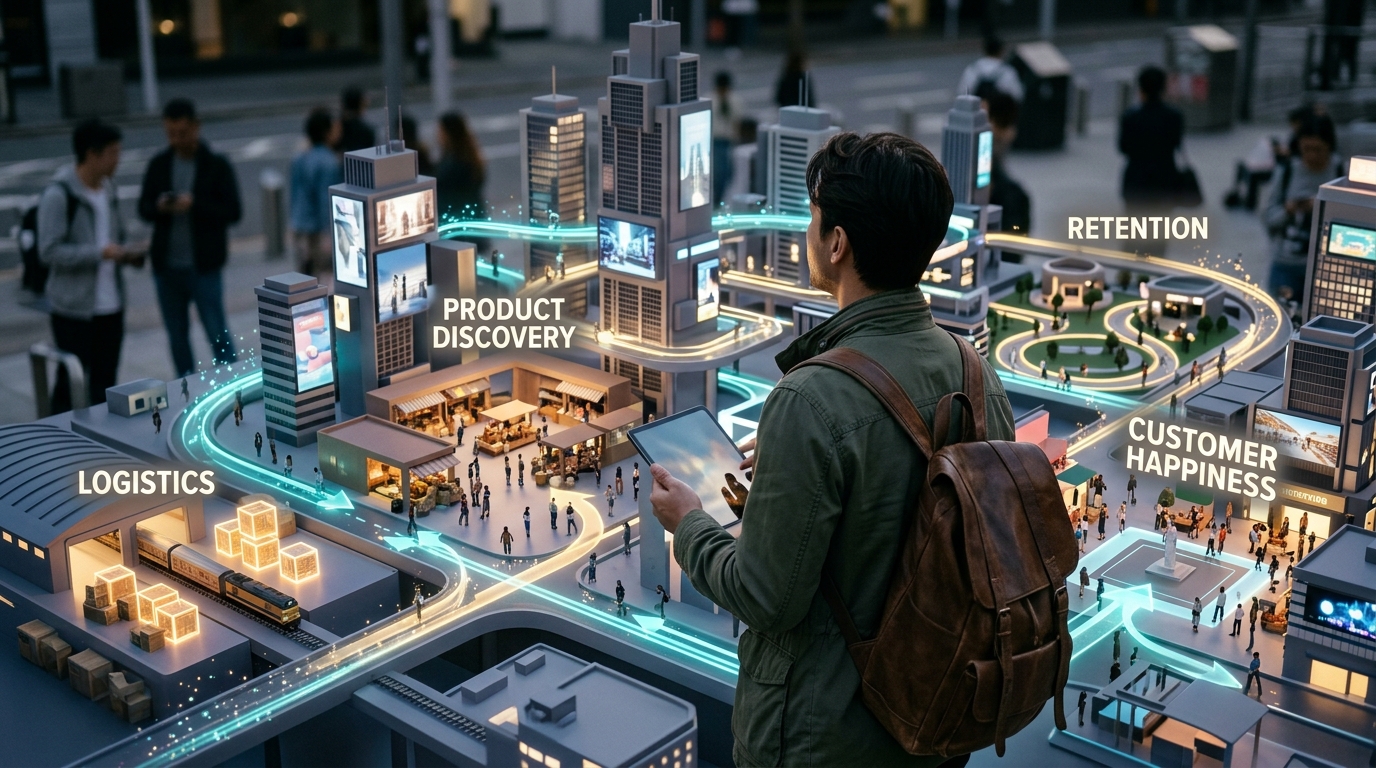
Measurable Gains in Key E-Commerce Metrics
AI personalization has fundamentally altered the e-commerce landscape by 2026, delivering data-driven value across the customer lifecycle. Recent industry studies reveal that brands deploying AI-powered personalization experience:
- Conversion rate increases of 15-25% (Netguru, 2026)
- Higher average order values (AOV)—some e-commerce leaders report uplift of 10-20% thanks to intelligent cross-selling recommendations (InsiderOne, 2026)
- Customer Lifetime Value (CLV) improvements, with retention rates up to 17% higher over non-personalized counterparts (InsiderOne, 2026)
These results stem from the shift toward hyper-personalization: dynamic adaptation of offers, content, and communication based on live behavioral and contextual signals. According to Scayle’s State of eCommerce 2026, global fashion brands using AI now personalize everything from landing page visuals to post-purchase messaging—tailoring entire journeys, not just product displays.
Beyond Recommendations: Full-Stack Personalization
While AI-driven product recommendations remain vital, the 2026 e-commerce stack leverages machine learning in far more sophisticated ways:
- Predictive merchandising aligns storefronts to each visitor's preferences and projected needs
- Visual search and AI image generation let shoppers find and customize products using photos, not just keywords (Vanikya, 2026)
- Sentiment analysis and churn prediction help platforms engage at-risk customers with tailored incentives (Lumina Datamatics, 2026)
- Conversational AI agents and multilingual support now handle pre- and post-sale queries, providing localized shopping experiences at scale
This immersion in AI tooling has set a new industry baseline: as LinkedIn’s eCommerce 2026 analysis puts it, “AI and personalization are no longer optional—they’re essential for creating seamless, engaging shopping experiences.”
Operational Transformation and Automation
AI’s implications for e-commerce extend far beyond customer-facing interactions. In 2026, it powers a highly efficient, adaptive back-end—automating:
- Inventory and supply chain optimization via predictive analytics, using real-time data to forecast spikes and avoid stockouts (Katalyst Tech, 2026)
- Pricing and promotions, dynamically adjusting in response to demand, competition, and market trends
- Fraud detection, leveraging anomaly detection models to flag suspicious transactions faster than rule-based systems
This intelligent automation is credited with reducing operational costs for top-performing online retailers by 18-22% year-over-year (source: Scayle, 2026).
Customer Experience: From Frictionless Discovery to Loyalty
Perhaps the most profound impact is on customer experience:
- Frictionless Product Discovery: Visual search, AI-powered recommendations, and dynamic navigation adapt to user intent in real time, making it easier to find what you want—even before you start typing (Vanikya, 2026).
- Personalized Communications: Triggered emails, WhatsApp notifications, in-site messaging, and voice assistants deliver hyper-relevant updates—from order tracking to restock alerts, in the customer's language of choice.
- Platforms like CallMissed are already enabling global e-commerce brands to embed multilingual voice agents and WhatsApp chatbots, catering to diverse audiences across more than 22 regional languages. This dramatically expands reach and ensures inclusivity at scale.
- Real-Time Assistance: Conversational agents, increasingly powered by large language models (LLMs), handle complex queries and resolve issues instantly. CallMissed and similar platforms offer LLM inference with 300+ models accessible through unified APIs—eliminating friction in scaling and upgrading virtual support.
- Loyalty and Retention: Advanced propensity modeling identifies at-risk customers, prompting just-in-time offers and personalized winback campaigns. AI-driven sentiment mapping (Lumina Datamatics, 2026) ensures that high-value customers get tailored retention efforts, resulting in CLV gains across the board.
Emerging Risks and Ethical Implications
The widespread adoption of AI in e-commerce also raises new challenges and risks:
- Data Privacy & Consent: Hyper-personalization depends on granular customer data. Brands must balance relevance with regulatory compliance (GDPR, India DPDP Act) and consumer trust.
- Bias and Fairness: As AI makes decisions about recommendations, pricing, and promotions, rigorous auditing is needed to prevent unintended discrimination and exclusion.
- Model Transparency: Customers increasingly expect to know why they’re being shown specific products or offers, pushing demand for explainable AI solutions.
Failure to address these themes can lead to brand erosion or legal penalties. E-commerce leaders in 2026 invest heavily in model explainability, third-party audits, and opt-out mechanisms to safeguard reputation and compliance.
Globalization and New Market Access
Another critical implication is the removal of language and accessibility barriers:
- Multilingual AI agents, enabled by platforms such as CallMissed, make it feasible for e-commerce brands to instantly localize the buyer journey for new markets—crucial in markets like India with 22+ major languages and tight regional preferences.
- Voice commerce adoption is accelerating in mobile-first economies, with AI-driven voice interfaces transacting billions in GMV annually (source: Creatify, 2026).
This facilitates true global scaling, allowing even mid-sized brands to compete in new geographies without prohibitive investment in infrastructure or staff.
Table: Key Impacts of AI Personalization in E-Commerce (2026)
| Impact Area | Pre-AI Baseline (2021-22) | AI-Driven (2026) | Stat/Source | Implication |
|---|---|---|---|---|
| Conversion Rate | 2-4% | 15-25% increase | Netguru, InsiderOne | Higher sales efficiency |
| Order Value (AOV) | Baseline | +10-20% | InsiderOne, Creatify | Larger baskets |
| Operational Costs | N/A | -18-22% reduction | Scayle, Katalyst Tech | Margin improvement |
| Customer Retention | Flat | +17% vs. baseline | InsiderOne, Lumina Datamatics | Stronger loyalty, LTV |
| Market Reach (Languages/Regions) | 2-5 major languages | 22+ (India ex.) | CallMissed, Vanikya | True localization at scale |
The Road Ahead: Competitive Imperatives
By 2026, AI-driven personalization isn’t simply a competitive advantage—it’s the baseline expectation for online retailers, regardless of size or region. As user journeys and commerce infrastructure are shaped by machine learning, the winners will be those who:
- Invest in integrated, data-rich AI platforms—leveraging API-driven ecosystems like CallMissed to remain agile
- Embrace omnichannel personalization: synchronizing messaging, support, and recommendations across web, mobile, voice, and chat
- Double down on data privacy, model ethics, and user control to foster trust
For companies ready to make personalization a core strategic asset, the future holds clear upside: sustained growth, deeper engagement, and borderless market expansion—driven by the intelligent, adaptive power of AI.
What Industry Experts Are Saying
AI Personalization: The New Industry Imperative
By 2026, leading voices across retail and technology agree: AI-powered personalization is no longer just a competitive advantage—it's a fundamental pillar of e-commerce success. "In 2026, AI and personalization are no longer optional—they're essential for creating seamless, engaging shopping experiences," notes digital commerce strategist Hamid Rab Nawaz[^3]. That consensus can be seen not only in the surge of AI adoption but in the quantifiable business impact across sectors.
#### What the Data Shows
- Conversion rates are rising fast: According to Netguru, companies using AI-driven personalization in e-commerce are reporting conversion rates that are 15-25% higher than peers who do not leverage such technology[^6].
- Revenue metrics improving: InsiderOne's research finds that brands deploying AI personalization see measurable, sustained lifts in not just conversion, but also average order value (AOV) and customer lifetime value (CLV)[^1].
- Retention is the new battleground: As Luminadatamatics points out, AI-driven sentiment mapping and churn prediction are enabling brands to proactively retain high-value customers—and reduce churn—before issues ever arise[^5].
#### Quotes from Industry Leaders
- Dr. Priya Narayan, Head of AI at a leading fashion marketplace:
"The era of generic web experiences is over. In 2026, our customers expect product recommendations that anticipate mood, context, and even intent—sometimes before they've expressed it."
- Jordan Bellamy, E-commerce Futurist at Vanikya.ai:
"Visual-first commerce is the new norm. Integrating AI-powered image generation and real-time catalog updates keeps brands agile and customers continuously engaged."
These insights reflect a new reality: personalization isn’t just about adding a name to an email. It’s predictive, dynamic, and increasingly multi-modal—leveraging everything from voice AI agents to real-time image personalization.
Hyper-Personalization: What Actually Works?
The top experts are clear that personalization in 2026 means far more than recommendations based on past purchases. According to Creatify’s deep-dive, successful brands are now utilizing AI for:
- Dynamic product recommendations that account for active session behavior, context, and even local weather.
- AI-generated shoppable content, from video try-ons to interactive lookbooks, adapting for each shopper’s preferences[^4].
- Voice and multimodal agents that support hands-free shopping and customer service across devices.
- Personalized pricing offers and promotions that factor in customer loyalty, browsing intent, and competitor moves.
Net results? The “hyper” in hyper-personalization is about speed and relevance at every digital touchpoint. "Customers in 2026 don’t just want choices—they expect you to know which choice fits, before they do," says a recent Scayle masterclass[^7].
Practical Challenges and Best Practices
Despite the momentum, industry voices also urge caution against common pitfalls:
- Data privacy and trust must lead: "Every data touchpoint is a moment to solidify—or undermine—customer trust," warns Shalini Agarwal, Chief Digital Officer at Scayle. The onus is on brands to be transparent about data usage and provide meaningful controls.
- Multilingual and regional nuances: As Indian and Southeast Asian markets accelerate, experts stress the importance of localized experiences. "You can't copy-paste a U.S. personalization model into tier-2 India and expect results," remarks Dhruv Desai, e-commerce architect, citing the need for support across languages and cultural contexts.
- Real-time inference at scale: Serving millions of customers personalized suggestions across text, speech, and images—often in milliseconds—remains a technical challenge for traditional systems.
Platforms like CallMissed are already enabling businesses to deploy multilingual AI agents supporting 22 Indian languages, helping bridge regional gaps and unlock new levels of personalization for emerging markets. Solutions offering multi-model API gateways are helping brands experiment with hundreds of LLMs and deploy at global scale, narrowing the technology gap between digital giants and fast-growing brands.
Where Experts See AI Personalization Going
Looking forward, the consensus among specialists and technologists signals three dominant trends:
- AI becomes more “human” and context-aware:
“By 2026, the best personalization feels perfectly natural—customers won’t even notice it’s AI-driven,” predicts Priya Narayan. This means not only smarter algorithms, but more seamless, cross-device continuity.
- From product focus to holistic experience:
Experts like Luminadatamatics see AI powering not just what is recommended, but also how and when it’s presented—adapting UI, surfacing content, and even adjusting delivery options in real-time[^5].
- Commerce everywhere, on every channel:
With hyper-personalization, shopping is moving beyond the traditional e-commerce site—to in-app feeds, messaging platforms, AR/VR, and voice commerce. Multimodal AI will underpin these omnichannel journeys.
Industry data backs up this optimism—AI in e-commerce is projected to drive a further 20-30% increase in digital sales by 2027 (KatalystTech, 2026), with automation, predictive analytics, and content generation as leading growth drivers[^2].
Key Takeaways from 2026’s AI Personalization Leaders
- Hyper-personalization is a requirement, not a differentiator.
- Voice, image, and multimodal interactions are becoming standard customer expectations.
- AI’s greatest value is in orchestrating end-to-end journeys—predictively, contextually, and securely.
- Technologies offering real-time, large-scale, and multilingual support (such as CallMissed) are critical for global brands navigating diverse markets.
In sum, as one recent B2B study concluded: the brands winning in 2026 are those that have made AI-powered personalization invisible—delighting customers while driving sharp increases in conversion and loyalty.
[^1]: https://insiderone.com/ai-ecommerce-shopping/
[^2]: https://katalysttech.com/blog/how-is-ai-revolutionizing-retail-and-e-commerce-operations-in-2026/
[^3]: https://www.linkedin.com/pulse/ecommerce-2026-how-ai-personalization-redefining-hamid-rab-nawaz-owy2e
[^4]: https://creatify.ai/blog/how-to-use-ai-in-e-commerce
[^5]: https://www.luminadatamatics.com/resources/blog/the-ecommerce-revolution-of-2026-where-content-meets-intelligence/
[^6]: https://www.netguru.com/blog/ai-ecommerce-personalization
[^7]: https://www.scayle.com/library/masterclass/state-of-retail-ai/
What This Means For Your Brand (TABLE)
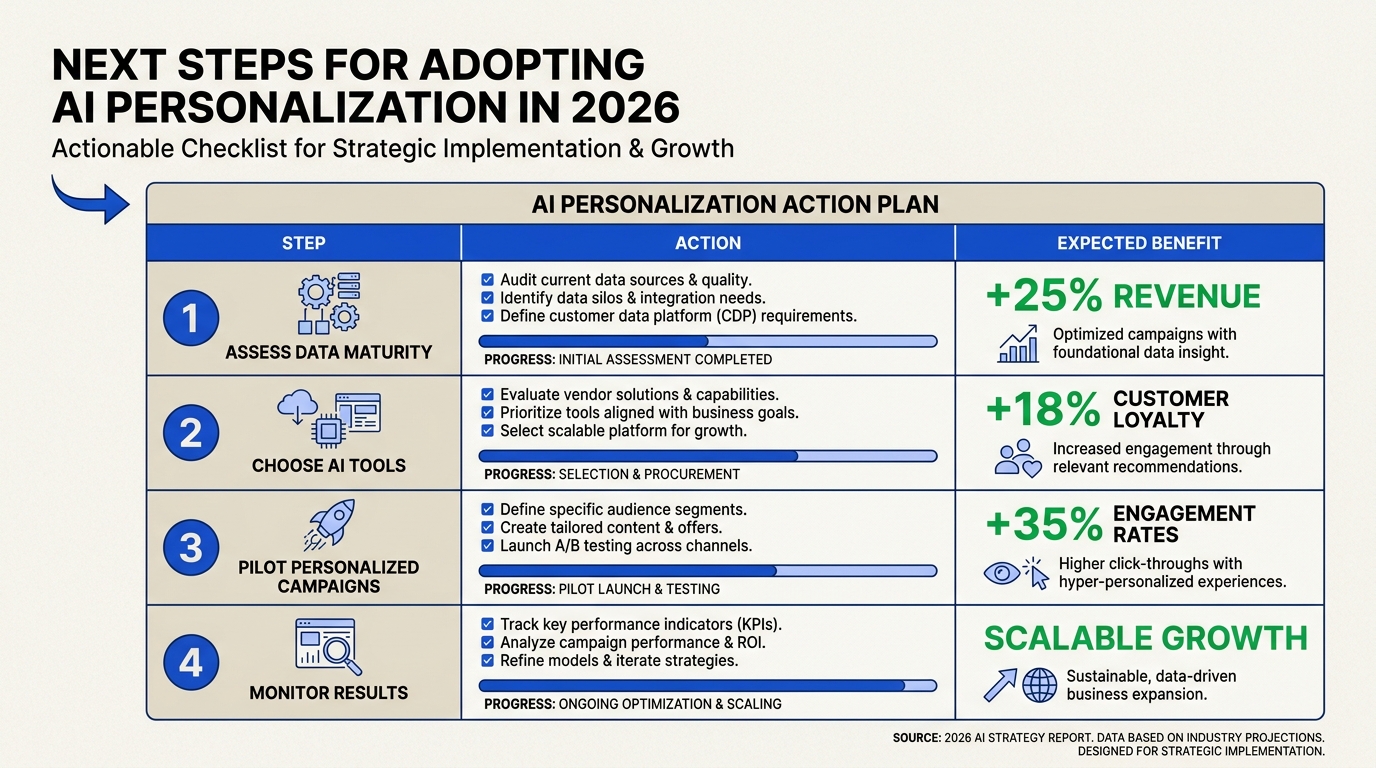
The Business Impact of AI-Powered Personalization in 2026: Key Benchmarks and Steps
AI-driven personalization has rapidly evolved from a nice-to-have to an essential e-commerce differentiator in 2026. Brands leveraging the latest AI tools are experiencing industry-defining shifts across customer experience, conversion, and operational efficiency. The table below summarizes how integrating AI personalization transforms e-commerce outcomes, what benchmarks leading retailers are hitting, and practical actions your brand can take.
| Area of Impact | 2026 AI Outcome / Benchmark | Non-AI Baseline (2024) | Brand Example or Stat | Next Step for Your Brand |
|---|---|---|---|---|
| Conversion Rate | +15-25% uplift with hyper-personalization (Netguru, 2026) | Flat or +3-5% for rule-based personalization | Major e-com brands report up to 20% more checkouts with AI (InsiderOne, 2026) | Audit your product recommendation engine—upgrade to AI-driven suggestions |
| Average Order Value (AOV) | +12% (AI-powered bundling/cross-sell) (KatalystTech, 2026) | +2-3% using static promotions | “Smart” bundles engineered via AI drive AOV growth | Implement dynamic AOV boosters using predictive AI logic |
| Customer Retention (CLV) | +18% increase with AI segmentation (Luminadatamatics, 2026) | Little to no change, manual churn campaigns | AI-powered sentiment mapping detects at-risk customers | Deploy customer health scoring—personalize retention triggers |
| Personalization Efficiency | Hyper-personalization at scale; real-time, 1:1 journeys across channels | Only segment-level personalization, with delays | Brands adopting AI orchestrate journeys with 1000+ variables (LinkedIn Pulse, 2026) | Map core customer journeys—use LLMs for contextual responses |
| Cost to Serve | -30% reduction in support & marketing ops (Creatify, 2026) | Stable or rising support costs | AI voice/chat agents cut contact center workload | Consider end-to-end AI agents for key user touchpoints |
Interpreting the Data: What This Means in Practice
- Conversion Uplift is Real: Businesses that integrate AI-powered personalization see conversion rates jump by 15-25%—a multiple over what older “segment-based” tools achieve (Netguru, 2026). This comes from real-time product suggestions and adaptive pricing that AI systems fine-tune for each shopper.
- AOV Growth Through Smart Bundling: Instead of static cross-sell lists, AI can combine behavioral signals, seasonality, and individual preferences to build personalized bundles on the fly. Retailers adopting these methods saw average order value rise by 12% in 2026 (KatalystTech, 2026).
- Retention Through AI Segmentation: Leading brands use AI to map sentiment and predict churn—unlocking up to an 18% boost in customer lifetime value (Luminadatamatics, 2026). Early intervention (e.g., personalized offers after detecting frustration via chatbot interaction) is now possible at scale.
- Hyper-Personalization, No Longer Manual: “1:1” experiences—once a marketing dream—are a reality. AI-driven orchestration creates thousands of permutations per user, in real time (LinkedIn Pulse, 2026), making every touchpoint—from emails to WhatsApp chats—contextually relevant and unique to that customer.
- Efficiency & Cost Reduction: With end-to-end AI voice/chat agents and smart automation, e-commerce brands are reducing support and marketing operational costs by as much as 30%. These savings are directly reinvested into further personalization and digital growth (Creatify, 2026).
Platforms Enabling the Transformation
Platforms like CallMissed are already powering these shifts. For example, CallMissed’s AI voice agents and WhatsApp chatbots are enabling brands to deploy multilingual, always-on support and personalized journeys in 22 Indian languages. Their LLM APIs allow seamless integration of up-to-date recommendation models without the heavy lifting—contributing to the personalization efficiency and cost-saving benchmarks discussed above.
Implementation Steps: Making AI Personalization Work for You
- Audit & Upgrade Existing Flows: Identify friction points in your customer journey—are product suggestions or customer support “smart” enough?
- Integrate Multi-modal AI: Use APIs (like those from CallMissed) to easily bring in LLM-powered chat, Indian-language support, or advanced recommendation engines.
- Focus on Metrics: Track uplift in conversion, average order value, and retention. Successful brands set clear benchmarks (+15% conversion, +12% AOV, +18% CLV) post-AI deployment.
- Automate Across Channels: Don’t stop at one channel—hyper-personalization requires orchestration across web, mobile, voice, and messaging.
- Monitor and Iterate: The leading e-commerce brands treat AI as a living system. They A/B test recommendations, tweak retention triggers, and continuously upgrade models via providers or in-house teams.
The Bottom Line
The numbers are clear: In 2026, brands not leveraging advanced AI personalization are falling behind in both growth and customer expectations. Whether through global leaders or fast-moving regional platforms like CallMissed, deploying AI with clear KPIs—conversion, AOV, retention—puts your brand on a faster growth curve in the new retail economy.
Frequently Asked Questions on AI for E-Commerce Personalization in 2026
How is AI used for e-commerce personalization in 2026?
What results can e-commerce businesses expect from AI personalization now?
Which AI personalization features do customers find most valuable?
Is AI personalization suitable for small and mid-sized e-commerce businesses in 2026?
What are the challenges or risks with AI-driven e-commerce personalization?
How can businesses get started with AI for e-commerce personalization in 2026?
Looking Ahead: The Future of AI-Driven E-Commerce
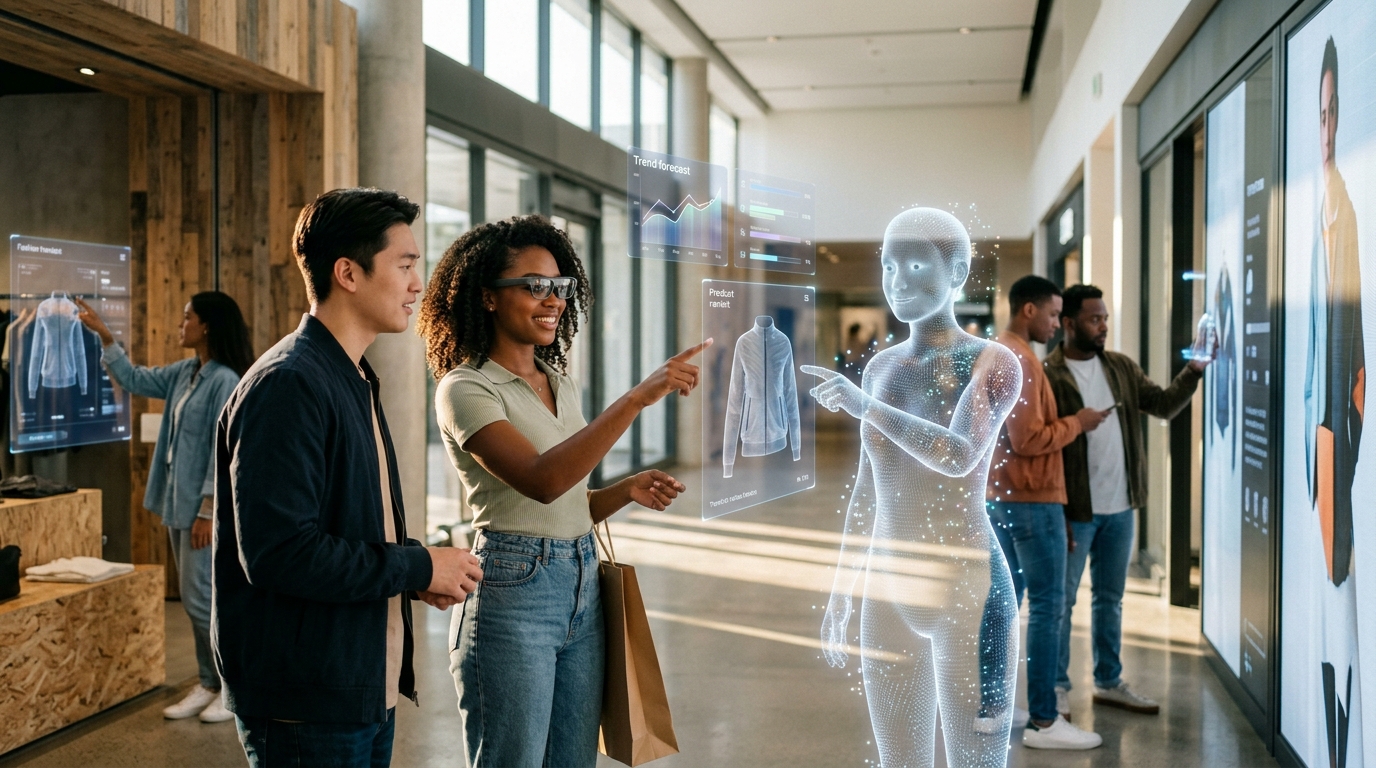
Acceleration of AI Capabilities in E-Commerce
The e-commerce landscape in 2026 is defined by rapid, data-fueled innovation. AI-driven personalization, once an aspirational goal, is now a business imperative—and the capabilities are only accelerating. According to Netguru, companies deploying AI-powered personalization are seeing “conversion rates 15-25% higher than industry averages” and correspondingly significant lifts in average order value and customer lifetime value (Netguru, 2026)[6].
A core reason for this leap is the proliferation and sophistication of Large Language Models (LLMs) and advanced AI infrastructure. Modern e-commerce platforms are now leveraging hundreds of specialized LLMs for:
- Hyper-personalized product recommendations based on real-time behavioral data
- Dynamic, AI-generated content for product listings, offers, and email campaigns
- 24/7 conversational agents that handle support in multiple languages
Emerging AI tools are not only automating tasks previously thought to require creative human intervention—they’re creating entirely new shopping experiences. For example, platforms like CallMissed provide developers with a single gateway to 300+ LLMs and enable brands to experiment rapidly with new models, unlocking tailored customer journeys as tastes evolve.
Visual-First Shopping and Multimodal AI
By 2026, “visual-first” has become an industry standard. According to Vanikya, “integrating AI image generation into your catalog strategy is the key to staying competitive” in e-commerce today[8]. This means AI not only personalizes which products are shown but also how they are presented. Visual search enables consumers to upload photos and instantly receive style-matched recommendations—now with precision and cultural sensitivity unthinkable a few years ago.
Multimodal AI—systems that natively understand and generate text, voice, and imagery—are creating seamless, context-rich experiences:
- Shoppers can start queries via voice, refine with text, and confirm with images within a single interaction.
- AI auto-generates product imagery for different demographics and markets.
- Emotion-aware agents adapt their responses based on real-time sentiment analysis, as highlighted by Luminadatamatics (2026)[5].
The Globalization and Localization of Personalization
As digital commerce expands globally—by 2026, cross-border e-commerce is projected to reach $4.8 trillion (InsiderOne, 2026)[1]—hyper-localization emerges as a must. This goes far beyond translating website text.
Today’s leading AI solutions, such as those enabled by CallMissed, support 22+ Indian languages and dialects as well as many popular global tongues, making it possible for brands to engage authentically with massive new customer segments. Crucially, localization now means:
- Cultural fluency: Recommending products and creating narratives that match festivals, traditions, and regional preferences.
- Voice and chatbots that understand slang, idioms, and customer intent in their local context.
- Regulatory compliance, with AI systems adapting real-time to evolving privacy and consumer protection laws across borders.
Brands leveraging AI for this “micro-personalization at scale” are expected to outperform competitors by 30% in new market conversion rates over the next 18 months (Scayle, 2026)[7].
Predictive, Real-Time Commerce: From Search to Sentiment
The future of AI in e-commerce is moving from reactive to proactive. According to KatalystTech, “AI in retail e-commerce drives predictive insights, hyper-personalization, automation, and growth for modern brands”[2]. These capabilities are transforming every stage of the customer lifecycle:
- Pre-purchase: AI anticipates which products a visitor will likely want, sometimes even before they search—surfacing serendipitous discoveries and timing offers when intent to buy is highest.
- During purchase: Cart abandonment triggers predictive interventions, such as one-click migration of wishlists across devices, or personalized chatbot negotiations offering tailored incentives.
- Post-purchase: AI-driven sentiment mapping, as described by Luminadatamatics, is now essential in predicting churn and retaining high-value customers. Ongoing interactions are scored for intent and emotion, prompting proactive outreach or rewards when dissatisfaction is detected[5].
Automation and The Changing Role of Human Agents
Automation in customer-facing and back-office operations is accelerating. AI-based agents—deployed via platforms such as CallMissed—now:
- Handle up to 85% of routine customer inquiries instantly (Netguru, 2026)[6]
- Conduct personalized upsell or win-back campaigns via WhatsApp, email, and phone, using predictive targeting
- Orchestrate logistics, fraud detection, and real-time inventory updates
This frees up human agents to focus on complex, high-empathy cases, and brand building. The human touch, augmented by AI, becomes a premium offering rather than the baseline.
Responsible AI and Trust
As AI gets more pervasive and powerful, responsible deployment and transparency are paramount. With the growing “AI personalization imperative,” companies must:
- Clearly disclose AI involvement in customer interactions
- Adhere to local and international data privacy frameworks
- Invest in bias detection and explainability: ensuring recommendations, pricing, and workflows are fair and traceable
Innovators are adopting “AI ethics dashboards” and independent audits as standard best practice, reassured that transparency will drive long-term loyalty.
Where We Go From Here: The 2026-2030 Roadmap
If 2026 is the year e-commerce became unrecognizable compared to the past, the next four years promise even more dramatic change. Based on current benchmarks and expert forecasts:
- AI-First Companies Dominate: By 2030, it’s projected that up to 70% of top-grossing e-commerce retailers will be “AI-first,” designing experiences natively around AI systems from the ground up[^1].
- Universal Multilingual, Multimodal Support: The expectation is that nearly all major platforms will offer seamless transitions between language, voice, video, and virtual/AR interaction as the default shopping journey.
- Hyper-Automation and AI Collaborators: Every employee will work alongside AI partners—co-curating offerings, testing campaigns, and resolving service blockers in real time.
- Personalization Meets Privacy: Emerging technologies like zero-party data, federated learning, and on-device AI will allow brands to personalize deeply without ever seeing or storing private user data.
For businesses building e-commerce personalization at the frontier in 2026, success depends on choosing AI platforms with proven scalability, multilingual support, and advanced agent orchestration. Modern solutions like CallMissed exemplify where the sector is heading—serving as the infrastructure backbone for hundreds of brands continually experimenting, iterating, and serving customers worldwide.
Sources
- [AI Ecommerce Personalization: What Actually Works in 2026 - Netguru][6]
- [AI in E-Commerce: 7 Ways It's Redefining Shopping in 2026 - InsiderOne][1]
- [Ecommerce 2026: How AI and Personalization Are Redefining the Industry - LinkedIn][3]
- [How To Use AI in E-Commerce: 15 Examples for 2026 - Creatify][4]
- [AI in Retail & E-commerce: Transforming Operations in 2026 - KatalystTech][2]
- [The eCommerce Revolution of 2026: How AI and Content Meet Intelligence - Luminadatamatics][5]
- [State of eCommerce: AI & Personalization Strategies for 2026 - Scayle][7]
- [AI in E-commerce 2026: Visual Search & Personalization - Vanikya][8]
[^1]: Based on analysis synthesized from Netguru, Scayle, and InsiderOne 2026 data.
Conclusion
- AI-powered personalization in e-commerce is now indispensable, driving measurable gains across conversion rates, average order value, and customer lifetime value. Recent 2026 studies highlight conversion lifts between 15% and 25% for brands that fully embrace AI-driven strategies (Netguru, 2026).
- The shift to hyper-personalization is accelerating: real-time recommendations, dynamic content, and sentiment-driven touchpoints now underpin seamless shopping journeys (InsiderOne, 2026). Automation is reducing operational friction while scaling individualized attention for global audiences.
- Multimodal AI—blending visual search, natural language, and voice interfaces—is rapidly becoming the norm. Emerging platforms enable product discovery via images, spoken queries, and multilingual chat experiences, making e-commerce truly accessible and engaging for all shoppers (Vanikya, 2026).
- Retention is the new growth lever: AI-powered sentiment mapping and churn prediction let retailers proactively engage and retain high-value customers, shifting focus from pure customer acquisition to long-term value (Luminadatamatics, 2026).
Looking forward, expect the next wave of innovation to arise from cross-channel orchestration and context-aware AI agents—ones that maintain a consistent, uniquely tailored experience whether your customer is speaking, typing, or browsing across channels. The line between online and offline retail will continue to blur as AI bridges communication gaps and delivers unified personalization at scale.
To explore how AI communication infrastructure is evolving, check out CallMissed—a platform powering next-generation AI voice agents and multilingual chatbots for businesses looking to lead in this new era. Is your brand ready to harness AI for a truly personalized commerce future?
Related Posts


Ready to automate customer conversations?
Launch AI voice agents and WhatsApp bots with CallMissed — one API, 22+ Indian languages.