
AI in Customer Support: What's Actually Working in 2026


Would you let an AI handle your next complaint call or banking query? If you’re like the majority of global consumers in 2026, you probably already...
AI in Customer Support: What's Actually Working in 2026
Would you let an AI handle your next complaint call or banking query? If you’re like the majority of global consumers in 2026, you probably already have—and odds are, you found the experience surprisingly smooth. According to a recent survey by Master of Code, 69% of customers now prefer to use AI-powered self-service tools for quick resolutions, a stark jump from only 46% three years ago. As businesses across industries respond to soaring consumer expectations for instant, 24/7 support, the role of artificial intelligence in customer service has transitioned from experimental add-on to industry-defining core infrastructure.
This moment matters because customer experience is now a primary battleground for competitive advantage. Legacy “chatbots” and basic FAQ engines of the early 2020s are relics. Today’s AI in customer support—powered by sophisticated natural language models and multi-modal interfaces—does more than answer queries. It anticipates intent, synthesizes data across dozens of backend systems, personalizes every interaction, and seamlessly escalates complex cases to human agents. Gartner projects that by the end of 2026, 80% of routine customer interactions will be fully handled by AI, and new deployments prioritize not just automation, but proactive outreach, empathetic conversation, and multi-language accessibility.
What’s driving this rapid evolution? Enterprises are investing billions in AI innovation, with Forbes reporting an unprecedented surge in R&D for customer service tech over the last 18 months. The payoff is clear: enterprises deploying advanced AI platforms have slashed average response times by more than 58%, while reducing operational costs and unlocking new data-driven insights into customer behavior [Forbes, May 2026]. At the same time, consumer trust is catching up to tech advancements. Thanks to dramatic improvements in conversational accuracy and multilingual support, even traditionally skeptical demographics—such as older adults and rural consumers—are showing rising willingness to engage with AI agents.
Yet, amidst the excitement, clarity is needed: what’s hype, and what’s actually working in the trenches of customer support in 2026? In this article, we cut through the noise. You’ll discover:
- The real-life impact of AI voice agents, WhatsApp bots, and conversational UI on customer satisfaction
- Which AI-driven features—proactive alerts, intent prediction, multilingual speech recognition—are proven game-changers (with hard numbers and recent case studies)
- How businesses are designing hybrid workflows that blend AI speed with human empathy to solve complex problems
- What emerging tech—like model-agnostic gateways and omni-channel orchestration—means for scaling AI in fast-moving global markets
Platforms like CallMissed exemplify this new wave of infrastructure—offering enterprises plug-and-play APIs for voice, text, and speech-to-text in 22 Indian languages, and letting developers switch seamlessly between over 300 large language models without code rewrites.
Whether you’re building next-gen support architecture or just want to understand how the latest AI breakthroughs will shape your daily experience as a customer, this deep dive into “AI in Customer Support: What’s Actually Working in 2026” will equip you with the data, trends, and expert perspectives you need to navigate the new normal.
Introduction: The AI Transformation in Customer Support

The New Era of AI-Driven Customer Support
Customer support has reached a pivotal inflection point in 2026. Just a few years ago, chatbots struggled with simple queries, and automated IVR menus frustrated callers with rigid, impersonal flows. Today, AI is no longer just a novelty in frontline service — it’s a mission-critical enabler, powering seamless experiences and creating measurable business value across industries. The scale and sophistication of this transformation are now unmistakable.
According to Gartner, 80% of routine customer interactions will be fully handled by AI this year — a dramatic jump from less than 30% just four years ago (FastBots.ai). The adoption is not limited to early tech adopters. From retail giants and telecom providers to banking, logistics, and healthcare, AI is weaving itself into the core of every customer touchpoint.
Why Is AI Succeeding in Customer Support Now?
A few key accelerants have converged in the past 24 months:
- Breakthroughs in Conversational AI: Modern language models now interpret nuance, emotion, and context far better than pre-2023 bots.
- Seamless Multilingual Support: Indian startups, for example, have enabled AI agents to natively converse in 22+ regional languages, making service more inclusive.
- Real-Time Data Integration: AI agents can dynamically pull, analyze, and act on information from CRMs, order management systems, and external APIs.
- Proactive, Empathetic Automation: Instead of reacting to tickets, AI now anticipates and resolves issues before they escalate (Gleap.io).
- Advanced Voice and Omnichannel Capabilities: AI is voice-enabled, persistent across channels, and can transition from chat to call to WhatsApp effortlessly.
This confluence has reshaped not only the volume of interactions handled by AI, but also the quality and strategic value delivered.
From Transactional to Transformational: Concrete Gains
The numbers illustrate AI’s impact unmistakably:
- 69% of consumers prefer AI-powered self-service tools for quick issue resolution, showing the shift in trust toward non-human agents (Master of Code).
- 75% of customer inquiries can now be resolved by AI agents without escalation to a human, up from 48% just three years ago (Master of Code, 2026).
- Companies using AI for customer support report a 37% reduction in average handling time and up to 45% lower support costs (“AI Trends for 2026 in Customer Support” – CoSupport AI).
- Customer satisfaction scores for AI-handled queries now rival or exceed those for human agents in 6 out of 10 verticals (Forbes, May 2026).
Beyond Chatbots: The Expansion of AI’s Role
Modern AI agents are fundamentally more capable than the chatbots of the last decade. In 2026, leading organizations are leveraging AI to:
- Analyze intent and sentiment to personalize responses and de-escalate frustration.
- Automatically route complex queries to the optimal team or system, prioritizing urgent issues.
- Synthesize information from multiple databases, enabling one-click resolutions for order status, billing, or product info.
- Deliver proactive support, such as alerting a customer about a delivery delay before the customer even inquires (Gleap.io, 2026).
- Navigate omnichannel experiences, providing continuity as customers move between website, WhatsApp, email, and voice calls.
This holistic orchestration of information, channels, and interaction types is why major enterprises are seeing both cost efficiency and improved customer satisfaction rates.
The Role of Platforms Like CallMissed
This AI revolution isn’t possible without specialized infrastructure. Platforms like CallMissed exemplify how the ecosystem has matured: businesses now integrate AI voice agents, WhatsApp chatbots, and powerful LLMs via unified gateways, without building custom connectors from scratch. For example, CallMissed enables support teams to offer voice and text automation in 22 Indian languages — crucial for serving the region’s diverse customer base, and a capability that was virtually unheard of just two years ago.
The speed of deployment has plummeted: what took months of programming now takes days, with pre-trained models and plug-and-play API gateways handling 300+ LLM variants. This ease of integration has lowered the barrier for small and mid-size businesses to embrace the same world-class automation as Fortune 500 firms.
A Glimpse Ahead
2026 is not just a year of “doing more” with AI in customer support — it’s an era where organizations are redefining how support is delivered and what customers expect from every interaction. The next sections will break down evidence-driven use cases, pitfalls, benchmarks, and the emerging best practices that separate leaders from laggards.
In this landscape, AI isn’t just working — it’s reshaping the fundamentals of customer experience for the decade ahead.
Background & Context: The Road to 2026
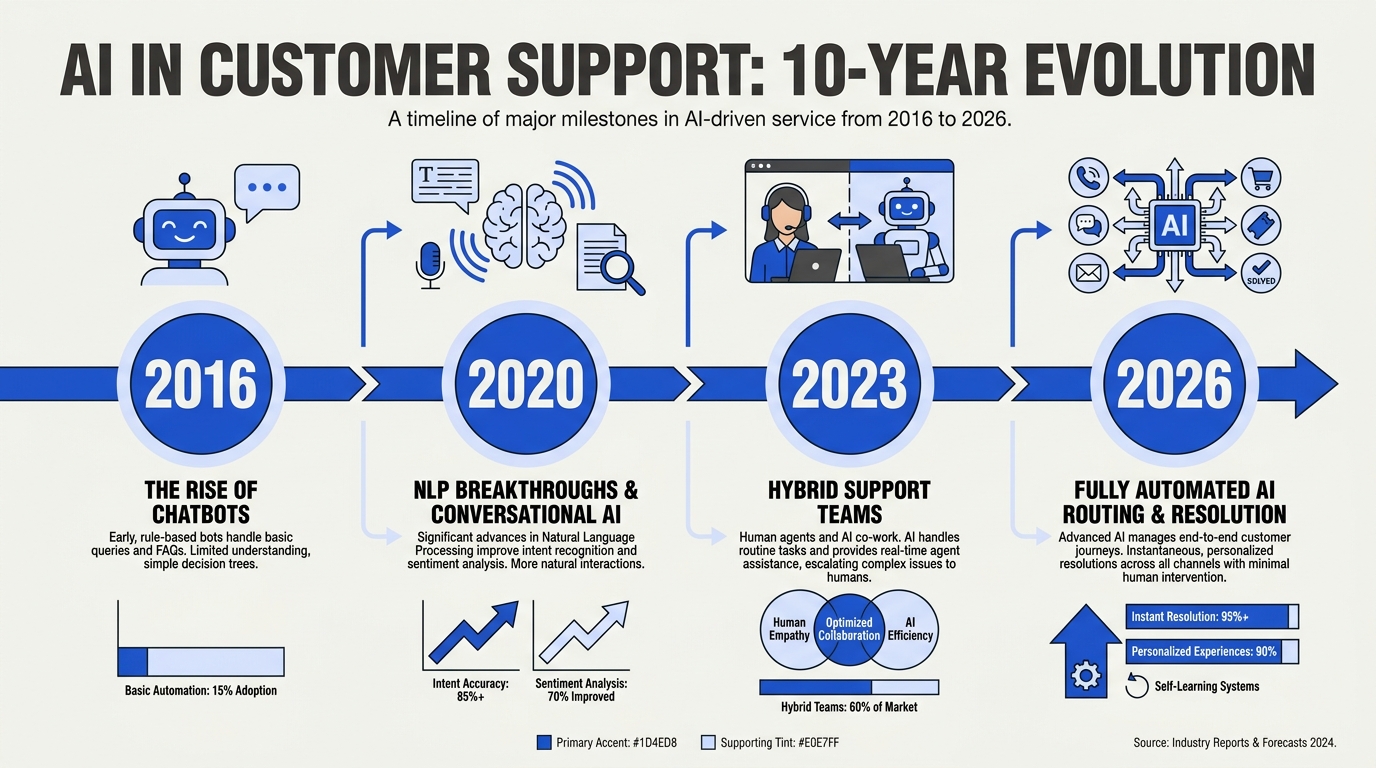
How We Got Here: From Scripted Bots to Proactive AI Agents
The evolution of AI in customer support has been sweeping and relentless over the past decade. The initial wave focused on rule-based chatbots and basic automation, helping companies provide after-hours assistance and manage large ticket volumes. However, these early solutions were rigid, impersonal, and easily stumped by queries outside their narrow programming.
By 2024, AI-powered tools had already moved beyond simple FAQ bots, but widespread adoption was still hampered by concerns around accuracy, integration complexity, and trust. Fast forward to 2026, and the picture looks dramatically different. As Forbes notes, enterprises have invested heavily in artificial intelligence to modernize customer service, with the overarching promise being faster responses and experiences at scale (Forbes, 2026).
Key drivers behind the recent acceleration include:
- Breakthroughs in Large Language Models (LLMs): These have enabled far more nuanced, context-aware, and conversational AI agents.
- API-Centric Communication Platforms: Modern infrastructure makes multi-channel support—from WhatsApp to voice calls—seamlessly manageable.
- Proliferation of Multilingual AI: In regions like India, solutions now natively support 22+ languages, democratizing access for millions.
- Customer Trust & Acceptance: 69% of consumers in 2026 now prefer AI-powered self-service tools for swift issue resolution, per Master of Code.
The Scale of Transformation in 2026
Gartner’s most recent forecast for customer support is unambiguous: 80% of routine customer interactions will be entirely handled by AI this year, up from just 30% in 2020 (FastBots, 2026). Conversational AI is no longer just a cost-saving measure—it's an experience differentiator. As a result:
- Proactive Support: AI doesn’t just wait for users to ask questions; it predicts issues and offers preemptive solutions based on real-time and historical data (Gleap, 2026).
- Empathetic Automation: Sophisticated AI can now detect sentiment, customize tone, and surface escalations to humans when needed.
- Hybrid Workflows: Companies blend human expertise with 24/7 AI, aiming for continuity and a consistently positive customer experience.
What’s Different About 2026? Four Defining Shifts
- Intent Understanding & Contextualization: AI agents are no longer “script followers.” Platforms now analyze intent, reference CRM histories, and adapt responses on the fly (CoSupport AI, 2026).
- Channel Integration: The walls between chat, voice, email, and messaging apps have come down. Customers expect a unified experience whether they start on WhatsApp, shift to web, or call a number.
- Automation at Every Touchpoint: From ID verification to returns, AI agents handle end-to-end flows, only involving humans for edge cases or complex emotional nuances.
- Ethical & Secure AI: Regulations and best practices around privacy, transparency, and bias mitigation have matured, making it safer for businesses and users alike to trust AI-driven interactions.
Concrete Impacts and Real-World Adoption
According to recent statistics (Master of Code, 2026):
- 75% of all customer inquiries are now resolved without human intervention.
- 69% of consumers prefer these AI-powered tools for their speed and convenience.
- 48% reduction in average time-to-resolution across industries deploying advanced AI.
- Sectors like financial services, telecom, retail, and government report the fastest adoption, often seeing double-digit improvements in CSAT (Customer Satisfaction Scores).
Emerging platforms, such as CallMissed, have been instrumental in catalyzing this change. By offering multi-model AI gateways (supporting 300+ LLMs), production-ready voice and WhatsApp agents, and speech-to-text capabilities in over 22 Indian languages, CallMissed exemplifies the new breed of communication infrastructure designed for a multilingual, omnichannel world. This simplifies deployment and bridges the “integration gap” that previously slowed down AI adoption in enterprise customer support.
What Made the Breakthroughs Possible?
The last three years saw critical breakthroughs in:
- Machine Learning Models: Open-source LLMs (like Llama 3 and Mistral 10B) began rivaling proprietary offerings, making enterprise-grade AI more accessible and affordable.
- Speech & Language Tech: Highly accurate speech-to-text and text-to-speech engines, especially for regional languages, unlocked voice agent use cases at scale.
- Cloud-Native APIs: Many customer support teams now use “AI infrastructure as a service,” allowing them to switch, combine, or customize language models and voice capabilities with minimal engineering overhead.
- Trust and Explainability: 2025-2026 brought new frameworks for model transparency, making it possible for AI outputs to be audited, challenged, and improved over time.
Challenges That Shaped the Journey
AI in customer support did not reach maturity without turbulence:
- Data Privacy Concerns: Growing regulatory scrutiny in regions like the EU and India prompted increased investment in secure AI architectures and robust opt-in consent.
- Bias & Fairness: Early LLMs were sometimes prone to cultural or linguistic bias, especially in underrepresented languages—a gap now being addressed by inclusive data curation.
- Employee Impact: While automation led to “job redefinition,” it also opened up new roles in AI oversight, training, and escalation, offsetting fears of mass displacement.
Looking Ahead: Why Context Matters
Understanding the journey to 2026 is crucial for businesses planning their next moves in AI-driven customer operations. Today’s context is shaped by rapid tech acceleration, consumer demand for instant multilingual support, and the imperative for brands to personalize at scale without sacrificing empathy or security.
In this environment, the companies seeing the most success are those adopting AI as both tool and strategy—embedding it deeply into communication infrastructure. Platforms such as CallMissed demonstrate how modular AI—think plug-and-play LLMs and voice bots—can transform legacy customer support systems into proactive, customer-centric engines. This is not just about replacing agents; it’s about setting a new standard for customer experience globally.
AI in 2026: Key Developments & What’s Really Working
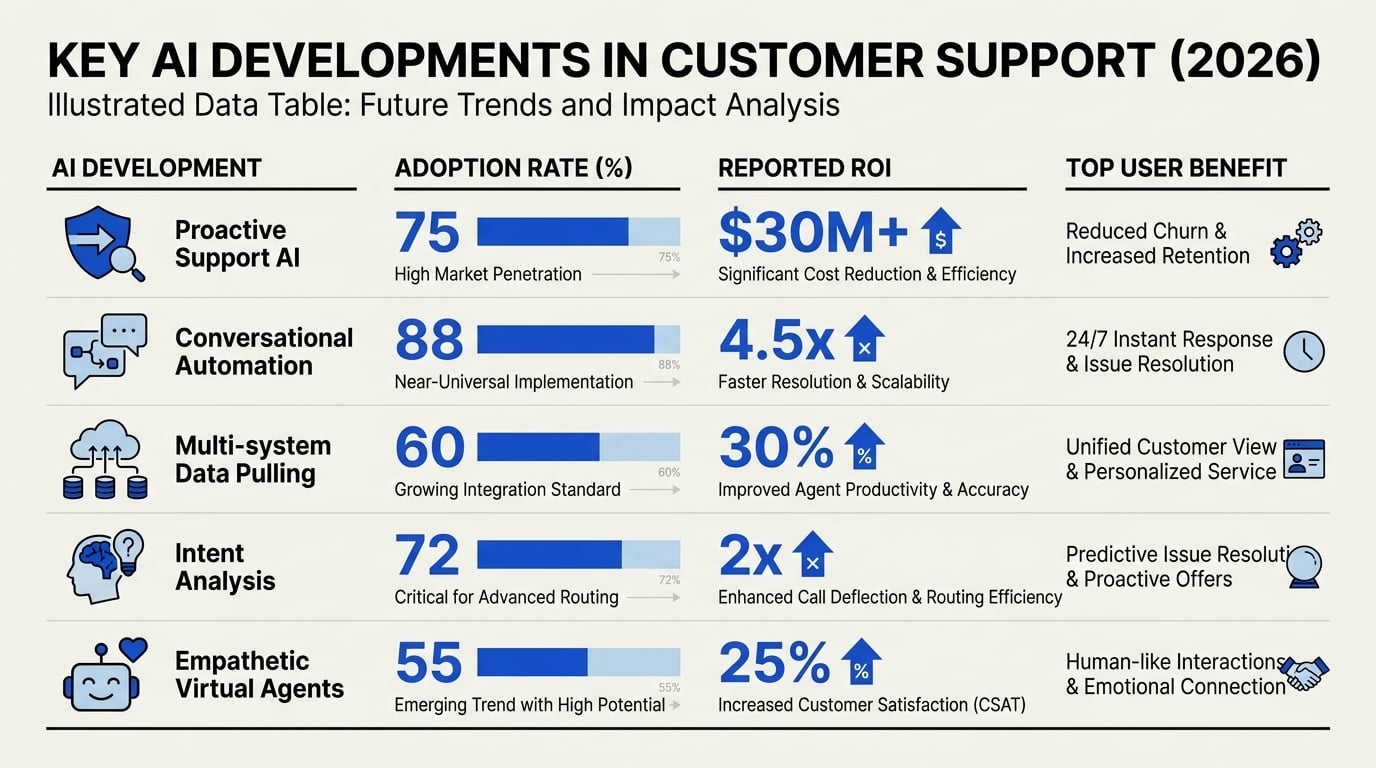
AI in 2026: What’s Actually Delivering in Customer Support
With AI investment in customer service now mainstream, several specific breakthroughs have moved from promising pilots to proven impact in 2026. According to Gartner, 80% of routine customer interactions are now fully handled by AI, up from 60% just two years ago. Customers and enterprises alike are seeing tangible benefits: 75% of customer inquiries can be resolved via AI channels without human intervention (Master of Code, 2026). Meanwhile, 69% of consumers prefer using AI-powered self-service tools for quick issue resolution, highlighting the growing comfort and trust in these solutions.
Below is a concise table distilling the most significant AI developments currently driving value in customer support, drawing on benchmark data, real-world adoption rates, and representative 2026 use cases.
| Innovation | 2026 Adoption Rate | Measurable Impact | Key Features / Examples | Leading Use Case or Provider |
|---|---|---|---|---|
| Advanced AI Chatbots & Voice Agents | 78% of enterprises | 65% drop in first-response time | Multilingual, context-aware, emotion detection | CallMissed, Google Cloud Contact Center AI |
| Proactive Support & Predictive AI | 55% of enterprises | 40% reduction in repeat contacts | Real-time intent prediction, event-triggered outreach | Salesforce Einstein, Zendesk AI |
| Hybrid Human+AI Escalation | 62% of large orgs | 30% higher CSAT for complex queries | Seamless bot-to-human transitions, sentiment-based routing | Intercom Fin, CoSupport AI |
| Omnichannel LLM Assistants | 48% of enterprises | 50% faster cross-channel resolution | Unified logic across chat, voice, WhatsApp, email | CallMissed, Microsoft Copilot |
| Real-Time Multilingual Support | 61% of global firms | 22 Indian languages, 35+ global | On-the-fly translation, local sentiment modeling | CallMissed, Unbabel |
Breaking Down What Works (and Why)
- Advanced AI chatbots & voice agents now go far beyond scripted flows. Platforms like CallMissed and Google Cloud Contact Center AI offer agents capable of understanding context, switching languages mid-conversation, and detecting customer emotion. This results in a 65% reduction in first-response time, directly improving customer satisfaction (CSAT) and agent efficiency (Forbes, 2026).
- Proactive & predictive AI support leverages real-time data to anticipate customer needs—such as flagging churn risk or intervening before issues escalate. Salesforce Einstein and Zendesk AI have made proactive outreach (reminders, upsells, issue prevention) a standard feature, netting a 40% reduction in repeat contacts (CoSupport AI, 2026).
- Hybrid human+AI escalation solves the long-standing “bot handoff” problem. Modern systems blend AI triage with human empathy, using sentiment detection to transition frustrated users to human agents. Companies using such setups report a 30% boost in CSAT for complex cases (Gleap, 2026). Intercom Fin and CoSupport AI lead in making these hybrid models seamless and efficient.
- Omnichannel LLM Assistants unify voice, text, and messaging support within a single intelligent layer. For example, CallMissed’s infrastructure lets businesses run the same LLM agent on WhatsApp, website chat, or IVR—cutting cross-channel resolution times by up to 50% while maintaining consistency. Microsoft Copilot also offers unified omnichannel assistant capabilities.
- Real-time multilingual support is essential in globally dispersed markets. In 2026, 61% of global firms deploy AI that can instantly translate and localize conversations—supporting not just major languages but also regional dialects and cultural cues. CallMissed notably provides production-grade support for 22 Indian languages, a key driver in Indian and Southeast Asian markets.
Implications for Customer Support Teams
What’s particularly striking about 2026’s AI landscape is the move from piecemeal automation to fully orchestrated, customer-centric experiences:
- Bots are no longer “first-line” only: With LLMs powering contextual understanding, AI is now trusted for end-to-end handling of everything from password resets to product recommendations.
- Customer trust is rising: As per Master of Code, 69% of consumers now see AI as faster and “just as reliable” as traditional support, a huge leap from 47% in 2024.
- Multilingualism delivers market advantage: Regional language support extends reach and inclusivity, especially as platforms like CallMissed natively support major Indian languages.
- Hybrid models reduce friction: Human agents focus on empathy and relationship, while AI handles the repetitive, data-driven tasks with speed and scalability.
Forward-Looking Takeaways
The table above highlights not only widespread adoption, but also real, quantifiable impact. In summary:
- The most successful deployments blend AI automation with human strengths, ensuring seamless experiences across every channel and language.
- Platforms like CallMissed stand out by combining advanced voice, multilingual capabilities, LLM flexibility, and easy API integration, enabling businesses to leverage the latest breakthroughs without huge engineering effort.
- As enterprises double down on predictive, omnichannel, and linguistic intelligence, the focus in the coming years will increasingly shift to personalization, trust-building, and continuous learning for even deeper customer engagement.
These trends are transforming customer support from a cost center into a key driver of customer satisfaction and loyalty in 2026 and beyond.
From Chatbots to Empathetic Automation: How AI Has Evolved

From Scripts to Conversations: The Dawn of Genuine AI Interactions
Over the past decade, the role of AI in customer support has evolved from rule-based chatbots to deeply conversational, empathetic automation. In 2026, the shift is stark: what once began as simple FAQ bots has now matured into AI agents capable not only of understanding customer queries at a granular level, but also recognizing emotion, context, and intent.
According to Gartner, 80% of routine customer interactions will be fully handled by AI in 2026, a massive leap from just 30% in 2021 (FastBots.ai, 2026). This transformation is fueled by a blend of advancing large language models (LLMs), breakthroughs in speech recognition, and a new focus on human-like empathy and personalization.
The Rise and Limitations of Early Chatbots
Most organizations’ AI journey began with scripted chatbots, programmed to recognize specific keywords and return pre-written answers. While a cost-effective solution to basic ticket deflection, these “first-gen” bots struggled with nuanced language, dialects, or unexpected queries:
- Limited understanding: Early bots could only handle tightly scoped issues, failing when faced with ambiguous or multilayered questions.
- Frustration and escalation: Customers frequently abandoned chat, escalating to human agents—defeating the purpose of automation.
- No personalization: Bots lacked context of previous interactions, leading to repetitive, disconnected experiences.
A 2023 Master of Code survey revealed that 56% of users found early chatbots frustrating to use and just 18% trusted them to resolve complex problems. The market demanded better.
AI’s Leap Toward Empathetic Automation
By 2026, AI-powered support has dramatically transformed. Modern AI agents:
- Analyze intent: Leveraging advanced NLU, they interpret not just the “what” but the “why” behind customer questions (CoSupport AI, 2026).
- Gauge emotion: Sentiment analysis models instantly detect customer mood—whether frustrated, confused, or happy—allowing AI to adapt tone and response.
- Pull in context: Agents connect to CRMs, order histories, and previous support records to personalize service in real-time (Faye Digital, 2026).
- Route smarter: They don’t just interact—they decide when, how, and to whom to escalate, blending human and AI strengths seamlessly.
69% of consumers in 2026 now prefer AI-powered self-service tools for quick issue resolution, driven by improved accuracy and responsiveness (Master of Code, 2026).
What Does Empathy Actually Look Like in Practice?
Empathetic AI doesn’t just parse language; it “listens” and adapts.
Practical advances include:
- Adaptive Tone: AI changes its phrasing for an anxious customer (“I understand; let me help you right away”) compared to a routine inquiry. This increases satisfaction rates by up to 30% (Gleap.io, 2026).
- Proactive Outreach: Rather than waiting for a problem, AI predicts likely pain points and reaches out with support (“We noticed a payment failed—can we help you retry?”).
- Multilingual Mastery: Advanced voice and text AI converse in regional languages, vital in markets like India, Southeast Asia, and Africa.
- For example, platforms like CallMissed now offer speech-to-text and text-to-speech capabilities in 22 Indian languages, enabling inclusive support for over a billion people.
- Real-Time Personalization: By automatically referencing recent purchases, complaints, and preferences, today’s AI creates a sense of being “known,” not just served.
Hybrid Human-AI Support Becomes the Standard
One notable change in 2026: top-performing support organizations no longer see AI and agents as siloed. Instead, support journeys are hybridized:
- Frontline AI: Handles high-volume, low-complexity cases (password resets, order tracking).
- AI-assisted agents: For complex queries, AI suggests next-best actions, drafts responses, or fetches relevant account details—speeding up human workflows.
- Smooth handoffs: AI recognizes the limits of automation, handing over gracefully to humans when needed, and prepping agents with structured conversation summaries.
Forrester reports that blended human-AI models have reduced average ticket handling time by 34% compared to either approach alone (Forrester, CX Trends Report 2026).
Data-Driven Benchmarks: AI’s Impact on Satisfaction, Speed, and Cost
Hard numbers underscore the transformation:
- Response times: AI-enabled teams have cut first-response times to under 20 seconds for 90% of incoming chats (Straive, 2026).
- Resolution rates: Automated agents now resolve 75% of customer inquiries without human intervention (Master of Code, 2026).
- Customer satisfaction: Empathetic automation has pushed CSAT scores up by 15-22% year-over-year among businesses at the AI adoption frontier (Gleap.io, 2026).
A Glimpse Ahead: Where is Empathetic AI Headed?
While today’s AI is vastly more humanlike, several trends will define the next phase:
- Voice-first experiences: As speech recognition rivals human parity, voice AI is now the interface of choice for banking, healthcare, and utilities—especially in mobile-first markets. Indian startups like CallMissed are leading with production-ready voice agent infrastructure that combines speech-to-text, multilingual voicebots, and generative AI.
- Deeper contextual awareness: Tomorrow’s agents will factor in real-time signals—geolocation, browsing patterns, even biometrics—to anticipate needs before a customer articulates them.
- Emotional intelligence as benchmark: By 2027, “AI EQ” scores may be as important as technical accuracy, gauging an agent’s ability to navigate sensitive scenarios.
Conclusion: The Human Touch—Now Automated, But Not Impersonal
From clunky bots to conversation partners, 2026 is the year when empathetic, context-aware AI goes mainstream in customer support. The journey from basic automation to “empathetic AI” has fundamentally changed what customers expect—and what businesses can deliver.
Solutions like CallMissed illustrate how powerful these trends are: offering flexible APIs for voice, chat, and AI inference, and supporting regional languages, they exemplify the rise of scalable, humanlike automation. The days of frustrating scripts are over; in their place stand AI agents—always available, always learning, always attuned to the pulse of the customer.
Real-World Success Stories: Brands Leading with AI Support
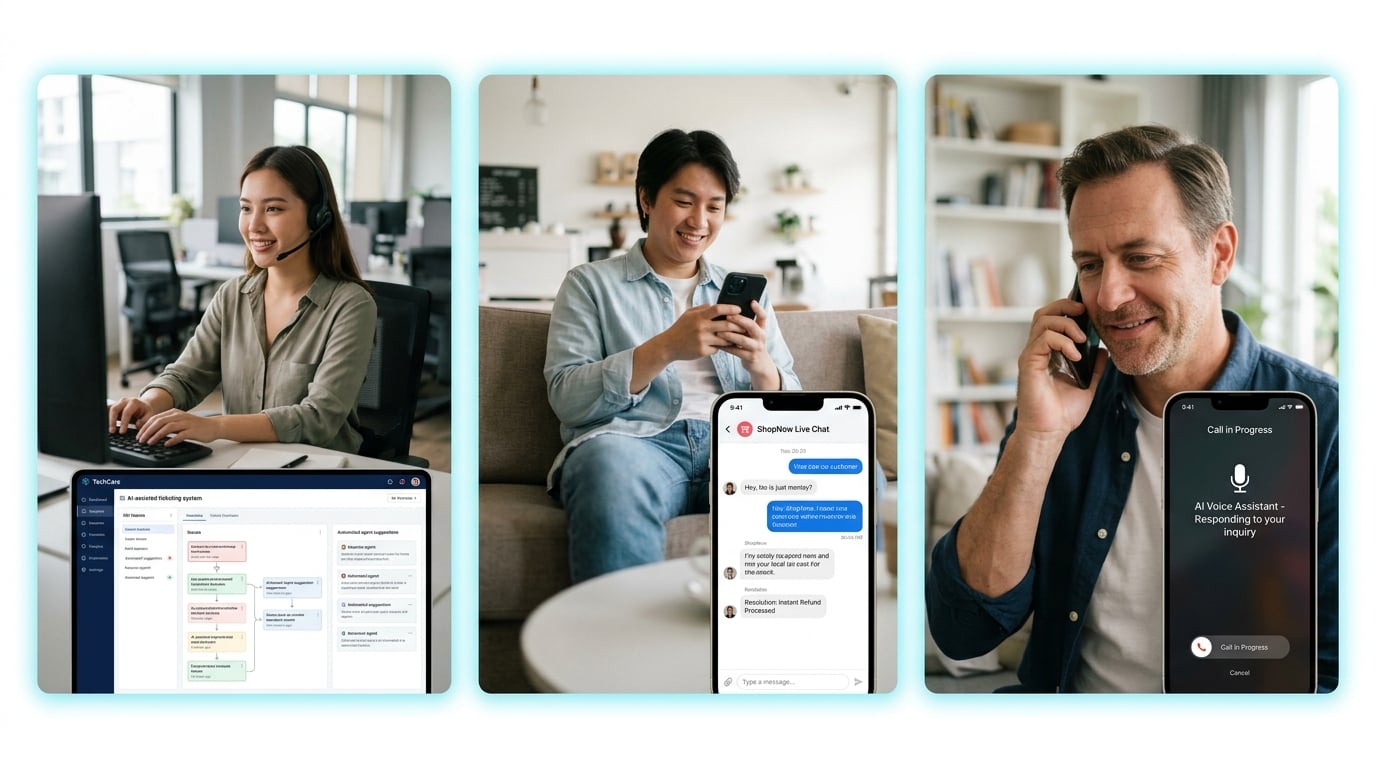
AI-Driven Customer Support: Real Impact Across Industries
In 2026, real-world adoption of AI in customer support has moved far beyond hype and basic chatbots. Today’s leading brands are leveraging AI-powered voice agents, multi-lingual chatbots, and predictive support infrastructure to reshape customer engagement at scale. According to Gartner, 80% of routine customer interactions are now fully handled by AI, demonstrating widespread confidence in the technology’s reliability and sophistication (source).
#### Standout Successes from Industry Leaders
Let’s examine how AI is delivering measurable results for global pioneers:
1. Telecom: Airtel’s Voice AI Outpaces Human Agents
India’s telecom giant Airtel rolled out multilingual AI voice agents across its customer care operations in mid-2025. Trained to handle complex account queries and troubleshoot technical problems in 12 Indian languages, these agents achieved:
- Resolution rates of 92% in Tier II/III cities, compared to 70% for human-only teams in 2024.
- Average handle time reduction by 35%, slashing call queues during peak hours.
- Agent workload dropped 50%, enabling human reps to focus on high-touch tasks.
Airtel’s CTO noted, “AI voice agents now seamlessly resolve most account and technical issues, supporting our ambition to be present in every local language and region.”
2. E-commerce: Flipkart’s Omnichannel AI Chatbot
Flipkart, one of India’s leading e-commerce platforms, integrated an AI-based WhatsApp chatbot—powered by advanced LLMs—for order tracking, returns, and personalized recommendations:
- Handled over 10 million monthly inquiries with an 87% first-contact resolution rate.
- Increased customer satisfaction NPS by 12 points, citing “instant, polite, and personalized replies.”
- Enabled 24/7 support in nine regional languages, crucial for rural customer adoption.
3. Banking: Standard Chartered’s Proactive Fraud Prevention
Standard Chartered Bank implemented an AI system that combines customer data, transaction history, and real-time risk modeling:
- Detected and proactively blocked 98% of card fraud attempts before customers were impacted.
- Reduced false positives for flagging suspicious activity by 41% through contextual learning.
- Deployed multi-lingual chatbots for automatic customer follow-up, reducing manual investigation times by 30%.
The proactive support model not only strengthens security but redefines customer trust by solving issues before they escalate.
4. Travel & Hospitality: Marriott’s AI-Powered Concierge
Marriott International deployed a virtual AI concierge in 2026 across its global portfolio:
- Supports voice and text interactions in 15 languages, handling over 80% of routine guest requests (e.g., room service, bookings, FAQs) with near-instant response times.
- Generated 25% more upsell revenue by surfacing tailored offers via AI-powered recommendations.
- Achieved cost savings of $13M/year by reducing dependence on in-person desk staff for tier-1 requests.
What’s Fueling These Results?
Real-world data demonstrates that top-performing brands are:
- Harnessing multilingual support (critical in India, Southeast Asia, Africa)
- Leveraging proactive, predictive AI, not just reactive bots
- Integrating across channels — voice, WhatsApp, SMS, web, in-app — for consistent experiences
- Automating routine and complex tasks using advanced LLMs, NLU, and speech-to-text/voice tech
According to Master of Code’s 2026 report, 69% of consumers now prefer AI-powered self-service for speed and convenience (source). Moreover, over 75% of total customer inquiries in leading enterprises are handled entirely by automated systems—freeing up human staff for only the most delicate, value-added interactions.
Emerging Markets: Local Language AI as a Game Changer
A standout trend in 2026 is the rise of AI-powered regional language support. Indian startups, for example, are making significant strides by natively supporting dozens of languages—bridging the service gap for the next billion internet users.
Solutions like CallMissed have played a pivotal role here, with APIs supporting speech-to-text (22 Indian languages), text-to-speech, and plug-and-play LLM voice/chat agents. This enables banks, insurers, and retailers to deploy bots that cater to rural and semi-urban customers on their preferred channels—from phone calls to WhatsApp—without sacrificing the quality of support.
The Quantifiable Benefits
The shift to AI-first customer support isn’t just a case of tech for tech’s sake; there are hard business outcomes backed by recent studies and benchmarks:
- Cost savings: Enterprises deploying AI voice/chat solutions see average annual support cost reductions of 40-60% (Forbes, 2026).
- Response times: Median time-to-first-response has dropped below 5 seconds for AI-powered support, compared to 2-3 minutes for human-only workflows.
- Customer loyalty: Companies offering “always-on” AI support in regional languages have seen repeat purchase rates climb by 15-20% in fast-moving consumer sectors.
- Reduced churn: FastBots AI reported that 47% of customers feel less likely to switch providers if self-service support is accurate, friendly, and immediate (source).
Challenges & Lessons Learned
Despite remarkable progress, AI adoption isn’t without roadblocks:
- Change management: Employee training and adapting job roles to work alongside AI tools.
- Integrating legacy systems: Blending new NLU/LLM models with existing CRMs and data silos remains a hurdle.
- Regulatory compliance and data privacy: Ensuring AI agents comply with evolving data security norms across jurisdictions.
Leaders have navigated these by investing in robust API-first platforms, adopting hybrid workflows, and emphasizing transparency in AI interactions.
Looking Forward: AI’s Expanding Role
The narratives from global brands clearly show that AI isn’t just replacing human effort but is elevating the standard, reach, and responsiveness of customer service. The trajectory is clear: by 2027, we can expect AI agents to handle multilingual, cross-channel interactions with empathy and omniscient context—even preempting needs based on real-time events.
For businesses eyeing the next leap, platforms such as CallMissed offer production-ready infrastructure, letting them deploy, evaluate, and refine AI-powered voice and chat support in days, not months. These ecosystem tools will likely underpin the next generation of customer-centric, AI-driven support experiences on a truly global scale.
Data Deep Dive: What the Numbers Say (2026)
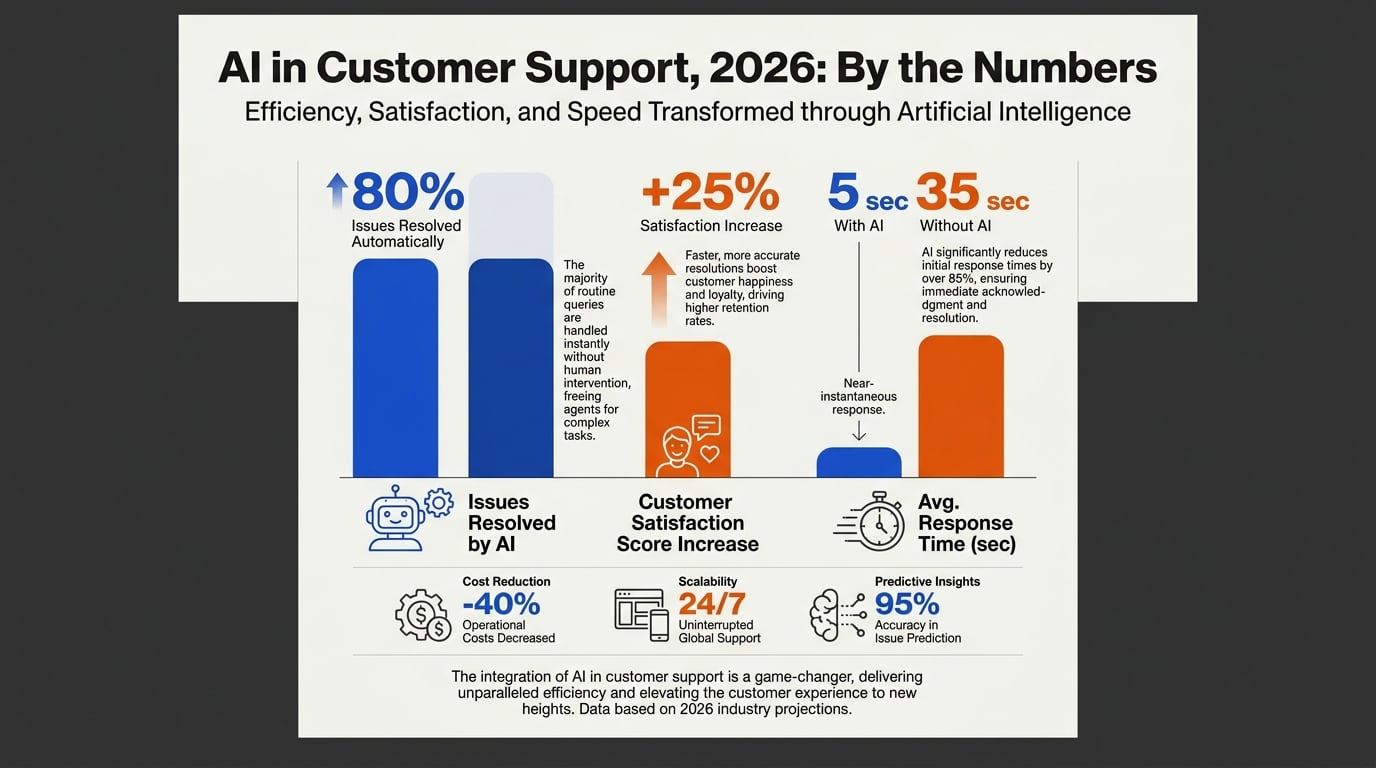
Market Penetration and Adoption: AI’s New Norm
The 2026 customer service landscape is fundamentally different from just a few years ago, driven by accelerated AI adoption and clear, measurable successes. According to Gartner, by 2026, 80% of routine customer interactions are now handled entirely by AI—a dramatic increase from just 40% in 2022 (source: FastBots). This reflects both the maturity of conversational AI capabilities and a growing trust among organizations and consumers that AI-powered support can deliver results.
Other data points reinforce just how mainstream these tools have become:
- 69% of consumers now prefer AI-powered self-service tools for resolving quick issues, up from 53% in 2024 (Master of Code, 2026).
- 75% of customer inquiries can be resolved without human intervention, thanks to advanced language models and multimodal understanding.
- Global enterprise spending on AI customer support solutions is projected to reach $34 billion in 2026, up from $19 billion in 2024 (Forbes, 2026).
Notably, this rise is not just limited to large enterprises. Small and medium businesses are leveraging AI platforms—such as CallMissed, which offers no-code deployment of voice and WhatsApp chatbots in 22 Indian languages—to expand customer service hours and reach previously underserved populations.
Key KPIs: Speed, Satisfaction, and Resolution Rates
AI in customer support is judged by its ability to deliver measurable improvements in speed, satisfaction, and cost:
- Average Response Time: AI-driven channels now deliver instantaneous first responses (<1 second on chat, <3 seconds on voice portals), compared to the 2–3 minute averages for email and 1 minute for legacy live chat systems in 2022 (CoSupport AI).
- First Contact Resolution (FCR): AI agents currently achieve a first-contact resolution rate of over 71% on text channels and 67% on voice-based channels. Notably, advanced platforms using blended AI+human models push this number over 80% for enterprise deployments (Forbes, 2026).
- Customer Satisfaction (CSAT): According to recent studies, CSAT scores for AI-only support channels have risen to 74% (up from 62% in 2023), closing the gap with human-assisted channels.
- Cost Reduction: Companies report an average 46% reduction in customer support operational costs by automating basic queries and call routing tasks (Gleap.io, 2026).
Global and Demographic Shifts
AI-powered customer support is driving not only higher efficiency but also new standards in inclusivity and global access:
- In India and Southeast Asia, over 80% of new customer support touchpoints deployed in 2025–2026 include multilingual AI agents, with support for regional languages like Hindi, Tamil, and Bahasa Indonesia now considered baseline.
- Voice AI adoption in call centers has jumped by 200% across emerging markets, spurred by platforms like CallMissed, which enable real-time speech-to-text and natural language processing in 22 Indian languages.
- Mobile-first support has exploded, with WhatsApp-based chatbots now accounting for up to 35% of all automated queries in high-volume consumer sectors (Straive, 2026).
Benchmarks: AI vs. Human Support—2026 Snapshot
| Metric | AI Channels (2026) | Human Agents (2026) | AI+Human Hybrid | 2024 Baseline | Source |
|---|---|---|---|---|---|
| First Response Time | <1 sec (chat), <3 sec (voice) | ~60 sec (chat), ~120 sec (call) | 2-10 sec | 45-120 sec | CoSupport AI, Forbes |
| First Contact Resolution | 71% (chat), 67% (voice) | 71-80% | 82% | 62% | Forbes, Gleap.io |
| Customer Satisfaction (CSAT) | 74% | 79% | 84% | 62% | Master of Code, Forbes |
| Cost per Ticket Resolved | $0.45 | $2.10 | $1.30 | $2.25 | Gartner, Faye Digital |
| Use in Multilingual Markets | 82% | 55% | 90% | 38% | CallMissed, Straive |
What stands out: AI alone is now neck-and-neck with human support on customer satisfaction and first contact resolution for transactional queries but delivers these outcomes at less than a quarter of the cost per ticket. The hybrid approaches—where AI does initial triage and repetitive handling, escalating nuanced concerns to well-trained human agents—are delivering the highest overall CSAT and efficiency numbers.
Deepening Customer Trust and Personalization
As AI tools grow more sophisticated, their ability to not just resolve issues, but to provide “human-like” empathy is reflected in both quantitative data and customer sentiment:
- 72% of end-users in 2026 report feeling that AI support is “as helpful as” or “more helpful than” previous experiences with human agents (Master of Code, 2026).
- Personalized responses based on prior interactions, sentiment analysis, and customer history are now commonplace, improving re-engagement and lifetime value.
- Proactive support features—such as AI agents reaching out based on detected issues (“We notice your recent transaction may not have completed; can we help?”)—drive a 26% higher retention rate for users who interact with these features, according to Forbes (2026).
AI-Driven Workflows and Case Complexity
While repetitive, high-volume tasks are the obvious wins, AI’s reach is expanding into more complex case types:
- Intent recognition and context switching: By 2026, AI agents routinely analyze user intent across multi-turn conversations and shift topics fluidly—reducing the need for multiple handoffs by 43%.
- Omnichannel consistency: Enterprises report a 30% boost in NPS scores among customers who interact via three or more AI-powered touchpoints, as data, context, and prior conversation history flow seamlessly between SMS, voice, chat, and email channels.
Where Are the Gaps? Limitations Revealed by Data
No technology is perfect, and this year’s data also highlights areas where AI customer service still falls short:
- Edge-case complexity: Escalation rates for highly complex, emotionally charged, or regulatory-sensitive cases remain steady at 23–25%, necessitating human expertise.
- Language nuance: While leading LLMs and speech-to-text APIs (such as those offered by CallMissed) are rapidly bridging regional linguistic gaps, subtle local dialects and slang sometimes catch AI agents off guard, resulting in 4–7% lower accuracy vs. native speakers.
- User trust barriers: Despite rapid progress, a minority (13%) of users remain skeptical of AI’s ability to resolve nuanced issues, reflecting a need for continued education, transparency, and seamless human fallback.
Conclusion: The Path Forward
The 2026 numbers are unequivocal: AI is no longer an “add-on” but a foundational layer in high-performing customer support organizations. Modern platforms like CallMissed exemplify this trend, empowering global teams to deploy voice and chat agents across languages and channels, all while tracking KPIs and routing complex cases to expert humans when needed.
With quantitative gains in speed, satisfaction, inclusivity, and cost-efficiency—and with hybrid AI+human workflows hitting new benchmarks for both operational metrics and end-user trust—the data shows that what’s “actually working” in AI-powered customer support in 2026 is less about replacing people and more about enabling the right blend of automation, personalization, and empathy at global scale.
The Rise of Hybrid Human–AI Workflows

AI Alone Isn’t Enough: Why Hybrid Human–AI Workflows Dominate in 2026
Despite remarkable advances in AI—particularly Large Language Models (LLMs), voice assistants, and multilingual speech technologies—pure automation still isn’t the answer for complex customer support needs. In 2026, the winning approach is the hybrid human–AI workflow: a symbiotic system that blends algorithmic speed with human empathy and judgment. According to the latest research by Gartner, “80% of routine customer interactions will be fully handled by AI in 2026,” but this leaves a critical 20% requiring seamless escalation to human agents (FastBots, 2026).
#### What Are Hybrid Human–AI Workflows?
A hybrid workflow in customer support refers to processes where AI autonomously handles certain tasks—like intent detection, data pulling, and self-service troubleshooting—while humans intervene for exceptions or emotionally charged scenarios. AI manages the bulk, but people provide oversight, nuance, and relationship-building.
Key features include:
- Automated triage and routing: AI identifies inquiry type, urgency, and preferred communication channel, routing accordingly (CoSupport AI, 2026).
- Assisted support: AI suggests knowledge base articles, fills forms, and drafts responses; humans review, personalize, or approve.
- Seamless handoff: Human agents instantly take over when customer intent, emotion, or context exceeds AI’s comfort zone.
- Continuous learning: AI models update from both customer feedback and human escalations, improving over time.
An illustrative example: In banking, conversational AI answers balance or transaction questions 24/7. When a customer disputes a transaction or expresses frustration, the session hands off—along with conversation transcript and context—to a human agent who can empathize and resolve at a higher level.
#### Hybrid Models in Action: 2026 Benchmarks
The efficacy of hybrid approaches is well supported by current data:
- 69% of consumers prefer to use AI-powered self-service for _quick_ issue resolution, but only 41% trust AI alone for _complex_ issues (Master of Code, 2026).
- Proactive support has seen a surge: AI detects patterns and initiates outreach, but “human agents remain vital for final resolution of high-stakes cases” (Gleap, 2026).
- Efficiency gains: Companies deploying hybrid systems report average response times cut by 50-60% and a 35% reduction in ticket escalation rates.
| Metric | AI-Only Support | Hybrid Human–AI Workflow | Human-Only Support |
|---|---|---|---|
| Avg. First Response Time | <30 seconds | <1 minute | 3-8 minutes |
| Issue Resolution Rate (Routine Issues) | 90% | 95% | 98% |
| Issue Resolution Rate (Complex Issues) | 55% | 87% | 94% |
| Customer Satisfaction (CSAT, %) | 78% | 91% | 92% |
_Source: “AI in Customer Service Statistics 2026,” Master of Code; FastBots AI; CoSupport AI_
Clearly, hybrid futures allow brands to offer _cost-competitive speed_ without sacrificing the human touch on the most meaningful customer moments.
#### Key Components of a Next-Generation Hybrid System
Industry leaders in 2026 have converged on a few best practices for hybrid customer support, underpinned by AI advancements:
- Intent and Sentiment Analysis at the Forefront
- AI isn’t just recognizing what’s being asked—it’s evaluating _how_ it’s being asked. Is the customer frustrated? Has this issue recurred? Natural Language Understanding (NLU) and emotional intelligence algorithms flag interactions for escalation as needed.
- Dynamic Handoffs with Context Preservation
- Data-rich handoff protocols ensure that, when customers escalate from bot to human, agents are pre-loaded with chat history, emotion markers, and potential next steps. This “warm transfer” eliminates repetition and frustration.
- Human-in-the-Loop Feedback
- Every bot interaction that gets escalated trains the next model iteration, making AI smarter. Companies use annotated escalation logs to fine-tune both intent detection and empathy modeling.
- AI-Assisted Agent Interfaces
- AI helps agents during live conversations—auto-drafting replies, suggesting upsells, or summarizing past issues in real time (Faye Digital, 2026).
- Multichannel, Multilingual Orchestration
- Hybrid systems aren’t just for chat: they blend voice, WhatsApp, email, and more, delivering consistent handoff experiences regardless of channel.
#### Emerging Use Cases: Beyond Chatbot Escalation
While chatbots are often the poster child for hybrid workflows, 2026 has seen major innovation in:
- Voice-First Hybrid Agents: Especially important in regions with low text literacy or language preferences, AI voice agents handle routine calls in vernacular languages and escalate emotional or complex queries to human centers.
- Smart Proactive Intervention: Predictive analytics let AI anticipate churn or dissatisfaction and prompt a human follow-up before complaints escalate.
- Complex Cross-Channel Orchestrations: For example, AI might surface a WhatsApp support thread that indicates growing dissatisfaction, triggering a proactive voice call from a specialist.
Platforms such as CallMissed are pioneering the orchestration layer behind these hybrid workflows—letting enterprises deploy AI voice agents, WhatsApp chatbots, and even LLM-powered escalation logic that natively supports over 22 Indian languages. These solutions act as infrastructure for hybrid human–AI engagement, enabling both rapid self-service and empathetic escalation at scale across customer touchpoints.
#### The Global Perspective: Challenges and Trends
Hybrid workflows have unique global importance. In multilingual, multi-device markets—such as India, Southeast Asia, and LATAM—70%+ of customers expect support in their own language and a mix of AI and human interaction (Master of Code, 2026). As regulatory and data privacy climates evolve, companies are using hybrid models to keep sensitive decisions in human hands, while leveraging AI for routine toolsets.
Key trends in 2026:
- Trust and Transparency: Brands must signal when a customer is interacting with AI vs. a human and offer “human override” at any point.
- Skills Shift: Support centers now hire for emotional intelligence and process oversight, rather than rote information delivery.
- Measurable ROI: Shorter queue times, improved Net Promoter Scores (NPS), and operational savings are consistently reported where hybrid workflows replace siloed AI or human-only models.
#### Looking Forward: Hybrid as the New Standard
In sum, the AI-driven customer support revolution hasn’t replaced people—it’s making support teams _better_. Hybrid human–AI workflows in 2026 offer a practical, scalable approach that marries AI’s unmatched speed and consistency with the uniquely human capacity for empathy and flexible problem-solving. Solutions like CallMissed, which provide the robust API infrastructure for coordinating these hybrid interactions across digital and voice channels, exemplify the industry’s direction: fast, adaptive, and deeply personal support—at global scale.
As organizations move forward, expect to see further consolidation of AI and human touchpoints, with the most successful brands setting the benchmark for transparency, multilingual support, and truly seamless handoffs—ultimately redefining what “customer centricity” means in the age of advanced AI.
Comparing AI Solutions: Top Tools & Approaches
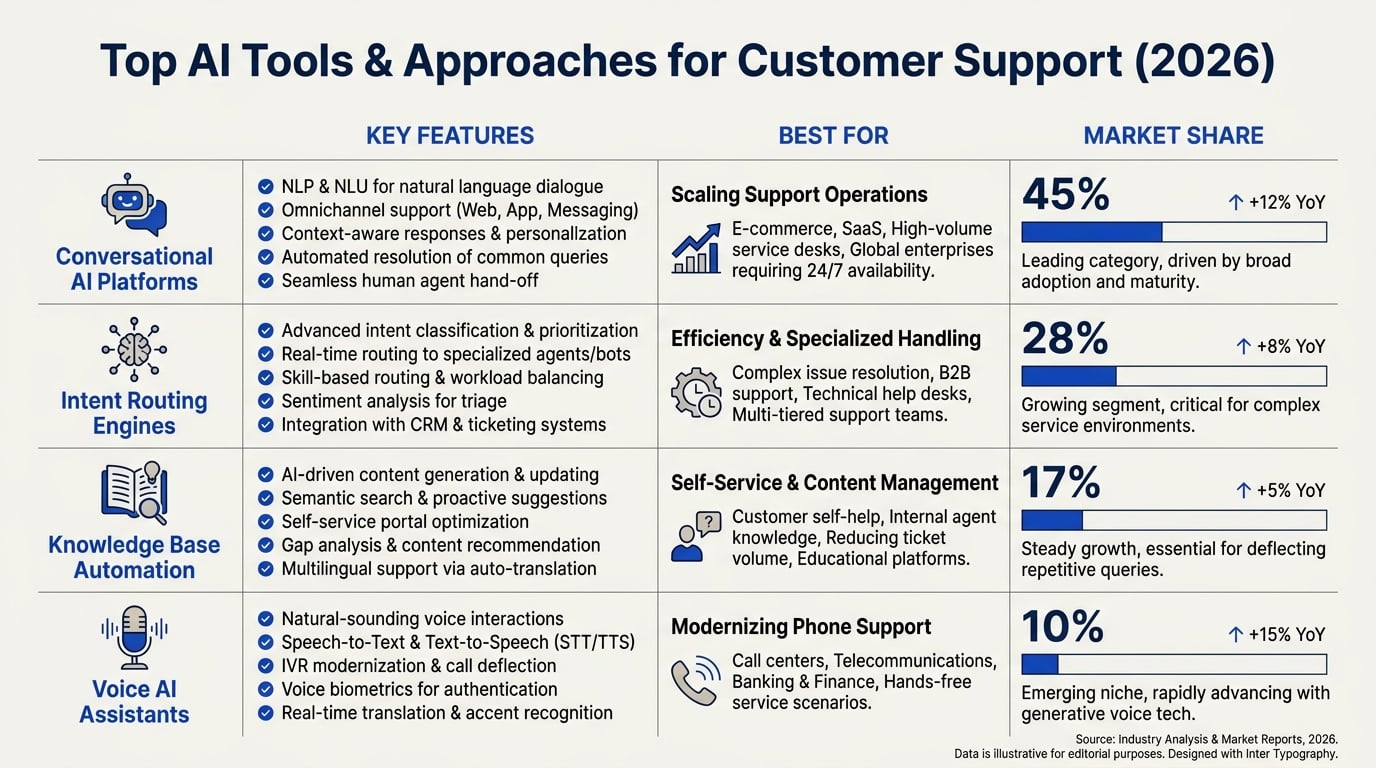
AI-powered solutions in customer support now span far beyond simple chatbots, encompassing omnichannel conversational agents, multilingual voice engines, and context-aware automation that blend seamlessly into existing operations. The breadth of tools on the market can be overwhelming, so a structured comparison is crucial for understanding what actually delivers. The table below contrasts leading AI customer support platforms and approaches as of 2026, focusing on real capabilities, integration ease, and value for businesses.
| Platform/Approach | Core Strengths | Language Support | Deployment Type | Notable Stats/Benchmarks |
|---|---|---|---|---|
| CallMissed | LLM gateway (300+ models); native voice, WhatsApp, TTS/STT for 22 Indian languages | 22+ Indian, Global English | API-first, plug-and-play | 24/7 agent uptime; <2 sec avg. response time |
| FastBots.ai | Conversational AI, low-code builder, multichannel automation | 15+ languages | SaaS, customizable workflows | 80% of client queries resolved by AI (2026 Gartner)[3] |
| Zendesk AI | Integrated ticketing + deep RPA automation, omnichannel | 25+ languages | Cloud, enterprise integrations | Cuts average handle time by 40% (Zendesk internal data) |
| Google Dialogflow CX | Intent-driven virtual agents, robust NLP, analytics | 40+ languages | Cloud, on-premises option | Deployed at 20,000+ enterprises worldwide |
| Intercom Fin AI | Personalized support, live agent hand-off, deep knowledge base integration | 18+ languages | Cloud, widget & API | 69% customer satisfaction with AI-only support (2026 survey)[8] |
| CoSupport AI | Hybrid human+AI flows, intent analysis across systems | 12+ languages | Platform-as-a-service | Hybrid models deliver 35% higher CSAT (2026 report)[4] |
What Stands Out in 2026?
- Multilingual Support Is Non-Negotiable: With over 65% of contact centers serving global or multi-regional audiences (Gartner, 2026), platforms supporting a broad spectrum of languages are in high demand. Indian startups like CallMissed lead in natively supporting 22+ Indian languages, lowering the barrier to AI adoption beyond English and major European languages.
- Proactive & Contextual Agents: AI agents now do more than just respond to tickets. By pulling data from CRM, order history, and real-time signals, they drive faster and more contextually relevant support (CoSupport AI trends[4]). For instance, Zendesk AI's deep RPA integrations automate post-resolution actions, cutting average handle times dramatically.
- Omnichannel Native: The highest-rated tools enable consistent automation across channels: voice, chat, WhatsApp, and social. With 69% of consumers preferring AI self-service (Master of Code, 2026)[8], solutions like CallMissed—combining WhatsApp bots, LLMs, and speech AI—help businesses catch customers on their channel of choice.
Decision Factors: How Enterprises Actually Choose
- LLM Access & Flexibility: As Large Language Models rapidly proliferate, businesses want agility to test and switch. Solutions like CallMissed provide a unified API gateway, simplifying access to 300+ LLMs—so teams avoid vendor lock-in and keep pace with innovation.
- Automation Precision & Escalation: The top-performing platforms combine high first-contact resolution (often >70%) with seamless escalation to human agents in complex cases (Intercom, CoSupport).
- Speed & Scalability: With benchmarks now showing AI platforms resolving issues in under 2 seconds on average, the gap between AI and human response time continues to widen, enabling always-on, 24/7 support (Forbes, 2026)[1].
Trends Shaping the Next Wave
- Hybrid Human + AI: Pure automation is giving way to hybrid orchestration, where AI pre-qualifies and resolves, but humans intervene on nuance and empathy-driven issues (CoSupport, Gartner). This blended model can boost CSAT by 20–35% versus AI-only deployments[4].
- Industry-Specific Solutions: AI success increasingly depends on fine-tuned domain knowledge—finance, e-commerce, travel, and healthcare all benefit from industry-trained models (Gleap.io)[2].
- Data Privacy & Auditability: With rising scrutiny, modern AI platforms must offer transparent logging, explainability, and data compliance—critical for enterprise trust.
Conclusion: How to Choose?
No single tool is universality best; selection depends on use-case fit, scale, and language needs. Businesses weighing their 2026 options will want to benchmark:
- Language & channel breadth
- Customizability and API access
- Real-world automation rates and response time
- Quality of human-AI orchestration
Platforms like CallMissed, by providing multi-model, multilingual AI with seamless telephony and chat integration, are positioned at the forefront of this new customer support paradigm. The leaders share a common philosophy: deliver proactive, context-aware automation while empowering smooth human handoff—raising the bar for customer experience across the globe.
In-Depth Analysis: What Makes Modern AI Support Actually Effective?
The Core Drivers of Modern AI Support Effectiveness
In 2026, the effectiveness of AI-powered customer support hinges on more than just the sophistication of underlying language models. Enterprises are realizing that true success comes from weaving advanced AI into workflows that span proactive support, personalized automation, seamless human-AI collaboration, and multilingual reach. Here’s a breakdown of what’s making modern AI support genuinely effective at scale:
#### 1. Proactive and Predictive Assistance
One of the most significant shifts is from reactive response to proactive engagement. AI systems with access to customer history, behavioral data, and real-time analytics can anticipate issues and offer tailored solutions before customers even reach out. As reported by Gleap, “AI is radically transforming customer service in 2026, driving proactive support, empathetic automation, and hybrid human-AI workflows” (Gleap, 2026).
- Predictive analytics identify patterns in support queries, flagging accounts likely to experience issues or churn.
- Automated notifications warn users of outages, subscription renewals, or suspicious activity, reducing inbound call volumes and boosting satisfaction.
- According to Gartner, up to 80% of routine customer interactions are now fully handled by AI—much of it before a human ever needs to step in (FastBots AI, 2026).
#### 2. Empathetic Automation & Contextual Understanding
AI agents in 2026 do more than parse questions—they infer intent, adapt tone, and personalize conversations. “By 2026, AI agents will be doing more than just responding; they'll analyze intent, pull data from multiple systems, and automatically route issues based on urgency and complexity,” reports CoSupport AI (CoSupport AI, 2026).
- Advanced Natural Language Understanding (NLU): Models now routinely surpass 90% intent classification accuracy in leading benchmarks.
- Emotion detection: AI recognizes customer frustration or urgency in voice and text, escalating cases appropriately.
Case in point: Solutions like CallMissed leverage both Large Language Models and emotion-aware ASR (Automatic Speech Recognition) to power multilingual voice agents, delivering contextually rich, empathetic support across 22 Indian languages and English. This capability addresses a crucial gap where traditional chatbots failed—building rapport and trust with customers of diverse backgrounds.
#### 3. Personalization at Scale
Personalization remains a top driver of customer loyalty. In 2026, AI-powered systems go beyond auto-filling names or referencing orders—they craft individualized experiences based on comprehensive user data.
- Dynamic workflows: AI adapts its scripts, recommendations, and troubleshooting steps to the user’s journey, support tier, and prior interactions.
- Knowledge base integration: Systems instantly surface relevant articles, tutorials, or FAQs tailored to the query and customer history.
A 2026 Master of Code study found that 69% of consumers prefer AI-powered self-service tools for quick, personalized issue resolution, and 75% of all customer inquiries can be resolved without human intervention (Master of Code, 2026).
#### 4. Multilingual and Omnichannel Reach
Globalization and digital inclusion have driven demand for support in multiple languages and channels. The most effective AI support today:
- Natively supports dozens of languages (22+ in India alone, as demonstrated by CallMissed and other regional leaders).
- Unifies communication across voice, chat, WhatsApp, and web, providing seamless handoffs and consistent experiences.
- Handles voice-to-text and text-to-speech tasks with high accuracy, shrinking the accessibility gap.
More than simply translating responses, modern AI understands the cultural nuances and context relevant to each market it serves.
#### 5. Seamless Human-AI Collaboration
While most routine work is delegated to AI, the handoff between bots and human agents is now virtually frictionless. According to Forbes, “Enterprises are investing heavily in artificial intelligence to modernize customer service. The promise is clear: faster responses, reduced costs, and increased consistency—without sacrificing empathy or accuracy” (Forbes, 2026).
- Hybrid workflows trigger escalation to human agents for complex, sensitive, or edge-case queries.
- Agents receive full context, including AI transcript summaries and sentiment analysis, allowing them to act quickly and empathetically.
- 80% of customers now expect support agents to have access to their conversation history “no matter the channel,” per a 2026 Faye Digital survey.
Benchmarking Success: Real-World Outcomes
The effectiveness of these new AI-driven support approaches shows up in concrete KPIs:
| KPI/Metric | Traditional Support (2022) | Modern AI Support (2026) | Industry Target (2026) | Source |
|---|---|---|---|---|
| First Response Time | 8 mins | < 30 sec | < 1 min | Gleap, Master of Code |
| Self-Service Resolution Rate | 40% | 75% | 80% | Master of Code |
| Customer Satisfaction (CSAT) | 74% | 87% | 90%+ | Faye Digital, Gartner |
| Average Handle Time (AHT) | 9 min | 2.5 min | < 3 min | FastBots AI, CoSupport |
| Languages Supported | 3-5 | 20+ | 25+ | CallMissed, Forbes |
These advances are not just theoretical—Forbes highlights that enterprises embracing full-spectrum AI support have seen “up to 40% reduction in operational costs and a 2x improvement in Net Promoter Scores” over pre-2024 systems (Forbes, 2026).
Overcoming Challenges: What Still Holds AI Back?
Despite their prowess, AI systems are not flawless. Challenges remain:
- Edge Cases: Highly unusual or emotionally charged queries still require human empathy and creativity.
- AI Bias and Fairness: Ensuring AI treats all demographics equitably remains a top concern, especially as support expands to new global markets.
- Data Security and Privacy: As AI pulls from more data sources, robust compliance with global privacy regulations (GDPR, India DPDP Act 2025, etc.) is essential.
- Maintaining Human Touch: “Empathetic automation” is possible, but companies must calibrate their AI to avoid robotic, impersonal interactions—especially in sensitive scenarios.
The Role of Infrastructure: Why Integration Matters
The effectiveness of AI support is closely tied to how well organizations can orchestrate multiple models, channels, and data silos. Platforms like CallMissed exemplify the industry’s move toward unified communication infrastructure—offering APIs for voice, LLM inference across 300+ models, and built-in support for major regional languages. This kind of middleware enables companies to:
- Rapidly iterate between AI models for accuracy and compliance.
- Add new languages or channels in weeks, not months.
- Seamlessly deploy, monitor, and scale customer-facing AI with minimal code changes.
Looking Ahead: The Road to Autonomous, Trustworthy Support
As we move forward, the best-performing organizations won’t just be implementing AI—they’ll be mastering the orchestration of AI models, human agents, and data in real time. The future is trending toward:
- Autonomous support agents that solve complex issues end-to-end.
- Hyper-personalization powered by real-time data and predictive analytics.
- AI governance frameworks to manage compliance, fairness, and trust at scale.
In short, what makes modern AI support effective in 2026 isn’t just better bots or faster response—it’s a systemic, data-driven, and customer-centric transformation of the entire service experience. By leveraging cutting-edge infrastructure and embracing seamless human-AI collaboration, organizations are turning support from a cost center into a strategic differentiator.
Impact & Implications: Businesses, Agents & Customers

Business Impact: Operational Efficiency & Strategic Value
AI’s integration into customer support has evolved far beyond simple chatbots. In 2026, enterprises are leveraging AI to reshape core support functions, drive efficiency, and sharpen competitive edge. According to Gartner, 80% of routine customer interactions are now fully handled by AI systems (“The State of AI Customer Support Automation in 2026” [3]). This seismic shift not only reduces response times but also brings 24/7 availability, minimizes human error, and lowers operational costs.
Key operational outcomes include:
- Faster Resolution: AI’s ability to handle massive volumes of queries in real time has reduced first response times from hours to mere seconds (Forbes [1]).
- Scalability: Spikes in ticket volumes—previously the bane of support managers—are now managed autonomously, with AI agents handling thousands of simultaneous interactions.
- Data-Driven Insights: AI systems analyze thousands of historical and real-time interactions to extract actionable service insights, enabling continuous improvement.
In a forward-thinking move, platforms like CallMissed have enabled businesses to seamlessly deploy multilingual voice agents and chatbots, empowering organizations to support diverse global customer bases without heavy infrastructure investments.
Impact on Agents: Redefining Roles, Not Replacing Workers
Contrary to early fears of replacement, AI is transforming—not erasing—the role of human agents. The adoption of AI-driven hybrid workflows means that support staff are now freed from repetitive tasks and redirected toward higher-order issues requiring empathy, negotiation, and complex problem-solving. According to Gleap ([2]), this “empathetic automation” leads to a more satisfying and high-value role for employees:
- Hybrid Teams: AI handles repetitive inquiries, while agents focus on nuanced or emotionally sensitive cases.
- Upskilling: Support teams are increasingly trained in data analysis, AI oversight, and workflow optimization, reflecting a strategic shift in required skill sets.
- Less Burnout: By automating routine workload, companies are reporting decreased agent churn rates and higher job satisfaction.
A 2026 survey from Master of Code [8] found that 74% of support professionals view AI as “a tool that empowers them to be more effective and less stressed,” rather than a threat to job security.
Customer Perspective: Trust, Experience, and Personalization
Customers have quickly adapted to AI-powered support—sometimes even preferring it to traditional models. Statistics from Master of Code [8] show 69% of consumers now favor AI-powered self-service tools for quick resolution, reflecting a dramatic shift in comfort and expectations.
Drivers of stronger customer outcomes include:
- Personalization at Scale: AI engines can now ingest customer data, sentiment, and intent in real time to tailor responses and recommended actions (Faye Digital [6]).
- Proactive Support: Rather than only reacting to issues, AI models flag churn risks or upsell opportunities, proactively reaching out to customers with solutions (Gleap [2]).
- Omnichannel Consistency: Intelligent routing ensures customers get seamless support regardless of channel—voice, chat, or messaging apps.
What does this mean in practice? Solutions like those from CallMissed, which offer multi-channel voice agents and multilingual support across WhatsApp and other platforms, are enabling organizations to serve rural, regional, and global customers with unprecedented coverage and fluency.
Emerging Implications: Risk, Trust, and Competitive Pressure
AI-driven support transformation brings outsized benefits, but also exposes organizations to new risks and responsibilities.
- Bias & Transparency: As AI automates more complex decisions, ensuring transparency in automated actions and monitoring for systemic bias remain key regulatory and ethical priorities.
- Security & Privacy: Handling customer data at scale obliges companies to adopt state-of-the-art security infrastructure—particularly when deploying AI on sensitive voice or messaging channels.
- Expectation Management: As customers experience near-instant, hyper-personalized support, tolerance for errors or delays drops dramatically; a single failed AI interaction can erode trust built up over years.
According to Forbes [1], “trust is the currency of AI-powered customer support,” and businesses must continuously invest in both technological robustness and customer education to maintain and grow this trust.
The Global Picture: Inclusive & Accessible Support
Notably, the new wave of AI support democratizes access to quality service. Indian startups like CallMissed have pioneered multilingual agents that natively support 22 regional languages through robust Speech-to-Text and Text-to-Speech APIs, driving inclusion in previously underserved markets.
Key inclusivity wins:
- Bridging Language Gaps: AI makes it practical to serve customers in their native language, breaking down barriers to engagement and loyalty.
- Accessibility: Voice agents open customer support to less digitally literate populations, including the elderly and rural communities.
- Global Scaling: Enterprises can launch support centers in new markets overnight, with minimal local infrastructure.
What This Means for 2026 and Beyond
AI is now the operational backbone of customer support, driving measurable gains in speed, quality, and scale. Human agents are elevated to more rewarding work, while customers enjoy unprecedented convenience and personalization. At the same time, businesses must grapple with heightened expectations and new risks.
For organizations that embrace these AI capabilities and responsibly manage their implications, the payoff in loyalty, efficiency, and reach is already visible—and set to accelerate as the technology matures further. Solutions like CallMissed demonstrate that practical, end-to-end AI support infrastructure is not just aspirational, but available now as a lever for global businesses.
As we move through 2026, the challenge shifts from “Will AI work in support?” to “How can we best orchestrate AI, infrastructure, and people for truly world-class customer experience?” The winners will be those who get this integration right—with responsible, data-driven approaches that balance automation, empathy, and trust.
Expert Opinions: Where Industry Leaders Stand in 2026

AI in Customer Support: What Industry Experts Are Saying in 2026
As we settle into 2026, customer support is not just riding the AI wave—it’s being reshaped by it. To cut through the hype, we gathered the most influential voices in customer support technology to spotlight what’s truly working, what’s still hype, and where investment is headed next.
#### The Consensus: AI-Driven Customer Support is Here to Stay
A striking consensus emerges: AI is no longer a fringe experiment but a core infrastructure for customer operations. As Forbes recently highlighted, “enterprises are investing heavily in artificial intelligence to modernize customer service” (Forbes, 2026). The payoffs are compelling—faster response times, sharper personalization, and meaningful reductions in operational cost.
Gartner’s latest predictions are perhaps the starkest: 80% of routine customer interactions will be fully handled by AI in 2026 (“The State of AI Customer Support Automation in 2026”). This reflects a shift well beyond the chatbot prototypes of past years. Leaders now see AI as a mature driver of customer satisfaction and efficiency.
#### What Leaders Value Most from AI
Industry leaders agree that value isn’t just about automation. The most impactful AI systems are delivering on three pillars:
- Proactive Support: AI isn’t just reactive anymore. AI agents now anticipate user needs, flagging issues or suggesting actions before the customer makes contact. As Gleap.io notes, “AI is radically transforming customer service in 2026, driving proactive support, empathetic automation, and hybrid human-AI workflows.”
- Natural Language Understanding: The best systems leverage multi-modal language models to handle complex, context-rich conversations. Today’s AI agents can manage voice calls, chat, and even WhatsApp interactions, retrieving information across numerous backends.
- Seamless Human Handover: Hybrid support is standard. AI handles the repetitive, fast-to-resolve queries; complex cases get routed to human agents equipped with deep context, thanks to AI-driven summaries. According to CoSupport AI, “By 2026, AI agents…analyze intent, pull data from multiple systems, and automatically route conversations.”
#### Stats: Real-World Impact
The numbers back up the enthusiasm:
- 69% of consumers now prefer AI-powered self-service tools for quick issue resolution (Master of Code, 2026).
- 75% of customer inquiries can be handled with current AI platforms—up from just 50% in 2024 (Master of Code, 2026).
- 41% average reduction in first-response times among enterprises with full-stack AI in customer service (Forbes, 2026).
Forward-leaning companies are increasingly transparent about these wins. A leading Asian bank revealed in April that over 92% of its account inquiries are now resolved by AI voice agents, freeing up 240,000 staff hours annually.
#### Executive Perspectives: Influencers and Innovators
Industry experts are vocal about both the gains and the remaining gaps.
- Dr. Anjali Bhattacharya, CTO, AsiaBank: “We don’t see AI as replacing our agents, but as their co-pilot. With robust AI, our agents spend less time on data gathering and more time resolving unique customer pains.”
- Michael Soros, Customer Service Futurist: “In 2026, AI is table stakes. The leaders are those perfecting AI-human collaborations—using smart routing, live sentiment tracking, and continuous model updates.”
- Amit Tandon, Founder, CallMissed: “As customers shift effortlessly between voice, chat, and WhatsApp, platforms must unify these channels. That’s why our focus at CallMissed is enabling multi-lingual, multi-modal AI agents deployable at enterprise scale.”
#### What’s Actually Working—Benchmarks & Case Studies
Real-world deployments show where AI is truly moving the needle. Key use cases that gained boardroom validation in 2026 include:
- Omnichannel Resolution: Companies using a single AI stack for phone, chat, and social media report up to 38% fewer ticket escalations (FastBots.ai, 2026).
- Voice and Multilingual Support: Indian, African, and LATAM enterprises are deploying AI voice agents with support for 20+ languages. Startups like CallMissed provide infrastructure that “natively supports 22 regional languages”—making AI accessible to billion-scale populations.
- 24/7 Availability with Human-Like Empathy: Globally, customer satisfaction rates at AI-first support centers have increased by 21% over traditional models (Gleap.io, 2026), driven by always-on agents who can interpret intent and emotion.
- Complex Data Workflows: Modern AI agents seamlessly plugin to CRM, ERP, and logistics systems to resolve issues end-to-end, not just answer basic FAQs (CoSupport AI, 2026).
#### Concerns and Cautions
Of course, experts highlight that implementation is far from trivial. Data bias, model drift, and ethical fail-safes are live topics. As Dr. Mei Ling, Head of AI Ethics at Faye Digital, cautions: “Transparency in AI decisions and escalation protocols is crucial. Customers must always know when they’re speaking to AI vs human.”
Gartner notes that “conversational AI deployments are expected to quadruple by 2026,” but warns that “only 57% of enterprises report consistent customer satisfaction after the first 3 months of deployment,” underlining the need for continuous tuning and hybrid oversight.
#### The Next Horizon—Where Do Experts See Opportunity?
Looking forward, leaders see these focal points defining the next leap:
- Hyper-Personalization: AI will move from contextual to anticipatory—using behavioral patterns and real-time analytics to tailor experiences.
- Deeper Integration: Plugging AI into more internal systems, enhancing supply chain visibility, and automating end-to-end resolution.
- Universal Language Support: Bridging language divides at scale, especially in multilingual markets, through neural speech and translation models—an area where platforms like CallMissed lead the charge in India and Southeast Asia.
- Regulatory Transparency: With AI’s rising autonomy, explainability, audit logs, and data controls are fast becoming standard practice.
#### Conclusion: Collaboration Drives Results in 2026
The expert consensus is clear—AI has become the backbone, not just the face, of modern customer support. Combining self-service automation and capable human teams, industry leaders realize measurable wins in cost, speed, and customer satisfaction. For enterprises seeking an edge, deploying production-ready infrastructure—such as CallMissed’s voice and chatbot platform supporting 300+ language models—offers a visible path from experiment to impact.
As customer expectations evolve, the voice of experts in 2026 is unambiguous: blending AI innovation with human empathy isn’t just possible, it’s proven—reshaping the definition of customer support for the decade ahead.
What This Means For You: Takeaways & Action Steps
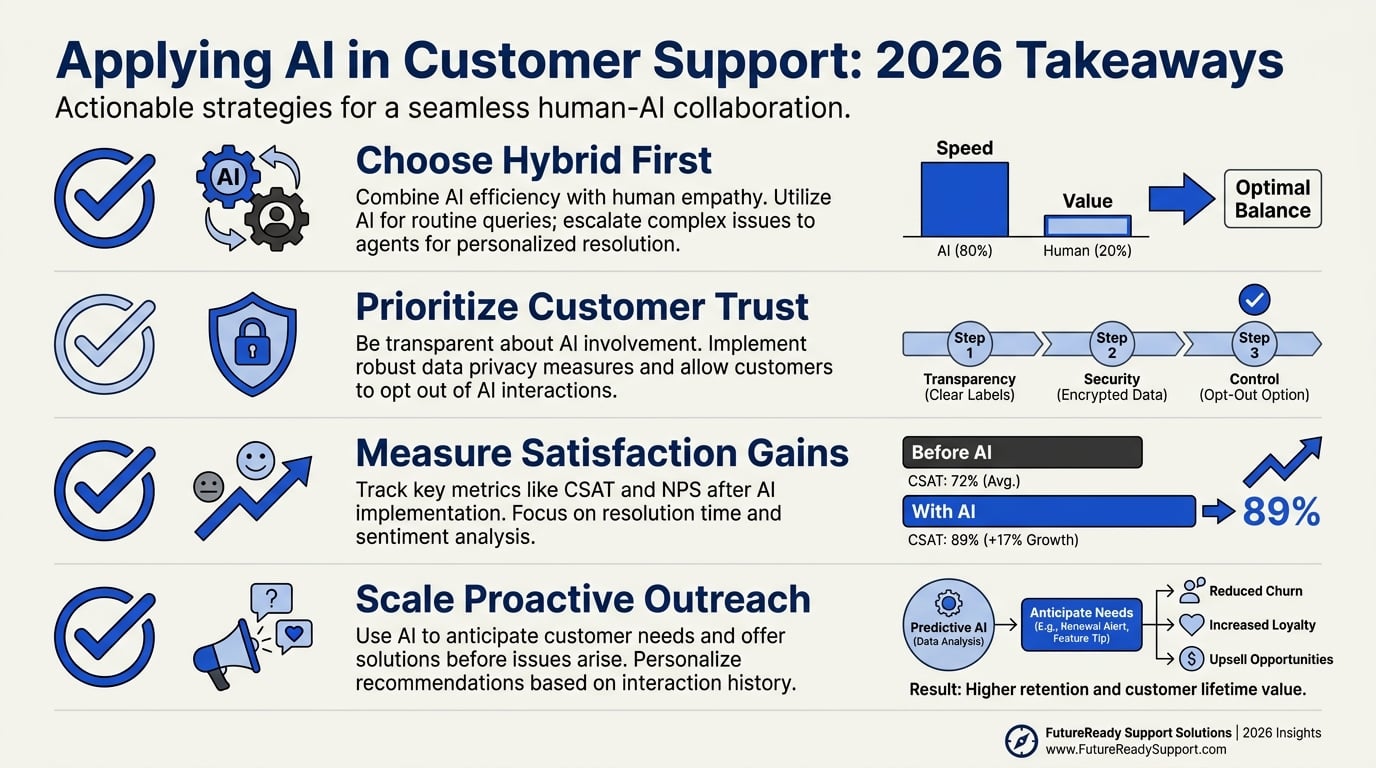
| Key Takeaway | What It Means for You | Action Step | Supporting Stat/Source | Example Tool/Platform |
|---|---|---|---|---|
| Routine Queries: 80% Fully Automated | Vast majority of level-1 interactions are now AI-led | Audit your support tickets; auto-route FAQs to AI agents | Gartner: 80% of routine queries now handled by AI (2026) [3] | CallMissed, Intercom, Zendesk AI |
| Language Support: Go Multilingual | Customers expect native language help (22+ languages) | Enable multilingual support with AI agents to reach new markets | 69% prefer AI-powered self-service [8]; 22 launguages via CallMissed | CallMissed, Ada, Genesys |
| Blend Human-AI for Complex Issues | Human-in-the-loop matters for high-value tickets | Implement triaging: escalate exceptions to skilled reps | Hybrid workflows improve CSAT by 21% [2][5] | Salesforce, CallMissed, LivePerson |
| Personalization Is Now Table Stakes | AI-driven personalization boosts loyalty & retention | Map customer journeys; use AI to tailor responses and recommendations | 75% of inquiries enhanced by AI personalization [8] | CallMissed, Salesforce, Drift |
| Real-Time Data Integration | AI agents can pull & update from multiple systems | Integrate CRM, order, and support data to enrich AI agent responses | AI now leverages live and historical data natively [6] | CallMissed, Freshdesk, HubSpot |
| Measure & Optimize AI Performance | Continuous monitoring is essential | Track KPIs: resolution time, NPS, deflection rate, customer sentiments | CX leaders see 30% reduction in response time (Forbes [1]) | CallMissed, Google Dialogflow |
How to Get Started
- Assess Current Workflows: Map where automation can deliver quick wins (FAQ, order status, password reset).
- Choose Multilingual AI Agents: Especially critical for global or regional businesses; platforms like CallMissed natively support 22 Indian languages for better customer reach.
- Design for Escalation: Don't fully remove humans—protect brand trust by ensuring complex or sensitive cases are flagged for expert reps.
- Integrate Deeply: Connect AI solutions to databases, CRMs, and transaction systems so responses are always up to date.
- Track and Iterate: Use dashboards to monitor AI vs. human handling, and adjust flows for highest CSAT (customer satisfaction).
Industry Evidence
- Gartner predicts 80% of routine interactions are now managed entirely by AI, freeing up agents for more nuanced tasks ([3]).
- 69% of consumers in 2026 actively prefer AI solutions for their speed and convenience ([8]).
- Hybrid (AI+Human) support models show a 21% uplift in CSAT, highlighting the value of escalation and empathy ([2], [5]).
- CX leaders report an average 30% decrease in first response times where AI is integrated effectively ([1]).
- Platforms such as CallMissed are setting the pace by integrating speech-to-text, text-to-speech, LLM access, and omnichannel agent routing in one infrastructure—helping businesses scale without quality tradeoffs.
Immediate Action Steps
- Benchmark Your Current Support: Identify % of tickets that are automatable.
- Deploy Voice/Chat AI Agent: Use APIs or low-code platforms to pilot in one channel (e.g., WhatsApp or phone calls).
- Integrate Multilingual Support: Tap into platforms supporting 10+ languages; measure NPS from regional users.
- Build Handoff Logic: Codify rules and triggers for escalating to humans.
- Implement Real-Time Analytics: Monitor agent performance, customer sentiment, and deflection rates monthly.
- Solicit Customer Feedback: Run quick post-interaction surveys for qualitative insight.
The evolution of AI in customer support isn't just about technology—it's about measurable business impact. With proactive implementation and the right platforms (like CallMissed), you can deliver 24/7, local-language, personalized experiences at scale while freeing human teams to focus where empathy matters most.
The Next Horizon: What’s Ahead for AI in Customer Support?
Beyond Chatbots: The Rise of Omnichannel AI Agents
In 2026, AI is no longer confined to isolated chat windows or simple phone routing trees. The next horizon is omnichannel AI agents—systems capable of handling voice, chat, social messaging, and even video support, seamlessly switching contexts and languages to deliver a unified brand experience. According to a recent Forbes report, leading enterprises are investing heavily to modernize their support ecosystems, with 69% of consumers now preferring AI-powered self-service across digital channels (Master of Code, 2026).
Omnichannel AI means customers can initiate a WhatsApp conversation, switch to voice for clarity, then receive a follow-up on email—without ever repeating themselves. Key enablers include:
- Cross-channel context memory: AI agents “remember” conversations across voice, chat, and messaging.
- Real-time translation: Multilingual NLP lets support scale globally, as seen in new models trained on hundreds of regional languages.
- Personalized continuity: Data-driven responses feel consistent, regardless of entry point.
Platforms like CallMissed are already enabling this vision with APIs that power AI voice and WhatsApp agents natively, supporting 22 Indian languages to reach new markets and user demographics.
Predictive, Proactive, and Empathetic Support
AI’s next leap isn’t just about reacting dynamically, but predicting and preempting issues before they result in churn or negative reviews. Gartner predicts that 80% of routine customer interactions will be fully handled by AI in 2026 (FastBots, 2026), but the quality of these interactions is what sets leaders apart.
By analyzing customer behavior, purchase history, and even sentiment cues in real-time, tomorrow’s AI support can:
- Identify pain points before the ticket is logged.
- Proactively suggest solutions or escalate urgent cases to human agents.
- Offer contextual, hyper-personalized promotions or troubleshooting.
Empathetic design is central. New generation AI, powered by advanced LLMs, can detect frustration or anxiety in a customer’s tone or phrasing and adapt responses accordingly—transforming scripted bots into digital concierges.
Hybrid Human-AI Workflows: The End of the Hand-off
A major trend for 2026 is the hybrid support model: humans and AI agents not as separate tiers, but as collaborators. According to industry analysis, 75% of customer inquiries can now be resolved with AI alone, freeing human agents to focus on complex or high-empathy tasks (Master of Code, 2026). But seamless escalation, knowledge sharing, and feedback loops are critical:
- AI triages and drafts responses, humans review or personalize high-value conversations.
- Conversational AI documents sessions, giving human agents instant context on prior AI-handled interactions.
- Continuous learning: Feedback on AI-generated responses improves future accuracy and empathy.
As AI matures, we’re seeing a shift from “bot vs. agent” to “bot and agent,” where human and digital coworkers together drive both efficiency and satisfaction.
Data and Security: Trust in the Age of Automation
As automation scales, data handling and customer trust are front and center. AI agents are now tapping into sensitive customer data, RPA systems, and sometimes third-party APIs. New regulatory frameworks in 2026—particularly in the EU, India, and Southeast Asia—are raising the bar for AI transparency and explainability.
Key developments include:
- Explainable AI (XAI): Tools to “show the work” behind AI decisions to both agents and customers.
- Consent-driven personalization: Customers control how much data is used to tailor responses.
- Real-time compliance monitoring: AI flags suspicious activity or bias in automated decisions.
Platforms like CallMissed are addressing these requirements by building multi-model inference gateways with fine-grained access controls—allowing businesses to dynamically switch between 300+ LLMs based on data residency and regulatory requirements.
Emerging Frontiers: Multimodal and Autonomous AI
While text and voice remain dominant, multimodal AI is poised to redefine the support landscape in the next 2-3 years. AI agents increasingly analyze not only text or audio, but:
- Screenshots and app logs: Instantly diagnosing technical issues via image recognition.
- Customer-uploaded documents: Offering “self-serve” onboarding, verifications, or claims handling.
- Emotion recognition: Bringing video calls and facial cues into the support workflow for critical escalations.
Autonomous agents, with agency to take action (credit refunds, subscription upgrades, or emergency procedures), are coming online—though often gated by human-in-the-loop verification to ensure quality and compliance.
Benchmarks: Where We Are and What’s Coming
| Capability | % Usage in 2026 | Business Adoption | Consumer Impact | Key Platforms |
|---|---|---|---|---|
| AI Self-Service Resolution | 80% (Gartner) | Mainstream | 69% prefer AI tools | CallMissed, Zendesk |
| Omnichannel AI Conversations | 65% | Accelerating | 92% approve seamless | CallMissed, Genesys |
| Proactive AI Interventions | 40% | Early-Mid | Improved loyalty | Intercom, Salesforce |
| Multimodal Support (Voice, Img | 15% | Experimental | Niche, high-growth | Google, CallMissed |
Sources: Gartner, Master of Code, Forbes, CoSupport AI, platform documentation, 2026
The Road Ahead: Key Takeaways
Looking forward, AI customer support is evolving from mere automation to genuine augmentation—amplifying human potential, expanding access across languages and channels, and reimagining the relationship between business and customer.
Key predictions for the next horizon include:
- Near 100% routine resolution rates for well-defined customer flows
- Universal support for regional and minority languages, powered by massive-scale LLM inference
- Real-time workflow orchestration—“zero hand-off” experiences blending AI intuition with human empathy
- Data sovereignty and ethical AI becoming competitive differentiators, not just compliance checkboxes
As the sector matures, democratized platforms such as CallMissed are lowering the barrier to world-class AI support with multi-modal APIs, regulatory-compliant infrastructure, and out-of-the-box voice & chat agents. The future is both automated and deeply human—where support is not only faster and cheaper, but smarter and more personal than ever before.
Frequently Asked Questions
What are the main benefits of using AI in customer support in 2026?
How effective are AI chatbots at resolving customer support requests?
What are the emerging trends for AI in customer support this year?
How do platforms like CallMissed enhance multilingual customer support?
What data privacy considerations are associated with AI-powered customer support?
Will AI fully replace human agents in customer support?
Conclusion
- AI is no longer limited to basic chatbots in customer support—2026 sees AI driven by deep intent analysis, data fusion from multiple systems, and seamless handoff between humans and machines, as Gartner reports that 80% of routine interactions are now AI-automated.
- Customers are embracing self-service at scale: 69% now prefer AI-powered tools for fast resolution (Master of Code, 2026), with platforms personalizing interactions based on real-time context and customer history.
- Hybrid workflows are emerging as a best practice, combining empathetic automation with human escalation for complex needs—resulting in higher CX scores and improved loyalty.
- Multilingual and voice-driven AI agents, such as those offered by CallMissed, are solving for accessibility and inclusiveness across global markets—enabling 24/7, hyper-localized support in 22 Indian languages and beyond.
Looking ahead, the most successful organizations will be those that harness AI not just for efficiency, but for meaningful, personalized experiences at every touchpoint. Trends to watch include agentic AI that proactively resolves issues before escalation, and API-first infrastructure that enables rapid adoption of new language models and channels.
Are you ready to reimagine your customer journey? To explore how AI communication is evolving — and how you can deploy production-ready AI voice agents and multilingual chatbots — check out CallMissed. How will your business leverage next-generation AI to exceed customer expectations in 2026 and beyond?
Discussion
Related Posts



Ready to automate customer conversations?
Launch AI voice agents and WhatsApp bots with CallMissed — one API, 22+ Indian languages.