

GPT-5.6 vs Kimi K3: Official GPT-5.6 Models Compared With a Rumored Kimi Release



Get a fact-checked GPT-5.6 vs Kimi K3 comparison covering verified models, pricing, access, capabilities, rumors, and fair testing.
GPT-5.6 vs Kimi K3: Official GPT-5.6 Models Compared With a Rumored Kimi Release
What if the most important AI model comparison this year is between one officially documented family and a model that may not exist publicly at all? GPT-5.6 vs Kimi K3 is already attracting attention, but the evidence is sharply uneven: OpenAI has published primary-source material for GPT-5.6 Sol, GPT-5.6 Terra, and GPT-5.6 Luna, while Kimi K3 remains a rumored/unverified release as of July 15, 2026.
That distinction matters because online benchmark screenshots, social-media claims, and speculative launch reports can make an unannounced model appear comparable to a production-ready system. They are not equivalent to an official model card, reproducible evaluation, or documented API listing. This analysis therefore treats GPT-5.6 as the confirmed side of the comparison and Kimi K3 as an unknown profile—not as a model with proven capabilities, pricing, context length, or release date.
OpenAI describes GPT-5.6 as a three-model family: Sol, the flagship; Terra, a lower-cost option; and Luna, the fastest and most cost-efficient tier, according to OpenAI’s GPT-5.6 announcement and preview system card. OpenAI lists GPT-5.6 Sol at $5 per 1 million input tokens and $30 per 1 million output tokens, while GPT-5.6 Terra is listed at $2.50 per 1 million input tokens and $15 per 1 million output tokens, according to OpenAI’s API materials. OpenAI’s platform documentation also reports a 1.05-million-token context length and 128,000-token maximum output for the relevant API offering, details that may influence long-document analysis, coding workflows, and agentic applications.
The central question is not simply whether GPT-5.6 Sol can outperform a rumored Kimi K3. It is whether developers should choose a documented flagship, a cheaper GPT-5.6 Terra deployment, or the speed-and-cost orientation of GPT-5.6 Luna when the alternative lacks publicly verifiable specifications. The article will examine the official GPT-5.6 release timeline, capabilities, availability, pricing, and system-card disclosures; separate confirmed facts from community claims; and outline a fair testing framework for reasoning, coding, latency, multilingual performance, and cost.
For teams turning models into real customer experiences, this shift from model hype to infrastructure evidence is equally important. Platforms such as CallMissed reflect the broader trend by giving developers one OpenAI-compatible gateway to multiple AI models, including language, speech, image, and search capabilities.
GPT-5.6 vs Kimi K3: Which Model Is Actually Confirmed as of July 15, 2026?

As of July 15, 2026, GPT-5.6 is the only side of this comparison supported by public primary-source documentation. OpenAI has documented GPT-5.6 Sol, GPT-5.6 Terra, and GPT-5.6 Luna across its announcement, API documentation, and preview system card; Kimi K3 remains rumored and unverified, with no confirmed public model card, pricing page, benchmark report, or release documentation identified from Moonshot AI in the available evidence.
Confirmation status: GPT-5.6 Sol, Terra, Luna, and Kimi K3
| Model | Confirmation status | Documented evidence | What remains unverified |
|---|---|---|---|
| GPT-5.6 Sol | Officially confirmed | OpenAI identifies Sol as the flagship GPT-5.6 model and lists API pricing of $5 per 1M input tokens and $30 per 1M output tokens. | Independent performance results across every claimed use case |
| GPT-5.6 Terra | Officially confirmed | OpenAI describes Terra as a lower-cost model priced at $2.50 per 1M input tokens and $15 per 1M output tokens. | Whether its real-world quality matches Sol for specific workloads |
| GPT-5.6 Luna | Officially confirmed | OpenAI’s GPT-5.6 announcement and preview system card describe Luna as the fastest and most cost-efficient tier; OpenAI’s preview materials list input pricing beginning at $1 per 1M tokens. | Complete public details on relative capability, latency, and output pricing |
| Kimi K3 | Rumored/unverified | No official Moonshot AI announcement, model card, API listing, pricing schedule, or reproducible evaluation is established in the supplied primary-source record. | Existence, release date, context window, modalities, pricing, benchmarks, and availability |
The official evidence comes from named OpenAI sources: “GPT-5.6: Frontier intelligence that scales with your ambition,” “Previewing GPT-5.6 Sol,” the GPT-5.6 Preview System Card, and OpenAI’s Models and API pages. OpenAI’s API documentation also reports a 1.05-million-token context length and 128,000-token maximum output for the relevant GPT-5.6 API offering. Those specifications are materially different from social posts or screenshots because developers can inspect the documented endpoint, pricing, and deployment terms.
Why the comparison must remain asymmetric
A conventional GPT-5.6 vs Kimi K3 benchmark would imply that both models have stable, testable releases. That premise has not been established. Until Moonshot AI publishes an official Kimi K3 announcement or equivalent technical documentation, claims about Kimi K3’s reasoning, coding ability, multilingual performance, latency, context length, or price should be labeled community speculation, not product facts.
This does not prove that Kimi K3 will be weak—or that it will never launch. It establishes only an evidence boundary:
- GPT-5.6 Sol, Terra, and Luna can be evaluated from documented access and specifications.
- Kimi K3 cannot yet be scored fairly without a confirmed model endpoint or reproducible test artifact.
- Community benchmark claims are not equivalent to independent, reproducible evaluations.
The practical choice today is therefore between GPT-5.6 tiers—not between two equally confirmed product families. Subsequent sections compare OpenAI’s documented capabilities, availability, pricing, and safety disclosures while tracking Kimi K3 as an unknown profile rather than inventing specifications.
What Are GPT-5.6 and Kimi K3, and Why Is This Comparison Uneven?
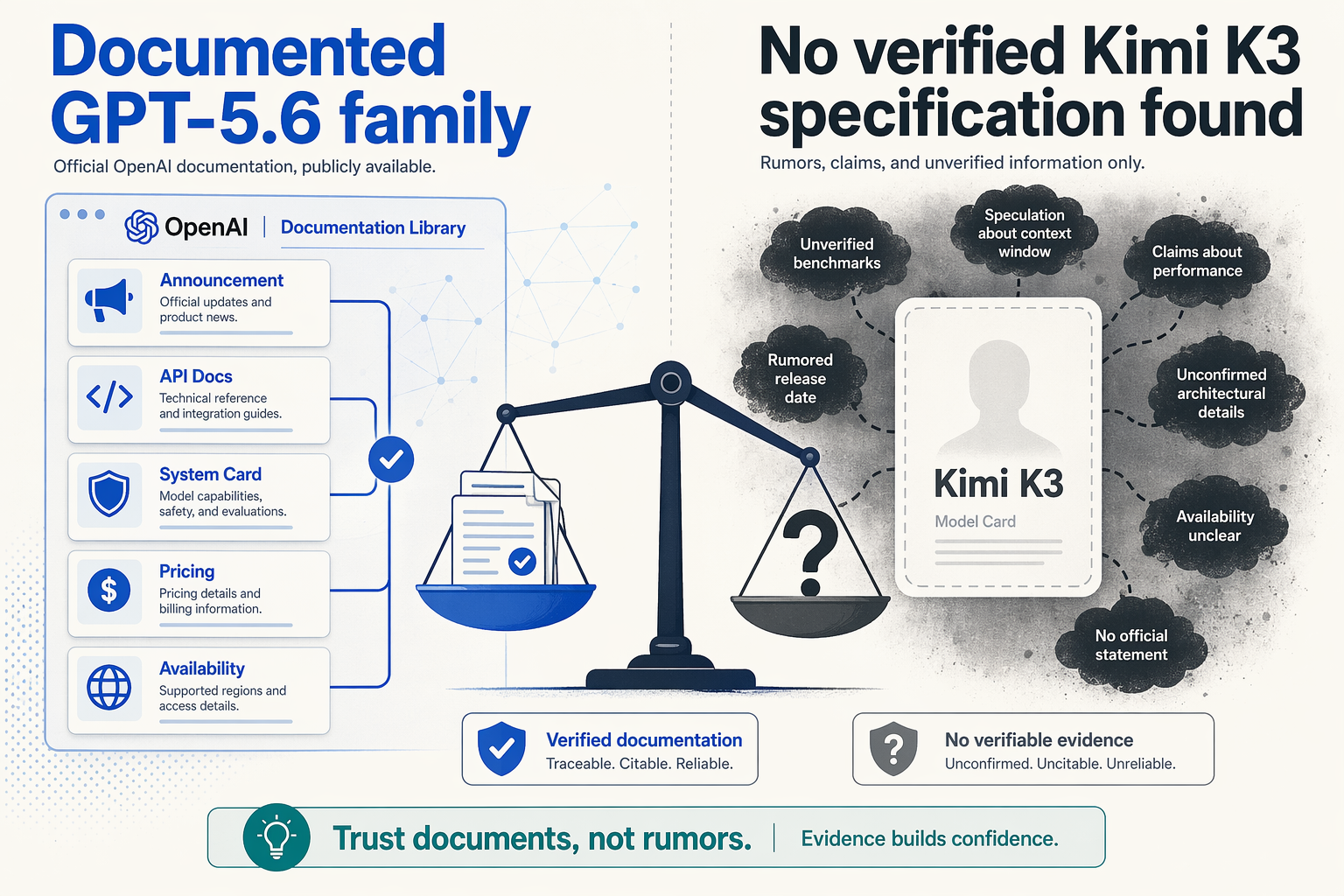
GPT-5.6 is a documented OpenAI model family, while Kimi K3 is an unverified release claim as of July 15, 2026. That makes a conventional benchmark comparison premature: GPT-5.6 has published specifications and safety documentation, but Kimi K3 has no confirmed public profile against which those facts can be tested.
GPT-5.6 Has a Defined Three-Tier Lineup
OpenAI describes GPT-5.6 as three models designed for different performance, cost, and latency requirements:
- GPT-5.6 Sol is OpenAI’s flagship model for demanding reasoning, coding, and general-purpose workloads.
- GPT-5.6 Terra is positioned as a capable, lower-cost alternative to Sol.
- GPT-5.6 Luna is described by OpenAI as its fastest and most cost-efficient GPT-5.6 option for high-volume or latency-sensitive applications.
OpenAI’s GPT-5.6 announcement, API documentation, and GPT-5.6 Preview System Card provide the primary evidence for this structure. OpenAI lists GPT-5.6 Sol at $5 per 1 million input tokens and $30 per 1 million output tokens, while GPT-5.6 Terra costs $2.50 per 1 million input tokens and $15 per 1 million output tokens, according to OpenAI’s API materials. OpenAI lists GPT-5.6 Luna at $1 per 1 million input tokens; buyers should verify the current output-token price in the API documentation before estimating production costs.
OpenAI’s platform documentation also reports a 1.05-million-token context length and 128,000-token maximum output for the relevant GPT-5.6 API offering. Those limits are directly relevant to long-document analysis, software repositories, research workflows, and agentic applications.
Kimi K3 Remains an Unknown Profile
Moonshot AI is the company behind the Kimi model family, but as of July 15, 2026, there is no confirmed Moonshot AI primary-source announcement, public model card, official API listing, pricing schedule, or reproducible benchmark documentation establishing a Kimi K3 release. Therefore, claims about Kimi K3’s context window, parameter count, reasoning ability, coding performance, multimodal support, price, or launch date should be labeled rumored, not reported as specifications.
A fair status summary is:
- GPT-5.6 Sol, Terra, and Luna: officially documented by OpenAI.
- Kimi K3: rumored or unverified; specifications unavailable for confirmation.
- Direct score comparison: not currently valid without an accessible Kimi K3 checkpoint or API.
- Community screenshots and social-media claims: leads for investigation, not independent evaluations.
Why the Comparison Is Uneven
The meaningful comparison is currently between a verified model family and an evidence gap. Developers can assess GPT-5.6 Sol vs Terra, or GPT-5.6 Luna vs Terra, using price, throughput, latency, output quality, and documented limits. They cannot responsibly declare GPT-5.6 Sol vs Kimi K3—or GPT-5.6 Terra vs Kimi 3—a winner until Moonshot AI publishes testable details.
This evidence-first approach also favors infrastructure that can route across documented models. For example, CallMissed’s OpenAI-compatible gateway lets developers access multiple model types through one integration while they monitor availability, cost, and performance rather than committing to an unverified rumor.
Which GPT-5.6 and Kimi K3 Claims Are Confirmed? Evidence and Status TABLE
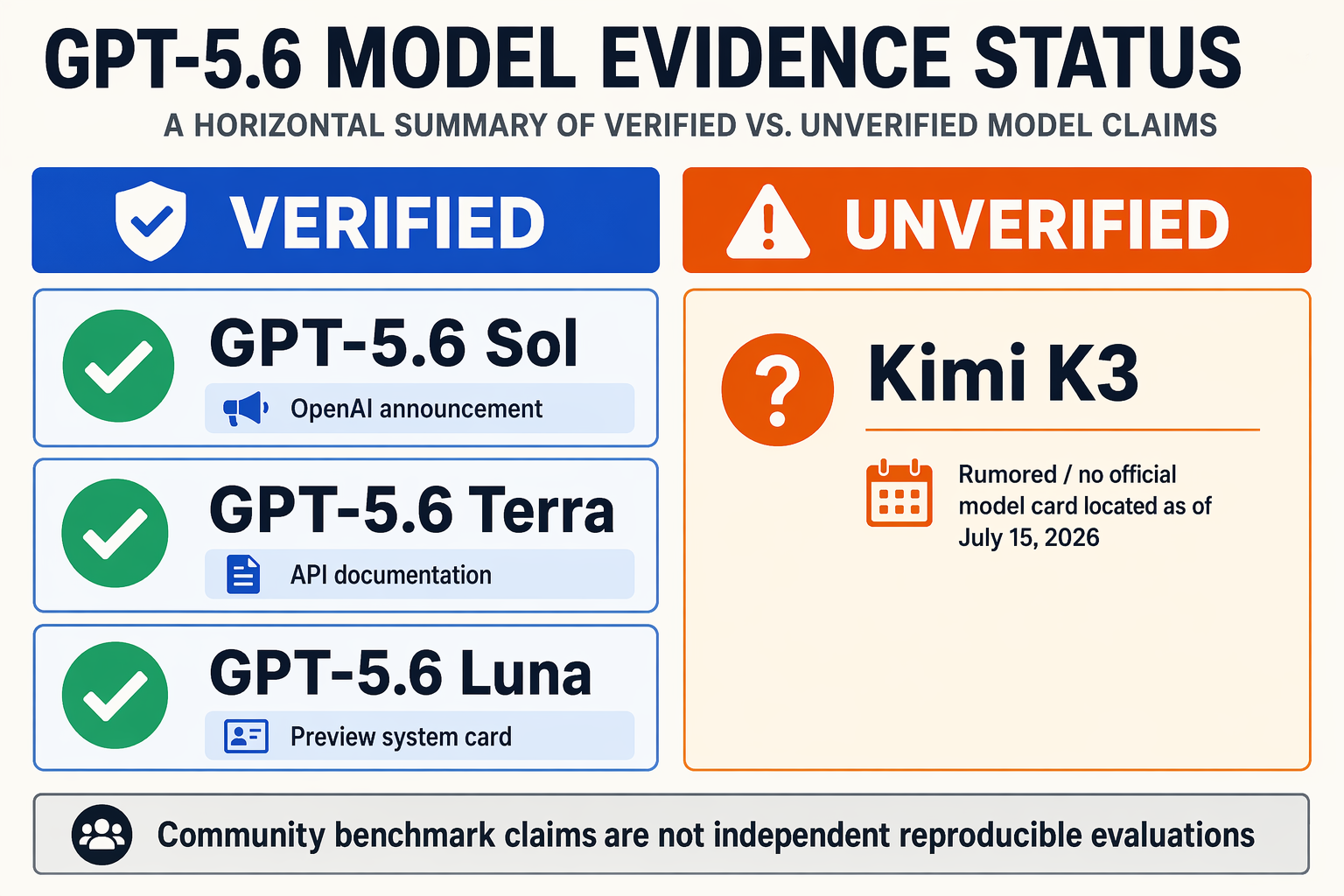
GPT-5.6 has confirmed primary-source documentation; Kimi K3 does not. As of July 15, 2026, OpenAI’s announcement, API documentation, and GPT-5.6 Preview System Card support specific claims about GPT-5.6 Sol, GPT-5.6 Terra, and GPT-5.6 Luna. By contrast, no official Moonshot AI or Kimi model card, pricing page, benchmark report, API listing, or release announcement for Kimi K3 is identified in the available evidence.
Confirmation standard
A claim is marked confirmed only when it is supported by an official product page, API document, system card, or named primary-source release. Community benchmark screenshots and social-media posts may indicate interest, but they do not establish reproducible performance, production availability, or commercial terms.
| Claim or specification | GPT-5.6 evidence | Kimi K3 evidence | Status as of July 15, 2026 |
|---|---|---|---|
| Model family and variants | OpenAI describes Sol, Terra, and Luna as a three-model family in its announcement and Preview System Card | No verified Kimi K3 family announcement or model card identified | GPT-5.6 confirmed; Kimi K3 unverified |
| Model positioning | Sol is the flagship; Terra is the lower-cost option; Luna is the fastest and most cost-efficient tier, according to OpenAI | No official Kimi K3 positioning is documented | GPT-5.6 confirmed; Kimi K3 unknown |
| API availability | OpenAI API documentation lists GPT-5.6 models for the Responses API and client SDKs | No confirmed Kimi K3 API endpoint or model identifier is available | GPT-5.6 confirmed; Kimi K3 unverified |
| Published pricing | OpenAI lists Sol at $5 per 1 million input tokens and $30 per 1 million output tokens; Terra at $2.50 input and $15 output per 1 million tokens | No verified Kimi K3 pricing has been published in the supplied evidence | GPT-5.6 confirmed; Kimi K3 unknown |
| Context and output limits | OpenAI’s API materials report a 1.05-million-token context length and 128,000-token maximum output for the relevant offering | No confirmed Kimi K3 context window or output limit | GPT-5.6 documented; Kimi K3 unknown |
| Release and evaluation claims | OpenAI provides an announcement, API materials, and a GPT-5.6 Preview System Card covering deployment and safety disclosures | Rumored claims cannot establish a release date, benchmark result, or safety profile | Evidence is asymmetric |
What the table means for comparison
The fair conclusion is not that GPT-5.6 automatically outperforms Kimi K3. It is that GPT-5.6 can currently be evaluated against documented criteria, while Kimi K3 cannot be scored responsibly without an official artifact. A claimed Kimi K3 benchmark should therefore remain labeled rumored until Moonshot AI or Kimi publishes a verifiable model identity, access method, test conditions, and results.
For developers, the confirmed GPT-5.6 lineup also supports a practical tier decision:
- Choose Sol when maximum documented capability is more important than token cost.
- Consider Terra for lower-cost workloads with published pricing.
- Evaluate Luna where speed and high-volume economics are the priority; OpenAI’s preview materials describe Luna as the fastest and most cost-efficient tier.
Platforms such as CallMissed, an OpenAI-compatible AI gateway, reflect the same evidence-first direction by allowing teams to route workloads across multiple documented model providers through one integration rather than tying an application to an unverified rumor.
How Do GPT-5.6 Sol, Terra, and Luna Differ in Capability, Price, Access, and Safety?
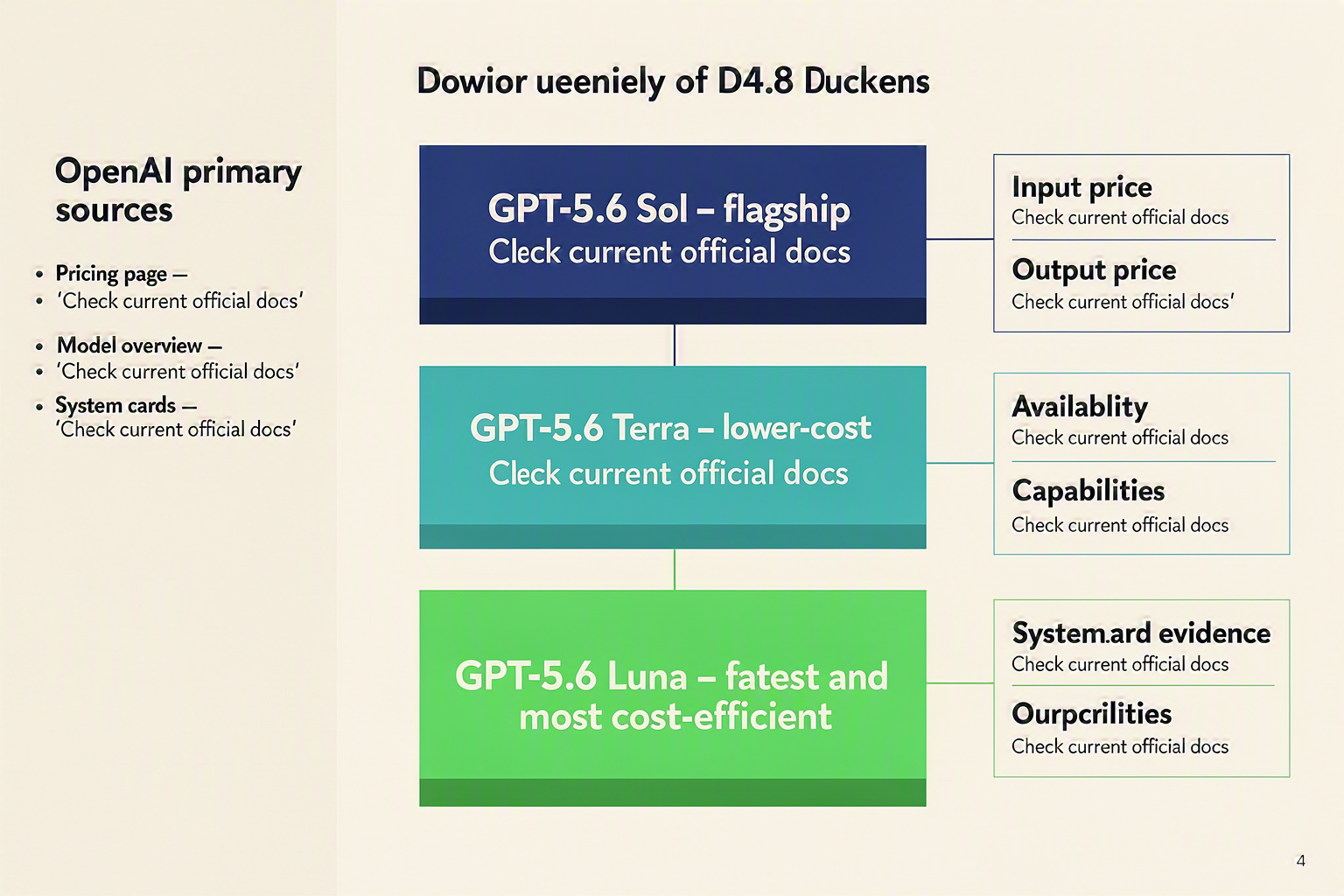
GPT-5.6 Sol, Terra, and Luna are differentiated primarily by capability tier, price, and throughput, not by three unrelated architectures. OpenAI identifies Sol as the flagship, Terra as the lower-cost option, and Luna as the fastest and most cost-efficient model; Kimi K3 has no verified public specifications against which to compare those trade-offs as of July 15, 2026.
GPT-5.6 Sol vs Terra vs Luna: capability positioning
OpenAI’s GPT-5.6 Preview System Card describes the family as three deployment tiers:
- GPT-5.6 Sol: The highest-capability model for demanding reasoning, coding, long-context analysis, and complex agentic workflows.
- GPT-5.6 Terra: A capable, lower-cost model intended for applications where quality remains important but Sol-level economics are difficult to justify at scale.
- GPT-5.6 Luna: The fastest and most cost-efficient tier, positioned for high-volume workloads, latency-sensitive applications, and routine generation.
OpenAI’s public materials do not support the claim that every benchmark or task will rank these models in a simple Sol-to-Luna order. Developers should test representative workloads rather than assume that the most expensive model is always the most effective choice.
The relevant OpenAI API offering lists a 1.05-million-token context length and 128,000-token maximum output, according to OpenAI’s API platform documentation. However, teams should confirm which limits apply to each model, endpoint, and account configuration before building around them.
Pricing and practical model selection
OpenAI’s published pricing makes the trade-off concrete:
| Model | Input price per 1M tokens | Output price per 1M tokens | Positioning |
|---|---|---|---|
| GPT-5.6 Sol | $5 | $30 | Flagship capability |
| GPT-5.6 Terra | $2.50 | $15 | Lower-cost general use |
| GPT-5.6 Luna | $1 | $5 | Fast, cost-efficient, high volume |
These figures come from OpenAI’s GPT-5.6 announcement, preview materials, and API documentation. Because output tokens cost more than input tokens—especially on Sol—long-form reasoning, code generation, and tool-using agents can produce substantially different bills even when prompts are identical.
A practical routing strategy is therefore:
- Use Sol for difficult research, high-stakes reasoning, and complex coding.
- Use Terra for everyday assistants, document workflows, and moderate-complexity automation.
- Use Luna for classification, summarization, support replies, and latency-sensitive volume.
Platforms such as CallMissed, an OpenAI-compatible AI gateway, reflect this multi-model approach by allowing developers to access multiple model types through one integration and billing layer.
Access and safety evidence
OpenAI states that GPT-5.6 models are available through the Responses API and client SDKs, while ChatGPT access, plan limits, and availability are documented separately in OpenAI’s ChatGPT help materials. Access should therefore be checked by product surface rather than assumed from the model’s announcement.
Safety evidence is also asymmetric. OpenAI has published a GPT-5.6 Preview System Card covering the family’s deployment-safety assessment. No equivalent Kimi K3 model card, official pricing page, reproducible benchmark report, or verified safety documentation was identified in the supplied primary-source record as of July 15, 2026. Consequently, “GPT-5.6 vs Kimi K3” remains an evidence-based comparison on one side and a rumor check on the other—not a conventional head-to-head model test.
How Should a Fair GPT-5.6 vs Kimi K3 Test Compare Reasoning, Coding, Speed, Cost, and Context?
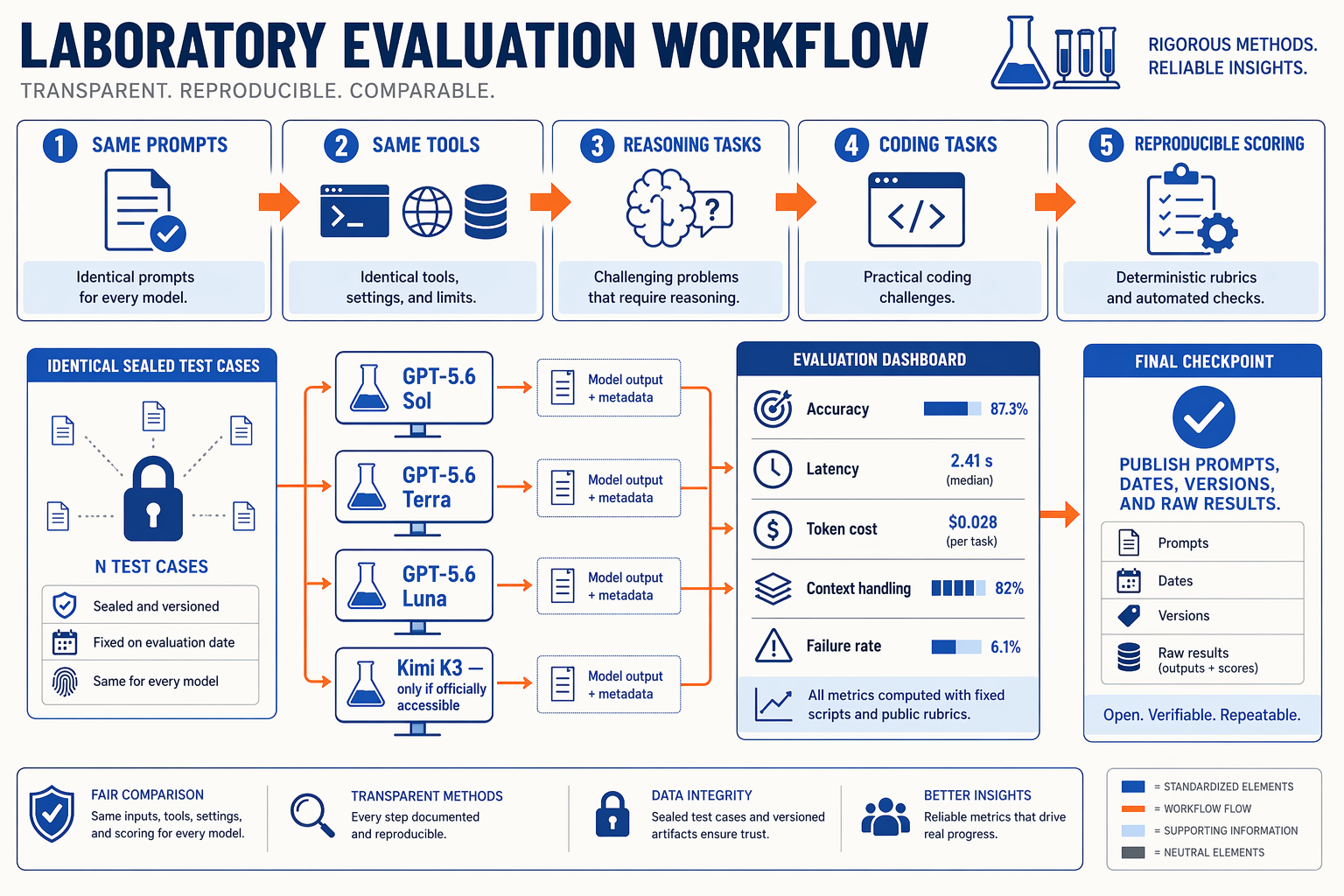
A fair GPT-5.6 vs Kimi K3 test should compare documented capabilities using identical prompts, tool access, hardware conditions, and accounting rules—while labeling every Kimi K3 result as unverified until Moonshot AI publishes an official model card or API specification. The comparison should measure reasoning quality, coding reliability, latency, total cost, context handling, and multilingual performance, not rely on isolated leaderboard screenshots.
1. Separate confirmed facts from unknowns
OpenAI’s primary materials identify GPT-5.6 Sol, GPT-5.6 Terra, and GPT-5.6 Luna as three model tiers: Sol is the flagship, Terra is the lower-cost option, and Luna is designed for speed and cost efficiency, according to OpenAI’s GPT-5.6 announcement and preview system card.
By contrast, Kimi K3 remains rumored and unverified as of July 15, 2026. A responsible test must not assign Kimi K3 a context window, parameter count, benchmark score, price, release date, or latency target without a Moonshot AI announcement, model card, API listing, or reproducible independent evaluation.
2. Use matched evaluation sets
A credible benchmark should use a preregistered or publicly documented test set containing fresh questions that neither system has been optimized against. The test should include:
- Reasoning: multi-step mathematics, scientific explanation, constraint satisfaction, planning, and uncertainty handling. Score both the final answer and whether the reasoning reaches a verifiable conclusion.
- Coding: repository-level bug fixes, code generation, test writing, SQL, debugging, and patch application. Measure tests passed, security defects, required edits, and successful execution—not just human preference.
- Long-context work: summarize, retrieve, compare, and transform information placed at several points within a long document. OpenAI’s API materials list a 1.05-million-token context length and 128,000-token maximum output for the relevant GPT-5.6 offering; Kimi K3 should be marked “not documented” unless Moonshot AI confirms equivalent figures.
- Multilingual performance: evaluate English plus Indian languages, including translation, intent classification, and code-switched customer requests. This matters for production systems serving regional audiences, not only English-language benchmarks.
3. Measure speed and cost under real workloads
Latency should be reported as time to first token, total response time, tokens per second, and timeout rate, with at least 30 repeated trials per task. Tests should separate cold starts from warm requests and record prompt length, output length, region, API version, and tool usage.
Cost comparisons must use the same token counts and include retries, reasoning overhead, tool calls, and failed requests. OpenAI lists GPT-5.6 Sol at $5 per 1 million input tokens and $30 per 1 million output tokens, while GPT-5.6 Terra costs $2.50 input and $15 output per 1 million tokens, according to OpenAI API materials. OpenAI’s GPT-5.6 announcement identifies Luna as the most affordable tier, but a final comparison should use its published price rather than infer a figure.
For developers testing multiple providers, an OpenAI-compatible gateway such as CallMissed can standardize request formats and route experiments across language, speech, image, and search models. The gateway does not replace independent evaluation; it can make the test setup more consistent.
4. Publish uncertainty with the results
The final report should show confidence intervals, failure examples, evaluation prompts, model versions, and exact dates. If Kimi K3 cannot be accessed through a verifiable Moonshot AI endpoint, the correct conclusion is “insufficient evidence for a direct benchmark,” not that GPT-5.6 wins by default. Community claims may guide future testing, but they are not equivalent to an official model card or an independent, reproducible evaluation.
What Do the Verified Facts Mean for Developers, Businesses, and Open-Model Buyers?

The verified evidence supports a deployment decision, not a conventional benchmark winner. Developers can evaluate GPT-5.6 Sol, Terra, and Luna using published specifications and API access; Kimi K3 should be treated as an unverified lead until Moonshot AI publishes an official announcement, model card, or usable endpoint.
Developers: build around evidence and routing
For engineering teams, the practical choice is between GPT-5.6 tiers rather than between a documented model and an unknown one.
- GPT-5.6 Sol is the logical candidate for complex reasoning, high-value coding, and difficult agent workflows where output quality justifies higher spend.
- GPT-5.6 Terra offers a lower-cost path for production applications that still need substantial capability.
- GPT-5.6 Luna is positioned by OpenAI as the fastest and most cost-efficient tier, making it relevant to high-volume classification, extraction, summarization, and latency-sensitive interactions.
OpenAI’s API materials list GPT-5.6 Sol at $5 per 1 million input tokens and $30 per 1 million output tokens, while GPT-5.6 Terra costs $2.50 per 1 million input tokens and $15 per 1 million output tokens, according to OpenAI’s July 2026 API documentation. OpenAI also reports a 1.05-million-token context length and 128,000-token maximum output for the relevant API offering, which may simplify long-document and multi-step workflows.
That documentation enables developers to estimate costs, test latency, inspect failure modes, and design fallback policies. A Kimi K3 claim without verified pricing, context limits, API behavior, or reproducible benchmarks cannot support the same level of planning.
Businesses: select for risk, volume, and customer impact
Businesses should map model tiers to workload value rather than use one model for every request:
- High-consequence interactions: Route complex support escalations, legal-document analysis, or revenue-critical automation to a thoroughly evaluated model such as GPT-5.6 Sol.
- Routine automation: Use Terra for structured drafting, internal search, summarization, and moderate-complexity customer operations.
- Large-scale, low-margin traffic: Test Luna for speed and cost efficiency, while measuring accuracy against an approved baseline.
- Human handoff and monitoring: Require confidence thresholds, audit logs, escalation paths, and prompt-injection testing before exposing any model to customers.
For Indian businesses, model selection also includes language coverage and channel infrastructure. Platforms such as CallMissed combine multi-model access with AI voice, WhatsApp automation, and support for speech-to-text and text-to-speech across 22 Indian languages. That illustrates an important operational point: the best model decision depends not only on text benchmark scores, but also on whether the surrounding system can serve real customers reliably.
Open-model buyers: do not confuse access with openness
“Open-model buyer” can mean a team seeking open weights, self-hosting, permissive licensing, or simply broader provider choice. The GPT-5.6 sources cited here document OpenAI-hosted models and API availability; they do not, by themselves, establish that GPT-5.6 is an open-weight model. Likewise, no verified Kimi K3 release evidence is available in the supplied research as of July 15, 2026.
Procurement teams should therefore request:
- An official model card and license
- Weight-release and self-hosting terms
- Data-retention and training-use policies
- Region, rate-limit, and availability commitments
- Reproducible evaluations on the buyer’s own tasks
Until Moonshot AI confirms Kimi K3 through primary documentation, the responsible conclusion is “GPT-5.6 documented; Kimi K3 unverified,” not “GPT-5.6 defeated Kimi K3.”
What Are Analysts and Official Sources Actually Saying—and What Remains Unknown?
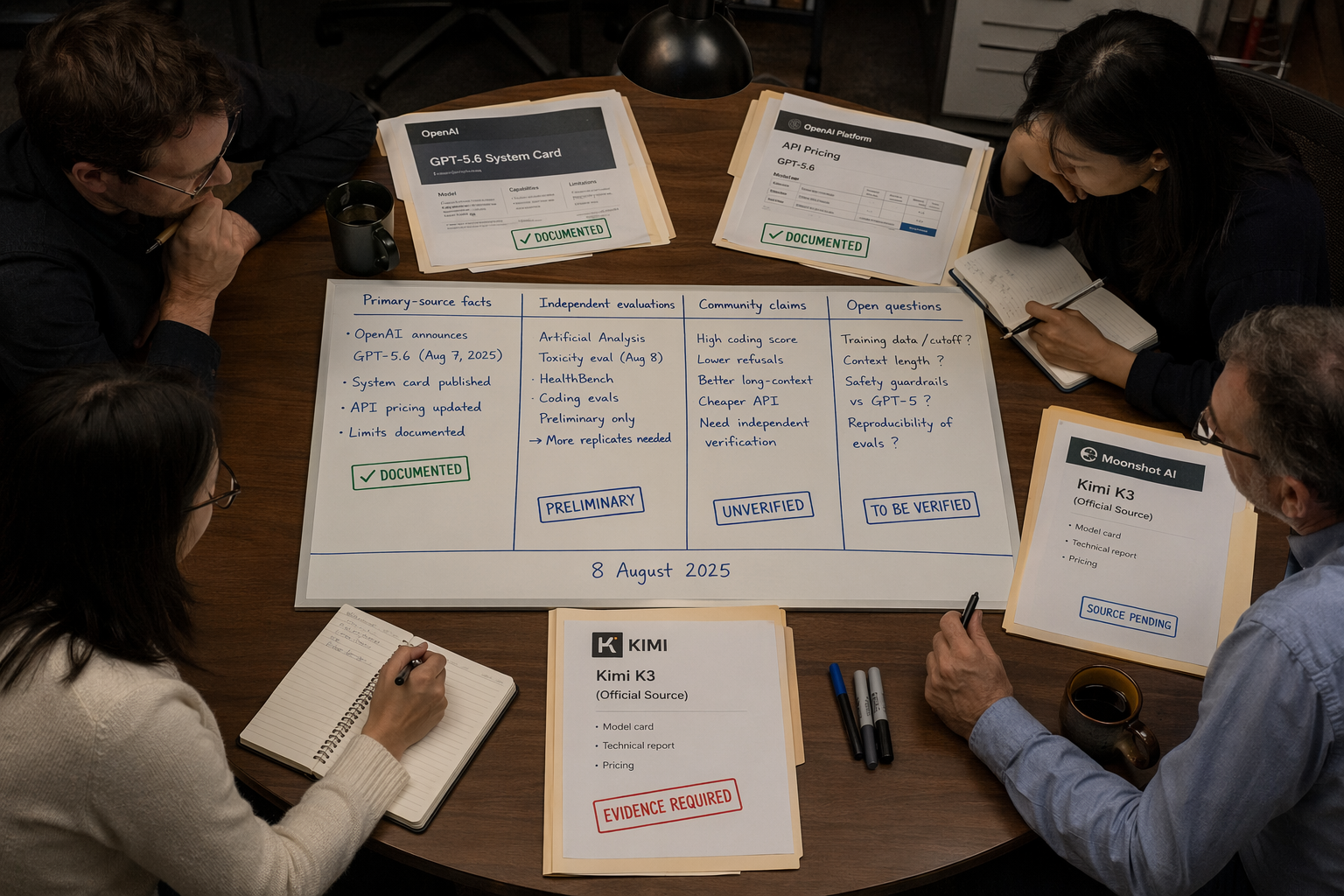
The evidence supports a documented GPT-5.6 family versus an unverified Kimi K3 claim, not a conventional head-to-head benchmark. OpenAI’s primary materials describe GPT-5.6 Sol, Terra, and Luna, while no Moonshot AI or Kimi primary-source specification for Kimi K3 is identified in the available evidence as of July 15, 2026.
What OpenAI’s Primary Sources Confirm
OpenAI’s GPT-5.6 announcement, Previewing GPT-5.6 Sol article, GPT-5.6 Preview System Card, and API model documentation consistently establish a three-tier lineup:
- GPT-5.6 Sol: OpenAI’s flagship model, priced at $5 per 1 million input tokens and $30 per 1 million output tokens.
- GPT-5.6 Terra: A lower-cost model priced at $2.50 per 1 million input tokens and $15 per 1 million output tokens.
- GPT-5.6 Luna: OpenAI describes Luna as its fastest and most cost-efficient model for cost-sensitive, high-volume workloads.
OpenAI’s API materials also report a 1.05-million-token context length and 128,000-token maximum output for the relevant GPT-5.6 API offering. Those figures are directly useful for evaluating long-document processing and agentic workflows, although they do not by themselves prove superior reasoning, coding, or reliability.
The GPT-5.6 Preview System Card is particularly important because it provides a safety and deployment reference rather than relying only on launch marketing. OpenAI’s model documentation states that GPT-5.6 models are available through the Responses API and OpenAI client SDKs. OpenAI’s news page also says GPT-5.6 became the preferred model in Microsoft 365 Copilot, providing an additional deployment signal.
What Analysts Can—and Cannot—Conclude
The available evidence does not support a credible analyst conclusion that Kimi K3 matches, exceeds, or undercuts any GPT-5.6 tier. A social-media post, benchmark screenshot, or unnamed “early tester” is not equivalent to a Moonshot AI model card, API listing, reproducible evaluation, or published pricing schedule.
For a defensible GPT-5.6 vs Kimi K3 analysis, readers should separate three evidence levels:
- Confirmed: OpenAI’s named model pages, API documentation, pricing, and system-card disclosures.
- Reported but unverified: Community claims about a possible Kimi K3 release, capability, or benchmark result.
- Unknown: Kimi K3’s context window, parameter or architecture details, availability, latency, safety testing, multilingual performance, pricing, and release date.
No specification should be inferred from Kimi K2, another Moonshot AI model, or a mislabeled benchmark. Until Moonshot AI publishes primary documentation, Kimi K3 should remain an unknown profile, not a scored competitor.
What a Fair Verification Test Requires
If Kimi K3 becomes publicly available, a meaningful comparison should use the same:
- Prompt set, temperature, tool permissions, and output limits
- Coding repositories and pass/fail tests
- Reasoning tasks with contamination checks
- Languages, including Indian-language customer-support prompts
- Latency, throughput, error-rate, and cost measurements
- Repeated trials with confidence intervals
Platforms such as CallMissed, which provide one OpenAI-compatible gateway across multiple models and modalities, reflect why reproducible routing and cost measurement matter more than unverified leaderboard claims. Until Kimi K3 has public evidence, the responsible conclusion is not that GPT-5.6 wins—it is that GPT-5.6 is currently the only side that can be evaluated with documented facts.
Which Model Should You Choose for Coding, Reasoning, Speed, Budget, or Open-Weight Requirements? TABLE
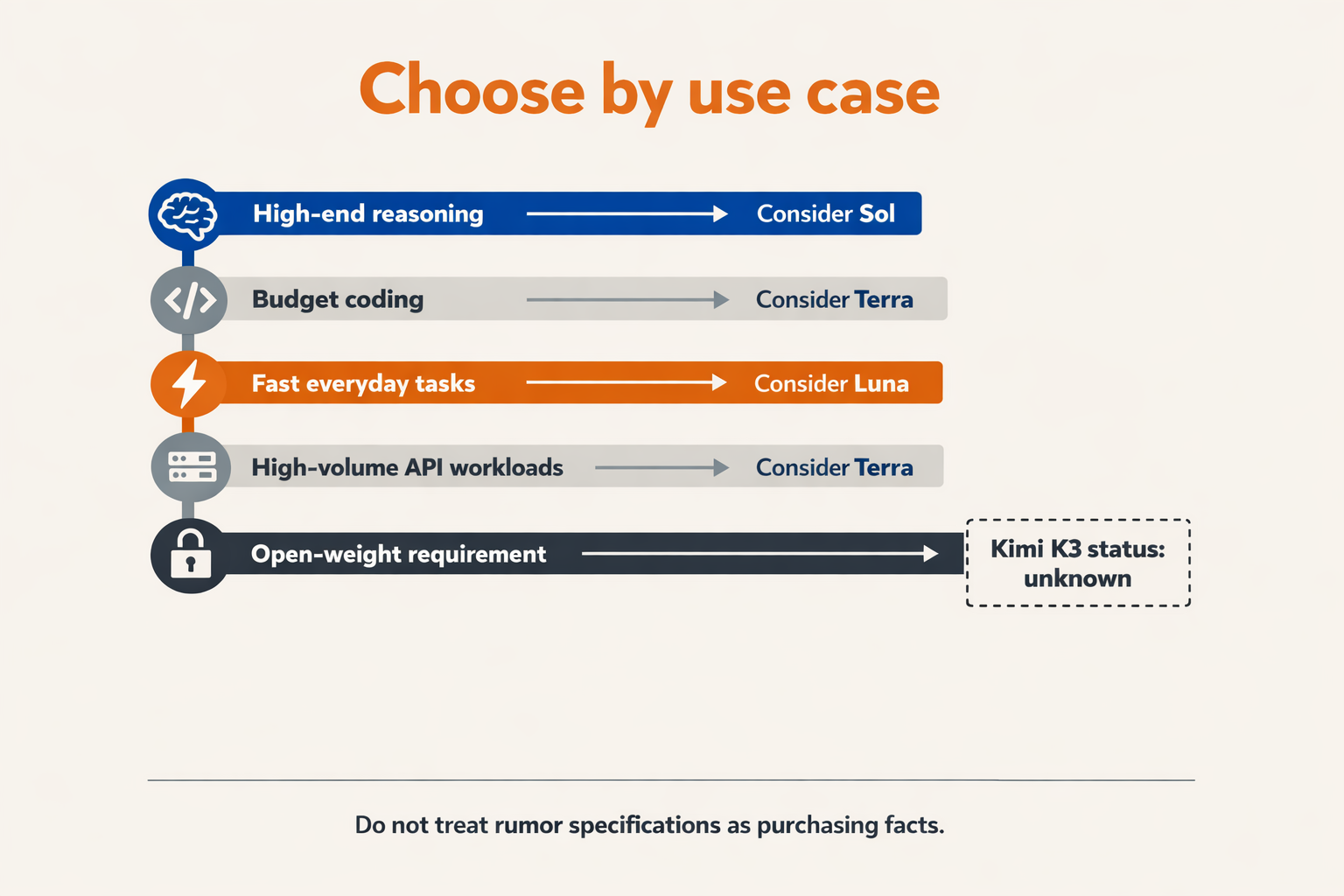
Choose GPT-5.6 Sol for the hardest documented coding and reasoning work, Terra for a lower-cost general deployment, and Luna for latency- and volume-sensitive workloads. If open weights are mandatory, however, neither GPT-5.6 nor the unverified Kimi K3 rumor currently provides a confirmed basis for selection.
| Requirement | Recommended option | Documented evidence | Kimi K3 status |
|---|---|---|---|
| Advanced coding and agentic tasks | GPT-5.6 Sol | OpenAI identifies Sol as the flagship model; the API supports up to 128,000 output tokens, according to OpenAI’s API documentation | No verified coding benchmark, API, or model card |
| Complex reasoning and long context | GPT-5.6 Sol, with Terra as a cost-aware alternative | OpenAI documents a 1.05-million-token context length for the relevant API offering; capability differences should be tested on the target workload | No confirmed context length or reasoning evaluation |
| Fast responses and high-volume inference | GPT-5.6 Luna | OpenAI describes Luna as its fastest and most cost-efficient GPT-5.6 model in the GPT-5.6 preview system card | No verified latency, throughput, or availability data |
| Budget-sensitive production applications | GPT-5.6 Luna or Terra | OpenAI lists Luna at $1 per 1 million input tokens and $5 per 1 million output tokens, while Terra costs $2.50 input and $15 output per 1 million tokens | No confirmed Kimi K3 pricing |
| Premium quality where output accuracy matters most | GPT-5.6 Sol | OpenAI lists Sol at $5 per 1 million input tokens and $30 per 1 million output tokens, positioning it as the family’s flagship | No independently reproducible comparison |
| Open-weight deployment | No confirmed GPT-5.6 choice; wait for verified release evidence | OpenAI’s published GPT-5.6 materials describe hosted models and API access, not downloadable weights | “Open-weight Kimi K3” remains an unverified claim as of July 15, 2026 |
How to apply the comparison
For software engineering, start with GPT-5.6 Sol when repository-wide reasoning, long generated patches, tool use, or difficult debugging justifies the premium. Route routine code completion, documentation, and test generation to GPT-5.6 Terra or Luna after measuring defect rates and review time—not merely token cost.
For reasoning-heavy workloads, the 1.05-million-token context specification may help with large codebases, legal files, or multi-document research. Context capacity is not the same as guaranteed recall or accuracy, so evaluations should measure citation correctness, contradiction handling, and performance as input length increases.
For speed and budget, Luna is the logical first candidate for classification, customer support, extraction, and other high-volume tasks. Terra offers a middle tier when Luna’s cost profile is attractive but the application needs a stronger quality-to-cost balance. OpenAI’s published prices are token rates; total operating cost also includes retries, tool calls, caching behavior, and human review.
For Kimi K3, the correct decision is to defer rather than infer. Moonshot AI or Kimi would need to publish an official announcement, model identifier, documentation, pricing, weights, or reproducible evaluation before developers can fairly compare it with GPT-5.6. Platforms such as CallMissed, which provide one OpenAI-compatible gateway to multiple models, can also support staged testing and provider changes without requiring a complete application rewrite.
GPT-5.6 vs Kimi K3 FAQ: Is Kimi K3 Official, Which GPT-5.6 Model Is Cheapest, and Can They Be Benchmarked Fairly?
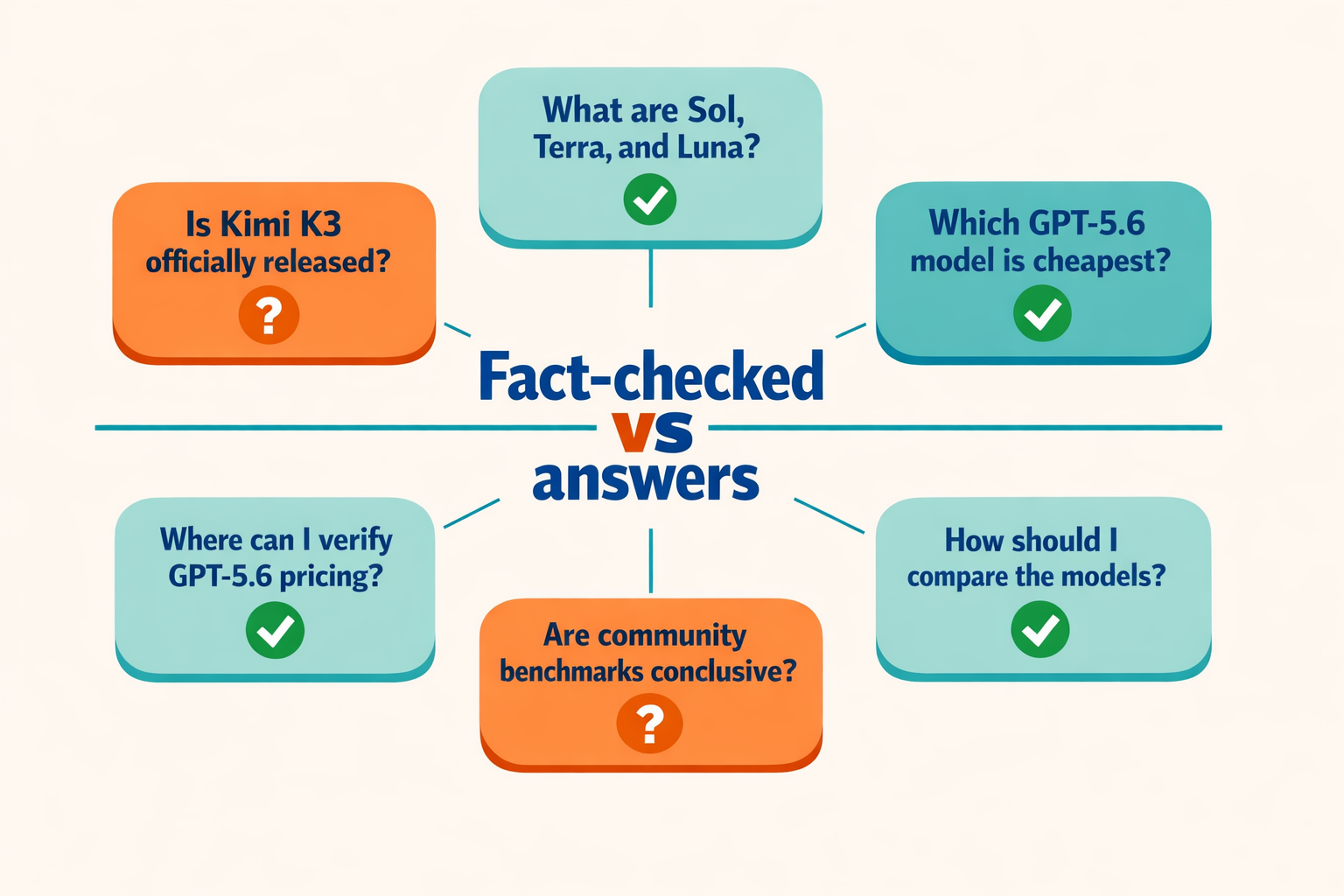
Is Kimi K3 an official model, or is Kimi K3 still rumored?
What is the difference between GPT-5.6 Sol, Terra, and Luna?
Which GPT-5.6 model is cheapest: Sol, Terra, or Luna?
How does GPT-5.6 vs Kimi K3 compare when Kimi K3 has no verified benchmarks?
Can developers benchmark GPT-5.6 against a rumored Kimi K3 fairly?
Which model should businesses choose for production AI applications today?
Conclusion
The GPT-5.6 vs Kimi K3 comparison currently has an evidence gap: OpenAI has documented GPT-5.6 Sol, Terra, and Luna, while Kimi K3 remains rumored and unverified as of July 15, 2026. That makes GPT-5.6 the only side with confirmable specifications, pricing, availability, and system-card disclosures.
- GPT-5.6 Sol is OpenAI’s flagship at $5 per 1 million input tokens and $30 per 1 million output tokens, according to OpenAI’s API materials and GPT-5.6 announcement.
- GPT-5.6 Terra reduces listed token pricing to $2.50 input and $15 output per 1 million tokens, while GPT-5.6 Luna targets speed and cost efficiency, according to OpenAI’s preview documentation.
- OpenAI’s API documentation reports a 1.05-million-token context window and 128,000-token maximum output for the relevant offering—useful evidence for long-context and agentic workloads.
- No verified Kimi K3 model card, benchmark report, pricing page, or release specification is available in the reviewed primary-source record, so community screenshots should not be treated as equivalent evidence.
The next meaningful development will be a formal Moonshot AI announcement—or reproducible independent testing—that gives Kimi K3 a verifiable profile. Until then, developers should compare documented GPT-5.6 tiers using consistent tests for reasoning, coding, latency, multilingual performance, and cost.
To explore how AI communication infrastructure is evolving, visit CallMissed, which brings voice agents and multilingual chatbots into practical business workflows. Will Kimi K3 become a documented competitor, or remain a name ahead of the evidence?
Related Reading
Related Posts


Ready to automate customer conversations?
Launch AI voice agents and WhatsApp bots with CallMissed — one API, 22+ Indian languages.