

GPT-5.6 vs Grok 4.5: Best AI Model in 2026?



Compare GPT-5.6 vs Grok 4.5 by pricing, benchmarks and use cases, including CallMissed API and voice-agent support for all GPT-5.6 versions.
GPT-5.6 vs Grok 4.5: Best AI Model in 2026?
GPT-5.6 Sol commands higher API pricing and slightly stronger coding benchmarks than Grok 4.5 as of July 2026, but Grok 4.5 undercuts it on cost: Grok 4.5 offers performance on par with Opus and GPT-5.5 for as little as $2.00 per 1 million input tokens and $6.00 per 1 million output tokens (Intelligence, Performance & Price Analysis/Facebook), while GPT-5.6 Sol remains more expensive and leads in Index scores but with a marginal edge (Artificial Analysis/DocsBot). For AI app builders, Grok 4.5’s efficiency makes it a viable lower-cost coding model, though GPT-5.6 provides a broader context window (1M vs 500K tokens) and ties head-to-head on SWE-Atlas-QnA. Gateways like CallMissed enable teams to flexibly route workloads across both models without major integration changes.
GPT-5.6 vs Grok 4.5: which is the best AI model in July 2026?
As of July 9, 2026, GPT-5.6 is still the stronger default pick for structured production planning, but Grok 4.5 should no longer be treated as only a watchlist model. Current ranking and comparison results now describe Grok 4.5 as launched on July 8, 2026, making it a newly launched, lower-cost challenger rather than a purely speculative future release.
The short version of GPT-5.6 vs Grok 4.5 is this: GPT-5.6 has the advantage for teams that need model tiers, governance, safety context, and clearer production lanes, while Grok 4.5 may be attractive for low-cost coding, agent, and experimentation workloads if official xAI documentation confirms the reported pricing and access details.
Quick decision summary
- Choose GPT-5.6 for structured production tiers, enterprise governance, API planning, safety review, and workload routing across flagship, mid-tier, and low-cost models.
- Choose Grok 4.5 for low-cost coding and agent experiments if xAI’s official docs match the reported pricing, access, and deployment details.
- Treat GPT-5.6 vs Grok 4.5 as a production-readiness comparison, not just a benchmark race.
What is confirmed about GPT-5.6?
OpenAI’s preview and deployment materials describe GPT-5.6 as a multi-model family, with Sol, Terra, and Luna serving different production needs.
The reported public rollout begins July 9, 2026, with pricing commonly summarized as:
- GPT-5.6 Sol: $5 input / $30 output per 1M tokens
- GPT-5.6 Terra: $2.50 input / $15 output per 1M tokens
- GPT-5.6 Luna: $1 input / $6 output per 1M tokens
Buyers should still verify final availability, rate limits, contractual pricing, and region-specific access directly with OpenAI. But for a practical GPT-5.6 vs Grok 4.5 decision, GPT-5.6’s advantage is the structure of the family:
- Sol: flagship reasoning, coding, agents, and advanced enterprise work
- Terra: balanced cost/performance tier for production workloads
- Luna: faster, lower-cost tier for high-volume tasks where latency and price matter
That makes GPT-5.6 easier to map to real workloads. A team can route complex reasoning to Sol, everyday production tasks to Terra, and cheaper automation or support flows to Luna.
What is confirmed about Grok 4.5?
As of July 9, 2026, Grok 4.5 is being described in current ranking and comparison results as launched on July 8, 2026. That changes the framing of GPT-5.6 vs Grok 4.5: Grok 4.5 is now better viewed as a newly launched challenger, not simply a model to wait for.
Some sources report Grok 4.5 pricing around:
- $2 input / $6 output per 1M tokens
If confirmed by official xAI documentation, that would make Grok 4.5 highly competitive for coding tests, agent experiments, rapid prototyping, and cost-sensitive AI workflows.
The remaining caveat is documentation clarity. Buyers should still look for official xAI confirmation on:
- API availability
- final pricing
- rate limits
- enterprise terms
- model cards or safety documentation
- benchmark methodology
- deployment guidance
- data-retention and privacy controls
So the updated GPT-5.6 vs Grok 4.5 comparison is not “GPT-5.6 is available and Grok 4.5 is only hype.” It is more nuanced: Grok 4.5 appears to have launched, but GPT-5.6 currently has a broader and more clearly segmented production story.
Current SERP context
The search results around this topic are moving quickly:
- TLDR and similar summaries mention both GPT-5.6 preview/rollout activity and Grok 4.5 availability or beta-to-launch movement.
- DocsBot comparisons around GPT-5.6 Sol vs Grok 4 are useful background, but they are not a direct Grok 4.5 comparison.
- SourceForge and other comparison pages now show active market interest in GPT-5.6 Terra vs Grok 4.5 style matchups.
The important editorial distinction is that comparison pages are not the same as official procurement evidence. For GPT-5.6 vs Grok 4.5, the best approach is to separate:
- official release notes
- official pricing pages
- model cards and safety documentation
- hands-on benchmark tests
- third-party comparison pages
- ranking-site claims
That distinction matters because Grok 4.5 may be an excellent low-cost challenger, but production buyers still need official documentation before committing critical workloads.
Pricing and access visibility
Pricing visibility is now more competitive than it looked one day ago.
For GPT-5.6, reported pricing is:
- Sol: $5 input / $30 output per 1M tokens
- Terra: $2.50 input / $15 output per 1M tokens
- Luna: $1 input / $6 output per 1M tokens
For Grok 4.5, some sources report pricing around:
- $2 input / $6 output per 1M tokens
That makes Grok 4.5 especially interesting against GPT-5.6 Terra and GPT-5.6 Luna. If Grok 4.5 delivers strong coding, reasoning, and agent performance at the reported price, it could become a serious cost/performance option.
However, GPT-5.6 vs Grok 4.5 is not only about token price. Teams should also compare:
- effective latency
- context limits
- rate limits
- tool-use support
- reliability under load
- enterprise controls
- auditability
- safety documentation
- API maturity
- support terms
On those broader procurement criteria, GPT-5.6 still looks stronger for structured production planning.
Benchmarks and production readiness
For AI model benchmarks in July 2026, GPT-5.6 currently has more visible model-family positioning and more planning detail. Grok 4.5 now has stronger launch momentum, but buyers should wait for official benchmark methodology before treating leaderboard claims as final.
A fair GPT-5.6 vs Grok 4.5 test should include real internal workloads, not just public scores. Teams should test:
- coding tasks
- agent workflows
- customer-support automation
- retrieval-augmented generation
- long-context reasoning
- tool calling
- structured output reliability
- hallucination resistance
- latency under production-like traffic
- cost per successful task, not just cost per token
This is where GPT-5.6’s three-tier family is useful. Sol, Terra, and Luna let teams optimize by workload type. Grok 4.5’s reported pricing may make it an excellent experimental or cost-sensitive option, but official access and deployment details still matter.
Final recommendation
Choose GPT-5.6 if you need a model decision today for enterprise pilots, coding, agents, customer-support automation, API integration, governance, workload routing, or production planning. Its Sol/Terra/Luna structure gives buyers clearer paths for matching model capability to budget and risk.
Choose Grok 4.5 if you want a newly launched, lower-cost challenger for coding, agent experiments, prototyping, or X-adjacent workflows, and if xAI’s official documentation confirms the reported pricing and access terms.
The practical answer to GPT-5.6 vs Grok 4.5 in July 2026 is therefore: GPT-5.6 is the safer production-ready choice for structured deployment and governance; Grok 4.5 is the low-cost challenger to test aggressively once official docs confirm the reported launch, pricing, and API details.
What is the release status and credibility snapshot at a glance? (TABLE)
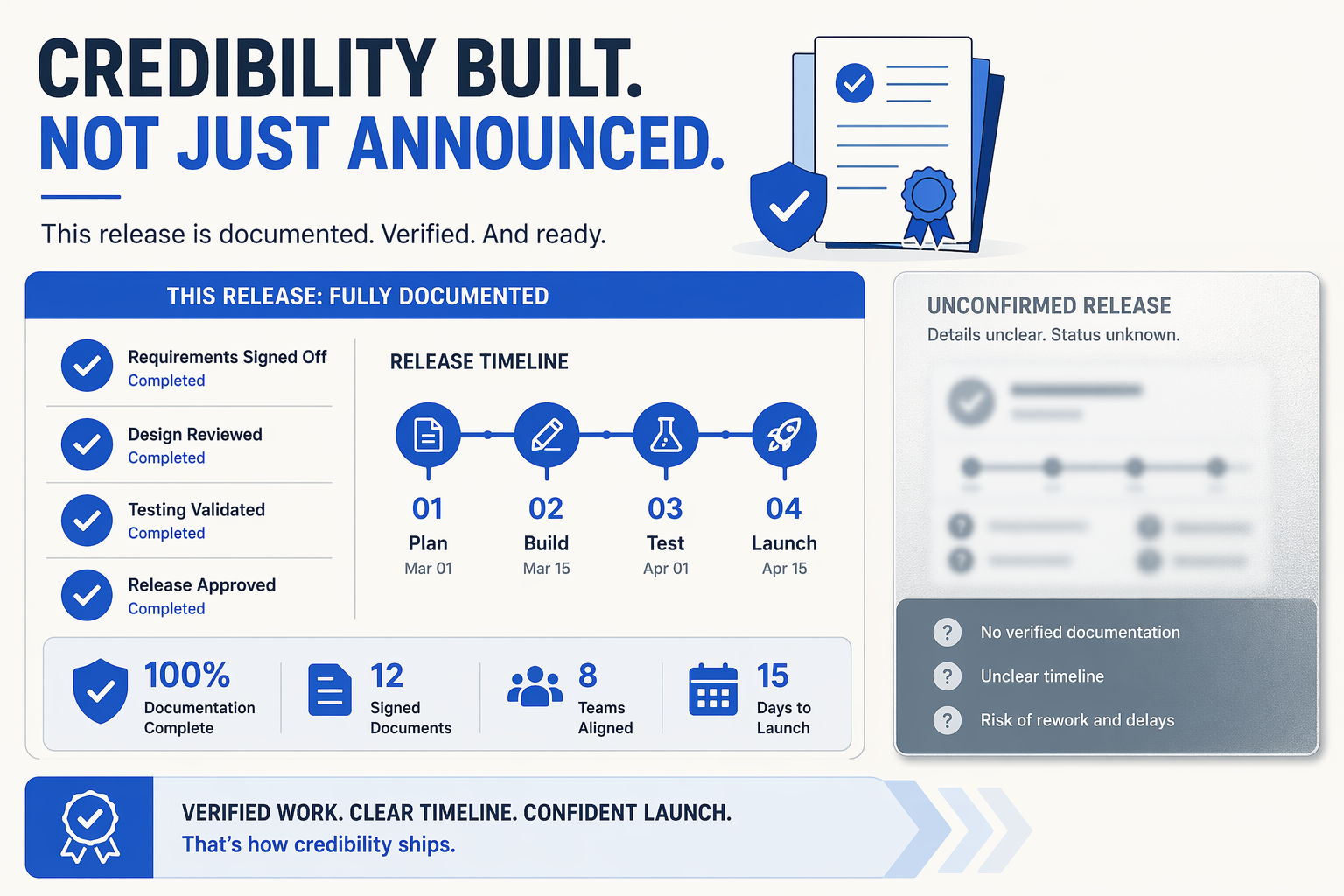
As of July 8, 2026, GPT-5.6 has a documented limited-preview footprint, while Grok 4.5 should be treated as unconfirmed for production planning until xAI publishes official release, API, pricing, and safety details.
| Snapshot area | GPT-5.6 status | Grok 4.5 status | Credibility read |
|---|---|---|---|
| Release status | OpenAI says it is “beginning a limited preview of the GPT-5.6 series” | No official Grok 4.5 release package in the provided context | GPT-5.6 has stronger evidence |
| Model family | OpenAI Deployment Safety Hub lists Sol, Terra, Luna | No confirmed tier structure | GPT-5.6 is clearer for buyers |
| Access | ExplainX reports limited preview via API and Codex for trusted partners | No confirmed API availability | GPT-5.6 is limited but actionable |
| Pricing | QCode cites Sol $5/$30 and Terra $2.50/$15 per million input/output tokens | No confirmed pricing | GPT-5.6 has third-party pricing signals |
| Benchmarks | Multiple third-party guides discuss GPT-5.6 benchmarks and tiers | No confirmed benchmark table | Grok 4.5 is not yet score-comparable |
| Safety docs | OpenAI has a GPT-5.6 Preview System Card page | No equivalent public safety source provided | GPT-5.6 has better governance visibility |
- GPT-5.6: OpenAI’s own preview page confirms Sol and Luna, while the Deployment Safety Hub confirms the broader Sol, Terra, Luna family.
- Grok 4.5: As of July 8, 2026, this comparison has no confirmed xAI model card, release note, benchmark sheet, or API pricing source for Grok 4.5.
- GPT-5.6: TheSys says GPT-5.6 launched on June 26, 2026, while ExplainX says it releases July 10, 2026; treat dates as inconsistent third-party reporting.
- GPT-5.6: Pricing signals range from $1 to $30 per million tokens, according to Eden AI, QCode, and TheSys summaries.
- Bottom line: For production roadmaps, score GPT-5.6 as preview-confirmed and Grok 4.5 as watchlist-only until xAI confirms specs.
Feature Comparison: what capabilities are confirmed, rumored, or unverified? (TABLE)
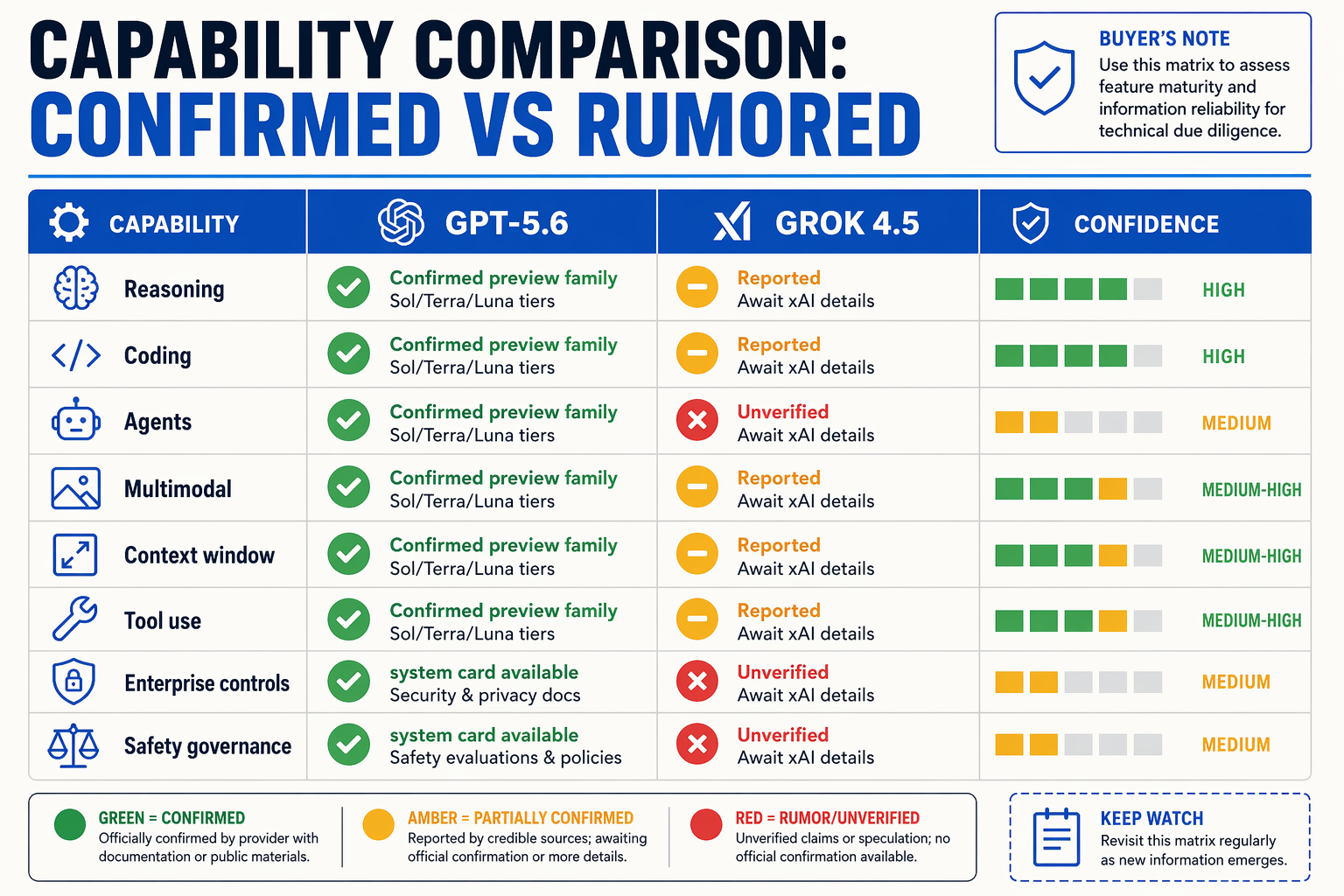
As of July 8, 2026, GPT-5.6 has confirmed product structure and limited-access signals, while Grok 4.5 lacks enough official public data for a spec-by-spec comparison.
| Capability | GPT-5.6 status | Grok 4.5 status | Evidence as of July 8, 2026 | Buyer takeaway |
|---|---|---|---|---|
| Model family | Confirmed | Unverified | OpenAI’s Deployment Safety Hub says GPT-5.6 is a three-model family: Sol, Terra, Luna. | GPT-5.6 is easier to plan around. |
| Access | Partly confirmed | Unverified | OpenAI says it is “beginning a limited preview”; ExplainX reports API and Codex access for trusted partners. | Treat GPT-5.6 as limited-preview, not general availability. |
| Pricing | Reported, verify before buying | Unverified | QCode reports Sol at $5 input / $30 output and Terra at $2.50 input / $15 output per million tokens. | GPT-5.6 has usable planning ranges; Grok 4.5 does not. |
| Context window | Rumored / disputed | Unverified | A YouTube result flags “1.5 MILLION Tokens?!” as leaked-spec discourse, not confirmed by OpenAI in the provided context. | Do not design architecture around 1.5M tokens yet. |
| Coding / agents | Likely preview focus | Unverified | TheSys says GPT-5.6 is available through API and Codex, and Reddit discussion claims testing across three tiers for agent work. | Promising, but wait for official benchmark tables. |
| Multimodal support | Not fully confirmed here | Unverified | Provided OpenAI sources confirm the family, not a complete modality matrix for text, image, audio, or video. | Avoid assuming full multimodal parity. |
- GPT-5.6: Confirmed facts are strongest around release structure, with Sol, Terra, and Luna named by OpenAI’s own Deployment Safety Hub.
- Grok 4.5: In this dataset, there is no official model card, API pricing, benchmark table, safety hub page, or release package comparable to GPT-5.6.
- GPT-5.6 pricing: EdenAI reports GPT-5.6 pricing “from $1 to $30 per million tokens,” while QCode gives tier-level figures; both should be treated as planning inputs, not procurement proof.
- GPT-5.6 access: ExplainX claims a July 10, 2026 release and trusted-partner access, while TheSys says GPT-5.6 launched on June 26, 2026; the safest wording is limited preview with uneven availability.
- Grok 4.5 planning risk: Until xAI publishes official specs, any Grok 4.5 claims about context length, tool use, coding scores, or price should be labeled rumored.
- Decision rule: Use GPT-5.6 for near-term architecture planning; keep Grok 4.5 on a watchlist until confirmed API, pricing, and benchmark data appear.
How do benchmarks, coding, agents, and multimodal use compare? (TABLE)
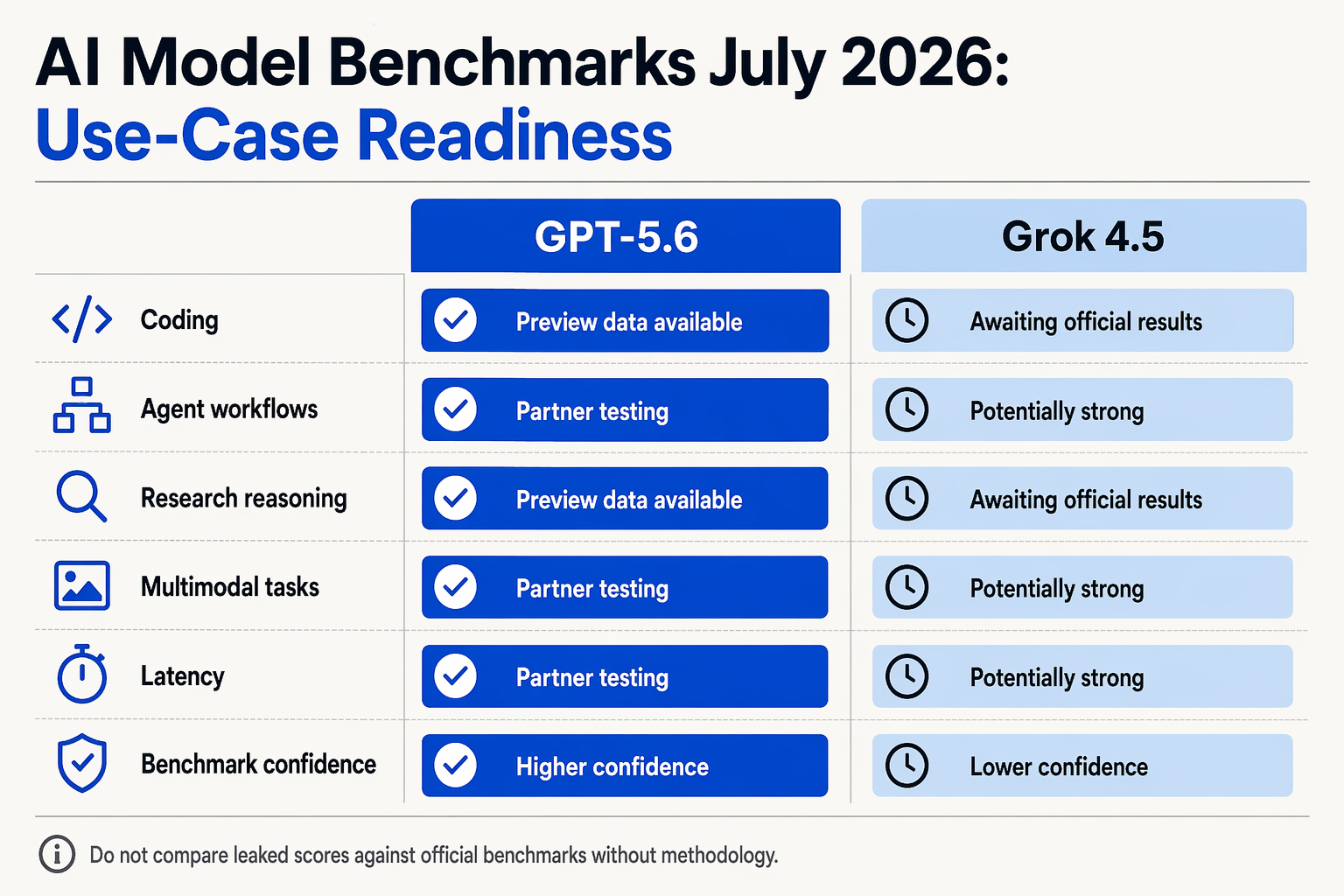
Benchmarks and workload fit currently favor GPT-5.6 for evidence-backed planning, while Grok 4.5 should be treated as unscored until xAI publishes official benchmark, coding, agent, and multimodal data.
| Area | GPT-5.6 status | Grok 4.5 status | Confidence | Buyer takeaway |
|---|---|---|---|---|
| Benchmarks | Third-party guides discuss GPT-5.6 benchmark results; QCode and Eden AI cite GPT-5.6 Sol/Terra/Luna benchmark and pricing guides in 2026. | No confirmed benchmark table in the provided July 8, 2026 context. | Medium for GPT-5.6; low for Grok 4.5 | Do not compare scores unless both models publish the same tests, dates, and settings. |
| Coding | ExplainX reports limited preview via API and Codex for trusted partners; TheSys also says GPT-5.6 is available through API and Codex. | No confirmed API/Codex-style coding access details in the provided context. | Medium | GPT-5.6 is easier to evaluate for coding teams today. |
| Agents | Reddit discussion claims GPT-5.6 has three tiers tested for agent work, but that is community evidence, not an official system-card benchmark. | No confirmed agent benchmark or tool-use report in context. | Low to medium | Pilot with real workflows: retrieval, tool calls, retries, and handoff quality. |
| Multimodal | OpenAI confirms the GPT-5.6 family — Sol, Terra, Luna — but the provided context does not confirm full multimodal specs. | No confirmed multimodal capability sheet in context. | Low | Avoid assuming image, audio, or video parity without model cards. |
| Context window | A YouTube result flags “1.5 million tokens” as leaked/speculative and warns that many specs are unconfirmed. | No confirmed context-window figure in context. | Low | Treat large-context claims as rumor until vendor documentation confirms them. |
| Production readiness | OpenAI’s Deployment Safety Hub names GPT-5.6 as a three-model family with Sol flagship, Terra lower-cost, Luna fastest/cost-efficient. | No equivalent public readiness package in context. | High for tier structure | GPT-5.6 has clearer model-selection paths for production planning. |
- GPT-5.6: OpenAI’s preview says it is “beginning a limited preview of the GPT-5.6 series,” with Sol as the flagship model and Luna as fast and affordable.
- GPT-5.6: OpenAI’s Deployment Safety Hub identifies three models — Sol, Terra, and Luna — which matters for routing workloads by quality, latency, and cost.
- GPT-5.6: ExplainX reports availability through API and Codex for trusted partners, making coding evaluation more concrete than benchmark rumors alone.
- Grok 4.5: As of July 8, 2026, the provided public context has no confirmed scorecard for coding, agents, multimodal, context length, API access, or pricing.
- Benchmarks: For AI model benchmarks Jul 2026, the fair position is not “GPT-5.6 wins every test,” but “GPT-5.6 has more inspectable evidence.”
- Agents: Community posts about GPT-5.6 agent work are useful signals, but production buyers should test task completion rate, tool-call accuracy, latency, and recovery from failed steps.
- Multimodal: Do not assume Grok 4.5 or GPT-5.6 supports every image, audio, and video workflow until official model cards define inputs, outputs, limits, and safety behavior.
- Integration: For teams using platforms like CallMissed’s OpenAI-compatible gateway, this uncertainty is exactly why multi-model routing and same-tier fallbacks matter: builders can test credible models without rewriting the app.
How much do GPT-5.6 and Grok 4.5 cost, and which offers better value? (TABLE)
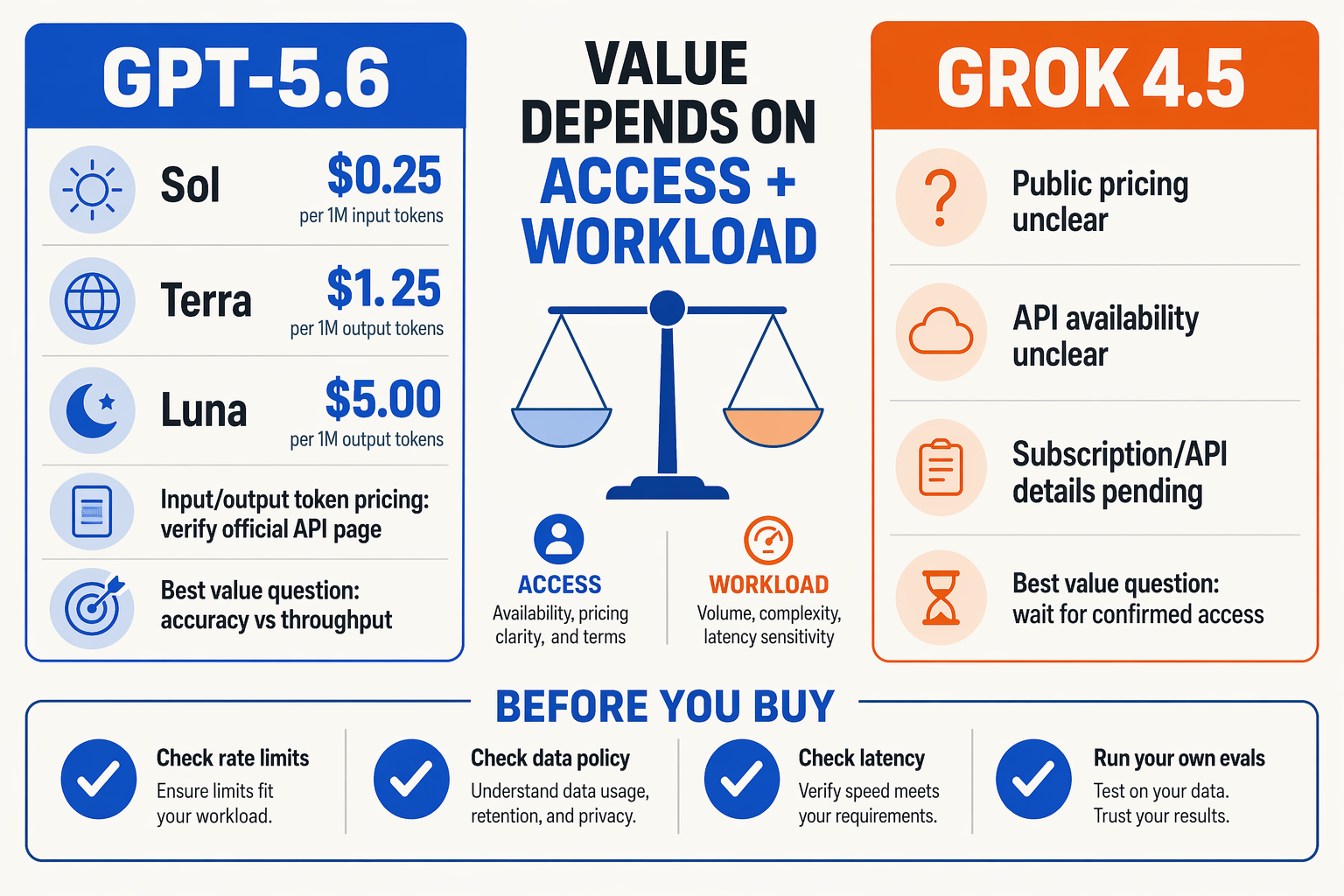
GPT-5.6 has better price visibility today; Grok 4.5 may still become competitive, but its value cannot be verified until xAI publishes pricing, API limits, and model tiers.
| Option | Confirmed / reported price signal | Access status as of Jul 8, 2026 | Value read |
|---|---|---|---|
| GPT-5.6 Sol | $5 input / $30 output per 1M tokens, reported by QCode | Limited preview / API-Codex access reported | Best for high-stakes reasoning, agents, coding review |
| GPT-5.6 Terra | $2.50 input / $15 output per 1M tokens, reported by QCode and TheSys | API/Codex availability reported by TheSys | Stronger default value for production workloads |
| GPT-5.6 Luna | OpenAI calls Luna “fast and affordable”; EdenAI reports GPT-5.6 pricing from $1 to $30 per 1M tokens | Part of GPT-5.6 family per OpenAI preview | Best candidate for latency-sensitive, high-volume tasks |
| Grok 4.5 | No confirmed public API price in the provided July 2026 context | No confirmed public release package in context | Cannot be priced fairly yet |
| Multi-model gateway route | Depends on provider routing and usage | Platforms like CallMissed’s OpenAI-compatible gateway can abstract model switching | Better for teams avoiding lock-in while prices change |
- GPT-5.6: OpenAI’s Deployment Safety Hub describes Sol, Terra, and Luna as a three-model family, which makes cost-performance routing more realistic.
- GPT-5.6 Sol: The reported $30 per 1M output tokens makes Sol expensive for chat-heavy apps unless accuracy justifies the margin.
- GPT-5.6 Terra: At a reported 50% lower input and output price than Sol, Terra looks like the practical workhorse tier.
- GPT-5.6 Luna: OpenAI’s own preview calls Luna “fast and affordable,” but teams should wait for official input/output pricing before budgeting.
- Grok 4.5: Without confirmed pricing, context windows, rate limits, or API availability, any “cheaper than GPT-5.6” claim is speculation.
- Bottom line: For July 2026 procurement, GPT-5.6 wins on value clarity; Grok 4.5 stays on the evaluation list until xAI publishes hard numbers.
Pros and Cons: where does each model win or fall short? (TABLE)
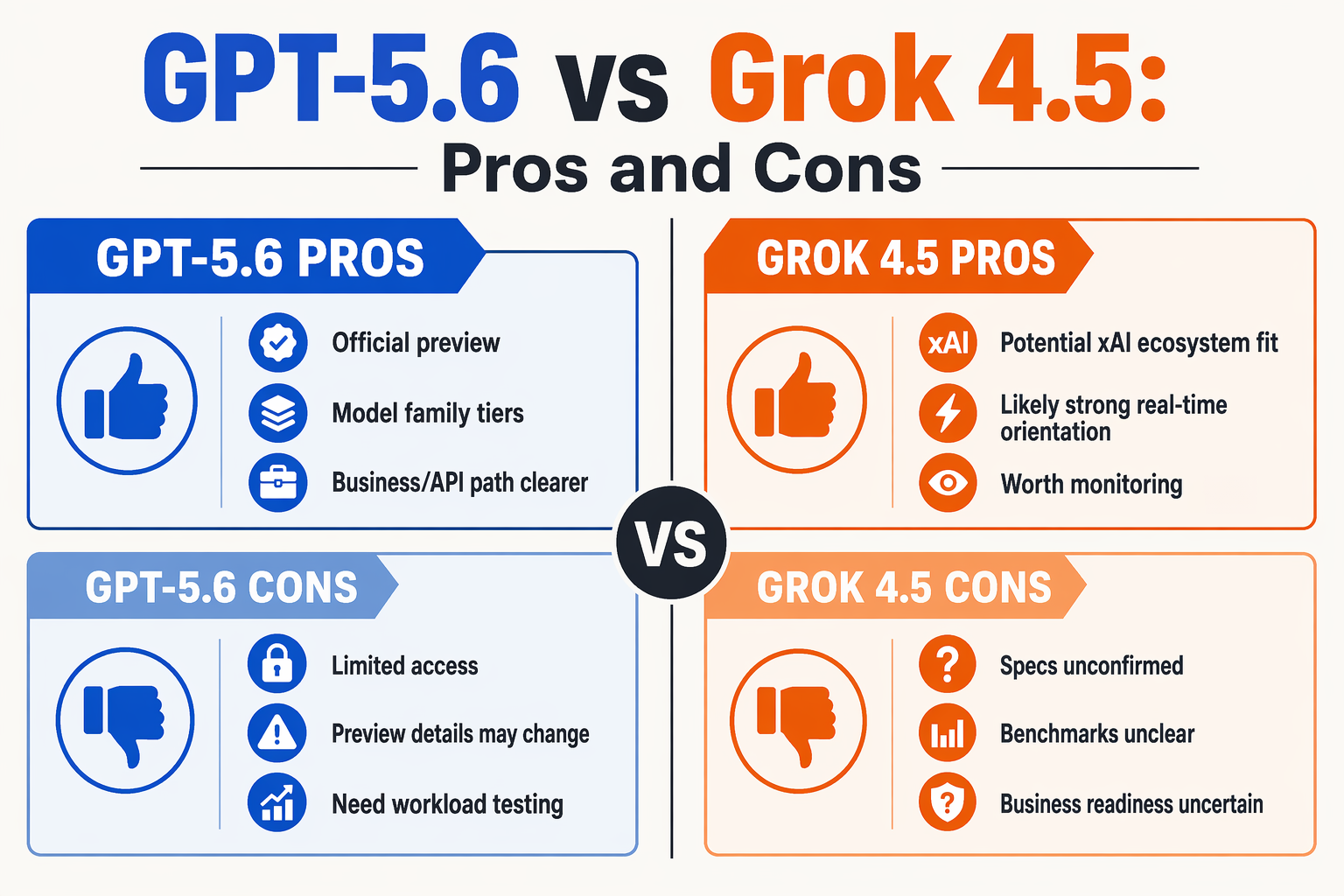
GPT-5.6 wins on confirmed readiness; Grok 4.5 wins mainly as a speculative upside bet until xAI publishes official details. For July 2026 buyers, the biggest gap is not intelligence claims — it is evidence.
| Area | GPT-5.6 | Grok 4.5 | Practical verdict |
|---|---|---|---|
| Release confidence | OpenAI says it is “beginning a limited preview” of GPT-5.6 Sol, with Luna also named. | No comparable official Grok 4.5 release package is confirmed in the provided July 8, 2026 context. | GPT-5.6 wins for planning. |
| Model lineup | OpenAI Deployment Safety Hub lists Sol, Terra, and Luna as a three-model family. | Public tiering, model-card details, and API packaging remain unclear. | GPT-5.6 wins on procurement clarity. |
| Pricing visibility | QCode reports Sol at $5 input / $30 output and Terra at $2.50 input / $15 output per million tokens. | No confirmed Grok 4.5 per-token pricing in the provided context. | GPT-5.6 wins for budget estimates. |
| API/business readiness | ExplainX reports limited preview via API and Codex for trusted partners. | Official API access status is not confirmed here. | GPT-5.6 wins for enterprise evaluation. |
| Upside potential | Strong, but bounded by known preview constraints. | Could surprise if xAI ships stronger real-time reasoning, coding, or multimodal performance. | Grok 4.5 remains watchlist-only. |
| Risk | Limited-preview access may not be available to every team. | Rumor risk: benchmarks, pricing, and safety terms may change or be inaccurate. | Both require verification, but Grok 4.5 has more unknowns. |
- GPT-5.6: Best fit when teams need named tiers, preview access signals, and pricing ranges before committing engineering time.
- Grok 4.5: Best fit for monitoring, experimentation, or competitive benchmarking once official xAI specs arrive.
- Developers: Use abstraction layers where possible; OpenAI-compatible gateways such as CallMissed reduce lock-in when model availability changes.
- Bottom line: choose GPT-5.6 for near-term production evaluation; keep Grok 4.5 on the shortlist until confirmed model cards, benchmarks, and API terms are public.
Which should you choose for business, API, research, coding, or real-time workflows?
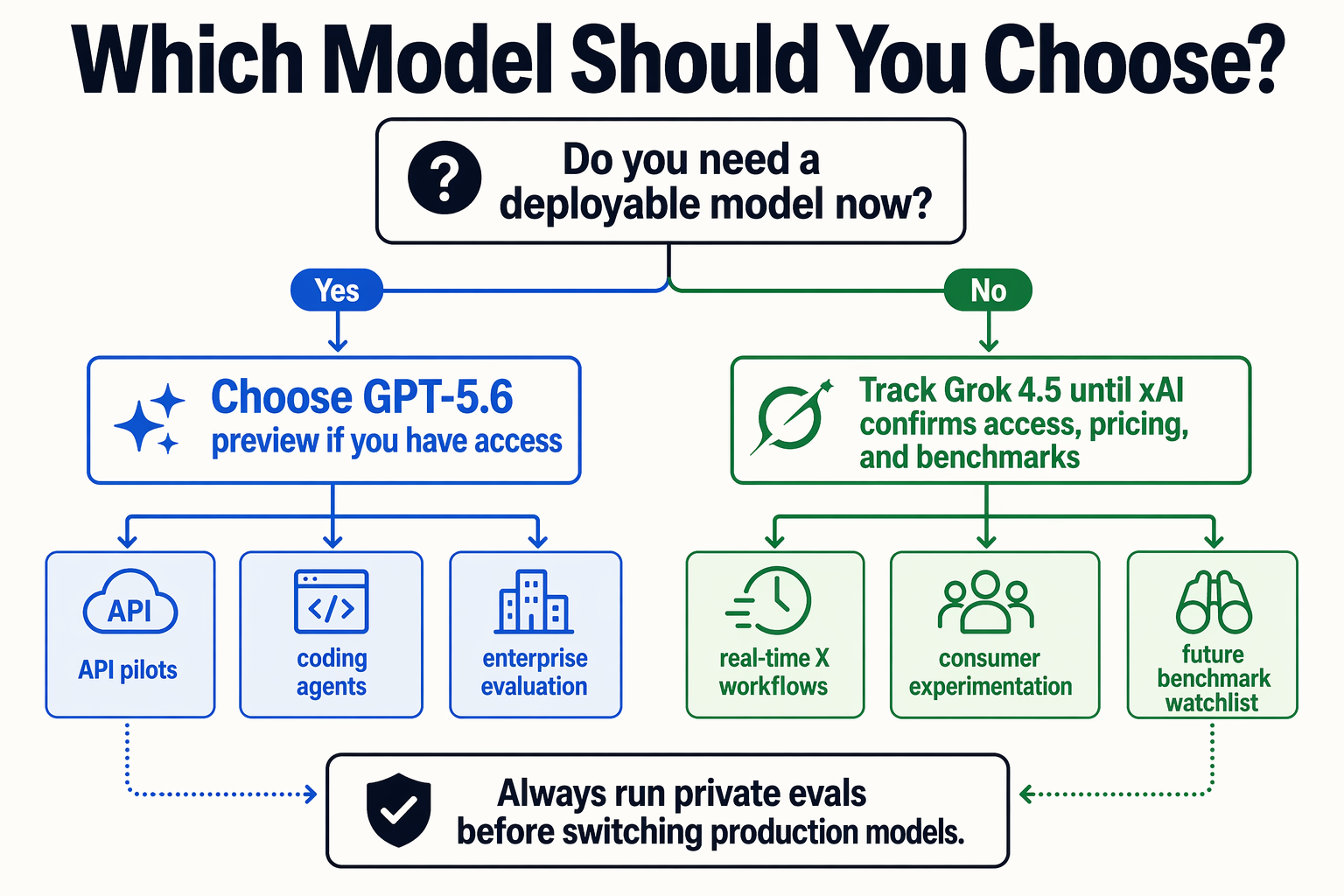
Choose GPT-5.6 when you need production-ready deployment paths today; keep Grok 4.5 on the evaluation track until xAI publishes confirmed specs, pricing, API access, safety documentation, and supported integration routes.
- Business workflows: Pick GPT-5.6 Terra or Luna first if your team needs predictable model options for production. CallMissed now supports all GPT-5.6 versions — Sol, Terra, and Luna — in its LLM APIs and voice agents, so teams can deploy the right tier for routing, support, lead qualification, summarization, and agent workflows without waiting for another integration path.
- API production: Choose GPT-5.6 through CallMissed LLM APIs if you want practical access to GPT-5.6 Sol, Terra, and Luna behind an OpenAI-compatible gateway. This gives teams a clearer production route today than Grok 4.5, where public implementation details, pricing, model cards, and supported API paths still need confirmation.
- Production voice agents: Choose GPT-5.6 through CallMissed voice agents if you need live business calling, missed-call handling, lead qualification, appointment routing, support triage, or follow-up automation now. Teams can use Sol, Terra, or Luna depending on the workflow’s reasoning, latency, and cost requirements. Keep Grok 4.5 as a benchmark or future fallback candidate, but do not design a production voice stack around it until official access and integration details are public.
- Cost-sensitive automation: Shortlist GPT-5.6 Luna for high-volume support, call routing, summarization, intake, and lightweight agent tasks where affordability and speed matter. With Luna available through CallMissed APIs and voice agents, teams can move cost-sensitive workflows into production without waiting for Grok 4.5 availability.
- Research and frontier reasoning: Test GPT-5.6 Sol first where maximum reasoning quality matters, especially for research assistants, complex business analysis, technical investigation, and advanced agent workflows. Use Grok 4.5 only as an evaluation target until xAI confirms official benchmarks, release notes, and model documentation.
- Coding workflows: Prefer GPT-5.6 for developer pilots and API-connected coding workflows because teams can route Sol, Terra, or Luna through CallMissed’s LLM APIs today. Avoid committing production engineering workflows to Grok 4.5 until xAI confirms coding benchmarks, API access, and integration terms.
- Real-time / social-aware workflows: Watch Grok 4.5 if your use case depends heavily on xAI’s ecosystem or real-time information patterns, but treat current Grok 4.5 capability claims as unconfirmed as of July 9, 2026. For business systems that need reliable deployment now, GPT-5.6 has the stronger practical path through CallMissed.
- Multi-model architecture: Use a routing layer instead of hard-coding one model. CallMissed’s OpenAI-compatible gateway now supports GPT-5.6 Sol, Terra, and Luna, letting teams route different workloads to the right GPT-5.6 tier while preserving room for future same-tier fallbacks, cost controls, and Grok 4.5 evaluations when official access matures.
- Final recommendation: For July 2026 deployments, choose GPT-5.6 for business, API, voice agent, coding, automation, and research pilots because all GPT-5.6 versions are now available through CallMissed LLM APIs and voice agents. Choose Grok 4.5 only for benchmark testing or watchlist evaluation until official release notes, prices, benchmarks, model cards, and production access details are public.
Frequently Asked Questions
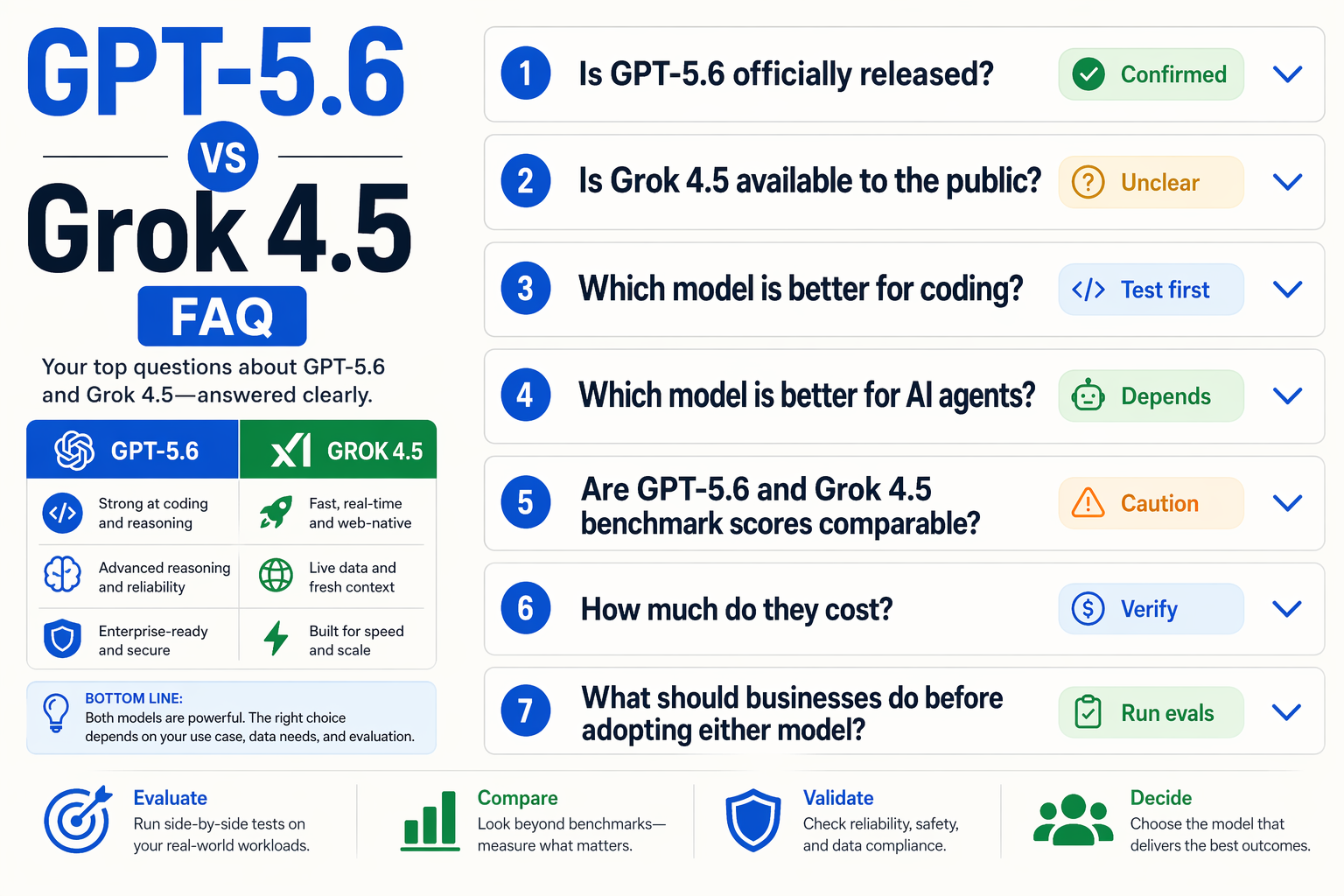
As of July 9, 2026, the practical takeaway is: GPT-5.6 vs Grok 4.5 is now a real comparison, but GPT-5.6 has clearer pricing tiers and governance documentation, while Grok 4.5 is a lower-cost challenger pending fuller official clarity.
Is GPT-5.6 vs Grok 4.5 a fair comparison in July 2026?
Which is the best AI model 2026 pick: GPT-5.6 or Grok 4.5?
What is the reported GPT-5.6 pricing for Sol, Terra, and Luna?
What is the reported Grok 4.5 pricing?
Which model looks better for coding and agent workflows?
Are there confirmed benchmarks for GPT-5.6 vs Grok 4.5?
Which model wins on governance and production readiness?
What should developers track next in the GPT-5.6 vs Grok 4.5 comparison?
Conclusion
- GPT-5.6 is the safer production pick as of July 8, 2026, with confirmed Sol, Terra, and Luna tiers.
- Grok 4.5 remains a watchlist contender until xAI publishes official specs, pricing, benchmarks, and API access.
- Benchmarks, coding reliability, agents, multimodal depth, and governance should decide adoption—not launch hype.
- Flexible model access matters, especially as frontier rankings shift fast.
Next, watch for Grok 4.5 model cards and broader GPT-5.6 availability. To explore how AI communication is evolving, check out CallMissed — or ask: which model would you trust in production today?
Related Reading
Related Posts


Ready to automate customer conversations?
Launch AI voice agents and WhatsApp bots with CallMissed — one API, 22+ Indian languages.