

GPT-5.6 Sol vs Terra vs Luna vs GPT-5.5: Which Model Should You Use?


Compare GPT-5.6 Sol, Terra, Luna, and GPT-5.5 by pricing, speed, capability, benchmarks, migration path, and best production use cases.
GPT-5.6 Sol vs Terra vs Luna vs GPT-5.5: Which Model Should You Use?
What if the biggest GPT-5.6 upgrade is not raw intelligence—but the fact that OpenAI has turned one flagship model into a three-tier buying decision?
That is the real story behind GPT-5.6 Sol vs Terra vs Luna vs GPT-5.5. Instead of asking “Is GPT-5.6 better?”, teams now have to ask a more practical question: Which model gives us the right mix of capability, latency, and cost for our workload? OpenAI’s GPT-5.6 preview introduces three distinct options: Sol as the highest-capability flagship, Terra as the balanced value tier, and Luna as the low-cost, high-volume model. The pricing makes the trade-off impossible to ignore: according to OpenAI’s preview, Sol costs $5 input / $30 output per 1M tokens, Terra costs $2.50 / $15, and Luna costs $1 / $6. Multiple industry summaries place GPT-5.5 at roughly Sol-level pricing, around $5 input / $30 output per 1M tokens.
That means GPT-5.6 is not just a performance update—it is a unit economics reset. If Terra can deliver GPT-5.5-competitive performance at about half the cost, as reported by sources like DataCamp and reflected in community discussion, it becomes the obvious candidate for many production workloads. If Luna delivers strong enough quality for routine tasks at one-fifth of Sol’s input price, it could change the economics of chatbots, summarization, classification, customer support, and high-throughput agents. And if Sol extends the frontier on complex reasoning, coding, enterprise automation, or safety-sensitive workflows, it remains the model you choose when failure is more expensive than tokens.
This comparison matters especially for companies building AI into real customer-facing systems. Platforms like CallMissed, which route workloads across voice agents, WhatsApp chatbots, speech APIs, and 300+ LLMs, reflect the broader shift: businesses increasingly need model selection strategies, not just access to the latest model.
In this guide, we’ll break down where GPT-5.6 Sol, GPT-5.6 Terra, GPT-5.6 Luna, and GPT-5.5 fit best—by pricing, performance expectations, workload type, and decision criteria—so you can choose based on outcomes, not hype.
Introduction

As of July 8, 2026, the practical verdict on GPT-5.6 Sol vs Terra vs Luna is straightforward:
- Use GPT-5.6 Sol for the hardest reasoning, coding, security, legal, financial, and high-stakes tasks where mistakes are expensive.
- Use GPT-5.6 Terra for most production applications that need strong quality without paying flagship-model prices.
- Use GPT-5.6 Luna for latency-sensitive, high-volume, and cost-sensitive workloads such as routing, classification, summaries, FAQs, and lightweight chat.
- Keep GPT-5.5 as a fallback if GPT-5.6 access is not yet available in your account, if your stack depends on existing GPT-5.5 behavior, or until general availability is fully confirmed.
The key update: GPT-5.6 Sol, Terra, and Luna are now reported to be rolling out publicly on Thursday, July 9, 2026. That means this comparison is no longer just a preview-era planning exercise. However, teams should still distinguish between official availability in their OpenAI account or API documentation and reported rollout timing. Until you can actually select the model in your environment, GPT-5.5 remains the safest operational baseline.
Why GPT-5.6 Is a Model Strategy Question
The most important thing about GPT-5.6 is not simply that OpenAI has a newer model family. It is that GPT-5.6 turns model selection into a tiered business decision.
Instead of one default upgrade path from GPT-5.5, the GPT-5.6 lineup is structured around three different deployment profiles:
- GPT-5.6 Sol — the flagship model for maximum capability
- GPT-5.6 Terra — the balanced tier for production-grade quality and efficiency
- GPT-5.6 Luna — the low-cost, fast option for high-volume workloads
That matters because most businesses should not use the biggest model for every task. A production AI system might need frontier reasoning in one workflow, fast inexpensive responses in another, and a balanced model for the majority of daily requests.
Reported pricing still points to very different deployment economics, with GPT-5.6 tiers commonly summarized around:
- Sol: $5 input / $30 output per 1M tokens
- Terra: $2.50 input / $15 output per 1M tokens
- Luna: $1 input / $6 output per 1M tokens
Multiple industry summaries have placed GPT-5.5 at roughly Sol-level pricing, around $5 input / $30 output per 1M tokens. If those numbers hold through public rollout, GPT-5.6 is not just “newer than GPT-5.5”—it gives teams a way to choose between frontier quality, mid-tier efficiency, and mass-scale affordability.
The Real Comparison: Capability vs Cost vs Volume
The practical question is no longer, “Which model is smartest?” It is:
Which model gives the best outcome for the workload you are actually running?
For example:
- If reasoning failure is expensive, Sol is likely the safest choice.
- If you need strong quality for everyday production apps, Terra is likely the default starting point.
- If you process millions of routine requests, Luna may deliver the strongest cost and latency advantage.
- If GPT-5.6 is not yet available in your account, GPT-5.5 remains the practical fallback.
This is especially important for customer support, document analysis, code review, internal copilots, sales assistants, AI agents, and voice workflows. Cost compounds quickly in production. A model that is only slightly cheaper per request can become dramatically cheaper at scale.
That is why Terra may be the model many teams evaluate first. It is positioned as the middle tier: capable enough for serious production work, but less expensive than the flagship Sol tier.
Meanwhile, Luna changes the equation for high-volume applications. Even if Luna is not the best choice for complex reasoning, it may be the right model for classification, summarization, routing, FAQ responses, lightweight chat, and fast automation steps where latency and cost matter more than maximum intelligence.
Why This Matters for Production AI
The GPT-5.6 lineup reflects a broader shift in AI infrastructure: businesses increasingly need model routing, not just model access. A support chatbot might use Luna for simple questions, Terra for nuanced requests, and Sol only when legal, financial, technical, or safety-sensitive reasoning is required.
That is also why platforms like CallMissed are becoming relevant in production AI stacks. When companies deploy voice agents, WhatsApp chatbots, multilingual speech APIs, and LLM workflows, the winning architecture is rarely “use the biggest model everywhere.” It is route each task to the right model based on quality, latency, availability, and cost.
This guide compares GPT-5.6 Sol vs Terra vs Luna vs GPT-5.5 through that lens: not hype, but practical decision-making for teams preparing to deploy the right model in the right place.
Quick Verdict: Which Model Should You Choose?
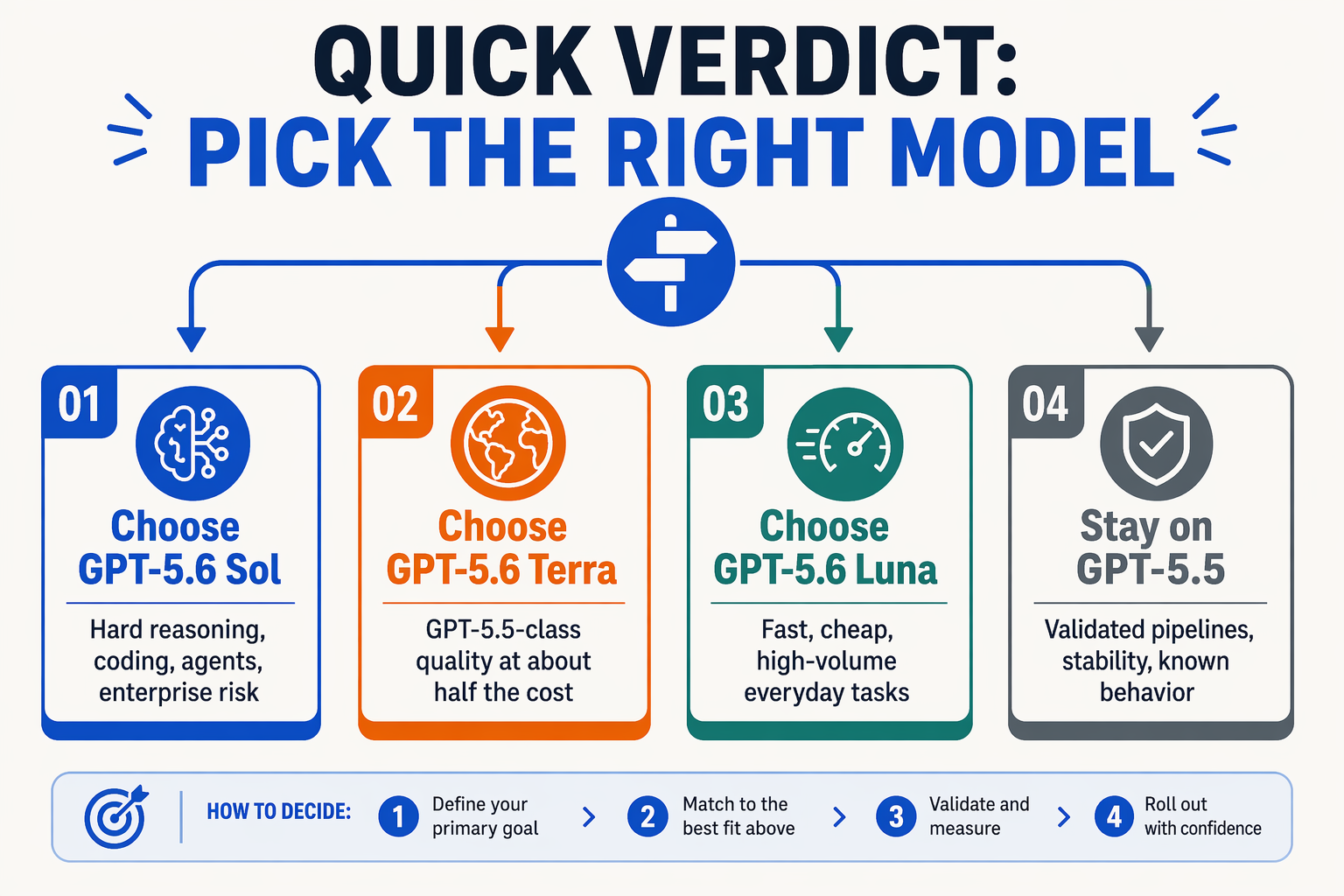
For the reported July 9 launch, the safest default is still GPT-5.6 Terra — assuming your account has access on day one. It is the best starting point for most production workloads because it is positioned as the balanced tier: strong quality, lower cost than Sol, and better economics for everyday applications.
Use Sol when quality and risk matter more than price. Use Luna when volume, speed, and cost matter more than deep reasoning. Keep GPT-5.5 where you need stability, proven behavior, or time to revalidate prompts.
Quick Decision Table
| Choose | Best for | Cost profile | Latency profile | Risk tolerance | Access note |
|---|---|---|---|---|---|
| GPT-5.6 Sol | Hard reasoning, advanced coding, legal/financial review, complex agents | Highest | Likely slower than smaller tiers | Best when wrong answers are expensive | May be limited by tier, region, or rollout queue at launch |
| GPT-5.6 Terra | Customer support, RAG apps, internal copilots, workflow automation | Mid-range | Good default balance | Best for normal production use | Test first if available; likely the best migration target from GPT-5.5 |
| GPT-5.6 Luna | Summaries, classification, routing, FAQs, call notes, lead qualification | Lowest | Likely fastest/most scalable | Best for low-risk, high-volume tasks | Use where quality checks pass on real traffic |
| GPT-5.5 | Existing regulated flows, already validated prompts, stable production systems | Known/current | Known/current | Best when change risk is higher than savings | Keep temporarily until 5.6 benchmarks are complete |
Best Model by Workload
- Use GPT-5.6 Sol for high-stakes reasoning, long-chain problem solving, production coding, compliance-heavy review, complex enterprise agents, and escalation paths.
- Use GPT-5.6 Terra for the majority of production apps: customer support, sales assistants, internal knowledge bots, RAG workflows, and multi-step automations.
- Use GPT-5.6 Luna for high-volume operational tasks such as ticket tagging, call summaries, intent detection, routing, FAQ responses, CRM cleanup, and lightweight chat.
- Use GPT-5.5 if the workflow is already validated, regulated, sensitive to behavior changes, or blocked by 5.6 access limits during launch week.
Launch Week Testing Guidance
Do not switch all traffic on July 9. Treat the launch as a controlled rollout:
- Run side-by-side tests with GPT-5.5, Terra, and Sol on your real prompts.
- Measure more than accuracy: compare cost per completed task, latency, refusal behavior, formatting consistency, tool-call reliability, and hallucination rate.
- Start with Terra as the main benchmark candidate against GPT-5.5.
- Test Luna separately on low-risk, high-volume workflows where small quality differences are acceptable.
- Reserve Sol for tasks where Terra fails, where reasoning depth matters, or where mistakes are expensive.
- Keep rollback paths open for at least the first week, especially for customer-facing or regulated workflows.
- Check access and rate limits before committing, because launch-week availability may vary by account, region, API tier, and product surface.
Final Recommendation
For most teams: benchmark Terra first, route simple traffic to Luna if quality holds, reserve Sol for high-risk or complex work, and keep GPT-5.5 in place until your production tests prove the upgrade is safe.
In short: Sol for maximum capability, Terra for best default value, Luna for scale, GPT-5.5 for stability and migration safety.
Overview of Options
The Four Choices in Plain English
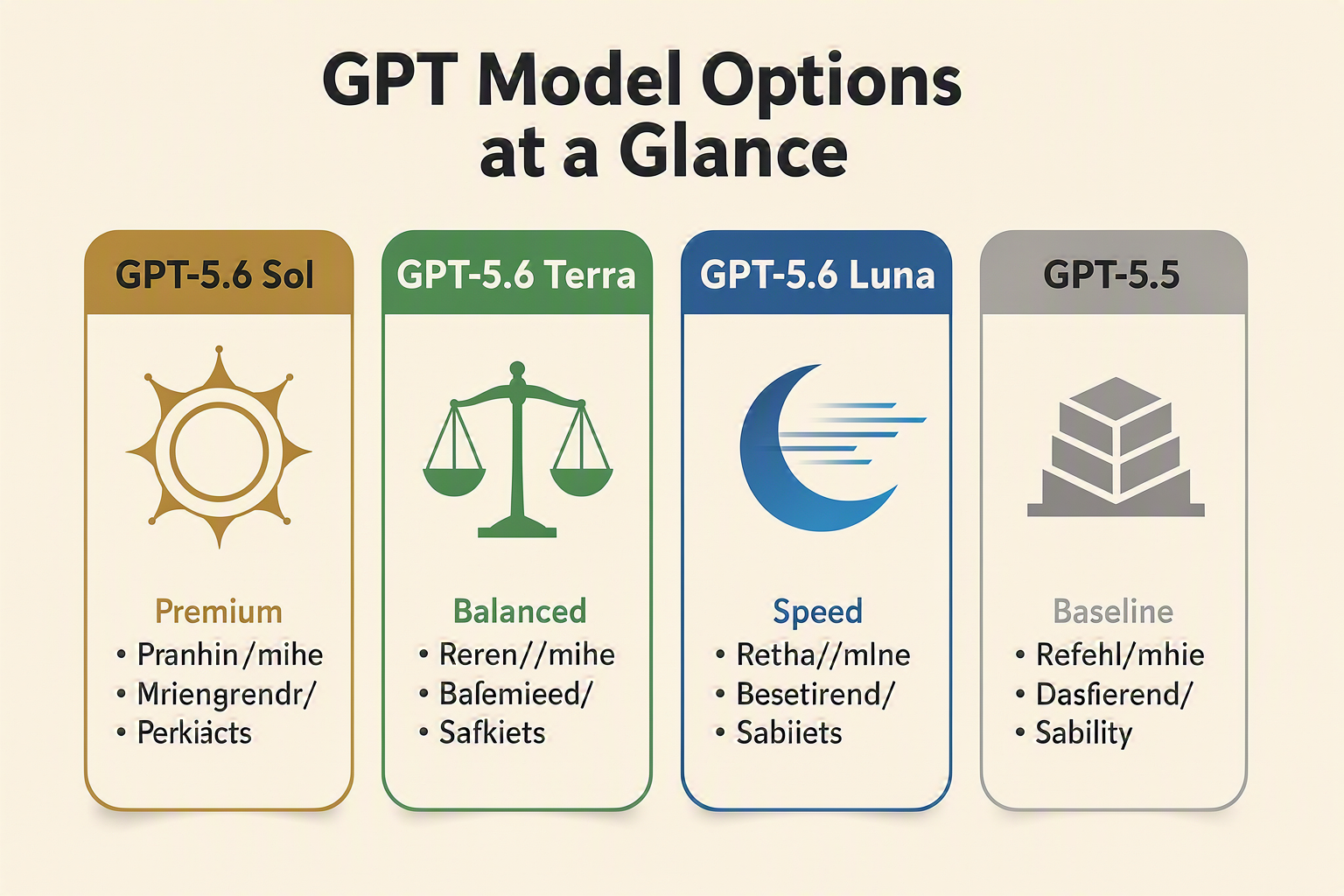
At a high level, the comparison is less “new model vs old model” and more four deployment profiles. OpenAI’s GPT-5.6 preview defines three new tiers—Sol, Terra, and Luna—while GPT-5.5 remains the familiar baseline many teams already use in production.
The practical split looks like this:
- Use Sol when quality matters most
- Use Terra when you want GPT-5.5-class capability at lower cost
- Use Luna when volume, latency, and affordability dominate
- Use GPT-5.5 when stability, existing evals, or migration risk matter more than savings
GPT-5.6 Sol: The Flagship Option
GPT-5.6 Sol is positioned as the strongest model in the GPT-5.6 family. DataCamp describes Sol as “the strongest and most capable model,” while OpenAI’s preview pricing places it at $5 input / $30 output per 1M tokens.
That pricing is important because it is roughly the same level that multiple summaries associate with GPT-5.5. In other words, Sol is not the cheap upgrade—it is the capability-first upgrade.
Choose Sol for workloads where error cost is high:
- Complex reasoning and multi-step analysis
- Advanced coding and code review
- Legal, financial, or compliance-heavy workflows
- Agentic systems that make decisions across tools
- Enterprise automation where reliability matters more than token cost
If a failed answer can trigger human escalation, customer churn, security risk, or expensive rework, Sol is the safest default among the new options.
GPT-5.6 Terra: The Value Tier
GPT-5.6 Terra is likely the most commercially interesting model in the lineup. OpenAI lists Terra at $2.50 input / $15 output per 1M tokens, exactly half of Sol’s listed price. DataCamp frames Terra as competitive with GPT-5.5 while being about 2x cheaper, and community discussion has focused heavily on that point.
That makes Terra the default candidate for teams currently using GPT-5.5 at scale. If your application does not require the absolute top reasoning tier, Terra may deliver the best price-performance ratio.
Good Terra use cases include:
- Customer support agents
- Internal knowledge assistants
- Drafting, rewriting, and summarization
- Product recommendation flows
- Sales and operations copilots
- WhatsApp and web chat automation
For platforms handling mixed workloads—such as CallMissed, which supports AI voice agents, WhatsApp chatbots, speech APIs, and routing across 300+ LLMs—Terra-style models are especially useful because they can become the economical “default brain” while more expensive models are reserved for escalations.
GPT-5.6 Luna: The High-Volume Workhorse
GPT-5.6 Luna is the affordability play. OpenAI’s preview prices Luna at $1 input / $6 output per 1M tokens, making it one-fifth the input cost and one-fifth the output cost of Sol.
Luna is not the model you pick for the hardest reasoning tasks. It is the model you evaluate when the same operation runs millions of times per day.
Best-fit Luna workloads include:
- Classification and routing
- Short-form summarization
- FAQ-style customer replies
- Data extraction from structured text
- High-volume chatbot turns
- First-pass triage before escalation
Some sources describe Luna as performing near GPT-5.5 levels on several benchmarks, but the safer interpretation is this: Luna should be tested task-by-task, especially where the task is repetitive, constrained, and easy to validate.
GPT-5.5: The Known Baseline
GPT-5.5 still matters because it is the established reference point. Many teams already have prompts, evaluations, latency expectations, and monitoring built around it. Its approximate pricing—widely cited at $5 input / $30 output per 1M tokens—also makes the comparison straightforward.
GPT-5.5 is best kept when:
- Your current system is stable
- Migration risk outweighs savings
- You need benchmark continuity
- You have not yet tested GPT-5.6 on your own workloads
The key question is no longer whether GPT-5.6 is “better.” It is whether Sol, Terra, or Luna beats GPT-5.5 for your specific cost, quality, and latency target.
Feature Comparison (TABLE)
Side-by-Side Model Breakdown
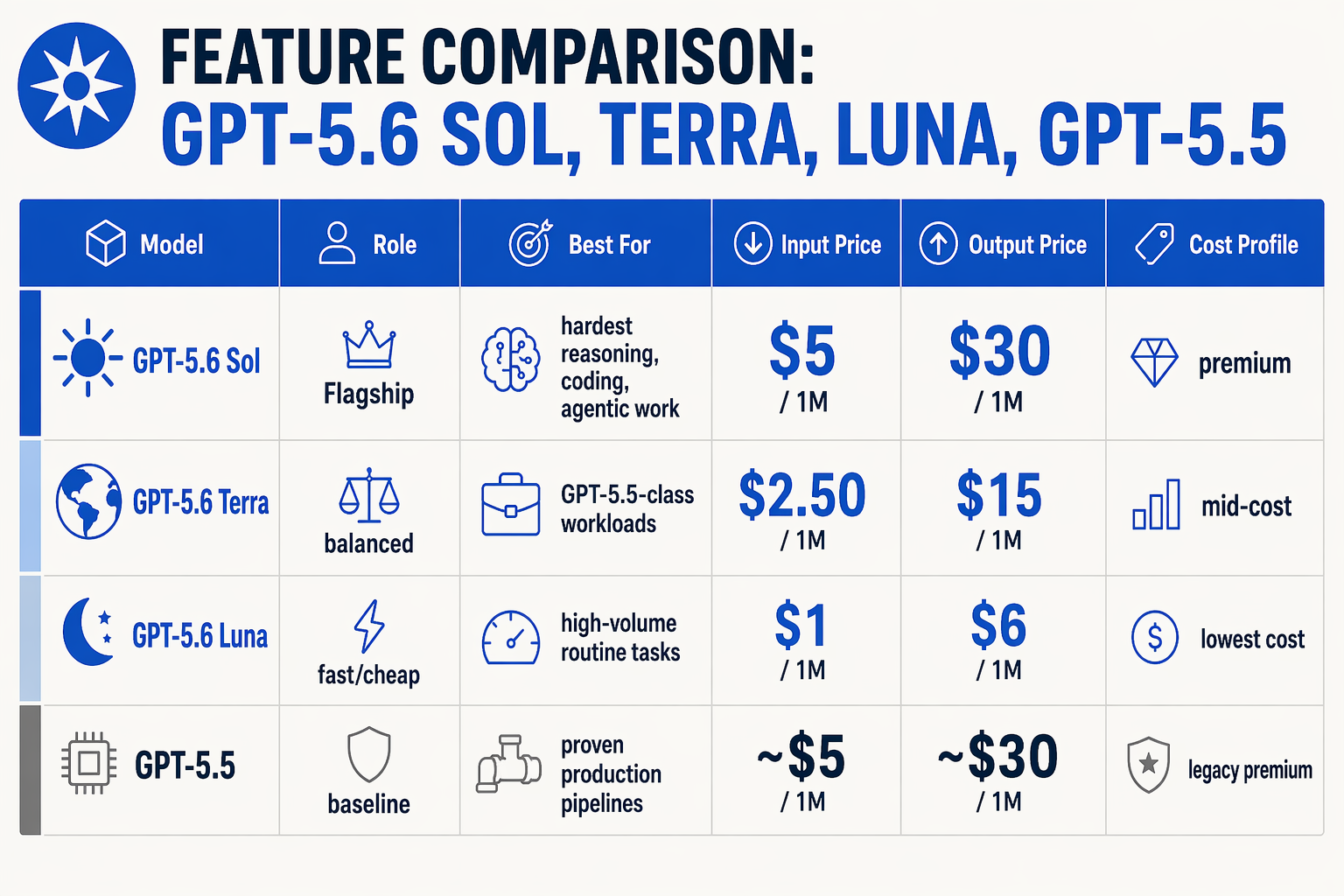
The clearest way to compare GPT-5.6 Sol, Terra, Luna, and GPT-5.5 is not “best to worst,” but capability per dollar. OpenAI’s preview pricing makes the segmentation explicit: Sol targets maximum performance, Terra targets GPT-5.5-class value, and Luna targets low-cost scale.
| Model | Price per 1M Tokens | Positioning | Best Use Cases | Main Trade-Off |
|---|---|---|---|---|
| GPT-5.6 Sol | $5 input / $30 output | Flagship, highest-capability GPT-5.6 tier | Complex reasoning, coding, agentic workflows, enterprise automation, safety-sensitive tasks | Highest cost in the GPT-5.6 family |
| GPT-5.6 Terra | $2.50 input / $15 output | Balanced tier; described by DataCamp as GPT-5.5-competitive at about 2x lower cost | Production assistants, support automation, analysis, content generation, workflow agents | May not match Sol on the hardest tasks |
| GPT-5.6 Luna | $1 input / $6 output | Cheapest and speed-oriented tier for volume | Chatbots, summarization, classification, routing, simple customer interactions | Lower ceiling for deep reasoning and complex coding |
| GPT-5.5 | Roughly $5 input / $30 output according to Medium and other summaries | Prior baseline and known production quantity | Existing apps, stable deployments, benchmark continuity | Same price range as Sol, but without the 5.6 tiering advantage |
What the Table Really Shows
The biggest takeaway is that GPT-5.6 changes the upgrade question. With GPT-5.5, many teams had one main frontier-model option. With GPT-5.6, the practical choice becomes:
- Use Sol when the task is expensive to fail.
- Use Terra when you want strong quality without Sol-level spend.
- Use Luna when the workload is repetitive, high-volume, or latency-sensitive.
- Keep GPT-5.5 only when migration risk, validation, or compatibility matters more than savings.
The pricing gap is substantial. Moving from Sol to Terra cuts both input and output token costs by 50%. Moving from Sol to Luna cuts input pricing from $5 to $1 per 1M tokens, an 80% reduction, while output drops from $30 to $6, also 80% lower. For applications generating millions of tokens daily, that difference can reshape margins.
Practical Selection Pattern
A useful deployment pattern is to avoid choosing one model for everything. Instead, route tasks by complexity:
- Luna first for simple intent detection, FAQ answers, transcript summaries, and message classification.
- Terra as the default for most user-facing AI workflows where quality matters but costs must stay controlled.
- Sol as escalation for difficult reasoning, code generation, legal-style analysis, multi-step planning, or high-value customer cases.
- GPT-5.5 as fallback where teams already have tested prompts, evaluations, and compliance approvals.
This is also where infrastructure matters. Platforms like CallMissed, which support workload routing across voice agents, WhatsApp chatbots, speech APIs, and 300+ LLMs, fit the emerging pattern: businesses increasingly need a model orchestration strategy, not just access to one powerful model.
Early Benchmark Signals
Some early summaries add context beyond pricing. Lushbinary reports GPT-5.6 brings 10–15% better token efficiency and a +9 biology benchmark jump, while BuildFastWithAI claims Sol Ultra reaches 91.9% on one reported benchmark. Those figures should be treated as early signals rather than universal proof, but they reinforce the same point: Sol is for peak capability, Terra is for value, and Luna is for scale.
Performance Analysis
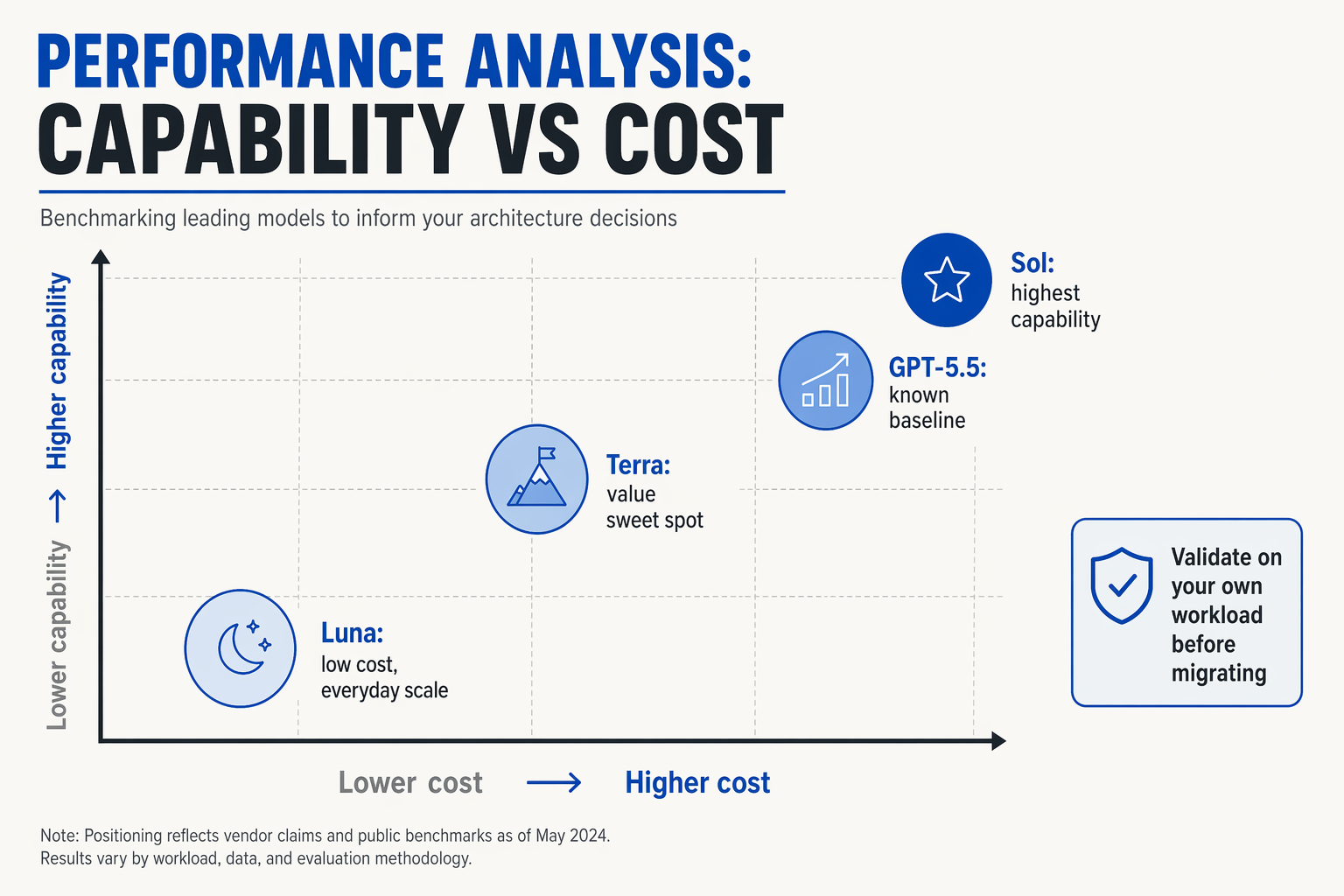
Capability: Sol Leads, but Terra Is the Practical Threat
From a pure performance standpoint, GPT-5.6 Sol is the model to beat. OpenAI’s preview positions Sol as the strongest and most capable member of the GPT-5.6 family, while DataCamp describes it as the top tier for advanced reasoning, coding, and complex enterprise use cases. That makes Sol the safest choice when the task has high ambiguity, long context, multi-step reasoning, or expensive failure modes.
But the more interesting performance story is GPT-5.6 Terra. DataCamp reports that Terra is positioned as competitive with GPT-5.5 while being about 2x cheaper, and community reaction has focused heavily on that point: if Terra really delivers GPT-5.5-class results at half the price, it becomes the default model for many production systems.
In practical terms:
- Sol wins when you need maximum reasoning quality.
- Terra wins when you need strong quality with better economics.
- Luna wins when speed, volume, and affordability matter more than frontier reasoning.
- GPT-5.5 remains useful as a known baseline, but economically it is under pressure.
Performance-per-Dollar Changes the Ranking
Raw benchmark scores are only one part of model performance. For businesses, performance per dollar often matters more.
OpenAI’s preview pricing gives us a clear comparison per 1M tokens:
- GPT-5.6 Sol: $5 input / $30 output
- GPT-5.6 Terra: $2.50 input / $15 output
- GPT-5.6 Luna: $1 input / $6 output
- GPT-5.5: widely reported around Sol-level pricing, roughly $5 input / $30 output
That means Terra costs 50% less than Sol and GPT-5.5, while Luna costs 80% less on input tokens than Sol. If a workload generates millions of tokens daily—support conversations, summarization pipelines, sales assistants, WhatsApp bots, or document classification—those differences are not marginal. They change which use cases are financially viable.
Lushbinary also reports that GPT-5.6 brings 10–15% better token efficiency versus GPT-5.5. If that holds across production workloads, the real savings may be larger than list pricing suggests because the model may need fewer tokens to complete the same task.
Reasoning, Coding, and Specialist Tasks
For hard reasoning and coding, Sol remains the strongest candidate. BuildFastWithAI reports that Sol Ultra hits 91.9% on a benchmark cited in its GPT-5.6 review, suggesting OpenAI is pushing the high end of capability with the Sol line. Lushbinary also notes a +9 biology jump, pointing to improvements in specialist reasoning domains rather than only general chat quality.
This matters for tasks such as:
- Complex code generation and review
- Legal, medical, or financial reasoning drafts
- Multi-agent planning
- Enterprise workflow automation
- High-stakes customer escalations
Terra should be tested aggressively for these workloads, but Sol is the better default when accuracy matters more than cost.
Speed and Throughput: Luna’s Advantage
GPT-5.6 Luna is not trying to beat Sol on intelligence. Its performance advantage is operational: lower cost, likely faster response times, and better suitability for high-volume workloads. Sources describe Luna as the cheapest tier and position it for everyday tasks where near-frontier reasoning is unnecessary.
That makes Luna a strong fit for:
- FAQ answering
- Call summaries
- Lead qualification
- Simple classification
- Short-form content generation
- Routine customer support flows
For platforms like CallMissed, which support AI voice agents, WhatsApp chatbots, speech-to-text, and routing across 300+ LLMs, this kind of tiering is exactly how production AI is moving: use Sol only where needed, Terra for balanced workloads, and Luna for scale.
Bottom Line
On performance alone, Sol is the winner. On performance-per-dollar, Terra may be the most important GPT-5.6 model. For high-volume automation, Luna could deliver the best economics. GPT-5.5 remains a reliable baseline, but GPT-5.6 appears designed to make teams question why they would keep paying Sol-level prices for older-model performance.
Detailed Comparison (TABLE)
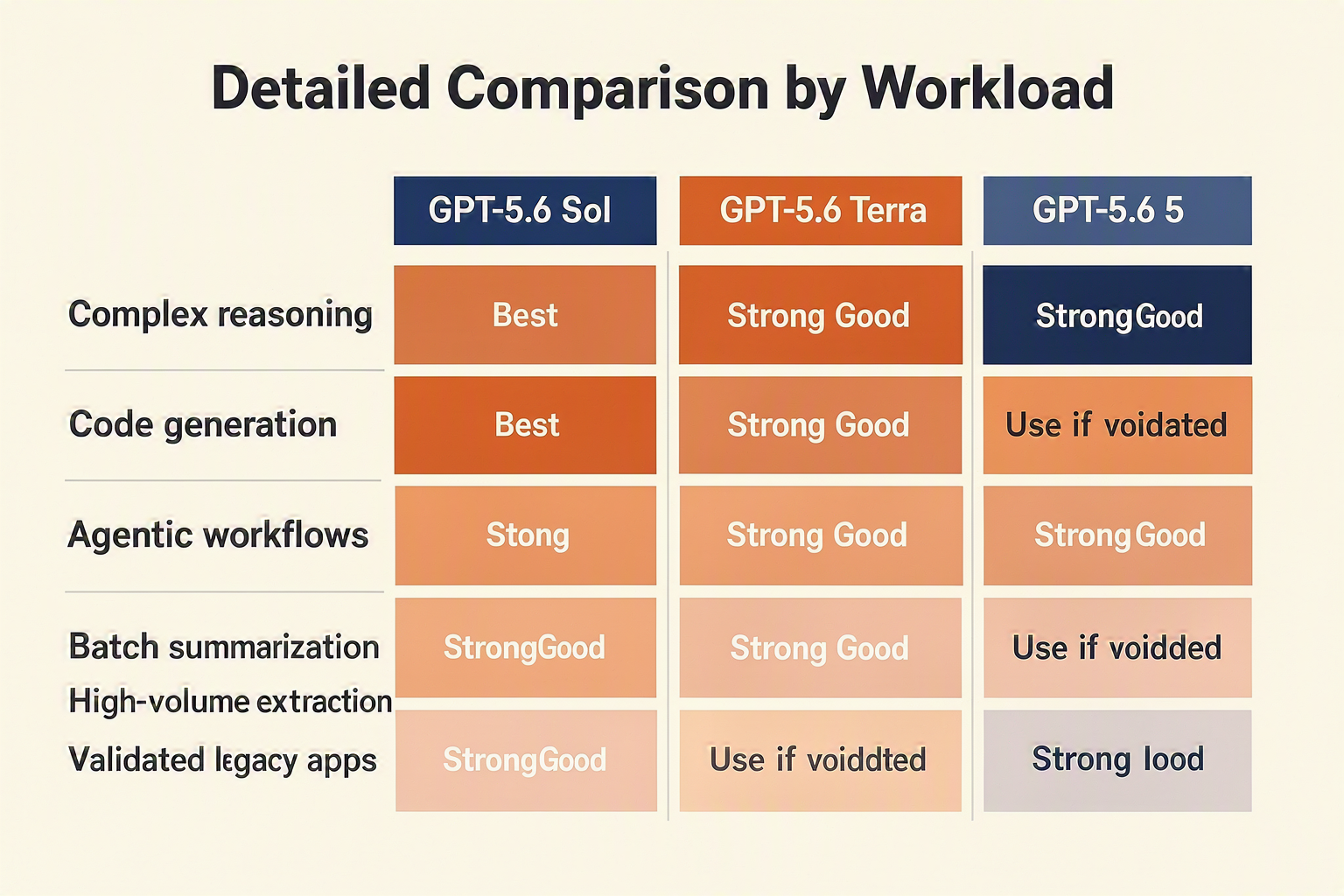
How to Read the Trade-Off
The practical comparison is not “new model beats old model.” It is capability per dollar. OpenAI’s preview prices GPT-5.6 by tier: Sol at $5 input / $30 output per 1M tokens, Terra at $2.50 / $15, and Luna at $1 / $6. Multiple summaries, including Medium and CodeAnt discussions, place GPT-5.5 at roughly Sol-level pricing: about $5 input / $30 output per 1M tokens.
That means Terra is the key disruption point: DataCamp describes it as competitive with GPT-5.5 while being about 2x cheaper, while community discussion summarized the sentiment bluntly: “The real deal is Terra” if it delivers GPT-5.5-class quality at half the cost.
Model-by-Model Comparison
| Model | Positioning | Price per 1M Tokens | Best For | Main Trade-Off |
|---|---|---|---|---|
| GPT-5.6 Sol | Flagship / highest capability | $5 input / $30 output | Complex reasoning, advanced coding, enterprise agents, safety-sensitive tasks | Highest cost in the GPT-5.6 family; use where quality outweighs unit cost |
| GPT-5.6 Terra | Balanced value tier | $2.50 input / $15 output | Production apps needing GPT-5.5-like quality at lower cost: support, analytics, internal copilots | May not match Sol on the hardest reasoning or edge-case reliability |
| GPT-5.6 Luna | Low-cost / high-volume tier | $1 input / $6 output | Chatbots, summarization, classification, routing, lightweight agents, bulk content workflows | Best for routine tasks; avoid assuming full GPT-5.5 parity without workload testing |
| GPT-5.5 | Prior baseline / known quantity | ~$5 input / $30 output | Existing production systems, stable prompts, teams avoiding migration risk | Economically pressured by Terra and capability-pressured by Sol |
What the Numbers Mean in Practice
The biggest cost difference appears when output tokens dominate, which is common in customer support, document drafting, coding assistants, and agent workflows.
For every 1M output tokens:
- Sol or GPT-5.5: $30
- Terra: $15 — roughly 50% lower
- Luna: $6 — roughly 80% lower than Sol
So if an application generates 100M output tokens per month, model choice alone can shift output-token spend from about $3,000 on Sol/GPT-5.5 to $1,500 on Terra or $600 on Luna, before considering input tokens, caching, retries, or agent loops.
This is why GPT-5.6 should be evaluated at the workflow level, not just the benchmark level. A model that is slightly less capable but dramatically cheaper may outperform a flagship model economically if it can complete the task reliably.
Decision Pattern for Real Deployments
A sensible routing strategy looks like this:
- Use Luna for repetitive, high-volume, low-risk tasks.
- Use Terra as the default for most production-grade reasoning and customer workflows.
- Escalate to Sol only when complexity, accuracy, or compliance risk justifies the premium.
- Keep GPT-5.5 where migration risk is higher than the savings, but benchmark against Terra quickly.
This is also where platforms like CallMissed become useful: businesses running AI voice agents, WhatsApp chatbots, and multilingual support flows often need to route requests across models based on cost, latency, and task difficulty—not hard-code one model everywhere.
Pricing & Value (TABLE)
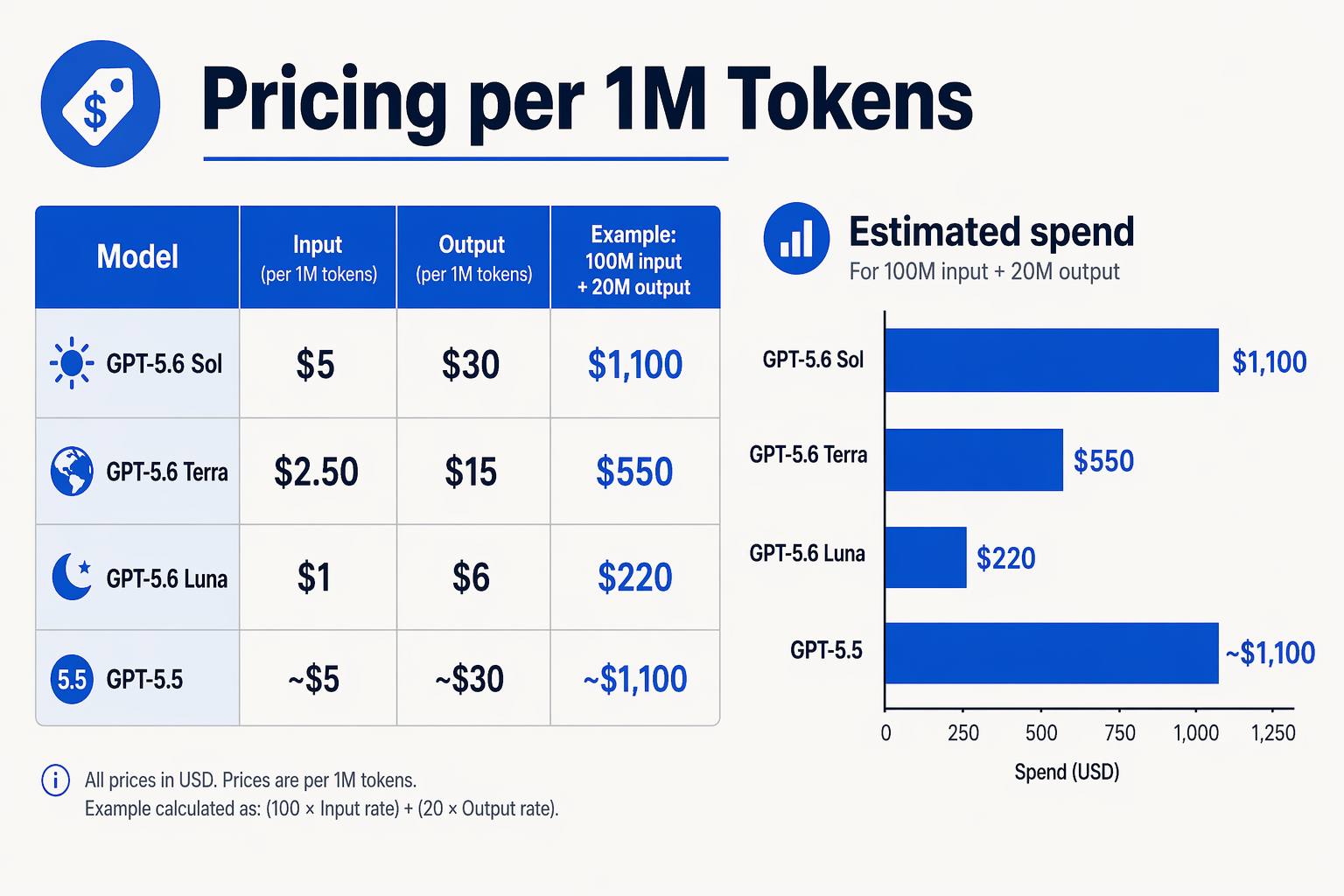
Unit Economics: The Real GPT-5.6 Decision
Pricing is where the GPT-5.6 family becomes more than a capability upgrade. OpenAI’s preview lists three clear price bands per 1 million tokens: Sol at $5 input / $30 output, Terra at $2.50 / $15, and Luna at $1 / $6. Multiple summaries, including Medium and CodeAnt, place GPT-5.5 at roughly Sol-level pricing, around $5 input / $30 output per 1M tokens.
That creates a simple but important value question: if GPT-5.6 Sol and GPT-5.5 are priced similarly, Sol is the premium upgrade path. But if Terra delivers the “GPT-5.5-competitive” quality described by DataCamp at about 2x lower cost, it becomes the default value choice for many teams.
| Model | Input Price / 1M | Output Price / 1M | Value Position | Best-Fit Workloads |
|---|---|---|---|---|
| GPT-5.6 Sol | $5.00 | $30.00 | Highest capability; similar price band to GPT-5.5 | Complex reasoning, coding, agentic workflows, high-risk enterprise tasks |
| GPT-5.6 Terra | $2.50 | $15.00 | Best balance; about 2x cheaper than Sol/GPT-5.5 | Production assistants, analytics, support automation, content workflows |
| GPT-5.6 Luna | $1.00 | $6.00 | Lowest cost; 80% cheaper input than Sol | High-volume chat, classification, summarization, routine customer queries |
| GPT-5.5 | ~$5.00 | ~$30.00 | Known baseline; economically challenged by 5.6 tiers | Existing deployments, legacy evals, stability-sensitive systems |
What This Means in Real Spend
For a balanced workload using 1M input tokens and 1M output tokens, the math is straightforward:
- GPT-5.6 Sol: $35 total
- GPT-5.6 Terra: $17.50 total
- GPT-5.6 Luna: $7 total
- GPT-5.5: roughly $35 total
For output-heavy applications—such as chatbots, report generation, code explanations, or voice-agent responses—the gap gets larger. At 1M input tokens and 3M output tokens, Sol or GPT-5.5 would cost about $95, Terra about $47.50, and Luna about $19.
That is why Luna matters even if it is not the strongest model. For millions of routine interactions, paying $6 per 1M output tokens instead of $30 can change whether an AI workflow is profitable at all.
The Practical Value Rule
A useful pricing strategy is:
- Use Sol when the cost of a wrong answer is higher than the token bill.
- Use Terra when you need strong GPT-5.5-class quality with better margins.
- Use Luna when scale, speed, and affordability matter more than frontier reasoning.
- Keep GPT-5.5 only where existing evaluations, compliance, or production stability make migration slower.
This is also where model-routing platforms become important. In real deployments, one model rarely fits every request. Platforms like CallMissed, which provide access to 300+ LLMs alongside voice agents, WhatsApp chatbots, Speech-to-Text for 22 Indian languages, and Text-to-Speech APIs, reflect the direction the market is moving: route simple tasks to cheaper models, reserve premium models for difficult cases, and optimize cost per successful outcome—not cost per token alone.
Migration Advice from GPT-5.5
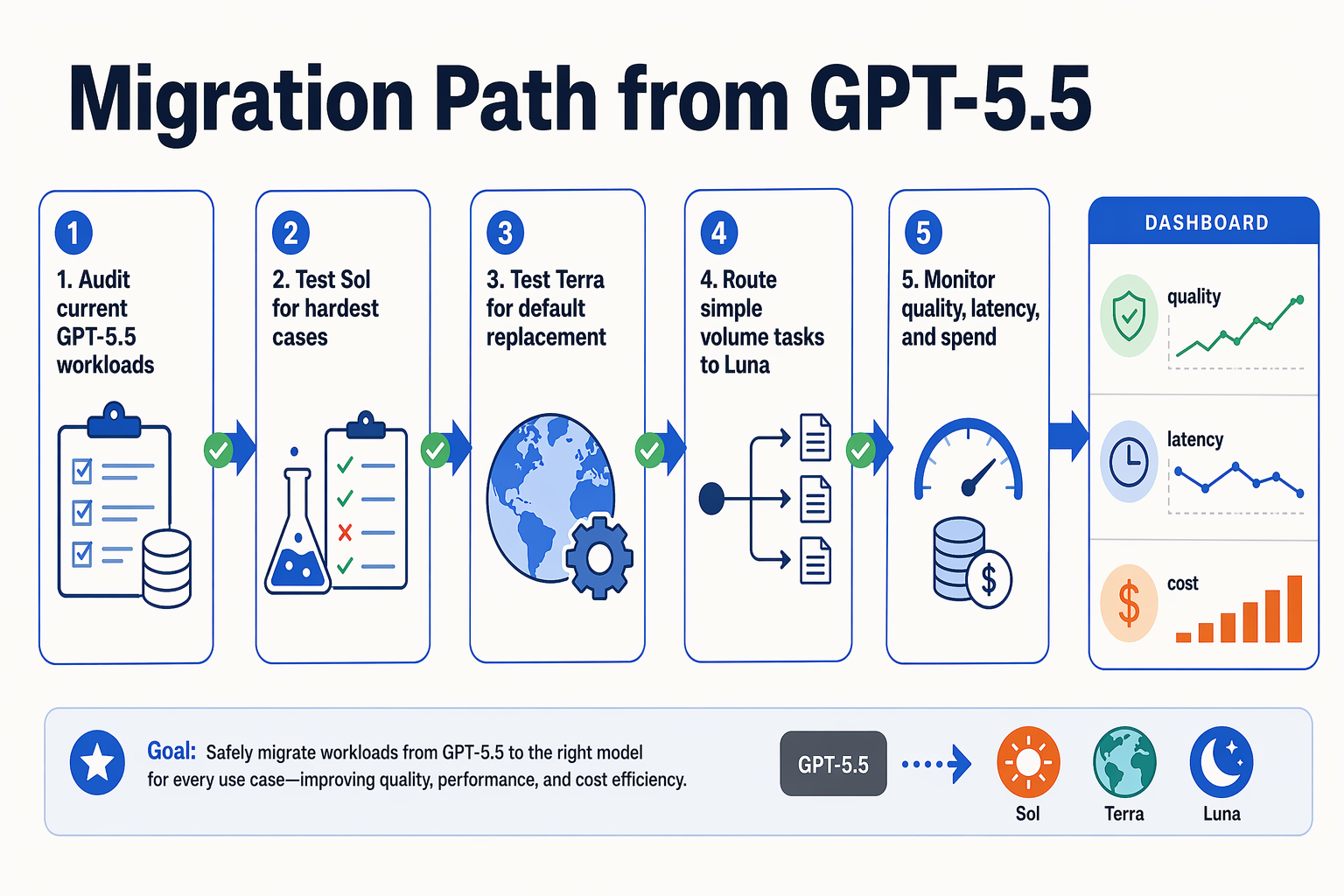
Start with a workload inventory, not a blanket upgrade
If you are already running GPT-5.5 in production, the wrong migration plan is “move everything to GPT-5.6 Sol.” Sol may be the most capable GPT-5.6 tier, but it is priced at $5 input / $30 output per 1M tokens, the same level multiple sources associate with GPT-5.5. That means Sol is best treated as a capability upgrade at similar token economics, not a cost-saving move.
A smarter migration starts by segmenting your current GPT-5.5 usage into three buckets:
- Critical reasoning workloads — complex coding, legal/financial analysis, enterprise agents, safety-sensitive decisions
- Standard production workloads — support replies, document Q&A, internal copilots, structured summarization
- High-volume utility workloads — classification, routing, extraction, first-draft responses, simple chatbot turns
Once you map usage this way, GPT-5.6 becomes much easier to adopt: Sol for the hardest cases, Terra for the default replacement path, Luna for scale economics.
Terra should be your first migration candidate
For most GPT-5.5 users, GPT-5.6 Terra is the model to test first. OpenAI’s preview pricing puts Terra at $2.50 input / $15 output per 1M tokens, exactly 50% of Sol’s listed price. DataCamp describes Terra as the mid-tier option “competitive with GPT-5.5 while being about 2x cheaper,” which makes it the obvious candidate for workloads where GPT-5.5 quality is acceptable but costs are limiting expansion.
A practical Terra migration plan:
- Run side-by-side evaluations against GPT-5.5 using real production prompts.
- Measure not only accuracy, but also format adherence, hallucination rate, latency, and retry rate.
- Prioritize workloads with large output volumes, because the output-token gap is substantial: $30 per 1M output tokens on GPT-5.5/Sol-level pricing vs $15 on Terra.
- Move low-risk GPT-5.5 traffic to Terra first, then expand after monitoring user satisfaction and escalation rates.
For many teams, Terra may become the new default model: not because it is always the best, but because it may offer the best quality-per-dollar trade-off.
Use Luna where cost unlocks volume
GPT-5.6 Luna is the bigger shift for teams constrained by token budgets. At $1 input / $6 output per 1M tokens, Luna is one-fifth of Sol’s input price and one-fifth of its output price. That changes what is economically possible for high-throughput systems.
Good Luna migration targets include:
- Intent classification and lead routing
- Call or chat summarization
- FAQ-style customer support
- CRM note generation
- Short-form translation or rewriting
- First-pass extraction before escalation to Terra or Sol
The key is to avoid treating Luna as a universal GPT-5.5 replacement. Sources position Luna around affordability, speed, and everyday workloads, with some commentary describing it as near GPT-5.5 levels on several benchmarks—but unless your own tests confirm that for your domain, use Luna as a volume layer, not the final authority for complex decisions.
Keep Sol for failure-expensive tasks
If a GPT-5.5 workflow is currently used because errors are expensive, migrate it to GPT-5.6 Sol rather than downgrading purely for cost. Sol’s pricing—$5 input / $30 output per 1M tokens—means the business case is not savings; it is higher capability at a familiar cost structure.
Use Sol for:
- Multi-step agentic workflows
- Advanced coding and code review
- Regulated or compliance-heavy reasoning
- Complex enterprise automation
- Final review after Luna or Terra pre-processing
Recommended migration pattern
The safest path is a tiered cascade:
- Luna handles cheap, high-volume first-pass tasks.
- Terra becomes the default GPT-5.5 replacement for mainstream production.
- Sol handles escalations, complex reasoning, and final decisions.
This is also where orchestration platforms become valuable. For example, platforms like CallMissed can route workloads across voice agents, WhatsApp bots, and 300+ LLMs, letting teams test Terra or Luna on specific traffic slices before retiring GPT-5.5 entirely.
Bottom line: do not migrate from GPT-5.5 to “GPT-5.6.” Migrate to a model portfolio—with Terra as the default test, Luna as the cost lever, and Sol as the premium reasoning tier.
Pros and Cons (TABLE)
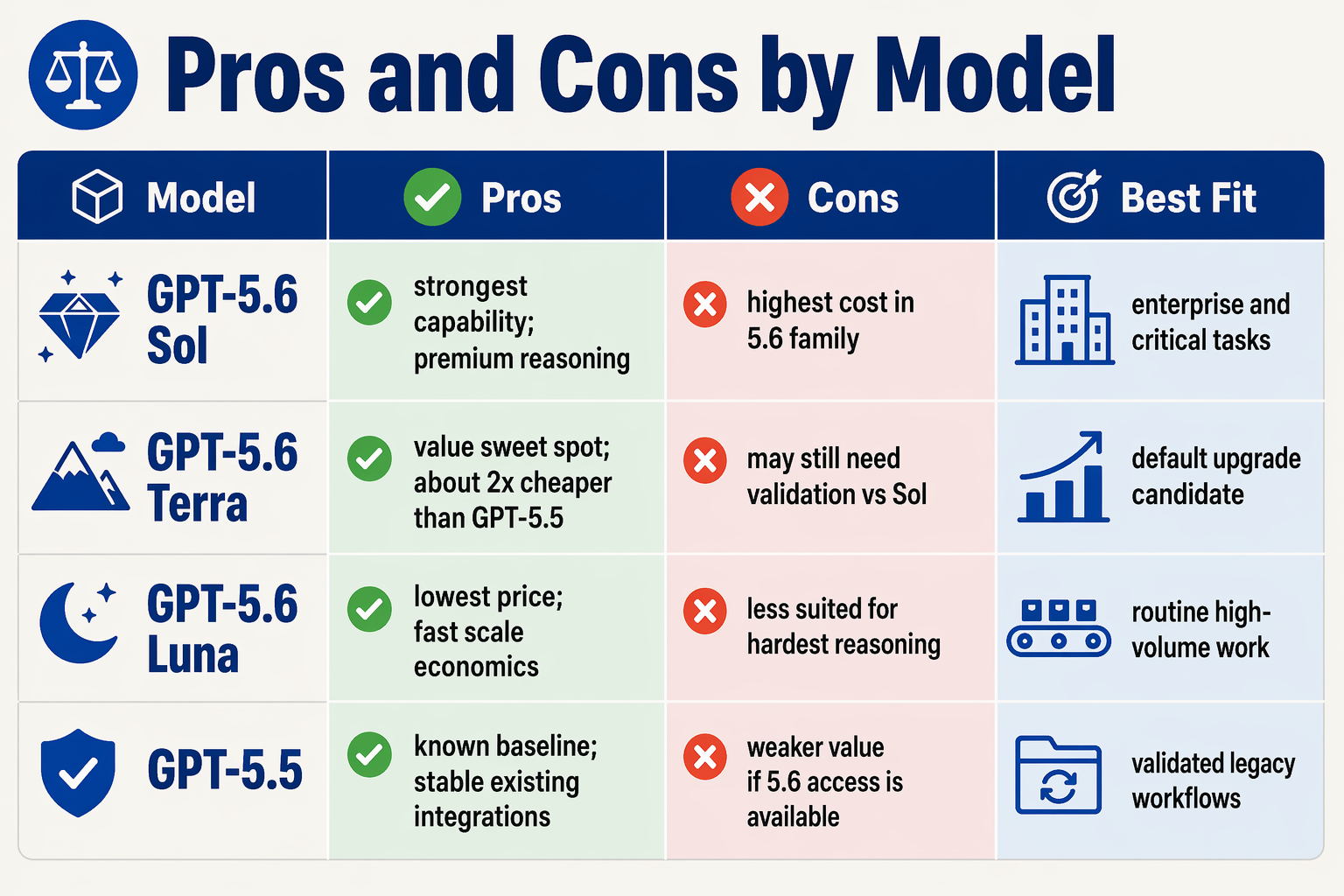
Quick Pros-and-Cons View
The choice is no longer “GPT-5.6 or GPT-5.5?” It is which cost-performance tier matches the job. OpenAI’s preview pricing makes the segmentation explicit: Sol at $5 input / $30 output per 1M tokens, Terra at $2.50 / $15, and Luna at $1 / $6. Multiple summaries place GPT-5.5 around Sol-level pricing, roughly $5 / $30 per 1M tokens, which makes GPT-5.6 a direct challenge to the old default.
| Model | Best Pros | Main Cons | Pricing per 1M Tokens | Best Fit |
|---|---|---|---|---|
| GPT-5.6 Sol | Highest-capability GPT-5.6 tier; best suited for hard reasoning, complex coding, enterprise automation, and safety-sensitive workflows | Expensive output pricing; overkill for routine summarization, support, or classification | $5 input / $30 output per OpenAI preview | Premium agents, critical decisions, advanced software engineering |
| GPT-5.6 Terra | Strong value tier; DataCamp describes it as GPT-5.5-competitive at about 2x lower cost | May not match Sol on the hardest multi-step reasoning or edge-case reliability | $2.50 input / $15 output | Production apps needing quality without Sol-level cost |
| GPT-5.6 Luna | Lowest-cost option; one-fifth of Sol’s input price and positioned for high-volume workloads | Less suitable for nuanced reasoning, deep coding, or high-stakes outputs | $1 input / $6 output | Chatbots, routing, summaries, extraction, large-scale support |
| GPT-5.5 | Known baseline; mature behavior and existing integrations | Same rough cost as Sol but without the GPT-5.6 tiering advantage | Around $5 input / $30 output, per industry summaries | Legacy systems, stable deployments, benchmark continuity |
| Hybrid routing | Lets teams use Luna/Terra by default and escalate to Sol only when needed | Requires evaluation, routing rules, monitoring, and fallback design | Blended cost depends on workload mix | Cost-optimized AI agents and customer communication systems |
What the Table Really Shows
The biggest winner on paper is Terra, not necessarily Sol. If Terra delivers the reported GPT-5.5-competitive performance at half the price, it becomes the default candidate for many real applications: customer support copilots, internal knowledge assistants, code review triage, sales enablement, and document workflows.
Sol is still important, but its role is narrower: use it when the cost of a bad answer is higher than the token bill. That includes legal reasoning, complex architecture planning, security-sensitive automation, advanced debugging, and multi-agent orchestration where failures can cascade.
Luna is the economics disruptor. At $1 input / $6 output per 1M tokens, it makes sense for high-throughput tasks where “good enough and fast” beats “maximum reasoning.” Examples include:
- First-pass ticket classification
- Call and chat summarization
- FAQ answering with retrieval
- Lead qualification
- Sentiment tagging
- Data extraction from structured messages
For platforms handling thousands of conversations daily, this is where model routing becomes strategic. A system like CallMissed, for example, can route routine WhatsApp chatbot or voice-agent tasks to lower-cost models while reserving stronger LLMs for escalation, complex customer intent, or supervisor workflows.
Practical Takeaway
If you want the simplest rule:
- Choose Sol when quality matters more than cost.
- Choose Terra when you want GPT-5.5-class capability at better unit economics.
- Choose Luna when scale, speed, and affordability matter most.
- Keep GPT-5.5 only where stability, existing evaluation history, or migration risk outweighs savings.
The smartest teams will not pick one model. They will build a tiered model strategy that uses each tier where it creates the most value.
Frequently Asked Questions
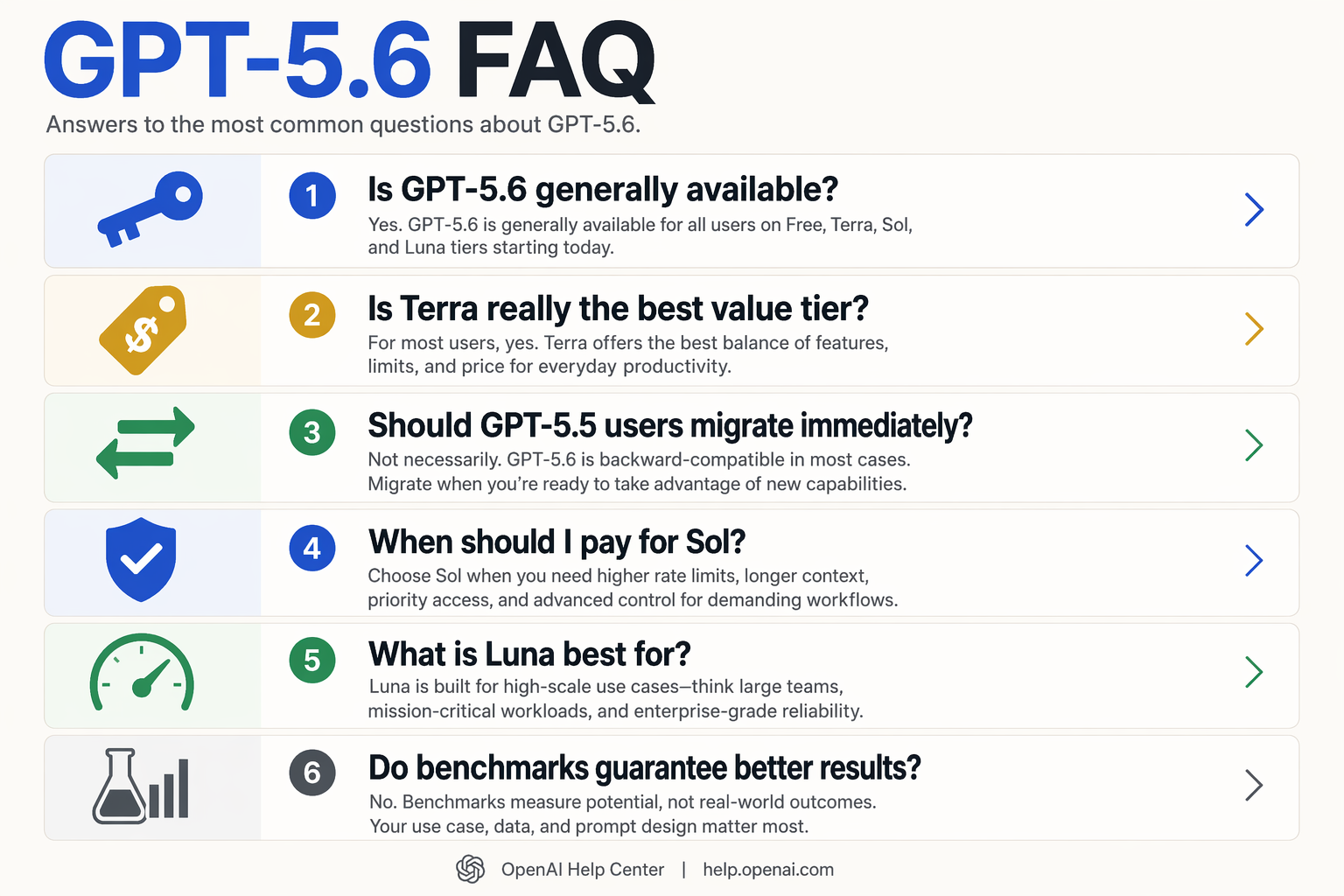
What is the main difference in GPT-5.6 Sol vs Terra vs Luna vs GPT-5.5?
Is GPT-5.6 Terra better value than GPT-5.5?
When should I use GPT-5.6 Sol instead of Terra or Luna?
Is GPT-5.6 Luna good enough for customer support and high-volume apps?
How should businesses choose in GPT-5.6 Sol vs Terra vs Luna vs GPT-5.5 deployments?
Should existing GPT-5.5 users upgrade to GPT-5.6 now?
Conclusion
The takeaway from GPT-5.6 Sol vs Terra vs Luna vs GPT-5.5 is simple: the best model is no longer the newest or most powerful one—it is the one that fits your workload economics.
- Choose GPT-5.6 Sol when maximum capability matters: complex reasoning, advanced coding, agentic workflows, enterprise automation, or safety-sensitive tasks where failure costs more than tokens.
- Choose GPT-5.6 Terra for the strongest value case: it is positioned as GPT-5.5-competitive at about 2x lower cost, with pricing of $2.50 input / $15 output per 1M tokens.
- Choose GPT-5.6 Luna for high-volume, lower-risk workloads like chatbots, summaries, classification, and routine support, where $1 input / $6 output can dramatically improve margins.
- Keep GPT-5.5 where stability, existing evaluations, and known behavior matter—but expect many teams to migrate as GPT-5.6 tiers mature.
What to watch next is real-world benchmarking: latency, tool use, hallucination rates, multilingual quality, and production reliability across Sol, Terra, and Luna. Platforms like CallMissed, which power AI voice agents, WhatsApp chatbots, and multi-model LLM workflows, are where these trade-offs become practical business decisions.
So the real question is: are you still choosing models by benchmark score—or by business outcome?
Related Posts



Ready to automate customer conversations?
Launch AI voice agents and WhatsApp bots with CallMissed — one API, 22+ Indian languages.