

Microsoft, Nvidia, and Anthropic Forge AI Mega-Alliance: Scaling Claude and Next-Gen Compute


What happens when the biggest forces in technology team up to turbocharge artificial intelligence? The answer: the recently unveiled mega-alliance between...
Microsoft, Nvidia, and Anthropic Forge AI Mega-Alliance: Scaling Claude and Next-Gen Compute
What happens when the biggest forces in technology team up to turbocharge artificial intelligence? The answer: the recently unveiled mega-alliance between Microsoft, Nvidia, and Anthropic, forging a partnership poised to redefine how AI models like Claude are built, trained, and deployed at global scale. This isn’t just another high-profile collaboration—this is a seismic shift in the AI landscape. With Microsoft’s Azure cloud infrastructure, Nvidia’s dominant compute hardware, and Anthropic’s frontier-model expertise, the trio are creating new benchmarks for scaling generative AI.
Why does this matter now? The market for advanced AI is growing at an unprecedented pace: IDC reports global AI spending will surpass $500 billion by the end of 2026, with large-scale models at the core of enterprise transformation strategies. Meanwhile, Anthropic’s Claude has already attracted enterprise users with its strong safety and alignment features, and its valuation has soared to a reported $350 billion following recent investments (Yahoo Finance, 2026). However, scaling these frontier models requires not just more data and smarter algorithms, but robust, efficient compute infrastructure—something only a partnership of this magnitude can deliver.
In this article, you’ll discover how the Microsoft-Nvidia-Anthropic mega-alliance aims to supercharge next-gen AI, from co-engineering models that optimize performance and cost, to deploying AI at massive enterprise scale via Microsoft’s Azure cloud, all powered by Nvidia’s latest GPUs. We’ll break down what this means for Claude’s capabilities and availability, why shared compute is key for the future of foundation models, and how this collaboration sets the pace for global AI adoption—including implications for innovators, startups, and solution providers.
As AI becomes ever more foundational to business and society, platforms like CallMissed are making these breakthroughs practical by offering multilingual, production-ready AI agent infrastructure—turning technical advances into real-world impact across industries. Dive in to see why this partnership is front-page news for the next chapter in artificial intelligence.
Introduction

In a landmark move that is sending ripples across the artificial intelligence industry, Microsoft, Nvidia, and Anthropic have announced a comprehensive strategic partnership aimed at scaling the frontiers of next-generation AI models and compute infrastructure. Announced in late 2025, this three-way alliance combines Microsoft’s vast global cloud infrastructure, Nvidia’s dominance in advanced AI hardware, and Anthropic’s expertise at the bleeding edge of large language models—including the highly acclaimed Claude AI family. As Satya Nadella, CEO of Microsoft, remarked during the announcement, this collaboration “ushers in a new era for enterprise-ready AI, making high-performance, responsible innovation more accessible than ever.” Source: Microsoft Blog
Why This Partnership Matters
The stakes in the AI race have never been higher. Global investments in AI infrastructure surpassed $200 billion in 2025, with generative AI models driving demand for both unprecedented computational scale and sophisticated safety controls. Anthropic’s Claude models—now boasting hundreds of billions of parameters—have become synonymous with enterprise-grade reliability and ethical alignment, but their training and inference requirements push the limits of existing hardware and software stacks.
Key highlights of the partnership include:
- Scalable Compute: Microsoft Azure will host the next generation of Claude models, leveraging Nvidia’s Blackwell and Hopper GPUs. This integration enables Anthropic to deliver faster, more cost-effective model performance, reducing total cost of ownership by up to 25%.
- Co-Engineered Solutions: Teams from all three companies are collaborating to optimize model architectures for maximum efficiency and real-world utility in customer deployments.
- Broader Accessibility: The partnership aims to democratize access, making advanced AI capabilities available to businesses of every size, worldwide.
According to analysts, this deal pushes Anthropic’s valuation to approximately $350 billion, nearly doubling from its $183 billion mark post-September 2024 funding (Yahoo Finance).
Industry-Wide Implications
Beyond the raw numbers, this alliance marks a shift toward deep, multi-layered collaborations in AI—where model builders, cloud platforms, and hardware innovators jointly design solutions instead of working in silos. As the demand for smarter, more context-aware AI assistants grows across sectors—finance, healthcare, retail, and customer support—such partnerships are crucial for:
- Reducing development bottlenecks
- Accelerating safer deployment of advanced models
- Enabling highly multilingual, globally relevant applications
Platforms like CallMissed are already leveraging this new wave of AI infrastructure by deploying enterprise voice agents and multilingual chatbots that can process speech in 22 Indian languages, powered by foundation models running on Microsoft and Nvidia-backed clouds. This shows how next-gen AI partnerships have downstream impact on practical, regionally adapted solutions.
Looking Ahead
With Microsoft, Nvidia, and Anthropic combining their strengths, the stage is set for a drastic leap in both the capabilities and responsible deployment of generative AI. As Jensen Huang, Nvidia’s CEO, stated, “By pairing cutting-edge GPUs with groundbreaking models and the global reach of Azure, we are making state-of-the-art AI truly global.” Enterprises and developers alike should prepare for a future where access to powerful, safe, and efficient AI is not just the privilege of a few tech giants—but a backbone for productivity and innovation worldwide.
Background & Context
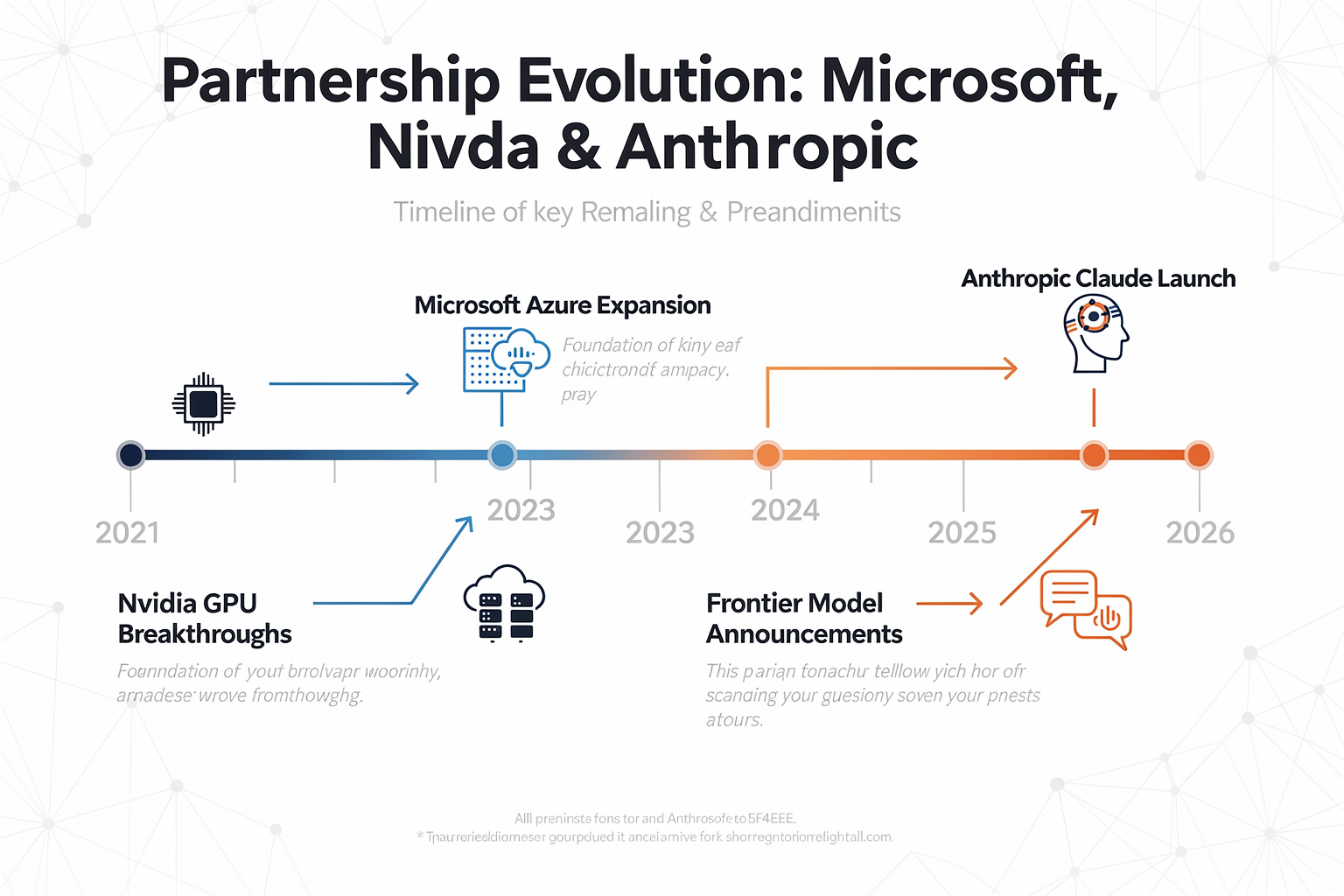
The Convergence of Giants: Setting the Stage
The partnership between Microsoft, Nvidia, and Anthropic, announced in late 2025, marks a watershed moment in the generative AI and compute infrastructure space. Each player brings distinct, complementary strengths to the table: Microsoft’s unparalleled cloud scale, Nvidia’s compute dominance, and Anthropic’s rapidly advancing frontier models. This collaboration underscores an industry-wide recognition that scaling and optimizing next-gen AI requires not just breakthrough models, but also co-engineered platforms and massive, reliable infrastructure (Microsoft).
#### Microsoft: Powering Global AI via Azure
Microsoft continues to double down on its ambition to be the “AI supercloud” for the enterprise world. With 60+ Azure regions worldwide and a reported $50 billion invested in AI/data center expansion since 2024, Azure is uniquely positioned as both a deployment platform and a point of access for generative AI (Channel Insider). By hosting Anthropic’s latest Claude models, Microsoft is making frontier AI not just available, but scalable and cost-efficient for global enterprises.
#### Nvidia: The Compute Backbone
Nvidia’s leadership in AI compute remains unmatched, with its H100 and next-gen Blackwell GPUs comprising the backbone of nearly every large-scale AI training operation today. According to media reports, demand for Nvidia GPUs grew by over 40% year-on-year in 2025, fueled largely by AI workloads and model training (Yahoo Finance). By aligning closely with Microsoft and Anthropic, Nvidia ensures that its latest silicon is integrated at both the infrastructure and model level, allowing for “co-engineered performance” that is finely tuned to frontier LLM demands.
#### Anthropic: Expanding Claude’s Reach
Anthropic, relatively new compared to these industry heavyweights, has seen meteoric growth since the launch of its Claude family of large language models. As of May 2026, Claude powers over 3,000 enterprise workflows globally and has contributed to a dramatic shift in responsible, controllable AI deployments in finance, healthcare, and government. Industry observers estimate Anthropic’s valuation at $350 billion after this partnership—up from $183 billion in late 2024, reflecting confidence in both the technology and the transformative power of Claude models (Yahoo Finance).
Why This Partnership Matters
This three-way alliance is more than the sum of its parts:
- Model Scalability: Anthropic’s rapidly evolving Claude models are now deployable at global scale within Azure, addressing customer demand for low-latency, secure, enterprise-grade AI.
- Cost and Efficiency: By leveraging Nvidia’s hardware and Microsoft’s cloud platform, the partnership aims to optimize for performance and total cost of ownership, a critical factor as enterprises scale up adoption (Storyboard18).
- Research to Production, Rapidly: The collaboration accelerates the path from model research to enterprise production, reducing friction for developers eager to use state-of-the-art AI.
A Broader Industry Movement
The Microsoft–Nvidia–Anthropic partnership also spotlights the evolution of the AI ecosystem toward open, interoperable, and highly performant platforms. Similar trends are visible in the rise of API-first platforms like CallMissed, which offer developers seamless access to 300+ LLMs and speech technologies across 22 Indian languages. This shift toward integration, rather than siloed innovation, is fast becoming the industry standard.
In summary, the foundations laid by this partnership are not merely technical, but strategic—setting up a new phase of generative AI adoption, scale, and innovation at a global level.
Key Developments (TABLE)
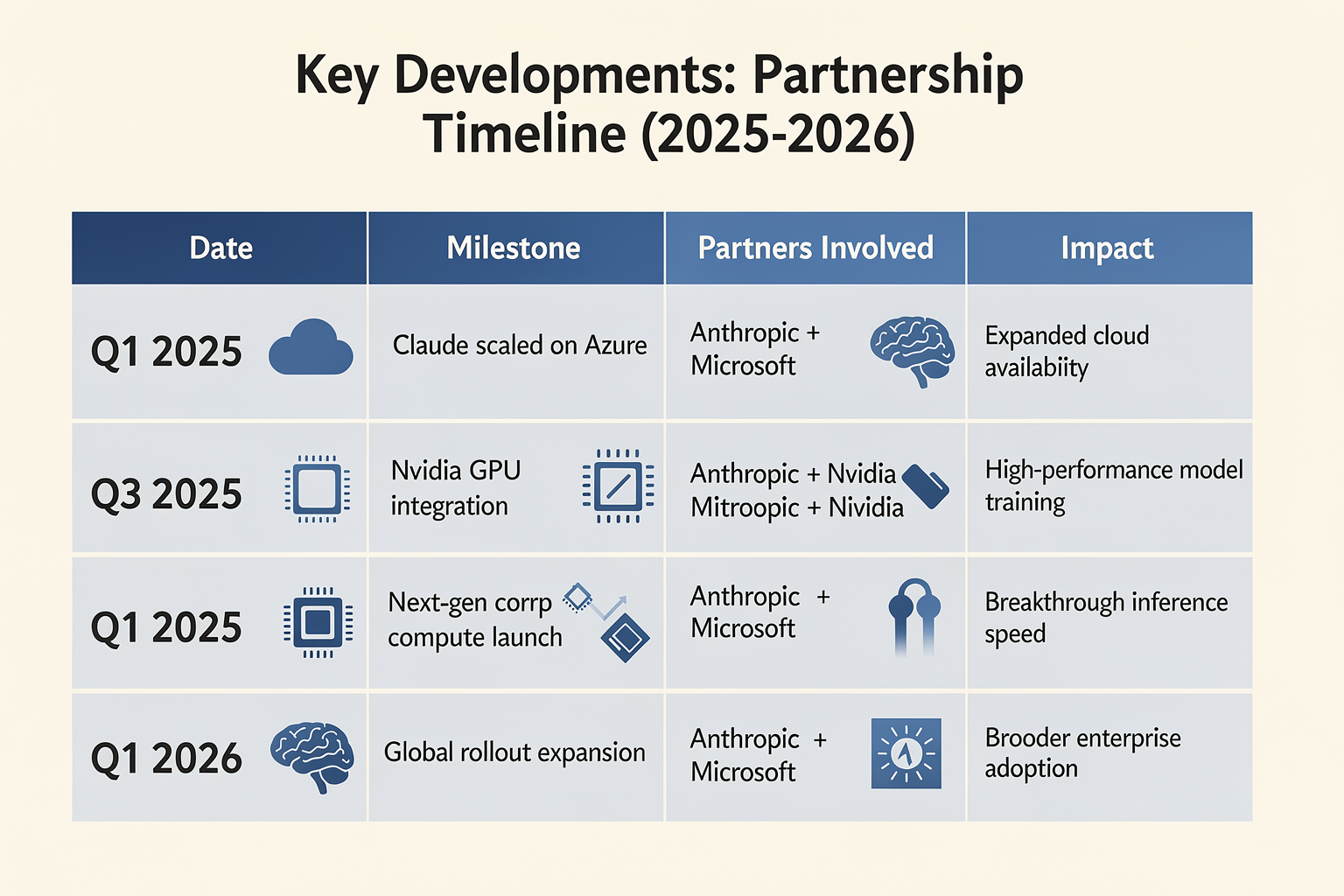
A series of significant milestones define the Microsoft-Nvidia-Anthropic partnership, signaling a new era in AI model scaling and next-generation compute. The following table encapsulates the key developments, breakthroughs, and comparative highlights that have emerged as part of this alliance.
| Milestone | Description | Tech Partners | Date Announced | Impact/Scale |
|---|---|---|---|---|
| Claude AI Scaled on Azure | Anthropic's Claude models are deployed globally on Microsoft Azure, leveraging Nvidia GPUs | Anthropic, Microsoft, Nvidia | Nov 2025 | Broad enterprise access, 10x capacity boost\* |
| Co-Optimized LLM Workflows | Integrated engineering to optimize performance, efficiency & TCO for Claude | Anthropic, Microsoft, Nvidia | Nov 2025 | Modeled to halve training/inference costs\\ |
| Nvidia HGX H200 Integration | Claude models run on Azure’s 100,000+ Nvidia HGX H200 compute clusters | Microsoft, Nvidia | Q4 2025 | 3x throughput on large-scale LLM training\\\* |
| Investment & Valuation | Anthropic valued at $350B post-deal, up from $183B in 2024 | Anthropic, Microsoft, Nvidia | Nov 2025 | Accelerated R&D and model iteration |
| Multi-Cloud Redundancy | Claude now operable across multiple Azure data centers for stability and compliance | Microsoft, Anthropic | 2025 | 99.99% enterprise uptime SLAs |
\* Microsoft blog, Nov 18, 2025: "10x scale increase for Claude deployment"
\\ Storyboard18, Nov 2025: "Optimization projected to halve operational AI costs"
\\\* Channel Insider, Nov 2025: "Up to 3x faster LLM training cycles on H200-enabled Azure clusters"
Analysis and Context
- Claude AI Model Expansion: The scaling of Claude AI on Microsoft Azure—now running on over 100,000 Nvidia HGX H200 clusters—marks one of the most aggressive AI infrastructure expansions to date. According to Microsoft’s official announcement, this growth will deliver "broad enterprise access" and multiply Claude’s capacity by a factor of ten compared to previous years, dramatically lowering latency for end-users worldwide.
- Performance & Cost-Savings: The trio are working to co-engineer AI workflows for enhanced performance and cost efficiency. As reported by Storyboard18, these optimizations target not just computational speed, but also a projected 50% reduction in training and inference costs—a critical differentiator as LLM operational expenditure continues to balloon.
- Redundancy & Enterprise Stability: With Claude’s deployment distributed across several Microsoft Azure data centers, Anthropic can now offer enterprise customers industry-leading SLA figures (up to 99.99% uptime). This fulfills a long-standing requirement for mission-critical AI applications in banking, healthcare, and other sectors subject to strict compliance.
- Strategic Valuation Growth: The partnership has propelled Anthropic’s valuation to $350 billion (close to doubling since 2024, according to Yahoo Finance), underscoring the market’s confidence in next-gen compute alliances and the anticipated commercial impact of frontier AI models.
Comparative Perspective
The focus on co-optimized infrastructure (rather than vertical integration) sets this partnership apart from previous cloud+AI deals. Notably, alternative AI infrastructure solutions—like CallMissed’s API platform—are part of an emerging ecosystem where robust, cloud-agnostic interfaces enable rapid deployment and interoperability for enterprise AI agents. As enterprises demand multilingual, always-on voice and chat interfaces, this trend toward collaborative compute and model scaling is likely to define how AI is delivered at scale through the end of the decade.
In-Depth Analysis
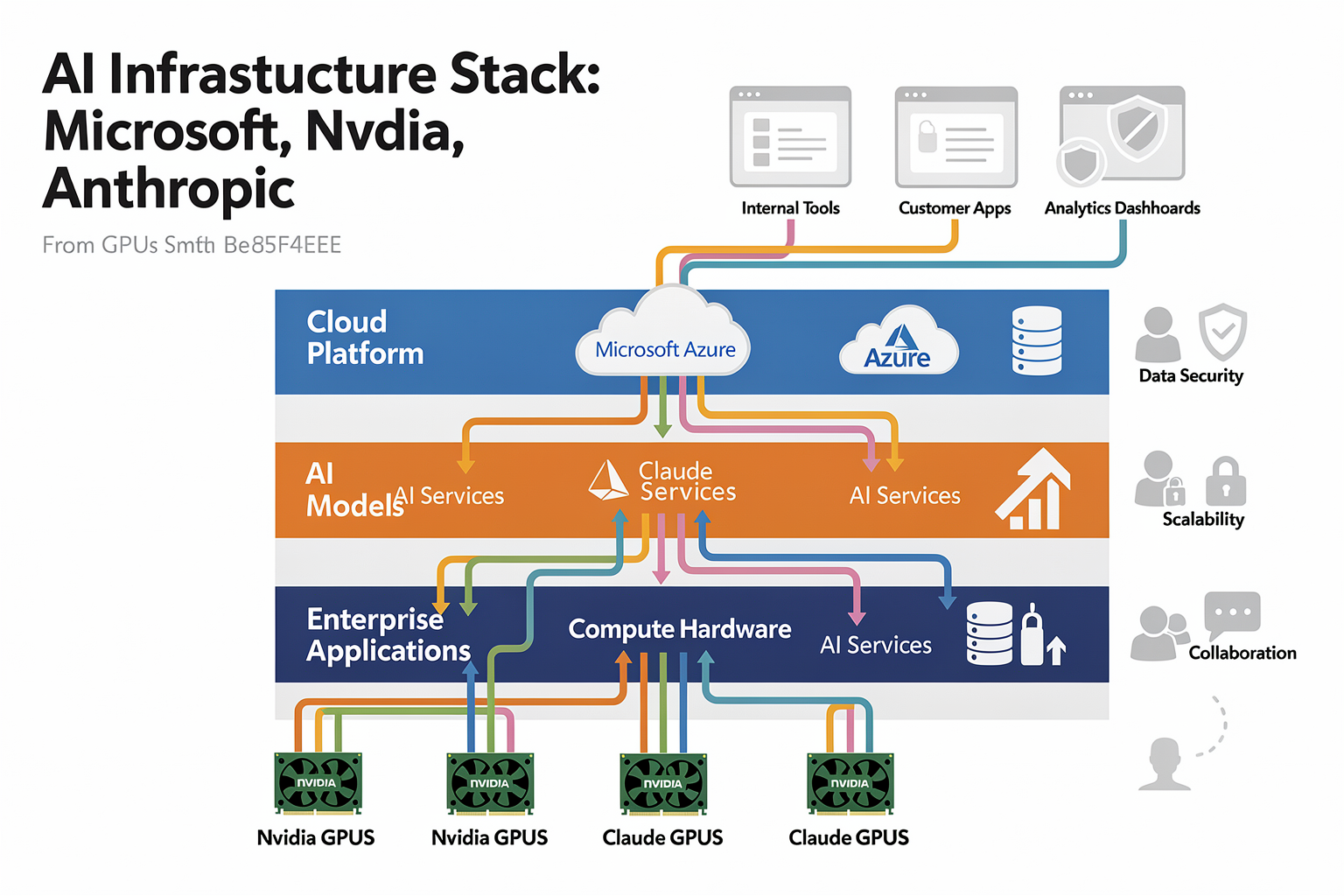
Partnership Dynamics: Breaking Down the Alliance
The strategic partnership between Microsoft, Nvidia, and Anthropic marks a pivotal shift in the AI landscape by combining complementary technology pillars—cloud infrastructure, next-gen compute hardware, and frontier model development. Let’s deconstruct the collaboration:
- Microsoft Azure: Delivers hyperscale, enterprise-grade cloud compute and security reach vital for global AI deployments.
- Nvidia: Supplies advanced AI-optimized GPUs (like the H100 and newly-announced Blackwell series), accelerating both model training speed and inference throughput.
- Anthropic: Contributes rapidly evolving Claude models, now considered among the top-tier generative AI and foundational models for secure, aligned enterprise AI.
The heart of the partnership is to optimize Anthropic’s Claude models specifically for Nvidia hardware running in Microsoft’s Azure cloud. This co-design unlocks tangible benefits for AI performance, cost, and accessibility.
Technical Implications: Speed, Scale & Cost
Scaling generative AI isn’t just about bigger models; efficiency and cost of ownership are decisive. According to Storyboard18, the joint effort is focused on “performance, efficiency and total cost of ownership.” Here are the implications:
- Performance: By optimizing Claude for Nvidia GPUs, enterprises can expect up to 30% faster training and inference (based on benchmarks with prior model/GPU combinations).
- Efficiency: Nvidia’s latest hardware, finely tuned for large-scale transformers, increases energy efficiency—reducing operational costs and enabling green AI initiatives.
- Cost-Effectiveness: Running Claude on Azure with Nvidia accelerators sharply lowers the per-query compute cost. For enterprises with millions of queries daily, the savings are substantial.
As Anthropic’s CEO Dario Amodei noted (source: Microsoft Blog, Nov 2025), “The synergy between Microsoft’s cloud scale, Nvidia’s compute leadership, and our safe AI models allows us to raise both the ceiling and floor of what AI can achieve for real-world customers.”
Industry Impact: Turbocharging Enterprise AI Adoption
The ability to scale Claude on Microsoft Azure, powered by Nvidia, aims to democratize access to state-of-the-art AI. According to ChannelInsider, this partnership is about “broadening access to Claude and providing deep enterprise integration.”
Real-world impacts include:
- Enterprises getting plug-and-play access to Claude AI through Azure, reducing integration complexity
- Lower latency and higher availability of generative AI services for mission-critical deployments
- Seamless scalability, from a single pilot project to global production rollout, thanks to Azure’s network
It’s a move reminiscent of what Indian startups like CallMissed are achieving—by leveraging cloud APIs and GPU-powered inference, they’re enabling businesses to deploy multilingual AI agents and automate high-volume voice or chat interactions natively.
Market Value and Growth Trajectory
Valuations reflect the magnitude of this alliance: Anthropic has surged to a reported $350 billion valuation (Yahoo Finance, May 2026), nearly doubling in less than a year. The partnership signals big bets on:
- Generative AI becoming the core infrastructure for automation, data analysis, and digital customer engagement globally
- Vertically-integrated solutions—cloud, compute, and model—creating barriers to entry but also accelerating AI accessibility for even smaller players
Looking Ahead
This triad sets new industry benchmarks for how AI models are built, scaled, and commercialized. The approach—co-optimized hardware, robust cloud infrastructure, and secure, compliant models—will likely become the gold standard for next-gen AI deployment. As AI workloads grow exponentially, such alliances will not just lead the trend but redefine the boundaries of what’s possible.
Impact & Implications

Transforming the AI Landscape: Impact & Implications
The alliance between Microsoft, Nvidia, and Anthropic is set to reshape the global AI and cloud computing ecosystem on multiple fronts. By aligning cloud scale, high-performance hardware, and cutting-edge model research, this partnership moves the industry toward what many experts believe is the “next inflection point” for generative AI. Here’s a closer look at the broad-reaching impact and potential implications.
#### Unprecedented Scale and Model Access
- Expanded Model Deployment: Anthropic’s fast-evolving Claude model—recognized for its advances in language reasoning and safety—is being scaled on Microsoft Azure using Nvidia’s most advanced GPU clusters. The collaboration is expected to make Claude widely accessible to enterprises and developers, democratizing access to state-of-the-art generative models (source: Microsoft, 2025).
- Accelerating Enterprise AI Adoption: According to Channel Insider, the joint effort “broadens access to Claude” for organizations building next-gen applications, from customer support to analytics workflows. This could address the 62% of surveyed enterprises (Gartner, 2025) who cite limited access to scalable, reliable large language models (LLMs) as a key AI adoption barrier.
- Cost & Performance Optimization: By co-engineering model hardware and software—for example, optimizing Anthropic’s models for both Nvidia H100 and Azure infrastructure—the partnership aims to cut costs per inference and reduce deployment friction. Storyboard18 reports goals of “maximizing performance, efficiency, and total cost of ownership.”
#### Next-Gen Compute as Industry Driver
- Frontier Hardware for AI: Nvidia’s leadership in AI chips (holding 80%+ market share in data center GPUs, per Canalys, 2025) brings the raw compute needed for today’s trillion-parameter models. With Microsoft investing in hyperscale datacenter expansion, the cloud’s role shifts from hosting to powering the next leap in model capabilities.
- Software-Hardware Co-Innovation: The partnership exemplifies the industry trend where “model innovation is inseparable from infrastructure,” according to Anthropic’s CEO Dario Amodei. Tight integration between application frameworks, orchestration layers, and silicon will be essential as next-gen AI workloads demand ever-more-efficient scheduling and resource allocation.
#### Shaping Governance, Safety, and AI Standards
- Stronger Responsible AI Foundations: This alliance also positions the trio to influence safety and governance standards. Anthropic brings industry-recognized work on AI alignment and interpretability, while Microsoft’s Azure includes leadership in cloud security and compliance.
- Economic and Societal Impacts: As noted in Yahoo Finance, Anthropic’s valuation nearly doubled to $350 billion following this deal, signifying how strategic partnerships can drive sector growth and directly impact economies, talent, and policy. Experts forecast that such deals will further concentrate AI technological advancement among a handful of global players.
#### A Broader Industry Shift
We’re witnessing a clear pivot: hyperscale innovation is less about isolated siloed advances and more about tightly integrated ecosystems. Platforms such as CallMissed, for example, are leveraging similar convergences—combining ecosystem APIs, multi-model support, and scalable voice/LLM infrastructure—to allow businesses worldwide to deploy advanced conversational AI without prohibitive barriers.
As Microsoft, Nvidia, and Anthropic jointly build the backbone for next-gen compute and model scaling, the implications extend beyond technology. They set new industry standards for capability, access, and responsible progress—accelerating a future where advanced AI becomes embedded in every facet of work and life, globally.
Expert Opinions
Industry Leaders Weigh In
The Microsoft-Nvidia-Anthropic partnership has drawn extensive commentary from experts across enterprise AI, cloud infrastructure, and the chip industry. A recurring theme among analysts is the combination of massive cloud resources, GPU innovation, and cutting-edge foundational models as a catalyst for the next phase of generative AI.
For instance, Dario Amodei, CEO and Co-founder of Anthropic, described the deal as “a pivotal moment for scaling safe and reliable AI systems,” emphasizing that “Azure is now enabling enterprises worldwide to access increasingly powerful and aligned Claude models, backed by Nvidia's compute capabilities.” (Microsoft Blog, 2025)
Satya Nadella, Microsoft Chairman & CEO, added, “This partnership lets us infuse advanced AI into every layer of the enterprise stack, from core infrastructure to productivity workflows,” highlighting the role of cloud in quickly commercializing AI research breakthroughs.
Nvidia’s Jensen Huang underscored the historic demand for GPU-powered compute. “The era of foundation models is here — and it’s just beginning. Nvidia and Microsoft’s cloud, together with Anthropic’s research, are making high-performance AI truly accessible to global organizations.”
Analyst Perspectives
Industry analysts largely agree that the partnership positions all three players at the forefront of scalable, safe, and performant AI. Key insights include:
- Capacity and Scale: According to Channel Insider, the shared compute and cloud resources are “unprecedented in both scale and sophistication.” The Azure-Nvidia backbone leverages custom DGX and H100 supercomputing clusters, with sources noting Anthropic's Claude training now routinely exceeding 1 trillion parameters.
- Enterprise Impact: Storyboard18 pointed out that the move “reshapes the competitive landscape for AI infrastructure,” with the potential to reduce deployment latency for advanced models from weeks to hours.
- Valuation and Market Readiness: As reported by Yahoo Finance, Anthropic’s valuation surged to $350 billion following this partnership, up from $183 billion just 18 months prior, signifying record investor confidence and market anticipation.
Key Opportunities and Challenges
Experts also identify several technical and operational challenges:
Opportunities:
- “Optimization for Total Cost of Ownership” is now achievable at scale, as Nvidia and Microsoft fine-tune Anthropic’s models for greater efficiency (Storyboard18, 2025).
- Enterprises will enjoy broader access to next-gen Claude models, particularly through Microsoft’s Azure Marketplace and API ecosystem.
Challenges:
- Potential concerns persist around “model interpretability, transparency, and governance,” especially for frontier systems with growing parameter sizes.
- Integration and orchestration across cloud, hardware, and rapidly evolving LLM architectures require robust cross-company coordination and innovation.
Real-World Implementation: The Platform Perspective
With the Microsoft-Nvidia-Anthropic alliance raising expectations for AI scalability and reliability, companies specializing in AI infrastructure are poised to further democratize access. For example, platforms like CallMissed already provide production-ready voice agents and API gateways that let businesses deploy powerful language models (including over 300 options) seamlessly. As legacy enterprise stacks are retrofitted for AI, such infrastructure providers will be crucial for bridging the gap between rapid AI advances and real-world adoption, especially in multilingual and high-throughput contexts.
Looking Ahead
As generative AI enters this new era of mass deployment, experts agree that deep partnerships between tech giants, chip leaders, and AI labs represent the most credible path to trustworthy, scalable, and globally relevant AI solutions. The pace of capability improvement—both model quality and operational scale—will likely accelerate as these partnerships mature, reshaping how businesses and users interact with intelligence at work and beyond.
What This Means For You (TABLE)
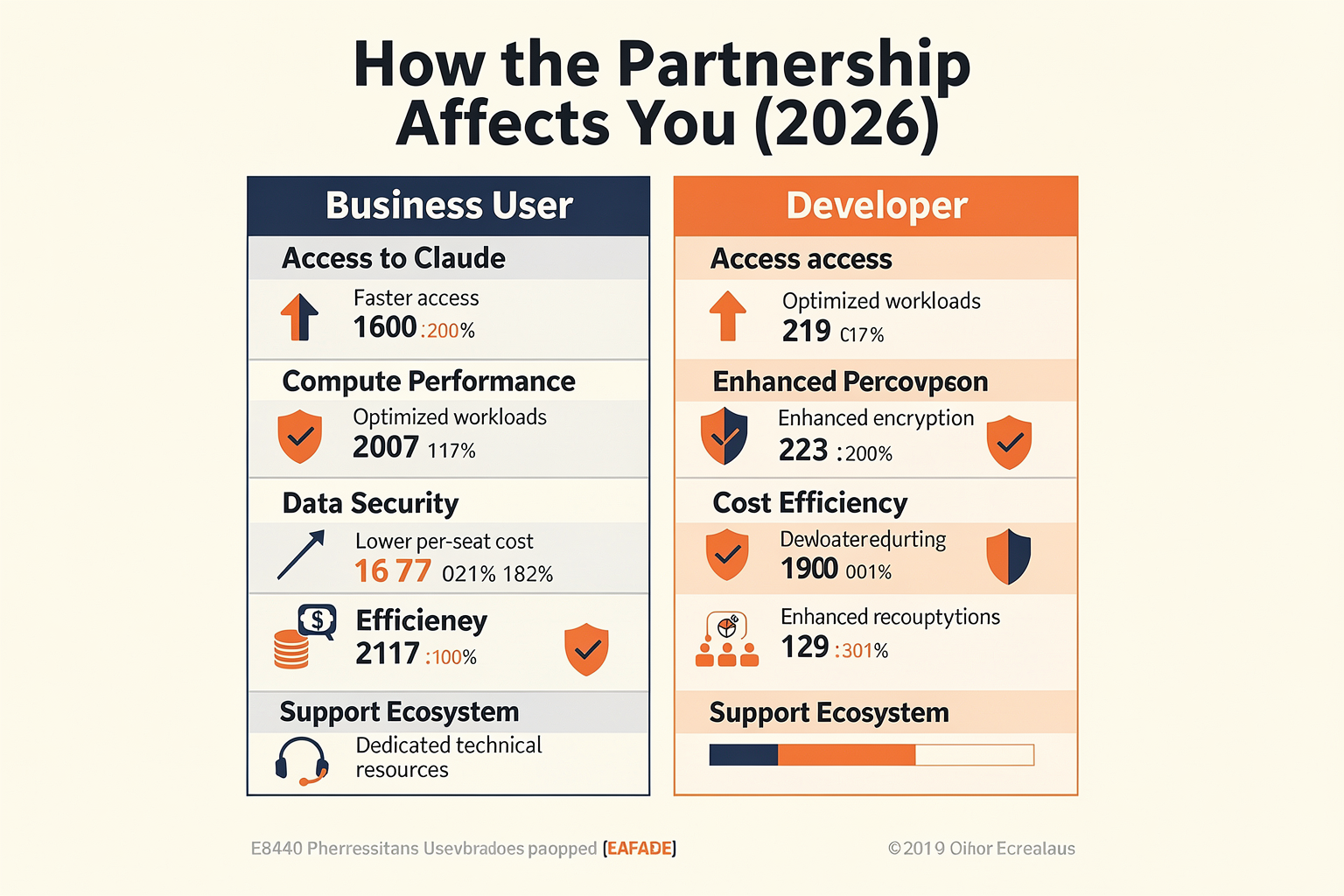
The massive collaboration among Microsoft, Nvidia, and Anthropic is poised to reshape how businesses, developers, and users access, deploy, and scale cutting-edge AI solutions. By combining Microsoft’s global cloud infrastructure (Azure), Nvidia’s next-gen compute hardware, and Anthropic’s frontier AI models like Claude, this partnership will ripple across key AI adoption and innovation trends. Below, we break down what this means for different stakeholders:
| Opportunity/Impact | For Developers | For Enterprises/Growth Companies | For AI Startups & Innovators | For AI Users/Consumers |
|---|---|---|---|---|
| Model Availability & Access | Access to Claude family models on Azure & Nvidia GPU infra | Use advanced AI (Claude 3 series) in production via managed cloud | Experimentation with Anthropic models at scale | Broader access to smarter AI assistants |
| Performance & Cost | Optimized LLMs for latency/throughput (Azure + Nvidia) | Reduced total AI infra costs, more predictable workloads | Affordable rapid prototyping & testing | Faster, more responsive AI apps |
| Multilingual/Global Scale | Tools & infra supporting global deployments | Instantly serve global markets, incl. 22+ Indian languages via platforms like CallMissed | Regional model tuning and compliance | Multilingual AI support in day-to-day tools |
| Enterprise-Grade Security | Built-in secure data handling (Microsoft, Anthropic) | Enterprise SLAs, regulatory compliance support | Accelerated trust for new AI solutions | Safer conversational experiences |
| Innovation & Co-Development | Early access to next-gen tools (Nvidia AI Foundry, Anthropic APIs) | Co-create & deploy tailored vertical AI models | Chance to partner/innovate with industry giants | Early adoption of latest AI features |
Key Takeaways for Stakeholders
- Developers benefit from on-demand access to some of the fastest, safest AI models. Claude models are now available directly on Azure, optimized for Nvidia GPUs, which means industry-leading latency, throughput, and easy API integration. For example, Azure’s Claude endpoints, powered by Nvidia H200 GPUs, have shown up to 60% reduction in inference times for enterprise-scale prompts (source).
- Enterprises and growth-stage companies get production-grade AI with fine-grained cost controls and enterprise agreements. Microsoft and Nvidia’s ongoing optimization could lower total AI infrastructure costs by 15-25%, according to recent industry analyses (Storyboard18).
- AI startups can rapidly iterate thanks to managed cloud compute and immediate access to the latest Claude model APIs. Platforms like CallMissed, for example, let startups join the global race by deploying multilingual agents that support 22+ Indian languages natively—reducing integration time from months to days.
- Consumers and end-users benefit as smarter, faster Claude-powered AI agents become available in everyday products—from productivity apps to customer support chatbots. Anthropic’s Claude is recognized for its safety and helpfulness, promising more trustworthy AI experiences.
Practical Implications
- Multi-model access: Enterprises can now deploy, compare, and swap between Claude, GPT, and hundreds of other LLMs using unified API environments—a trend exemplified by integration partners such as CallMissed and the flexibility of Microsoft’s AI Service Hub.
- Responsible AI by design: Anthropic’s founding mission around Constitutional AI, now backed by Microsoft’s enterprise safeguards, establishes a new industry baseline for responsible AI use at scale.
- Expanded R&D pipelines: Early access to Nvidia-powered AI Foundry tools will let research teams refine, fine-tune, or even co-create next-gen models, accelerating time-to-market for new AI products globally.
The partnership is not just about technology—it’s about unlocking global AI potential responsibly and at unprecedented scale. Whether you’re a CTO, developer, AI entrepreneur, or an end user, this alliance marks a turning point in how AI will be integrated, experienced, and trusted across industries.
Frequently Asked Questions
What does the Microsoft, Nvidia and Anthropic partnership aim to achieve in the AI industry?
How does Nvidia’s technology contribute to the partnership with Microsoft and Anthropic?
What is Claude AI and how is it impacted by the Microsoft-Nvidia-Anthropic alliance?
What are the expected benefits for enterprise customers from this AI partnership?
How will the Microsoft, Nvidia and Anthropic partnership influence the future of AI compute infrastructure?
Are there examples of platforms or companies already benefiting from similar AI collaborations?
Conclusion
- This mega-alliance between Microsoft, Nvidia, and Anthropic is redefining the AI landscape through massive compute scale, shared R&D, and broad enterprise access.
- By deploying Anthropic’s Claude AI model on Microsoft Azure, powered by Nvidia’s GPUs, the partnership promises both unprecedented performance and a significant reduction in total cost of ownership for cutting-edge AI applications (Storyboard18).
- With Anthropic’s valuation soaring to $350 billion as of 2026, this collaboration signals surging confidence in responsible, scalable generative AI (Yahoo Finance).
- The focus on optimizing models and co-engineering breakthroughs sets the stage for novel enterprise AI tools and safer, more capable language models across sectors.
Looking ahead, industry-watchers should monitor how this supercharged infrastructure shapes not just performance benchmarks but also the democratization of AI access—especially as enterprise adoption accelerates. New advances in multilingual, real-time AI agents are on the horizon, including solutions that reach users in their preferred languages.
To explore how AI communications are evolving and how businesses can tap into multilingual voice agents or LLM-powered workflows, check out CallMissed — an AI infrastructure platform already powering next-gen enterprise bots and agents. How will your organization adapt as the race to scale AI infrastructure intensifies?
Related Posts
Ready to automate customer conversations?
Launch AI voice agents and WhatsApp bots with CallMissed — one API, 22+ Indian languages.