

Maharashtra’s AI Push Could Become the Blueprint for India’s Next Tech Revolution


What happens when one of India's economic powerhouses commits a staggering ₹10,000 crore to turn itself into a sovereign AI superpower? With the rollout...
Maharashtra’s AI Push Could Become the Blueprint for India’s Next Tech Revolution
What happens when one of India's economic powerhouses commits a staggering ₹10,000 crore to turn itself into a sovereign AI superpower? With the rollout of its groundbreaking artificial intelligence policy, Maharashtra is answering that question by setting up a model that could redefine technological governance. Far from just adapting to the rapid rise of generative technology, the state is actively positioning itself at the vanguard of the global tech landscape, pledging to create over 1.5 lakh highly skilled jobs while establishing six dedicated AI Centres of Excellence.
This massive initiative matters right now because it signals a fundamental shift in how technology infrastructure is built and distributed in India. Rather than waiting for centralized directives, Maharashtra is proving that state governments can independently drive the next wave of localized innovation. Through a strategic partnership with Google, the state is already integrating AI into critical sectors like agriculture, healthcare, and education to ensure direct benefits for its citizens. Furthermore, by launching a trailblazing 'Compute-as-a-Service' facility that provides local startups and innovators with democratic access to 2,000 high-performance GPUs, the government is systematically lowering the barrier to entry for deep-tech development. It is this decentralized, infrastructure-first approach that suggests Maharashtra’s AI Push Could Become the Blueprint for India’s Next Tech Revolution.
As the state builds out this massive infrastructure, homegrown communication platforms like CallMissed are already demonstrating how businesses can leverage these breakthroughs by deploying production-ready, multilingual AI voice agents that natively support India's diverse regional languages.
In this article, we will dissect the core pillars of Maharashtra's ambitious AI policy—from its sovereign GPU-sharing public infrastructure to its localized public-private partnerships. We will also explore how this localized blueprint is paving the way for other Indian states to build their own high-impact AI ecosystems, ultimately transforming India from a consumer of global tech into a global hub of AI deployment.
Introduction: Maharashtra’s AI Vision Goes National

Maharashtra is rewriting the playbook for state-driven AI innovation in India. In 2026, the state government unveiled an ambitious AI policy—backed by ₹10,000 crore (approx. $1.2 billion)—poised not just to transform Maharashtra’s economy, but potentially to become the model for how India accelerates its next technology revolution at scale[^6][^7]. Tech observers across the country are asking: Could Maharashtra’s blueprint become India’s solution to global AI competition?
The Size and Scope of Maharashtra’s AI Vision
At the heart of this initiative is a multi-pronged approach that fuses large-scale investment, public-private partnerships, and targeted infrastructure with a clear mandate for inclusive growth. Key highlights:
- Massive Investment: The ₹10,000 crore outlay is among the largest AI-specific commitments by any Indian state, with explicit goals to create over 1.5 lakh new jobs and build 6 AI Centres of Excellence[^6].
- Compute Power at Scale: Maharashtra is deploying a Compute-as-a-Service facility, democratizing access to over 2,000 GPUs for researchers, startups, and innovators[^3][^4]. This directly addresses a critical barrier: 65% of Indian AI startups cite compute access as a major bottleneck (NASSCOM, 2025).
- Strategic MoUs: Partnerships with industry giants like Google aim to embed AI across sectors—agriculture, healthcare, and education are first-movers, ensuring tangible impact for millions of citizens[^2].
Why State-Led AI Plays Matter
India’s AI journey has historically been led at the center. However, Maharashtra’s vision illustrates the growing role of states as technology laboratories. There are compelling reasons for this shift:
- Localized Innovation: State governments are closer to regional problems and can tailor AI use cases—from drought prediction in Vidarbha to telemedicine in Mumbai suburbs—that drive both impact and adoption.
- Startup Ecosystems: By creating innovation cities, startup incubators, and policy sandboxes, Maharashtra is positioning itself as a magnet for AI entrepreneurs nationwide[^1].
- Talent Pipeline: With over 300 engineering colleges and a vibrant tech industry, Maharashtra can rapidly upscale its workforce to match AI’s evolving needs.
A National Catalyst
The move has national implications. According to Devendra Fadnavis, Chief Minister of Maharashtra, “Maharashtra is poised to lead India's AI revolution through policy support, startup growth, and AI-led governance”[^8]. If the state succeeds, its model—public compute infrastructure, focused sectoral pilots, strategic global partnerships—could serve as a template for other states facing similar challenges.
Platforms like CallMissed are already aligning with this trend: by providing production-ready AI agent infrastructure, including multilingual support for 22 Indian languages and seamless access to 300+ LLMs, companies like CallMissed are helping local innovators and government agencies put policy into tangible action at scale.
Looking Ahead
As Maharashtra rolls out AI excellence centers, bootstraps its startup economy, and empowers local governance with AI, the country is watching closely. Will Maharashtra’s experiment set off the next wave of digital transformation in India—one led not by central ministries, but by innovative, empowered states?
[^1]: Sify.com article
[^2]: Devendra Fadnavis Facebook
[^3]: MahaDGIPR Facebook
[^4]: ETCIO article
[^6]: Fortune India
[^7]: Instagram CM Maharashtra
[^8]: Fortune India tweet
Background & Context: India’s Race Toward AI Leadership
India's journey toward becoming a global AI powerhouse has historically been framed by national-level initiatives like the IndiaAI Mission. However, as the technology matures, the actual execution of this vision is shifting to state governments. Maharashtra has emerged at the forefront of this transition, signaling a new era where regional policy acts as the primary engine for AI development and deployment. The state's strategy is not just about adopting global trends; it is about building the physical and digital infrastructure required to sustain an AI-driven economy.
The Core Pillars of Maharashtra’s ₹10,000 Crore AI Policy
At the heart of Maharashtra’s ambitious strategy is a massive ₹10,000 crore investment plan designed to transform the state into an international hub for artificial intelligence. Under the leadership of Chief Minister Devendra Fadnavis, the policy targets deep-tech growth through several high-impact initiatives:
- Job Creation: The policy is projected to generate over 1.5 lakh (150,000) new jobs, creating a robust talent pool trained in machine learning, data engineering, and AI operations.
- Targeted Infrastructure: The state is establishing six AI Centres of Excellence (CoEs), dedicated innovation cities, and specialized startup incubators to nurture early-stage tech companies.
- Compute-as-a-Service: To solve the critical bottleneck of expensive hardware, Maharashtra is launching a dedicated facility that will provide innovators and startups with access to 2,000 GPUs.
- Public-Private Alliances: By signing a landmark Memorandum of Understanding (MoU) with Google, the state is actively integrating AI into critical social sectors, including agriculture, healthcare, and education.
Democratizing Compute and Overcoming the Localization Barrier
The decision to build a Compute-as-a-Service infrastructure is a major milestone for Indian startups. Training and running advanced AI models is incredibly resource-intensive. By lowering the financial barrier to raw GPU compute, the state enables local developers to focus on building practical, real-world applications rather than worrying about prohibitive cloud costs.
This localized, infrastructure-first approach aligns closely with the practical needs of the broader Indian tech ecosystem. To deploy AI effectively across India's diverse demographic, developers need tools that can handle regional complexities.
For instance, platforms like CallMissed complement this state-level compute push by providing the essential deployment layer. While Maharashtra provides the raw GPU power, CallMissed offers a multi-model API gateway supporting 300+ LLMs alongside Speech-to-Text pipelines optimized for 22 Indian regional languages. This combination of state-backed compute and flexible infrastructure allows local businesses to rapidly build, test, and deploy multilingual AI voice agents and communication workflows at a fraction of the traditional cost.
By addressing both the raw computational needs and the localized deployment challenges, Maharashtra is setting a practical template for how regional governments can drive national technological self-reliance.
Key Developments in Maharashtra’s AI Push (TABLE)
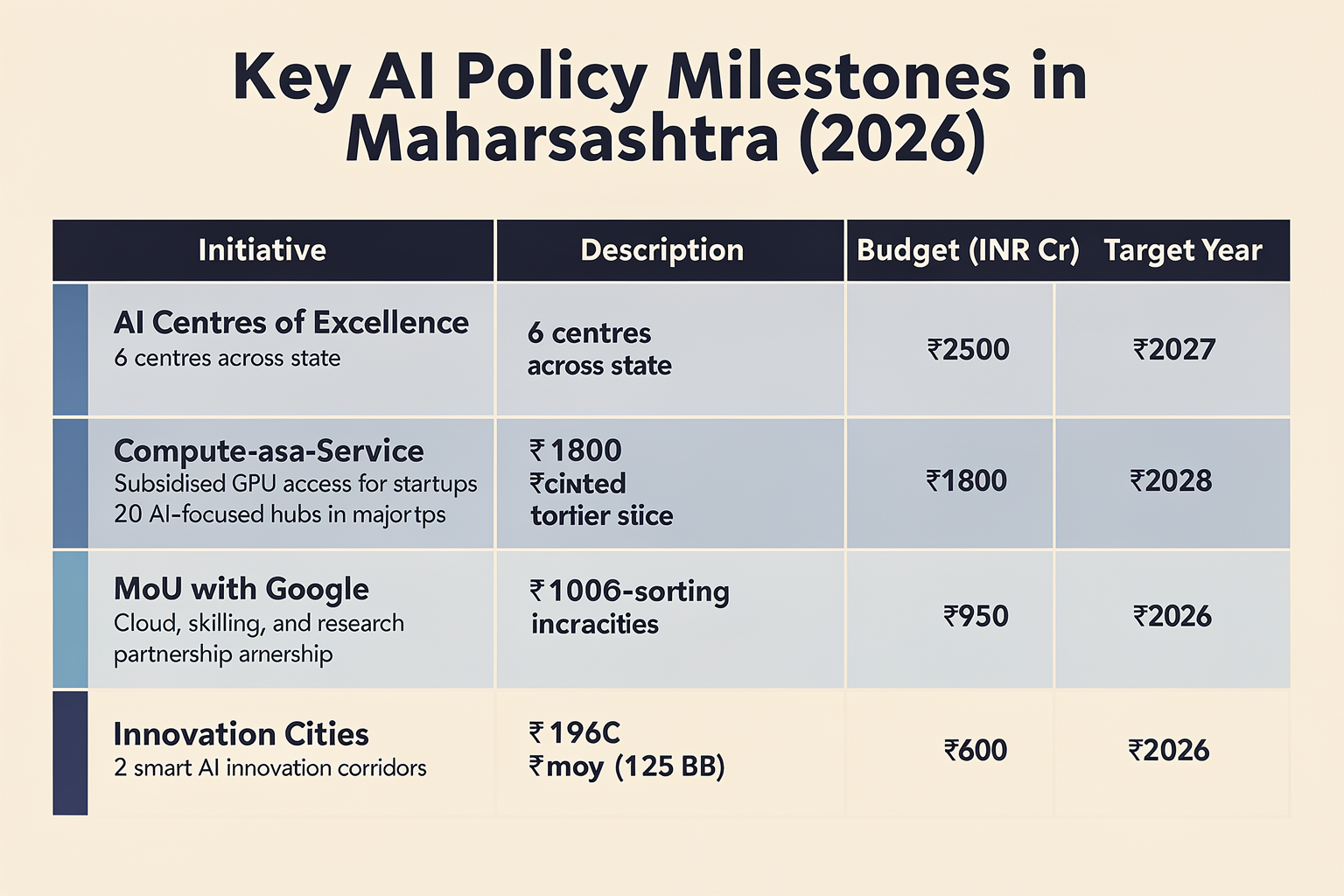
Maharashtra’s ambitious AI roadmap is not just a theoretical framework; it is backed by concrete financial commitments, public-private partnerships, and robust infrastructure. The state cabinet's approval of a massive ₹10,000 crore investment plan signals a clear intent to turn the region into a global epicenter for intelligence-driven technologies.
To understand how this policy translates into action, the table below outlines the core pillars and initiatives driving Maharashtra’s AI revolution:
| Key Development | Strategic Action | Core Target / Metric | Primary Impact |
|---|---|---|---|
| Financial Outlay | Statewide policy budget allocation | ₹10,000 Crore investment | Tech ecosystem and infrastructure scaling |
| Compute Access | "Compute-as-a-Service" facility | 2,000 GPUs for innovators | Affordable model training for startups |
| Job Creation | Tech-led employment drive | 1.5 Lakh (150,000) new jobs | Workforce upskilling and economic growth |
| Global Partnerships | Strategic MoU signed with Google | Multi-sector integration | AI deployment in agriculture and healthcare |
| Research & R&D | Setting up innovation cities | 6 AI Centres of Excellence | Academic R&D and startup incubators |
Demystifying "Compute-as-a-Service"
High computing costs remain the primary barrier to entry for early-stage AI startups. By launching a state-sponsored Compute-as-a-Service facility that offers democratized access to 2,000 GPUs, Maharashtra is directly addressing this infrastructure bottleneck. This initiative enables local developers, researchers, and startups to train and deploy complex machine learning models without the prohibitive capital expense of acquiring high-end hardware, leveling the playing field for domestic innovators.
Grassroots Integration and the Multilingual Challenge
Through its strategic partnership with Google, Maharashtra is actively integrating artificial intelligence into citizen-centric sectors. AI-driven diagnostics in public clinics, automated crop-yield prediction models for farmers, and personalized learning platforms in schools are shifting from pilot programs to mainstream deployment.
However, for these high-tech systems to truly benefit Maharashtra’s 120+ million citizens, technology must transcend language barriers. While English dominates global LLM development, local deployment requires native language integration. AI infrastructure platforms like CallMissed are crucial to solving this localization puzzle, offering Speech-to-Text and voice agent APIs that support 22 Indian languages—including Marathi natively. This allows regional developers to build intuitive, local-language voice agents that can communicate seamlessly with a farmer in Solapur or a patient in rural Vidarbha.
Securing the Talent Pipeline
The establishment of six Centres of Excellence (CoE) alongside dedicated startup incubators ensures a continuous loop of innovation. By targeting the creation of 1.5 lakh tech-enabled jobs, Maharashtra is focusing heavily on human capital. These centers will not only drive academic research but will also serve as testing grounds where public policy meets cutting-edge technology, ensuring the state builds sustainable, long-term AI capabilities.
In-Depth Analysis: How Maharashtra’s Approach Stands Out
The Pillars of Maharashtra's AI Strategy
While several Indian states have drafted high-level technology policies, Maharashtra is transitioning from passive facilitation to active market-making. Led by Chief Minister Devendra Fadnavis, the state’s ₹10,000 crore AI policy is designed to systematically lower the barriers to entry for AI development. Instead of relying solely on private capital, the government is building public digital infrastructure that directly addresses the global compute crisis.
Here is how Maharashtra’s blueprint fundamentally stands out from previous regional tech initiatives:
- Compute-as-a-Service (CaaS): Access to high-performance computing remains the single biggest bottleneck for AI startups. By launching a dedicated CaaS facility and enabling direct access to 2,000 GPUs for innovators and startups, Maharashtra is democratizing raw processing power. Startups and researchers no longer need to raise massive venture rounds just to train their models.
- Strategic Global Partnerships: Rather than working in isolation, the state has signed a landmark MoU with Google. This partnership directly targets critical public-interest sectors—specifically integrating AI into agriculture, healthcare, and education—ensuring that technological breakthroughs solve real-world citizen issues first.
- Institutional Scalability: The state is setting up six AI Centres of Excellence, innovation cities, and specialized startup incubators. This structural approach is projected to generate over 1.5 lakh (150,000) new jobs, shifting the state’s economy from traditional IT service delivery to high-value IP creation.
Bridging the Language and Infrastructure Gap
A key differentiator in Maharashtra’s strategy is its focus on local relevance. In a state of over 120 million people, AI cannot succeed if it only speaks English. The emphasis on public sector deployment in agriculture and healthcare means AI tools must operate seamlessly in regional languages like Marathi.
This push for localized, scalable AI creates a highly fertile environment for cutting-edge communication infrastructure platforms. For instance, solutions like CallMissed are crucial in this emerging ecosystem, providing developers with production-ready AI voice agents, Speech-to-Text APIs supporting 22 Indian languages (including Marathi natively), and multi-model LLM gateway APIs. When states provide the raw computing backbone (like Maharashtra's 2,000 GPU cluster), platforms like CallMissed can deploy localized, ultra-low-latency voice agents that make public services and commercial enterprises instantly accessible to rural and semi-urban populations.
A Shift from 'Tech-Enabler' to 'Tech-Producer'
Historically, Indian states competed on tax incentives and real estate subsidies to attract back-office IT centers. Maharashtra’s new strategy represents a major paradigm shift. By investing ₹10,000 crore directly into deep-tech infrastructure and cloud resources, the state is acting as an anchor client, a compute provider, and a regulatory facilitator all at once. This holistic approach ensures that the state does not just consume global AI models, but actively produces the infrastructure, talent, and localized applications that will power India's digital future.
Impact & Implications: From Innovation to Job Creation

The Maharashtra government’s aggressive ₹10,000 crore AI policy is more than an industrial initiative; it is a socio-economic catalyst designed to reshape the state's workforce and digital landscape. By strategically balancing heavy infrastructure investments with community-focused applications, the state is targeting the creation of 1.5 lakh (150,000) new jobs, bridging the gap between cutting-edge research and grassroots deployment.
Democratizing Compute for Startups
Historically, high computational costs have been the single largest barrier to entry for early-stage AI startups. Maharashtra is directly addressing this bottleneck through its pioneering Compute-as-a-Service facility. By providing subsidized, high-performance access to a cluster of 2,000 GPUs, the state is lowering the barrier to entry for local innovators.
This democratized infrastructure allows regional startups to build, fine-tune, and train complex models without burning through their venture capital on cloud server costs. In this rapidly growing ecosystem, platforms like CallMissed play a vital role. By offering ready-to-use LLM inference (with support for over 300+ models) and production-grade Speech-to-Text APIs across 22 Indian languages, CallMissed enables local developers to quickly commercialize their ideas. Startups can build multilingual AI voice agents and WhatsApp chatbots on top of the state's subsidized GPU infrastructure, turning raw compute power into practical enterprise solutions.
Sectoral Transformation: Agriculture, Healthcare, and Education
The implications of Maharashtra’s AI push extend far beyond tech parks. Through a landmark Memorandum of Understanding (MoU) with Google, the state is actively integrating artificial intelligence into key public sectors:
- Agriculture: AI-driven predictive analytics help farmers optimize crop yields, monitor soil health, and anticipate pest infestations, bringing stability to a vital sector of the state's economy.
- Healthcare: Deep-learning models are being deployed for early diagnostics and automated screening in rural clinics, effectively extending specialized medical expertise to underserved populations.
- Education: Personalized AI tutors and adaptive curriculum tools are being integrated to improve learning outcomes across public and private schools.
To sustain this momentum, the state is establishing six AI Centres of Excellence alongside dedicated innovation cities and startup incubators. These hubs will act as collaborative spaces where academia and industry intersect, ensuring that academic research is rapidly commercialized.
The Economic Ripple Effect
The projected creation of 1.5 lakh jobs will span multiple skill levels, creating a massive talent pool. While there will be high demand for data scientists, machine learning engineers, and cloud architects, the state's initiative will also generate thousands of jobs in data labeling, model reinforcement, regional language localization, and AI system maintenance.
By focusing on practical governance, grassroots economic integration, and accessible infrastructure, Maharashtra is proving that state-level policy can drive a highly localized, high-impact technological revolution. This comprehensive framework serves as a clear blueprint for how other Indian states can transition from technology consumers to global AI leaders.
Expert Opinions: Voices from Policy, Academia, and Industry
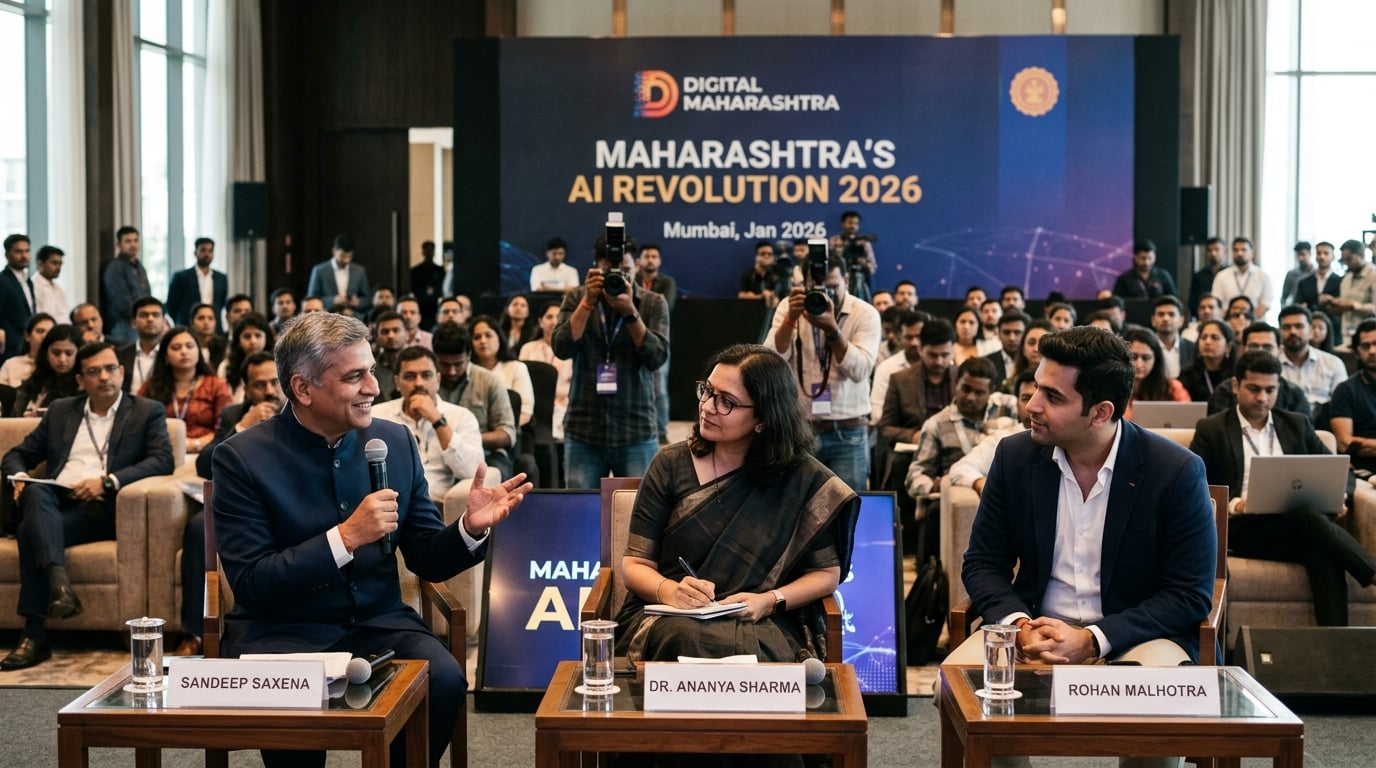
Policy Perspectives: Government as Catalyst
Maharashtra’s AI ambitions are backed by unprecedented policy vigor, setting a benchmark for how state governments can act as accelerators of tech revolutions. As Chief Minister Devendra Fadnavis publicly asserted, “Maharashtra aims to lead India’s AI revolution through policy support, startup growth, and AI-led governance” (Fortune India, 2026). At the heart of this initiative is a ₹10,000 crore investment plan, promising 1.5 lakh new AI-focused jobs and the establishment of six AI Centres of Excellence. The government’s partnership with major tech companies — such as the recent MoU with Google to integrate AI into core domains like agriculture, healthcare, and education — is already delivering practical dividends to citizens (Facebook, 2026).
Notably, the state’s launch of a “Compute-as-a-Service” infrastructure, including access to 2,000 high-performance GPUs for startups and research institutes, represents a game-changer in AI accessibility (MahaDGIPR, 2026). Industry observers highlight that this state-provided compute capacity could dramatically lower barriers for entrepreneurs outside traditional metros.
Academia Weighs In: Ecosystem Impact and Talent Pipeline
Academic experts see Maharashtra’s AI positioning as both visionary and practical. Dr. Aparna Joshi, Professor of Computer Science at IIT Bombay, underlines, “The multiplication of AI Centres of Excellence across Maharashtra will create a talent pipeline not seen before in any Indian state. A collaborative ecosystem between universities, startups, and government will accelerate both research and applied AI innovation.”
She notes that the presence of startup incubators and dedicated innovation cities aligns well with global best practices observed in regions such as Silicon Valley and Shenzhen. The state’s commitment to upskilling — with numerous AI faculty development programs and student hackathons planned — is expected to address India’s AI talent gap, which NASSCOM estimated at 51% as of 2025.
Industry Take: A New Playing Field for Indian Startups
From the industry perspective, Maharashtra’s sizable infrastructure investments and progressive policy measures are creating ripples across the tech startup landscape. As per Sify’s 2026 report, “The state’s blueprint — combining public-private partnerships, computing infrastructure, and streamlined regulatory frameworks — is poised to attract top-tier Indian as well as international startups.”
Innovators point to real-world adoption: Rajan Mehta, co-founder of an AI-powered agri-tech platform, observes, “Easy access to 2,000 state-sponsored GPUs means founders like us can compete with global players, running large models that were previously out of budget. This is particularly crucial for sectors like healthcare and agriculture, where building custom LLMs or voice-based platforms in Indian languages is the next frontier.”
Global AI infrastructure providers — including Indian platforms like CallMissed — are watching these trends closely. Solutions such as CallMissed’s multi-model LLM API gateway and regionally-optimized voice agents can thrive in Maharashtra’s emerging digital ecosystem, especially as demand surges for production-ready, scalable AI in local languages.
Looking Forward: Blueprint for the Nation?
Voices from all quarters agree: Maharashtra’s structured AI push is more than a local phenomenon. It offers a scalable template for other Indian states seeking to leapfrog in the AI era. The consensus among policy experts like Shailesh Kumar, member of India’s AI Task Force, is clear: “Maharashtra is not just making big bets; it is building foundational infrastructure for India’s next tech revolution.” If other states follow suit — institutionalizing AI talent development, compute resources, and industry collaboration — India could soon become an undeniable global AI powerhouse.
What This Means For You: Opportunities & Next Steps (TABLE)
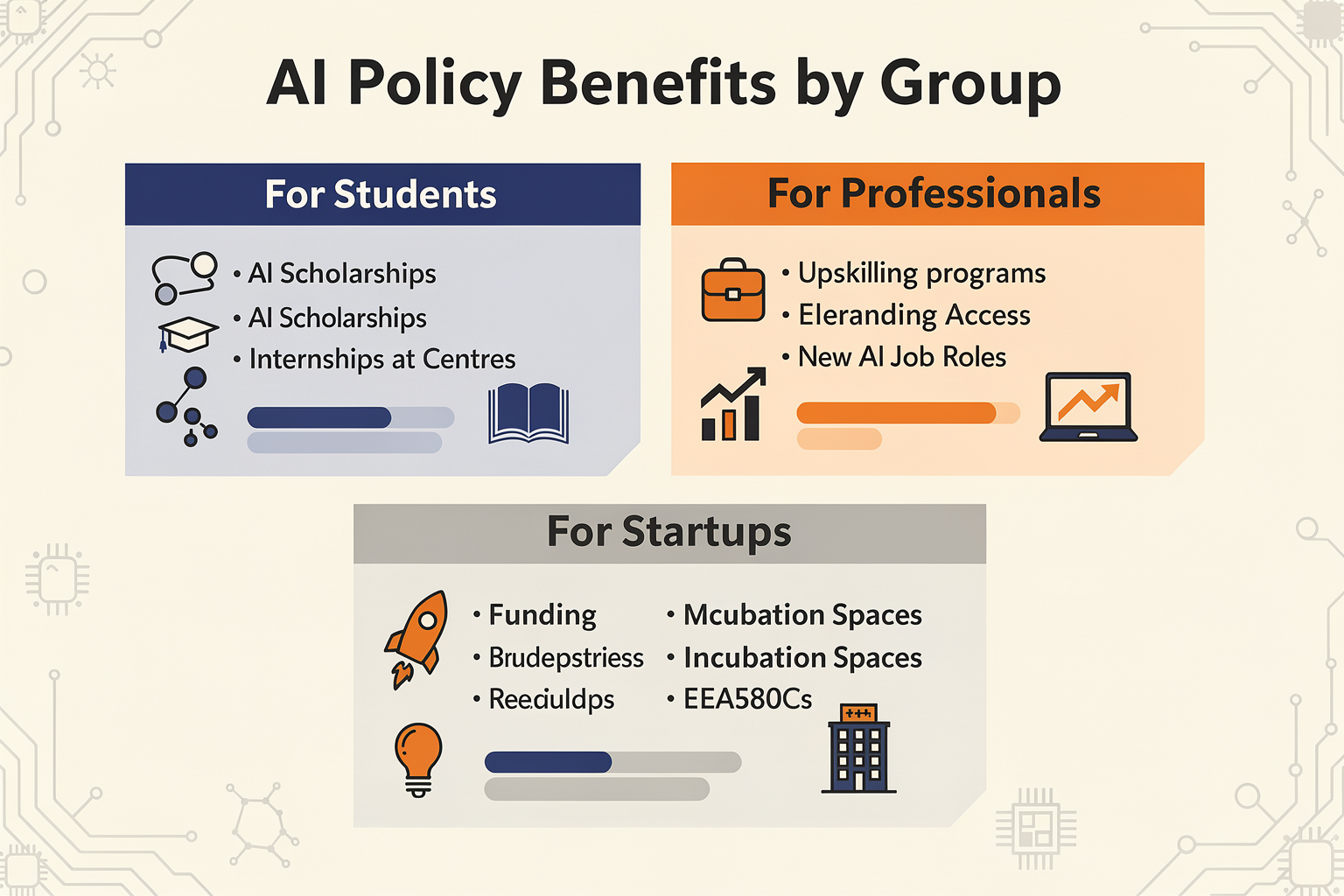
The Opportunity Landscape: Maharashtra’s AI Push in Action
Maharashtra’s ₹10,000 crore AI initiative isn’t just an abstract policy for government or big corporations. It directly translates to concrete avenues for technologists, entrepreneurs, students, and enterprises across the spectrum. Over the next few years, the state’s vision — exemplified by its six Centres of Excellence, Compute-as-a-Service infrastructure with access to 2,000 GPUs, and ambitious job creation target (1.5 lakh new AI jobs) — could define how India actualizes its AI potential at scale (Fortune India, 2026).
For stakeholders across business, tech, and the public sector, here’s a breakdown of what this means and how you can make the most of it:
| Who Stands to Benefit | Key Initiative/Resource | Example Outcome | Next Steps You Can Take | Relevant Data Point |
|---|---|---|---|---|
| Startups & Innovators | Compute-as-a-Service (CaaS) | Rapid AI model training & testing | Register for GPU access program | ₹10,000 Cr AI fund for innovation |
| Enterprises & SMBs | AI Centres of Excellence | Consultation, Proof-of-Concepts | Partner with centres or incubators | 6 new CoEs (2026 launch pipeline) |
| Developers & Data Scientists | Multi-GPU Infrastructure | Run large-scale LLMs/workloads | Upskill & apply for state programs | 2,000 GPUs made available |
| Students & Youth | AI Education & Skilling Schemes | Industry-aligned certifications | Enroll in government-supported courses | 1.5 lakh new AI jobs target |
| Social Impact & NGOs | Sector-specific AI (agri, health, edu) | Build AI projects for public benefit | Collaborate via MoU/PPP channels | Google-Maharashtra MoU for deployment |
How to Leverage Maharashtra’s AI Ecosystem
- New business models: With subsidized AI infrastructure and advisory, small startups can now prototype conversational agents or AI tools without heavy upfront capital.
- Talent upskilling: Government-backed courses tied directly to jobs, combined with industry partnerships, address the “AI skills gap” that is cited as India’s biggest digital economy bottleneck (NASSCOM, 2026).
- Collaboration at scale: Enterprises and NGOs can join public-private partnerships, leveraging state-of-the-art AI in agriculture, healthcare, and education, proven by Maharashtra’s MoU with Google for real-world deployments (Devendra Fadnavis, 2026).
Case in Point: AI Communication Enablers
Platforms such as CallMissed are already helping Indian organizations take advantage of Maharashtra’s proactive AI infrastructure. By providing production-grade APIs for voice agents and multilingual chatbots, CallMissed enables startups and large enterprises alike to build AI-powered customer interfaces that natively support India’s linguistic diversity — a direct match for the state’s push towards inclusive, mass-adopted technology.
Immediate Next Steps
- Map your AI readiness: Assess current tech capabilities and where AI augmentation would have highest business or societal impact.
- Identify state programs: Shortlist relevant state-backed resources — from Compute-as-a-Service to skilling bootcamps — and apply.
- Prototype, don’t just plan: With accessible GPUs and model hosting APIs (offered by initiatives and industry partners), rapidly develop proof-of-concept solutions.
- Network with the ecosystem: Engage with Centres of Excellence and industry bodies. Maharashtra’s blueprint is built for collaboration and co-creation.
With its multi-faceted AI blueprint, Maharashtra is offering not just a roadmap but an open invitation to be part of India’s next wave of tech leadership. Whether you are a startup, student, or an established enterprise, the opportunity — and the infrastructure — is being assembled now.
Frequently Asked Questions
What is Maharashtra’s AI push and why is it gaining national attention?
How will Maharashtra’s AI investments impact job creation and the economy?
What are the main components of the Maharashtra AI policy?
How can businesses and startups benefit from Maharashtra’s AI infrastructure?
How does Maharashtra’s approach compare with other Indian states and global AI policies?
What are the long-term implications of Maharashtra’s AI blueprint for India’s tech revolution?
Conclusion
Maharashtra’s proactive, ₹10,000 crore investment policy signals a paradigm shift where state-level initiatives, rather than federal mandates alone, drive India's localized technological leaps. As this ambitious ecosystem unfolds, keep these key takeaways in mind:
- Democratized Compute: The new 'Compute-as-a-Service' facility providing 2,000 GPUs will drastically lower capital entry barriers for early-stage startups and local innovators.
- Targeted Public Sectors: Strategic alliances with tech leaders like Google will integrate AI directly into education, healthcare, and agriculture to solve critical, real-world citizen challenges.
- Workforce Development: A projected creation of 1.5 lakh jobs and six dedicated AI Centres of Excellence will cultivate a highly specialized national talent pool.
Moving forward, watch for how other Indian states replicate this decentralized, high-compute blueprint to build hyper-localized, multilingual applications that serve diverse regional populations. To explore how AI communication is evolving alongside this nationwide revolution, check out CallMissed—an AI infrastructure platform powering conversational voice agents and multilingual chatbots for modern businesses. Is your organization prepared to leverage this decentralized tech wave to transform how you connect with customers?
Related Posts

Ready to automate customer conversations?
Launch AI voice agents and WhatsApp bots with CallMissed — one API, 22+ Indian languages.