

Google Agentic Commerce: How "Buy For Me" and AI Voice Agents Are Redefining Retail in 2026


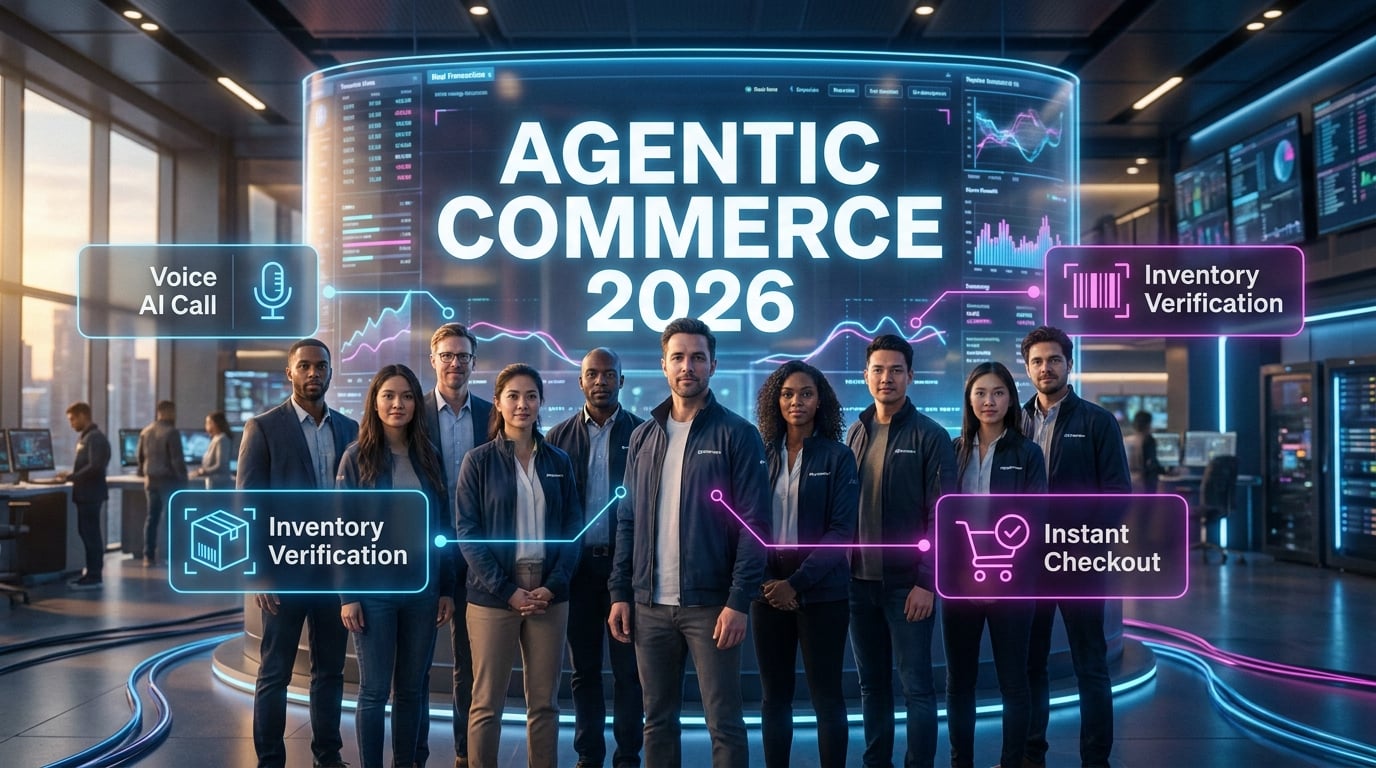
What if you could delegate your entire holiday shopping list to an AI assistant that doesn’t just find the best deals, but actually calls local boutique...
Google Agentic Commerce: How "Buy For Me" and AI Voice Agents Are Redefining Retail in 2026
What if you could delegate your entire holiday shopping list to an AI assistant that doesn’t just find the best deals, but actually calls local boutique stores to verify physical stock, negotiates shipping, and completes the checkout securely while you sleep? In 2026, this is no longer a futuristic concept; it is the immediate reality of Google Agentic Commerce. With the recent deployment of Google’s highly anticipated "Buy for Me" feature and its open-standard Universal Commerce Protocol, we are witnessing a massive paradigm shift from passive digital browsing to fully autonomous, execution-based retail.
This shift matters immensely today because it completely rewrites the rules of consumer engagement. Instead of forcing users to navigate dozens of open tabs, compare complex specifications, and fill out repetitive checkout forms, Google's agentic AI now handles the entire pipeline—discovery, price comparison, checkout, and post-purchase logistics. According to Google Cloud, this transition into "agentic" shopping is turning passive consumers into active, highly personalized decision-makers who rely on AI proxies. Furthermore, with Google’s AI voice agents now capable of placing direct phone calls to local retailers to check real-time inventory, the boundary between brick-and-mortar stores and digital algorithms has officially dissolved.
As consumer-facing AI agents begin executing purchases independently, the backend communications infrastructure must keep pace. While tech giants are building the consumer side of this ecosystem, platforms like CallMissed are empowering businesses on the receiving end, offering the robust voice agent infrastructure and multilingual APIs required to instantly handle these incoming automated inquiries across 22 regional languages.
In this article, we will unpack the exact mechanics behind Google's "Buy for Me" feature, dive into how the new Universal Commerce Protocol is reshaping payment and checkout standards, and provide a strategic roadmap for how brands can optimize their data to win in this new era of autonomous shopping.
Introduction: The Rise of Autonomous Shopping

The retail landscape is undergoing its most radical transformation since the dawn of e-commerce. In 2026, we are transitioning away from "conversational commerce"—where basic chatbots simply answer customer FAQs—and entering the era of agentic commerce. Backed by Google’s latest AI-driven innovations, consumers no longer have to navigate endless browser tabs, compare complex product specifications, or manually fill out repetitive shipping and checkout forms. Instead, they can hand off their entire shopping experience to autonomous AI agents capable of executing transactions from initial discovery to final delivery.
This paradigm shift is anchored by Google’s highly anticipated "Buy for Me" feature and the introduction of its open-standard Universal Commerce Protocol. According to Google Cloud, this transition transforms passive digital browsers into active decision-makers who rely on AI proxies to do the heavy lifting. Rather than merely presenting search results, Google’s agentic AI now autonomously completes checkouts, manages complex cart configurations across different platforms, and handles post-purchase logistics.
Bridging the Digital and Physical Divide
Crucially, this technology bridges the gap between online algorithms and brick-and-mortar storefronts. One of Google's standout features allows consumer-facing AI voice agents to place direct, autonomous phone calls to local retail stores on behalf of users. For instance, if a shopper needs to verify that a local boutique has a specific item in stock before driving over, the AI agent will place the call, converse with the store representative to check physical inventory, and report back with the confirmation—all while the consumer is focus on other tasks.
This rapid evolution presents an unprecedented infrastructure challenge for merchants. If thousands of consumer AI agents start placing automated phone calls to local businesses to check inventory, negotiate shipping, or verify store hours, human staff will quickly become overwhelmed.
To survive and thrive in this agentic era, businesses must upgrade their receiving infrastructure. Communication platforms like CallMissed are solving this exact bottleneck by providing production-ready AI voice agent infrastructure. By leveraging CallMissed's advanced Speech-to-Text APIs—which natively support 22 regional Indian languages—merchants can deploy their own automated voice agents. These business-side agents can instantly pick up, understand, and resolve incoming AI-to-business calls, ensuring that no potential sale is missed due to busy phone lines.
What Lies Ahead
To help brands navigate this new frontier, this article will deep-dive into:
- The Mechanics of "Buy for Me": How Google's AI seamlessly navigates the purchase pipeline.
- The Universal Commerce Protocol: The new open standard driving payment and checkout interoperability across the web.
- The Data Optimization Playbook: How retailers can structure and audit their product data so autonomous shopping agents can easily discover and purchase their products.
- The Agent-to-Agent Economy: Preparing your customer service and communications backend for a world dominated by AI-driven transactions.
Background & Context: From Passive Browsing to Agentic AI
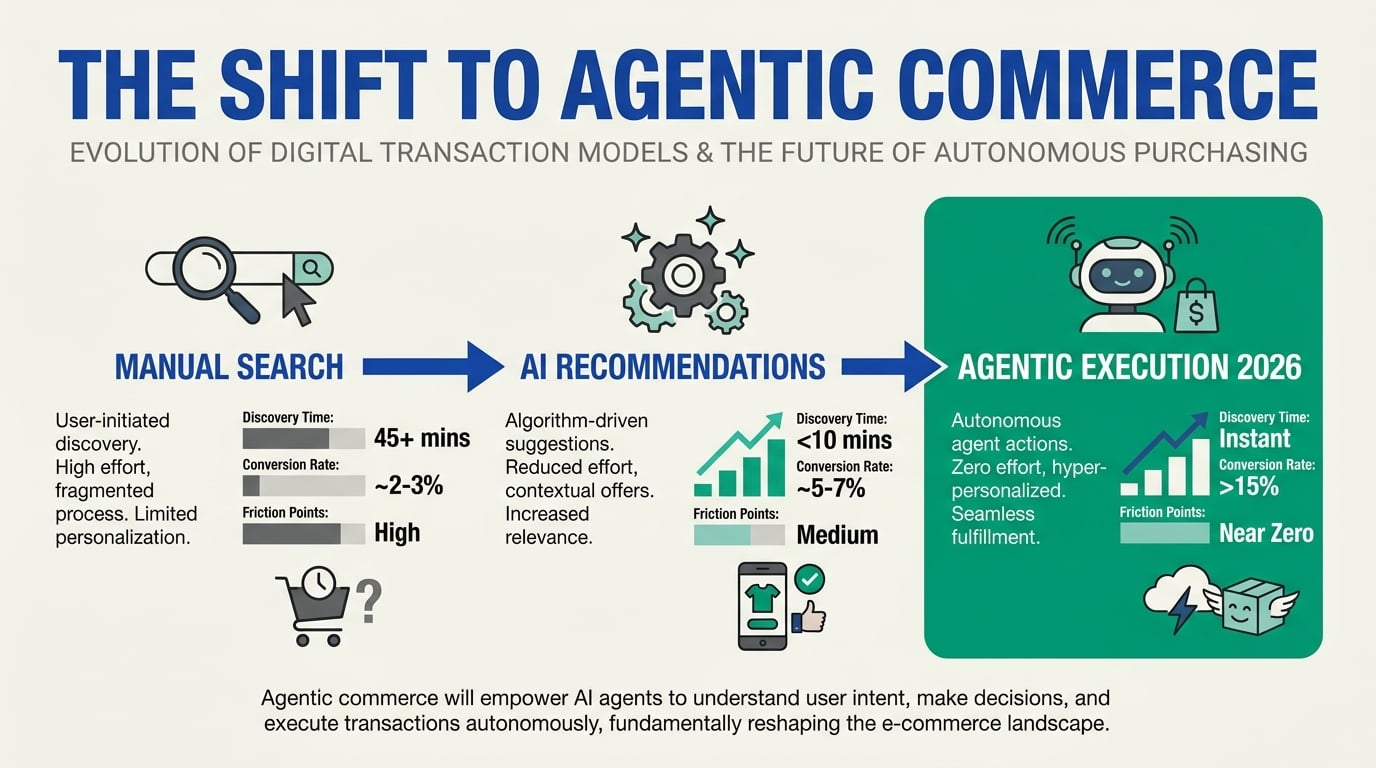
The Evolution of Digital Retail: From Clicking to Delegating
For nearly three decades, online shopping has relied on a pull-based, manual navigation mechanism. Consumers search for a product, browse multiple websites, compare specifications, and manually input billing and shipping information. Even the rise of "conversational commerce" in the early 2020s—which relied on basic FAQ chatbots and guided shopping flows—did little to change this fundamental workflow; chatbots merely pointed users to the correct URL to complete the transaction.
Today, agentic commerce is dismantling this passive browsing model. Instead of acting as glorified digital catalogs, AI systems now operate as autonomous proxies. Armed with advanced reasoning, secure payment credentials, and real-time execution capabilities, these agents don't just recommend products; they execute the purchase. According to Google Cloud, this paradigm shift transforms consumers from passive searchers into executive decision-makers. Rather than spending hours researching, shoppers delegate the entire transaction lifecycle—discovery, comparison, negotiation, and checkout—to digital representatives.
The Technical Pillars of the Agentic Shift
This transition from passive browsing to execution-based retail is driven by three major technical advancements:
- Autonomous Decision-Making: Modern AI agents utilize advanced Large Language Models (LLMs) to understand complex, subjective human preferences (e.g., "Find a durable, highly-rated raincoat suitable for heavy monsoon weather that fits a medium build and is under $150").
- Unified Commerce Standards: The introduction of Google’s Universal Commerce Protocol establishes a shared open-standard infrastructure. According to retail experts, this protocol allows disparate AI systems to seamlessly manage discovery, secure checkout, and post-purchase support across different platforms without custom API integrations for every merchant.
- Physical-Digital Interoperability: AI agents are no longer restricted to digital-only storefronts. As documented by industry analysts, Google's "Buy for Me" framework leverages AI voice agents to place actual outbound telephone calls to local brick-and-mortar retailers, verifying physical stock availability before the consumer makes a purchase.
The Infrastructure Challenge for Merchants
As consumers rapidly hand over their purchasing power to AI shopping assistants, the burden of adaptation shifts to retailers. According to CNBC, Google’s aggressive push into this space is a strategic bid to secure its place in the e-commerce ecosystem, positioning its AI-powered checkout infrastructure alongside legacy payment networks like Visa, Mastercard, and PayPal.
However, for a merchant to benefit from this shift, their backend systems must be capable of communicating with these autonomous buyers. If a local store receives hundreds of automated phone inquiries daily from Google's voice agents checking inventory, relying on human staff to answer these calls is highly inefficient.
To bridge this gap, businesses require advanced communication infrastructure. Platforms like CallMissed provide the critical backend technology—such as high-accuracy Speech-to-Text APIs supporting 22 regional languages and multi-model LLM integration—that allows merchant systems to automatically interpret, process, and respond to incoming AI voice agent inquiries. By optimizing for these automated machine-to-business interactions, brands can ensure they remain visible and transactional in an era where the primary shopper is an algorithm.
Key Developments: Google's New Agentic Commerce Ecosystem (TABLE)
To make sense of Google's rapid rollouts, we must look at the specific technological pillars forming this new retail market structure. Google is not merely updating its search algorithms; it is deploying a multi-layered framework that combines multimodal processing, open web standards, and secure payment rails. This structured ecosystem allows autonomous software to act as trusted financial and logistics proxies for human buyers.
The table below outlines the core components of Google’s newly established agentic commerce ecosystem and their practical implications for modern merchants:
| Component | Primary Function | Core Technology | Strategic Impact |
|---|---|---|---|
| "Buy for Me" Engine | Automates end-to-end shopping pipelines, including product discovery, comparison, and checkout. | Gemini Multimodal LLMs | Bypasses traditional storefront browsing; requires brands to optimize data for AI crawlers. |
| Universal Commerce Protocol | Open-standard framework managing product discovery, checkout, and post-purchase support across platforms. | Interoperable, open-source API schemas | Establishes shared infrastructure, eroding closed-loop marketplace monopolies. |
| Autonomous Voice Agents | Initiates outbound telephone calls to local brick-and-mortar stores to verify real-time shelf stock. | Advanced natural language processing & TTS | Bridges offline retail inventory with digital, intent-driven AI search. |
| AI-Powered Checkout | Executes secure, tokenized financial transactions autonomously on behalf of the user. | Google Pay integration & secure identity tokens | Redefines payment gateways, directly rivaling legacy checkout solutions like PayPal. |
Bridging the Digital-to-Physical Gap with Voice
One of the most disruptive developments in this ecosystem is the integration of autonomous voice agents capable of calling physical stores. When a consumer asks their AI agent to locate a specific product nearby, the system does not simply rely on potentially outdated website data. Instead, it places a real-time call to local boutiques or retailers to verify actual inventory.
This introduces a unique operational bottleneck on the merchant side. Physical store associates cannot spend their shifts answering continuous waves of automated machine inquiries. To capture this incoming high-intent traffic, retailers must deploy equivalent inbound automated voice systems. Communication platforms like CallMissed resolve this bottleneck, allowing businesses to set up responsive, multilingual AI voice agents that handle these incoming machine-to-merchant calls. By native-routing queries across 22 regional Indian languages and instantly confirming inventory status, such platforms ensure offline businesses never miss an autonomous sales opportunity.
Standardizing Transactions via the Universal Commerce Protocol
At the backend of this transformation sits the Universal Commerce Protocol, which Google championed in early 2026. By establishing a shared, open-standard infrastructure for checkout routing and post-purchase logistics, Google is actively preventing platform fragmentation.
This protocol allows independent AI systems to communicate seamlessly with diverse retail backend architectures. A transaction initiated by a Google assistant can be structured, verified, and settled on any external e-commerce platform that adopts these open standards. For digital brands, optimizing product metadata and implementing these standardized schemas is no longer a futuristic experiment—it is the baseline requirement to remain discoverable and transactable in an agent-dominated economy.
In-Depth Analysis: Inside "Buy For Me" & AI Voice Agents
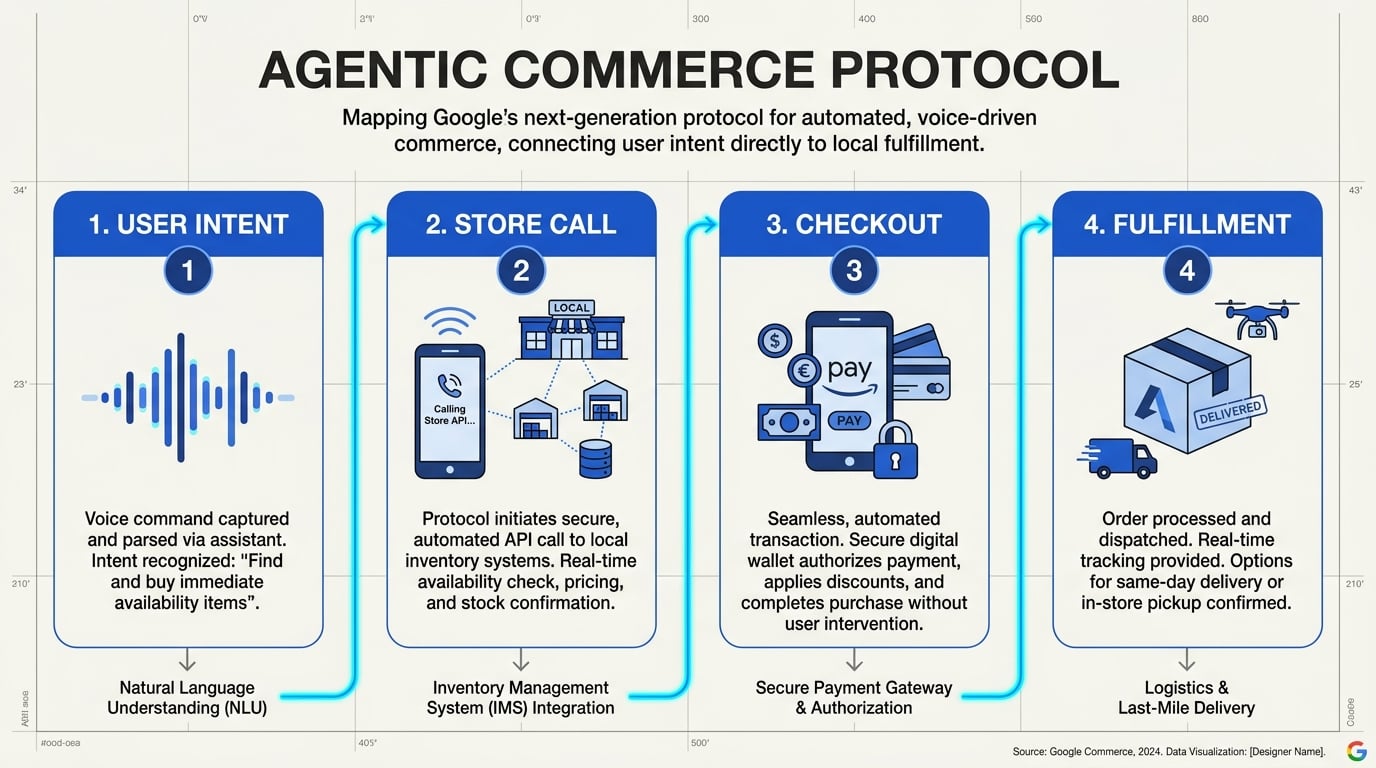
To understand the sheer scale of Google’s agentic commerce push in 2026, we must look under the hood of its two core pillars: the "Buy for Me" engine and its underlying AI Voice Agents. This is not merely an incremental software update; it is an entirely new operational layer for consumer transactions that bridges digital search with physical-world action.
How the "Buy For Me" Engine Executes Purchases
The "Buy for Me" feature functions as an autonomous procurement proxy for everyday consumers. Instead of simply generating a static list of product links for a user to click and compare, the agent executes the end-to-end purchasing lifecycle autonomously:
- Contextual Discovery: The consumer provides a highly specific natural language prompt, such as: "Find me a waterproof, breathable green shell jacket in size Medium for under $150, cross-reference reviews for durability, and buy the best option."
- Algorithmic Evaluation: The AI scans millions of product listings, filters out sponsored noise, analyzes real-time customer sentiment from platforms like Bazaarvoice, and identifies the optimal product match.
- Autonomous Checkout: Using secure, tokenized payment credentials stored in Google’s payment ecosystem, the agent navigates the retailer’s cart, automatically inputs shipping details, applies valid discount codes, and completes the checkout—notifying the user only after the order is confirmed.
AI Voice Agents: Bridging the Digital-Physical Divide
While e-commerce is highly digitized, a massive portion of retail still relies on local brick-and-mortar inventory. Google’s AI voice agents solve this physical blind spot by making autonomous, outbound telephone calls to local stores.
If a consumer needs an item immediately, the AI voice agent will call local retailers on their behalf to check physical shelf availability, verify hours of operation, and even reserve the item for curbside pickup. By speaking naturally, interpreting human responses, and extracting structured data from unstructured phone conversations, Google's agents ensure that local, offline commerce is fully integrated into the digital shopping loop.
The Receiving End: Why Businesses Must Adapt
This rise of outbound consumer agents creates an immediate operational challenge for businesses. If thousands of automated AI agents start dialing local retailers to verify real-time stock, human retail associates will quickly become overwhelmed by machine-generated phone calls.
To survive this wave of automated inquiries, businesses must deploy their own receiving-side voice infrastructure. Platforms like CallMissed are crucial in this transition, allowing retailers to deploy responsive AI voice agents that can answer incoming inquiries 24/7. Equipped with advanced Speech-to-Text API capabilities that natively support 22 regional languages, a CallMissed-powered voice agent can seamlessly converse with a consumer's Google agent, instantly confirm inventory from the store's backend database, and secure the sale without a human associate ever having to pick up the receiver. This machine-to-machine communication layer is the hidden engine that will make agentic commerce truly scalable for businesses of all sizes.
Impact & Implications: Transforming the Retail Landscape
The deployment of Google’s "Buy for Me" feature and the open-standard Universal Commerce Protocol does far more than simplify checkout; it fundamentally restructures the economic and operational dynamics of the retail industry. As we progress through 2026, the traditional e-commerce sales funnel—designed to capture human attention through visual merchandising, SEO keywords, and retargeting ads—is rapidly shifting. When autonomous agents become the primary shoppers, the metrics of retail success must be completely redefined.
The Death of the Click: From Human Browsing to Agentic Search
For decades, digital marketing has relied on keeping users on a website as long as possible to drive conversions. Agentic commerce completely reverses this incentive. Because AI shopping agents parse product details in milliseconds, brands must shift their focus from aesthetic appeal to highly structured, machine-readable data.
- Structured Data as the New SEO: AI agents do not look at promotional banners; they read APIs, product feeds, and schema markup. If a merchant's real-time inventory, product specifications, or shipping details are inaccurate or slow to load, the AI shopper will instantly bypass them.
- Trust and Authenticity: Industry frameworks emphasize that winning in this era requires auditing product data and building deep machine trust. User-generated content, verified reviews, and transparent pricing are no longer just social proof for humans; they are critical data signals that AI agents analyze to determine product quality and brand credibility.
Disruption in Payments and Checkout Infrastructure
Google’s introduction of an AI-powered checkout protocol positions the tech giant directly alongside legacy payment networks like Visa, Mastercard, and PayPal. By embedding secure, programmatic payment execution directly within the agentic workflow, Google is streamlining the highly fragmented checkout process.
For merchants, this means that simply supporting traditional digital wallets is no longer enough. To avoid being locked out of the "Buy for Me" ecosystem, retail platforms must integrate with universal agentic payment standards that allow proxy AI shoppers to securely authorize and finalize transactions on behalf of users.
The Operational Reality for Local Brick-and-Mortar
Perhaps the most immediate disruption is occurring at the local retail level. Because Google’s AI voice agents can autonomously call local stores to verify physical inventory, neighborhood boutiques and regional outlets are beginning to face an entirely new phenomenon: an influx of inbound, automated phone calls from artificial consumers.
For a busy local store, answering hundreds of AI-driven inquiries manually is operationally impossible. To survive this transition, merchants require automated backend systems capable of handling incoming agentic traffic. Platforms like CallMissed are vital in bridging this gap. By offering production-ready voice agent infrastructure and highly accurate Speech-to-Text APIs across 22 regional Indian languages, CallMissed enables businesses to deploy their own multilingual AI voice agents. These business-side agents can seamlessly interact with incoming consumer-facing AI shoppers, instantly verifying local stock and securing offline sales without requiring human staff to pick up the phone.
Expert Opinions: What Industry Leaders Are Saying

The rapid rollout of Google’s Universal Commerce Protocol and "Buy for Me" functionality has sparked intense discussion among retail analysts, fintech experts, and database architects. The industry consensus is clear: e-commerce is no longer about attracting human eyes to a webpage; it is about optimizing for machine-readable data and secure, automated execution.
Here is what leading industry voices and analysts are saying about this paradigm shift in 2026:
Redefining the Checkout and Payments Battlefield
Google’s foray into agentic transactions is being viewed as a direct disruption to the payment industry. Financial services expert Monica Jasuja noted that Google is entering the "agentic commerce battlefield" with its AI-powered checkout feature, positioning itself directly alongside legacy payment giants like Visa, Mastercard, and PayPal. By establishing an open, AI-managed checkout standard, Google is streamlining the transactional pipeline and reducing the checkout friction that historically led to cart abandonment.
Furthermore, analysts at CNBC highlight that Google's new protocol is a strategic move to secure its dominance in the e-commerce landscape. As retailers rush to build their own customer service and shopping agents, Google's universal standards ensure it remains the underlying infrastructure connecting these disparate systems.
The "Triple-A" Framework: Building Trust for AI Agents
Industry experts at Bazaarvoice emphasize that to win in this new era, brands must completely pivot their optimization strategies. Because AI agents—rather than human shoppers—will filter and select products, brands must build credibility with algorithms. Bazaarvoice advocates for a "Triple-A Framework" designed to optimize retail footprints for agentic commerce:
- Audit Product Data: Ensuring high-quality, structured merchant feeds that AI agents can crawl and digest instantly.
- Authenticate Reviews: AI agents rely on verified, authentic user-generated content (UGC) to assess product quality and reliability.
- Accelerate Integration: Adapting retail APIs to interact seamlessly with autonomous buyers.
Experts agree that if a brand's product data is messy, incomplete, or lacks authenticated customer sentiment, Google’s autonomous shopping agents will simply bypass them in favor of competitors with cleaner data structures.
Bridging the Infrastructure Gap for Retailers
While tech giants are successfully deploying consumer-facing AI agents, many business-to-consumer (B2C) operations face a significant backend infrastructure gap. When Google's "Buy for Me" voice agents call a local store to verify real-time inventory, that store must be equipped to handle an automated, machine-to-machine dialogue.
To address this, communications infrastructure platforms are stepping up. For instance, CallMissed is helping businesses close this loop by enabling merchants to deploy their own localized AI voice agents. By utilizing CallMissed’s low-latency Speech-to-Text APIs—which support 22 regional Indian languages—and a multi-model gateway of over 300 LLMs, businesses can instantly process complex, automated inquiries from Google's agents. This ensures that even small-to-medium retailers can seamlessly participate in the automated checkout ecosystem without manual intervention.
What This Means For You: Adapting to Agentic Commerce (TABLE)
For businesses and retail leaders in 2026, the rise of Google's agentic shopping suite marks a massive shift in how products are discovered, evaluated, and sold. We are rapidly moving away from optimizing websites for human eyes—characterized by flash banners and persuasive copy—to optimizing systems for machine comprehension. When Google’s "Buy for Me" agent navigates the web to purchase a product on behalf of a consumer, it bypasses landing pages entirely; instead, it searches for precise API schemas, standardized inventory structures, and friction-free payment endpoints.
Adapting to the Machine-to-Machine Economy
To thrive in this new landscape, businesses must pivot from traditional SEO to Agent Engine Optimization (AEO). Because autonomous shopping agents rely entirely on structured data feeds to compare real-time pricing and stock, any gap in your inventory data means immediate exclusion from the agent's selection pool.
The transition requires a complete restructuring of retail touchpoints. Below is a strategic comparison of traditional e-commerce paradigms versus the new requirements of agentic commerce:
| Dimension | Traditional E-Commerce | Agentic Commerce | Required Brand Pivot |
|---|---|---|---|
| Discovery | Keywords, SEO, and visual blog posts | API integrations and structured Schema markup | Audit product feeds for LLM and agent readability |
| Inquiries | Static FAQs, manual live chat, and emails | AI Voice Agents handling automated system calls | Deploy conversational, low-latency API gateways |
| Checkout | Manual cart checkout and payment fields | Google’s "Buy for Me" & Universal Commerce Protocol | Implement tokenized, protocol-compliant checkout |
| Trust Building | Visual branding and user review pages | Verifiable merchant ratings and data accuracy | Secure high-quality third-party data validation |
Building an Agent-Friendly Retail Infrastructure
Succeeding in this ecosystem requires brands to implement a robust, agent-friendly architecture. This begins with Google’s new Universal Commerce Protocol, which serves as the translation layer between consumer-facing agents and retail backend systems. To prepare your business for autonomous buyers, you should focus on three critical pillars:
- Data Auditing and Structuring: Clean product data is the lifeblood of agentic commerce. Retailers must audit their merchant feeds to ensure that attributes like size, color, real-time pricing, and exact stock availability are updated continuously. If an agent detects mismatched inventory, it will flag your store as unreliable and redirect the purchase elsewhere.
- Integrating Universal Protocol Standards: Ensure your payment and inventory APIs are compliant with Google's open-standard protocol. This allows autonomous agents to query your checkout systems directly and complete secure, tokenized payment processes without manual friction.
- Automating the Response Layer: As consumer agents start placing automated phone calls to verify local boutique stock, businesses cannot rely on busy human store clerks to answer the receiver. Implementing AI-native communication infrastructure is essential. Platforms like CallMissed solve this bottleneck by providing multilingual AI voice agents that natively support 22 regional Indian languages. When automated shopping proxies dial in to verify regional inventory, CallMissed APIs ensure your store handles the inbound inquiry instantly and accurately, locking in the sale without human intervention.
By adapting your data architecture and communication channels today, your brand can transition from a passive storefront into an active, friction-free node within Google’s autonomous shopping grid.
Frequently Asked Questions
What is Google Agentic Commerce and how does it work?
How does Google's "Buy for Me" feature execute transactions autonomously?
Can Google's agentic commerce voice agents interact with brick-and-mortar stores?
What is the Universal Commerce Protocol introduced by Google?
How can retail brands optimize their digital storefronts for AI shopping agents?
Is the payment process secure when using Google's autonomous shopping agents?
Conclusion
As we navigate this massive retail paradigm shift in 2026, the key takeaways are clear:
- From Browsing to Execution: Google’s "Buy for Me" feature is actively transforming passive online browsing into fully autonomous, secure checkout experiences.
- Unified Ecosystems: The Universal Commerce Protocol is establishing a standardized backbone for seamless discovery, checkout, and post-purchase logistics across diverse platforms.
- Bridging the Physical Gap: AI voice agents are now directly calling local brick-and-mortar retailers to verify real-time inventory, dissolving the boundaries between physical and digital storefronts.
Looking ahead, the retail champions of this era will not be those with the flashiest websites, but those whose backend systems and data structures are fully optimized for autonomous AI proxies. As consumer AI agents take over the purchasing journey, businesses must rapidly adapt their communication channels to handle these incoming automated inquiries.
Will your brand be ready to answer when an AI assistant calls to complete a purchase? To explore how AI communication is evolving, check out CallMissed—an AI infrastructure platform powering multilingual voice agents and chatbots that ensure your business is always open to both human and autonomous shoppers.
Related Posts

Ready to automate customer conversations?
Launch AI voice agents and WhatsApp bots with CallMissed — one API, 22+ Indian languages.