

Claude Haiku 4.5 vs GPT-5.4 Nano Latency Comparison: What Can Be Verified?


Claude Haiku 4.5 vs GPT-5.4 Nano latency comparison with an evidence-first verdict, pricing gaps, metrics, and a reproducible test plan.
Claude Haiku 4.5 vs GPT-5.4 Nano Latency Comparison: What Can Be Verified?
No defensible winner can be named in the Claude Haiku 4.5 vs GPT-5.4 Nano latency comparison because the available research contains no verifiable official latency data, pricing pages, or independent benchmark results for either exact model name. A fair verdict requires controlled measurements—or authoritative provider documentation—not a guessed speed ranking.
That uncertainty matters for real-time chat, voice agents, and coding tools, where time to first token (TTFT), total completion time, and tail latency can shape user experience. This evidence-first comparison explains what is—and is not—published, then provides a reproducible test using identical prompts, fixed token budgets, streaming and non-streaming runs, cold and warm requests, controlled concurrency, and at least 30 trials per condition. It also separates Claude Haiku 4.5 latency from GPT-5.4 Nano latency, examines pricing without invented figures, and shows why platforms such as CallMissed evaluate multiple AI models through one API gateway.
Which is faster, Claude Haiku 4.5 or GPT-5.4 Nano?
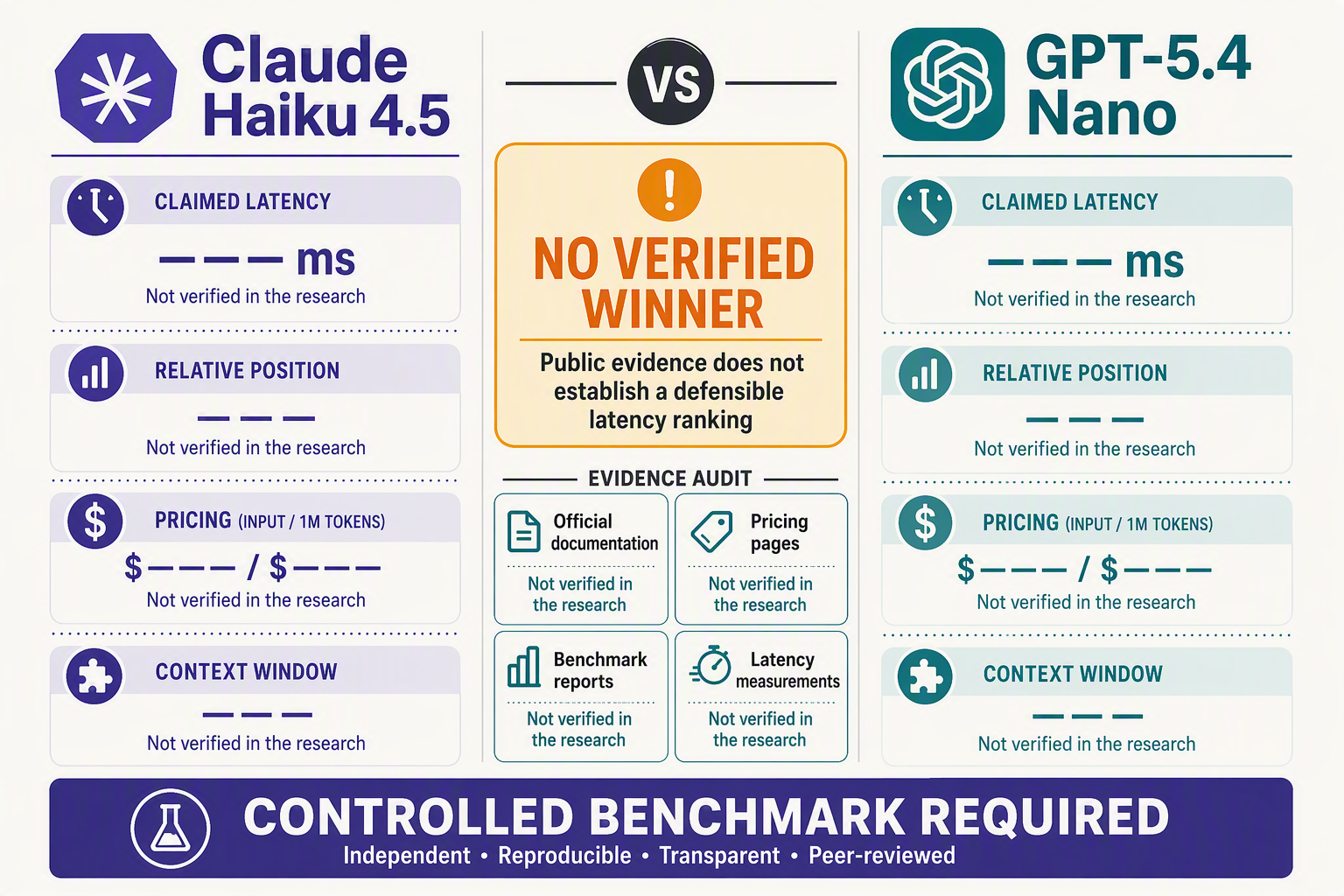
No verified winner can be stated in the Claude Haiku 4.5 vs GPT-5.4 Nano latency comparison. The available research contains no authoritative latency measurements or independent benchmark results for either exact model name, so a fair answer requires controlled testing or provider documentation.
- Claude Haiku 4.5: No verifiable public figures for Claude Haiku 4.5 latency, including time to first token (TTFT), completion time, or throughput, were found in the supplied research.
- GPT-5.4 Nano: No verifiable public figures for GPT-5.4 Nano latency, pricing, context limits, or throughput were found either; estimates would be fabrication.
- TTFT: Measures the time from request submission until the first streamed token arrives; it is often the most visible metric in chat and voice applications.
- End-to-end latency: Measures request submission until the final token arrives, while inter-token latency measures the spacing between streamed tokens.
- Tail latency: Averages are insufficient: p50 represents the median, while p95 and p99 expose slower requests that can affect real-time user experience.
- Test conditions matter: Cold starts, warm requests, region, network path, SDK, provider routing, queueing, concurrency, retries, batching, and rate limits can materially change results.
- A valid latency comparison should use identical prompts and system instructions, fixed input/output token budgets, separate streaming and non-streaming runs, controlled concurrency, and at least 30 trials per condition.
- Practical verdict: Until those measurements exist, neither model can honestly be called faster. Platforms such as CallMissed, an OpenAI-compatible multi-model gateway, can help teams test several providers through one integration while recording comparable application-level timings.
What features can actually be verified for each model? (TABLE)
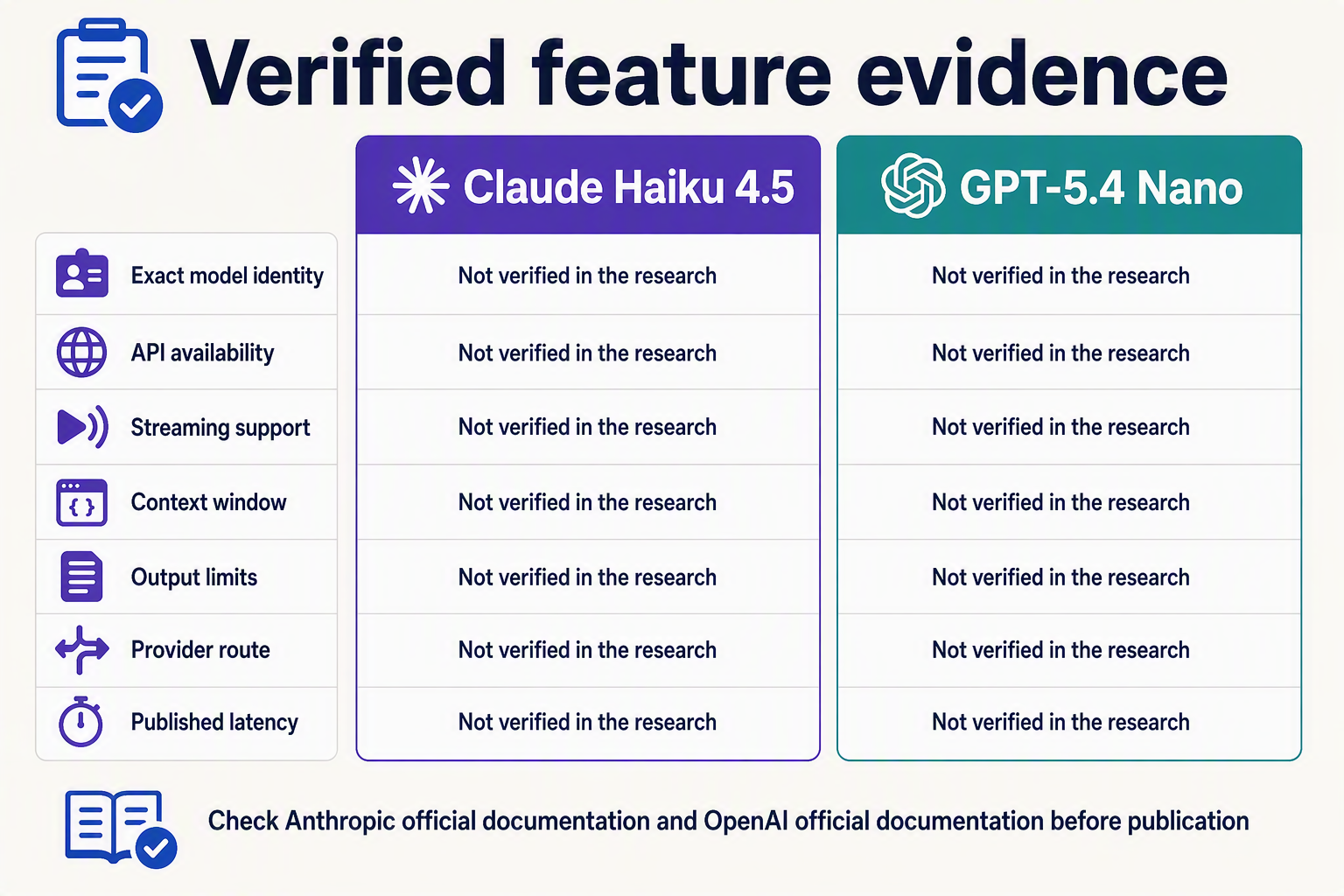
No defensible feature or latency winner can be established for Claude Haiku 4.5 vs GPT-5.4 Nano from the available research. The exact model names lack verifiable provider documentation, pricing pages, and benchmark results in the supplied evidence.
| Feature | Claude Haiku 4.5 | GPT-5.4 Nano | Verification status |
|---|---|---|---|
| Official latency | Not verified in the research | Not verified in the research | No TTFT or completion figures found |
| Time to first token (TTFT) | Not verified | Not verified | Requires streaming measurements |
| Throughput | Not verified | Not verified | No tokens-per-second data found |
| Pricing | Not verified | Not verified | No authoritative price cards found |
| Context limit | Not verified | Not verified | Do not infer from similarly named models |
| Release/version details | Not verified | Not verified | Exact provider identity is unconfirmed |
- Claude Haiku 4.5: No authoritative figures were found for latency, throughput, token pricing, context length, or API limits.
- GPT-5.4 Nano: No authoritative figures were found for latency, throughput, token pricing, context length, or API limits.
- Latency comparison: A valid result must separately measure streaming TTFT, end-to-end completion time, inter-token latency, and cold versus warm requests.
- Tail performance: Record p50, p95, and p99 latency; averages alone can conceal slow requests affecting voice and interactive applications.
- Benchmark requirement: Run at least 30 trials per condition using identical prompts, fixed input/output budgets, controlled concurrency, and the same region and provider route where possible.
- Evidence rule: Label every unavailable field “Not verified in the research” rather than substituting estimates from another Claude or GPT model.
- Integration context: An OpenAI-compatible gateway such as CallMissed can help teams test multiple models through one API while recording comparable application-level timings, but the gateway does not create missing provider specifications.
Which model is cheaper, and what pricing evidence exists? (TABLE)
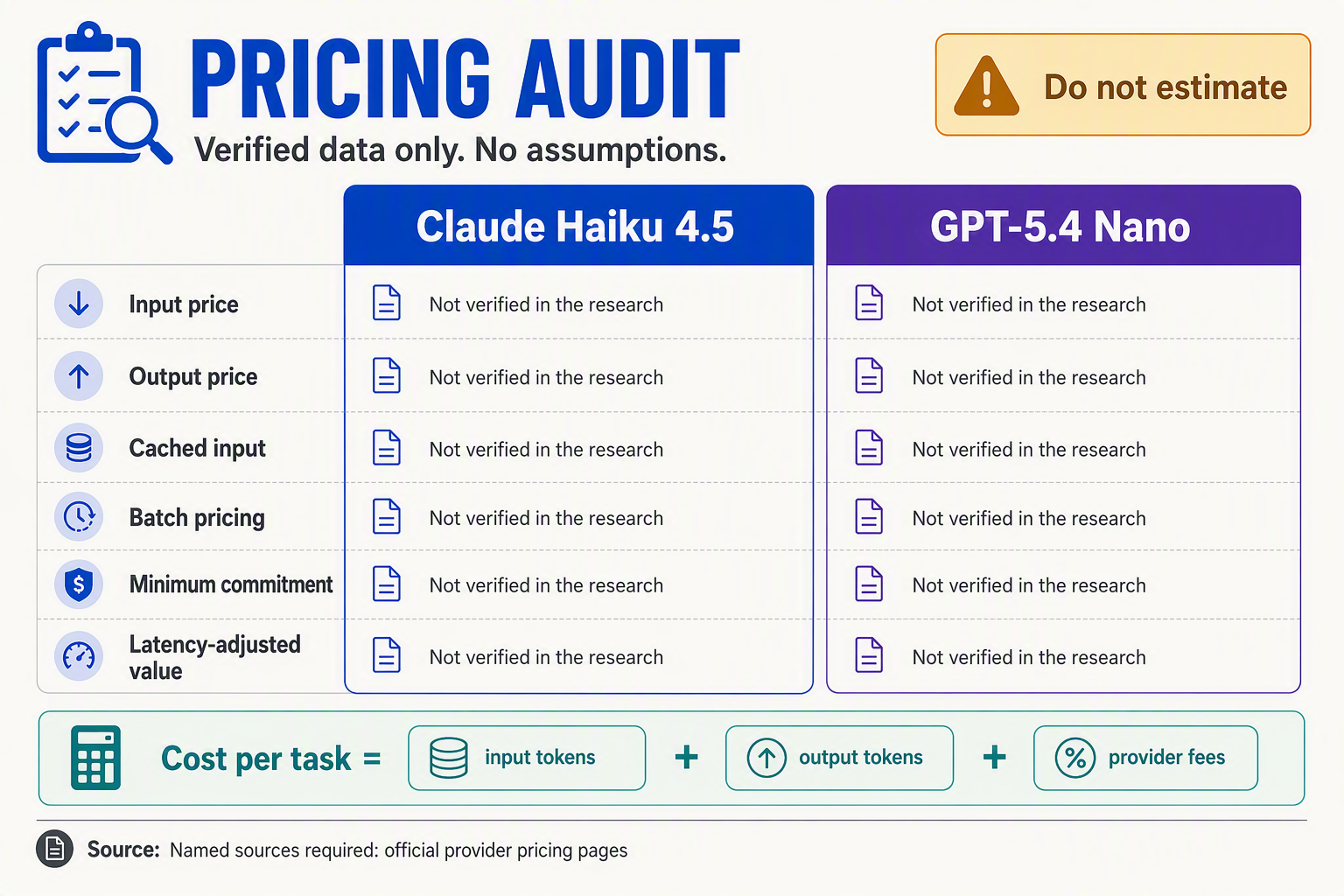
No defensible cheaper model can be identified in the available evidence. Neither Claude Haiku 4.5 nor GPT-5.4 Nano has a verified token-price figure in the supplied research, so any numerical cost ranking would be speculative.
What pricing evidence is actually available?
| Evidence item | Claude Haiku 4.5 | GPT-5.4 Nano | Interpretation |
|---|---|---|---|
| Official input-token price | Not verified in the research | Not verified in the research | No reliable input-cost comparison |
| Official output-token price | Not verified in the research | Not verified in the research | No reliable output-cost comparison |
| Independent pricing analysis | Not verified in the research | Not verified in the research | No third-party cross-check |
| Latency-per-dollar benchmark | Not verified in the research | Not verified in the research | Cost and speed cannot be combined credibly |
| Context or usage limits relevant to billing | Not verified in the research | Not verified in the research | Do not estimate total request cost |
- Claude Haiku 4.5: The supplied research contains no named provider pricing page, dated token rates, or verified input/output billing figures for this exact model name.
- GPT-5.4 Nano: The same research contains no authoritative price, context limit, throughput figure, or independent cost benchmark for this exact model name.
- Cost formula: Once official rates exist, estimate cost as
(input tokens × input price) + (output tokens × output price), then compare it with measured TTFT and end-to-end latency. - Workload matters: A model with a lower token rate may still cost more for an application if it generates longer answers, retries more often, or requires additional calls.
- Evidence standard: Treat pricing shown in aggregators, screenshots, or uncited comparison posts as unverified until matched against a dated provider document.
- Practical option: A gateway such as CallMissed can centralize multi-model billing and testing, but it cannot create missing official prices or establish which model is cheaper.
What are the real trade-offs for latency-sensitive applications? (TABLE)
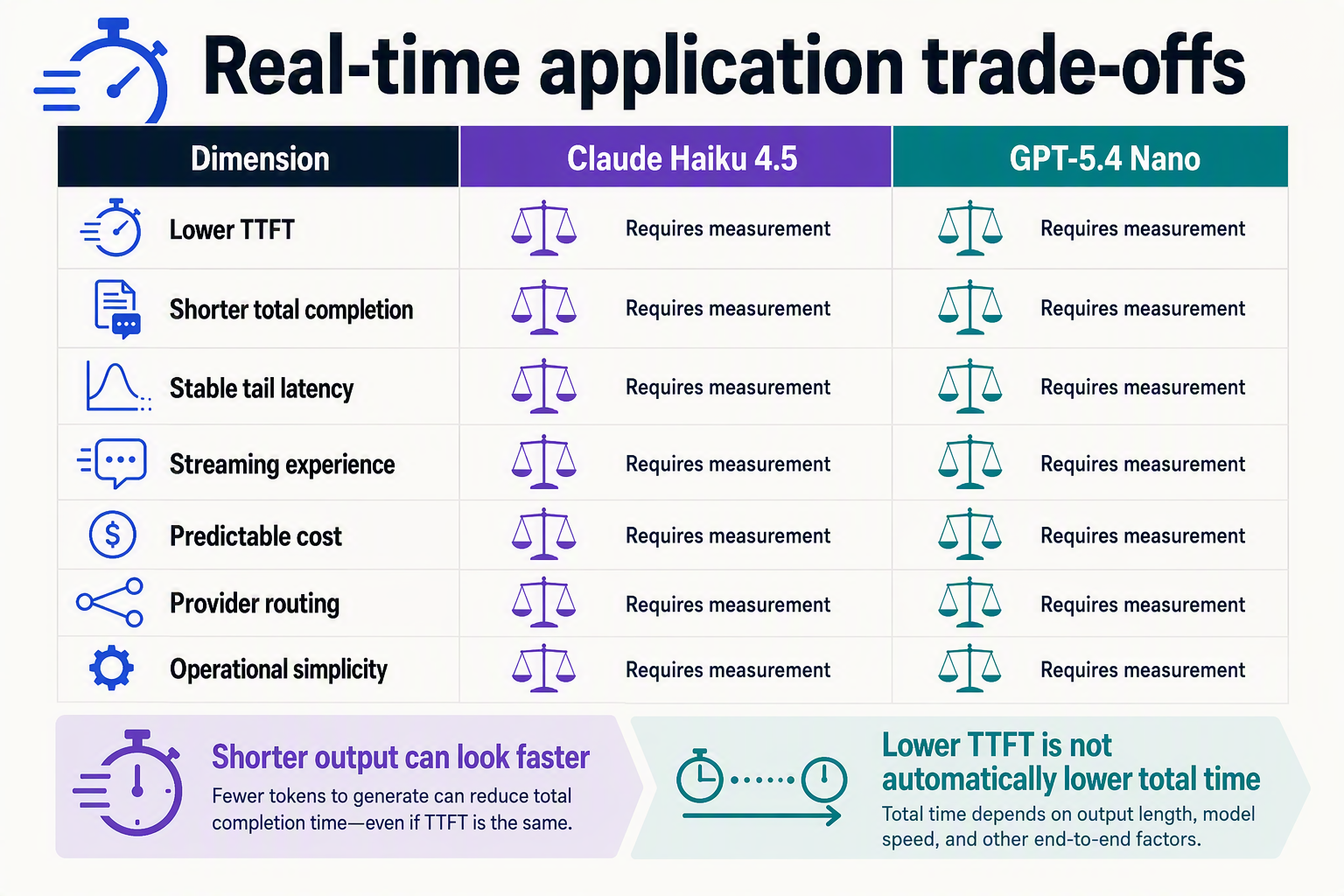
The real trade-off is not “fast versus slow”: no verified public evidence establishes a winner between Claude Haiku 4.5 and GPT-5.4 Nano. Latency-sensitive teams must measure TTFT, completion time, tail latency, reliability, and cost under the same conditions.
| Trade-off | Claude Haiku 4.5 | GPT-5.4 Nano | Practical implication |
|---|---|---|---|
| Published latency | Not verified in the research | Not verified in the research | Do not claim either model is faster |
| Time to first token (TTFT) | Requires controlled measurement | Requires controlled measurement | Important for chat, voice, and streaming UX |
| End-to-end completion | Depends on output length and generation speed | Depends on output length and generation speed | Lower TTFT may not mean faster final answers |
| Tail latency | p50, p95, and p99 must be measured | p50, p95, and p99 must be measured | Slow outliers can disrupt real-time workflows |
| Streaming behavior | Must be tested separately | Must be tested separately | Streaming can improve perceived responsiveness |
| Operational factors | Region, routing, queueing, retries, and rate limits are unknown | Region, routing, queueing, retries, and rate limits are unknown | Provider infrastructure may dominate observed latency |
- TTFT: Measures request submission until the first streamed token; it is usually the most visible metric in interactive applications.
- End-to-end latency: Measures request submission until the final token, while inter-token latency measures the interval between streamed tokens.
- Cold versus warm requests: Cold-start latency and warm-request latency should be reported separately because initialization and connection reuse can change results.
- Benchmark design: Run identical prompts, system instructions, token budgets, regions, and API settings, with streaming and non-streaming tests separated.
- Sample size: Use at least 30 trials per condition, recording timestamps, actual input/output tokens, errors, retries, concurrency, and model/provider version.
- Application choice: A model with lower TTFT may still cost more or take longer overall; platforms such as CallMissed can help teams test multiple models through one OpenAI-compatible gateway before committing to a production route.
How should you benchmark Claude Haiku 4.5 latency and GPT-5.4 Nano latency?
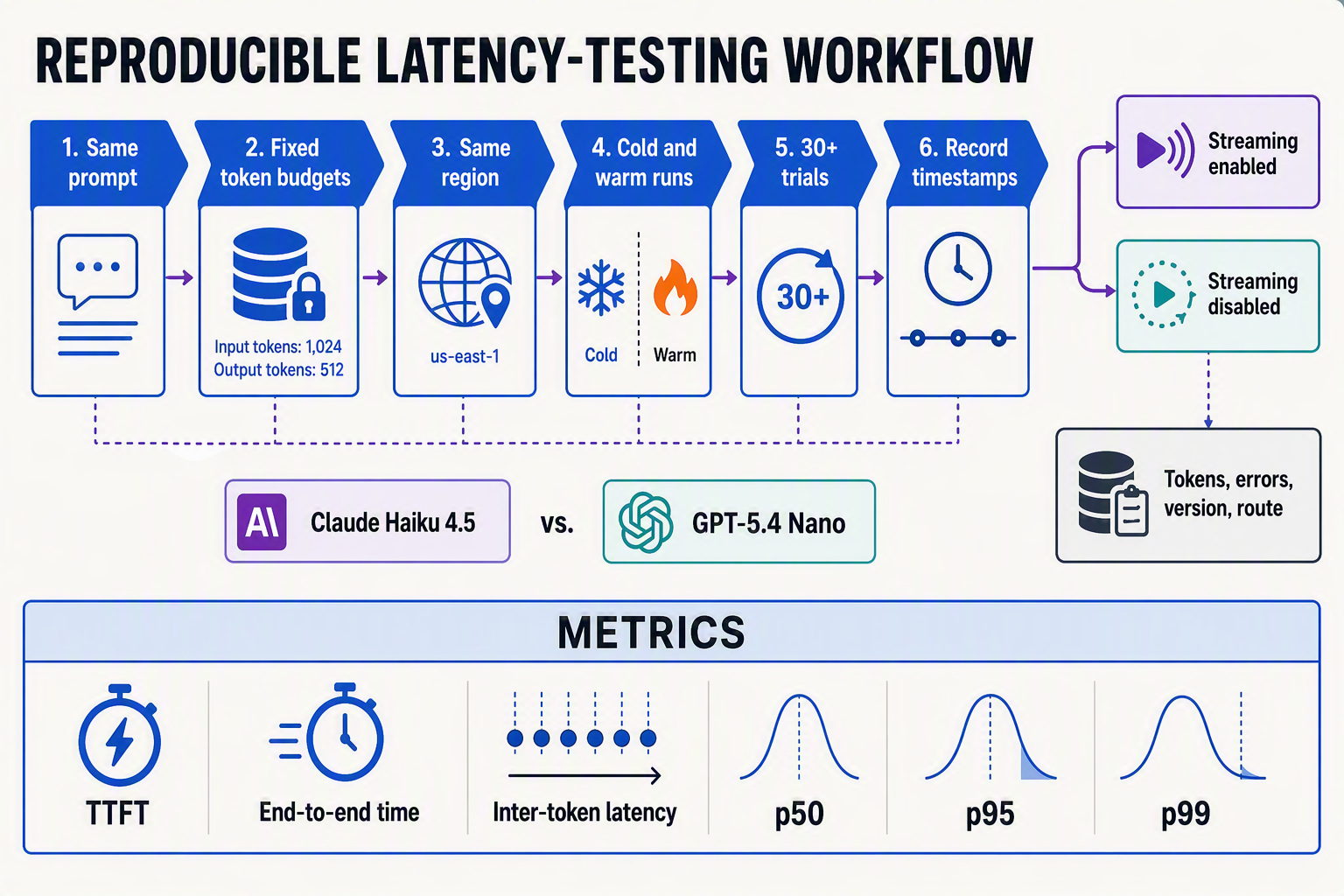
A defensible Claude Haiku 4.5 vs GPT-5.4 Nano latency comparison requires controlled measurements; the available research does not provide authoritative latency data for either exact model name. Use the same workload, routing conditions, and measurement definitions before declaring a winner.
What should the benchmark measure?
- TTFT: Record the time from request submission to the first streamed token; report p50, p95, and p99, not only the average.
- End-to-end latency: Measure request submission to the final token; also record inter-token latency to show how consistently each model streams.
- Cold versus warm: Run separate cold-start and warm-request tests because initialization, connection reuse, and provider queueing can materially change results.
- Identical workload: Use the same system prompt, user prompts, input-token range, maximum output tokens, temperature, reasoning settings, SDK, API route, and geographic region where possible.
- Streaming modes: Test streaming enabled and disabled separately; streaming can improve perceived responsiveness through earlier TTFT without necessarily reducing total completion time.
- Repeated trials: Run at least 30 trials per condition, recording timestamps, actual input and output tokens, HTTP/API errors, retries, concurrency, and the exact model/provider version.
- Controlled load: Test sequential requests first, then fixed concurrency levels; report rate-limit responses, queueing, batching, network time, and provider routing rather than attributing every delay to the model.
- Interpretation: Compare equal output lengths and task quality. A shorter answer may appear faster, while a lower TTFT does not guarantee lower end-to-end latency; therefore, no winner is established until both models produce comparable p50/p95/p99 results. A gateway such as CallMissed can simplify multi-model testing through one OpenAI-compatible integration.
Which model should you choose for a real-time workload?
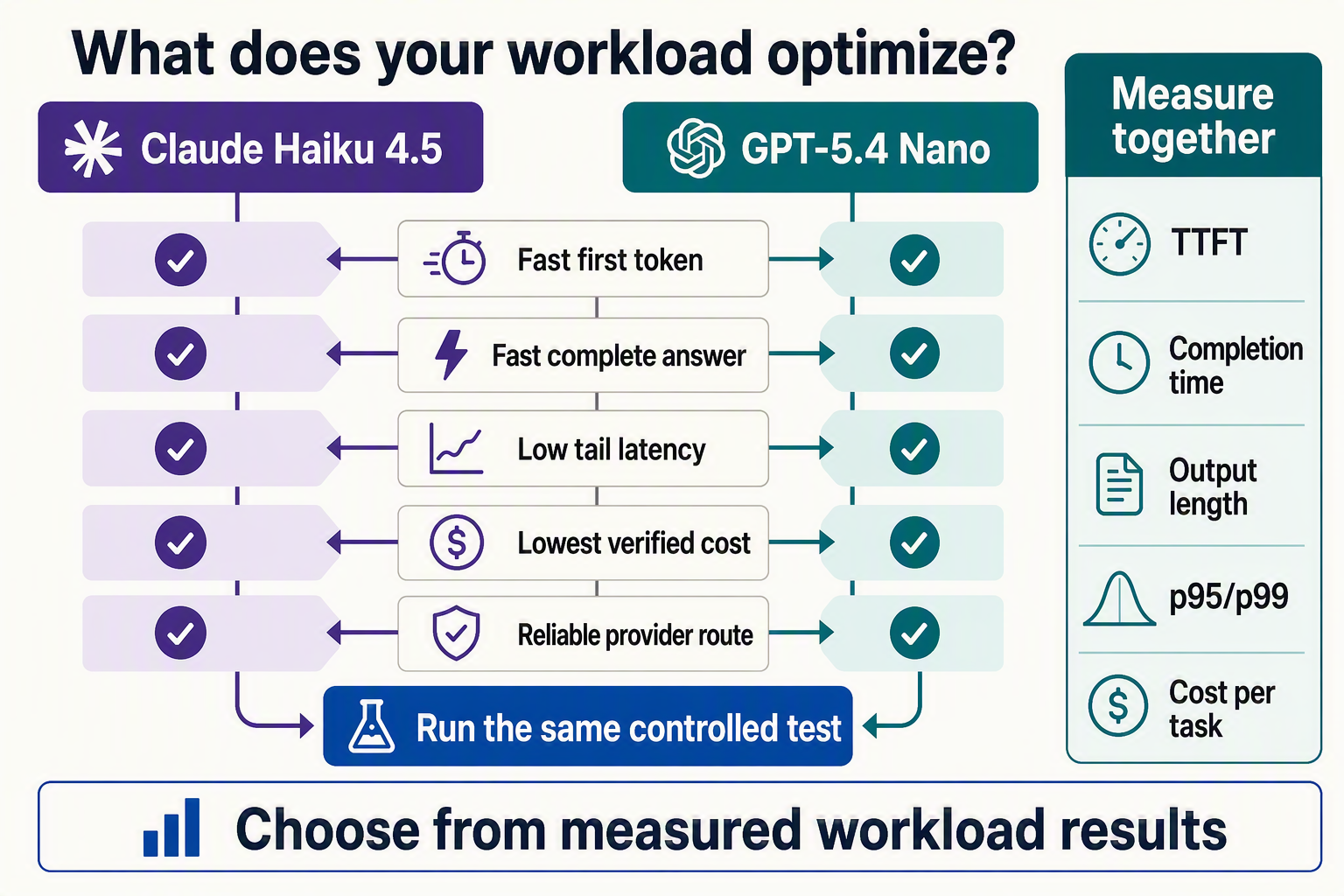
Choose based on measured workload performance, not an assumed speed ranking: the available evidence does not verify a winner in the Claude Haiku 4.5 vs GPT-5.4 Nano latency comparison. For real-time systems, benchmark both models under identical conditions, then optimize for the latency percentile and cost your users actually experience.
- Claude Haiku 4.5: Choose only if your controlled test shows acceptable TTFT, p95 latency, output quality, and availability for your workload; the supplied research contains no verified public Claude Haiku 4.5 latency figure.
- GPT-5.4 Nano: Consider it when its measured time to last token, throughput, or task accuracy fits the application; the supplied research contains no verified GPT-5.4 Nano latency or pricing figure.
- Voice agents: Prioritize TTFT and inter-token latency over raw tokens per second. Delayed first audio can make a conversational agent feel unresponsive even when total completion time is short.
- Streaming chat: Select the model with the better p95 TTFT and acceptable token cadence across at least 30 trials per condition; streaming improves perceived responsiveness but does not guarantee faster completion.
- High-concurrency workloads: Compare p95 and p99, not just averages. Queueing, provider routing, rate limits, retries, region, SDK, and network conditions can dominate observed latency.
- Cost-sensitive applications: Do not choose on speed alone. Compare measured latency, actual input/output token usage, error rates, and provider pricing once authoritative pricing for both exact model names is available.
- Multi-model deployments: Route by task—fast responses for simple intents, stronger reasoning for difficult cases—and re-test after model or provider changes. CallMissed’s OpenAI-compatible gateway can help teams evaluate multiple models through one integration while recording application-level timings.
- Bottom line: Until a reproducible benchmark or official provider documentation appears, neither Claude Haiku 4.5 nor GPT-5.4 Nano can honestly be recommended as the universally faster real-time choice.
What do readers still ask about this latency comparison?
No verified universal latency winner is available for Claude Haiku 4.5 versus GPT-5.4 Nano. A reliable comparison requires controlled testing under identical conditions.
- Q: Which is faster, Claude Haiku 4.5 or GPT-5.4 Nano?
A: Neither can be declared universally faster from the available evidence. No authoritative, directly comparable latency measurements for these exact models establish a winner.
- Q: How should time to first token (TTFT) be compared?
A: Measure TTFT using the same region, prompt, API settings, connection method, concurrency level, and streaming configuration. Report distributions such as p50, p95, and p99 rather than a single average.
- Q: What does end-to-end latency measure?
A: End-to-end latency measures the time from sending a request until the complete response arrives. It depends on factors including output length, token-generation speed, network delay, queueing, and retries.
- Q: How should the models be benchmarked fairly?
A: Run at least 30 trials per condition with identical prompts and comparable output limits. Separate cold and warm requests, record actual token counts and errors, and test streaming, non-streaming, and concurrency levels independently.
- Q: Does streaming make either model faster?
A: Streaming can improve perceived responsiveness by displaying tokens before the response is complete. It does not necessarily reduce end-to-end latency, so TTFT and time to the final token should be measured separately.
- Q: How does concurrency affect latency?
A: Higher concurrency can increase queueing, rate-limit exposure, and tail latency. Test each model at realistic request volumes and compare p95 and p99 results, not just low-load averages.
- Q: Which model should be selected for production?
A: Choose based on workload-specific tests that include latency, response quality, reliability, cost, rate limits, and regional availability. Without controlled production-like measurements, neither model can be recommended as the universal latency winner.
Conclusion
No defensible winner emerges from the Claude Haiku 4.5 vs GPT-5.4 Nano latency comparison: the available research provides no verified latency, pricing, or independent benchmark data for either exact model.
- No reliable Claude Haiku 4.5 latency or GPT-5.4 Nano latency figure is published here.
- A fair verdict requires at least 30 controlled trials measuring TTFT, completion time, and p50/p95/p99.
- Streaming, region, routing, concurrency, and output length can change results substantially.
Watch for authoritative provider documentation and reproducible benchmarks. To explore this evolving infrastructure, visit CallMissed—and consider: which latency metric matters most for your application?
Related Reading
Related Posts
Deepgram Aura बनाम ElevenLabs मूल्य निर्धारण: सत्यापित लागत तुलना
एंटरप्राइज़ TTS के लिए Deepgram Aura-2 बनाम Amazon Polly: विशेषताएँ, मूल्य निर्धारण और निष्कर्ष
मुफ़्त टियर मॉडल वाले AI गेटवे: परीक्षण, प्रोटोटाइपिंग और प्रोडक्शन के लिए सर्वोत्तम विकल्प
Ready to automate customer conversations?
Launch AI voice agents and WhatsApp bots with CallMissed — one API, 22+ Indian languages.