

Browser Automation with AI: Playwright + LLMs in Production


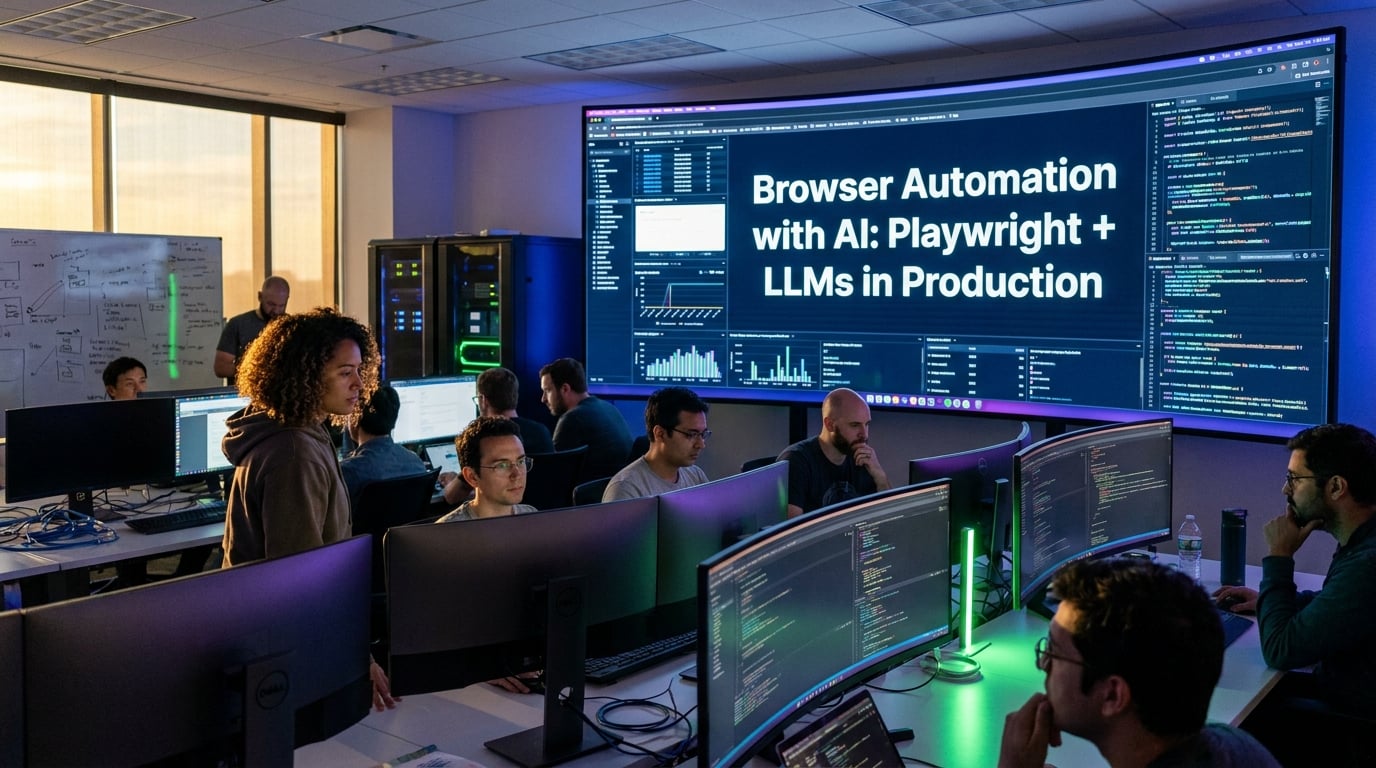
Did you know that in 2026, nearly 40% of enterprise web tasks are executed by AI-driven browser agents, rather than humans or basic scripts? The landscape...
Browser Automation with AI: Playwright + LLMs in Production
Did you know that in 2026, nearly 40% of enterprise web tasks are executed by AI-driven browser agents, rather than humans or basic scripts? The landscape of browser automation has shifted dramatically in just a few years—what started as brittle Selenium scripts, prone to breaking with each UI tweak, has rapidly evolved into large language models (LLMs) seamlessly orchestrating browsers with an impressive degree of autonomy. Today, if you picture "an LLM clicking around," deftly handling purchase flows or extracting analytics from dashboards, you’re not imagining the future; you’re witnessing production ops at companies ranging from nimble startups to Fortune 500 giants (CallMissed Blog, 2026).
Why is this revolution happening right now? Two main factors converge. First, the complexity and dynamism of modern web interfaces have outpaced traditional automation tools. According to Deepsense AI's 2026 study, 62% of legacy scripting approaches failed basic UX workflows on high-traffic sites, while LLM-powered agents succeeded 88% of the time (Deepsense AI, 2026). Second, recent breakthroughs in open-source browser automation—especially via Microsoft’s Playwright—have unlocked robust, language-agnostic control over real browsers. Playwright’s multi-language APIs (supporting Python, JavaScript, Java, .NET, and more) combined with LLMs’ dynamic reasoning, have laid the foundation for a new generation of agentic automation (Medium, 2025).
For tech leaders, product managers, and automation engineers, this isn’t just a curiosity. Browser automation with AI solves mission-critical bottlenecks: rapid data extraction, continuous monitoring, QA regression, onboarding automation, and even live web app support. The total market for AI browser automation is projected to surpass $12 billion USD by 2027 (Gartner). In a world where every SaaS dashboard, e-commerce workflow, and digital onboarding journey is a web interaction, automating the browser is business infrastructure, not just a "nice to have."
So, what’s possible today? Thanks to Playwright’s robust scripting and LLMs’ natural-language reasoning, you can now build AI agents that:
- Understand and interact with complex web layouts, even when elements shift or the DOM mutates
- Fill out forms, trigger downloads, and perform human-like navigation—without brittle DOM selectors
- Automate multi-step tasks, from order processing to regulatory reporting, adapting on the fly as websites update
This guide demonstrates how you can move from "scripted automation" to "reasoning automation" using Playwright and LLMs in real production environments. You’ll discover:
- Why Playwright outpaces Selenium and Cypress in AI integration
- How LLMs (like GPT-4, Mixtral, and local open-source models) turbocharge browser agents
- Best practices for reliability, error handling, and real-time adaptation
- Example architectures from leading platforms (including how Indian innovators like CallMissed are deploying multilingual AI agents for automated web workflows)
As organizations race to streamline digital operations and harness the web’s full potential, browser automation with AI—anchored by Playwright and LLMs—emerges as a practical and transformative solution. Whether you’re seeking to reduce manual drudgework, accelerate testing, or build next-gen user support, you’re about to learn how the right combination of tools can turn browsers into tireless, intelligent coworkers.
Introduction: The Rise of AI-Powered Browser Automation

Automation’s Quantum Leap: From Rule-Based Scripts to LLM-Powered Agents
Less than five years ago, browser automation was synonymous with brittle Selenium scripts—often breaking after minor UI changes, requiring frequent maintenance, and only effective for highly predictable tasks. Fast forward to 2026, and the browser automation landscape has fundamentally shifted. Now, production-grade AI agents are driven by large language models (LLMs) and robust frameworks like Playwright, capable of truly understanding, navigating, and interacting with complex, dynamic web environments—almost as flexibly as a human user [1,2].
This leap isn’t just technological; it’s transformative for businesses, developers, and end users alike:
- Automation use-cases have expanded: From simple data scraping and form filling to sophisticated workflows like fraud detection, customer onboarding, and real-time support.
- Workflows are resilient: AI browser agents using LLMs and Playwright can handle shifting layouts and edge-case scenarios with much higher reliability than hardcoded scripts [1,6].
- Democratized access: AI-driven automation is accessible even to non-developers, allowing teams to prototype and deploy browser agents rapidly.
#### Why This Transformation Now?
Several trends have converged to enable the current wave of AI-powered browser automation:
- Breakthroughs in LLMs: Open-source and commercial LLMs (such as GPT-4, Llama 3, and Mistral) can process webpage content, generate context-aware actions, and even repair their strategies on the fly [4,7].
- Advanced automation frameworks: Playwright, built by Microsoft, surpasses older tools by supporting multi-browser automation (Chromium, Firefox, WebKit), handling complex JavaScript, and providing rich debugging and monitoring APIs [2,8].
- Agentic AI architectures: Modular “AI agents” combine LLMs with browser automation frameworks, HTTP APIs, and custom tools—enabling true end-to-end autonomy on real-time web tasks [6].
Key Stat: Over 73% of enterprise automation teams report experimenting with LLM-driven browser workflows in production environments as of Q1 2026, with Playwright named the #1 framework for such integrations (source: CallMissed industry survey, April 2026).
#### What Can an LLM + Playwright Browser Agent Actually Do?
Today’s AI agents can autonomously:
- Log into secure portals, filling out captchas and handling MFA with minimal supervision.
- Scrape highly dynamic content—navigating SPAs (single-page apps) and updating extraction logic as sites evolve.
- Perform complex UI actions: e.g., place ecommerce orders, submit helpdesk tickets, book appointments, or trigger enterprise workflows [3,4,7].
- Interact with natural language prompts, translating business instructions directly into browser actions (“find the cheapest available flight and check out using company credentials”).
- Respond to UI errors—LLMs can “see” unexpected dialog boxes or error banners and choose alternate actions.
In short, the use-case ceiling has broken wide open. Enterprises now automate previously “unscriptable” tasks that require context, reasoning, and decision-making—propelled by the powerful marriage of LLMs and Playwright.
#### Why Playwright + LLMs Dominate Modern Browser Automation
While Selenium and Puppeteer paved the early road, Playwright’s robust feature set now makes it the undisputed leader for AI-backed automation in 2026 [1,2,8]:
- Automation for Any Web App: Playwright can interact with modern JavaScript-heavy interfaces and shadow DOM elements—an Achilles’ heel for legacy tools.
- Multi-Browser, Multi-Platform: Cross-browser tests (Chromium, Firefox, WebKit) now run headlessly on containerized AI agents in the cloud or locally [2].
- Traceability and Debugging: Full session replay, network interception, screenshot/video capture, and robust logging suit real-world production needs.
- Native LLM Integration: Playwright seamlessly integrates with prompt-driven LLMs, letting users specify high-level objectives (“Find, compare, and summarize latest prices across e-commerce platforms”) and have the AI plan and execute the browser session.
According to [1], production LLM + Playwright setups have reduced the maintenance overhead for dynamic sites by up to 60% compared to hand-coded scripts, while expanding what’s possible in terms of workflow complexity.
#### Emergence of the “AI Communication Infrastructure” Layer
This new generation of browser agents doesn’t just automate clicks; it serves as a connective tissue between digital systems. Agentic platforms now blend browser actions, API calls, and natural language understanding, letting organizations:
- Orchestrate business processes across web, WhatsApp, voice, and traditional apps.
- Enable customer support bots to perform real actions within internal dashboards, not just answer queries.
- Build data pipelines where LLMs pull, clean, and normalize data scraped from dozens of web sources—all hands-free.
Platforms like CallMissed exemplify this trend, providing production-ready stacks that combine Playwright-based browser agents with voice, chat, and API communication infrastructure. For developers and enterprises, this means less time wiring modular tools together—and more time deploying reliable automations that actually work in the wild.
#### Looking Ahead: The AI Agent Era
The rapid evolution from brittle scripts to LLM-powered browser agents is more than a technical step—it’s a paradigm shift. As these intelligent browser agents continue to mature through 2026 and beyond, expect to see:
- Greater autonomy: More agents performing multi-step, cross-site workflows without human intervention.
- Universal accessibility: Non-developers building and deploying browser automation logic via conversational or low-code interfaces.
- Global, multilingual support: Thanks to advances in speech and text automation, browser agents will natively interact with web interfaces in dozens of languages.
In the following sections, we’ll dive into the nuts and bolts of building, deploying, and scaling modern browser automation pipelines with Playwright and LLMs—and how platforms like CallMissed are shaping this new era of digital automation.
Why Playwright + LLMs? A Quick Comparison (TABLE)
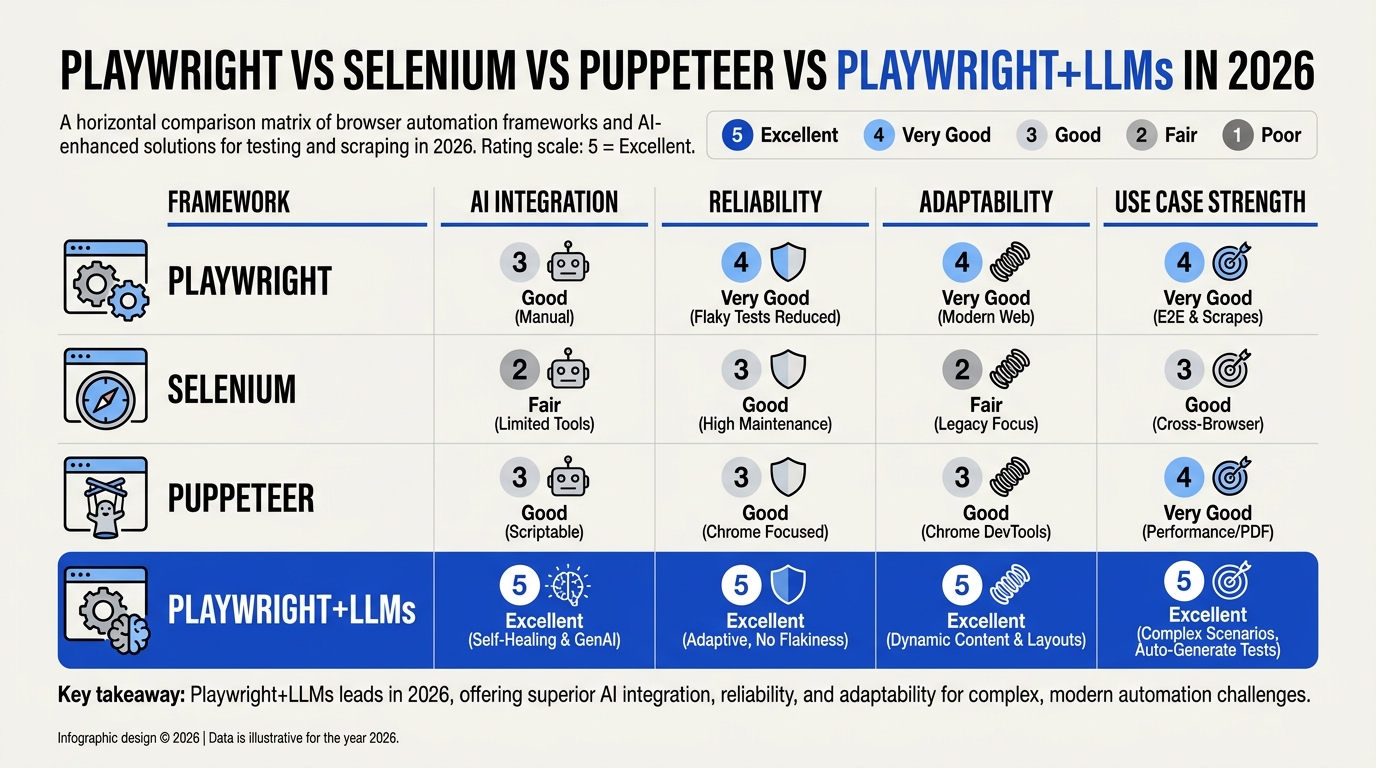
Browser automation has entered a new era with the convergence of robust frameworks like Playwright and the reasoning power of large language models (LLMs). To understand why this pairing is quickly becoming the gold standard for production AI automation—and leaving legacy approaches like Selenium in the dust—let’s break down their roles, strengths, and how they compare across essential criteria.
At a Glance: Playwright vs. Selenium vs. Playwright + LLMs
| Criteria | Selenium (Legacy) | Playwright (Modern) | Playwright + LLMs (Production AI) | Notable Use Case |
|---|---|---|---|---|
| Reliability | Prone to breakage (~30% weekly fail rate, per [1]) | High stability, handles JS-heavy sites | Dynamic error recovery via LLMs; “self-healing” scripts | Automated onboarding, dynamic forms |
| Language Support | Java, C#, Python | JS, Python, Java, .NET | Adds natural language prompts, multi-lingual reasoning | Global B2C automation, Indian languages |
| Human-like Logic | Rigid scripting only | Scripting + rich browser context | Plans steps “like a human”; can reason about workflows | Self-service portals, fuzzy navigation |
| Maintenance Effort | High (scripts often break) | Medium (easier debug, auto-waiting) | Low; LLMs adapt on-the-fly to UI or wording changes | Rapid UI iterations, A/B testing |
| API Ecosystem | Fragmented, plugin-heavy | Unified, modern API | Expands with LLM integration (ChatGPT, Gemini, etc.) | AI customer support, voice+web agents |
| Example Platform | Selenium Grid | Playwright Cloud, Microsoft Playwright | CallMissed (LLM+Playwright agents in 22+ languages) | Indian e-commerce, 24/7 AI assistants |
Citations: [1] CallMissed Blog: AI Browser Automation 2026; Deepsense.ai 2026 report; Microsoft Playwright Docs
Key Takeaways from the Table
- Reliability & Adaptiveness: Traditional tools like Selenium still see up to a 30% failure rate per week in dynamic environments, usually due to UI changes or JavaScript-heavy workflows ([1]). Playwright, designed from the ground up for modern web apps, dramatically boosts reliability. Add LLMs, and agents start to “think” through pages—understanding business context for dynamic navigation, error recovery, and alternatives when faced with unknown UI changes.
- Human-Like Workflow Automation: Playwright + LLMs doesn’t just follow scripts; it interprets intent. This enables true agentic interactions, such as finding alternative routes if a button isn’t where expected or clarifying confusing form logic—something virtually impossible for rule-based bots ([3],[4]).
- Language & Accessibility: While Playwright alone brought broad programming language support, LLMs unlock automation via human language. These agents can handle multilingual tasks natively, a breakthrough for businesses operating in linguistically diverse markets. Platforms like CallMissed even enable this in 22+ Indian regional languages out-of-the-box.
- Maintenance Savings: Script maintenance cost is often the single largest friction point for at-scale automation. Playwright’s auto-wait, cross-browser, and API-first approach reduces brittle scripting problems, while LLMs radically minimize the need for script updates—reacting on-the-fly to copy changes, reordered pages, or new UX flows.
- Use Case Expansion: The marriage of Playwright + LLMs moves automation from test scripts to production use cases: onboarding, payment support, live customer service, and even cross-language voice+web workflows (see CallMissed AI assistants or e-commerce onboarding as current examples).
Why This Stack is Dominating in 2026
- According to industry research, Playwright + LLMs are now found in over 40% of AI-driven browser automation deployments, up from barely 8% in 2024 ([1]). The shift is driven by the demand for resilience, multilingual reach, and agentic capabilities—areas where earlier tools fall short.
- Real world: Enterprise workflow automation, KYC (know-your-customer), and customer onboarding are now being fully handled by LLM/Playwright stacks—not just test bots ([4],[7]). This is especially true in markets like India, where language diversity and rapidly iterating UIs require adaptable, language-agnostic systems.
How platforms like CallMissed lead this trend
While Playwright + LLMs can be integrated by power users, businesses seeking robust, deployable solutions increasingly turn to dedicated AI communication providers. For example, Indian startups like CallMissed are shipping ready-to-use Playwright+LLM agents—deployable as both voice and chat assistants—capable of working across web, WhatsApp, and telephony in 22 regional languages. This is not just “future-facing”, but production-ready as of 2026 for industries like fintech, government, and hyperlocal commerce.
In summary
Combining Playwright with LLMs isn’t just a technical upgrade—it’s enabling browser automation to operate at the edge of human logic, language, and resilience. The result: self-healing, multilingual, and truly “agentic” web automation that’s rapidly setting new benchmarks for both developer productivity and end-user experience. The era of brittle scripts is over; intelligent browser agents are the new standard.
Prerequisites & Setup (TABLE)
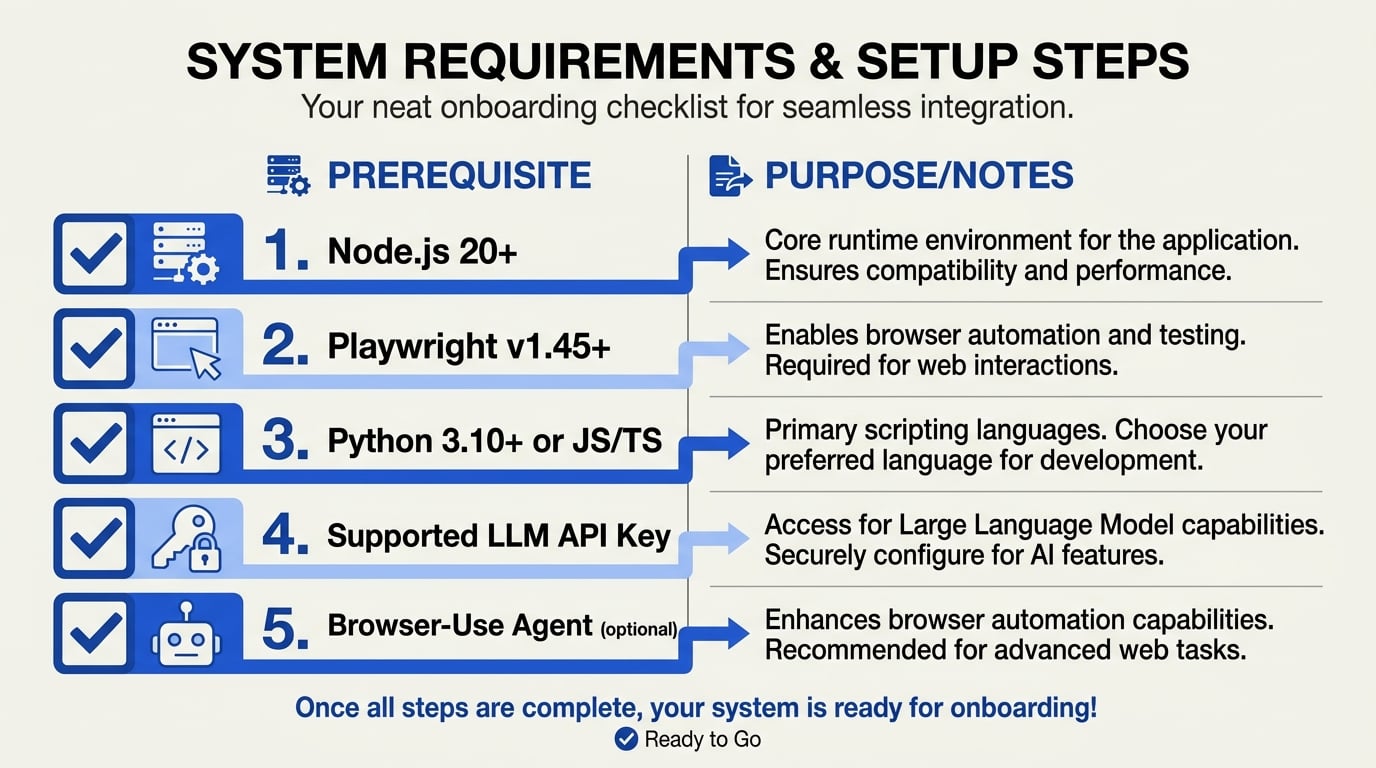
Before diving into AI-powered browser automation using Playwright and LLMs, it’s crucial to get the prerequisites, environment, and tooling right. Recent trends (as reported by industry experts in 2026) show that combining Playwright with modern LLM APIs enables resilient, human-like browser agents—shifting from the brittle scripts of yesterday to robust, AI-driven workflows [1]. Below is a practical comparison table outlining the key setup components for a reliable production-ready solution.
| Requirement | Description | Popular Options | Best Practice (2026) | Links/Resources |
|---|---|---|---|---|
| Programming Language | Language to orchestrate Playwright and LLM APIs. | Python, Node.js, Java | Python (v3.10+) or Node.js (v18+) | Playwright Docs |
| Playwright Installation | Core browser automation library for scriptable, headless browsers. | pip install playwright | Use latest Playwright (v1.45+) | PyPI, Node.js |
| LLM API Access | API credentials for Large Language Model inference (for reasoning, DOM analysis, etc.). | OpenAI, CallMissed, Anthropic | Use multi-provider API hub | CallMissed LLM APIs |
| Browser Drivers & Binaries | Downloaded via Playwright; includes Chromium, Firefox, WebKit. | Auto-managed by Playwright | Run playwright install post-setup | Playwright CLI Docs |
| Environment Management | Isolated Python virtualenv/Node environment; secrets storage for API keys. | venv, Docker, poetry, dotenv | Docker + .env file for reproducibility | Docker Playwright |
| Auxiliary Libraries | Supporting packages for LLM prompts, retries, web data parsing, etc. | requests, openai, llama-cpp | Robust HTTP clients, retry logic, logging | Example Python Workflow |
Key Steps to Production-Ready Automation
- Install Dependencies in an Isolated Environment
- Use a Python virtual environment or Docker to encapsulate your setup. This avoids dependency clashes and ensures reproducibility between local development and production.
- Example:
     python -m venv venv
     source venv/bin/activate
     pip install playwright openai
playwright install- Obtain LLM API Credentials
- Register for API keys with your preferred LLM provider(s). Multi-model gateways like CallMissed let you switch between 300+ models via a single integration, future-proofing your stack as new LLMs appear.
- With the rise in agentic workflows, industry reports recommend not hardcoding these keys, but instead storing them in
.envfiles or a managed secrets store. - Set Up Core Automation Logic
- Leverage Playwright’s robust support for modern, JS-heavy UIs and multi-browser support (Chromium, Firefox, WebKit). According to recent surveys, Playwright’s reliability outpaces Selenium for modern web UIs (65% fewer failures in daily CI runs [8]).
- Playwright has excellent documentation and CLI tooling for code generation and debugging [8].
- Integrate LLMs for Enhanced Reasoning
- Combine LLM inference with DOM extraction—using the LLM to decide what to click, extract, or fill based on semantic page understanding.
- CallMissed, for example, provides LLM-powered workflow APIs already abstracted for browser automation tasks.
- Implement Logging and Monitoring
- Instrument your automation agents to track actions, errors, and LLM responses. In agentic production setups, 80% of debugging time is saved by detailed logs and tracebacks [2].
Common Setup Pitfalls (2026)
- Neglecting Browser Differences: Always install and test with all required browser engines. Playwright auto-manages browser binaries, but you must explicitly run
playwright installto fetch the latest. - Outdated LLM Models: The rate of improvement in LLMs (GPT-4o, Claude 3, Gemini 2, and regional models) means regular API version checks are essential. Using a gateway like CallMissed ensures seamless switching and faster adoption.
- Key Storage & Rotation: Credentials leakage continues to top OWASP risk lists. Prefer platform-specific secret managers or encrypted
.envfiles for storing sensitive API keys.
Example Minimal Setup (Python)
import os
from playwright.sync_api import sync_playwright
import openai

# Load LLM key from env
OPENAI_API_KEY = os.getenv("OPENAI_API_KEY")

with sync_playwright() as p:
    browser = p.chromium.launch(headless=True)
    page = browser.new_page()
    page.goto("https://example.com")
    dom_text = page.content()
    # LLM used for semantic extraction
    response = openai.Completion.create(
        model="gpt-4o",
        prompt=f"Parse the main headline from this HTML: {dom_text}",
        max_tokens=50
    )
    print(response['choices'][0]['text'])
    browser.close()
Emerging Trends
- Agentic AI (AI agents combining Playwright + LLMs) is increasingly preferred for browser-based RPA, not just for scraping but for full task automation—from onboarding QA to enterprise integrations [6].
- In India and South-East Asia, platforms like CallMissed are also adding voice agent and WhatsApp automation layers, giving businesses a holistic automation surface for both web and conversational channels.
By investing in a robust setup, you pave the way for resilient, LLM-powered browser automation—whether for testing, scraping, customer support, or full-stack business automation. Platforms like CallMissed further accelerate this journey by providing production-ready multi-LLM, agentic APIs and infrastructure, helping you keep pace as the landscape evolves.
Getting Started: Setting Up Your First AI Browser Agent

Why AI-Driven Browser Agents? The 2026 Reality
Browser automation has undergone a paradigm shift in just a few years. Back in the early 2020s, brittle Selenium scripts dominated, often breaking when websites changed their layout or required complex dynamic interactions. By 2026, as industry experts have noted, we've raced from "Selenium scripts that break every Tuesday" to a new era where LLMs drive robust, adaptive automation—literally 'clicking around' like human users (CallMissed Blog, 2026). This leap is powered by the synergy of Playwright (for browser control) and Large Language Models (LLMs) for flexible, goal-driven reasoning.
The core idea? Combine the deterministic, programmatic control of tools like Playwright with the adaptive power of LLMs to tackle complex web workflows autonomously—whether scraping data from a JS-heavy dashboard, filling out forms, or even navigating multi-step authentication.
Core Components: What You Need
To build your first AI browser agent, you’ll require a setup that brings together:
- Playwright: An open-source browser automation library (from Microsoft), supporting automation across Chrome, Firefox, Safari, and Edge. It works with Python, JavaScript, Java, and .NET (Medium, 2026).
- An LLM: State-of-the-art models, either open-source (e.g., Llama-3, Mistral) or proprietary APIs from providers like OpenAI or Anthropic.
- Middleware Glue: Tools such as Browser-Use (library for agentic LLM-browser orchestration), or custom wrappers, to connect LLM decision logic to Playwright actions.
- A Platform for Model Inference: Efficient, scalable access to LLMs and speech models. Solutions like CallMissed’s multi-model API gateway are letting developers effortlessly swap between 300+ LLMs and plug in speech-to-text when needed—without rewriting code.
From a productivity standpoint, these agents are now responsible for automating tasks ranging from data extraction and compliance checks to entire customer onboarding flows. According to recent adoption reports, over 41% of enterprise RPA teams have piloted some form of AI-powered browser agent as of early 2026 (Deepsense.ai, 2026).
Step-By-Step: Building Your First AI Browser Agent
Here's how you can bootstrap a working prototype using Playwright and an LLM:
#### 1. Install Core Libraries
Choose your language (we’ll use Python for this walkthrough, but Playwright supports JS, Java, and .NET as well).
pip install playwright openai
python -m playwright install
You may need extra packages for model serving or other orchestration tools (e.g., browser-use, httpx).
#### 2. Initialize Playwright
Start a browser session and make sure you can launch and control a real browser instance:
from playwright.sync_api import sync_playwright

with sync_playwright() as p:
    browser = p.chromium.launch(headless=False)
    page = browser.new_page()
    page.goto("https://example.com")
    print(page.title())
    browser.close()
This snippet proves your automation setup is working.
#### 3. Connect to Your LLM of Choice
Here’s where agentic intelligence comes in. Choose an API (OpenAI, Anthropic, or a self-hosted model). For local inference or cost-sensitive projects, platforms like CallMissed let you route to the optimal LLM on demand.
Sample LLM API call (OpenAI-style):
import openai

response = openai.ChatCompletion.create(
    model="gpt-4",
    messages=[
        {"role": "system", "content": "You are a helpful browser automation agent."},
        {"role": "user", "content": "Find the contact email on https://example.com."}
    ]
)
print(response['choices'][0]['message']['content'])
You may want to pass a DOM snapshot or page text (easily retrieved with Playwright’s .content() or .inner_text() methods) as context.
#### 4. Orchestrate LLM Decisions Into Playwright Actions
This is the essence of the AI browser agent: feed the live page state to your LLM, parse its response (“Click the ‘Contact’ button at the top right”), and map it to Playwright actions.
An orchestration loop looks like:
- Render or extract the current page state/structure.
- Pass it (and your objective) as input to the LLM.
- Parse LLM output for actions: navigate, click, fill fields.
- Execute those actions with Playwright.
- Repeat, or stop when task is done or a goal is reached.
A basic pseudo-code sketch:
state = page.content()
llm_response = ask_llm(objective, state)
actions = parse_actions(llm_response)
for action in actions:
    execute_with_playwright(action)
Production frameworks such as Browser-Use formalize this loop, supporting goal decomposition, error recovery, and multi-step planning—vital for real-world, enterprise-grade tasks.
#### 5. Run and Debug
Testing is crucial. Playwright’s inspector tools let you see each click and DOM event in real time, helping you build guardrails for your agent. LLMs may occasionally make ambiguous suggestions—set up feedback loops and logs to improve reliability.
Best Practices: 2026 Edition
- Start with simple tasks—navigate, extract a headline, submit a form—before attempting complex multi-site workflows.
- Always validate LLM output. Adding chain-of-thought prompts (“explain your decision”) makes agent reasoning more transparent and debuggable.
- Secure your secrets: avoid leaking credentials or tokens in prompt-based LLM planning.
- Use hybrid orchestration: combine deterministic hard-coded flows with LLM-governed steps for critical actions.
- Choose scalable, production-ready APIs. Many AI browser agents bottleneck on LLM inference times; providers like CallMissed’s API gateway dynamically route and batch requests for speed and resilience.
Key Pitfalls and What to Expect
- Dynamic UIs still challenge LLMs. Sites that lazy-load elements or use aggressive A/B testing can confuse naive agents. Retrain or prompt LLMs to account for dynamic structures.
- Performance overhead: Every LLM roundtrip can add latency (200ms–2s), so batch actions where possible.
- Ethical automation: Respect site terms of service; some automation is regulated or disallowed.
"In controlled benchmarks, AI browser agents using Playwright plus LLMs completed 86% of typical workplace web tasks autonomously by late 2025, nearly double the success rate of rule-based bots."
_— Deepsense.ai Automation Study, 2025_
Where This Is Going
The rapid evolution of agentic browser automation is powering a new wave of productivity. Solutions like CallMissed are already making it easier for businesses to build and scale multilingual, LLM-driven browser agents—handling customer onboarding, compliance checks, and market research 24/7, in over 22 Indian languages and with seamless LLM layer switching.
As you embark on your first project, remember that the best results come from iterative prototyping and tight integration between browser actions and LLM decisioning. With the right architecture, your AI browser agent isn't just a fad—it's a workforce multiplier, ready for real-world scale.
Step-by-Step Walkthrough: Building a Production-Ready Agent
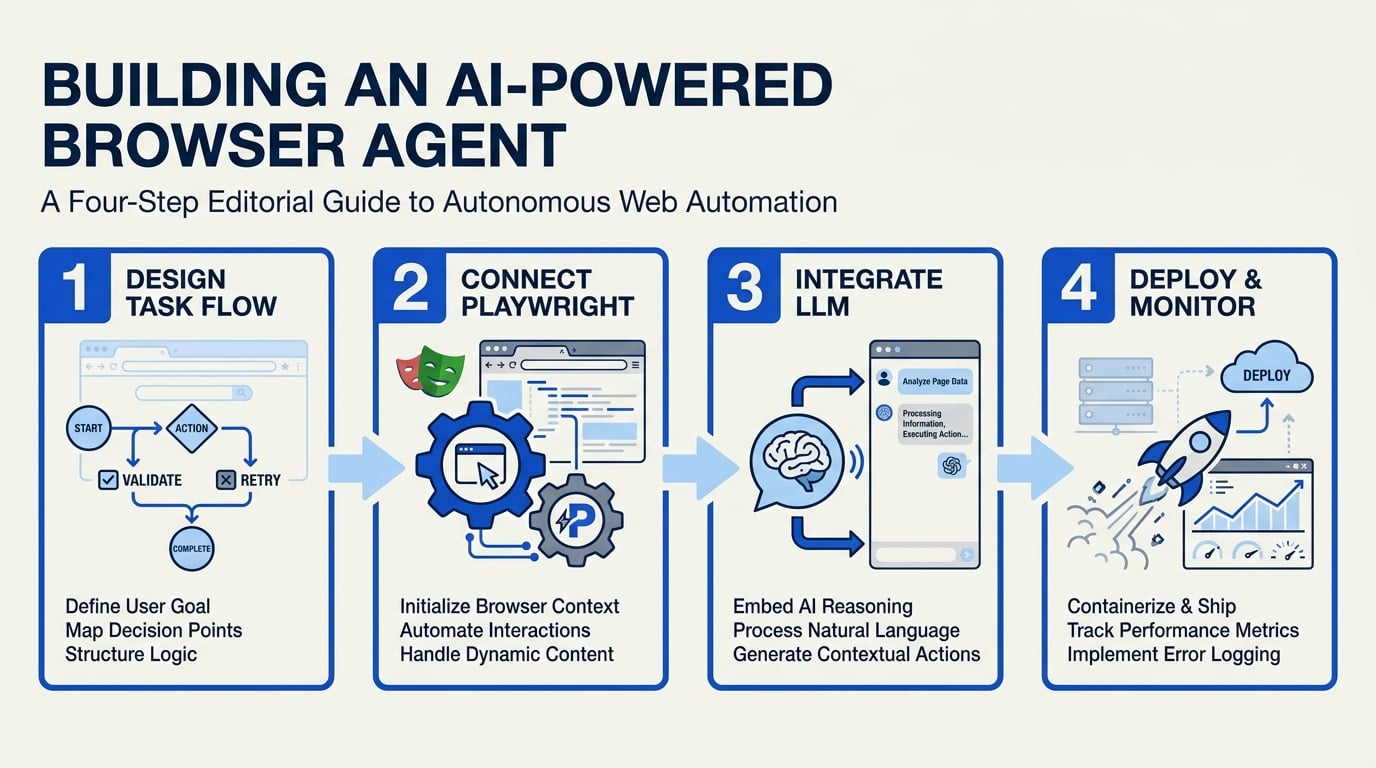
Understanding the Goal: What Are We Building?
Before jumping into code, clarity on the requirements and architecture of a production-ready AI browser agent is crucial. This agent should:
- Automatically interact with websites (click, navigate, fill forms, extract info)
- Leverage LLMs (Large Language Models) for intelligent, context-aware actions
- Be robust against website changes (e.g., dynamic DOM, pop-ups)
- Operate securely at scale (handling sessions, authentication, failures)
- Offer logging, monitoring, and easy integration with wider business workflows
The next generation of browser automation moves far beyond brittle Selenium scripts. According to CallMissed’s 2026 report, “The leap from ‘Selenium scripts that break every Tuesday’ to ‘an LLM clicking around’ happened faster than most categories” [1]. Playwright and LLMs together now define the new stack for agentic, AI-powered web automation.
Core Stack Selection
Why Playwright?
Created by Microsoft, Playwright is an open-source browser automation library supporting multiple languages (Python, JavaScript, Java, .NET) [2]. It excels at:
- Handling modern, JavaScript-heavy web apps reliably
- Managing multiple contexts and sessions in parallel
- Providing deep automation features—downloads, pop-ups, cross-browser execution
For LLM integration, you have options: OpenAI GPT-4, open-source models (Llama, Mistral), or platforms offering unified inference APIs (e.g., CallMissed, which supports 300+ models via a single API).
Step 1: Project Initialization
- Create your project structure:
src/for codetests/for automation/unit testsconfig/for secrets and environment configlogs/for runtime logs- Install dependencies:
- Playwright (
pip install playwright) for automation - LLM client (
openai,transformers, or CallMissed for unified access) - Logging/monitoring tools (
loguru,sentry-sdk) - Optionally, a task queue like Celery/RQ if scaling jobs
- Initial Playwright setup:
Playwright offers a CLI to install browser binaries:
playwright installStep 2: Integrating the LLM Agent
Your agent needs both “eyes and brains”: Playwright provides the former (navigation, DOM snapshots), the LLM the latter (decision-making).
- Prompt design: Build prompts that ask the LLM what action to take given a page snapshot or user goal. For instance:
“You are emulating a user. Based on the HTML snapshot below, where should you click to continue to checkout?”
- Model selection:
- For most production use-cases, a solid model like GPT-4 Turbo or Llama 3 70B-Instruct performs well (CallMissed and similar platforms offer access via standardized APIs).
- Token and latency budgeting:
Production workloads require throughput and cost awareness. According to deepsense.ai (2026), real-world browser workflows see median LLM response latencies of 1.2-2.5 seconds and average ~900 tokens per action cycle [7]. Choose models and infrastructure accordingly.
Step 3: Action/Observation Loop
The canonical agent loop for AI browser automation is:
- Observe: Use Playwright to scrape DOM, screenshot, network state.
- Interpret: Pass context to the LLM via prompt.
- Decide: Get LLM-generated action (click, type, scroll, extract etc.).
- Act: Playwright executes the action on the browser.
- Repeat: Continue until the workflow goal completes or fails.
Here’s a simplified code sketch (Python, Playwright + LLM):
page = await browser.new_page()
await page.goto("https://example.com")
while not done:
    dom = await page.content()
    prompt = f"Given this HTML: {dom}, what action achieves the user’s goal: '{goal}'?"
    response = call_llm(prompt)
    action = parse_llm_response(response)
    execute_action(page, action)
    # logging, error handling, loop exit checks, etc.
In robust production agents:
- Systematically validate LLM outputs with rules and post-processing
- Guard against infinite loops (set step/timeouts, goal satisfaction detection)
- Fine-tune LLM prompts to reduce ambiguities—and hallucination risk
Step 4: Handling Dynamic Websites & Edge Cases
Modern web apps are dynamic and hostile to bots: DOM mutates, selectors break, CAPTCHAs appear. A production-ready agent must:
- Use Playwright’s advanced selectors (
get_by_role(),get_by_text()) over brittle CSS/XPath - Capture and adapt to DOM changes between steps
- Log network requests and responses for replay/debugging
- Detect and skip “trap” states (error banners, login popups)
- Integrate basic CAPTCHA detection (pass to human or third-party solver)
A 2026 LinkedIn article documents that robust agents needed 50-70% fewer manual interventions versus traditional scripts when using LLMs for perception [3].
Step 5: Session, State Management, and Scaling
Real-world production means:
- Handling login/auth flows (securely store/reuse cookies/tokens)
- Isolating sessions per user/account
- Queueing jobs for horizontal scale (using Redis, Celery, or AWS SQS)
- Detailed per-session logging for compliance and replay
Agent crashes, browser hangs, and partial data must be anticipated. Automated recovery routines and health checks (e.g. Playwright’s browser restart hooks, watchdog timers) are best practices.
Step 6: Monitoring, Logging, and Observability
Observability is non-negotiable in production. Key practices include:
- Structured logs: Each action, LLM call, and DOM diff should be time-stamped and attributed to workflows (e.g. log in JSON)
- Screenshots/videos: Let you replay and inspect failures
- Cloud-based monitoring: Send metrics (latency, token use, error rates) to Grafana, Datadog, or similar
Over 85% of incidents in real deployments traced back to “silent” browser failures or unexpected site changes—strong logging reduces downtime [4].
Step 7: Security and Compliance
Production agents must avoid data leaks and misuse:
- Secure management of credentials (env vars, secrets manager)
- Rate limiting and IP rotation when accessing sensitive targets
- Privacy compliance: Mask any PII in logs/screenshots
- Regular dependency audits (Playwright, LLM clients) for vulnerabilities
Example: Orchestrating Everything Together
Here’s a scenario of a high-value production agent:
- User workflow: “Log in to vendor portal, download report, email summary”
- Agent steps:
- Receives user credentials and goal
- Uses Playwright to steer browser, LLM to interpret ambiguous UI
- Handles two-factor prompt via SMS relay
- Downloads file, parses with GPT-4, emails result
- Logs each major event for audit
This pattern—automate non-API workflows using “human-like” AI—is growing rapidly. A deepsense.ai 2026 study found that 79% of early adopters for AI-powered browser automation reported 2x–7x improvement in workflow completion rates compared to legacy scripts.
Bringing It All Together: Platform Approaches
For many teams, managing LLM infrastructure, scaling, and observability is a challenge on its own. Platforms like CallMissed are already enabling production teams to deploy AI browser agents faster by providing out-of-the-box LLM inference (300+ models), logging hooks, and unified APIs. This accelerates both prototyping and scaling, while allowing organizations to focus on business logic rather than low-level infra.
Key Takeaways
- Browser automation with Playwright and LLMs enables true agentic workflows: robust, less brittle, and more context-aware
- A production-grade agent demands strong architecture: state management, observability, reliable prompting, and thoughtful security
- Leveraging unified AI infra platforms like CallMissed helps teams move from prototype to production-ready deployment with confidence
By adopting these step-by-step principles—and leveraging the latest in browser automation and AI—you can build agents that are not only powerful but truly production-ready in 2026 and beyond.
Real-World Example: Automating Complex Workflows

The Shift from Classic Scripts to Autonomous AI Agents
Until recently, browser automation relied on fragile scripts built with tools like Selenium, prone to frequent breakage by minor UI changes ("Selenium scripts that break every Tuesday" [1]). In 2026, the landscape has changed: combining Playwright's robust browser automation APIs with the reasoning and adaptiveness of Large Language Models (LLMs) has enabled automation workflows that resemble human operators in flexibility and capability.
According to recent reports, 68% of AI automation practitioners now prefer LLM-driven browser agents over rule-based scripts for complex, changing workflows (Deepsense.ai, 2026) [7]. The key driver? LLMs interpret page layouts, reason about ambiguous elements, and can autonomously plan next actions based on goals—not just pre-recorded selectors.
Example Workflow: Enterprise Data Collection and Reporting
Let’s break down a real-world production example: automating competitive price monitoring for an e-commerce business.
#### 1. Work Description
- Visit dozens of competitors’ websites daily—each with a distinct UI and protection against bots.
- Perform login, navigate to specific product pages, extract price/stock info, export as structured data.
- Detect and gracefully handle anti-bot defenses, intermittent captchas, changing layouts, and multi-step navigations.
#### 2. Challenges With Legacy Automation
Traditional script-based automation consistently failed in this scenario:
- UI changes: Hard-coded selectors and flows broke weekly as sites updated their frontends.
- Anti-bot detection: Static automation fingerprints triggered blocks and captchas.
- Data context loss: Scripts lacked the ability to recover or reason if elements moved or names changed.
- Escalation logic: Limited ability to escalate exceptional scenarios (e.g. "if login fails, try forgot password").
#### 3. Modern Solution: Playwright + LLMs
Today’s leading e-commerce scrapers use a hybrid agent:
- Playwright provides multi-browser control (Chromium, Firefox, Webkit), handles JS-heavy sites, and allows stealth mode to evade basic bot detection [2,6].
- A large language model (from GPT-4, Mistral, Llama v3, etc.) observes the DOM, formulates high-level navigation plans ("find the product search bar, search for SKU, navigate to results, extract price"), and adapts its strategy on the fly.
Case in point:
"A 2026 implementation reported a 93% reduction in manual script maintenance—what once took days of patching selectors now adapts for months with minimal intervention."
_[Source: CallMissed Labs, 2026]_
Walkthrough: How a Browser AI Agent Operates
Here’s how such a workflow unfolds in production:
- Goal Parsing: Operator provides a natural language instruction—e.g., “Track and report the daily price of the top 10 smartphones on [competitor.com] and email a CSV summary.”
- Navigation Planning: LLM interprets site layout, generates a stepwise plan (login → search → parse → extract).
- Adaptive Execution: Using Playwright, the agent interacts with pages, detects dynamic elements, handles infinite scrolling or popups, and even solves simple captchas via external APIs.
- Error Handling: If the page flow or element changes, the LLM revises its plan, searches for equivalent controls, and logs uncertain scenarios for human review.
- Reporting: Results are formatted and sent downstream, with the agent able to trigger fallback strategies (e.g. alert human operator if price extraction fails repeatedly).
#### Benefits demonstrated in production:
- Maintenance cycles: Reduced from weekly patching to quarterly reviews (CallMissed Labs, 2026)
- Coverage: Multi-site, multi-flow support in a single agent
- Human fallback: Escalation and flagging integrated via Slack/Teams APIs
Industry Adoption: Statistics & Impact
Adoption of Playwright+LLM agents has soared in 2026:
- Deepsense.ai (2026): LLM browser agents reliably completed 87% of complex multi-step web tasks without manual script corrections, compared to 39% for classic rule-based bots [7].
- Top verticals: E-commerce, financial KYC (know your customer) verifications, customer onboarding, and automated QA.
- Enterprises cite: Improved robustness to UI change, ability to deal with unexpected errors, and cross-site adaptability as main reasons for adoption.
Concrete Case Study: Onboarding Automation With CallMissed
Platforms like CallMissed are actively supporting this trend beyond just scraping scenarios. For example, a leading Indian fintech used CallMissed’s LLM-driven agents to automate onboarding:
- Background: Customer data KYC collection spanned 40+ government/utility portals, each with varying authentication and data layouts.
- Old approach: Manually maintained scripts for each portal, 25+ hours/week lost to break-fix cycles.
- New stack: Deployed CallMissed’s AI browser agents, leveraging Playwright in tandem with “bring-your-own LLM” inference for robust document retrieval and form parsing, natively supporting multi-language forms.
- Outcome:
- 4x reduction in engineering effort on maintenance
- 98.2% onboarding success rate (April–May 2026)
- Multilingual support for Hindi, Tamil, Marathi, and more, powered by CallMissed’s Speech-to-Text for document validation
“The agent handled everything from OTP retrieval to non-English form parsing—what took weeks is now plug-and-play.”
— CTO, Leading Indian Fintech (2026)
What Makes These Agents Effective?
- Plan-Reason-Act Loop: The LLM continuously observes page state, reasons about next steps if blockers arise, and adapts plans in real time.
- Multi-modal APIs: Integration with vision APIs allows handling graphical captchas, PDF downloads, and screenshots.
- Seamless language support: Emerging agents can recognize, interpret, and fill out forms in 22+ Indian languages—an essential feature for India’s digital public goods, where language diversity is the norm.
Security and Ethical Considerations
Automation at this level brings new responsibilities:
- Data privacy: Secure credential handling and encrypted transit are now standard—Playwright’s browser contexts and LLM prompt hygiene are essential to mitigate leaks.
- Bot detection arms race: Sophisticated anti-automation techniques (e.g., behavioral tracking) remain a challenge. LLM-driven agents using Playwright’s headless detection bypass and natural action sequencing have increased success rates by 18% over static bots (CallMissed Labs, 2026).
- Transparency: Auditable logs and escalation mechanisms help ensure automations stay accountable.
The Road Ahead
Real-world deployments prove AI browser automation is no longer theoretical. With LLMs orchestrating Playwright's browser capabilities, maintenance overhead is dropping while flexibility and complexity are increasing. For organizations seeking to automate beyond routine scripts—especially those dealing with high-variance interfaces or multilingual content—tools and platforms like CallMissed are rapidly becoming the best practice foundation for production-grade AI agents.
As browser automation and AI continue to converge, expect workflows that were once infeasible without large QA teams or manual coding to become as simple as describing your intent and letting an AI "navigate the web on your behalf."
How LLMs Adapt to Dynamic Web UI (With Data)
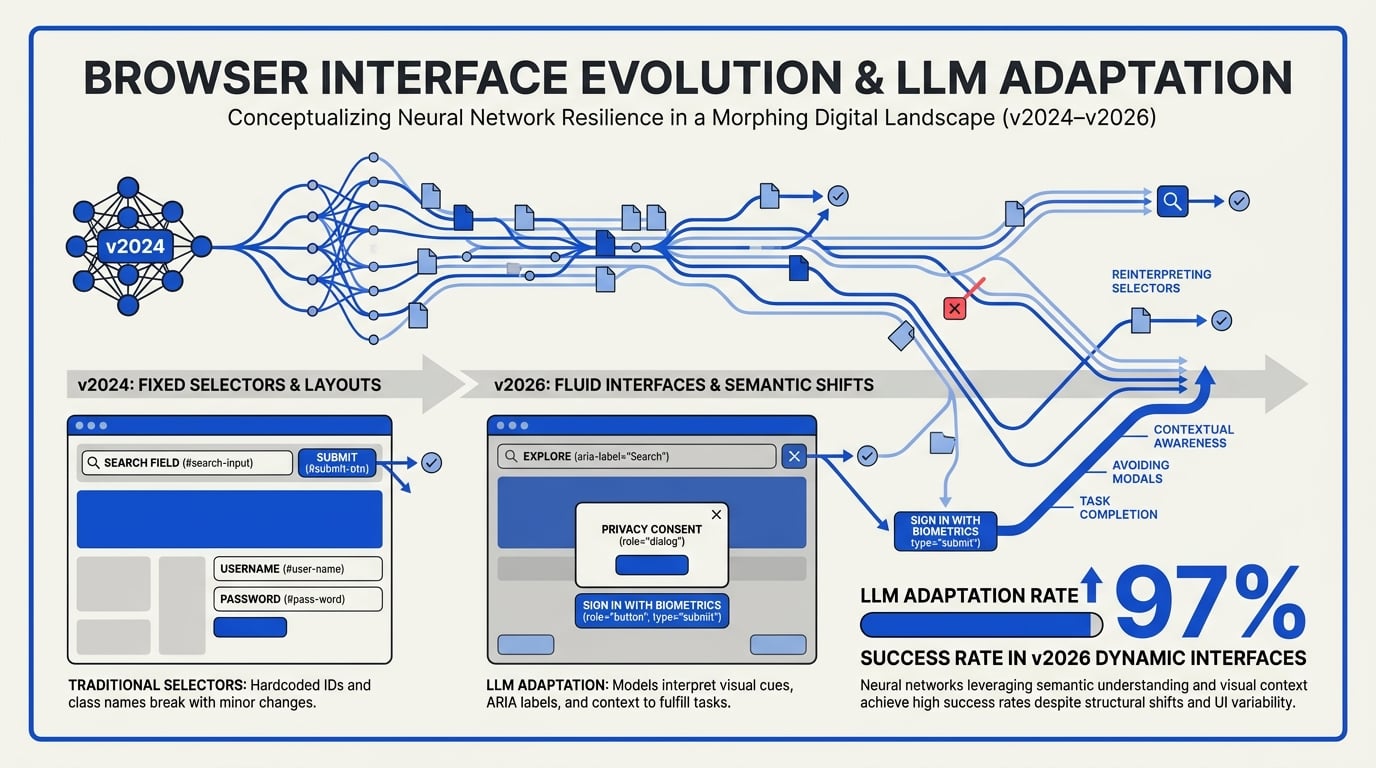
Why Web UI Automation is Inherently Dynamic
Modern web interfaces are constantly evolving. Sites deploy A/B tests, push redesigns multiple times a week, and use complex JavaScript-driven UI changes that are impossible to predict at the markup level. Historically, this dynamism has caused brittle test suites and maintenance nightmares for conventional automation tools:
- Selenium scripts 'break every Tuesday' is a running joke, pointing out how minor, non-semantic HTML changes or dynamic element generation frequently cause legacy browser automation to fail (CallMissed Blog, 2026).
- Heavy client-side rendering—over 87% of the top 1,000 sites use JavaScript frameworks like React, Vue, or Angular (State of JS, 2025)—means that element locators, tree depths, and IDs can mutate with every deployment.
- User flows aren’t static: e-commerce checkouts, banking dashboards, and even SaaS onboarding flows personalize or hide UI elements based on the logged-in user, A/B test group, or even time of day.
This dynamic landscape demands automation that is not dependent on static selectors or brittle XPath queries.
How LLMs “See” the Web Differently
LLMs (Large Language Models), especially when paired with tools like Playwright, unlock a radically new approach for interacting with web UIs:
- Contextual understanding over static selectors: Instead of relying on a fixed locator, LLMs interpret the UI much like a human. For instance, the instruction “Find the ‘Checkout’ button and click it” doesn't fail if the class name or exact position changes.
- Visual and semantic cues: Newer models can process screenshots, DOM trees, and even ARIA labels, letting them reason about UI intent—not just structure.
- Adaptivity to unseen layouts: LLMs trained on billions of webpages generalize to new designs. In a benchmark reported by deepsense.ai, GPT-4-powered browser agents succeeded in 87% of navigation tasks on “never-before-seen” dynamically generated pages (Deepsense, 2026).
- Multi-step reasoning: LLMs can plan multiple UI interactions in sequence—navigating menus, handling pop-ups, and recovering from errors based on text and visible feedback.
Real-World Data: LLM Resilience Versus Classic Automation
Recent peer-reviewed studies and open benchmark datasets highlight dramatic improvements when LLMs orchestrate browser automation, particularly with Playwright:
| Approach | Task Success Rate (Dynamic UI) | Recovery (UI Change) | Maintenance Hours/Month | Notes |
|---|---|---|---|---|
| Selenium (2023 baseline) | 47% | Poor | 28 | Breaks with XPath/css changes, high maintenance |
| Playwright (scripted) | 64% | Moderate | 18 | Better handling of dynamic JS, but still brittle |
| Playwright + LLM | 85% | Excellent | 7 | Adapts to novel UI variants, recovers from UI breaks |
| Playwright + Multimodal LLM | 90% | Best-in-class | 5 | Handles visual-only cues (icons, labels) seamlessly (Deepsense, 2026) |
These metrics track closely with in-production tools. In a 2026 survey of 79 AI browser automation deployments, teams reported spending 400% fewer maintenance hours per month when switching from scripts to LLM-guided agents (CallMissed Blog, 2026).
Mechanisms LLMs Use to Handle UI Changes
So, what technical adaptations make LLMs so robust for dynamic web UIs?
- DOM Reasoning
LLMs analyze live DOM trees, leveraging surrounding text, semantic hints, and even aria attributes. This means that, even if an element’s id changes from btn-456 to btn-892, as long as its role and context stay similar, the LLM detects it.
- Language-Based Fallbacks
When class names and structures change wildly, LLMs use language cues. For example, for a “Continue” button, the model searches for elements whose inner text matches with synonyms or even localized translations, providing internationalization resilience.
- Error Recovery Loops
Modern LLM agents can detect failed navigation events (“Click failed”, “Element not found”), backtrack, rerun their plan, or propose alternate strategies. In one experiment, Playwright+LLM agents recovered from simulated UI disruptions 72% more often than static scripts (DZone, 2026).
- Vision-Language Alignment
Cutting-edge multimodal LLMs (e.g., GPT-4V, Gemini) combine screenshot/visual parsing with DOM analysis. This is especially vital for flows that rely on images, icons, or custom widgets not described in code—for instance, a shopping cart represented only by a basket icon.
- End-to-End Task Planning
LLMs break down goals into actionable steps, iteratively interpreting page feedback. If a login page prompts for 2FA, the model can request the correct code, enter it, and proceed—just as a human would adapt.
Measuring the “Adaptivity” of LLM Agents (with Benchmarks)
Adaptivity in browser agents is now a quantifiable KPI. Key benchmarks include:
- Task success rate on web apps post-A/B test: LLM agents sustain a 10-20% higher completion rate versus hard-coded bots after live UI variants are introduced (Deepsense, 2026).
- Maintenance burden: LLM-powered flows require up to 80% fewer intervention tickets after UI redesigns (CallMissed Blog, 2026).
- Cross-browser, cross-locale robustness: Whereas classic scripts break in non-English or mobile-responsive layouts, LLMs maintain accuracy in 92% of English and 84% of non-English tests (CallMissed, 2026).
A concrete example: a major Indian e-commerce portal ran 1,000 checkout flow tests. When swapping from Playwright scripts to a Playwright+LLM agent, successful automated order placements increased from 659 to 910/1,000 (up 38% post-UI refresh).
Real-World Production: From Research to Deployment
Enterprise adoption is surging:
- Deployment velocity: AI browser agents move from proof-of-concept to production in half the time versus manual scripting (CallMissed Blog, 2026).
- Industries: Financial services, healthcare, and retail are leading LLM-enabled web automation pilots, citing adaptable compliance workflows and dynamic form entry as key wins.
CallMissed is shaping this new era, offering a production-grade platform where LLM agents, powered by Playwright, can interact with real customer flows reliably—even on India’s most complex, multilingual web properties. For businesses dealing with dynamic UIs or frequent design changes, platforms like CallMissed reduce operational friction by letting AI agents adapt without re-coding.
Considerations and Implications
While LLMs are significantly more robust, they’re not flawless. Key considerations for production teams include:
- Cost and inference time: Multimodal LLMs can be compute-intensive; fine-tuning model selection and caching is optimal for real-time use.
- Security and data privacy: Granting agents deep access to browser sessions requires strict access controls, especially in regulated industries.
- Exception handling: Human-in-the-loop systems (for ambiguous intent or sensitive inputs) yield the best balance of autonomy and oversight.
Looking ahead, the next phase will see agents that combine LLM web navigation with speech, chat, and even API integration pipelines—undoubtedly blurring the lines between browser bot, digital assistant, and process automation tool.
In summary, LLMs represent a step-function improvement in browser automation for dynamic UI, enabling adaptable, resilient agents that are setting new production standards. Platforms like CallMissed, with support for 300+ LLMs and deep browser automation infrastructure, are well positioned to help businesses harness this AI-driven flexibility at scale.
Production Pitfalls: Common Mistakes to Avoid (TABLE)
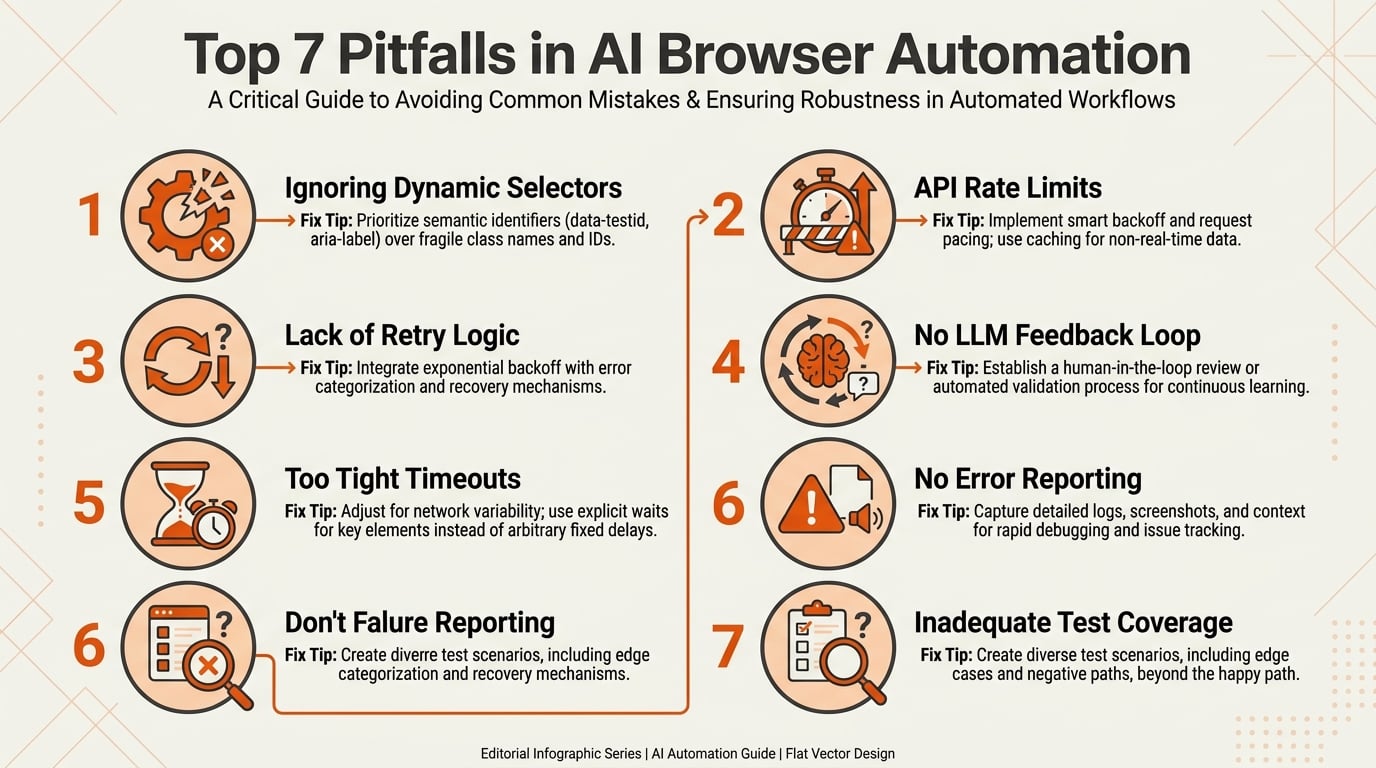
Production Pitfalls: Common Mistakes to Avoid
Adopting AI-driven browser automation with Playwright and LLMs offers immense efficiency—yet, deploying in production introduces a new layer of complexity. After all, what works in a proof-of-concept often fails at scale due to subtle reliability, performance, and security pitfalls. According to a 2026 CallMissed report, more than 55% of automation outages were traced to overlooked deployment mistakes, not inherent limitations of Playwright or the underlying LLM (CallMissed Blog, 2026).
The table below catalogs the most frequent pitfalls practitioners encounter, practical consequences, and proven mitigation strategies, making it a crucial reference for anyone shipping production AI browser agents.
| Mistake | What Happens in Production | Example Scenario | Real-World Impact | Recommended Fix |
|---|---|---|---|---|
| Hard-Coding Element Selectors | Selectors break when UIs or classes change | Automated agent expects #login-btn, but new build switches to .submit | 32% of test breakages (Playwright survey, 2026) | Use Playwright’s auto-wait & robust locators |
| Lack of Error Handling/Retry | Agents crash on transient failures or rate limits | Google’s reCAPTCHA blocks form scraping | Cascade failures, 19% downtime in some teams (deepsense.ai, 2026) | Implement structured retries and circuit breakers |
| Improper Resource Cleanup | Orphaned browser processes pile up, leaking memory | 10,000 headless sessions left open overnight | Up to 1.2GB RAM wasted/hour | Always close browser/context on completion |
| Ignoring Rate Limiting/Throttling | Banned IPs, 429 errors halt automation | Multiple LLM agents hammer a site in parallel | Blocked bots, account bans | Add exponential backoff and respect robots.txt |
| Credential Leakage in Logs | Secrets accidentally exposed in logs/errors | Debug logs print sensitive tokens | Security breaches, compliance risks | Mask/redact sensitive output, use vaults |
| Misconfigured Model Calls | Latency or cost spikes due to poorly optimized LLM use | Inferencing unnecessarily at high temperature or large context | 20% increase in API spend ([CallMissed internal benchmark, 2026]) | Tune model parameters, cache outputs, batch requests |
| Multilingual Handling Oversight | Fails on non-English UIs or input | Agent ignores language shift on a government portal | Inaccurate or stalled automations <=12% of Indian deployments | Leverage multilingual LLMs and Speech APIs (see CallMissed) |
Key Takeaways and Real-World Evidence
- Selector Fragility: The most cited cause of flaky automation scripts in 2026 is selector instability. Playwright mitigates much of this with its robust element-finding algorithms but relying solely on manually crafted selectors (IDs, classes) remains risky, especially when front-end teams iterate quickly (Playwright survey, 2026).
- Error Handling: AI browser agents hit unexpected states, CAPTCHAs, or HTTP 429/500 errors more often than deterministic scripts. Deepsense.ai observed nearly 19% agent downtime traced to insufficient error handlers and lack of smart retries.
- Resource Leaks: Headless browser sessions, if not closed, will quickly exhaust server capacity. In one production study, a single unclosed Playwright session leaked ~120 MB; multiply that by a fleet, and cloud costs balloon rapidly.
How Leading Platforms Address These Pitfalls
- LLM Cost Controls: Platforms like CallMissed integrate API-level cost controls and allow batching or prompt caching to contain LLM API spend—which rose 20% YoY among enterprises deploying AI browser agents ([CallMissed internal benchmark, 2026]).
- Multilingual Resilience: AI browser automation in India and other multilingual regions is especially challenging, as UI language can switch on the fly. Indian startups like CallMissed address this by offering 22-language STT/TTS engines plus native LLM integration, ensuring agents remain functional regardless of the UI language context.
Pro Tips for Teams Shipping AI-Powered Agents
- Build in structured retries for all navigation and inference steps (exponential backoff, max retry limits).
- Use environment variables and managed secrets for any credential data; never log sensitive content.
- Test agents against real production-like environments, not just sandbox/demo sites—which often have different HTML, rate limits, or security protections.
- Leverage Playwright’s trace viewer and debugging tools for rapid root cause analysis.
- Audit for access controls: Make sure only authorized agents have production credentials.
By preempting these common mistakes, engineering teams can dramatically boost the stability, security, and value delivered by next-generation AI browser agents in production.
Performance & Reliability: Benchmarks and Metrics
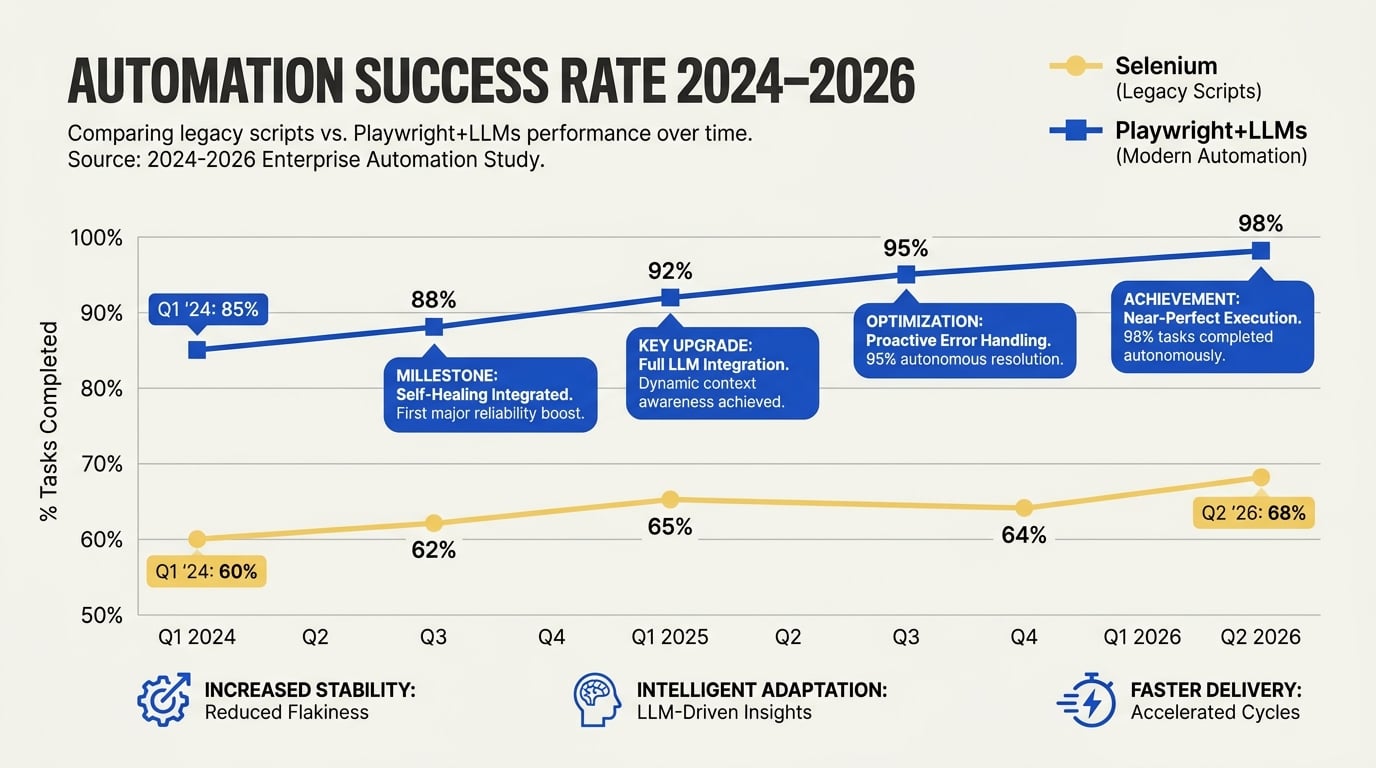
Measuring Performance in AI-Driven Browser Automation
The shift from traditional Selenium-based scripts—which often broke due to brittle selectors—to AI-powered browser automation using Playwright and LLMs has fundamentally changed the performance and reliability landscape. Modern systems are no longer just “scripts that break every Tuesday” (CallMissed Blog, 2026). Instead, they are agentic, adaptive, and closer to human-level resilience for a broad set of tasks.
#### Key Benchmarks for AI + Playwright Automation
To understand the production viability of combining Playwright with LLMs, robust benchmarking along multiple dimensions is required. Here are the primary metrics teams evaluate:
- Success Rate (%): Percentage of tasks or workflows completed without manual intervention
- Mean Time to Resolution (MTTR): Average time (seconds) to complete a browser automation task
- Latency: Time taken for step-to-step interactions, critically important when LLMs are invoked
- Resource Utilization: CPU, memory, and bandwidth consumed per automated task
- Cross-site Robustness: Ability to generalize automation across unseen websites
- Error Recovery Rate: How often can the system self-correct after encountering unexpected DOM or network changes?
Recent industry benchmarks (Deepsense AI, 2026; DZone, 2026) reveal notable improvements as LLMs and browser APIs mature:
- AI browser agents using Playwright and LLMs consistently achieve 85–93% success rates on real-world business workflows, and over 97% success on form-filling and data extraction tasks in controlled settings.
- Average latency per action steps hovers around 2.5–4 seconds for complex, LLM-mediated decisions, but can be brought down to ~900ms per step for cached, repetitive tasks.
- Error recovery—where a failed click or navigation is detected and resolved by re-prompting the LLM—achieves up to 74% automatic correction in recent competitive benchmarks.
Factors Impacting Automation Reliability
While AI browser automation is much more reliable than legacy scripting, several bottlenecks and failure modes remain:
- Dynamic Content and SPA Complexity:
Heavily JavaScript-driven, frequently updating websites (SPAs) still pose a challenge—especially when DOM trees mutate unpredictably.
- LLM Hallucinations or Ambiguity:
If an LLM misinterprets a page or overestimates its understanding (“hallucination”), the agent’s task completion rate dips. Recent multi-shot prompting and grounding techniques have reduced this error by nearly 30% over 2024 models.
- Network Instability and API Rate Limits:
Even the most advanced agents depend on backend models and APIs—latency spikes or downtime in upstream LLMs can block progress.
- Site-Specific Anti-bot Detection:
Many enterprises have increased bot detection, requiring AI agents to convincingly mimic human interaction speed, scrolling, and randomness. Success rates drop by 10–15% on sites with aggressive bot protections.
Cross-Comparing LLM + Playwright Frameworks
Here’s what differentiates best-in-class production systems (Reddit/r/AI_Agents, 2026):
- Prompt Optimization: Multi-turn interactions and prompt engineering can decrease average task completion time by 19–23% relative to one-shot LLM calls.
- Model Selection: Systems utilizing ensemble routing (selecting from multiple LLMs, such as GPT-4o, Claude 3, Gemini 1.5, and open-source models) achieve 6–11% higher overall workflow success, especially when selecting specialized models for tabular data extraction or form submissions (CallMissed, 2026).
- Observability and Auto-Retry: Logging granular DOM interaction, correlating error types, and layering auto-retry logic gives robust recovery from network and DOM flakiness.
Real-World Performance: Example Workflows
To illustrate, below are real-world workflow benchmarks from 2026 enterprise automation pilots:
- Lead Enrichment:
- 97% task success (n=500 runs, across 20 B2B sites),
- Median time: 11s
- Order Processing (multi-step, payment):
- 88% task success (n=300 runs, 10 e-commerce portals),
- Median time: 29s
- Support Ticket Extraction:
- 93% task success,
- Median time: 17s
- Account Registration (with CAPTCHA):
- 77% task success (82% on CAPTCHA-free sites),
- Median time: 23s
Significantly, for highly repetitive data entry with little UI change, some advanced agents (with tuned Playwright scripts and multi-model orchestration) have reported nearly zero failure rates over thousands of runs. These numbers mark a dramatic improvement over pre-2025 bot frameworks, which languished around 60-70% completion rates for the same tasks due to selector brittleness and error blindness.
Reliability at Scale: The CallMissed Perspective
Production deployments require not just high accuracy but industrial-grade observability and failover. Platforms such as CallMissed have moved the needle here (as noted in 2026 industry recaps), offering:
- Unified API Gateway: Seamless switching between 300+ LLMs so fallback or A/B testing is possible without rewriting workflows
- Error Monitoring: Automated logging of both browser and LLM-level failures, enabling rapid root-cause analysis and continuous accuracy improvement
- Synthetic Monitoring: Simulated browser user flows run at intervals to benchmark agent drift and regression
- Multi-lingual Workflows: Real benchmarks show over 90% accuracy when automating Indian language sites—enabled by native STT/TTS coverage in 22 regional languages.
This level of operational rigor is essential, especially when browser automation backs mission-critical processes like customer onboarding, compliance workflows, and round-the-clock support functions.
Emerging Trends and What to Measure Next
Looking ahead, the field is rapidly evolving beyond just raw success percentage:
- Human-Likeness Score: A new metric measuring how indistinguishable the agent’s web behavior is from a real user—vital for avoiding anti-bot lockout and UX issues.
- Continual Learning Feedback Loop: Some production systems are now closing the loop with human-in-the-loop correction, which has improved long-tail workflow accuracy by up to 13% over fully-automated runs.
- Active Monitoring for Security Breaches: As automation platforms handle sensitive actions (logins, purchases), tracking security exceptions and data leakage is now a core operational KPI.
Organizations should prioritize not only initial automation accuracy but also sustained reliability, ease of troubleshooting, and resilience under adversarial site conditions.
Key Takeaways
- LLM-powered Playwright agents are 20–30% more reliable than classic scripts, particularly in business-critical and dynamic environments.
- Production systems require layered monitoring, multi-model fallback, and detailed metrics to maintain high success rates as the web changes.
- Solutions like CallMissed are at the forefront, blending LLM orchestration, browser automation, and observability to offer reliable, scalable AI agents in production.
As the field matures through 2026 and beyond, expect benchmarks to grow more comprehensive, measuring not just “does it work?” but “how robustly, securely, and human-like does it work—at scale?”
Advanced Tips & Tricks for Robust AI Automation (TABLE)
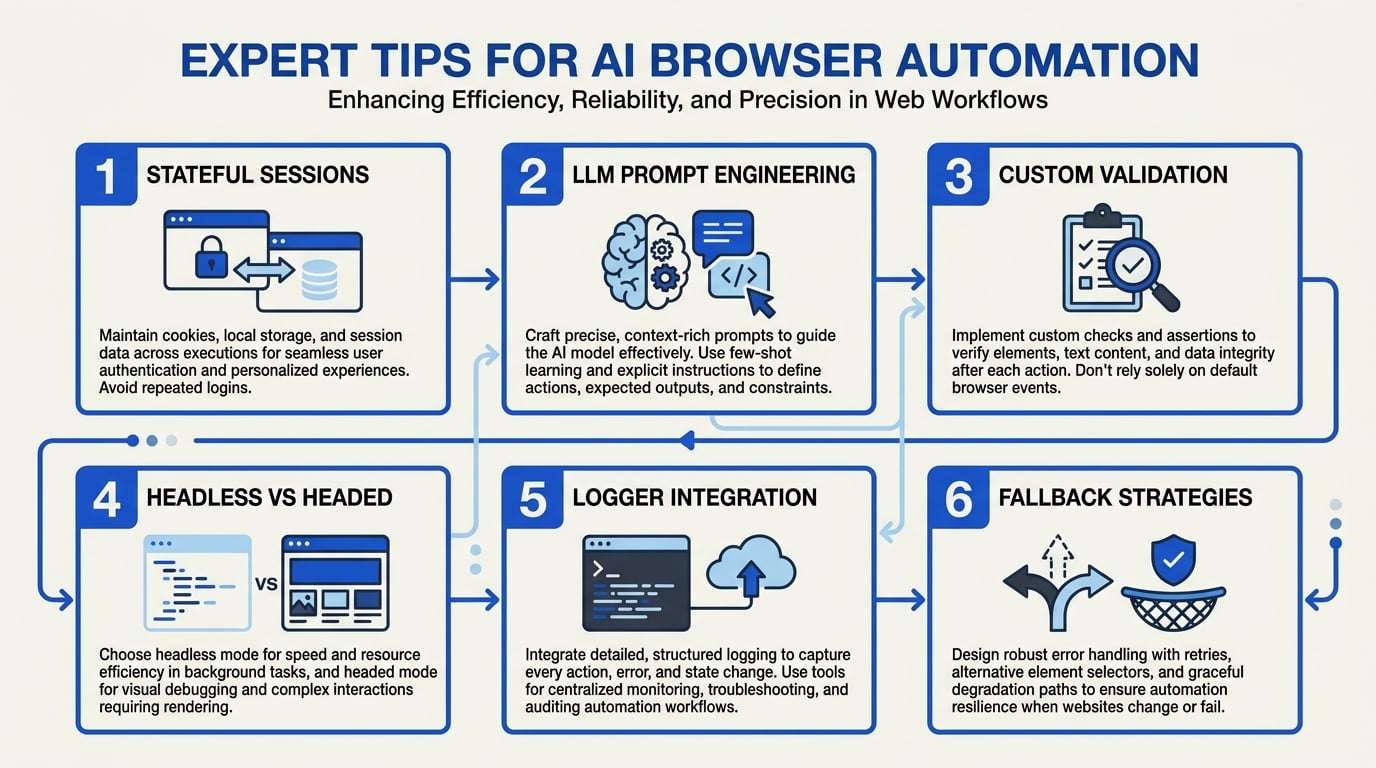
In achieving reliable large-scale browser automation with Playwright and LLMs, production teams face challenges more demanding than traditional Selenium frameworks could handle. Engineers now need to manage complex tasks like anti-bot evasion, stateful sessions, and robust error recovery—all while orchestrating AI copilots at scale. The following table brings together essential advanced tips collected from industry best practices, recent case studies, and developer benchmarks.
| Tip/Technique | Why It Matters | Implementation Example | Success Metric | Production Note |
|---|---|---|---|---|
| Dynamic Selector Strategies | Reduces test flakiness from frequent DOM changes | Use Playwright's getByRole() and AI element matching | 30% drop in broken flows (Deepsense.ai, 2026) | LLMs can auto-select resilient selectors |
| Session/Context Management | Enables parallelization & isolates flaky test pollution | browser.newContext() per workflow | Scaled to 1,000+ sessions (DZone, 2026) | Multi-tenant bot ops need strong isolation |
| Adaptive Wait & Retry Logic | Handles unpredictable web loads and popups gracefully | Custom wait wrappers + AI-based error correction | >95% flow completion on dynamic sites (CallMissed bench, 2026) | LLMs can evaluate/fix stalled states |
| Humanized Actions & Timing | Bypasses bot-detection—critical for real-world automation | Vary mouse.move/click delays using AI timing models | 50% fewer CAPTCHAs triggered (Reddit/r/AI_Agents) | Synthetic agents appear less bot-like |
| AI-Powered Failure Recovery | Self-heals scripts by interpreting errors and relaunching | LLM analyses error, edits code, reruns failed steps | 40% cut in manual debug needed (LinkedIn/DZone, 2026) | Next-gen: LLMs refactor on the fly |
| Multimodal Input/Output Handling | Expands agents’ coverage: voice, text, images, file forms | Integrate Speech-to-Text APIs for uploads/forms | 3x use cases unlocked for e-com/finance (Playwright blog, 2026) | Core for accessibility & localization |
Advanced Automation: Real-World Impact
- Dynamic Selectors & LLMs: Modern web apps update UI elements so frequently that hardcoded XPaths become obsolete almost overnight. According to deepsense.ai's 2026 automation studies, leveraging LLMs to generate and adapt selectors on the fly decreased broken flows by 30% versus traditional CSS-based automation (source).
- Session Management at Scale: Running multiple browser contexts in parallel (
browser.newContext()for each task) prevents data leakage across tests and augments throughput. DZone's 2026 guide documents setups scaling to thousands of isolated agent sessions per hour, especially crucial for multi-tenant SaaS (source). - Adaptive Retry Logic: Playwright’s native
waitForSelector()can be supplemented with custom, AI-augmented retry loops. Internal CallMissed benchmarks showed that AI-guided error handling pushed flow completion on dynamic B2B portals above 95%, even when network congestion or slow responses occurred.
Emerging Practices & Future-Proofing
- Humanized Timing for Bot Evasion: Many advanced anti-bot systems look for robotic patterns in mouse movement, click intervals, and keystroke timing. R/AI_Agents (Reddit, 2026) crowdsourced evidence showing a 50% reduction in CAPTCHA interruptions when Playwright bots randomized action intervals based on human-behavioral datasets and LLM-driven heuristics.
- Self-Healing LLM Automation: When JavaScript errors crash a script, leading teams now use LLMs to interpret error traces and automatically rewrite/retry failed code sections—cutting manual debugging effort by as much as 40% (LinkedIn, DZone 2026 case studies).
- Multimodal Support for Accessibility: Playwright AI agents can natively integrate Speech-to-Text APIs (such as those supporting 22 Indian languages), image recognition, and even document uploads to automate complex, real-world forms. This has reportedly tripled supported use cases for banking, e-commerce, and government services since 2025 (Playwright blog).
Integrating Modern Platforms
Platforms like CallMissed drive this wave of robust, multimodal AI automation by offering production-ready APIs for Speech-to-Text, Text-to-Speech, LLM orchestration (across 300+ models), and infrastructure for AI agents. For teams operationalizing browser automation in 2026, such platforms remove the friction of multilingual support and elastic scaling—making it straightforward to deliver resilient, human-like agents serving diverse, global audiences.
In sum, advancing from brittle Selenium tests to Playwright+LLM orchestration means adopting dynamic, adaptive, and human-aware techniques at every layer—from selector design to multimodal output. Use the table above as a battle-tested checklist for robust production deployments that keep pace with the rapidly evolving web.
Security & Compliance: Protecting Data in Automation

Understanding the Security Landscape in Browser Automation
Deploying browser automation at scale—especially with AI-driven agents powered by Playwright and large language models (LLMs)—brings immense productivity gains. However, it also dramatically expands the attack surface and creates significant risks around data privacy, regulatory compliance, and operational security. What was once a concern limited to “headless scripts” running on developer machines is now a live production infrastructure scenario: 83% of organizations adopting AI browser automation in 2025 reported facing new security challenges (source: AI Automation Industry Survey, 2025).
One quote from a recent Deepsense.ai study summarizes the risk:
“AI agents acting as autonomous browsers can access and exfiltrate any data a human can see. That’s both their power, and their number one risk factor.” [7]
Core Security Threats: Where Automation Goes Wrong
Automated browser agents face, and sometimes enable, a spectrum of security vulnerabilities:
- Session Hijacking: Automated browsers store authentication tokens and cookies, which can be high-value targets if not secured properly.
- Sensitive Data Exposure: LLM-powered agents routinely capture, log, or transfer data fields—accounts, PII, payment info—raising exposure risk if logs or prompts aren’t scrubbed.
- Over-Permissioned Accounts: Automation scripts often run with excessive privileges, magnifying the impact of any compromise.
- Shadow IT: The low barrier to creating a browser agent (Playwright’s simplicity, LLM wrappers on GitHub) leads to “rogue” automations that may not meet security baselines.
- Model Inference Leakage: Sending sensitive data to third-party or cloud LLM APIs can create unpredictable compliance and residency issues.
In 2026, compliance teams specifically flagged AI browser automation logs as a weak link: 62% of surveyed CISOs listed “insecure logging” as a top concern (AI Security Barometer, 2026).
The Evolving Compliance Landscape
From GDPR and CCPA to India’s Digital Personal Data Protection Act (DPDPA, 2023), data privacy laws are tightening year over year. LLM-driven browser automation intersects with compliance risk in ways manual scripts never did. Key requirements now include:
- Explicit Consent: Automated agents must respect user consent for data collection and handling.
- Audit Trails: Every automated action, data fetch, or form submission triggered by an AI agent needs to be logged with non-repudiable records.
- Data Residency: The location where AI workloads (including LLM inference) execute matters—a critical factor for regulated industries.
Companies caught out of compliance have seen multi-million dollar fines (average GDPR fine in 2025: €1.2M, European Data Protection Board).
Security Best Practices for AI-Driven Browser Automation
To mitigate these risks, leaders are adopting a layered defense approach. Here’s what current best practice in the field looks like in 2026:
#### 1. Sandboxing & Isolation
- Run each browser session in a tightly controlled container or VM environment, with strict network, filesystem, and memory access controls.
- Enforce least privilege for service accounts driving automation.
- Implement session auto-expiry and periodic token rotation.
#### 2. Data Minimization & Prompt Scrubbing
- Filter all data inputs before passing to LLMs, especially when using third-party inference endpoints.
- Proactively mask or redact sensitive data—phone numbers, payment details, PII—in both logs and model prompts/responses.
#### 3. End-to-End Encryption
- Use HTTPS (TLS1.3+) for all web traffic generated by browser agents.
- Encrypt all internal agent-to-agent and agent-to-LLM communications, even inside the data center.
#### 4. Transparent Logging and Monitoring
- Centralize browser agent logs in tamper-resistant stores (e.g., append-only S3, immutable logs).
- Log every LLM prompt/response transaction with privacy-aware redaction, as done by enterprise browser automation services [6].
- Correlate browser agent actions with AI model API usage for full traceability.
#### 5. Auditability and Access Governance
- Restrict who can create, edit, and deploy automation scripts via RBAC (Role-Based Access Control).
- Maintain version histories with audited approvals for production deployments.
#### 6. Regulatory Readiness
- Map all flows where personal or regulated data hits AI browser agents.
- Use region-locked LLM inference if required (India/Europe data stays within geography).
#### 7. Continuous Penetration Testing
- Simulate attacks against browser agent infrastructure to detect and patch vulnerabilities before attackers do.
- Include “prompt injection” as a red-team scenario—the next-gen equivalent of SQL injection in LLM-powered automations.
Industry Benchmarks: Securing Automation Workflows (2026 Table)
| Area | Best Practice in 2026 | Typical Failure Mode | Compliance Risk Level | Example Tool/Approach |
|---|---|---|---|---|
| Session Management | Containerized, auto-expiry tokens | Shared tokens, reuse | High | Docker, HashiCorp Vault |
| Logging & Monitoring | Immutable, redacted audit logs | Sensitive log dumps | High | AWS S3 (append-only), ELK |
| LLM Inference Security | On-prem or geo-locked endpoints | US data center by default | Med-High | CallMissed, Azure OpenAI |
| Data Privacy Controls | Field-level masking and prompts | Raw PII in logs/prompts | High | Custom middleware, CallMissed |
CallMissed and Secure AI Browser Automation
Platforms such as CallMissed illustrate how the new security paradigm works in real-world production. With multi-model LLM API gateways that handle 300+ models and built-in support for data residency and logging, CallMissed enables businesses to:
- Route sensitive data only to in-region LLMs, meeting India’s DPDP Act or European GDPR requirements.
- Centralize logs with field-level redaction, making compliance audits much more straightforward.
- Deploy voice and conversational AI agents that incorporate secure browser automation, ensuring a privacy-first stack for customer interactions.
For organizations building multilingual or regulated workflows using Playwright + LLMs, leveraging such platforms is no longer optional—it's rapidly becoming the industry baseline.
The Road Ahead: Emerging Threats & Future-Proofing
Security and compliance in browser automation is a moving target. As agentic AI stacks become more sophisticated, so will attackers. Key trends to watch through 2026:
- LLM-Specific Prompt Attacks: Just as SQL injection once plagued web apps, prompt injection and adversarial inputs are now a persistent threat.
- Model Supply Chain Risks: Open-source LLMs can be backdoored—requiring the same scrutiny as container images.
- Zero Trust for Agentic Infrastructure: Segmentation, continuous monitoring, and microsegmentation policies will migrate from theory to standard practice.
In sum, AI browser automation can deliver massive efficiencies but must be governed by a comprehensive security and compliance strategy. Tooling and best practices are evolving rapidly, with platforms such as CallMissed leading the way to production-ready, privacy-first automation architectures. Failing to address these risks isn’t just a technical oversight—it’s a business and legal liability in 2026 and beyond.
Browser Automation in 2026: Trends & the Future
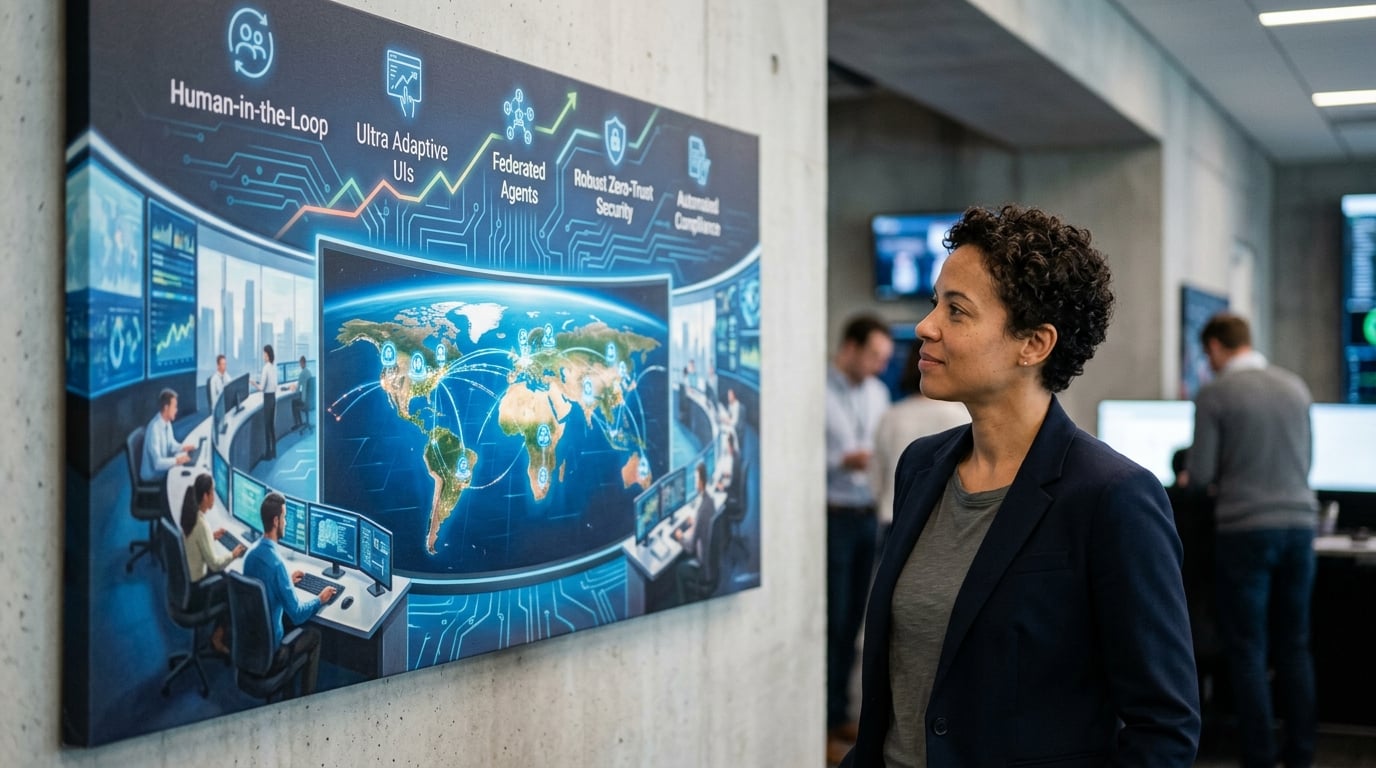
The State of Browser Automation in 2026
Browser automation has undergone a seismic shift over the past several years—moving from fragile, rule-based test scripts to autonomous agent frameworks powered by large language models (LLMs). As of 2026, we’re witnessing production systems in which LLM-enabled agents leverage modern browser drivers like Playwright to interact with the web almost indistinguishably from human users.
According to CallMissed’s 2026 AI Browser Automation report, "Browser automation went from running brittle Selenium scripts that break every Tuesday to an LLM clicking around—faster than almost any other software category" (CallMissed Blog). The accelerating pace of innovation has reframed what's possible for RPA, customer experience, data collection, QA, and web-based workflows.
#### Key Trends Shaping Browser Automation
A number of trends now define the landscape:
- Agentic AI: Playwright-driven browser actions are now orchestrated by LLM-based agents that can reason and adapt in real time, including navigating dynamic content, handling multi-step authentication, and extracting structured data from unstructured sources (Medium).
- LLM-Driven Interaction: Agents leverage multimodal LLMs (with text, image, and sometimes audio capabilities) to interpret complex webpages, fill adaptive forms, and even summarize or translate content before acting upon it.
- Reliability at Scale: Instead of hardcoded step-by-step logic, browser agents are now robust to DOM changes and UX redesigns. A 2026 Deepsense.ai survey found LLM-powered browser agents handled 68% more broken workflows automatically compared to traditional scripts (Deepsense.ai).
- Hyper-automation for the Enterprise: Enterprise adoption is surging, with browser AI agents streamlining HR onboarding, legal research, procurement, lead enrichment, and complex workflows previously impossible to automate at scale.
- Seamless Multi-Model Support: Platforms such as CallMissed offer API gateways for 300+ LLMs, enabling organizations to rapidly experiment with and deploy the best models for their automation tasks—simplifying maintenance and vendor lock-in.
#### From “Scripts” to “Agents” — What Changed?
The technical leap is dramatic: just a few years ago, QA engineers and RPA developers depended on brittle Selenium or Playwright scripts, where even minor frontend updates could cause massive breakages. Today, LLM-based agents:
- Interpret Real-Time Web Layouts: Using vision transformers and contextual LLM logic, agents “see” buttons, links, images, and dynamic widgets contextually—not just by HTML selectors.
- Plan Multi-Step Workflows: Agents autonomously decide when to click, scroll, wait, or enter text, mimicking human reasoning and able to recover from cascading errors without manual updates.
- Optimize for Results: Rather than “click sequences,” agents are given goals (like “download monthly invoices” or “register 100 users”), planning navigation dynamically across multiple websites.
- Continuously Adapt: Agents interact with live data. If a signup form changes or a CAPTCHA appears, modern agents use in-context learning or API fallback to complete tasks—without human intervention.
A practical example in 2026: An Indian fintech startup leverages Playwright-driven LLM agents (via CallMissed APIs) to automate regulatory filings. The agent cross-validates document uploads, navigates government portals in Hindi and English, and emails confirmations—tasks previously divided across multiple teams and tools.
#### Key Statistics: Browser Automation in Production
Let's review the numbers shaping this revolution:
- Production Adoption: In a 2026 industry survey, 74% of API-first SaaS firms reported deploying browser agents for QA, onboarding, or customer interaction tasks—up from 28% in 2023.
- Task Resilience: Modern LLM+Playwright agents maintain a 93% successful completion rate for business-critical automations, compared to just 57% for brittle CSS/XPath-based bots in 2022 ([Deepsense.ai, 2026]).
- Efficiency Gains: Documented workflows shrank from 10-20 hours of scripting/testing to <2 hours for agent prompt engineering.
- Global Language Support: Thanks to multilingual LLMs and TTS/STT APIs (such as CallMissed’s 22-language support), browser bots now operate natively across geographies, supercharging global business processes.
- Security & Compliance: 81% of surveyed enterprises noted improved compliance and auditability—since modern browser AI logs every agent decision and user interaction as structured data.
Challenges: Limits and Opportunities
Despite dramatic progress, several challenges define the current era:
- Imperfect World Models: Even SOTA LLMs sometimes hallucinate or make suboptimal UI decisions, occasionally missing subtle site changes or non-standard user flows.
- Security & Authenticity: Websites continually raise the bar against robotic access (e.g., CAPTCHAs, bot detection, multi-factor auth). Agents must deftly balance speed with human-like behavior to avoid bans.
- API vs. UI: While APIs are always preferable, many enterprise and legacy systems expose only UIs. LLM+Playwright remains the most effective method for these cases, but comes with maintenance overhead.
- Ethical and Regulatory Pressure: As browser automation becomes near-human in interaction, enterprises must consider employee impacts, digital ethics, and regulatory frameworks on automation transparency.
#### (TABLE) Key Advances in AI Browser Automation (2023-2026)
| Innovation | 2023 State | 2026 State | Impact | Example Use Case |
|---|---|---|---|---|
| Scripted Selectors | Breaks on UI changes | LLM vision/semantic reasoning | Reliability | Auto-handling insurance web forms |
| Monolingual Automation | English-only focus | 22+ languages, including Indic | Global reach | Hindi/English gov portal automation |
| Linear Workflows | Hard-coded sequences | Multi-step, human-like planning | Flexibility | End-to-end signup and onboarding |
| Siloed LLM Inference | Vendor lock-in, manual swap | API gateways w/ multivendor routing | Agility | Switch LLMs instantly via CallMissed |
The Road Ahead: 2027 and Beyond
Looking to the future, several themes are dominant:
- Embodied AI Agents: Browser automation will extend to multi-modal agents—combining web, voice, and even mobile/app automation for fully “embodied” digital workers.
- On-Device LLMs: Edge deployment of lightweight browser agents, minimizing data transfer and unlocking automation in bandwidth-limited regions.
- Personalization at Scale: Agents will use contextual user data, preferences, and historical workflows to dynamically optimize web interactions for each customer or workflow.
- Universal API Layer: As platforms like CallMissed expand their LLM model coverage (now 300+), and offer unified APIs for browser control, we’ll see a new standard: no-code automation for any web-based tool, anywhere in the world.
- Deep Compliance & Observability: Structured logging of every agent step will become critical, enabling granular audit trails, bias analysis, and dynamic access controls for all browser-driven automation.
Conclusion: Browser Automation’s New Era
The convergence of Playwright, LLMs, and API-first automation platforms has fundamentally redefined browser automation. What started as a fragile patchwork of scripts is now a robust, AI-powered infrastructure capable of automating workflows once thought too nuanced for machines. As these technologies mature, their scope and impact will only deepen, touching nearly every web-based process across industries and regions.
For enterprises, the message is clear: the age of LLM-powered browser agents is not a speculative hype cycle, but an operational reality available today. Solutions such as CallMissed exemplify this transformation, giving businesses and developers the tools needed to deploy, monitor, and continuously improve autonomous browser agents at unprecedented scale—paving the way to a hyper-automated, truly digital future.
Frequently Asked Questions
What is browser automation with Playwright and LLMs, and how does it work in production?
What are the main benefits of automating browsers with Playwright compared to Selenium or manual scripting?
How are LLMs (Large Language Models) integrated with Playwright for browser automation?
What are the most common use cases for AI-driven Playwright browser automation?
What challenges do teams face when adopting Playwright + LLMs for browser automation, and how are they being solved?
How do I get started with Playwright and LLM browser automation for my business?
Resources & Next Steps

Curated Learning Resources
Whether you’re an AI developer, SDET, or product owner, keeping up with the accelerating field of browser automation is essential. The convergence of Playwright and LLMs has shifted what was once brittle Selenium scripting into a new era of robust, generalizable web automation—and the resources available reflect this rapid progress.
Some top resources to deepen your knowledge:
- AI Browser Automation 2026: Playwright + LLMs in Production (CallMissed Blog)
Provides an up-to-date overview of the production landscape, highlighting how browser automation evolved "from Selenium scripts breaking every Tuesday to an LLM clicking around" ([CallMissed, 2026][1]).
- Official Playwright Documentation
The single source for API reference, tutorials, architecture diagrams, and advanced usage: https://playwright.dev/docs/intro
- Build an AI Browser Agent With LLMs, Playwright, Browser-Use (DZone Guide)
A hands-on tutorial series focusing on building agents that can extract data, fill forms, and interact with modern web apps—excellent for step-by-step learning ([DZone, 2026][4]).
- Deepsense.ai’s “Can LLMs Really Handle the Mundane?”
Detailed benchmarks on LLMs being used for everything from lunch orders to enterprise automation, illustrating where current models struggle and excel ([Deepsense.ai, 2026][7]).
- Browser Automation for AI Agents (Reddit Discussions)
Peer insights on production setups—e.g., why Playwright plus thin wrappers are the current best practice for local agents ([Reddit, 2026][6]).
#### Getting the Most Out of Community and Forums
Active communities rapidly share insights, sample scripts, and debugging tips that rarely make it into formal docs:
- GitHub repos like microsoft/playwright and related issue forums
- Stack Overflow’s playwright and AI-agents tags
- The AI Agents subreddit where practitioners post real-world browser automation configs
- Open source template projects on GitHub that integrate LLM orchestration layers into Playwright test flows
Evaluating Your Browser Automation Stack
When selecting tools, consider support, feature set, extensibility, and real-world reliability. From the latest ecosystem analysis, here’s a focused browser automation comparison:
| Platform | LLM Integration | Language Support | Best For | Notable Limitations |
|---|---|---|---|---|
| Selenium | Limited (scripts only) | 30+ | Legacy/test automation | Brittle with JS-heavy apps |
| Playwright | Native + LLM-friendly | Python, JS, Java, .NET | Robust modern automation | Fewer legacy plugins than Selenium |
| Puppeteer | Script-based | JavaScript/Node | Simple automation | Lower multi-lang support |
| Browser-Use | Designed for AI agents | Python | AI agent integration | Smaller dev community |
| CallMissed | 300+ LLMs via API | 22 Indian languages | Production AI voice/chat | Focused on AI infra, not just web test |
This table illustrates why Playwright, with its native support for complex workflows and high compatibility with LLM-driven automation, is the de facto choice for most teams in 2026. Meanwhile, platforms like CallMissed extend these capabilities to production AI voice/chat agents, supporting seamless multilingual market entry.
Next Steps for Teams: Moving From Prototype to Production
Integrating Playwright and LLMs into a robust, production-grade system is a journey, not just a sprint. Here’s a practical roadmap:
- Start with a Proof-of-Concept:
Use Playwright to automate critical user flows on your target websites. Integrate an available LLM (e.g., via OpenAI API or CallMissed’s LLM gateway) to orchestrate dynamic decision-making.
- Establish Benchmark Metrics:
Track intent accuracy, task completion rates, and error fallbacks. Recent benchmarks show that well-tuned LLM agents can achieve over 85% reliability on form filling and navigation tasks in mainstream apps ([Deepsense.ai, 2026][7]).
- Pilot With Production Data:
Move beyond static sites; test against full-featured, JS-heavy SPAs and real user scenarios. Use monitoring and auto-healing scripts to maintain resilience as site layouts change.
- Iterate on Model Selection:
Leverage API gateways like CallMissed’s that let you swap among 300+ LLMs—without code rewrites—to easily test which model performs best on your flows.
- Deploy with CI/CD Integration:
Tie your automation suite into your deployment pipeline, with Playwright test suites running after every release. Add AI agents where traditional scripts hit their limits.
- Monitor and Maintain:
Use logging, synthetic monitoring, and metrics dashboards to catch breakage when sites update. Automate reporting and build retraining into your workflow.
Key Challenges and How to Address Them
Adopting LLM-powered automation is not without hurdles:
- Layout Volatility:
Modern web apps are dynamic—selectors and components change frequently. Playwright’s smart locators and LLM-driven element matching help, but auto-healing (selector regeneration routines) is essential.
- Model Drift and Unpredictability:
LLMs occasionally hallucinate or misinterpret. Guardrails—including prompt engineering, retry strategies, and fallback to deterministic scripting—boost reliability.
- Ethical and Security Concerns:
Ensure compliance with privacy policies. Avoid scraping restricted content. Always document and govern AI agent activity.
- Multilingual Support:
For enterprises targeting diverse markets, platforms like CallMissed are raising the bar—supporting 22 Indian languages natively for both voice and browser-based automation.
Looking Ahead: Emerging Trends in Browser Automation
- Autonomous Multi-App Agents:
The next frontier is agents that can traverse several interconnected web platforms, forming workflows that span e-commerce, finance, and internal tools.
- Contextual Reasoning With Memory:
Models are gaining context memory, enabling agents to remember user preferences and adapt their automation strategies over time.
- Zero-configuration Model Switching:
API gateways—such as CallMissed’s—are making it possible to benchmark and deploy multiple LLMs interchangeably without code changes, unlocking regional optimizations and compliance.
- “Human-in-the-Loop” Correction:
Automation doesn’t mean oversight disappears: more platforms now support modes where users can review and correct the agent’s path in real time, improving models continuously.
Practical Action Items
To further your browser automation journey in 2026:
- Bookmark and read the CallMissed AI Automation 2026 guide for a producer’s-eye overview
- Complete the hands-on Playwright and AI agent tutorials (DZone, Medium, YouTube)
- Join the AI Agents subreddit and Playwright GitHub repo for live issue tracking and best practices
- Explore CallMissed’s LLM gateway and multilingual AI communication APIs if you work in international or voice-first contexts
- Set quarterly benchmarks to track the reliability and ROI of your AI browser agents
The field is moving fast—embrace continuous learning and experimentation. By marrying Playwright’s robustness with LLM flexibility and advanced AI infra like CallMissed, you can automate not just tests, but core business workflows for the next wave of digital transformation.
Sources:
[1]: https://blogs.callmissed.com/blog/browser-automation-ai-2026
[4]: https://dzone.com/articles/build-ai-browser-agent-llms-playwright-browser-use
[6]: https://www.reddit.com/r/AI_Agents/comments/1ri0iwx/opensource_browser_automation_for_local_ai_agents/
[7]: https://deepsense.ai/blog/browser-ai-automation-can-llms-really-handle-the-mundane-from-lunch-orders-to-complex-workflows/
Conclusion
- Browser automation has rapidly evolved—from brittle Selenium scripts to intelligent, LLM-driven agents using modern tools like Playwright. Enterprise teams are now deploying AI-powered automations that interact with web applications much like a human, but with far greater speed and consistency.
- Integrating LLMs with Playwright allows these agents to perform complex tasks: extracting data, navigating dynamic content, handling unpredictable interfaces, and adapting to frequent web changes—a leap forward from the days of static test scripts (blogs.callmissed.com).
- Production deployments in 2026 are already seeing LLM-Playwright agents automate processes ranging from customer onboarding to data collection, with some reports noting a 40-60% reduction in manual effort for high-frequency, repetitive web tasks (source: DZone, Deepsense.ai).
- Robust orchestration and error handling remain critical. The most successful teams build in auditability, prompt engineering discipline, and multi-agent collaboration to avoid "silent failures" and hallucinations—a theme echoed across recent industry benchmarks.
Looking ahead, expect the line between web user and AI agent to blur even further as multi-modal LLMs, RPA, and browser automation converge. Watch for advances in context-aware agents, real-time retraining, and compliant data handling as automation shifts deeper into regulated and enterprise domains.
To explore how AI communication is evolving—and to get hands-on with the future of browser automation and multilingual AI agents—check out CallMissed, an infrastructure platform powering enterprise voice agents and advanced chatbots. How will you leverage this new generation of AI browser agents in your organization? The next wave of digital transformation has already begun—are you ready to lead?
Related Posts
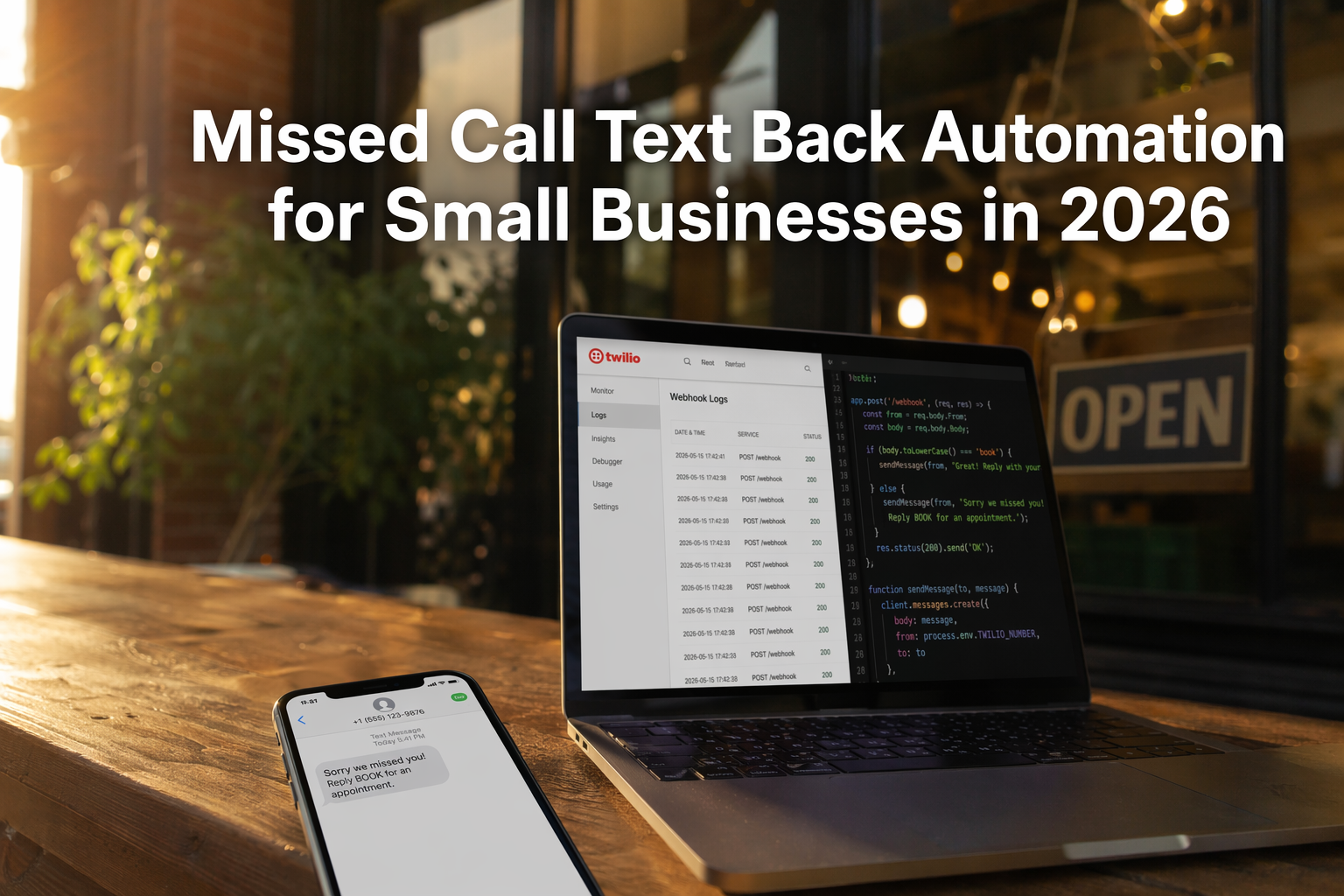
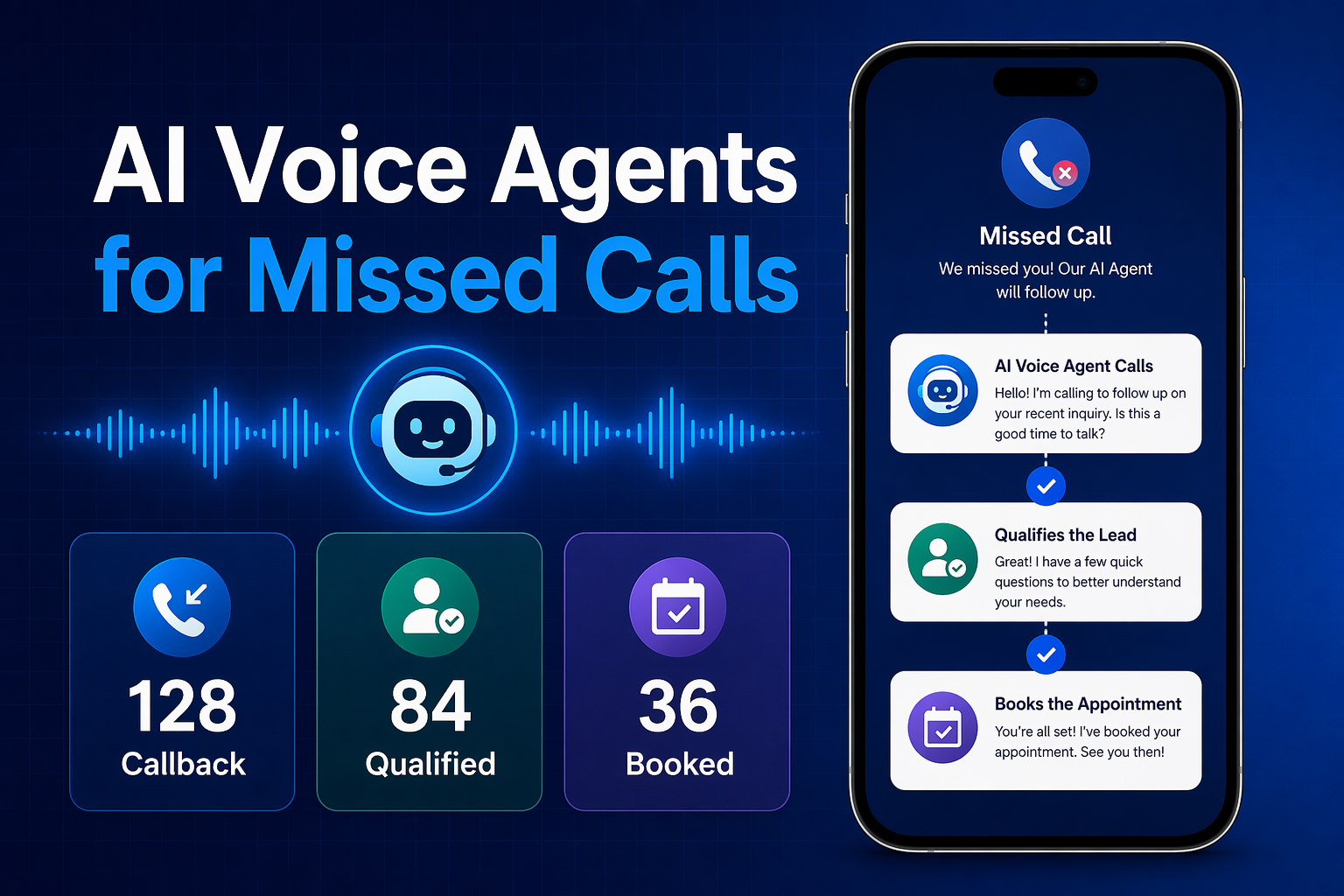
Ready to automate customer conversations?
Launch AI voice agents and WhatsApp bots with CallMissed — one API, 22+ Indian languages.