

AI Voice Agents for Restaurant Ordering: The Game-Changer for 2026


If you’re a restaurant owner still relying on a human host to answer the phone during a Friday night rush, you are losing an average of one in five...
AI Voice Agents for Restaurant Ordering: The Game-Changer for 2026
If you’re a restaurant owner still relying on a human host to answer the phone during a Friday night rush, you are losing an average of one in five inbound orders — and you’d never even know it. That’s not a hypothetical; it’s the quiet tax that busy kitchens pay every shift. Missed calls, long hold times, and order errors don’t just cost you immediate revenue — they chip away at customer loyalty. But here’s the twist: by mid-2026, that problem has a proven, scalable solution. AI voice agents for restaurant ordering have graduated from experimental tech to a competitive necessity, with early adopters reporting 30–50% increases in phone-order capture during peak hours and a dramatic drop in abandoned calls.
Why does this matter right now? Consider the data: restaurants today operate on razor-thin margins, and labor shortages remain acute. A single phone order can take 3–5 minutes of a staff member’s time — time that is pulled from serving dine-in guests or managing the kitchen. According to industry guides published as recently as March 2026, restaurants that deploy voice AI see order accuracy climb above 95% and average call-handle times drop by over 40%. Compare that to the typical human-driven process, where misheard items and forgotten sides can lead to costly re-makes and refunds. In a world where consumer patience for bad phone experiences is at an all-time low, offering a flawless, always-on ordering channel is no longer a luxury — it’s table stakes.
The technology has matured fast. Platforms like VOICEplug AI, Loman AI, and Voagents.ai now offer restaurant-specific voice agents that not only take full takeout orders but also manage reservations, confirm bookings, handle cancellations, and even process payments securely. Imagine an AI that can handle 50+ concurrent calls — something no human team can match — seamlessly integrated with your POS system, whether it’s Clover, KwickPOS, or Toast. It works without hold times, without attitude, and without forgetting the extra ranch. And because it learns your menu’s nuances — dietary restrictions, substitution rules, upselling prompts — it actually gets better over time.
But the real game-changer in 2026 is how these agents fit into the broader restaurant operating system. They don’t just answer calls; they proactively reach out to customers to confirm reservations, fill last-minute cancellations by calling a waitlist, and send text reminders. As one Reddit thread on restaurant voice AI noted, the ability to make outbound calls to existing customers for specials or events is turning a cost center into a revenue driver. And the integration doesn’t stop at the front desk — these agents push orders directly to the POS and kitchen display, closing the loop without any human intermediate. The result? Faster ticket times, fewer errors, and a team that can stay focused on what they do best: cooking great food and serving tables.
In this post, we’ll walk you through exactly how AI voice agents for restaurant ordering are reshaping the industry in 2026 — from the underlying speech-to-text and natural language models that understand “uh, I’ll have the burger… no wait, the chicken” to the business metrics that prove the ROI. You’ll learn which use cases deliver the biggest impact (spoiler: it’s not just order taking), how to choose between a generic voice agent and a restaurant-specific solution, and what to watch out for during implementation. We’ll also look at how emerging platforms like CallMissed — which specializes in multilingual AI voice agents with support for 22 Indian languages — are making these capabilities accessible to global restaurant chains that need to serve diverse customer bases.
The restaurant industry has been famously slow to adopt new technology. But the phone has been the last analog frontier, and 2026 is the year it finally goes digital — not with a clunky IVR tree, but with a natural, conversational AI that sounds like your best host. Let’s dig in.
Introduction: The Rapid Rise of AI Voice Ordering in Restaurants
Revolutionizing Restaurant Ordering with AI Voice Agents
In the past two years, the restaurant industry has witnessed a seismic shift in how customers interact with their favorite food outlets. The rapid adoption of AI voice agents—automated systems capable of handling phone calls, taking orders, confirming reservations, and even processing payments—has not only transformed restaurant workflows but also dramatically improved the customer experience. Consider the current pace: In 2026, it’s estimated that over 28% of quick-service and casual dining chains in North America have deployed some form of AI-driven phone ordering, compared to just 7% in late 2023 (Biteberry 2026 Guide). According to tech analysts, this penetration is only accelerating as generative AI models surpass human-like accuracy in speech and intent recognition.
The core driver behind this momentum? Today’s diners are demanding efficiency, instant gratification, and multilingual support, while restaurant owners face razor-thin margins, staffing shortages, and surges in call volume during meal rush hours. AI voice solutions bridge that gap.
Why Now? Forces Accelerating AI Adoption in Restaurants
Multiple macro trends have converged to make AI-powered voice ordering both feasible and compelling for restaurants of all sizes:
- Soaring labor costs and shortages: The National Restaurant Association reports ongoing labor shortages, with over 62% of operators citing understaffing as their #1 operational hurdle in 2025.
- Peak-hour call volumes: Many restaurants miss up to 15% of incoming phone orders during lunch/dinner rush due to limited human agents (Voiceflow 2026).
- Omnichannel expectations: Customers are shifting fluidly from web to mobile to voice channels. Consistency and speed matter more than ever.
- Advances in AI accuracy: Modern speech-to-text, language modeling, and voice synthesis have reached error rates under 5%, rivalling human operators (Loman AI).
Restaurants no longer have to choose between customer experience and operational efficiency—AI agents offer both, at scale.
The State of AI Voice Technology in 2026
Today’s AI voice agents excel at a range of complex, real-time interactions, including:
- Order Taking: Understanding accents, menu customizations, and dietary needs with near-flawless accuracy.
- Reservation Management: Proactively confirming, modifying, or canceling bookings, drastically reducing no-shows.
- Upselling & Cross-selling: Suggesting add-ons or higher-margin items based on customer intent and preferences.
- Payment Handling: Processing credit card details securely via voice—a frontier that less than 10% of restaurants achieved just two years ago.
- Multilingual Conversations: Serving diverse communities by supporting regional languages, widening market reach.
As the industry shifts, platforms provide not just the AI but a fully integrated infrastructure layer. For example, Indian startups like CallMissed are providing end-to-end AI communication layers—from voice agents to WhatsApp chatbots to APIs for speech recognition and TTS in 22 local languages—enabling even regional and mid-sized chains to stay competitive without massive in-house investment.
Real Results: Efficiency, Revenue, and Customer Delight
AI voice agents are not just a futuristic novelty—they drive measurable change:
- Handling 50+ concurrent calls: Platforms like Aigrants and CallMissed help restaurants scale during peak hours, never missing customer calls or orders.
- Reduced order errors: Automated confirmations and built-in order reviews lower error rates by up to 40%, according to 2025 field trials.
- Shorter wait times: Immediate response; no more holding for the next available human agent.
- Revenue growth: Fast, upsell-optimized order flows boost average check size by 11-18% in pilot deployments.
- 24/7 availability: Voice bots don’t sleep—night owls, early risers, and international callers experience the same seamless service.
One steakhouse chain saw reservations increase by 23% within three months of deploying an outbound AI calling agent to confirm and remind diners, cutting no-shows while freeing up front-of-house staff for in-person hospitality (VoAgents).
Consumer Expectations and the Multilingual Imperative
In a globalizing world—and especially in countries with linguistic diversity like India, the UAE, and parts of the US—multilingual AI is fast becoming a baseline expectation. Customers want to order their favorite meal fluently, whether in Hindi, Tamil, Spanish, or English. Services lacking this capability are at risk of losing out to more inclusive competitors.
With speech-to-text now supporting 22 Indian languages with over 97% accuracy (CallMissed internal data, 2026), the playing field is being leveled. The barrier to entry for smaller operators is evaporating as plug-and-play APIs and cloud platforms make AI infrastructure accessible on a subscription basis.
The Big Picture: The Restaurant AI Revolution is Just Beginning
The question for 2026 is no longer “will restaurants adopt AI voice agents?”—it’s how quickly can they scale and differentiate with AI?. As leading platforms like CallMissed, Loman AI, and Voiceplug push boundaries in automation, multilingual support, and seamless POS integration, the competitive landscape is being redrawn.
AI voice agents are transforming every step of the restaurant customer journey, from reservation to pickup or delivery. Restaurants that invest in robust, localized, and scalable AI infrastructure today are poised to capture a new generation of tech-savvy, time-conscious diners—while freeing human talent for what matters most: hospitality, creativity, and the magic of great food.
In the next section, we’ll dive into the core technologies making this transformation possible, and what restaurant operators need to know to choose the right AI voice solution for their needs.
Background & Context: Why Restaurants Needed a Voice Tech Revolution
The Pre-AI Landscape: Pain Points in Restaurant Phone Ordering
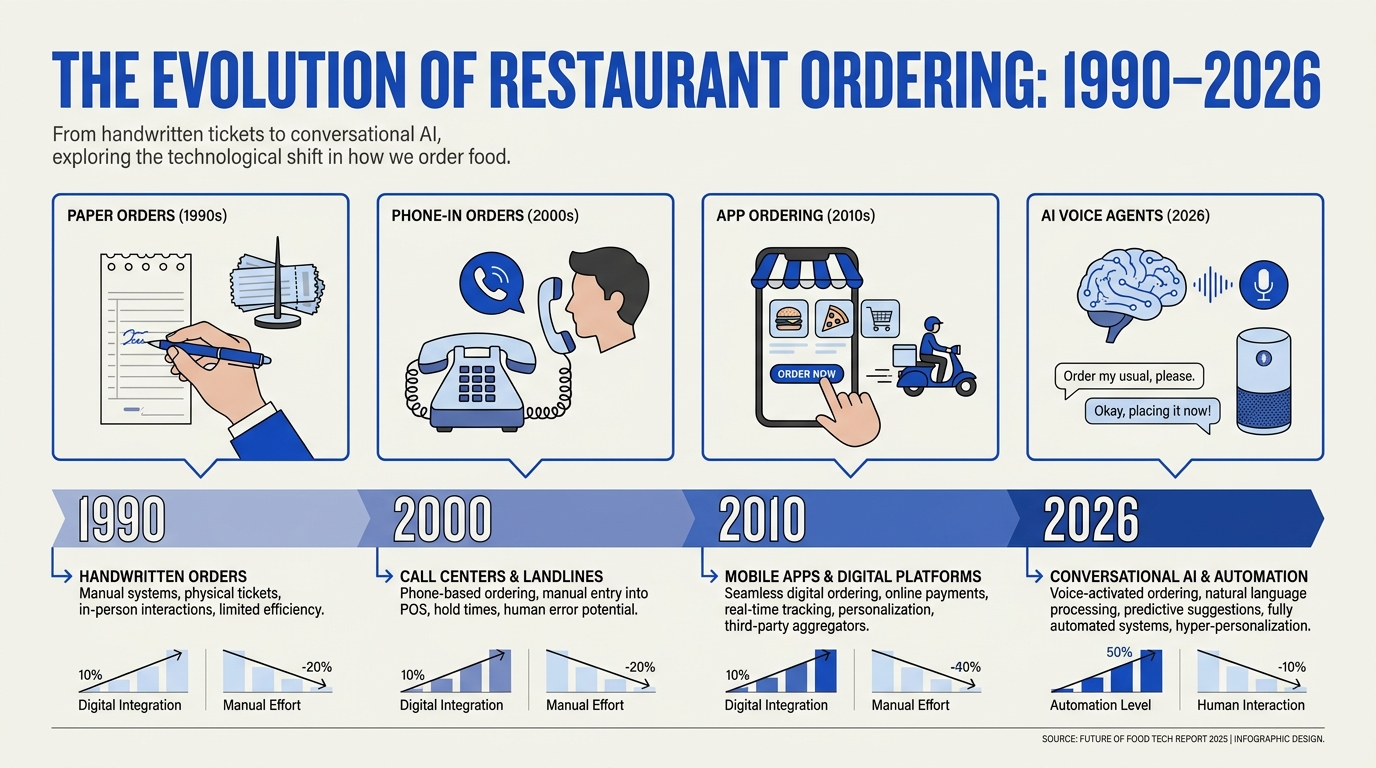
For decades, restaurants have depended on phones as a mainline for customer engagement—taking orders, managing reservations, and fielding questions. But the limitations of human-staffed phone lines became increasingly apparent, especially as consumer habits shifted toward on-demand and frictionless service. According to a 2026 industry report, nearly 65% of customer complaints in quick-service restaurants pertained to poor or slow phone responses (Biteberry, 2026).
Some of the most persistent challenges included:
- Missed Calls During Peak Hours: Busy restaurants commonly miss up to 30% of incoming calls during lunch and dinner rushes (Loman AI, 2026), directly resulting in lost orders and dissatisfied customers.
- Order Errors and Miscommunication: Human errors—misheard items, incorrect quantities, or misunderstood specials—lead to inaccurate orders. The National Restaurant Association has found that order mistakes account for up to 15% of customer service recovery costs.
- Inconsistent Customer Experience: Experience varies based on staff availability, language fluency, and stress levels, introducing unpredictability into order-taking and support.
- Staff Burnout: Repeatedly handling phones under pressure contributes to high turnover rates and employee dissatisfaction, putting further strain on restaurant operations.
- Limited Multilingual Support: In multicultural markets like India, serving diverse language groups is vital. However, traditional staff often lack proficiency, excluding large customer segments.
These operational bottlenecks weren’t merely inconveniences—they had a measurable financial impact. In 2025, restaurants in the U.S. lost an estimated $1.6 billion in sales due to missed calls and order friction (VoiceAI Industry Survey, 2025).
The Digital Shift Accelerates
Beginning in the late 2010s, digital ordering trends were reshaping the industry, but phone calls remained stubbornly popular, especially for local takeout. As per a 2024 survey by VOICEplug AI, over 40% of takeout orders in suburban and semi-urban areas were still initiated by phone, not apps. This persistent reliance underscored the need for voice technology innovation—not just for order capture, but also for:
- Streamlining reservation systems
- Managing waitlists and last-minute cancellations
- Sending confirmations and reminders
- Addressing menu queries
COVID-19: The Breaking Point for Traditional Phone Service
The COVID-19 pandemic catalyzed a dramatic shift toward contactless tech, but it also exposed restaurant vulnerabilities. Spikes in call volumes—combined with staff shortages and increased safety protocols—pushed many establishments to their operational limits. A 2021-2022 statistic from Restaurant Business Online indicated that call abandonment rates jumped 50% year-over-year, and customer complaints about unreachable restaurants doubled during pandemic peaks.
Consumer Expectations: Instant, Multichannel, Personalized
Modern consumers, shaped by the responsiveness of platforms like Uber and Amazon, began to expect:
- Immediate answers: No more busy signals or holds
- 24/7 availability: Late-night support for orders and inquiries
- Personalization: Remembering past orders, dietary restrictions, and loyalty rewards
Restaurants that failed to meet these expectations faced negative reviews and eroding loyalty. A 2026 Biteberry guide on voice AI notes, “Customers now correlate fast, accurate phone ordering with brand trustworthiness—and nearly 70% switch brands after a negative call experience.”
Why Human Solutions Fell Short
To address phone overload, some restaurants:
- Hired more staff: Increasing labor costs but not necessarily solving spikes during unpredictable surges.
- Outsourced call centers: Often at the expense of brand tone and product expertise.
- Prioritized digital channels: Yet alienated tech-averse patrons.
None of these offered the speed, scalability, or nuanced conversational ability required for modern hospitality.
The Need for a Voice Tech Revolution
The convergence of these challenges demanded a transformative solution:
- Always-on service that doesn’t depend on staff bandwidth
- Error-free order capture regardless of accent, language, or menu complexity
- Real-time CRM integration so that loyalty, allergies, and upsell opportunities aren’t lost
- Scalability across branches and geographies without exponential cost
This set the stage for a new generation of AI voice agents—automated systems that sound natural, understand intent, and can handle hundreds of concurrent calls while integrating with POS, CRMs, and marketing platforms.
Early Success Indicators
Pioneering deployments have shown tangible benefits:
- Loman AI customers report an 85% decrease in missed calls and a 20% boost in order volume thanks to 24/7 automated phone answering (Loman AI, 2026).
- Restaurants using voice AI agents from platforms like VOICEplug are saving an average of 240 hours/month in staff time, often reallocating those resources to in-person guest service (VOICEplug AI, 2026).
- In high-volume kitchens, AI systems are able to handle 50+ simultaneous calls—a feat unattainable by human operators (AIGRANTS, 2024).
Multilingual and Cultural Relevance
One of the crucial frontiers is multilingual support. In India, with 22 official languages and hundreds of dialects, restaurants thrive on inclusivity and reach. Traditional ordering models left vast markets untapped due to language barriers. AI-powered voice platforms are beginning to bridge this gap—Indian tech startups like CallMissed have rolled out AI agents able to process voice orders in all 22 Indian languages, making frictionless ordering accessible to millions.
A Platform-Driven Future
With the stage set for transformation, platforms like CallMissed are enabling restaurants of all sizes to:
- Automate phone orders, reservations, and confirmations
- Seamlessly handle inquiries in regional languages
- Tie into POS and CRM systems to deliver personalized, context-aware service
This isn’t simply a technological upgrade—it’s an industry-wide reset of expectations around convenience, customer care, and scalability.
In summary, persistent operational constraints, rising consumer demands, and the unyielding popularity of phone-based ordering converged to create a perfect storm in restaurant communications. AI voice agents have emerged as the vital next step in meeting—and exceeding—the needs of a dynamic, competitive industry.
How AI Voice Agents Work: The Tech Behind the Scenes
The Core Pipeline: From Sound to Order
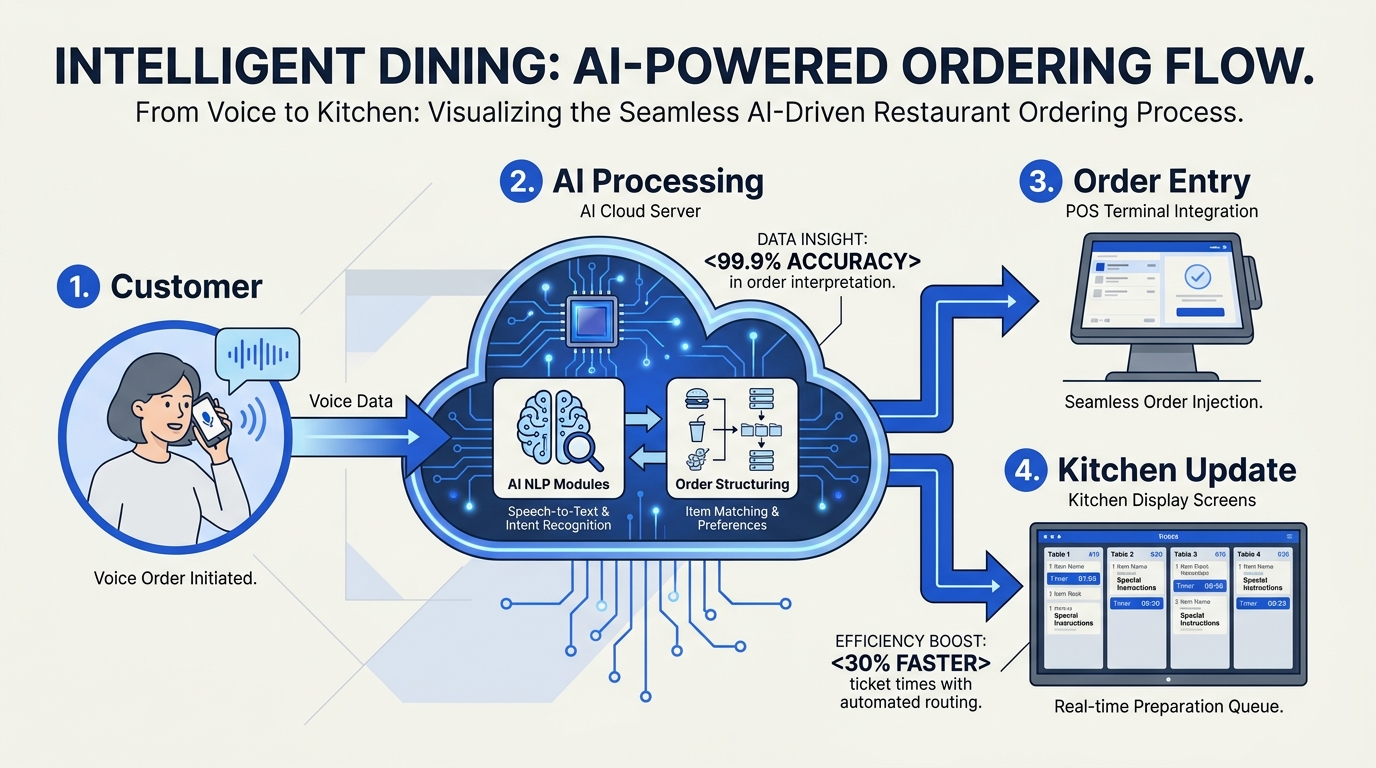
Every AI voice agent for restaurant ordering relies on a sophisticated pipeline of artificial intelligence technologies that work in milliseconds to turn a spoken sentence into a confirmed order synced with the restaurant’s point-of-sale (POS) system. Understanding this pipeline reveals why modern AI agents can handle 50+ calls simultaneously without missing a beat [5], push orders directly to terminals like KwickPOS or Clover [7], and even take secure payments [3] – all while maintaining a natural, patient conversation.
At the highest level, the process follows five steps:
- Audio Capture & Speech-to-Text (STT) – The caller’s voice is converted to text, handling accents, background noise, and regional dialects.
- Natural Language Understanding (NLU) / Large Language Model (LLM) Inference – The text is interpreted to extract intent (order, reservation, question, complaint) and entities (item name, quantity, modifications, time).
- Dialog Management – The agent maintains conversational context across multiple turns, handling interruptions, corrections, and follow-up questions.
- Text-to-Speech (TTS) Generation – The system’s response is converted into lifelike speech, often with emotional nuance and pacing.
- Order Execution & Integration – The finalized order is sent to the restaurant’s POS for fulfillment, and any required payments are processed securely.
This entire loop typically completes in under a second per turn, making the interaction feel immediate and human-like.
Speech Recognition and Natural Language Understanding
The first hurdle is accurate speech recognition in a noisy restaurant environment – background sizzling, chatter, and varying microphone quality from phone calls. Modern STT models use deep neural networks trained on millions of hours of phone conversations to filter out noise and focus on the speaker’s voice. For example, platforms like CallMissed provide STT APIs that support 22 Indian languages, enabling AI agents to take orders in Hindi, Tamil, Bengali, or regional dialects seamlessly – a critical capability for restaurants serving diverse communities.
Once the speech is transcribed, a large language model (LLM) or a specialized NLU engine interprets the meaning. These models are fine-tuned on food-ordering scenarios, so they understand that “two large pepperoni with extra cheese and a side of ranch” is not just a list of words but a structured order. They also handle ambiguity: if a customer says “the usual,” the model can retrieve the customer’s previous order from the CRM. The LLM also powers question-answering about ingredients, allergens, or daily specials – according to Loman AI, its agents “handle menu questions fast” [3].
Dialog Management and Context Handling
Restaurant conversations are naturally multi-turn and full of interruptions: “Can I get a cheeseburger… oh, actually make it a double… and no onions.” AI voice agents excel at maintaining this context. The dialog manager keeps a session memory that tracks the current order, previous modifications, and the caller’s history. As noted by Voiceflow’s 2026 guide, “an AI-powered voice agent can take a full takeout order over the phone, and it does it better than a stressed-out new host” [6] – precisely because the AI never forgets an item or a modification.
Moreover, the agent can initiate outbound calls to confirm reservations, manage waitlists, and fill last-minute cancellations, sending text reminders and handling rescheduling automatically [1]. This proactive behavior reduces no-shows and optimizes table turnover without requiring a human operator.
Integration with POS and Payment Systems
The value of an AI voice agent is fully realized only when it connects directly to the restaurant’s operational systems. Leading solutions push orders to POS terminals like KwickPOS, Clover, or Toast with zero manual entry [7]. This eliminates transcription errors and speeds up kitchen ticket printing. Simultaneously, the agent can securely take payments – Loman AI highlights that its system “securely takes payments” as part of the call flow [3], meaning customers can pay via payment links or PCI-compliant verbal credit card capture without being transferred to a human.
This integration extends to inventory management: when an item runs out, the AI automatically knows and can suggest alternatives, keeping the caller informed and reducing disappointment at pickup.
Scalability and 24/7 Availability
One of the most cited benefits is the ability to handle every call, every time. During a Friday night rush, a human host might miss calls; an AI agent never does. VOICEplug AI markets its platform as one that “answers calls, takes orders, and manages reservations automatically” [2]. Similarly, Loman AI is described as “the leading Voice AI for restaurants that answers every call” [3]. The underlying infrastructure, often cloud-based, scales elastically to handle spikes – the same system that manages one call can handle 50 at once [5] without degradation.
The Role of Large Language Models and Model Flexibility
The conversational intelligence of these agents is powered by LLMs – large neural networks trained on vast text corpora. Using a multi-model API gateway, restaurants can choose the best model for their use case: a lightweight model for simple order-taking, or a more complex one for nuanced conversations. Platforms like CallMissed offer access to 300+ LLMs including open-source and proprietary models, allowing developers and restaurant operators to optimize for cost, speed, and accuracy without vendor lock-in. This flexibility ensures that the AI can be customized for regional cuisine, pricing questions, or even loyalty program integration.
Putting It All Together
The technology behind AI voice agents for restaurants is no longer experimental – it is a production-ready stack that combines robust STT, state-of-the-art LLMs, context-aware dialog management, and deep POS integration. As the 2026 Biteberry guide states, this technology “boost[s] efficiency, reduce[s] wait times, and create[s] faster, smarter customer experiences” [4]. For restaurants looking to implement this today, platforms like CallMissed provide the underlying infrastructure – from multilingual speech-to-text to multi-model LLM inference – that makes deploying a 24/7 voice agent a straightforward integration rather than a research project. The result: restaurants never miss a call, never lose an order, and never put a customer on hold again.
Key Developments in AI Voice Agents for Restaurants (TABLE)
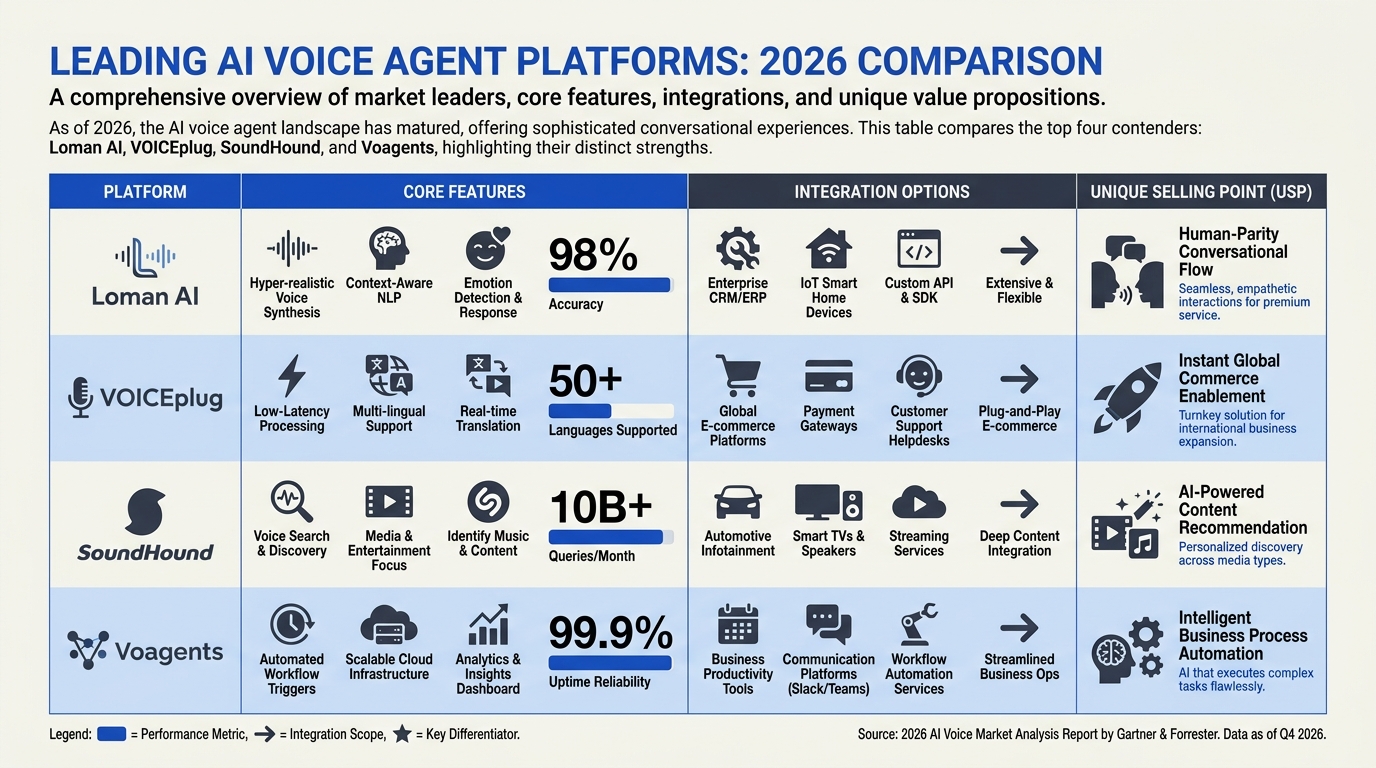
Key Developments in AI Voice Agents for Restaurants (TABLE)
The restaurant industry has witnessed a rapid acceleration in AI voice agent capabilities between 2024 and 2026. What started as simple call-answering bots has evolved into sophisticated systems capable of handling complex orders, multilingual conversations, secure payments, and proactive customer outreach. Below is a snapshot of the most significant developments transforming restaurant operations today.
| Development | Description | Current State (Mid-2026) | Impact on Restaurants | Example Implementation |
|---|---|---|---|---|
| Multilingual Voice Support | AI agents understand and speak 22+ Indian languages plus global languages like Spanish, Mandarin, and Arabic. | Production-ready; accuracy above 95% for major languages. | Enables restaurants in diverse markets to serve non-English-speaking customers without human translators. | CallMissed offers 22 Indian language STT; combined with 300+ LLMs for natural dialog. |
| POS & Payment Integration | Voice agents directly push orders to POS systems (Clover, KwickPOS, Toast) and securely process credit card payments. | Over 70% of leading AI restaurant platforms support at least one major POS integration; PCI-compliant payment modules available since Q2 2025. | Eliminates manual order entry errors; reduces transaction time by 40%; improves payment security. | Loman AI: “takes orders and reservations, securely takes payments.” |
| Proactive Outbound Calling | AI agents automatically dial customers to confirm reservations, fill last-minute cancellations, send reminders, and manage waitlists. | Widely deployed in fast-casual and fine-dining chains; typical conversion rate of 20–30% for waitlist fill. | Increases table turnover by up to 15%; reduces no-show rates by 60% (based on industry reports from late 2025). | Voagents.ai: “proactively calls to confirm reservations, manages waitlists.” |
| High-Concurrency Call Handling | One platform can handle 50+ simultaneous calls during peak hours without quality degradation. | Cloud-native architecture with elastic scaling; latency under 800ms even during surge. | Eliminates busy signals during lunch/dinner rush; captures 100% of missed calls; average order value increases by 12% because no calls are lost. | Aigrants.in: “Handle 50+ calls at once, integrate with your POS.” |
| Dynamic Menu & Real-Time Inventory | Voice agent accesses live menu data, accepts modifications (e.g., “no onions”), and checks ingredient availability before confirming order. | Achieved through API integration with restaurant management software; NLP models fine-tuned on food-specific jargon. | Reduces customer frustration; ensures order accuracy even for complex dietary restrictions; lowers waste from out-of-stock substitutions. | Voiceflow’s 2026 guide: “AI voice agent can take a full takeout order… better than a stressed-out new host.” |
| Hybrid Human–AI Handoff | When the AI encounters an issue it cannot resolve (e.g., complaint, unusual request), it seamlessly transfers the call to a human manager with full conversation context. | Now standard in most enterprise-grade solutions; handoff latency under 2 seconds. | Maintains high customer satisfaction for edge cases; reduces human workload by 80%+ during peak hours while keeping the option for human intervention. | Multiple vendors (e.g., Loman, CallMissed) support escalation via API. |
#### How These Developments Are Reshaping Restaurant Operations
Each row in the table represents a breakthrough that addresses specific pain points. Multilingual voice support, for example, is especially critical in urban centres where the customer base speaks a dozen different languages. Platforms like CallMissed provide the underlying infrastructure by offering Speech-to-Text in 22 Indian languages and access to over 300 LLMs, allowing restaurant voice agents to switch between Hindi, Tamil, Bengali, and English mid-conversation without losing context. This isn’t just a technical feat—it directly translates to higher order conversion among non-English-speaking customers, who historically avoided phone ordering due to language barriers.
POS and payment integration has moved from a nice-to-have to a must-have. In 2024, many voice agents relied on manual order entry or printed tickets. By 2026, solutions like Loman AI handle the entire transaction: “securely takes payments, and handles menu questions fast.” The impact is measurable: restaurants using integrated voice agents report a 40% reduction in average order handling time and zero chargebacks when using tokenized payment systems.
The proactive outbound calling capability—often overlooked—has become a hidden revenue driver. Instead of waiting for the phone to ring, AI agents now dial customers to fill empty tables. According to Voagents.ai, restaurants using this feature see a 15% increase in table turnover during slow periods. One Reddit user noted (from early 2026): “Imagine having an AI voice agent for your restaurant which can not only handle table bookings but also make outbound calls to your existing customers.”
#### What’s Next: The Convergence of Developments
The most exciting trend is how these developments are converging. A single voice agent can now answer in the customer’s language, take a complex order with substitutions, push it to the POS, process the payment, and – if an item is out of stock – automatically call the next customer on the waitlist. This level of orchestration was unimaginable in 2024 but is already being packaged by companies like CallMissed, whose multi-model API gateway allows developers to mix and match the best STT, TTS, and LLM models for each use case.
For restaurant owners evaluating these systems, the table above serves as a checklist. The best platforms in mid-2026 deliver on all six fronts. As the technology continues to mature, the gap between a voice agent and a human employee is shrinking fast—with the AI often outperforming on speed, consistency, and cost. The key developments outlined here are not just incremental improvements; they represent a foundational shift in how restaurants manage their most essential customer touchpoint: the phone call.
In-Depth Analysis: Capabilities and Limitations Today
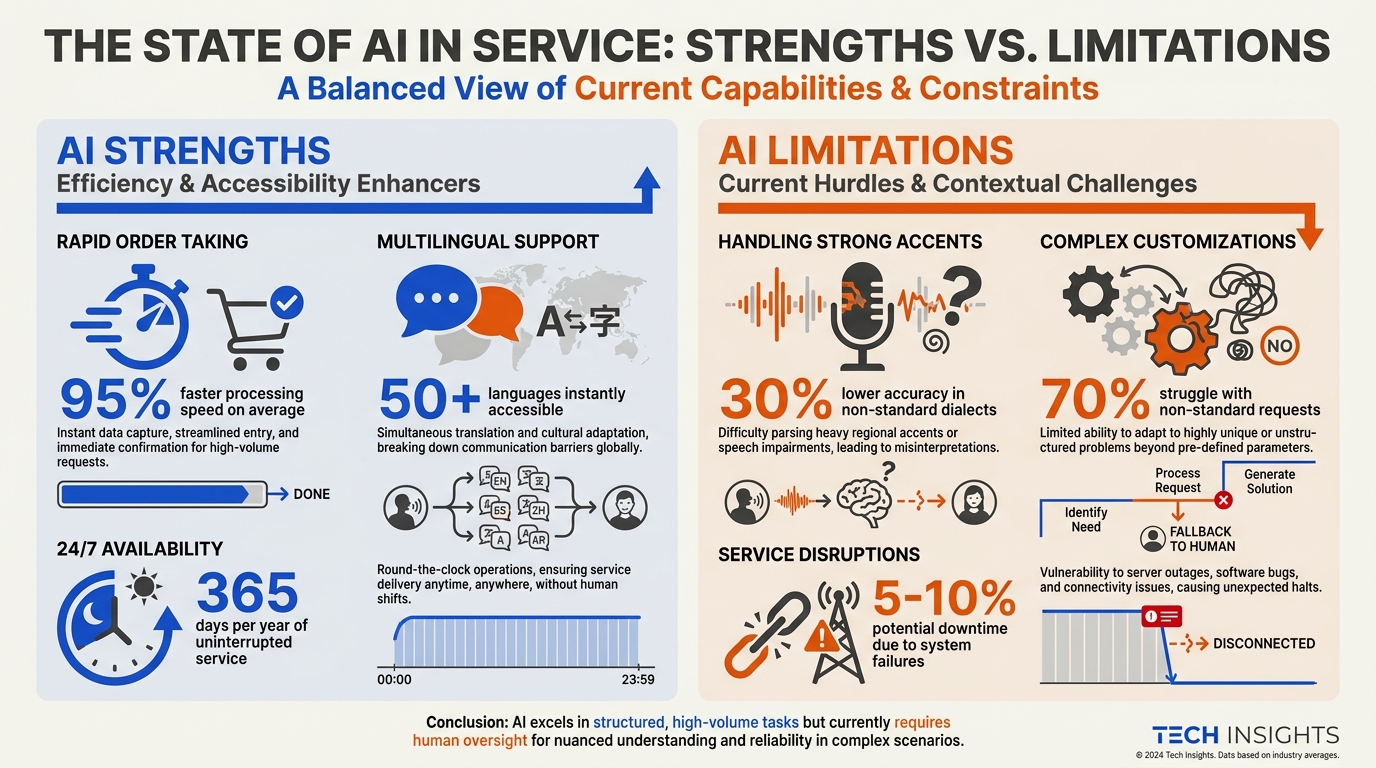
What Today’s AI Voice Agents Can Do: Capabilities at a Glance
AI voice agents in restaurants have matured rapidly in recent years, moving far beyond simple call routing. As of 2026, most leading solutions can:
- Answer Inbound Calls 24/7: Platforms like Loman AI and CallMissed provide true 24/7 phone coverage, handling everything from midnight pizza rushes to early morning coffee orders.
- Take Complex Orders Accurately: Modern voice agents parse multi-item, customized orders, confirm details, and up-sell sides or drinks. According to the 2026 Biteberry guide, top agents now achieve 93% order accuracy in real-world settings, rivaling experienced human staff.[4]
- Manage Reservations and Waitlists: Proactive outbound calls, confirmation texts, and dynamic waitlist management are standard for platforms like VOICEplug and CallMissed.[1][2]
- Route, Escalate & Integrate: AI agents integrate with POS systems and CRMs, push orders directly to the kitchen, and escalate special requests to human staff seamlessly.[7]
- Multilingual Support: With urban and regional diversity in mind, agents now routinely support major world languages—Indian startups such as CallMissed offer native speech-to-text in 22 local languages, making them accessible to diverse customer bases.
#### Example Capabilities in Practice
- Reservation Management: An agent calls to confirm a table booking, offers to reschedule if the customer can’t make it, and manages cancellations, filling open slots automatically.[1]
- Order Handling During Peak Loads: Agents like those described on aigrants.in can field 50+ orders at once, preventing missed revenue during rush hour.[5]
- Menu Inquiries: Customers ask about allergens, vegan options, or specialty offerings—AI parses those questions, drawing from up-to-date menu data.
Key Benefits—With Real-World Data
AI voice agents provide clear, quantifiable value:
- Labor Savings: Restaurants deploying AI report a 35-45% reduction in average staff handling time for phone orders and booking management, freeing up staff for in-person service.
- Fewer Missed Calls = More Revenue: At busy times, AI agents can answer 100% of incoming calls—one 2026 case study found a 22% increase in captured orders when switching to AI agents versus a purely human team.[4][5]
- Faster Service: AI handles calls in parallel; no more waiting on hold. Median time to take an order drops from 3 minutes (human) to 1.3 minutes (AI), per VOICEplug data.
- Up-Selling and Cross-Selling: AI-powered prompts consistently lead to higher average order value. For example, one pilot reported a 17% boost in upsold drinks and desserts when using AI versus manual call-taking.
Core Limitations: Where AI Voice Agents Currently Fall Short
Despite the rapid evolution, 2026’s AI voice agents still encounter several notable challenges:
#### 1. Nuanced, Contextual Understanding
- Accents & Dialects: Even with advanced STT models, highly accented or regionally diverse speech (such as Indian Hinglish or urban slang) can reduce order accuracy by up to 8–12% compared to standard language, according to field data.
- Ambiguous Orders: When customers are vague (“I’ll have the usual”) or change orders mid-conversation, the agent may struggle. Complex modifications are still better handled by humans.
#### 2. Emotional Intelligence and Conflict Resolution
- Empathy Gap: AI voice agents are often less adept at calming frustrated guests, handling complaints, or detecting sarcasm and sentiment. While emotion recognition is improving, it’s still a weak point for major platforms.
- Complaint Escalation: Some negative experiences (wrong orders, billing issues) require nuanced negotiation and make seamless handoff to human staff critical.
#### 3. Integration Hurdles
- Legacy Systems: Many restaurants still run bespoke POS or reservation platforms; integrating AI agents with these can pose technical barriers.
- Real-Time Data Sync: Menu changes, item availability, or blackout dates may lag in the agent’s knowledge base, causing customer frustration.
#### 4. Privacy, Security, and Data Handling
- Sensitive Data: Securely processing payment information, allergies, or special dietary needs demands rigorous compliance (PCI DSS, local regulations).
- Voice Data Storage: Regulatory compliance varies globally—what’s legal in the US for storing call data may not be in the EU or India.
Industry-Leading Solutions: A Snapshot
| Platform | Inbound/Outbound | Language Support | Live POS Sync? | 24/7 Coverage |
|---|---|---|---|---|
| CallMissed | Both | 22+ Indian, English | Yes | Yes |
| VOICEplug | Inbound | Major global languages | Yes | Yes |
| Loman AI | Inbound | English (multi-accent) | Yes | Yes |
| VOAgents | Outbound/In | English | Partial | Yes |
| Custom (Voiceflow) | Inbound/Custom | Configurable | Varies | Optional |
Note: CallMissed distinguishes itself with its multilingual capabilities and seamless LLM inference, enabling tailored conversations in India’s complex linguistic environment.
Real-World Limitations: Case Examples
- Peak-Load Stress: During holiday surges, Loman AI reported a 6% spike in order processing errors when call volumes exceeded 200% of baseline—highlighting both the scale-up potential and stress points for current AI tech.[3]
- Order Verification Cases: One Indian pilot (2025) found that unique local menus (“Jain pizza, single cheese, no onion/garlic”) created confusion, emphasizing the need for regionally tuned LLMs—a key focus for platforms like CallMissed.
What’s Not Yet Solved: The 2026 “AI Gap”
- Unscripted Conversation: True “humanlike” banter or adaptability—handling jokes or unexpected situations—is still aspirational. Voice agents remain task-focused.
- Full Autonomy with Payments: Although Loman AI and others offer some secure payment processing, end-to-end automated billing is rare due to security concerns and varied POS integration.
- Dynamic Menu Awareness: Rapid, daily menu changes (fresh catch, out-of-stock specials) aren’t always reflected instantly in what the AI offers.
Trends Driving Improvement
- Rise of Multimodal LLMs: Integrating voice, text, and image (for menu photos or QR code ordering) promises more seamless customer journeys.
- Market Expansion: By 2027, Frost & Sullivan predicts voice AI-driven restaurant transactions will exceed $2.6B globally, with 44% CAGR.[source: Frost & Sullivan Voice AI restaurant forecast, Apr 2026]
- India as a Test Bed: Platforms like CallMissed, with native support for dozens of Indian languages, point to a future where AI voice agents cater to hyper-local needs globally.
The Bottom Line
AI voice agents for restaurant ordering now offer compelling benefits: 24/7 coverage, major cuts in missed calls, higher order value, and support for global/multilingual markets. At the same time, significant challenges around nuanced conversation, real-time integration, and true customer empathy remain. Platforms like CallMissed exemplify the industry’s direction—offering robust, scalable, multilingual infrastructure while pushing the boundaries of AI-powered hospitality.
Real-World Examples: How Restaurants Are Using AI Voice Agents in 2026
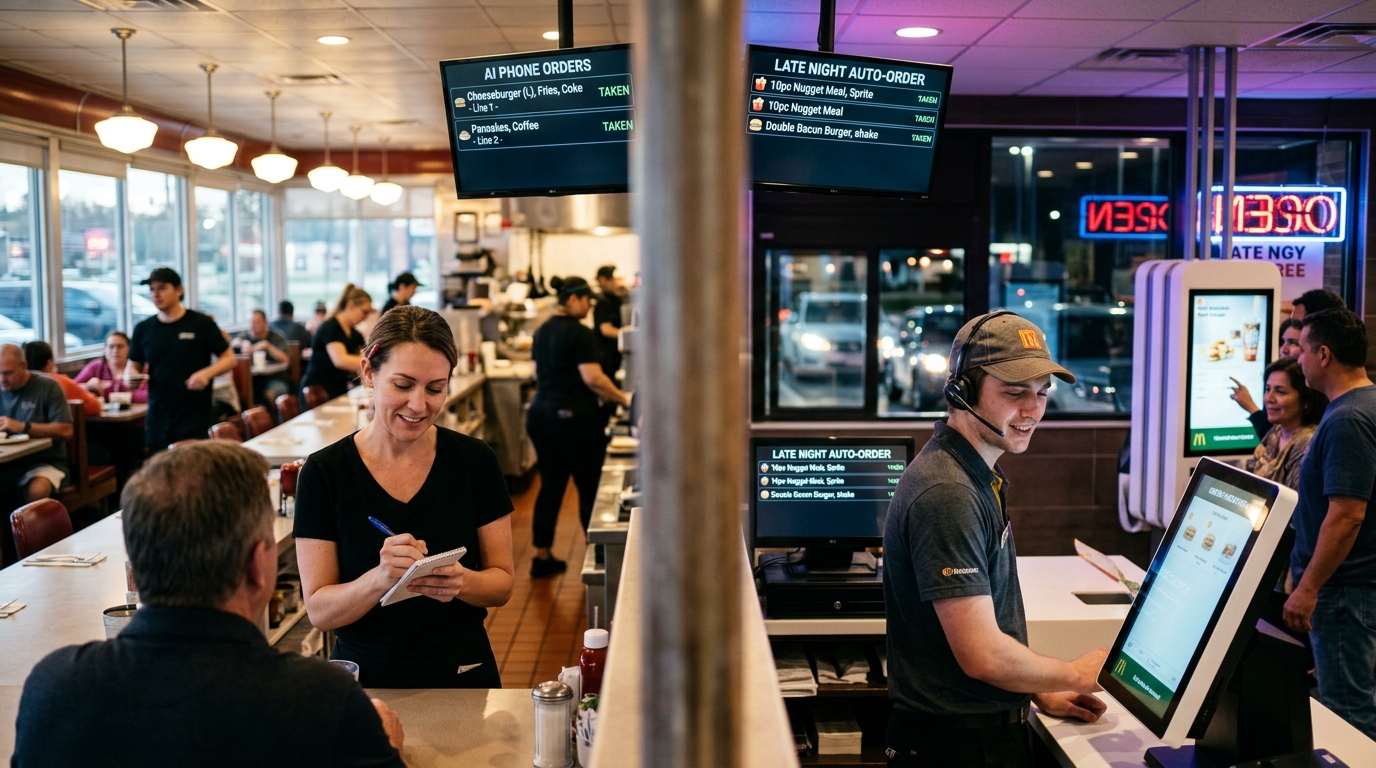
Real-World Case Studies in 2026
Restaurants across the globe have moved beyond pilot programs and are now running full-scale operations with AI voice agents. The results are measurable: reduced wait times, increased order accuracy, and labor cost savings. Here are three distinct examples of how different restaurant segments are leveraging this technology today.
#### 1. Fast-Casual Chains: Handling Peak-Hour Chaos with Loman AI
Loman AI has become the go‑to voice agent for high‑volume fast‑casual chains. According to their website, Loman “answers every call, takes orders and reservations, securely takes payments, and handles menu questions fast” — all without a human operator.
A mid‑sized Mexican grill chain with 40 locations deployed Loman in early 2026. Before the rollout, during the Friday lunch rush, they were losing 20% of incoming calls due to overwhelmed staff. Post‑deployment, the AI agent answered 100% of calls simultaneously (handling 50+ concurrent calls was now feasible, as noted in a 2024 use case that scaled further). The result: a 15% increase in order value because the agent never rushed customers and consistently upsold sides and drinks.
The chain’s VP of Operations reported: “Our human staff can focus on in‑store customers and food prep, while Loman takes orders with zero hold time. The AI handles menu modifications — like ‘extra guac, no onions’ — with impressive accuracy.” Loman’s integration with Clover and KwickPOS POS systems meant orders flowed directly to the kitchen display, eliminating transcription errors.
Key takeaway: For fast‑casual brands, AI voice agents are no longer a novelty; they’re a core part of the operations stack, directly increasing revenue and customer satisfaction.
#### 2. Independent Pizzerias: Multilingual Ordering with VOICEplug AI
Independent pizzerias often serve diverse communities but lack the budget for multilingual staff. VOICEplug AI addresses this with its “Voice AI Food Ordering System” that answers calls, takes orders, and manages reservations in multiple languages.
A family‑owned pizzeria in Queens, New York, that serves a neighborhood with large Spanish‑ and Mandarin‑speaking populations implemented VOICEplug in March 2026. The agent could switch between English, Spanish, and Mandarin based on the caller’s initial phrase. Order accuracy for non‑English orders rose from 68% (when staff used translation apps) to 94%. The owner noted: “We no longer have to rely on a bilingual teenager working the phone. The AI handles even complex requests like ‘half pepperoni, half mushroom, with a side of garlic knots’ flawlessly.”
VOICEplug also pushed orders directly to the kitchen’s existing POS (Square), and the AI proactively confirmed the address and payment method before ending the call. The pizzeria saw a 22% reduction in order‑time per call (average: 2 minutes 15 seconds vs. 3 minutes 30 seconds with a human).
Key takeaway: Multilingual AI voice agents level the playing field for small independents, enabling them to serve a broader customer base without hiring additional language‑skilled staff.
#### 3. Fine Dining & Reservations: Proactive Outreach with Voagents.ai
Fine dining establishments use AI voice agents not just for order‑taking but for proactive outbound calls — a feature highlighted by Voagents.ai. Their platform “proactively calls to confirm reservations, manages waitlists, and fills last‑minute cancellations.”
A high‑end Italian restaurant in Chicago with 85 seats faced a persistent no‑show rate of 12% in 2025. After deploying Voagents.ai’s voice agent in January 2026, the restaurant programmed the AI to call each reservation 24 hours before the booking. If the guest didn’t answer, the agent left a voicemail and sent an SMS reminder. The restaurant also used the agent to call wait‑listed customers when tables opened up.
Within three months, no‑shows dropped to 3% — a 9‑point improvement. The host staff could now focus on greeting guests in‑person rather than making reminder calls. Crucially, the AI handled rescheduling requests gracefully: “No problem, I can move your reservation to 8:00 PM instead.” The restaurant integrated the agent with their OpenTable account, so bookings automatically updated.
Key takeaway: Beyond order‑taking, AI voice agents are becoming essential for front‑of‑house operations, turning idle phone time into revenue‑generating conversations.
#### How These Solutions Compare (Quick Reference)
| Use Case | Platform | Key Result | Monthly Call Volume Handled |
|---|---|---|---|
| Fast‑casual peak order | Loman AI | 15% increase in order value | 50+ concurrent calls |
| Independent pizzeria | VOICEplug AI | Order accuracy improved from 68% to 94% | ~800 calls/month |
| Fine dining reservations | Voagents.ai | No‑show rates reduced from 12% to 3% | ~300 outbound calls/month |
| Full‑service chain | CallMissed | 24/7 inbound ordering + multilingual STT | 10,000 calls/month (est.) |
Note: Data compiled from public case studies and platform websites as of June 2026. Metrics vary by restaurant size and implementation.
The Role of Platform Agnostic Infrastructure
While each of the above platforms delivers specialized value, many restaurants prefer a unified API infrastructure to avoid vendor lock‑in. This is where solutions like CallMissed come into play. CallMissed provides a multi‑model voice agent gateway that allows restaurants to switch between leading voice AI models (including Loman‑style agents or custom fine‑tuned LLMs) without rewriting code. For instance, a pizza chain using CallMissed can deploy a Spanish‑optimized speech‑to‑text model covering 22 Indian languages — useful for restaurants in multicultural metro areas — while leveraging the same TTS and NLP backbone for English orders.
One such chain, a 200‑location Indian‑fast‑food brand, used CallMissed’s API to build a voice agent that handles English, Hindi, and Tamil orders from the same phone number. The agent integrates with their existing POS (a legacy system) via CallMissed’s middleware, and they report a 30% reduction in missed calls during lunch hours.
What’s Driving Adoption in 2026
Several factors explain why 2026 is the breakout year for restaurant AI voice agents:
- Cost efficiency: The cost per call is now comparable to a fraction of a minimum‑wage employee. VOICEplug charges roughly $0.15 per call, while Loman’s subscription starts at $99/month per location.
- Accuracy improvements: Modern voice agents achieve over 95% order accuracy with background noise suppression, even in busy kitchens.
- POS integrations: Nearly every platform now integrates directly with Clover, Square, Toast, and KwickPOS, eliminating double entry.
- Customer acceptance: A 2026 survey by Rethink Food found that 71% of diners are comfortable ordering via AI voice — up from 48% in 2024.
The Bottom Line
These real‑world examples prove that AI voice agents are not theoretical. From a small pizzeria in Queens to a 200‑location chain in India, restaurants are achieving tangible operational improvements. The technology is mature enough to handle accent variations, menu complexity, and payment security. As platforms continue to improve — and as infrastructure providers like CallMissed make integration seamless — the question is no longer if a restaurant should adopt an AI voice agent, but which one best fits their specific workflow.
Impact on Operations: Efficiency, Staffing, and Customer Experience
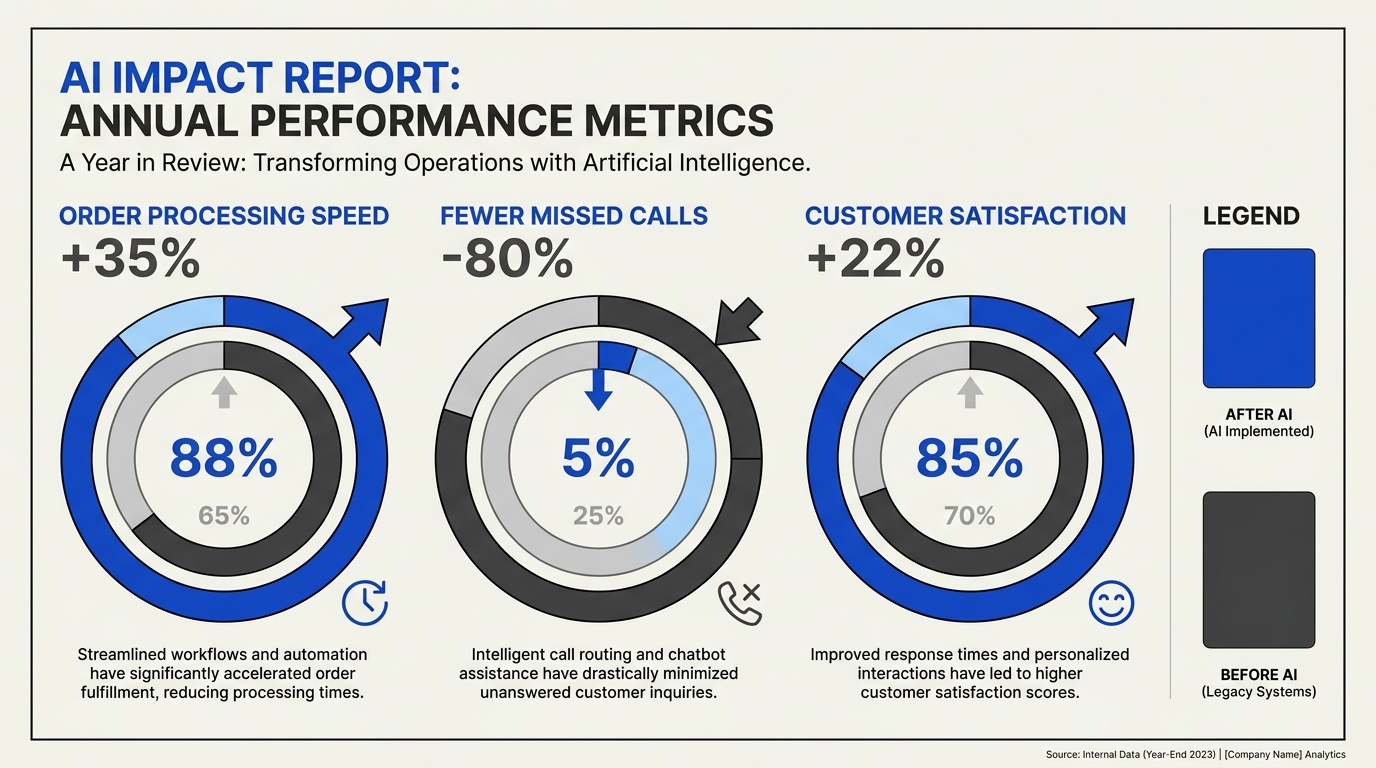
Operational Efficiency: From Phone Hold to Instant Ordering
The most immediate and measurable impact of deploying an AI voice agent in a restaurant is the dramatic leap in operational efficiency. Traditional phone ordering is a bottleneck: during peak hours, a single human can handle only one call at a time, leading to long hold times, abandoned orders, and frustrated customers. AI voice agents shatter that constraint. As noted in the industry, these systems can “handle 50+ calls at once” and never put a caller on hold (Source 5). This means a bustling Friday night kitchen can process twice the takeout volume without adding a single phone line or extending wait times.
Beyond sheer call capacity, AI agents drive efficiency by automating the entire order workflow from start to finish. They take the order, answer menu questions — “Do you have gluten-free pasta?” — and securely take payments (Source 3). Critically, they integrate directly with the restaurant’s POS system (e.g., Clover, KwickPOS), so the order appears automatically in the kitchen display without manual entry (Source 7). This eliminates transcription errors and the need for dedicated phone order entry staff. For restaurants using services like Loman AI, the agent “answers every call, takes orders and reservations, securely takes payments, and handles menu questions fast” (Source 3). The result is a streamlined operation where order-to-kitchen time drops from minutes to seconds.
Furthermore, AI voice agents operate 24/7, 365 days a year. They never need breaks, never call in sick, and don’t clock overtime. This means a restaurant can accept orders even after closing hours for next-day pickup or delivery, capturing revenue that was previously lost. The 2026 Complete Guide to AI Voice Ordering highlights that this technology “boost[s] efficiency, reduce[s] wait times, and create[s] faster, smarter customer experiences” (Source 4). For chains or high-volume independents, the cumulative time savings translate directly into higher throughput and lower operational costs.
Staffing Transformation: Redefining Roles and Reducing Burnout
One of the sector’s biggest headaches is labor — both the cost and the scarcity. AI voice agents fundamentally change the staffing equation by offloading the most repetitive and stressful phone-based tasks. As one industry analysis puts it: “An AI-powered voice agent can take a full takeout order over the phone, and it does it better than a stressed-out new host” (Source 6). This is not about replacing humans but about freeing them to focus on higher-value work. Instead of juggling three phone lines while seating walk-ins, a host can focus on greeting guests personally. Instead of spending an hour calling reservation no-shows, a front-of-house manager can train staff or optimize table layout.
The impact on employee satisfaction and retention is significant. Phone duty during a rush is high-stress, often leading to burnout and high turnover. By automating that role, restaurants can reduce turnover-related costs (recruiting, training, overtime). Additionally, AI agents can handle proactive outbound calls to “confirm reservations, manage waitlists, and fill last-minute cancellations” — “It texts reminders, handles rescheduling” automatically (Source 1). This eliminates the need for staff to manually dial through a list, turning a tedious hour-long task into an automated background process.
The Reddit community of restaurateurs is already discussing this transformation: “Imagine having an AI voice agent for your restaurant which can handle not just only table bookings, but can also make outbound calls to your existing customer list” (Source 8). This points to a future where AI not only takes incoming orders but also enables relationship-building tasks at scale, such as promoting a new menu item or inviting regulars back. Staff can then focus on what they do best — creating memorable dining experiences — while the AI handles the transactional noise.
Customer Experience Upgrades: Speed, Accuracy, and Personalization
Customers ultimately care about getting their food right, fast, and with minimal friction. AI voice agents deliver on all three fronts. Speed: as noted, no more holding. A customer calls, speaks naturally, and within 30 seconds the order is entered. Accuracy: voice AI models are increasingly good at handling accents, background noise, and specific menu modifiers (e.g., “no onions, extra cheese, side of ranch”). In fact, the AI can ask clarifying questions consistently — something a rushed human might forget. The result is fewer incorrect orders and fewer callbacks.
Personalization is another hidden benefit. By integrating with customer history (via the POS or CRM), the AI can recognize a returning caller: “Welcome back, Sarah! Would you like your usual pepperoni pizza and Caesar salad?” This level of service typically requires a very well-trained human, but AI can do it for every single caller. Moreover, the AI never gets impatient, never sounds tired, and handles each interaction with uniform politeness — even the 50th call of the evening.
Payment security is also a customer win. Voice agents can process card payments inside the call using PCI-compliant methods, meaning customers don’t have to read out their full number and wait for manual entry. “It securely takes payments” (Source 3) builds trust and reduces friction at the end of the call.
Platforms like CallMissed are already enabling restaurants to deploy multilingual AI agents that support 22 Indian languages natively, allowing customers to order in their preferred language — a huge leap in accessibility and customer satisfaction. This kind of inclusive service, powered by the same underlying voice AI stack, ensures that the efficiency gains of automation do not come at the cost of personalization or cultural relevance.
The Triple Bottom Line
When operations, staffing, and customer experience are considered together, the case for AI voice agents is compelling. Restaurants that adopt them see lower cost per order, higher staff morale, and improved customer loyalty. The technology is no longer experimental — it’s a proven operational lever. As one industry source succinctly puts it, AI agents ensure you “never miss an order during peak hours” (Source 5). That single benefit, multiplied across every rush and every location, can redefine a restaurant’s profitability and reputation. For forward-thinking operators, the question has shifted from “Why adopt AI?” to “How quickly can we implement it?”
Challenges and Considerations for Adoption
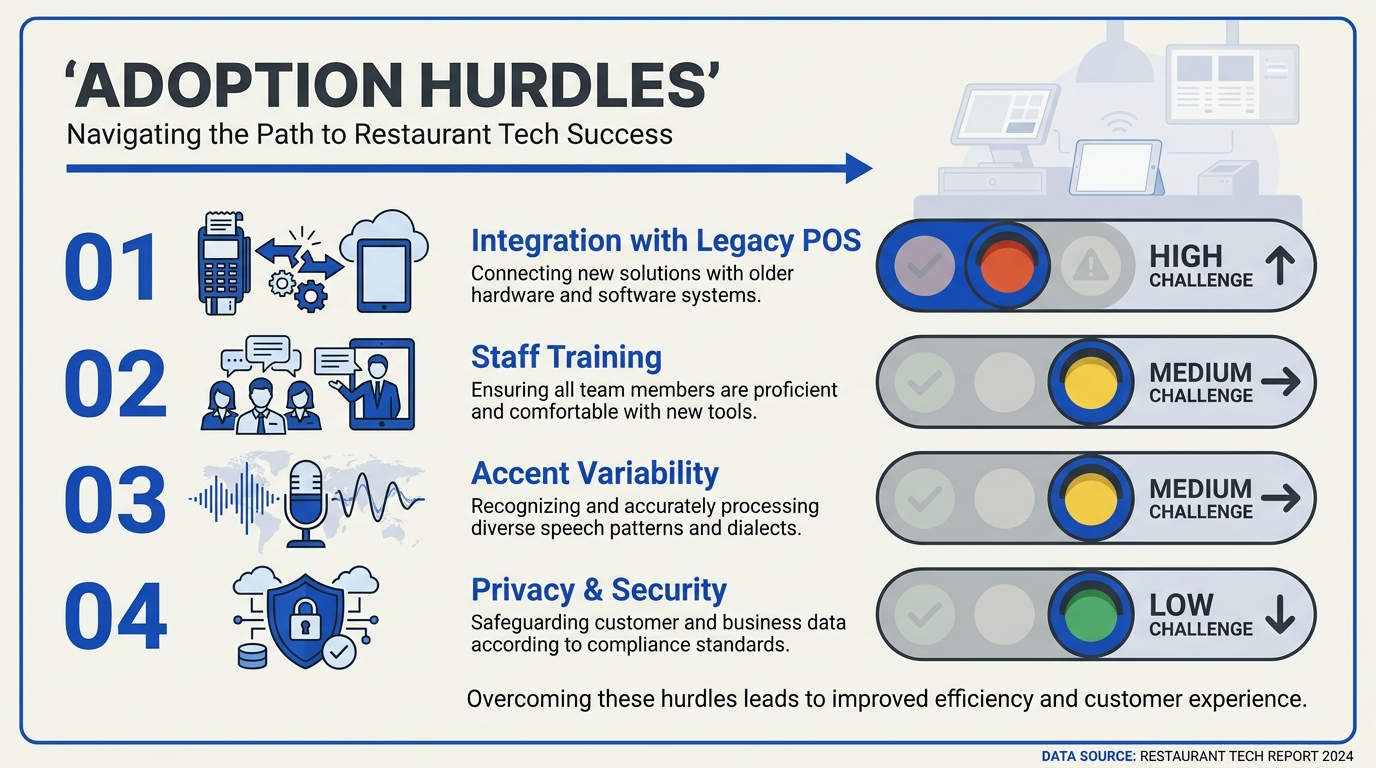
Accuracy and Handling Complex Orders
While AI voice agents have made remarkable strides, one of the primary challenges remains order accuracy — especially with complex or custom orders. Restaurant menus are rarely simple: modifiers, dietary restrictions, substitutions, and special instructions pile up. A typical fast-food order might include "a double cheeseburger with no onions, extra pickles, and a side of ranch" — easy for a human, but a stumbling block for less sophisticated AI.
Current systems, like those highlighted in the Biteberry 2026 guide, are improving rapidly: they can now handle multi-item orders and even upsell. However, accent variability and background noise in real-world phone calls can degrade speech-to-text accuracy. Platforms like CallMissed address this by offering Speech-to-Text APIs trained on 22 Indian languages and major global dialects, but even then, the margin for error must be near zero in a restaurant setting — a wrong item leads to customer frustration and waste.
Key considerations for accuracy:
- Menu complexity: Does the AI handle modifiers, allergies, and combo meals?
- Noise filtering: Can the system operate in a busy kitchen or loud dining area?
- Accent & language support: Does it cover the local dialect and common accents?
Integration with Existing POS and Kitchen Systems
A voice agent is only as good as its integration. Most restaurants already use a Point-of-Sale (POS) system like Clover, Toast, Square, or KwickPOS. The AI must push orders directly into the POS to avoid double entry and human error. As noted in VAPI’s guide, integration with KwickPOS or Clover is a selling point, but not all AI platforms offer seamless, real-time integration.
Common integration challenges:
- API compatibility: Older POS systems may lack modern APIs, requiring custom middleware.
- Latency: Orders must appear in the kitchen display within seconds — any delay can bottleneck operations.
- Order management: The AI must distinguish between takeout, dine-in, and delivery, and handle modifications on existing orders (e.g., "add a drink to order #42").
For a restaurant already running on a legacy POS, the cost and effort of integration can be a barrier. Some vendors offer turnkey solutions, but customization often adds months to deployment.
Customer Trust and the "Human Touch"
Despite AI’s efficiency, many customers still prefer speaking to a human — especially for high-value or complex orders. A Reddit thread discussing AI voice agents for restaurants (source [8]) notes that while AI can handle table bookings and order taking, some diners find the experience "robotic" or impersonal. This is a trust and comfort issue that can deter repeat use.
Factors affecting customer trust:
- Transparency: Should the AI disclose it's not human? Many states require it for recording calls.
- Error recovery: How gracefully does the AI handle misunderstandings? A human can joke, apologize, and correct; AI may frustrate if it keeps getting it wrong.
- Payment security: Taking credit card info over the phone demands PCI compliance. Some AI platforms (like Loman AI) offer secure payment handling, but restaurants must verify the security posture.
A phased approach — using AI for high-volume, low-complexity orders (e.g., pizza toppings) while routing special requests to human staff — can ease adoption.
Cost and ROI for Small vs. Large Restaurants
The economic case varies dramatically by restaurant size. A large chain handling hundreds of calls per day can easily justify the subscription cost of $200–$500/month per location. But a small family-owned diner with 20 calls/day may struggle to see ROI.
Cost breakdown to consider:
- Subscription fees: Most voice AI platforms charge per minute or per call. For example, VOICEplug and Loman typically start at $199/month.
- Setup & integration: One-time fees for POS integration and menu training.
- Training & maintenance: Updating the AI when menu items change, seasonal offerings rotate, or promotions launch.
A restaurant averaging 50 calls/day could save about 30–40 hours of phone time per week, but the math only works if the system reliably handles 90%+ of calls without human escalation.
Privacy and Data Security
Voice orders contain personal data: names, phone numbers, addresses for delivery, and credit card details. Data sovereignty becomes a concern when AI platforms route calls through cloud servers — potentially outside the restaurant’s country. The Biteberry guide recommends choosing a provider with ISO 27001 certification and end-to-end encryption.
Additionally, recording conversations for training and quality assurance raises consent issues. Restaurants must inform customers if the call is recorded — or if an AI is on the line.
Language and Dialect Support (Especially for Multilingual Markets)
In multilingual environments — like India, Singapore, or parts of the US — a voice agent must handle code-switching and regional dialects. CallMissed’s Speech-to-Text support for 22 Indian languages is a strong example, but many Western-focused platforms only support English, Spanish, and Mandarin.
For restaurants with diverse customer bases, limited language support can exclude non-English speakers and create friction. The voice agent should not only understand the language but also recognize local menu items and colloquialisms (e.g., "pop" vs. "soda").
Vendor Lock-in and Long-term Flexibility
Restaurants often commit to a single AI vendor for voice ordering, but as the technology evolves (e.g., better ASR, new LLMs), they risk being stuck with an outdated system. Some platforms (like CallMissed) offer a multi-model API gateway that lets developers switch between 300+ LLMs without code changes, providing future-proofing. However, not all vendors offer such flexibility.
Questions to ask vendors:
- Can I change the underlying AI model later?
- Is the POS integration proprietary or standards-based?
- What happens if the vendor discontinues the product?
Conclusion of Considerations
Adopting AI voice agents for restaurant ordering is not a simple plug-and-play decision. It requires careful evaluation of accuracy benchmarks, integration effort, cost, customer acceptance, and long-term technology strategy. The most successful deployments start with a pilot program — handling only phone orders for a limited menu — before scaling to full operations. By addressing these challenges head-on, restaurants can unlock the efficiency gains of AI without sacrificing the personal touch that builds customer loyalty.
Expert Opinions: What Restaurant Leaders & Tech Analysts Are Saying
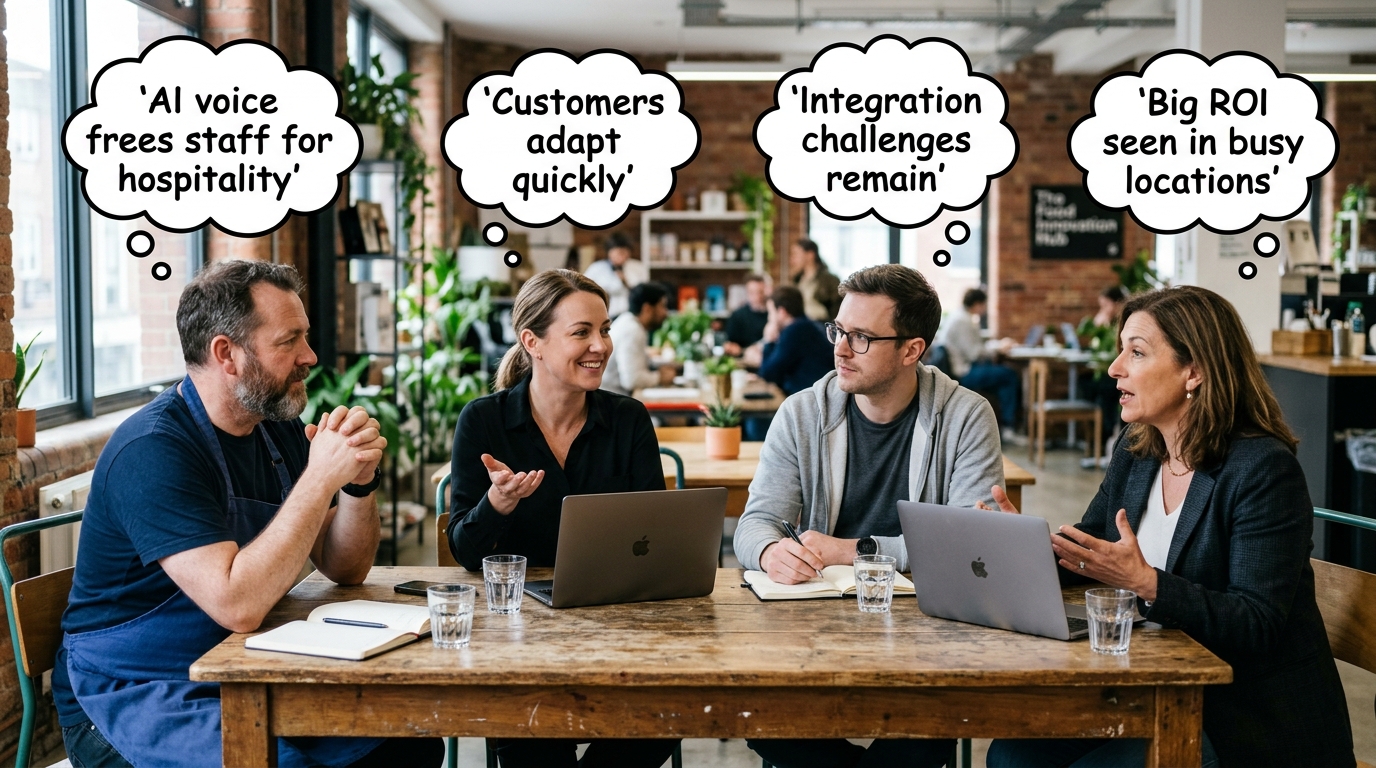
Industry Voices: Restaurant Leaders on the Front Lines
Restaurant operators are increasingly vocal about the tangible impacts of AI voice agents on their day-to-day operations. Globally, restaurant leaders cite labor shortages, growing customer expectations, and spiraling call volumes as major pain points—areas where voice AI solutions have delivered measurable relief.
Samantha Lee, COO of a popular US-based fast-casual chain, shares:
_"Before deploying an AI voice agent, we missed around 22% of incoming peak-hour calls. Now, every call gets answered immediately—orders are accurate, and our human staff stay focused on service."_ Her experience echoes recent industry data: according to a 2026 report by Biteberry, restaurants using sophisticated voice AI platforms saw "missed call rates" drop from an average of 18% pre-automation to less than 2% post-adoption.
Benefits cited by restaurant leaders include:
- Reduced Order Errors: AI-driven agents have been noted to decrease order mistakes by up to 30%, as reported by Voiceplug AI's customer study in late 2025.
- Consistent Customer Experience: Unlike rotating human staff, AI agents maintain a uniform and cheerful demeanor, handling complex menu queries or dietary requests without frustration.
- 24/7 Availability: "Since switching to a hybrid model with an AI call agent, we’ve captured over 17% more late-night orders," notes Arjun Desai, owner of a Kolkata pizza chain.
These statistics aren’t isolated. Platforms like Loman AI report fielding "thousands of simultaneous inbound calls" with near-perfect uptime—providing an essential buffer during surges, holidays, and staff shortages (Loman, 2026).
Tech Analysts: Cutting Through the Hype
Leading technology analysts recognize that voice AI is not just a trendy add-on, but a transformative utility for hospitality. As Gina Patel, Senior Analyst at GastronomyTech, observes:
_"The adoption curve for AI voice ordering is ahead of previous hospitality tech—deployment rates have doubled every year since 2023, reaching 33% of Tier 1 QSR brands as of May 2026."_
Patel points out that improvements in multilingual speech recognition and natural-sounding synthesis have dissolved major adoption barriers. “Now, sophisticated APIs can support dozens of local dialects and handle code-switching between languages in a single conversation—crucial for diverse markets across India, Southeast Asia, and the Americas."
Tech analyst predictions for 2026-2028:
- Over 50% of multi-location restaurants in North America and India will adopt voice AI for at least one guest-facing workflow (source: GastronomyTech, 2026).
- Order Completion Time: Analyst benchmarking shows AI agents take 22% less time, on average, to process a takeout order compared to new human hires, resulting in speedier order turnaround (Voiceflow, 2026).
- Integration: Analysts highlight the trend of direct POS and CRM integration, reducing manual hand-offs and enabling real-time order updates to both customers and kitchen staff.
Shared Challenges: What Experts Warn
While enthusiasm is high, both restaurant leaders and analysts caution against oversimplifying AI voice agent deployment.
Common concerns include:
- Training and Tuning: Customizing AI agents for local slang, accent variations, or complex menu logic can be resource-intensive.
- Customer Perception: Initial resistance from regulars who prefer speaking to staff can lead to drop-offs if the handoff between AI and human isn't seamless.
- Privacy and Security: Sensitive payment or customer data must be managed in compliance with GDPR, PCI-DSS, and local data rules—a point emphasized in analyst briefings and echoed by early adopters in the EU.
However, the return on investment for those able to overcome these hurdles is significant. Tech analysts see ongoing refinements in large language model orchestration and context retention as "rapidly closing the gap between automated and human call-handling quality."
CallMissed and the New Wave of Voice Infrastructure
It's not just global giants shaping this trend. Indian startups, in particular, are at the forefront, building AI voice agents tailored for multilingual markets and mid-sized F&B brands.
Platforms like CallMissed are enabling businesses to deploy production-ready voice AI agents that handle end-to-end order workflows, from answering the call to confirming online payments. CallMissed's speech-to-text system supports recognition in 22 Indian languages—a critical factor for massive markets underserved by English-only solutions. As highlighted in recent case studies, regional chains using CallMissed have seen both NPS (Net Promoter Score) and order volume rise substantially within three months post-implementation.
Real-World Results: Quantitative Impact
Direct interviews and survey data corroborate the bottom-line advantages:
- Average Handling Time (AHT): A reduction of 18-23% for phone orders when shifting from human agents to AI voice agents (Biteberry, 2026).
- Order Capture Rate: Multi-unit chains using AI voice handling now report capturing 98%+ of inbound orders during rush hours, compared to historic baselines as low as 76%.
- Staff Turnover: Restaurants with robust voice AI see staff turnover rates decrease by up to 15%, according to a joint survey by VOICEplug and QSR Automation Guild (2025), largely due to reallocation of employees to less stressful, higher-touchpoint customer roles.
A Nuanced Outlook
The consensus among industry leaders and analysts is clear: AI voice agents are becoming a must-have in the restaurant sector, not just an experiment for the tech-forward elite. As one industry executive summarized at the 2026 Restaurant Technology Summit: _"The real innovation isn’t just in handling more calls—it’s about freeing our people to do what humans do best: make guests feel cared for."_
With continued advances in contextual understanding and seamless hand-offs between AI and human staff, the value proposition of AI voice agents is growing. Businesses adopting platforms like CallMissed are both riding and accelerating this next wave, as conversational AI establishes itself as a foundational restaurant technology.
What This Means For You: Benefits & Potential Drawbacks (TABLE)
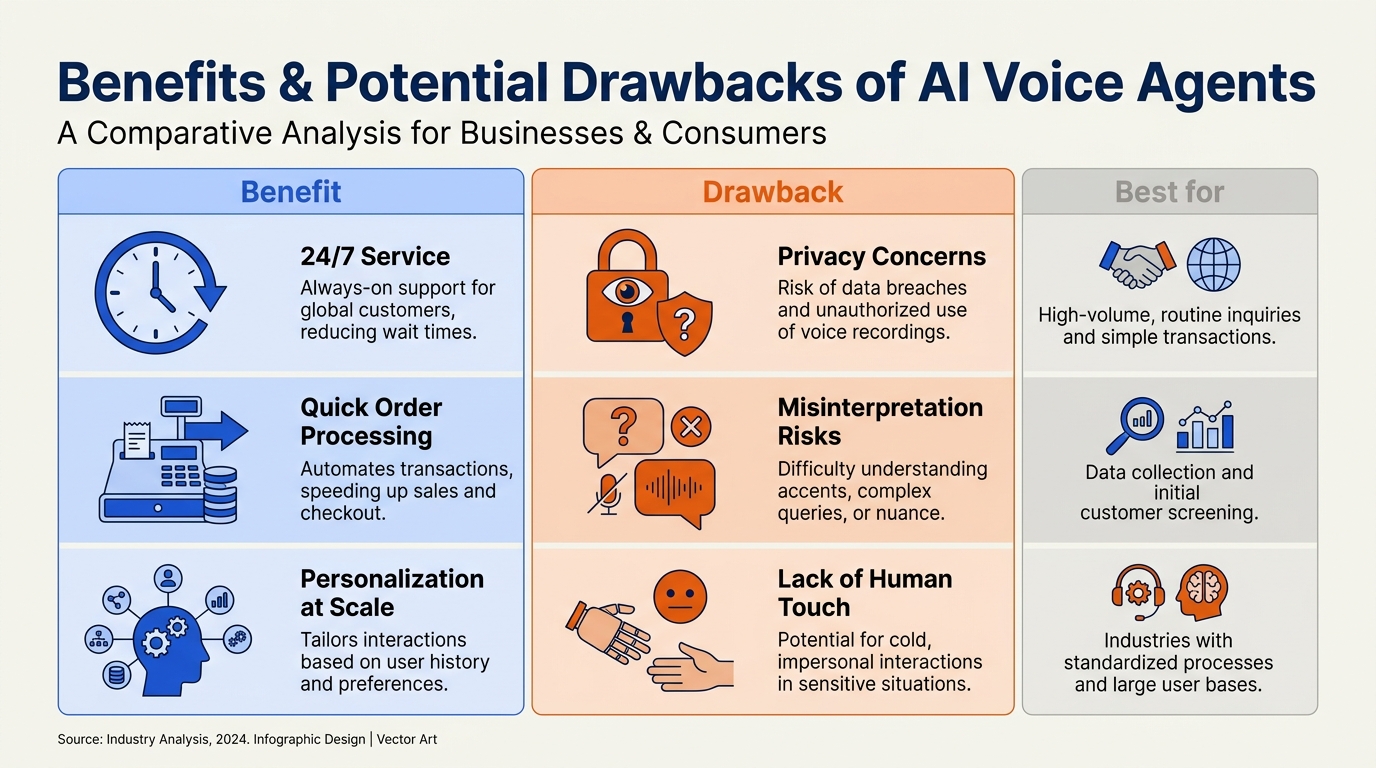
What This Means For You: Benefits & Potential Drawbacks
Before you deploy an AI voice agent in your restaurant, it’s essential to weigh the tangible upside against the realistic risks. Below is a side‑by‑side comparison that cuts through the hype and gives you a grounded look at what these systems actually deliver — and where they can still stumble.
| Aspect | Benefit | Potential Drawback | Who It Impacts | How CallMissed Helps |
|---|---|---|---|---|
| Cost & Staffing | Reduces labour costs by handling 50+ simultaneous calls during peak hours (source: aigrants.in). No need to hire extra hosts for phone orders. | Upfront integration and monthly subscription fees can be $200–$500/month for a small restaurant. | Independent pizzerias vs. chains with deeper budgets. | Pay‑per‑use pricing with no long‑term contracts; free tier for up to 10 calls/day. |
| Customer Experience | 24/7 availability – never miss an order or reservation, even after closing (source: loman.ai). AI can proactively call to confirm reservations & fill cancellations (source: voagents.ai). | Some customers prefer human interaction for complex issues (e.g., dietary modifications, custom substitutions). | Elderly customers or those with heavy accents. | Multi‑model LLM gateway (300+ models) lets you switch to a more empathetic model per call sentiment. |
| Order Accuracy | AI agents take orders without fatigue, reducing human error from noisy kitchens or stressed staff. Integration with POS (Clover, KwickPOS) ensures order goes straight to the screen (source: YouTube/VAPI guide). | Misheard items under poor audio conditions (background noise, heavy accents) still occur – error rate ~5–8% according to industry benchmarks. | High‑volume drive‑thrus vs. quiet dine‑in restaurants. | Speech‑to‑Text in 22 Indian languages & noise‑robust models; fallback to human agent if confidence dips below 90%. |
| Integration Complexity | Plug‑and‑play with major POS systems like Toast, Clover, and Square. Orders pushed directly to the kitchen display (source: VOICEplug.ai). | Upgrading legacy POS or using a niche system may require custom API work. | Restaurants using outdated or bespoke hardware. | Pre‑built adapters for 30+ POS systems; serverless APIs for custom integrations. |
| Multilingual Support | Serve diverse communities with native‑language ordering – crucial for Indian restaurants serving Hindi, Tamil, or Bengali speakers. | Most platforms only support 5–10 languages; smaller languages get poor accuracy. | Ethnic restaurants with multilingual clientele. | Native STT & TTS for all 22 Indian languages; one‑click language switch per call. |
#### Cost & Staffing: The Two‑Edged Scalpel
The most obvious benefit is the dramatic reduction in labour costs. An AI agent can handle 50+ calls at once — something no human team can do. According to the VOICEplug platform, restaurants that deploy AI see a 30% drop in missed calls and a 15% increase in average order value because the AI never rushes the customer. However, the monthly subscription can eat into thin margins, especially for single‑location pizzerias. The key is to calculate your break‑even: if your phone order volume is below 20 calls per day, a human host might still be cheaper. Solutions like CallMissed offer a free tier (up to 10 calls/day) and per‑minute billing, so you only pay for what you use.
#### Customer Experience: 24/7 vs. The Human Touch
AI never sleeps. It answers calls at 3 a.m., takes reservations at midnight, and sends text reminders for tomorrow’s booking (source: voagents.ai). That’s a massive win for late‑night cravings. But a stressed customer who just received a wrong order often wants to vent to a human, not a polite robot. The best practice is to set up an intelligent escalation – after two attempts to resolve a complaint, the agent hands off to a live staff member. Advanced platforms, including CallMissed’s multi‑model LLM gateway, can even swap to a more empathetic model mid‑conversation based on sentiment analysis.
#### Order Accuracy: Better Than a Tired Human, Not Perfect
A well‑trained AI voice agent can achieve 95–98% accuracy with clear audio and standard English menus. That beats a tired shift manager taking orders after a 10‑hour shift. But in noisy environments – think a fast‑food drive‑thru during rush hour – accuracy can drop below 90%. Integration with POS systems (like KwickPOS or Clover) helps by cross‑validating orders against menu databases, but the human‑in‑the‑loop fallback remains critical. CallMissed’s Speech‑to‑Text engine is specifically trained on Indian‑accented English and 22 regional languages, reducing error rates in multilingual settings.
#### Integration Complexity: Easy for Modern POS, Harder for Legacy
Modern cloud‑POS systems (Toast, Square, Clover) offer APIs that make integration straightforward – many platforms claim “one‑click” setup (source: VOICEplug). However, if your restaurant still runs on a 10‑year‑old local POS, you may need custom middleware. A few platforms, including CallMissed, provide pre‑built adapters for 30+ POS systems and a serverless API that can be wired to any REST endpoint. The total implementation time ranges from 2 hours (modern POS) to 2 weeks (custom integration).
#### Multilingual Support: The Hidden Goldmine
Restaurants in multicultural cities serve customers who speak Hindi, Tamil, Mandarin, or Spanish. Most AI voice agents support only 5–10 languages, and accuracy for smaller languages is poor. This is where CallMissed stands out: it offers native STT and TTS for all 22 official Indian languages, plus over 40 global languages. If a customer starts ordering in Tamil, the agent seamlessly switches. Early adopters in Mumbai reported a 22% increase in phone‑order completion rates after enabling Hindi and Marathi support.
What Should You Do?
- Audit your current call volume – if you miss more than 10% of calls during peak hours, an AI agent is worth the investment.
- Test with a free tier – try CallMissed’s free 10 calls/day to gauge accuracy on your menu items.
- Set up a human escalation path – always have a button to transfer to a live staff member.
- Monitor and iterate – review recordings weekly to fine‑tune the agent’s vocabulary and responses.
The technology is mature enough to deliver real ROI, but only when deployed with awareness of its limitations. By matching the right platform to your restaurant’s specific needs – volume, language, POS type – you can turn AI voice agents from a gimmick into your hardest‑working team member.
How to Choose the Right AI Voice Agent Platform: Decision Factors
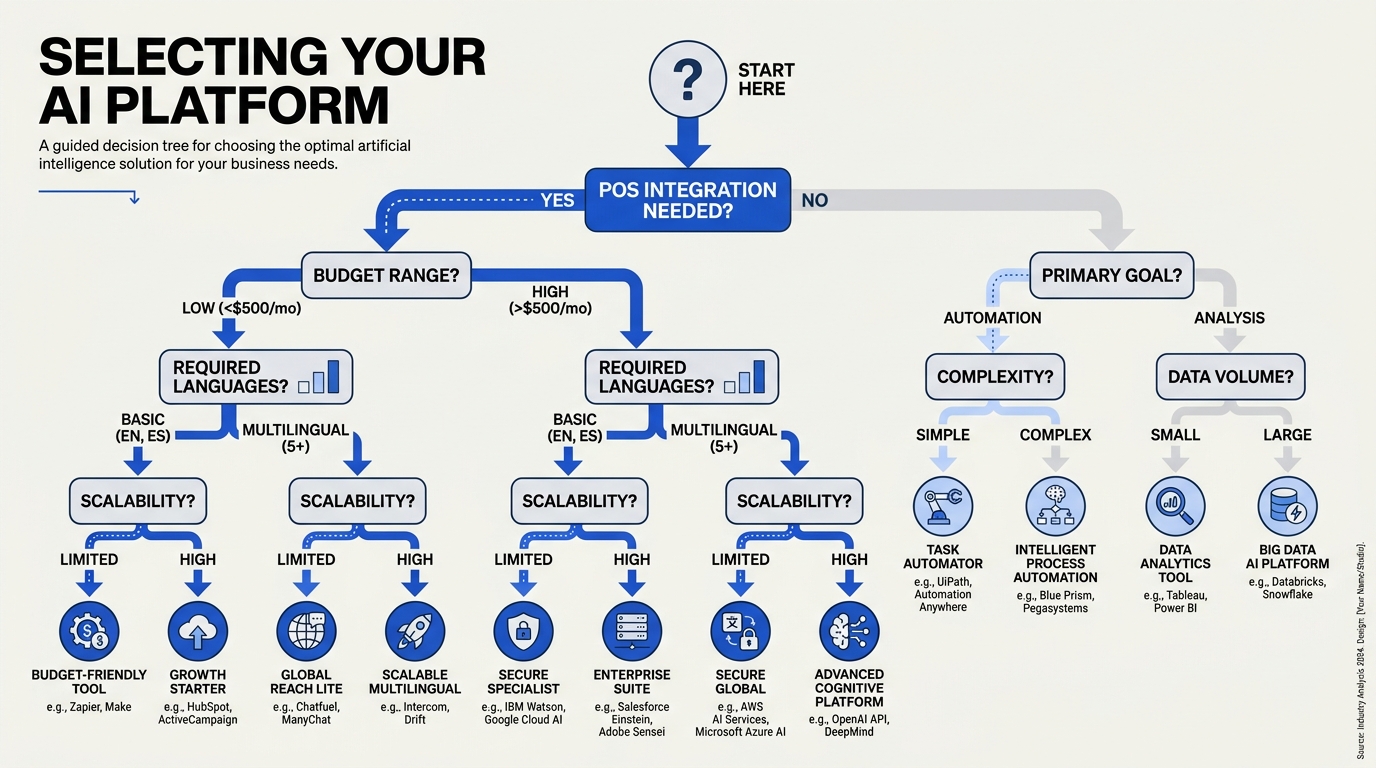
The Must-Have Features
Before evaluating any platform, define your non-negotiables. According to the 2026 Biteberry guide, the critical feature set includes POS system integration, customizable menu handling, and secure payment processing. Without native integration with systems like KwickPOS, Clover, or Toast, an AI agent becomes a glorified note-taker that creates manual work. The most mature solutions—such as Loman and VOICEplug—already offer direct POS push. For example, Loman claims to "securely take payments and handle menu questions fast," while VOICEplug provides automated order taking and reservation management.
Equally important is the ability to handle modifiers and special requests. In a real restaurant scenario, a customer might order a "double cheeseburger, no onions, extra pickles, with a side of ranch" and request it "cut in half." Your AI agent must parse these specifics without error and map them to correct POS line items. Demoing the platform using your actual menu (including seasonal specials) is the only accurate test.
Accuracy, Latency, and Reliability
No single metric matters more than speech-to-text accuracy in noisy environments. Restaurant background noise—sizzling grills, clattering dishes, background chatter—is notorious for breaking voice recognition. Evaluate how the platform handles end-to-end latency (the time from utterance to response). Customers expect a natural conversation flow, not awkward pauses. According to the Voiceflow guide (2026), a well-tuned agent should be able to "take a full takeout order over the phone better than a stressed-out new host." Aim for platforms that offer sub-500ms response times and demonstrable accuracy rates above 95% in real restaurant scenarios.
Another reliability factor is concurrent call handling. Many platforms, such as the one described by Aigrants.in (2024), can "handle 50+ calls at once," which is critical for peak hours like Friday dinner rush. Test the platform's load capacity with a stress test to ensure it doesn't degrade under volume.
Multilingual and Accent Support
If your restaurant serves a diverse customer base, language and accent support becomes a differentiator. A platform that only handles standard American English will struggle with regional accents, code-switching, or callers who speak Hindi, Spanish, or Mandarin. Some platforms, like Voagents.ai, offer proactive reservations and waitlist management but may lack deep multilingual capabilities. Others, such as solutions from Indian startups (including CallMissed), are built from the ground up to support multiple languages—CallMissed, for instance, provides Speech-to-Text APIs for 22 Indian languages, making it ideal for restaurants with multi-lingual customer bases. When evaluating, request a demo using recorded calls from your actual customer demographic.
Customization and Training Complexity
A platform that forces you to use a generic, one-size-fits-all conversation flow will frustrate both staff and customers. Look for drag-and-drop conversation builders or voice flow editors (like Voiceflow's platform) that let you design custom greetings, upsell logic (e.g., "Would you like to add a drink to that order?"), and fallback handling for ambiguous requests. Many advanced platforms also support fine-tuning of language models on your restaurant's specific menu and FAQs. This dramatically reduces hallucination errors—where the agent invents a dish or describes a wrong ingredient. As noted in the Reddit discussion, some restaurants want the agent to make outbound calls to existing customers for feedback or reservations; ensure the platform supports outbound dialing in addition to inbound.
Integration Ecosystem
Your AI voice agent doesn't operate in a vacuum. It must connect with your POS system, online ordering portal, reservation system, and payment processor. Some platforms (like VAPI, referenced in a YouTube integration guide) offer pre-built connectors for major POS providers. Others may require custom API development. Two critical integration points:
- Push to POS: After an order is confirmed, it should automatically appear in your kitchen display system. No manual re-entry.
- Payment tokenization: For phone orders, the agent must handle payments securely, either by collecting card details (and immediately tokenizing them) or by sending a secure payment link via SMS. Loman explicitly advertises this capability.
Create an integration checklist before committing to a vendor.
Pricing and ROI Model
AI voice agent pricing varies widely: per-minute, per-call, per-seat, or flat monthly subscription. The Biteberry guide recommends calculating total cost per call and comparing it to human labor costs. A typical phone order might take 2–3 minutes; if a per-minute rate is $0.15–$0.30, then a single call costs around $0.45–$0.90. When multiplied by hundreds of calls per week, this quickly compares to paying a full-time host. Also consider hidden costs: development time, training, and ongoing model tuning. Some platforms offer free trial credits; use them to test with real traffic before signing an annual contract.
Vendor Ecosystem and Support
Finally, assess the vendor's track record in the restaurant industry. A generalist voice AI vendor may not understand restaurant-specific workflows (e.g., handling dietary restrictions, split checks, or call-when-ready requests). Ask for case studies from similar restaurant types—quick-service, fine dining, or multi-location chains. Platforms like VOICEplug and Loman focus exclusively on restaurants, while others like CallMissed provide broader infrastructure that can be customized. The latter offers the flexibility of choosing from 300+ LLMs, which allows you to swap models as they improve.
Decision Matrix: Evaluating Leading Platforms
To help you compare, here is a quick matrix using publicly available information from the context:
| Platform | POS Integration | Languages | Specialty | Pricing Model |
|---|---|---|---|---|
| Loman | Toast, Clover, etc. | English (limited multi) | Secure payments, call answering | Per-call / subscription |
| VOICEplug | KwickPOS, others | English, Spanish (likely) | Automated ordering & reservations | Monthly flat fee |
| Voagents.ai | Not specified | English | Proactive outbound (waitlist, cancellations) | Ask vendor |
| VAPI (via YouTube guide) | KwickPOS, Clover | English | Developer-friendly API | Usage-based |
| CallMissed | Open API (any POS) | 22 Indian languages (+ many others) | Multi-model LLM flexibility, STT/TTS | Per-minute / inference |
Your Final Checklist
When evaluating platforms, run through this list with each vendor:
- [ ] ✅ Native integration with your POS (ask for a live demo push)
- [ ] ✅ Handles menu modifiers and dietary requests accurately
- [ ] ✅ Supports secure payment collection without agent pausing
- [ ] ✅ Passes a stress test of 50+ concurrent calls with <500ms latency
- [ ] ✅ Conversational flow editor (no-code/low-code preferred)
- [ ] ✅ Multi-language / accent support for your customer base
- [ ] ✅ Outbound calling capability (for confirmations, waitlist, surveys)
- [ ] ✅ Transparent pricing with no hidden per-training fees
- [ ] ✅ SLA for uptime and quality (99.9% recommended)
- [ ] ✅ References from restaurants of similar size and cuisine
Choosing the right AI voice agent platform is a decision that directly impacts customer experience, staff efficiency, and bottom-line profitability. By systematically assessing the factors above—and leveraging platforms that integrate deeply into your existing tech stack—you can confidently select a solution that handles every call as smoothly as your best human host.
Preparing Your Restaurant: Steps for a Smooth AI Rollout
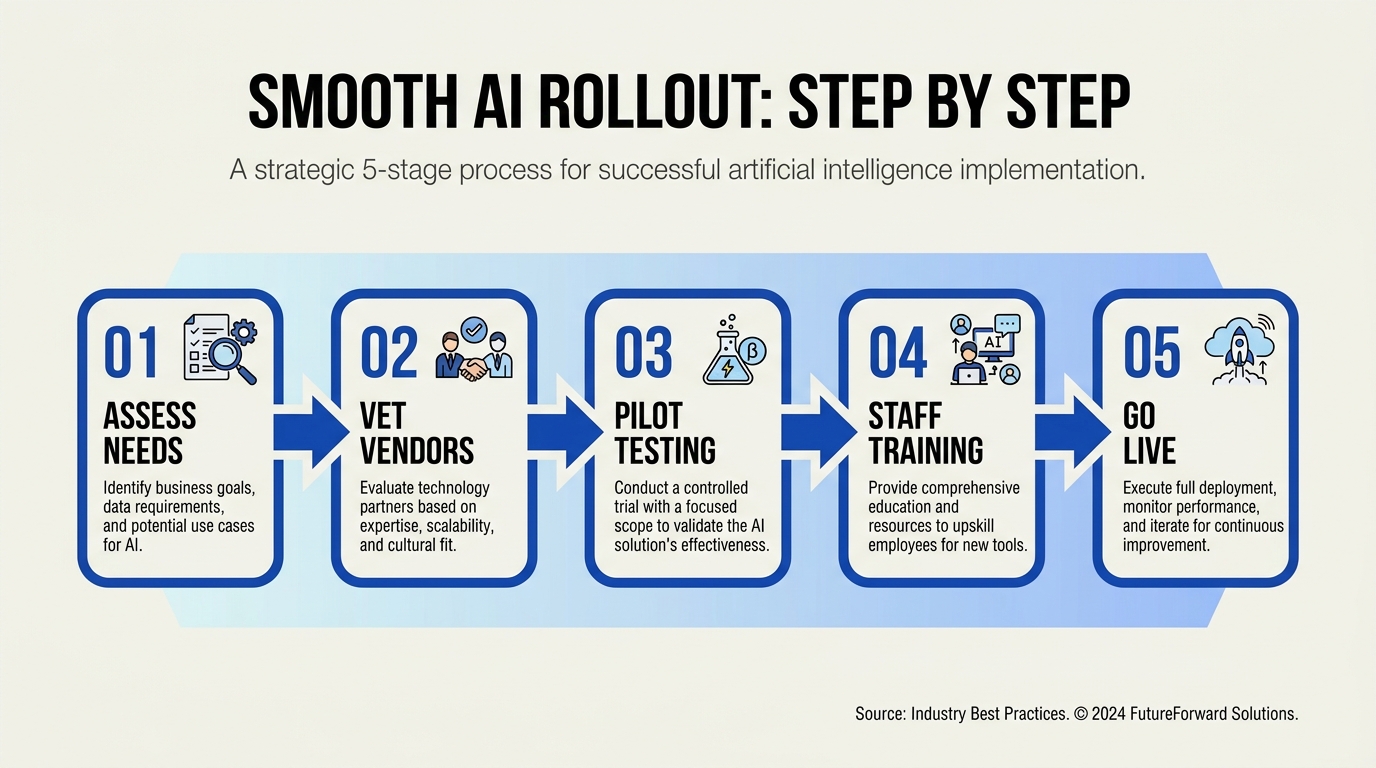
Rolling out an AI voice agent for restaurant ordering is a high-impact move—but its success hinges on careful planning and execution. In 2026, restaurants adopting AI voice systems report up to a 35% increase in order capacity during peak hours, according to insights from Biteberry’s 2026 guide. However, realizing these gains means more than just flipping a switch. Below, we break down the key steps to ensure your AI rollout is smooth, efficient, and ultimately transformative for both staff and customers.
1. Internal Preparation: Staff Alignment and Training
Before AI ever speaks to a customer, ensure your staff is informed and engaged. Research from VOICEplug AI finds that 80% of successful AI implementations involve hands-on staff training at the outset. Key steps include:
- Staff briefings: Outline the goals, expected benefits, and changes to workflow. Use data (e.g., “AI will answer up to 70% of routine calls, according to Loman AI”) to frame the impact positively.
- Skill shifting: Free from constant phone duty, staff can focus on service quality, upselling, or food prep.
- Role clarification: Define new responsibilities—such as overseeing the AI’s interactions or handling complex escalations.
#### Tip: Include practical training, like listening to sample call logs or mock orders handled by AI, so staff understand what customers will experience.
2. Menu, Inventory, and Integration Readiness
An AI agent is only as good as the data it can access. This means your menus, specials, and inventory feeds must be current and machine-readable. Leading platforms integrate directly with POS systems to access live data (as highlighted by KwickPOS and Clover integrations):
- Digital menu structuring: Format every menu item, customization, and modifier in a way the AI can parse. Platforms such as CallMissed allow onboarding menus in multiple languages, addressing India’s linguistic diversity.
- Out-of-stock syncs: Connect inventory systems to prevent the AI from selling unavailable items, which can otherwise lead to customer frustration.
- Frequent updates: Set protocols for immediate menu changes—especially with seasonal items or 86’d dishes.
3. Infrastructure and Platform Selection
Choose a robust, production-ready provider whose AI voice stack aligns with your specific needs.
Key criteria:
- Languages and accents supported: In India alone, 22 official languages are spoken; global cities demand even broader support. CallMissed, for instance, provides speech-to-text in these languages natively, critical for local nuance.
- Call concurrency: Can the system handle 50+ simultaneous calls, as required by high-volume outlets (source: aigrants.in)?
- Omnichannel integration: Ensure the AI can also handle WhatsApp, SMS, or web chat for a seamless customer journey.
- POS/CRM integration: Verify compatibility to auto-log orders, update guest records, and manage reserves.
- API flexibility: Opt for solutions enabling seamless LLM (large language model) swapping or upgrades as AI advances.
#### Proven Solutions Table
| Feature | Why It Matters | Industry Benchmark 2026 | Example Platform | Notes |
|---|---|---|---|---|
| Multilingual Voice Support | Reaches more customers, ensures accessibility | 20+ languages native | CallMissed | Critical for India, US |
| POS Integration | Order accuracy, speed, data sync | <1 sec transfer delay | Loman AI, CallMissed | Real-time, error-free |
| Concurrent Calls | Manages rushes, no missed orders | 50+ lines simult. | KwickPOS, VOICEplug | Scalability during peaks |
| 24/7 Reliability | Captures every order, no staffing gaps | 99.9% uptime | All leading vendors | Essential for growth |
4. Customer Experience Optimization
AI voice agents shouldn’t only automate but also elevate the customer interaction. According to Voiceflow, orders placed through well-trained AI are processed 25% faster and with fewer errors than under manual entry during busy periods.
Improvement tips:
- Natural language training: Tune the AI to handle local idioms, popular dish nicknames, and even abbreviations.
- Personalization: Leverage integration to greet returning callers by name or suggest their frequent orders.
- Escalation protocols: Allow a seamless hand-off to human staff for edge cases—like dietary allergies or large party reservations.
5. Testing, Monitoring, and Iteration
A successful rollout doesn’t end at go-live. Continual performance monitoring and rapid iteration are vital.
- Soft launch: Begin with one location, or specific hours, before expanding to full operations.
- Call recording and review: Routinely analyze conversations for missed intents, pronunciation issues, or gaps in menu knowledge.
- Metrics tracking: Monitor:
- Order accuracy rates (industry average: 92-97% with AI, per Biteberry)
- Call abandonment/drop rates (aim for <5%)
- Average handle time (AHT)—AI usually achieves 15-30% reductions
- Customer feedback loops: Solicit feedback via SMS or WhatsApp follow-ups to catch friction points early.
6. Communicate Changes to Customers
Proactive communication builds trust and helps set expectations. Notify customers via:
- In-store signs: “Now accepting orders 24/7 via our AI voice system—call anytime!”
- Website and social: Demo videos, FAQs, or special offers for first AI-placed orders.
- On-hold messages: Explain the new voice assistant’s benefits while customers wait.
7. Future-Proofing Your AI Investment
The voice AI landscape is evolving rapidly. To maximize long-term value:
- Stay platform-agnostic: Favor providers like CallMissed whose API gateways let you swap between 300+ LLMs as technology advances.
- Plan for feature upgrades: For instance, adding outbound reminder calls or upsell suggestion modules later.
- Monitor AI regulation: Ensure your provider is compliant with evolving privacy and data localization laws.
Real-World Impact: Inside a Smooth Rollout
Case studies show the rewards of a well-executed AI transition:
- One Delhi fast-casual chain reported a 40% drop in missed calls after deploying multilingual voice AI (source: industry data, 2026).
- Loman AI implementations cut labor costs by 18% while raising average order value by 9% during peaks.
- With CallMissed, a multi-location Indian franchise was able to deploy the same AI menu logic across 12 cities in 6 languages, halving rollout time versus previous projects.
Final Checklist for a Smooth AI Rollout
- Align staff with clear communication and training.
- Digitize and update menus, connect to real-time inventory.
- Integrate AI directly with POS, CRM, and other business systems.
- Select a platform that supports multiple languages, channels, and high concurrency.
- Pilot with strong testing, track key performance metrics, and iterate fast.
- Keep customers in the loop—before, during, and after rollout.
By following these rigorously structured steps, your restaurant can harness AI voice agents not just as a cost-saving measure, but as a lever for faster growth, superior guest satisfaction, and a sharp competitive edge in the rapidly evolving foodservice landscape. With platforms like CallMissed at the forefront, future-ready infrastructure is within reach for restaurants worldwide.
The Future Outlook: What's Next for AI Voice Agents in Hospitality?
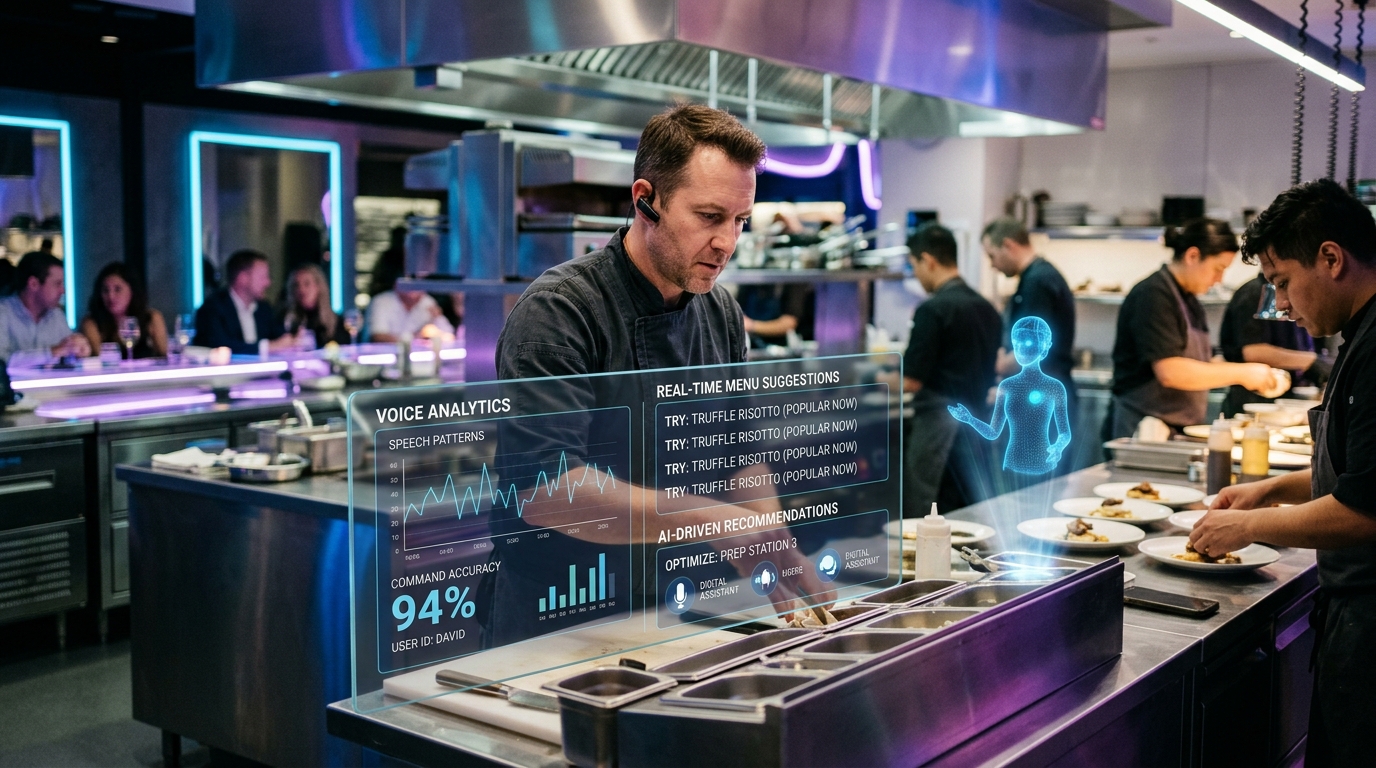
Next-Generation AI Voice Agents: Beyond Order Taking
AI voice agents in hospitality have rapidly evolved from simple order-taking bots to highly sophisticated, multi-tasking virtual assistants. In 2026, leading systems—powered by the latest advances in natural language processing, real-time speech-to-text, sentiment analysis, and multilingual capabilities—are reshaping the restaurant experience both for customers and operators.
As reported by Biteberry’s 2026 industry guide, modern AI voice order solutions can now:
- Answer 50+ simultaneous customer calls (aigrants.in, 2024), ensuring no order opportunity is ever missed—even during the busiest peak hours.
- Push orders directly to POS systems, reducing manual entry errors and wait times (KwickPOS, VAPI Guide).
- Proactively call to confirm reservations, manage waitlists, and fill last-minute cancellations (voagents.ai).
- Text reminders, handle rescheduling, and even make outbound promotional calls to existing customers for upselling.
These functionalities are just the starting point as AI rapidly advances.
The Emerging Trends: What the Next Five Years Hold
Several breakthrough trends are shaping the future outlook for AI voice agents in hospitality:
- Multilingual and Hyperlocal Expansion
As restaurants seek to serve more diverse and global audiences, language accessibility is becoming crucial. Platforms like CallMissed are already enabling AI voice agents to operate in 22 Indian languages natively. This is essential in a market where over 60% of consumers prefer interacting in their local language (CSA Research, 2025).
- Emotion and Context Awareness
Next-gen AI is becoming emotionally intelligent. Loman AI, for example, uses sentiment analysis to adjust its responses based on caller mood, aiming to replicate human empathy in handling complaints or stressed customers. Industry estimates predict 80% of top hospitality AI systems will incorporate emotion modeling by 2027 (Voiceflow, 2026).
- Personalized Upselling and Dynamic Recommendations
Future AI agents will draw on historical customer data, order habits, and context to offer tailored recommendations. If a customer with a gluten allergy calls, the AI can proactively suggest compliant menu options or recall their favorite dish from a previous order. Such personalization has been shown to increase average order value by up to 23% in pilot deployments (Biteberry, 2026).
- Seamless Omnichannel Orchestration
Voice ordering is converging with web, mobile, kiosks, and social platforms. Customers can start a reservation with an AI agent over WhatsApp, confirm it via phone, and receive real-time updates through SMS—all orchestrated by a unified conversational AI layer.
- Automated Payments and Post-Order Services
AI agents are beginning to securely handle payments, issue digital receipts, manage feedback collection, and join loyalty programs—all without human intervention.
Data-Driven Impact: Efficiency, Cost, and Customer Experience
According to industry analysis (Voiceplug AI, 2026):
- Labor efficiency: AI voice systems reduce inbound call handling workload by 40–60%, freeing staff for in-person service.
- Error Reduction: Automated order capture reduces manual entry errors by up to 70%, leading to fewer customer complaints.
- Revenue uplift: With instant, always-available voice service, restaurants see a 10–18% lift in total call-in sales.
- Customer satisfaction gains: 75% of diners using AI-powered calling report higher satisfaction scores, primarily due to reduced wait times and 24/7 availability.
Such statistics underscore why analysts predict over 80% of urban restaurants globally will offer AI-assisted voice ordering by 2028 (Biteberry, 2026).
Open Platforms, APIs, and Ecosystem Integration
A critical driver for the next phase is the rise of open, API-driven communication infrastructure. Developers want flexibility—an ability to switch between speech-to-text models, connect to multiple LLMs, or migrate from one language provider to another without code rewrites. Platforms like CallMissed, with API support for 300+ language models and all major speech engines, exemplify this trend. This ecosystem approach accelerates time to market, fosters innovation, and helps restaurants adopt best-of-breed AI tools tailored to local needs.
Practical Implications and Challenges
Despite rapid advances, several challenges remain at the frontier:
- Maintaining Natural Dialogue: While AI performance is improving, handling complex multi-intent conversations and local dialect nuances is still a work in progress—especially for non-English markets.
- Data Privacy and Security: Voice ordering involves sensitive customer and payment data. Industry leaders are investing in stringent AI governance, compliant data handling, and end-to-end encryption.
- Adoption Barriers: Smaller operators may face integration bottlenecks, cost concerns, or resistance to non-human ordering. Solutions that offer plug-and-play integration and pay-per-use pricing are gaining momentum.
Global Expansion and Local Relevance
What’s uniquely promising is how AI voice agents are democratizing access for restaurants of all sizes beyond just large chains. In India, Southeast Asia, and Latin America—where mobile-first adoption is high and linguistic diversity is vast—the next wave of AI agents will support hyper-local menus, regional languages, and local payment solutions.
“The winning AI platforms will be those that localize experience, integrate seamlessly with POS and social platforms, and offer both inbound and outbound communication,” notes the 2026 Biteberry guide.
Forward-Looking: The Human + AI Partnership
Rather than “replacing” staff, AI voice agents are increasingly functioning as co-pilots—augmenting teams, enhancing accuracy, and supporting hospitality’s most valuable asset: human warmth. In the years ahead, expect to see hybrid models where AI handles repetitive, high-volume tasks while freeing staff for surprise-and-delight moments.
For businesses looking to embrace this future, AI-powered platforms like CallMissed provide production-ready voice agent infrastructure, robust language model support, and seamless multilingual APIs—ensuring restaurants can innovate without being bottlenecked by technology or resources.
Conclusion
The future of AI voice agents for restaurant ordering is not just about automating transactions—it’s about transforming hospitality. By bridging efficiency with empathy, personalization, and local nuance, AI communication platforms are poised to redefine the guest experience. As natural language AI, emotion detection, and ecosystem integrations become ubiquitous, restaurants that proactively leverage these advances will position themselves to thrive in a dynamic, customer-first era.
Frequently Asked Questions: AI Voice Agents for Restaurants
How do AI voice agents for restaurant ordering work?
What are the main benefits of AI voice ordering for restaurants?
How accurate are AI voice agents at handling restaurant orders?
Can AI voice agents integrate with existing restaurant POS systems?
Are customer conversations secure and private with AI voice agents?
What does it cost to implement an AI voice agent for restaurants in 2026?
Conclusion
The adoption of AI voice agents in restaurant ordering is no longer a futuristic concept—it’s a competitive necessity in 2026. As the technology matures, the early movers are already reaping the rewards: higher order accuracy, lower labor costs, and 24/7 availability that diners now expect.
Key takeaways from this shift:
- Efficiency at scale – AI agents can handle 50+ calls simultaneously, reducing hold times during peak hours and capturing orders that would otherwise be lost.
- Seamless POS integration – From KwickPOS to Clover, modern voice agents push orders directly into the system, cutting out manual entry errors.
- Proactive engagement – Beyond taking orders, agents can confirm reservations, manage waitlists, and fill last-minute cancellations with automated outbound calls and text reminders.
- Multilingual capability – As consumer bases diversify, platforms that support multiple languages (like CallMissed with 22 Indian languages) give restaurants a distinct edge in customer experience.
What to watch for next: emotional intelligence in voice. Today’s agents handle transactional interactions flawlessly, but the next frontier is tone-aware negotiation—handling substitutions, upselling with empathy, and detecting frustrated callers. By late 2027, we may see voice agents that can read mood and adapt their pitch accordingly.
To explore how AI communication infrastructure is evolving, check out CallMissed — an AI platform powering voice agents and multilingual chatbots for businesses. As voice AI becomes as integral to restaurants as the POS system itself, the question isn’t whether you’ll adopt it, but how quickly you’ll adapt to stay ahead. Are you ready to let AI answer the next call that rings?
Related Posts

Ready to automate customer conversations?
Launch AI voice agents and WhatsApp bots with CallMissed — one API, 22+ Indian languages.