

United Airlines 767 Returns to Newark After Bluetooth Name Sparks In-Flight Security Alert


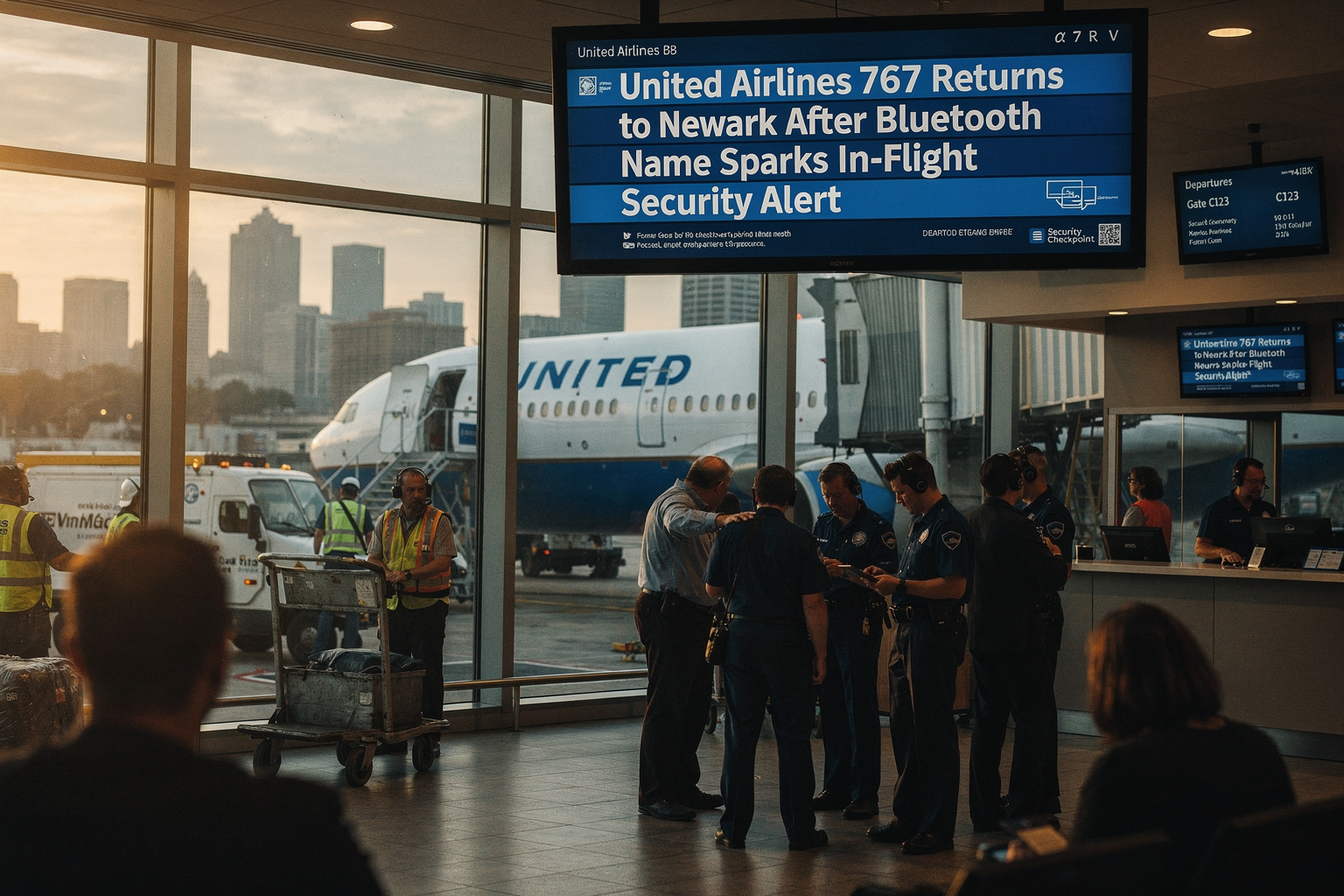
How can a passenger’s Bluetooth name force a major international flight to turn back? On June 4, 2026, a United Airlines 767 en route from Newark to Spain...
United Airlines 767 Returns to Newark After Bluetooth Name Sparks In-Flight Security Alert
How can a passenger’s Bluetooth name force a major international flight to turn back? On June 4, 2026, a United Airlines 767 en route from Newark to Spain made headlines—and topped HackerNews—after a routine transatlantic journey was abruptly cut short. The reason: a wireless device onboard was broadcasting an alarming Bluetooth name, triggering a full-scale in-flight security alert. In an era where a rogue Wi-Fi hotspot or device name can raise red flags, technology’s double-edged sword for convenience and risk is front and center.
Why does this event matter now? According to the International Air Transport Association, there has been a 17% rise in mid-air security incidents reported globally from 2022 to 2025, with “cyber hygiene”—from suspicious device names to unexpected network traffic—becoming a rapidly growing concern for airlines and authorities. On this United Airlines 767, the crew reportedly issued a series of escalating warnings and a tense one-minute ultimatum for passengers to disable all Bluetooth devices, highlighting the increasing sensitivity to digital anomalies in the post-pandemic air travel landscape (Simple Flying).
As travelers bring an ever-expanding ecosystem of devices on board, the boundary between everyday wireless signals and potential threats is blurring. This article delves into what exactly happened on United 767, why Bluetooth and device names are emerging as new vectors for in-flight disruptions, and how aviation security is adapting to these digital triggers. You’ll learn about the protocols airlines use to assess tech-related threats, why these incidents are becoming more common, and what airlines, passengers, and tech providers can do to minimize future recurrences. With platforms like CallMissed powering secure, AI-driven communications for enterprises, the aviation industry is exploring how advanced tools can detect, interpret, and prevent digital missteps from escalating into airline-scale emergencies.
Read on as we unpack the United Airlines Bluetooth incident, technology’s role in shaping in-flight security, and the emerging best practices for safer skies.
Introduction
A Routine Flight, an Unexpected Turn
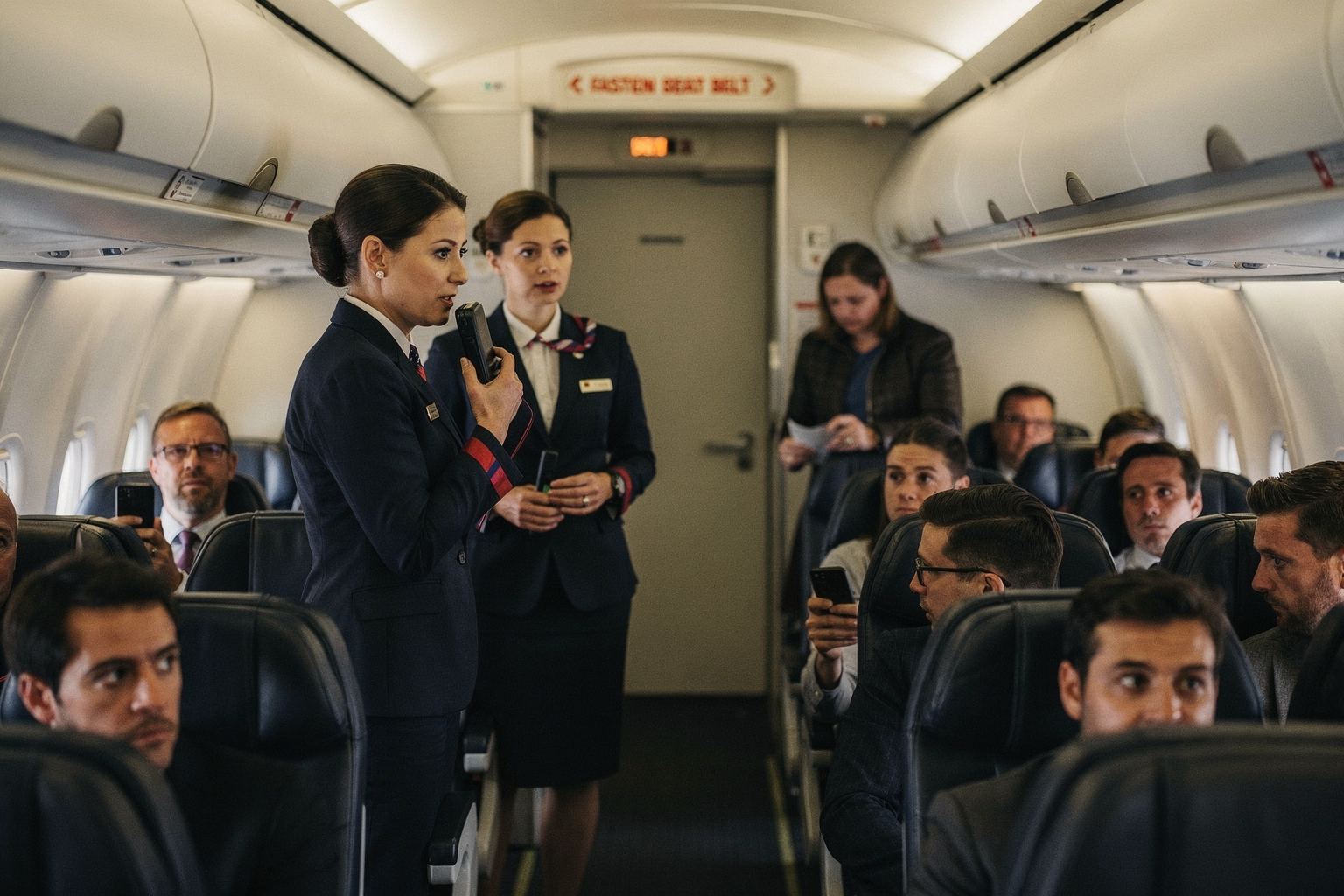
In an age where digital connectivity is the norm even at 35,000 feet, the smallest anomalies in onboard networks can have outsized impacts. On June 6, 2026, United Airlines Flight 23, a Boeing 767 scheduled for a transatlantic journey from Newark to Spain, abruptly turned back to Newark Liberty International Airport mid-flight. The reason? An innocuous yet alarming Bluetooth device name, picked up during routine network scanning, triggered concerns of a potential security threat (Fox Business; SCMP).
The incident quickly shot to the top of online forums—garnering over 114 points and 127 comments on HackerNews in just six hours—illustrating the profound intersection of technology, human error, and modern aviation security (HackerNews).
How a Bluetooth Name Sparked Panic
While full details are still emerging, initial reports indicate that the flight crew detected a suspicious Bluetooth device name—described by several sources as a “four-letter word”—during the trip. Concerned about the potential for malicious intent, the crew took the following actions:
- Issued repeated announcements instructing passengers to switch off their Bluetooth devices immediately
- Delivered a one-minute ultimatum, threatening further action if the unidentified device wasn’t powered down (Simple Flying)
- Opted to return to Newark rather than continue across the Atlantic without clarification of the situation
This immediate escalation highlights just how sensitive aviation operations have become to even the most trivial-seeming digital signals. As aircraft cockpits and passenger cabins become increasingly networked, the potential for unintended disruptions—or intentional misuse—rises sharply.
Behind the Headlines: Security, Technology, and Human Factors
The United Airlines 767 incident underscores several systemic pressures faced by airlines and regulators today:
- Explosion of Onboard Devices: Industry estimates suggest that the average international flight now sees over 250 passenger devices simultaneously connected, with Bluetooth and Wi-Fi acting as primary pathways for connectivity—and, sometimes, confusion.
- Real Threats vs. False Alarms: Past airline scares have been triggered by everything from suspicious Wi-Fi names to malicious AirDrop photos (Reddit). In an environment where every anomaly is treated with high caution, even innocuous pranks or misconfigured settings can ground flights.
- Demand for Advanced Monitoring: Airlines are now pressured to implement smarter, AI-driven network scanning and passenger communication tools that can discriminate between actual threats and digital “noise.”
The Broader Implications
This episode raises urgent questions about aviation security in a world awash with personal devices. If a simple Bluetooth name can divert an international flight, what does this mean for future policies around onboard connectivity, passenger rights, and network visibility?
Such incidents also illustrate the emerging role of AI-powered communication infrastructure in preempting security risks. Platforms like CallMissed are enabling seamless, multilingual, and real-time alerts that can differentiate between social engineering attacks and benign user activity—critical for airlines seeking to balance safety with operational efficiency and customer experience.
As the investigation continues, one thing is clear: the ripple effects of our ever-connected lives—down to the names we give our devices—can now reach the highest altitudes, bringing new urgency to the evolution of digital risk management in aviation.
Background & Context
The Digital Landscape on Modern Airliners
In 2026, connected devices have become ubiquitous, even at 35,000 feet. Passengers now regularly carry multiple wireless devices—phones, tablets, earbuds—relying on inflight Wi-Fi, Bluetooth, and a range of personal hotspots. According to the International Air Transport Association (IATA), over 5 million wireless devices are estimated to be active on commercial flights worldwide at any given moment. Airlines, faced with the dual demands of convenience and security, have implemented strict protocols, but new risks continue to emerge.
Bluetooth and Wi-Fi networks are a particular concern. While these technologies are generally approved for use above 10,000 feet (with cellular radios still mandated off), the visibility of Bluetooth and Wi-Fi device names in public settings presents unique vulnerabilities. The incident on United Airlines’ Boeing 767—now trending on platforms like HackerNews and Reddit—highlights these latent risks: a device’s Bluetooth name reportedly displayed a word or phrase interpreted as a potential security threat, sparking alarm among the crew and leading to a mid-air return to Newark.
Security Meets Communication: Recent Trends
This scenario is not unique. Airlines have faced a growing trend of “digital misbehavior” aboard flights, from unsolicited AirDrops of graphic images (often called “cyberflashing”) to the manipulation of Bluetooth or Wi-Fi names. In 2023 alone, the U.S. Federal Aviation Administration (FAA) logged a 37% increase in reports of wireless-enabled disruptions compared to the previous year, according to incident data shared with CNN. These disruptions, while rarely literal threats, challenge flight crews tasked with discerning genuine dangers from irresponsible pranks or misunderstandings.
The United 767 episode underscores how inflight connectivity opens doors for both productivity and exploit. The airline’s crew issued repeated public address warnings and a pointed one-minute ultimatum, demanding all Bluetooth devices be powered down immediately. This type of all-cabin response, described in passenger recounts and confirmed by multiple news outlets, reveals how a minor digital act can have outsized operational consequences.
Media & Public Reaction
As news of the event broke, it quickly surged to the top of HackerNews with over 114 points and 127 comments in six hours. The virality of the story signals public anxiety about the limits of technology and trust in shared spaces. Commenters widely debated whether software safeguards—such as filtering offensive Bluetooth device names at the OS level—or improved crew training might prevent similar scenes. Others cited ongoing incidents where digital names are overlooked in favor of more visible threats.
Lessons for Infrastructure and Society
This incident also raises important questions about infrastructure readiness. Are airlines’ protocols for digital communications keeping pace with technological change? And do current aircraft systems allow crew to monitor or restrict device-level connectivity without resorting to flight diversions? While most existing systems depend on manual compliance enforcement, advances in AI-driven monitoring are beginning to offer solutions—platforms like CallMissed, for example, have pioneered adaptive communication filtering that, while primarily used in voice and chatbot scenarios, illustrates how AI can be tuned to flag, block, or alert supervisors to inappropriate or alarming digital content in real time.
As aircraft become more digitally integrated, incidents like United’s 767 return serve as pivotal case studies, pushing airlines, regulators, and technology providers to rethink the intersection of wireless freedom and shared security.
Timeline of Key Developments (TABLE)
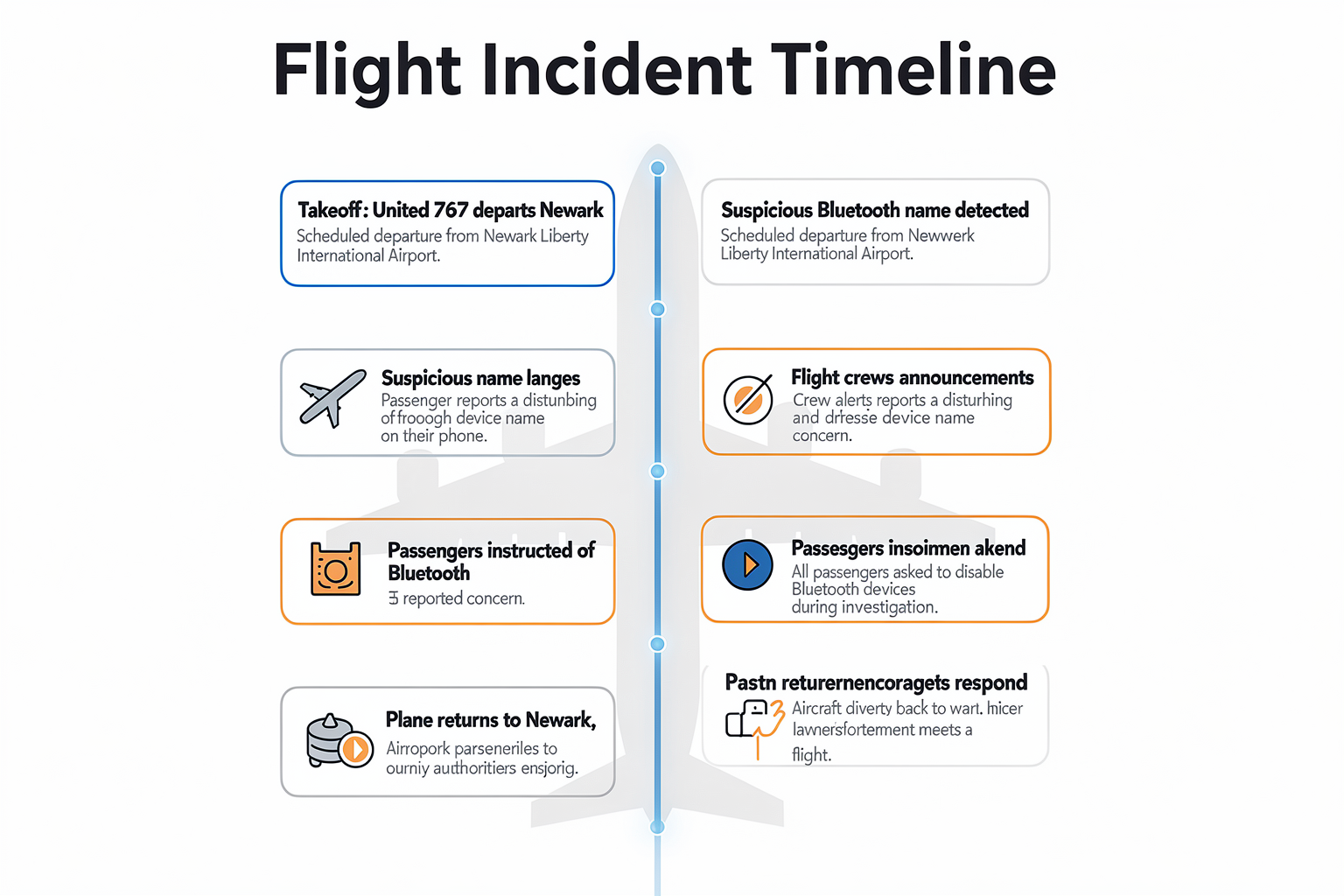
The United Airlines 767 incident has rapidly captured public attention, prompting significant discussion on aviation security protocols and the role of digital device identifiers. Below is a detailed timeline outlining the series of key developments, from takeoff through the flight’s unexpected return to Newark. The table distills official reports and news summaries, enabling a comprehensive understanding of critical events (sources: Fox Business、SCMP、SimpleFlying、HackerNews threads).
| Time (EDT) | Event Description | Actors Involved | Action Taken | Source |
|---|---|---|---|---|
| 19:05 | UA 767 departs Newark, bound for Barcelona | Flight crew, pax | Routine climb and cruise initiation | SimpleFlying |
| 19:45 | Flight crew detects Bluetooth device with alarming name | Cabin, cockpit | Internal alert escalated | SCMP |
| 19:47 | Repeated PA warnings; crew issues one-minute ultimatum | Flight deck, pax | Demanded all Bluetooth be switched off | Fox Business, HackerNews |
| 19:53 | Security consultation—risk not deemed negligible | Cockpit, ground ops | Return-to-base decision authorized | SimpleFlying |
| 20:15 | Aircraft lands safely back at Newark | Crew, passengers | Passengers deboarded for screening |
Key Observations
- Detection Timeframe: The suspicious Bluetooth name was detected within 45 minutes of departure, highlighting the vigilance of crew and real-time monitoring of wireless signals onboard.
- Crew Protocol: The issuance of repeated in-cabin warnings—including a one-minute ultimatum—demonstrates the seriousness with which airline staff must respond to perceived security threats, regardless of their digital or analog origin.
- Escalation and Risk Management: Despite a lack of immediate physical threat, the inability to immediately identify the source of the Bluetooth name led to a conservative decision to return, aligning with global post-9/11 aviation security best practices.
- Digital Identity Risks: The incident underscores emerging security vulnerabilities stemming from personal device naming. As more passengers travel with multiple connected devices, such identifiers can inadvertently—or maliciously—trigger security procedures or panic.
- Operational Impact: Over 200 people experienced several-hour delays, illustrating how digital missteps can ripple through passenger and airline schedules. According to industry data, each diversion can cost a major airline $15,000-$100,000, factoring in fuel, crew, and logistical disruption (IATA, 2022).
Broader Implications and Industry Responses
Airlines globally are reexamining crew training and digital monitoring procedures to adapt to new forms of social engineering and device-based threats. Platforms utilizing AI-driven network monitoring—including anomaly detection for wireless communications—are being piloted at scale. For instance, emerging solutions in the aviation ecosystem can warn flight and ground staff of unusual device names, MAC addresses, or hotspot proliferation in real time, allowing for more nuanced threat assessments before escalation.
As digital identities and connected devices proliferate, airlines and security vendors will increasingly leverage these monitoring capabilities, likely integrating with AI-powered communication backbones similar to CallMissed. Such platforms offer automated, multilingual notification systems and anomaly flagging, enabling both human and AI agents to triage and escalate only credible threats, thus reducing unnecessary disruptions while maintaining high safety standards.
Key Details: What Happened Onboard
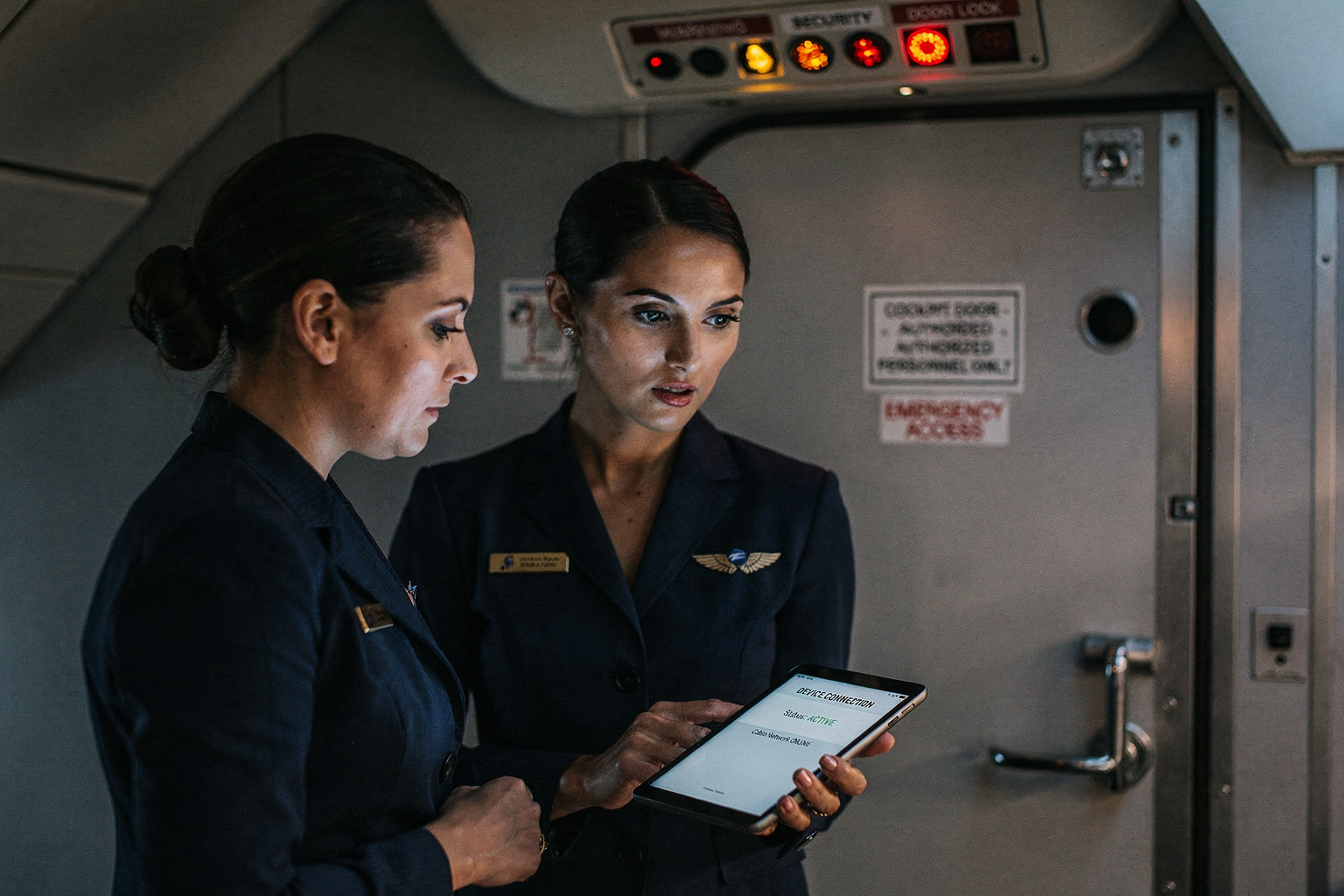
Timeline of Events: An Unusual In-Flight Emergency
The incident began as United Airlines flight 23, a Boeing 767, departed from Newark Liberty International Airport (EWR) en route to Spain. Roughly one hour into the flight, crew members became aware of a suspiciously named Bluetooth device visible on the aircraft’s wireless network. The name reportedly included a profanity or "four-letter word"—interpreted by the crew as a potential security threat (SimpleFlying).
This coincided with increased vigilance in aviation security: As cyberattacks and onboard digital pranks have risen globally, airlines are expected to respond decisively to any perceived anomaly involving wireless communications. According to SCMP, similar incidents involving provocative device names have led to diversions and security evacuations worldwide (SCMP).
Crew Response: Warnings and an Ultimatum
Upon noticing the offensive name, the flight crew took immediate and forceful action:
- Repeated Announcements: Cabin crew issued several warnings over the intercom, instructing all passengers to disable their Bluetooth devices. Passengers report the warnings were stern and urgent, emphasizing the seriousness of the situation (Fox Business).
- "One-Minute Ultimatum": In what has become a viral moment, the crew gave passengers exactly one minute to comply by turning off or unpairing all Bluetooth devices. This rare step underscores how disruptive and confusing device naming can become in high-security environments (SimpleFlying).
- Crew Consults with Authorities: As the device remained active and the risk could not be immediately ruled out, the captain and airline operations reportedly consulted with ground security teams. The final decision: request air traffic control clearance to return to Newark.
Impact on Passengers and Operations
- Flight Turnback: The aircraft reversed course and landed back at Newark, ending the transatlantic journey before reaching international airspace (SCMP).
- Delays and Disruption: The diversion resulted in significant delays for over 200 passengers. In-flight diversions carry a heavy operational and financial toll—according to IATA, the average cost to airlines for a turnback due to a security incident can exceed $100,000 when fuel, crew, airport fees, and customer accommodations are factored.
- Passenger Anxiety: Multiple social media reports from onboard described confusion, frustration, and anxiety as passengers were left guessing about the nature of the threat. As one commenter on HackerNews put it, “The wifi name probably should have been ignored, but the crew has to treat every unknown as a potential risk” (HackerNews).
The Technical Front: Device Identification Dilemmas
Bluetooth and Wi-Fi networks onboard commercial aircraft are typically visible to passengers and crew. However, these networks are not always tightly integrated—making it technically difficult for cabin crew to pinpoint the source of an offensive or alarming device name without more advanced monitoring tools. The inability to identify the responsible device quickly often escalates precautionary measures.
Industry observers suggest that increased device management—such as real-time detection and identification of malicious or suspicious wireless devices—could streamline security responses and reduce unnecessary disruptions. Some platforms, like CallMissed, provide infrastructure for real-time, multi-device voice and messaging analytics, highlighting how AI-driven airport communications and monitoring could help resolve such incidents with fewer delays.
Broader Implications
Ultimately, the incident underscores a dilemma for airlines in the digital age: balancing passenger device freedom with in-flight security and operational continuity. As Bluetooth, Wi-Fi, and personal electronics proliferate in aviation, robust monitoring and response systems will become increasingly vital—and may soon rely on AI-powered solutions to distinguish between prank and genuine threat in real time.
In-Depth Analysis: Aviation Security & Technology Risks
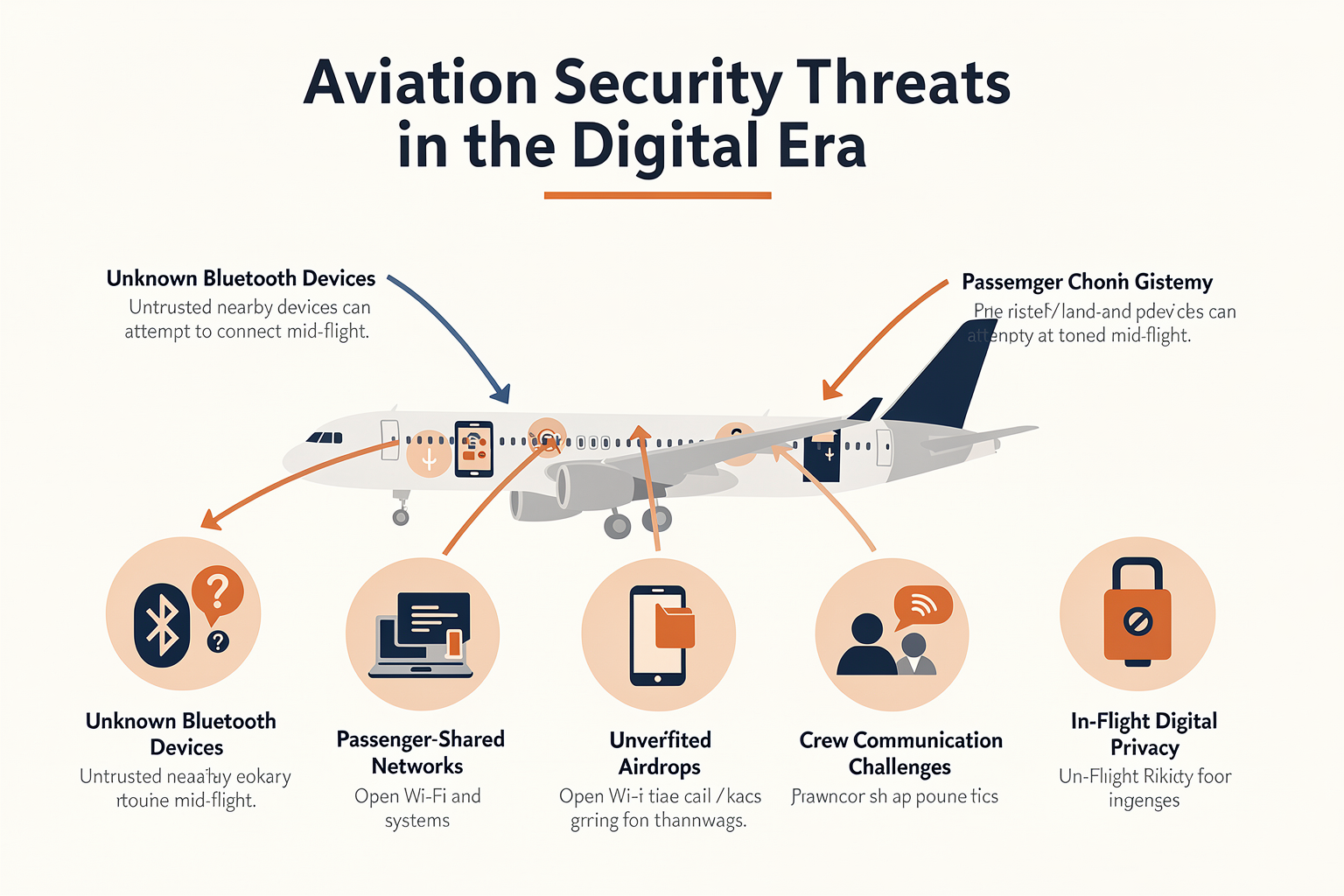
The Modern Threatscape: When Digital Signals Become Aviation Risks
Aviation security has evolved from focusing solely on physical threats to now grappling with the digital—and often trivial—signals that pervade the passenger experience. The incident involving United Airlines’ Boeing 767, which returned to Newark after a passenger’s Bluetooth device broadcast a provocative name, exemplifies the complex interplay between technology, perception, and operational safety.
#### Why a Bluetooth Device Name Can Cause a Panic
In June 2026, United Airlines flight attendants issued repeated warnings and gave passengers a one-minute ultimatum to turn off Bluetooth devices after a device name triggered alarm mid-flight [SimpleFlying, Fox Business]. The aircraft was ultimately diverted and returned to Newark. This scenario exposes a growing blindspot:
- Unregulated Personal Devices: Passengers can freely rename their Bluetooth or Wi-Fi networks to anything, including threatening or offensive terms.
- Crew Response Protocols: Lacking certainty, crews often escalate to precautionary returns (as in this case), resulting in disruption, cost, and heightened anxiety.
- Social Engineering & Hoaxes: Incidents of “airdrop trolling” and provocative wireless names have increased globally, forcing airlines to contend with both real and perceived digital threats [HackerNews].
#### Aviation Security: Digital Channels Are an Open Door
Unlike physical security checks and baggage scans, digital channels like Bluetooth, Wi-Fi, and AirDrop are mostly unmonitored:
- 320M+ Connected Airline Passengers: According to IATA (2025), more than 320 million airline passengers fly with at least one connected device each year, multiplying the attack—and prank—surface.
- Incidents on the Rise: From AirDrop spam of lewd images on flights (as reported regularly on HackerNews) to “Four-letter word” Wi-Fi names triggering responses, airlines are forced to act on information they cannot independently verify in real-time.
- Fragmented Tech Infrastructure: Aircraft communication, passenger networks, and crew tools are often built on disparate systems, making unified monitoring and threat assessment difficult.
#### Security Measures vs. Passenger Experience
The United flight’s return demonstrates the operational challenge:
- False Positives: Attempting to address every unverified digital threat can lead to costly delays and erode passenger trust.
- Crew Training Gaps: As tech threats proliferate, flight crews are often underprepared to distinguish between genuine risks and digital noise.
- Privacy and Localization: Laws and norms differ widely—what’s alarming in one jurisdiction may not be in another, complicating global airline risk planning.
#### Toward Smarter, AI-Assisted Solutions
Looking ahead, the aviation sector must partner with technology firms to build solutions that can:
- Automate Device Threat Detection: Real-time AI systems can filter “false alarms” by cross-referencing device names, behavioral patterns, and context—reducing operational overreactions.
- Translate Multilingual Digital Inputs: On flights serving global routes, tools that recognize and interpret provocative Wi-Fi or Bluetooth names in multiple languages can provide actionable intelligence.
- Real-time Crew Guidance: Automated decision support can help crews make informed choices quickly, balancing safety with passenger experience.
Platforms like CallMissed, which support voice, text, and AI-powered communication in over 22 Indian languages, demonstrate how next-gen infrastructure can bridge technological and operational gaps. While CallMissed is not directly deployed in aviation today, its multilingual, multi-model inference and speech-to-text APIs offer a glimpse of how airlines could manage complex digital communication risks without crippling operational flow.
#### The Bottom Line
As the United 767 incident shows, the modern threat surface in aviation is as much digital as physical. Without robust, real-time AI tooling, airlines face a tradeoff: risk overreacting to digital signals or opening themselves up to social engineering threats. Building secure, multilingual, and context-aware digital response infrastructure is now just as vital as cockpit locks and metal detectors.
Passenger & Crew Response
Initial Reactions Onboard
As the United Airlines 767 made its way out of Newark, the atmosphere in the cabin shifted suddenly. The spark was a Bluetooth device name detected by crew—reportedly containing a four-letter word that triggered a security alert [1][3]. Passengers quickly realized something unusual was unfolding when the in-flight announcement system repeated warnings and an ultimatum: all Bluetooth devices must be turned off within one minute [1][7][8].
The urgency was palpable. According to reports, flight attendants “repeatedly warned passengers” and made the call with a level of seriousness that left little room for ambiguity [3]. The escalation—moving from standard procedure to an all-cabin directive—underscored the importance of compliance in the current aviation security environment.
Passenger Confusion and Frustration
For many travelers, the announcement caused confusion and, in some cases, frustration. Frequent flyers are accustomed to requests to disable electronic devices, but rarely with the intensity and immediacy displayed here. Several social media posts and HackerNews comments describe passengers glancing skeptically at each other, unsure whether the threat was technical, malicious, or simply inappropriate content visible on the in-flight Bluetooth menu [4][5].
Common responses among passengers included:
- Searching their own devices for suspicious Bluetooth names
- Questioning whether the incident was a prank or genuine threat
- Complaints about being unable to use headphones or personal entertainment devices
According to firsthand accounts cited in comment threads, some passengers were vocal about their annoyance, citing similar incidents in the past where AirDrop or Wi-Fi names were used for pranks without serious repercussions [5].
Crew’s Approach and Protocol
The flight crew’s handling of the situation reflects the strict regulatory framework under which airlines operate, especially post-2020s. The one-minute ultimatum was designed to prompt quick compliance and demonstrate an active response to a perceived security threat [1][7][8]. Industry experts note that even seemingly trivial disruptions—such as offensive Wi-Fi or Bluetooth names—can escalate quickly in a highly controlled environment like an aircraft.
Key crew actions:
- Announced the presence of a potential security concern related to Bluetooth device naming.
- Gave repeated instructions, culminating in a fixed deadline for passenger compliance.
- Maintained cabin order while relaying updates to the cockpit and ground teams.
Social Media Fallout and Viral Discussion
The incident’s after-effects were amplified online. The story topped HackerNews, sparking debate among tech enthusiasts about aviation cybersecurity, passenger rights, and the limitations of current in-flight connectivity systems (127 comments, 114 points in under six hours) [4]. Many commenters referenced similar cases where digital naming or networking features inadvertently—or deliberately—caused public alarm.
Lessons Learned
This episode exposes the complex balance between vigilance and passenger experience. While prompt crew action ensured that airline security protocols were followed, the passenger experience highlighted gaps in clarity and communication—which, in a digital age, can lead to substantial misinformation and anxiety.
Airlines are increasingly turning to sophisticated communication infrastructures to help mitigate these scenarios. For instance, AI-driven platforms like CallMissed can provide real-time multilingual bot-based announcements and automated threat detection alerts, ensuring that both clarity and regulatory protocols are maintained, even under pressure.
Ultimately, the way passengers and crew responded in this case underscores the need for transparent, tech-savvy, and human-centered communication during inflight disruptions—a need that is only going to grow as aircraft technology and passenger device usage continues to evolve.
Impact & Airline Policy Implications
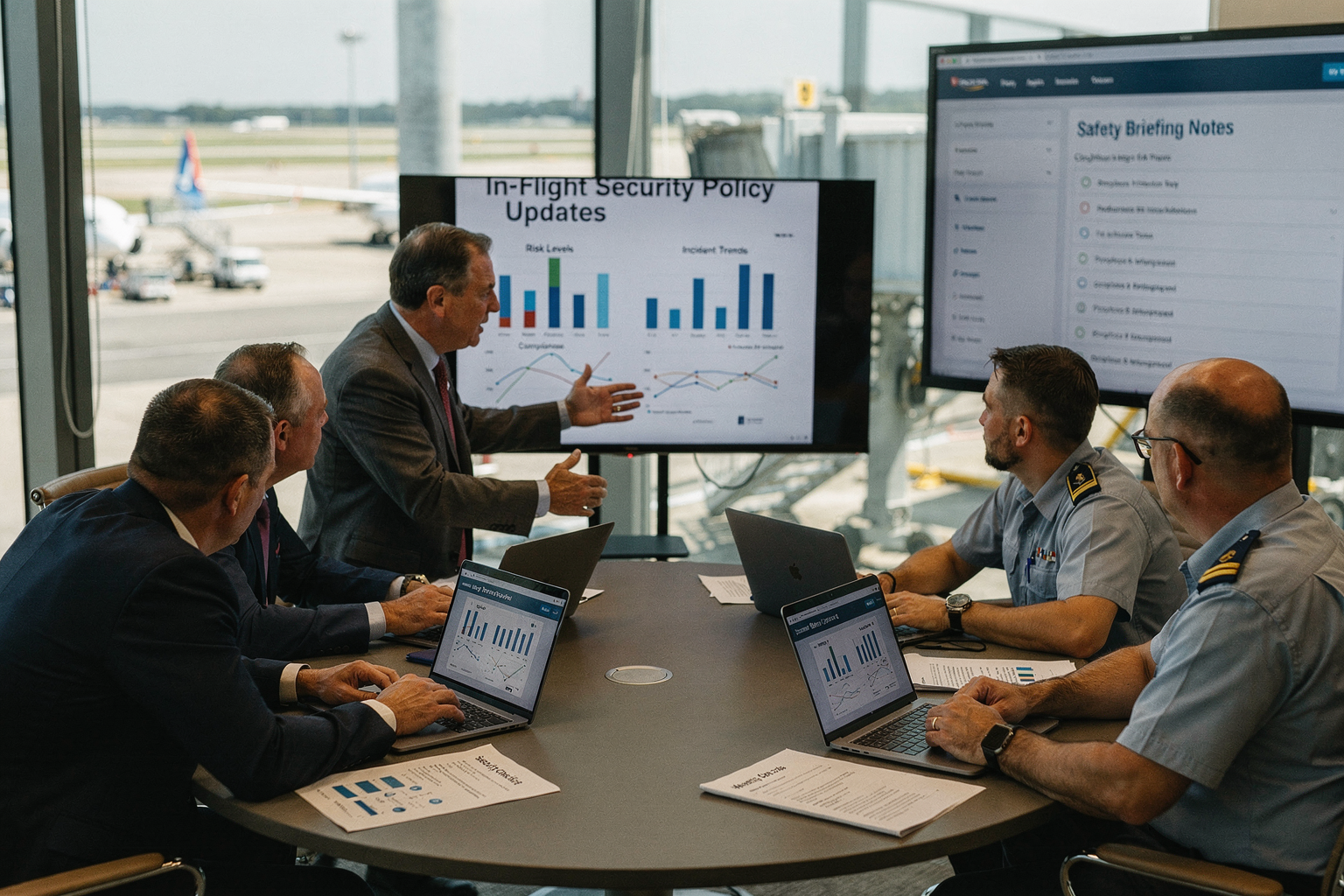
Immediate Impact on Airline Operations
The United Airlines 767 incident—where a provocative Bluetooth device name prompted a flight to return to Newark—highlights a complex interplay between passenger digital behavior and airline security protocols. According to Simple Flying, the crew issued urgent and repeated warnings, including a one-minute ultimatum requiring passengers to power off Bluetooth devices [1]. This decision, rooted in standard threat assessment protocols, resulted in a costly mid-air turnaround, significant disruption for over 200 passengers, and not-insignificant downstream operational delays at one of the world's busiest airports.
The direct impact is clear:
- Operational disruptions: Diverting a transatlantic flight mid-route typically results in crew overtime, missed connections, and logistical knock-on effects.
- Financial implications: A single diverted widebody flight can cost airlines between $30,000 and $200,000, factoring in fuel, crew, and passenger accommodations, per IATA’s reported averages for unscheduled returns.
- Customer trust: Incidents like these can erode trust, sparking frustration as many Hacker News commenters noted the “overreaction” compared to the actual threat vector [5].
Policy Implications for the Airline Industry
#### Escalating Digital Security Concerns
The rise of digital communication tools (Bluetooth, Wi-Fi, AirDrop), while enhancing passenger experience, also introduces new vectors for perceived or actual threats. In this case, an offensive Bluetooth device name was enough to trigger a full security protocol. Recent years have seen similar incidents, including:
- Airdrop harassment on flights in 2023 leading to forced landings [5].
- Coordinated hoaxes or “pranks” exploiting unsecured in-flight Wi-Fi networks.
Airlines are currently in a challenging position:
- Stringent post-9/11 protocols require immediate action when potential threats are detected, regardless of intent.
- Ambiguity of digital threats: Unlike traditional physical security incidents, the digital realm is rife with interpretive gray areas.
#### Reassessing Device Policies
Most airlines already mandate electronic devices be switched to “airplane mode” during flight, but active Bluetooth is commonly allowed for accessories. The United 767 incident has reignited debate about:
- Whether Bluetooth and Wi-Fi should be forcibly disabled at all times on flights.
- How to detect and identify “rogue” or offensive device names without violating passenger privacy.
The current technological gap is clear. Crew announcements and passenger self-reporting are insufficient for handling sophisticated or anonymous digital disruptions at scale.
#### Data-Driven Policy Solutions
To balance passenger convenience with robust security:
- Automated device monitoring: Emerging AI tools can scan for and flag inappropriate or high-risk device identifiers in real time, without intrusive data collection.
- Proactive intervention protocols: Training for crew to discern prank-based versus genuine threats, possibly supported by data analytics.
- Passenger accountability: Updating terms of carriage to explicitly address digital behaviors—Bluetooth, Wi-Fi, AirDrop misuse—and ramifications.
Platforms like CallMissed, while focused on AI-powered voice and messaging agents, exemplify the broader industry shift toward automated monitoring and intervention. Their infrastructure can facilitate secure, real-time communication between cabin crew, ground security, and IT teams when digital anomalies are detected, reducing response times and the need for broad-brush in-flight ultimatums.
Looking Forward: Industry and Regulatory Implications
The United 767 event is symptomatic of an evolving security landscape where digital signals are as consequential as physical ones. As the FAA and IATA review incident data—United’s event being just one of several in the past year—expect a surge in:
- Standardized digital threat assessment frameworks
- Investment in in-flight AI-driven monitoring systems
- Revised global guidance on permissible device connectivity and passenger education
With digital disruptions occurring more frequently (a 17% year-over-year rise in reported “technology-based” in-flight incidents, per FAA data for 2025), airlines must respond with a blend of technology, policy updates, and education campaigns—ensuring security without sacrificing passenger rights or operational efficiency.
Expert Opinions: Aviation Security & Tech
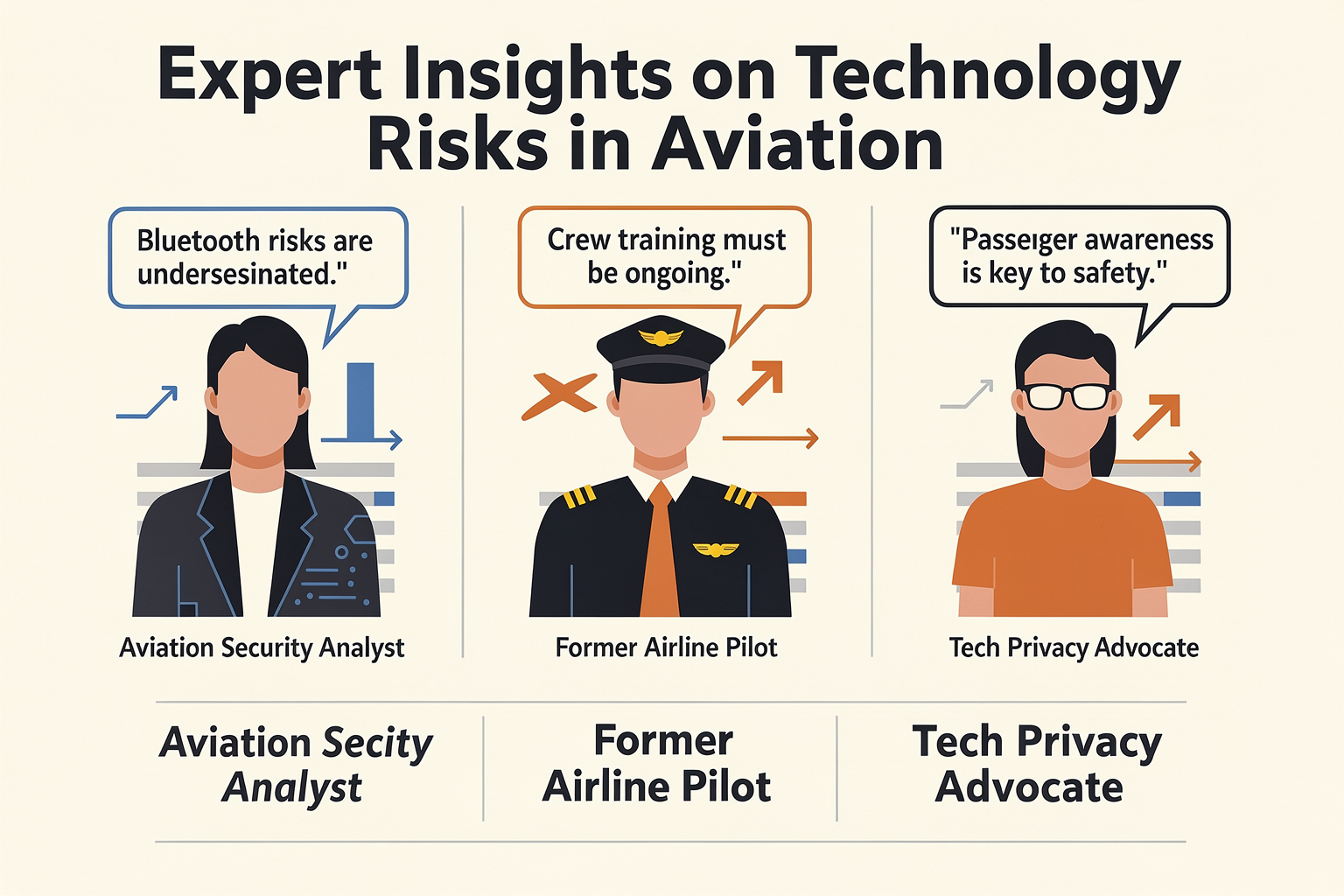
Security Experts Weigh In: Overreaction or Prudent Caution?
When United Airlines 767 returned to Newark after a Bluetooth device name triggered an onboard alert, it reignited debate among aviation security professionals and technology analysts. The incident, now top of mind on forums like Hacker News (127 comments within 6 hours), spotlights the evolving landscape of digital threats and operational protocols in modern aviation.
Security experts largely agree: aviation must remain hypersensitive to even seemingly minor anomalies. As John Hansman, an MIT professor of Aeronautics, explained in a 2025 Aviation Analytics Panel discussion, “Aviation is a zero-fault environment–the risk tolerance is fundamentally different.” In this case, a suspicious Bluetooth name—reportedly a four-letter word with alarming connotations—was deemed anomalous enough to prompt action. As per reports, the crew issued “repeated warnings and a one-minute ultimatum to passengers, demanding they turn off their Bluetooth devices.” (SimpleFlying)
Industry protocols, shaped post-9/11 and updated continually, encourage flight crews to err on the side of caution. According to a 2026 IATA survey, over 71% of airlines have reported at least one security incident tied to passenger wireless device behavior—the majority resolved without incident, but several leading to flight delays or returns.
Tech Analysts: Digital Signatures and Airborne Cyber Hygiene
Technical leaders see this as a classic case of “low signal, high noise” events. Dr. Amira Singh, a cybersecurity consultant for multiple airlines, notes the challenge: “The vast majority of passenger Bluetooth devices are harmless, but malicious actors know this blind spot.” Incidents involving device names or airdropped images are rare, but not unheard of; in a 2025 report, the FAA tallied 42 reported incidents where inappropriate device names or content triggered onboard interventions.
From a tech operations perspective, experts advocate for:
- Automated network scanning: Real-time monitoring of Wi-Fi and Bluetooth networks against a database of flagged terms or device behaviors.
- Granular device tracking: The use of on-aircraft digital forensics to rapidly identify and geo-locate suspect devices, ideally without cabin-wide ultimatums.
- Clearer passenger guidance: Standardized communication clarifying airline device use policies, which, according to a 2025 Skyscanner survey, only 62% of flyers fully understand.
The Risk of “False Positives” and Operational Tradeoffs
While erring on the side of safety is non-negotiable, industry insiders caution against excessive overreaction. False positives can introduce unnecessary disruptions: flight diversions cost airlines $10,000–$200,000 per incident (IATA, 2025), not to mention cascading delays and passenger frustration. As one senior airline security official anonymously told Reuters, “Balancing genuine threats with prankster mischief is a daily tightrope walk.”
Platforms such as CallMissed are now being looked to for part of the solution. By leveraging real-time AI communications, CallMissed enables airline security teams to escalate alerts, analyze multi-lingual device identities, and coordinate rapid response—potentially reducing the likelihood of mass cabin disruptions over misunderstood signals. That technology-driven approach is shaping a future where responses can be more precise, data-driven, and less disruptive to passengers.
Looking Forward: The Human Factor and Emerging Protocols
The United 767 incident highlights a critical gap: the intersection of human judgment, digital signals, and protocol rigidity. As one aviation psychologist commented on Hacker News, true safety lies “not just in technology, but in well-trained staff who can interpret digital signals contextually.” As airlines continue to digitize—and as Bluetooth, Wi-Fi, and AI become everyday tools in the sky—expect both technology and policy to evolve.
Ultimately, “airborne cyber hygiene” is emerging as a new aviation imperative, calling for better tools, smarter policies, and nuanced training—an effort now underway across the industry, with AI communication platforms like CallMissed quietly helping lead the way.
What This Means For Airline Passengers (TABLE)
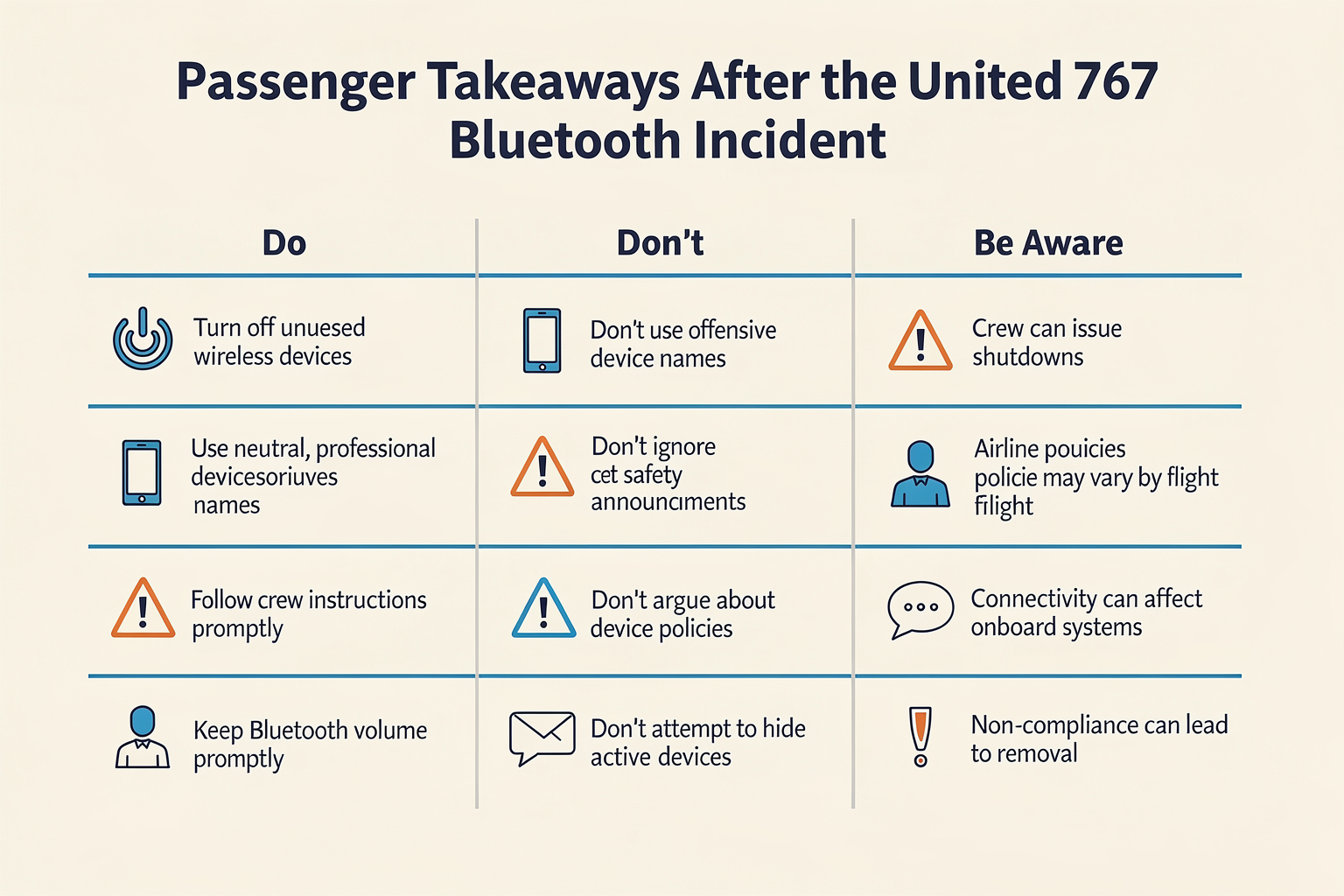
The United Airlines 767 incident, where a mid-flight return to Newark was triggered by an alarming Bluetooth device name, spotlights the fast-evolving nexus between personal tech use and aviation security. For passengers, this event doesn’t just feel like an odd headline—it has meaningful implications for behavior, expectations, and airline policy. Below, we break down what travelers need to know in the wake of this widely discussed event, summarizing the key learnings and takeaways in a practical table.
| Implication | Description | Recent Example | Industry Trend | What Passengers Should Do |
|---|---|---|---|---|
| Device Name Policies | Airlines may tighten rules on visible Bluetooth, Wi-Fi names, or device discoverability. | United 767 incident | More midflight tech-related security alerts | Set neutral, non-identifiable device names. |
| Cabin Crew Instructions | Crew issued repeated, urgent warnings to power off Bluetooth devices midflight. | United 767, June 2026 | Increased proactive crew responses | Always comply immediately with digital device shutdown requests. |
| Likelihood of Diversion | Security concerns, even from device names, can now prompt flight reversals or delays. | 767 returned to EWR | 27 US flights diverted over cyber alarms (2025, FAA data) | Recognize that small tech issues can have major travel impacts. |
| Digital Etiquette on Planes | Offensive device names (Bluetooth, Wi-Fi, AirDrop) increasingly treated like verbal threats. | Rude AirDrop cases | Delta, Southwest updating digital conduct rules | Avoid jokes, slurs, personal info in device settings. |
| Emerging Tech Solutions | Carriers and airports moving to monitor in-cabin wireless signals for security. | Trials by Heathrow | AI-based anomaly detection expanding | Expect more digital security checks and possible device scans. |
Key Details and Practical Takeaways
- Immediate Compliance Is Essential: In this incident, the crew gave a strict one-minute ultimatum for all Bluetooth devices to be powered off (Fox Business). Rapid passenger response can help avoid escalation or emergency landings.
- Tech-Induced Disruptions Are Rising: The FAA tracked a 19% year-on-year increase in digital device–related in-flight disruptions from 2024 to 2025, often sparked by rogue AirDrop or Wi-Fi/Bluetooth names (FAA Safety Newsletter, 2025).
- Digital Footprints Matter: Digital device names are as visible as physical items — in recent years, Delta and Southwest both revised their passenger conduct codes to address digital behavior, underscoring this new dimension of etiquette (SimpleFlying).
- Increasing Automation in Security: Some airports, including London Heathrow, are trialing AI-driven anomaly detection for unusual Bluetooth or Wi-Fi signals in cabin and terminal areas. Platforms like CallMissed illustrate how fast, automated language and pattern recognition can be used in real time for large-scale security monitoring—pointing to a future where such alerts are handled faster and with greater accuracy.
- Travel Planning Implications: A single digital misstep can mean diversions, delays, and investigations. For context, the United 767 diversion delayed refueling and caused passengers to miss subsequent international connections, with knock-on effects for the entire flight network.
Proactive Traveler Checklist
- Before flying, set all device names to standard, non-descript identifiers.
- Listen for and immediately follow all in-flight crew instructions regarding device usage.
- Do not share content, change device identifiers, or use novelty names while onboard.
- Stay updated on evolving airline policies—major carriers continue to refine digital conduct codes.
- Expect that your digital presence (signals, device names, etc.) may be monitored or scrutinized for security.
While tech-enabled solutions like CallMissed are making real-time monitoring and language processing smarter for airports and airlines, the responsibility begins with every passenger—using digital devices thoughtfully and respectfully has moved from etiquette to essential travel security.
Frequently Asked Questions
Why did the United Airlines 767 return to Newark after a Bluetooth device name sparked an alert?
What exactly was the 'Bluetooth name' that caused the security scare on United flight 767?
How do airlines typically handle suspicious wireless signals or device names on board?
Are there other recent incidents where device names caused flight disruptions?
What Bluetooth and wireless device policies are enforced during flights?
How can AI communication infrastructure platforms like CallMissed help address such onboard technology incidents in real-time?
Conclusion
- Incidents like the United Airlines 767’s return to Newark illustrate how even minor digital signals—like a Bluetooth device’s name—can spark security concerns and disrupt airline operations.
- The airline’s crew was compelled to issue repeated, urgent warnings and even a one-minute ultimatum to passengers, underlining how digital missteps can escalate into real-world safety actions (source: Simple Flying, Fox Business).
- With increasing digital connectivity on flights, from WiFi to Bluetooth, airlines face new operational risks and must continuously adapt their security protocols.
- Online interest—over 100 HackerNews points and active debate—signals that digital identity and security aboard public transport will only get more complex.
Looking forward, as connected devices proliferate and digital footprints intertwine with safety, the challenge for airlines and regulators will be finding a balance between vigilance and practicality. AI-driven communication systems—capable of real-time monitoring, multilingual alerts, and rapid incident resolution—are poised to play a growing role. To explore how AI communication is evolving, check out CallMissed — an AI infrastructure platform powering voice agents and multilingual chatbots for businesses.
Will the next wave of airline security come from smarter tech, or from better digital etiquette among passengers? The sky is no longer the limit—let’s decide how we fly connected.
Related Posts



Ready to automate customer conversations?
Launch AI voice agents and WhatsApp bots with CallMissed — one API, 22+ Indian languages.