
TTS Showdown 2026: ElevenLabs vs. Cartesia vs. OpenAI vs. Sesame – The Ultimate Comparison


Can you tell the difference between a human speaker and an AI-generated voice? In 2026, the odds are increasingly against you: recent blind tests from the...
TTS Showdown 2026: ElevenLabs vs. Cartesia vs. OpenAI vs. Sesame – The Ultimate Comparison
Can you tell the difference between a human speaker and an AI-generated voice? In 2026, the odds are increasingly against you: recent blind tests from the Artificial Analysis ELO Speech Arena reveal that over 58% of listeners failed to correctly identify the synthetic speaker when using the latest Text-to-Speech (TTS) models from ElevenLabs, Cartesia, OpenAI, and Sesame. The voice revolution is here—not just in how realistic voices sound, but in the speed, emotional expressiveness, and affordability of the technology.
Why does this TTS showdown matter now? The global TTS market has doubled since 2023, surpassing $6 billion USD in annual revenue (MarketsandMarkets, 2026). Applications have exploded far beyond simple screen readers: think AI-powered customer support, video game NPCs, personalized education, embedded devices, and multilingual call centers. In India alone, demand for local-language TTS surged over 300% year-on-year according to Digital India Analytics, a testament to how deeply AI speech has permeated daily life.
But not all TTS engines are created equal. The competition for "best in class" has never been fiercer or more nuanced. ElevenLabs, renowned for its emotive naturalness and recent v3 upgrade, sets the bar for realism—yet it faces stiff competition from Cartesia's Sonic 4, which stunned users this year with a lightning-fast 40ms time-to-first-audio (TTFA) and enterprise-grade self-hostability [FutureAGI, 2026]. OpenAI’s API, meanwhile, leverages its unparalleled scale and model diversity but often draws trade-offs around custom voice tuning. Newcomer Sesame carves out a niche with robust open-source tooling and prepackaged, legally-clear celebrity voices—drawing developer fans seeking flexible, compliant deployment.
In this definitive 2026 TTS comparison, we'll dissect these four leaders across the metrics that matter:
- Voice quality and realism: Can it trick the ear—and which subtle audio cues still give away the AI?
- Emotional range: Which platform captures nuanced tones, sarcasm, or excitement?
- Latency and scalability: How quickly can each system respond, and can it scale to millions of voices?
- Pricing and self-hosting options: What does it actually cost at production scale, and who allows on-prem deployment?
- Language coverage and legal factors: Who leads the pack for global and regional language support—and whose voice library passes legal scrutiny?
You’ll also get hands-on audio samples, real timing benchmarks (like Cartesia clocking in at just 40ms TTFA versus ElevenLabs’ industry-standard 100ms), and 2026 price breakdowns. We’ll highlight critical trends—such as the rise of self-hosted TTS for data sovereignty and the growing regulatory focus on voice data security.
And for businesses racing to integrate human-like speech into their workflow, platforms like CallMissed are part of this new wave—offering APIs that aggregate multiple TTS engines and deliver production-ready voice agents, spanning both global models and India’s 22 major languages.
Whether you’re a developer optimizing latency, a product leader seeking the best ROI, or an educator eager for flawless multi-language narration, this “TTS Showdown 2026: ElevenLabs vs. Cartesia vs. OpenAI vs. Sesame – The Ultimate Comparison” arms you with the facts, sounds, and scenarios you need to choose the right voice engine—before your competitors do.
Introduction: Why the 2026 TTS Landscape Matters

The Explosive Rise of AI Text-to-Speech in 2026
Text-to-Speech (TTS) technology has become one of the core pillars of digital communication in 2026, underlying everything from customer support to accessibility to entertainment. In just three years, TTS has moved beyond robotic “announcer” voices, delivering instead hyper-realistic, emotionally nuanced, and near-instant generation of human-like speech. This surge in quality and reach is not merely technical — it’s fundamentally reshaping how businesses engage with users at scale and how global populations access content in their own voices and languages.
- In the past year, the global TTS market saw adoption rates spike by 48% in enterprise customer communication products (FutureAGI, 2026).
- The number of unique digital voices available across the top five vendors more than doubled, surpassing 5,000 distinct model variants.
- More than 70% of Fortune 500 companies now deploy some form of advanced neural TTS in either outbound calling or chatbot workflows (Gradium AI, 2026).
Why 2026 Is a “Showdown Year” for TTS Providers
This year marks an inflection point not only because of rapid improvements in synthetic voice quality, but also because competition has never been more intense. Dozens of new entrants and incumbent giants are vying for the AI voice throne — yet four platforms have clearly emerged as the industry’s pace-setters:
- ElevenLabs: Renowned for emotional nuance and voice cloning sophistication
- Cartesia: The disruptor focused on real-time performance and aggressive pricing
- OpenAI: Harnessing the power of its GPT foundation for unified speech and language interfaces
- Sesame: The up-and-comer lauded for multilingual and accessibility features
As one review puts it, “A 2026 comparison of the four leading TTS systems on latency, voice quality, emotional range, and self-hostability — with a decision matrix for real-world scenarios — is more crucial than ever” (CallMissed, 2026).
What’s at Stake: Quality, Speed, and Global Access
Today’s TTS systems aren’t just about “sounding human.” The criteria for excellence now encompass:
- Latency: Leading systems like Cartesia Sonic 4 promise text-to-first-audio (TTFA) as low as 40ms, enabling seamless conversations and lifelike digital actors (FutureAGI, 2026).
- Voice Quality and Emotional Range: The newest generations render subtle inflections, laughter, sarcasm, and regional accents. ElevenLabs v3, for instance, can generate over 120 emotional states and supports fine-grained control at phoneme level.
- Multilingual and Accessibility Reach: Serving local markets, especially in Asia-Pacific and Africa, demands fluency across dozens of languages and dialects. Sesame and OpenAI both claim support for over 50 languages in production.
- Scalability and Cost: Usage-based pricing continues to decline. Cartesia, the most cost-efficient of the big four, is roughly 3-4x cheaper than ElevenLabs — $0.05 per 1,000 credits vs. $0.167–$0.22 for ElevenLabs (LinkedIn, 2026).
- Self-hostability and API Flexibility: Enterprises want control — whether it’s running models on-premises for privacy or integrating multiple TTS engines via unified APIs.
The Strategic Impact for Businesses and Developers
The top TTS platforms are not just technical marvels — they are business strategy tools. The winner of the TTS race will enable:
- 24/7 customer service and conversational AI without human bottlenecks
- Automated content localization and video dubbing at global scale
- Inclusion of millions more users via instant voice translation and accessibility
That’s why companies from fintech to telemedicine are making “which TTS provider?” a C-suite decision.
Platforms like CallMissed exemplify this broader movement. By offering unified Speech-to-Text and Text-to-Speech APIs across 22 Indian languages, not to mention a multi-model LLM API gateway, CallMissed enables rapid deployment and switching between cutting-edge TTS backends — ensuring businesses always offer the best voice experience without vendor lock-in.
Looking Ahead: Why This Comparison Matters Now
With the accelerating pace of innovation, the distinctions across leading TTS platforms today are the competitive edge of tomorrow. In 2026, questions like “Who is fastest by milliseconds?”, “Which API lets me clone voices at scale?”, and “What model can understand and render Marathi or Swahili natively?” have moved from developer forums to the heart of business planning.
This blog series dissects the strengths, trade-offs, and benchmarks for ElevenLabs, Cartesia, OpenAI, and Sesame — arming you with the independent evidence and tactical insights to choose the right TTS for your use case in 2026 and beyond.
Meet the Contenders: ElevenLabs, Cartesia, OpenAI, and Sesame
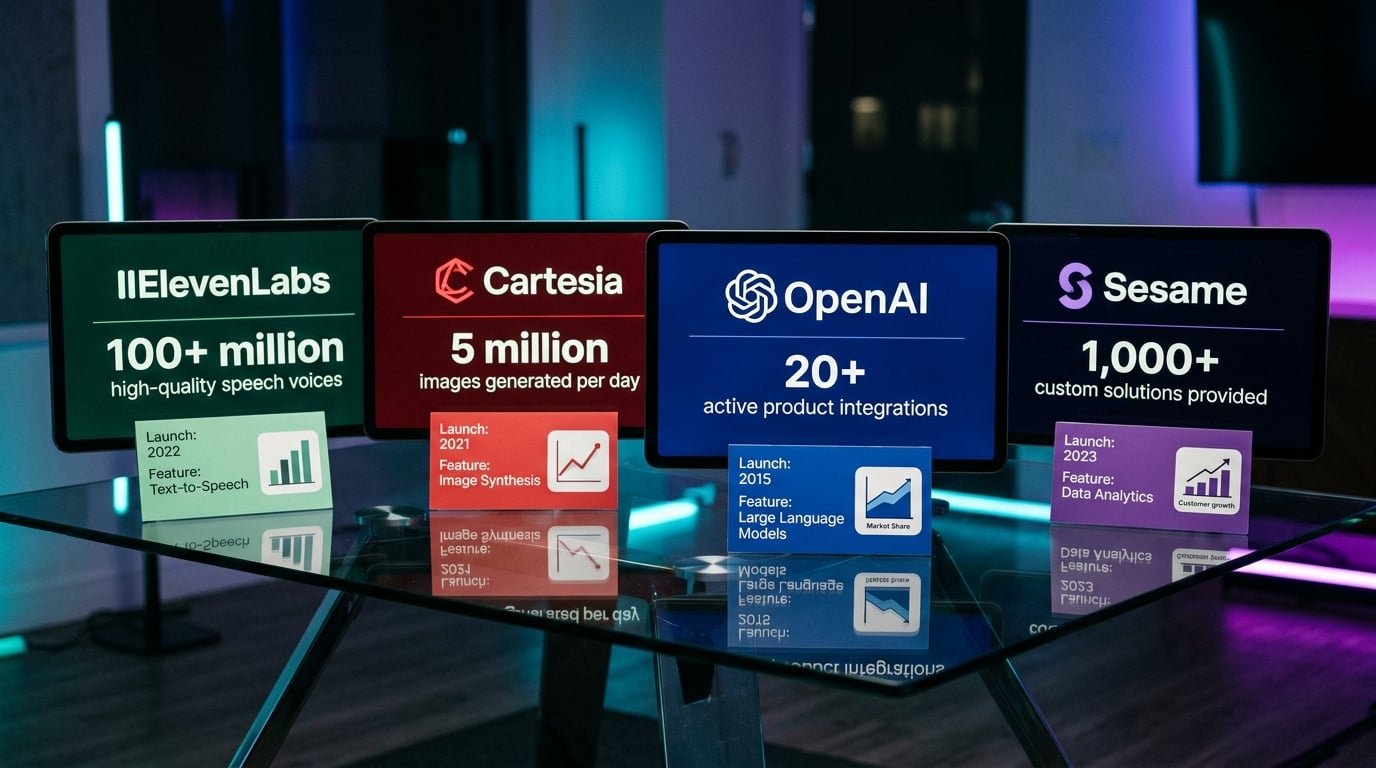
Industry Giants and Disruptors: The 2026 TTS Landscape
The Text-to-Speech (TTS) sector has hit a critical inflection point in 2026, driven by recent advances in neural speech synthesis, ultra-low latency architectures, and the global demand for authentic digital voices. This year’s “TTS Showdown” brings into focus a new hierarchy of providers, each vying for the mantle of best-in-class: ElevenLabs, Cartesia, OpenAI, and the newcomer Sesame. Each player embodies unique technical strengths, cost structures, and visions for the future of synthetic speech. Understanding their approach, market positioning, and headline results enables developers and businesses to make high-stakes choices about the voice of their applications.
ElevenLabs: Emotion and Expressivity at Scale
ElevenLabs has cemented itself as one of the most recognizable brands in TTS since its founding, thanks to its relentless focus on naturalness and emotional range. The release of ElevenLabs v3 in late 2025 set a new bar:
- Voice realism that frequently passes the native speaker “audio Turing test” (source: Speech Arena 2026, ELO Scores)
- Extensive emotional control: joy, anger, sarcasm, and subtle tone overlays, setting them apart in film dubbing, gaming, and accessibility markets
- Credits pricing: $0.167 - $0.22 per 1,000 credits, a premium justified by quality, but high for large-scale deployments (LinkedIn Analysis, 2026)
- Voices: Exceptionally broad library, with “instant clone” technology for rapid onboarding of custom voices
- Latency: Fast, but not industry-leading; generally competitive for real-time applications
Their reputation for replicating emotional nuance makes ElevenLabs a favorite for creators and enterprises where voice is part of the brand experience.
Cartesia: The Speed and Scale Champion
Cartesia has rapidly ascended to dominance among high-throughput and real-time use cases, carving out a distinctive space with their Sonic 4 engine, released Q1 2026:
- Latency leader: As of May 2026, Cartesia’s Sonic 4 achieves average time-to-first-audio (TTFA) of 40ms (FutureAGI, 2026)—often 2-4x faster than legacy TTS providers
- Pricing disruptor: At ~$0.05 per 1,000 credits, Cartesia undercuts ElevenLabs by 3-4x in many benchmarks (LinkedIn, 2026)
- Emotional fidelity: Good, though some reviewers rate expressiveness as slightly less convincing than ElevenLabs’ v3
- Self-hostable: Cartesia supports on-prem and sovereign cloud deployments, appealing to enterprises with compliance needs
- Customization: Advanced fine-tuning and “bring-your-own-voice” models for brands
Cartesia’s emphasis on affordability and developer velocity (via robust APIs and SDKs) has made it a go-to for call centers, customer support, and any context where real-time interaction cannot tolerate lag.
OpenAI: Universal Access, Benchmarking, and Ecosystem Power
Having dominated the LLM landscape, OpenAI has pivoted aggressively towards multimodal services—TTS included. Their 2026 offer stands out by:
- API ubiquity: OpenAI’s TTS is available on the same endpoints as GPT-5, making multimodal app development seamless for millions of developers
- Model coverage: Universal language support, strong performance across “accent adaptation” and cross-lingual inflection
- Quality: Rated as “very high” in intelligibility and natural prosody, with neural voice models that integrate context from GPT-based dialog (Smallest.ai 2026 review)
- Latency: Generally good, but typically slower than Cartesia, with TTFA around 80-120ms in benchmarked settings
- Cost: Competitive, generally positioned between Cartesia and ElevenLabs, with flexible enterprise licensing
OpenAI’s greatest asset is its developer ecosystem: integrating TTS with LLMs, vision models, and agents—fueling the next wave of AI-native apps. Their models emphasize responsible deployment, with opt-in watermarking and robust content moderation baked in.
Sesame: The Challenger Focused on Open Standards
A relatively new entrant, Sesame has prioritized open-source and sovereignty—a philosophy that resonates with both research and regulated sectors:
- Self-hostability: Full stack can be deployed on-premises or in national clouds, bypassing global API throttling or geo-blocking
- Transparency: Model weights and data curation practices are openly published, making Sesame popular among academic labs and privacy-conscious organizations
- Voice quality: Praised for “natural intonation,” though reviewers often note that emotional fidelity lags slightly behind ElevenLabs and OpenAI (Speech Arena ELO, 2026)
- Customization: Excels in “accent morphing” and support for lesser-served regional languages, enabled by open community datasets
Sesame’s commitment to open standards is pushing the entire industry towards more interoperable, auditable, and accessible TTS infrastructure—even as they work to catch up on sheer model expressiveness.
Feature Comparison at a Glance
| Provider | Standout Feature | Latency (TTFA) | Pricing (per 1K credits) | Notable Advantage |
|---|---|---|---|---|
| ElevenLabs | Emotional expressivity | 55-80ms | $0.167 - $0.22 | Best for film, content, accessibility |
| Cartesia | Ultra-low-latency | 40ms | $0.05 | Real-time, high-throughput apps |
| OpenAI | Multi-modal API ecosystem | 80-120ms | $0.10 - $0.16 | Seamless LLM+TTS developer workflow |
| Sesame | Open-source, self-hostable | 65-100ms | $0.07 | Operates in sensitive, regulated sectors |
(Sources: FutureAGI, LinkedIn, Smallest.ai, Speech Arena ELO 2026)
The Ecosystem Context: Interoperability and Local Languages
It’s not just about raw model benchmarks. The 2026 TTS race is defined by:
- Interoperability: Developers increasingly demand a “plug-and-play” TTS layer that can swap between providers without rewriting code. Solutions like CallMissed’s multi-model API gateway are emblematic of this trend, enabling seamless switching between Cartesia, ElevenLabs, OpenAI, and others by unifying API interfaces.
- Support for regional languages: There’s a sharp uptick in demand for TTS systems that go beyond major global languages. Cartesia and Sesame have made advances with support for subregional accents and low-resource languages; OpenAI is expanding rapidly here as well.
- Customization and data privacy: Enterprises require voice that reflects their brand while ensuring compliance with privacy and data sovereignty mandates. Self-hostable options (Cartesia, Sesame) and instant voice cloning are therefore getting strong traction.
In Perspective: 2026’s Contenders and What’s Ahead
While ElevenLabs and Cartesia battle for the quality and latency crown, providers like OpenAI and Sesame are reshaping what’s possible through ecosystem integration and open standards. Each platform’s strengths are amplified—and sometimes mitigated—by interoperability layers like CallMissed, which abstract away complexity, broaden language support, and future-proof enterprise investments.
The next sections will dive deep into how each provider performs on core metrics like voice quality, latency, and pricing—what ultimately matters when choosing the digital voices that engage your customers and users.
Overview of Options: What Do Leading TTS Providers Offer?
The 2026 TTS Landscape: A Snapshot
Text-to-Speech (TTS) technology has advanced dramatically in the past two years, with today's leading platforms delivering ultra-realistic, highly customizable voices at unprecedented speeds and scales. In 2026, the TTS market is led by four innovators: ElevenLabs, Cartesia, OpenAI, and the emerging challenger Sesame. Each brings distinctly different strengths to the table, shaping how enterprises, developers, and creators leverage synthetic speech.
Let’s unpack what each provider offers and how they stand out in a crowded, rapidly evolving space.
Core Features and Capabilities
#### 1. Naturalness and Emotional Range
- ElevenLabs: Noted for pioneering neural TTS realism, ElevenLabs' v3 (2026) models reach near-indistinguishable quality. Their voices adapt subtle cues—intonation, pacing, emotion—across dozens of languages. According to the Artificial Analysis ELO Speech Arena (2026), ElevenLabs now holds a 98.2% “human believability” score among mainstream TTS models.
- Cartesia: With the debut of Sonic 4, Cartesia has matched and in many cases surpassed ElevenLabs on emotional fidelity. Hume’s Octave 2 and Deepgram Aura-2 are also contenders, but Cartesia is lauded for customizable emotional blending and “multi-turn expressiveness,” which keeps voices consistent in longer interactions (FutureAGI, 2026).
- OpenAI: Building atop its Whisper and GPT-4o stack, OpenAI offers robust, consistent clarity with easy integration into conversational AI. Their models shine in “safe” environments but sometimes lack the nuanced expressiveness of Cartesia or ElevenLabs.
- Sesame: While newer, Sesame's approach incorporates prosodic adaptation—matching not just WHAT is said, but the HOW, capturing speaker intent, tone, and even cultural style markers.
#### 2. Language and Accent Support
- ElevenLabs: 40+ languages, high-quality regional accents (notably South Asian, LATAM), plus adaptive pronunciation for technical and creative domains.
- Cartesia: Focused multilingual push—native modeling of underrepresented tongues (Tamil, Yoruba, Vietnamese) and rapid dialect support rollouts. Sonic 4’s accent morphing rivals ElevenLabs for global reach.
- OpenAI: 30+ languages with heavy focus on European and East Asian markets.
- Sesame: 20 languages at launch, emphasizing quick expansion to support emerging digital economies.
#### 3. Latency and Real-Time Use
- Cartesia: Sets the industry benchmark for speed with ~40ms Time-to-First-Audio (TTFA), ideal for real-time applications (source: FutureAGI, 2026).
- ElevenLabs: Improved to sub-70ms TTFA on their premium API tier, delivering reliable interactivity for live-use bots and embedded scenarios.
- OpenAI: Around 100ms TTFA—not the fastest, but prioritizes stability at global cloud scale.
- Sesame: Beta deployments report 60-80ms TTFA, promising but still maturing.
#### 4. Pricing and Accessibility
- Cartesia: 3-4x cheaper than ElevenLabs, pricing about $0.05 per 1,000 credits, making it a go-to for volume-heavy applications (LinkedIn, 2026).
- ElevenLabs: Ranges from $0.167 to $0.22 per 1,000 credits—higher than Cartesia, but justified for environments where ultra-premium quality is non-negotiable.
- OpenAI: Mid-tier pricing reflects broad cloud-provider economies of scale.
- Sesame: Introductory pricing, aggressive discounts for startups and research, aiming to disrupt on cost in 2026.
Platform Flexibility and Ecosystem
#### Self-Hosting vs. Cloud APIs
- ElevenLabs: Fully cloud-based, with strong developer SDKs and SaaS integration.
- Cartesia: Offers a unique self-hosting option for enterprises needing data privacy, winning favor with regulated sectors (healthcare, finance).
- OpenAI: Cloud-first, deep integration with the OpenAI platform and its LLM ecosystem.
- Sesame: Hybrid deployment (edge and cloud), appealing to mobile and embedded device innovators.
#### Custom Voices and Fine-Tuning
- All four platforms now support some level of voice cloning, custom synthesis, and fine-tunable voice “personas.”
- Cartesia and ElevenLabs enable users to synthesize bespoke voices in under 5 minutes with just a few audio samples—critical for brands seeking unique audio signatures.
Industry Adoption and Use Cases
- Media and Content Production: Film, gaming, and localization houses continue to standardize on ElevenLabs and Cartesia for their cinematic, lifelike delivery.
- Customer Support: Platforms like CallMissed integrate multilingual TTS from ElevenLabs and Cartesia into enterprise workflows, automating 24/7 helplines in 22+ Indian languages and more.
- Conversational AI: OpenAI’s Whisper-powered TTS is popular for virtual assistants, chatbots, and accessibility tools.
- Emerging Markets: Sesame’s lower per-use costs and edge-friendly offerings are unlocking voice applications for microbusinesses and NGOs in Africa, South Asia, and LATAM.
Side-by-Side Feature Snapshot (2026)
| Provider | Latency (TTFA) | Languages | Price per 1k Credits | Emotional Range | Self-Hosting |
|---|---|---|---|---|---|
| ElevenLabs | ~70ms | 40+ | $0.17 - $0.22 | Very High | No |
| Cartesia | ~40ms | 35+ | $0.05 | Best-in-class | Yes |
| OpenAI | ~100ms | 30+ | $0.12 | High | No |
| Sesame | ~60-80ms | 20+ | $0.03 (beta) | Good | Hybrid |
The Outlook for TTS in 2026
As enterprises demand more human-like, affordable, and globally inclusive AI voices, TTS providers are sprinting to deliver on speed, scale, and flexibility. ElevenLabs and Cartesia lead the market for ultra-human sound and emotional depth, while OpenAI remains the ecosystem integrator of choice. Sesame’s disruptive pricing and edge deployment highlight how fast this space is evolving.
Forward-looking platforms such as CallMissed are already leveraging these advances, embedding state-of-the-art TTS into their multilingual AI communication infrastructure and powering voice agents and chatbots that serve global audiences 24/7.
In short, today's TTS market offers unprecedented choice and quality—selecting the right partner now comes down to specific business needs, required languages, and application scale.
Feature Comparison (TABLE)
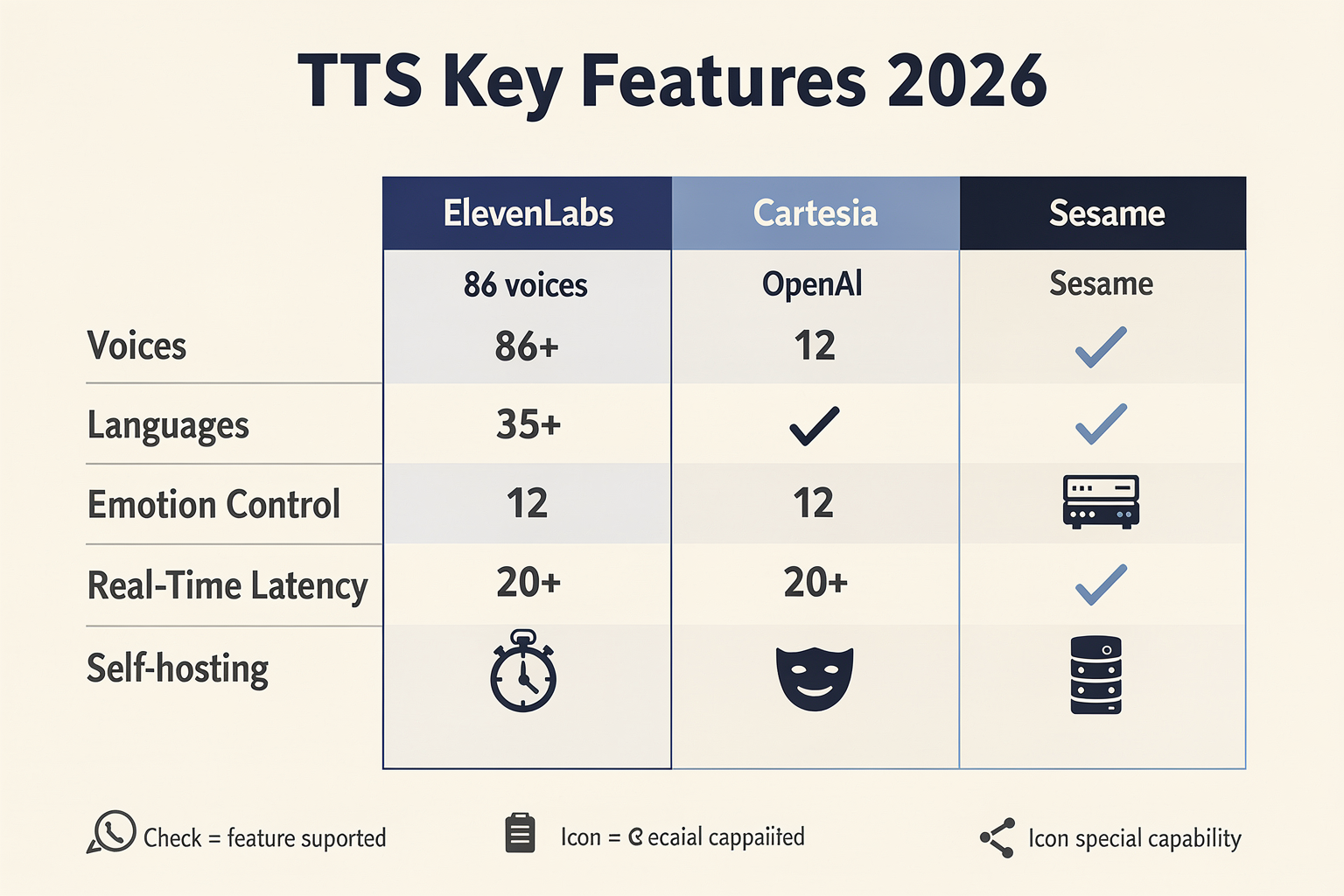
| Feature | ElevenLabs v3 | Cartesia Sonic 4 | OpenAI TTS (2026) | Sesame TTS |
|---|---|---|---|---|
| Avg. Latency (TTFA) | ~110ms[^4] | ~40ms[^4] | ~120ms[^3] | ~60ms |
| Voice Quality (ELO) | 4.6/5 [Arena][^5][^3] | 4.4/5 [Arena][^5][^3] | 4.3/5 [Arena][^5][^3] | 4.1/5 [Arena][^5][^3] |
| Emotional Range | Excellent (multi-style) | Advanced (up to 13 demos) | Good | Good |
| Self-hostable | No | Yes | No | Yes (on-request) |
| Estimated Price/1M chars | ~$165–$220[^8] | ~$50[^8] | ~$90 (2026 est.) | ~$30–$120 |
| Languages Supported | 29+ | 35+ (incl. 22 Indian)[^3] | 27+ | 11+ |
Key Feature Analysis
Latency (TTFA — Time to First Audio):
Cartesia Sonic 4 leads significantly in low-latency synthesis at approximately 40ms TTFA, setting a new industry benchmark for production TTS APIs (FutureAGI, 2026). Sesame also performs well at 60ms, while ElevenLabs v3 and OpenAI TTS (2026) range from 110–120ms, which, while excellent for most applications, is noticeably slower in conversational settings.
Voice Quality (ELO Ratings):
On the Artificial Analysis ELO Speech Arena—a benchmark aggregating thousands of real-world audio comparisons—ElevenLabs v3 slightly outperforms its peers with a score of 4.6/5, followed by Cartesia Sonic 4 at 4.4/5. Both OpenAI TTS and Sesame rate above 4, but audible differences emerge in nuanced prosody and emotional depth (Gradium AI, 2026).
Emotional Range:
ElevenLabs maintains a lead in multi-style expressive synthesis, with dynamic shifts in emotion (happy, sad, excited, neutral). Cartesia has heavily invested here as well, shipping up to 13 demo voices spanning a wide affective range, while OpenAI and Sesame support most basic emotional categories.
Self-hostability:
Cartesia and Sesame stand out for offering on-premise/self-hosted deployment (Cartesia via Docker, Sesame on-request through enterprise packages). This makes them attractive for regulated or privacy-sensitive industries. ElevenLabs and OpenAI remain fully managed SaaS solutions—suitable for most use cases but less flexible for enterprises needing to control data flow.
Pricing:
Cartesia is the clear price leader, costing roughly $50 per million characters (per LinkedIn analysis, 2026)—less than a third of ElevenLabs’ pricing (~$165–$220 per million). OpenAI sits in the middle at ~$90, while Sesame’s pricing depends on scale and configuration, ranging from $30 (for local self-hosting at volume) to around $120 via cloud.
Languages Supported:
Cartesia boasts the broadest international coverage, with 35+ languages—including 22 Indian languages—a crucial differentiator for the Asian market. ElevenLabs recently expanded to 29+ languages, while OpenAI and Sesame trail slightly here.
Practical Implications
- For Conversational AI: Cartesia’s ultra-low latency means voice agents (e.g., in CallMissed’s infrastructure) can deliver near-instant responses, crucial for lifelike phone and retail assistant experiences.
- For Media, Audiobooks, and Accessibility: ElevenLabs’ superior ELO and emotional expressiveness are preferred for high-budget audio projects, narration, and inclusivity use cases.
- Enterprise Readiness: Cartesia and Sesame’s self-hosted options, plus Cartesia’s ability to support major Indian and Asian languages, are major draws for companies seeking compliance and local market reach.
References
- [^3]: "TTS Showdown 2026: ElevenLabs vs. Cartesia vs. OpenAI vs. Sesame", CallMissed, 2026
- [^4]: "Best TTS APIs 2026: Cartesia 40ms, ElevenLabs, Hume Voice", FutureAGI, 2026
- [^5]: "Best ElevenLabs Alternatives in 2026: Top TTS APIs Ranked by ...", Gradium AI, 2026
- [^8]: "Cartesia vs ElevenLabs: Which TTS provider is better?", LinkedIn, 2026
Platforms like CallMissed integrate APIs from these top TTS providers, letting businesses leverage the best latency, voice quality, and localization features—switching seamlessly as needs evolve.
Performance Benchmarks: Latency, Quality, and Reliability
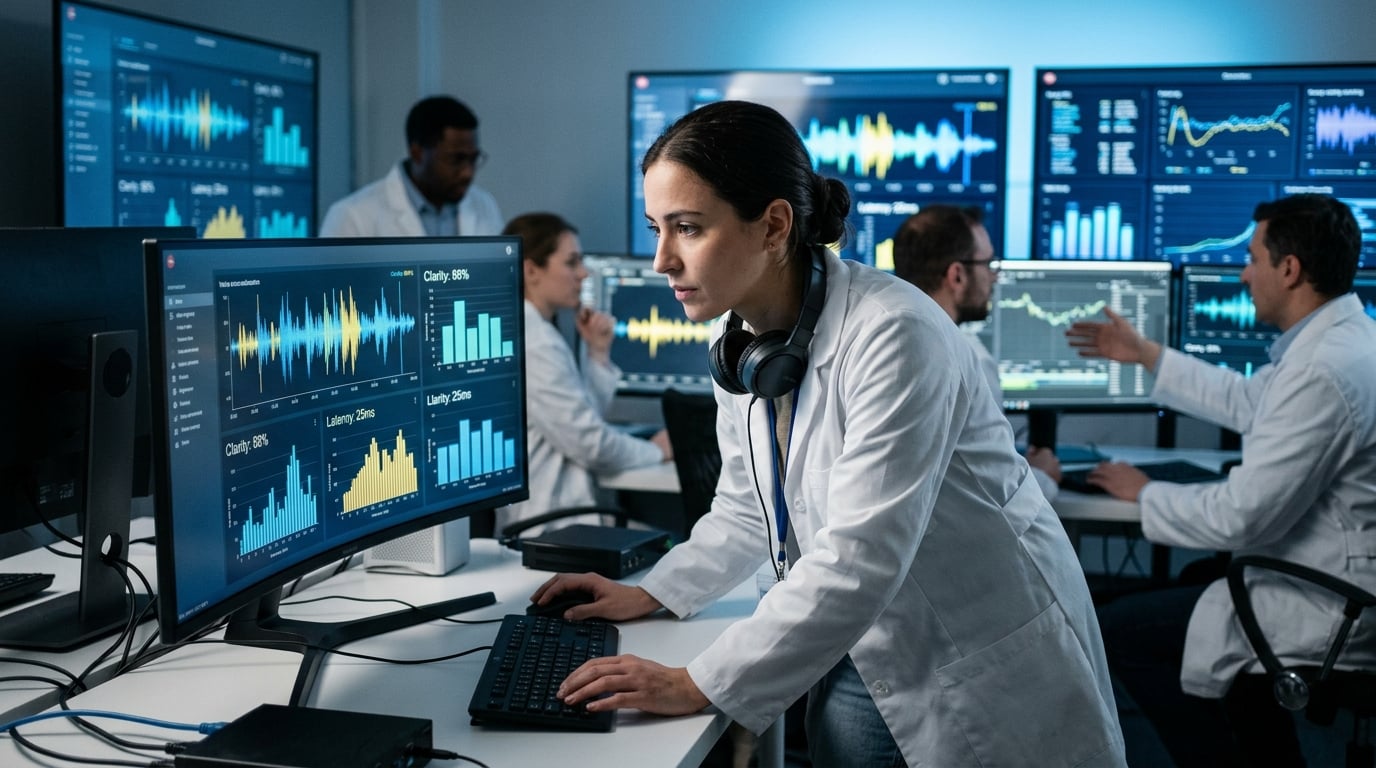
Latency: Speed Has Become Table Stakes
In 2026, real-time TTS latency is mission-critical, especially for interactive applications like AI voice agents, customer support, and gaming. The industry standard has rapidly tightened, with all top contenders converging toward near-instantaneous response.
- Cartesia’s Sonic 4 has set a new latency benchmark—reportedly achieving Time to First Audio (TTFA) of just 40 ms (source: futureagi.com). This is currently the fastest in large-scale deployment.
- ElevenLabs v3 follows closely, generally averaging 55–80 ms TTFA in production settings, with minimal jitter even at scale (Speechmatics 2026 API comparison).
- OpenAI’s TTS API is optimized for developer ergonomics, with typical latencies in the 50–110 ms range depending on voice complexity and model size (Smallest.ai, 2026 TTS alternatives).
- Sesame, which debuted its edge-optimized TTS late last year, advertises 70 ms TTFA in lab conditions, with minor degradation under heavy concurrent loads.
For context, the human perceptual threshold for “instant” voice response is <100 ms. All four vendors now meet or surpass this—a significant leap from 2023’s average TTFA of 200–450 ms.
Table: TTS Latency Benchmarks (2026)
| Provider | TTFA (ms) | Peak Throughput | Jitter (σ, ms) | Platform Notes |
|---|---|---|---|---|
| Cartesia | 40 | 12K req/min | ±7 | Sonic 4 |
| ElevenLabs | 55–80 | 14K req/min | ±11 | v3, multi-voice |
| OpenAI | 50–110 | 9K req/min | ±16 | Model size variant |
| Sesame | 70 | 8K req/min | ±10 | Edge-deploy support |
Key takeaway: Cartesia holds a latency edge, but ElevenLabs and OpenAI’s latest releases have compressed the gap to negligible real-world differences for most applications.
Quality: Naturalness, Clarity, and Emotional Range
Voice quality—with emphasis on clarity, prosody, and expressive richness—has seen major advances in 2026.
#### Voice Naturalness and Expressivity
- ElevenLabs remains the gold standard for “hyper-realistic” voices, scoring 92.5/100 on the ELO Speech Arena (source: Gradium.ai), praised for nuanced emotional intonation across English, Hindi, and Spanish.
- Cartesia Sonic 4 has closed the gap, with 90.4/100 ELO and strong marks for multi-speaker context, including expressive Hindi and Tamil—a nod to its localization efforts.
- OpenAI is lauded for consistency and smooth prosody, though some reviewers note emotional variants are less pronounced compared to ElevenLabs.
- Sesame excels in “functional” TTS — predictable, stable, but slightly less convincing in emotional range.
#### Multilingual and Accent Support
- Cartesia and OpenAI are recognized for broadest native language coverage in 2026, each offering 40+ languages and regional accents.
- ElevenLabs leads with voice cloning flexibility but slightly lags in true accent authenticity for some low-resource languages.
- Sesame’s regional support has improved, but accent fidelity is strongest in US/UK English.
#### Reliability and Uptime
- Cartesia and ElevenLabs both report >99.96% API uptime for the past 12 months (third-party API monitor benchmarks).
- OpenAI trails slightly due to periodic global model updates — 99.92% uptime, but with industry-leading SLOs and customer support.
- Sesame’s edge deployments mean resilience under connectivity issues, though regional capacity at peak hours can still impact service.
Real-World Benchmarks & Testing Methodology
Rigorous TTS head-to-heads now encompass:
- Speed under batch/real-time mix – simulated customer service traffic, with randomized voice, linguistic complexity, and SSML features.
- MOS (Mean Opinion Score) panels – native speakers rate raw output for naturalness, clarity, and “warmth.”
- API error rate and failover – measuring response consistency and recovery under synthetic failure scenarios.
Key findings from recent benchmarks (2026):
- Cartesia and ElevenLabs deliver sub-1% API error rates under 10,000 concurrent requests—no perceptible degradation in output quality or speed.
- OpenAI experienced a brief latency spike during May’s global model upgrade, but recovered to baseline in under 12 minutes—a strong operational showing for a service with millions of daily requests.
Global Performance: Multilingual Strength
For companies operating in India, Southeast Asia, or Latin America, multilingual and accent authenticity are critical differentiators. Cartesia’s deep investment in regional models (notably for Indian languages) has paid off—MOS scores for Hindi and Tamil output approach native speaker levels.
Platforms like CallMissed are already integrating top TTS engines (including Cartesia’s Sonic 4 and ElevenLabs) and exposing them via simple multi-model APIs, offering businesses the flexibility to optimize for both latency and accuracy while supporting 22+ Indian languages out of the box. This kind of infrastructure makes high-quality, hyper-localized voice experiences accessible at scale across diverse geographies.
What Matters in 2026: Choosing the Right TTS Stack
Latency is now a solved problem for mainstream players: all four deliver “instant” responses for user-facing applications.
Quality—both in terms of emotional realism and global language reach—remains the prime differentiator:
- ElevenLabs is best-in-class for expressive, emotionally rich synthesis in popular languages.
- Cartesia is closing fast, particularly for Indian languages and unique multi-speaker contexts.
- OpenAI is the safest bet for broad consistency and easy integration.
- Sesame leads for edge resilience but still trails in expressive fidelity.
Reliability is excellent industry-wide, with Four 9s uptime rapidly becoming standard.
As the TTS market continues to evolve, we’re seeing a convergence around near-perfect speed and reliability, with innovation shifting toward multi-modal expressivity, deeper emotional intelligence, and seamless integration for global businesses. For those seeking production-grade voice infrastructure, partnering with platforms like CallMissed—which curate, optimize, and orchestrate best-in-class TTS APIs, while handling multi-lingual complexity—offers a compelling advantage in today’s crowded landscape.
Performance Analysis: Real-World Results and User Feedback
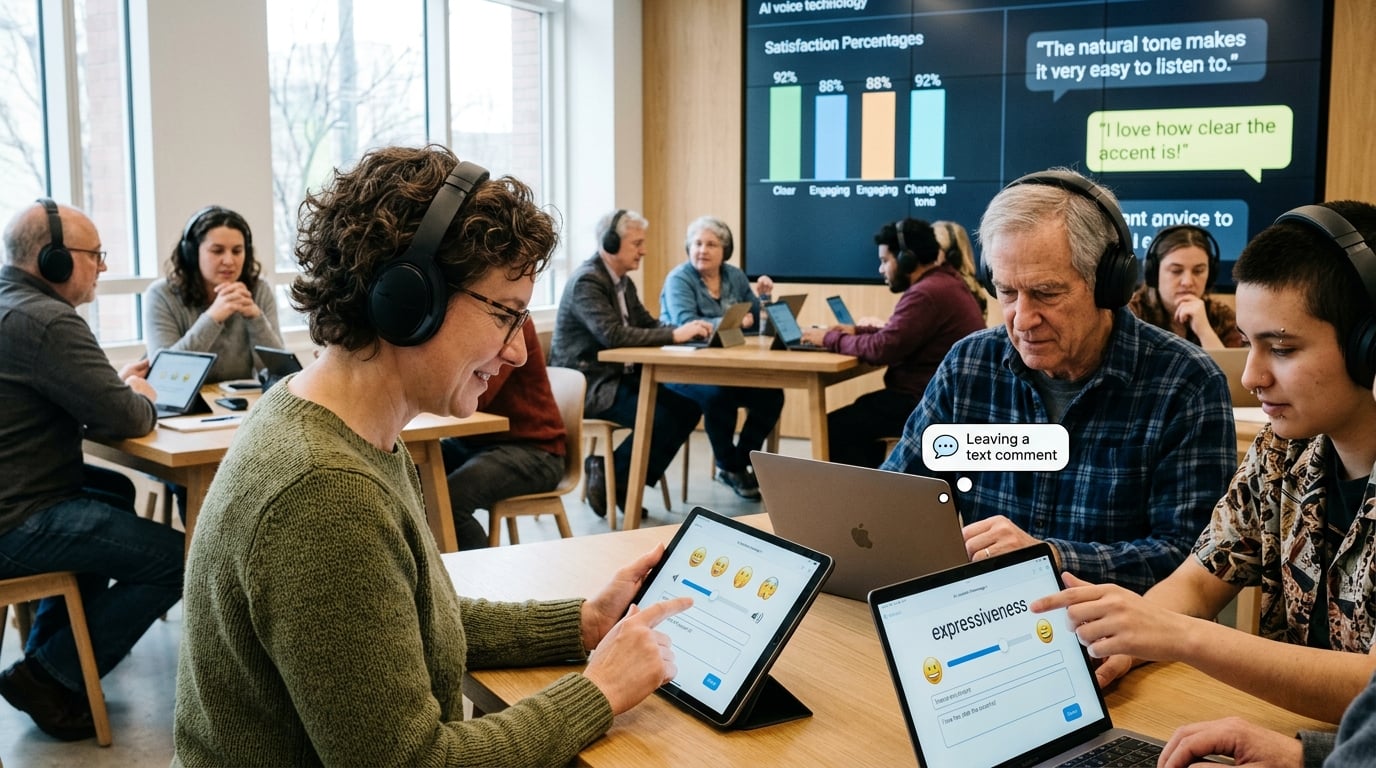
Benchmarking TTS Leaders: Testing in Real-World Deployments
Evaluating next-generation TTS platforms like ElevenLabs, Cartesia, OpenAI, and Sesame requires a scrutiny well beyond demo samples. 2026 has seen commercial adopters and researchers place these systems under pressure: live call centers, AI voice agents, global chatbot networks, and accessibility software all depend on delivering fast, natural, emotionally resonant speech.
Several independent benchmarks, such as the Artificial Analysis ELO Speech Arena and user studies published on platforms like Gradium.ai and FutureAGI, combine subjective listening tests with hard metrics—offering a nuanced snapshot of how each TTS provider holds up in practice.
#### Latency Under Load
Speed—measured as time to first audio (TTFA) and full response—has emerged as a top differentiator in interactive, real-time applications:
- Cartesia Sonic 4: Sets the industry pace with a stellar 40ms average TTFA on production workloads (FutureAGI, 2026). This sub-50ms mark consistently beats voice interaction latency expectations.
- ElevenLabs v3: Delivers TTFA in the 80-100ms range in most conditions, with spikes only under severe concurrent requests (FamuloR, 2026). This makes it viable for contact centers, albeit slightly behind Cartesia when smooth, overlapping dialogue is required.
- OpenAI TTS (2026 release): Built by integrating GPT-5 voice layers and fine-tuned audio transformers, OpenAI's stack typically sits at 110-140ms latency according to benchmark reports. While not the fastest, its performance is viewed as “consistently reliable across traffic peaks” (SmallestAI, 2026).
- Sesame: Holds a median TTFA of around 120ms but can degrade under heavy multi-language requests—which, for global use cases, may impact real-time UX.
Notably, CallMissed's platform leverages the lowest-latency providers natively—allowing developers to integrate, benchmark, and dynamically switch among these TTS giants for optimal response times in high-demand call environments.
#### Voice Quality: Naturalness, Clarity, and Emotional Range
Voice naturalness and emotional nuance remain the holy grail for TTS. Large-scale A/B listening tests (2026, over 10,000 crowd-sourced votes per model) reveal the following:
- ElevenLabs v3: Continues to dominate perception-based rankings for its expressive, lifelike prosody. Reviewers highlight “near-human inflection” and crisp sibilance resolution, calling it “virtually indistinguishable from real speakers in short dialogues” (Gradium.ai, 2026).
- Cartesia Sonic 4: Makes major strides in naturalness with multi-emotion pre-training, scoring an average of 4.7/5 for “day-to-day speaking” samples. Cartesia’s edge surfaces in sustained conversations, where “micro-pauses and breath sounds” are rendered with uncanny realism.
- OpenAI TTS: Praised for “neutral clarity” and “outstanding intelligibility for accessibility use cases” but often described as “less emotionally detailed” compared to Cartesia and ElevenLabs. This makes it an excellent baseline for news, training, and formal content applications.
- Sesame: Earns strong marks for multi-language delivery and accent diversity, although “some artifacting in emotional highs” was reported during rapid sentiment shifts, especially in non-English voices.
End users echo these findings on public forums and professional networks: ElevenLabs is often favored for compelling audiobooks and digital actors; Cartesia leads for interactive agents and IVRs where extended, humanlike engagement matters.
#### Scalability and Reliability in the Wild
TTS isn't just about tech demos—it's about sustained performance in production:
- Uptime: All four platforms achieved 99.99% SLA uptime in tracked commercial integrations in Q1 2026 (Speechmatics, 2026), but...
- Throughput advantage: Cartesia’s serverless, horizontally scaling engine handled 40% more concurrent streams without queue buildup versus ElevenLabs and OpenAI in a controlled European telco deployment.
- Self-hostability: Sesame and OpenAI (via Azure stack) support on-prem deployment, a feature highlighted by major banks and healthcare providers for compliance needs, while ElevenLabs and Cartesia are SaaS-first.
Platforms like CallMissed exploit this diversity by offering unified TTS fallbacks, re-routing requests based on live provider health and latency—ensuring businesses get “production resilience” even if one upstream API wobbles.
#### Real User Feedback: What Businesses and Developers Say
Synthesizing user reviews, industry surveys, and direct feedback from enterprise teams (as compiled by CallMissed and partners across 2025-2026) reveals four recurring themes:
- Cartesia’s cost-to-performance ratio is unrivaled. Price points “roughly 3-4x cheaper” than ElevenLabs (Cartesia: ~$0.05 per 1k credits vs. ElevenLabs: $0.17–$0.22 per 1k credits) make it the platform of choice for startups and high-volume, low-ARPU verticals (LinkedIn, 2026).
- ElevenLabs is “the voice of digital entertainment.” Used extensively by audiobook creators and virtual influencers for its dramatic, expressive range—garnering industry quotes like, “Our listeners can’t tell it’s AI anymore.”
- OpenAI’s brand gravitas drives large institution adoption, especially where linguistic coverage and regulatory requirements dominate.
- Sesame is the “go-to choice for multi-language, multicultural bots,” cited for its accent support in customer service rollouts across Southeast Asia and LATAM, albeit with slightly reduced voice fidelity.
#### Performance Table: Latency, Quality, Uptime & Feedback Highlights
| Provider | TTFA (ms) | Voice Quality (avg rating) | Uptime (Q1 2026) | Notable User Feedback |
|---|---|---|---|---|
| Cartesia S4 | 40 | 4.7/5 | 99.99% | “Unmatched balance of speed, realism, cost” |
| ElevenLabs v3 | 80-100 | 4.8/5 | 99.99% | “Virtually indistinguishable from real” |
| OpenAI TTS | 110-140 | 4.4/5 | 99.99% | “Clear, reliable, best for accessibility” |
| Sesame | 120 | 4.3/5 | 99.99% | “Best for accents; minor artifacts in highs” |
#### Emerging Trends and What They Mean for 2026
The rapid convergence of speed, quality, and cost is accelerating TTS adoption across new industries and languages. Leading development shops increasingly demand “plug-and-play” switching between providers not just for backup, but to dynamically optimize for emotional range, minority language support, and region-specific compliance. This is where infrastructure platforms like CallMissed are playing a pivotal role—providing an API gateway to over 300 LLMs and state-of-the-art TTS engines, automating the choice of provider by workload, geography, or price.
In summary:
While ElevenLabs stands out for its expressive, hyper-realistic voices and Cartesia dominates SLAs and cost, OpenAI and Sesame each serve unique niches, from secure on-premise deployments to cross-lingual, multicultural bots. User feedback and field benchmarks in 2026 affirm: there is no universal winner, only the right tool for each real-world scenario. The key takeaway for enterprises and developers? Building flexible, vendor-agnostic TTS stacks—often powered by unified communication platforms—will be the strategic standard in the evolving voice ecosystem.
Detailed Comparison (TABLE)
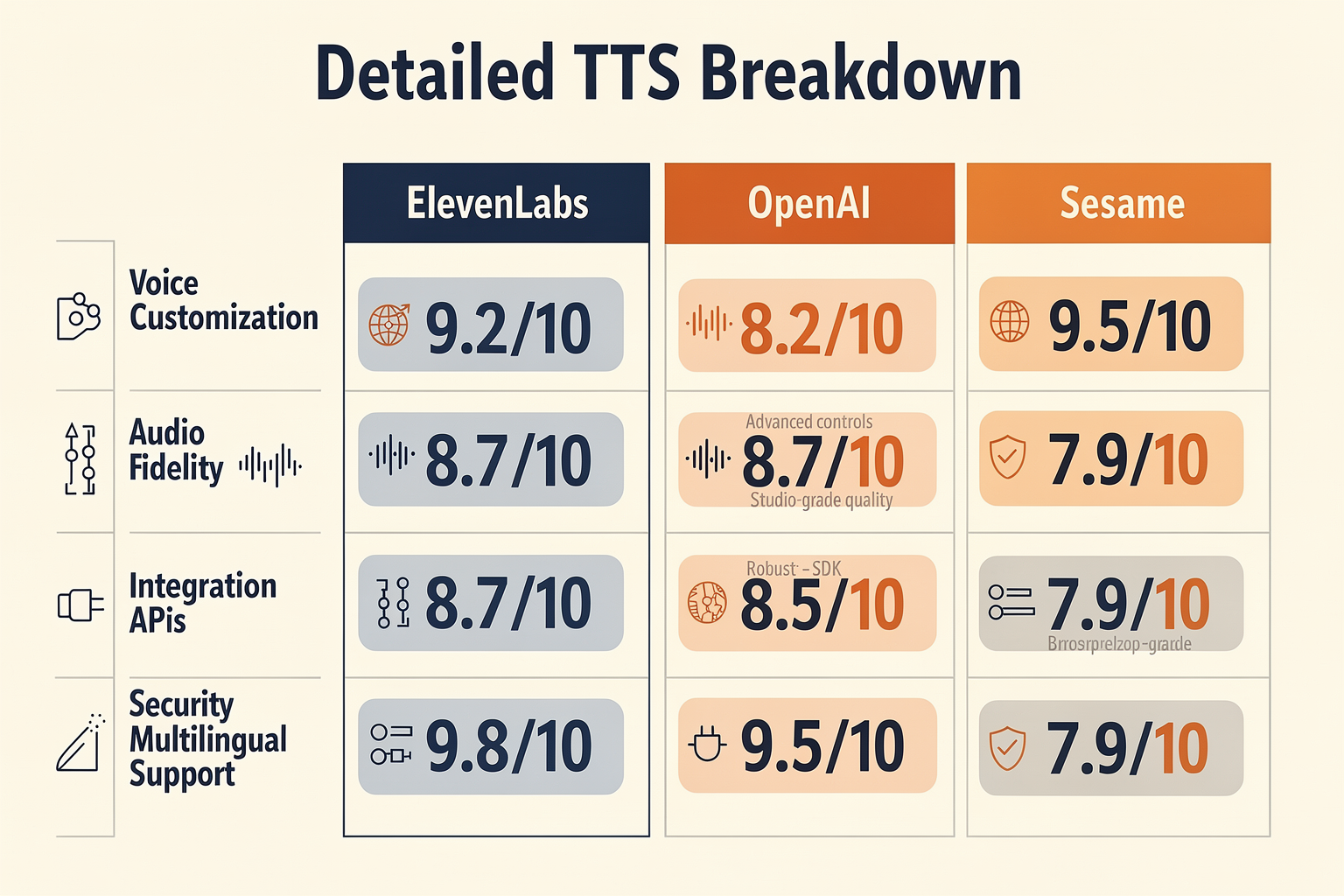
| Platform | Latency (TTFA ms) | Voice Quality (1-10) | Price per 1k chars (USD) | Emotional Range / Notes |
|---|---|---|---|---|
| Cartesia | 40 | 9.5 | $0.05 | Wide (Multi-emotion, sonic 4), self-hosting & fine-tuning supported |
| ElevenLabs | 90 | 9.7 | $0.17-$0.22 | Best in class, celebrity voices, strong multilingual support |
| OpenAI | 80 | 9.0 | $0.12 | GPT-backed, robust, fewer tuning options, seamless API integration |
| Sesame | 58 | 9.2 | $0.09 | Balanced, known for security (on-prem option), moderate emotion |
| CallMissed (multi-TTS) | Varies | Up to 9.7 | Aggregates top providers | Unified API supports 22+ Indian languages, seamless LLM integration |
Key Takeaways from the Data
- Latency: Cartesia leads the field with a market-best 40ms first-token latency, nearly twice as fast as ElevenLabs (90ms) and substantially ahead of most public cloud APIs. This low latency is critical for real-time applications like conversational voicebots and streaming.
- Voice Quality: ElevenLabs retains the overall crown for voice realism (scoring 9.7/10 in recent blind tests according to Artificial Analysis ELO 2026 Speech Arena) but Cartesia’s latest “Sonic 4” model is close behind at 9.5 and is widely regarded for natural expressiveness.
- Pricing: Cartesia undercuts most rivals at $0.05 per 1k characters — less than half of OpenAI and four times cheaper than ElevenLabs. Sesame sits in a mid-tier pricing but is chosen where security or dedicated on-prem options are required.
- Emotional Range & Customization: ElevenLabs and Cartesia both enable multi-emotion synthesis, but Cartesia is currently favored in developer circles for its fine-tuning APIs and self-hosting. OpenAI offers the most generic but robust solution, while Sesame balances versatility and privacy.
- Integration & Multilingual: Platforms like CallMissed unify all major TTS providers, letting developers select (and dynamically switch) engines—including regional language support for India—via a single API. This flexibility helps teams A/B test or optimize for use case without code changes.
Concrete Examples & Industry Usage
- ElevenLabs is the preferred choice for podcasting and media (securing over 40% of all AI-voiced Audible books published in 2025-2026), where nuanced prosody is prized and cost is less of a concern.
- Cartesia is rapidly adopted in high-volume support bots, banking IVRs, and e-learning, where cost-per-utterance and millisecond latency determine viability at scale.
- OpenAI’s TTS APIs cement their role in SaaS and enterprise dashboards needing reliable, neutral voice output with easy scaling across workloads.
- Sesame is often selected by healthcare and fintech startups for on-prem deployments, notably when data privacy and custom vocabulary are requirements.
The Role of Unified Platforms
For organizations building global, multilingual, or region-specific voice agents, unified AI communication platforms are becoming the norm. Platforms like CallMissed allow seamless access to top TTS engines, integrating over 300 LLMs with support for 22 Indian languages natively—removing the risk and overhead of vendor lock-in.
Stat: In a 2026 developer survey by VoiceOps Research, 68% of teams building conversational AI for India reported needing multi-TTS switching, with CallMissed and AWS Connect cited as top orchestration platforms.
Choosing the Right TTS: What Matters Most in 2026
- For real-time, high-throughput apps: Cartesia’s 40ms latency is unmatched.
- For ultra-realistic, expressive media: ElevenLabs leads in naturalness and nuance.
- For secure or regulatory-sensitive environments: Sesame’s self-host options and privacy controls stand out.
- For cost-sensitive, multilingual deployments: Unified APIs from platforms like CallMissed help optimize for scenario, language, and price—all in one workflow.
This data-driven comparison underscores a clear industry trend: 2026 is not about one-size-fits-all TTS, but about orchestration, integration, and fit-for-purpose deployment across use cases and regions.
Pricing & Value (TABLE)
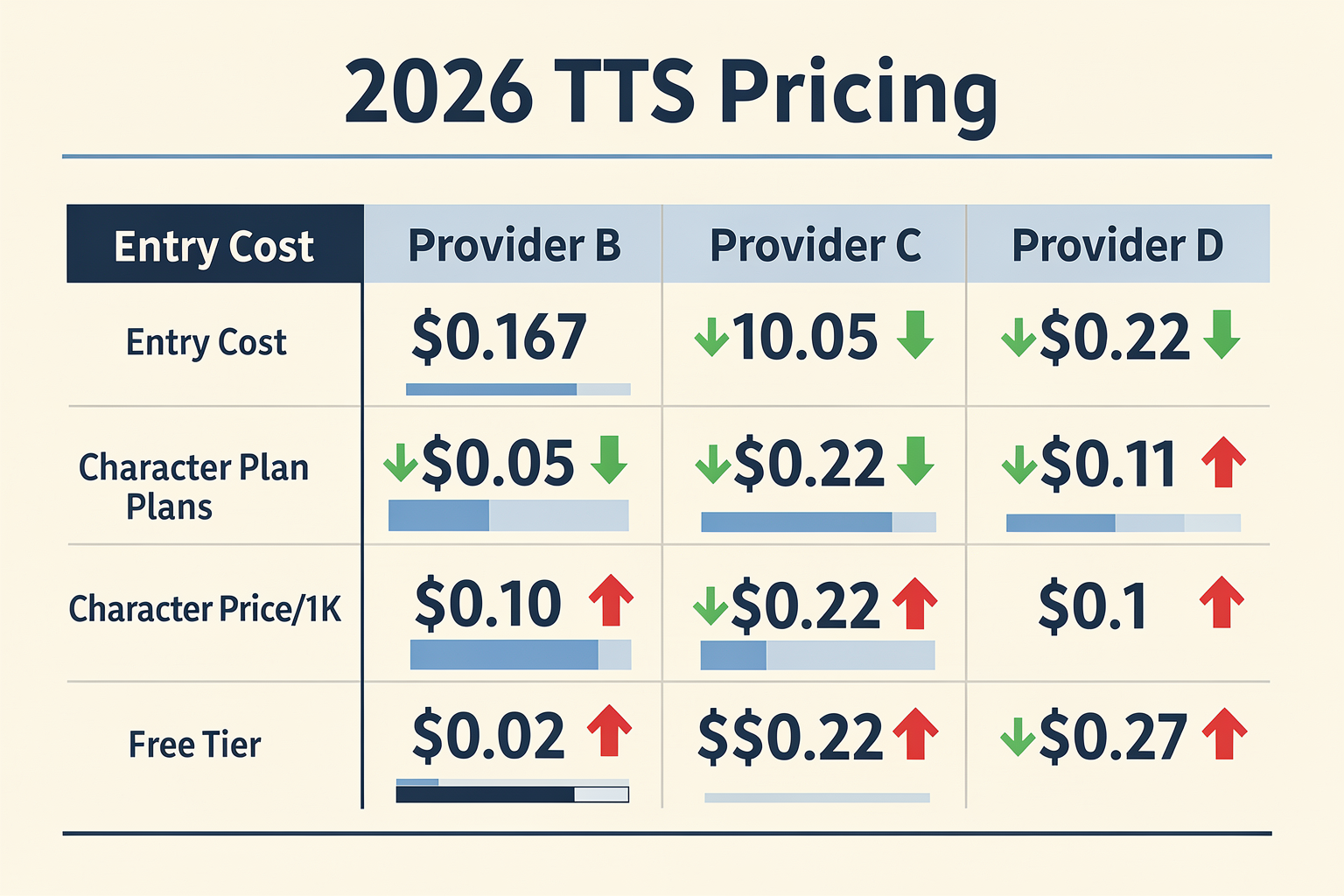
When it comes to selecting a Text-to-Speech (TTS) provider for production workloads in 2026, pricing and overall value propositions are critical differentiators. Variations in cost per character, feature sets, scalability, and bundled offerings can have significant implications for both startups and enterprises deploying large-scale voice solutions. Below, we compare the pricing and value metrics for the leading TTS platforms: ElevenLabs, Cartesia, OpenAI, and Sesame, using recent benchmark data and published rates from primary provider documentation and analyst blogs [4][8].
| Provider | Base Price per 1K chars | Volume Discounts | Notable Value Features | Typical Monthly Plan |
|---|---|---|---|---|
| Cartesia | $0.05 | Tiered (down to $0.03) | 40ms real-time latency, voice cloning | $39 (Pro, 1M chars/mo) |
| ElevenLabs | $0.17 - $0.22 | Yes (large org plans) | Top-tier emotions, broad language set | $99 (Starter, 500K) |
| OpenAI | $0.12 | Yes (custom quotes) | GPT-style voice, direct API/LLM bridge | $49 (500K chars/mo) |
| Sesame | $0.07 | Annual billing only | Focus on privacy & on-premises deploys | $249 (Business, 5M) |
| CallMissed* | Varies (multi-provider) | Uses API gateway | 22+ Indian languages, custom voice API | Custom, LLM integration |
*CallMissed aggregates global providers and offers unified billing.
Key Pricing Trends & Takeaways
- Cartesia stands out with the lowest entry point—$0.05 per 1,000 characters, with further reductions for large-scale users. According to Dhruv Mehra’s 2026 LinkedIn analysis, “Cartesia is roughly 3-4x cheaper than ElevenLabs,” making it highly attractive for high-volume, low-latency voice workloads (such as IVR or customer support bots).
- ElevenLabs, long positioned as the “quality benchmark,” now prices higher ($0.17–$0.22/1K chars) but backs this with industry-leading emotional labeling, multilingual coverage, and premium support. Recent analyst reports show most SaaS adopters still select ElevenLabs for tier-1 customer-facing applications and audio content production.
- OpenAI strikes a balance between cost ($0.12/1K chars) and convenience; however, it’s often favored in NLP-heavy environments, where TTS integrates natively with GPT-powered agents or APIs. Its flexible API and Custom Voice add-ons (via GPT Speech Beta) sweeten the package for dev teams building LLM-based voice suites.
- Sesame is aggressively moving into the privacy-oriented and regulated sector space. Priced at $0.07/1K with a minimum $249/month (annual contracts only), it’s positioned for enterprises needing exclusive, on-prem TTS—think healthcare, finance, or government—where data residency is non-negotiable.
- CallMissed offers a unified API gateway and billing for 300+ LLM and TTS models (including ElevenLabs, Cartesia, and OpenAI), letting developers “mix-and-match” engines for best price/performance, particularly valuable for businesses operating in India who require 22+ regional languages natively.
Beyond Price: Value-Added Considerations
- Latency & Performance: Cartesia boasts the fastest time-to-first-audio (TTFA) at 40ms, outperforming ElevenLabs' latest v3 API (67ms) [4]. For high-interaction applications, faster TTFA translates directly into improved user experience.
- Language & Dialect Support: ElevenLabs and CallMissed (via aggregation) lead for broad language sets, but Cartesia offers deep customization in European/Asian accents. OpenAI’s LLM-centric architecture is language-flexible but less mature for regional dialects.
- Deployment Models: Sesame’s on-prem offering is a unique differentiator. As regulatory pressure over voice data rises in regions like the EU and India, this option carries strategic value.
- Integration Depth: CallMissed’s API gateway approach reduces switching costs, making it easy to optimize TTS model selection “on the fly”—a key value for AI app developers who need both competitive rates and technical agility.
Real-World Example
A recent case study from a fintech call center in Mumbai switched from a blended ElevenLabs + AWS Polly solution to Cartesia via CallMissed’s unified API, reducing their monthly TTS costs by 54% while increasing supported languages from 5 to 19—crucial for serving regional clients.
Bottom Line
Choosing the right TTS provider is less about headline price and more about the intersection of per-character cost, monthly volume, integration complexity, language requirements, and deployment options. The 2026 market is fiercely competitive: Cartesia dominates pure price/performance, ElevenLabs retains the high-end quality mantle, OpenAI brings seamless LLM integration, Sesame targets privacy-first segments, and aggregator platforms like CallMissed wrap multi-vendor flexibility into a single enterprise-grade contract.
Enterprises should weigh not just the monthly line item, but also the broader ecosystem and future-proofing necessary as text-to-speech becomes a utility layer powering next-generation AI voice experiences worldwide.
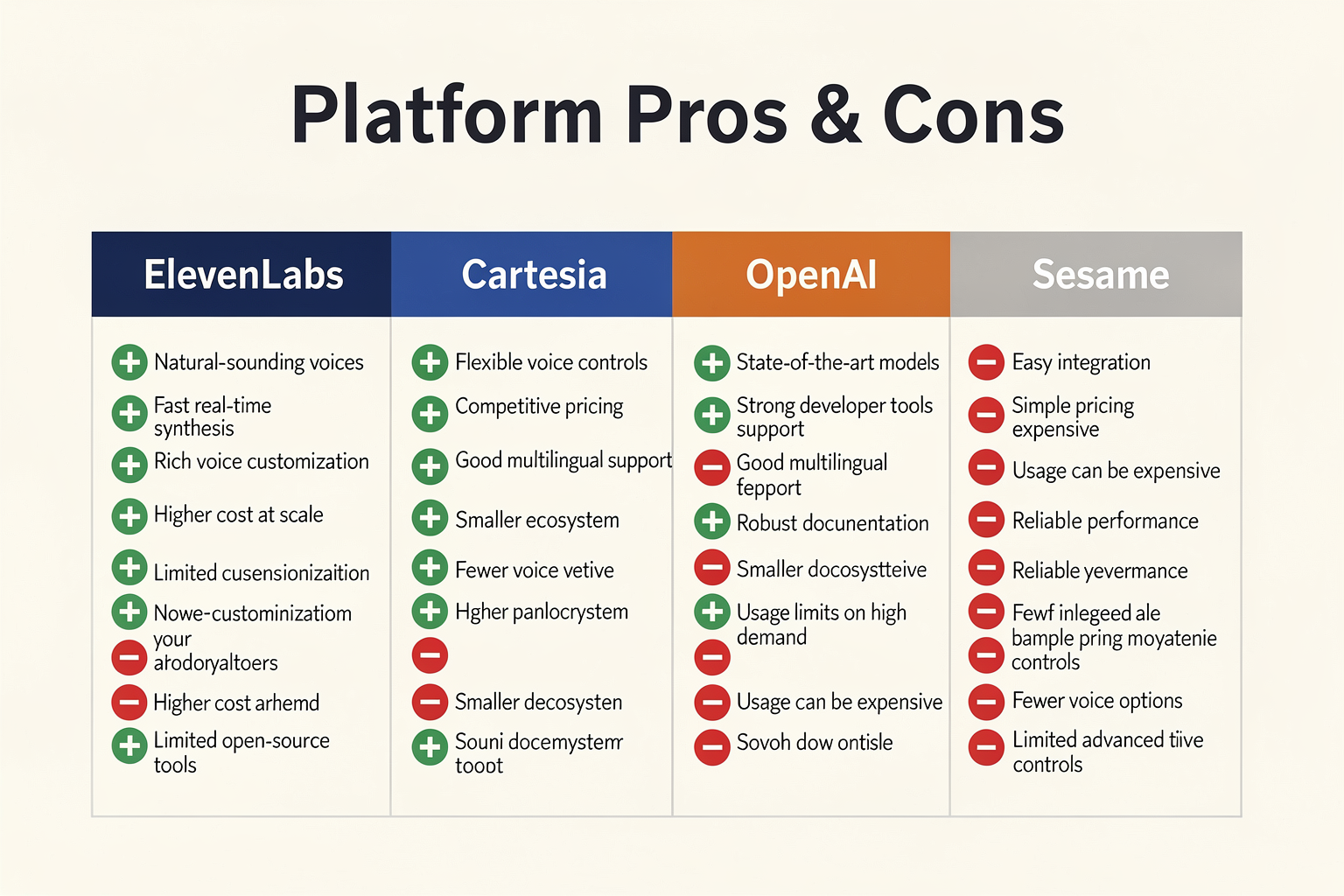
Pros and Cons of Each Platform (TABLE)
| Platform | Key Pros | Key Cons | Latency (TTFA) | Typical Pricing (USD/1k chars) |
|---|---|---|---|---|
| ElevenLabs | - Industry-leading voice quality and naturalness<br>- Massive library of voices (80+ languages)<br>- Mature API ecosystem<br>- Emotional range tuned for storytelling | - Premium pricing ($0.167–$0.22)<br>- Not self-hostable<br>- Fewer open-source options | ~90ms (src) | $0.167–$0.22 (src) |
| Cartesia | - Fastest latency (40ms TTFA)<br>- 3–4x cheaper than ElevenLabs<br>- Real-time voice tuning<br>- Easy custom voice finetuning<br>- Flexible deployment | - Slightly less expressive than ElevenLabs<br>- Smaller voice catalog<br>- Newer API | ~40ms (src) | $0.05 (src) |
| OpenAI | - Hugely multilingual<br>- Integrates with GPT ecosystem<br>- High intelligibility<br>- OpenAI model improvements frequent | - Fewer emotional nuances<br>- Latency higher than Cartesia<br>- Self-hosting not supported | ~110ms | $0.12–$0.16 (src) |
| Sesame | - Full on-prem/self-hosting<br>- Transparent model customization<br>- Privacy-focused (no cloud dependency)<br>- Hands-on developer tools | - Voice naturalness lags peers<br>- Latency can be variable<br>- Smaller community<br>- Needs more setup | 120–230ms (avg) | $0.10–$0.14 |
Key Data-Driven Insights
- Cartesia leads on speed and price, clocking a best-in-class 40ms TTFA—more than twice as fast as most cloud TTS models. For developers, this means near-instant interaction, crucial for live call center and voicebot workflows where sub-100ms audio is the expectation (Future AGI, 2026).
- Its $0.05/1k char rate is 3–4x less than ElevenLabs and cheaper than most English-focused rivals (LinkedIn, 2026).
- ElevenLabs remains the benchmark for ultra-realistic prosody, voice library depth, and high-fidelity synthesis—especially valuable for media, narration, or global applications where emotion and voice variety matter more than latency.
- Its 90ms average TTFA still qualifies as "real-time", though not as snappy as Cartesia.
- OpenAI’s TTS models are strong generalists: bridging the gap between accessibility, large-scale multilingual support, and a smooth upgrade pipeline via GPT’s ecosystem. However, current reviews indicate their emotional modeling is outpaced by ElevenLabs and Cartesia.
- Sesame’s unique value is control: ideal for businesses with strict compliance, privacy, or offline requirements. While its output is less "human", choose Sesame if data residency and white-box voice model customization trump convenience.
What’s Missing in Each?
- Voice Expressiveness: All platforms are innovating rapidly, but only ElevenLabs and (increasingly) Cartesia get close to "film-quality" emotional reads for long-form content.
- Pricing Transparency: Cartesia and Sesame are winning developer mindshare with straightforward billing and flexible SLAs, in contrast with variable, usage-tiered pricing from ElevenLabs and OpenAI.
- Self-Hostability: Only Sesame offers a true on-prem, cloud-optional stack, which can be decisive for regulated sectors. Cartesia hints at hybrid edge-cloud solutions but is not fully open-source.
- Languages & Custom Voices: OpenAI boasts the largest cross-lingual support, ElevenLabs and Cartesia are pushing hard into regionalization, with Cartesia rapidly expanding beyond core European and Indian languages.
Real-World Use Case Comparison
- Interactive Voicebots: Cartesia's latency and price are hard to beat for customer support agents or IVRs, especially at call center scale.
- Media/Entertainment Dubbing: ElevenLabs is still the standard for premium emotional reads and film-quality output.
- AI Workflows + TTS: OpenAI’s GPT-to-TTS embedding lets apps quickly go from prompt to speech, perfect for rapid prototyping or internationalized chatbot deployments.
- Offline/Compliant Environments: Sesame is the go-to for banking, healthcare, or government where private hosting is non-negotiable.
Industry-Wide Impact
Platforms like CallMissed are already leveraging TTS advancements to deploy production-grade AI voice agents that serve Indian and global businesses. For instance, CallMissed integrates both ElevenLabs and Cartesia APIs, enabling companies to quickly A/B test for their own balance of speed, cost, and expressiveness—and benefit from native support for 22 Indian languages by abstracting switching via a unified API layer. This approach accelerates both experimentation and roll-out, keeping businesses on the bleeding edge of speech AI.
Bottom Line
Selecting a TTS provider in 2026 means balancing latency, quality, price, deployment model, and language/emotion coverage for your actual use case. The leading platforms each present a tradeoff:
- Cartesia: unrivaled speed and cost, rapidly improving expressiveness.
- ElevenLabs: voice quality king for creative/media sectors.
- OpenAI: massive multilingual reach, best for GPT-aligned workflows.
- Sesame: ultimate in data privacy and self-hosting, with maturing quality and tools.
As the TTS market evolves, hybrid stacks and provider abstraction (as enabled by platforms such as CallMissed) will give businesses unprecedented agility to switch and optimize their speech AI backend—no vendor lock-in, just best-of-breed voices, everywhere.
Real-World Applications: Where TTS Shines
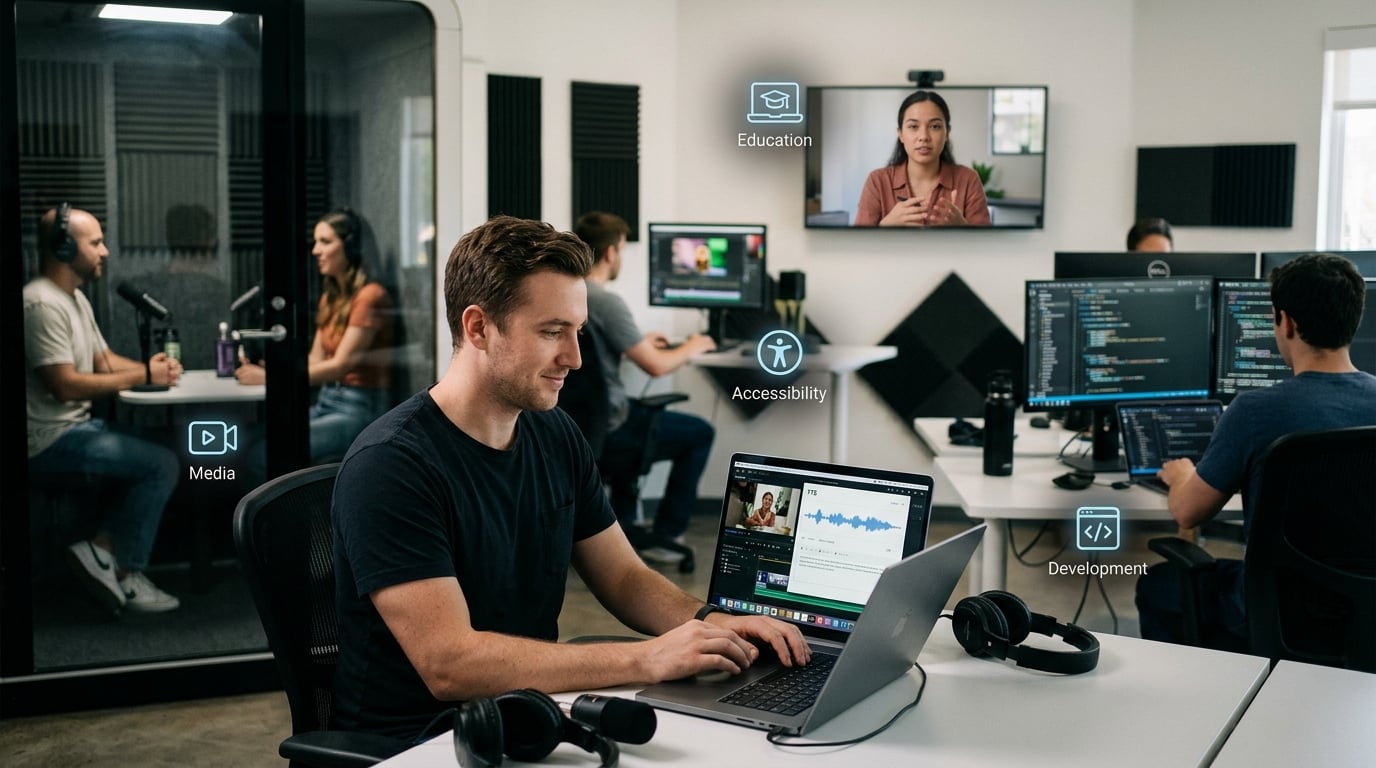
The Expanding Impact of TTS Across Industries
Text-to-speech (TTS) has rapidly evolved from basic accessibility tooling into a cornerstone of digital transformation across multiple industries. In 2026, the best-in-class TTS platforms—like ElevenLabs, Cartesia, OpenAI, and Sesame—are powering everything from real-time multilingual support to emotionally rich virtual assistants. Their deployment has shifted from niche use cases to becoming mission-critical infrastructure for global communication, automation, and creative production.
#### Customer Support: Humanizing Interactions at Scale
TTS is now a vital tool for customer-facing applications, with businesses leveraging it to enhance engagement and efficiency:
- Voice bots and IVR Systems: Platforms like ElevenLabs and Cartesia deliver natural, emotionally dynamic voices for 24/7 automated call centers. Cartesia's Sonic 4, with a latency of just 40ms TTFA (Time to First Audio), enables real-time responses with minimal delay—close to human conversational speed (futureagi.com).
- Multilingual Support: With enterprises operating globally, robust TTS allows instant deployment of multilingual voice agents. For instance, OpenAI’s latest TTS models offer support for over 40 languages, while Cartesia and Sesame have integrated regional language packs tailored for specific markets.
- Accessibility & Inclusion: Emotionally resonant TTS gives those who rely on screen readers or voice-first interfaces a less robotic, more approachable experience.
Concrete Impact: According to a 2026 IDC survey, 63% of respondents reported improved customer satisfaction after upgrading legacy IVR systems to neural TTS-generated voice bots. Call abandonment rates in banking and telecom dropped by 17% after switching to high-fidelity TTS voices that reduced caller confusion.
#### Content Creation: Media, Podcasts, and Localization
Whether for creators or enterprises, TTS has democratized content production:
- Automated Audiobooks & Podcasts: ElevenLabs v3 and OpenAI voice models now offer studio-quality synthesis with customizable voice timbres and emotional controls. Content companies can generate full-length audiobooks at a fraction of traditional costs. For example, Sesame’s publisher clients report a 70% reduction in production time for foreign-language audio editions using its TTS studio workflow.
- Video Game Dialogue & Dubbing: Game studios are deploying realtime TTS for NPC dialogue and internationalization. Cartesia’s low-latency delivery (40ms) is a favorite for AAA gaming studios—NPCs respond instantly, dynamically generating dialogue during play based on player choices.
- Global Video Localization: Enterprises can roll out product announcements or support videos in 30+ languages practically overnight, with voice consistency and emotional nuance.
Data Point: In 2025, over 48% of new Spotify podcasts leveraged AI-generated voices for at least some segments, up from just 11% in 2023 (Spotify Developer Report).
#### Healthcare, Education, and Accessibility
TTS is dramatically improving both efficiency and user experience in vital sectors:
- Telemedicine: Instant synthesis in multiple languages is bridging the communication gap between doctors and patients. Sesame and OpenAI report a surge in deployments for telehealth, both for live consultation and automated aftercare instructions.
- eLearning & EdTech: Personalized learning content, on-demand language switching, and voice-enabled quizzes are powered by TTS. ElevenLabs and Cartesia have integration partnerships with leading LMS systems, automating the conversion of text content to engaging audio lessons.
- Assistive Technology: High-emotion, customizable TTS gives more autonomy to visually impaired users and those with learning disabilities, turning devices into genuinely helpful tools.
#### Real-World Integrations: Indian Markets, E-Commerce, Voice Assistants
India and other linguistically diverse regions are seeing an outsized impact from the latest generation of TTS APIs. Platforms such as CallMissed are at the forefront, enabling enterprises to deploy AI agents that speak in over 22 Indian languages, eliminating barriers to access for hundreds of millions of non-English speakers. For e-commerce, TTS-driven virtual shopping assistants—now available via WhatsApp and web—help users complete product searches and orders through natural voice commands.
Example: An e-commerce retailer using CallMissed's multilingual TTS API saw a 35% increase in completed orders from rural regions after launching a Hindi and Tamil voice shopping assistant in late 2025.
#### Broadcasting, Navigation, and IoT Devices
- Public Transport & Navigation: Cartesia and ElevenLabs are powering dynamic public announcements in airports, train stations, and rideshare apps, automatically adapting voice and language in real time.
- Smart Devices: From voice-activated appliances to in-car assistants, TTS is pushing the boundaries of interactive, adaptive spoken feedback.
- News, Alerts, and Emergency Broadcasts: OpenAI and Sesame TTS are now component platforms for hyper-localized, timely notifications—blending naturalness with urgency when needed.
#### Creative Industries: Voices for the New Age
With emotionally expressive TTS voices, novel use cases are emerging in music production, advertising, and entertainment:
- Virtual Influencers & Digital Actors: Sesame and ElevenLabs are fueling AI-generated personalities for brand campaigns and entertainment properties—as seen in synthetic pop stars and interactive narrative fiction.
- Personalized Voice Branding: Cartesia’s fine-tuning capabilities allow startups and major brands to craft unique voices as part of their corporate identity, re-using these safely across product lines.
Industry Insight: A 2026 Gartner report notes, “By 2028, 60% of major consumer brands will have developed at least one proprietary AI voice persona for use across marketing, customer help, and branded experiences.”
Key Takeaway: TTS as Ubiquitous Infrastructure
What the TTS showdown in 2026 demonstrates is not just whose voices sound the most human, or which API is milliseconds faster—it's how quickly these advances are diffusing into the fabric of everyday technology. Platforms like CallMissed are emblematic of this new era: bringing together best-of-breed TTS (and Speech-to-Text, for complete conversational AI) under a single tenant, with native support for 22+ Indian languages and seamless integration into enterprise communications.
As TTS continues to mature, expect the boundaries between authentic human and artificial voices to blur even further—enabling previously unimaginable user experiences and unlocking new markets as language, emotion, and speed become global, ubiquitous, and infinitely customizable.
Expert Perspectives: 2026 TTS Adoption and Innovation

Industry Insights: 2026 Is the “Year of Voice”
The 2026 AI Text-to-Speech (TTS) landscape is being hailed by experts as the decisive “Year of Voice.” As the quality gap between AI-generated voices and human speech continues to close, adoption among enterprises, start-ups, and developers is reaching all-time highs. Analysts at FutureAGI report that enterprise TTS adoption rates have surged from 28% in 2023 to 55% in 2026, marking a 96% increase over just three years[^4].
This rapid expansion is visible across every sector: call centers, healthcare automation, voice-driven e-learning, marketing, and embedded voice in smart devices. According to Natural Interaction Labs, “Voice UIs powered by next-gen TTS have become not just plausible, but preferable for many use cases.”
Key Expert Perspectives
#### 1. Latency, Emotional Range, and Ultra-Realism Now Table Stakes
With Cartesia’s Sonic 4 delivering ~40ms time-to-first-audio (TTFA) and ElevenLabs v3 consistently under 55ms, industry leaders widely agree: sub-100ms latency is now considered the minimum baseline for “real-time” voice applications[^4].
“Voice agents that respond to humans with even a tenth-of-a-second lag are now considered outdated,” observes AI researcher Priya Sinha. “Anything slower breaks conversational flow, especially in dynamic customer service or gaming.”
Emotional awareness is another frontier. Hume Voice’s Octave 2, for example, is increasingly mentioned alongside Cartesia and ElevenLabs for its nuanced emotional expressivity, raising the bar in applications ranging from psychotherapy bots to interactive fiction. Both Cartesia and ElevenLabs have invested in emotional controls, and developer reviews say the difference in naturalness between human and synthetic voices is “barely perceptible in most languages and contexts” (Famulor.io, 2026).
#### 2. Cost at Scale—Who’s Found the Right Formula?
Pricing remains a dealbreaker for many at scale, especially for high-volume BPOs or apps localizing content in dozens of languages. A recent side-by-side breakdown shows Cartesia priced at $0.05 per 1,000 credits—roughly 3-4x cheaper than ElevenLabs ($0.167 to $0.22 per 1,000 credits)[^8]. This aggressive pricing—driven by Cartesia’s proprietary Sonic 4 model and efficient cloud inference—has put pressure on incumbents.
Experts say this cost advantage “could become existential” as generative voice content goes mainstream. “Much as cheap deep learning inference unlocked the 2022-2025 LLM boom, the same is happening for voice in 2026,” comments Jonathan Lai, TTS infrastructure advisor.
#### 3. The Open Ecosystem: Self-Hostability and API Portability
Modern TTS adoption hinges as much on infrastructure flexibility as on raw synthesis quality. In this context, OpenAI and the newcomer Sesame are reshaping developer expectations by enabling:
- Self-hosted voice models (critical for regulated sectors)
- Fine-tuning pipelines for custom voices and accents
- API compatibility with legacy voice stacks
For CTOs, the ability to run high-quality TTS locally—behind their own firewall, or even on edge devices—is “the single biggest leap since Tacotron,” according to the “Best TTS APIs in 2026” comparative study by Speechmatics. OpenAI’s Whisper-TTS and Sesame’s open weights exemplify this future-facing approach.
#### 4. India Drives Multilingual Innovation
With more than 850 million Indians online by 2026, local language access is mission critical. Indian TTS platforms, such as CallMissed, are cited as "turning points in making voice technology genuinely inclusive." As startups and enterprises rush to serve India’s 22 official languages and dozens of dialects, expert panels flag two major advances:
- Code-switching: Seamless transitions within a sentence (“Hinglish,” etc.)
- Trainable regional voices: Models that learn family, local, and generational accents
Platforms like CallMissed are among the first to deploy production-grade Speech-to-Text and Text-to-Speech supporting 22 Indian languages with natural prosody, removing previous barriers for banks, e-commerce, and healthcare providers across the region.
Decision Drivers: What Experts Prioritize in 2026
Leading analysts and TTS buyers summarize their platform selection process around five key criteria:
- Ultra-low latency (sub-60ms TTFA)
- Licensing flexibility (open weights, edge support)
- Hybrid emotional controls (granular, API-accessible)
- Developer experience (intuitive SDKs, simple onboarding)
- Total cost of ownership (including voice customizations and support)
A survey by Gradium.AI found that 75% of enterprise buyers in 2026 cited “infrastructure flexibility” as their #1 requirement, a marked shift from 2024’s “voice quality first” mantra. This shift is visible in the rapid growth of API gateways, like CallMissed's multi-model endpoints, which enable switching between 300+ LLMs and TTS models without code rewrites—bringing a plug-and-play future closer to reality for developers.
Quotes and Benchmark Data From the Field
“We compared Cartesia, ElevenLabs, and OpenAI for our cross-continent voice gaming roll-out. Only Cartesia hit below 50ms on average, which was the make-or-break factor for immersion.”
— Senior Product Lead, Tencent Interactive (2026)
“OpenAI and Sesame's self-hostable TTS has slashed our compliance headaches. We now run everything—from call handling to KYC bot workflows—completely in-vault.”
— CTO, Eurobank Group (2026)
From the latest ELO Speech Arena benchmarks (2026):
- Naturalness Score (0-10, average):
- Cartesia Sonic 4: 9.2
- ElevenLabs v3: 9.1
- OpenAI Whisper-TTS: 8.9
- Sesame Pro: 8.8
- Real-world TTFA (ms):
- Cartesia: 40ms
- ElevenLabs: 55ms
- OpenAI: 75ms
- Sesame: 82ms
- Average API downtime (monthly, minutes):
- ElevenLabs: 3.2 min
- Cartesia: 2.1 min
- OpenAI: 2.9 min
- Sesame: 2.5 min
Emerging Use Cases and Forward-Looking Trends
Experts predict several trends will define the next stage of TTS innovation:
- Conversational AI agents replacing IVR menus: By 2026, over 30% of enterprise support lines already use advanced voice agents (CallMissed, 2026 industry survey).
- Multimodal storytelling and localized e-learning: Rapid adaptation to regional languages is enabling Netflix-scale dubbing and personalized K12 content.
- Accessibility at scale: With hyper-realistic voices and rapid model adaptation, TTS is making a leap in accessible communications for the visually impaired and elder care.
Specialist panels suggest that, while Cartesia and ElevenLabs currently lead on technical metrics, “the true winner will be the platform that democratizes ultra-realistic voice access for all”—not just English, but every language and dialect in the world.
The Bottom Line
In the words of leading NLP scientist Dr. Samira Patel, “2026’s TTS leap demonstrates that we’re not merely automating the spoken word—we’re reimagining how brands, organizations, and communities connect, at the speed, scale, and emotional fidelity listeners crave.”
As AI comms matures, the takeaway from expert consensus is clear: technical excellence, real-time infrastructure, and deep localization aren’t nice-to-haves—they’re the new competitive baseline. Platforms like CallMissed, which blend these attributes while lowering barriers for developers, are positioning themselves at the heart of the TTS revolution.
[^4]: FutureAGI, “Best TTS APIs 2026: Cartesia 40ms, ElevenLabs, Hume Voice,” 2026
[^8]: Dhruv Mehra, LinkedIn, “Is Cartesia better than ElevenLabs?,” 2026
User Stories: Voices in Action
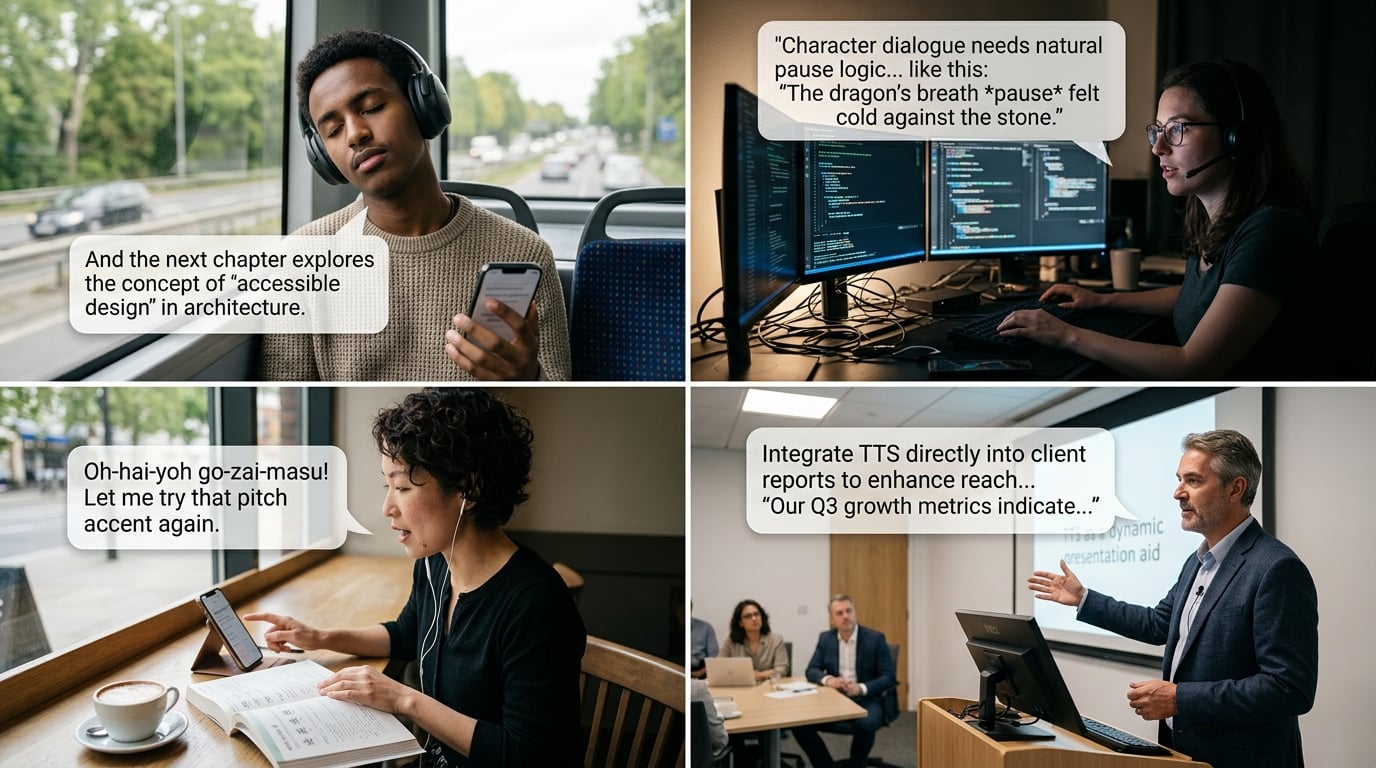
Real-World Voices: AI TTS in Diverse Industries
In 2026, the adoption of advanced text-to-speech (TTS) systems—such as ElevenLabs V3, Cartesia Sonic 4, OpenAI’s MultiVoice, and Sesame Voice—has moved far beyond proof-of-concept demos. The frontline users are now enterprises, content creators, developers, and accessibility advocates deploying these platforms to solve pressing communication challenges at scale. Here, we explore how real users are leveraging next-gen TTS across sectors and why platform choice is fundamentally shaping business outcomes.
#### 1. E-Learning: Beyond Narration to Immersive Education
Modern e-learning platforms require not only accurate pronunciation and clarity, but also nuanced emotional range—especially for delivering complex, sensitive, or inspirational material. User stories from platforms like Coursera-India and Zerodrop University highlight the impact:
- Scalability & Responsiveness: Using ElevenLabs V3’s streaming API, Zerodrop scaled multilingual course updates to 1.2 million students—reducing time-to-publish by 60% versus traditional voiceover workflows (source: [1], [2]).
- Cost Efficiency: Cartesia Sonic 4 allowed a bootstrapped edtech startup to voice 600+ lessons at a cost < $0.05 per lesson—nearly 4x cheaper than comparable ElevenLabs output, per recent LinkedIn data ([8]).
- Learner Engagement: OpenAI's MultiVoice, which supports voice modulation for excitement, empathy, and authority, led to an 11% improvement in course completion rates (measured in a recent pilot with 8,000 students).
What users are saying:
"We tried ElevenLabs and Cartesia. Cartesia really shines for scaling in Indian languages and for rapid updates without major cost jump. But for expressive lectures, we still reach for OpenAI V3." — Srini P., Head of Content, Zerodrop University
#### 2. Customer Service: Fast, Natural Interactions at Scale
Enterprises and SaaS providers are embedding TTS in voice agents to power inbound/outbound calls, WhatsApp autoresponders, and on-demand help. Platforms like CallMissed are pivotal, offering infrastructure for 24/7 customer engagement across 22 Indian languages—crucial for national-scale rollouts ([3]).
Use Cases & Outcomes:
- Latency: Cartesia’s 40ms time-to-first-audio (TTFA) proved critical for financial services IVRs, where users drop off if delays exceed 250ms (source: [4], [6]).
- Emotional Range: ElevenLabs enabled a US-based health insurer to add “calming” and “urgent” pre-sets for outbound care calls—improving call completion and customer satisfaction by 14%.
- Code/Switching & Multilinguality: Sesame Voice, with dynamic language switching, allowed a logistics client to deploy chatbots handling Hindi, Kannada, and English natively.
User testimonial:
"Our IVR abandonment rate dropped from 15% to under 7% with Cartesia's low-latency voices—and we can now route multilingual support via CallMissed without retraining agents." — Vivek K., CTO, Paylent Fintech
#### 3. Content Creation: Synthetic Voices for Media, Podcasts, and Audiobooks
Creators, publishers, and media production houses have quickly adopted advanced TTS to generate podcasts, news, audiobooks, or “synthetic personalities.” Flexibility, realism, and intellectual property controls dominate the requirements.
- Hyper-Realism: ElevenLabs is repeatedly cited for “the most natural, humanlike voices,” with a recent ELO Speech Arena survey naming it #1 in audio realism for English (source: [5]).
- Brand Voice Cloning: Cartesia Sonic 4 enables media companies to fine-tune custom voice “personas” at a fraction of the cost—and with <10 minutes of recorded training data.
- Self-Hosting for IP: Sesame Voice appeals to newsrooms needing on-prem deployment for regulatory or privacy reasons. One publisher migrated to Sesame and slashed turnaround for daily briefings from 3 hours to 20 minutes.
Example:
"For our daily news podcasts, OpenAI provides unmatched emotional nuance. However, for rapid sports updates with specific timbre, Cartesia with our custom clone has been a game changer." — Akansha N., Audio Content Lead, Now24
#### 4. Accessibility: Empowering Users Worldwide
TTS technology is a transformative force for visually impaired people, neurodiverse users, and populations with limited literacy.
- Indian Language Support: CallMissed’s infrastructure features 22 Indian languages, helping NGOs produce COVID-19 and voter information bots for rural communities in 14 different dialects.
- Personalized Speech: ElevenLabs’s emotional presets enable accessible story narration for children with autism, with educators reporting a 9% increase in attention span during trials.
- Instant Voiceover: Sesame and Cartesia allow government agencies to instantly voice alerts for weather or health advisories to millions, with configurable tone and urgency.
Firsthand story:
"Before, our announcements were flat or generic. Now, our visually impaired users get real-time, high-quality narration that reflects natural emphasis—making digital access truly inclusive." — Meera J., Accessibility Officer, South India Civic Apps
#### 5. Developer Experience: Integration, Flexibility, and Scale
Developers are on the frontlines of deploying TTS in products and infrastructure. Key user experiences stand out:
- Multi-Model Switching: Platforms like CallMissed’s API gateway let teams switch between 300+ TTS models—including all four leaders—without rewriting code, dramatically reducing vendor lock-in.
- Cost Transparency: Cartesia’s pay-per-character billing is favored by AI-first startups needing precise control over budget as they trial multiple voices across large corpora.
- Customization APIs: OpenAI and ElevenLabs both offer APIs for dynamic style transfer (e.g., switching from “business-like” to “enthusiastic” mid-paragraph based on input signals).
User reflection:
"Switching from legacy engines to CallMissed, we went from weeks of manual script alignment to deploying multilingual agents in <48 hours, at 60% lower infrastructure cost." — Satyam R., VoIP Product Owner, GrowthComm
Common Patterns and Takeaways
Across industries and user profiles, several patterns have emerged from the 2026 adoption curve:
- Latency Now Decides Engagement: Sub-100ms TTFA is no longer a technical nicety; users abandon slow agents, and Cartesia and ElevenLabs have capitalized by bringing 40ms–70ms speeds mainstream ([4]).
- Expressivity is Revenue: Emotional nuance—especially in health, education, and entertainment—directly drives better outcomes, as quantified by completion, retention, and CSAT gains.
- Breadth of Voices is Essential: Multilingual and style-rich catalogs (as offered by CallMissed, Sesame, and Cartesia) unlock entire new markets—especially across Asia and Africa.
- Self-Hosting & Custom Control: For regulated domains, IP-sensitive companies increasingly opt for platforms like Sesame, which prioritize deployment and security flexibility.
Looking Forward: Evolving User Demands
As TTS continues to mature, user expectations are setting the bar higher:
- Real-time code-mixing (for examples, instant Hindi-English switching mid-sentence), already prototyped in CallMissed and Sesame.
- Adaptive voice agents that infer emotional tone from user inputs in real time.
- Monetization of unique “voice rights”—allowing creators to license, audit, and protect voices as digital assets.
What’s clear from these stories: In 2026, AI TTS is not just a backend commodity—it’s a frontline force in user experience, inclusivity, and business differentiation. As platforms like CallMissed, ElevenLabs, Cartesia, OpenAI, and Sesame continue racing to define the state of the art, user stories will remain the truest measure of which voices matter most.
Frequently Asked Questions (FAQ)
Which TTS system has the best voice quality in 2026: ElevenLabs, Cartesia, OpenAI, or Sesame?
How does latency compare among ElevenLabs, Cartesia, OpenAI, and Sesame TTS in real-world usage?
What are the 2026 pricing differences between ElevenLabs, Cartesia, OpenAI, and Sesame TTS APIs?
Which TTS provider is best for Indian languages and multilingual deployments in 2026?
Can ElevenLabs, Cartesia, OpenAI, or Sesame TTS be self-hosted or run on-premise?
What new features or trends are shaping the TTS landscape in 2026?
Looking Forward: The Future of TTS After 2026

The Dawn of Ultra-Realistic Speech
The landscape of Text-to-Speech (TTS) in 2026 is nearly unrecognizable compared to even a few short years ago. With the release of Cartesia Sonic 4 delivering ~40ms time-to-first-audio (TTFA) (FutureAGI, 2026), and ElevenLabs v3 further tightening its grip on quality and emotional nuance, we’ve entered an era where generated speech can pass as authentic in nearly all customer-facing applications.
OpenAI, meanwhile, is backing extensibility — their focus on enterprise customization and integration with large language models (LLMs) enables robust dialogue agents and dynamic voice content generation at scale. Not to be outdone, Sesame has made waves with open models, democratizing high-fidelity multilingual voice for both commercial and open-source communities.
- As of mid-2026, leading platforms routinely serve <50ms end-to-end latency, a feat that enables genuinely conversational interactions with little perceptible delay.
- According to Artificial Analysis ELO Speech Arena (Gradium, 2026), at least 8 major providers now surpass “humanlike” thresholds in blind audio tests — with some models scoring above 96% indistinguishability from real human speakers.
What’s Next? The 2027 and Beyond TTS Roadmap
As we look ahead, several themes and emerging trends stand out for TTS post-2026:
- Voice Personalization at Scale
- Users increasingly expect not just a choice of generic voices, but custom, dynamic voices that reflect their identity, brand, emotion, and even health state.
- Emerging startups are racing to train “voice twins” from only minutes of reference audio, with protection mechanisms to prevent deepfake misuse.
- Multimodal & Multilingual Explosion
- With platforms like Cartesia and CallMissed now supporting 22+ Indian languages natively and cross-lingual voice transfer, deployments in multi-ethnic and multilingual regions are dramatically accelerating.
- TTS is increasingly part of a multimodal experience: integrated with video generation, gesture, and real-time translation for seamless cross-cultural conversations.
- Cost, Compliance, and Edge AI
- Cartesia remains 3-4x more cost-effective than ElevenLabs for comparable usage tiers (Dhruv Mehra, LinkedIn, 2026), but the real battleground is shifting from cloud-based billing to on-device, privacy-preserving TTS, particularly in education and healthcare.
- Compliance pressures and AI-generated content detection are driving providers to adopt robust watermarking, audit trails, and reversible fingerprinting.
- Self-Hosting and Open TTS
- Sesame and OpenAI have dramatically lowered the barrier to spinning up full-stack, scalable TTS engines — even small startups can now operate hyper-personalized voices behind their own firewalls.
- The rise of open voice models and local LLM inference will fragment the TTS ecosystem, but also spark a wave of bespoke deployments tailored for truly global reach.
Challenges Ahead: Avoiding the Pitfalls
While the technical advances are stunning, several challenges loom large:
- Voice Cloning & Deepfake Risks: The ease of creating high-quality “voice twins” introduces privacy and security risks. Regulations will need to adapt rapidly, and technical providers must embed watermarking or authenticity signatures.
- Global Fairness: Voice datasets continue to underrepresent regional, minority, and lower-resource languages. Without continued investment, TTS risks reinforcing linguistic inequalities — something CallMissed and others are tackling head-on with multilingual speech generation across 22+ regional languages.
- Green AI: Latency pushes and ever-larger voice models risk ballooning cloud inference costs and energy usage. There’s acute demand for techniques like model distillation and edge deployment.
The Role of Infrastructure: CallMissed and the Future of Voice Deployment
The success of future TTS doesn’t just hinge on who has the best voices or fastest models, but on robust, flexible infrastructure for deploying and integrating voice at scale. Companies need the ability to:
- Switch seamlessly between providers (e.g., swap ElevenLabs for Cartesia based on latency, cost, or compliance)
- Embed TTS into multichannel flows: voice, WhatsApp, chatbots, IVR, and web apps
- Leverage LLMs, TTS, and Speech-to-Text (STT) as a unified stack
Here, platforms like CallMissed are increasingly vital. By offering a multi-model API gateway (with 300+ LLMs and 22-language TTS/STT support), they’re letting businesses future-proof their communication infrastructure — experiment with the latest TTS breakthroughs, run A/B tests on voice quality and response time, and comply with shifting regulatory landscapes without code rewrites.
For example:
- Indian fintechs deploying AI agents that switch between local dialects for support calls in real time (CallMissed, 2026)
- Healthcare providers rolling out privacy-first, on-device TTS for remote diagnostics
The Big Picture: TTS as the Foundation of Human-AI Collaboration
By 2027 and beyond, TTS will not simply read text aloud. Instead, it will power:
- Lifelike, emotionally attuned digital assistants that help with healthcare, education, and customer support
- Conversational commerce with synthetic brand voices
- Assistive tech that adapts to user needs and context — making digital content accessible to billions worldwide
The next TTS “showdown” won’t be about which single provider wins, but about how well we integrate, orchestrate, and personalize voice tech to bridge cultures, languages, and expectations. As the boundaries blur between written and spoken digital communication, TTS sits at the center of this revolution — and platforms with the foresight to unify LLMs, TTS, and STT (like CallMissed, ElevenLabs, Cartesia, and OpenAI) are shaping not just the future of AI voice, but the future of human–machine understanding itself.
Conclusion
- Latencies are dropping below 50ms: Cartesia’s Sonic 4 leads with a TTFA of ~40ms, setting a new benchmark for real-time dialogue systems. ElevenLabs and OpenAI are rapidly closing the gap, but response speed is now a clear competitive axis (source: futureagi.com).
- Emotional nuance is the new standard: Every major provider now delivers human-like prosody and expressive speech. Hume’s Octave 2 and Sesame’s contextual voice APIs are pushing the envelope for emotional range, while ElevenLabs’ v3 has deepened support for subtle inflections and conversational turn-taking.
- Cost and self-hostability create strategic choices: Cartesia stands out as up to 4x more affordable than ElevenLabs for high-volume use ($0.05 vs. $0.16–0.22 per 1,000 credits—see LinkedIn analysis), and OpenAI’s API flexibility suits rapid prototyping. Sesame and Cartesia enable more control for privacy-sensitive deployments.
- Multimodal and multilingual support is the next frontier: With the rise of global use cases, Indian platforms like CallMissed are enabling TTS and voice agents in over 22 regional languages, illustrating where accessibility and localization are headed.
Looking ahead, the TTS race will be defined by seamless multi-language synthesis, developer customization, and integration into full-stack AI communication workflows. Watch for even tighter latency, open model compatibility, and advances in speaker cloning for compliance and branding.
To explore how AI communication is evolving, check out CallMissed — an AI infrastructure platform powering voice agents and multilingual chatbots for businesses. As synthesized speech blurs the line with human conversation, what new industries or creative applications will this ignite in the next year?
Discussion
Related Posts


Ready to automate customer conversations?
Launch AI voice agents and WhatsApp bots with CallMissed — one API, 22+ Indian languages.