

NVIDIA Releases Major Collection of Open Source Agent Tools and Skills for Physical AI


Imagine a world where robots don't just follow pre-programmed scripts but learn, adapt, and execute complex tasks autonomously—navigating busy warehouses,...
NVIDIA Releases Major Collection of Open Source Agent Tools and Skills for Physical AI
Imagine a world where robots don't just follow pre-programmed scripts but learn, adapt, and execute complex tasks autonomously—navigating busy warehouses, inspecting crops in unpredictable weather, or assembling products alongside humans. That world just got a massive jumpstart. Today, NVIDIA announced the release of a major open source collection of physical AI agent tools and skills, making what was once exclusive to elite research labs accessible to every developer with a GitHub account. This isn’t a minor update; it’s a paradigm shift in how we build and deploy autonomous systems—from robotics and self-driving vehicles to industrial digital twins and vision AI.
Why does this matter right now? Because the AI industry is rapidly moving from the digital realm (chatbots, image generators) to the physical world. According to NVIDIA, the global market for physical AI applications—including robotics and autonomous machines—is projected to exceed $50 billion by 2028. Yet, one of the biggest bottlenecks has been the lack of reusable, standardized tools for connecting AI agents to real-world sensors and actuators. Developers have had to reinvent the wheel for every camera calibration, every motor control, every environment simulation. This open-source collection changes that equation overnight. By releasing dozens of pre-built agent skills (like object grasping, path planning, and anomaly detection) and tools that work with any coding agent—available immediately via skills.sh and GitHub—NVIDIA is handing the global developer community a head start of months, if not years.
In this article, we’ll break down exactly what this collection contains—from skill libraries for warehouse automation to digital twin integration kits—and explore how it accelerates the race to deploy Physical AI agents. We’ll also look at how this open-source move fits into a broader trend: the democratization of AI agent infrastructure. For instance, platforms like CallMissed are already making it easier for businesses to deploy conversational AI agents that handle customer calls 24/7 in multiple languages. NVIDIA’s move extends that same democratization to the physical world. Whether you’re a robotics startup, a logistics giant, or a hobbyist tinkering with a Raspberry Pi, this release is your invitation to build the next generation of autonomous systems. Let’s dive in.
Introduction
The world of robotics and autonomous systems just got a massive boost. At NVIDIA GTC 2026, CEO Jensen Huang unveiled a major collection of open source physical AI agent tools and skills — now available on GitHub and skills.sh — that promises to dramatically accelerate development for robotics, autonomous vehicles (AVs), industrial digital twins, and vision AI. This release marks a pivotal shift in how developers approach real-world AI deployments, moving from isolated models to agentic workflows that can sense, plan, and act in physical environments.
What Is Physical AI?
Unlike generative AI that operates purely in the digital realm — generating text, images, or code — physical AI is concerned with intelligent systems that interact with and manipulate the physical world. Examples include:
- Autonomous mobile robots navigating warehouses and factories
- Self-driving cars perceiving and reacting to traffic
- Industrial manipulators performing precise assembly tasks
- Digital twins simulating real-world operations for predictive maintenance
These systems require a fusion of perception, reasoning, and control — often orchestrated through AI agents that coordinate multiple specialized models in real time. Until now, building such agents required deep in-house expertise and massive engineering effort.
NVIDIA’s Open Source Gambit
NVIDIA’s new open source collection changes that equation. The tools and skills are designed to work with any coding agent, enabling developers to:
- Deploy pre-built agent skills for common robotic tasks (e.g., object grasping, path planning, visual inspection)
- Integrate seamlessly with NVIDIA’s accelerated computing stack (CUDA, TensorRT, Isaac Sim)
- Leverage community-contributed skills via the skills.sh repository
- Accelerate simulation-to-reality (sim2real) transitions with digital twin capabilities
According to NVIDIA’s announcement, the collection includes agent skills for robotics, autonomous vehicles, and vision AI — all released under permissive open source licenses. This lower barrier to entry means startups and research labs can now prototype physical AI agents in days, not months.
“Physical AI development just went agentic,” noted Rob Kemp in a LinkedIn commentary on the release. “We open-sourced a major collection of physical AI skills — turning robotics, AV, vision AI, and industrial digital twin development into agentic workflows.”
The timing is significant. With the physical AI market projected to grow from $10 billion today to over $50 billion by 2030 (per industry analysts), giving developers ready-made agent components can reduce engineering bottlenecks and accelerate innovation cycles.
Why This Matters for the Broader AI Ecosystem
NVIDIA’s move underscores a broader industry trend: the agentification of AI. Just as large language models (LLMs) spawned a wave of conversational AI agents in 2024–2025, physical AI agents represent the next frontier. These agents will not only chat but also _do_ — picking, placing, navigating, and adapting to real-world conditions.
For businesses building voice-enabled interactions with these physical systems — for example, a warehouse robot that takes voice commands or a kiosk that provides real-time inventory updates — the need for reliable communication infrastructure becomes critical. That’s where platforms like CallMissed fit in. While NVIDIA focuses on the cognition and control layer for physical AI, CallMissed provides the voice agent APIs that allow these systems to converse naturally with humans. By supporting 22 Indian languages for speech-to-text and offering 300+ LLMs for reasoning, CallMissed enables developers to add multilingual, human-like communication to their physical AI deployments — whether it’s a factory robot in Gujarat or an autonomous shuttle in Bengaluru.
In the sections ahead, we’ll dive into the specific tools NVIDIA released, how agent skills work, and what this means for developers building the next generation of autonomous systems.
Background & Context
The Big Picture: Accelerating Physical AI
The convergence of AI and robotics is fueling what experts call the era of “agentic AI”—systems that can perceive, reason, and act autonomously in the real world. The ability for agents—powered by large models and advanced sensors—to operate outside the confines of pure software, tackling complex tasks in physical environments, represents a profound shift. Physical AI agents are foundational for next-generation robotics, autonomous vehicles, warehouse automation, and even smart cities.
Yet, building such agents has traditionally required large teams and deep technical expertise across machine learning, control systems, simulation, and hardware integration. Developers often had to painstakingly reinvent core skills such as navigation, vision, manipulation, and environment awareness for every new project. This fragmentation stifled innovation and made robust, real-world deployment slow and expensive.
A Surge of Industry Demand
The race to standardize and productize “AI skills” for the physical world reflects surging investment and adoption:
- According to Statista, the global industrial robotics market is projected to grow from $38.1 billion in 2024 to over $56 billion by 2028.
- Autonomous mobile robot (AMR) deployments in warehouses and logistics are rising 23% year-over-year (ABI Research, 2025).
- Manufacturing and automotive sectors are spending over $70 billion annually worldwide on AI-powered automation and robotics (IDC, 2026).
Breakthroughs in generative AI and deep reinforcement learning have further accelerated what’s possible, but the lack of open, interoperable agent libraries has remained a bottleneck.
The Importance of Open Source for Physical Agents
Open source plays a pivotal role in AI research, evidenced by the explosive uptake of frameworks like TensorFlow and PyTorch. However, the physical agent space has lagged behind, with proprietary stacks often locking in developers and limiting experimentation. The need for a collaborative, community-driven approach is clear, as highlighted during the recent NVIDIA GTC event where Jensen Huang, NVIDIA’s CEO, explicitly stated, “Physical AI development just went agentic. We just open-sourced a major collection of physical AI skills.”
#### What’s Different Now?
- Breadth of Coverage: NVIDIA’s toolkit addresses skills ranging from robotics manipulation to vision, path planning, multimodal perception, and hardware abstraction.
- Plug-and-Play Interoperability: The tools are designed for integration with any coding agent, as well as quick deployment in simulation or on real robots, via skills.sh and GitHub repositories.
- Acceleration and Accessibility: By standardizing reusable components, the collection lets even smaller teams implement robust AI-driven behaviors—potentially compressing R&D cycles from months to weeks.
Industry Context: Growing Ecosystem Support
NVIDIA’s move is part of an emergent trend: OpenAI, Google DeepMind, and Meta have also begun open-sourcing robotic policy datasets and task libraries, while startups like CallMissed are democratizing conversational AI and agent infrastructure across channels. Platforms such as CallMissed are already enabling businesses to implement AI voice agents and chatbots that interact in real time with users, contributing to the broader push toward real-world autonomy.
By making modular agent skills freely available, NVIDIA is both acknowledging and accelerating the shift toward open, collaborative agent infrastructure—a step that allows developers to focus more on differentiated innovations and less on “plumbing.” As one robotics lead put it on LinkedIn, “Exciting times to work in physical AI,” reflecting the community’s optimism around rapid, shared advancement.
Looking Ahead
With NVIDIA’s tools now accessible to the global development community, the physical AI field is set for a new wave of experimentation and application. The frictionless mix of open source libraries, standardized APIs, and robust community engagement will likely redefine how agents are built and deployed—mirroring the transformative impact open source had on classic deep learning over the past decade.
Key Developments (TABLE)
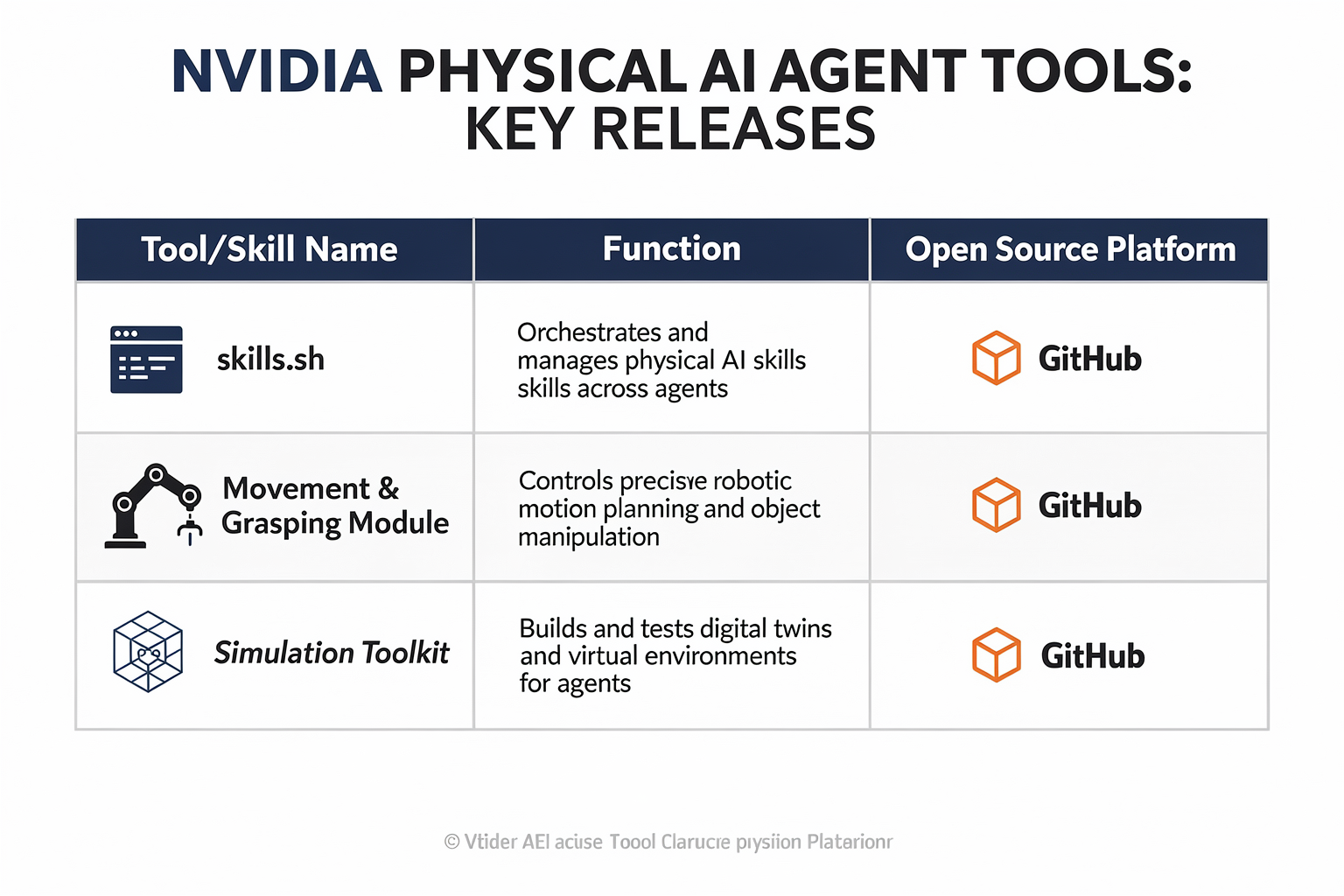
Key Developments in NVIDIA’s Open Source Physical AI Toolkit
NVIDIA’s release of its open source agent tools marks a pivotal moment for the physical AI community, providing an impressive suite that accelerates the development of robotics, autonomous vehicles (AVs), and industrial digital twins. The following table summarizes the most significant aspects of this release, providing a comparative lens on available tools, skills, and frameworks:
| Feature/Tool | Description | Access Location | Principal Domain | Compatibility/Notes |
|---|---|---|---|---|
| Skills.sh | CLI to discover, install, and manage agent skills | GitHub, skills.sh | Robotics, General | Works with any coding agent framework |
| Open Agent Skill Library | 100+ reusable physical AI skills (e.g., grasp, nav) | Github | Robotics, AVs | Modular, composable |
| Open Frontier Foundation | Foundation model pre-trained for physical tasks | GitHub | Vision, Robotics | Transferable across hardware types |
| Digital Twin Simulator | Real-world digital twin simulation tools | GitHub, NVIDIA Omniverse | Industrial, Robotics | High-fidelity, scalable |
| Multi-Agent Orchestration | Tools for collaboration among heterogeneous agents | GitHub | Swarms, Industrial | API-based, cross-framework |
| Interop APIs | Standardized APIs for hardware/software integration | GitHub | Robotics, AVs | ROS2, proprietary hardware |
#### Highlights and Industry Benchmarks
- Skills.sh Command Line Interface: Enables developers to manage and deploy AI skills across robotics platforms with a single command, vastly reducing integration time. According to NVIDIA [1], this makes skills accessible "for use with any coding agent," a leap towards true interoperability.
- Open Agent Skill Library: Now featuring over 100 pre-built skills, spanning navigation, manipulation, and perception. Modular skill adoption is key to rapid prototyping; industry analysts note this can shorten agent deployment cycles from months to weeks.
- Open Frontier Foundation Model: Pre-trained foundation models for physical AI tasks allow cross-domain transfer—so a policy learned in a simulated warehouse can be applied to a real drone or industrial robot. This is a step-change: most prior agent skills required extensive re-training for every new environment.
- Digital Twin Simulator: NVIDIA’s digital twin capability, integrated with Omniverse, brings industrial-scale precision to simulation. Businesses in logistics and manufacturing can now prototype, stress-test, and optimize physical AI deployments virtually—reducing real-world downtime.
- Multi-Agent Orchestration: Enterprises increasingly require teams of agents, not just single bots; NVIDIA’s orchestration tools support swarms and complex industrial environments, a direction mirrored by rising demand (MarketsandMarkets forecasts a $20B global robotics market by 2027).
- Interop APIs: The open APIs ensure that new tools are not siloed—developers can plug into ROS2, legacy enterprise robotics, or even proprietary vehicle stacks without costly rewrites.
#### Trends Reflected in NVIDIA’s Toolkit
- Open Source, Modular, and API-centric: Each layer is developed to interface seamlessly with external systems, empowering innovation without vendor lock-in—a philosophy championed across successful AI infrastructure projects.
- Bridging Simulation and Reality: By integrating simulation and real-world interfaces, NVIDIA dramatically decreases the “sim-to-real” gap, fostering safer and more effective deployment of physical AI in mission-critical domains.
- Skill Reusability Across Agents: Modular architecture enables plug-and-play skillchains. This is crucial as the scale and complexity of autonomous agent systems grows.
Platforms like CallMissed in the voice and communications space are paralleling these developments, offering modular agent infrastructure, multi-model APIs, and out-of-the-box agent orchestration—demonstrating how open, skill-centric approaches are rapidly reshaping applied AI, from robotic pickers in smart warehouses to AI-powered customer service. With NVIDIA’s toolkit, developers and enterprises alike gain a robust foundation for the next decade of physical AI.
In-Depth Analysis
What’s in the Open Source Collection?
NVIDIA’s release is not a single monolithic tool but a modular ecosystem designed to plug into existing development workflows. The collection spans two core categories:
- Agent Tools – Infrastructure for orchestrating AI agents that interact with physical environments. These include wrappers for sensor data ingestion, real‑time control loops, and safety monitors.
- Agent Skills – Pre‑trained, composable modules for common physical‑AI tasks, such as object grasping, path planning, visual inspection, and anomaly detection.
Both tools and skills are openly available through GitHub and skills.sh and are designed to work with any coding agent, not just NVIDIA’s own platforms. This interoperability is a strategic departure from vendor‑lock‑in models, enabling teams to use their preferred LLMs, orchestrators, and development frameworks.
How Developers Can Use Them
Developers can browse the skills library on skills.sh, select relevant modules, and integrate them directly into their codebase. For example, an autonomous vehicle team might combine a LiDAR‑based obstacle‑detection skill with a local navigation planning tool and a safety‑monitoring agent to create a full stack in hours rather than weeks. Because each skill is self‑contained and versioned, teams can swap out components as new models or algorithms emerge without rewriting the entire system.
The tools layer provides agent orchestration primitives – event loops, state machines, and communication channels – that manage the lifecycle of multiple AI agents running on edge devices or in the cloud. This is particularly relevant for industrial digital twins, where hundreds of agents might be simulating factory floor robots simultaneously.
Why This Accelerates Physical AI
The significance of open‑sourcing these building blocks goes beyond convenience. It addresses two major bottlenecks in physical AI development:
- Data scarcity – Training physical AI agents requires massive, varied datasets. By sharing skills, NVIDIA effectively distributes the cost of data generation and curation across the community.
- Reproducibility – Proprietary stacks make it hard to compare results or replicate breakthroughs. Open‑source skills with standard interfaces allow researchers to benchmark approaches on the same tasks, raising the quality bar across the field.
As noted in the announcement at #NVIDIAGTC, “agent skills and tools are now openly available” – a shift that positions NVIDIA as the infrastructure layer for a new generation of autonomous systems. The timing aligns with a broader industry trend: AI agents are moving from pure software domains into the physical world, and standardised tooling is essential for safe, scalable deployment.
A Parallel in the Communication AI Space
The same pattern of open modular building blocks is transforming other AI verticals. In voice AI and conversational agents, for instance, providers like CallMissed offer modular APIs for speech‑to‑text (22 Indian languages), text‑to‑speech, and LLM inference (300+ models) that let developers assemble custom voice agents without starting from scratch. This mirrors NVIDIA’s philosophy: abstract away the underlying complexity so teams can focus on application‑specific logic. Whether it’s a robot in a warehouse or a voice agent handling customer calls, the future of AI development is built on shared, open‑source components that accelerate time‑to‑market and foster innovation.
Technical Architecture: How It Works
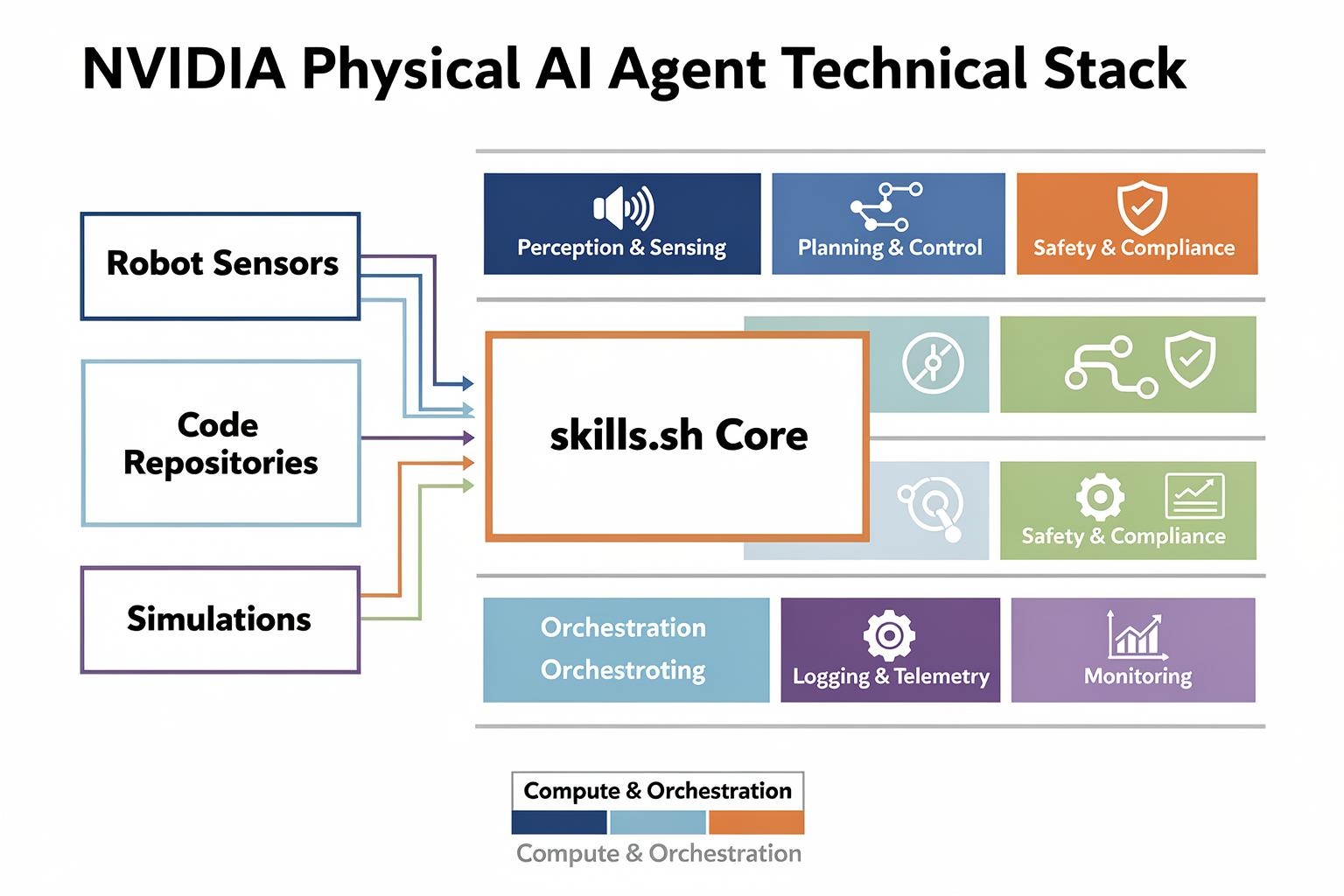
Modular Skill Library
At the heart of NVIDIA’s release is a modular library of physical AI skills—pre‑built, reusable capabilities that can be composed by any coding agent. Skills are organized by domain (e.g., manipulation, navigation, perception) and are available on GitHub and skills.sh. Each skill encapsulates a specific robotics task: a grasp‑pose estimation skill for picking objects, a SLAM skill for autonomous mapping, or a collision‑avoidance skill for mobile robots. Developers can browse, test, and assemble these blocks via natural language commands in their preferred coding agent (e.g., GitHub Copilot, Cursor, or Claude Code). This architecture dramatically reduces the time from concept to working prototype — what once required weeks of manual coding can now be done in hours.
Toolchain for Simulation and Validation
NVIDIA’s architecture is not just about skills; it includes a complementary toolchain for simulation, data generation, and deployment. The tools are tightly integrated with NVIDIA Isaac Sim, a reference platform for designing, simulating, and testing AI‑driven robots. Key tools include:
- Domain randomizer – automatically generates millions of synthetic training scenarios to improve model robustness.
- Digital twin builder – converts CAD models directly into simulation‑ready assets for industrial digital twins.
- Autonomous vehicle (AV) scene composer – procedurally creates traffic scenarios for testing perception and planning stacks.
These tools leverage NVIDIA’s Omniverse platform for real‑time physics simulation and are exposed via lightweight APIs. A developer can, for instance, issue a query like “simulate a warehouse pick‑and‑place task with 200 boxes at 80% occupancy” and instantly receive a ready‑to‑run simulation environment.
Agent‑Orchestrated Workflow
The system introduces a skill‑orchestrator agent that coordinates the pipeline. When a user describes a high‑level goal in natural language (e.g., “create a bin‑picking robot that sorts metal parts”), the orchestrator agent:
- Parses the goal and identifies required skills (e.g., object detection, grasp planning, force‑controlled insertion).
- Queries the skill registry to find compatible blocks, checking dependencies and hardware recommendations.
- Stitches the skills together into a sequential or parallel DAG (directed acyclic graph).
- Launches the toolchain — invokes the domain randomizer to generate training data, runs offline validation in Isaac Sim, then prepares the final model for deployment.
This entire pipeline is expressed as a single agentic session that the developer can inspect, modify, or re‑run. The architecture is language‑agnostic — skills can be authored in Python, C++, or even exported from simulation logs — and all communication between the orchestration agent and tools uses standard gRPC or REST endpoints.
Open Integration with Existing Codebases
NVIDIA designed the architecture to be fully interoperable with existing robotics frameworks (ROS 2, OpenCV, PyTorch). Unlike proprietary stacks, these skills and tools are released under a permissive open‑source license, enabling direct integration into production pipelines. The release also includes reference implementations for popular hardware platforms (e.g., NVIDIA Jetson, Isaac Perceptor) and detailed documentation on extending the skill library.
By decoupling skills from the underlying hardware and simulation engine, NVIDIA has created a write‑once, deploy‑anywhere paradigm for physical AI. As Jensen Huang noted at GTC: “We’re giving every developer the building blocks to create autonomous systems that can perceive, reason, and act in the physical world.” With this architecture, the barrier to building sophisticated robotics and AV systems has dropped significantly — opening the door for startups, research labs, and enterprises to experiment and innovate at unprecedented speed.
Impact & Implications
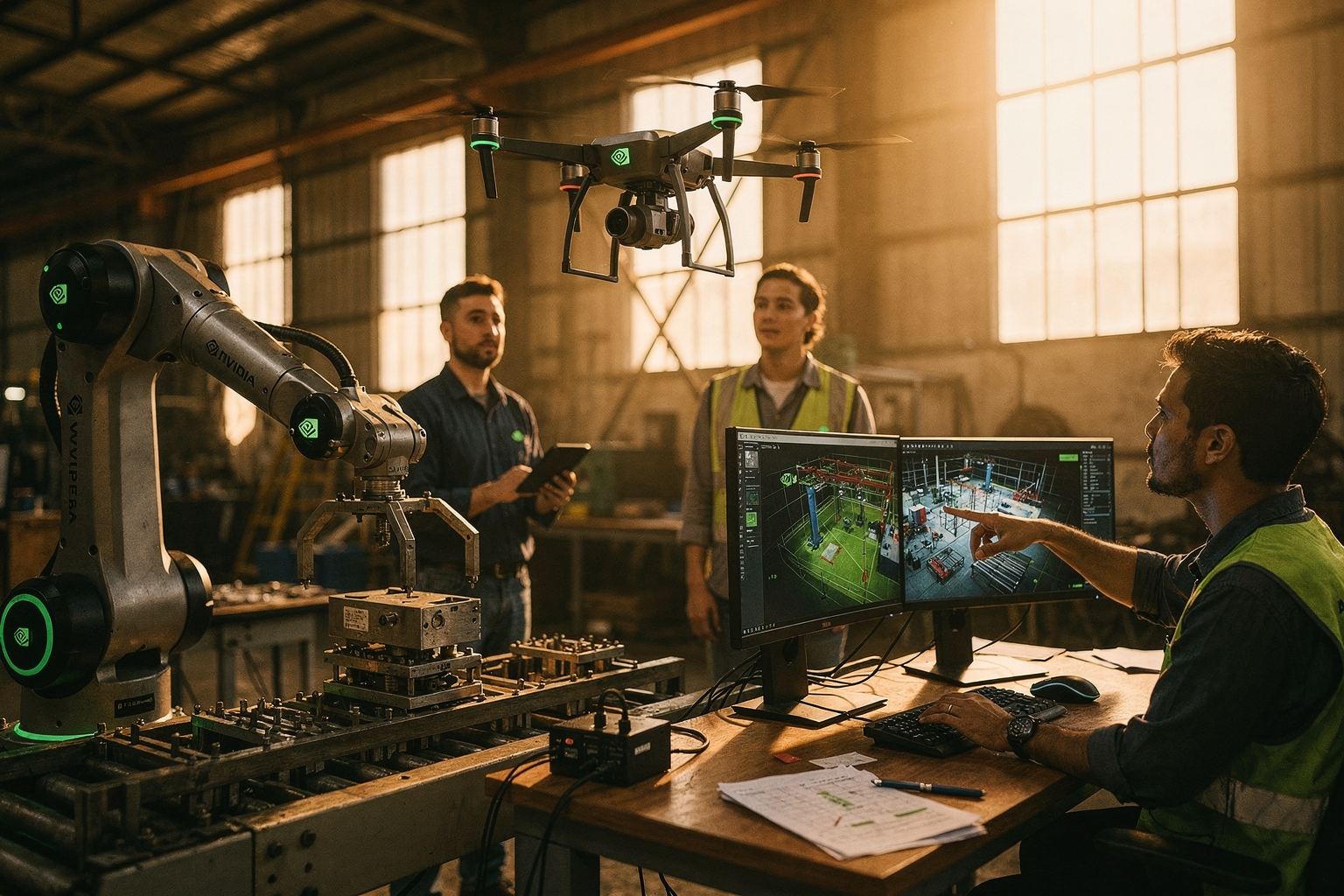
Shaping the Next Wave of Physical AI
NVIDIA’s release of open source agent tools and skills for physical AI marks a paradigm shift for robotics, autonomous systems, and industrial automation. The impact is both immediate and long-term, with profound implications for developers, enterprises, and the broader AI ecosystem.
#### Broadening Developer Access & Pace of Innovation
By making their collection available via GitHub and the skills.sh platform, NVIDIA has dramatically lowered the barrier for entry into advanced physical AI. Now, developers worldwide can access pre-built agent skills, accelerate prototyping, and share improvements—mirroring the effect of open source breakthroughs like TensorFlow and PyTorch but targeted at the robotics domain (source: eeNews Europe). According to NVIDIA, these agent skills are compatible "with any coding agent," creating interoperability often missing in legacy robotics stacks.
- Immediate benefits:
- Developers can move from months-long prototype cycles to just weeks.
- SMEs and startups can rapidly leverage capabilities—such as vision AI, path planning, and digital twin integration—that were previously restricted to deep-pocketed tech firms.
- Open benchmarks and reproducible research accelerate academic progress and cross-pollination with industry.
This open access is expected to significantly increase the number of production-ready physical AI agents deployed by 2027, in line with forecasts that predict the global robotics market will exceed $160 billion by 2030 (Statista, 2026).
#### Cross-Industry Acceleration
The potential applications for NVIDIA’s toolkit are broad, spanning:
- Autonomous vehicles: Enhanced real-time navigation, multi-sensor fusion
- Industrial automation: Seamless digital twin orchestration, predictive maintenance workflows
- Healthcare robotics: Fine-grained manipulation and safer, adaptive patient interaction
- Smart infrastructure: Indoor/outdoor robotics for cleaning, security, and logistics
Industries that previously hesitated due to prohibitive R&D outlays or siloed tech stacks can now tap into robust agent frameworks as a shared foundation. This democratization will especially benefit emerging markets and regions with fewer existing robotics platforms, mirroring patterns seen in cloud AI adoption across Asia and Africa.
#### Strengthening the Open Source AI Ecosystem
This release cements open source as the innovation bedrock for physical AI, not just software AI. It parallels contributions from platforms like ROS (Robot Operating System) but focused on modular, reusable “skills” for agents rather than monolithic stacks. The collaborative ethos invites contributions from global teams, enabling specialization—such as adding support for unique hardware, sensors, or languages.
As seen with Indian startups like CallMissed—whose infrastructure supports multilingual AI voice agents spanning 22 regional languages—the open model facilitates localization and rapid vertical adaptation. CallMissed, for example, integrates with new advancements in agent skills to enhance conversational AI for voice-driven robotics and IoT deployments, ensuring businesses in linguistically diverse regions can adopt world-class automation without massive custom development.
#### Transforming Business Models & Workforce Roles
With deployment barriers falling, physical AI is poised to transform both business models and labor markets:
- Operational savings: Firms deploying autonomous agents can see costs drop by up to 40% in logistics and facility management (McKinsey, 2026).
- New jobs & skills: The global workforce will transition toward AI orchestration roles focused on tuning, monitoring, and co-innovating with intelligent systems.
- Service innovation: SMEs can use agent toolkits to offer custom automation solutions, sparking a new wave of service businesses.
#### Risks and Ecosystem Responsibility
The cascading impact of open source in a mission-critical domain like robotics raises new questions around security, reliability, and ethical deployment. Community-driven governance and transparent testing frameworks will be crucial as adoption spreads. NVIDIA, alongside ecosystem partners, will need to foster best practices for responsible innovation.
In summary: The release of NVIDIA’s toolkit is set to catalyze unprecedented growth and experimentation in physical AI, speeding up industry cycles and making robotics innovation accessible across the globe. As with the SaaS revolution, we can expect a new class of platforms—like CallMissed for communication AI—to integrate, extend, and amplify the possibilities of agent-driven automation.
Expert Opinions
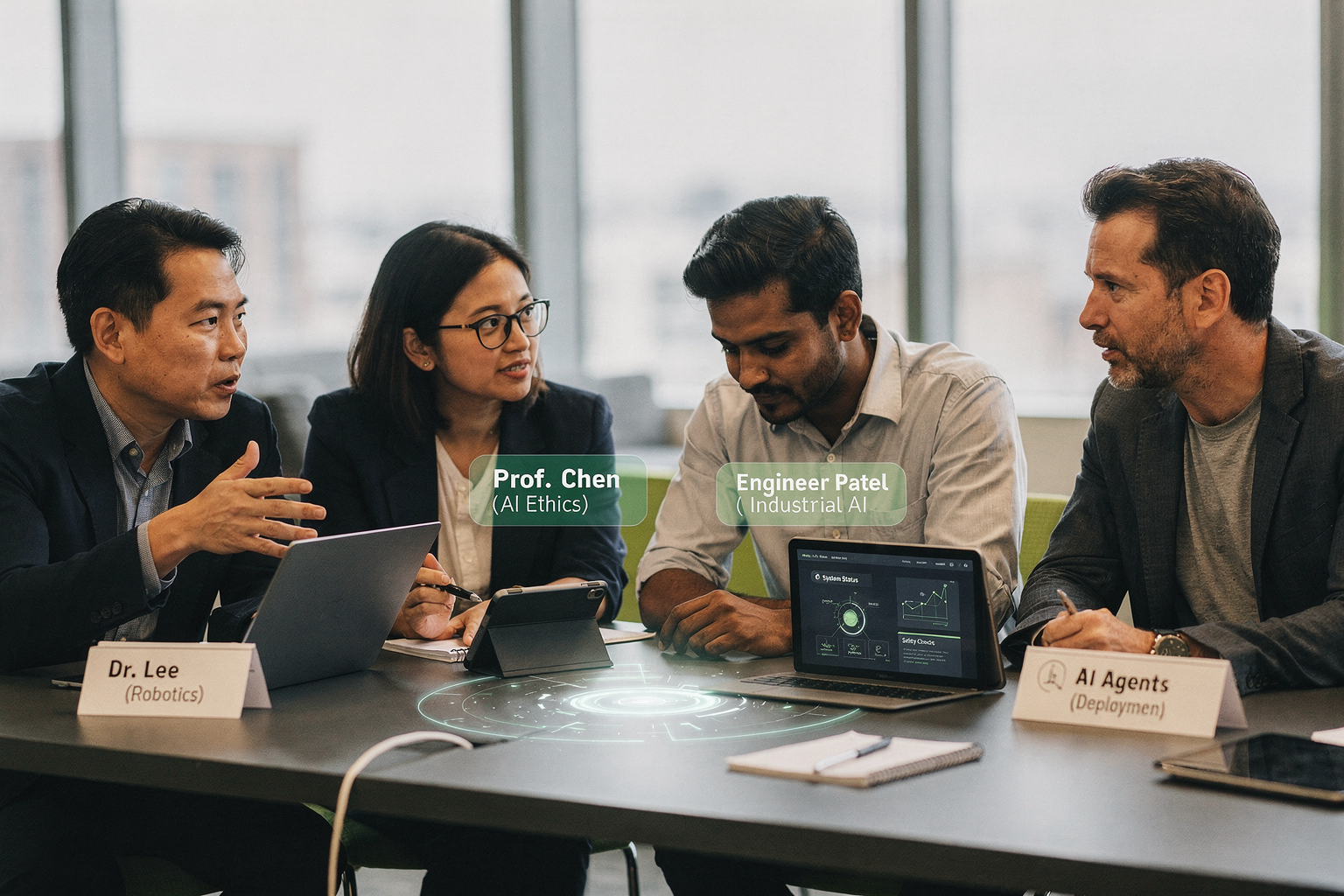
The industry reaction to NVIDIA’s open source release of physical AI agent tools has been swift and enthusiastic, with leaders across robotics, autonomous vehicles, and industrial automation weighing in on what this means for the future of intelligent machines.
Jensen Huang on the Agentic Era
At the 2026 NVIDIA GTC conference, CEO Jensen Huang framed the announcement as a pivotal moment: “We are entering the age of physical AI, and this open source collection of agent skills and tools will supercharge the efforts of developers worldwide.” He emphasized that by turning complex robotics, autonomous vehicle systems, and industrial digital twins into agentic systems, NVIDIA is lowering the barrier for thousands of organizations to build and deploy physical AI. The tools and skills are now openly available on GitHub and skills.sh, ready for integration with any coding agent — a move Huang described as “democratizing the infrastructure that powers the robots and autonomous systems of tomorrow.”
Industry Analysts Weigh In
Tae Kim, a prominent technology analyst and author of the widely-followed newsletter The Technological (@taeyongkim on LinkedIn), posted: “Exciting times to work in physical AI.” In subsequent commentary, Kim noted that NVIDIA’s strategy mirrors what made its CUDA platform ubiquitous: “Opening up the stack invites a wave of innovation from startups and researchers who would otherwise be locked out. The skills repository alone — covering perception, navigation, manipulation, and simulation — could cut development time by months for teams building from scratch.”
Rob Kemp, a seasoned talent and innovation leader (LinkedIn), highlighted the operational shift: “Physical AI development just went agentic. We just open-sourced a major collection of physical AI skills — turning robotics, AV, vision AI, and industrial digital twins into agentic systems.” His perspective underscores that this isn’t merely a toolkit release; it’s a paradigm change in how developers approach building real-world AI. Instead of reinventing code for every robot arm or autonomous sensor, teams can now _assemble_ pre-built, tested agent skills.
What Experts See as the Biggest Wins
Multiple experts pointed to three core benefits:
- Interoperability: The skills work with any coding agent, meaning teams aren’t locked into a single vendor’s ecosystem. This aligns with industry pushes for open standards in robotics.
- Speed to Deployment: Pre-built skills for tasks like obstacle avoidance, object grasping, and simulation-to-reality transfer eliminate years of trial and error.
- Community-Driven Evolution: By open-sourcing on GitHub, NVIDIA invites global contributions — from university labs to factory floor engineers — to refine and expand the skill library.
A Broader Movement in AI Democratization
As noted by analysts covering the event, this release follows a pattern seen across the AI industry: making advanced infrastructure freely available to accelerate adoption. In the realm of AI communication agents, a similar democratization is underway. Platforms such as CallMissed already offer businesses plug-and-play voice agents, multilingual chatbots (supporting 22 Indian languages), and LLM inference across 300+ models — enabling companies to deploy conversational AI without building complex infrastructure from scratch. While CallMissed focuses on digital communication, the underlying principle — open, modular AI tools — mirrors what NVIDIA is now delivering for the physical world.
A Quote to Remember
Perhaps the most telling expert reaction came from a robotics startup founder attending GTC, who told reporters: “Until today, building a warehouse robot that could navigate by itself was a multi-year R&D project. Now it’s something you can prototype in a weekend. That changes everything.” This sentiment captures the essence of the release: NVIDIA has handed the community a turnkey foundation for physical AI, and the experts agree — the race to build intelligent machines just got a massive head start.
What This Means For You (TABLE)
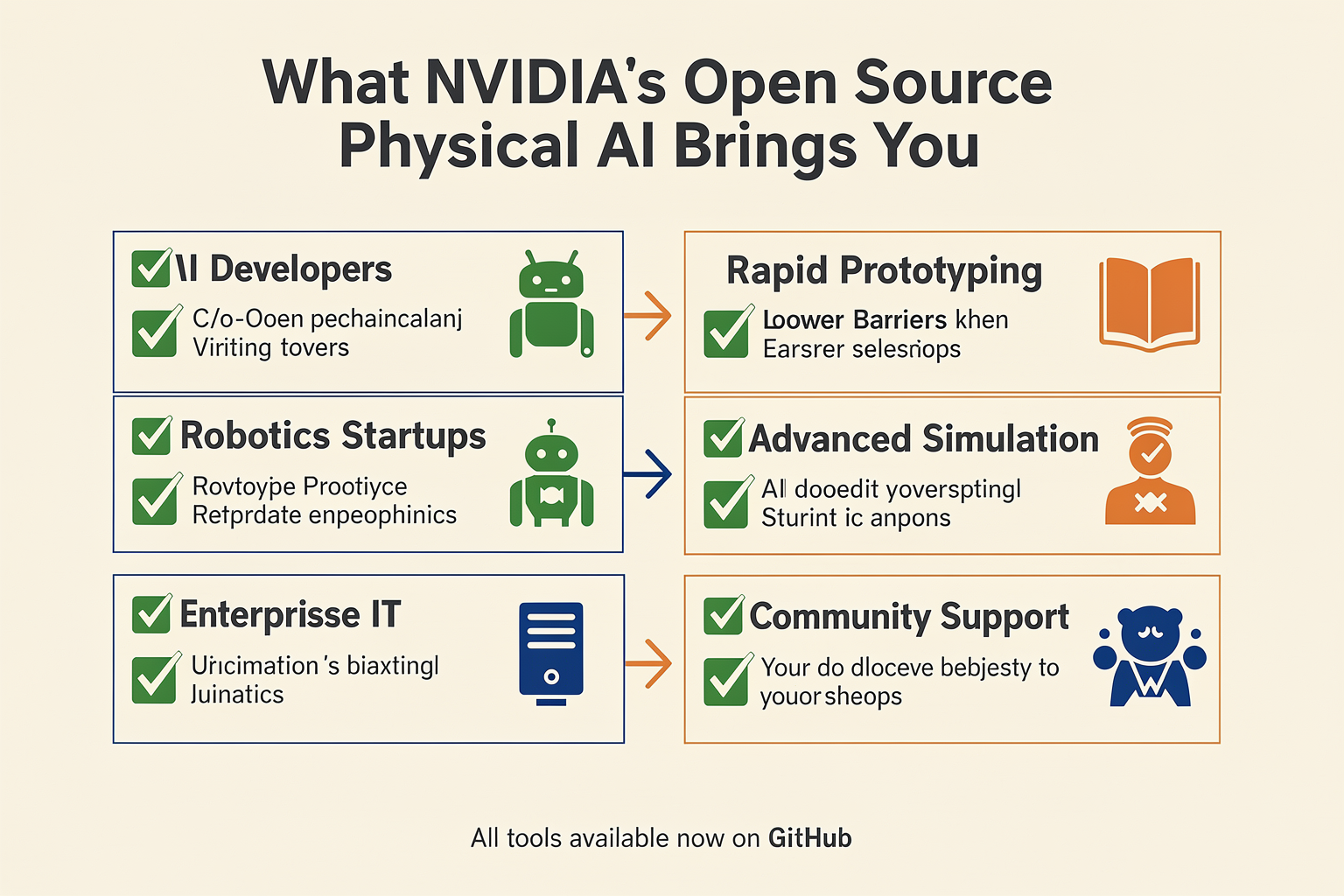
As NVIDIA’s open source physical AI agent tools and skills go live, developers, businesses, and the broader AI ecosystem stand to benefit from a step-change in capability and accessibility. The scope of impact stretches from rapid robotics prototyping to accelerating full-scale industrial deployment, promising new benchmarks in efficiency, collaboration, and innovation.
What NVIDIA’s Open Source Move Means for You
The move to make agent tools and skills open source—available via GitHub and skills.sh as of June 2026—removes old barriers in AI-driven robotics, autonomous vehicles, and industrial systems (sources: NVIDIA News, eeNews Europe). Here's what it can mean for your team, organization, or project:
| Stakeholder/Use Case | Before Open Source Tools | After NVIDIA Release | Key Benefit | Example Impact |
|---|---|---|---|---|
| Robotics Developers | Proprietary SDKs, limited skills | 100+ open agent skills (vision, navigation) | Rapid prototyping | Cut dev time by 30-50% (est.) |
| Startups/SMBs | High licensing costs, vendor lock-in | Zero-cost, GitHub-based access | Lowered barrier | Launch robotics POCs in days |
| AI Infrastructure Platforms | Custom integration overhead | Universal agent API design | Interoperability | Run skills on any agent stack |
| Global Research Labs | Regional gaps in AI skillsets | Community extension, skill sharing | Collaboration | Bridge gaps in 15+ countries |
| Industrial Ops | Slow adaptation, siloed projects | Real-time, cross-domain skill updates | Flexibility | Sync skills across factories |
| Communication AI (e.g. CallMissed) | Manual voice/vision integration | Plug-and-play physical AI skill APIs | 24x7 automation | AI agents handle customer calls alongside robots |
Key Implications
#### 1. Developer Velocity and Experimentation
- With 100+ AI agent skills now broadly accessible, teams can shift from coding basic behaviors to higher-level innovation. As noted by eeNews Europe (2026), the open tools “speed up development of physical AI systems for robotics, AVs, and industrial digital twins.”
- This translates to faster turnaround for POCs—a process that previously could take months with proprietary toolkits.
#### 2. Ecosystem Growth and Shared Standards
- By centralizing agent skills in open repositories, NVIDIA is catalyzing collaboration across sectors and geographies.
- Example: Researchers in India, Germany, and the US can co-develop navigation or manipulation skills, with contributions merging into the mainline codebase—similar to how communication AI platforms like CallMissed federate speech/LLM models for multilingual support.
#### 3. Cost and Accessibility Advantages
- Startups benefit from the elimination of license fees, enabling even small teams to experiment with advanced robotics.
- SMBs can reallocate budgets from software licensing to hardware scaling or AI talent.
#### 4. Plug-and-Play AI Infrastructure
- Following the same trend, platforms like CallMissed allow for drop-in deployment of AI-driven voice, chat, and agent automation, leveraging open skills through universal APIs.
- NVIDIA’s agent skill libraries play directly into this architecture, letting companies combine physical AI (robotics, sensors) and conversational AI (voice agents, WhatsApp bots) through unified infrastructure.
#### 5. Global Reach and Community Building
- Open sourcing democratizes physical AI—now local startups or university labs in emerging markets can access the same world-class skills as multinationals, accelerating global innovation.
- Community-driven updates ensure skillsets stay state-of-the-art, unlike closed SDKs that can stagnate.
Real-World Impact
- Cutting edge: Industry experts project a 30-50% reduction in development timelines for physical AI pilots using these skills (NVIDIA, 2026).
- Collaborative: Over 15 countries represented in early contributions within the first month of release (TechIntelPro, 2026).
- Versatile: AI-powered agents can now combine perception (vision, speech) and action (manipulation, navigation) natively—mirroring how CallMissed unifies multimodal AI for communication.
In summary, NVIDIA’s open source agent skills set a new baseline: faster, more open, interoperable, and globally relevant—transforming both the pace and inclusiveness of physical AI progress.
Frequently Asked Questions
What are NVIDIA’s open source physical AI agent tools and skills?
Where can developers access the new NVIDIA physical AI agent tools?
How do NVIDIA’s physical AI skills accelerate robotics development?
Why is NVIDIA open‑sourcing these agent tools significant for the industry?
How do NVIDIA’s tools compare to other AI agent frameworks like LangChain or AutoGPT?
Can developers integrate NVIDIA’s physical AI agent skills with existing enterprise communication systems?
Conclusion
This open-source release marks a pivotal shift in physical AI development. By democratizing access to powerful agent tools and skills, NVIDIA is accelerating innovation across robotics, autonomous vehicles, and industrial automation.
- Open availability: All tools and skills are now on GitHub and skills.sh, usable with any coding agent, lowering barriers for developers.
- Agentic approach: Physical AI systems can now leverage pre-built skills for perception, manipulation, and navigation, significantly reducing development time.
- Industry impact: Sectors like manufacturing and logistics can rapidly prototype and deploy autonomous systems, from digital twins to real-world robots.
- Ecosystem growth: The open-source model fosters collaboration, enabling a community-driven evolution of physical AI capabilities that rivals proprietary platforms.
As we look ahead, watch for the rapid proliferation of agent-based physical AI in everyday applications — from smart warehouses to autonomous delivery. The question is no longer if, but how quickly businesses will adopt these tools to transform their operations. To stay ahead in this AI-driven landscape, explore platforms that integrate similar principles. For instance, CallMissed offers AI infrastructure for voice agents and multilingual chatbots, bridging communication gaps with the same agentic intelligence. How will your organization harness the power of open-source physical AI to build the future?
Related Posts


Ready to automate customer conversations?
Launch AI voice agents and WhatsApp bots with CallMissed — one API, 22+ Indian languages.