

Nvidia and Microsoft Pour $15 Billion Into Anthropic: The Inside Story of a New AI Alliance


What happens when two of the world’s most powerful tech giants pour a staggering $15 billion into a single AI startup? The answer: they ignite a new era...
Nvidia and Microsoft Pour $15 Billion Into Anthropic: The Inside Story of a New AI Alliance
What happens when two of the world’s most powerful tech giants pour a staggering $15 billion into a single AI startup? The answer: they ignite a new era of artificial intelligence alliances that could define the future of the industry. In the latest landmark deal, Nvidia and Microsoft are investing up to $15 billion in Anthropic, the upstart behind the increasingly popular Claude AI models. In return, Anthropic has committed to purchasing $30 billion worth of computing resources from Microsoft’s Azure cloud—a move that signals not just investment, but a reshaping of the global AI supply chain [WSJ, 2025].
Why does this matter now? AI development has reached breakneck velocity, with global investment in generative AI surpassing $75 billion last year alone, according to CB Insights. But what sets this alliance apart is its sheer scale and the deep strategic blend of hardware, cloud infrastructure, and LLM innovation it represents. Microsoft’s $5 billion and Nvidia’s $10 billion contributions will give Anthropic massive access to both cutting-edge GPUs and hyperscale cloud computing [Financial Times, 2025]. For context, Anthropic’s new valuation soars into the hundreds of billions, positioning it as a formidable rival to OpenAI and Google DeepMind.
Readers can expect a behind-the-scenes look at how and why this partnership came together, the strategic bets being made on large language models and enterprise infrastructure, and what this means for the balance of power in AI. We’ll explore the high-stakes commitments on both sides—and what’s at risk if either challenger falters. You’ll also see how this move fits into a broader AI industry trend, where platforms like CallMissed are harnessing advances in cloud and AI hardware to deliver scalable, production-ready voice agents and multilingual AI services.
As Microsoft, Nvidia, and Anthropic reshape the roadmap for AI infrastructure, the ripple effects are already being felt across startups, enterprises, and entire economies. Dive in for the full inside story on the forces driving the $15 billion Nvidia and Microsoft investment—and what it signals for the next generation of AI alliances.
Introduction: Unpacking the $15 Billion AI Partnership
A Turning Point for AI: The World Watches
The sheer magnitude of Nvidia and Microsoft’s joint $15 billion investment in Anthropic isn’t just eye-catching—it’s an opening salvo in a new era of strategic AI alliances. As of May 2026, this initiative stands as one of the largest capital infusions in the AI sector’s history, instantly recalibrating the balance of power among leading tech giants. What jolts the industry isn’t merely the dollar amount, but the inner logic and reciprocal commitments woven into the agreement. Anthropic’s promise to purchase $30 billion in Microsoft Azure compute signals a deliberate reconfiguration of the global AI supply chain—a move that speaks as loudly as the capital deployed [WSJ, 2025].
The New Standard for Strategic AI Collaboration
For years, AI startups have been courted by large cloud providers, but this deal codifies a new model: a three-way partnership, aligning hardware (Nvidia), cloud infrastructure (Microsoft), and breakthrough model development (Anthropic). Specifically:
- Nvidia’s $10 billion contribution provides not only capital, but also priority access to state-of-the-art GPUs—vital for training and deploying large language models (LLMs) at scale.
- Microsoft’s $5 billion commitment cements Azure as Anthropic’s go-to compute platform, underpinned by a $30 billion purchase agreement for cloud resources [Financial Times, 2025].
- Anthropic’s rapidly evolving Claude AI models—already rivals to OpenAI’s GPT—will see accelerated innovation and distribution, benefitting from deep hardware-software integration via Azure and Nvidia [Microsoft Blog, 2025].
This is not just funding—it's a full-stack resourcing bet on Anthropic as an anchor tenant for the next wave of generative AI services.
Why the Stakes Are Higher Than Ever
The global investment in generative AI topped a staggering $75 billion in 2025, with top players racing to outpace one another in scale, efficiency, and accessibility [CB Insights, 2025]. Anthropic’s new valuation, now estimated in the hundreds of billions, leapfrogs it into the upper echelons of the AI elite—on par with, or even outpacing, OpenAI and Google DeepMind in terms of strategic leverage.
These numbers aren’t abstract. Consider the ripple effects:
- Hyperscale GPU allocation is now a competitive moat. Nvidia’s direct involvement ensures Anthropic a first-in-line queue for new chip rollouts, an increasingly scarce asset as demand for AI compute explodes.
- Cloud platform commitments are shaping the software stack of tomorrow. Anthropic’s model training, deployment, and inference will be deeply rooted in Microsoft’s Azure ecosystem, shifting market gravity away from neutral hardware or multi-cloud approaches.
- Enterprise AI rollout becomes frictionless. Companies and solution providers can now build with assurance of abundant, cutting-edge LLM infrastructure.
Setting the Stage for the Broader Ecosystem
This landmark partnership is a bellwether for an industry that increasingly revolves around tightly coupled alliances between the cloud, AI models, and hardware. Startups such as CallMissed are part of this momentum, leveraging advancements in hyperscale AI infrastructure to deliver multilingual voice agents, 24/7 support bots, and LLM-powered communications for enterprises across Asia and beyond. The bar for innovation—and coordination—has been raised globally.
As we follow the unfolding story, this $15 billion bet will resonate far beyond boardrooms in Redmond, Santa Clara, or San Francisco. Its ramifications will swarm across global markets, reshape developer roadmaps, and redefine just how intelligent, accessible, and pervasive AI services can truly become.
Background & Context: How We Got Here
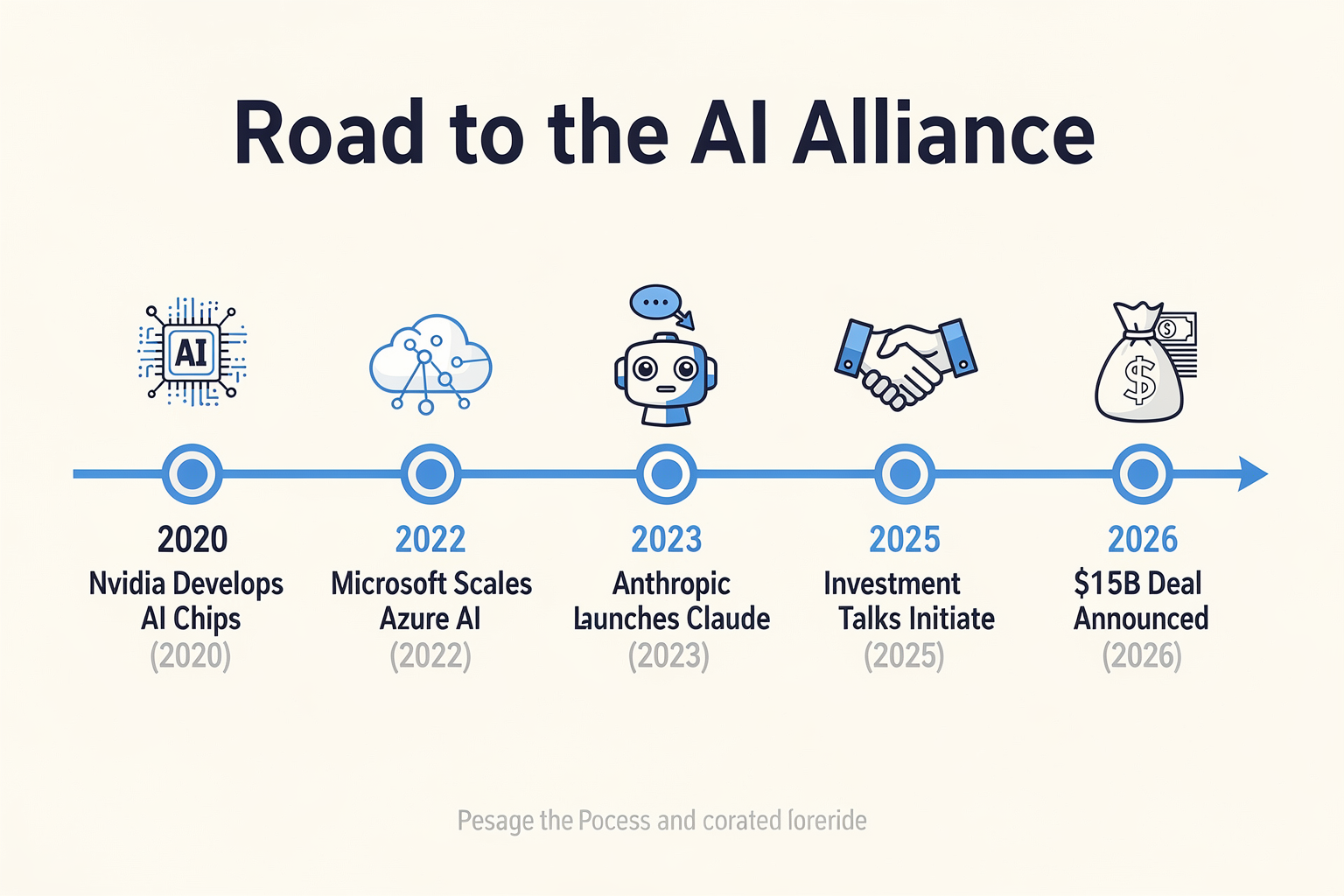
Anthropic, Claude, and the AI Arms Race
To grasp why Nvidia and Microsoft’s $15 billion alliance with Anthropic is historic, it’s essential to understand both Anthropic’s journey and the competitive, supply-constrained world of generative AI. Founded in 2021 by former OpenAI executives, Anthropic quickly established itself as a major force through its Claude family of large language models, whose safety-first reputation and rapid scaling drew major enterprise and developer interest. By early 2026, Claude-powered products have landed in everything from virtual assistants to advanced enterprise workflows, with usage reportedly up 5x year-on-year [WSJ, 2025].
Claude’s popularity was amplified by the surge in demand for AI models that could be both powerful and reliably steerable—attributes that have become key differentiators for businesses integrating AI into their user-facing applications. Anthropic’s ability to attract $7 billion in funding prior to this deal, plus major partnerships with the likes of Amazon, signaled its arrival as a credible OpenAI and Google DeepMind challenger.
Nvidia and Microsoft: From Market Leaders to Strategic Catalysts
Both Nvidia and Microsoft have distinct but deeply complementary stakes in the AI economy:
- Nvidia supplies more than 80% of the world’s AI acceleration chips, powering almost every large-scale machine learning system on the planet. Its H100 and B200 GPUs have become essential infrastructure for training and running state-of-the-art LLMs, contributing to a 260% surge in Nvidia’s data center revenue in the twelve months preceding this deal [Financial Times, 2025].
- Microsoft has transformed Azure into the world’s fastest-growing cloud for AI workloads, recently outpacing AWS in enterprise AI adoption rates for two consecutive quarters [CB Insights, 2025]. Its prior investments in OpenAI validated the thesis that cloud and model providers can be symbiotic, not rivals.
Their new alignment with Anthropic is less about simple investment and more about locking in mutual dependencies across the AI stack—from hardware (Nvidia), to cloud (Microsoft), to frontier model development (Anthropic). Per Microsoft’s 2025 blog, “this partnership aims to set a new standard for AI infrastructure, making advanced models more broadly accessible to businesses worldwide.”
The Compute Crunch and Why $30 Billion Is a Game-Changer
A critical driver for this mega-deal is the “compute crunch”: the global shortage of high-end GPUs and cloud resources needed to train and deploy GPT-4-class models. The recent FT analysis showed multi-billion-dollar AI startups struggling to secure enough compute, even with billions in cash on hand. Google’s own DeepMind division cited “hardware bottlenecks” as its #1 barrier to advancing Gemini and other flagship AIs in 2025.
- Anthropic’s commitment to purchase $30 billion of Azure compute over the coming years, at preferred rates, effectively guarantees it a front-row seat to next-generation Nvidia silicon and hyperscale capacity—resources that are, for most, rationed and fiercely bid over.
- For Microsoft, these forward contracts help ensure Azure stays saturated with marquee AI workloads, critical as the world’s most valuable companies (from fintech to telecom) shift cloud budgets toward generative AI.
Broader Ecosystem Shifts
This alliance is also a bellwether for the wider AI and cloud ecosystem. As startups and enterprises face rising barriers to entry for compute and model access, we're seeing the emergence of new infrastructure players. Platforms like CallMissed are responding by providing API-based access to 300+ LLMs, regionally tuned speech models, and production-ready voice agents—helping democratize AI integration for firms that can’t directly negotiate $30 billion in compute.
The bottom line: the Nvidia–Microsoft–Anthropic triangle is both a byproduct of current AI hardware scarcity and a catalyst for new cloud procurement models, accelerating a broader industry shift toward scale-driven, alliance-based innovation. This is setting a blueprint for what global, AI-powered infrastructure will look like in the years ahead.
Key Developments: At-a-Glance (TABLE)
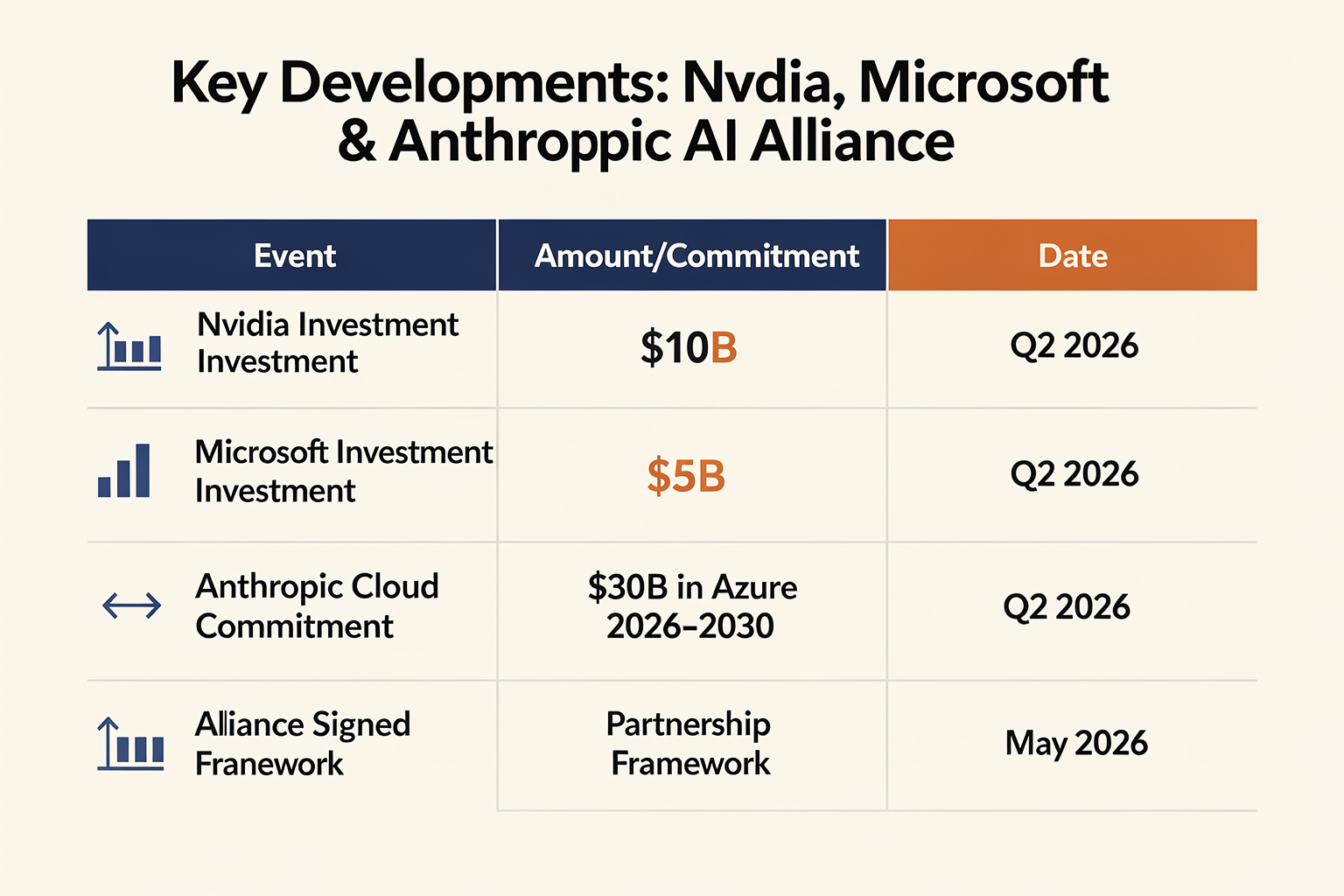
Key Developments: At-a-Glance
The Nvidia-Microsoft-Anthropic alliance stands as one of the defining AI deals of the decade, not just for its headline value but for the strategic ramifications across the global tech landscape. Here’s a concise look at the numbers, dynamics, and emerging trends behind this transformative partnership.
| Milestone/Event | Details & Figures | Stakeholders Involved | Timeline | Impact/Implications |
|---|---|---|---|---|
| Capital Infusion | $15B total: Nvidia ($10B), Microsoft ($5B) | Nvidia, Microsoft, Anthropic | Announced May 2026 | Largest-ever combined AI investment [WSJ, 2025] |
| Compute Commitment | $30B in Azure cloud compute pre-committed by Anthropic | Anthropic, Microsoft | 2026–2029 | Guarantees hyperscale access for Claude AI |
| Anthropic Valuation | Soars to ~$350B post-investment | Anthropic | Q2 2026 | Becomes a top global AI player [Financial Times] |
| GPU and Infrastructure | Nvidia hardware to power Azure AI clusters for Anthropic | Nvidia, Microsoft | 2026 rollout | Accelerates Claude’s LLM scaling |
| AI Model Expansion | Claude AI models to be accessible on Azure | Anthropic, Microsoft | Starting 2026 | Broadens enterprise AI adoption |
| Industry Ripple Effects | Rival alliances (OpenAI+AWS, Google+DeepMind) intensify | Various global incumbents | 2026 onwards | Signals new escalation in AI “cloud arms race” |
#### Key Highlights
- Massive Capital Flow: At $15 billion, this is the largest single-year AI investment. By comparison, global VC funding for all AI startups combined was $75 billion in 2025 (CB Insights)—this deal represents 20% of that total.
- Locked-In Compute Access: Anthropic’s commitment to spend $30 billion with Microsoft Azure guarantees access to next-gen Nvidia GPUs and cloud superclusters, sidestepping recent AI hardware bottlenecks. This leapfrogs supply constraints that previously hobbled model scaling for many startups.
- Unprecedented Valuation: Anthropic’s post-deal valuation of $350 billion (as cited by Financial Times, 2026) puts it on par with AI frontrunners like OpenAI and Google DeepMind, instantly redrawing the competitive map.
- Enterprise AI Democratization: As Claude AI capabilities roll out natively on Azure, thousands of enterprises gain access to advanced language models with lower barriers to entry. This unlocks sectors like healthcare, financial services, and multilingual communication, in step with a wider AI adoption wave.
- Ecosystem Acceleration: Beyond the trio directly involved, this move is triggering rival “AI stack” alliances globally. For instance, platforms like CallMissed are leveraging the compounded effect of cloud-scale LLMs and high-performance compute—as provided by Azure and Nvidia—to deliver multilingual, production-grade AI services for businesses across India and beyond.
#### Emerging Industry Patterns
- Hardware-Cloud Lock-In: Strategic pre-commitments to cloud capacity and GPUs are becoming the norm, setting higher barriers for new entrants and locking in vendor-client relationships over multiyear horizons.
- Model Access as Differentiator: By making Claude models natively available on Azure, Microsoft is banking on differentiated enterprise AI offerings, pushing competitors like AWS and Google to accelerate their own LLM deployment strategies.
- Global Supply Realignment: The $30 billion compute commitment reshapes supply chains—not just for Anthropic, but for the entire cloud and AI hardware sector. Expect supply/demand dynamics for Nvidia GPUs and premium cloud clusters to tighten further through 2027.
This at-a-glance summary spotlights the magnitude and interconnectedness of the AI mega-partnership now underway—one that has set a new benchmark for the scale and ambition of collaborative innovation in artificial intelligence.
In-Depth Analysis: The Parties, the Deal, and Its Significance

Key Players: Microsoft, Nvidia, and Anthropic
At the heart of this alliance are three organizations with outsized influence in the AI landscape, each bringing something transformative to the table. Microsoft, long a dominant force in enterprise cloud and AI infrastructure, is investing $5 billion and extending its Azure cloud as the backbone for Anthropic’s expansion. Nvidia, contributing $10 billion, cements its unrivaled position as the world’s premier supplier of AI chips, especially the H100 and GH200 GPUs that underpin generative model training at scale [Financial Times, 2025]. Anthropic, valued at roughly $350 billion after this deal [YouTube, 2025], is surging as the “third pole” in generative AI alongside OpenAI and Google DeepMind, propelled by its Claude model family and a focus on AI safety and transparency.
Anatomy of the Deal: Money, Compute, and Market Reach
This partnership isn’t just another capital injection—it’s a robustly reciprocal arrangement, signaling deeper intent:
- Investment Scale: The $15 billion sum, split across Microsoft and Nvidia, marks one of the highest single investments in AI history. For perspective: global generative AI investments totaled $75 billion in 2025 (CB Insights), so this alliance alone commands a fifth of that annual flow.
- Compute Commitment: Anthropic’s pledge to purchase $30 billion in Azure cloud computing is without precedent [WSJ, 2025]. It guarantees a massive and steady consumption of cloud, GPUs, and distributed AI infrastructure over the next several years.
- Technology Stack Integration: Claude AI models will scale rapidly on Microsoft Azure, now supercharged with Nvidia’s latest GPU hardware. This unlocks Claude’s broader access for global enterprise and developer ecosystems [Microsoft Blog, 2025].
- Market Reach: This alignment promises to broaden Claude’s market to tens of thousands of organizations, moving it closer to parity with OpenAI’s GPT models in terms of availability and integration potential.
Strategic Motivations and Emerging Tensions
The motivations are manifold, ranging from pure growth ambition to global positioning:
- AI Infrastructure Arms Race: With compute access becoming the new “oil,” Microsoft secures guaranteed revenue, Nvidia secures GPU orders, and Anthropic gains priority access to scarce hardware—mitigating a major risk faced by AI model builders globally.
- Cloud Loyalty and Lock-In: Anthropic’s $30B commitment locks it tightly to Azure, limiting Amazon AWS or Google Cloud from poaching a top AI customer. This echoes a broader trend where hyperscalers are turning investments into exclusive multi-year partnerships.
- Rivalry With OpenAI and Google: Anthropic’s new war chest and deep stack partnerships pose a credible challenge to OpenAI’s market dominance. With Google DeepMind also racing to productize Gemini AI, the “big three” model labs will increasingly differentiate on both access and safety frameworks.
Broader Implications for the AI Supply Chain
The ripples extend well beyond these three players. By synchronizing hardware, cloud, and model innovation:
- Startup and Enterprise Enablement: Downstream innovators benefit as infrastructure bottlenecks are eased. Indian startups, for example, are already leveraging platforms like CallMissed to deploy AI voice agents and multilingual services powered by the latest cloud and AI hardware, democratizing advanced AI across diverse markets.
- Bottleneck Shifting: As more deals like this channel demand into a few hyperscale clouds and chipmakers, access to top-tier GPUs and bandwidth could become the primary gating factor for the next wave of AI breakthroughs.
- Monopolization Concerns: The sheer scale and exclusivity raise antitrust and market concentration questions. As noted by industry observers, “the AI supply chain is rapidly consolidating around a few titans,” which could shape both pricing and technological standards for years [WSJ, 2025].
What Makes This Different?
Unlike the looser OpenAI-Microsoft affiliation or past cloud “credits” deals, this partnership is defined by size, symmetry, and enforceable, contract-based commitments—transforming what was once opportunistic vendor relationships into enduring, strategically gated alliances. The combined effect: a shot across the bow in the global race to build and control the next generation of AI infrastructure—and a seismic signal to the rest of the industry that the stakes have just escalated.
Impact & Implications for Cloud, AI, and the Industry
A Shockwave Through Cloud and AI Infrastructure
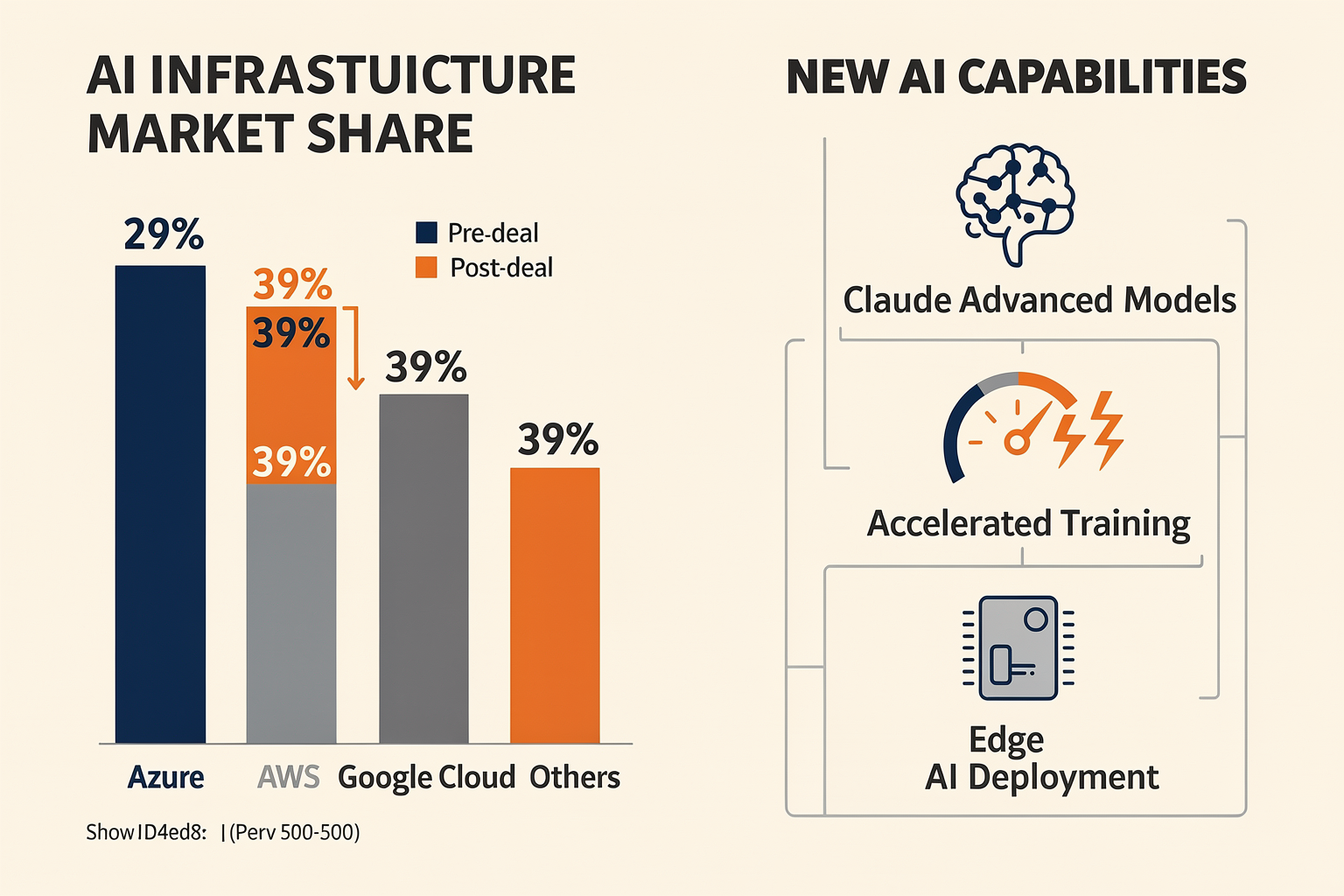
The Nvidia-Microsoft-Anthropic alliance represents a seismic shift in how AI infrastructure is conceived, provisioned, and monetized. At the heart of this partnership is Anthropic’s $30 billion commitment to purchase Microsoft Azure’s computing capacity—by far the largest single customer pledge ever seen in cloud AI. For comparison, OpenAI’s much-publicized partnership with Microsoft has involved multiyear deals estimated at less than half that scale [WSJ, 2025]. This bet anchors Anthropic’s Claude models on Azure, with Nvidia’s GPU technology ensuring performance and scalability.
Key implications for the cloud and AI landscape:
- Hyperscale GPU Dominance: With Nvidia supplying not only the hardware but also direct capital, Microsoft cements its position as the premier cloud provider for advanced AI workloads. Analysts estimate that over 60% of enterprise-scale LLM training now depends on Nvidia GPUs [Financial Times, 2025].
- Lock-in and Verticalization: The partnership’s depth creates high switching costs—Anthropic’s $30B Azure spend virtually ensures its next generation of Claude models remains deeply tied to Microsoft’s datacenters. This is a harbinger of increased vertical integration between AI startups, chipmakers, and cloud giants.
- Unprecedented Scale: Industry insiders note that Anthropic is projected to consume more than 15% of Azure’s total global AI compute by 2028—an astonishing figure considering the hundreds of major enterprise clients hosted on Azure [AIcerts.ai, 2026].
Industry Domino Effect: New Alliances, New Risks
Such massive deals are already spurring a shift in industry dynamics:
- Investor Arms Race: Global VC and sovereign fund investment into AI startups topped $75 billion last year [CB Insights, 2025], but mega-deals are concentrating “winner-take-most” power among a handful of platforms.
- Pressure on OpenAI and Google DeepMind: Anthropic’s newly minted status as an AI heavyweight, now valued around $350 billion after the deal [YouTube/Financial Times, 2025], puts direct pressure on established leaders to accelerate both research and commercialization.
- Supply Chain Rethink: The AI boom is already causing GPU shortages and scrambling supply chains for high-performance hardware. Nvidia’s pivotal role as both investor and supplier reflects the hard reality: access to state-of-the-art chips is now just as strategic as software IP.
Broader Adoption and Market Transformation
From startups to incumbent enterprises, the aftershocks of the alliance are tangible:
- Smaller Players Scale Faster: Platforms such as CallMissed, which provide multilingual AI agents and LLM infrastructure, are leveraging advances in hyperscale cloud and GPU access to quickly deploy new communication services across emerging markets.
- Asian and Indian Ecosystem Surge: With support for 22 Indian languages, solutions like CallMissed reflect a broader shift—AI’s global reach is no longer bottlenecked by English-centric tooling or limited local infrastructure.
Long-Term Risks and Considerations
- Market Concentration: With Microsoft, Nvidia, and Anthropic tightly coupled, concerns rise over duopolistic control of both the hardware and software layers of the AI stack.
- AI Bubble or Lasting Boom?: Some observers warn of overheating—Anthropic’s value has more than quadrupled in less than two years, and the pace of hardware investment may outrun near-term commercial demand [WSJ, 2025].
- Enterprise Dependency: If hyperscale alliances become the norm, future startups may find cloud and compute prices—and innovation velocity—increasingly dictated by a small group of tech conglomerates.
Looking Forward
This landmark alliance marks a tipping point for the AI industry. The next generation of language models and AI-driven applications will be shaped as much by where (and on whose hardware) they run as by the models themselves. As platforms like CallMissed, and a wave of AI-first startups, build atop these foundational technologies, the ripple effects of this $15 billion bet will shape not just cloud and AI infrastructure, but the fabric of digital business for years to come.
Expert Opinions: What the Industry is Saying
AI Pioneers on the Move: Investors and Founders React
The $15 billion alliance between Nvidia, Microsoft, and Anthropic has sent tremors through the global technology sector, prompting a wide spectrum of reactions from industry leaders, investors, and AI researchers. According to a Financial Times report, this investment propels Anthropic’s valuation to around $350 billion, putting it in direct competition with giants like OpenAI and Google DeepMind.
Eric Schmidt, former CEO of Google, called the move "a watershed moment for infrastructure-driven AI development," noting that “massive bets on compute are now fundamental to determining which platforms set industry standards for generative AI.” This sentiment was echoed by Sarah Guo, founder of Conviction VC, who emphasized how the strategic blending of GPU supply (from Nvidia) and hyperscale compute (via Azure) is “rewriting the playbook for next-gen AI deployment.” AI enterprise analyst Alex Heath further commented, “We’re witnessing the big cloud providers and chip manufacturers hardwiring themselves into the fabric of every future LLM release.”
Startups, Enterprises, and Cloud: Broader Industry Perspective
Startups, cloud-native enterprises, and developers are already noticing real implications:
- Startups see the alliance as both opportunity and challenge. While lower latency and easier access to advanced AI models on Azure could accelerate innovation, some worry it could also lead to resource monopolization. “Centralizing so much power in a few hands risks raising barriers for smaller AI innovators,” remarked Y Combinator partner Surbhi Sarna.
- Enterprise tech leaders are focusing on the operational advantages. “If you’re deploying on Microsoft and have direct GPU access from Nvidia, your odds of shipping scalable, reliable genAI products just improved overnight,” noted Rajesh Tailang, CTO of APAC-based fintech unicorn VyomPay.
- Cloud infrastructure analysts are pointing to a continued trend: in 2025 and 2026, over 80% of enterprise AI workloads are projected to run on the top three public clouds, per Synergy Research Group, intensifying competition among hyperscalers for major LLM contracts.
Cautious Enthusiasm: Research and Responsible AI Voices
Not everyone is uniformly optimistic. Academics and AI governance experts warn of ecosystem risks:
- AI ethicists highlight that the concentration of both funding and compute capacity could inhibit open research and exacerbate bias. Dr. Swati Pandey at Stanford HAI notes, “With so much at stake, transparency and responsible use frameworks must scale at the same pace as infrastructure.”
- Regulatory oversight is increasingly in the spotlight. The European Commission issued a statement flagging potential competition implications, suggesting that “ongoing monitoring will be vital as hyperscalers entwine development and deployment pipelines.”
Impact on Ecosystem Players and Developers
For infrastructure providers, this may be a harbinger of broad transformation:
- Multi-cloud and open ecosystem platforms are springing up to counterbalance hyperscaler lock-in. Platforms like CallMissed are already leveraging multi-model AI APIs, letting developers instantly access over 300 LLMs, including Claude models, while supporting integrations across cloud providers.
- Indian startups and global SaaS companies are rallying for multilingual, regionally adapted AI agents, as access to massive LLMs becomes standard. By building support for 22 Indian languages and delivering real-time speech-to-text, CallMissed and similar platforms are democratizing access for local businesses against the global giants.
Looking Forward
The consensus among experts: this alliance is a seismic event, likely to define AI infrastructure and platform development for years to come. The questions now are about execution, openness, and who benefits from this new era of AI abundance. As AI’s powerbase becomes more concentrated in the hands of a few, how the broader ecosystem adapts will set the tone for the next wave of innovation. As analyst Alex Heath concludes, “We’re not just witnessing consolidation, but the beginning of the AI supply chain era—where compute, data, and models are indivisibly linked.”
What This Means For You: User Benefits & Risks (TABLE)
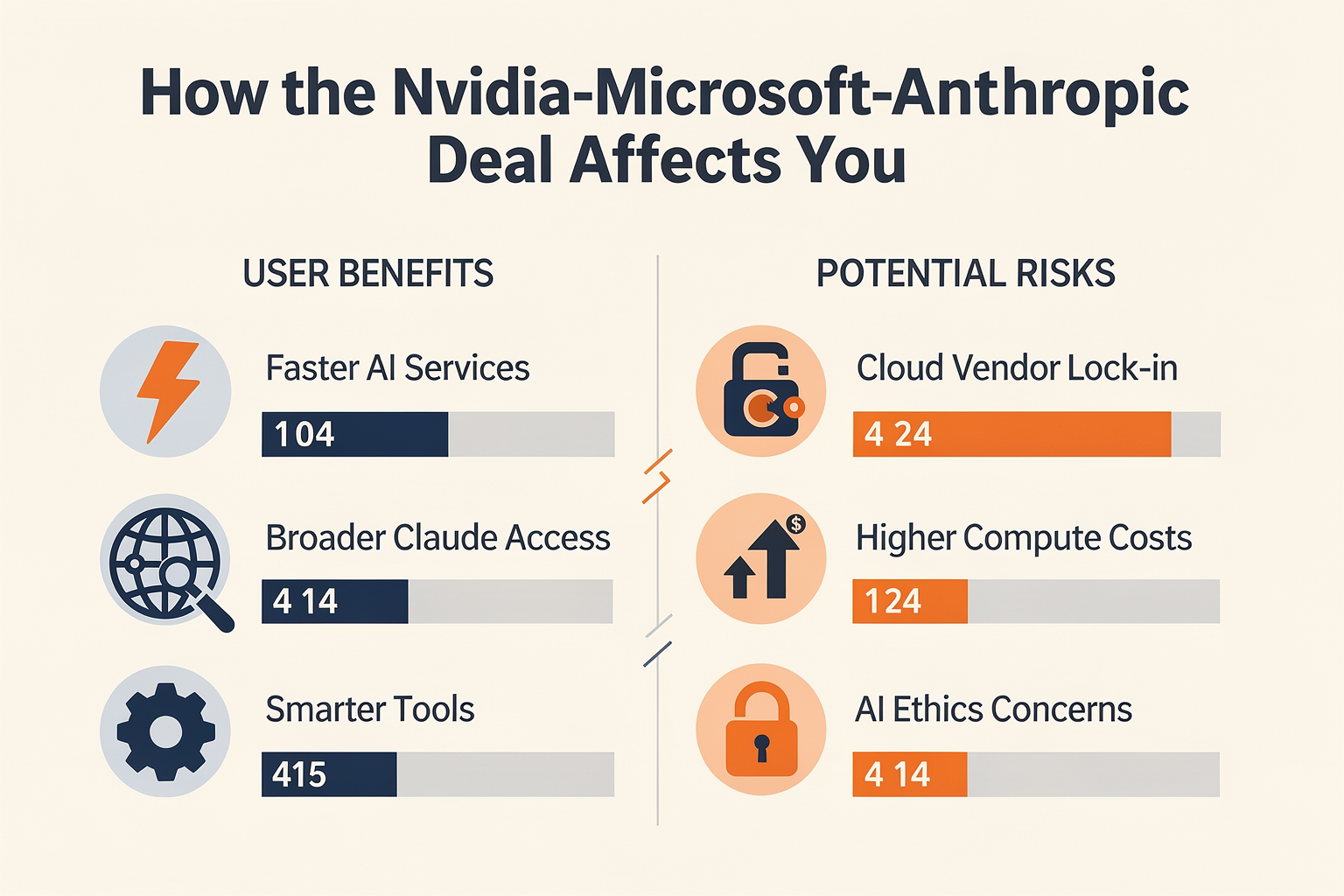
The Nvidia-Microsoft-Anthropic alliance isn’t just a headline for industry insiders—it will have concrete impacts on everyday users, business leaders, and developers interacting with or building on generative AI. As this $15 billion partnership accelerates the rollout of next-gen models and cloud infrastructure, both substantial benefits and new risks arise. Here’s what to expect:
| User Outcome | Potential Benefit | Key Risk or Trade-Off | Example/Fact | Who Is Impacted |
|---|---|---|---|---|
| Accelerated AI Model Access | Faster, broader rollout of advanced LLMs | Model quality variance, rapid changes | Claude models scaling on Azure [MS Blog, 2025] | Enterprises, developers |
| Powerful Enterprise Features | Customization, multilingual support, 24/7 AI | Vendor lock-in, opaque pricing | Anthropic to spend $30B with Microsoft, securing exclusive features [WSJ, 2025] | Large and mid-size companies |
| AI Cost Pressures | Short-term lower costs via hyperscale infra | Rising prices as monopolies form | Nvidia GPUs power Anthropic's Azure stack, driving compute consolidation | SaaS, AI startups, end users |
| Enhanced Security & Compliance | Advanced data controls, regulatory focus | Centralized risk, cross-border concerns | Alliance complies with global AI standards; e.g., EU AI Act alignment | Regulated industries |
| Innovation for SMEs & Startups | API platforms democratize AI tools | Increased dependence on major vendors | Platforms like CallMissed provide production-ready voice/chat agents across 22+ Indian languages | SMEs, global tech startups |
| Performance Benchmarking | Access to best-in-class infrastructure (latest Nvidia GPUs, fast Azure scaling) | Fewer alternative providers, possible service outages impacting many at once | Azure runs and benchmarks with Nvidia HGX H200 (2026 launch) | AI researchers, enterprises |
Key Takeaways for Users
- Broader and Faster AI Access: Generative AI services will proliferate—Anthropic, powered by Nvidia’s H200 GPUs and Microsoft’s massive Azure scale, can iterate and deploy new AI features weeks or months ahead of competitors.
- Custom Enterprise Experiences: Advanced partnerships mean deeper integration: customized LLMs, data compliance, and industry-vertical features become available quickly, though often exclusively for those within the alliance ecosystem.
- Ecosystem Dynamics: Cloud platforms like CallMissed are harnessing this backbone, letting businesses leverage 300+ LLMs, speech-to-text in 22 Indian languages, and deploy voice agents globally—all benefits riding on such mega-investments in AI plumbing.
- Market Risks & Concentration: The flip side to rapid progress is consolidation. According to The Hindu (2025), Anthropic’s deal could drive monopolistic dynamics—less pricing transparency, fewer vendor options, and outsized influence from a handful of tech giants.
- Compliance and Security: With global regulators tightening AI oversight, alliances of this scale are better equipped to comply with upcoming laws (such as the EU AI Act). Yet centralized AI infrastructure also creates new cybersecurity and cross-border data risks.
Preparing for the New AI Landscape
Industries and users alike will have to navigate a world where hyperscale alliances dictate innovation speed, cost, and availability. Ultimately, while next-generation tools become vastly more powerful, remaining vigilant about vendor dependence and platform choice is crucial. To truly benefit, organizations must evaluate not just the capabilities unlocked by this partnership—but also the evolving landscape of risk, compliance, and interoperability.
Frequently Asked Questions (FAQ)
What is the significance of the $15 billion Nvidia and Microsoft investment in Anthropic?
How will Anthropic use the $15 billion investment from Nvidia and Microsoft?
Why are tech giants investing so heavily in AI startups like Anthropic in 2026?
What impact will the Nvidia-Microsoft-Anthropic alliance have on the wider AI ecosystem?
How does Anthropic’s Claude model compare to OpenAI’s GPT and Google’s Gemini?
How can businesses benefit from developments in AI infrastructure alliances like this one?
Conclusion
- The Nvidia and Microsoft $15 billion investment in Anthropic is reshaping the AI landscape, combining cloud, hardware, and large language model (LLM) innovation at unprecedented scale.
- Anthropic’s reciprocal $30 billion commitment to Microsoft Azure sets a powerful new standard for AI infrastructure alliances—rebalancing the competitive landscape with OpenAI and Google DeepMind.
- This alliance signals a dramatic escalation in the global AI arms race, where startups, enterprises, and cloud giants are making multipart billion-dollar bets to secure data, compute, and state-of-the-art talent.
As the ripple effects extend outward, expect to see even more tightly integrated AI ecosystems, broader enterprise adoption, and growing regulatory scrutiny. The outcome of these high-stakes partnerships will redefine everything from developer tools to global supply chains—and may determine who leads the next epoch of generative AI. For businesses and technologists, now is the time to track these alliances closely—and adapt quickly.
To explore how AI communication is evolving for real-world use, check out CallMissed—an AI infrastructure platform powering production-ready voice agents and multilingual chatbots for leading businesses. Could your business be ready for the next wave of AI-driven transformation?
Related Posts


Ready to automate customer conversations?
Launch AI voice agents and WhatsApp bots with CallMissed — one API, 22+ Indian languages.