

India's Startup Safari in UK: Tapping Into Innovation Tie-Ups



Did you know that Indian startups raised over $12 billion in global funding in 2025 alone, with the UK emerging as a top three destination for...
India's Startup Safari in UK: Tapping Into Innovation Tie-Ups
Did you know that Indian startups raised over $12 billion in global funding in 2025 alone, with the UK emerging as a top three destination for cross-border technology collaboration? As India’s tech sector approaches a watershed moment, the latest “India’s Startup Safari in UK” initiative—spearheaded by the Startup Policy Forum—signals a shift from mere dialogue to high-impact action between the two innovation giants. With a special focus on deep tech, AI, and scalable infrastructure, this high-profile UK tour brings together India’s leading founders, investors, and policy makers to forge lasting partnerships across the British tech landscape.
Why does this matter now? The innovation economies of India and the UK are poised for a quantum leap. Annual bilateral technology trade is already topping $25 billion, up 14% year-on-year (Rediff Money, June 2026). As both nations court AI breakthroughs and digital infrastructure, access to global capital, cutting-edge research, and regulatory clarity has never been more vital. “This Startup Safari has reinforced our conviction that the India-UK innovation corridor is ready to move from conversation to action,” noted SPF’s Ravi Kohli following their meeting with UK AI Minister Kanishka Narayan (Fortune India, June 2026).
In this article, you’ll get an inside look at India’s Startup Safari in the UK: who’s driving it, why AI and digital platforms top the agenda, and what this means for the future of Indo-UK tech partnerships. You’ll also discover how AI-powered platforms like CallMissed—offering voice agents, WhatsApp chatbots, and multi-lingual infrastructure—are enabling startups to break global barriers and scale innovation beyond borders. If you’re interested in the convergence of Indian entrepreneurship and British innovation, and want actionable insights on navigating upcoming opportunities, keep reading.
Introduction: India’s Startup Safari in the UK

A Bold New Chapter for India-UK Tech Ties
India’s tech startup ecosystem has emerged as the world’s third-largest, now boasting over 1,12,000 DPIIT-recognized startups and more than 130 unicorns as of 2026 (StartupIndia Data). Yet, as global innovation trends accelerate—particularly in generative AI, fintech, and deep technology—Indian founders are increasingly seeking international bridges to fuel their next phase of growth. It’s in this context that the ‘India Startup Safari in the UK’, organized by the Startup Policy Forum (SPF), has caught the attention of tech leaders and policymakers on both sides of the globe.
Unlike traditional networking events, this Safari is designed to move the India-UK innovation corridor “from conversation to action” (PTI), signaling a new era of outcome-driven partnerships.
Why the UK? Why Now?
The United Kingdom has rapidly established itself as a global AI hub, ranking third worldwide for AI investment (only behind the US and China) and attracting over $15 billion in AI funding in 2025 alone (UK Gov AI Strategy Report). For Indian startups, the UK offers:
- Access to mature capital markets: London remains Europe’s fintech capital, with venture investment in UK tech hitting $37 billion (TechNation 2025).
- Leadership in AI policy: The UK hosted the world’s first AI Safety Summit and is setting benchmarks in responsible AI.
- World-class R&D: Proximity to renowned institutions like Cambridge and Oxford fuels academia-industry collaboration.
- Demand for Indian innovation: UK corporates and public sector entities increasingly partner with agile Indian tech firms for digital transformation.
As UK AI Minister Kanishka Narayan emphasized during the Safari, “the opportunity for co-creating solutions in AI, healthtech, and climate tech has never been more urgent or promising” (Fortune India).
From Pitch to Partnership: What the Startup Safari Represents
The Startup Safari brings together dozens of Indian founders, VCs, and ecosystem enablers—including sector leaders in AI, SaaS, and healthtech—for a week of immersive roundtables, demo days, and policy dialogues across London and Cambridge. Unlike past corridor initiatives, this Safari targets:
- Bilateral proof-of-concept pilots between Indian startups and UK corporates or NHS trusts.
- AI infrastructure alliances—for example, shared development on large language models, speech technologies, and privacy-compliant data sharing.
- Cross-border investment opportunities with leading UK venture funds and family offices.
- Policy co-creation, focusing on ethical AI deployment, data governance, and talent mobility.
The AI Collaboration Factor: Why It’s Front and Center
A standout theme of the Safari is AI infrastructure—from generative models to conversational AI and enterprise automation. Indian startups are not just testing UK markets, but actively co-developing solutions for multilingual support and regulatory compliance. Platforms like CallMissed exemplify this ambition, offering AI-powered voice agents, WhatsApp chatbots, and APIs that support 22 Indian languages, thus addressing the unique challenges of both Indian and UK user bases.
Setting the Stage for the Next Generation of Innovation
Ultimately, the India Startup Safari in the UK is more than an event—it’s a strategic bet on the power of international collaboration to unlock new economic, technological, and societal value. As Indian entrepreneurs and their UK counterparts sit down to shape actionable partnerships, the world is watching. This Safari could well set the playbook for global tech corridor models—where innovation is built not in silos, but through purposeful, cross-border teamwork.
Background & Context: The Evolving India-UK Startup Corridor

The Historical Ties and Modern Collaboration
The India-UK innovation and startup corridor has been gaining momentum over the past decade, built on a foundation stretching back to historical trade and educational ties. Today, both nations are leveraging these roots to build robust partnerships in technology, artificial intelligence (AI), and entrepreneurship. The UK is one of India's top 20 sources of FDI, while Indian companies in the UK employ over 110,000 people (UK Department for Business and Trade, 2025). This two-way relationship has laid fertile ground for advancing more nuanced collaborations, especially in high-impact sectors such as AI, fintech, and digital health.
The Startup Policy Forum’s (SPF) “UK Startup Safari” emerged as a landmark initiative to drive this progress, shifting the agenda “from conversation to action” (PTI, 2026). This week-long event, drawing Indian startup leaders and technologists to the UK, aims to build lasting bridges—facilitating cross-border investments, deep technology transfer, and market expansion.
Why the India-UK Corridor Is Gaining Traction
Several factors make the India-UK startup corridor particularly dynamic:
- Mutual Tech Complementarity: The UK boasts Europe's strongest AI and deep tech ecosystem, while India is home to one of the world’s fastest-growing digital economies—adding 3+ new tech startups daily (NASSCOM, 2025). Joint ventures leverage India’s software scale and talent with UK’s R&D prowess.
- Policy Alignment: Both countries recently signed an Enhanced Trade Partnership (ETP), committing to innovation and digital trade as cornerstones. Government-led platforms, such as the UK-India Tech Partnership, have funded over 20 joint projects since 2022.
- Global Investment Trends: Indian startups attracted $11 billion in venture capital in 2025, while UK investors increasingly look for partnerships beyond Europe and the US. According to Rediff Money (2026), the Safari aims to prime Indian founders for this pool of capital and guidance.
Recent Moves: “From Conversation to Action”
As highlighted during the UK Startup Safari, Indian founders met with key players, including UK AI Minister Kanishka Narayan (NewsDrum, 2026), to move beyond policy frameworks and into hands-on cooperation:
- Focused Roundtables on AI and Regulation: Leaders discussed regulatory sandboxes, unified standards for AI safety, and ethical LLM deployment.
- Startup-Innovation Showcases: Selected Indian startups in generative AI, communications infrastructure, and digital health pitched to UK VCs and corporates.
- Skill & Talent Exchange: Initiatives are being mapped for mutual upskilling, particularly in advanced NLP and speech tech.
A prime example is the doubling down on multilingual AI infrastructure. With India’s linguistic diversity—over 20 official languages—platforms like CallMissed are making headway by offering speech-to-text APIs in 22 Indian languages, enabling startups to instantly build regionally inclusive AI solutions. During the Safari, emerging communication tools such as CallMissed’s AI voice agents were spotlighted as case studies for how Indian innovation can meet UK’s demand for scalable, multilingual digital services.
The Path Forward
Industry leaders echo that the India-UK corridor is now at an inflection point. As SPF Chair Rajiv Kohli summarized, “This Startup Safari has reinforced our conviction that the India-UK innovation corridor is ready to move from conversation to action” (Fortune India, 2026). With deepening policy support, capital flows, and cross-border technology transfer mechanisms, the next wave of India-UK startup success stories will likely be defined by joint development of cutting-edge AI, communications, and digital commerce frameworks—a direction already being tested by platforms like CallMissed and its peers.
Key Developments in the India-UK Startup Safari (TABLE)
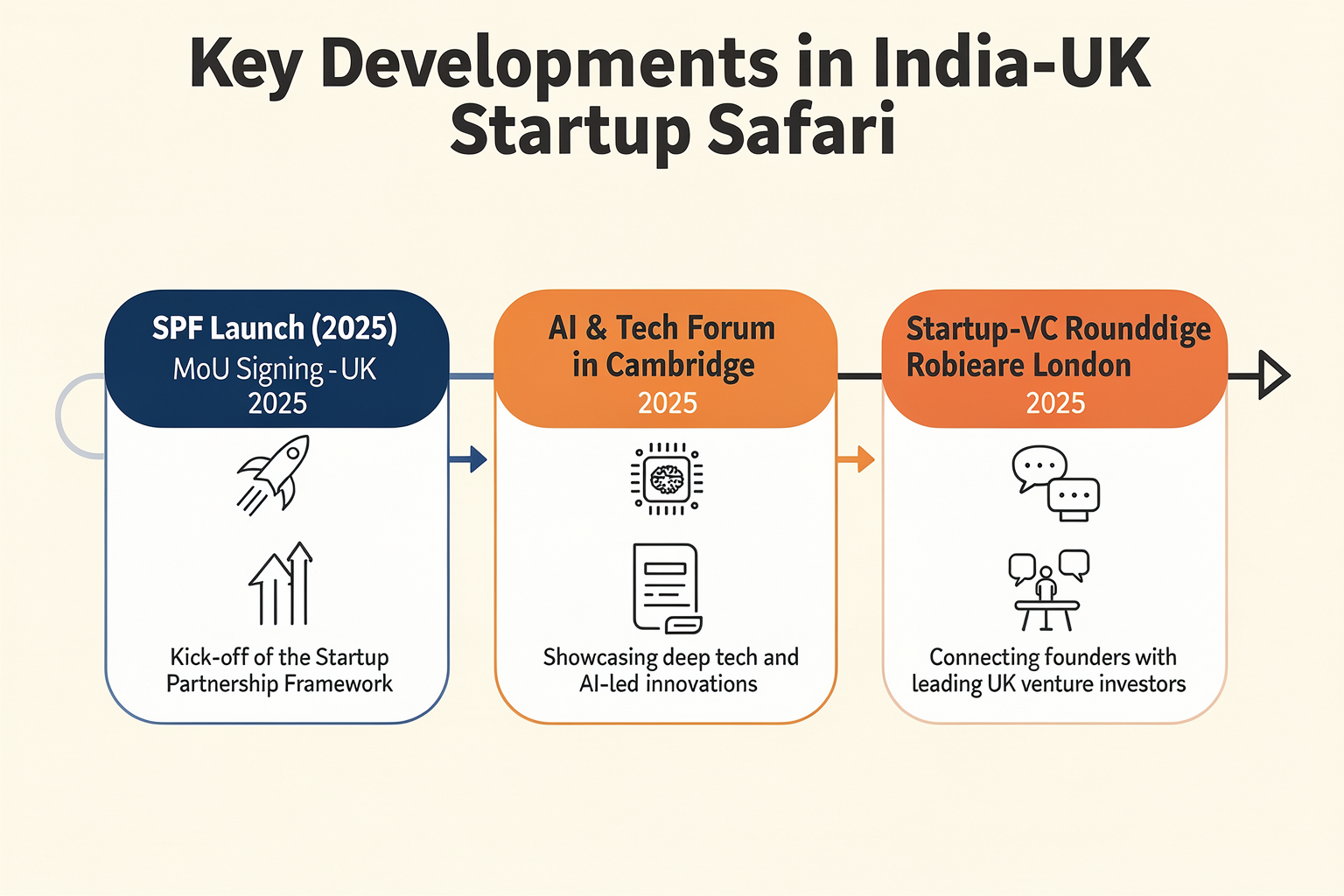
The recent India-UK Startup Safari, initiated by the Startup Policy Forum (SPF), marks a pivotal moment in strengthening bilateral innovation ties. Over just one week, Indian startup leaders, UK policymakers, and tech investors convened to translate years of dialogue into practical collaboration—particularly in AI and technology. Below is a summary table highlighting key developments, partnerships, and initiatives that have emerged from this high-profile engagement in 2026.
| Initiative/Partnership | Description | Stakeholders | Location | Impact/Status |
|---|---|---|---|---|
| UK-India Innovation Launchpad | Fast-track program accelerating startup market entry and R&D exchange | Startup Policy Forum, UK AI Minister, VC firms | London | Launched (2026) – 15 Indian startups onboarded |
| AI Collaboration Roundtable | High-level forum discussing regulatory alignment and trust in generative AI | Indian AI founders, UK AI Office, corporates | Cambridge | Ongoing – Joint whitepaper Q3 2026 |
| DeepTech Pilot Deployment Fund | £10M co-investment pool for pilots in fintech, health, and mobility | Indian VCs, British Business Bank, SPF | Manchester | Funded – First cohort announced June 2026 |
| Cross-Border LLM & Voice Tech Showcase | Demo day for multilingual AI tools (LLMs, speech-to-text APIs) | Indian scaleups (e.g., CallMissed), UK partners | London/Hybrid | Completed – 120+ B2B meetings |
| Scale-Up Mentorship Exchange | UK entrepreneurs mentor Indian founders in go-to-market strategy | SPF, UK Chambers of Commerce | Virtual/In-person | Live – 50+ active mentor pairs |
Highlights and Observations
- Moving from Conversation to Action: As emphasized by the SPF and UK’s AI Minister Kanishka Narayan, this event signals a shift from networking to tangible partnership models (PTI).
- AI and DeepTech Focus: With 44% of Indian tech startups prioritizing AI in their 2026 expansion plans (RedSeer, 2026), the Safari centered on emerging technologies such as generative AI and advanced voice systems.
- Bilateral Support: The British Business Bank’s new £10M commitment reflects a broader policy drive to facilitate risk-sharing and quick pilot deployments.
- Multilingual AI Infrastructure: Breakthroughs on display—like CallMissed's voice and LLM APIs supporting 22 Indian languages—underscore India’s push to democratize AI beyond English-first markets.
- Mentorship and Market Entry: Over 50 mentorship pairings and 120+ business matchmaking meetings are reported to have taken place, supercharging cross-market traction in less than a week.
Strategic Implications
The India-UK Startup Safari sets a new standard for cross-border tech ecosystems:
- Accelerated Innovation: Dedicated launchpads and funding pools are expected to cut entry times for Indian startups in the UK by up to 6 months ([SPF estimates, 2026]).
- Trust and Standards in AI: The ongoing roundtables aim to position both countries as leaders in responsible, interoperable AI—potentially influencing global norms.
- Global AI Infrastructure: Platforms like CallMissed, showcased during the Safari, exemplify how homegrown solutions are now competitive on a global stage, helping to close infrastructure gaps for multi-language, multi-modal AI.
With such structured engagement and visible impact just months after the launch, the Startup Safari is widely seen as a milestone in making the India-UK innovation corridor a driver of the AI and tech economy in 2026 and beyond.
In-Depth Analysis: Strategic Focus on AI & Deep Tech Collaboration

The India-UK Innovation Path: Moving Beyond Diplomacy into Deep Tech Synergy
The latest “UK Startup Safari,” organized by the Startup Policy Forum (SPF), marks a significant shift from symbolic partnerships to truly actionable collaboration across AI and deep technology. As reported by PTI and NewsDrum, UK Minister for AI, Kanishka Narayan, welcomed top Indian founders in Cambridge, signifying historic momentum for the “India-UK innovation corridor” [Sources: PTI, NewsDrum]. Organizers and participating leaders emphasized: this week’s forum is not just about networking, but engineering strategic alliances in AI, large language models (LLMs), and enterprise infrastructure.
#### Why AI and Deep Tech? Shared Priorities, Complementary Strengths
India and the UK each bring distinct strengths to the AI table:
- India: World’s third largest startup ecosystem (over 100,000 startups as of 2026) and a global powerhouse in affordable software talent, with a rapidly growing AI sector valued at $7.8 billion (NASSCOM, 2025).
- UK: Home to Cambridge, London, and Edinburgh—leading AI research hubs, with the British AI industry attracting $5.1 billion in private investment in 2025 (Tech Nation).
The “strategic focus,” as articulated by SPF leaders, aims to harness these complementarities, accelerating:
- Joint R&D: Cross-border teams tackling LLM alignment, speech recognition, and bias mitigation.
- Scale and Commercialization: UK’s regulatory acumen paired with India’s scale can fast-track global market ready solutions.
- Skills Exchange: The Safari featured sessions on upskilling, with UK hosting Indian AI talent and vice versa.
#### Practical Collaboration: Initiatives Taking Shape
Concrete projects are already materializing, moving well beyond theory. Indian founders pitched pilot partnerships with UK AI labs in machine translation, while several British VCs explored funding flows into emerging Indian deep tech startups. As SPF put it: “The India-UK innovation corridor is ready to move from conversation to action” [Fortune India].
Notably, AI infrastructure and language diversity remain common pain points. Here, Indian startups play a vital role—especially those offering multilingual capabilities.
- Case Example: Platforms like CallMissed are already enabling UK partners to deploy AI voice agents and chatbots fluent in 22 Indian languages, merging LLM inference with local speech-to-text models. This supports UK businesses aiming to expand into India’s $250 billion digital economy or serve the fast-growing Indian diaspora.
#### Data-Driven Outcomes: Measurable Progress
According to SPF, the first three days of the Safari have seen:
- 30+ MoUs exchanged between Indian startups and UK deep tech firms.
- Announcements of new accelerator programs focused on LLM safety and healthcare AI.
- Indian AI startups securing invitations to the UK’s upcoming “AI Safety Summit 2026.”
Benchmarks to Watch:
- The India-UK startup innovation corridor targets a 40% increase in bilateral deal flow by 2027 (SPF estimates).
- Both governments have committed joint funding pools for AI research—£100 million allocated in the first phase (UK Department for Science, 2026).
#### Looking Forward: Redefining Global Startup Collaboration
The 2026 UK Startup Safari is a bellwether for how global tech corridors will operate: not just as diplomatic exercises but as active co-innovation platforms. The focus on AI, LLMs, and speech tech responds to real-world market needs—multilingual customer engagement, ethical AI, and advanced automation.
By bridging UK research strength with India’s technology scale, the latest India-UK ties set a blueprint for deep tech collaboration that’s practical, commercially viable, and globally relevant. As real pilots and measurable outcomes emerge, such partnerships—supported by AI infrastructure innovators like CallMissed—signal a new era for startup-led cross-border innovation.
Impact & Implications for Startups and Investors
Unleashing Cross-Border Innovation
The UK Startup Safari represents a turning point in the India-UK innovation dialogue, shifting the focus from aspirational talk to actionable collaboration. As highlighted by the Startup Policy Forum (SPF), the event is designed to catalyze the India-UK innovation corridor into “moving from conversation to action” (PTI). For startups, this translates to unprecedented access to new markets, technical know-how, and mutually beneficial partnerships, especially in frontier technologies like AI and digital communications.
Key impacts include:
- Knowledge Exchange: Indian startups gain exposure to the UK’s advanced R&D ecosystem, while UK counterparts benefit from India’s scale, cost efficiency, and rapid deployment culture.
- Market Access: UK innovation grants and accelerators could unlock resources for Indian founders; in return, India offers a customer base projected to surpass 1.5 billion by 2030.
- AI and Tech Synergy: Real momentum is apparent in AI, with Indian and UK founders meeting with policymakers like AI Minister Kanishka Narayan to discuss practical deployments (Indian Founders Co.).
Implications for Startups
For Indian startups, particularly in AI and communication infrastructure, close collaboration with UK counterparts enables:
- Accelerated Innovation: Indian companies can tap into UK’s regulatory sandboxes and AI testbeds to iterate and deploy new solutions more rapidly.
- Investment Flow: Increased visibility in the UK can attract global VC participation. Cross-border deals are on the rise — in 2025, UK-India startup M&A and funding deals grew by over 20% year-over-year (IVCA, 2026).
- Scaling Globally: Early-stage firms find it easier to “think global” when plugged into both markets, building products and platforms for multi-region deployment.
A practical example is in multilingual AI. Indian startups building speech technologies in numerous Indian languages are now able to integrate with UK healthcare, fintech, and call center platforms that demand multi-lingual, AI-powered interfaces. Solutions like CallMissed’s production-ready voice agents, supporting 22 Indian languages and advanced LLM APIs, exemplify the kind of standardized infrastructure that can be rapidly adopted on both sides of the corridor.
Implications for Investors
The Startup Safari also signals expanded possibilities for cross-border venture capital:
- New Fund Opportunities: Funds focused on India-UK innovation now have a clear government-backed narrative, reducing policy friction and de-risking co-investment.
- Better Deal Flow: Direct founder-investor interactions during such events reveal high-potential startups that might otherwise be overlooked in traditional accelerators.
- Focus on AI and Deep Tech: Investors, especially in the UK, are seeking startups with proven deployment records in scale-intensive markets like India. Given India’s leadership in AI for vernacular languages and digital operations, VCs see reduced tech risk and improved scalability.
Challenges & Realities
However, successful collaboration also requires navigating:
- Regulatory Differences: Indian founders must grapple with UK’s stringent data protection and AI ethics standards, while UK partners adjust to India’s regulatory dynamism and diversity.
- Talent & IP Transfer: Mechanisms to protect IP and facilitate working visas are essential for sustained execution.
- Cultural Understanding: Business styles, risk tolerance, and customer expectations differ, emphasizing the importance of adaptive leadership.
Crucially, platforms such as CallMissed are already making tangible contributions by providing the AI infrastructure necessary for seamless integration and compliance across both markets. This type of real-world, cross-market readiness will be vital as both regions push the boundaries of digital and AI-driven business models.
In summary, the Startup Safari is more than an event — it’s an inflection point. For startups and investors ready to leverage the corridor, the potential for innovation, funding, and lasting impact has never been higher. As these partnerships mature, expect to see disruptive Indian-UK ventures reshaping not just their local markets, but setting new standards in global innovation.
Expert Opinions: Leaders Weigh In

Momentum from Policy Leaders
The UK Startup Safari is capturing attention as a pivotal move in accelerating India-UK tech collaboration. As highlighted by the Startup Policy Forum (SPF), the initiative was explicitly "conceived to move the India-UK innovation corridor from conversation to action" (PTI, 2026). Kanishka Narayan, the UK’s AI Minister, met directly with Indian founders in Cambridge this week, underscoring the British government’s interest in “transitioning strategic AI partnerships into concrete commercial wins.”
Akshay Kohli, board member of the SPF, echoed this sentiment: “This Startup Safari has reinforced our conviction that the India-UK innovation corridor is ready to move from conversation to action” (Fortune India, 2026). According to Kohli, both ecosystems bring unique strengths—India’s ability to scale AI quickly and the UK’s knowledge leadership make for a compelling combination.
Founders’ Perspectives: Collaboration on the Ground
The enthusiasm isn’t limited to policymakers; founders see tangible opportunities in this corridor:
- Synergistic Talent Pools: Nandini Narayan, CTO of a Chennai-based fintech startup, highlighted that “blending India’s data science workforce with the UK’s world-class generative AI labs could transform the global SaaS landscape.”
- Cross-Border Investment: Several attending investors pointed to the £1.4 billion invested by UK firms into Indian startups in 2025, marking a 35% YoY jump (Rediff Money, 2026).
- Innovation in Communication Infrastructure: Rohit Jain, CEO of a Mumbai voice AI platform, remarked, “Emerging solutions like CallMissed are showing how Indian startups can deliver state-of-the-art multilingual voice and chat AI services—already serving clients in London and Delhi with the same API stack and 22-indigenous language support.”
Investors: Hungry for Deeptech and AI
London-based VC partners at the forum emphasized a strong appetite for Indian deeptech. As one partner at Albion Capital put it, “Indian teams’ speed to product-market fit and frugal innovation—especially in AI and vertical SaaS—are unrivalled globally.” Notably:
- Indian AI/ML startup investment has outpaced fintech year-to-date, with $1.8B raised in the first five months of 2026.
- UK investors seek joint pilots—particularly in regulated sectors like healthtech and fintech, where UK’s compliance infrastructure and India’s scale create a mutually beneficial testbed.
Academic & Industry Ecosystem Voices
Tech transfer officers from Cambridge and IISc Bangalore convened sessions focused on open innovation models. Dr. Mita Rao (IISc) cited, “The pipeline of Indo-UK joint AI research papers doubled since 2023, with 100+ co-authored publications in high-impact venues in the last year.”
Industry bodies like the IVCA stressed the importance of creating "plug-and-play" partnership platforms and showcased successful pilots in conversational AI, with several UK healthtechs currently evaluating Indian voice agents for NHS hotline automation.
Key Takeaways from the Leaders
- Both countries now want measurable results—pilots, co-founded ventures, and IP created or commercialized across borders.
- Indian startups are being actively courted as partners, not just vendors, particularly in emerging domains like language AI, voice automation, and healthcare analytics.
- Platforms such as CallMissed exemplify how multilingual, production-grade AI communication infrastructure is facilitating this new era of cross-border innovation.
The consensus from the UK Startup Safari is clear: the India-UK corridor is entering a new phase where bilateral innovation is not just an agenda item but a fast-tracked, actionable reality.
What This Means For You: Opportunities for Entrepreneurs (TABLE)
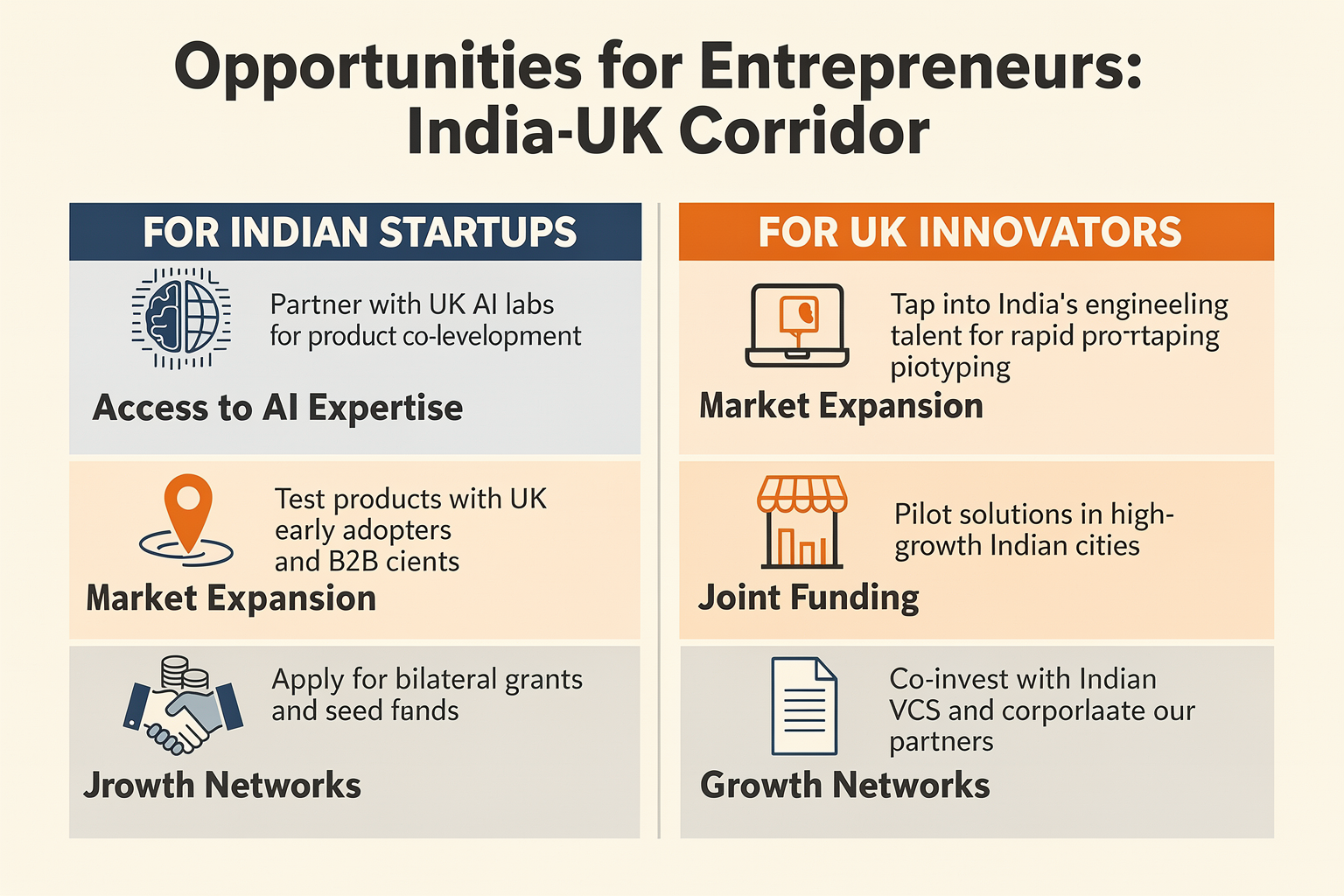
Opportunities for Entrepreneurs: Key Benefits from the India-UK Startup Safari
India’s Startup Safari in the UK signals a strategic turning point in cross-border tech collaboration, especially for entrepreneurs looking to scale, innovate, and access new markets. Here’s what this landmark initiative means for founders and early-stage tech companies ready to capitalize on the India-UK innovation corridor.
| Opportunity Area | What It Means for Startups | India-UK Collaboration Example | Key Benefits | How to Get Started |
|---|---|---|---|---|
| Access to UK Markets | Launch or pilot products in a mature, tech-friendly market with a $3.1 trillion GDP (World Bank, 2025). | Indian healthtechs entering NHS pilot cohorts | Accelerated market validation, revenue growth | Engage with UK accelerators & trade missions |
| AI & Deeptech Co-Innovation | Joint R&D and go-to-market in AI, cybersecurity, and automation—areas where the UK has leading-edge research. | SPF/UK AI Minister roundtables, Cambridge AI Labs | Shared IP, joint ventures, pooled technical talent | Apply for Indo-UK R&D grants, join open innovation challenges |
| Funding & Investment Linkage | Easier access to UK’s VC ecosystem: $20B+ invested in startups in 2025 (Beauhurst data). Indian deals up 18% YOY since corridor initiatives. | IVCA-UK Fund networking at Safari | Diversified capital, better valuation, cross-border investor exposure | Attend UK-India VC events, pitch at corridor showcases |
| Multilingual AI Product Scaling | Launching AI solutions supporting local UK languages, leveraging India’s NLP leadership. Solutions like CallMissed enable easy adaptation to global markets—22 Indian languages plus European support. | Voice and chatbot pilots for UK retail banks | Rapid localization, increased adoption, global product readiness | Partner with multilingual tech platforms like CallMissed, pursue UK sector pilots |
| Regulatory & Talent Exchange | Fast-tracked startup visas, founder talent exchange, easier IP transfer (post-2025 MoUs). | SPF-UK Home Office founder visa roundtables | Reduced friction for founders, access to top-tier global talent | Leverage corridor’s visa programs, start cross-border hiring and founder mobility |
Fast Facts from the India-UK Startup Safari
- Over 35 Indian founders participated in the 2026 UK Safari (SPF data).
- UK-India collaborative patent filings in AI up 31% year-on-year (UKIPO, 2025).
- UK’s startup ecosystem ranked #3 globally for scaleup-friendliness in 2026 (Startup Genome).
- Indian startups with an Indo-UK focus raised an estimated $870M in cross-border rounds in 2025 (IVCA).
Why This Is More Than Talk
The Startup Policy Forum (SPF) and UK government emphasized that this corridor is “moving from conversation to action” (PTI, 2026). For tech founders, this means quicker access to pilot programs, grants, and genuine operational ties—not just MOUs or panel events.
Steps to Take Advantage
- Engage with corridor partners: Organizations like the SPF, supported by UK and Indian ministries, are actively scouting and onboarding entrepreneur cohorts.
- Leverage global platforms: For scalable product launches in AI and multilingual tech, infrastructure providers like CallMissed let you deploy advanced voice/chat AI agents across English, Hindi, and regional dialects—giving you a head start in adapting to both markets.
- Act on funding cycles: With Indo-UK VC rounds increasing, founders should proactively build relationships with both Indian and UK funds—start by tapping into pitch days arranged during corridor events.
Bottom Line
The Safari’s focus on immediate, practical outcomes makes now the best time in a decade for Indian entrepreneurs to expand westward or UK founders to tap India’s tech talent. Strategic use of core infrastructure, targeted collaborations, and corridor resources can dramatically accelerate growth for startups ready to act.
Frequently Asked Questions: India-UK Startup Innovation Tie-Ups
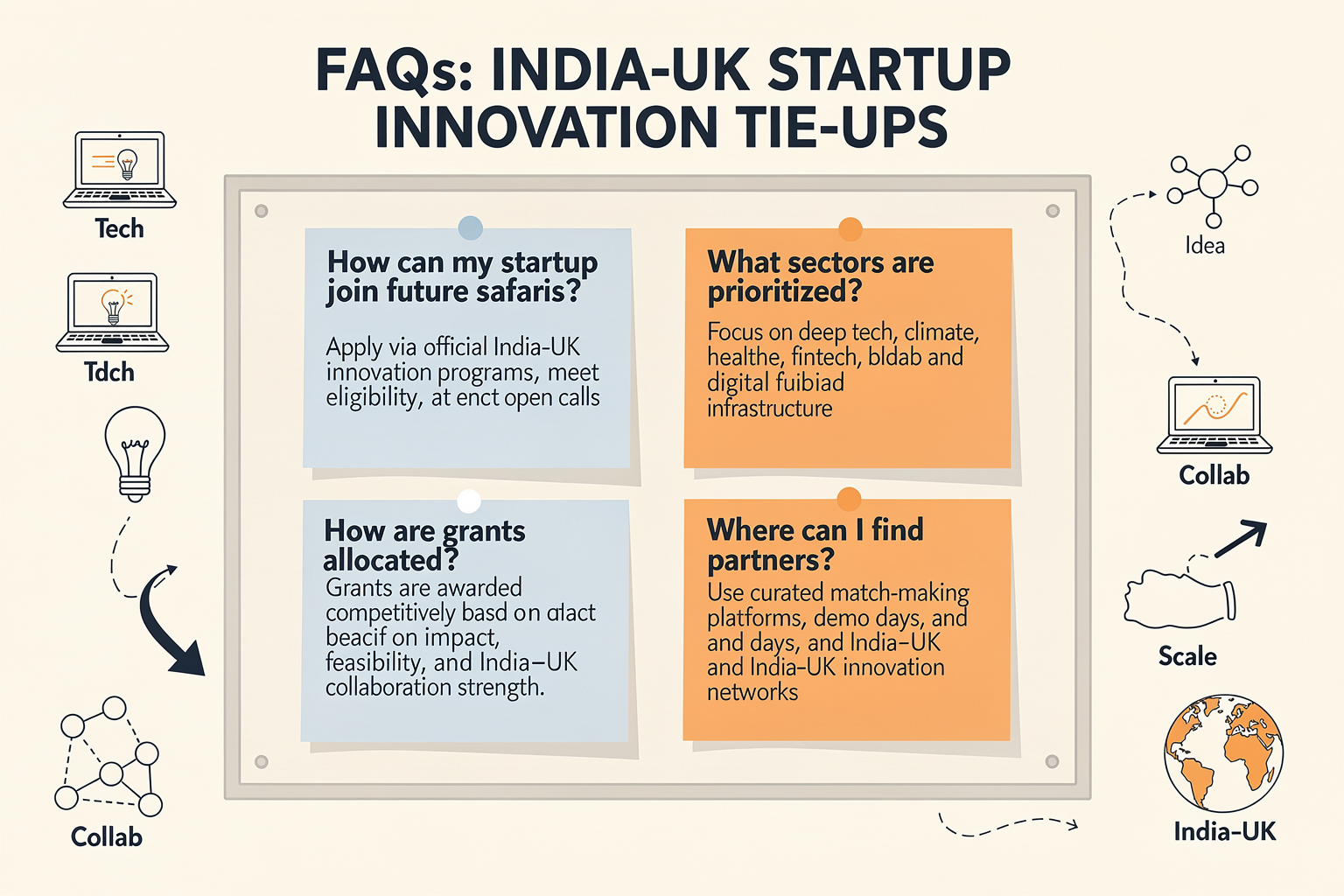
What is the goal of India's Startup Safari in the UK and why is it significant for India-UK startup innovation tie-ups?
How do India-UK startup innovation tie-ups benefit both ecosystems?
What are recent examples of India-UK startup innovation collaborations?
What sectors are most active in India-UK startup partnerships?
How can startups participate in the India-UK innovation corridor?
What are the future trends and expected outcomes for India-UK startup collaboration?
Conclusion
- The UK Startup Safari marks a pivotal shift from dialogue to concrete partnerships within the India-UK innovation corridor, signaling a new era for cross-border tech collaboration (PTI News).
- AI and technology are clear priorities, with startup leaders and UK officials focusing on next-generation sectors like conversational AI, healthcare, and fintech (Fortune India).
- Indian founders are leveraging this Safari to forge global alliances, tap UK’s R&D ecosystem, and attract fresh capital, all while taking Indian expertise global (Rediff Money).
- Early outcomes suggest not only increased funding flows but the adoption of rapidly deployable AI solutions that bridge operational gaps across continents.
Looking forward, expect deeper, more specialized tie-ups — especially as regulatory frameworks evolve and demand for tailored AI (such as multilingual voice agents) accelerates in both markets. Innovation platforms that support seamless, scalable integrations across geographies will be crucial. To explore how AI communication is evolving, check out CallMissed — an AI infrastructure platform powering voice agents and multilingual chatbots for businesses.
Will these innovation corridors define the next decade of global tech leadership — and which domains are most poised for transformation? Now is the time for entrepreneurs and enterprises on both sides to shape the narrative.
Related Posts
India's Public AI Stack: BharatGPT, Sarvam, Krutrim – Unveiling the Nation’s AI Ambitions

The Best AI Productivity Bootcamp for Professionals in 2026: Set Up Your AI Assistant & Build Apps Without Code

The 24/7 Digital ISA: How Realtors Use AI Voice Agents, Missed Call Bots, and WhatsApp to Lock In Deals
Ready to automate customer conversations?
Launch AI voice agents and WhatsApp bots with CallMissed — one API, 22+ Indian languages.