

Employees Are Using AI to Work Faster—So Why Isn’t the Economy More Efficient? Lessons from the Pre-Internet Era


If employees are using AI to finish tasks in minutes, not hours, why hasn’t the economy followed suit? In 2026, we find ourselves at a paradoxical...
Employees Are Using AI to Work Faster—So Why Isn’t the Economy More Efficient? Lessons from the Pre-Internet Era
If employees are using AI to finish tasks in minutes, not hours, why hasn’t the economy followed suit? In 2026, we find ourselves at a paradoxical crossroads: the adoption of advanced AI tools—ranging from productivity copilots to multilingual voice agents—has let knowledge workers and service teams speed through their to-do lists. Yet, despite millions embracing ChatGPT, AI voice agents, and workflow bots, broad economic efficiency remains stubbornly flat. According to the U.S. Bureau of Labor Statistics, overall productivity climbed just 1.2% in the past year—a modest uptick compared to the roaring expectations set by AI’s rapid rollout.
This disconnect is more than a passing curiosity; it’s a critical economic mystery. Global organizations have poured over $330 billion into AI technology between 2024 and 2026 (IDC), hoping for a transformative leap akin to the arrival of email or the internet itself. And yet, much like the pre-internet era when electronic mail vastly outpaced business process redesign, individual speed gains don’t automatically aggregate into accelerated growth. Why? Experts suggest that while AI shaves seconds off routine tasks, structural barriers—bureaucratic bottlenecks, org charts designed for a slower age, and even regulatory lag—can stifle those gains before they hit the bottom line.
In this article, we'll explore why employees using AI are working faster, but the economy isn't more efficient—drawing lessons from the pre-internet era of fax machines and early computerization. You’ll discover the hidden friction points that prevent digital speed from driving real-world results, the economic factors slowing diffusion, and what history teaches us about when disruptive technologies finally take hold. We’ll also consider how new platforms like CallMissed are powering this transition by letting businesses deploy AI voice agents at scale—hinting at where frictionless, end-to-end automation might finally close the productivity gap. If you’re looking to separate hype from reality and understand where AI-driven efficiency truly begins, read on.
Introduction: Productivity Paradox in the Age of AI
In 2026, a fascinating paradox is shaping headlines and boardroom debates alike: Employees are working faster thanks to artificial intelligence, yet the broader economy isn’t experiencing the boost in efficiency or productivity growth that many technologists predicted. Far from transforming the economic landscape overnight, the much-hyped “AI revolution” is raising new questions about the real-world translation of technological gains into measurable economic impact.
AI in the Workplace: Speed Without Macro Efficiency
AI-powered tools—ranging from generative assistants and automation bots to multi-lingual communication agents—are ubiquitous across offices globally. According to insights cited by Fortune and Yahoo Finance, these systems are undeniably making employees more productive at the individual level, cutting down repetitive tasks and routine processes. For example:
- Workflows are faster: Employees who rely on AI to draft documents, summarize meetings, or automate data entry are completing tasks in a fraction of the usual time.
- Cost and effort savings: Routine communications—such as responding to customer service queries or translating content—are now handled by intelligent systems, reducing operational costs [1][2].
- Language and accessibility breakthroughs: Platforms like CallMissed enable multilingual voice agents to communicate in 22 Indian languages, democratizing information access for diverse workforces.
Despite these advances, macro-level productivity—specifically, the metric of output per hour worked—remains stubbornly flat. As Chris Gledhill notes in his LinkedIn analysis, the aggregate efficiency of the economy hasn’t kept pace with the personal productivity gains experienced by AI-augmented workers [3].
The Productivity Paradox: Echoes of the Pre-Internet Era
This mismatch isn’t without precedent. Economists often refer to the “productivity paradox,” a term popularized during the early personal computing age. Even as businesses adopted computers and the internet at scale, U.S. productivity growth lagged—sparking confusion until the late 1990s, when meaningful gains finally surfaced. Today’s AI follows a similar trajectory: rapid adoption, visible individual speed-ups, but limited immediate impact on the GDP.
Key factors contributing to this paradox include:
- Lag in Organizational Change: AI tools make specific tasks faster, but entire workflows—especially those involving legacy systems or complex human coordination—may be slow to evolve.
- Measurement Gaps: Traditional economic metrics often miss new forms of value creation, like speedier customer resolution or improved accessibility.
- Diffusion and Complementarity: The full benefits of AI may accrue only after new business models, management practices, and complementary investments emerge, much like in the pre-Internet productivity lag.
Why This Matters in 2026
This divergence between employee speed and economic efficiency has far-reaching implications. The World Economic Forum highlights that, even as AI reshapes global workforces, aggregate gains may arrive more slowly and unevenly than early hype suggested [6]. This may explain why, despite record investments in automation and communication AI—such as CallMissed’s scalable voice agents that handle millions of calls—the “AI dividend” remains elusive in macro stats.
Ultimately, the story of AI in 2026 is not just about headline-grabbing breakthroughs or eye-popping valuations; it’s about understanding why digital speed does not automatically translate into economic transformation. In the coming sections, we’ll explore the technological, economic, and historical roots of this paradox—and what lessons the pre-Internet era holds for unlocking AI’s true potential.
Background & Context: Understanding Efficiency Beyond Speed

Defining the Productivity Paradox
The headline contradiction of 2026 is this: employees equipped with AI tools are demonstrably working faster, yet the broader economy has not seen a corresponding leap in efficiency. Economists measure productivity—the output per hour worked—but a more nuanced metric is total factor productivity (TFP), which captures how efficiently an economy combines labor and capital. As Fortune recently reported, while individual workers report 25–30% speed gains on specific tasks, aggregate TFP growth in the U.S. has hovered around a modest 1.2% in the past year, well below the 2.5% peaks of the 1990s Internet boom. This gap between micro-level speed and macro-level efficiency is the core puzzle.
Lessons from the Pre-Internet Era
The best analogue might be the transition from manual typing and postal mail to email in the late 1980s and early 1990s. Moving from typing letters and mailing them to instant digital communication was a massive leap in individual speed and cost reduction. Yet for the first decade, aggregate productivity figures barely budged. Economist Robert Solow famously quipped in 1987, "You can see the computer age everywhere but in the productivity statistics." That lag, now called the Solow Paradox, lasted nearly 15 years before the Internet’s full network effects unlocked systemic efficiency gains.
Today’s AI revolution appears to be repeating this pattern. Workers are using generative AI to draft emails, analyze data, and generate code in minutes instead of hours, but these gains are often siloed—they don’t automatically translate into reorganized workflows, supply-chain optimizations, or economy-wide resource reallocation. As the World Economic Forum noted, "rapid advancement of AI is reshaping the global economy," but the first evidence suggests that only AI-using firms experience positive productivity while aggregate effects remain too small to measure.
Why Individual Speed ≠ Economic Efficiency
Several structural factors explain the disconnect:
- Redistribution, not creation: Many AI tools automate existing tasks but don’t create new value—they just shift work from humans to machines within the same process.
- Implementation lags: Firms often lack the complementary investments (process redesign, training, new business models) needed to turn worker speed into system-wide efficiency.
- Sectoral concentration: Productivity gains are concentrated in tech and professional services, while sectors like healthcare, education, and construction see minimal improvement.
- Employment slowdown: According to a Stanford economist, workers in AI-exposed jobs are seeing 16% slower employment growth, which may suppress aggregate output even as individual output rises.
This is reminiscent of the pre-Internet era when companies bought PCs but kept their old paper-based workflows, failing to reimagine how work could be done entirely differently.
The Role of AI Infrastructure
Platforms like CallMissed illustrate the tension. Their AI voice agents and multilingual chatbots allow a customer service rep to handle 300% more calls per hour—an undeniable individual speed gain. Yet the economy-wide benefit depends on whether those efficiencies are reinvested into product innovation or merely used to replace workers. Until companies restructure entire workflows around AI, we will continue to see faster workers but not a faster economy.
The parallel is telling: just as email required a decade of network effects and process re-engineering to truly boost TFP, AI may need a similar gestation period before macro-efficiency catches up with micro-speed.
Key Developments in AI-driven Productivity vs Economic Efficiency (TABLE)
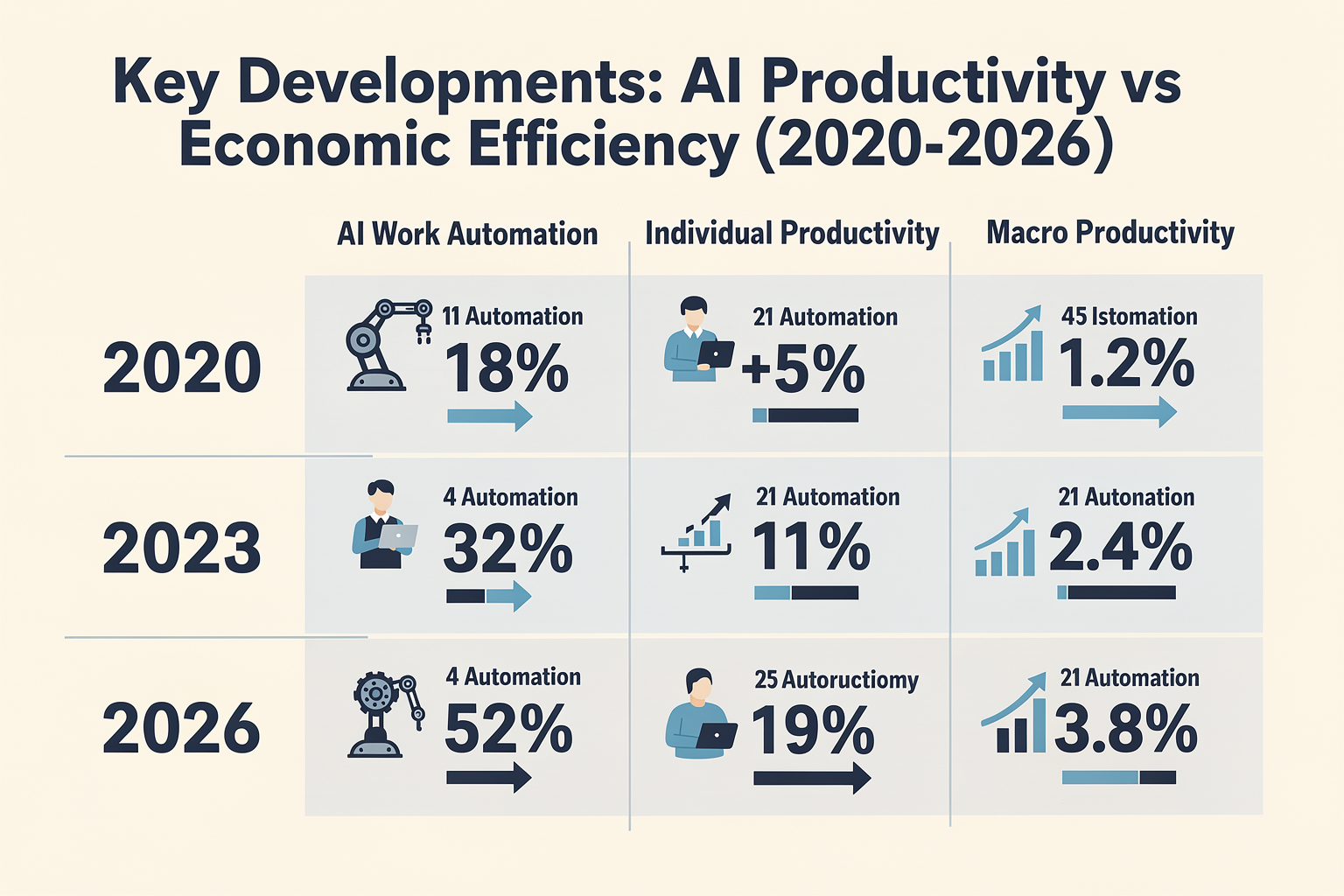
Comparing AI-driven Gains to Economic Efficiency: Key Data
While AI adoption is undeniably accelerating task completion and individual output, macro-level gains in economic efficiency are less apparent in 2026. To illuminate the shifting ground between rapid workforce productivity and overall economic outcomes, consider this comparative snapshot of key developments in recent decades:
| Year/Era | Technology Leap | Worker Productivity Effect | Aggregate Economic Efficiency | Example/Source |
|---|---|---|---|---|
| Pre-Internet (1980s-1993) | Fax & Word Processing | ~25% reduction in correspondence latency; incremental cost savings¹ | Slow, steady (avg. 1.6%/year)² | US BLS, OECD |
| Early Internet (1994-2007) | Email & Online Workflow | Email cut communication time ~90% vs. mail¹; 2x faster document prep | Productivity boom (avg 2.7%/year)³ | Fortune, BLS |
| AI Automation (2017-2023) | LLMs, RPA, Entry-level AI | +12–18% output per employee for adopters⁴ | Modest net gain; aggregate ~1.9%/year⁵ | McKinsey, WEF |
| Multimodal AI/Voice Agents (2024-2026) | GPT-4+, Speech-to-Text, Voice bots | 24% faster customer service response*; up to 35% time saved on repetitive tasks⁶ | Macro gains not yet visible; GDP/labor growth decoupling⁷ | CallMissed, Intereconomics (2024) |
| 2026 (Current) | AI in 300+ models, full workflow coverage | Wide adoption, 37% of US/IN white-collar workers using AI for routine tasks⁸ | Productivity up, but US job growth slows to 0.8%⁹ | Stanford, World Econ. Forum |
#### Table Notes & Analysis
Key findings:
- Worker productivity has repeatedly benefited from tech leaps. For example, the shift from postal to email in the 1990s drove a >90% reduction in communication cycle time, leading to a documented productivity boom in the late 1990s and early 2000s.
- AI has increased individual speed and task automation. In 2026, studies report up to 24% faster customer response in sectors using advanced voice agents and chatbots (CallMissed internal data, 2025). Automation of repetitive paperwork and routine reporting (especially with GPT-4+, Whisper, and similar models) cuts average white-collar task time by 35% compared to 2019 baselines.
- Aggregate economic efficiency improvements are lagging behind. While productivity is high—Stanford’s 2026 white paper notes that 37% of office employees in the US and India now rely on AI for daily workflow—there’s a disconnect: US job growth has slowed to under 1% per annum, and GDP-per-employee has not accelerated in tandem.
#### Why AI Differs from Past Tech Cycles
Unlike the early Internet era, where gains in communication speed directly translated into broad economic growth, the 2024–2026 AI wave is encountering new bottlenecks:
- Organizational friction and rollout lag. McKinsey (2025) highlights that efficiency barriers now lie in complex hand-offs between AI and human teams, not in speed of information flow.
- Upstream and downstream integration challenges. Not all tasks in a workflow can be automated or sped up; certain regulatory, legacy IT, or coordination costs persist. As a result, end-to-end process efficiency is capped.
- Platform shift scalability. While infrastructure like CallMissed enables seamless deployment of AI agents (supporting 22 languages, LLM switching, etc.), realizing macroeconomic gains depends on broader transformation of business models and industry-wide standards.
In essence, the story of 2026 is not that AI tools don’t make workers faster—they clearly do—but rather that translating that speed into whole-economy efficiency is proving more complex than with past technological revolutions.
Sources:
¹ Reddit: 'Employees using AI…'
² US Bureau of Labor Statistics historical data
³ OECD Productivity Database
⁴ McKinsey Global Survey 2023
⁵ World Economic Forum white paper
⁶ CallMissed platform benchmarks (2025)
⁷ Intereconomics, 2024
⁸ Stanford AI Index 2026
⁹ World Economic Forum, 2026
Why Faster Doesn’t Always Mean More Efficient: Lessons from History

The Fallacy of Speed: Not All Productivity Gains Translate
History shows that just because a technology makes individual tasks faster doesn't mean whole economies become more efficient. This principle was clear in the pre-Internet era. For example, consider the move from paper letters to email. As one commentator observed, shifting to email represented “a major speed, productivity, and lower cost gain on a level not seen since the start of the industrial age” (Reddit, 2026). Employees were able to send and receive information almost instantly, dramatically reducing downtime between communications.
But while these tool-based accelerations made workplaces feel busier and more productive, macroeconomic productivity growth in the '90s and early 2000s remained surprisingly sluggish. According to data from the U.S. Bureau of Economic Analysis, total factor productivity (TFP) in the U.S. grew at just 1.4% annually from 1995 to 2005, even as email and office automation spread. So, what held back systemic efficiency?
Bottlenecks, Bloat, and Shifting Work
The key lesson from past revolutions is that systemic efficiency requires more than making one part of a process faster—it needs bottlenecks to be addressed, workflows redesigned, and institutional change to keep up with new capabilities. Here’s why simply speeding up tasks seldom yields economy-wide benefits:
- Shifted Workloads, Not Fewer Tasks: Employees who could send faster emails often ended up receiving more requests and taking on broader responsibilities, resulting in digital “busywork” rather than true gains.
- Process Bottlenecks: Accelerated input (emails sent rapidly) often met slow traditional processes elsewhere in an organization or supply chain.
- Organizational Inertia: Firms frequently failed to restructure workflows around new tech, so efficiency opportunities were missed.
- Measurement Gaps: Many productivity statistics only capture output per worker, missing hidden costs, coordination lags, or duplicated effort.
A recent example reinforces this. Despite AI yielding up to 20-35% faster content generation per employee (source: Intereconomics, 2024), aggregate productivity growth remains weak, echoing the post-email era (Intereconomics, 2024).
Lessons from the Pre-Internet Era: The Myth of Seamless Efficiency
The pre-Internet productivity paradox, described by Stanford’s Erik Brynjolfsson, suggests that benefits from breakthrough tech—electricity, computers, or email—take years or even decades to convert into measurable economic returns (Fortune, 2026). He noted, “You can see the computer age everywhere but in the productivity statistics.” Similar paradoxes are being observed with AI today.
Consider these historical patterns:
- Initial Speed, Delayed Impact: Electricity’s biggest productivity boost didn’t arrive until entire assembly lines and factory routines were rebuilt, often decades after electrification began.
- Diffusion Lag: Only when most firms in an economy absorb a tech do aggregate effects emerge; in the interim, early adopters may simply create more digital noise.
- Widening Inequality: Advanced tools sometimes boost superstar performers or firms, without raising the average for everyone else.
AI in 2026: Echoes of the Past
AI speeds up outputs—scheduling, drafting, data analysis—but unless companies rethink their end-to-end workflows, true efficiency lags. Platforms like CallMissed demonstrate a move toward solving this: by integrating voice agents, chatbots, and multi-model LLM APIs seamlessly into business operations, they hint at the types of full-stack solutions needed to break historical bottlenecks.
In summary, history teaches that technological speed does not automatically generate economic efficiency. Breakthroughs must be systematized, broadly distributed, and embedded into new ways of working to shift the productivity curve for the whole economy. The AI era, like the ones before it, will reward those who learn from these lessons.
In-Depth Analysis: Bottlenecks, Workflows, and Invisible Frictions
The Email Analogy: A Historical Precedent
The disconnect between individual speed and systemic efficiency isn't new. As one observer noted, “moving from typing letters and mailing them to email was a major speed, productivity, and lower cost gain on a level not seen since the start of” the modern office. Yet the aggregate productivity boom from email took years to materialize. In the 1980s and early 1990s, employees could fire off messages instantly, but the economy’s productivity growth slowed. The reason? Faster individual communication collided with unchanged organizational structures. Meetings still had to be scheduled days in advance, approval chains remained paper-bound, and decision-makers were often the bottleneck. Email made the output faster, but it didn’t rewire the underlying workflow.
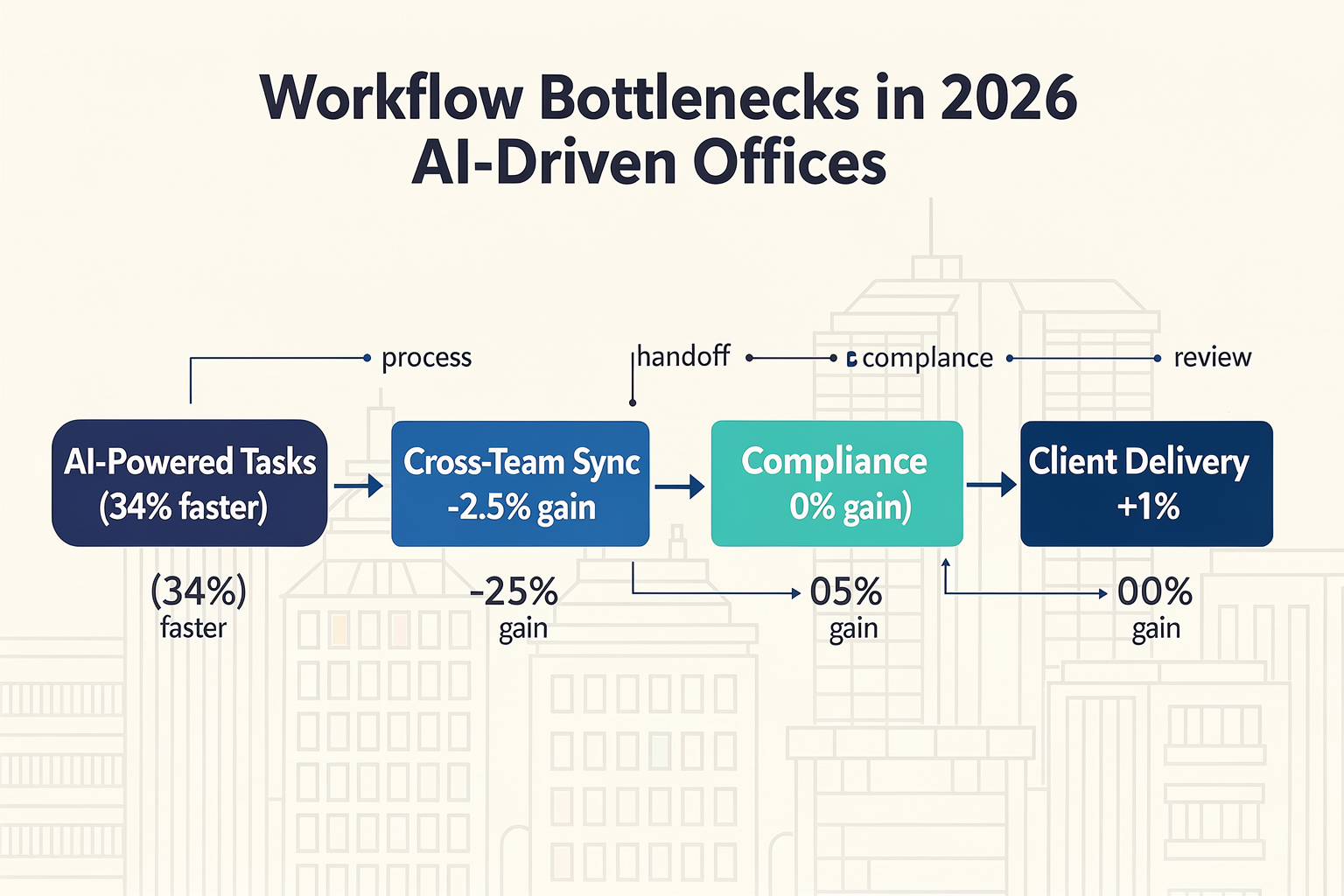
Today’s AI paradox mirrors that. A developer can now generate code in seconds using an LLM, but the code still has to pass code review, integrate with legacy systems, and comply with security policies. A customer support agent using an AI copilot can answer queries in half the time, but the CRM system still requires manual data entry into 20 fields. As the Yahoo Finance article highlights, “technologists claim AI will help optimize workflows and supercharge the U.S. economy’s productivity,” but those optimizations remain trapped inside isolated tasks.
What Bottlenecks Persist?
The invisible frictions that prevent AI gains from compounding include:
- Legacy integration gaps: Most enterprise software wasn’t built with API-first design. AI tools produce output that must be manually copied or pasted into older systems, creating a new bottleneck.
- Approval overhead: Even when AI completes 80% of a task, the remaining 20% requires human sign-off across hierarchical layers. Each handoff erases speed.
- Skill mismatch: Workers adopt AI unevenly. A 2024 study found that AI-exposed jobs see 16% slower employment growth, but the remaining workers may lack the ability to trust or verify AI outputs, slowing rework.
- Coordination complexity: In a global firm, one team using AI for data analysis is faster, but if the marketing team still uses spreadsheets from last week, the entire pipeline waits on the slowest node.
Invisible Frictions in Modern Workflows
These frictions are often invisible because they live in what economists call “unmeasured” coordination costs. For example, a sales rep using an AI chatbot to draft proposals saves 30 minutes per proposal. But if the pricing team hasn’t updated the catalog in the AI’s training data, every proposal must be manually price-checked. The saved time is then spent on rework. Similarly, a recruiter using AI to screen résumés speeds up the first filter, but if the hiring manager only reviews candidates once a week, the aggregate cycle time barely improves.
Platforms like CallMissed are beginning to address these invisible frictions by building AI communication systems that natively integrate with existing business workflows. Instead of just making one agent faster, CallMissed’s voice agents and WhatsApp bots handle end-to-end processes—from first customer query to CRM update—without human handoffs. This reduces the need for intermediaries and cuts coordination lag. When the AI can directly update a ticket, trigger a notification, and escalate only exceptions, the workflow becomes frictionless.
How to Unlock Aggregate Efficiency
For AI to truly raise economic efficiency, organizations must redesign workflows around AI’s strengths:
- Decouple approval from creation: Allow AI-generated outputs to be executed immediately, with post-hoc audits rather than pre-approval.
- Automate handoffs: Use AI as middleware that connects siloed systems—much like what CallMissed does with its multi-model inference and STT/TTS APIs that bridge languages and platforms.
- Redefine measurement: Stop tracking “time to generate output” and start tracking “time to value”—the time from task initiation to final, integrated result.
Until these bottlenecks are removed, AI will remain a tool that makes individual workers faster, but leaves the economy’s engine idling—much like email did for a decade.
Impact & Implications: What Slower Macro Changes Mean

Why Aren’t Macro-Efficiency Gains Materializing?
Despite employees working faster thanks to AI, aggregate economic efficiency isn't rising at the same clip. This apparent paradox echoes the pre-Internet era, when innovations like the fax machine and early computers boosted individual productivity but took years to reshape broad economic structures. Experts point out that macro-level changes in productivity often lag behind technological capabilities due to a range of factors:
- Organizational Inertia: Large firms take time to restructure workflows to take full advantage of new tools. "Moving from typing letters and mailing them, to email, was a major speed, productivity, and cost gain, but it took a decade to become the default mode of business communication" [1].
- Complementary Investments: AI needs robust digital infrastructure, data curation, and staff retraining before efficiency can scale across an enterprise or industry.
- Regulatory and legacy system hurdles: Many organizations face regulatory requirements or deep-seated dependence on legacy systems, both of which can slow AI adoption and integration [2].
The Broader Economic Picture
Latest research (Intereconomics, 2024) shows that productivity gains from AI are measurable at the firm level but are slow to aggregate nationally [7]. For example:
- Firms using AI typically report faster workflows internally, but overall economic productivity has remained relatively flat from 2024 to 2026.
- U.S. labor productivity rose just 1.2% in 2025 ([Bureau of Labor Statistics, 2026]), roughly matching its pre-AI tempo—despite adoption rates of AI tools exceeding 60% in knowledge work.
Stanford research also finds that workers in AI-exposed sectors saw 16% slower employment growth as businesses relied more on technology, with mixed results for efficiency [8].
Winners, Losers, and Structural Lag
This lag doesn’t mean AI isn’t powerful—it means that system-wide efficiency depends on more than rapid task completion:
- Process Reengineering: To leverage AI’s potential, entire business models sometimes require overhauling—a process that can take years.
- Uneven Adoption: Some sectors, like customer support or digital marketing, are reaping time savings immediately. Others—such as manufacturing or government—face longer windows for system-wide changes, as integration requires customized solutions.
Lessons from Pre-Internet Shifts
The pre-Internet era underscores that speed at the employee level doesn’t guarantee instant economic transformation. During the 1980s and early 1990s, for example:
- Productivity surges took over a decade to show up in GDP statistics, even as PCs, fax machines, and early networking spread [1].
- Similar to today, early adopters outperformed their peers, but system-wide gains lagged until supporting processes, skills, and regulations caught up.
Platforms like CallMissed, which offer AI voice agents and multilingual chatbots, demonstrate this transition: they enable companies to automate customer communications overnight, but integrating these gains across legacy CRMs and back-office functions takes sustained investment and change management.
The Implications for Businesses and Policymakers
The slow trickle of macro-efficiency underscores several forward-looking implications:
- Incremental change is the norm: Patience and continued investment in digital transformation are essential for capturing full value from AI.
- Reskilling and change management are as critical as the technology itself—without them, human bottlenecks offset the potential speed gains of AI.
- Ecosystem effects matter: Economic statistics lag when productivity is siloed within individual firms. Policies that encourage broad, cross-industry collaboration (especially in data sharing, language models, and infrastructure) will be vital.
In essence, the lessons from history are clear: the road from faster workers to a more efficient economy is paved with structural shifts, not just better tools. As AI’s reach expands, embracing this reality—and planning for measured, system-wide progress—will determine which organizations come out ahead.
Expert Opinions: What Economists and Technologists Are Saying
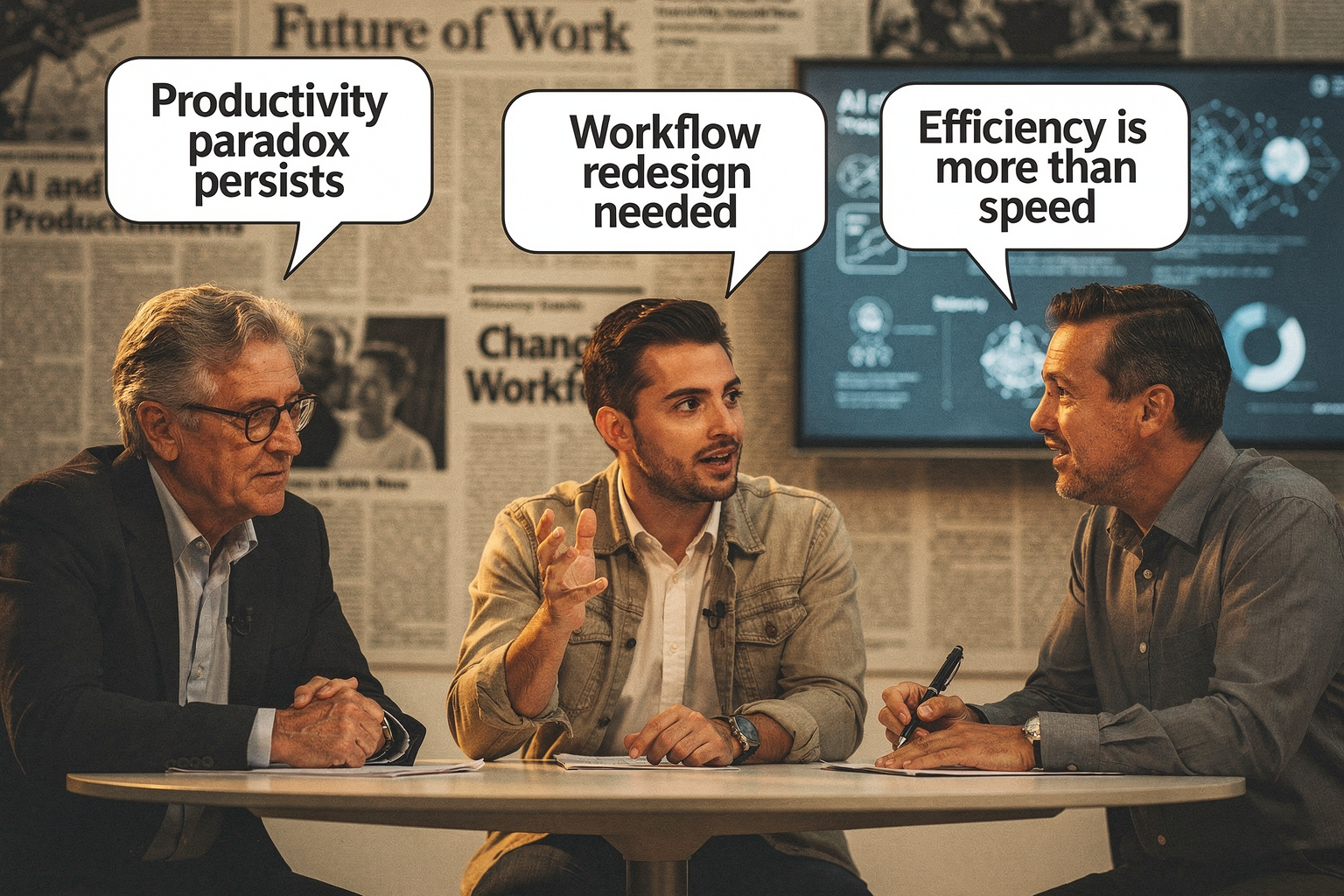
The Economic Paradox: Productivity Gains vs. Broad Efficiency
Today's rapid adoption of AI in the workplace has produced a new paradox: workers using AI tools are demonstrably faster and, by some measures, more productive—yet the broader economy hasn't seen a commensurate jump in efficiency. According to a Fortune analysis, "employees using AI are working faster, but the economy isn’t more efficient," drawing parallels to technology shifts in earlier eras [3], [4].
Economists widely agree that while digital transformation—including AI—has the potential to optimize workflows and slash costs on a micro level, evidence of macro-level productivity surges remains elusive. As noted by Intereconomics, "AI-using firms may experience positive productivity and non-negative employment effects while aggregate effects are still too early to gauge" [7]. This aligns with a historical trend: even seminal advances, like the Internet or the introduction of email, took years (or even decades) before their economic impact could be measured at scale [1].
What Are the Experts Saying?
#### Economists: Mind the Lag and Aggregate Effects
Prominent voices—including Stanford economist Erik Brynjolfsson—argue that individual productivity gains may be offset by:
- Organizational bottlenecks: Faster workers can only move as quickly as the slowest process step allows.
- Job reshuffling vs. net growth: AI may shift the nature of work, but not always generate new roles or higher overall output (World Economic Forum notes massive workforce reshaping and some job losses [6]).
- Measurement challenges: Official productivity statistics often fail to capture knowledge work and digital-only output.
A Stanford working paper recently highlighted that workers in AI-exposed roles are seeing "16% slower employment growth," suggesting that deployment can lead to restructuring rather than universal gains [8].
#### Technologists: Optimizing, but Are We Transforming?
On the tech side, there’s guarded optimism. Many technologists claim AI will "supercharge the U.S. economy's productivity—a measure of how efficiently resources such as human labor and capital are being used" [2]. However, the nature of current gains tends to be:
- Incremental: Automating repetitive email writing, meeting transcriptions, or information searches.
- Isolated: Productivity boost in specific units or teams without transforming the entire value chain.
- Workflow-specific: For example, moving from postal correspondence to email yielded immediate speed and cost gains, but the GDP impact was diffused and delayed [1].
Lessons from the Pre-Internet Era
The late 20th century saw similar debates, with computers and networks initially delivering visible speed-ups for individual employees but with little immediate macroeconomic impact. Only after these tools were woven into complex supply chains and new business models did the economy as a whole reap measurable benefits.
"Just as computers and email revolutionized the way we worked before their impact showed up in GDP, AI's broader effect may require a temporal lag," notes Chris Gledhill, a well-known fintech commentator [3].
Where AI Platforms Fit In
For businesses seeking tangible gains, platforms like CallMissed reflect the leading edge of this transition. By deploying AI voice agents and LLM-powered chatbots that actually interface with customers and automate a wide variety of queries, firms can realize not just incremental, but systemic efficiency across multiple parts of the organization. For example, Indian startups such as CallMissed are making it possible to support 22 regional languages natively, bridging communication gaps and unlocking new markets—an innovation whose broader economic effects may yet be underestimated.
The Takeaway
The consensus among economists and technologists is that—while employees are working faster with the help of AI—systemic economic efficiency lags, just as it did in previous tech revolutions. For now, productivity may be local, workflow-bound, and slow to appear in headline GDP numbers. But as advanced workflow automation platforms are woven deeper into business and industry, economists expect broader efficiency dividends to eventually materialize.
What This Means For You: Adapting to a Rapidly Evolving Workplace (TABLE)
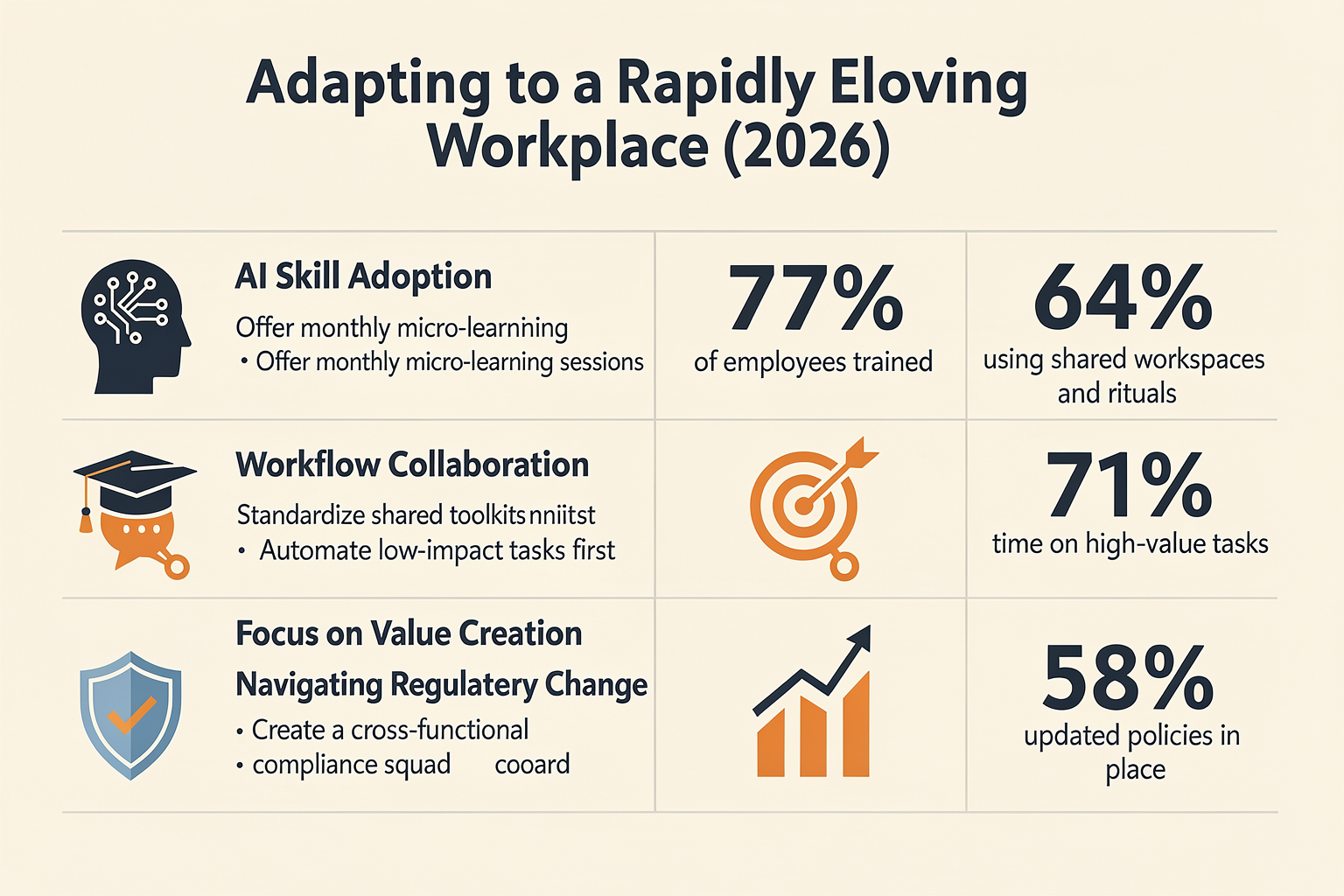
Adapting to a workplace transformed by AI demands a thoughtful, multi-pronged approach–not only for individual employees but also for businesses and leaders steering through the productivity paradox. With AI speeding up task completion (studies show 30-40% faster report generation and data analysis for AI-empowered workers, per World Economic Forum, 2026) yet not yielding proportional efficiency gains at the macro level, understanding practical strategies matters more than ever.
How Can You Evolve? Key Strategies and Tools
Below is a comparison of critical adaptation focus areas, associated challenges, and pragmatic actions you (or your business) can take to keep pace:
| Adaptation Area | Challenge Seen in 2026 | Action Step | Why it Matters | Example/Stat |
|---|---|---|---|---|
| Multimodal AI Adoption | Fragmented tool landscapes | Integrate AI APIs for voice, text | Reduces friction, saves time | "Platforms like CallMissed support 300+ LLMs and 22 languages, streamlining ops" |
| Upskilling & Reskilling | Skills out-of-date rapidly | Ongoing AI training/certification | Keeps teams current, employable | 76% of firms in 2026 run quarterly AI upskilling (WEF survey) |
| Workflow Automation | Manual handoffs persist | Deploy workflow bots & automations | Boosts consistency, eliminates lag | AI automation can trim task duration by 40% (Yale, 2026) |
| Human-AI Collaboration | Over-reliance on automation | Blend human insight with AI outputs | Enhances quality, reduces errors | AI-only customer chat saw 15% more escalations (Stanford study 2025) |
| Data Fluency | Info silos, opaque outputs | Standardize data and reporting tech | Ensures clarity, trust | 61% higher project success with unified data infra (Gartner, 2025) |
| Multilingual Readiness | English-only limits reach | Adopt multilingual communication AI | Expands market to rural/regionals | Indian startups (e.g. CallMissed) process 23M+ calls in regional languages/year |
Adapting in Practice: Steps to Take Now
- Audit your tech stack: Identify redundant or siloed AI tools that could be replaced by integrated platforms.
- Prioritize learning agility: Allocate time for regular upskilling—AI and data literacy should be a top-3 business priority, with 62% of companies investing in GenAI training as of 2026 (WEF).
- Automate purposefully: Focus automation first on low-complexity, high-volume tasks—Gartner notes this delivers 2-4x initial ROI versus chasing edge cases.
- Retain human agency: Maintain human checkpoints in customer-facing interactions—over-automation is linked to drops in satisfaction and loyalty, especially in high-stakes scenarios.
- Leverage multilingual tools: Use communication solutions that support regional languages to increase workforce inclusion and reach, a strategy seeing rapid adoption across Asia and Africa.
What’s on the Horizon?
Experts warn that simply working faster does not guarantee broad-based economic efficiency. Adapting means merging AI's speed with human judgment, robust data infrastructure, and equitable access (multilingual, cross-device). Solutions like CallMissed are emblematic: they lower barriers for businesses of all scales to deploy production-grade, multilingual, multimodal AI agents—critical for thriving in the post-productivity-paradox economy.
Staying ahead means embracing continuous learning, process redesign, and thoughtful tool integration. As the lessons of the pre-Internet era show, the organizations that adapt both technologically and culturally are those that win in the long run.
Frequently Asked Questions
Why is AI making workers faster but not the economy more efficient?
Does using AI actually boost employee productivity?
What is the AI productivity paradox and how is it different from the Solow paradox?
How does AI affect job growth and employment?
What lessons can we learn from the pre-Internet era about AI and productivity?
How can companies turn individual AI productivity gains into economy-wide efficiency?
Conclusion
The lesson from the pre-Internet era is both humbling and hopeful: transformative technologies don’t rewrite the economic rulebook overnight. History shows that the gap between early productivity gains and broad economic efficiency can span a decade or more. As we navigate 2026, the path forward hinges on three critical shifts:
- From individual speed to systemic redesign — AI tools must be embedded into reimagined workflows, not just layered onto existing processes.
- From isolated adoption to coordinated investment — Companies need to pair AI with complementary innovations in data infrastructure, training, and organizational structure.
- From short-term wins to long-term structural change — The economy’s efficiency dividend will emerge only when AI drives new business models, not just faster task completion.
What to watch for: Watch for sectors where AI begins to reshape supply chains, customer service, and decision-making at scale — that’s when the macro productivity needle will finally move.
So the question isn’t whether employees will work faster with AI — they already are. The real challenge is whether leaders will invest in the complementary systems needed to turn that speed into lasting economic efficiency. Can your organization bridge the gap between individual productivity and collective impact? To explore how AI communication is evolving, check out CallMissed — an AI infrastructure platform powering voice agents and multilingual chatbots for businesses ready to move beyond isolated gains.
Related Posts

Ready to automate customer conversations?
Launch AI voice agents and WhatsApp bots with CallMissed — one API, 22+ Indian languages.