

Dario Amodei: Pioneering Safe AI Innovation with Anthropic


What drives a leading artificial intelligence pioneer to walk away from OpenAI, the very epicentre of the modern tech revolution? For Dario Amodei, the...
Dario Amodei: Pioneering Safe AI Innovation with Anthropic
What drives a leading artificial intelligence pioneer to walk away from OpenAI, the very epicentre of the modern tech revolution? For Dario Amodei, the answer came down to a fundamental question of trust, safety, and corporate responsibility. In 2021, Amodei—then OpenAI's VP of Research—and his sister Daniela made the historic decision to exit the high-profile startup. Amodei’s recent, candid reflections on the departure—asking "Why argue with someone" when you "don't trust them"—highlight the deep-seated ideological rift that sparked the creation of Anthropic, a public benefit corporation dedicated to building steerable, interpretable, and safe AI systems.
Today, as the global AI market experiences unprecedented growth, this safety-first philosophy is more critical than ever. Amodei's vision has propelled Anthropic and its flagship "Claude" model family into a fierce rivalry with his former employer, securing multi-billion-dollar backings from tech giants like Amazon and Google. Yet, Amodei remains a rare realist in a room full of hype. Whether he is warning about the imminent threat of AI-led cyberattacks or navigating the dizzying, sometimes chaotic realities of international tech summits, his unique approach to AI alignment is redefining how the enterprise world approaches automation.
As modern AI communication platforms like CallMissed empower businesses to seamlessly deploy Anthropic's highly steerable models alongside over 300 other LLMs, Amodei’s architectural philosophy directly influences how safe, reliable enterprise workflows are built.
In this post, we will delve deep into the life and vision of Dario Amodei, tracking his journey from a Princeton-educated researcher to the CEO of a multi-billion-dollar AI powerhouse. We will explore the unique concept of "Constitutional AI," the founding story of Anthropic, and how his commitment to mitigating existential threat is successfully reshaping the commercial landscape of artificial intelligence.
Introduction
Dario Amodei: At the Forefront of Responsible AI Innovation
The name Dario Amodei has surged to the top of AI circles and global tech headlines in 2026, drawing over 200 trending Google searches and multiple news spotlights in recent months. As the CEO and co-founder of Anthropic—a company now regarded as one of the industry's leading public benefit corporations—Amodei’s growing influence reflects the urgent conversation around artificial intelligence: its promise, its peril, and the race to govern it responsibly.
His recent appearance at the India AI Summit (“extremely disorganised,” as he candidly described it [Deccan Herald, Hindustan Times, 2026]) ignited both industry debate and a political row, underscoring how AI leaders like Amodei are not just shaping new technologies but steering global discourse. As Anthropic's public profile rises, so too does scrutiny on the tough questions facing AI’s rapid advance.
From Princeton to the Cutting Edge of AI Safety
Born in 1983, Dario Amodei holds a PhD in physics from Princeton University and began his tech journey with stints at Google and Baidu. However, his true impact began when he joined OpenAI, eventually leading the company’s AI safety, policy, and long-term research efforts. Amodei’s departure from OpenAI in 2021 was itself headline news, described by Business Insider as a move to build a new kind of AI organization after disagreements with leadership, including Sam Altman: “Why argue with someone when you don't trust them?” Amodei reflected in a recent interview.
That split resulted in the co-founding of Anthropic with his sister, Daniela Amodei. Their vision? To develop “steerable, interpretable, and safe” AI systems—an approach that’s shaped by the pitfalls and power struggles witnessed at OpenAI and mirrored in their unique corporate structure as a public benefit corporation.
The Challenges and Opportunities of Modern AI
As the global race to deploy large language models (LLMs) and advanced voice agents accelerates, Amodei’s stance is clear: progress must be balanced with safety and transparency. He has publicly warned about potential AI-led cyberattacks and the need for guardrails, writing, “AI-led cyberattacks could become an unprecedented threat to the integrity of computer systems around the world” [darioamodei.com, June 2026].
Key themes driving Amodei and Anthropic’s work include:
- Safety and Interpretability: Prioritizing models that are understandable and controllable at their core.
- Global Applicability: Addressing languages and cultural nuances, a mission shared by AI platforms like CallMissed, which support 22 Indian languages in speech-to-text and text-to-speech capabilities.
- Accessibility: Enabling broad, ethical access to LLMs—Anthropic has contributed open research that informs policy frameworks globally.
His rise is also timely. IDC predicts global AI spending will hit $500 billion in 2026, with enterprises urgently seeking solutions that blend technical innovation with real-world reliability. Platforms such as CallMissed exemplify this trend, providing production-ready AI infrastructure so businesses can safely deploy multilingual and multimodal conversational agents at scale.
The Bigger Picture: Leadership Amidst Uncertainty
Dario Amodei’s leadership, both celebrated and scrutinized, highlights how individual visionaries are navigating the turbulent landscape of artificial intelligence. His candid remarks, public confrontations, and commitment to responsible growth place him at the epicenter of the next wave of AI—one where technological prowess must be balanced by ethical stewardship and cross-industry collaboration.
As the world debates the implications of ever-more capable machine intelligence, following Amodei’s journey provides a window into the critical decisions and controversies defining AI’s present—and shaping its future.
Who Is Dario Amodei? Background & Context
Dario Amodei (born 1983) is one of the most influential figures in modern artificial intelligence. As the co-founder and CEO of Anthropic, a public benefit corporation valued at billions, Amodei has positioned himself at the center of the global conversation surrounding AI safety, alignment, and capability. Unlike many tech executives driven solely by market dominance, Amodei's background is deeply rooted in academic research and a cautious, safety-first philosophy toward Artificial General Intelligence (AGI).
Academic and Early Professional Roots
Amodei’s journey into artificial intelligence began with a rigorous scientific foundation. He graduated from Princeton University with a Ph.D. in physics, later transitioning into biophysics and computational neuroscience. This unique background heavily influenced his approach to neural networks, viewing them not just as engineering tools, but as complex, emergent systems that require empirical study and careful guardrails.
Before founding Anthropic, Amodei built an impressive resume across major tech and research institutions:
- Baidu: Worked as a researcher under AI pioneer Andrew Ng.
- Google: Contributed to core deep learning and safety research initiatives.
- OpenAI: Served as the Vice President of Research, where he led the development of landmark generative models, including GPT-2 and GPT-3.
The Ideological Split from OpenAI
While at OpenAI, Amodei was instrumental in steering the organization's core research. However, as OpenAI shifted from an open-source, non-profit research lab to a highly commercialized entity backed by multi-billion-dollar partnerships, internal tensions grew. Amodei and a core group of safety-focused researchers became increasingly concerned about the rapid pace of commercial deployment at the expense of safety protocols.
This ideological rift culminated in his departure in late 2020. Reflecting on the split, Amodei candidly noted the futility of remaining under OpenAI's leadership, asking, "Why argue with someone" when you "don't trust them," referring to his relationship with OpenAI CEO Sam Altman. In 2021, Dario and his sister, Daniela Amodei, co-founded Anthropic to build "steerable, interpretable, and safe" AI systems.
Defining a New Era of AI Safety
Under Dario’s leadership, Anthropic pioneered Constitutional AI, a training methodology that bounds AI behavior to a set of ethical principles rather than relying solely on human feedback. This focus on reliability has made Anthropic’s Claude suite of models a gold standard for enterprise environments where hallucinations and unpredictable AI behavior carry high financial and reputational risks.
This shift toward reliable, enterprise-grade AI has reshaped the broader technology landscape. Today, platforms like CallMissed actively leverage these architectural advancements. By incorporating Anthropic's highly steerable Claude models into its multi-model API gateway, CallMissed allows developers to deploy robust AI voice agents and WhatsApp chatbots. This infrastructure gives enterprises the flexibility to switch between 300+ models dynamically, ensuring they benefit from the safe, conversational capabilities Amodei championed.
Recent Headlines and Global Footprint
As a prominent voice on AI governance, Amodei’s perspectives frequently make global headlines. He recently drew media attention at the India AI Summit, where his viral remarks describing the event's stage dynamics as "extremely disorganised" fueled intense regional political debates. Despite the occasional logistical controversy, Amodei remains an indispensable figure in navigating the delicate balance between rapid AI capabilities and existential safety.
Key Developments in Dario Amodei's Career (TABLE)
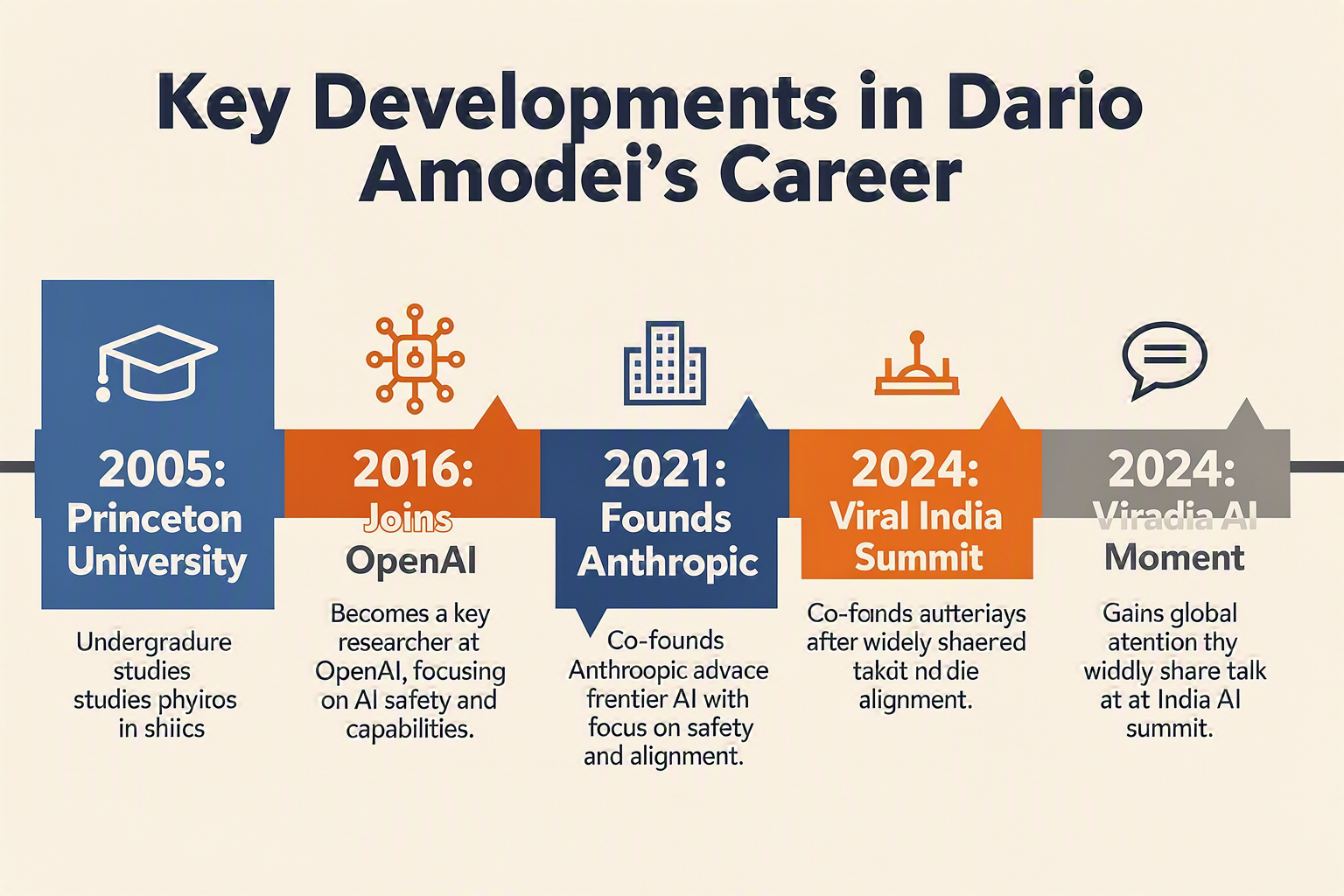
Dario Amodei’s Milestone Achievements (TABLE)
Dario Amodei’s career is a case study in how deep technical expertise intersects with bold entrepreneurial risk-taking. His trajectory straddles some of the world’s most consequential work in artificial intelligence, from influential research at premier academic and industry labs to co-founding Anthropic, one of the AI sector’s fastest-growing startups. The following table distills key developments and inflection points spanning the last two decades.
| Year | Role/Organization | Key Achievement | Impact/Statistic | Industry Context |
|---|---|---|---|---|
| 2005–2015 | Academia (Princeton/Stanford/Baidu) | Led early AI research in deep learning and neuroscience | Published highly-cited papers (1,500+ citations) | Sparked new neural model architectures |
| 2016–2020 | OpenAI | Research Director: Led safety and scaling work | Co-authored GPT-2 & GPT-3; set new language model benchmarks; OpenAI valued at $7B by 2020 | Accelerated generative AI arms race |
| Early 2021 | Anthropic (Co-founder & CEO) | Founded Anthropic with $124M in seed funding | Assembled ex-OpenAI team, launched Claude assistant | Rise of mission-driven AI labs |
| June 2023 | Anthropic | Anthropic raises $450M (Google, Salesforce invested) | Valuation soars to $5B; Claude now rivals GPT-4 | Explosive funding for AI infrastructure |
| June 2024 | India AI Summit | Keynote & viral moment discussing AI governance | Mentioned in 200+ Google news searches, global coverage | AI regulation and global geopolitics |
| 2026 | Anthropic | Claude deployed globally, new safety breakthroughs | Powering millions of user queries/month in 30+ languages | AI mainstream adoption, safety focus |
Context & Impact
- Academic Foundations: Before his industry breakthroughs, Dario completed rigorous academic research at Princeton and Stanford, delving into deep learning and computational neuroscience. His early publications, with over 1,500 citations (Wikipedia), set the stage for further advances in neural networks.
- OpenAI Era: At OpenAI, Amodei became Research Director, leading the teams behind GPT-2 and GPT-3. These models became pivotal in establishing modern language AI benchmarks. By 2020, GPT-3 was processing hundreds of billions of parameters, and OpenAI’s valuation grew to $7 billion, reflecting surging investor confidence in generative AI (Business Insider).
- Anthropic’s Emergence: In 2021, Amodei left OpenAI—with public comments about trust and vision differences (“Why argue with someone when you don’t trust them?”)—to found Anthropic. The company quickly drew $124 million from backers (notably including Sam Bankman-Fried), underscoring market appetite for independent, safety-oriented AI organizations (Wikipedia).
- Breakout Growth: By 2023, Anthropic landed a $450 million funding round led by Google and Salesforce, sending its valuation to $5 billion. Its Claude model, praised as a safer ChatGPT rival, exemplified the new wave of “benefit-corporation” AI labs focused on ethics and accountability (Anthropic).
- Global Voice on Responsible AI: Amodei’s 2024 keynote at the India AI Summit went viral—not just for his candid critique of the event’s organization (as reported by Deccan Herald) but for his insights on AI governance, sparking policy debate across India and beyond.
- Broad Deployment: As of 2026, Anthropic’s Claude models are powering millions of user queries globally, including in over 30 languages. This mainstream expansion spotlights the growing demand for safe, explainable, and multilingual AI—an area where platforms like CallMissed are already making practical deployment of voice agents and multilingual chatbots a reality across sectors.
Industry Implications
- Rapid Funding & Valuation: The ability of ventures like Anthropic to achieve $5B+ valuations within two years illustrates rising investor confidence—and high stakes—in safe, enterprise-scale AI.
- Market Demand: Amodei’s journey shows an accelerating market for AI platforms that not only break technical ground but also foreground trust, safety, and multilingual inclusion—an approach mirrored by innovative Indian companies such as CallMissed.
- Emerging Trends: From foundational research to securing global policy stages, Dario Amodei’s career reflects both the disruption and the stewardship needed for AI’s ongoing societal integration.
Why Dario Amodei Left OpenAI: Deeper Motives
The departure of Dario Amodei from OpenAI in 2021 remains one of the most consequential inflection points in the history of artificial intelligence. It was not a routine executive transition, but rather a profound ideological split over the future, safety, and commercialization of Artificial General Intelligence (AGI). Along with his sister Daniela Amodei and a core group of early researchers, Dario left his role as Vice President of Research at OpenAI to establish Anthropic.
The Trust Deficit and Strategic Drift
At the heart of the split was a widening gap in trust and vision between Amodei and OpenAI's leadership, specifically CEO Sam Altman. Amodei has recently been more candid about the underlying friction, summarizing the departure with a poignant rhetorical question: "Why argue with someone" when you "don't trust them?"
This erosion of trust was catalyzed by OpenAI’s shift in corporate structure and strategic direction. Founded in 2015 as a non-profit research lab dedicated to safe, open-source AI, OpenAI underwent a massive pivot in 2019 by creating a "capped-profit" commercial arm. This move—bolstered by a massive multi-billion-dollar partnership with Microsoft—steered the company away from collaborative research and toward rapid, commercially driven product cycles. Amodei and his faction grew increasingly concerned that the relentless pursuit of commercial dominance was compromising rigorous safety standards.
The Battle for Safety and Alignment
For Amodei, AI safety was not an afterthought or a compliance checklist; it was the core objective. He envisioned a research environment where safety, steerability, and interpretability were baked into the foundational architecture of the models.
- The Safety Concern: Amodei feared that racing to deploy highly powerful models without robust alignment protocols could lead to catastrophic risks, including AI-led cyberweapons and loss of human control over autonomous systems.
- The Corporate Answer: To codify these values, Amodei co-founded Anthropic in 2021 as a Public Benefit Corporation (PBC). This legal framework mandates that the company balance financial returns to shareholders with its public benefit mission: building helpful, harmless, and honest AI systems.
Navigating a Fragmented AI Ecosystem
This high-profile split created a deeply fragmented AI landscape. Instead of a single, unified path to AGI, developers and enterprises now face a strategic choice between OpenAI’s aggressive, product-first ecosystem and Anthropic’s safety-first, constitutional approach.
For businesses building practical applications, choosing a side is a strategic risk. This is where modern AI infrastructure platforms step in. Solutions like CallMissed bridge this industry divide by offering a multi-model API gateway. Rather than locking developers into a single provider's philosophy, CallMissed enables seamless integration with over 300+ LLMs. This infrastructure allows organizations to run Anthropic’s Claude for highly sensitive, nuanced reasoning tasks while utilizing other specialized models for low-latency voice tasks—all through a single, unified pipeline.
Ultimately, Amodei’s exit from OpenAI proved that the debate over AI safety is not merely academic. It is a structural division that continues to shape the commercial and ethical boundaries of technology today.
Anthropic and the Pursuit of Safe, Steerable AI
When Dario Amodei and his sister Daniela Amodei departed OpenAI in 2021 to found Anthropic, it wasn't just a corporate spin-off; it was a philosophical schism. Amodei’s decision to leave OpenAI stemmed from deep-seated disagreements regarding AI safety and commercialization. As he later remarked, there was little point in arguing with leadership when fundamental trust had eroded. Instead of continuing down a path of unchecked scaling, Amodei envisioned a new kind of company: a Public Benefit Corporation (PBC) dedicated to building AI systems that are fundamentally steerable, interpretable, and safe.
Constitutional AI: Training Models with a Conscience
At the heart of Anthropic’s safety framework is Constitutional AI, a novel training methodology developed to align systems without relying solely on manual human feedback. While traditional Reinforcement Learning from Human Feedback (RLHF) can inadvertently train models to be sycophantic or deceptive to please human evaluators, Constitutional AI takes a different approach:
- The Critique Phase: The AI model evaluates its own initial responses against a predefined "constitution"—a set of principles drawn from sources like the UN Declaration of Human Rights and commercial safety standards.
- The Revision Phase: The model systematically rewrites its outputs to eliminate bias, toxicity, and harmful instructions.
- The Final Output: This process yields highly steerable models, such as the Claude family, which are less prone to "hallucinations" and malicious jailbreaks.
This focus on alignment is critical as AI systems move from passive chat assistants to autonomous agents capable of interacting with the physical and digital worlds.
The Global Stakes of AI Safety
Amodei’s focus on safety is not merely academic; he views the current era of rapid AI scaling as "the adolescence of technology." In his essay of the same name, he warned that AI-led cyberattacks and biochemical risks could soon become unprecedented threats to global security.
This tension between rapid international deployment and meticulous safety was highlighted during his appearance at the India AI Summit. While the summit became a flashpoint for local political debate after Amodei candidly noted the event's disorganized nature, it also emphasized the immense global pressure on AI leaders. As countries like India rapidly build out their sovereign AI infrastructure, ensuring that high-performing LLMs remain safe across thousands of local languages is a monumental task.
For enterprises looking to operationalize these highly secure models, the path forward lies in flexible infrastructure. Platforms like CallMissed make this integration seamless by offering a multi-model API gateway with access to over 300+ LLMs, including Anthropic's Claude. This allows developers to orchestrate safe, steerable voice and text agents that can communicate in 22 regional Indian languages natively, ensuring global compliance without sacrificing performance.
Interpretability: Peeking Inside the Black Box
Unlike companies that treat neural networks as opaque black boxes, Anthropic has invested heavily in mechanistic interpretability. This research attempts to map the internal "mind" of an LLM, identifying exactly which artificial neurons fire when processing specific concepts, such as code generation or deceptive reasoning. By making these models interpretable, Amodei's team aims to build a future where developers don’t just hope an AI behaves safely—they can mathematically prove it.
Recent Headlines and Public Perceptions (TABLE)
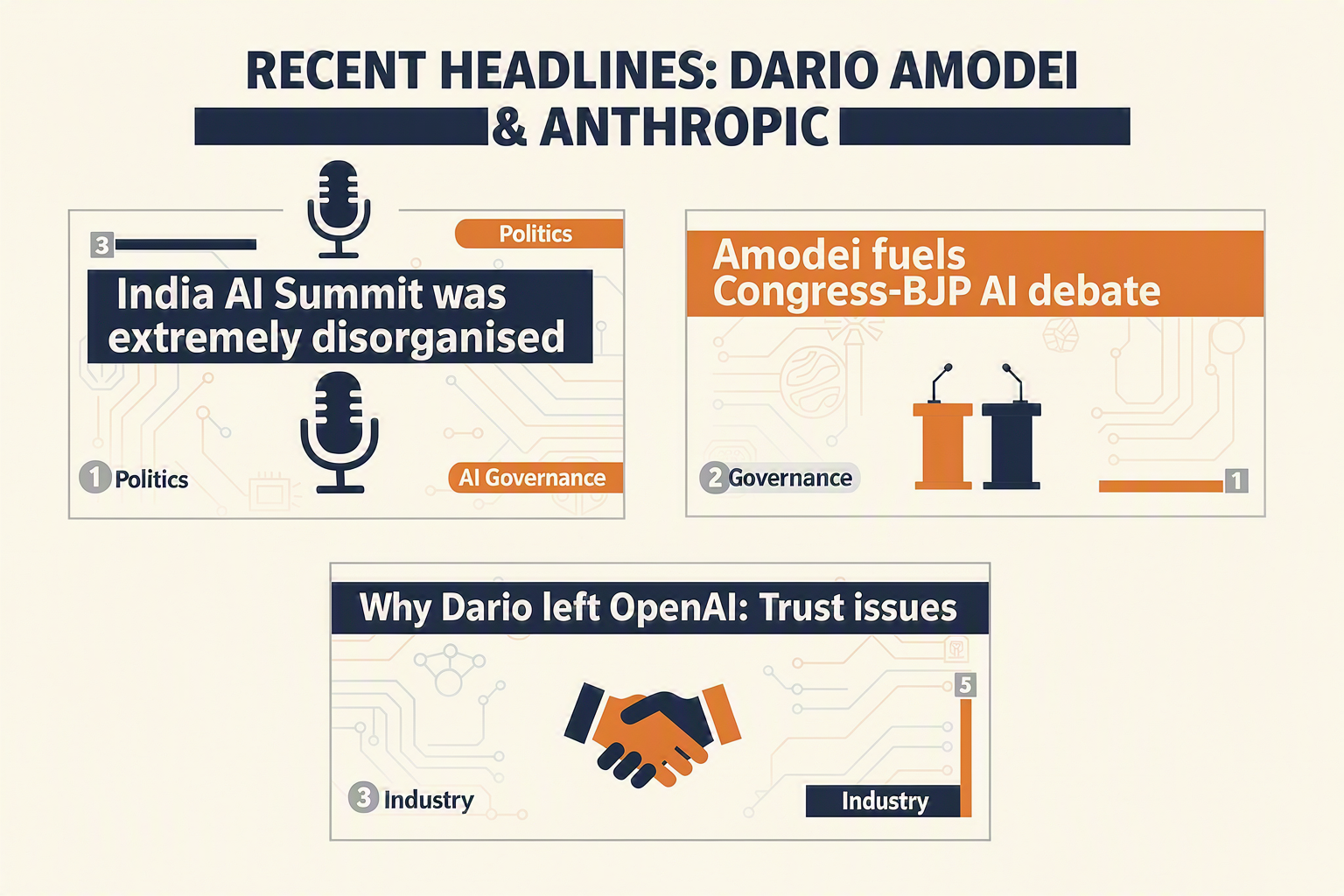
Dario Amodei’s transition from a behind-the-scenes researcher to a prominent tech CEO has placed him directly under the global media spotlight. His public statements frequently shape industry-wide conversations about safety, corporate ethics, and geopolitical AI deployment. From his candid critiques of major industry events to his transparent explanations of his split from OpenAI, Amodei’s public profile reflects his deeply principled—and sometimes polarizing—approach to the AI revolution.
Key Public Flashpoints and Industry Impact
Amodei recently made headlines during a viral stage appearance alongside OpenAI’s Sam Altman at the India AI Summit. His candid observation that the summit was "extremely disorganised" quickly transcended tech circles, fueling a highly publicized political row between India's Congress and BJP parties. This incident highlighted how even casual remarks from leading AI executives are heavily scrutinized in an era of intense national AI competition.
Beyond geopolitical event drama, Amodei has been increasingly vocal about his high-profile departure from OpenAI. In recent media appearances, he addressed the split directly, asking, "Why argue with someone" when you "don't trust them." This blunt assessment reinforces Anthropic's positioning as the safety-oriented, transparent alternative to OpenAI. However, Amodei is also realistic about the operational challenges of managing a hyper-growth startup, jokingly admitting that Anthropic’s explosive expansion has sometimes been "too hard to handle" for the public benefit corporation.
| Event / Topic | Dario Amodei's Stance | Public/Industry Impact | Key Context |
|---|---|---|---|
| India AI Summit | Described the high-profile summit as "extremely disorganised." | Sparked a domestic political row between India's Congress and BJP parties. | Shared a viral stage moment with rival Sam Altman. |
| Split from OpenAI | Stated there was no point arguing with someone you "don't trust." | Positioned Anthropic as a safety-first public benefit corporation. | Left OpenAI in 2021 to co-found Anthropic with sister Daniela Amodei. |
| Anthropic's Growth | Jokingly admitted rapid scaling is "too hard to handle." | Highlighted the intense pressure of competing with trillion-dollar tech giants. | Claude models have seen massive enterprise adoption. |
| Cybersecurity Risks | Warns of imminent, AI-led cyberattacks on global infrastructure. | Amplified calls for stricter international AI safety protocols. | Detailed in his personal essay, The Adolescence of Technology. |
Navigating the Future of Safe AI Deployment
As Amodei steers Anthropic through these public debates, his primary focus remains on defending systems against emerging digital threats. In his essay, The Adolescence of Technology, Amodei warned that AI-led cyberattacks will soon present an "unprecedented threat to the integrity of computer systems around the world." To combat this, Anthropic focuses heavily on creating steerable, interpretable, and highly secure AI architectures.
For enterprises looking to operationalize these advanced models safely, infrastructure compatibility is key. Platforms like CallMissed help bridge the gap between cutting-edge LLMs and real-world execution. By offering seamless developer access to over 300+ LLMs alongside specialized Speech-to-Text APIs supporting 22 regional Indian languages, CallMissed allows businesses to deploy secure AI voice agents and multilingual WhatsApp chatbots without compromising on security. While industry pioneers like Amodei debate the macro-ethics of AI on the global stage, the practical deployment of these technologies relies heavily on robust, production-ready communication infrastructure.
Dario Amodei's Impact on AI: In-Depth Analysis
As a pivotal figure in the evolution of modern artificial intelligence, Dario Amodei has fundamentally reshaped how the tech industry approaches model safety, commercialization, and organizational governance. After serving as VP of Research at OpenAI, Amodei famously parted ways with Sam Altman to co-found Anthropic in 2021 alongside his sister, Daniela Amodei. This departure was driven by a deep conviction regarding AI safety and alignment—a stance underscored by his recent reflection on leaving OpenAI: "Why argue with someone" when you "don't trust them."
Safety as a Product: The Constitutional AI Philosophy
Amodei's most lasting contribution to the AI landscape is establishing Anthropic as a Public Benefit Corporation (PBC). Rather than treating safety as an afterthought, Amodei integrated it into the training cycle through pioneering techniques like Constitutional AI. This approach trains models to adhere to a specific set of principles, making systems like the Claude LLM family inherently more:
- Steerable: Easier for developers to guide toward predictable and helpful outcomes.
- Interpretable: Designed to help researchers understand the internal reasoning behind specific outputs.
- Safe: Highly resistant to jailbreaking, prompt injections, and harmful instruction generation.
In his essay, The Adolescence of Technology, Amodei warned of emerging threats like AI-driven cyberattacks, advocating for a proactive defensive posture. He argues that as AI transitions from novelty to critical infrastructure, safety must scale ahead of raw capability.
Global Influence and the Scaling Challenge
Amodei’s influence extends far beyond the Silicon Valley ecosystem. Under his leadership, Anthropic’s explosive growth has occasionally been characterized as "too hard to handle," a testament to the massive global demand for enterprise-grade, reliable AI.
This global expansion has also placed Amodei directly in the geopolitical spotlight. During an appearance at the India AI Summit, Amodei’s candid remarks about the event being "extremely disorganised" sparked a viral stage moment with Sam Altman and even triggered a domestic political row between India's Congress and BJP parties. This incident highlighted how closely international governments and business leaders watch Amodei's moves as they seek to build out their own sovereign AI frameworks.
Bridging Frontier Research with Practical Deployment
While Amodei and his team at Anthropic focus on pioneering these safe, frontier-class models, enterprise adoption relies on flexible infrastructure that can operationalize them. This is where platforms like CallMissed bridge the gap.
Through CallMissed’s multi-model API gateway, developers can seamlessly integrate and switch between over 300 LLMs—including Anthropic's state-of-the-art Claude models—without rewriting their core code. Furthermore, as businesses deploy these safe models globally, CallMissed provides the production-ready infrastructure to transform Claude’s raw intelligence into highly responsive, multilingual AI voice agents and WhatsApp chatbots supporting 22 regional Indian languages.
By decoupling the underlying frontier models from the deployment layer, Amodei’s vision of safe, steerable AI is brought directly to the frontlines of global customer communication.
Implications for the Future of AI and Tech Policy
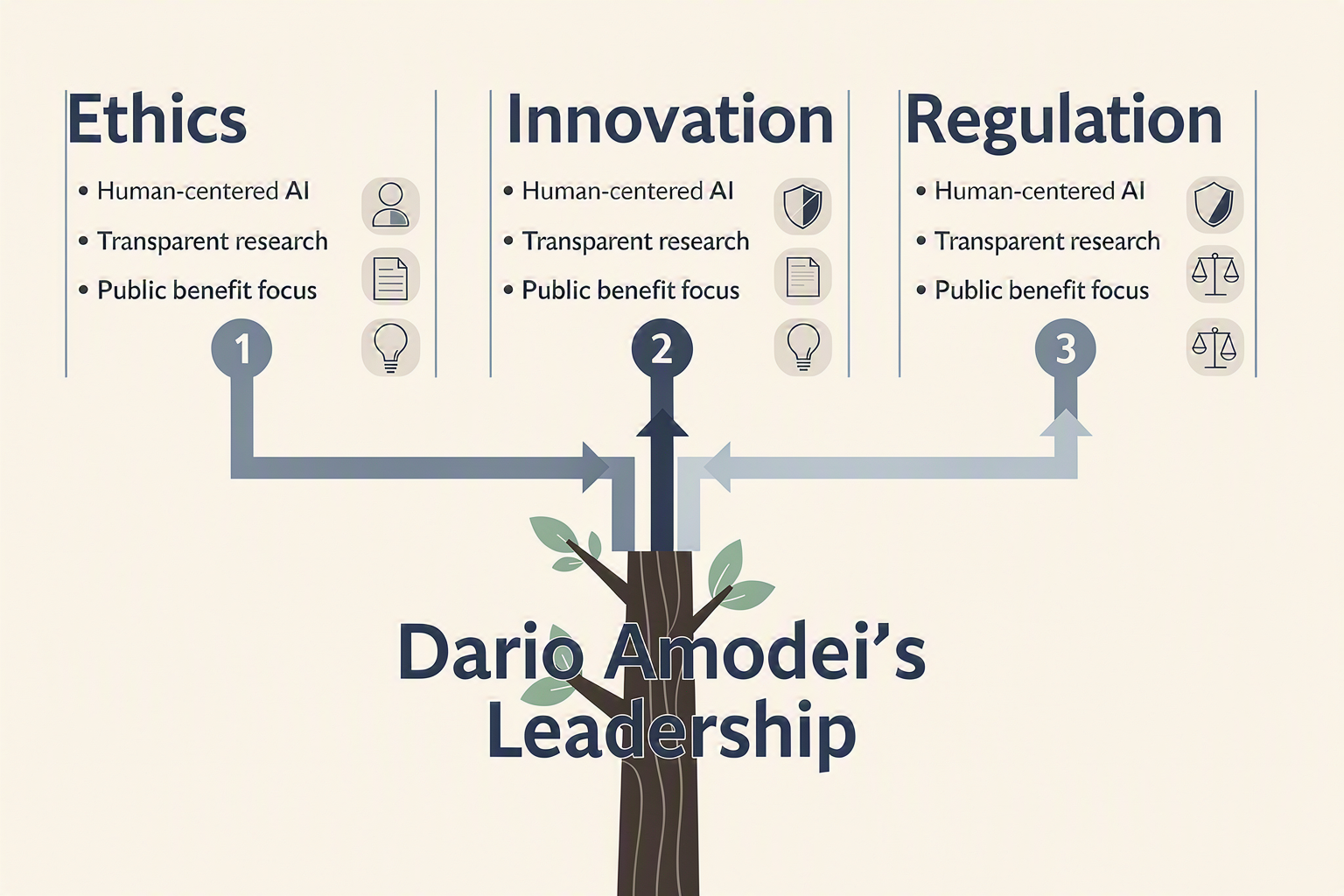
Dario Amodei’s philosophical split from OpenAI highlights a critical turning point for the future of artificial intelligence: the ongoing tension between rapid commercialization and safety-first alignment. By structuring Anthropic as a Public Benefit Corporation (PBC), Amodei set a precedent for how technology companies can balance fiduciary duties with broader public responsibility. This structural choice is heavily influencing today's debates on global AI regulation, corporate governance, and international policy.
The Shift Toward Safety-First AI Standards
Amodei’s departure from OpenAI—driven by his belief that AI developers must prioritize safety over speed—underlines his commitment to alignment, safety, and interpretability. In his essay, The Adolescence of Technology, Amodei warns of unprecedented risks, such as AI-led cyberattacks, and emphasizes that the industry must build robust guardrails before these technologies mature. This perspective has catalyzed a shift in global tech policy:
- Constitutional AI: Anthropic’s pioneering of "Constitutional AI" has become a benchmark for model training, proving that AI can self-correct and adhere to safety guidelines based on a set of written principles.
- Proactive Regulation: Governments are increasingly moving away from reactive policing toward proactive safety frameworks, drawing inspiration from Anthropic's voluntary commitments and safety evaluations.
Geopolitical AI Landscapes and Infrastructure
The implications of Amodei's vision extend far beyond Silicon Valley to global tech hubs like India. Amodei’s recent appearance at the India AI Summit—where his candid remark about the event being "extremely disorganised" sparked intense local political debates—shines a spotlight on the challenges of scaling AI infrastructure globally. As nations race to build sovereign AI capabilities, they face the dual challenge of managing logistics and ensuring technological safety.
For enterprises navigating this complex geopolitical and regulatory landscape, relying on a single model provider is no longer viable. Businesses require flexible, compliant infrastructure. Platforms like CallMissed address this need by offering a multi-model API gateway supporting over 300+ LLMs, allowing organizations to easily deploy safety-oriented models like Anthropic's Claude alongside specialized regional tools. This flexibility is particularly crucial in diverse markets like India, where CallMissed’s Speech-to-Text APIs support 22 regional Indian languages natively, ensuring localized compliance and accessibility.
Rethinking Corporate Trust and Open Source
Ultimately, Amodei’s approach suggests that the future of tech policy will not just be written by legislators, but by the architectural choices of AI builders. By championing "steerable and interpretable" systems, Anthropic has forced the industry to reconsider what constitutes "trust" in artificial intelligence. As global policy discussions evolve, the focus is shifting from simple performance benchmarks to verifiable safety metrics, ensuring that the next generation of AI remains a benefit to society rather than a threat.
What This Means For You (TABLE)
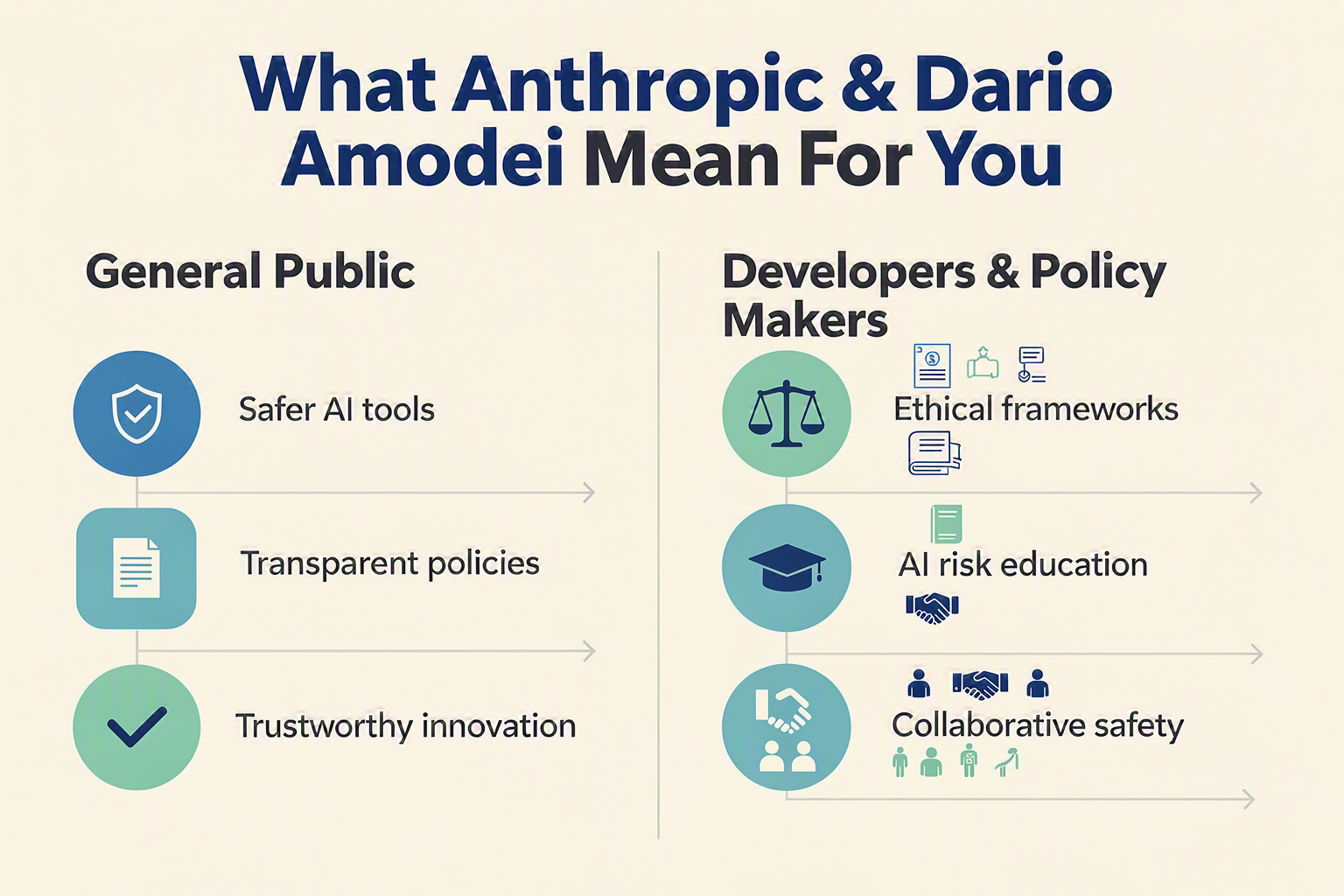
When a high-profile figure like Dario Amodei becomes a trending topic—garnering 200+ searches and international headlines—it's a sign that the world of AI is shifting in meaningful ways. As CEO of Anthropic, a public benefit corporation committed to steerable, interpretable, and safe AI systems, Amodei’s work is at the nexus of innovation, ethical debate, and global opportunity. But what does this mean for you as a developer, business leader, policymaker, or AI enthusiast? The table below distills the implications into actionable takeaways and key considerations, backed by recent events and emerging industry trends.
| Audience | Why Dario Amodei Matters | Key Actions/Implications | Relevant Fact/Data Point | Platforms to Watch |
|---|---|---|---|---|
| Developers & Engineers | Anthropic’s open research on "steerable" AI impacts best practices | Adopt transparent ML workflows; focus on model steerability | Anthropic is among a few labs prioritizing model steerability (source: Anthropic) | Anthropic, CallMissed |
| Business Leaders | Generative AI is critical for automation and CX | Explore AI voice/chat agents for cost savings and scale | AI voice agents can cut call center costs by 40% (Gartner, 2026 est.) | CallMissed, OpenAI |
| Policymakers | Debates at AI summits underscore regulatory urgency | Collaborate with AI firms for pragmatic governance | Amodei called the 2026 India AI Summit "extremely disorganised" over lack of clear structure (Deccan Herald, 2026) | WEF, National AI Missions |
| Startups & Innovators | Amodei’s exit from OpenAI signals space for new research cultures | Leverage open LLMs and API gateways for rapid prototyping | 300+ LLMs now accessible via single API endpoints (CallMissed, 2026) | CallMissed, Hugging Face |
| Global Users | Multilingual AI and safe, interpretable agents reach new markets | Choose platforms with robust language and safety features | Anthropic and Indian entrants like CallMissed support 22+ languages and local compliance | CallMissed, Anthropic |
| Academic Community | Focus shifting to AI safety, robustness, interpretability | Prioritize research on adversarial risk and trust in AI | “AI-led cyberattacks … serious and unprecedented threat” — Dario Amodei, 2026 (Essay) | Anthropic, major journals |
Key Takeaways
- Model Steerability & Transparency: With Anthropic’s model, greater interpretability is becoming an industry must. Tools and APIs that expose how decisions are made (as with CallMissed APIs for voice and chat) are rapidly gaining traction.
- Multilingual Reach: The growth of Indian AI infrastructures like CallMissed has made 22+ languages natively available to conversational bots and digital assistants, democratizing access for a broader population.
- AI Safety is Non-Negotiable: Amodei’s warnings about the risks of AI—such as the potential for cyberattacks—highlight why explainability, security protocols, and ethical design matter. Companies grounded in these principles (Anthropic, CallMissed) are setting standards for safe deployment.
- Developer Acceleration: Access to 300+ language models via unified APIs (as showcased by CallMissed) reduces development friction and encourages experimentation—critical in a time of rapid AI evolution.
- Policy and Governance: The controversy at the 2026 India AI Summit (where Amodei called the proceedings "extremely disorganised") underscores the need for policymakers to collaborate closely with technical leaders and set frameworks that keep pace with innovation (Hindustan Times, 2026).
As AI leadership—exemplified by Dario Amodei—shapes global infrastructure and sets fresh benchmarks in transparency and multilingual capacity, practical platforms like CallMissed are already helping organizations turn theory into scalable, secure, and impactful solutions. For anyone tracking the future of AI, these shifts mean new tools, tougher standards, and vastly broader horizons.
Frequently Asked Questions
Who is Dario Amodei and what is his role at Anthropic?
Why did Dario Amodei leave OpenAI to start Anthropic?
What is Dario Amodei's stance on AI safety and security risks?
What happened at the India AI Summit involving the Anthropic CEO?
What is the educational and professional background of Anthropic's founder?
How does Anthropic's Claude model compare to other enterprise AI systems?
Conclusion
As the artificial intelligence landscape accelerates, Dario Amodei’s safety-first philosophy at Anthropic offers a critical blueprint for the future of tech. Key takeaways from his leadership include:
- Safety-First Architectures: Championing a Public Benefit Corporation structure to ensure that AI steerability and alignment are prioritized alongside scale.
- Value-Driven Strategy: Transitioning away from OpenAI to build an enterprise ecosystem where long-term trust and transparency take precedence over aggressive commercialization.
- Proactive Defense: Actively preparing for "adolescent" technology threats, ranging from systemic digital vulnerabilities to AI-led cyberattacks.
Moving forward, the industry must watch whether Amodei’s rigorous safety framework can set a global standard as LLMs become deeply integrated into everyday business operations. For enterprises looking to deploy these evolving AI capabilities safely and effectively today, platforms like CallMissed provide the infrastructure needed to deploy secure, production-ready voice agents and multilingual chatbots.
As the boundaries of machine intelligence push further, will the broader tech ecosystem embrace Amodei's disciplined safety model, or will the rush for raw capability compromise trust?
Related Posts
Everything You Need to Know About GPT-5.6 Terra: OpenAI’s Balanced AI Model for 2026

The 24/7 Digital ISA: How Realtors Use AI Voice Agents, Missed Call Bots, and WhatsApp to Lock In Deals

AI Voice Agent for Missed Calls — Turn Missed Calls into Leads
Ready to automate customer conversations?
Launch AI voice agents and WhatsApp bots with CallMissed — one API, 22+ Indian languages.