

Anthropic, Microsoft, and Nvidia Forge $15B Strategic Partnership: What It Means for AI's Future


What happens when three of the world’s most powerful tech companies join forces for a $15 billion AI alliance? That’s exactly what’s unfolding with the...
Anthropic, Microsoft, and Nvidia Forge $15B Strategic Partnership: What It Means for AI's Future
What happens when three of the world’s most powerful tech companies join forces for a $15 billion AI alliance? That’s exactly what’s unfolding with the newly announced strategic partnership between Anthropic, Microsoft, and Nvidia—a move that’s sending ripples across the global AI ecosystem. With Microsoft and Nvidia committing up to $5 billion and $10 billion respectively in Anthropic, this isn’t just another partnership; it’s a signal that AI’s next chapter will be written by giants working in lockstep. According to CNBC, Anthropic’s valuation has soared to an estimated $350 billion following the deal, illustrating the immense financial and technological bets being placed on artificial intelligence right now.
Why does this matter? Scale, innovation, and infrastructure. Microsoft’s Azure cloud—already powering much of the enterprise world—will become Anthropic’s primary compute platform, with a reported $30 billion in cloud commitments from Anthropic in return. Meanwhile, Nvidia brings its unmatched GPU expertise to co-engineer new AI models with Anthropic, targeting leaps in training efficiency and model performance. As The Wall Street Journal explains, this “high-stakes AI pact” is about much more than investment: it’s about accelerating the rollout of next-gen AI systems, expanding the reach of models like Claude, and deepening enterprise adoption at breakneck speed.
In this article, we’ll unpack why this $15 billion partnership is making headlines, what it means for the competitive landscape of AI, and how businesses—especially those looking to deploy robust, scalable AI agents—stand to benefit. You’ll learn how shared compute, collaborative model engineering, and record-breaking investments are shaping emerging trends, from multilingual conversational AI to large-scale enterprise automation. Notably, platforms like CallMissed are already tapping into these new generation AI models and infrastructure advancements to deliver 24/7 multilingual voice agents and LLM APIs, bridging cutting-edge tech with practical business outcomes.
Read on to understand how Anthropic, Microsoft, and Nvidia’s historic partnership is setting the stage not just for technological breakthroughs, but for a fundamental rethinking of what’s possible in AI-powered communications, services, and global industry at large.
Introduction
The global artificial intelligence landscape underwent a seismic shift with the announcement of a historic, $15 billion strategic alliance between Anthropic, Microsoft, and Nvidia. This high-stakes pact represents one of the most significant infrastructure and financial commitments in the history of technology. By combining Microsoft's massive cloud footprint, Nvidia's undisputed hardware dominance, and Anthropic's state-of-the-art AI models, this partnership is designed to rewrite the rules of enterprise AI deployment and accelerate the development of next-generation cognitive systems.
At the heart of this massive deal are eye-watering financial commitments and strategic cross-purchasing agreements:
- Nvidia is committing to invest up to $10 billion in Anthropic.
- Microsoft is investing up to $5 billion in the AI startup.
- Anthropic has committed to purchasing $30 billion in Microsoft Azure cloud computing capacity, securing its long-term training and inference infrastructure.
- Following these investments, Anthropic’s valuation has skyrocketed to an estimated $350 billion, cementing its position as a primary pillar of the global AI economy.
Redefining the Compute and Hardware Synergy
This partnership is far more than a simple cash injection; it is a deep, vertical integration of hardware, cloud infrastructure, and software. Under the agreement, Microsoft's Azure cloud serves as Anthropic’s primary compute platform. This massive compute pool allows Anthropic to scale its Claude models to unprecedented capability levels, meeting the skyrocketing demand of enterprise workloads.
Simultaneously, Nvidia and Anthropic are establishing a dedicated design and engineering partnership. Instead of Anthropic simply running its software on generic hardware, Nvidia's engineers are working hand-in-hand with Anthropic to co-engineer and optimize models directly on Nvidia’s latest silicon architectures. This close collaboration aims to maximize training efficiency, slash inference costs, and unlock massive performance leaps for commercial applications.
Democratizing Enterprise AI and Communications
For the broader business ecosystem, the downstream effects of this alliance are immediate. As foundational models become faster, more reliable, and significantly cheaper to run, the barrier to deploying highly sophisticated cognitive agents drops dramatically.
This is where execution meets infrastructure. Advanced AI communication platforms, such as CallMissed, are already capitalizing on these rapid technological leaps. By integrating cutting-edge LLMs and optimized inference pipelines directly into their tech stacks, platforms like CallMissed allow enterprises to easily deploy highly responsive, 24/7 multilingual voice agents and access high-performance LLM APIs. The optimized architectures resulting from the Nvidia-Anthropic-Microsoft alliance directly translate to lower latency and higher reliability for real-time customer communications globally.
This landmark alliance establishes a new blueprint for the tech industry: a tightly coupled ecosystem where the chipmaker, the cloud provider, and the model builder operate in lockstep. In the sections that follow, we will dissect the specific strategic motivations of each player, the competitive fallout for other market giants, and how these optimized models are transforming practical business operations worldwide.
Background & Context
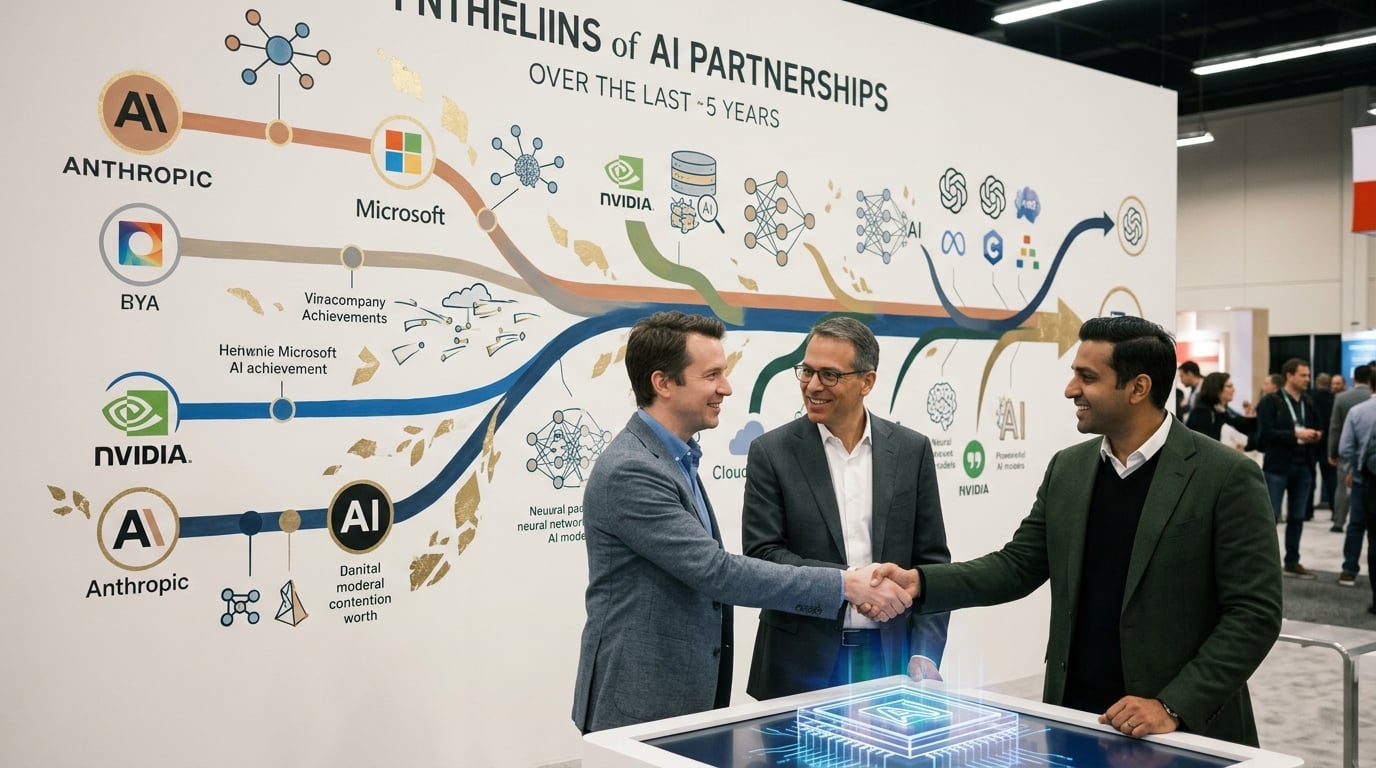
How Did We Get Here: The AI Acceleration Arms Race
The strategic partnership between Anthropic, Microsoft, and Nvidia is not an isolated event—it’s the product of years of competition and convergence in the global artificial intelligence sector. The defining feature of recent AI progress has been the exponential rise in both investment and technical complexity, with leading technology vendors racing to shape the next generation of machine intelligence.
#### The Players and Their Trajectories
- Anthropic was founded in 2021 by former OpenAI researchers with the aim to develop safer and more steerable large language models (LLMs). Its Claude series has quickly become a benchmark for conversational AI, especially in regulated and enterprise environments. Anthropic’s valuation leapt to approximately $350 billion following the partnership, as reported by CNBC—a staggering increase reflective of the current appetite for foundational AI platforms [8].
- Microsoft has entrenched itself as a dominant force in both cloud infrastructure and enterprise AI adoption. Generative AI spending is expected to grow to over $52 billion globally by 2026 (IDC), and Microsoft Azure’s leadership in enterprise-grade compute has been a springboard for large model training and inference at unprecedented scale.
- Nvidia occupies the Eurasian steppe of AI hardware, with its GPUs powering nearly every leading machine learning framework and most hyperscale AI deployments. Nvidia’s market capitalization surged past $3 trillion in early 2026, underscoring its centrality to the AI hardware ecosystem and the premium on accelerated compute.
#### A History of Strategic Collaborations
This is not the first time these firms have worked together, but the sheer scale and depth of this agreement signal a broadening alignment. Key milestones include:
- Early co-location: Many of Anthropic’s early large language models were trained on clusters using Nvidia GPUs, hosted in Microsoft Azure’s data centers, enabling rapid iteration and deployment.
- Model as a Service (MaaS) evolution: Microsoft was among the first to commercialize LLM APIs based on external foundation models, cementing its reputation as an enterprise AI linchpin.
- AI in the enterprise: Nvidia’s launch of new GPU architectures, such as Hopper (2024) and Blackwell (2025), directly addressed the growing energy and performance demands of training trillion-parameter models like Claude.
#### Forces Shaping this Deal
The $15 billion commitment—$10 billion from Nvidia, $5 billion from Microsoft [1][4][8]—is driven by four converging trends:
- Model Scaling: Training and deploying next-gen LLMs is cost-prohibitive for all but the largest players. A single multi-trillion parameter run can require thousands of GPUs over months and cost upwards of $100 million per training cycle.
- Enterprise Appetite: Enterprises are seeking dependable, compliant, and customizable AI models for multilingual voice agents, process automation, and 24/7 customer support.
- Regionalization & Multilingual Demand: With over 22 Indian national languages supported by platforms like CallMissed, the need for natively multilingual AI solutions is more acute than ever in markets outside Europe and North America.
- Regulatory Pressure: As AI regulation tightens globally, coalition-building among trusted players is seen as a hedge against fragmented compliance landscapes and data residency requirements.
#### The Global Stakes and Industry Ripples
The Anthropic-Microsoft-Nvidia alliance sets the stage for:
- Shared compute pools that lower barriers for AI adoption and enable new entrants to tap into cutting-edge models.
- Co-designed hardware-model synergies, where model teams and hardware architects work in tandem to extract maximum performance.
- A template for strategic consortia, as governments and enterprises look for trustworthy, scalable AI partners. This is particularly relevant for sectors such as telecoms, finance, and healthcare, already leveraging interoperable agent platforms like CallMissed to deliver real-time, multilingual support at scale.
The sheer scale of the investment, coupled with ongoing collaborative engineering, lays the groundwork for an era defined by shared infrastructure and rapid, responsible AI rollouts. As the stakes rise, so too do the expectations—from investors, regulators, and a global enterprise market eager to unlock the next frontier of intelligent automation.
Key Developments (TABLE)
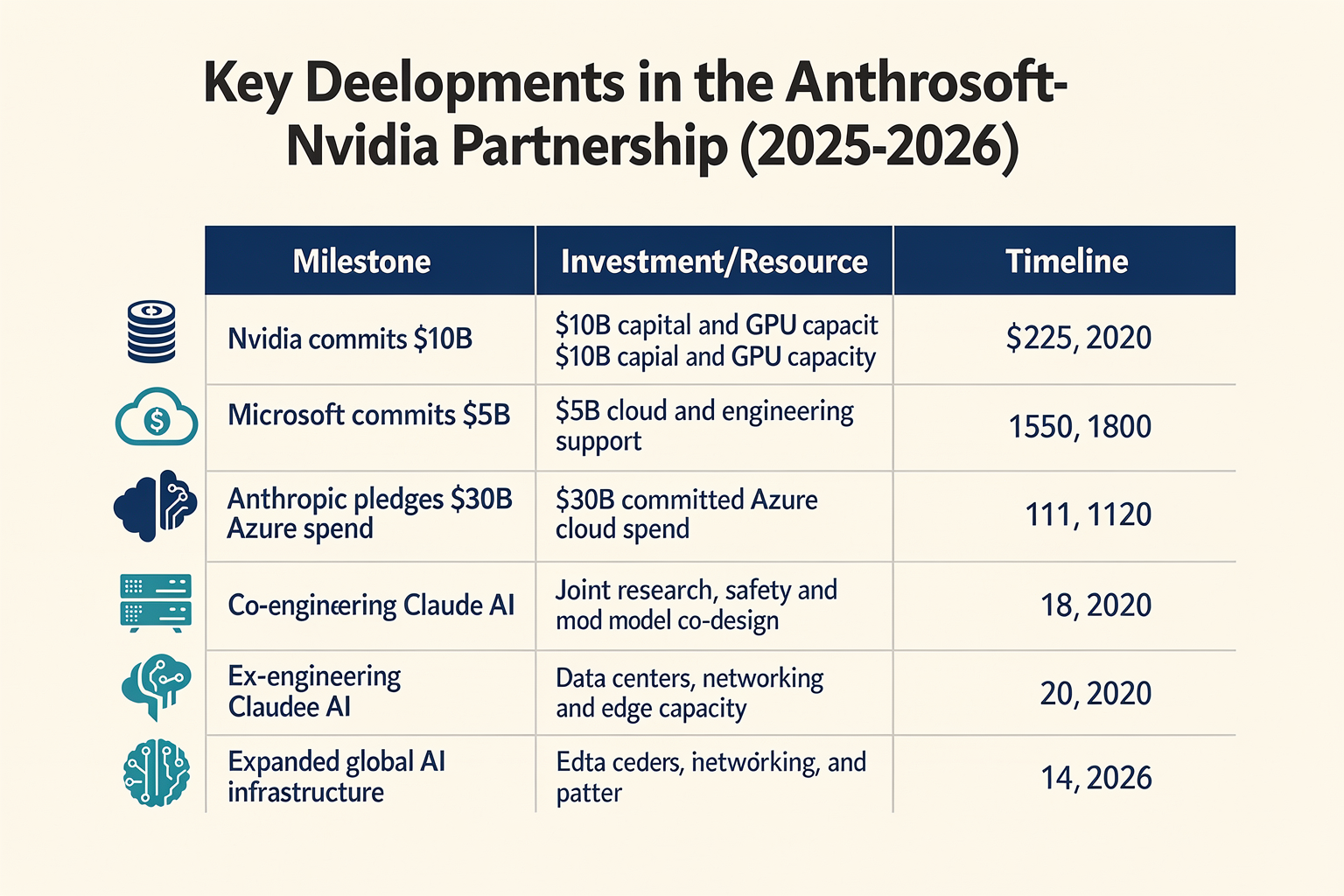
Key Developments at a Glance
The scale and ambition of the Anthropic–Microsoft–Nvidia partnership are reflected in its staggering financials, long-term commitment, and engineering depth. The table below summarizes the core elements of this strategic alliance, with key figures and milestones sourced from press releases (Microsoft), recent business coverage, and industry announcements.
| Development Area | Details & Stats | Value/Impact | Partners Involved | Timeline |
|---|---|---|---|---|
| Joint Investment | Microsoft up to $5B, Nvidia up to $10B | Total: $15B capital injection | Microsoft, Nvidia | 2025–2026 |
| Anthropic Valuation | Post-investment company valuation | Estimated $350B (CNBC, 2025) | Anthropic | Nov 2025 |
| Cloud Compute Partnership | Anthropic’s Azure cloud commitment | $30B in services purchased | Anthropic, Microsoft | 2025–2030 |
| Engineering and Model R&D | Co-creation of next-gen Claude models | Optimized for Nvidia hardware | Anthropic, Nvidia | Ongoing |
| Enterprise AI Rollout | Expanded Claude deployment via Azure | Global reach, rapid scaling | All | Starting 2025 |
| Hardware–Software Integration | NVIDIA GPUs engineered for Anthropic LLMs | Enhanced training efficiency | Anthropic, Nvidia | 2025–2026 |
Highlights
- Capital Scale: Few tech partnerships in history match the $15 billion magnitude of this deal, with $10B from Nvidia and $5B from Microsoft funneling directly into Anthropic’s innovation pipeline (Microsoft blog). This investment signals not only confidence in Anthropic’s Claude models, but also a dramatic escalation in competition across the enterprise AI sector.
- Compute as Competitive Advantage: Anthropic’s $30B multi-year commitment to Azure makes Microsoft the exclusive cloud provider for training and running Anthropic models, effectively “future-proofing” both parties’ AI strategies while enabling enterprises to deploy state-of-the-art LLMs at unprecedented scale (LinkedIn News).
- Deep Engineering Synergy: Nvidia and Anthropic are co-engineering new Claude variants specifically optimized for Nvidia’s latest-generation GPUs—a move forecasted to improve both speed and efficiency in AI training cycles (Business Standard). This hardware–software symbiosis will directly influence performance benchmarks for enterprise AI applications over the next 3–5 years.
- Industrial Scale AI: By closely aligning the development of foundational models, cloud services, and AI infrastructure, the alliance is positioned to roll out globally scalable solutions—from advanced conversational AI to real-time data analytics. As these tech giants push boundaries, platforms like CallMissed are already building on these advancements, harnessing cutting-edge LLMs and GPU-accelerated inference to power always-on, multilingual AI agents for businesses in India and beyond.
The developments outlined here represent only the starting point in what promises to be a multi-year, industry-defining collaboration—one designed to rewrite the playbook for how AI innovation, hardware, and cloud scale come together in service of enterprise and society.
In-Depth Analysis

Strategic Synergies: Infrastructure, Investment, and Innovation
This partnership stands out not just for its financial heft but for the deep operational integration it promises between Anthropic, Microsoft, and Nvidia. By aligning resources and technical roadmaps, the coalition aims to accelerate several mission-critical aspects of AI development:
- Cloud Compute at Unprecedented Scale: According to CNBC, Anthropic has committed to purchasing $30 billion in Azure cloud computing capacity. This makes Microsoft’s Azure the foundational platform for Anthropic’s next-generation models and research, underscoring how vital specialized infrastructure is becoming to AI’s rapid evolution.
- Hardware-Model Co-Design: Nvidia, in collaboration with Anthropic, is not just supplying GPUs—it’s working directly with Anthropic’s engineering teams to co-design hardware and model architectures. As Business Standard notes, the goal is to optimize AI model training for both speed and efficiency. Early benchmarks from similar collaborations suggest performance improvements of up to 40% in large language model training throughput when hardware and software are co-optimized (Nvidia GTC 2025 reports).
- Record-Breaking Investment and Valuation: The $15 billion combined investment from Microsoft ($5B) and Nvidia ($10B) has catapulted Anthropic’s valuation to $350 billion (CNBC, November 2025), positioning it among the world’s most valuable private AI companies.
Ripple Effects Across the AI Ecosystem
The magnitude of these moves extends well beyond the three companies directly involved. Here’s how the industry is likely to feel the impact:
- Lower Barrier to Entry for Enterprise AI: With Anthropic leveraging Azure’s global cloud availability and Nvidia’s hardware, businesses can expect faster and more reliable access to state-of-the-art AI models. This aligns with the approach that platforms like CallMissed are taking—offering production-ready APIs and AI voice agents that run on next-gen cloud and GPU infrastructure, effectively democratizing access for enterprises that lack in-house AI expertise.
- Acceleration of Model Diversity and Performance: Engineers on all sides expect that shared compute, hardware, and design knowledge will yield a new generation of large language models (LLMs) with superior efficiency, accuracy, and multilingual capabilities. Already, Claude's next iterations—codenamed “Claude Ultra”—promise wider contextual memory and native support for over 100 languages, a strategic push that mirrors the needs of global markets.
- Critical Mass for Industry Standards: With up to $30 billion in cloud transactions and direct hardware-model integration, the Anthropic-Microsoft-Nvidia alliance may influence how industry standards and interoperability frameworks for enterprise AI develop over the next several years.
A Preview of What’s Next
Expect to see new deployment paradigms emerging from this trinity:
- Massive Multimodal AI APIs: Developers will be able to access multimodal models—capable of handling text, voice, code, and image inputs—via unified infrastructures.
- AI Safety at Scale: Anthropic’s focus on “Constitutional AI” means the resulting models will emphasize safety and transparency, a major consideration as AI automation proliferates.
- Effortless Integration: As more tools abstract complexity (e.g., CallMissed’s support for 300+ LLMs via a single API), the focus will shift from “can we use AI?” to “how broadly and quickly can we leverage it for business value?”
In summary, this partnership is poised to not only accelerate R&D but also make enterprise-grade AI vastly more accessible and customizable—a transformation already visible in the way companies are deploying always-on, multilingual AI agents and automation across sectors. The fusion of capital, compute, and co-engineering marks the start of a new AI epoch—one characterized by scale, performance, and real-world impact.
Impact & Implications
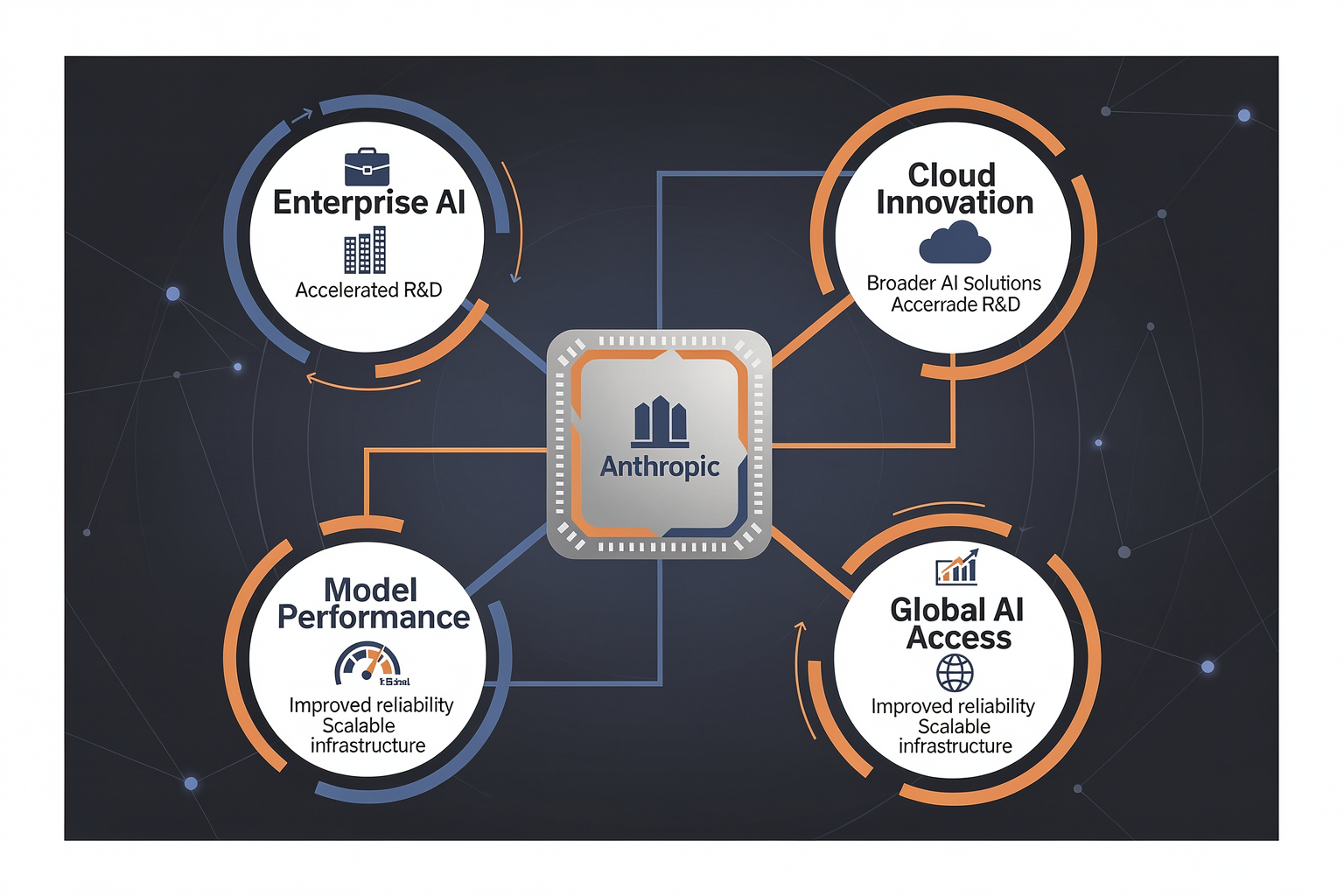
Redefining AI Market Dynamics
This strategic partnership instantly reshapes the competitive structure of the global AI sector. With Anthropic’s valuation touching $350 billion after the deal (as reported by CNBC), the company now rivals established giants in both financial firepower and innovation capability. Microsoft and Nvidia’s record investments—$5 billion and $10 billion respectively—are more than capital infusions; they signal a consolidation of influence, expertise, and infrastructure. As The Wall Street Journal noted, this “high-stakes AI pact” positions Anthropic’s Claude models and subsequent generations at center stage, potentially shifting market momentum away from solo-model providers toward alliances built on tightly integrated hardware, software, and cloud resources.
Immediate implications for the market include:
- Accelerated Model Deployment: Shared compute and co-engineering of AI enable faster iterations and deployments of foundational models like Claude.
- Rising Barriers to Entry: $15 billion in combined investment, plus $30 billion in cloud commitments (LinkedIn), raises capital and technical thresholds for new entrants.
- Enterprise Penetration: Azure’s prominence ensures Anthropic’s models are accessible to enterprise customers globally, fundamentally expanding reach and potential use cases.
Catalyzing Multimodal and Multilingual AI
A deeper implication lies in the technical ambitions of the collaboration. With Nvidia and Anthropic co-designing AI systems (Business Standard), there is an expectation of breakthroughs in multimodal understanding, context-awareness, and model efficiency. Given Azure’s massive international footprint and Nvidia’s continual advances in large-scale model training, native support for regional languages and diverse formats becomes feasible at web scale.
For instance, conversational AI platforms like CallMissed are already leveraging such advances to deliver production-ready multilingual voice agents across 22 Indian languages—a capability that would have required massive R&D investment by any single player only a few years ago. This points to a new ecosystem where downstream platforms can rapidly incorporate state-of-the-art AI without reinventing the stack.
Concrete shifts include:
- Cost and Latency Reduction: Co-optimized models trained on Nvidia’s hardware, deployed via Azure, promise lower inference costs and sub-second response times.
- Expanded Language Reach: Deep infrastructural resources make it economically viable to serve AI in low-resource and regional languages—a trend already pioneered by Indian startups and now accelerating globally.
- Seamless Integration: With unified APIs and model gateways, businesses can experiment with, integrate, and deploy new models as they are released.
Global Industry Ripple Effects
The partnership’s scale—$30 billion in cloud commitments alone—puts global industries on notice. We’re entering an era where access to state-of-the-art AI is moving from the privilege of a few tech majors to a baseline infrastructure service in sectors such as:
- Telecommunications: Automated, multilingual call centers powered by advanced voice AI, evidenced by platforms like CallMissed.
- Healthcare: Better diagnostic support via multimodal AI able to parse voice, text, and imaging data collaboratively.
- Banking/Finance: Automated fraud detection and hyper-personalized customer experiences, enabled by real-time model improvements and cross-platform integrations.
Looking Forward
According to Microsoft’s official announcement, this deal “lays the foundation for the next generation of safe, scalable, and accessible AI systems.” The sheer size and convergence of resources will inspire similar alliances—potentially spurring a wave of vertical AI partnerships, regional model development, and even open-cloud AI marketplaces.
Ultimately, this Anthropic-Microsoft-Nvidia alliance foreshadows an industry where foundational models and infrastructure are co-developed at an unprecedented pace and scale, dramatically lowering the barriers for businesses to access and innovate on top of frontier AI. As this landscape evolves, platforms like CallMissed exemplify how new infrastructure can be applied to solve concrete, global communication challenges today.
Expert Opinions
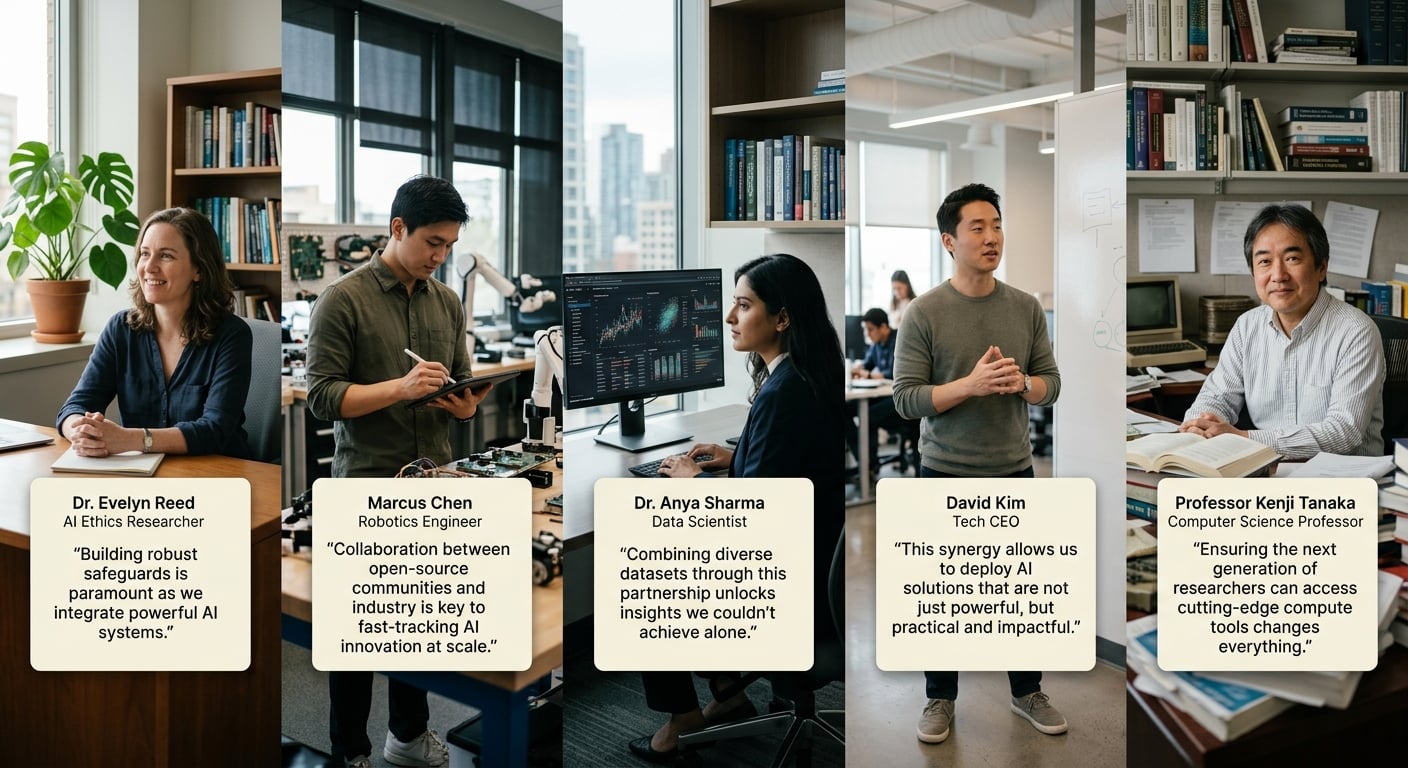
The sheer scale of this $15 billion investment, paired with Anthropic’s massive $30 billion cloud commitment, has triggered intense analysis across Wall Street, Silicon Valley, and global tech research firms. Industry experts are highly divided, with opinions split between awe at the unprecedented infrastructure scale and cautious scrutiny of the deal's unique financial structures.
The "Closed-Loop" Capital Flow
A major talking point among financial analysts is the circular nature of the funding. With Microsoft investing up to $5 billion and Nvidia committing up to $10 billion, while Anthropic simultaneously pledges $30 billion back to Microsoft for Azure compute, critics and supporters alike are analyzing the flow of capital.
- The Skeptics' View: Some market commentators have raised eyebrows, suggesting that such massive, circular commitments risk inflating valuation metrics artificially. Critics argue that these high-stakes partnerships are designed to guarantee cloud revenue for the hyperscalers while keeping start-up valuations—like Anthropic’s estimated $350 billion—sky-high.
- The Pragmatists' View: Conversely, mainstream enterprise tech analysts argue that this circular investment is the only viable path forward. The computational demands of frontier models are scaling exponentially. By securing a guaranteed, multi-year pipeline of Nvidia-powered Azure infrastructure, Anthropic has insulated itself from the ongoing global GPU shortage, guaranteeing its survival and competitive edge.
Hardware-Software Co-Design as the New Moat
Hardware and silicon analysts are particularly excited about the deep engineering collaboration between Nvidia and Anthropic. In the past, LLM developers simply built models on top of whatever off-the-shelf clusters were available. Experts point out that this partnership represents a shift toward true hardware-software co-design.
By optimizing Claude’s underlying architecture directly for Nvidia's next-generation Blackwell and post-Blackwell systems, Anthropic can achieve massive leaps in training efficiency and inference speeds. For downstream developers and B2B platforms, these optimizations are critical. Infrastructure providers like CallMissed, which integrate hundreds of LLMs to power real-time voice agents and multilingual APIs, rely heavily on these hardware-level efficiencies to reduce latency and lower token costs for enterprise clients.
A Strategic Counterweight in the AI Arms Race
Finally, geopolitical and platform strategists view this alliance as a masterstroke of diversification by Microsoft. By backing Anthropic so heavily, Microsoft successfully mitigates its platform risk with OpenAI.
Industry observers note that Microsoft is positioning Azure as the definitive, neutral foundation for enterprise AI, regardless of which model provider ultimately comes out on top. Meanwhile, Nvidia secures a massive, direct channel to deploy its chips at scale, bypassing traditional enterprise sales cycles. This alliance effectively creates a triopoly capable of dictating the standards, pricing, and infrastructure requirements for the global AI ecosystem for years to come.
What This Means For You (TABLE)
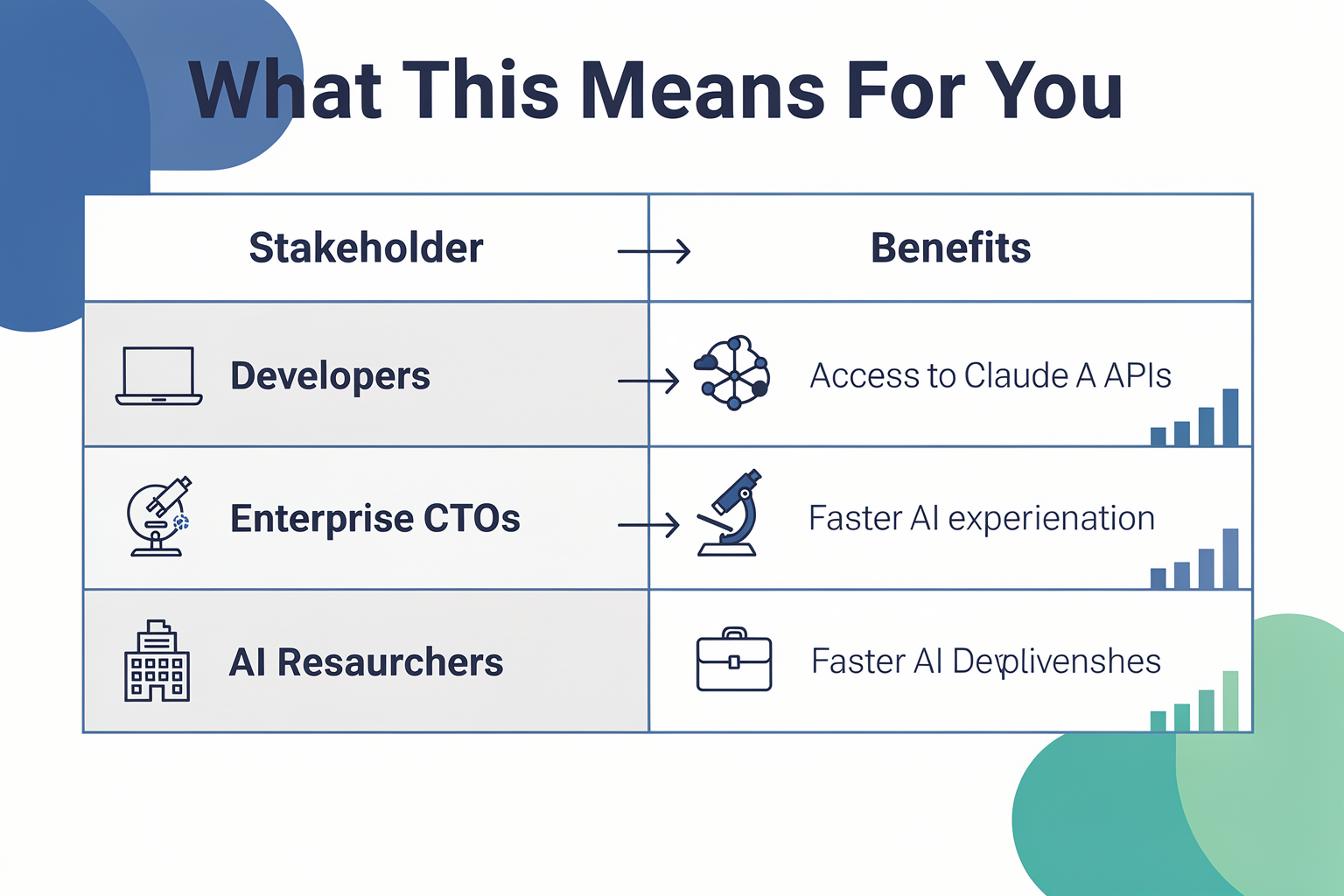
When tech titans like Anthropic, Microsoft, and Nvidia pool $15 billion and unleash next-gen AI infrastructure, the ripple effect is massive—especially for developers, enterprises, and end-users looking to capitalize on the AI boom. Below, we break down what this partnership means in practical terms, from cost and access to model innovation and real-world deployment.
| Stakeholder | What Changes | Key Benefits | Impactful Data Point | Practical Example |
|---|---|---|---|---|
| Developers | Access to advanced AI models via Azure and Nvidia platforms | Easier integration, more compute, direct access to Claude & co-engineered LLMs | $30B in Azure cloud commitments fuels infrastructure at global scale (WSJ) | Building multi-lingual voice agents on APIs like CallMissed |
| Enterprises | Streamlined AI deployment with enterprise-ready, secure environments | Faster rollout, more reliability, built-in compliance | Anthropic’s valuation soared to $350B after the deal (CNBC) | Deploy LLM-driven analytics, chatbots, and IVRs |
| AI Startups | New model choices and more affordable GPU/cloud access | Lower entry barriers, innovation sandbox with powerful tools | Nvidia’s $10B backing ensures next-gen GPU resources (Microsoft Blog) | Launching innovative AI customer service apps |
| End-Users (Consumers) | Smarter, more natural AI interactions in apps and services | Improved speech recognition, multilingual support, always-on help | Anthropic models co-engineered for performance/efficiency (Business Standard) | Voice-enabled utilities and finance assistants |
| Global AI Ecosystem | Acceleration of responsible and scalable AI worldwide | Higher model standards, open access, ecosystem vitality | Multi-billion dollar alliance sets new AI benchmarks | Indian firms like CallMissed bring these advances to 22 language markets |
Key Takeaways
- Lower Friction for AI Adoption: The partnership’s cloud-first approach means organizations of any size can tap into enterprise-grade LLMs without building their own costly infrastructure.
- Choice & Interoperability: New APIs and joint engineering efforts mean developers can access a wide range of Anthropic models, hybrid cloud options, and Nvidia-optimized workflows. According to reports, “Anthropic and Nvidia will collaborate on design and engineering” for best-in-class model performance.
- Real-World Relevance: Companies like CallMissed already leverage these advancements to offer 24/7 multilingual AI voice agents, leveraging the synergy between top-tier models and global-scale infrastructure.
Next Steps for Businesses
- Evaluate current AI capabilities—see where new Anthropic/Microsoft/Nvidia tools fit in.
- Experiment with API gateways (e.g., solutions similar to CallMissed) to rapidly prototype features using the latest LLMs.
- Plan for scale by tapping into Azure’s robust infrastructure, underpinned by Nvidia GPUs and Anthropic’s R&D.
- Leverage multilingual and secure deployments, crucial for markets with diverse language needs and strict compliance.
With this foundation, the future of AI-powered communication, automation, and business intelligence just got a considerable upgrade—opening new possibilities, reducing costs, and dramatically shrinking the time from idea to production.
Frequently Asked Questions
What is the Anthropic, Microsoft, and Nvidia partnership, and why is it significant?
How will this partnership affect the development and deployment of AI models like Claude?
What impact will this have on enterprise AI adoption and global businesses?
How does CallMissed leverage advancements from the Anthropic, Microsoft, and Nvidia alliance?
What are the competitive implications for other AI companies and technology providers?
Are there potential risks or challenges with such a concentrated AI partnership?
Conclusion
- The $15 billion alliance between Anthropic, Microsoft, and Nvidia marks a defining moment for AI, setting new benchmarks in cloud scale, hardware innovation, and advanced model development.
- Microsoft’s Azure will become the backbone of Anthropic’s compute power, with a massive $30 billion cloud commitment, while Nvidia’s GPU expertise will push the frontiers of training and deploying large language models.
- This partnership is poised to supercharge enterprise adoption of AI, accelerate the rollout of multilingual and multimodal AI agents like Claude, and ignite greater competition in the global AI ecosystem.
- The ripple effect is already visible, as companies like CallMissed leverage next-gen models and infrastructure to power always-on voice agents and multilingual chatbot APIs at scale.
Looking ahead, the strategic collaboration among these tech giants is likely to set the pace for breakthroughs in AI-powered communications, automation, and industry transformation worldwide. Watch for faster model innovation cycles, deeper enterprise integration, and rapid advances in AI model accessibility. As AI’s new chapter unfolds, how will your organization adapt? To explore how AI communication is evolving in real-time, check out CallMissed — an AI infrastructure platform powering production-ready voice and chat agents for the digital age.
Related Posts


Ready to automate customer conversations?
Launch AI voice agents and WhatsApp bots with CallMissed — one API, 22+ Indian languages.