
Call Missed Protection in CallMissed: How AI Helps You Never Miss a Customer Call


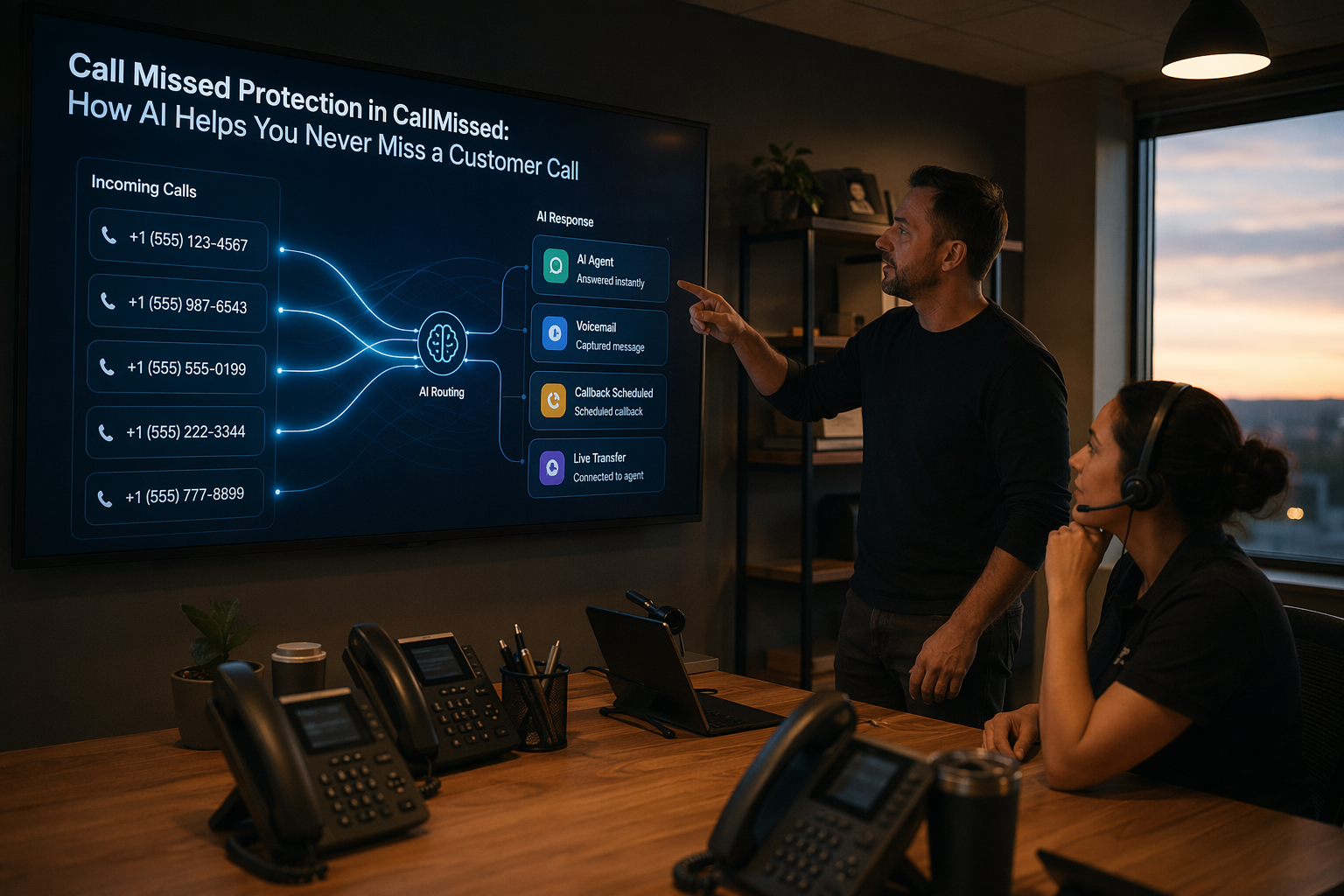
Learn how CallMissed prevents missed calls with AI routing, instant responses, analytics, and practical setup steps for busy teams.
Call Missed Protection in CallMissed: How AI Helps You Never Miss a Customer Call
What if the most expensive customer call is not the one you answered poorly—but the one your team never answered at all?
A missed call sounds simple. Wikipedia defines it as “a telephone call that is deliberately terminated by the caller before being answered by its intended recipient.” But for a business, that tiny red notification can mean a lost lead, an unhappy customer, an abandoned booking, or a competitor getting the conversation instead. Traditional missed call tools were built to tell you what already went wrong. For example, Google Play’s “Missed call Alert” app description says it “keeps record of all Miss Calls and rejected calls which are left without reply,” while Vodafone Idea’s missed call alert service is activated by sending “ACT MCI” to 54300. Useful? Yes. Preventive? Not really.
That is why call missed protection in CallMissed matters right now. Customers expect instant answers across phone, WhatsApp, and chat—often outside office hours, during peak demand, or when human teams are busy. A missed call notification may help you call back later, but “later” is often too late. Modern AI communication infrastructure is shifting the goal from missed call recovery to missed call prevention: answering every inbound call, understanding intent, collecting details, routing urgent requests, and following up automatically.
This is where platforms like CallMissed are part of a broader trend: instead of acting as a basic missed call notification app, CallMissed positions AI voice agents, WhatsApp chatbots, multilingual Speech-to-Text, Text-to-Speech, and access to 300+ LLMs as infrastructure that keeps customer conversations alive in real time.
In this article, you’ll learn:
- What “call missed protection” actually means beyond alerts and logs
- Why traditional missed call alerts fail for sales, support, clinics, agencies, and local businesses
- How AI voice agents can answer calls 24/7, capture customer intent, and reduce response delays
- How CallMissed uses automation, multilingual AI, and smart routing to prevent missed opportunities
- What businesses should look for when choosing an AI-powered call protection system
The core idea is simple: a missed call should no longer be treated as an unavoidable operational gap. With AI, every ring can become a handled conversation, every inquiry can be captured, and every customer can feel heard—even when your human team is unavailable.
Introduction
Why one unanswered call can cost more than it appears
A missed call is easy to underestimate. Technically, Wikipedia defines a missed call as “a telephone call that is deliberately terminated by the caller before being answered by its intended recipient.” In everyday business, however, that simple event often represents something much larger: a buyer who could not get pricing, a patient who could not book an appointment, a customer whose complaint went unresolved, or a high-intent lead who called the next competitor.
For years, missed call systems focused on notification after failure. Google Play’s “Missed call Alert” app, for example, says it “keeps record of all Miss Calls and rejected calls which are left without reply.” Vodafone Idea’s missed call alert service can be activated by sending “ACT MCI” to 54300. These tools are useful for logging what happened, but they do not solve the core problem: the customer still did not get an answer when they needed one.
That gap is exactly where call missed protection in CallMissed changes the model. Instead of treating missed calls as inevitable events to be tracked later, AI communication infrastructure can help businesses answer, understand, and act on calls in real time.
From missed call alerts to missed call prevention
Traditional missed call alerts belong to an older communications era. They tell you:
- Who called
- When they called
- Whether the call was unanswered or rejected
- Whether your team needs to call back
But they usually do not tell you:
- What the customer wanted
- Whether the request was urgent
- Whether the lead was ready to buy
- Which team should handle the issue
- How to continue the conversation automatically
Modern customers expect faster response cycles. They may call during lunch hours, after closing time, during sales peaks, or while every staff member is already speaking to someone else. If the only response is a missed call notification, the business is already behind.
Call missed protection means building a system where the call does not simply fail when humans are unavailable. Instead, an AI voice agent can answer, greet the caller, capture intent, collect key details, escalate urgent issues, and trigger follow-up through phone, WhatsApp, or internal workflows.
Where CallMissed fits into this shift
CallMissed is built around this newer idea: not just recording missed calls, but reducing the chance that important customer conversations are missed at all. The platform combines AI voice agents, WhatsApp chatbots, LLM inference across 300+ models, Speech-to-Text for 22 Indian languages, and Text-to-Speech APIs to support always-on customer communication.
That matters especially for businesses where calls are still high-value:
- Clinics and hospitals handling appointment requests
- Real estate teams managing property inquiries
- Local service providers receiving urgent calls
- Sales teams responding to inbound leads
- Support teams dealing with repeat customer issues
In each case, the real objective is not just to know that a call was missed. The objective is to ensure the caller gets a useful response before they give up.
What this article will explain
This article breaks down how call missed protection works inside CallMissed and why it is different from a basic missed call alert. We will cover:
- The limitations of conventional missed call tracking
- How AI voice agents answer calls 24/7
- How intent capture, routing, and follow-up reduce lost opportunities
- Why multilingual support matters in markets like India
- What businesses should evaluate before adopting an AI call protection system
The key idea is simple: a missed call should no longer be treated as an unavoidable operational weakness. With the right AI layer, every ring can become a handled conversation.
Background & Context
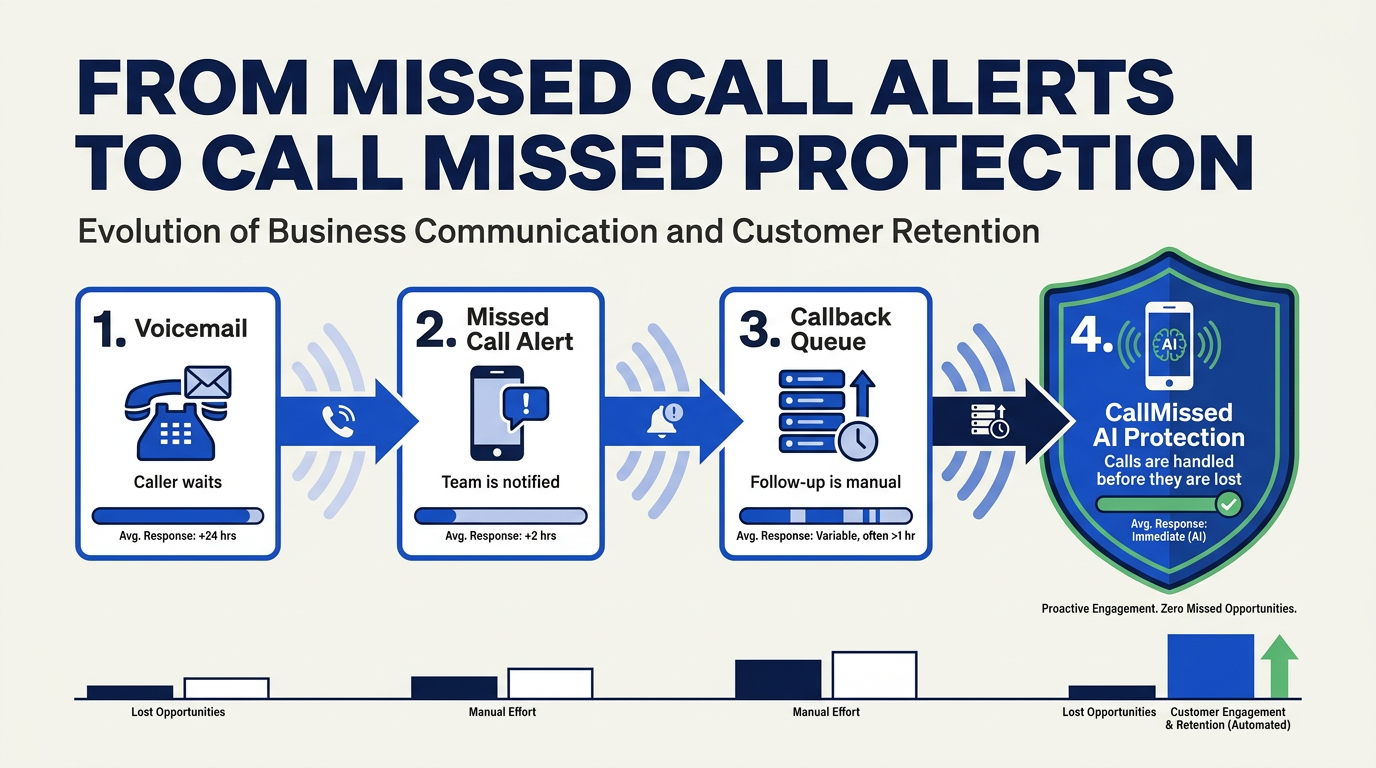
From missed call alerts to missed call protection
For years, the telecom industry treated missed calls as a notification problem. If a call did not connect, the system’s job was to record it, alert the recipient, and let a human decide what to do next. That thinking shows up across the ecosystem: a Google Play “Missed call Alert” app says it “keeps record of all Miss Calls and rejected calls which are left without reply,” while Vodafone Idea’s missed call alert service can be activated by sending “ACT MCI” to 54300.
That model made sense when calls were mostly personal and follow-up was manual. But business communication has changed. A customer calling a clinic, real estate broker, repair service, school, hotel, or insurance agency is often not “just calling”—they are trying to complete a task. They may want to:
- Book an appointment
- Check pricing or availability
- Escalate a support issue
- Confirm an order or delivery
- Speak to sales before choosing a competitor
In that context, a missed call alert is useful but incomplete. It tells the business a conversation was lost, not what the customer wanted, how urgent it was, or whether someone else already handled it.
Why the old approach is reactive by design
Traditional missed call systems were built around after-the-fact awareness. Even telecom patents reflect this orientation: US patent US20060133590A1 describes a method of providing a Missed Call Alert (MCA) for a missed call to a device in a telecommunications network. The core idea is alerting—not answering, qualifying, resolving, or routing.
That creates a major gap for businesses. A missed call log may include a phone number and timestamp, but it usually does not capture:
- Customer intent — Was it sales, support, billing, emergency, or feedback?
- Conversation context — Was the caller new, returning, angry, or ready to buy?
- Priority level — Should the business respond immediately or later?
- Next action — Should the call create a ticket, WhatsApp message, CRM lead, or appointment?
- Language preference — Can the customer communicate comfortably in English, Hindi, Tamil, Bengali, Telugu, or another regional language?
This is why the industry is moving from missed call management to call missed protection. The difference is simple: management starts after the call is lost; protection starts while the phone is still ringing.
The customer expectation has shifted
The healthcare sector offers a useful example. Memorial Sloan Kettering Cancer Center publishes guidance on how patients can prevent missing calls from their care team, showing that missed calls are not only a sales problem—they can affect important service experiences and time-sensitive communication.
The same principle applies commercially. Customers now expect businesses to be reachable across channels, not only during office hours. If the phone is busy, they expect a callback. If they prefer messaging, they expect WhatsApp. If they speak a regional language, they expect to be understood.
This is where AI communication infrastructure becomes relevant. Platforms such as CallMissed approach the problem differently: instead of functioning as another missed call notification app, they use AI voice agents, WhatsApp chatbots, multilingual Speech-to-Text, Text-to-Speech, and access to 300+ LLMs to keep the interaction alive in real time.
The new baseline: every call should produce an outcome
The background context is clear: missed call alerts solved the visibility problem, but not the business outcome problem. A modern call protection system should ensure that every inbound call leads to something measurable:
- A live AI-handled conversation
- A captured lead or support request
- A routed escalation
- A scheduled callback
- A WhatsApp follow-up
- A CRM or ticketing update
That is the foundation for understanding call missed protection in CallMissed: it is not about remembering who called. It is about making sure the customer gets a response before the opportunity disappears.
Key Developments
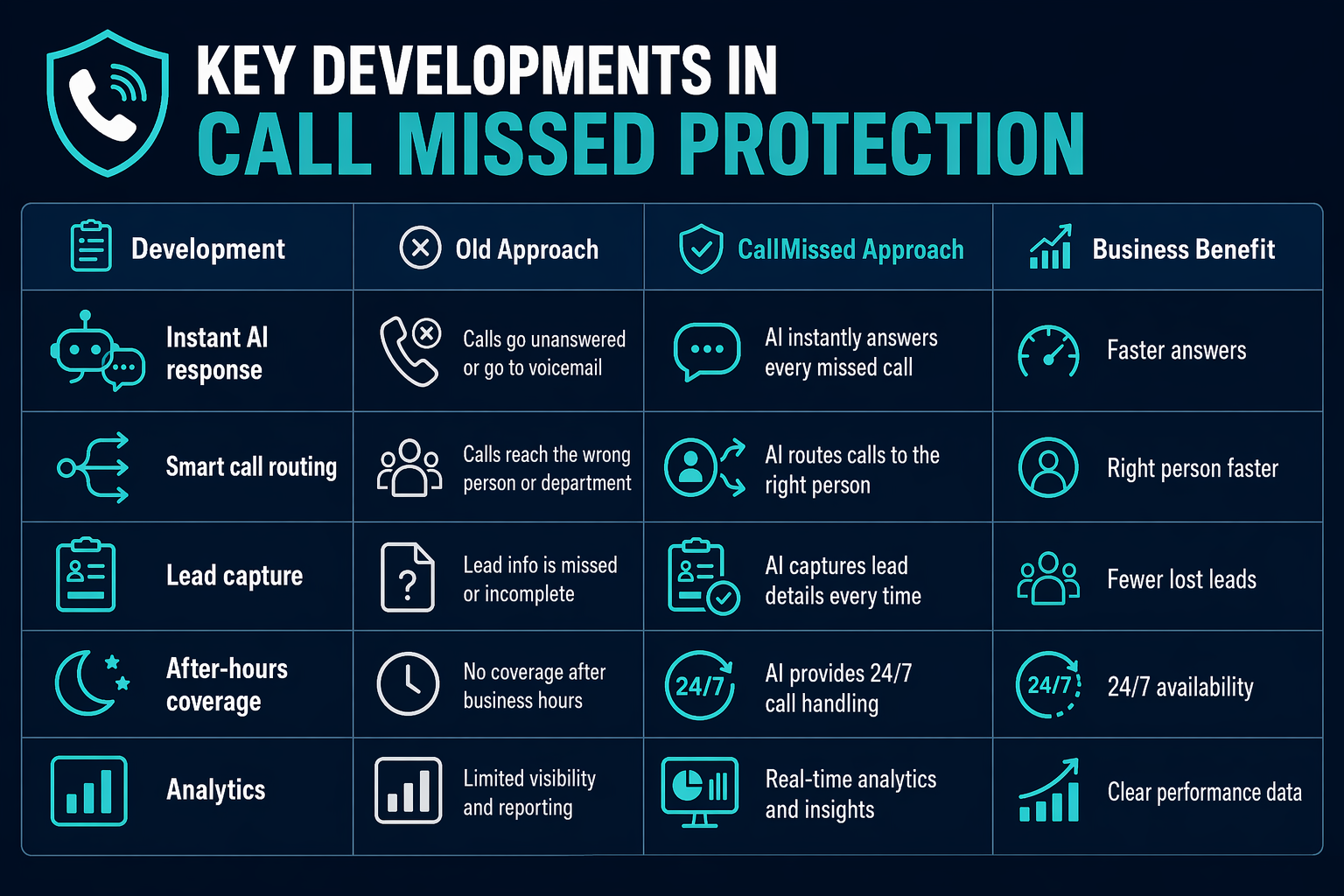
From alerting after the fact to protecting the conversation
The biggest development in missed call management is a shift in objective: from recording missed calls to preventing customer intent from being lost. Older systems treated the missed call as the event. Modern AI systems treat it as a signal that a conversation must continue immediately—through voice automation, WhatsApp, routing, or follow-up.
| Development | Traditional Approach | New Protection Model | Evidence / Source | Business Impact |
|---|---|---|---|---|
| Missed call definition | A call ends before being answered | The call becomes an unresolved customer intent | Wikipedia defines a missed call as one “terminated by the caller before being answered” | Reframes missed calls as lost opportunities, not just phone events |
| Basic missed call logging | Store missed/rejected call history | Capture caller details, reason, urgency, and next step | Google Play listing says “Missed call Alert” “keeps record of all Miss Calls and rejected calls” | Logging helps later, but does not save time-sensitive leads |
| Telecom missed call alerts | SMS-based notification activation | Always-on AI answering and routing | Vodafone Idea says users activate MCA by sending “ACT MCI” to 54300 | Useful for awareness, limited for sales/support conversion |
| Patent-era MCA systems | Notify a device that a call was missed | Automate response before the lead goes cold | Google Patents describes a method for providing a Missed Call Alert (MCA) | Shows the category was historically notification-first |
| AI voice agents | Not available in legacy MCA tools | Answer calls 24/7, understand intent, trigger workflows | CallMissed positions itself as “not a missed call notification app” but an AI platform to prevent missed calls | Reduces dependency on human availability during peak/off-hours |
| Multilingual communication | Caller must wait for the right human agent | AI can transcribe, respond, and escalate in local languages | CallMissed supports Speech-to-Text across 22 Indian languages and access to 300+ LLMs | Better coverage for Indian and global businesses serving diverse callers |
What this means for CallMissed users
For businesses evaluating call missed protection in CallMissed, the key change is operational: the system is not only asking, “Who called?” It is asking:
- Why did they call?
- How urgent is the request?
- Can AI resolve it now?
- Should it move to WhatsApp, CRM, or a human agent?
- What follow-up must happen automatically?
That is a major departure from missed call alert services, which typically stop at notification. A missed call log may tell a clinic that a patient called at 8:43 PM. An AI communication layer can answer, ask whether the patient wants an appointment, collect preferred timing, confirm details, and send the request to staff before the next working day.
The practical takeaway
The market has moved through three stages:
- Stage 1: Notification — “You missed a call.”
- Stage 2: Management — “Here is a list of missed calls to call back.”
- Stage 3: Protection — “The call was answered, understood, and routed automatically.”
CallMissed fits into this third stage by combining AI voice agents, WhatsApp chatbots, multilingual Speech-to-Text, Text-to-Speech, and multi-model LLM access. The result is not just better visibility into missed calls—it is a system designed to keep conversations alive when human teams are busy, offline, or overloaded.
In-Depth Analysis
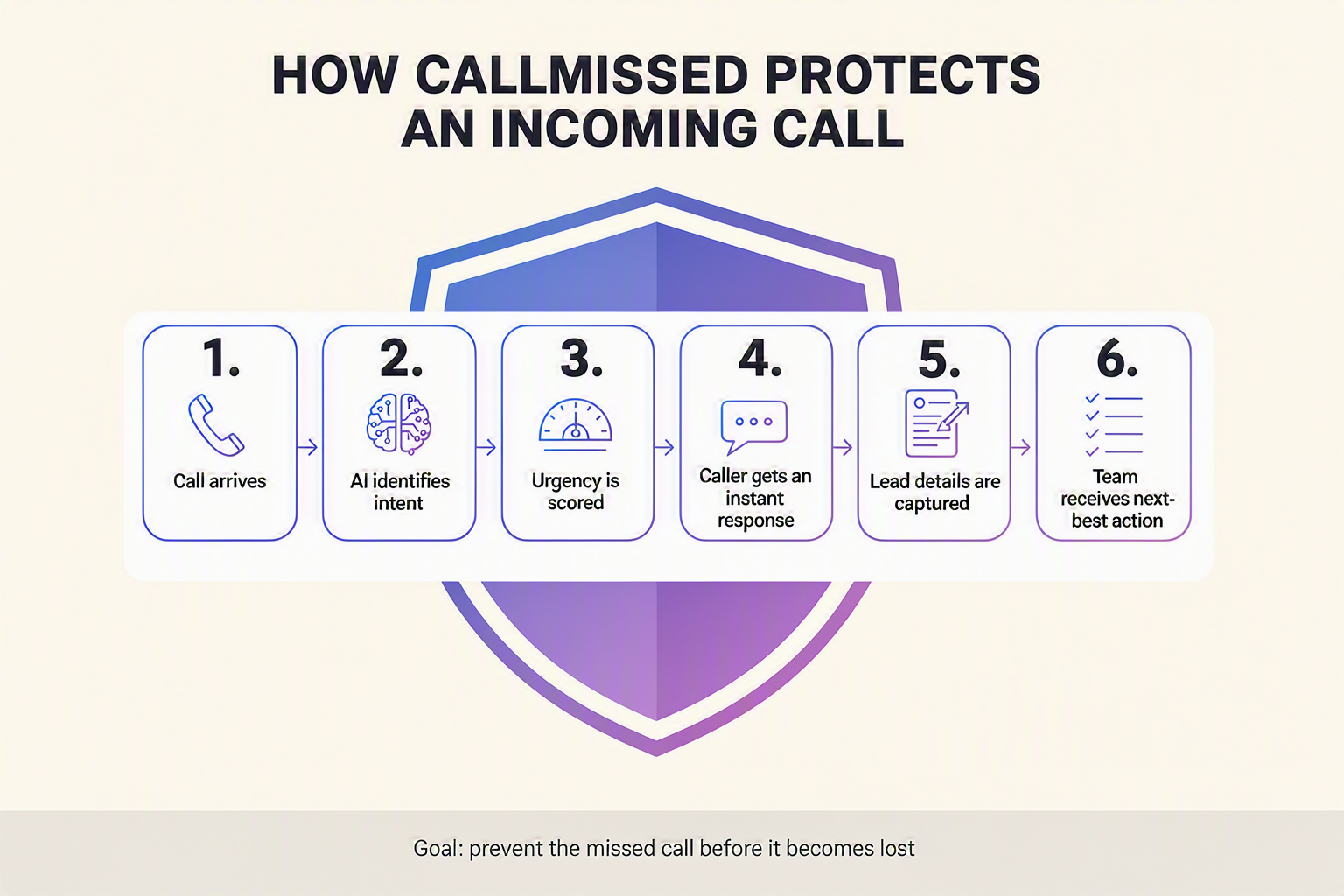
From missed call alerts to missed call protection
The core difference between a traditional missed call system and call missed protection in CallMissed is timing. Most missed call tools operate after the failure has already happened. The Google Play listing for “Missed call Alert,” for example, says it “keeps record of all Miss Calls and rejected calls which are left without reply.” Vodafone Idea’s missed call alert service follows the same reactive pattern: users activate it by sending “ACT MCI” to 54300, then receive alerts when calls are missed.
That model is useful for personal phone hygiene, but it is incomplete for businesses. A lead who called for pricing, a patient trying to schedule, or a customer reporting an urgent issue may not wait for a callback. The business problem is not just “Did we know a call was missed?” It is: Was the customer’s intent captured before they moved on?
The real failure point: response latency
Missed calls create a delay between customer intent and business action. That delay has several hidden costs:
- Lost intent: The caller’s reason is unknown unless they leave a voicemail or answer a callback.
- Lost context: Even if the number is logged, the business does not know whether the call was about sales, support, billing, booking, or escalation.
- Lost trust: Customers interpret silence as unavailability, especially when competitors are one tap away.
- Lost routing accuracy: Without understanding the request, teams cannot prioritize urgent calls over low-value ones.
This is why “call protection” must be more than a notification layer. It needs to answer, understand, classify, and route in real time.
How AI changes the architecture
Older missed call alert systems were built around telecom signaling. A patent such as US20060133590A1 describes “a method of providing a Missed Call Alert (MCA) for a missed call to a first device in a first telecommunications network.” In other words, the network detects that a call was not answered and triggers an alert.
AI communication infrastructure changes the flow:
- Call arrives: Instead of ringing endlessly, an AI voice agent can answer instantly.
- Speech is transcribed: Speech-to-Text converts the caller’s words into structured text.
- Intent is detected: An LLM identifies whether the call is about sales, support, appointment booking, complaint handling, or follow-up.
- Action is triggered: The system can create a ticket, send a WhatsApp message, route to a human, or schedule a callback.
- Conversation continues: If the caller prefers messaging, the flow can move from voice to WhatsApp without losing context.
Platforms like CallMissed apply this model with AI voice agents, WhatsApp chatbots, Text-to-Speech, Speech-to-Text for 22 Indian languages, and access to 300+ LLMs—turning call handling into an always-on workflow rather than a manual callback queue.
Why prevention is stronger than recovery
A missed call alert answers one question: Who called?
Call missed protection answers several more valuable questions:
- Why did they call?
- How urgent is the request?
- Can it be resolved automatically?
- Should a human be notified immediately?
- What follow-up should happen next?
That distinction matters because not every call has the same business value. A restaurant reservation, emergency clinic inquiry, real estate lead, loan application, or SaaS support escalation may require different treatment. AI can tag and route these calls based on intent rather than forcing teams to manually inspect call logs.
The operational advantage
The strongest missed call protection systems do three things well:
- Availability: They answer 24/7, including after hours, lunch breaks, holidays, and peak call periods.
- Understanding: They capture caller intent instead of just storing a phone number.
- Continuity: They move the conversation into follow-up channels such as WhatsApp, CRM, email, or human callback.
That is the strategic shift: missed call management is no longer about maintaining a list of unanswered numbers. It is about building a communication layer where every customer attempt receives an immediate, intelligent response.
Impact & Implications
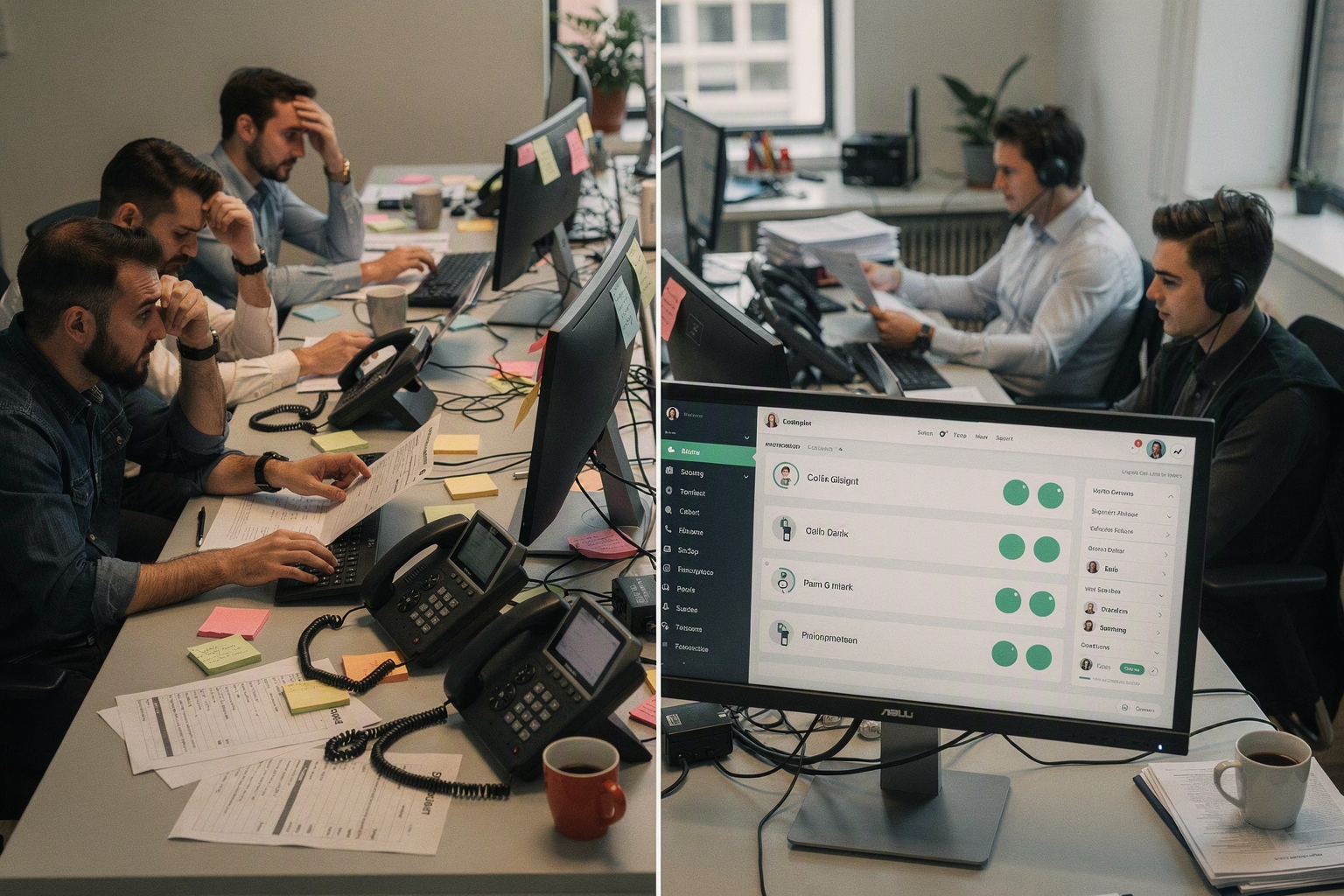
From missed-call logs to revenue protection
The biggest implication of call missed protection in CallMissed is that missed calls stop being treated as an administrative problem and start being treated as a revenue, trust, and continuity problem. Traditional tools mostly document failure after it happens. The Google Play listing for “Missed call Alert,” for example, says it “keeps record of all Miss Calls and rejected calls which are left without reply.” Vodafone Idea’s missed call alert flow is similarly reactive: users activate alerts by sending “ACT MCI” to 54300.
That model helps you know a call was missed. It does not help you save the customer in the moment.
CallMissed changes the operating model by making the first response automated, conversational, and available 24/7. Instead of a business discovering a missed opportunity later, an AI voice agent can answer, identify intent, collect customer details, and trigger the next action while the caller is still engaged.
Operational impact: fewer bottlenecks, faster response
For teams that depend on inbound calls—clinics, real estate agencies, repair services, coaching centers, restaurants, legal offices, local retailers—the impact is immediate. Call traffic rarely arrives evenly. It spikes during campaigns, lunch breaks, emergencies, weekends, holidays, and after-hours windows. Human teams cannot always scale with that demand.
With AI call protection, businesses can:
- Capture every inquiry even when staff are busy or offline
- Separate urgent from routine calls through intent detection
- Route qualified leads to the right person or workflow
- Send instant follow-ups over WhatsApp or SMS
- Maintain service consistency across locations, languages, and time zones
This matters because a missed call is not just a communication gap—it is often a decision point. If the caller needs a cab, a doctor, a plumber, a loan consultation, or a booking confirmation, they may not wait for a callback. They may call the next provider.
Customer experience implications
Wikipedia defines a missed call as a call “terminated by the caller before being answered by its intended recipient.” In customer experience terms, that termination often means frustration. The caller made an effort, received no answer, and now has to decide whether to try again.
AI-powered missed call protection reduces that friction by making the business feel always reachable. Even if a human cannot immediately take over, the customer can still:
- Explain the reason for calling
- Get basic information
- Receive confirmation that their request was recorded
- Be routed to WhatsApp for continued interaction
- Get a scheduled callback instead of waiting indefinitely
This is especially important in multilingual markets like India, where callers may prefer speaking in regional languages. Platforms such as CallMissed support Speech-to-Text across 22 Indian languages, making call protection more inclusive than English-only IVR systems or generic voicemail.
Strategic implications for modern businesses
The larger shift is from missed call alerting to AI communication infrastructure. Older systems, including patented missed call alert methods such as US20060133590A1, were designed to notify a device that a call was missed. Today’s businesses need infrastructure that prevents the missed interaction from becoming a missed outcome.
That has strategic implications:
- Sales teams can reduce lead leakage from unanswered calls
- Support teams can triage issues before agents intervene
- Healthcare providers can protect appointment requests and urgent callbacks
- Service businesses can handle after-hours demand without expanding headcount
- SMBs can offer enterprise-grade responsiveness without a full contact center
CallMissed’s positioning—AI voice agents, WhatsApp chatbots, Text-to-Speech APIs, and access to 300+ LLMs—reflects this broader industry movement. The phone call is no longer an isolated channel. It becomes one entry point into a connected customer conversation.
The business implication: every ring becomes measurable
The most important outcome is accountability. Once calls are answered by AI instead of simply logged as missed, businesses can measure what callers wanted, when demand peaked, which campaigns drove calls, and where handoffs failed.
In that sense, call missed protection is not just about answering more calls. It is about turning a historically invisible loss into structured data, automated workflows, and recoverable customer value.
Expert Opinions

What telecom and CX experts would agree on
Across telecom operations, customer experience, and AI automation, the expert view is converging around one idea: missed call alerts are necessary but no longer sufficient. They tell a business that contact was attempted, but they do not resolve the customer’s need in the moment.
The legacy model is well documented. A traditional missed call alert system, such as the one described in Google Patent US20060133590A1, focuses on “providing a Missed Call Alert (MCA) for a missed call to a first device in a first telecommunications network.” In plain language, the system is built to notify—not converse, qualify, route, or resolve.
That distinction matters. A Google Play listing for “Missed call Alert” says the app “keeps record of all Miss Calls and rejected calls which are left without reply.” Vodafone Idea’s missed call alert service similarly depends on activation by sending “ACT MCI” to 54300. These tools help users know a call was missed, but from an expert CX perspective, they still leave the business with the hardest work: calling back fast enough, understanding the issue, and preventing churn.
The expert shift: from notification to live resolution
Operations leaders increasingly evaluate missed calls through three lenses:
- Speed of response
If the customer has urgent intent—booking, complaint, pricing, emergency support—a delayed callback can lose the opportunity.
- Intent capture
Knowing that a caller rang is less valuable than knowing why they called: sales inquiry, support escalation, appointment request, payment issue, or cancellation risk.
- Continuity across channels
A modern customer journey may start on voice, continue on WhatsApp, and end with a payment link or support ticket. Missed call protection must therefore connect voice, chat, and workflow automation.
This is where AI communication platforms are changing the baseline. CallMissed, for example, frames the problem differently: it is “not a missed call notification app” but an AI platform designed to prevent missed calls from happening in the first place. That aligns with the broader expert view that businesses should not merely log failed contact attempts—they should answer, understand, and act automatically.
What AI specialists look for in call missed protection
AI experts typically focus on whether the system can handle real-world conversation complexity, not just ring events. Strong call missed protection should include:
- 24/7 AI voice agents that answer when staff are busy, offline, or overloaded
- Speech-to-Text accuracy across local languages and accents
- Text-to-Speech quality that sounds clear, natural, and brand-safe
- LLM-based intent detection to classify caller needs in real time
- Escalation logic for urgent, high-value, or sensitive calls
- CRM and WhatsApp follow-up so no conversation disappears after the call ends
For India and other multilingual markets, language coverage is especially important. CallMissed’s support for Speech-to-Text in 22 Indian languages reflects a key expert recommendation: missed call protection should not assume every caller speaks English or Hindi fluently.
The practical takeaway from experts
The strongest expert consensus is that businesses should stop measuring missed calls only as a telecom event and start treating them as a revenue, support, and trust risk.
A basic missed call alert answers one question: Who tried to call?
AI-powered protection answers several more valuable questions:
- What did the caller want?
- Was the issue urgent?
- Should a human be notified immediately?
- Can the AI resolve it now?
- Should the next step happen on WhatsApp, CRM, or another channel?
In short, experts would not define the future of call handling as better missed call logs. They would define it as fewer missed conversations—and that is the standard modern businesses should now expect.
What This Means For You
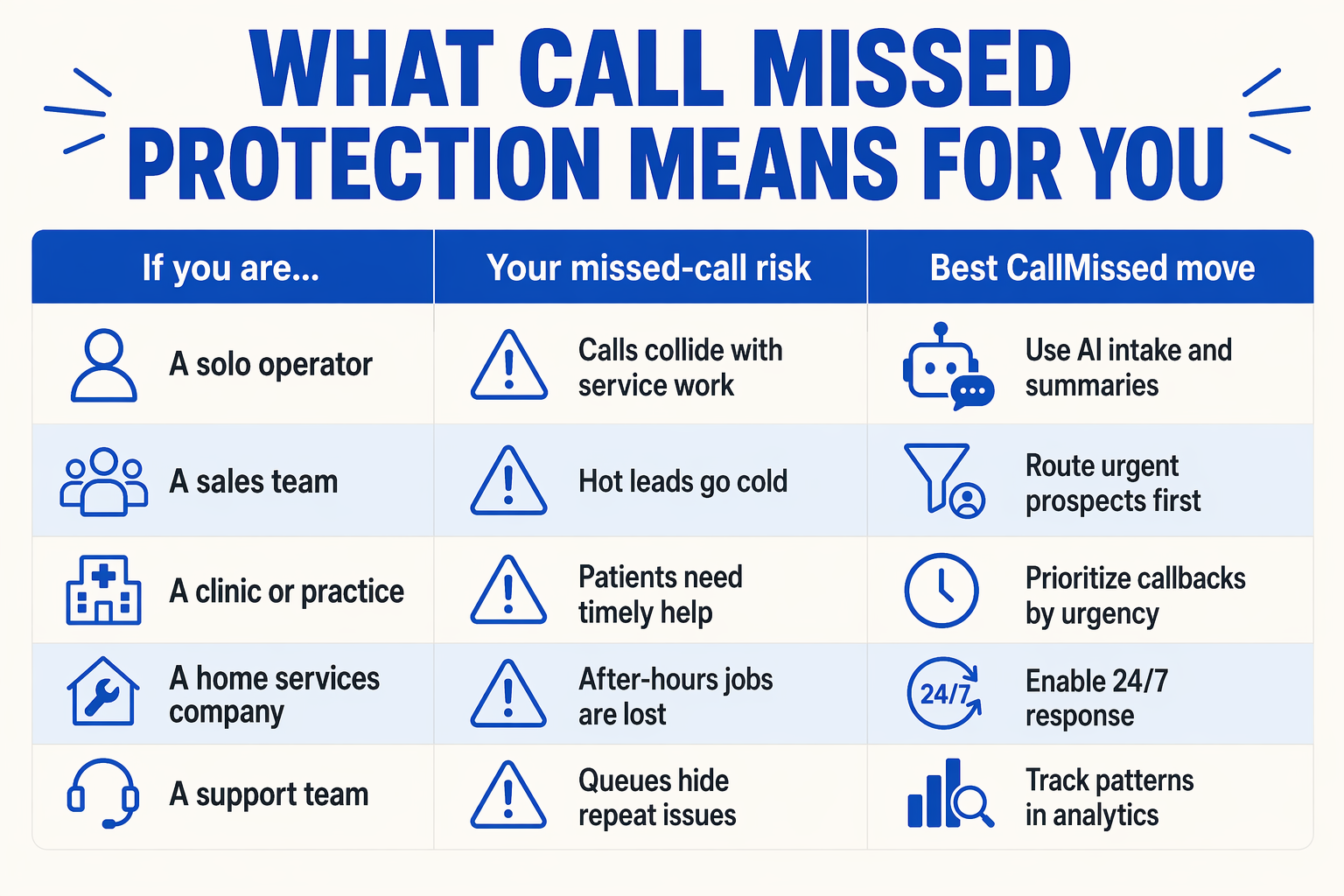
The practical shift: from “call back later” to “answer now”
For your business, call missed protection changes the operating model. Instead of relying on a log that tells you a customer called and left, you build a system where the call is answered, understood, and acted on—even when your staff is busy, offline, or handling another customer.
That distinction matters because traditional tools are mostly reactive. A missed call app on Google Play says it “keeps record of all Miss Calls and rejected calls which are left without reply.” Vodafone Idea’s missed call alert can be activated by sending “ACT MCI” to 54300. These services are useful for visibility, but they do not qualify the caller, capture intent, answer questions, or move the customer to the next step.
CallMissed’s approach is different: it treats every inbound call as a live customer moment that should be protected before it becomes a missed opportunity.
| Business situation | Traditional missed call alert | Call missed protection with CallMissed | What improves |
|---|---|---|---|
| After-hours inquiry | Shows a missed call notification later | AI voice agent answers 24/7 and captures name, need, and urgency | Faster response, fewer lost leads |
| Busy sales team | Caller may abandon and call a competitor | AI handles first response, qualifies the lead, and routes follow-up | Better lead capture and prioritization |
| Multilingual customer base | Human callback depends on available language skills | Speech-to-Text supports 22 Indian languages for regional conversations | Wider accessibility and local trust |
| High call volume days | Call logs pile up without context | AI summarizes intent and separates urgent vs routine requests | Lower manual workload |
| Support escalation | Customer repeats the issue later | Voice/chatbot captures issue details and can trigger WhatsApp follow-up | Smoother customer experience |
| AI model flexibility | Fixed script or basic IVR tree | Access to 300+ LLMs for different automation needs | More adaptable workflows |
What changes inside your team
The biggest benefit is not just that fewer calls are missed. It is that your team stops working from incomplete information.
With basic missed call alerts, the only data point is usually: who called and when. With AI-powered call protection, your team can receive structured context such as:
- Caller intent: sales inquiry, complaint, appointment, renewal, delivery issue
- Urgency level: emergency, high-priority, routine, general information
- Customer details: name, phone number, preferred language, location, requirement
- Next action: callback, booking, ticket creation, WhatsApp message, escalation
- Conversation summary: what the caller asked and what the AI responded
This means sales teams can call back warmer leads first, clinics can prioritize urgent appointments, service businesses can avoid duplicate conversations, and founders can stop depending on personal availability to protect revenue.
What changes for your customers
From the customer’s point of view, the experience becomes simpler: they call, someone answers, and the conversation moves forward. They do not need to wait for a callback, repeat themselves, or wonder whether the business is active.
That is the key difference between a missed call alert and missed call prevention. Wikipedia’s definition of a missed call focuses on a call ending before it is answered. For a customer, however, the emotional meaning is clearer: “This business was not available when I needed them.”
Platforms like CallMissed help businesses avoid that moment by combining AI voice agents, WhatsApp chatbots, multilingual speech recognition, Text-to-Speech, and LLM inference into one communication layer.
How to apply this now
If you are evaluating call missed protection, start with three practical questions:
- When do we miss the most calls? After hours, lunch breaks, weekends, campaigns, peak seasons?
- Which missed calls cost the most? New leads, support complaints, bookings, renewals, urgent cases?
- What should happen automatically? Answer, qualify, summarize, route, WhatsApp follow-up, or CRM update?
The goal is not to replace your team. It is to ensure your team never starts from silence. Every call should create a usable conversation record, a next step, and a better chance of conversion.
Frequently Asked Questions
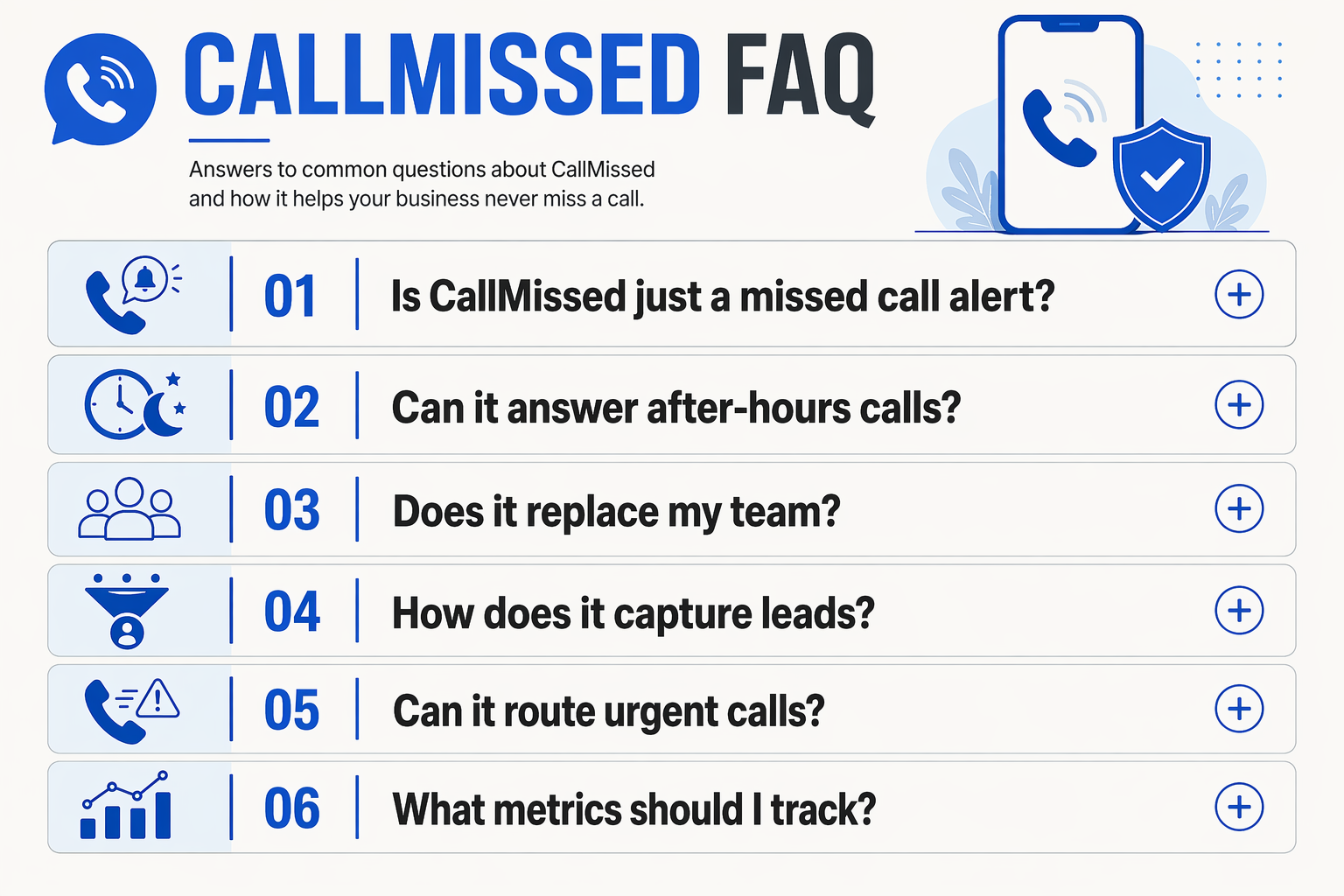
Practical answers for teams evaluating missed call prevention
What is call missed protection in CallMissed?
How is CallMissed different from a missed call alert app?
Why do businesses need call missed protection in CallMissed instead of calling customers back later?
Can CallMissed handle calls in Indian regional languages?
Is call missed protection in CallMissed useful for small businesses?
Does CallMissed replace human agents completely?
Conclusion
A missed call is no longer just a notification—it is a moment of customer intent that either gets captured or disappears. Traditional tools can log what happened after the fact, but call missed protection in CallMissed points to a more proactive future: AI systems that answer, understand, route, and follow up before opportunity is lost.
Key takeaways:
- Missed call alerts are reactive. Apps that “keep record of all Miss Calls,” or telecom services activated via steps like Vi’s “ACT MCI” SMS to 54300, help you know what went wrong—but not prevent it.
- AI voice agents shift the model to prevention. They can answer calls 24/7, capture intent, qualify leads, and keep conversations moving when human teams are unavailable.
- Multilingual automation matters. With voice, WhatsApp, Speech-to-Text, Text-to-Speech, and LLM-powered workflows, businesses can support more customers across channels and languages.
- Speed is now a competitive advantage. The business that responds first often wins the customer.
What to watch next is the move from simple call handling to fully integrated AI conversation infrastructure—where every phone call, chat, and follow-up becomes part of one intelligent customer journey.
To explore how AI communication is evolving, check out CallMissed — an AI infrastructure platform powering voice agents and multilingual chatbots for businesses. The real question is: how many customer conversations can your business afford to miss?
Discussion
Related Posts


Ready to automate customer conversations?
Launch AI voice agents and WhatsApp bots with CallMissed — one API, 22+ Indian languages.