
Anthropic and Infosys Point to a Bigger Market for Regulated-Industry Communication AI


Anthropic and Infosys Point to a Bigger Market for Regulated-Industry Communication AI explains what this AI launch means for CallMissed-style voice, WhatsApp, Smart IVR, and customer workflow auto...
Anthropic and Infosys Point to a Bigger Market for Regulated-Industry Communication AI
Anthropic published Anthropic and Infosys collaborate to build AI agents for telecommunications and other regulated industries on February 17, 2026, and the announcement matters because it points to where the AI market is heading for communication-heavy products. This is not generic model news. It is a signal about how customer-facing workflows, agent runtimes, voice systems, and business messaging are being rebuilt.
For CallMissed, the relevance is direct. The product is positioned as AI communication infrastructure with WhatsApp chatbots, AI voice call agents, Smart IVR, multilingual speech APIs, and OpenAI-compatible endpoints. That means each of these launches should be evaluated through one practical lens: does it improve how businesses answer, route, follow up, and complete customer work across channels?
What the source actually says
- Anthropic and Infosys announced a collaboration to build AI agents across telecommunications and other regulated industries.
- Anthropic explicitly described the gap between demo-ready AI and production-ready AI for regulated environments.
- The announcement specifically mentions telecommunications, customer lifecycle management, and service delivery modernization.
The primary source is here: Anthropic and Infosys collaborate to build AI agents for telecommunications and other regulated industries. In this article, the important move is not only the feature list. It is the direction of travel: more production readiness, more deployment maturity, more observability, better real-time performance, or stronger cost discipline depending on the topic.
Why this trend matters now
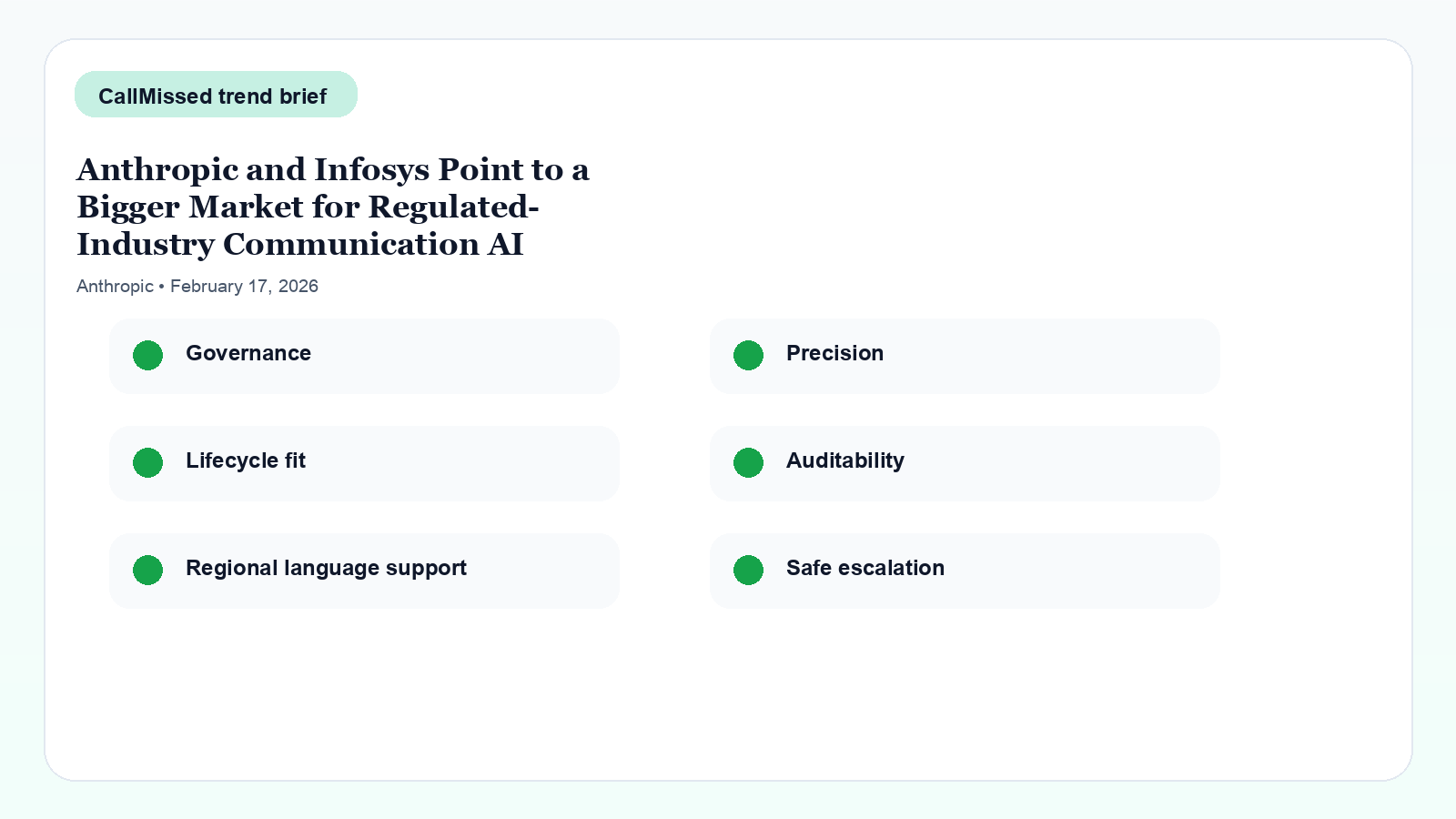
Telecom and regulated-industry communication is a strong signal market because it forces AI products to deal with scale, precision, compliance, and legacy system complexity all at once.
If frontier vendors and systems integrators are targeting these workloads, it means the demand for operational communication AI is maturing beyond consumer novelty and internal productivity pilots.
The next wave of value will likely accrue to products that can make AI useful in the first moment of contact while respecting the constraints of enterprise systems and regulated workflows.
What this means for CallMissed
CallMissed is highly relevant to this theme because telecommunications and customer lifecycle management are precisely the environments where voice agents, Smart IVR, and omnichannel follow-up become strategic rather than optional.
A product like CallMissed can turn this market momentum into practical value by offering AI-first communication workflows that already understand inbound calls, missed calls, multilingual speech, and channel transitions.
The business opportunity is especially strong where the customer interaction itself is the workflow entry point. In those cases, communication AI is not an accessory. It is the operating surface.
CallMissed documentation reinforces the same architectural story. The platform offers AI-powered communication APIs, WhatsApp business workflows, voice-call agents, Smart IVR, speech-to-text in 22 Indic languages plus English, text-to-speech options for telephony, and OpenAI-compatible endpoints. Those verified capabilities make the product a natural surface for turning this market momentum into real business workflows instead of one-off experiments.
Practical operating blueprint
- Treat compliance and precision as design inputs from day one, especially for sectors with regulated disclosures or strict record-keeping.
- Start with customer lifecycle tasks that are repetitive but meaningful, such as support triage, status communication, or guided handoff.
- Use AI to shorten time-to-resolution and reduce manual churn, but keep rule-heavy and high-risk cases on explicit human escalation paths.
- Design summaries for auditability as well as convenience. In regulated environments, a handoff note is not only a productivity tool.
- Make multilingual design a first-class requirement where customer bases are regionally diverse or operationally distributed.
Where teams can use this immediately
- Telecom support and customer lifecycle flows where scale and consistency are mandatory.
- Financial or insurance communication layers that need tightly controlled first-line automation.
- Healthcare-adjacent intake or service workflows where AI must be useful without becoming uncontrolled.
- Enterprise modernization programs where communication is the front door to the rest of the workflow stack.
Commercial perspective
The reason regulated industry communication AI matters is that communication systems sit near revenue and support cost at the same time. When a company answers faster, routes more accurately, preserves context across channels, and lowers repetitive agent work, the gains show up in booked appointments, recovered leads, faster ticket flow, lower backlog, or healthier margins. That is why these infrastructure and model announcements matter even when they seem technical on the surface.
The other important shift is buyer expectation. Enterprise teams increasingly expect AI communication platforms to look like serious software infrastructure: secure enough to deploy, measurable enough to improve, and flexible enough to fit the business’s chosen channels and workflows. Products that only sound impressive in demos will lose to products that make the day-to-day operating loop cleaner.
Risks and mistakes to avoid
- Starting with the hardest regulated edge cases before proving value in simpler lifecycle workflows.
- Assuming compliance concerns are only legal concerns rather than product and UX concerns too.
- Neglecting human-readable summaries and reviewability in environments where audits matter.
- Designing for one channel only when the real lifecycle spans voice, chat, and asynchronous follow-up.
Metrics to review after rollout
| Metric | Why it matters |
|---|---|
| Audit-ready summaries | Regulated workflows need records that explain how the AI handled the interaction. |
| Escalation precision | A strong system knows when to continue and when to hand over before risk increases. |
| Lifecycle consistency | The more the workflow spans channels cleanly, the more usable the automation becomes in enterprise operations. |
The common trap in AI communication programs is optimizing for the wrong layer. Teams celebrate a model change, a voice upgrade, or a faster runtime while the actual workflow remains fragmented. The right question is always the same: did the customer interaction become easier to complete, and did the business spend less manual effort to complete it?
FAQ
Why is the Anthropic-Infosys partnership relevant to communication AI?
How does this help CallMissed?
Where should enterprises begin?
What is the key lesson?
Sources
- Anthropic (February 17, 2026): Anthropic and Infosys collaborate to build AI agents for telecommunications and other regulated industries
- CallMissed Introduction: https://docs.callmissed.com/docs/introduction
- CallMissed Quickstart: https://docs.callmissed.com/docs/quickstart
- CallMissed Speech to Text: https://docs.callmissed.com/docs/speech-to-text
- CallMissed Text to Speech: https://docs.callmissed.com/docs/text-to-speech
- CallMissed Chat Completions: https://docs.callmissed.com/docs/chat-completion
Conclusion
Anthropic and Infosys Point to a Bigger Market for Regulated-Industry Communication AI is important because it shows how quickly the market is professionalizing around communication AI. The lesson for CallMissed is not to chase every logo or every launch headline. The lesson is to keep building the operational layer where these advances become useful: voice, WhatsApp, Smart IVR, multilingual understanding, measured routing, and clean handoffs. That is where real business value appears.
Discussion
Related Posts


Ready to automate customer conversations?
Launch AI voice agents and WhatsApp bots with CallMissed — one API, 22+ Indian languages.