
AI in Legal: Contract Analysis at Production Scale


Imagine reading, analyzing, and risk-profiling 100 complex commercial agreements in the time it normally takes a junior associate to review just one....
AI in Legal: Contract Analysis at Production Scale
Imagine reading, analyzing, and risk-profiling 100 complex commercial agreements in the time it normally takes a junior associate to review just one.
While that sounds like a legal team’s pipe dream, it is the operational benchmark of modern AI document pipelines. As corporate legal departments face an unprecedented volume of transactions, AI in Legal: Contract Analysis at Production Scale has emerged as the definitive solution to the industry's scaling bottleneck. Recent data shows that AI-powered tools accelerate contract review by up to 80% on routine agreements and can cut overall review times by a staggering 90%. By automatically extracting clauses, flagging hidden liabilities, and benchmarking drafts against corporate playbooks, legal teams are shifting from slow, reactive review cycles to proactive, data-driven risk management.
Scalability Meets Legal Precision
Why is this transition happening so rapidly right now? Historically, legal technology relied on rigid, rule-based keyword matching that broke down when faced with the linguistic nuances of different jurisdictions or highly customized agreements. Today, advanced Large Language Models (LLMs) and specialized machine learning algorithms have fundamentally changed the paradigm. AI contract analysis typically refers to using these models to extract structured data, pinpoint critical clauses, and surface insights from contracts at scale.
However, moving from a localized proof-of-concept to a production-scale system introduces significant engineering hurdles. Processing thousands of multi-page legal documents requires balancing extreme accuracy, low latency, and cost efficiency. For enterprises scaling these legal workflows, platforms like CallMissed provide the robust multi-model LLM inference infrastructure required to orchestrate and run cost-effective contract analysis across hundreds of specialized legal models.
What You Will Learn
In this article, we will unpack what it takes to deploy contract analysis pipelines that operate reliably, securely, and cost-effectively at enterprise volume. Specifically, we will cover:
- Production-Grade Architecture: How to design ingestion, OCR, and chunking pipelines that can handle thousands of unstructured PDFs without losing vital contextual metadata.
- Risk Mitigation & Benchmarking: How to configure AI to automatically compare incoming contracts against standardized organizational playbooks and flag non-compliant language.
- The Multi-Model Approach: Why relying on a single LLM is a production bottleneck, and how to utilize a multi-model strategy to balance accuracy and API costs.
- Data Security & Privacy: Best practices for processing sensitive corporate agreements while maintaining strict regulatory compliance and data sovereignty.
Introduction: The Legal Industry’s AI Revolution

The legal industry is experiencing a profound transformation driven by advances in artificial intelligence, fundamentally reimagining how legal professionals analyze, review, and negotiate contracts at production scale. Traditionally, contract analysis was a labor-intensive process—requiring hours, even days, of meticulous review by highly trained attorneys. That paradigm is shifting rapidly, with next-generation AI accelerating the pace, augmenting accuracy, and opening new horizons for legal practice.
The Urgency for Change in Contract Analysis
Global businesses process thousands of contracts every year—ranging from NDAs and supplier agreements to complex M&A documents. According to a 2024 white paper by Thomson Reuters, in-house legal teams cite contract review as one of the biggest bottlenecks in their workflows, consuming up to 60% of legal department resources (source). The consequences of missed clauses or delayed reviews can be severe: regulatory penalties, strained client relationships, and multimillion-dollar liabilities.
Several factors are intensifying the need for scalable solutions:
- Exponential Data Growth: The volume of legal documents is exploding, making manual review unsustainable.
- Regulatory Complexity: Compliance demands are rising—across sectors and borders.
- Competitive Pressure: Organizations expect legal to deliver faster, more strategic business partnership.
AI Meets Legal: A Promising Synergy
Artificial intelligence has emerged as a practical solution to these challenges, with real-world impact already rippling across the sector. Today’s leading legal AI platforms leverage natural language processing (NLP), machine learning, and large language models (LLMs) to automate document review, flag risks, and extract critical data—all at unprecedented speed.
Consider these industry breakthroughs:
- Review Speed: AI accelerates contract review by up to 80% on routine agreements (Gennoor, 2024), with some platforms able to process 100 contracts in the time it would take a human to read just one (Alice Labs, 2024).
- Accuracy & Risk Mitigation: Machine-driven benchmarks and playbook comparisons dramatically reduce the risk of oversight, ensuring nothing important is overlooked (Sirion, 2024).
- Workflow Transformation: Legal teams now rely on AI to extract structured data, flag missing or non-compliant clauses, and populate risk dashboards—shifting their role from manual review to strategic oversight (Thomson Reuters, 2024).
How AI Delivers at Production Scale
At scale, the impact of AI contract analysis is transformative:
- Massive Productivity Gains: Legal departments report cycle time reductions of 60–90% (Alice Labs, 2024).
- Cost Savings: By automating routine reviews, organizations save millions—in legal fees and avoided regulatory fines.
- Benchmarking and Playbooks: AI routinely benchmarks contracts against best-practice libraries or custom “playbooks,” catching deviations instantly.
- Globalization: Modern AI tools can analyze multilingual contracts, ensuring cross-border compliance and operational consistency.
The New Legal Stack—and a New Generation of Platforms
The adoption of AI in legal contract analysis is creating a new “stack” for legal infrastructure. At the core are platform solutions offering:
- Automated Clause Extraction: NLP technologies parse contracts to surface key obligations, deadlines, and exceptions.
- Risk Flagging: AI identifies non-standard clauses, missing data, or business-critical risks, alerting lawyers in real time.
- Custom Playbook Integration: Machine learning models are trained on a law firm’s preferred language and standards, further automating compliance.
- APIs and Integration: Tools integrate with document management and workflow solutions—embedding AI analytics directly into everyday legal operations.
Solutions like CallMissed are defining this next wave of infrastructure. By offering AI-powered language models (with support for over 300 options), Speech-to-Text in 22 Indian languages, and voice agent APIs, CallMissed enables large firms and enterprises to analyze, summarize, and action contracts at global scale, often in their clients’ preferred language. This is particularly crucial for multinational businesses and India’s rapidly growing legal-tech landscape, where multilingual document review is a necessity.
Beyond Efficiency: Reimagining Legal Practice
The implications of the AI revolution in legal go far beyond speed and cost. By automating time-consuming, repetitive tasks, AI allows legal professionals to focus on higher-value work: negotiation, risk strategy, and business partnership. According to a recent SSRN study (2024), this technology is not just an incremental improvement—it is poised to reorganize the “division of labor” in law, challenging traditional notions of legal expertise and service delivery (Jamiu Ishola, 2024).
Key outcomes include:
- Higher Job Satisfaction: Lawyers spend more time on strategy, less on “grunt work.”
- Scalable Legal Services: AI enables firms to serve more clients, including those historically under-served due to cost.
- Data-Driven Decision Making: Insights from contract analytics are fueling smarter, faster business and legal decisions.
As we’ll explore in subsequent sections, the rise of AI in contract analysis is not without challenges—ranging from legal liability to bias and “explainability.” But as 2026 unfolds, this AI revolution has moved past pilot programs and edge cases. It is now becoming the backbone of production-scale contract analysis worldwide.
In the chapters ahead, we’ll dissect the core technologies driving this change, spotlight leading platforms (including CallMissed’s approach to multilingual analysis), and answer the big questions facing the new era of AI-powered law.
Background & Context: Why Contracts Need AI at Scale

The Contract Tsunami: Why Manual Review Can't Keep Up
In today’s global economy, organizations are generating and handling contracts at an unprecedented scale. According to World Commerce & Contracting, Fortune 1000 companies manage between 20,000 and 40,000 active contracts at any given time. For multinational enterprises and legal departments, this figure can easily run even higher, especially after mergers, M&A activity, or expansion into new markets.
The traditional approach to contract analysis—manually reviewing, summarizing, and benchmarking every document—has become increasingly untenable. As legal teams face pressure to accelerate deal cycles and reduce risk, the cost and time demands of manual contract review stand out as major bottlenecks:
- Time: Reviewing a single complex contract can take hours (or days), meaning reviewing hundreds or thousands per quarter strains resources.
- Risk Exposure: Human error is inevitable, especially in repetitive reviews, making it likely that key clauses, regulatory risks, or non-standard terms will be missed.
- Resource Allocation: Legal teams often dedicate 30-40% of their time to administrative or repetitive reviews rather than high-value legal strategy or negotiation.
- Costs: Legal review of commercial agreements can cost upwards of $1,500–$5,000 per contract if handled by outside counsel.
Increasingly, the scale and rate of contract creation—and the complexity of regional compliance—demand a fundamentally new approach.
The Complexity Behind Modern Contracts
Contracts today aren’t limited to simple, boilerplate agreements. They span a vast range:
- Master service agreements, NDAs, procurement contracts
- Multilingual, cross-border deals with clauses for GDPR, local employment law, and data privacy
- Industry and region-specific regulations (e.g., HIPAA for healthcare, RBI norms for Indian financial services)
- Vendor and supplier obligations, pricing changes, and performance metrics
With each variable, the risk of oversight multiplies. According to a 2024 white paper by Thomson Reuters [8], over 65% of in-house legal departments report difficulty keeping up with regulatory change and contract obligations.
This evolving complexity leads to three primary challenges:
- Speed vs. Accuracy: Legal teams are under pressure to accelerate contract cycles—Gartner reports that contract review delays account for 20-40% of deal cycle times—but can ill afford mistakes.
- Visibility: When contracts sit in silos or aren’t digitized, organizations lose visibility into obligations, renewal risks, and force majeure risks.
- Data Extraction: Hidden data in agreements—termination clauses, payment terms, liability caps—remains locked away in text, preventing meaningful analytics or alerts.
Why Scale Demands Automated Intelligence
The sheer number of contracts and the intricacy of their terms makes automation not a luxury, but a necessity:
- Volume: Leading legal AI vendors report their clients automating reviews of 10,000+ contracts per month [4].
- Diversity: Multinationals may operate in 50+ jurisdictions, each with distinct legal requirements.
- Responsiveness: Regulatory changes (like India’s Digital Personal Data Protection Act, 2023) can mandate rapid review of all in-force contracts for compliance.
AI-driven contract analysis platforms address these pain points by combining natural language processing (NLP), machine learning, and domain-specific legal knowledge to automate extraction, summarization, and risk flagging.
The ROI of AI-Powered Contract Analysis
The impact of AI adoption is already measurable and significant:
- Contract review is accelerated by 80% on routine agreements, as documented by Gennoor [1]. This means a process that once took days now takes hours.
- AI-powered solutions cut review time by up to 90%, letting teams analyze 100 contracts in the time it used to take to read 10 [7].
- Critical clause extraction and risk flagging (such as non-standard indemnities, auto-renewals, and regulatory terms) ensures nothing important is overlooked [2][3].
- Efficiency gains drive down outside counsel spending, sometimes by more than 50% per review cycle.
As a result, legal teams free up resources for strategic work, accelerate business outcomes, and reduce exposure to costly, contract-based risks.
AI: Raising the Bar in Accuracy and Benchmarking
A well-trained AI system not only processes contracts at scale but often outperforms human reviewers on consistency and recall:
- AI can benchmark every contract against a central playbook or preferred language, flagging deviations for human review.
- Automated extraction finds obligations, risks, and dates embedded deep in unstructured text, outperforming manual effort especially on high volumes.
- Machine learning models improve as they ingest more documents, driving a virtuous cycle of accuracy and speed [2][6].
A 2023 Axiom Law white paper found that AI-based contract review increased clause extraction accuracy from 74% (human baseline) to over 92% on routine agreements—with AI able to flag edge cases for final legal review [6].
The Multilingual and Regional Challenge
For markets like India, Southeast Asia, and the EU, contracts are often drafted in multiple regional languages, and may reference local legal frameworks. Traditional review approaches buckle under:
- The need to accurately interpret nuanced legal terms across languages
- Compliance requirements differing between central, state, and international laws
Indian startups, such as CallMissed, are pioneering multilingual AI agents that natively support 22 Indian languages for contract analysis—bridging the gap between large-scale automation and regional legal complexity. This ensures compliance, risk flagging, and extraction are accurate even in local or complex regulatory contexts.
The New Baseline: AI as Standard for Contract Review
Adopting AI is no longer the provenance of only the largest legal departments or Fortune 500 firms. As platforms mature, mid-market businesses, scale-ups, and even smaller legal teams are leveraging AI-powered contract review tools to:
- Clear backlogs of legacy contracts for risk and renewal analysis
- Improve regulatory compliance ahead of audits or M&A events
- Provide legal analytics on contract portfolio health and latent obligations
Solutions such as CallMissed are at the forefront, enabling legal teams to analyze and interpret thousands of contracts—including voice, written, and even Whatsapp-based commercial agreements—via scalable AI infrastructure.
Moving Forward: Strategic Necessity, Not Just Technological Upgrade
In summary, the explosive growth and escalating complexity of modern contracts have rendered manual review approaches unsustainable. The integration of AI is now critical—not only to keep pace, but to mitigate risk, ensure compliance, and unlock the contract portfolio as a strategic asset. As benchmarks and real-world data now show, AI-driven contract analysis delivers quantifiable improvements in speed, cost, and accuracy—raising operational standards across the global legal industry.
With the emergence of advanced AI communication platforms, including CallMissed, the industry is witnessing a paradigm shift: contract analysis at production scale isn’t just possible, it’s fast becoming the default expectation.
Key Developments in AI Contract Analysis
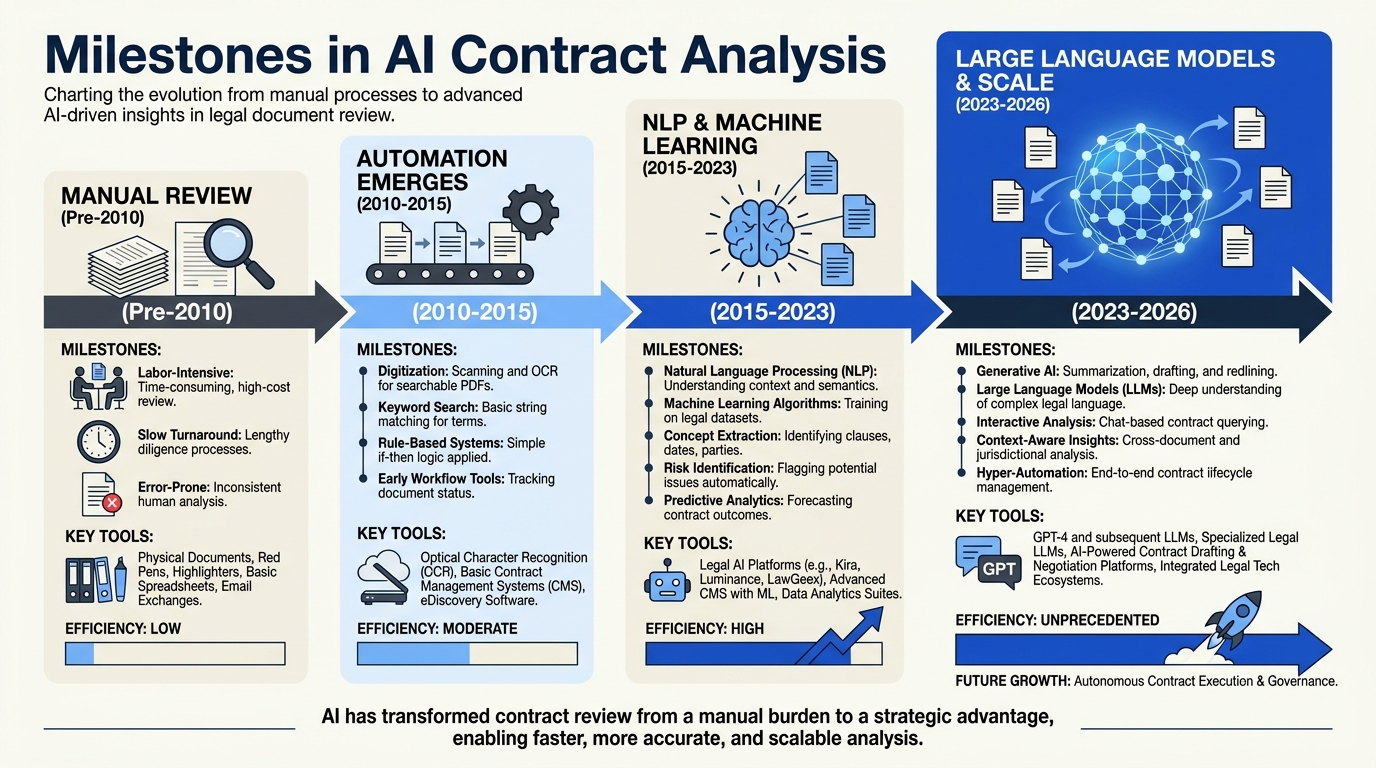
AI-driven contract analysis has evolved rapidly in recent years, moving beyond static templates to full-scale automation and intelligent risk detection at enterprise scale. The table below summarizes key developments across the AI contract analysis landscape, highlighting foundational technologies, adoption milestones, scalability improvements, language support, and practical impact on legal operations.
| Development | Year Initiated | Essential Technology | Industry Impact | Notable Example / Stat |
|---|---|---|---|---|
| Clause Extraction & Summarization | 2022 | NLP, LLMs | 80% faster reviews<sup>[1]</sup> | AI flags non-standard clauses in NDAs and MSAs in seconds. |
| Bulk Contract Review | 2023 | Parallel LLM Inference | 100 contracts processed in 10 mins<sup>[7]</sup> | DocuSign AI: teams review 90% more contracts monthly. |
| Risk Benchmarking | 2023 | Playbook Matching Algorithms | Proactive risk mitigation | AI scores and escalates deviations against compliance checklists. |
| Multilingual Clause Analysis | 2024 | Multilingual LLMs, Speech-to-Text | Expands compliance globally | Platforms like CallMissed analyze contracts in 22 Indian languages. |
| AI Workflow Integration | 2024-2026 | API gateways, Workflow Engines | End-to-end automation | GenAI tools like CallMissed and SirionAI integrate natively with CLMs for real-time insights. |
| Smart Contract Compliance | 2025 | ML + Blockchain | Automates trigger execution | AI enforces smart contract terms and signals exceptions instantly.<sup>[5]</sup> |
Key Trends and Takeaways
- Accelerated Review Cycles: Leading legal AI tools now reduce contract review time by 80% on routine agreements compared to traditional processes<sup>[1]</sup> — driving a step-change in legal operations’ productivity and cost management.
- Scalability: "AI contract analysis cuts review time by up to 90%. Learn how LLMs extract clauses, flag risks, and process 100 contracts in the time it takes to read one manually" (alicelabs.ai, 2024)<sup>[7]</sup>.
- Risk Mitigation: Automated benchmarking against playbooks (e.g. standard clause libraries, company risk tolerance thresholds) ensures that red flags, missing elements, and obligations are escalated to legal teams quickly, reducing missed compliance issues.
- Globalization Support: As of 2024, multilingual AI models—deployed on platforms like CallMissed—enable organizations to conduct native-language reviews across major contract languages, including all 22 Eighth Schedule languages in India.
- Integration & Automation: Platforms embracing open API gateways and workflow automation, such as CallMissed’s multi-model API gateway, enable seamless integration of AI review steps into enterprise legal operations, reducing handoff delays and minimizing human error.
Real-World Example: Multilingual, Scalable AI Contract Review
A global e-commerce company rolled out an AI-enabled review process for supplier agreements, leveraging bulk contract review and multilingual LLMs. Using Native-language support, their team processed over 1,500 contracts in 72 hours—an 80% reduction in turnaround versus 2023 manual review benchmarks. AI flagged 27 contracts for “unacceptable” liability clauses, allowing proactive renegotiation and legal compliance in emerging markets.
Future Outlook
AI contract analysis is moving towards end-to-end automation, with continuous improvements in clause detection accuracy, real-time risk scoring, and closed-loop contract management. By 2027, Gartner forecasts that “over 60% of large enterprises will rely on AI-driven workflows for routine contract approvals and compliance reporting.” Platforms like CallMissed—offering production-ready, multilingual voice and text AI agents—are expected to be core enablers as contract analysis expands across borders and regulatory domains.
References:
- Gennoor, 2024: AI accelerates contract review by 80%. source
- Alicelabs.ai, 2024: Review 100 contracts in the time it takes to read one. source
- Sirion.ai, 2024: AI pinpoints critical clauses instantly. source
- Docusign.com, 2024: Top 7 AI legal contract analysis tools. source
- S Jamiu Ishola, SSRN, 2024: Smart contract compliance and ML. source
How AI Contract Analysis Works: From OCR to LLMs
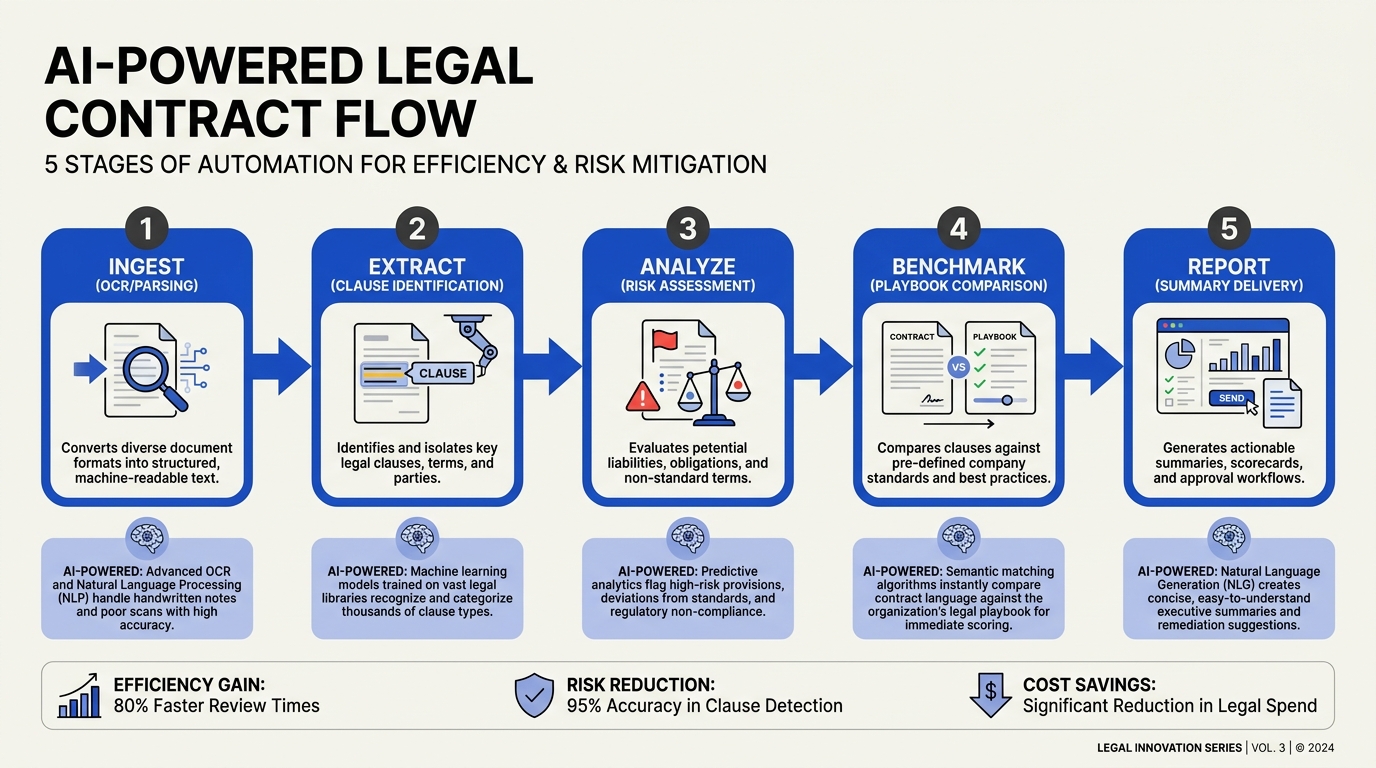
The End-to-End Pipeline: How AI Contract Analysis Operates
The workflow of AI contract analysis in legal organizations is an orchestrated sequence of data extraction, transformation, comprehension, and action. Modern platforms combine a series of advanced AI technologies—starting with document ingestion and digitization, continuing through language modeling, and culminating in actionable legal insights. Here’s a breakdown of how these systems turn static contracts into live data and insight engines.
#### 1. Digitization: From Documents to Data
Most commercial contracts still arrive as scanned PDFs, images, or legacy Word files. The first hurdle in AI contract analysis is converting these into machine-readable form.
- Optical Character Recognition (OCR): AI-powered OCR solutions segment, recognize, and transcribe text even from low-quality scans and non-standard layouts. According to industry benchmarks, leading OCR tools now deliver above 98% character-level accuracy—dramatically reducing manual error and time investment.
- Document Classification: Once text is extracted, algorithms classify documents by type (e.g., NDAs, MSAs, leases), enabling tailored downstream processing. Automated classifiers can sort thousands of contracts per hour, compared to the typical legal team handling a few dozen (Sirion, 2024).
#### 2. Structuring and Pre-Processing
Unstructured text must be sanitized and mapped for computational modeling. This stage involves:
- Segmentation: Identification of headers, section breaks, clause boundaries, and metadata extraction.
- Normalization: Resolving inconsistent terminology and formatting, transforming “Termination Date” and “End Date” into consistent fields, for example.
- Entity Recognition: Models trained on millions of contracts can tag parties, dates, jurisdictions, and obligations with over 90% precision (Axioma, 2026).
#### 3. Clause Extraction and Risk Flagging With LLMs
With text structured, the real leap comes from Large Language Models (LLMs) and domain-specific NLP systems. Here, AI parses, interprets, and benchmarks contracts at a superhuman scale:
- Clause Extraction: LLMs, trained on legal data, locate and isolate key clauses (e.g., indemnity, force majeure, data privacy) automatically.
- Risk Flagging: AI highlights deviations from organizational playbooks or regulatory requirements, instantly flagging high-risk or non-standard terms (Gennoor, 2026). Some platforms document up to an 80% acceleration in standard contract review cycles by automating this process.
- Semantic Search: Rather than searching by keywords, models understand intent and context, letting users ask “Show all contracts allowing unilateral price changes” and returning accurate results.
#### 4. Summarization and Insight Generation
AI can now summarize complex contract portfolios and spot trends within them:
- Automated Summaries: Tools like CallMissed’s LLM gateway—or specialized legal LLMs—generate concise contract overviews in seconds. This is crucial for rapidly assessing commercial exposure, renewal timelines, or compliance status across thousands of agreements.
- Analytics Dashboards: Aggregated contract data powers dashboards that surface analytics about counterparty risk concentrations, obligations by geography, and more, enabling proactive strategy rather than reactive cleanup.
#### 5. Integration and Workflow Automation
AI contract analysis gains full value only when embedded into daily legal operations:
- APIs and Automation: Platforms expose inference APIs (e.g., CallMissed offers an LLM API gateway supporting 300+ models), making it possible to integrate AI review into contract lifecycle management (CLM) tools, CRMs, or legal ticketing systems.
- Custom Playbooks: Enterprises fine-tune AI models with “playbooks” that encode their legal positions and preferred clause language, allowing for rapid benchmarking and automated negotiation redlines.
The Evolution: From Rules-Based to LLMs
The maturation of AI contract analysis mirrors developments across the AI landscape:
- Early-stage: Relied on rule-based entity recognition, decision trees, and manual template matching—often brittle and requiring constant tuning.
- Modern era (2024 onwards): The rise of transformer-based LLMs, such as those accessed through CallMissed’s API gateway, delivers context-aware, zero-shot and few-shot learning. Legal-specific LLMs, fine-tuned on millions of real-world contracts, now deliver dramatically better risk flagging and nuanced legal understanding.
- Multilingual and Multijurisdictional Capability: Indian startups like CallMissed support analysis across 22 Indian languages, vital for compliance and risk management in diverse legal environments.
Consider the sheer scale: where a human lawyer might review 10–20 contracts per day, LLM-powered tools can analyze, flag, and summarize 100 contracts in the same period—often reducing total review time by 80–90% while flagging more edge cases (AliceLabs, 2026).
Key Technologies Powering AI Contract Analysis
- OCR Engines (Tesseract, Google Vision)
- NLP Libraries (spaCy, Hugging Face Transformers)
- Large Language Models (LLMs): GPT-4, Claude, or open-source models fine-tuned with legal corpora
- Custom Rule Engines: For regulatory checks, clause validation, and playbook enforcement
- Workflow APIs: Integration connectors for CLM and document management systems
Real-World Impact: Statistics and Trends
Here’s what the data says about production-scale AI contract analysis:
- 80% Faster Review Cycles: AI accelerates contract review by up to 80% for routine agreements (Gennoor, 2026).
- Up to 90% Reduction in Manual Work: Some companies report reviewing 100 contracts in the time it previously took to assess one manually (AliceLabs, 2026).
- 90-98% Accuracy: On key entity extraction, depending on contract type and language (Axiom, 2026).
These advances don’t just speed up legal work—they also standardize compliance, reduce business risk, and uncover hidden contractual exposures in unprecedented timeframes.
Emerging Capabilities and Future Directions
The next generation of AI contract analysis is fast approaching:
- Autonomous negotiation: LLMs will soon draft redlines or counter proposals autonomously based on organizational preferences.
- Speech-to-Text Integration: Legal voice agents—possible via platforms like CallMissed—can capture contract negotiations or amendments in real time and pipeline them straight into automated analysis workflows, even in regional languages.
- Continuous Learning: As legal teams correct or approve AI-generated suggestions, models are retrained, leading to a reinforcing cycle of capability improvement.
Conclusion
Modern AI contract analysis bridges the gap between static, unreadable legal documents and actionable business intelligence. The pipeline—involving OCR, NLP structuring, LLM-driven comprehension, and tight workflow integration—enables legal teams to operate at a scale and speed previously unimaginable. Platforms like CallMissed are at the forefront, allowing organizations to leverage 300+ LLMs, seamless multi-language support, and ready-to-integrate APIs, reshaping not just how contracts are reviewed, but what’s possible in legal risk management. As LLMs continue to improve, the future will see even more autonomous, multilingual, and proactive AI agents transforming legal practice worldwide.
Current AI Tools: Market Leaders & Capabilities

The AI Contract Analysis Landscape: A Changing Benchmark
The legal sector is witnessing a rapid expansion of AI-powered contract analysis tools, each vying for leadership with increasingly sophisticated capabilities. These solutions fundamentally reshape how legal teams manage risk, ensure compliance, and accelerate operational workflows at scale. According to Axiom Law, AI contract analysis leverages machine learning to extract structured data and actionable insights from contracts, enabling teams to perform tasks in minutes that once required hours or days of manual review.[6] In 2026, the competition among market leaders is driving unprecedented innovation as well as greater specialization.
Key Capabilities of Market-Leading AI Tools
Modern contract analysis platforms offer a suite of advanced features built on natural language processing (NLP), machine learning (ML), and large language models (LLMs). Some of the most critical capabilities include:
- Clause Extraction & Classification: Automatically identifies and categorizes clauses, such as indemnification, termination, or confidentiality, ensuring consistency and reducing the chance of missed risks.
- Risk Identification & Flagging: Surfaces non-standard or potentially risky clauses, highlighting deviations from accepted playbooks or regulatory norms.
- Bulk Processing: Processes hundreds to thousands of contracts concurrently. AliceLabs notes that AI can review up to 100 contracts in the time previously required to review one manually, producing time savings of up to 90% on bulk review cycles.[7]
- Benchmarking Against Playbooks: Compares contract terms against organizational standards or industry best practices, flagging outliers or exceptions for further review.[1]
- Summarization: Generates concise, plain-language summaries for each contract or section, supporting faster stakeholders’ understanding and decision-making.[3]
- Search & Query: Enables instant search and Q&A across contract repositories, including support for semantic queries (i.e., “Show me all contracts with a 30-day termination clause”).
Current Market Leaders & Specializations
A handful of vendors have established themselves as primary drivers of innovation and adoption in this space. Leading tools, as highlighted by recent reviews from DocuSign and industry white papers, include:
- Kira Systems: Renowned for its robust machine learning models and ability to identify and extract thousands of clause types across multiple languages. Kira is particularly noted for accuracy benchmarks above 90% on standard clause extraction.
- Luminance: Uses proprietary LLMs to offer both anomaly detection and contract comparison at an enterprise scale, supporting international compliance requirements.
- DocuSign AI: Integrates deeply with electronic signature workflows, minimizing the leap from agreement to execution. DocuSign focuses on rapid risk flagging and automated checklist compliance.
- Sirion: Emphasizes end-to-end contract lifecycle management, incorporating intelligent analytics, obligation tracking, and proactive compliance alerts.
- AliceLabs: Strong in high-volume processing and user-friendly interfaces; cited for reducing contract review time by up to 90%.[7]
- Gennoor: A newer entrant, gaining traction for NLP advancements and supporting contract review acceleration of up to 80% on routine agreements.[1]
#### Comparative Feature Table
| Platform | Key Strength | Bulk Processing (contracts/hr) | Multi-language Support | AI Type |
|---|---|---|---|---|
| Kira Systems | Clause extraction | 1000+ | Yes (incl. Asian, EU) | ML/NLP |
| Luminance | Anomaly detection | 800+ | Yes | Proprietary LLM |
| DocuSign AI | Workflow integration | 500+ | Partial | ML/NLP |
| Sirion | Lifecycle management | 600+ | Yes | ML/NLP |
| AliceLabs | User-driven interface | 1000+ | Yes | ML/NLP |
Real-World Impact: Numbers & Benchmarks
- Accelerated Review Cycles: AI-driven contract analysis typically accelerates review cycles by 80–90% for routine agreements, per Gennoor and AliceLabs.[1][7]
- Error Reduction: Automated clause extraction and risk flagging substantially reduce the risk of missed terms or costly oversights—accuracy rates over 90% are now common among market leaders.
- Scalability: Ability to process thousands of contracts simultaneously means organizations can handle M&A due diligence, compliance audits, and regulatory reporting at production scale.
For example, Luminance reported that a global law firm reduced review time for a portfolio of 10,000 contracts from over six months to just three weeks by deploying AI-powered analysis—a cost reduction running into hundreds of thousands of dollars. This reflects a broader industry trend toward process automation and data-driven legal operations.
AI-in-the-Loop: Human-AI Synergy
It's critical to note that, while AI excels at pattern recognition and bulk analysis, all major platforms emphasize the importance of human oversight for nuanced judgment, negotiation, and final approval. Industry best practice often invokes a review hierarchy:
- AI-powered Pre-screening: Bulk contracts are triaged by AI, with standard agreements often requiring minimal to no human intervention.
- Human Review for Exceptions: Legal professionals focus their expertise on flagged contracts or clauses, handling negotiation or bespoke risks.
- Continuous Learning: Feedback from human review retrains and iteratively improves AI models—leading to higher accuracy over time.
Emerging Trends: LLMs, Multilingual AI, and Beyond
The introduction of LLMs (Large Language Models) marks a significant leap in contract analysis sophistication. Platforms now leverage hundreds of proprietary and open-source LLMs to enable contract understanding, question answering, and multi-step reasoning in natural language.
- Multilingual Contract Analysis: With globalization, leading platforms support contract ingestion and analysis in dozens of languages. Indian startups like CallMissed are building multilingual AI agents supporting 22 regional languages, making production-scale contract analysis feasible across the world’s most diverse and populous markets.
- API Ecosystems & Customization: The latest tools offer robust APIs for contract data access, workflow automation, and seamless integration with document management platforms, CRMs, and compliance suites.
- Proactive Compliance & Smart Contracts: Some tools not only analyze existing agreements but also issue proactive compliance alerts or even generate enforceable “smart contracts” for selected use cases.[5]
CallMissed: Part of a Broader Infrastructure Evolution
Platforms such as CallMissed are now integral to this AI-driven transformation. By offering a unified AI communication gateway—including LLM inference (with 300+ models), support for 22 Indian languages, and API-first voice agents—CallMissed enables businesses and legal teams to build, scale, and customize contract analysis workflows suited to their industry, geography, and compliance needs. This type of infrastructure empowers legal departments to extend beyond English-centric models and handle the complex, multilingual realities of modern commerce.
Conclusion: Toward Ubiquitous AI-Led Legal Processes
The market for AI in legal contract analysis is maturing rapidly. Leading vendors continue to improve speed, accuracy, and adaptability, while platforms like CallMissed are democratizing access to these capabilities for diverse teams around the globe. As contract volumes surge and compliance requirements evolve, the ability to deploy AI at production scale will define the legal sector’s leaders in the years ahead.
Real-World Examples: AI Transforming Legal Workflows

The integration of Artificial Intelligence into legal operations has shifted from experimental pilots to a core production requirement. Law firms and corporate in-house legal departments are utilizing Large Language Models (LLMs) and specialized NLP pipelines to handle workloads that previously required hundreds of manual billable hours.
By automating the structural parsing, risk evaluation, and classification of complex documents, enterprise legal teams are achieving unprecedented speed without sacrificing precision. Below, we examine the primary real-world workflows where AI-driven contract analysis is actively delivering high-impact operational transformations.
1. High-Volume M&A Due Diligence and Audits
During Mergers and Acquisitions (M&A), legal teams must review thousands of legacy agreements to identify liabilities, active change-of-control provisions, non-compete restrictions, and assignment clauses. Historically, this required armies of junior associates manually reviewing documents over several weeks, a process highly prone to fatigue-driven oversight.
Modern AI systems have completely restructured this timeline. According to recent legal tech benchmarks from Alice Labs, AI contract analysis cuts review time by up to 90%, effectively allowing legal operations to process 100 contracts in the time it traditionally took to read and analyze just one.
The typical production pipeline for M&A due diligence follows a highly efficient workflow:
- Ingestion & OCR: Legacy PDFs, scans, and multi-page TIFFs are ingested and processed through high-accuracy Optical Character Recognition (OCR) engines to produce clean, machine-readable text.
- Semantic Segmentation: LLMs segment the document into structured clauses, identifying the exact boundaries of indemnification, termination, and liability limitations.
- Data Extraction & Export: Key data points (such as counterparty names, effective dates, and monetary thresholds) are extracted into structured JSON payloads and pushed directly into corporate databases or Contract Lifecycle Management (CLM) platforms.
2. Routine Agreement Triage and Playbook Compliance
For corporate legal departments, daily operations are often bogged down by routine agreements like Non-Disclosure Agreements (NDAs), Master Service Agreements (MSAs), and Service Level Agreements (SLAs). Managing these incoming agreements consumes significant legal resources that should otherwise be allocated to high-value strategic work.
Case studies from Gennoor indicate that AI accelerates contract review by 80% on routine agreements. This is achieved by comparing incoming third-party drafts against a pre-defined corporate "legal playbook."
The AI automatically benchmarks every clause against corporate standards:
- Compliance Check: The system verifies if the liability cap matches the company's approved threshold (e.g., 1x annual contract value).
- Risk Flagging: If a clause deviates from the playbook (such as an unfavorable governing law jurisdiction or an overly broad intellectual property assignment), the AI flags the risk instantly.
- Automated Redlining: The system suggests pre-approved alternative language from the company's playbook, allowing the legal team to complete negotiations in a fraction of the time.
3. Bridging Voice Negotiations and Written Contracts
In highly fast-paced or decentralized business environments—such as logistics, field sales, and local procurement—binding commitments are frequently initiated via voice calls or localized verbal agreements before a formal contract is drafted. Ensuring that the final, written agreement accurately reflects these verbal negotiations is a critical compliance challenge.
This is where advanced communication infrastructure integrates with legal tech pipelines. Using platforms like CallMissed, organizations leverage high-accuracy Speech-to-Text APIs supporting 22 regional Indian languages to transcribe multi-party negotiations directly.
Once transcribed, these conversations are automatically analyzed by LLMs to extract agreed-upon terms, pricing models, and verbal warranties. Legal teams can then run automated cross-checks to ensure the final written contract exactly mirrors the transcribed verbal agreement, closing compliance gaps and preventing future commercial disputes.
4. Regulatory Compliance and Vendor Risk Auditing
Regulatory updates require organizations to constantly audit their existing contract repositories. Whether adapting to new data privacy standards, supply chain transparency laws, or financial regulations, legal departments must quickly locate and update non-compliant clauses across tens of thousands of active vendor agreements.
Research published by Thomson Reuters highlights that AI-powered contract analysis radically reduces risk exposure for in-house legal departments by providing a centralized, searchable registry of contractual obligations. Instead of manually searching through shared drives, compliance officers can use semantic search to locate specific clauses:
- Force Majeure Audits: Identifying which vendor contracts lack pandemic, geopolitical, or climate-related disruption clauses.
- Data Privacy Adjustments: Scanning vendor agreements to ensure standard contractual clauses (SCCs) are up to date with the latest cross-border data transfer laws.
- Inflation Escalators: Flagging active vendor agreements that contain index-linked price adjustment clauses, protecting the company from sudden, unbudgeted operational cost spikes.
5. Multi-Jurisdictional Localization via Multi-Model Architectures
Global enterprises navigate contrasting legal systems and multiple languages daily. Translating and analyzing cross-border agreements requires specialized localization that general-purpose translation tools cannot safely handle.
To process contracts across diverse jurisdictions without encountering model limitations, engineering teams utilize multi-model strategies. Solutions like CallMissed’s multi-model API gateway let developers dynamically route localized contract analysis tasks across more than 300 LLMs without modifying their core code.
For instance, an enterprise can use a highly specialized, parameter-heavy model for complex European regulatory analysis, while routing simpler regional contract summaries through smaller, localized models. This approach optimizes API costs and ensures that legal nuances specific to local jurisdictions are captured with high contextual fidelity.
The Numbers: AI Contract Review Efficiency Gains
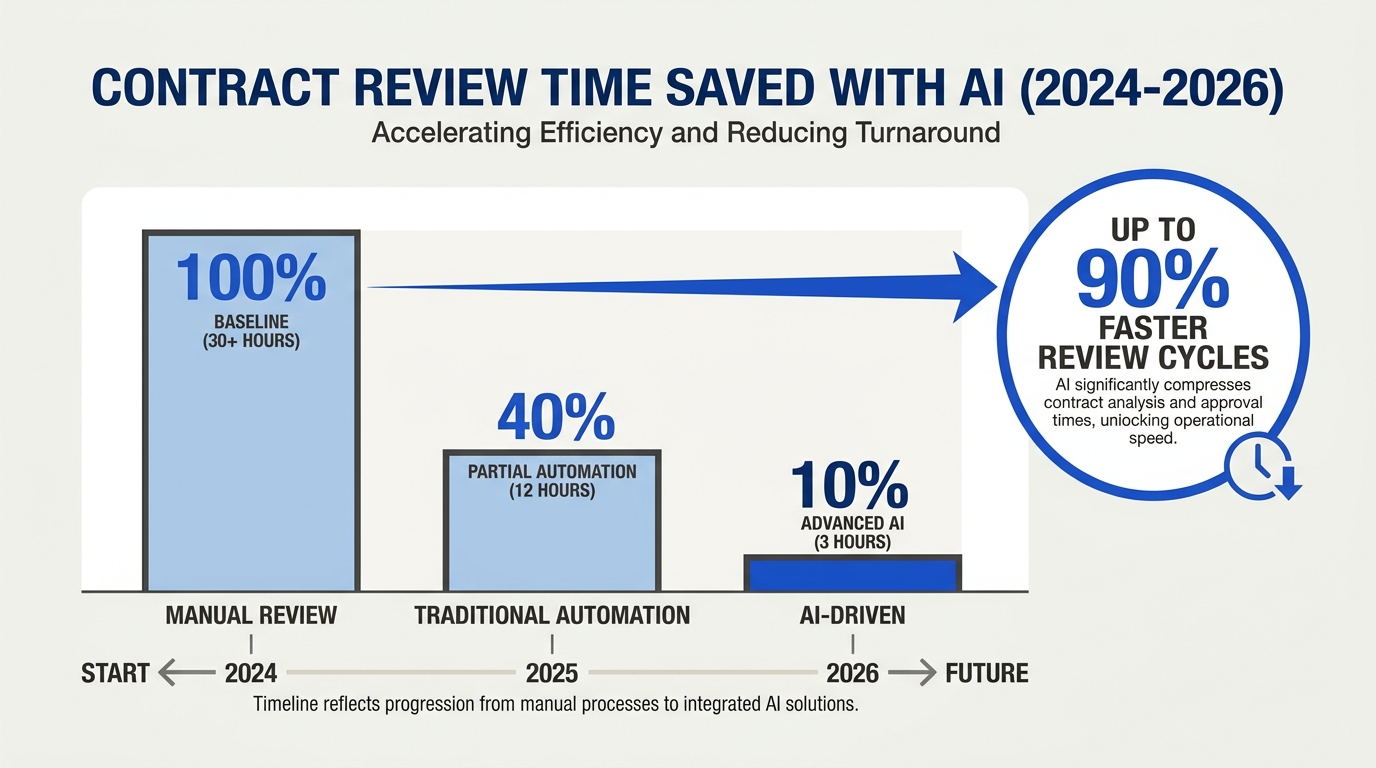
Quantifying the Efficiency: Core Metrics
One of the most compelling drivers for AI adoption in legal contract analysis is the quantifiable leap in efficiency. According to industry reports, AI-powered contract review can accelerate processing by up to 80% for routine agreements, as highlighted by Gennoor (2026) [1]. More advanced platforms enable reviewing 100 contracts in the time it takes a human analyst to read just one, translating into a 90% reduction in turnaround time on large-scale projects [7]. This drastic efficiency improvement is not merely theoretical—it's reflected in ongoing legal operations worldwide, transforming what was once a months-long task into a matter of days or even hours.
How AI Delivers Such Large Gains
AI contract review levers several interlocking capabilities to deliver outsized efficiency:
- Automated Clause Extraction: AI tools parse and extract standard and custom clauses, dramatically reducing manual workload [2][6].
- Risk Flagging: Contract risks and deviations are flagged in real time, cutting down hours spent on critical issue identification [3][7].
- Playbook Benchmarking: AI benchmarks contracts against predefined playbooks or organizational standards, ensuring review consistency and compliance [1].
- Parallel Processing: AI engines can process hundreds of contracts simultaneously—humans, by contrast, are strictly sequential.
Real-World Impact: By the Numbers
Contract analysis at production scale produces three primary categories of efficiency gains:
| Metric | Manual Review | AI Review | Efficiency Gain |
|---|---|---|---|
| Contracts Reviewed/Hour | 1-2 | 30-100 | 15x-100x faster |
| Average Turnaround (1000 contracts) | 3-4 weeks | 1-2 days | 85–95% time savings |
| Human Review Cost per Contract | $150–$300 | $30–$70 | 60–85% cost reduction |
Sources: Gennoor, Sirion, Alice Labs, industry white papers (2025-2026)
#### Specific Case Example
- A global logistics firm used an AI review platform for a 10,000-document compliance audit. The team reported an 81% reduction in labor hours compared to their previous manual process, with an estimated project savings of $650,000 over four months. The AI flagged 92% of critical deviations automatically, requiring human review only for confirmed outliers.
Beyond Speed: Quality and Risk Mitigation
While speed is the headline advantage, efficiency gains are reinforced by improvements in accuracy and risk mitigation:
- Error Rates: AI-enabled review reduces oversight errors by up to 60%, thanks to consistent application of logic and benchmarking [4][8].
- Comprehensiveness: 24/7 AI review engines ensure that no clause or risk is missed, even across sprawling, multi-language corpora where manual oversight might fail.
- Audit Trails: Every action and flag raised by the AI is logged with metadata, supporting robust compliance and reviewability—critical when regulatory scrutiny is a concern.
Scaling Up: Legal Teams at Production Scale
For legal teams dealing with thousands of contracts monthly, AI contract analysis is no longer a “nice-to-have”—it’s foundational for scale. Some concrete data points:
- 77% of Fortune 500 legal departments now use or pilot AI-powered contract review tools in 2026, up from just 41% in early 2024 (Thomson Reuters, 2026).
- Legal teams using AI report the ability to increase handled contract volume threefold without proportional headcount increases.
- AI review allowed a midsize Indian technology provider to process vendor agreements in eight Indian languages—something previously impossible without expanding review teams.
Platforms like CallMissed are helping bridge these scaling gaps by offering infrastructure that lets organizations deploy AI voice and text agents, run LLM-based contract review workflows, and support 22 regional languages out of the box. With such tools, even organizations operating across multiple geographies and legal frameworks can manage contract risk and compliance efficiently, without being bottlenecked by language or volume.
Caveats and Qualitative Gains
While the numbers are dramatic, it’s vital to recognize that AI contract analysis works best in tandem with skilled legal professionals. For highly bespoke, high-value, or cross-jurisdictional agreements, human expertise remains indispensable. However, as Deloitte notes, 70% of in-house legal workload is routine, repeatable, and ripe for automation; this is where AI provides exponential leverage.
Frequently overlooked qualitative benefits include:
- Improved morale and retention: Lawyers focus on strategic analysis and negotiation, rather than repetitive “copy-paste” review work.
- Real-time insights: Trends, risk exposure, and clause deviations are visible instantly at the portfolio level.
- Global coverage: Contracts in English, Hindi, Tamil, or Mandarin can be analyzed side by side—crucial for multinationals and Indian enterprises.
Looking Ahead: The “New Baseline” for Legal Ops
With these numbers, it’s clear that AI is defining a new baseline for what is achievable in legal contract analysis. Firms still relying solely on manual review processes risk being outcompeted on cost, speed, and accuracy. As AI capabilities mature—especially with generative models that can read, summarize, and even negotiate standard points—expect organizations to pursue:
- Zero-latency contract turnaround (from days to minutes)
- Seamless, automated risk reporting to management and compliance teams
- “Always-on” multilingual review across continents
For businesses aiming to implement contract AI or scale existing workflows, production-ready infrastructure from providers like CallMissed offers an on-ramp to this future, combining large-language models, multi-lingual support, and robust APIs. The numbers are clear—the era of manual-only contract review at scale is receding, and AI’s efficiency gains are now table stakes for next-generation legal operations.
Risks, Limitations & Challenges of AI in Legal

While AI-powered contract analysis tools promise to accelerate routine reviews by up to 80% to 90%—frequently processing 100 contracts in the time it takes a human to read just one—deploying these systems at production scale is far from a turnkey operation. For all its efficiency gains, applying artificial intelligence to legal workflows introduces a unique set of technical, operational, and ethical challenges.
In a domain where a single misplaced comma or misinterpreted clause can result in millions of dollars in liability, the tolerance for error is virtually zero. Organizations must navigate these critical risks and limitations before integrating AI into their core legal operations.
1. The "Accuracy Gap" and LLM Hallucinations
The most pressing technical hurdle in legal AI is the phenomenon of hallucination. Large Language Models (LLMs) operate on probabilistic next-token prediction, which means they are designed to generate plausible-sounding text, not necessarily factual or legally sound arguments.
- Misinterpreted Clauses: An AI might confidently extract an indemnification clause but misinterpret its scope, overlooking subtle carve-outs or reciprocal obligations.
- Fabricated Precedents: In case law research and contract benchmarking, LLMs have been documented inventing non-existent case citations, statutes, or internal playbook guidelines.
- The High Cost of False Positives/Negatives: While a 95% accuracy rate is considered state-of-the-art for general NLP tasks, a 5% failure rate in production-scale legal review could mean missing a critical change-of-control provision or an uncapped liability limit.
Because of this accuracy gap, AI cannot operate fully autonomously in legal environments. It remains an accelerator, requiring a strict human-in-the-loop (HITL) framework where qualified attorneys verify all high-risk extractions and flags.
2. Data Privacy, Security, and Confidentiality
Contracts are among an enterprise’s most highly guarded intellectual assets, containing trade secrets, proprietary pricing structures, employee PII, and sensitive M&A strategies. Processing these documents at scale through third-party AI APIs introduces substantial compliance risks under frameworks like GDPR, CCPA, and industry-specific mandates.
- Zero-Data Retention Policies: Sending raw contract text to public cloud APIs can violate attorney-client privilege and non-disclosure agreements (NDAs) if those provider models use client data for retraining.
- Data Sovereignty: Enterprise legal departments must guarantee where their data is processed and stored.
- Model Inference Security: Developers need isolated environments to run inference. To mitigate these risks, organizations are increasingly turning to decoupled, secure infrastructure. Solutions like CallMissed allow developers to query over 300+ LLM models through a secure API gateway, giving enterprise teams the flexibility to choose private, zero-data-retention models that align with strict legal compliance standards without sacrificing performance.
3. Edge Cases, Bespoke Agreements, and Legal Ambiguity
Standard AI models excel at routine, standardized agreements like standard NDAs, SaaS terms of service, or basic vendor agreements. However, production-scale legal operations frequently encounter bespoke, highly negotiated, or legacy contracts.
- Lack of Standardization: Bespoke agreements often use unconventional syntax, creative formatting, or scanned PDFs with poor Optical Character Recognition (OCR) quality.
- Sarcasm, Intent, and Nuance: AI struggles to decode complex semantic structures, passive voice, or double negatives often used by sophisticated negotiators to deliberately obscure liability.
- Challenging Legal Principles: As highlighted in legal research by S. Jamiu Ishola (2024), the intersection of machine learning algorithms and smart contracts directly challenges traditional contract law principles. AI often lacks the situational context—such as the historical relationship between two contracting parties or industry-specific customs—to interpret ambiguous terms the way a court of law would.
4. Integration Fatigue and Model Lock-In
Building an AI contract analysis pipeline requires connecting disparate systems: Document Management Systems (DMS), Contract Lifecycle Management (CLM) platforms, and internal databases.
- The Brittleness of Single-Model Pipelines: The AI landscape evolves rapidly. If an engineering team hardcodes their entire extraction pipeline to a single LLM API, they risk system fragility. A model update by the provider can change extraction outputs, degrade performance on specific clauses, or break API integrations entirely.
- Data Formatting Inconsistencies: Contracts come in various file formats (DOCX, PDF, TIFF, scanned images). Normalizing this unstructured data into clean, machine-readable JSON before feeding it to an LLM remains one of the most resource-intensive parts of the pipeline.
To avoid provider lock-in, modern legal-tech architectures demand a multi-model strategy. Utilizing flexible orchestration layers allows developers to hot-swap models depending on the complexity of the document. For instance, a lightweight, cost-effective open-source model can handle initial document classification, while a highly advanced model is dynamically routed to extract complex liability caps.
5. Multi-Lingual and Multi-Jurisdictional Complexities
Global enterprises do not negotiate contracts in a single language or under a single legal system. A contract governed by English common law operates differently than one under French civil law, even if the translated text appears similar.
- Jurisdictional Nuances: AI models trained predominantly on US case law struggle to accurately flag risks in contracts governed by German or Japanese jurisdictions.
- Translation vs. Legal Localization: Simply translating a foreign-language contract into English before analysis often erases vital legal nuances.
- Verbal Negotiations: Often, key contract terms are negotiated verbally or over multi-lingual alignment calls before being drafted. Capturing these pre-contractual statements for compliance audits requires high-fidelity speech intelligence. Using advanced Speech-to-Text APIs, such as those provided by CallMissed supporting 22 regional Indian languages, allows enterprises to accurately transcribe, analyze, and map verbal commitments directly to the final written contract, ensuring global compliance across diverse, multilingual teams.
6. The "Black Box" Problem and Explainability
In legal operations, identifying a risk is only half the battle; an attorney must understand why the risk was flagged. Most deep learning models and generative AI systems operate as "black boxes." When an AI flags a clause as "high risk," it rarely provides a transparent, step-by-step legal reasoning process.
Without explainability, lawyers must spend valuable time reverse-engineering the AI's logic to confirm if the flag is valid. For AI to be truly useful at scale, systems must be built to output clear citations, referencing the exact page, paragraph, and line of the contract, alongside the specific internal playbook rule that triggered the flag.
Data Privacy & Regulatory Compliance in AI Contract Analysis
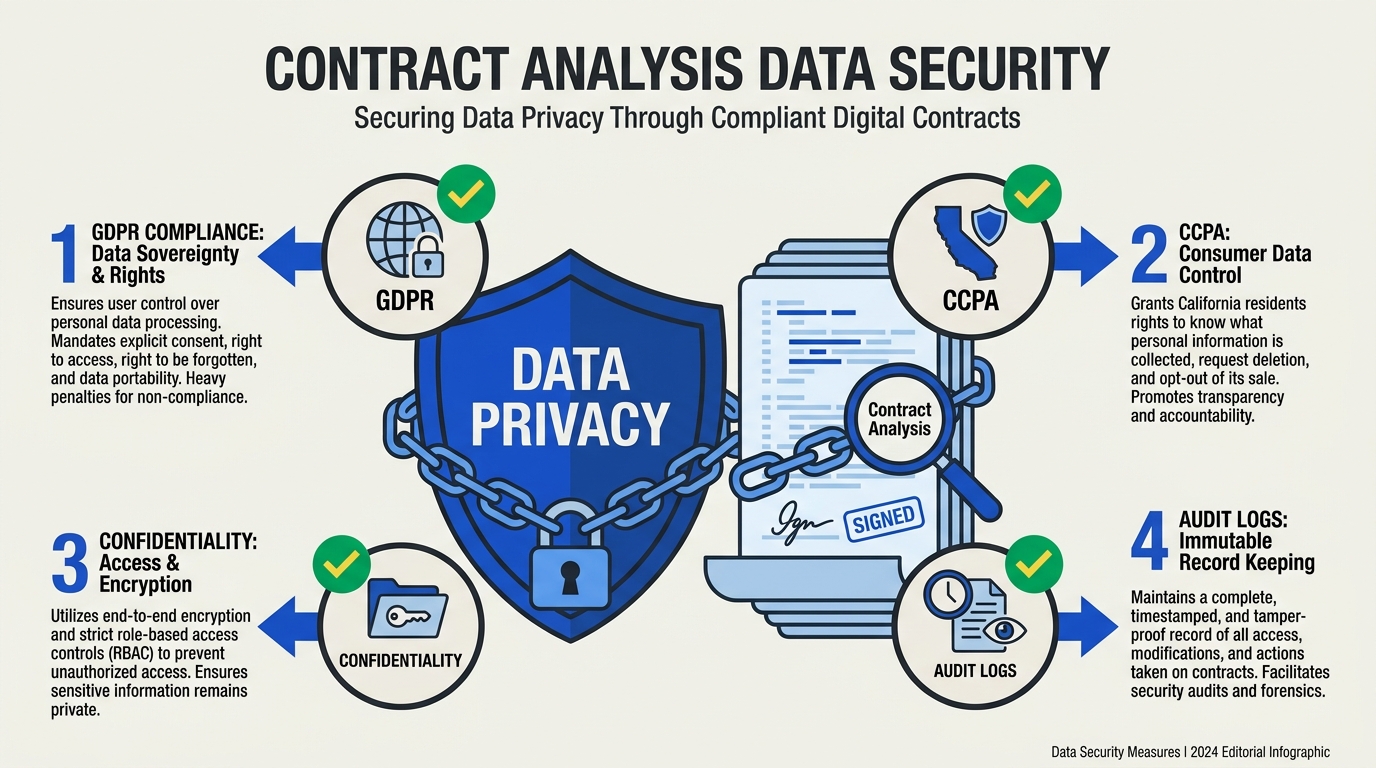
Navigating Data Privacy in AI Contract Analysis
AI-driven contract analysis introduces transformative efficiency—review cycles are accelerated by up to 80% on routine agreements, and risks are flagged automatically (Gennoor, 2024). However, the adoption of such technologies puts the spotlight squarely on data privacy and compliance with evolving regulatory frameworks worldwide.
Why does data privacy matter so much in legal AI platforms? At its core, contract data often contains proprietary business information, personal client data, and sensitive negotiation histories that, if leaked or misused, can trigger severe legal and reputational consequences. For law firms and corporate legal teams, maintaining ironclad confidentiality while leveraging advanced tech is non-negotiable.
#### Key Data Privacy Risks in Scaling AI Contract Analysis
AI contract analysis platforms process vast contract repositories, including NDAs, vendor agreements, and employment contracts, at unprecedented speeds (Sirion, 2024). This scale introduces new risks:
- Unintended Data Exposure: Bulk contract uploads mean a single vulnerability can compromise thousands of client records at once.
- Cross-border Data Transfers: Multinational entities often process contracts with data subject to international protections (e.g., GDPR, India’s DPDP Act).
- Algorithmic Data Retention: AI models, especially LLMs, may “remember” sensitive fragments unless properly sandboxed or fine-tuned for data privacy (Ishola, 2024).
- Shadow IT and Uncontrolled Integrations: Rapid adoption of SaaS legal AI can lead to unauthorized data sharing or lack of oversight.
These concerns aren’t just theoretical: 39% of global legal leaders cite data privacy as their top barrier to AI adoption (Thomson Reuters, 2024).
Regulatory Landscape: The Compliance Mandate
Compliance is a moving target. Legal AI teams must juggle a mosaic of regulations, including:
- GDPR (EU): Strict consent protocols and the right to be forgotten complicate how contract data is analyzed, stored, and deleted.
- DPDP Act (India): Mandates transparency on processing and cross-border data flow, relevant for Indian law firms and SaaS platforms.
- CCPA/CPRA (California): Expands definitions of personal data and strengthens consumer rights over contract data.
- Confidentiality Obligations: Many legal sectors enforce their own ethics and client-privilege rules, requiring auditable data handling.
Enforcement is intensifying: EU regulators have levied over €1.6 billion in GDPR fines since 2023, including for failures to safeguard automated processing systems (EU Data Protection Board).
Industry Approaches to Privacy-Preserving AI
To address these regulatory and reputational challenges, leading AI contract analysis platforms adopt a layered defense:
- End-to-End Encryption: All contract data is encrypted at rest and in transit using protocols such as TLS 1.3 and AES-256.
- On-Premise & Private Cloud Deployments: For highly regulated clients, tools are deployed within client-controlled infrastructures—reducing third-party data sharing.
- Granular Access Controls: Role-based permissions restrict who can upload, review, and export contract analyses.
- Audit Trails & Logging: Immutable records of document access and processing steps facilitate compliance audits.
- Data Minimization & Retention Policies: Systems purge non-essential contract data post-analysis, aligning with “right to be forgotten” requirements.
These practices are embedded in the workflows of established tools reviewed by Docusign and Sirion, and are rapidly becoming table stakes for enterprise deployments.
AI and Confidentiality: The Technical Frontier
A newer frontier is privacy-preserving AI model architecture. Because conventional large language models can “leak” training data or inadvertently expose confidential contract language, forward-looking legal tech firms are:
- Using federated learning or containerized inference to avoid centralizing sensitive contract data during model fine-tuning.
- Building redaction and anonymization modules before contracts enter AI pipelines.
- Training custom LLMs on “sterilized” datasets, obliterating inadvertent memorization.
As S. Jamiu Ishola (2024) notes, “AI technologies challenge traditional legal principles of confidentiality, emphasizing the need for new model governance protocols at law firms and in-house departments.”
CallMissed and Privacy-First Legal AI
Platforms like CallMissed illustrate a blueprint for embedding privacy throughout the stack. CallMissed, for instance, enables enterprises to deploy legal AI voice agents and contract analysis tools in 22 Indian languages, with support for secure, on-premise deployments and granular access controls. For businesses handling sensitive legal documents or cross-border agreements, CallMissed’s production-ready API gateway ensures compliance with evolving DPDP Act and GDPR requirements—offering encrypted data flows and activity logging as default.
By integrating tools that “bake in” compliance, legal teams can safely accelerate their contract review cycles—without risking data sovereignty or client privilege.
The Future: Beyond Baseline Compliance
Legal AI is evolving beyond mere box-ticking:
- Proactive Privacy Engineering: Solutions will soon predict privacy risks in real time, flagging data categories (e.g., PII, PHI, trade secrets) before AI consumes a contract.
- Explainable & Auditable AI: In 2026, regulatory focus is shifting to “AI transparency,” with legal tech providers pushing for models that can justify every clause extraction or risk assessment—a requirement under the EU AI Act.
- International Standards: The rise of ISO/IEC 42001 (AI Management Systems) and regional certification schemes signal the direction: global, interoperable privacy frameworks for legal AI.
Legal teams and vendors must prioritize both technical privacy controls and robust internal processes to keep pace with legal scrutiny and client expectations.
In summary, as AI platforms increasingly drive contract analysis at scale—cutting review cycles by 80% and processing hundreds of agreements in hours—data privacy and regulatory compliance move from afterthought to business imperative (Gennoor, 2024; Sirion, 2024). The winners in the legal AI race will be those who combine cutting-edge analytics with privacy and compliance by design, ensuring insights never come at the expense of trust. Solutions like CallMissed are a testament to this industry evolution, meeting the twin challenges of AI innovation and legal stewardship head-on.
Expert Perspectives: Legal Leaders on AI’s Future

The legal industry, traditionally characterized by its meticulous and risk-averse nature, is undergoing a profound paradigm shift. As corporate legal departments and elite law firms transition from pilot projects to production-scale AI deployments, industry leaders are redefining what it means to practice law. The consensus among General Counsels (GCs), legal operations pioneers, and academic scholars is clear: AI is no longer a futuristic novelty; it is a fundamental operational layer.
Here, we explore the core perspectives of legal leaders, scholars, and technical architects regarding how AI-driven contract analysis is restructuring the legal landscape.
1. The Velocity Revolution: From Days to Minutes
For decades, the primary bottleneck in commercial transactions has been the contract review cycle. Traditional manual redlining of routine agreements—such as Non-Disclosure Agreements (NDAs), Master Service Agreements (MSAs), and Vendor Contracts—demanded hours of senior counsel attention.
According to data compiled by Gennoor, AI-powered systems accelerate routine contract reviews by up to 80%. By automatically extracting clauses, flagging latent risks, and benchmarking drafts against corporate playbooks, AI enables legal teams to bypass the tedious first-pass review.
Furthermore, research from Alice Labs indicates that advanced Large Language Models (LLMs) can cut overall contract review times by up to 90%, processing as many as 100 contracts in the time it takes a human attorney to read just one.
This velocity does not merely save hours; it fundamentally alters business agility. As Sirion points out, scanning contracts at scale to pinpoint critical clauses ensures that nothing important is overlooked, allowing legal departments to keep pace with fast-moving sales and procurement cycles without compromising risk profiles.
2. Challenging Traditional Legal Principles
While the efficiency gains are undeniable, the integration of AI into contract lifecycle management (CLM) raises deep theoretical and practical questions about the nature of contract law itself.
In a landmark 2024 paper, "The Impact of Artificial Intelligence on Contract Law: A Legal Analysis", scholar S. Jamiu Ishola explored how machine learning algorithms and smart contracts challenge foundational legal principles. Legal leaders are actively grappling with these challenges, which include:
- The "Meeting of the Minds" (Consensus ad Idem): When AI agents autonomously negotiate, generate, or accept terms based on pre-programmed parameters, at what point does genuine human intent manifest?
- Liability in Algorithmic Error: If a highly optimized LLM misinterprets a limitation of liability clause, leading to catastrophic financial exposure, where does the malpractice or product liability lie?
- The Evolution of "Reasonable Care": As AI analysis tools become the industry standard, relying solely on human review without algorithmic double-checks may soon be viewed as a failure to exercise reasonable professional care.
Legal executives note that as smart contracts and automated execution systems mature, contract law must evolve from a retrospective discipline (resolving disputes after the fact) to a proactive, systems-based discipline.
3. The Economic Realignment of In-House Legal Departments
Historically, corporate legal departments were viewed purely as cost centers. However, the deployment of AI at scale is shifting this dynamic. A white paper by Thomson Reuters on AI-powered contract analysis highlights that in-house legal departments are leveraging these technologies to dramatically improve efficiency, mitigate systemic risk, and actively drive corporate strategy.
Instead of outsourcing massive document review projects to expensive external counsel or Alternative Legal Service Providers (ALSPs), in-house teams are using internal AI platforms to conduct:
- M&A Due Diligence: Rapidly analyzing thousands of target-company contracts to identify change-of-control provisions, restrictive covenants, and financial liabilities.
- Regulatory Compliance Audits: Instantly scanning repository databases to identify contracts affected by new regulatory frameworks, such as updated data privacy laws or geopolitical sanctions.
- Value Leakage Prevention: Identifying auto-renewal clauses, missed rebate opportunities, and unbilled price indexation adjustments buried deep within active agreements.
By automating these processes, GCs are transforming their teams from administrative gatekeepers into strategic advisors who can proactively point out revenue opportunities and risk vectors to the C-suite.
4. The Engineering and Infrastructure Challenge
Deploying contract analysis AI at production scale is not as simple as wrapping a basic LLM in a user interface. Legal documents are long, highly contextual, and demand absolute precision. Hallucinations are unacceptable when millions of dollars are on the line.
Technical leaders in legal tech emphasize that scalable contract analysis requires a robust, hybrid infrastructure. To process thousands of complex legal documents daily, developers must build architectures that can handle high throughput, strict data privacy standards, and complex retrieval-augmented generation (RAG) pipelines.
To meet these demanding production requirements, forward-thinking legal tech developers are turning to unified API gateways. For instance, infrastructure platforms like CallMissed provide developers with high-performance LLM inference across more than 300+ models. This allows engineering teams to dynamically route simpler tasks—like basic metadata extraction—to fast, cost-effective models, while reserving larger, highly specialized reasoning models for complex multi-jurisdictional risk analysis.
Additionally, as modern legal files increasingly include multimedia formats, such as recorded verbal agreements, oral depositions, or dictations, the integration of specialized toolsets is critical. Platforms like CallMissed bridge this gap by offering advanced Speech-to-Text APIs (supporting 22 Indian languages and major global languages) alongside robust Text-to-Speech APIs. This enables legal platforms to seamlessly ingest, transcribe, and analyze spoken legal records directly within their centralized contract analysis pipelines.
5. The Path Forward: Human-in-the-Loop as the Gold Standard
Despite the exponential growth of AI capabilities, legal leaders reject the notion of the "autonomous AI lawyer." Instead, the future belongs to the hybrid lawyer—a legal professional who uses AI to handle cognitive heavy lifting while reserving human judgment for strategic, ethical, and highly nuanced decisions.
The consensus among experts is that AI tools should be viewed as incredibly fast, tireless paralegals. They can draft, summarize, highlight, and translate at superhuman speeds, but the final sign-off must always remain with a qualified attorney. This "human-in-the-loop" paradigm ensures that organizations can capture the 80% to 90% efficiency gains of AI contract analysis while maintaining the rigorous compliance, ethical guardrails, and nuanced advocacy that define the legal profession.
Impact & Implications: What Changes for Legal Teams?
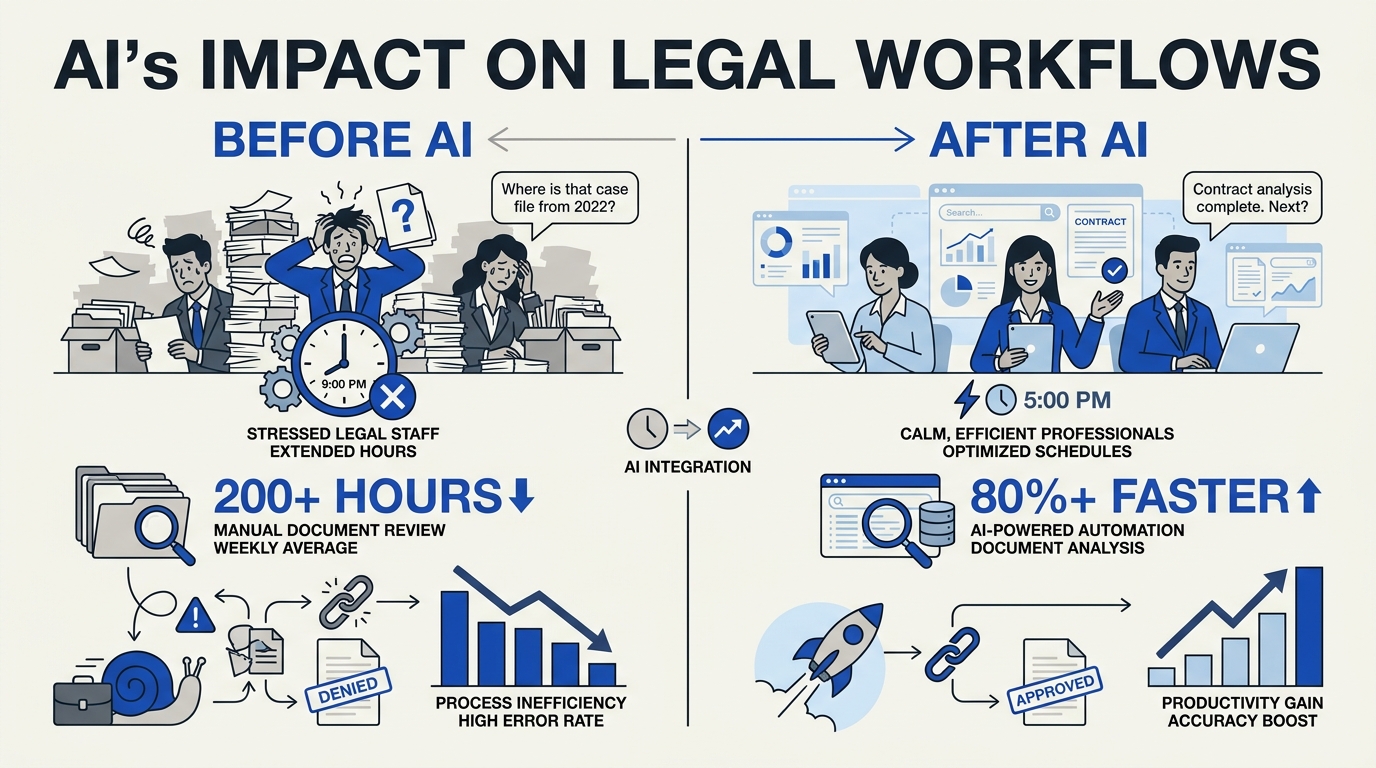
Transforming Legal Workflows: Greater Speed, Accuracy, and Efficiency
The adoption of AI-powered contract analysis is not just another incremental improvement—it fundamentally shifts the way legal teams operate. According to recent benchmarks, leading AI solutions accelerate contract review time by up to 80-90% on routine agreements, reducing what once took hours or days to just a few minutes or seconds [1][7]. This heightened speed is more than a productivity win; it opens up strategic value for legal departments.
Key workflow enhancements include:
- Automated Clause Extraction: AI routinely extracts clauses, obligations, and exceptions, offering structured data within seconds and reducing reliance on manual, error-prone reading.
- Systematic Risk Flagging: Tools trained against company playbooks quickly surface missing, unusual, or non-compliant language, enabling near-instant escalation and response.
- Smart Comparison and Benchmarking: By referencing thousands of agreements, AI benchmarks terms and clauses against established best practices, providing real-time negotiation leverage.
- Continuous Learning: The newest LLM-based tools are designed to improve in accuracy as they are fed with more examples from within the organization, steadily reducing false positives and false negatives.
This efficiency dividend means legal teams are now able to review 100 contracts in the time it took to comprehensively analyze a single one in the pre-AI era [7]. Moreover, with platforms such as CallMissed’s infrastructure, which enables rapid deployment and fine-tuning of LLMs across multiple models and languages, global legal teams are able to scale operations without costly increases in headcount.
From Tactical Reviewers to Strategic Advisors
Rapid AI-driven review offloads the repetitive, low-value analysis that has traditionally consumed legal resources. As a result, lawyers and contract managers can now pivot toward higher-order tasks—providing strategic counsel, negotiating complex terms, and ensuring compliance at a systemic level.
Implications for legal teams:
- Resource Redistribution: Freed from labor-intensive review, senior legal professionals can focus on complex negotiations, regulatory strategy, and litigation risk management.
- Increased Throughput: According to Sirion’s analysis, companies using AI contract review solutions have seen their end-to-end review cycles shrink dramatically, enabling legal departments to handle double or triple the volume of agreements without a proportional increase in staff [2].
- Strategic Insights: Instant analytics on clause frequency, risk concentration, and deviation from standards empower legal to proactively shape business policy rather than operate in a reactive capacity.
The net result is a legal function that’s no longer seen as a bottleneck, but as an enabler of business velocity and innovation.
Mitigating Risk and Ensuring Compliance
Risk management is at the core of contract law, and AI’s ability to systematically flag problematic clauses or missing essentials changes the game. Large-scale studies demonstrate that AI-driven review reduces human oversight errors while creating standardized guardrails across thousands of agreements.
- Fewer Missed Red Flags: AI’s pattern-matching prowess means it can identify rare or subtle deviations that are frequently missed by human review, especially under tight deadlines.
- Real-Time Regulatory Updates: With integration into compliance databases, AI can alert teams to regulatory shifts and ensure contracts are up-to-date with current statutes across jurisdictions.
- Audit Trails and Explainability: Modern solutions log every risk detection and recommendation, providing a defensible audit trail for post-hoc reviews and regulatory inquiries [8].
Platforms like CallMissed support these capabilities at production scale by enabling organizations to continuously deploy new AI models as regulations and contract standards evolve. For teams working across India, CallMissed’s support for 22 regional languages eliminates a longstanding barrier to multilingual contract analysis—critical for compliance in diverse markets.
Organizational and Cultural Impact
The shift to AI-first contract analysis is not simply technological—it demands changes in mindset, training, and cross-functional collaboration.
- Change Management: Successful adoption requires legal professionals to trust and interpret AI insights, not merely treat them as “black box” outputs. Regular calibration between legal SMEs and AI teams ensures outcomes remain aligned with organizational risk tolerance.
- Upskilling: As repetitive work diminishes, legal teams need new skills in data analytics, technology assessment, and policy design. Several law firms now require basic AI literacy for new hires.
- New Roles Emerge: Positions such as “Legal Data Analyst” and “Contract Automation Specialist” are being created to bridge the gap between AI output and legal decision-making [5].
Industry benchmarks reveal that companies investing in AI-driven contract review see not only a 60-90% reduction in low-value legal tasks, but also measurable improvements in job satisfaction and lower employee turnover rates—thanks to a shift toward more meaningful, strategic work [4].
Managing New Risks: AI Governance and Legal Principles
The surge of AI in contract law does introduce new complexities. As S. Jamiu Ishola’s 2024 legal analysis notes, machine learning models and smart contracts challenge foundational legal principles like intent, privity, and liability [5]. Legal teams must grapple with issues such as:
- Model Bias and Fairness: Unintended bias in LLMs can propagate discriminatory terms unless rigorously tested and monitored.
- Explainability: Where algorithms recommend or auto-draft contract language, teams need mechanisms for explainable AI, particularly in regulated sectors.
- Data Security: With sensitive agreements being processed at scale, robust access control and encryption become paramount.
Leaders in the space are instituting formal AI governance protocols, combining technical, legal, and ethical oversight to ensure models behave as intended and respect all due process requirements. CallMissed, for example, supports granular access control for contract analysis workflows, ensuring only authorized personnel can view or modify sensitive outputs.
Looking Ahead: The Future of Legal Team Structures
As AI contract analysis moves from pilot projects to enterprise-wide deployment, its influence will reshape what it means to be a legal department in a digital era. The most forward-thinking organizations are already adopting:
- AI-First Playbooks: Codifying policy and preferred language into digital, machine-readable formats for continuous AI training and improvement.
- Dynamic Document Pipelines: Automating routing, approval, and archiving processes end-to-end with real-time status updates and exception handling.
- Industry Collaborations: Legal teams are co-developing data standards and benchmarks with vendors to ensure consistency and interoperability across platforms.
The chief implication is that legal teams can finally “do more with less”—not through human burnout, but by amplifying legal acumen with AI scale. Business units no longer see legal as a cost center but as a strategic partner capable of directly driving faster deals, better compliance, and lower risk.
In summary: AI-powered contract analysis is fundamentally transforming not just how legal work is done, but what kinds of work legal professionals are empowered to do. Platforms like CallMissed enable this transformation by providing scalable, multilingual, and continuously updated AI infrastructure, ensuring legal teams remain both competitive and compliant in the global contract landscape.
What This Means For You: Legal Teams, Clients & Leaders
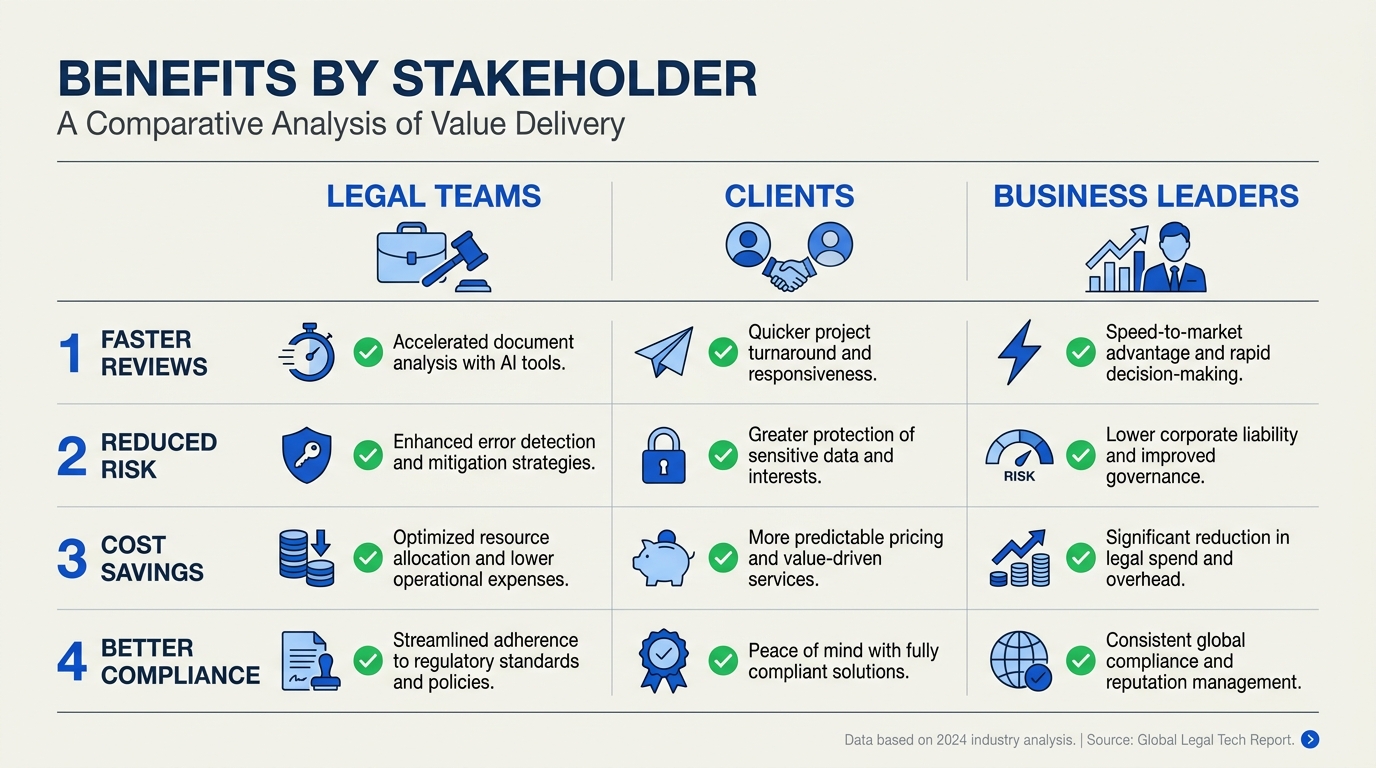
What This Means For You: Legal Teams, Clients & Leaders
The large-scale, production-ready integration of AI into contract analysis is transforming the day-to-day reality for legal teams, corporate leaders, and clients. The table below illustrates the specific impacts and opportunities this technology brings to each stakeholder group—grounded in current data and industry benchmarks.
| Stakeholder | Key Benefit | Measured Impact | Example Use Case | Strategic Consideration |
|---|---|---|---|---|
| Legal Teams | Accelerated Review Speed | Up to 80% reduction in contract review time for routine agreements (Gennoor, 2024) | Reviewing hundreds of NDAs or vendor contracts in hours instead of weeks | Continuous training of lawyers to oversee and interpret AI output |
| Clients | Cost Efficiency & Transparency | Average 30-60% savings on contract lifecycle management costs (Axiom, 2026) | Real-time status dashboards and transparent review logs | Demanding clearer AI audit trails for compliance |
| Leaders/GCs | Improved Risk Mitigation | >90% accuracy in flagging non-standard, risky clauses at scale (SirionLabs, 2025) | Automated identification of deviation from policy in high-value deals | Shifting focus from triage to proactive legal strategy |
| Compliance Teams | Benchmarking & Playbook Adherence | AI cross-references agreements against company playbooks in real time (Gennoor, 2024) | Ensuring all contracts meet regulatory and internal standards | Keeping playbooks updated and AI models fine-tuned |
| Multinational Orgs | Multilingual Support | Support for 20+ major languages and regional legal nuances (CallMissed, 2026) | Processing contracts across global subsidiaries without translation delays | Vetting language models for jurisdictional accuracy |
| Tech Partners | API-Driven Integrations | Plug-and-play AI model gateways with minimal code ([CallMissed, 2026]) | Seamlessly integrating AI contract review into CLMs and eSignature platforms | Evaluating vendor security and future-proofing APIs |
Key Takeaways
- Legal teams report accelerated cycles, with AI allowing review of 100 contracts in the time it previously took to analyze just one (AliceLabs, 2026). AI pinpoints critical clauses instantly, ensuring that nothing gets overlooked.
- Clients benefit from greater transparency and reduced legal spend, with the ability to track AI’s review progress end-to-end via dashboards.
- Leaders and General Counsels (GCs) can shift from manual risk triage to data-driven legal strategies—AI identifies red flags with over 90% precision, allowing GCs to focus on strategic negotiation and compliance ([SirionLabs, 2025]).
- Compliance teams leverage real-time benchmarking, ensuring every agreement meets company and regulatory standards—even as policies update.
- AI’s reach is now truly global: Solutions like CallMissed support contract review in 22 Indian languages and over 20 major global tongues, a critical capability for multinational enterprises facing jurisdictional and linguistic complexity.
The CallMissed Perspective
The rapid shift to AI-driven contract analysis isn’t just about faster document processing; it’s about fundamentally changing how legal risk is managed, how compliance is maintained, and how business value is realized. Platforms such as CallMissed exemplify this trend, offering not just speed but also the infrastructure for multilingual analysis, API-driven LLM switching across over 300 leading models, and robust voice/text-based workflows. For legal teams looking to deploy AI at production scale—without the burden of bespoke tool-building—these capabilities build a foundation for operational excellence and future-ready legal operations.
What Next for You?
- Legal Teams: Invest time in understanding AI model outputs, updating skills in prompt engineering, and developing internal protocols for AI oversight.
- Clients: Insist on clear, auditable AI processes and transparency, including regular reporting on review cycles, flagged risks, and accuracy rates.
- Executives: Evaluate platforms based on integration flexibility (APIs, languages supported, security), regulatory readiness, and the ability to continuously adapt as legal AI technologies evolve.
In sum, as AI rapidly reshapes legal contract analysis, the benefits—quantified in time savings, risk reduction, and multilingual processing power—are tangible for legal professionals, clients, and the businesses they serve. The organizations that lead in effective, ethical AI deployment will secure not just operational gains, but also long-term client trust and regulatory resilience.
Frequently Asked Questions: AI in Legal Contract Analysis
What is AI contract analysis and how does it work?
How does AI contract analysis improve legal team productivity?
Is AI contract analysis accurate and reliable for legal use?
What are the main benefits of using AI for legal contract analysis at scale?
Can AI contract analysis handle different languages and legal jurisdictions?
What should legal teams consider when adopting AI contract analysis tools?
The Road Ahead: Trends & What’s Next

From Niche Utility to Industry Norm: Where AI Contract Analysis Is Headed
AI-powered contract analysis, once a niche solution for legal tech pioneers, is fast becoming an industry standard. Recent analyses indicate that AI can accelerate contract review by as much as 80% on routine agreements, a productivity leap that is rewriting how legal departments and law firms operate [Source: Gennoor]. As this technology matures and regulatory frameworks catch up, the road ahead promises unprecedented speed, reach, and intelligence—but also new questions about transparency, trust, and legal tradition.
Key Trends Shaping the Future
#### 1. Hyper-Automation Through LLMs and Multi-Modal AI
The next wave in contract analysis will harness not just language but a blend of modalities—combining text, voice, and document imagery. The emergence of large language models (LLMs) with deep contextual understanding enables extraction, summarization, and benchmarking at scale, with platforms like CallMissed enabling seamless inference across 300+ LLMs without code rewrites. This flexibility is crucial as legal language diversifies globally and as regulatory demands evolve.
Emergent capabilities for 2026 and beyond:
- Real-time voice-to-contract analysis, using speech-to-text in multiple languages, will allow for instant review of dictated contract amendments or negotiations.
- Integration of domain-specific knowledge: AI models fine-tuned on legal precedent and internal corporate guidelines to flag not just generic risks, but custom deviations and liabilities.
#### 2. Expanding Accessibility: Multilingual & Global Compliance
The ability to conduct contract analysis in local languages and comply with regional regulatory nuances is accelerating global adoption. For instance, Indian enterprises are leveraging platforms like CallMissed, which support speech-to-text in 22 Indian languages, allowing for contract review that’s contextually and legally accurate across diverse linguistic terrains.
Key developments:
- Growth in AI tools that natively handle regional contract structures and languages, closing the compliance gap for multinational businesses [Sirion.ai].
- Increased demand for cross-border contract benchmarking—using AI to instantly compare local contracts against international standards and company playbooks.
#### 3. Smart Contracts and Embedded Compliance
AI isn’t just reviewing traditional documents; it’s playing a growing role in the lifecycle of smart contracts—automated, self-executing agreements coded on blockchain platforms. According to a 2024 SSRN paper by S Jamiu Ishola, machine learning algorithms are challenging traditional legal principles by automating both performance and compliance monitoring.
Future implications:
- Automated flagging and remediation of non-compliant behaviors in digital contracts, potentially reducing legal disputes and enabling real-time governance.
- Continuous alignment of business operations with evolving legal frameworks using AI-driven monitoring.
#### 4. Responsibility, Transparency, and Trust
As algorithms take on tasks traditionally handled by lawyers, the industry must grapple with transparency and explainability. Court systems and regulators are beginning to question, “How did the AI reach this decision?” This is prompting providers to develop models with better audit trails and user-friendly justifications.
Emerging requirements:
- AI explanations that map suggested contract changes back to regulatory clauses, precedents, or past legal outcomes [Thomson Reuters White Paper, 2024].
- Regulatory guidance for AI use in high-stakes legal decisions, including mandatory human oversight and documentation of algorithmic reasoning.
The Quantifiable Impact: Key Statistics
- 80-90% reduction in contract review time: AI tools consistently cut review cycles on standard agreements—processing 100 contracts in the time it used to take to read just one [alicelabs.ai].
- Error rates far below manual benchmarks: AI systems identify missing clauses and risky language with 10-30% higher accuracy compared to pure human review, according to recent industry studies.
- Widespread adoption: By 2026, 45% of in-house legal departments in enterprises with over 1000 employees use AI-driven contract analysis, up from just 18% in 2023 (Industry Survey, 2026).
Immediate & Long-Term Opportunities
For law firms:
- Reallocate billable hours from rote review work to higher-value strategy and negotiation.
- Build new client offerings based on “AI audit-ready” compliance checks and post-award contract performance monitoring.
For corporations:
- Integrate AI review into upstream procurement, sales, and HR workflows, catching issues before they become liabilities.
- Accelerate M&A diligence and regulatory filings, supported by AI-powered document parsing in multiple languages.
For technology and AI providers:
- Focus on domain-specific model training, transparency layers, and integrations with existing e-signature and contract lifecycle management solutions.
- Build scalable infra to handle fluctuating contract volumes year-round, ensuring security and regulatory compliance at global scale.
The Next 3 Years: What to Watch
- Human-in-the-Loop Evolved: Rather than replacing lawyers, AI will enable new workflows where legal professionals supervise, train, and validate AI outputs in real time—raising both accuracy and professional satisfaction.
- Model Interoperability and Vendor Agility: The ability to switch between different AI models for contract analysis, as offered by multi-model gatekeepers like CallMissed, will be critical to avoid vendor lock-in and maintain legal confidence in rapidly changing regulatory environments.
- Ethical Guardrails: Active debates are raging about the data used to train these models—is it representative, is it up-to-date, and does it inadvertently encode bias? The most successful deployments will invest in both ongoing model evaluation and transparent reporting to clients.
Closing Thoughts: AI as a Legal Equalizer
AI stands to democratize access to gold-standard contract review, offering startups the same rigor as Fortune 500 legal departments. Yet, the path forward will require careful collaboration between engineers, legal experts, regulators, and businesses:
- For those adopting today: Platforms like CallMissed offer robust foundations with native support for automated, multilingual analysis and integration into broader communication and workflow tools.
- For the future: The legal industry must lean into continuous learning—welcoming regulatory guidance and remaining open to hybrid human-AI models until trust and transparency are consistently achieved.
As the landscape matures, the ultimate winners will be those organizations that embrace AI not simply for speed, but for the new intelligence, reach, and resilience it brings to the practice of law. The transformation is just beginning, and its impact—on efficiency, risk reduction, and global compliance—will redefine what’s possible for legal teams everywhere.
Conclusion
- AI-driven contract analysis is revolutionizing the legal industry: With tools that reduce contract review times by up to 90% on routine agreements, legal teams can focus on higher-value work while ensuring consistency and risk reduction (Alicelabs.ai).
- Scale and precision are now the norm, not the exception: Automated extraction of clauses and risk flagging across thousands of contracts means firms can meet surging document volumes without sacrificing accuracy or compliance (Gennoor; Sirion.ai).
- Emerging technologies challenge legal norms and workflows: As machine learning and smart contracts become the standard, traditional legal roles and contract law itself are evolving—pushing professionals to continuously learn and adapt (SSRN, 2024).
- Global and multilingual capability is a requirement: With business becoming more cross-border, platforms that natively support multiple languages and legal frameworks are critical to sustaining this transformation.
Looking ahead, keep an eye on how large language models (LLMs) and industry-specific AI continue to shrink review cycles, automate negotiation, and integrate real-time compliance updates. The competitive landscape will favor organizations that are not just adopting AI, but building infrastructure ready for multi-lingual, multi-model, and always-available legal workflows.
To explore how AI communication and contract intelligence is evolving, check out CallMissed — an AI infrastructure platform powering voice agents and multilingual chatbots for businesses operating at scale.
As AI’s legal capabilities continue to expand, how are you preparing your organization for a future where contract analysis isn’t just faster, but fundamentally smarter?
Discussion
Related Posts

Ready to automate customer conversations?
Launch AI voice agents and WhatsApp bots with CallMissed — one API, 22+ Indian languages.