

Best AI Model 2026: GPT-5.6 vs Claude Opus 4.8, Sonnet 5 and Rumored Kimi K3


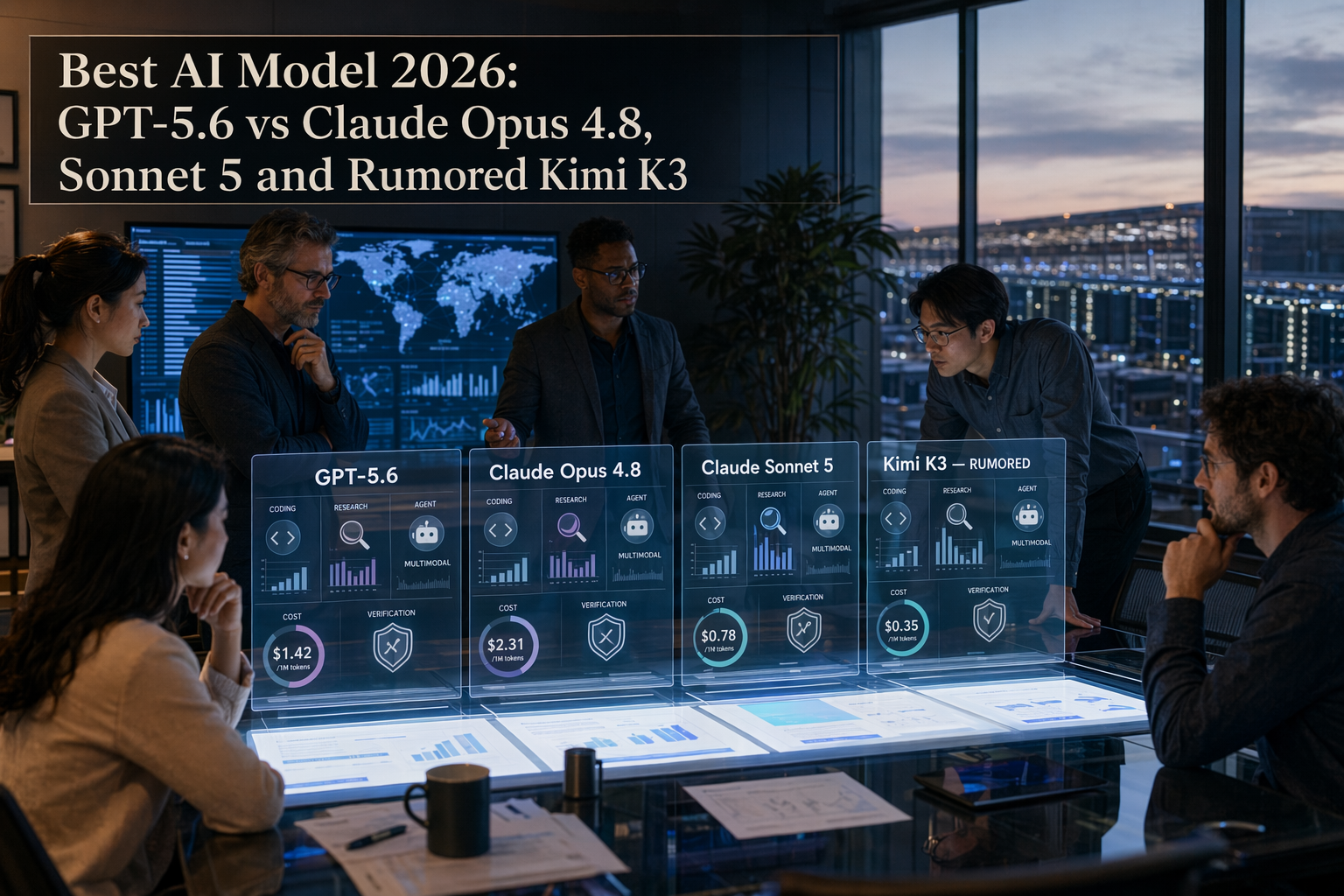
Compare GPT-5.6, Claude Opus 4.8, Sonnet 5 and rumored Kimi K3 by capability, cost, risk and use case, with a practical 2026 buying framework.
Best AI Model 2026: GPT-5.6 vs Claude Opus 4.8, Sonnet 5 and Rumored Kimi K3
What if the “best AI model 2026” is not the model with the highest benchmark score, but the one that delivers reliable results at your workload, latency target, and budget?
That question matters more on July 15, 2026, because model choice is becoming a procurement decision—not merely a chatbot preference. OpenAI’s official release notes identify GPT-5.6 Sol as a reasoning model introduced in ChatGPT on July 9, 2026, designed for complex work across coding, research, science, cybersecurity, computer use, and design. OpenAI also says GPT-5.6 has become the preferred model in Microsoft 365 Copilot, extending its reach into Word, Excel, PowerPoint, Chat, and Cowork. Meanwhile, buyers are comparing it with Anthropic’s Claude Opus 4.8 and Claude Sonnet 5, while online discussion continues around the rumored Kimi K3 from Moonshot AI.
The challenge is that these names do not all have the same level of public verification. GPT-5.6 Sol—and the broader GPT-5.6 family described by OpenAI—can be assessed through official documentation and product availability. Claude Opus 4.8 and Claude Sonnet 5 must be checked against Anthropic’s current model documentation, pricing, and API materials. Kimi K3 requires a stricter standard: unless Moonshot AI publishes an official announcement or technical documentation, its release status, pricing, context window, benchmarks, and capabilities should be treated as unverified, not fact.
This buyer’s guide will help you navigate the GPT-5.6 vs Claude Opus 4.8 decision and the Claude Sonnet 5 vs GPT-5.6 comparison without relying on hype. You will find practical recommendations for:
- Software development and code review
- Long-horizon agents and complex workflows
- Research, analysis, and knowledge work
- Multimodal tasks and computer use
- Cost-sensitive production deployments
- Privacy, regional hosting, and open-weight requirements
- “Wait and test” scenarios involving rumored models such as Kimi K3
We will also outline an apples-to-apples evaluation method, a procurement checklist, and the questions teams should answer before switching models. Platforms such as CallMissed, with one OpenAI-compatible gateway spanning multiple model providers and modalities, reflect the broader shift toward testing and routing models through a unified infrastructure layer.
The goal is not to crown a universal winner. It is to identify which model is documented, suitable, economical, and dependable for your specific application—and when the smartest buying decision is to wait for primary-source confirmation.
Which AI model should you choose in 2026? The short answer
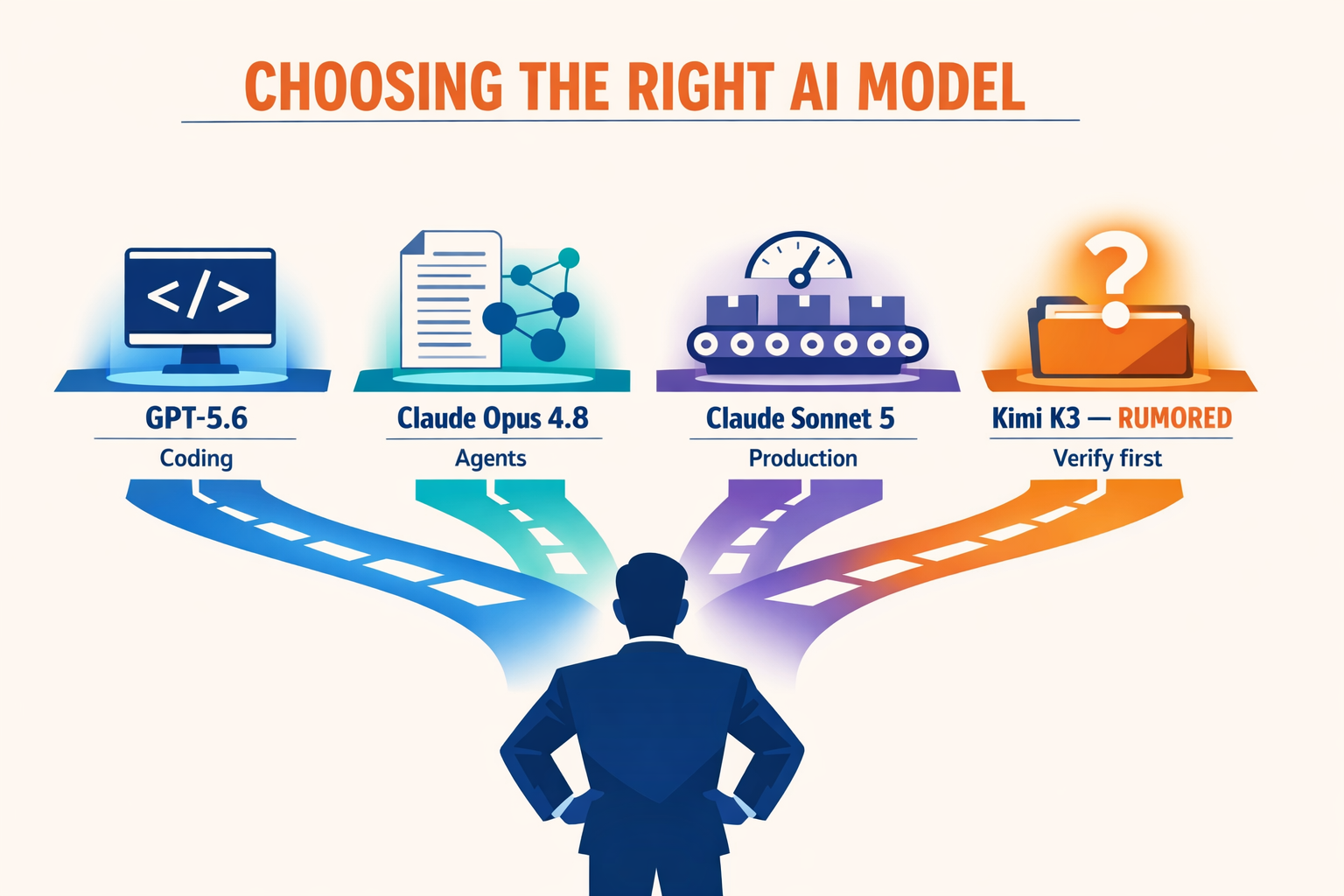
The short answer: choose GPT-5.6 when you need a documented, high-capability model for complex reasoning, coding, research, or computer use; choose Claude Opus 4.8 or Claude Sonnet 5 only after confirming their current availability, pricing, and API specifications in Anthropic’s official documentation; and do not buy around rumored Kimi K3 until Moonshot AI publishes primary-source details.
As of July 15, 2026, the evidence is not equally strong for all four names. OpenAI’s official release notes confirm that GPT-5.6 Sol was introduced in ChatGPT on July 9, 2026, as a reasoning model for coding, research, science, cybersecurity, computer use, and design. OpenAI also identifies GPT-5.6 as the preferred model in Microsoft 365 Copilot, including Word, Excel, PowerPoint, Chat, and Cowork.
The practical recommendation
Use this initial shortlist before running detailed evaluations:
- Select GPT-5.6 Sol when your priority is a documented flagship model for difficult, multi-step work and you need a model already integrated into OpenAI and Microsoft product ecosystems.
- Evaluate Claude Opus 4.8 for high-value workloads only if Anthropic’s official model catalogue confirms the model name, access method, supported features, pricing, and service terms.
- Evaluate Claude Sonnet 5 when your workload may benefit from a balance of capability, speed, and operating cost—but verify those characteristics from Anthropic rather than assuming them from the name or online comparisons.
- Wait and test Kimi K3 unless Moonshot AI or Kimi publishes an official announcement, model card, API documentation, and pricing. There is currently no responsible basis for assigning Kimi K3 a context window, benchmark score, launch date, price, or capability.
This distinction matters because “rumored” is not a procurement status. A model can generate substantial online interest while remaining unavailable, undocumented, or unsuitable for production integration.
A fast decision rule for buyers
Ask these questions in order:
- Is the model officially documented and accessible to your team?
If not, remove it from the production shortlist and place it in a watchlist.
- Does it match the workload?
Coding agents, long-horizon research, customer support, document extraction, and multimodal computer use can reward different model behaviours.
- Can you measure quality at your required latency and budget?
A benchmark leader may not be the most economical choice once retries, tool calls, human review, and failed generations are included.
- Can you switch providers without rebuilding your application?
A unified OpenAI-compatible gateway such as CallMissed can help developers test multiple LLM providers through one integration and billing layer, reducing the friction of controlled model comparisons.
The right answer to “GPT-5.6 vs Claude Opus 4.8” or “Claude Sonnet 5 vs GPT-5.6” is therefore conditional: start with documented availability, then validate performance on your own workload. The following sections turn that principle into use-case recommendations, evaluation tables, and a procurement checklist.
What is actually documented about GPT-5.6, Claude Opus 4.8, Sonnet 5, and Kimi K3?
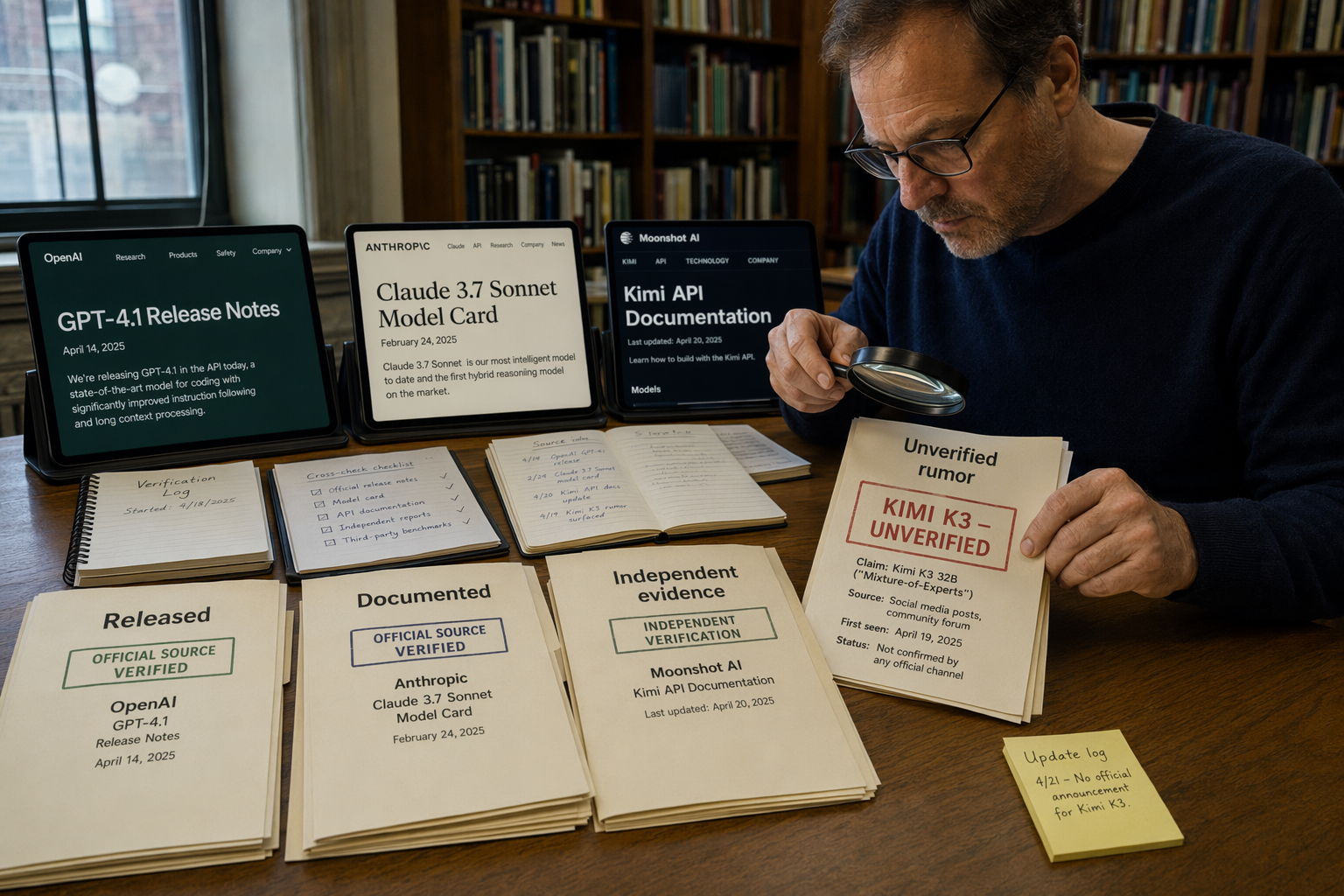
The public evidence is not evenly distributed: GPT-5.6 Sol is documented by OpenAI, while Claude Opus 4.8, Claude Sonnet 5, and Kimi K3 require direct confirmation from Anthropic or Moonshot AI before they can be evaluated as procurement-ready models.
GPT-5.6: the model with primary-source documentation
OpenAI’s official materials establish the following facts as of July 15, 2026:
- GPT-5.6 Sol launched in ChatGPT on July 9, 2026, according to OpenAI’s Model Release Notes.
- OpenAI describes GPT-5.6 Sol as a reasoning model for complex work, including coding, research, science, cybersecurity, computer use, and design.
- OpenAI’s GPT-5.6 announcement identifies a broader family that includes Sol, Terra, and Luna, although buyers should confirm the availability, model IDs, access conditions, and API specifications for each variant separately.
- OpenAI also announced that GPT-5.6 became the preferred model in Microsoft 365 Copilot, including Word, Excel, PowerPoint, Chat, and Cowork.
This makes GPT-5.6 Sol the clearest starting point for a buyer comparing the best AI model for coding in 2026, agentic workflows, or enterprise knowledge work. However, a ChatGPT release does not automatically prove that the same model, limits, pricing, or tools are available through every developer API.
Claude Opus 4.8 and Claude Sonnet 5: verify before comparing
The names Claude Opus 4.8 and Claude Sonnet 5 should not be treated as fully documented merely because they appear in search results, social posts, comparison articles, or vendor discussions. For each model, check Anthropic’s official model documentation for:
- An official announcement or model page
- An API model identifier
- Current input and output pricing
- Context-window and output-token limits
- Tool-use, vision, streaming, and regional-availability details
- Deprecation or preview status
Without those primary-source details, a precise Claude Sonnet 5 vs GPT-5.6 or GPT-5.6 vs Claude Opus 4.8 benchmark comparison would create false precision. A model may be announced, preview-only, available only in a consumer product, or absent from the public API.
Kimi K3: an unverified rumor, not a buying option
As of July 15, 2026, Kimi K3 should be classified as unverified unless Moonshot AI publishes an official announcement or technical documentation. Do not assume its context window, benchmark scores, launch date, pricing, multimodal capabilities, open-weight status, or API access.
| Model | Evidence status | Buyer action |
|---|---|---|
| GPT-5.6 Sol | Documented by OpenAI | Test against your workload |
| GPT-5.6 Terra/Luna | Family names publicly referenced by OpenAI | Confirm exact access and specifications |
| Claude Opus 4.8 | Require Anthropic primary-source confirmation | Do not rely on unofficial comparisons |
| Claude Sonnet 5 | Require Anthropic primary-source confirmation | Verify before procurement |
| Kimi K3 | Unverified rumor without confirmed specifications | Wait and monitor Moonshot AI |
The practical rule is simple: buy against documented model IDs and measurable service terms, not names circulating online. A unified gateway such as CallMissed can help teams test multiple confirmed providers through one OpenAI-compatible integration, while preserving the option to add a newly documented model later.
What are the key developments and verification statuses?
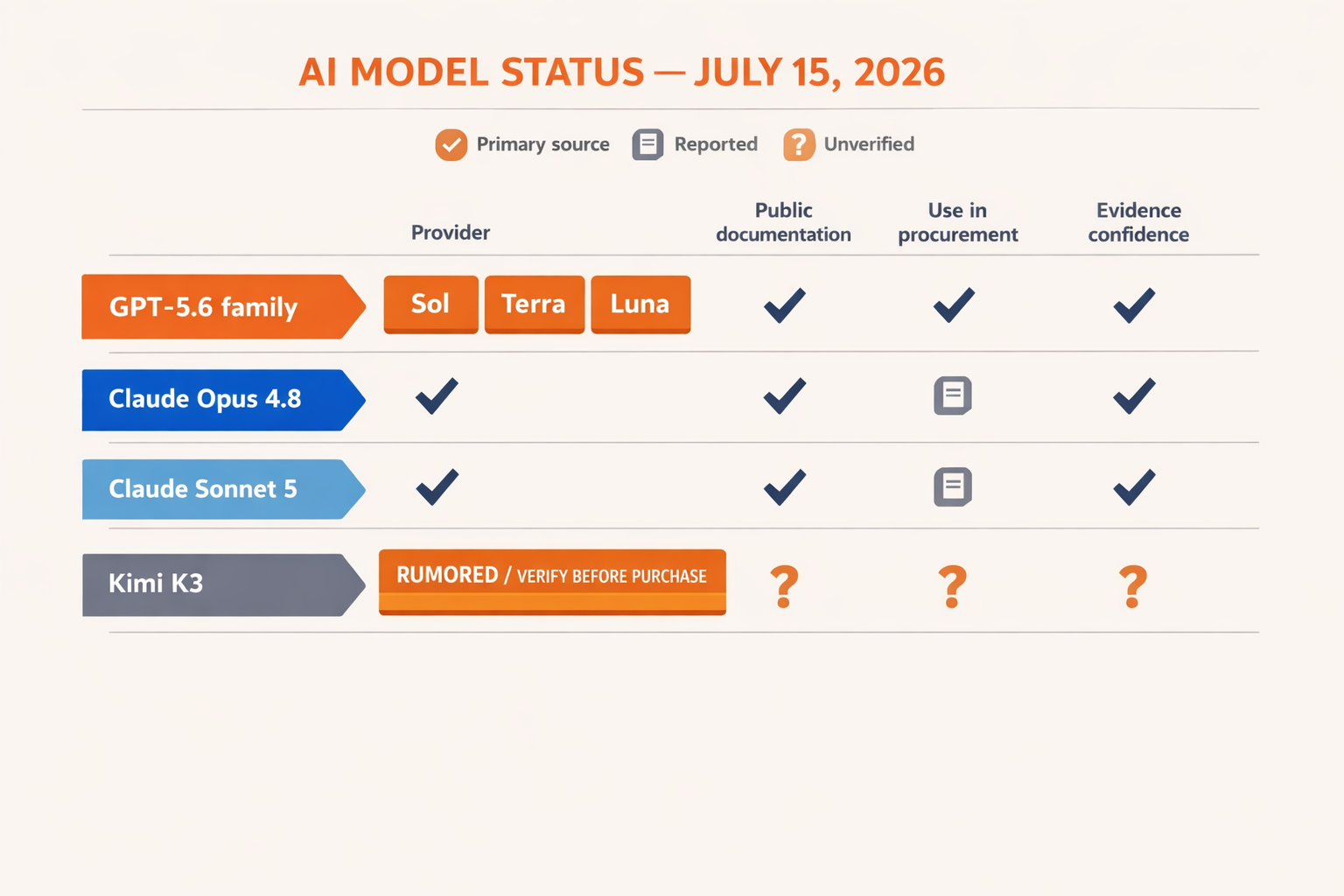
Verification rule: release evidence comes before benchmark claims
As of July 15, 2026, the four names in this comparison do not have equal verification status. GPT-5.6 Sol is documented by OpenAI as released in ChatGPT, while Claude Opus 4.8, Claude Sonnet 5, and the rumored Kimi K3 should be evaluated only against current primary-source documentation from Anthropic or Moonshot AI.
| Model or development | Primary-source status | What is documented | Buyer implication |
|---|---|---|---|
| GPT-5.6 Sol | Verified | OpenAI’s Model Release Notes record its ChatGPT introduction on July 9, 2026 as a reasoning model for coding, research, science, cybersecurity, computer use, and design. | Suitable for a documented evaluation or production shortlist, subject to checking API access, pricing, limits, and regional availability. |
| GPT-5.6 family: Sol, Terra, Luna | Partly documented | OpenAI previewed the GPT-5.6 family, naming Sol, Terra, and Luna in its July 2026 announcement materials. | Do not assume that every family member has the same access, capability, pricing, or deployment status as Sol. Verify each model separately. |
| GPT-5.6 in Microsoft 365 Copilot | Verified integration development | OpenAI announced that GPT-5.6 would become the preferred model in Microsoft 365 Copilot, including Word, Excel, PowerPoint, Chat, and Cowork. | Relevant for organizations already standardized on Microsoft 365; Copilot availability does not automatically mean identical API availability. |
| Claude Opus 4.8 | Requires Anthropic confirmation | The model name appears in the buyer comparison, but current release notes, API documentation, pricing, and availability should be confirmed directly through Anthropic. | Treat capabilities, context limits, benchmarks, and commercial terms as unconfirmed until Anthropic publishes them. |
| Claude Sonnet 5 | Requires Anthropic confirmation | Anthropic’s official model documentation should establish whether Claude Sonnet 5 is released, accessible through an API, and offered at stated limits and prices. | A Claude Sonnet 5 vs GPT-5.6 comparison is not apples-to-apples until both models have comparable primary-source specifications. |
| Rumored Kimi K3 | Unverified | No release date, price, context window, benchmark, modality, or production-access claim should be accepted without an official announcement or technical document from Moonshot AI/Kimi. | Keep Kimi K3 in a wait-and-test track; do not select it for a committed deployment based on social posts or speculation. |
How to interpret the evidence
OpenAI’s official materials provide the clearest confirmed facts in the current source set: GPT-5.6 Sol was introduced in ChatGPT on July 9, 2026, and OpenAI describes it as designed for complex work across multiple technical and knowledge-work categories. OpenAI also reports its Microsoft 365 Copilot integration, which is a product-deployment signal rather than an independent benchmark.
For Claude Opus 4.8 vs GPT-5.6 and Claude Sonnet 5 vs GPT-5.6, separate three questions:
- Does the model officially exist and have an identified version?
- Can your team access it through the required product or API?
- Are price, rate limits, context, modalities, and safety terms documented?
CallMissed’s OpenAI-compatible gateway illustrates a practical response to changing model catalogs: teams can test multiple documented providers through one integration rather than hard-coding every experiment into a separate application. That reduces switching friction, but it does not replace primary-source verification for each model.
How do GPT-5.6, Claude Opus 4.8, and Claude Sonnet 5 compare in real buying decisions?
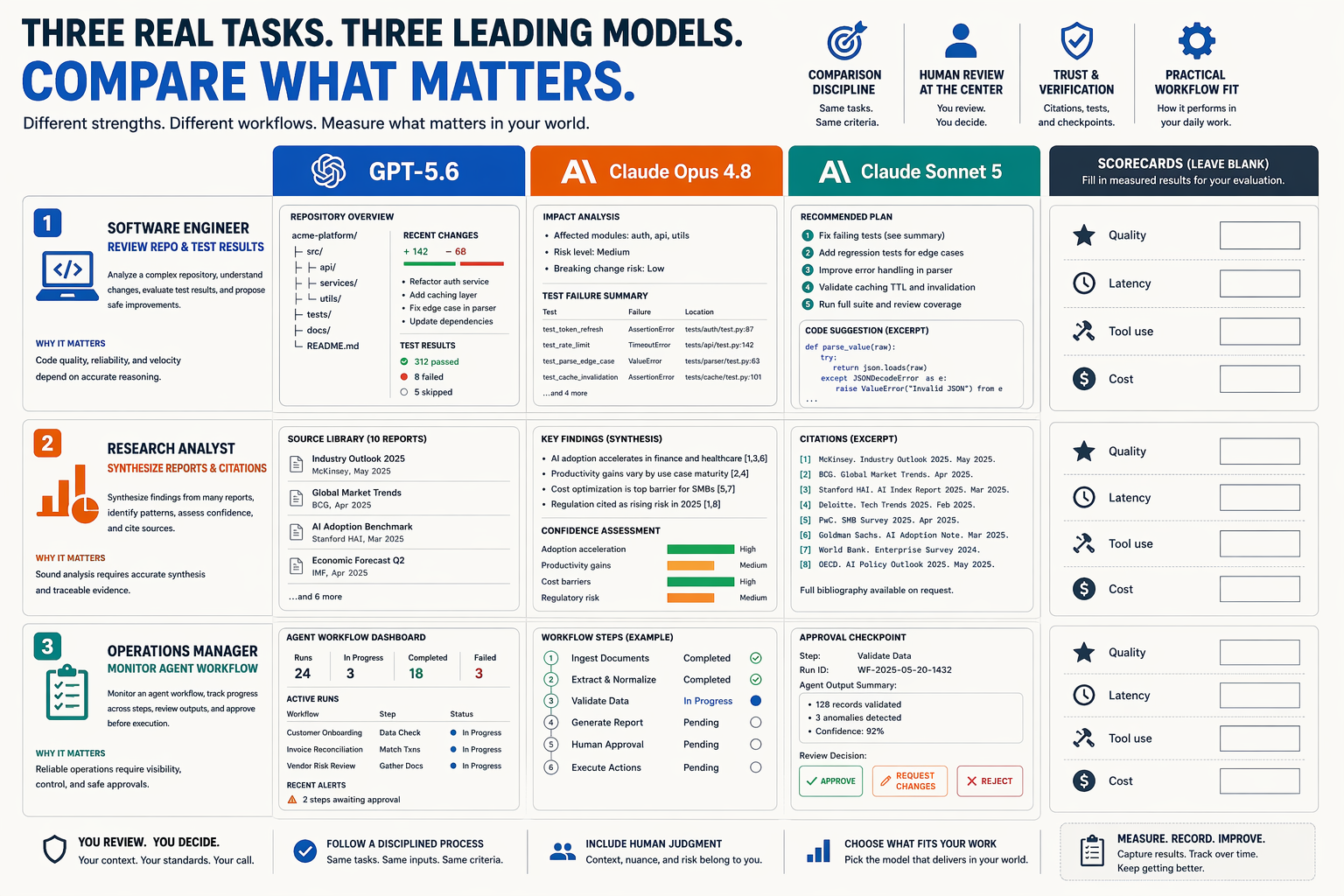
The practical comparison is less about declaring a universal winner and more about evidence, workload fit, and procurement risk. As of July 15, 2026, GPT-5.6 Sol has the clearest verification in the supplied primary-source material; buyers should validate Claude Opus 4.8 and Claude Sonnet 5 against Anthropic’s live model documentation before treating either as an approved production choice, while Kimi K3 remains unverified without an official Moonshot AI announcement.
What the documented evidence supports
OpenAI’s July 9, 2026 release notes describe GPT-5.6 Sol as a reasoning model for coding, research, science, cybersecurity, computer use, and design. OpenAI also identifies GPT-5.6 as the preferred model in Microsoft 365 Copilot, including Word, Excel, PowerPoint, Chat, and Cowork. Those facts make GPT-5.6 a credible first candidate for organizations already invested in Microsoft workflows or needing a broad, documented capability profile.
For Anthropic models, the buying decision requires a different verification step:
- Confirm that Claude Opus 4.8 is listed in Anthropic’s official API and model documentation.
- Confirm that Claude Sonnet 5 is listed separately, with its own capabilities, limits, pricing, and availability.
- Record the exact model IDs, version dates, context limits, tool support, data-retention terms, and regional availability.
- Do not infer performance or price from earlier Claude generations.
The same rule applies even more strongly to Kimi K3. Unless Moonshot AI publishes primary documentation, buyers should assign Kimi K3 no confirmed benchmark, price, context window, launch date, or production capability. Online claims can inform a watchlist, but they should not support a purchase order.
Decision guide by workload
| Buying situation | First model to evaluate | What to verify before purchase |
|---|---|---|
| Complex coding and code review | GPT-5.6 Sol | Repository-scale performance, tool calling, latency, and error recovery |
| Long-horizon agents | GPT-5.6 Sol, then verified Claude options | Planning reliability, state management, intervention rate, and task completion |
| Research and analysis | GPT-5.6 Sol | Citation accuracy, source handling, reasoning quality, and auditability |
| Microsoft 365 knowledge work | GPT-5.6 Sol | Tenant controls, licensing, data governance, and workflow integration |
| Cost-sensitive production | Verified Claude Sonnet 5 or another documented tier | Current token prices, throughput, rate limits, and quality at target volume |
| Uncertain or emerging model | Kimi K3 only in a sandbox | Official Moonshot AI release, API terms, security review, and reproducible tests |
How to make the GPT-5.6 vs Claude decision
Run the same 50–100 production-like tasks through each officially available model, using identical prompts, tools, context, and output limits. Score correctness, first-pass success, escalation frequency, latency, and total cost—not just a public benchmark.
For Indian teams testing multiple providers, CallMissed’s OpenAI-compatible gateway can provide one integration and billing layer across a broad model catalogue. That makes it practical to compare documented models without rewriting the application each time, while keeping the final decision tied to measured workload results rather than model branding.
Which model is best for coding, long-horizon agents, research, multimodal work, and cost-sensitive production?
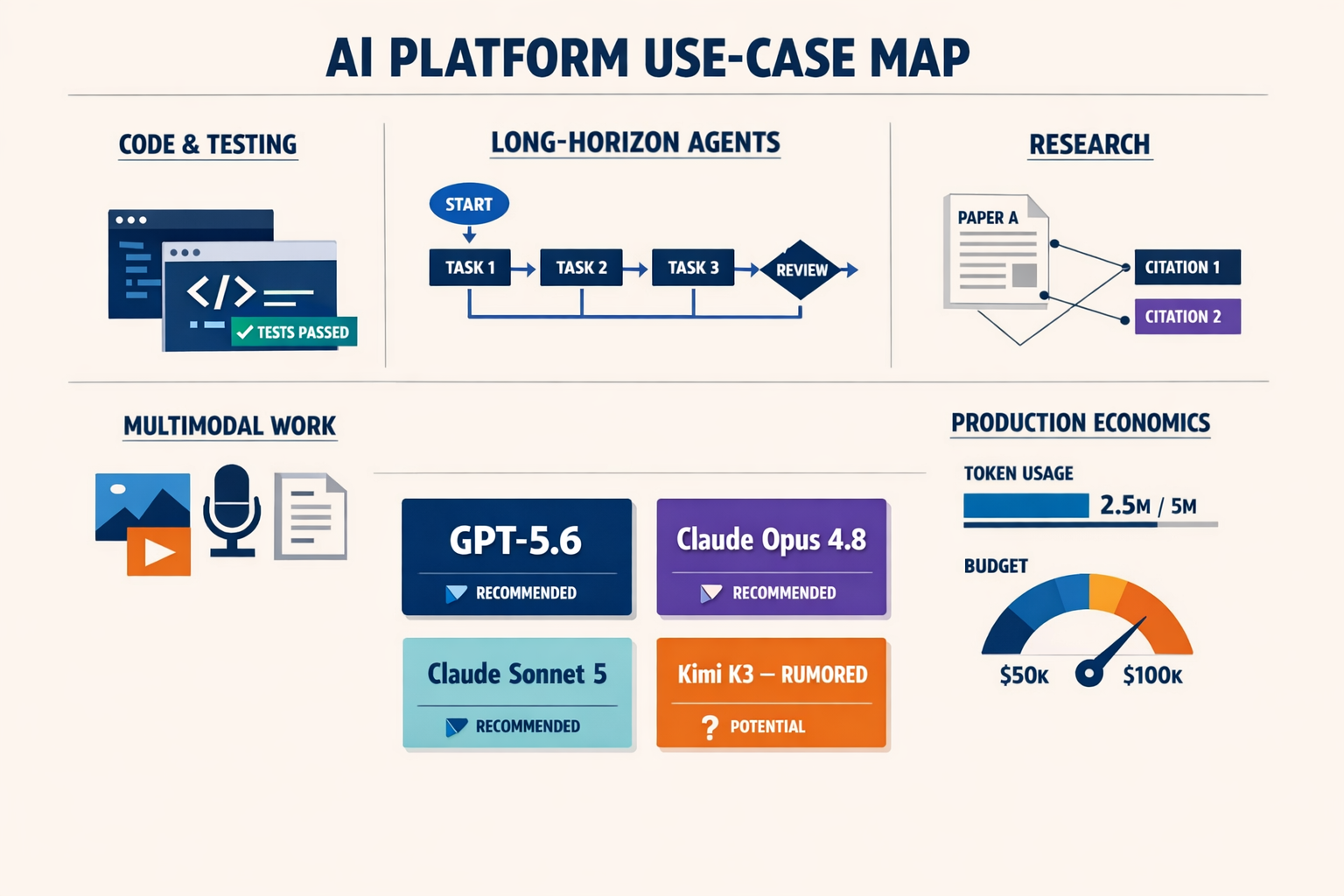
The practical answer is workload-dependent: GPT-5.6 Sol is the most directly documented choice in the supplied primary-source record for complex coding, research, cybersecurity, computer use, and design; Claude Opus 4.8 and Claude Sonnet 5 should be shortlisted only after Anthropic confirms their current API status, pricing, and capabilities; and Kimi K3 remains a wait-and-test candidate unless Moonshot AI publishes official evidence.
Decision matrix
| Workload | Recommended buying position | What to verify before purchase |
|---|---|---|
| Software development and code review | Start with GPT-5.6 Sol for complex implementation, debugging, and review workflows. | Repository-level accuracy, test-pass rate, tool-call reliability, latency, and cost per completed task. |
| Long-horizon agents | Evaluate GPT-5.6 Sol first, especially where workflows involve computer use or multiple reasoning steps. | Recovery from failed actions, planning consistency, maximum run duration, approvals, and observability. |
| Research and analysis | Use GPT-5.6 Sol as a documented baseline for research, science, and knowledge work. | Citation accuracy, source freshness, search behavior, uncertainty handling, and analyst review time. |
| Multimodal or computer-use work | Shortlist GPT-5.6 Sol where design and computer-use workflows are central. | Supported input/output formats, visual accuracy, browser or desktop actions, and human-approval controls. |
| Cost-sensitive production | Do not choose by model name alone; compare cost per successful outcome across GPT-5.6, Claude models, and smaller alternatives. | Current token prices, cached-input treatment, retries, latency, rate limits, and fallback costs. |
| Kimi K3 | Keep Kimi K3 in a wait-and-test track, not a production plan. | An official Moonshot AI announcement, model identifier, API documentation, pricing, limits, benchmarks, and data-handling terms. |
OpenAI’s official Model Release Notes state that GPT-5.6 Sol was introduced in ChatGPT on July 9, 2026 as a reasoning model for “coding, research, science, cybersecurity, computer use, and design.” OpenAI also identifies GPT-5.6 as the preferred model in Microsoft 365 Copilot across Word, Excel, PowerPoint, Chat, and Cowork, which is relevant evidence of enterprise distribution—not proof that it will be optimal for every API workload.
How to interpret the Claude and Kimi names
For the Claude Sonnet 5 vs GPT-5.6 and GPT-5.6 vs Claude Opus 4.8 comparisons, require Anthropic’s official model documentation to confirm that Claude Opus 4.8 and Claude Sonnet 5 are released, API-accessible models as of July 15, 2026. Do not infer context windows, benchmark scores, multimodal support, or pricing from social posts or vendor comparisons that cannot be traced to Anthropic.
The same standard is stricter for Kimi K3. Unless Moonshot AI publishes primary-source confirmation, its launch date, capabilities, benchmarks, context window, price, and production readiness are unverified. A rumor can justify preparing an evaluation script; it cannot justify architecture changes or procurement commitments.
For teams that want to compare several providers without repeatedly rewriting integrations, CallMissed’s OpenAI-compatible gateway offers one integration and billing layer across multiple model and modality providers. That can make controlled routing, fallback testing, and workload-specific evaluation easier.
What do reported benchmarks, expert views, and primary sources actually prove?
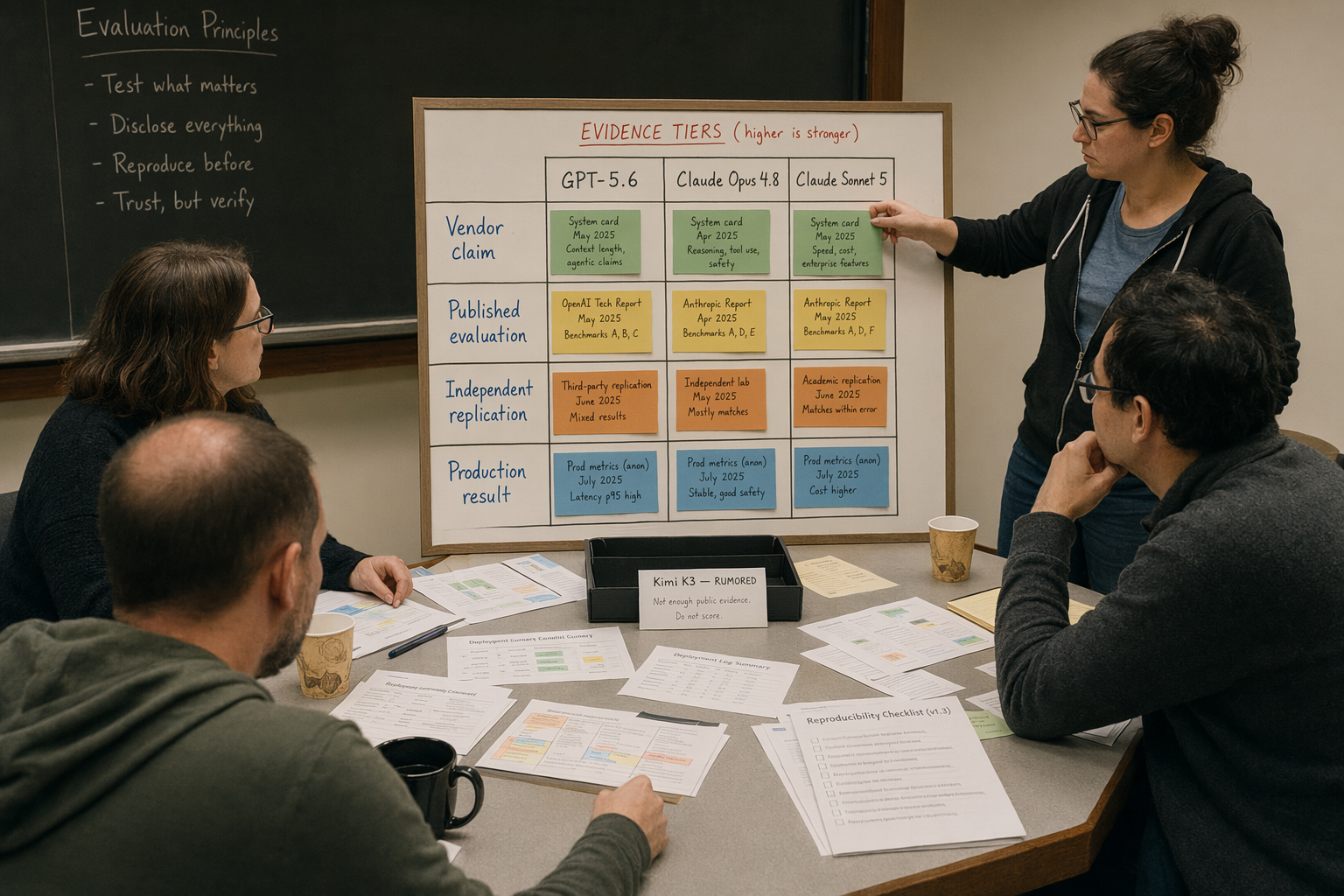
The evidence supports model-specific decisions, not a universal winner. As of July 15, 2026, primary sources verify GPT-5.6 Sol’s ChatGPT availability and intended use cases, while claims about Claude Opus 4.8, Claude Sonnet 5, and rumored Kimi K3 require separate confirmation from Anthropic and Moonshot AI. Reported benchmarks can inform a shortlist, but they cannot predict performance on your exact workload.
What OpenAI’s primary sources establish
OpenAI’s July 9, 2026 Model Release Notes identify GPT-5.6 Sol as a reasoning model for coding, research, science, cybersecurity, computer use, and design. OpenAI’s official GPT-5.6 materials also publish evaluation results intended to demonstrate improvements in agentic work, coding, knowledge work, and efficiency.
Those sources establish several procurement facts:
- GPT-5.6 Sol is a documented model, not merely a community rumor.
- OpenAI has publicly associated it with complex, multi-step tasks rather than only conversational generation.
- OpenAI announced that GPT-5.6 became the preferred model in Microsoft 365 Copilot, including Word, Excel, PowerPoint, Chat, and Cowork.
- OpenAI’s benchmark results are vendor-reported evaluations. They are useful evidence, but they are not independent proof that GPT-5.6 will be the fastest, cheapest, or most accurate model for every business workflow.
A benchmark score therefore answers, “How did this model perform under this test protocol?” It does not answer, “Will this model reduce our support costs or produce reliable code in production?”
What benchmarks can—and cannot—prove
Independent evaluations are most useful when they disclose the dataset, version, prompting method, tool access, sampling settings, scoring rubric, and test date. Without those details, a leaderboard position can be difficult to reproduce.
Use benchmark results to compare:
- Task fit: coding, mathematics, document analysis, tool use, or multimodal reasoning
- Reliability: pass rate across repeated runs, not just the best response
- Operational performance: latency, timeout rate, throughput, and failure recovery
- Economics: cost per successful task, including retries and tool calls
- Freshness: whether the tested model version is still the production version
A model that leads on a reasoning benchmark may still lose on a structured extraction task, a regional-language voice workflow, or a cost-constrained customer-support application.
How to treat expert views and rumored releases
Expert commentary, developer reports, and social-media testing are valuable hypothesis generators, not primary-source confirmation. Claims about Claude Opus 4.8 and Claude Sonnet 5 should be checked against Anthropic’s official model documentation, API reference, pricing, and release announcements before procurement. Do not infer availability, context limits, pricing, or capabilities from screenshots or search snippets.
The same standard applies even more strongly to Kimi K3. Unless Moonshot AI publishes an official announcement or technical documentation, Kimi K3 has no verified launch date, price, context window, benchmark record, or production API. Treat it as a watchlist item, not a selectable supplier.
For teams comparing multiple providers, a gateway such as CallMissed can simplify controlled testing through one OpenAI-compatible endpoint, while keeping the final decision grounded in primary documentation and measured workload results.
What does each model mean for your budget, privacy, deployment, and risk?
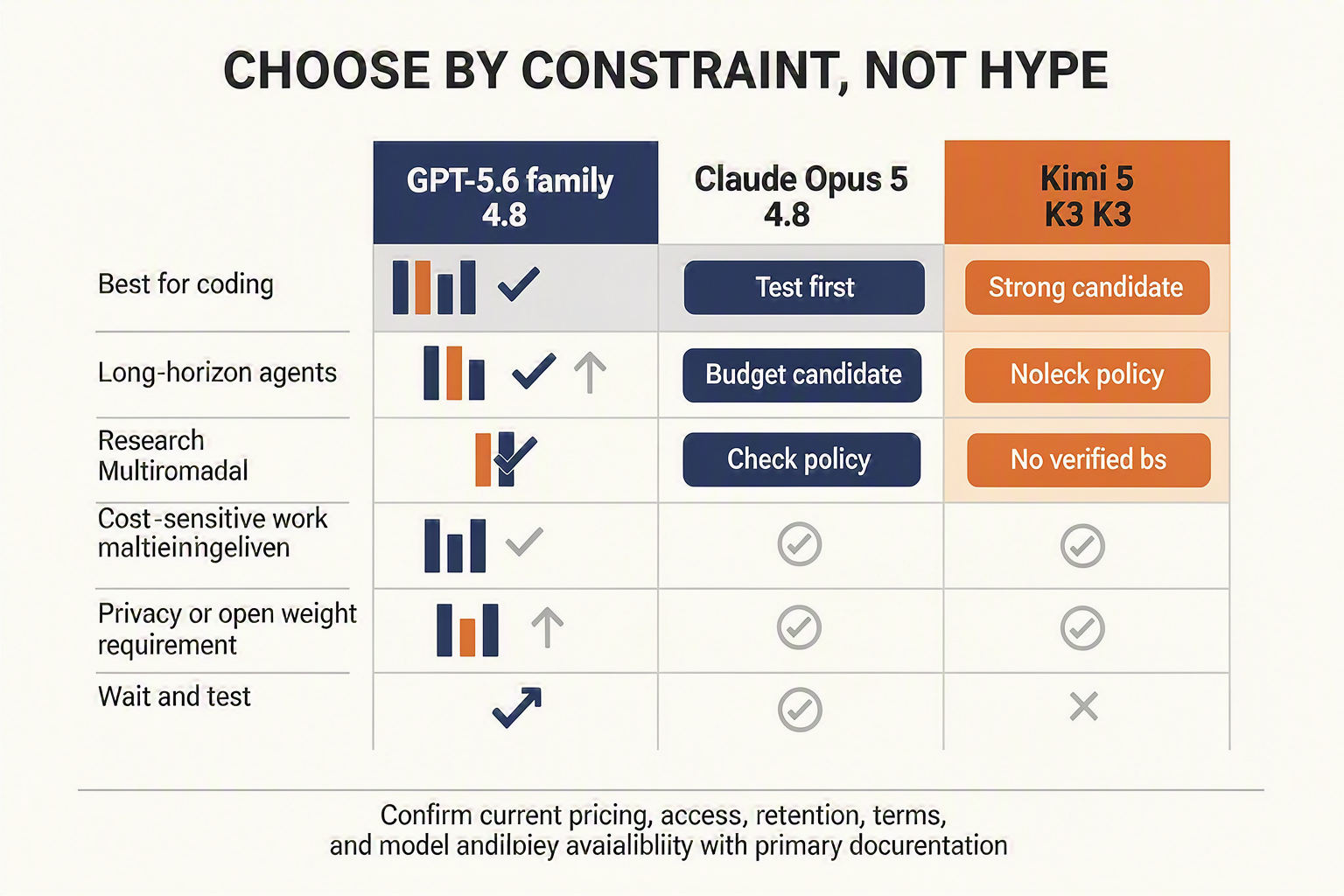
Budget, privacy, and deployment comparison
The safest procurement decision is to separate documented capability from unverified claims. As of July 15, 2026, OpenAI officially documents GPT-5.6 Sol, while buyers should confirm the current API, pricing, retention, and regional-processing terms for Anthropic’s Claude Opus 4.8 and Claude Sonnet 5. Moonshot AI’s Kimi K3 remains a rumored, unverified model unless Moonshot publishes primary-source documentation.
| Model | Budget implications | Privacy and deployment | Best operational fit | Main buyer risk |
|---|---|---|---|---|
| GPT-5.6 Sol | Do not estimate production cost from ChatGPT subscription pricing; verify OpenAI API rates, reasoning-token treatment, quotas, and enterprise terms separately. | Confirm API data-use, retention, residency, and enterprise controls with OpenAI before processing regulated data. | Complex reasoning, coding, research, cybersecurity, computer use, and design. OpenAI describes GPT-5.6 Sol as a reasoning model introduced in ChatGPT on July 9, 2026. | Higher reasoning workloads may create variable latency or spend; validate cost per completed task, not only cost per token. |
| Claude Opus 4.8 | Confirm Anthropic’s current input/output prices, batch discounts, rate limits, and whether the required capability is available at the selected API tier. | Review Anthropic’s current commercial terms, retention controls, regional availability, and deployment options; do not infer them from older Claude releases. | Potential flagship candidate for demanding analysis or agent workflows, subject to current Anthropic documentation and workload testing. | The model name, availability, context limits, tools, and benchmarks must be verified in Anthropic’s official materials before purchase. |
| Claude Sonnet 5 | Compare verified price per successful task against GPT-5.6 Sol and Opus 4.8; a lower list price does not guarantee lower total cost if retries increase. | Confirm Anthropic’s applicable privacy, residency, logging, and enterprise provisions for the exact product and region. | Cost-sensitive production, coding, and general knowledge work if current specifications meet the application’s quality threshold. | Treat “Sonnet 5 vs GPT-5.6” claims as provisional until Anthropic confirms the model, pricing, and API documentation. |
| Rumored Kimi K3 | Assign no forecastable budget until Moonshot AI publishes official pricing, limits, and access conditions. | Do not send confidential or personal data to an unofficial endpoint, demo, or third-party reseller claiming Kimi K3 access. | A wait-and-test candidate only; consider it after Moonshot AI confirms release status and technical documentation. | Do not use rumored benchmarks, context windows, launch dates, or capability claims in a business case. |
| Multi-model gateway | A unified billing layer can simplify experiments, but compare provider-level usage, fallback, and markup policies. | Check how the gateway handles prompts, logs, keys, residency, and provider pass-through terms. | Routing, fallback, and rapid A/B testing across models and modalities. | Abstraction can hide provider-specific features, limits, or compliance obligations. |
How to convert the table into a buying decision
- Set a hard budget: calculate cost per resolved ticket, accepted code change, completed research task, or successful voice interaction—not merely cost per million tokens.
- Define the privacy boundary: classify data as public, internal, confidential, personal, or regulated, then require written retention and processing terms for each model.
- Test deployment friction: measure API stability, rate limits, tool calling, structured outputs, streaming, regional access, and rollback procedures.
- Price failure, not just success: include retries, human review, hallucination remediation, latency penalties, and fallback calls.
CallMissed’s OpenAI-compatible gateway reflects this procurement pattern: teams can evaluate multiple LLMs, Speech-to-Text, Text-to-Speech, image, and search providers through one integration and billing layer. That reduces switching effort, but it does not remove the need to verify each underlying provider’s privacy and commercial terms.
How can you run an apples-to-apples evaluation before signing a contract?
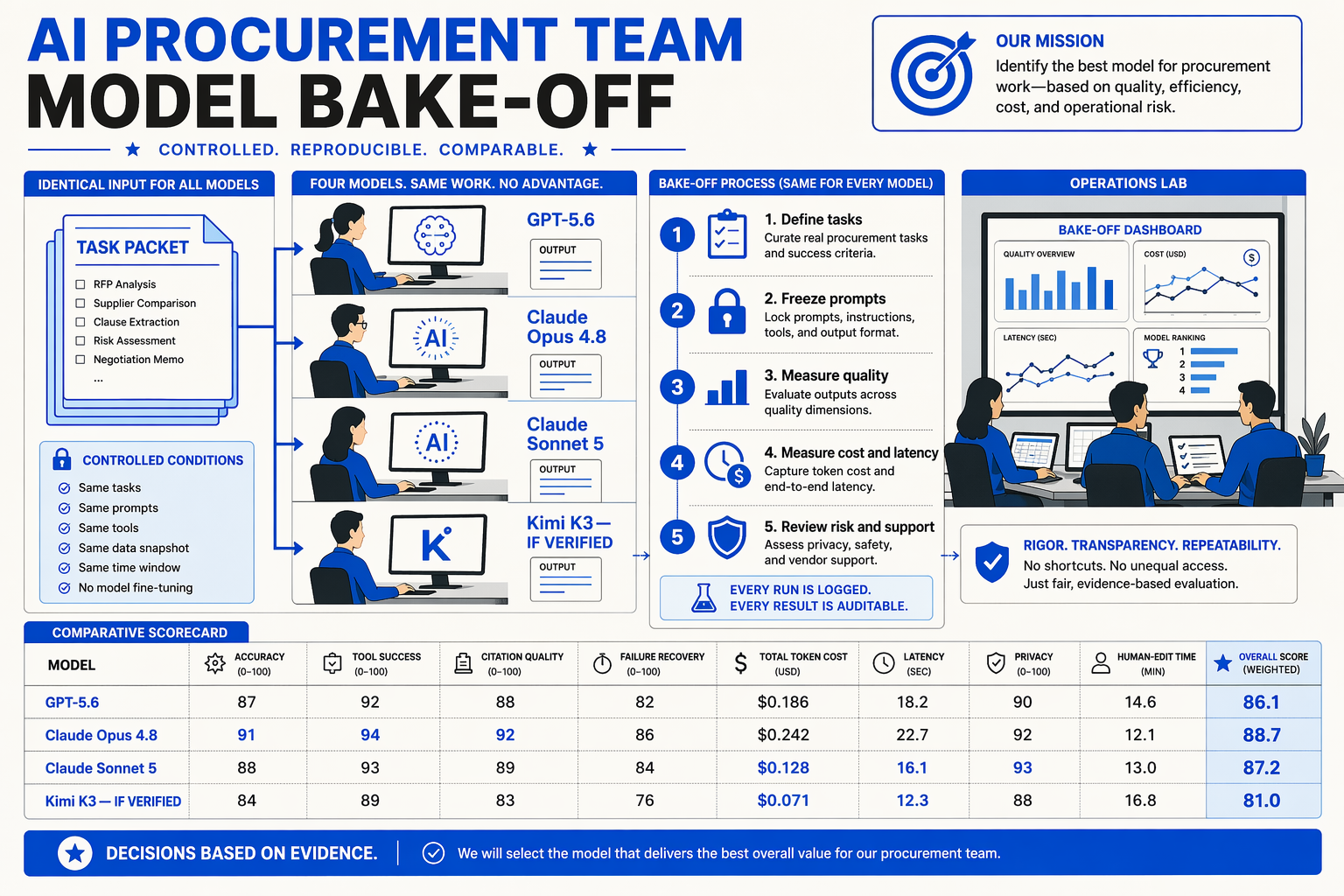
The fairest evaluation uses the same production tasks, inputs, tools, success criteria, and measurement window for every model. Compare cost per successful outcome—not token price or benchmark score alone—and exclude rumored Kimi K3 from production scoring until Moonshot AI publishes primary documentation.
1. Freeze the evaluation scope
Before testing GPT-5.6, Claude Opus 4.8, or Claude Sonnet 5, write a one-page test protocol. Record:
- The exact model identifier, API version, region, and access date
- System prompts, user prompts, tool definitions, retrieval configuration, and output schemas
- Maximum latency, token, and reasoning budgets supported by each provider
- Required behaviors, prohibited behaviors, escalation rules, and human-review thresholds
- The commercial assumption: expected monthly requests, average input/output size, concurrency, and uptime target
This prevents a model from appearing stronger simply because it received better context or more permissive tool access. It also creates an audit trail when model versions change.
OpenAI’s Model Release Notes state that GPT-5.6 Sol was introduced in ChatGPT on July 9, 2026, for complex work across coding, research, science, cybersecurity, computer use, and design. Treat that as a documented availability point, while verifying the developer model ID, API access, and commercial terms separately. For Claude Opus 4.8 and Claude Sonnet 5, confirm current status, pricing, limits, and supported features in Anthropic’s official documentation rather than relying on comparison articles.
2. Build a representative, blinded test set
Use at least 50–100 tasks per major workflow, sampled from real tickets, code changes, documents, calls, or agent traces. Remove personal and confidential information, then create a “gold” answer or acceptance rubric before running the models.
Include both routine and failure-prone cases:
- Coding: bug fixes, repository navigation, tests, security review, and code explanations
- Research: citation accuracy, conflicting sources, extraction, and uncertainty handling
- Agents: multi-step tool use, retries, state preservation, and safe termination
- Multimodal work: screenshots, PDFs, tables, and structured extraction
- Customer operations: intent classification, response quality, language handling, and escalation
Run each deterministic task multiple times where practical. Randomize model order and hide model names from human reviewers to reduce expectation bias. Platforms such as CallMissed’s OpenAI-compatible gateway can help teams route comparable workloads across multiple providers through one integration, although the evaluation must still preserve provider-specific behavior and policies.
3. Measure business outcomes, not just quality
Track these metrics separately:
| Measure | What to record |
|---|---|
| Quality | Rubric score, task pass rate, factuality, citation correctness |
| Reliability | Tool-call success, schema validity, refusal rate, retry frequency |
| Speed | Time to first token, completion latency, and p50/p95 latency |
| Economics | Input/output spend, retries, human-review cost, cost per successful task |
| Risk | Sensitive-data handling, policy violations, jailbreak resistance, auditability |
Calculate cost per successful task as total model and operational cost divided by accepted outputs. Report confidence intervals where the sample is large enough, and publish raw failure examples—not only averages.
4. Run a controlled pilot before contracting
Select the top two documented candidates and run a two- to four-week shadow or limited-production pilot. Keep traffic, prompts, reviewers, and routing rules stable; monitor regressions weekly.
Do not score Kimi K3 as if it were a released competitor. As of July 15, 2026, include it only in a watchlist and future-test plan unless Moonshot AI provides an official announcement, model documentation, access method, pricing, and safety terms. That distinction keeps the GPT-5.6 vs Claude Opus 4.8 and Claude Sonnet 5 vs GPT-5.6 comparison evidence-based rather than rumor-driven.
What should you ask before buying an AI model in 2026?
Buyer FAQ
What is the best AI model 2026 for a business buying its first production model?
How should I compare GPT-5.6 vs Claude Opus 4.8 for enterprise work?
Is Claude Sonnet 5 vs GPT-5.6 a meaningful comparison for cost-sensitive production?
Should developers wait for the rumored Kimi K3 before choosing an AI model in 2026?
What should I test before switching to the best AI model 2026?
How can Indian businesses compare multiple AI models through one integration?
Conclusion
The best AI model in 2026 is the one that matches your workload, reliability requirements, latency target, and budget—not necessarily the model with the highest benchmark score.
- Choose GPT-5.6 Sol when you need a publicly documented model for complex coding, research, science, cybersecurity, design, or computer-use workflows. OpenAI’s release notes confirm its ChatGPT introduction on July 9, 2026, and OpenAI reports that GPT-5.6 became the preferred model in Microsoft 365 Copilot.
- Consider Claude Opus 4.8 or Claude Sonnet 5 only after verifying current availability, pricing, limits, and API specifications directly in Anthropic’s documentation. A credible comparison requires primary-source confirmation, not social-media claims.
- Treat Kimi K3 as unverified unless Moonshot AI publishes an official announcement or technical documentation. Do not rely on rumored benchmarks, context windows, pricing, or launch dates.
- Test before switching: evaluate representative coding, agent, research, multimodal, and production tasks using identical prompts, tools, budgets, and success criteria.
The next models to watch are those that combine stronger reasoning with predictable cost, low latency, dependable tool use, and deployment flexibility. Platforms such as CallMissed reflect this shift by giving teams unified access to multiple AI models and communication modalities.
Which model can prove the best fit for your real workload—not merely win the headline comparison?
Related Reading
Related Posts


Ready to automate customer conversations?
Launch AI voice agents and WhatsApp bots with CallMissed — one API, 22+ Indian languages.