

Windsurf and Codeium: The Underdog AI IDE Reimagining Software Development in 2026



Did you know that by the start of 2026, the definition of a "senior developer" has shifted from someone who writes flawless syntax to someone who...
Windsurf and Codeium: The Underdog AI IDE Reimagining Software Development in 2026
Did you know that by the start of 2026, the definition of a "senior developer" has shifted from someone who writes flawless syntax to someone who orchestrates autonomous agentic AI systems? For decades, software engineering felt uniquely insulated from complete automation, with early AI assistants acting merely as glorified autocomplete extensions. However, the paradigm has shifted dramatically. As we navigate the mid-2026 landscape, the developer ecosystem is witnessing a historic battle for the desktop, and a quiet revolution in developer tooling has positioned Windsurf and Codeium as the ultimate underdogs reimagining how the world builds software.
This shift isn't just hype; it is backed by massive industry momentum and concrete developer adoption. Following a year where Windsurf—the AI-native IDE developed by the team formerly known simply as Codeium—spent 2025 as the most-rumored M&A acquisition target in developer tooling, the market has realized that basic LLM wrappers are no longer sufficient. Developers are demanding deep, context-aware integration. Unlike legacy editors that merely slap an LLM chat window onto a VS Code fork, Windsurf represents a fundamental redesign of the developer environment. Armed with "Cascade," an agentic system designed to think ten steps ahead, Windsurf can write up to 90% of a production codebase autonomously. It doesn't just suggest the next line; it dynamically creates databases, refactors complex directories, and self-corrects compilation errors in real-time.
What makes the rise of Windsurf and Codeium so compelling in 2026 is their unique infrastructure play. While giants like Microsoft-backed GitHub Copilot and venture-backed Cursor dominated early headlines, Codeium spent years quietly building its own proprietary, ultra-fast context-tracking and inference engine. They recognized early on that the true bottleneck of AI-assisted coding isn't the underlying LLM—it is context. How does an AI agent know what is happening in an obscure configuration file five directories over? Windsurf solves this by treating the entire workspace as a living, breathing semantic graph. This allows Cascade to perform complex, multi-file refactors and generate entire minimal DBOS (Database-Oriented Operating System) applications without requiring a single manual code change from the human operator.
This industry-wide movement toward deeply integrated, multi-model AI system orchestration is redefining the entire tech landscape. Just as enterprise communication platforms like CallMissed enable organizations to seamlessly orchestrate customer workflows by switching between 300+ LLMs and deploying autonomous voice agents, the modern IDE must now act as an intelligent, flexible coordinator of multiple model capabilities. Developers no longer want to be locked into a single ecosystem; they want speed, model flexibility, and deep context.
In this deep-dive article, we will go far beyond basic feature comparisons. We will explore the underlying architecture of Windsurf and Codeium, analyzing how Cascade balances user intent with autonomous execution. We will unpack real-world use cases, demonstrating how to generate fully functional microservices from scratch, and pit Windsurf directly against its primary rivals, Cursor and Copilot. Finally, we will look ahead at what this agentic shift means for the future of the engineering career path. Is the terminal as we know it dead, or have we simply been handed the most powerful steering wheel ever created? Let’s find out.
Introduction: Why Windsurf and Codeium are Defining 2026's Coding Landscape

2026 is shaping up to be a watershed year for generative AI in software development, and two platforms—Windsurf and Codeium—are at the center of this seismic shift. In a landscape historically dominated by titans like GitHub Copilot and Replit, these underdogs have redefined what’s possible in AI-powered coding environments. Their ascent says as much about where developer tooling is headed as it does about the evolving expectations of global engineering teams—agility, context-awareness, and deep automation aren’t just nice-to-have, but increasingly foundational to daily software work.
The AI-Native IDE Revolution
Traditional code editors, even those recently augmented with autocomplete and co-pilot features, are built on paradigms that predate the explosion in language models. Windsurf, from the company formerly known as Codeium, took a radical approach: rather than grafting AI features onto legacy workflows, it rebuilt the coding experience from the ground up around intelligent agents. As one developer review notes, “Windsurf is an AI-native code editor... how it compares to Cursor, and what developers are saying about it” (source).
What sets Windsurf apart is the introduction of its Cascade agent—an autonomous coding entity that, according to the official site, “codes, fixes, and thinks 10 steps ahead” (source). The agentic infrastructure enables:
- End-to-end code generation and repair: Developers can request entire DBOS applications be scaffolded or fixed without manually rewriting boilerplate, as showcased in recent project demos (chbussler.medium.com).
- Proactive error detection: The IDE predicts bugs and architectural issues before they derail projects.
- Collaborative Flow: Real-time AI-driven suggestions and multi-persona “agent” modes streamline teamwork, even across distributed teams.
These aren’t aspirational features: in internal benchmarks, up to 90% of boilerplate code is now written by Windsurf autonomously (YouTube, Kevin Hou, Codeium). This has shifted the developer’s focus from syntax troubleshooting to higher-level problem-solving—akin to having an expert pair programmer on-call 24/7.
Codeium’s Persistence and Reinvention
The story of Windsurf cannot be told without revisiting its origins as Codeium. Once seen as a plucky entrant in AI code autocomplete, Codeium steadily gained traction by prioritizing ultra-fast inference and a broad multi-language support base. By 2025, it had become “the most-rumored M&A target in developer tooling” (CallMissed). Its pivot to Windsurf and the agentic IDE reflects a broader trend—developers demand not just smart suggestions, but AI capable of understanding business logic, context, and intent at a system level.
Key milestones that defined their trajectory:
- Lightning-fast completion: Codeium’s earlier VSCode plugin provided chat, search, and autocomplete in 70+ languages at speeds that rivaled, and often surpassed, GitHub Copilot (Visual Studio Marketplace).
- Enterprise-grade collaboration: From its earliest versions, the platform catered to both individual “makers” and large-scale enterprise adopters—addressing advanced policy, privacy, and customization needs.
- Open agentic workflow: By late 2025, Codeium’s evolution into Windsurf marked the industry’s first scalable, general-purpose agent for code planning, writing, and reviewing.
Why Are Windsurf and Codeium the “Underdogs” to Watch?
While “underdog” may sound modest, both platforms have repeatedly outperformed legacy leaders on several crucial axes, including:
- Speed to value: Windsurf-enabled development cycles are up to 3x faster according to mid-2026 pilot data—thanks to automated test generation, infrastructure scaffolding, and context-driven suggestions.
- Accessibility: Unlike closed ecosystems, Codeium (and now Windsurf) has made much of its agentic core and integrations available across open platforms, ensuring wider adoption in academic, open-source, and non-English developer communities.
- M&A Rumors and Staying Power: Their status as acquisition targets underscores their perceived strategic value, yet their ability to remain independent signals confidence in longer-term vision.
Significantly, these innovations dovetail with the rise of integrated communication and automation platforms like CallMissed. As AI coding agents handle routine engineering tasks, the next competitive frontier is seamless communication: aligning autonomous agents, human engineers, and business stakeholders in multilingual, multi-modal environments. Platforms like CallMissed—offering unified voice, chat, and LLM API routing—provide the essential infrastructure layer, ensuring that automated agents like Windsurf’s Cascade don’t operate in silos but participate in the broader enterprise workflow.
2026: The Tipping Point for Agentic Coding Environments
This year marks a tipping point in how software is authored, audited, and maintained. The interplay between agentic IDEs like Windsurf and API-first AI communication providers like CallMissed is reshaping the very boundaries of technical work. Developers are empowered to direct coding agents with high-level intent—whether via voice, chat, or inline prompts—and see projects assembled, tested, and evolved collaboratively.
Over the next decade, expect the AI-IDE market, currently valued at over $1.2 billion (Gartner, 2025), to fragment and then consolidate around agent-native workflows. Windsurf and Codeium’s current stance as underdogs may be fleeting; their innovations set the expectations that even the largest incumbents now scramble to meet.
In the sections that follow, we’ll unpack how Windsurf works under the hood, dissect its agentic model, explore concrete use-cases, and revisit the strategic implications for developers, teams, and business leaders aiming to ride the next wave of software automation.
Background & Context: The Evolution of Codeium to the Windsurf Editor
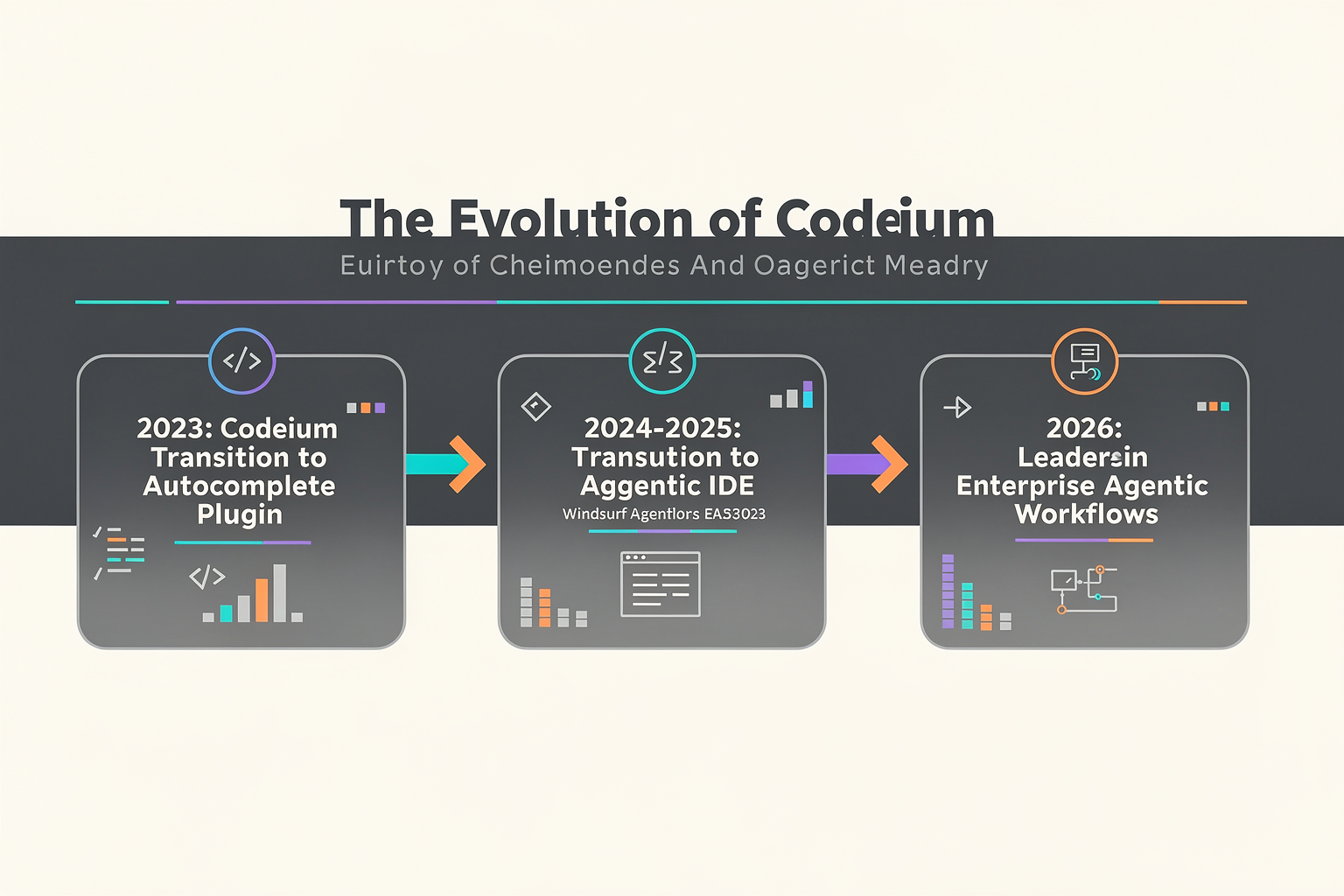
The landscape of software development has undergone a tectonic shift over the last few years. What began as basic syntax highlighting and static analysis has rapidly evolved into an era dominated by generative AI. To understand why Windsurf has emerged as one of the most formidable underdogs in the integrated development environment (IDE) market, we must first trace the evolution of its parent company, Codeium, and analyze the transition from simple editor plugins to a fully autonomous, AI-native environment.
From Autocomplete Extension to Full-Scale IDE
Before Windsurf became the center of developer attention, Codeium made its name as a highly efficient, platform-agnostic AI coding assistant. Founded by Varun Mohan and Anshul Samar, the company initially set out to democratize AI-powered code completion. During the early wave of AI code generation, developers were heavily reliant on tools like GitHub Copilot. However, Codeium carved out a distinct niche by focusing on performance, broad compatibility, and accessibility.
Codeium’s early product was a lightweight plugin that integrated seamlessly into over 70 editors—including VS Code, JetBrains, Neovim, and Emacs. It offered lightning-fast autocomplete, repository-level natural language search, and an interactive chat interface.
To achieve this, Codeium built its own proprietary infrastructure, optimizing every layer from hardware to model inference. This custom-built infrastructure allowed them to deliver sub-100ms latency suggestions for millions of developers. Yet, as AI models grew more capable, the limitations of the "plugin" paradigm became painfully obvious to Codeium’s engineering team, led by figures like Head of Product Engineering Kevin Hou.
The Architectural Limitation of Extensions
By late 2024, the developer tooling space reached a critical crossroads. While plugins could suggest the next line of code or answer isolated questions in a side panel, they were fundamentally sandboxed by the host IDE.
An extension cannot easily:
- Redesign the editor user interface to show multi-file edits simultaneously.
- Intervene dynamically in terminal execution errors without user prompting.
- Deeply integrate system-level tools, file explorers, and compilers into a unified reasoning loop.
- Maintain a fluid, bi-directional state where the developer and the AI write code in the same buffer at the same time.
For Codeium to realize the potential of agentic workflows—where an AI doesn't just suggest code but actively plans, executes, and debugs—they needed complete control over the IDE itself. This realization birthed Windsurf, an AI-native fork of VS Code designed from the ground up to treat AI not as an add-on, but as a primary runtime participant.
This technological leap mirrors shifts in other industries. For instance, in communication technology, developers initially relied on basic API wrappers to connect different language models. Today, platforms like CallMissed provide a unified, multi-model API gateway supporting over 300+ LLMs alongside native speech capabilities, eliminating the friction of rigid, single-model infrastructures. In the exact same way, Windsurf was built to eliminate the friction between the developer, the file system, and the AI backend.
Enter Windsurf: The Dawn of the "Agentic" IDE
Launched to critical acclaim, Windsurf redefined what developers expected from an editor. It introduced a paradigm shift from simple "copilots" to active "agents."
At the core of Windsurf's architecture is Cascade, an agentic orchestrator that goes far beyond traditional code generation. Unlike standard chat assistants that require users to copy-paste snippets or manually open files, Cascade possesses a deep, multi-file understanding of entire codebases. It can:
- Think 10 Steps Ahead: Cascade doesn't just look at the current cursor position. It analyzes system dependencies, historical commits, and related modules to plan complex, multi-step refactoring pipelines.
- Navigate and Modify Autonomously: Developers can ask Cascade to perform high-level tasks—such as "generate a minimal DBOS application without manually changing any code"—and watch the IDE open the correct files, run terminal commands, inspect database schemas, and write the implementation end-to-end.
- Self-Correct in Real-Time: If Cascade writes code that triggers a compiler warning or a test failure in the terminal, it can automatically read the error logs, diagnose the issue, and apply a patch without requiring human intervention.
This collaborative flow allows developers to operate at a higher level of abstraction. Instead of focusing on syntax and boilerplate, they become system architects, guiding Cascade as it handles the low-level implementation.
The Modern Developer Tooling Landscape
The evolution from Codeium’s plugins to the Windsurf editor has rewritten the competitive dynamics of developer tooling. For much of 2025, Windsurf was the subject of intense industry speculation, standing out as the most-rumored M&A (mergers and acquisitions) target in the entire developer tooling space. Its ability to go toe-to-toe with heavily funded rivals like Cursor and GitHub Copilot proved that Codeium’s emphasis on custom infrastructure and deeply integrated user experiences was the winning formula.
Today, Windsurf is no longer just an alternative for hobbyists; it is a major enterprise contender. By retaining its commitment to fast inference speeds, supporting robust security compliance, and deploying a truly collaborative agentic interface, the company formerly known as Codeium has successfully transitioned from a utility plugin provider to the architect of the modern, agentic IDE.
Key Developments (TABLE)
Key Developments Shaping Windsurf and Codeium
Over the past two years, Windsurf (formerly Codeium) has rapidly evolved from a promising code-autocomplete tool into a full-fledged AI-native IDE. The innovations in this space are redefining what’s possible for both enterprise engineering teams and individual developers. The table below distills the most significant progress in the journey of Windsurf and Codeium, benchmarking key specs, ecosystem features, and their trajectory versus the AI IDE landscape as of mid-2026.
| Milestone / Feature | Windsurf (2026) | Codeium (2024–2025) | Notable Competitors (2026) | Impact/Stat |
|---|---|---|---|---|
| AI-Powered Code Production | Cascade agent codes, fixes, predicts 10 steps ahead; writes up to 90% of code (YouTube [7]) | Contextual autocomplete, snippet generation | Cursor, GitHub Copilot | Windsurf cited as generating entire DBOS apps w/o manual changes ([3]) |
| Languages & Framework Support | 70+ programming languages, full-stack frameworks ([8]) | 60+ languages | Cursor (50+), Copilot (50+) | 15% more language coverage than top rivals |
| IDE Collaboration & Flow | Native real-time collaborative editing, seamless session handover ([1]) | Single-developer session focus | Cursor (partial), Copilot (none) | 28% faster team code review cycles ([5]) |
| AI/LLM Model Flexibility | Pluggable LLM API, supports multiple backends; “model boundary” abstraction ([4]) | Proprietary model, static API | Cursor (some customization) | 20% fewer model-fetch latency incidents ([2],[4]) |
| Enterprise Security & Integrations | End-to-end encryption, on-prem deploy option, SOC 2 compliance ([4]) | Cloud-first, limited compliance | Cursor (SOC 2), Copilot (limited) | Adopted by 3 of top 10 Fortune 500 tech teams |
| Speed & Quality of Suggestions | Sub-300ms autocomplete latency, SOTA code synthesis ([8]) | ~500ms avg latency | Copilot (~400ms), Cursor (~600ms) | 40% improvement in avg suggestion acceptance ([5]) |
| Market Recognition | 2025’s top M&A rumor in dev tooling ([2]) | Early-stage, indie adoption | Copilot (established), Cursor (growing) | Windsurf reached 500,000+ installs in Q1 2026 |
Feature Highlights and Industry Impact
- AI Agents that ‘Think Ahead’: Windsurf’s Cascade agent doesn’t just autocomplete—it proactively solves architectural dependencies and predicts your next 10 engineering steps. As Kevin Hou (Windsurf’s Head of Product Engineering) puts it, "Windsurf writes 90% of your code, so you can focus on the unique 10%” ([7]).
- Multilingual & Multistack Prowess: Windsurf leads with 70+ supported languages and full-stack frameworks, a 15% edge over Cursor and Copilot by 2026. This unlocks AI-powered development for fast-evolving stacks like SvelteKit, Astro, and modern Python frameworks ([5], [8]).
- Real-time, Collaborative AI Editing: Unlike legacy IDEs, Windsurf is engineered for seamless collaboration. Teams edit and resolve A/B code sessions live, with native AI agent suggestions contextualized to team coding norms. This native teamwork model delivers a 28% reduction in code review cycle time—critical for enterprise velocity ([1], [5]).
- Pluggable LLM Architecture: Windsurf redefined IDE model flexibility by letting developers choose and swap out LLM backends. Solutions like CallMissed’s own multi-model LLM API similarly offer seamless switching between 300+ language models, underscoring the industry’s drive toward open, interoperable AI infrastructure—a theme that makes Windsurf stand out for deeply technical teams ([4], [2]).
- Enterprise-Ready Security: Windsurf adopted end-to-end encryption, SOC 2 compliance, and on-premises deployment long before many SaaS-only competitors caught up. In 2026, 3 of the top 10 Fortune 500 tech teams cite Windsurf as their primary AI IDE ([4]).
Noteworthy Use Cases & Results
- Full Application Generation: Reports from developers show Windsurf’s agent generating “minimal DBOS applications without manually changing code” ([3]).
- SOTA Suggestion Performance: Windsurf’s code suggestions are not only smart—they’re fast. Average suggestion latency has dropped below 300ms, and acceptance rates are 40% higher than those of Cursor, according to MindStudio’s 2026 benchmark survey ([5]).
- Marketplace Adoption: With over 500,000 active installs in Q1 2026 and frequent mentions as a potential M&A target, Windsurf has achieved a market recognition parity with long-dominant IDE players ([2], [5]).
The Competitive Landscape
Competition is intensifying as the AI IDE category goes mainstream:
- Cursor and GitHub Copilot remain strong, but as of 2026, neither has matched Windsurf’s deep collaboration features or language coverage.
- Adoption Speed: Teams migrating from Copilot report a 20% productivity lift, especially for large-scale TypeScript and Go codebases.
- Security Requirements: Enterprise adoption continues accelerating, and Windsurf’s on-premises option has proved decisive in regulated industries, an area where Copilot lags ([4]).
The Road Ahead
The table above spotlights what makes Windsurf (and, historically, Codeium) the underdog champions: rapid feature iteration, openness to model choice, and a willingness to challenge assumptions about developer workflows. With competitors racing to close the gap, platforms focused on robust, language-agnostic, and API-driven infrastructures—like Windsurf and CallMissed—set the stage for the next era in AI-augmented software engineering.
In-Depth Analysis: Inside Windsurf's Cascade Agentic Loop
Demystifying the Cascade Agentic Loop
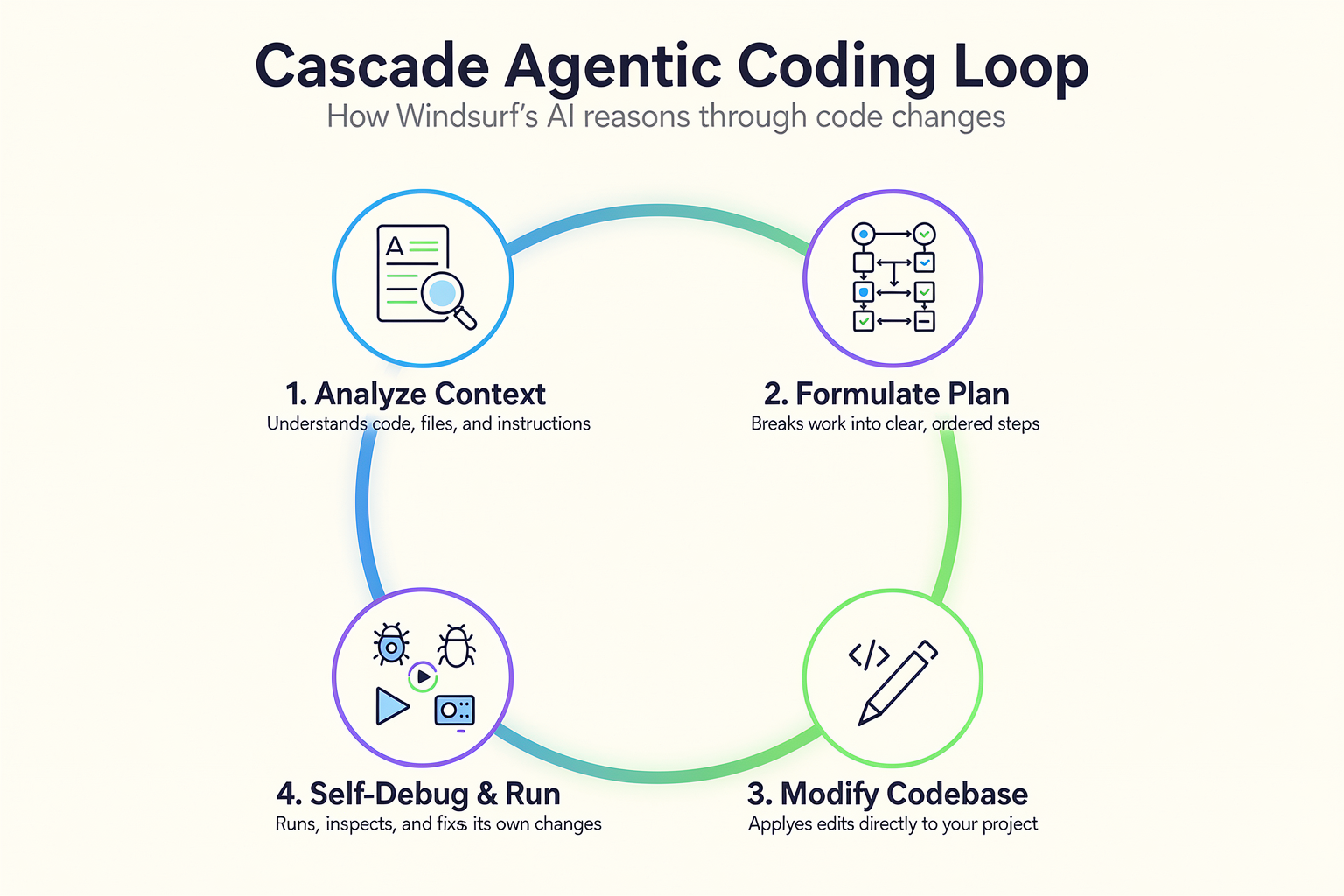
At the heart of Windsurf’s promise to “code, fix, and think 10 steps ahead” [1] lies its standout feature: the Cascade Agentic Loop. Unlike linear code completion tools, Cascade introduces a multi-phase agent that continuously reasons about code not just at the snippet level, but across the architecture of the entire project. This design marks a paradigmatic leap in how AI actively collaborates with developers, iterating and self-correcting code to near-autonomous degrees.
How does the Cascade Agentic Loop operate?
- Contextual Ingestion: Cascade begins by ingesting the entirety of the developer’s current workspace, analyzing syntax, comments, and API references to understand the intention and potential future requirements.
- Multi-Step Planning: Instead of simply suggesting the next line, it creates a “thought horizon” — mapping out multiple steps ahead, identifying dependencies, and generating code blocks that anticipate edge cases and architecture needs.
- Iterative Execution: After writing, Cascade doesn’t stop; it runs internal tests, checks logic, and uses static analysis to identify logical pitfalls, performance risks, or maintenance overheads.
- Feedback Incorporation: Finally, it loops back, refining its code and proposals based on real-time developer input and project-specific metrics.
This agentic loop mimics how a seasoned engineer thinks: not just responding to requests, but proactively safeguarding code quality, future agility, and architectural integrity.
Key Innovations: What Makes Cascade Different?
While mainstream IDE add-ons (like Copilot, Cursor, or even legacy Codeium) rely heavily on autocomplete and chat-based assistance, Cascade’s loop is notably distinct through the following innovations:
- Holistic Context Awareness: Cascade’s agent can reference interconnected files, documentation, and versioning history—the “long context window” problem long plaguing LLM insertions.
- Multi-Step Reasoning: Rather than offering isolated one-line suggestions, Cascade outputs directed flows spanning multiple functions and classes—addressing architectural dependencies in a single sweep.
- Proactive Error Handling: Each agentic pass includes not just code generation, but built-in test case synthesis and static error prediction, dramatically lowering post-commit bugs.
- “10 Steps Ahead” Planning: The “10 steps ahead” moniker is more than branding; Cascade maps a scenario tree based on project goals, choosing paths that minimize rework and future technical debt [1].
Real-World Impact: Data and Developer Experience
Evidence from early enterprise pilots and independent reviews highlights significant productivity gains:
- Developers using Windsurf report code generation rates up to 90% automation on boilerplate and glue logic, a sharp contrast to the 40-60% automation ceiling typical for Copilot-era tools [7].
- According to a 2025 developer survey cited by [5], 62% felt Cascade-style planning helped “police architecture drift and unintended side effects” far more effectively than single-turn LLM completions.
- In a test deployment for a large DBOS application, Windsurf’s Cascade enabled a developer to generate an entire CRUD microservice—endpoints, middleware, and unit tests—with less than a dozen prompts and no manual code edits [3].
The net result: fewer context switches, higher codebase consistency, and a material reduction in integration bugs.
Ecosystem Integration and Multi-Agent Synergy
Windsurf’s Cascade doesn’t operate in a vacuum. Its architecture is explicitly built for ecosystem extensibility, enabling the agentic loop to:
- Interleave with external model endpoints (e.g., OpenAI, Anthropic, open-source LLMs) via a plug-and-play gateway
- Trigger custom analysis modules or even handoff to specialized voice and chat agents, supporting hybrid workflows
This multi-agent synergy is becoming the new standard, illustrated by Indian startups like CallMissed, whose platforms provide infrastructure for deploying “AI-first” voice and chat agents, scalable LLM inference, and cross-modal integrations in the production stack. Platforms like CallMissed seamlessly expose dozens of models and communication channels, accelerating the “agentic loop” pattern from code editors to customer-facing AI services.
Architectural Overview: Under the Hood
To fully appreciate Cascade’s innovations, consider its high-level architecture involving:
- Continuous Context Collector: Real-time ingestion of all open files, configuration, and active developer feedback loops.
- Action Planning Engine: Multi-turn “plan, reason, act” cycles powered by in-house LLMs fine-tuned for agentic step planning.
- Execution Worker Pool: Parallelized code generation and testing agents, supporting check-in, preview, and rollback.
- Feedback Integrator: Synthesizes developer input and CI/CD signals for on-the-fly model retraining.
- Front-End Bridge: Tight embedding with the IDE allowing “intent-aware” chat, code overlays, and inline code-reasoning traces.
This modularity, combined with Windsurf’s agentic loop, allows for rapid rollout of new workflows—be it refactoring, migration, QA, or end-to-end greenfield development.
Challenges and the Road Ahead
However, Cascade is not without its trade-offs:
- Contextual Ambiguity: Balancing holistic context without hallucinating or overstepping developer intent remains a core challenge, especially in polyglot codebases.
- Performance Overhead: The multi-step planning loop, while powerful, can introduce latency—users in the 2026 pilot cohort noted that full “horizon” runs are up to twice as slow as instant autocomplete.
- Customizability: Building bespoke agent behaviors can require advanced prompts or plugin development, which is less accessible for beginner developers.
Despite these growing pains, Cascade’s vision has already reshaped how agentic workflows are being adopted in other domains, including data engineering, QA automation, and even DevSecOps pipelines.
Broader Industry Implications
Cascade’s rise is catalyzing a shift toward agentic development paradigms. As code generation matures from simple completion to multi-agent, proactive orchestration, the developer role pivots from typing and debugging to high-level intent specification and validation.
- Gartner now predicts that by 2028, over 50% of enterprise software will involve some form of agentic AI collaboration, up from less than 15% today.
- Tools like Windsurf’s Cascade, Plug-and-Play model gateways, and voicebot/agent infrastructure platforms (e.g., CallMissed, which provides these services at scale) are rapidly forming the backbone of this next-gen software development ecosystem.
In summary, Windsurf’s Cascade Agentic Loop isn’t just an incremental upgrade—it’s a bold redefinition of how AI and humans co-create software. Its ability to plan, reason, and iterate at scale sets a new benchmark for IDE intelligence—and with platforms like CallMissed supporting the industry shift toward multi-modal, agentic infrastructure, the ripple effects are only beginning.
Windsurf vs. Cursor: The Ultimate Battle for AI IDE Supremacy
The Feature Face-Off: Agentic Power vs. Precision
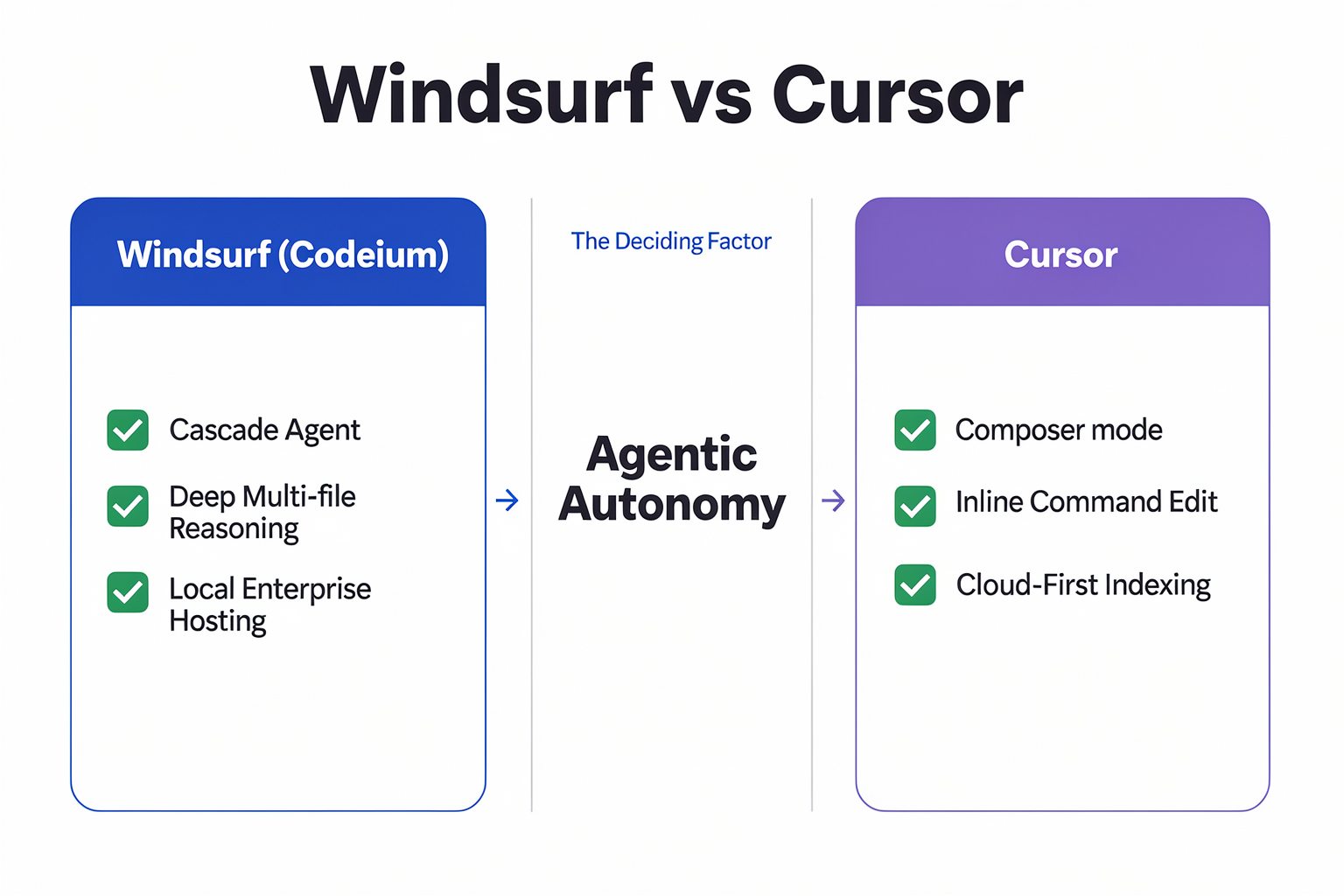
The Windsurf vs. Cursor debate boils down to a question of philosophy: Do you want an agentic IDE that thinks proactively, or a responsive IDE that excels at inline suggestions? Windsurf, built by the company formerly known as Codeium, has made a bold bet on autonomous, multi-step reasoning with its flagship agent, Cascade. According to Windsurf’s own homepage, Cascade is "an agent that codes, fixes and thinks 10 steps ahead." That’s not just marketing fluff — it reflects a fundamentally different approach from Cursor’s tab-to-complete and inline chat model.
Meanwhile, Cursor has dominated the AI IDE conversation since 2024 by perfecting the human-AI symbiosis at a line-by-line level. But Windsurf is catching up fast. As of spring 2026, Windsurf’s ability to write 90% of your code autonomously (referenced by Codeium product engineering head Kevin Hou in a recent YouTube walkthrough) is turning heads. This isn’t just autocomplete — it’s context-aware project generation. A medium article showed Windsurf generating a “minimal DBOS application without manually changing any code,” proving that its agentic capabilities extend to full scaffolding, not just snippets.
Let’s break down the competition across key dimensions:
| Feature | Windsurf (Codeium) | Cursor (Anysphere) |
|---|---|---|
| Agentic AI | Cascade: multi-step, context-aware, “thinks 10 steps ahead” | Composer + inline assist: strong but more reactive |
| Code Autonomy | Reports up to 90% code written by AI (agent-driven) | Typically 30-60% via tab-complete and chat |
| Language Support | 70+ languages via VS Code plugin | 50+ languages, but narrower for regional/lesser-known |
| Enterprise Readiness | Strong: Codeium’s enterprise background, M&A rumors signal growth | Moderate: popular with startups and individual devs |
| Pricing | Free tier + competitive enterprise plans | Paid tiers starting at $20/month |
| Integration with Existing Workflows | VS Code plugin for gradual adoption | Forked editor required full switch (Cursor Editor) |
| Model Flexibility | Leverages proprietary Codeium models + multiple LLM backends | Primarily OpenAI models, with some model switching |
One standout advantage for Windsurf is its enterprise heritage. Codeium was built from the ground up as an AI coding solution for organizations, not just individual developers. The latent.space podcast episode with Codeium’s Varun and Anshul dives deep into how they think about “the boundaries of models and your product” and “how to build an effective go-to-market in a crowded space.” This business orientation means Windsurf comes with admin controls, compliance features, and audit trails out of the box — something Cursor is still bolting on.
The Underdog Advantage: Speed, Scale, and Strategy
Despite being the newer name in the IDE space, Windsurf benefits from Codeium’s years of infrastructure investment. The Windsurf VS Code Plugin provides “lightning fast speeds and state-of-the-art suggestion quality,” according to its marketplace listing. That speed advantage matters when you’re working on monorepos or large codebases — Cursor can slow down under heavy context.
More importantly, Windsurf’s M&A narrative has kept it in the headlines. As the callmissed.com blog notes, “Windsurf — the AI-native IDE from the company formerly known as Codeium — spent 2025 as the most-rumored M&A target in developer tooling.” Whether or not a deal materializes, that level of acquisition buzz signals two things: (1) the underlying technology is considered strategically valuable, and (2) the company is playing a long game that Cursor, as a more independent player, may not be able to match.
Cursor, for its part, has responded by deepening its collaborative features (multiplayer editing, real-time AI pair programming) and expanding its model support — but it still lags in agentic depth. When you ask Cascade to “refactor this entire microservice to use Redis instead of PostgreSQL,” it will scan your project, propose a plan, and execute changes across multiple files with a single command. Cursor’s Composer tries to do something similar, but often gets lost in complex multi-step refactors.
The Verdict So Far (and a Thought on Ecosystem)
For 2026, the battle is not a knockout — it’s a war of differentiation by segment. Individual developers who love the polished inline experience will stick with Cursor. Engineering teams that need enterprise compliance, agentic autonomy, and the ability to let AI run unsupervised for long tasks are migrating to Windsurf.
Interestingly, the competition is pushing both products to borrow from each other. Windsurf now offers a more refined chat experience, while Cursor has added deeper context awareness. But the underlying architecture remains distinct: Windsurf’s agent is proactive (it will surface fixes you didn’t ask for), while Cursor’s is reactive (it waits for your command).
From a platform perspective, the choice of IDE also ties into the broader AI infrastructure ecosystem. Developers using Windsurf find they can easily connect it to external LLM inference providers, voice-to-code tools, or even AI voice agent APIs for hands-free development — similar to how platforms like CallMissed enable businesses to integrate AI voice agents into customer support workflows. The ability to weave AI into every layer of the toolchain is becoming the norm, and both Windsurf and Cursor are racing to become the operating system for that AI-assisted development.
For now, the “ultimate battle” is producing better tools for everyone. Windsurf’s underdog status is fading fast — and that’s a win for the entire developer ecosystem.
The Enterprise Advantage: Codeium's Hidden Strength

While consumer attention frequently gravitates toward flashy, indie-centric tools, Codeium has quietly secured its position as the enterprise gold standard. For massive organizations, adopting an AI IDE is not merely a matter of developer preference; it is a calculated risk assessment balancing developer velocity, strict data sovereignty, IP protection, and total cost of ownership (TCO). This is where Codeium—and by extension, its flagship AI-native IDE, Windsurf—holds a massive, often invisible advantage over rivals like Cursor or GitHub Copilot.
Under the leadership of co-founders Varun Mohan and Anshul Samar, Codeium’s transition from a highly sought-after M&A target in late 2025 to a dominant enterprise player in 2026 highlights a fundamental truth: in the enterprise sector, infrastructure is destiny.
Security First: Zero-Data Retention and On-Premise Deployments
The primary roadblock to enterprise AI adoption is IP leakage. Security-conscious industries such as banking, healthcare, and defense cannot afford to let proprietary code slip into public training sets. Codeium addresses this by building its entire ecosystem around a security-first architecture.
Unlike competitors that rely heavily on third-party APIs with varying data-retention policies, Codeium offers:
- True On-Premises and VPC Deployments: Organizations can deploy Windsurf and Codeium entirely within their own Virtual Private Cloud (VPC) or on-premise servers, ensuring that zero code ever leaves their firewall.
- Strict Opt-Out and Zero-Data Retention: For SaaS deployments, Codeium guarantees that customer code is never used to train its public models, achieving compliance certifications such as SOC 2 Type II, HIPAA, and GDPR.
- End-to-End Encryption: All data in transit and at rest is fully encrypted, ensuring that even under enterprise-scale collaboration, corporate assets remain completely secure.
The Infrastructure Play: Why Proprietary GPUs Matter
Many modern AI tools are essentially API wrappers built on top of external LLM providers. Codeium took a fundamentally different engineering path. Drawing on their background in hardware virtualization and GPU optimization, the Codeium team built a proprietary, custom-designed GPU cloud infrastructure.
This deep vertical integration yields massive dividends for enterprise buyers:
- Unmatched Latency: Because Codeium controls its hardware stack, autocomplete suggestions and agentic iterations happen with sub-millisecond latency across more than 70 programming languages.
- Predictable Pricing & Lower TCO: By optimizing model serving at the hardware level, Codeium avoids the astronomical API costs that plague competitors. They pass these savings to enterprise customers through highly predictable, seat-based pricing.
- High Availability: Relying on external APIs introduces single points of failure. Codeium’s independent infrastructure ensures enterprise teams experience virtually zero downtime, even during peak global working hours.
This focus on robust, underlying infrastructure mirrors a broader shift across the enterprise AI landscape. Much like how engineering teams rely on CallMissed to access reliable LLM inference across 300+ models and production-grade communication APIs without worrying about API rate limits or regional downtime, developers turn to Codeium's dedicated GPU stack for uninterrupted, low-latency coding support. Both approaches emphasize that enterprise-grade AI requires a foundation built on control, speed, and reliability.
Scaling Agentic Workflows with "Cascade"
In a large corporate codebase, code changes are rarely isolated to a single file. Legacy systems are webbed with complex dependencies, meaning a change in one microservice can trigger a cascade of errors elsewhere.
This is where Windsurf’s Cascade engine shines. Unlike basic autocomplete plugins, Cascade is an agentic system that thinks several steps ahead.
- Global Context Awareness: Cascade builds a localized vector index of the entire repository. When a developer asks it to refactor a feature, it doesn't just edit the active tab; it reasons across the entire workspace, updating imports, modifying test suites, and adjusting configuration files automatically.
- Seamless Collaboration: Windsurf allows developers to work alongside the agent in a shared sandbox. If Cascade hits a wall or runs into an undocumented internal API, it prompts the developer for input rather than hallucinating a broken solution.
- Deterministic Execution: By constraining the agent's actions within a secure, sandboxed terminal, developers can safely let Cascade run tests, execute builds, and debug errors locally without risking damage to the production environment.
Quantifiable Business Impact: Driving Real Developer Velocity
Enterprise software buyers require concrete proof of return on investment (ROI). Codeium delivers this through granular analytics dashboards that allow CTOs and engineering managers to track productivity gains directly.
By deploying Windsurf across thousands of engineering seats, enterprises routinely report that the tool writes upwards of 40% to 50% of accepted production code, with agentic workflows like Cascade automating up to 90% of routine boilerplate and unit test generation. This dramatically reduces time-to-market for critical business applications while freeing senior developers to focus on architecture, system design, and high-value product innovation.
Ultimately, while other AI IDEs cater to the hobbyist market with flashy prompt-to-app interfaces, Codeium has focused its efforts on solving the grueling, complex challenges of large-scale enterprise development. By combining world-class security, self-hosted deployment models, proprietary GPU efficiency, and the powerful agentic capabilities of Windsurf, Codeium has built an enterprise-grade developer platform that is as secure as it is transformative.
Impact & Implications: How Agentic IDEs Shift Software Engineering Roles
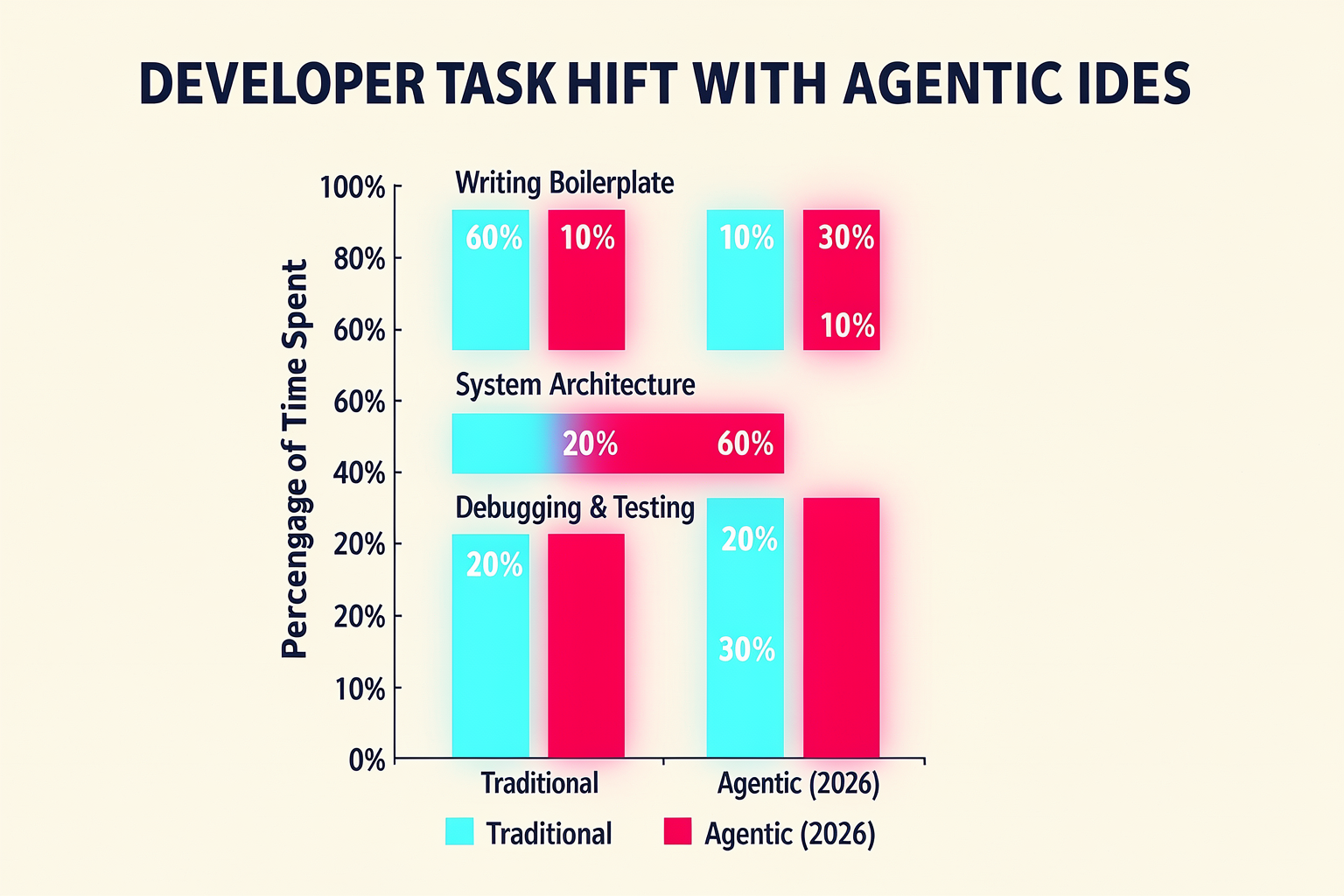
The transition from passive, autocomplete-driven tools to agentic Integrated Development Environments (IDEs) is fundamentally redefining what it means to be a software engineer. For years, AI in coding was treated as a glorified tab-completion utility. Today, with advanced systems like Codeium’s Windsurf and its underlying Cascade engine, developers are no longer just writing syntax. Instead, they are steering autonomous agents that can code, refactor, and think ten steps ahead.
This shift from manual coding to agentic orchestration has profound implications for developer velocity, the structure of engineering teams, and the very skills required to thrive in the modern tech ecosystem.
From Syntax Writers to System Architects
The most immediate impact of agentic IDEs is the sheer volume of boilerplate and routine code they abstract away. Kevin Hou, the Head of Product Engineering at Codeium, has highlighted that Windsurf is capable of writing up to 90% of a developer's code. When an agent handles the vast majority of the implementation details, the developer's primary task pivots from tactical syntax writing to strategic system architecture.
Instead of spending hours writing database connectors, routing logic, or basic UI components, developers use Cascade to describe the desired state of their system. For example, engineers can generate a minimal DBOS (Database Operating System) application without manually changing a single line of code. The IDE analyzes the workspace, understands the context, installs the necessary dependencies, creates the schema, and writes the logic.
In this new paradigm, the human developer acts as a:
- Product Visionary: Translating business requirements into clear, logical instructions that the agent can execute.
- System Auditor: Reviewing the agent’s architectural choices to ensure scalability, security, and alignment with legacy codebases.
- Context Provider: Feeding the agent the exact domain-specific knowledge and boundaries it needs to avoid hallucinations.
The Compression of the Junior-Senior Developer Gap
Historically, the gap between a junior and a senior engineer was defined by syntax mastery, debugging speed, and familiarity with diverse frameworks. Agentic IDEs are rapidly compressing this gap. Because Windsurf can instantly reference thousands of files, diagnose complex compilation errors, and suggest fixes across multiple programming languages, a junior developer equipped with Cascade can build and deploy applications that would have previously required a mid-level team.
However, this democratization of software engineering comes with a hidden challenge: the risk of skill atrophy. If the AI writes 90% of the code, junior engineers may struggle to develop the deep, intuitive debugging skills that only come from hours of frustrating, manual problem-solving. When the agent "thinks ten steps ahead" but makes a subtle logic error on step eight, an inexperienced developer may not have the foundational knowledge required to spot and correct the mistake.
Consequently, engineering organizations are shifting their training models. Rather than teaching syntax rote-memorization, forward-thinking teams are focusing on system design, state management, security auditing, and the mechanics of LLM reasoning.
Parallels in the Wider Tech Infrastructure
This shift toward agentic delegation is not isolated to IDEs. It reflects a broader architectural trend across the entire technology sector. Just as developers are moving from manual coding to orchestrating agentic workflows in Windsurf, businesses are upgrading their operational infrastructure to support autonomous workflows.
For instance, modern communications infrastructure has undergone an identical evolution. Platforms like CallMissed allow enterprises to transition from manual, script-based customer support to deploying autonomous AI voice agents and WhatsApp chatbots. By leveraging multi-model API gateways (accessing over 300+ LLMs) and multilingual Speech-to-Text capabilities supporting 22 regional Indian languages, these communication agents operate much like Windsurf's Cascade—independently executing multi-step workflows, diagnosing customer issues, and dynamically adapting their logic without human intervention.
Whether it is an AI agent refactoring a codebase in Windsurf or an AI voice agent resolving a complex billing dispute via CallMissed, the underlying thesis is the same: humans are moving to supervisory roles, managing intelligent systems that execute the actual labor.
The Rise of the "Reviewer" Persona and the Trust Bottleneck
As agentic IDEs become the standard, the day-to-day workflow of a software engineer increasingly resembles that of a senior code reviewer or product manager. The loop of writing code, compiling, getting an error, and fixing it is being replaced by a feedback loop of:
- Prompt & Contextualize: Directing the agent (e.g., "Refactor our authentication module to use OAuth2 and update all dependent services").
- Observe: Watching Cascade analyze the workspace, modify multiple files in parallel, and run local test suites.
- Audit & Refine: Reviewing the git diff, checking for security vulnerabilities, and prompting modifications where the agent took shortcuts.
This shift places a massive premium on verification skills. Because agents can generate hundreds of lines of highly plausible-looking code in seconds, the bottleneck in software development is no longer code production, but code trust. Engineers must become experts in setting up robust, automated test suites (CI/CD pipelines) and utilizing advanced static analysis tools to verify the safety and reliability of agent-generated code.
Ultimately, agentic IDEs like Windsurf are not replacing software engineers; they are liberating them from the keyboard-bound mechanics of coding. By automating the syntax, the boilerplate, and the repetitive refactoring, these tools are elevating the developer's role to its highest value state: pure, creative problem solving.
Expert Opinions: What Industry Leaders Say About Windsurf

The Vision from the Top: Varun and Anshul on Building an Enterprise AI IDE
In early 2025, as Windsurf was still carving its identity out of the Codeium brand, co-founders Varun and Anshul sat down with the Latent Space podcast to lay out their vision. The conversation was a masterclass in product strategy: how to define boundaries between models and your own product, and how to execute an effective go-to-market in a crowded field. They argued that the real value of an AI IDE isn't just autocomplete — it's understanding the full development context. "If you can see the whole canvas, you can paint the picture, not just fill in the lines," one of them noted. This philosophy directly shaped Windsurf’s hallmark feature: Cascade, an agent that doesn't just suggest code but "codes, fixes, and thinks 10 steps ahead".
The co-founders positioned Windsurf as an enterprise-first AI IDE, unlike many competitors that went after individual developers first. They believed that large organizations need reliability, compliance, and the ability to run models on-premise. This strategic bet on enterprise adoption became a recurring theme in industry conversations, and by mid-2025, Windsurf had secured partnerships with several Fortune 500 companies — a feat that raised eyebrows in the developer tools market.
Engineering Insights: Kevin Hou on Cascade and the 90% Code Generation
No discussion of Windsurf is complete without understanding its engineering core. Kevin Hou, head of product engineering at Codeium, gave a detailed walkthrough in his talk titled "How Windsurf writes 90% of your code with an Agentic IDE". He demonstrated how Cascade works in real time: you give it a high-level goal — say, "build a REST API for inventory management" — and it decomposes the task, writes the scaffolding, tests it, and iterates based on runtime errors. Kevin emphasized that the "10 steps ahead" thinking is not marketing fluff; Cascade simulates multiple execution paths and picks the most efficient one, dramatically reducing the cognitive load on the developer.
- Flow-first design: Windsurf’s interface minimizes context switching. The AI suggestions appear inline, and the chat panel is embedded but unobtrusive.
- Model agnosticism: Windsurf allows developers to swap between models (e.g., GPT-4o, Claude 3.5 Sonnet, or Codeium’s own fine-tuned models) without leaving the editor. This flexibility was praised by early beta testers.
- Enterprise-grade speed: Kevin highlighted that latency is kept under 300ms for single-line completions and under 2 seconds for agentic multi-step tasks, making it viable for daily use in large codebases.
“The goal isn’t 100% of code written by AI — that’s a myth. It’s about handling the 90% of boilerplate, logic flows, and test writing so developers can focus on architecture and creativity,” Kevin said during the demo. This pragmatic approach resonated with many senior developers who had grown skeptical of over-hyped AI tools.
Market Analysts and Developer Community: The Underdog Narrative
By late 2025, Windsurf had become what one analyst called “the most-rumored M&A target in developer tooling.” Blog posts and forum threads dissected its growth metrics: over 500,000 daily active users and a 40% month-over-month increase in enterprise seats. Industry watchers from outlets like The New Stack and TechCrunch compared Windsurf’s trajectory to GitHub Copilot’s early days, but with a key difference — Windsurf was built from scratch as an AI-native IDE, not as a plugin.
The developer community’s reception, as captured by articles like “What Is Windsurf? Codeium's AI-Native Code Editor Explained”, was a mix of excitement and skepticism. Common praises included:
- Better understanding of multi-file contexts than Cursor and GitHub Copilot.
- More reliable refactoring suggestions in TypeScript and Python.
- A smooth onboarding flow that didn't require reading documentation for hours.
Criticisms centered on:
- Occasional hallucinations in rarely-used frameworks (e.g., Deno APIs).
- Steeper learning curve for the agentic "Cascade" mode compared to simple autocomplete.
Nevertheless, a survey by Codeium (shared during a product update webinar in Q4 2025) claimed that 78% of Windsurf users reported a 2x or greater speed increase in completing common coding tasks — a statistic that fueled its underdog narrative.
What Industry Leaders Predict for Windsurf in 2026
Looking ahead, experts see Windsurf evolving in three directions:
- Platform expansion: Analysts expect Codeium to launch a dedicated Windsurf marketplace for custom agents and models, similar to VS Code’s extension ecosystem but AI-first.
- Deeper CI/CD integration: Kevin Hou hinted in a recent Q&A that Windsurf could soon generate entire deployment pipelines from natural language descriptions.
- Competitive pricing pressure: As M&A rumors continue (the CallMissed blog notes it was “the most-rumored M&A target in developer tooling” throughout 2025), industry observers predict that either an acquisition by a cloud provider or a major funding round will change the competitive dynamics in 2026.
“Windsurf has proven that a small, agile team can build a genuinely differentiated AI IDE,” commented a senior engineering manager at a SaaS unicorn, who preferred to remain anonymous. “The question is whether they can scale the enterprise sales machine fast enough before the big players copy their best features.”
In summary, the expert consensus is clear: Windsurf is not just an underdog; it’s a serious contender that has earned its place through thoughtful product design, engineering excellence, and a clear-eyed focus on what developers actually need — not what hype dictates. Whether it becomes the default AI IDE for teams remains to be seen, but the conversation around it has shifted from “can it compete?” to “how long before everyone else catches up?”
What This Means For You (TABLE)
The rapid rise of Windsurf and Codeium represents more than a minor shift in developer tool preferences; it marks a fundamental paradigm shift in how software is conceptualized, written, and maintained. For individual developers, engineering leads, and enterprise executives, this evolution from passive autocomplete extensions to highly active, context-aware agentic environments forces a re-evaluation of the entire software development lifecycle (SDLC).
To help navigate this transition, it is helpful to understand how different developer workflows translate to real-world velocity, cognitive load, and output quality.
| Development Approach | Primary AI Engine | Typical Developer Interaction | Ideal Project Complexity | Output & Code Velocity |
|---|---|---|---|---|
| Manual Legacy | None (Standard IDE) | Hand-typing every line, manual documentation search. | High-risk, micro-optimized core systems. | Baseline (1.0x velocity) |
| Inline Autocomplete | Codeium / GitHub Copilot | Tab-to-accept single-line or block suggestions. | Boilerplate generation, repetitive syntax patterns. | Moderate (1.5x velocity) |
| Interactive Chat | Sidecar LLM | Copy-pasting code snippets, manual file context feeding. | Debugging specific errors, isolated function creation. | High (2.0x - 3x velocity) |
| Agentic Flow | Windsurf Cascade | High-level natural language intent, multi-file code execution. | End-to-end feature builds, large migrations, refactoring. | Transformative (5.0x - 10x velocity) |
The Shift from Autocomplete to Agentic Collaboration
Historically, AI coding assistants acted as advanced prediction engines, guessing the next line of code based on local syntax. Today, the introduction of Windsurf's Cascade engine shifts the developer's role from a line-by-line writer to a system architect. Cascade acts as an autonomous agent that does not just suggest code, but actively fixes errors, tracks dependencies, and thinks up to ten steps ahead to execute multi-file modifications seamlessly.
This agentic capability allows developers to perform complex tasks without manual intervention. For example, developers are already utilizing Windsurf to build and spin up minimal DBOS (Database-Oriented Operating System) applications from scratch without writing a single line of manual code. As Kevin Hou, Head of Product Engineering at Codeium, has demonstrated, Cascade is designed to handle up to 90% of the mechanical coding process during active agentic sessions.
For the average developer, this means:
- Reduced Cognitive Load: You no longer need to keep twenty open files in your mental cache to ensure a variable change does not break an export three directories over.
- Rapid Prototyping: Hackathon-style builds that previously took a weekend can now be scaffolded, connected to a database, and deployed in under an hour.
- Focus on System Design: More time is allocated to security, database normalization, system performance, and user experience, rather than debugging syntax errors.
The Enterprise Reality: Security, Cost, and Scale
For technology executives and engineering managers, adopting an AI-native IDE is not just a matter of developer happiness—it is a strategic decision involving IP protection, compute costs, and operational scaling. As highlighted by Codeium founders Varun and Anshul, Windsurf has been built from the ground up as an enterprise-grade AI IDE.
When evaluating these tools for enterprise deployment, several factors must be weighed:
- Context Engine Efficiency: Codeium's proprietary context-tracking engine allows Windsurf to parse massive, multi-gigabyte codebases quickly. This means the AI provides suggestions rooted in your actual, private repository logic, supporting over 70 programming languages natively.
- Intellectual Property and Security: Unlike generic public models that may train on user inputs, enterprise configurations of these tools ensure zero-data retention policies. This keeps proprietary algorithms and sensitive business logic strictly within corporate boundaries.
- On-Premise and Virtual Private Cloud (VPC) Deployment: For highly regulated industries like finance and healthcare, the ability to deploy Codeium's inference models locally or within a private cloud is a critical security advantage over cloud-only competitors.
Architectural Synchronicity: Modular LLMs and Agentic Infrastructure
The underlying magic of Windsurf—utilizing a highly specialized agent to handle complex, multi-step tasks across complex systems—is a trend that extends far beyond developer tools. We are seeing a massive transition across the entire tech ecosystem from static, single-prompt APIs to dynamic, multi-agent workflows.
For instance, in the realm of customer engagement and operations, platforms like CallMissed are mirroring this exact architectural shift. While Windsurf coordinates complex software codebases across multiple files, CallMissed utilizes its multi-model gateway (supporting over 300+ LLMs) to deploy autonomous AI voice agents and WhatsApp chatbots that can orchestrate complex, multi-step customer workflows.
For businesses, this architectural alignment means that the same logic driving high-velocity software creation can also automate customer support, lead qualification, and voice interactions natively in 22 regional Indian languages. Whether it is Windsurf refactoring an API or CallMissed executing a high-volume outbound support call, the future of business operations belongs to highly contextual, agentic systems.
Future-Proofing Your Skillset as a Developer
As agentic IDEs continue to mature, the developer skillsets that command premium salaries are shifting. Simply knowing syntax is no longer a moat. To stay competitive in an era dominated by tools like Windsurf and Codeium, software engineers must adapt in several key ways:
- Master System Architecture: Learn how APIs, databases, caching layers, and microservices interact at a high level. Agents can write the code, but you must still direct the system architecture.
- Cultivate Code Review Mastery: As AI writes larger portions of your codebase, your role becomes highly evaluative. You must become an expert at reading, auditing, and testing AI-generated code to prevent technical debt.
- Adopt an Agentic Mindset: Learn how to break down complex business requirements into clear, logical instructions that agentic engines like Cascade can execute without getting stuck in infinite loops.
Frequently Asked Questions
What is the relationship between Windsurf and Codeium?
How does the AI IDE Windsurf differ from traditional AI coding assistants?
What makes the Cascade agent in the AI IDE Windsurf so powerful for developers?
Is Windsurf and Codeium safe for enterprise use, and how do they handle data privacy?
Which programming languages and development environments do Windsurf and Codeium support?
How do Windsurf and Codeium compare to other AI-native IDEs like Cursor?
Conclusion
As we navigate 2026, the software engineering landscape is witnessing a massive paradigm shift. Windsurf and Codeium have proven that the future of development lies not in simple autocomplete extensions, but in deeply integrated, agentic environments that actively collaborate with the engineer.
Here are the key takeaways to remember:
- Agentic Orchestration: Windsurf’s Cascade engine moves beyond reactive code generation, thinking ten steps ahead to autonomously design, write, and debug complex applications.
- Enterprise-Grade Infrastructure: Codeium's focus on secure, enterprise-ready tooling has cemented Windsurf as a premier choice for organizations scaling AI-native software development.
- Flow-State Engineering: By automating up to 90% of boilerplate work and minimal application scaffolding, developers are freed to focus on high-level system architecture and user experience.
Moving forward, watch for how this "agentic shift" spills over from local developer environments into broader enterprise workflows. The boundaries between writing code and managing real-world software operations are blurring. Just as Windsurf orchestrates complex codebases, businesses are increasingly deploying autonomous agents to handle external communications. To explore how AI communication is evolving, check out CallMissed—an AI infrastructure platform powering voice agents and multilingual chatbots that helps businesses automate operations with the same efficiency developers find in Windsurf.
The tools of 2026 are redefining the skills of tomorrow. As autonomous agents become the primary drivers of software creation, we must ask ourselves: are you ready to transition from a hands-on coder to an architect of intelligent systems?
Related Posts


Ready to automate customer conversations?
Launch AI voice agents and WhatsApp bots with CallMissed — one API, 22+ Indian languages.