

Why UK Ministers Are Resisting Alignment with the EU's Strict AI Rules


Could the UK's high-stakes bid to reset its relationship with the European Union inadvertently strangle its crown jewel—the thriving domestic technology...
Why UK Ministers Are Resisting Alignment with the EU's Strict AI Rules
Could the UK's high-stakes bid to reset its relationship with the European Union inadvertently strangle its crown jewel—the thriving domestic technology sector? As Prime Minister Sir Keir Starmer campaigns to place "Britain at the heart of Europe," a quiet rebellion is brewing within his own government. UK technology ministers are actively pushing back against aligning with Brussels’ stringent regulatory framework, warning that adopting the EU AI Act could "smother" British innovation and erode the nation’s hard-won competitive edge.
This internal friction highlights a critical turning point for global technology policy. The UK has successfully carved out a reputation as a leading international AI hub, securing its position as a dominant force in Europe by attracting billions in venture capital and hosting some of the world's most prominent AI safety research institutions. However, Whitehall officials fear that forcing British startups to comply with the EU’s heavy-handed compliance demands will stall momentum, drive tech giants away, and severely strain the UK's strategic AI alliance with the United States. While Brussels focuses on strict, risk-mitigation mandates, Washington and London have historically favored more flexible, pro-innovation approaches designed to foster rapid growth.
As businesses and developers navigate this increasingly fragmented global regulatory landscape, agility is becoming their most valuable asset. Scalable communication platforms like CallMissed are helping enterprises adapt to these shifting jurisdictions by offering flexible, multi-model AI infrastructure that allows businesses to remain compliant regardless of where regional regulations land.
In this article, we will examine the core reasons why UK ministers resist alignment with EU's AI rules. We’ll dive into the economic stakes of Starmer’s proposed European reset, analyze how regulatory divergence could protect British startups, and explore what this geopolitical tug-of-war means for the future of AI deployment on both sides of the Channel.
Introduction
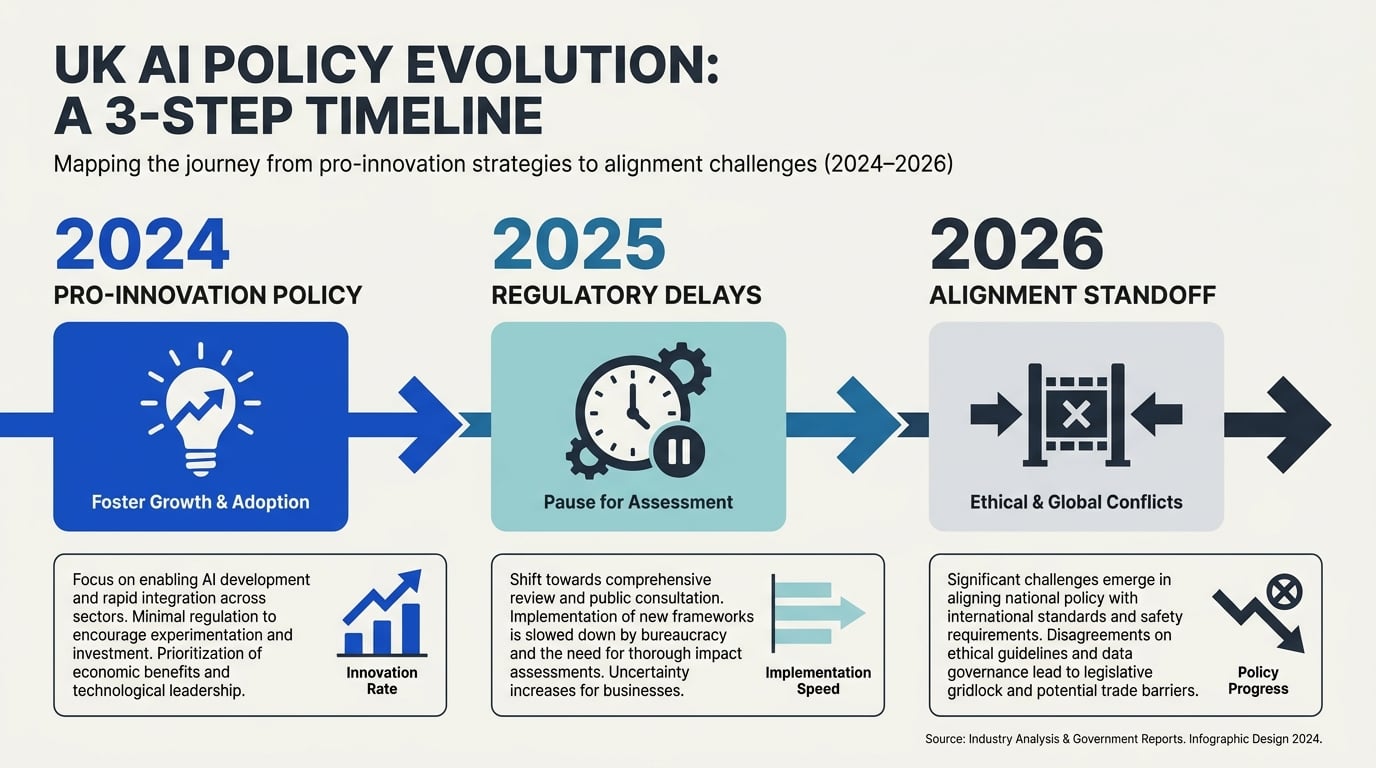
The delicate political balancing act of Prime Minister Sir Keir Starmer’s "EU reset" has hit a major roadblock in the technology sector. As the UK government seeks closer diplomatic and economic ties with Brussels, British technology ministers are actively resisting pressure to align with the European Union’s stringent Artificial Intelligence (AI) regulations. Whitehall officials have sounded the alarm, warning that adopting Brussels-style frameworks—specifically the landmark EU AI Act—could "smother" domestic innovation and strip the UK of its hard-won competitive advantage in the global AI race.
This internal clash highlights a fundamental strategic dilemma: how can the UK rebuild its relationship with Europe without strangling its most promising high-growth industry?
The "Smother" Effect on British Innovation
At the heart of the debate is the fear that importing the EU's highly bureaucratic, risk-based regulatory framework will stifle the agility that has made the UK a global hub for AI research and development. UK technology ministers argue that the country's current "pro-innovation" approach—which relies on existing regulators to manage AI risks within their specific sectors rather than introducing sweeping, blanket legislation—has been central to attracting venture capital.
Adopting EU-style regulations risks imposing heavy compliance burdens that could:
- Stifle early-stage startups: Small and medium enterprises (SMEs) lack the legal resources to navigate the EU's complex compliance and auditing categorization of AI systems.
- Deter foreign investment: Tech giants and venture capitalists may redirect capital toward more laissez-faire markets, such as the United States, rather than navigating European red tape.
- Slow down deployment cycles: Strict regulatory pre-approvals and conformity assessments delay the time-to-market for cutting-edge AI products.
The Geopolitical Tightrope: US vs. EU
Ministers are also deeply concerned about the geopolitical implications of aligning too closely with Europe. The UK has traditionally positioned itself as a bridge between the heavily regulated European market and the highly entrepreneurial, market-driven ecosystem of the United States. Forcing British companies to comply with Brussels' rulebook could damage the UK's strategic technology alliance with Washington and alienate key American tech partners who favor a more flexible regulatory environment.
For businesses operating globally, this regulatory fragmentation creates a massive compliance headache. Organizations must decide whether to build separate systems for different jurisdictions or restrict their market reach entirely.
To survive in this fragmented landscape, adaptability is key. Multi-model AI infrastructure platforms, such as CallMissed, are already helping businesses navigate this regulatory maze. By providing an API gateway that supports over 300 LLMs alongside specialized tools like Speech-to-Text in 22 regional languages, CallMissed allows developers to seamlessly switch models and adjust data-handling protocols. This technical flexibility ensures that enterprises can remain compliant with differing UK, US, or EU jurisdictions without having to rebuild their core communication infrastructure from scratch.
As the debate intensifies within Whitehall, the decision the UK makes will not just shape its political relationship with Europe—it will define the trajectory of its entire digital economy.
Background & Context

The debate over the United Kingdom’s technological future has reached a critical juncture. Prime Minister Sir Keir Starmer's administration has made a highly publicized "EU reset" a cornerstone of its foreign and economic policy, pledging to place "Britain at the heart of Europe." However, this push for closer alignment with Brussels has ignited fierce internal resistance. UK technology ministers and Whitehall officials have raised urgent warnings that mimicking the European Union's stringent regulatory frameworks could "smother" the UK's thriving AI sector and erode its competitive advantage.
The Clash of Regulatory Philosophies
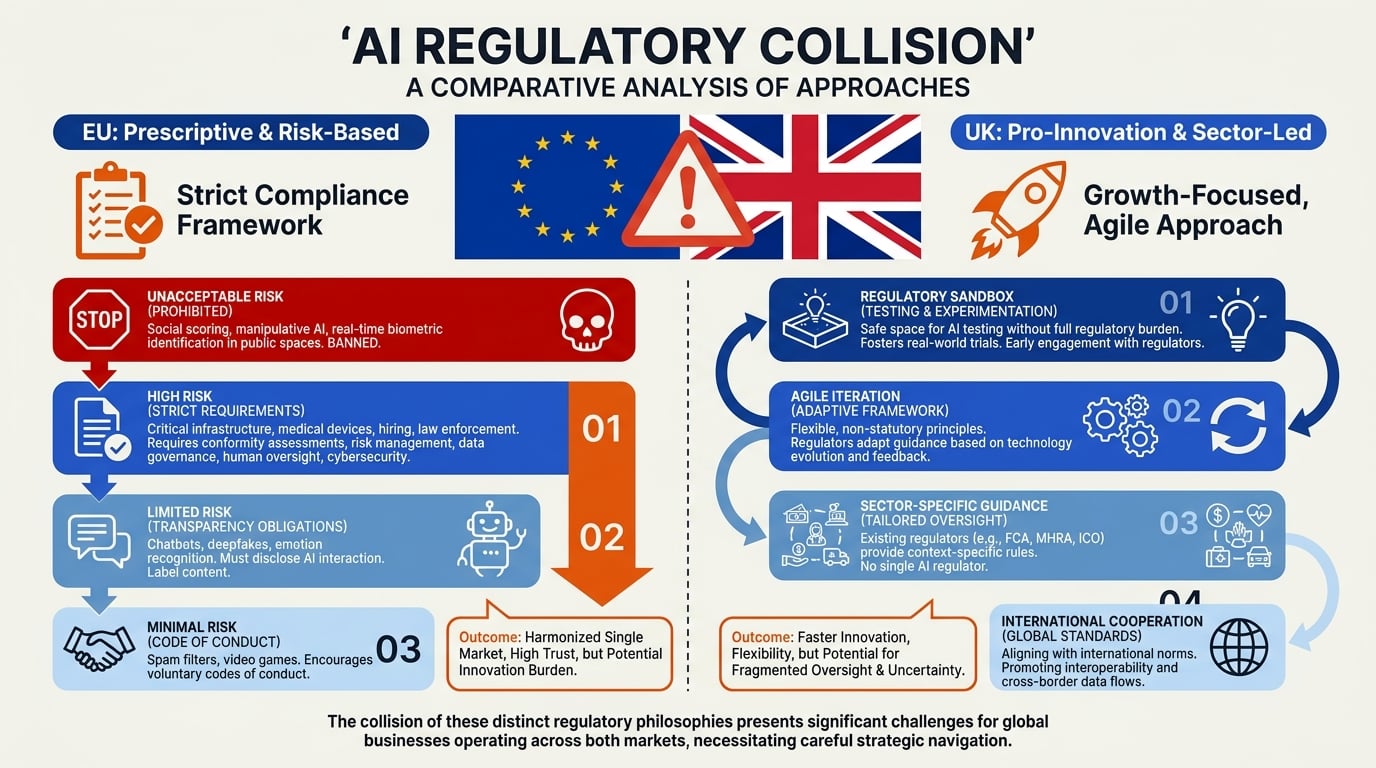
At the heart of the dispute is a fundamental philosophical divide over how to govern artificial intelligence:
- The EU Approach: Anchored by the comprehensive EU AI Act, Brussels has pioneered a prescriptive, risk-based regulatory framework. While intended to safeguard consumer privacy and fundamental rights, critics argue it imposes heavy compliance burdens that stifle early-stage startups and discourage venture capital.
- The UK Approach: Historically, the UK has championed a "pro-innovation," context-driven strategy, relying on existing regulators to monitor AI within their respective domains. This flexibility has allowed the UK to establish itself as a dominant global hub for AI research, development, and commercialization.
The Threat to Innovation and Alliances
Whitehall insiders worry that adopting EU-style AI regulations would not only strangle local innovation but also threaten the UK's strategic partnerships. Specifically, ministers fear that strict alignment with the EU would alienate the United States—the world’s leading source of AI capital and technological breakthroughs.
Because US tech firms favor a more permissive development environment, forcing them to comply with strict EU-style rules to operate in the UK could drive investment away from London. Many officials argue that keeping the UK regulatory regime distinct is vital for maintaining its unique competitive edge in attracting global tech talent and enterprise investment.
Navigating Global Regulatory Divergence
As governments debate these cross-border regulatory boundaries, companies building and deploying AI tools face a complex and fragmented landscape. To stay compliant without sacrificing progress, modern enterprises require highly adaptable technology stacks.
This is where advanced communication infrastructure becomes critical. Globally minded platforms like CallMissed allow organizations to navigate regional regulatory shifts seamlessly. By offering a multi-model API gateway that supports over 300 LLMs, CallMissed enables developers to switch models and adjust hosting environments dynamically. This flexibility ensures that businesses can easily comply with localized EU data rules or leverage more flexible US and UK frameworks without having to rewrite their core infrastructure.
The Strategic Dilemma
The tension between political integration and economic competitiveness is poised to define the UK's legislative agenda. If the government capitulates to EU rules for the sake of political alignment, it risks losing its status as a leading global sandbox for breakthrough AI technologies. Conversely, complete divergence could create regulatory friction with its closest geographic trading partners. Finding a middle path is the ultimate challenge currently facing Starmer's cabinet as the global race for AI supremacy accelerates.
Key Developments (TABLE)
The ongoing debate within the UK government highlights a critical crossroads for the nation's technology strategy. As Prime Minister Sir Keir Starmer pushes for a diplomatic "reset" with Brussels, tension has flared within Whitehall. Technology ministers are actively resisting calls to align the UK’s artificial intelligence regulatory framework with the European Union’s stringent EU AI Act.
According to Whitehall officials, ministers fear that importing Brussels-style bureaucracy will "smother" British innovation, handicap the country's thriving startup ecosystem, and threaten crucial technology alliances with the United States.
To understand the stakes of this regulatory tug-of-war, the table below outlines the competing frameworks and the friction points driving the current policy resistance:
| Stakeholder / Initiative | Primary Regulatory Stance | Core Philosophy | Potential Impact on UK Tech |
|---|---|---|---|
| European Union (EU AI Act) | Strict, centralized, risk-based classification. | Precautionary principle, consumer protection, high penalties. | High compliance burden; risks "smothering" early-stage innovation. |
| UK Tech Ministers (DSIT) | Pro-innovation, decentralized, sector-led guidance. | Flexibility, market agility, maintaining US tech alliances. | Preserves UK's competitive edge and VC investment appeal. |
| Starmer's "EU Reset" | Closer alignment on key industrial and trade standards. | Diplomatic harmonization and removing trade barriers. | Raises fears of "shadow alignment" with EU digital rules. |
| US Framework | Decentralized, market-led with safety guidelines. | Rapid commercialization paired with voluntary safety standards. | Remains the primary destination and ally for UK tech collaboration. |
| Adaptive Tech (e.g., CallMissed) | Regulatory-agnostic, multi-model infrastructure. | Dynamic compliance, borderless deployment, platform flexibility. | Empowers enterprises to deploy AI without regional regulatory lock-in. |
The Battle Over Regulatory "Shadow Alignment"
The primary concern among British ministers is that a soft alignment with the EU to ease broader trade could inadvertently force the UK to swallow the EU AI Act whole. This "shadow alignment" would subject UK developers to the same strict classification systems and punitive fines that critics argue are already dampening tech investment across continental Europe.
The UK's AI ecosystem has traditionally flourished under a more flexible, common-law approach that encourages experimentation. For businesses operating internationally, this growing regulatory fragmentation between the US, UK, and EU presents a major operational hurdle. Building a compliance framework for every target market is incredibly resource-intensive.
To navigate this, many forward-thinking enterprises are decoupling their application logic from specific, highly regulated LLMs. For instance, communication platforms like CallMissed provide a crucial layer of flexibility by offering an API gateway supporting over 300 LLMs. This allows developers to dynamically switch models or route data locally to comply with regional sovereignty laws—such as the EU's strict data localization rules—without rebuilding their entire voice agent or chatbot infrastructure from scratch.
Ultimately, the resistance from UK tech ministers underlines a fundamental belief: Britain’s future as an AI superpower depends on its ability to remain agile, lean, and closely aligned with the fast-moving US tech sector, rather than shackled to continental red tape.
In-Depth Analysis
The tension at the heart of Downing Street’s technology strategy lies in balancing geopolitical diplomacy with economic competitiveness. While Prime Minister Sir Keir Starmer has championed a post-Brexit "reset" with Brussels, UK technology ministers have raised the alarm, warning that adopting the bloc's prescriptive regulatory regime could "smother" British innovation.
The "Precautionary" vs. "Innovation-First" Divide
At its core, the resistance from Whitehall officials stems from a fundamental divergence in regulatory philosophy:
- The EU’s Risk-Based Mandate: The EU AI Act imposes strict, legally binding compliance obligations based on risk categories, requiring extensive auditing, data governance, and documentation for "high-risk" systems.
- The UK's Agile Approach: Historically, the UK has favored a pro-innovation, context-specific framework overseen by existing regulators rather than a single, sweeping watchdog. This flexibility has allowed the UK to position itself as a premier global AI hub, trailing only the US and China in venture capital attraction.
According to reports from Whitehall, ministers fear that forcing British startups to comply with rigid, Brussels-style rules will drain their limited resources. Unlike tech giants, early-stage AI firms lack the legal and compliance budgets to navigate complex regulatory hurdles. In a fragmented regulatory landscape, developer agility is the ultimate competitive advantage. This is where modular infrastructure platforms like CallMissed become invaluable; their multi-model API gateway supports over 300 LLMs, allowing developers to easily swap foundational models to maintain compliance across different jurisdictions without rewriting their entire codebase.
Preserving the Transatlantic Alliance
Another critical factor driving the ministerial pushback is the UK’s strategic relationship with the United States.
- Venture Capital Flows: A significant portion of funding for UK tech scale-ups originates from US venture capital firms, which favor growth-oriented, low-barrier markets.
- Strategic Tech Partners: The US remains the undisputed leader in generative AI, housing pioneers like OpenAI, Anthropic, and Google. Aligning too closely with the EU could isolate the UK from these key American partners, who operate under a more market-driven framework.
- National Security Collaboration: Joint intelligence and defense projects rely heavily on seamless, unhindered data and AI sharing across the Atlantic, which EU digital sovereignty laws could complicate.
In parliamentary debates as recently as March 2026, some policymakers argued that joining the EU’s digital regulatory sphere offers the benefits of scale. However, technology ministers remain resolute that the cost of compliance would stifle domestic growth.
The Cost of Regulatory Fragmentation for Businesses
For enterprises operating globally, the primary headache of this regulatory tug-of-war is fragmentation. Companies targeting both the UK and EU markets must design dual-compliance strategies.
To adapt, businesses are increasingly relying on flexible, decoupled AI architectures. By leveraging platforms like CallMissed to deploy customer-facing tools—such as multilingual Speech-to-Text APIs and voice agents—companies can ensure their customer interaction layers remain highly adaptable. This modularity allows them to easily alter data processing pipelines to adhere to localized regional rules, whether they are operating under the strict mandates of the EU or the more relaxed guidelines of the UK.
Impact & Implications
The decision by UK technology ministers to push back against aligning with the EU’s stringent AI rules carries profound implications for the country’s economic future, geopolitical alliances, and the day-to-day operations of its tech sector. By actively resisting the European Union’s regulatory framework, the UK is attempting to carve out a distinct "third way" in global AI governance—one positioned strategically between the market-led, rapid-innovation model of the United States and the highly precautionary, risk-management model of Brussels.
Diverging from Brussels to Protect the UK’s AI Advantage
The primary driver behind this resistance is the fear of "smothering" British innovation. According to Whitehall officials, adopting EU-style rules under Prime Minister Keir Starmer’s planned "EU reset" would place an unsustainable compliance burden on early-stage startups and mid-market scaleups. The UK currently ranks as a leading global hub for AI research and venture capital. Forcing these businesses to comply with the heavy bureaucratic overhead of the EU AI Act could severely compromise their speed-to-market and drain vital capital into legal compliance rather than product development.
Furthermore, this policy stance highlights a critical strategic trade-off:
- The Risk of Over-Regulation: Aligning too closely with the EU could lead to what critics call "regulatory strangulation," making the UK a less attractive destination for international tech investment.
- The "Brussels Effect" Dilemma: While avoiding alignment keeps UK domestic policy flexible, British companies wishing to export AI services to the EU market of 450 million consumers will still have to comply with the EU AI Act regardless, potentially creating a costly dual-compliance reality for UK businesses.
Straining the Transatlantic Tech Alliance
The reluctance of UK tech ministers also stems from a desire to safeguard the country’s deep technology alliance with the United States. Silicon Valley remains the primary source of global venture capital and foundational LLM development. Aligning with the EU's heavy-handed restrictions on frontier models would risk alienating major US tech giants, who have repeatedly warned that overly restrictive laws will limit their investment in Europe. By maintaining a more flexible regulatory environment, the UK hopes to position itself as a highly attractive sandbox where US tech firms can safely test and deploy advanced AI systems.
Navigating Fragmented Compliance for Businesses
For enterprise leaders and AI developers, this regulatory divergence creates immediate operational complexity. Deploying AI products across borders will now require highly adaptable technical architectures that can pivot based on local jurisdictions.
This is where advanced infrastructure platforms play a critical role. For example, platforms like CallMissed help developers build resilient AI setups using multi-model LLM API gateways. By allowing businesses to seamlessly switch between 300+ LLMs and customize model routing, CallMissed enables companies to run highly regulated, EU-compliant models for European clients while simultaneously leveraging faster, unconstrained foundational models for UK and US markets—all without rewriting core application code.
Ultimately, the UK’s resistance to EU alignment is a high-stakes gamble. If successful, it could cement the UK’s position as a dynamic, high-growth alternative to a heavily regulated European market. If it fails, British firms may find themselves isolated, caught between two dominant regulatory superpowers without the scale of either.
Expert Opinions

The debate surrounding the UK’s alignment with the EU AI Act has polarized policymakers, industry leaders, and legal scholars. As Sir Keir Starmer pushes forward with his vaunted "EU reset" aimed at placing "Britain at the heart of Europe," internal friction within Whitehall highlights a deep-seated fear: that over-regulation could strangle one of the UK’s most critical post-Brexit economic engines.
The "Innovation Kill" Argument from Tech Ministers
Inside government circles, UK technology ministers have voiced sharp concerns that strict alignment with Brussels would "smother" British innovation. Whitehall officials argue that a rigid, EU-style regulatory framework would dismantle the UK’s current competitive advantage.
- Impact on Startups: Ministers warn that the compliance costs inherent in the EU AI Act—which categorizes AI systems by risk profiles and imposes heavy auditing burdens—would disproportionately impact early-stage UK startups.
- The US Alliance: There is also a strategic anxiety regarding the UK’s alliance with the US. The US favors a more market-driven, voluntary safety framework. Aligning too closely with the EU’s prescriptive rules could alienate American tech giants and venture capitalists who view the EU regulatory landscape as historically restrictive to tech investment.
Industry Warnings of Regulatory "Strangulation"
Policy analysts and industry commentators have mirrored these ministerial anxieties. Commentators at publications like City A.M. warn that Starmer's diplomatic reset risks "strangling" the UK AI sector by importing bureaucratic red tape. Critics point to the EU's historically punitive regulatory stance toward tech giants, which many believe has stifled native European tech development and chased away investment.
Rather than imposing blanket prohibitions, expert consensus among UK tech advocates favors a sector-specific, outcomes-based model. This flexible approach allows existing bodies like the Financial Conduct Authority (FCA) to adapt rules to AI within their specific domains, rather than creating a massive, centralized AI regulatory body.
The Need for Technical Agility
As the regulatory divide between the UK, the EU, and the US widens, the burden of compliance falls heavily on AI developers who must build for a fractured global market. Experts point out that the survival of AI enterprises will depend on technical agility.
To navigate this fragmented landscape, forward-thinking businesses are bypassing rigid, single-model setups. For example, AI platforms like CallMissed allow developers to leverage a multi-model gateway supporting over 300+ LLMs. This architecture lets businesses seamlessly swap models or route processing depending on the regional jurisdiction of the user—ensuring compliance with strict EU safety guidelines for continental clients, while utilizing more permissive, high-speed models for UK and US markets.
Ultimately, experts agree that while safety is paramount, the UK cannot afford to lose its agile edge. If the government capitulates to EU alignment for the sake of broader political harmony, it risks turning the UK from an active global AI laboratory into a passive consumer of foreign technology.
What This Means For You (TABLE)
As UK ministers actively push back against aligning with the EU’s prescriptive AI Act to protect local innovation and foster closer tech ties with the US, businesses are left navigating a fragmented regulatory landscape. For founders, enterprise leaders, and developers, this policy divergence is not just a theoretical debate—it directly impacts product roadmaps, compliance budgets, and international deployment speeds in 2026.
To help you understand how this regulatory split affects your operations, we have mapped out the key differences and immediate impacts across different stakeholder groups:
| Stakeholder Group | EU AI Act Approach | Expected UK Approach | Key Business Impact |
|---|---|---|---|
| AI Startups & Scaleups | Strict categorization of risk; heavy compliance costs for high-risk foundation models. | Pro-innovation, flexible sandbox frameworks to "un-smother" local R&D. | Lower barrier to entry in the UK; potential scaling friction when expanding to EU markets. |
| Enterprise Brands | Mandatory audits, strict transparency rules, and heavy fines for non-compliance. | Sector-specific guidelines led by existing regulators (e.g., FCA, CMA). | Requires dual-compliance mapping; UK operations can move faster with less red tape. |
| Developers & Engineers | Strict data governance, mandatory bias testing, and rigorous documentation. | Light-touch, outcome-based guidelines allowing rapid model iteration. | Faster testing and deployment cycles in the UK; need modular codebases to toggle compliance. |
| Multinational Corps | Extraterritorial reach; applies to any AI system impacting EU citizens. | Strategic alignment with US standards to maintain transatlantic data flows. | Fragmented deployment pipelines; architecture must segment EU and non-EU user data. |
Navigating Divergent AI Standards
For companies operating across borders, the UK’s resistance to EU rules presents a double-edged sword. On one hand, the UK remains an incredibly attractive testbed for cutting-edge AI deployments, free from the heavy administrative burdens of Brussels. On the other hand, tech firms cannot ignore the EU market, meaning many developers will still have to design their systems to meet the highest common denominator of compliance.
To prevent regulatory fragmentation from slowing down your product pipeline, engineering teams must adopt a modular architecture. Instead of hardcoding compliance rules into your core application, isolate your regional data pipelines and model configurations.
Modular Deployment: The Path Forward
Building this level of flexibility internally can be resource-intensive, which is why forward-thinking enterprises are turning to adaptive AI infrastructure. Platforms like CallMissed help bridge this regulatory divide by offering a multi-model API gateway that allows developers to seamlessly switch between 300+ LLMs.
By leveraging CallMissed, businesses can route European customer interactions through localized, highly compliant models hosted on EU-compliant servers to satisfy the EU AI Act, while routing UK and US traffic through faster, cutting-edge models that leverage the UK's more permissive regulatory environment. This ensures you can scale globally without having to rewrite your entire communication and voice agent infrastructure every time a regional policy changes.
Frequently Asked Questions
Regulatory Policy and the "Europe Reset"
Why do UK ministers resist alignment with EU’s AI rules?
How does Sir Keir Starmer’s "EU reset" impact the UK tech sector?
Divergent Frameworks and Global Markets
What are the main differences between the UK approach and the EU AI Act?
Will the decision where UK ministers resist alignment with EU’s AI rules strengthen the US-UK tech alliance?
Economic Implications for Innovation
How will British startups be affected if the UK completely diverges from EU AI rules?
What is the risk of "regulatory smothering" for UK AI development?
Conclusion
As the UK charts its own regulatory path, several key themes will define the future of the British technology sector:
- Prioritizing growth: Ministers fear EU-style compliance will smother local startups and hinder early-stage investment.
- The US tech alliance: Maintaining alignment with American innovation standards remains a vital geopolitical and economic priority.
- A delicate political tightrope: The Starmer administration must balance closer diplomatic ties to Europe without sacrificing its regulatory freedom.
Moving forward, watch for whether the UK can successfully market itself as an agile "third way"—attracting global AI developers with a flexible, outcomes-based sandbox model. Navigating this increasingly fragmented compliance landscape requires highly adaptable, compliant technology. To explore how AI communication is evolving, check out CallMissed — an AI infrastructure platform powering voice agents and multilingual chatbots for businesses.
Will the UK's refusal to align with Brussels secure its position as a global AI superpower, or will regulatory divergence ultimately isolate British innovators?
Related Posts



Ready to automate customer conversations?
Launch AI voice agents and WhatsApp bots with CallMissed — one API, 22+ Indian languages.