

Voice AI Agents Are Replacing Contact Centers in 2026: Here’s What That Means for CX Leaders


Did you know that conversational AI deployments in contact centers are projected to slash global agent labor costs by a staggering $80 billion this year?...
Voice AI Agents Are Replacing Contact Centers in 2026: Here’s What That Means for CX Leaders
Did you know that conversational AI deployments in contact centers are projected to slash global agent labor costs by a staggering $80 billion this year? In 2026, we are no longer debating the theoretical potential of artificial intelligence in customer service—we are witnessing its complete dominance. The era of clunky, rigid interactive voice response (IVR) systems is officially over. In its place, highly sophisticated voice AI agents have emerged, capable of answering calls instantly, speaking with natural human cadence, and resolving complex customer inquiries in seconds.
For customer experience (CX) leaders, the landscape has fundamentally shifted: voice AI agents are replacing contact centers as we traditionally knew them. This migration is driven by a simple reality: modern consumers expect instantaneous, highly personalized resolution without the frustration of long hold times or repetitive routing. According to market analysts, conversational AI has transitioned from a standalone support tool into an enterprise-wide strategy for driving retention and brand loyalty.
Implementing this shift requires robust infrastructure that can handle human-like dialogue across diverse markets. Platforms like CallMissed are facilitating this transition, offering production-ready AI voice agent infrastructure and support for dozens of regional languages to help brands deliver seamless, 24/7 support globally.
But what does this automated revolution actually mean for your organization, your budget, and your remaining human workforce? In this guide, we will unpack:
- The financial and operational ROI of migrating from legacy BPO models to voice AI.
- How modern conversational AI builds, rather than erodes, customer trust through empathy-driven design and rapid resolution.
- The critical strategies CX leaders must deploy to upskill human agents for high-complexity, high-empathy scenarios.
- The technical benchmarks you need to demand from your AI voice infrastructure in 2026.
Introduction: The 2026 Voice AI Revolution in Customer Experience
Did you know that conversational AI deployments in contact centers are projected to slash global agent labor costs by a staggering $80 billion this year? In 2026, we are no longer debating the theoretical potential of artificial intelligence in customer service—we are witnessing its complete dominance. The era of clunky, rigid interactive voice response (IVR) systems is officially over. In its place, highly sophisticated voice AI agents have emerged, capable of answering calls instantly, speaking with natural human cadence, and resolving complex customer inquiries in seconds.
For customer experience (CX) leaders, the landscape has fundamentally shifted: voice AI agents are replacing contact centers as we traditionally knew them. This migration is driven by a simple reality: modern consumers expect instantaneous, highly personalized resolution without the frustration of long hold times or repetitive routing. Conversational AI has transitioned from a standalone support tool into an enterprise-wide strategy for driving retention and brand loyalty.
Beyond Standalone Tools: The Strategic Shift
This evolution is reshaping how enterprise leaders view automation. As Ebrahim Hyder, VP of Customer Care for Michael Kors, recently highlighted, conversational AI is proving itself to be much more than a standalone support technology; it is now a core driver of brand identity and customer relationship management. Today's voice AI agents do not just route calls—they understand context, detect subtle emotional cues, and resolve transactional issues end-to-end without human intervention.
Implementing this shift at scale requires robust infrastructure that can handle human-like dialogue across diverse, global markets. Platforms like CallMissed are at the forefront of this transition. By offering production-ready voice agent infrastructure—including low-latency speech-to-text supporting 22 regional Indian languages and seamless API integration with over 300 LLMs—CallMissed enables businesses to deploy localized, highly capable AI agents that handle customer queries 24/7 without losing the nuance of natural human conversation.
What This Guide Will Cover
But what does this automated revolution actually mean for your organization, your budget, and your remaining human workforce? In this guide, we will unpack the structural changes redefining customer operations in 2026:
- The financial and operational ROI of migrating from legacy business process outsourcing (BPO) models to voice AI.
- How modern conversational AI builds, rather than erodes, customer trust through empathy-driven design and rapid resolution.
- The critical strategies CX leaders must deploy to upskill human agents for high-complexity, high-empathy scenarios.
- The technical benchmarks you need to demand from your AI voice infrastructure in 2026.
Let’s dive into how the technology has evolved, and why failing to adapt this year means falling permanently behind.
Background & Context: The Shift from Rigid IVR to Autonomous Voice Agents

To understand why voice AI agents are systematically dismantling traditional contact centers in 2026, we must first examine the technology they are rendering obsolete: legacy Interactive Voice Response (IVR) systems.
For decades, contact centers relied on rigid, DTMF-based ("press 1 for billing") or basic keyword-recognition IVR routing. Designed primarily as cost-saving deflection tools rather than resolution engines, these systems forced human customers to adapt to the narrow constraints of a machine. The results were predictably frustrating: labyrinthine menu trees, high call abandonment rates, and customers desperately shouting "representative" into their phones.
In 2026, the paradigm has shifted entirely. We have transitioned from static, pre-scripted IVR systems to autonomous, generative voice AI agents. This evolution is defined by several core technological breakthroughs:
From Scripted Logic to LLM-Driven Reasoning
Unlike legacy IVR, which relies on hard-coded decision trees, modern voice AI agents are powered by sophisticated Large Language Models (LLMs). They do not just recognize words; they comprehend intent, sentiment, and context. Customers can speak naturally, interrupt mid-sentence, change their minds, or present multi-part queries, and the AI agent will adjust its responses in real time.
Enterprise-Wide Strategy Over Standalone Tools
As CX leaders pivot toward total automation, industry experts point out that conversational AI has graduated from an experimental add-on to a core operational strategy. Industry leaders, such as Ebrahim Hyder, VP of Customer Care at Michael Kors, emphasize that conversational AI in 2026 is no longer viewed as a standalone support technology, but as a crucial pillar for driving deeper, enterprise-wide customer relationships and operational efficiency.
Sub-Second Latency and Natural Speech Synthesis
The "uncanny valley" of robotic voice assistants has been bridged. Today's voice agents utilize advanced text-to-speech (TTS) engines capable of expressing human-like warmth, empathy, and appropriate conversational pauses. Coupled with ultra-low latency infrastructure, these agents respond in under a second, establishing a natural conversational flow that makes the interaction feel like speaking with a highly trained human representative.
For organizations looking to deploy this next-generation capability, leveraging the right underlying infrastructure is critical. Platforms like CallMissed are accelerating this transition by offering developers an API gateway with access to over 300+ LLMs and advanced Speech-to-Text APIs supporting 22 regional Indian languages. This allows global enterprises to deploy voice agents that not only speak naturally but also navigate complex local dialects and cultural nuances effortlessly.
How Rigid IVR Compares to Autonomous Voice Agents
- Navigation: Legacy IVR relies on linear, push-button or voice-keyword menus. Autonomous agents offer free-form, natural language dialogue.
- Resolution Capability: IVR is built to route calls to human queues. Voice AI agents are built to resolve complex transactions, like processing refunds or changing flights, by integrating directly with backend CRM and ERP databases.
- Scalability: Standard contact centers face bottlenecks during peak hours, leading to long hold times. Voice AI infrastructure scales instantly, answering thousands of concurrent calls with zero wait time.
The death of the rigid IVR is not just a win for operational budgets; it is a massive leap forward for consumer trust. In the next section, we will explore the tangible financial and operational ROI of transitioning your customer experience infrastructure to these autonomous voice agents.
Key Developments in Voice AI Technology (TABLE)
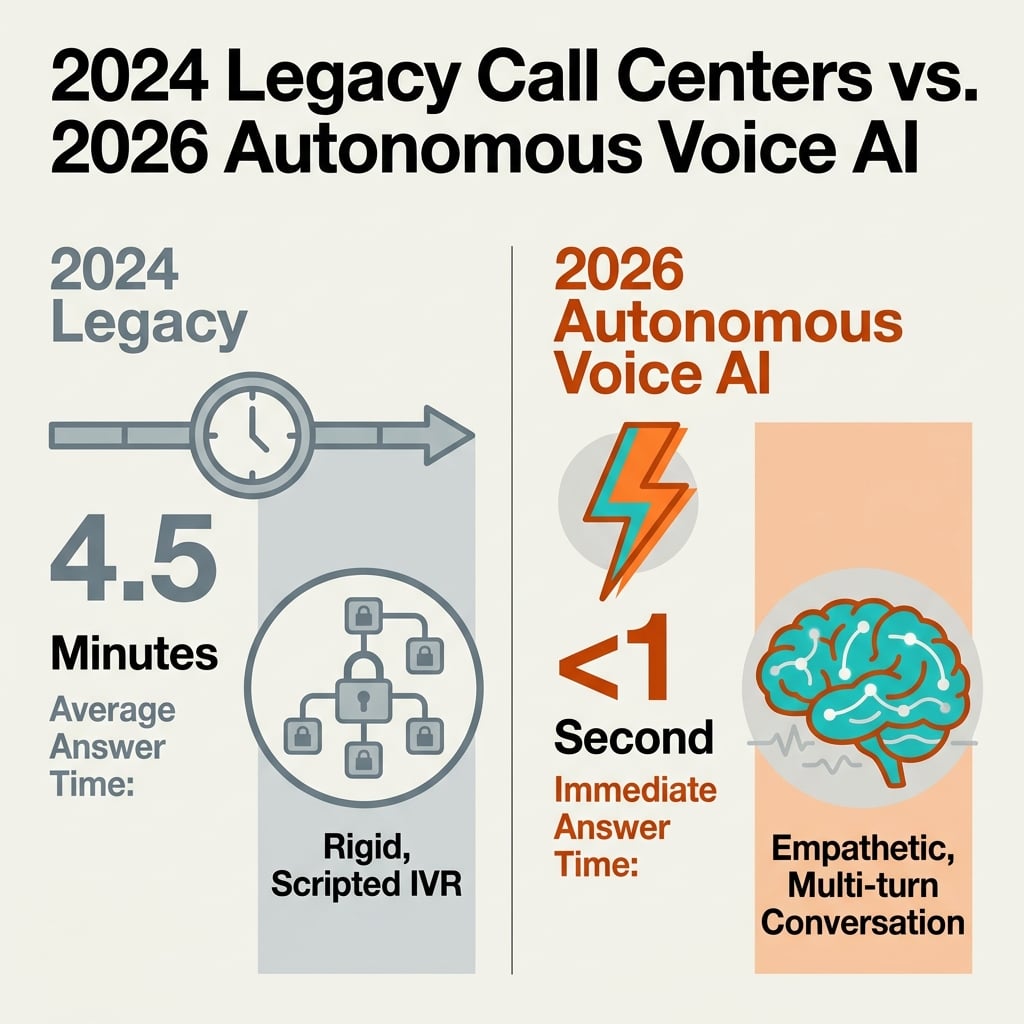
The transition from legacy contact centers to fully automated, voice-driven customer experience environments has not happened in a vacuum. It is propelled by compounding breakthroughs in core AI disciplines: speech-to-text (STT) accuracy, large language model (LLM) reasoning speeds, and naturalistic text-to-speech (TTS) synthesis.
Historically, voice bots failed because they relied on rigid decision trees, resulting in frustrating "press 1 for billing" loops. In 2026, voice AI agents function as autonomous, thinking entities. Equipped with sub-second response times and emotional intelligence, they hold dynamic, multi-turn conversations, handle unexpected interruptions, and retrieve secure enterprise data in real time to resolve complex queries.
To understand why traditional contact centers are being replaced so rapidly, CX leaders must look at the technical capabilities defining this year’s state-of-the-art voice infrastructure compared to legacy systems:
| Technology Dimension | Legacy Systems (IVR / Early Bots) | 2026 Voice AI Agents | Direct CX Impact |
|---|---|---|---|
| Latency & Response Time | 3.0 to 5.0 seconds (awkward silences) | Sub-second latency (under 800ms) | Natural, human-like pacing without overlaps |
| Language & Dialect Support | Static, pre-recorded scripts in major languages | Dynamic multilingual translation in regional dialects | Seamless local customer engagement globally |
| Context & Interruption | Resets or crashes if user speaks over the bot | Detects user interruption and adapts context instantly | Frictionless, frustration-free conversations |
| Reasoning & Actionability | Basic keyword matching with limited routing | Real-time APIs, multi-model LLM orchestration | 70%+ first-contact resolution (FCR) |
| Voice Synthesis | Robotic text-to-speech engine | Empathetic, human-like emotional cadence | Increased customer trust and brand loyalty |
Achieving this level of fluid interaction requires a highly sophisticated technical stack. The voice agents of 2026 do not rely on a single, monolithic model. Instead, they leverage modular AI orchestrators. Modern communication platforms—such as CallMissed—empower organizations by providing unified LLM inference gateways with access to over 300 models. This allows enterprises to instantly route calls to the most efficient LLM depending on the query's complexity, balancing speed and cost.
Additionally, globalization has forced voice technology to move beyond English-centric designs. To scale worldwide, modern voice infrastructure must understand localized speech patterns. For example, CallMissed’s specialized Speech-to-Text engine, which supports 22 Indian languages and regional dialects, exemplifies how AI now bridges cultural and linguistic gaps that previously required expensive, offshore human teams.
By decoupling customer service from physical seats and routing it through ultra-low-latency, multi-model AI pipelines, CX leaders are achieving operational agility that was physically impossible just a few years ago.
In-Depth Analysis: How Modern Voice AI Builds Unprecedented Customer Trust
Historically, customer experience (CX) leaders viewed automation as a compromise. The industry consensus was clear: automated tools saved money but eroded customer satisfaction and brand trust. In 2026, however, this paradigm has been completely inverted. The chief driver of consumer distrust is no longer talking to an artificial intelligence; it is being placed on a 45-minute hold, repeating account details to three different human representatives, and receiving inconsistent answers. Modern voice AI solves these precise pain points, actively building customer trust through speed, emotional intelligence, and highly specialized design.
Breaking the Friction Barrier with Ultra-Low Latency
Trust begins with responsiveness. When a customer calls a brand with an urgent query, every second of hold music chips away at their confidence. Today’s advanced voice AI agents answer calls instantly, with zero wait time. Utilizing sub-500ms response latencies, these agents engage in fluid, back-and-forth dialogue without the awkward gaps that plagued early voice models. By resolving issues on the first contact—and eliminating the dread of the queue—brands demonstrate immediate respect for their customers' time, laying a reliable foundation for long-term loyalty.
Empathy-Driven Design and Natural Conversational Flows
One of the major breakthroughs of 2026 is the integration of emotional inflection and active listening into voice AI. Rather than reading rigid scripts, modern conversational systems adjust their tone, pitch, and pacing based on real-time customer sentiment analysis.
- Sentiment-aware responses: If a caller is distressed about a fraudulent transaction, the AI agent shifts to a calm, reassuring cadence.
- Active listening cues: AI agents now utilize verbal nods like "mm-hmm" and "I understand" at appropriate moments, mimicking natural human-to-human interaction.
- Intelligent interruption handling: Customers can interrupt the AI mid-sentence to clarify details or change direction without breaking the conversational flow.
Hyper-Localized Trust Through Multilingual Support
In a globalized market, true customer trust is impossible to build without linguistic inclusivity. Customers feel most secure when speaking in their primary tongue, particularly during complex financial, travel, or medical inquiries.
This is where advanced infrastructure becomes vital. For instance, platforms like CallMissed enable enterprises to build highly localized experiences by offering robust Speech-to-Text (STT) and Text-to-Speech (TTS) APIs natively supporting 22 regional Indian languages. When a regional customer can seamlessly switch from English to Hindi, Tamil, or Bengali and receive the same level of conversational nuance, trust shifts from an abstract goal to a measurable metric.
Consistency: The Ultimate Trust-Builder
Human agents, despite their best efforts, have bad days, suffer from fatigue, or occasionally provide outdated information. Conversely, voice AI agents access the exact same unified enterprise knowledge base 24/7. They deliver compliant, highly accurate information during every single interaction, completely eliminating human-error discrepancies. For CX leaders, this means absolute brand consistency and a customer base that knows exactly what to expect: fast, accurate, and completely unbiased support every time they call.
Impact & Implications: Shifting ROI and the $80 Billion Cost Reduction
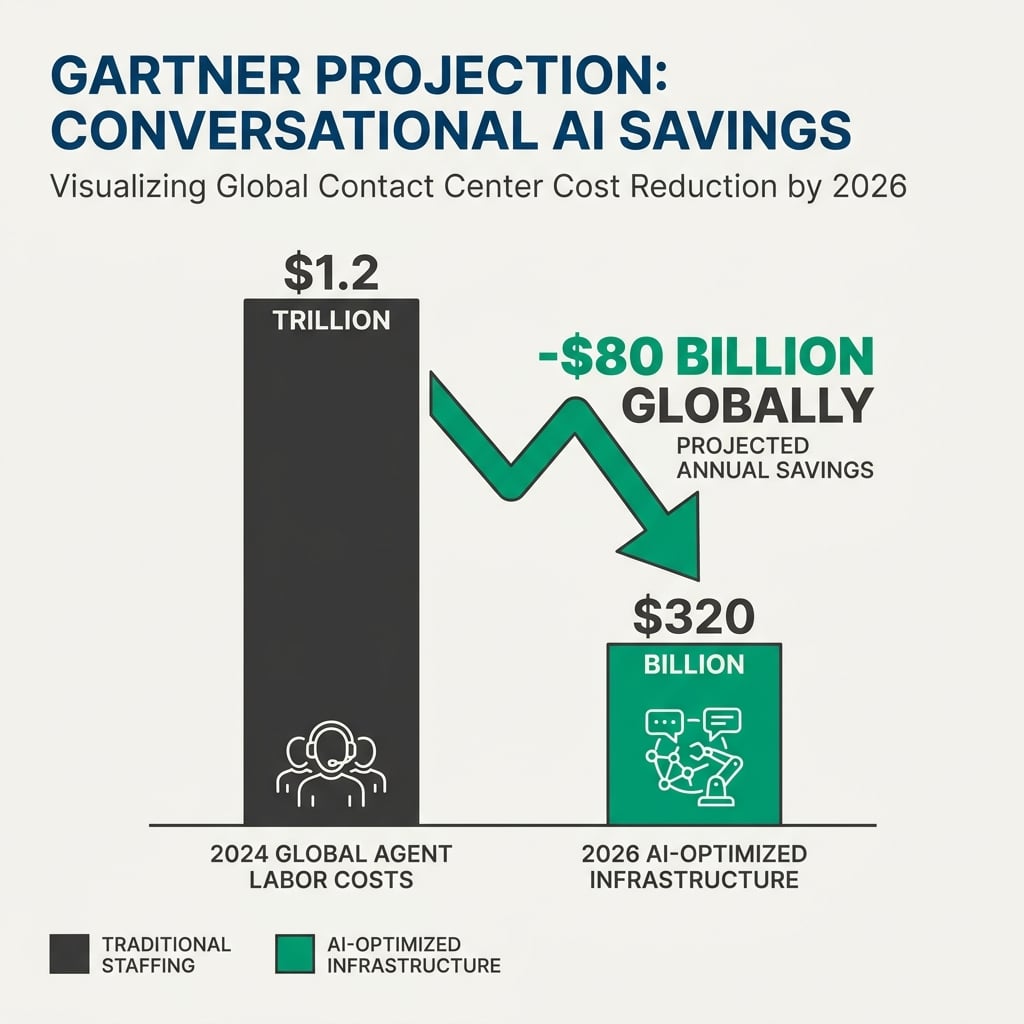
The financial reality of 2026 has forced a massive reckoning for customer service budgets. For decades, contact centers operated on a linear scaling model: more customers meant more support tickets, which inevitably required hiring more human agents. Today, that model has collapsed under the weight of an unprecedented economic shift. According to research firm Gartner, conversational AI deployments in contact centers are projected to slash global agent labor costs by a staggering $80 billion this year.
This $80 billion cost reduction isn't just a theoretical high-level estimate—it is actively reshaping enterprise bottom lines. Traditional Business Process Outsourcing (BPO) models, which carry heavy overheads for training, benefits, and real estate, are being replaced by highly scalable voice AI infrastructure. Let's look at the financial implications of this transition:
The Economics of Voice AI vs. Legacy BPOs
- Drastic Drop in Cost-per-Interaction: A typical human-led contact center interaction costs between $5.00 and $12.00, depending on the complexity and region. In contrast, a fully automated interaction powered by an advanced voice AI agent costs a fraction of a dollar—frequently between $0.10 and $0.25.
- Eliminating Idle Time Expenses: Traditional call centers require paying agents for idle time between calls. Voice AI scales up instantly during peak volume times and down to zero costs during quiet hours, completely eliminating wasted operational spend.
- Deflecting High-Volume, Low-Complexity Queries: By instantly resolving routine inquiries—such as order tracking, billing questions, and appointment scheduling—AI agents allow organizations to achieve 60% to 80% containment rates right out of the gate.
To successfully capture these savings, enterprise brands are turning to specialized, production-ready infrastructure. For example, platforms like CallMissed enable businesses to deploy voice AI agents that scale instantly across 22 regional Indian languages, bypassing the astronomical costs associated with recruiting and training multilingual human agent teams.
Redefining ROI: From Efficiency to Outcomes
In 2026, the metrics landscape has fundamentally evolved. CX leaders are abandoning outdated legacy KPIs in favor of modern, outcome-based measures:
- Cost-per-Resolution (CPR): Rather than focusing on Average Handle Time (AHT)—a metric that historically incentivized human agents to rush customers off the phone—leaders now prioritize CPR. Voice AI agents drive this metric down because they do not charge by the minute and can stay on the line until a problem is fully solved.
- First-Contact Resolution (FCR) at Scale: Because modern voice AI possesses instantaneous access to CRM databases, shipping APIs, and inventory systems, they can resolve customer queries on the first try, eliminating costly, frustrating follow-up calls.
- The Shift to Customer Lifetime Value (LTV): By shifting human agents away from repetitive tier-1 tasks and onto high-value relationship building, enterprises are seeing a direct correlation between AI deployment and increased customer retention.
Ultimately, the $80 billion cost reduction represents a historic transfer of capital. By redirecting budget away from manual, repetitive labor and investing in intelligent, automated voice infrastructure, forward-thinking CX leaders are positioning their organizations to dominate the customer experience landscape of 2026 and beyond.
Expert Opinions: What CX and Industry Leaders Say About Autonomous Agent Adoption
To understand the true magnitude of the 2026 autonomous agent rollout, we must look at how brand leaders are shifting their operational mindsets. Ebrahim Hyder, VP of Customer Care for Michael Kors, emphasizes that conversational AI has evolved far beyond its origins as a standalone, siloed support tool. Today, it is treated as a core pillar of holistic brand strategy and customer engagement. Brand leaders are no longer deploying voice AI simply to deflect tickets; they are using it to cultivate deeper customer lifetime value (LTV) through hyper-personalized, zero-latency interactions.
Analysts Weigh In on the Speed-Trust Paradigm
At major industry forums like Enterprise Connect, CX analysts Katherine Stone and Charlie Mitchell have highlighted a massive shift in how consumer trust is established. Historically, organizations assumed that only human-to-human interaction could build brand loyalty. However, 2026 market data reveals that modern customers increasingly associate trust with speed, execution, and accuracy.
According to industry analysts, an AI agent that resolves a complex billing discrepancy or processes a booking modification in 30 seconds builds far more goodwill than a human agent who has to place the caller on a 15-minute hold. The consensus is clear: convenience is the ultimate form of customer empathy.
Furthermore, research from firms like Gartner points out that the financial implications—including the projected $80 billion in global labor savings—are driving a wholesale reallocation of capital. Instead of funding massive BPO seat counts, CX leaders are reinvesting these savings into deep backend integrations, ensuring their AI agents have real-time access to CRMs, transactional APIs, and inventory databases to resolve issues autonomously.
Scaling Across Diverse and Multilingual Markets
A major theme among global CX executives is the challenge of maintaining a consistent brand voice across highly fragmented, multilingual markets. To address this, leaders are moving away from single-LLM dependencies toward dynamic orchestration layers that can adapt to different regional dialects and conversational nuances.
This is where advanced infrastructural platforms are proving essential. For instance, CallMissed is enabling enterprises to deploy these highly localized strategies seamlessly. By offering a robust API gateway that orchestrates over 300+ LLMs alongside Speech-to-Text APIs supporting 22 regional Indian languages, CallMissed allows companies to scale natural, culturally nuanced voice agents globally without complex development overhead.
The Industry Consensus on the Future of CX
Ultimately, CX visionaries agree on three core predictions for the remainder of 2026 and beyond:
- Default-Automated Frontline Support: Voice AI will handle upward of 80% of tier-one and tier-two phone inquiries, leaving human "super-agents" to focus exclusively on high-stakes, high-empathy scenarios.
- Instant Operational Elasticity: The ability to scale phone support capacity by 10x instantly during peak retail seasons or service outages—without hiring or training bottlenecks—is the new baseline for operational agility.
- The Total Demise of legacy IVR: Rigid "press 1 for billing" trees are being entirely replaced by open-ended, natural language conversations where the customer simply states their problem and the AI solves it.
What This Means For You: Strategic Checklist for CX Leaders (TABLE)
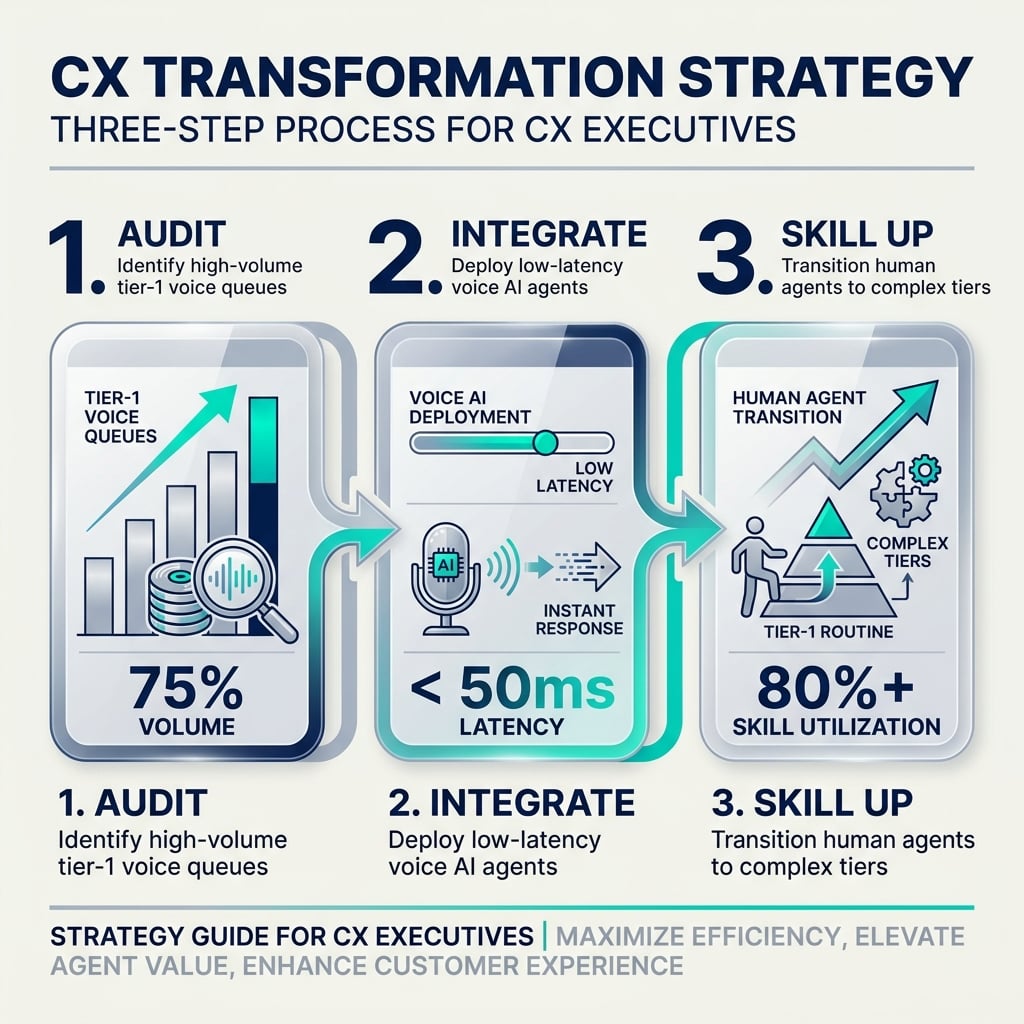
As conversational AI transitions from a speculative tech trend into a mission-critical CX strategy expected to slash agent labor costs by $80 billion globally this year, enterprise leaders must pivot from passive observation to active deployment. Transitioning from a legacy BPO or clunky IVR model to an agile, voice-AI-first contact center requires a structured, phase-by-phase playbook.
The checklist below outlines the crucial operational, technical, and strategic milestones CX leaders must hit to successfully navigate this transition.
| Implementation Phase | Strategic Action Item | Critical Success Metrics | Core Tech Requirement | Priority |
|---|---|---|---|---|
| 1. Intent Mapping | Audit historical ticket data; identify top 40% of repetitive, high-volume call drivers. | Target First Contact Resolution (FCR) > 85% on automated flows. | Natural Language Understanding (NLU) categorization engines. | High |
| 2. Infrastructure Setup | Integrate low-latency voice AI gateways with existing CRM, ERP, and ticketing databases. | End-to-end voice latency < 1.5 seconds to maintain natural flow. | Multi-model LLM APIs and real-time Speech-to-Text (STT) engines. | Critical |
| 3. Routing & Escalate | Design frictionless "human-in-the-loop" handoffs with full context transfer for complex queries. | Zero-drop transfer rate; Average Handle Time (AHT) drop of 30% for humans. | SIP trunking, live agent routing protocols, and active agent desktop sync. | Critical |
| 4. Localization & Scale | Deploy localized voice agents tailored with regional accents, dialects, and multilingual capabilities. | CSAT score parity (>4.5/5) across all supported regions and languages. | Multilingual TTS APIs supporting native and regional accents. | Medium |
| 5. Continuous Tuning | Implement real-time call transcription and automated sentiment analysis to retrain LLMs daily. | Drop in hallucination rates below 1%; continuous intent refinement. | Closed-loop RLHF (Reinforcement Learning from Human Feedback) pipelines. | High |
Executing the Playbook: Key Focus Areas for 2026
To move these items from paper to production, CX leaders should focus heavily on two foundational elements:
Unified, Multi-Model Interoperability
Your voice infrastructure cannot be tied to a single, monolithic model. As LLM capabilities evolve rapidly in 2026, agility is your greatest asset. Leading platforms like CallMissed allow enterprises to dynamically orchestrate their AI stack using a multi-model API gateway with access to over 300+ LLMs. This ensures your system can seamlessly switch models based on cost, latency, or specific regional language demands without rewriting core integrations.
Frictionless Contextual Handoffs
An AI voice agent's success is defined as much by how it handles failures as how it resolves successes. When an inquiry requires human empathy or complex cross-department navigation, the AI agent must hand off the call with zero latency. The human agent should receive a real-time transcript and a bulleted summary of the interaction so the customer never has to repeat themselves. Integrating these fallback paths directly into your CRM keeps customer satisfaction high while preserving expensive human labor for high-value tasks.
Frequently Asked Questions About Voice AI in Contact Centers
How are voice AI agents replacing traditional contact centers in 2026?
What are the primary benefits of deploying voice AI agents for customer experience (CX)?
What is the role of human support representatives once voice AI is implemented?
How do voice AI agents support global markets and regional languages?
How do conversational AI systems ensure data security and enterprise compliance?
What infrastructure is required to transition a legacy contact center to AI voice technology?
Conclusion
The transition to voice AI is no longer a distant prediction; in 2026, it is a strategic and operational necessity. To successfully navigate this revolution, CX leaders must keep these key takeaways in mind:
- Staggering Financial ROI: Migrating from legacy BPO models to voice AI is driving a massive $80 billion reduction in global agent labor costs this year.
- Elevated Trust & Empathy: Modern voice agents foster deeper customer loyalty through instantaneous, highly personalized, and empathy-driven resolutions.
- A Reimagined Workforce: Human agents are being upskilled to focus exclusively on high-complexity, high-empathy scenarios.
Looking forward, the next milestone in customer experience will belong to brands that successfully deploy ultra-low latency voice infrastructure with native, hyper-local multilingual capabilities. To explore how AI communication is evolving, check out CallMissed — an AI infrastructure platform powering voice agents and multilingual chatbots for businesses.
Is your organization ready to lead this conversational revolution, or will you be left holding the line?
Related Posts

Ready to automate customer conversations?
Launch AI voice agents and WhatsApp bots with CallMissed — one API, 22+ Indian languages.