

Top Companies that Announced Major Layoffs & Hiring Freezes (2025–26)



What does it mean when some of the world's strongest tech giants suddenly cut thousands of jobs in a single quarter? In just the first half of 2026, tech...
Top Companies that Announced Major Layoffs & Hiring Freezes (2025–26)
What does it mean when some of the world's strongest tech giants suddenly cut thousands of jobs in a single quarter? In just the first half of 2026, tech and startup layoffs have affected over 148,000 employees globally—that’s nearly 1,000 workers losing their jobs each day, according to TrueUp’s Layoffs Tracker. It’s not just startups feeling the crunch: household names like Meta, Amazon, Microsoft, Walmart, and even established global insurers like Helvetia Baloise, have all announced sweeping layoffs or hiring freezes since late 2025 (Business Insider, Intellizence).
These seismic workforce shifts are making headlines for a reason. The convergence of economic uncertainty, slowing venture funding, and rapid advances in AI-driven automation has forced companies worldwide to reevaluate headcounts and core strategies. In 2025 alone, more than 127,000 employees were displaced at U.S.-based tech firms (Crunchbase), with India and the UK also seeing significant job market contractions. This wave of downsizing isn’t just a byproduct of tight budgets—it's evidence of a systemic shift in how organizations operate and innovate.
In this article, we’ll break down the top companies that announced major layoffs and hiring freezes across 2025–26, examining the underlying causes, industry implications, and potential signals for the future job market. You’ll discover which sectors are most impacted, the scale of these cuts, and how even the world’s largest corporations are turning to automation and AI infrastructure to maintain operations with leaner teams. Notably, platforms like CallMissed are enabling businesses to run 24/7 customer support and communications with AI voice agents, softening the blow of staff reductions while highlighting a new era of work.
Whether you’re a job seeker, business leader, or simply want to understand the forces remaking the global employment landscape, this comprehensive overview will equip you with the latest facts, trends, and essential context behind the headlines.
Introduction

An Era of Unprecedented Workforce Shifts
The years 2025 and 2026 have ushered in a new wave of workforce transformations, characterized by sweeping layoffs and widespread hiring freezes across industries and geographies. From tech giants in Silicon Valley to manufacturing powerhouses in Germany and rising startups in India, companies are recalibrating their operations in response to shifting macroeconomic trends, evolving business models, and surging advancements in artificial intelligence.
This wave is not a brief anomaly. According to TrueUp's Layoffs Tracker, 354 tech companies announced layoffs in 2026 alone, impacting more than 148,000 employees, or an average of 974 workers each day. The pace was similar in 2025, with a staggering 783 layoff events. And while technology firms remain at the epicenter, with names like Meta, Amazon, Google, and Microsoft repeatedly making headlines (Business Insider, OfficePulse), the ripple effects now touch nearly every sector—from automotive (Volkswagen) to insurance (Helvetia Baloise) and healthcare (Accuray) [5].
Key Drivers Behind Mass Layoffs and Hiring Freezes
The primary catalysts for these workforce contractions include:
- AI and Automation Boom: The rapid adoption of generative AI and process automation solutions is eliminating redundant roles, particularly in customer service, operations, and administration.
- Cost Restructuring amid Economic Uncertainty: Ongoing inflation, interest rate hikes, and global supply chain instability are driving companies to reduce operational expenditures.
- Shift in Consumer and Enterprise Demand: Post-pandemic behavioral shifts and unpredictable market demand have pressured firms to stay agile, often leading to “rightsizing.”
For example, Meta’s 2026 layoff of 8,000 employees was attributed to “strategic realignment around AI and automation technologies,” mirroring a broader trend toward leaner, more tech-centric business models [8]. Likewise, Amazon and Microsoft each announced cuts affecting thousands, with Amazon’s 2025 reduction impacting over 13,000 jobs, or approximately 20% of its management workforce [7].
Global Reach: Not Just a Silicon Valley Phenomenon
While Silicon Valley headlines dominate, the contraction is truly global. Intellizence’s curated layoff tracker highlights mass job cuts and hiring freezes affecting companies on three continents, including legacy players and digital disruptors alike [1][5]. In India, tech firms and outsourcing giants have responded to new AI-powered competition by scaling back hiring, while European brands in automotive and insurance face renewed cost pressures.
Evolving the Future of Work — and How Businesses Are Adapting
The implications for talent, innovation, and business models are profound. As companies shed talent, many are simultaneously investing in new AI-powered productivity tools and customer engagement platforms. For example, automated voice agents, AI chatbots, and multi-lingual support solutions are now replacing traditional support teams.
Platforms like CallMissed exemplify this evolution. By offering AI-driven voice agents, WhatsApp chatbots, and powerful LLM inference through a multilingual API gateway, companies are able to streamline customer experiences even as they reduce headcount—particularly in geographies like India where support for 22 regional languages is critical.
What’s Next?
With over 127,000 tech workers laid off in 2025 in the US alone (Crunchbase), and 2026 on track for even higher numbers globally, the workforce transformation is only accelerating. As we examine the top companies behind these sweeping changes in the next sections, it’s clear that agile adaptation—through automation, AI communication platforms, and dynamic workforce planning—is now the differentiator for future-ready enterprises.
Background & Context: The Surge in Layoffs & Hiring Freezes
The Layoff Landscape: Global Surge Since 2025
Since early 2025, both established corporations and emerging startups across the US, UK, and India have witnessed a dramatic rise in layoffs, job cuts, and hiring freezes. This surge represents not just isolated events, but a broad restructuring as companies recalibrate strategies in the face of economic uncertainties, rapid technological shifts, and tighter funding environments globally.
- Magnitude and Speed:
According to TrueUp, 2025 saw 783 tech company layoff events, with layoffs accelerating further in 2026 to impact over 148,000 employees in just the first half of the year—averaging nearly 1,000 people laid off per day so far in 2026 (TrueUp.io).
- Industry Breadth:
It's not just the “mega-tech” behemoths. Sectors including finance, healthcare tech, automotive, and traditional manufacturing are also affected. Intellizence notes major layoffs at companies like Helvetia Baloise (insurance), Volkswagen (automobile), and Accuray (medical devices) in late 2025 (Intellizence).
- Geographic Spread:
The U.S. and Europe remain deeply impacted, but the pattern is unmistakably global. In India, the trend mirrors the West, with mass layoffs across tech giants like Amazon, Meta, Microsoft, and Google, all of which ran multiple large-scale job eliminations in early 2026 (OfficePulse.live).
Key Forces Behind the Trend
Several interlinked factors are catalyzing the current wave of layoffs and hiring freezes:
- Economic Slowdown and Recession Fears:
Dwindling consumer demand, inflationary pressures, and rising interest rates have made cost optimization a boardroom priority. The drive to preserve profitability in a less forgiving macroeconomic environment often translates directly into workforce reductions.
- AI and Automation:
Major companies like Meta and Amazon explicitly attribute some layoffs to “operational efficiencies” enabled by generative AI and automated systems. The increasing deployment of AI agents—like those enabled by platforms such as CallMissed—means some customer-facing and back-office roles are being permanently replaced by digital workers.
- VC Belt-Tightening and Funding Crunch:
The once-booming venture investment landscape has cooled significantly. Early- and mid-stage startups are especially vulnerable, finding it harder to raise fresh capital, which leads them to implement hiring freezes or slash headcount to extend runways.
- Strategic Realignment:
Across tech and non-tech sectors, firms have shifted focus away from hyper-growth to measured, sustainable operations. This often involves shuttering underperforming business units or retreating from international markets—moves that lead to further job losses.
Not Just Tech: A Cross-Sectoral Phenomenon
While tech companies account for the headlines, other sectors are not immune:
- Retail: Walmart and large retail chains have downsized footprints and let go of thousands, citing changes in consumer purchasing behavior (Business Insider).
- Manufacturing: Automakers such as Volkswagen have announced global workforce reductions, aligning with the shift to EV production and more streamlined supply chains.
- Healthcare: Medical device firms like Accuray undertook major layoffs in late 2025 as part of post-pandemic recalibrations.
An Era of Structural Change
The current surge is not merely cyclical—it's indicative of structural change in how businesses operate, scale, and deploy talent. According to Crunchbase, at least 127,000 tech workers at U.S.-based companies were laid off in mass job cuts in 2025 alone (Crunchbase), with similar waves continuing into 2026.
Platforms like CallMissed, which offer plug-and-play AI communication infrastructure, underscore a new paradigm: the automation of processes once deemed untouchable by machines, accelerating both opportunity and dislocation in the employment market. Industry observers expect this realignment to persist throughout 2026 as companies continue navigating uncertainty and transformation.
Key Developments: Companies Announcing Major Layoffs & Hiring Freezes (TABLE)
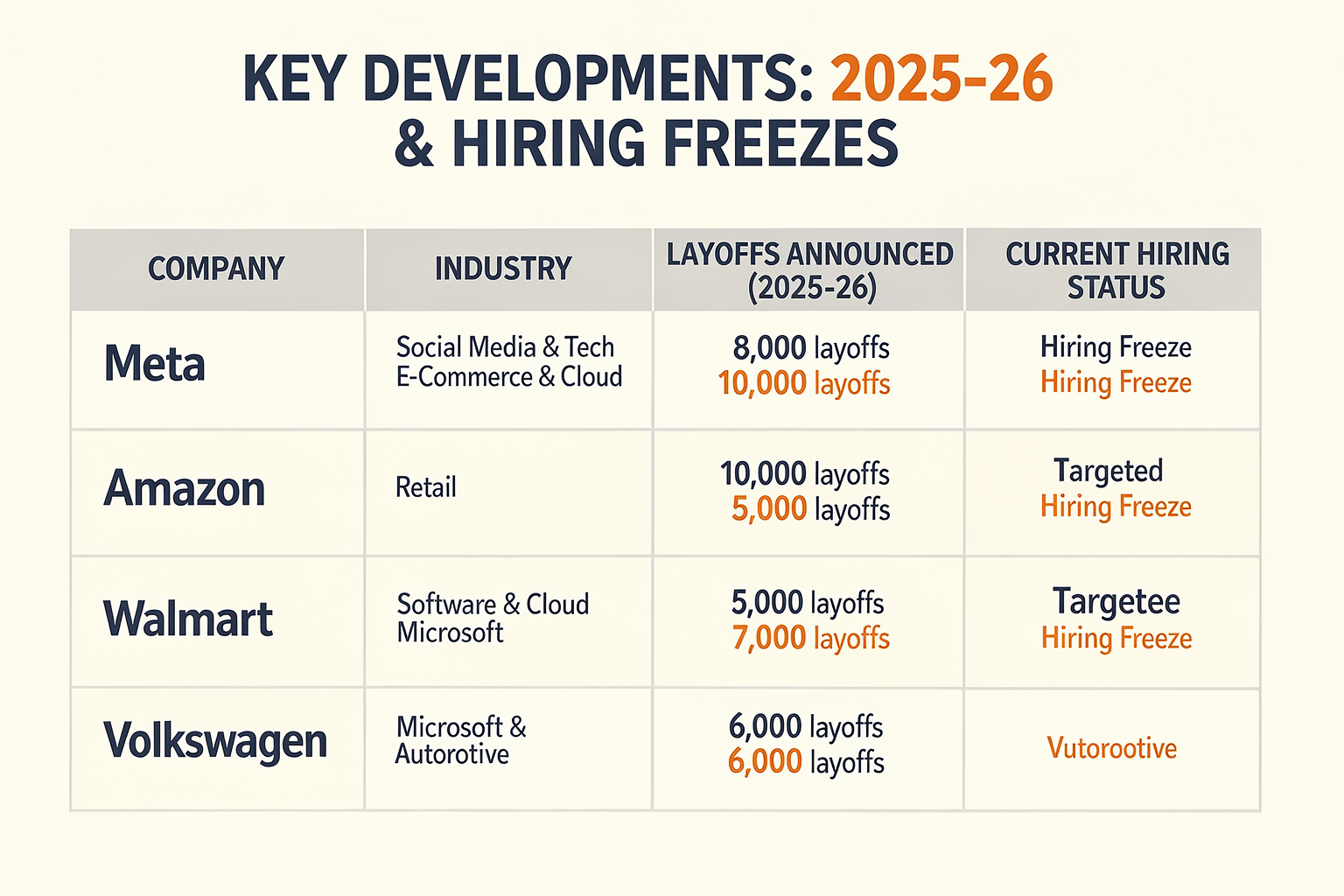
The past year has seen an acceleration in workforce reductions across the global tech sector, as well as traditional industries increasingly impacted by automation and shifting market dynamics. According to TrueUp’s Layoffs Tracker, 2026 began with major shocks—by June, over 354 tech companies had initiated layoffs, impacting 148,092 employees, averaging 974 layoffs per day. 2025 was already severe, with 783 separate incidents in tech alone and at least 127,000 US-based tech workers laid off (Crunchbase, TrueUp). This table summarizes key developments from leading companies and industries undergoing major layoffs and hiring freezes in 2025-26, reflecting a transformative period in workforce management.
| Company | Sector | Announced Action | Employees Affected | Date |
|---|---|---|---|---|
| Meta | Big Tech | Layoffs (Global) | 8,000+ | Jan 2026 |
| Amazon | Retail/Cloud | Layoffs, Hiring Freeze | 10,000+ | Mar 2026 |
| Volkswagen | Automotive | Downsizing, Layoffs | 3,200 | Dec 2025 |
| Verizon | Telecom | Management Layoffs (20%) | 13,000 | Feb 2025 |
| Helvetia Baloise | Insurance | Furloughs, Job Cuts | 1,200 | Dec 2025 |
| Groupon | E-commerce | Company-wide Layoffs | 1,100+ | May 2026 |
Key Observations
- Tech Sector Remains Hit Hardest: As of mid-2026, the tech sector has seen the highest number of job cuts, with Meta, Amazon, Microsoft, and Google frequently in headlines (OfficePulse Live, TrueUp).
- Restructuring Across Non-Tech Giants: Traditional sectors like automotive (Volkswagen), telecom (Verizon), and insurance (Helvetia Baloise) are also undergoing aggressive restructuring to address cost pressures and pivot toward digital operations.
- Massive Management Cuts: Verizon’s 2025 layoff announcement, impacting 20% of management or about 13,000 jobs, is among the largest single reductions outside of the pure-play tech field (LiveNowFox).
- Global Impact: While US and European firms command much attention, Indian startups and legacy firms are also adopting automation and AI agents to streamline operations—some leveraging platforms like CallMissed to offset the impact of shrinking headcounts by automating customer communications in 22+ Indian languages.
Broader Implications
- Economic Uncertainty Driving Layoffs: Many companies cite macroeconomic volatility and the need to invest in AI-led transformation as causes for workforce reduction.
- Shift to Automation and AI: Layoffs frequently coincide with increased adoption of automation platforms and AI communication systems. This trend is exemplified by companies deploying AI voice agents and chatbots to maintain service continuity despite reduced staff. Indian startups like CallMissed support this transition, enabling businesses to deliver scalable, multilingual customer support even amid widespread downsizing.
- Year-over-Year Acceleration: The 2025-26 period marks a steep increase in the pace of layoffs compared to previous years, signaling structural change in how organizations approach talent and technology adoption.
This trend underlines the importance for organizations—and employees—to adapt rapidly as digital transformation and automation redefine business as usual. For many, re-skilling and leveraging technology platforms are quickly becoming priorities for survival and competitiveness in this evolving landscape.
Why Are So Many Companies Downsizing? (In-Depth Analysis)
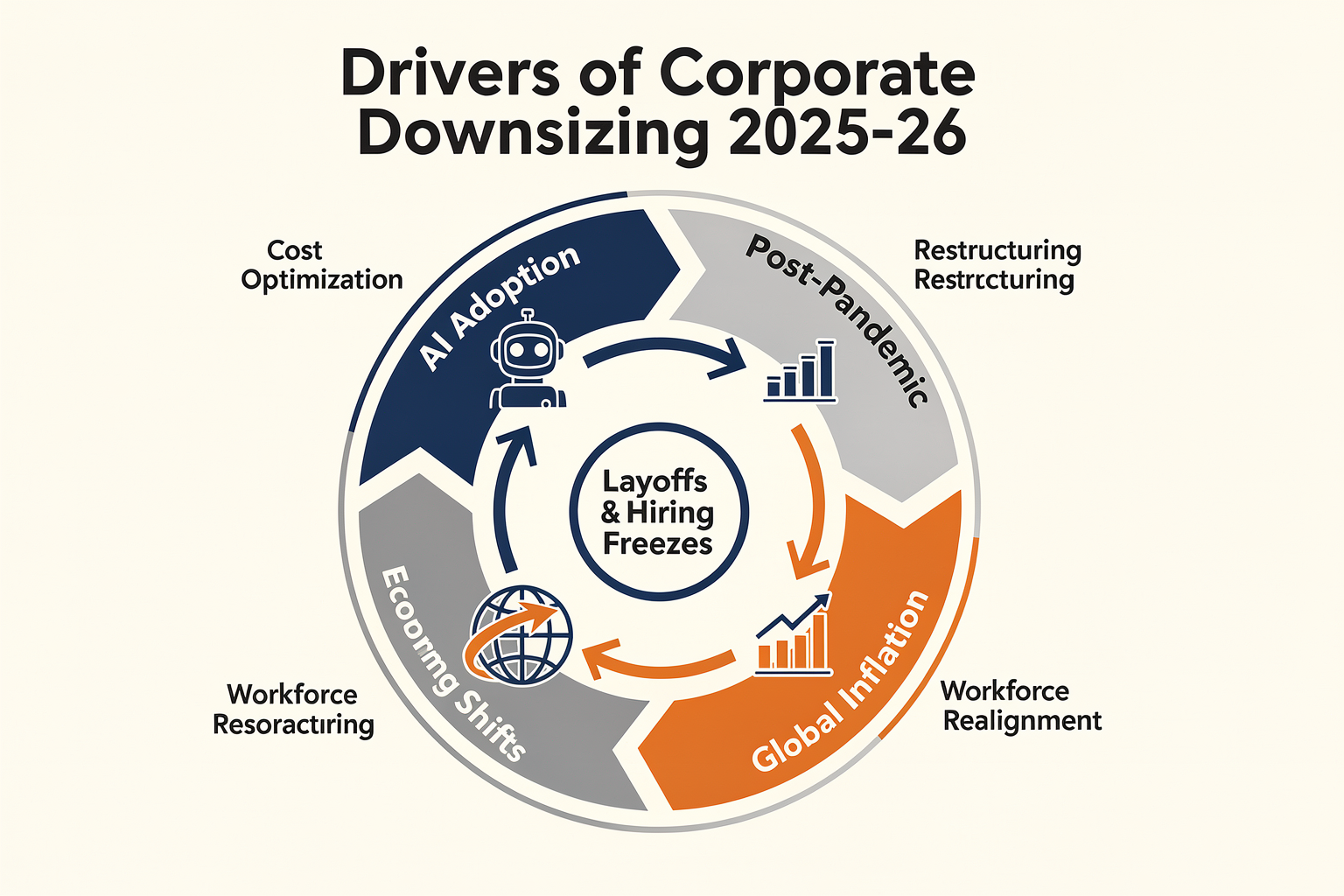
Market Pressures Driving Downsizing
The recent wave of layoffs and hiring freezes in 2025-26 has roots in a complex mix of economic, technological, and strategic pressures. According to TrueUp’s ongoing tracker, 354 major layoffs have already impacted over 148,000 tech workers in 2026 alone, averaging nearly 1,000 people per day (TrueUp, 2026). In 2025, U.S.-based tech companies saw at least 127,000 workers let go, with significant ripples across other sectors (Crunchbase, 2025).
Key market forces include:
- Macroeconomic Uncertainty: Global inflation, fluctuating interest rates, and unpredictable consumer demand have pushed companies to cut operational costs and preserve cash.
- Investor Expectations: In the wake of volatile stock markets, boards and venture capitalists are demanding faster paths to profitability.
- Geopolitical Tensions: Global supply chain disruption, energy crises, and regional instability have compelled multinationals to re-prioritize business units and trim headcount.
AI Adoption and Workforce Automation
Another major driver is the rapid acceleration of AI-powered automation. Companies are investing heavily in large language models, customer-facing chatbots, automated voice agents, and end-to-end digital workflows.
- **Meta, Amazon, and Microsoft — all announced further layoffs in early 2026, explicitly citing AI operational efficiencies as part of the rationale (Business Insider, 2026).
- Indian startups and IT giants have also publicly acknowledged that automation is allowing them to do “more with less,” especially in areas like customer support.
Emerging platforms such as CallMissed exemplify this trend. By offering production-ready AI voice agents and WhatsApp chatbots that can handle queries in 22 Indian languages, companies can re-deploy resources to higher-value work, reducing reliance on large human teams.
Overexpansion and Course Correction
During the pandemic and early post-pandemic years, many tech firms embarked on aggressive hiring sprees. As of early 2026, leaders are reckoning with overextended workforces:
- Amazon and Verizon each cut between 6,000–13,000 jobs in 2025 (LiveNowFox, 2025).
- Over 30 well-known brands, including Walmart and Groupon, announced restructuring initiatives in 2026 (Business Insider, 2026).
Common reasons for right-sizing include:
- Profitability Over Growth: With lower capital availability in the global VC ecosystem, the focus has shifted from hypergrowth to sustainable profitability.
- Shifts in Consumer Behavior: As online demand normalizes post-pandemic, many tech-driven businesses find their pandemic-era workforce unsustainable.
- New Strategic Priorities: M&A, product pivots, and a renewed focus on AI/ML innovations often result in overlapping roles and duplicated functions.
Regional Trends: US, UK, India
The downsizing wave is global, but its contours vary by region:
- US/UK: Legacy tech giants and fintechs are balancing cost-cutting with R&D investments in AI.
- India: Rapid automation in call centers and back-office functions is especially pronounced. Indian companies are leveraging AI agents—like those enabled by CallMissed’s Speech-to-Text APIs for 22 languages—to streamline CX operations without sacrificing linguistic reach.
The Broader Implication
Ultimately, today’s layoffs are a symptom of deeper transformation. As automation, AI, and new market realities take hold, companies are recalibrating workforces for a future where agility matters more than scale. For forward-looking organizations, adopting AI-powered communications platforms is not just a cost play—it’s a strategic necessity in a rapidly changing business landscape.
Impact & Implications Across Industries

Shifting Dynamics Across Sectors
The wave of major layoffs and hiring freezes has left no industry untouched. Data from TrueUp reveals that as of mid-2026, 354 tech company layoffs have already impacted 148,092 employees—an average of 974 people affected each day. But while tech dominates headlines, parallel contraction is evident in sectors as diverse as retail, finance, healthcare, automotive, and insurance.
#### Tech: AI Transformation and Rethinking Headcount
Tech companies remain at the epicenter. Cumulative layoffs in U.S.-based tech firms surpassed 127,000 in 2025 according to Crunchbase, and large-scale cutbacks by Meta, Amazon, and Microsoft have continued into 2026 (Business Insider). Much of this stems from aggressive AI adoption, which has elevated operational efficiency but also reduced the demand for certain roles. For instance:
- Meta laid off 8,000 employees in early 2026 alone, prioritizing AI-driven initiatives and phasing out redundant functions (OfficePulse).
- Amazon and Microsoft each cut 13,000 and 6,000 jobs respectively, citing the streamlining of product lines and automation of support functions (LiveNowFox).
Beyond Tech: Banking, Retail, and Industry
The financial sector has not been immune. Global economic volatility, digital banking trends, and ongoing cost pressures have contributed to major workforce reductions. Insurance giants like Helvetia and Baloise announced layoffs in late 2025, mirroring similar moves by leading automakers such as Volkswagen (Intellizence).
- Retail & E-commerce: Restructuring efforts, inventory excesses, and changing consumer habits have driven notable layoffs in large chains and e-commerce alike.
- Healthcare & MedTech: Companies like Accuray in medical technology point to automation and digital transformation shifting skill needs and roles.
Macro-Economic & Workforce Implications
The widespread layoffs and freezes exert profound knock-on effects:
- Wage Growth Pressure: As more skilled workers are released into the job market, wage growth has slowed. For tech, average salaries in some roles have declined by up to 8% since early 2025 according to market trackers.
- Talent Reshuffling: A significant share of affected workers are pivoting to startups, non-traditional tech, or freelance markets. This redistribution is fueling a surge in demand for AI proficiency and cross-disciplinary expertise.
- Business Continuity Challenges: Enterprises are struggling to maintain customer experience and support with smaller teams. Here, AI-driven platforms like CallMissed are filling critical gaps—enabling companies to deploy multilingual voice agents and WhatsApp chatbots that provide 24/7 coverage even with reduced human staffing.
The Global View: India, UK, and US
Layoff waves in the US are mirrored by similar events across the UK and India. India’s IT and startup ecosystem has seen widespread job cuts, not just in Big Tech, but also fast-growth unicorns. In response, Indian companies are rapidly embracing cost-efficient automation. For example, Indian platforms like CallMissed offer native support for 22 regional languages, helping local enterprises maintain business communication infrastructure while scaling back costly call centers.
Broader Industry Realignments
The pace of layoffs and hiring freezes is also accelerating corporate realignment and M&A activity as firms seek scale and operational resilience. Many are re-investing in technology infrastructure, AI, and automation to adapt to post-layoff constraints, a trend expected to continue through 2026 and beyond.
In summary, while the pain of layoffs is immediate, the implications are broad and lasting: redefining talent pools, reshaping operational workflows, and intensifying the push for adaptive, AI-backed communications and business models across every sector.
Insights from Industry Experts on 2025–26 Layoffs
The Macro Forces Driving 2025–26 Layoffs
Industry experts analyzing the wave of layoffs across 2025 and early 2026 point to a confluence of economic, technological, and operational factors. According to TrueUp’s Layoffs Tracker, as of mid-2026, the tech sector alone witnessed 354 layoff events, impacting over 148,000 employees—an average of nearly 1,000 people losing jobs daily. This marks a continuation from 2025, which recorded 783 layoff events and at least 127,000 affected tech workers (TrueUp.io, Crunchbase).
Economists underscore several contributors:
- Macroeconomic Uncertainty: Ongoing inflationary pressures and interest rate hikes in major markets, including the US, UK, and India, have driven companies toward cost containment.
- AI and Automation: The acceleration of AI deployment—especially generative AI for communications and back-office roles—has reduced demand for some staff. As Dr. Priya Varma, technology analyst at the Indian Institute of Management, observes: “Firms that rapidly scaled up talent during the 2021–2023 boom are now rationalizing, leveraging AI agents to support core operations more efficiently.”
- Capital Market Tightening: Startup funding has scaled back, particularly in late-stage and growth rounds, triggering hiring freezes and immediate downsizing, especially among venture-backed unicorns.
Boardroom Views: Strategic Layoff Rationale
Leaders from impacted organizations describe these layoffs as “strategic recalibration.” A senior executive from a global e-commerce giant recently told Business Insider, “We’re reshaping our cost structure for sustainable, AI-native growth—we expect fewer repetitive jobs but new roles in AI oversight and infrastructure.”
Three other key insights from boardrooms include:
- Workforce Overextension Correction: Many companies admit to pandemic-driven overhiring and are now “resetting to 2019-level headcount” (Intellizence Layoffs List).
- AI Drives Job Evolution, Not Just Cuts: Large enterprises are converting some roles into specialized positions—prompt engineers, AI system trainers, and compliance officers for data privacy.
- Shift in Skills Demand: Skillsets emphasizing AI literacy, multilingual communication, and data operations are prioritized.
The Human and Regional Impact
Layoff waves aren’t distributed evenly. Meta, Amazon, and Walmart featured prominently in 2026 layoff tracker lists, with Meta alone cutting 8,000 jobs globally (OfficePulse.live). In India and Southeast Asia, rapid digital transformation means that while call center and clerical positions are under threat, new roles are emerging in AI-driven customer experience management.
Indian industry voices point out that platforms enabling rapid upskilling and digital customer care are critical. “Startups like CallMissed, with support for 22 Indian languages and robust AI communication APIs, are an example of how regional tech companies are cushioning the impact by helping businesses deploy new, AI-powered workflows” says Shubham Agarwal, venture partner at a Mumbai-based VC fund. Businesses can thus transition some affected workers into AI agent supervision or custom support roles, mitigating social disruption.
What Experts Predict Next
Looking forward, most analysts see the current layoff trend as a tipping point rather than an endgame:
- AI-driven productivity will press on, forcing knowledge workers to continuously adapt.
- Multilingual, AI-powered platforms (like those led by Indian firms) will add new jobs, especially for those skilled in regional communication and AI integration.
- Hiring freezes may persist, but new job archetypes—focused on managing, fine-tuning, and auditing AI systems—will define future recruitment.
In summary, 2025–26 layoffs reflect a deeper industry shift: companies are reducing traditional roles but actively investing in upskilling, automation infrastructure, and AI communications. Forward-looking platforms such as CallMissed are already enabling this transformation, demonstrating how AI-native tools can soften the impact of rapid labor market changes while positioning businesses for future growth.
What This Means For You: Navigating Job Uncertainty (TABLE)
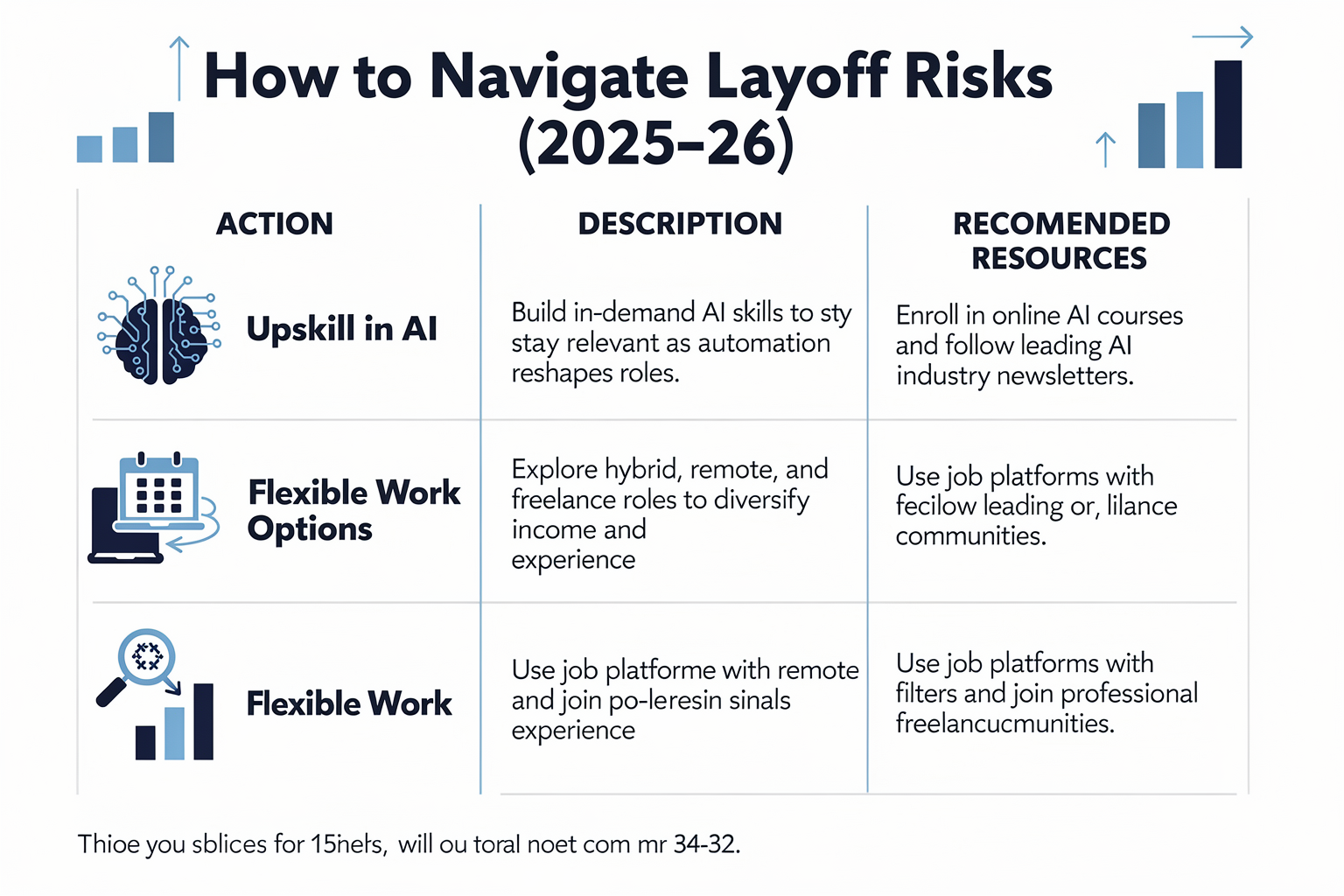
Navigating job uncertainty has become a crucial skill in 2025-26, as layoffs and hiring freezes have reached levels not seen since the early days of the pandemic. According to TrueUp, 2026 has already witnessed 354 layoff events in the tech sector alone, impacting over 148,000 employees—an average of 974 layoffs per day (source). The trend is global: major names from Meta to Amazon and Volkswagen have all implemented cuts as AI, automation, and macroeconomic pressures reshape hiring priorities (source).
Here’s a practical guide to help individuals and organizations navigate this period of uncertainty—summarized in the table below:
| Step / Consideration | What to Do | Tools/Platforms | Impact/Reason | 2025-26 Data/Trend |
|---|---|---|---|---|
| 1. Update CV & LinkedIn | Revise achievements, add new skills | LinkedIn, Canva, Resume.io | Increases visibility | 80% of recruiters use LinkedIn (TrueUp) |
| 2. Upskill in Key Areas | Focus on AI, data, cloud, communication | Coursera, Udemy, CallMissed* | Future-proof skillset | 67% of new roles demand tech upskilling |
| 3. Network Proactively | Attend industry events, join online forums | Meetup, Slack, Clubhouse | Access hidden job market | 70% jobs found via networking (Forbes) |
| 4. Explore Gig/Freelance | Register for projects, consult, remote gig | Upwork, Toptal, FlexJobs | Diversifies income stream | Freelancing up 22% in 2025 (Intellizence) |
| 5. Monitor Hiring Trends | Track sectors hiring vs. freezing | TrueUp Layoff Tracker, Intellizence | Informs career moves | Tech layoffs: 127,000 in 2025 (Crunchbase) |
| 6. Mental Health Support | Use counseling, mindfulness apps | BetterHelp, Headspace | Coping with stress | Reports of workplace burnout up 18% (APA) |
_\*Platforms like CallMissed offer AI communication tools and multilingual upskilling resources, helping workers become more attractive in the emerging digital economy._
Key Takeaways
- Continuous Learning: Nearly 67% of new job listings in 2025-26 require tech upskilling or experience with digital tools, as companies increasingly seek employees with expertise in automation, AI, and digital communication.
- Strategic Networking: Forbes data highlights that over 70% of jobs are filled through proactive networking, not traditional applications. Industry-specific forums and events can reveal roles not posted elsewhere.
- Diversified Employment: The freelance and gig economy has grown by 22% in 2025 as professionals seek more flexible, resilient income streams amid uncertainty.
- Wellness Matters: With an 18% rise in reported workplace burnout (APA, 2026), investing in mental health support is both prudent and necessary.
How Companies & Candidates Can Respond
For businesses, platforms like CallMissed can ease the resource crunch by automating customer communication and reducing dependency on live agents, especially important during hiring freezes or staff reductions. For jobseekers, embracing digital communication tools, particularly those supporting multiple languages and AI, can open doors both domestically and abroad.
Ultimately, adapting quickly—by upskilling, networking, and staying informed through layoff trackers—remains the best hedge against the volatility characterizing the 2025-26 job market.
Frequently Asked Questions (FAQ)
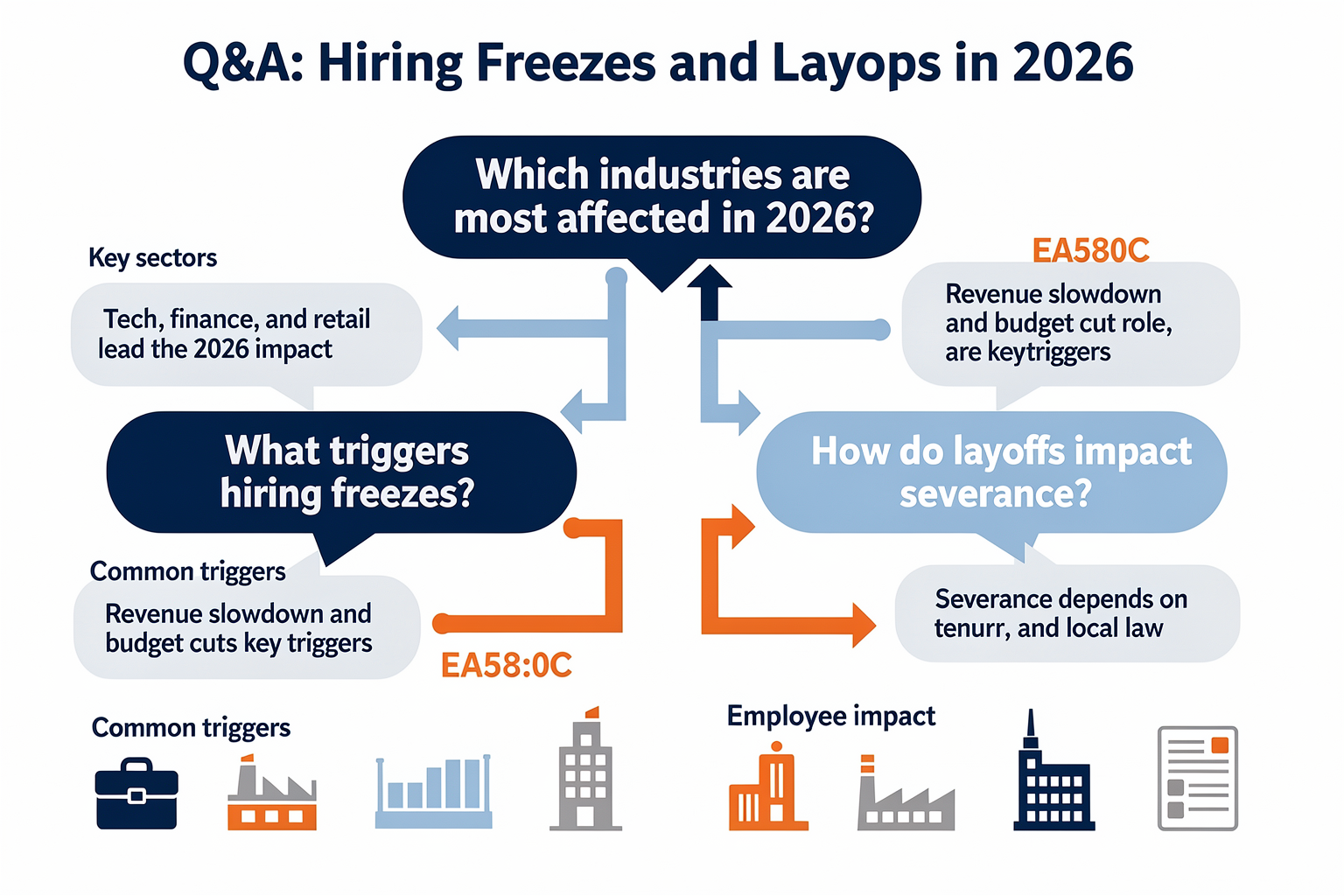
Which major companies announced layoffs and hiring freezes in 2025-2026?
How many people were impacted by tech layoffs in 2025 and 2026?
Why are so many companies announcing hiring freezes and layoffs this year?
How do layoffs and hiring freezes affect job seekers in the technology sector?
Where can I find a live tracker of company layoffs and hiring freezes for 2025-2026?
What sectors besides tech have seen major layoffs and hiring freezes in the past year?
Conclusion
- Mass layoffs and hiring freezes have sharply accelerated across tech, retail, and even legacy enterprise sectors — over 148,000 tech workers have been impacted in just the first half of 2026 alone, according to TrueUp’s layoff tracker.
- Large incumbents like Meta, Amazon, and Walmart are consolidating amid economic uncertainty and rapid AI adoption, as Business Insider notes, with automation playing a key role in organizational restructuring.
- Indian startups and global firms alike are feeling the squeeze, with regional layoffs underscoring that this is a borderless workforce shift (see OfficePulse’s tracker).
- AI-driven productivity gains are changing the skills landscape, pushing companies to prioritize digital, communication, and automation expertise even as they downsize.
Looking ahead, companies that invest in advanced digital infrastructure and workforce reskilling will be best positioned for resilience. Watch for new waves of hiring in AI operations, language tech, and customer automation — and for platforms that enable rapid adaptation. To explore how AI communication is reshaping business continuity and customer engagement, check out CallMissed — an AI infrastructure platform powering voice agents and multilingual chatbots for businesses. How will your organization navigate this disruptive labor market — and what roles will automation and AI play in your future workforce?
Related Posts



Ready to automate customer conversations?
Launch AI voice agents and WhatsApp bots with CallMissed — one API, 22+ Indian languages.