

Top Agent AI Trends Shaping 2026: The Agentic Revolution



What if the software your business relies on didn't just wait for human commands, but proactively negotiated deals, managed operations, and executed...
Top Agent AI Trends Shaping 2026: The Agentic Revolution
What if the software your business relies on didn't just wait for human commands, but proactively negotiated deals, managed operations, and executed financial transactions autonomously? Welcome to 2026, where the "Agentic Revolution" is no longer a series of pilot programs, but the primary engine driving global enterprise efficiency.
This shift from reactive AI to proactive, self-directing agents is transforming the business landscape at an unprecedented pace. The financial impact is already staggering: according to McKinsey, organizations deploying autonomous AI agents are experiencing a massive 30% to 40% reduction in operational costs. No longer confined to simple search and retrieval tasks, today's agents are capable of reasoning, planning, and executing highly complex, multi-step workflows with minimal human oversight.
This massive transition is being driven by a convergence of technological breakthroughs. We are witnessing a surge of investment in voice-first AI, rapid market consolidation, and groundbreaking advancements in AI agent commerce—a milestone where autonomous agents can now securely make payments and complete financial transactions on behalf of users. Staying ahead of these developments is critical for any organization looking to maintain a competitive edge in a hyper-automated economy.
In this post, we will explore the Top Agent AI Trends Shaping 2026, breaking down how agentic transformation is redefining modern workflows, why voice-first interactions are dominating the enterprise, and how agent-to-agent commerce is creating entirely new business models. We will also examine how the underlying infrastructure is evolving; for instance, communication platforms like CallMissed are already enabling enterprises to seamlessly deploy highly sophisticated, multilingual voice agents that handle complex customer interactions around the clock.
Ready to see what the future of automation looks like? Let’s dive into the major trends defining the agentic landscape this year.
Introduction
The landscape of artificial intelligence has fundamentally shifted. As we navigate 2026, the era of passive, prompt-based LLMs has officially given way to the Agentic Revolution. Instead of waiting for human inputs to summarize text or draft static emails, modern AI agents now autonomously reason, plan, negotiate, and execute complex, multi-step workflows. We are witnessing a transition from simple, reactive co-pilots to independent digital workers capable of managing entire operational pipelines.
The Economic Catalyst of Agentic Workflows
This shift is not merely academic; it is rapidly redefining enterprise economics. According to data from McKinsey, organizations that have actively deployed autonomous AI agents are realizing a staggering 30% to 40% reduction in operational costs. By automating high-frequency, cognitively demanding tasks, companies are freeing up human capital for strategic growth. Google Cloud’s highly anticipated AI Agent Trends 2026 report echoes this sentiment, positioning autonomous agents as the single most critical driver of enterprise productivity and workflow transformation for this year and beyond.
Key Drivers of the 2026 Agent Ecosystem
As businesses rush to integrate these systems, three distinct market forces are shaping the agentic ecosystem:
- Soaring Investment in Voice AI: Voice has emerged as the premier interface for agentic systems. Enterprises are replacing rigid IVR menus with highly expressive, context-aware voice agents that understand natural human speech, including regional dialects and colloquialisms.
- AI Agent Commerce and Autonomous Payments: AI agents are no longer just information gatherers; they are transaction executors. With advances in secure payment APIs, agents can now autonomously buy inventory, negotiate software licensing agreements, and settle invoices with zero human intervention.
- M&A and Market Consolidation: The sheer speed of agentic innovation has triggered an unprecedented wave of mergers and acquisitions. Industry giants are aggressively acquiring specialized agent startups to build unified, end-to-end agentic platforms.
Building the Infrastructure for Autonomous Agents
Deploying these advanced agents requires robust, scalable underlying infrastructure. This is where advanced AI communication platforms like CallMissed play a pivotal role. By providing a multi-model gateway with access to over 300+ LLMs, ultra-low latency Text-to-Speech (TTS), and Speech-to-Text (STT) APIs supporting 22 regional Indian languages, CallMissed allows developers to bypass complex infrastructure hurdles. Enterprises can leverage these tools to launch production-grade, multilingual voice agents in a fraction of the traditional development time.
Over the next sections of this guide, we will deep-dive into each of these tectonic trends, helping your business understand how to harness the power of agentic workflows to remain competitive in a hyper-automated global economy. Let's explore how the architecture of work is being rewritten.
Background & Context
To understand the agentic landscape of 2026, we must trace how the underlying technology matured. In 2024 and 2025, enterprise AI was defined by reactive, prompt-based Large Language Models (LLMs) acting as digital "copilots." While these systems excelled at summarizing text and drafting emails, they remained constrained by a fundamental limitation: they required constant human prompting and oversight to take action.
The transition to Agentic Transformation represents a structural leap. Today, AI agents are built on cognitive architectures capable of iterative planning, self-correction, and direct tool usage. They no longer wait for human commands to bridge the gap between systems; instead, they operate as autonomous digital workers within the enterprise ecosystem.
The Macroeconomic Drivers of 2026
According to recent industry analysis, including reports from Google Cloud and financial watchdogs like Fintech News Switzerland, the rapid adoption of agentic AI is being accelerated by three critical macroeconomic forces:
- Market Consolidation & M&A Activity: The market is rapidly moving away from fragmented, single-use AI wrappers. Enterprises are demanding unified, robust agentic platforms, leading to a massive wave of mergers and acquisitions as tech giants consolidate specialized agent startups into comprehensive orchestration suites.
- The Rise of Agent-to-Agent Commerce: AI agents are no longer just processing data; they are executing financial transactions. Secure payment APIs and decentralized digital wallets now allow autonomous agents to negotiate contracts, purchase SaaS licenses, and manage supply chain procurement within pre-authorized budget limits.
- Massive Capital Inflow into Voice AI: While text-based agents dominated early deployments, investment has heavily pivoted toward natural, low-latency voice-first interfaces. Voice is now the primary interface for complex customer support, operations, and field-service agent interactions.
The Infrastructure Gap
Deploying these highly autonomous agents at scale is not without its challenges. For an agent to negotiate a transaction or resolve a customer dispute in real time, it requires highly reliable, ultra-low-latency infrastructure. This means integrating real-time Speech-to-Text (STT), high-fidelity Text-to-Speech (TTS), and access to specialized LLMs that can reason on the fly.
To bridge this gap, enterprises are increasingly relying on specialized communication gateways. Platforms like CallMissed are crucial to this evolution, offering the underlying infrastructure that allows companies to run 300+ distinct LLMs and leverage advanced Speech-to-Text APIs supporting 22 regional Indian languages. By solving the complex orchestration of voice, text, and model inference, such platforms enable businesses to deploy highly contextualized, multilingual agents capable of executing complex workflows globally.
As we look closer at the specific trends defining this year, we see that the businesses winning the race are those who treat AI agents not as isolated software tools, but as a dynamic, transactional workforce.
Key Developments (TABLE)
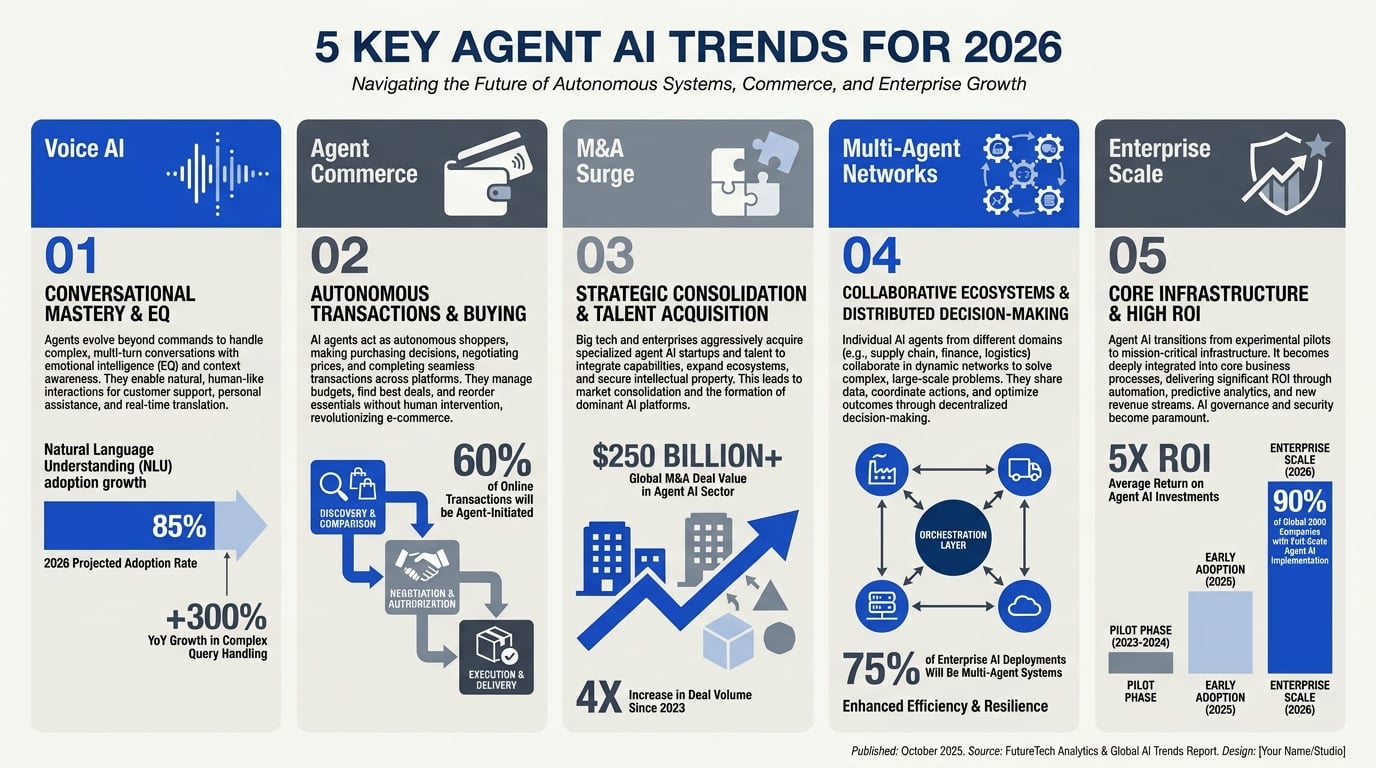
To fully understand the trajectory of this shift, we must look at the specific technical and strategic pillars underpinning the 2026 agentic landscape. The transition from experimental pilots to production-ready enterprise workers is marked by massive capital injections into real-time voice AI, secure payment protocols, and a massive consolidation of fragmented toolings.
The following matrix details the key developments driving this transformation this year, highlighting their primary drivers and the underlying infrastructure required to support them.
| Key Development (2026) | Primary Driver | Core Enterprise Impact | Infrastructure Requirement |
|---|---|---|---|
| Voice-First AI Agents | Surge in low-latency Speech-to-Text and TTS technologies | Hands-free, natural human-agent workflows and automated customer support | Low-latency voice APIs with sub-100ms real-time translation |
| Agentic Commerce & Payments | APIs enabling secure, autonomous financial transactions | Agents independently negotiating and purchasing software/materials | Tokenized digital wallets and secure financial authorization protocols |
| M&A and Market Consolidation | Intense competition and search for unified, enterprise-grade platforms | Shift from fragmented single-use tools to all-in-one agentic suites | Open APIs and interoperable multi-model gateways |
| Multilingual Localized Operations | Global expansion and regional regulatory requirements | Seamless customer engagement across diverse, non-English speaking markets | Multi-dialect Speech-to-Text support (e.g., 22 Indian regional languages) |
| Agent-to-Agent (A2A) Collaboration | The rise of specialized, task-specific digital workforces | Decentralized workflows where agents negotiate directly with other company agents | Standardized orchestration layers and shared memory protocols |
The Rise of Voice-First and Multilingual Agents
Among these developments, voice-first interaction represents the fastest-growing investment segment in 2026. Rather than forcing users to interact with text boxes, modern voice agents conduct natural, fluid conversations with human-like latency. For global enterprises, however, deployment is not just about English-speaking markets; it requires deep regional accessibility.
Communication infrastructure platforms like CallMissed are helping bridge this gap. By offering Speech-to-Text APIs supporting 22 Indian regional languages natively, CallMissed enables enterprises to deploy highly localized voice agents that handle complex customer inquiries in local dialects. This level of linguistic adaptability is transforming how customer service is delivered in highly diverse regional economies.
From Information Retrieval to Autonomous Transactions
Perhaps the most disruptive trend of 2026 is the emergence of agentic commerce. Yesterday's agents were restricted to drafting emails or analyzing spreadsheets; today's agents are equipped with specialized, secure payment tokens that allow them to execute financial transactions.
For example, a supply chain agent can autonomously monitor inventory levels, detect a shortage of raw materials, negotiate bulk pricing with a supplier’s sales agent, and initiate a secure wire transfer—all within pre-approved budget boundaries. This level of transactional autonomy relies on secure, multi-model infrastructure. Developers are increasingly leveraging platforms like CallMissed to access a unified gateway of over 300 LLMs, allowing them to route different parts of a transactional workflow to the most cost-effective or secure model depending on the task's complexity.
In-Depth Analysis

To fully grasp the magnitude of the agentic revolution in 2026, we must look closely at the underlying forces driving this transformation. The current market is defined by a massive influx of capital into voice-first technology, rapid industry consolidation, and the emergence of autonomous financial capabilities. Below, we break down these critical trends and their technical implications for modern enterprises.
The Voice-First Frontier: Breaking Latency and Language Barriers
Voice has officially graduated from a simple input-output tool to the primary natural interface for complex workflows. In 2026, venture capital and enterprise budgets are heavily weighted toward voice AI infrastructure. This is because real-time voice agents have finally overcome the "latency gap," reducing response times to sub-500 milliseconds—making interactions indistinguishable from human conversation.
However, scaling these voice-first systems globally requires more than just low latency; it demands deep linguistic intelligence. To succeed in highly diverse markets, organizations cannot rely on monolingual English models. This is where advanced infrastructure proves vital. For example, platforms like CallMissed are empowering enterprises to deploy multilingual voice agents instantly by integrating Speech-to-Text (STT) APIs covering 22 Indian languages natively alongside highly expressive Text-to-Speech (TTS) engines. This localized, voice-first capability allows brands to deliver hyper-personalized support to millions of users in their native dialects.
Agentic Commerce: From Inquiry to Transaction
We are moving rapidly past the era where AI agents merely search for information or draft emails. Today's agents are authorized economic actors. Agent-to-agent commerce and autonomous payments are actively reshaping the fintech and B2B SaaS landscapes.
Through secure API gateways and specialized digital wallets, agents can now negotiate terms, execute contracts, and settle payments autonomously. Key elements enabling this trust-based architecture include:
- Tokenized Authorization: Secure protocols that grant agents cryptographic access to specific funds, capped by strict, user-defined budgets.
- Programmatic Negotiations: A buyer's agent can negotiate directly with a seller’s inventory agent, dynamically driving down unit costs based on volume before closing the deal.
- Automated Reconciliation: Agents don't just pay; they verify invoice accuracy against actual delivery data, logging transactions straight into enterprise ERP systems.
M&A Consolidation and the Push for Multi-Model Agility
As agentic technology matures, the market is undergoing intense M&A consolidation. Enterprise software giants and telecommunication leaders are acquiring niche agent developers to build unified, end-to-end communication and automation ecosystems.
For IT decision-makers, this consolidation highlights the risk of vendor lock-in. To remain agile, forward-thinking enterprises are choosing open, multi-model architectures. Rather than tying their entire operations to a single foundation model, developers are leveraging platforms like CallMissed, which offers an API gateway connecting to 300+ LLMs. This allows companies to seamlessly route tasks to the most efficient model—balancing cost, speed, and accuracy—without refactoring their core application code as the vendor landscape shifts.
Impact & Implications
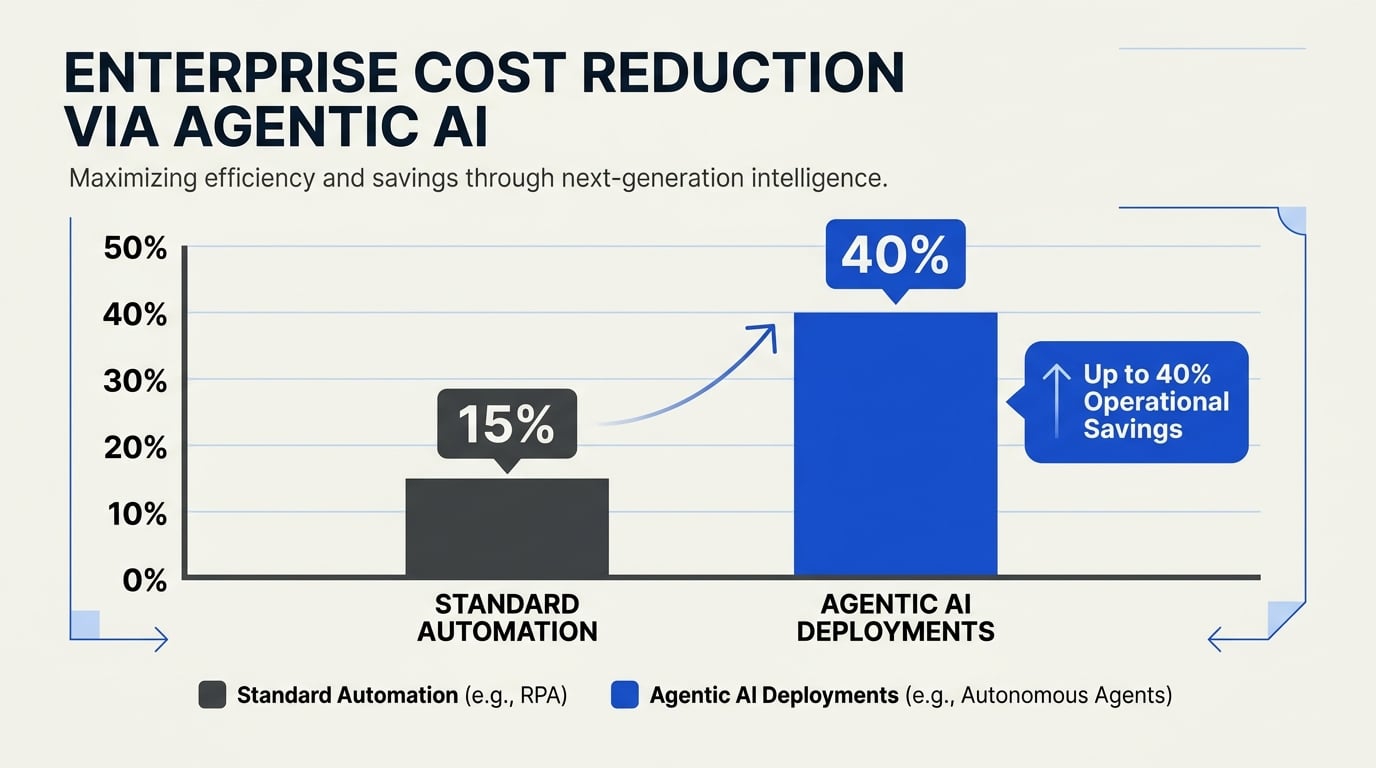
Redefining the Enterprise Workforce and Productivity
The rise of agentic AI is triggering a structural shift in how organizations define productivity. Rather than merely assisting employees with isolated tasks, autonomous agents in 2026 are acting as digital colleagues that manage end-to-end business operations. This evolution is fundamentally changing human roles from "executioners of tasks" to "orchestrators of agentic networks."
The macroeconomic implications are profound. With the ability of agents to process unstructured data, reason through multi-step challenges, and execute tasks, organizations are shifting away from rigid, legacy software silos. By delegating high-volume, cognitively repetitive pipelines to autonomous systems, enterprises are realizing unprecedented agility, allowing human teams to focus entirely on high-level strategic growth, creative design, and complex relationship management.
The Dawn of Agent-to-Agent Commerce
One of the most disruptive implications of 2026's agentic wave is the rapid emergence of agent-to-agent (A2A) commerce. In this new paradigm, AI agents do not just recommend products; they actively negotiate contracts, manage supply chains, and execute financial transactions with other agents.
This shift introduces critical operational considerations:
- Financial and Security Protocols: Enterprises must establish strict spending thresholds, secure cryptographic digital wallets, and zero-trust authentication mechanisms for their digital agents to prevent unauthorized transactional loops.
- Autonomous Negotiation: Agents are now analyzing real-time market dynamics to negotiate prices on raw materials, cloud compute, or logistics services in milliseconds, completely bypassing traditional, slow human-negotiation cycles.
- API-First Ecosystems: Traditional user interfaces (UIs) are taking a backseat to machine-readable APIs, as software must now be designed for consumption by other AI agents rather than human eyes.
Communication and Multilingual Accessibility
As agentic workflows scale, the barrier of language and accessibility is fast disappearing. Global enterprises are realizing that to truly capitalize on this revolution, their autonomous agents must interact naturally across diverse customer demographics.
This is where advanced communication infrastructure becomes indispensable. Platforms like CallMissed are playing a pivotal role by allowing businesses to seamlessly bridge the gap between complex AI reasoning and human interaction. By offering native Speech-to-Text and Text-to-Speech support for 22 regional Indian languages alongside access to over 300+ LLMs, CallMissed ensures that enterprise voice agents can interact with localized markets with the same nuance and cultural accuracy as a native speaker, democratizing access to services globally.
Consolidation and Tech Stack Rationalization
The massive wave of mergers, acquisitions, and market consolidation in 2026 is forcing enterprises to rethink their IT architectures. Instead of maintaining disjointed legacy APIs and specialized narrow AI models, businesses are centralizing their operations around unified agentic platforms. The goal is to build a single, resilient source of truth where voice, chat, and transactional databases are seamlessly interconnected, ensuring that agents can access real-time information to execute critical business decisions flawlessly.
Expert Opinions
Industry analysts and technology leaders agree: the agentic transition of 2026 is fundamentally reshaping enterprise architecture. As organizations move beyond initial pilot programs, experts from top research firms are highlighting the critical strategies and infrastructure requirements necessary to survive and thrive in this automated economy.
The Imperative of Model-Agnostic Infrastructure
A major consensus among technology analysts is the danger of LLM vendor lock-in. According to insights from Google Cloud's 2026 Agentic AI Trends Report, the pace of model innovation is too rapid for enterprises to commit to a single foundational LLM. Experts advise that the most resilient AI agents are built on decoupled, model-agnostic layers that allow for real-time model swapping based on latency, cost, and task complexity.
For businesses building these systems, agility is paramount. Infrastructure platforms like CallMissed address this exact challenge by providing a multi-model API gateway. This enables developers to dynamically route agent tasks across more than 300 LLMs, ensuring that an enterprise’s agentic workforce is never bottlenecked by a single provider's downtime or outdated performance benchmarks.
The Rise of Voice-First Agentic Ecosystems
Another major trend noted by financial and technology analysts is the "soaring investment in voice AI." As highlighted by Fintech News Switzerland, speech has emerged as the premier interface for agent-to-human collaboration in 2026. Experts emphasize that voice agents are no longer glorified interactive voice response (IVR) systems; they are sophisticated, context-aware digital colleagues capable of real-time reasoning.
However, deployment experts warn that global and regional scalability remains a significant hurdle. For voice agents to truly drive value, they must bridge regional linguistic gaps. Platforms like CallMissed are solving this accessibility bottleneck by offering native Speech-to-Text and Text-to-Speech APIs supporting 22 regional Indian languages, allowing multinational enterprises to deploy voice agents that communicate naturally with diverse customer bases.
The Transition to Agent-to-Agent Commerce
Looking ahead at the macroeconomic impact, financial analysts are closely watching the rise of autonomous transaction execution. Experts suggest that the true maturity of the agentic era will be defined by "agentic commerce"—where AI agents possess secure digital wallets and authorized credentials to negotiate, contract, and complete financial transactions with other agents.
According to current market forecasts, integrating secure payment rails into agentic workflows will drastically reduce procurement cycles from weeks to seconds. Experts agree that the organizations prioritizing secure, agent-ready transactional infrastructure today will dominate the highly automated supply chains of tomorrow.
What This Means For You (TABLE)
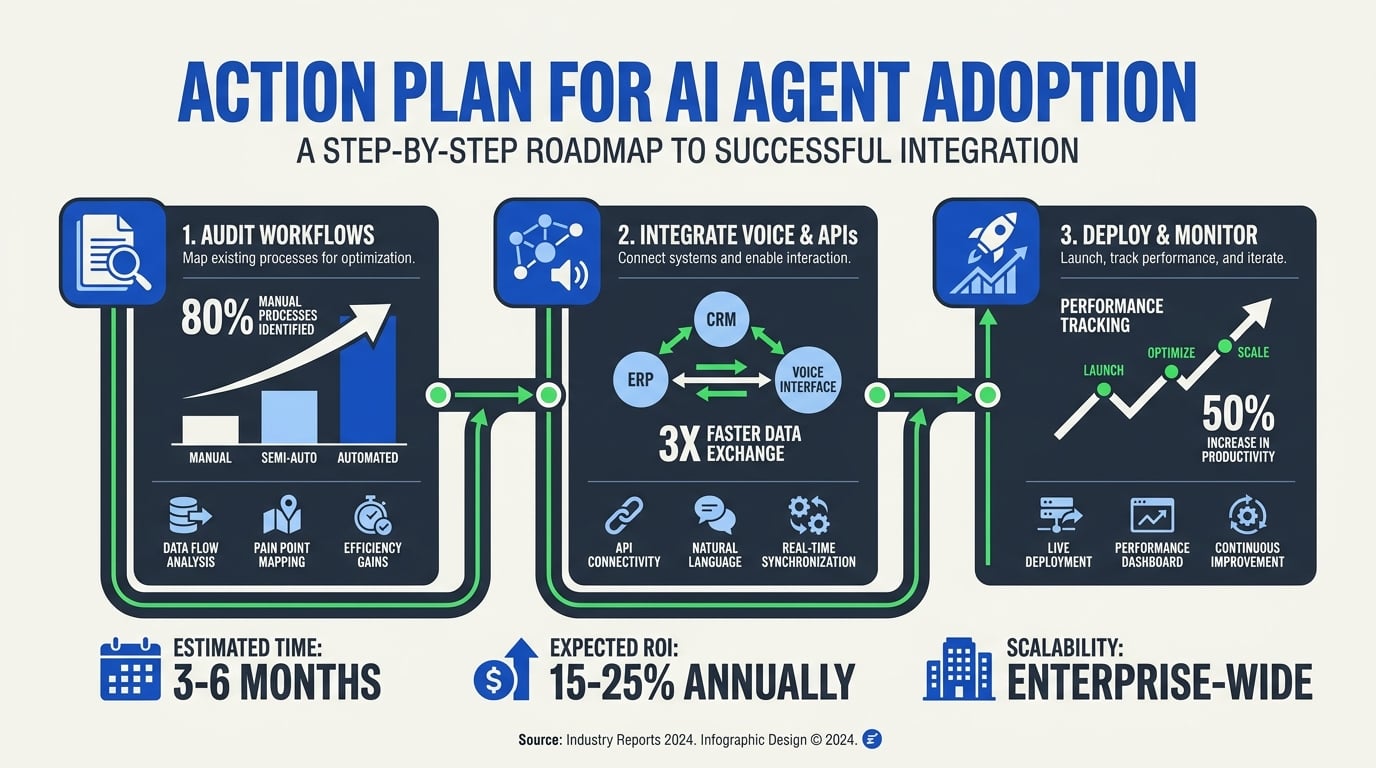
The massive shift toward the Agentic Revolution in 2026 isn't just an abstract technological milestone—it is a fundamental restructuring of how enterprises operate, budget, and scale. With McKinsey highlighting a 30% to 40% reduction in operational costs for early adopters, the question is no longer if you should adopt AI agents, but how quickly you can deploy them across your core business units.
To successfully navigate this transition, organizations must move past generic chat interfaces and implement specialized, action-oriented agents. This means equipping your teams with the infrastructure to support autonomous workflows, secure agent-to-agent transactions, and seamless voice communication.
The table below outlines how this paradigm shift directly impacts various organizational functions this year, alongside the immediate tactical steps you should take to capitalize on these trends.
| Business Function | 2026 Agentic Impact | Key Action Item | Primary Benefit |
|---|---|---|---|
| Customer Support | Voice-first agents autonomously resolve complex, multi-turn customer issues. | Integrate multilingual voice agents into your core support pipeline. | 24/7 instant resolution; 35%+ reduction in operational overhead. |
| Finance & Procurement | AI-to-AI commerce agents negotiate deals and securely execute B2B payments. | Establish secure payment credentials and tokenized transaction limits. | Complete elimination of manual invoicing bottlenecks and delays. |
| IT & Infrastructure | Multi-agent orchestrators manage complex software ecosystems and LLM calls. | Adopt flexible API gateways to easily route tasks across 300+ LLMs. | Maximum operational agility with zero vendor lock-in. |
| Sales & Operations | Proactive agents analyze lead data, execute outreach, and schedule meetings. | Sync outbound communication agents directly with enterprise CRM systems. | 3x pipeline acceleration and continuous, automated lead qualification. |
Aligning Infrastructure with Strategy
To turn these operational impacts into a distinct competitive advantage, your underlying technical infrastructure must be robust enough to support real-time, low-latency agent execution. This is particularly crucial for voice-first interactions and multilingual market coverage, which have emerged as the dominant customer touchpoints this year.
For organizations looking to execute this transition smoothly, communication infrastructure platforms like CallMissed offer a highly practical path forward. By providing production-ready, multilingual voice agent APIs that natively support 22 regional Indian languages alongside 300+ LLM integrations, CallMissed enables IT and customer operations teams to deploy conversational AI agents that resolve user queries around the clock. Instead of spending months building custom pipelines, businesses can leverage these specialized APIs to immediately lower their operational costs and future-proof their communication strategies.
Ultimately, the organizations that thrive in 2026 will be those that transition their workforce from "doers" to "orchestrators." By automating transactional work, your human talent is freed up to focus on high-level strategy, creative problem-solving, and the critical ethical guardrails that keep autonomous systems aligned with business goals.
Frequently Asked Questions
What are the primary Agent AI trends shaping 2026 for enterprises?
How do the Agent AI trends shaping 2026 impact global business operations and costs?
Which emerging technologies are driving the top AI agent trends shaping 2026?
What is agent-to-agent commerce, and how does it function in modern workflows?
Why is voice-first AI dominating customer communication channels this year?
How can businesses prepare their IT infrastructure for the ongoing agentic revolution?
Conclusion
The Agentic Revolution of 2026 marks a permanent shift from passive tools to active, self-directing partners. As you prepare your organization for this hyper-automated future, keep these core takeaways in mind:
- Autonomous Workflows: AI agents have officially evolved from basic co-pilots into proactive digital workers that autonomously reason, plan, and execute multi-step enterprise operations with minimal human oversight.
- Substantial Cost Savings: Real-world agentic deployments are driving a massive 30% to 40% reduction in operational costs, proving the immense economic value of this transition.
- Voice and Commerce Integration: The rise of voice-first AI interfaces and secure, agentic payment capabilities is creating seamless, fully automated customer interactions and business transactions.
As we look ahead, the organizations that thrive will be those that actively integrate these autonomous workflows into their customer engagement strategies. To explore how AI communication infrastructure is evolving, check out CallMissed—an AI platform powering highly sophisticated, multilingual voice agents and chatbots that keep enterprises ahead of the curve.
Is your organization ready to transition from manual software prompts to fully autonomous execution?
Related Posts


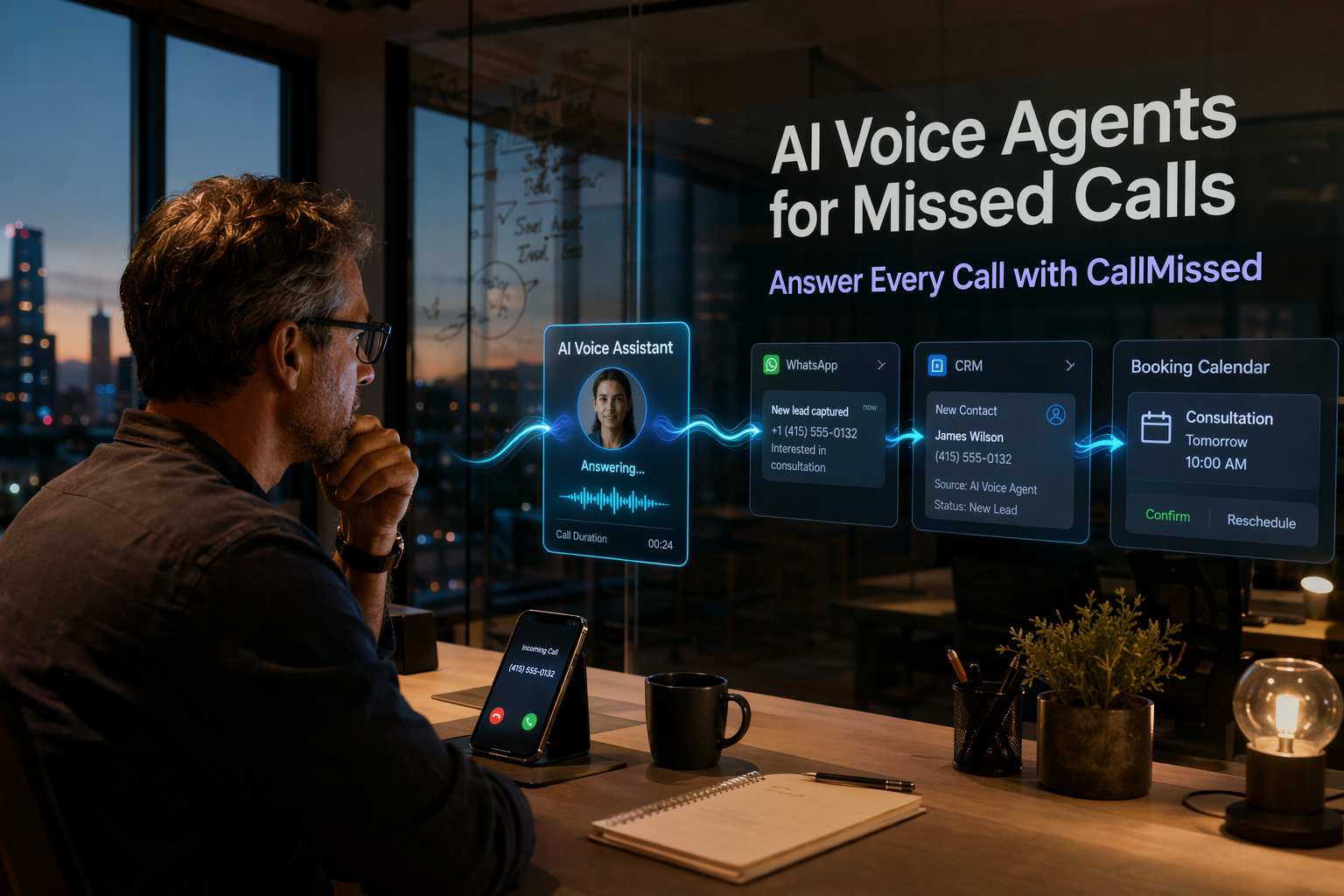
Ready to automate customer conversations?
Launch AI voice agents and WhatsApp bots with CallMissed — one API, 22+ Indian languages.