

Nano Banana 2: How Gemini 3.1 Flash Image Beat the Field


Did you know that Google’s latest powerhouse AI image generator—whimsically code-named after a yellow fruit—is currently outperforming pro-tier models...
Nano Banana 2: How Gemini 3.1 Flash Image Beat the Field
Did you know that Google’s latest powerhouse AI image generator—whimsically code-named after a yellow fruit—is currently outperforming pro-tier models while slashing operational costs by a staggering 50%?
As we navigate the demands of 2026, the artificial intelligence landscape is undergoing a massive paradigm shift. The initial novelty of generating surreal digital art has worn off; today, enterprises and developers demand high-fidelity, production-grade visual assets delivered at instantaneous speeds. For years, creators had to make a frustrating compromise: choose heavy, expensive "Pro" models and endure slow generation times, or opt for "Flash" models and sacrifice visual accuracy, spatial intelligence, and text legibility.
The release of Gemini 3.1 Flash Image, colloquially known as Nano Banana 2, has completely rewritten these rules. Built directly on Google’s advanced Gemini 3.1 Flash architecture, this model brings cognitive reasoning into the pixels themselves. It isn't just generating images based on noise; it understands complex spatial layouts, maintains multi-subject consistency across frames, and renders highly legible embedded text natively.
Why Nano Banana 2 Matters Right Now
The business implications of this release are profound. In a digital economy where real-time personalization dominates, static workflows are no longer viable. Nano Banana 2 solves the core bottleneck of visual AI by delivering:
- Unprecedented Efficiency: It operates at roughly four times the speed of its predecessor, Nano Banana Pro.
- Drastic Cost Reduction: It costs half as much per image to run, making massive-scale dynamic visual generation commercially viable for the first time.
- Professional Fidelity: It supports native 4K resolution outputs, bypassing the need for secondary upscaling models that often distort fine details.
- Built-in Safety: Every image generated or edited natively embeds an invisible SynthID digital watermark, securing intellectual property and ensuring transparency without compromising image quality.
As enterprises rush to build complex multimodal applications, having access to fast, intelligent, and affordable generation models is critical. This trend toward ultra-efficient, multi-model infrastructure is why platforms like CallMissed are becoming vital, allowing developers to orchestrate 300+ advanced LLMs alongside real-time voice and communication APIs seamlessly.
What This Review Covers
In this comprehensive deep-dive, we will pull back the curtain on Google’s latest visual powerhouse. We will analyze the benchmarking data to see exactly how Nano Banana 2 outperformed competing models in key creative tasks. You will learn:
- How the model achieves its 4x speed increase without degrading image fidelity.
- The mechanics behind its multi-subject consistency and spatial reasoning capabilities.
- A breakdown of its text-rendering capabilities, solving one of the most persistent issues in AI image generation.
- Practical ways to integrate Gemini 3.1 Flash Image into your existing developer pipelines for maximum ROI.
Let's dive into the data and discover how this "Flash" model managed to beat the entire field.
Introduction: The Next Era of AI Image Generation

The generative AI landscape is evolving at a breakneck pace, but for a long time, image generation suffered from a persistent trade-off: you could have high-quality, complex reasoning, or you could have speed and cost-efficiency—never both. Enterprise applications required visual generators that could instantly output high-fidelity assets without stalling user workflows or breaking infrastructure budgets.
This technological bottleneck has officially been broken. Google has unveiled Nano Banana 2, the developer community's name for Gemini 3.1 Flash Image. Optimized specifically for lightning-fast image understanding and generation, Gemini 3.1 Flash Image brings the deep reasoning and intelligence of the Gemini ecosystem directly into the creative pipeline. By delivering "Pro-level" visual fidelity at a fraction of the traditional cost and latency, this model is reshaping how developers, creators, and enterprises build visual experiences.
The Evolution: From Slow Artistry to Real-Time Intelligence
Historically, diffusion models and AI image generators operated in isolation. They excelled at creating beautiful art from text prompts, but they lacked a broader understanding of context, spatial reasoning, and real-time execution. If you needed to edit a specific part of an image, maintain multi-subject consistency, or generate legible text within a graphic, the models would often fail or require dozens of resource-intensive attempts.
Nano Banana 2 solves this by unifying image generation with the core logic of the Gemini 3.1 family. This means the model does not just blindly paint pixels; it understands the logical relationship between objects, text, and context. Whether you are generating a complex schematic, designing localized marketing materials, or building dynamic interfaces, the model applies advanced spatial intelligence to execute your prompts with high conceptual precision.
For companies building comprehensive user experiences, this shift is revolutionary. Modern applications no longer rely on single-purpose AI models. Instead, they require unified ecosystems where voice, text, and visual elements interact fluidly. Platforms like CallMissed are already helping businesses navigate this transition by offering robust AI communication infrastructure—including voice agents, multi-language Speech-to-Text, and access to over 300+ LLMs—enabling developers to build highly interactive, multimodal customer agents that can see, speak, and generate contextual responses in real-time.
Why Gemini 3.1 Flash Image is Beating the Field
The competitive edge of Nano Banana 2 lies in its architecture, which is tuned for raw performance, cost reduction, and enterprise safety. Several key breakthroughs set this model apart from competitors:
- Exceptional Speed and Cost Efficiency: According to Google's technical documentation, Gemini 3.1 Flash Image is roughly four times faster than its predecessor, Nano Banana Pro. Furthermore, it slashes operational expenses by costing approximately half as much per image, making mass-scale image generation commercially viable for the first time.
- True Multimodality (Input and Output): Unlike traditional text-to-image models, Nano Banana 2 supports text and images in, and text and images out. This makes complex image-to-image edits, inpainting, outpainting, and iterative image-based conversations seamless.
- Legible Text and Multi-Subject Consistency: One of the historic downfalls of AI image models has been gibberish text and a failure to maintain character consistency across multiple frames. Nano Banana 2 natively resolves this, outputting crisp, legible typography and preserving the visual identity of multiple subjects across varied scenes.
- Native 4K Resolution: The model outputs high-definition visuals natively, minimizing the need for external upscalers that often introduce unwanted artifacts or distort the original generation.
- Enterprise-Grade Security and Watermarking: In an era where digital authenticity is paramount, every image created or edited with the Gemini 3.1 Flash Image model includes an invisible SynthID digital watermark. Developed by Google DeepMind, SynthID embeds a tamper-resistant identifier directly into the pixel metadata, allowing enterprises to verify AI-generated content reliably without compromising visual quality.
Setting a New Benchmark for Production-Ready AI
In the past, deploying high-end image generation meant dealing with heavy infrastructure overhead and unpredictable API latencies. Gemini 3.1 Flash Image (Nano Banana 2) proves that high quality does not have to come with a premium price tag or slow load times.
By delivering pro-level intelligence at "Flash-tier" speeds, Google has shifted the conversation from what AI can generate to how fast and how cheaply it can do so at scale. As businesses integrate these visual models alongside advanced voice and conversational interfaces—such as those powered by CallMissed’s multi-model API gateways—the possibilities for fully immersive, automated, and multimodal customer journeys are virtually limitless. In the following sections, we will dive deep into the technical architecture, performance benchmarks, and real-world applications that make Nano Banana 2 the undisputed champion of modern image generation.
The Evolution: From Nano Banana Pro to Gemini 3.1 Flash Image
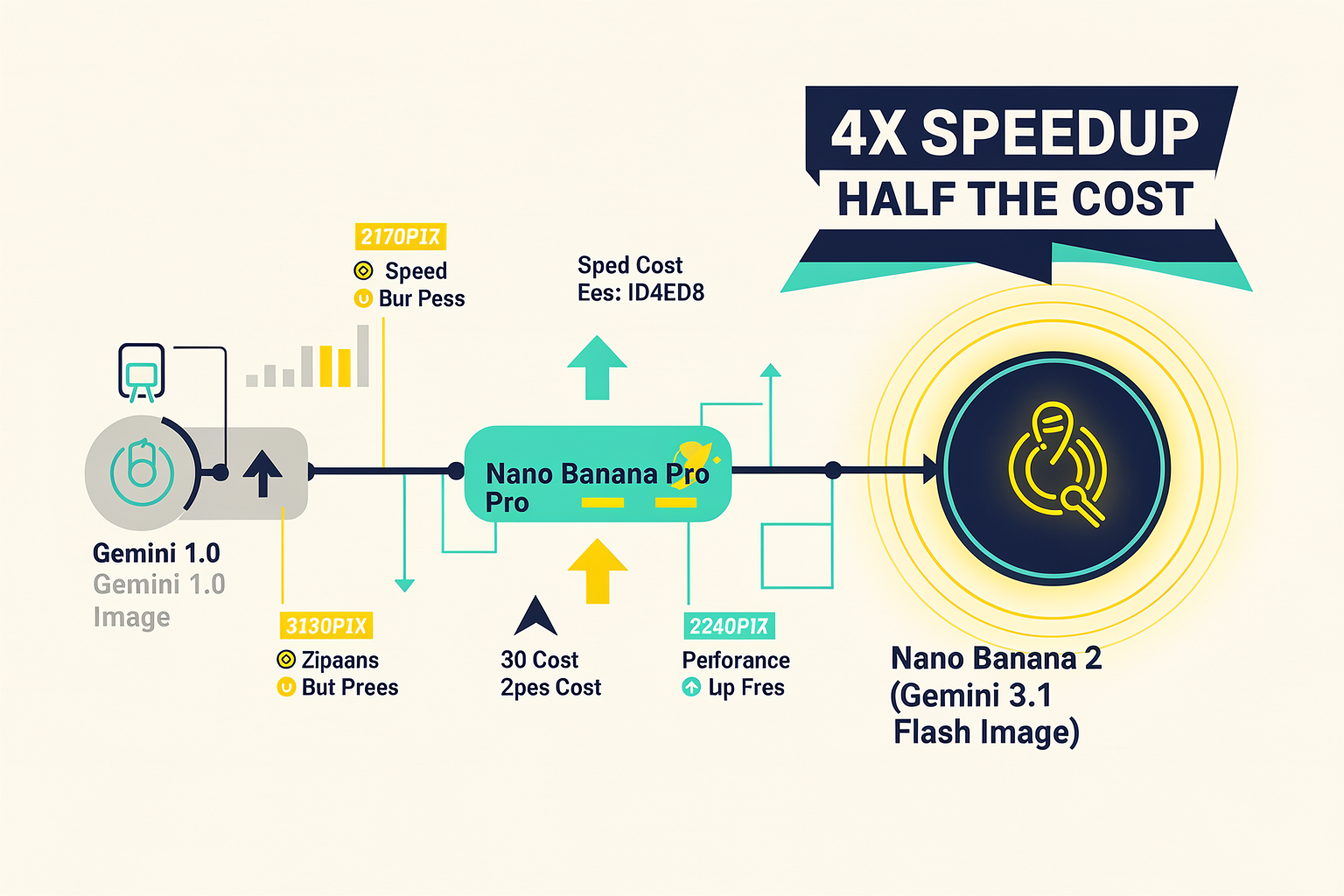
The landscape of AI image generation has shifted from slow, compute-heavy, isolated models toward rapid, highly aligned, and context-aware systems. When Google first experimented in this specific niche, models like Nano Banana Pro showcased what was possible in terms of raw visual fidelity. However, they frequently struggled with high latency, steep operational costs, and the infamous "black box" prompt-understanding problem where models failed to parse complex instructions.
The release of Nano Banana 2—officially designated as Gemini 3.1 Flash Image—marks a massive paradigm shift. It is not merely an incremental patch; it is a foundational redesign that merges the cognitive reasoning of the Gemini ecosystem with a high-speed, cost-efficient image generation and editing engine. By moving away from isolated diffusion architectures and infusing the model with the native intelligence of Gemini 3.1, Google has solved the historic trade-off between speed, cost, and intelligence.
The Quantifiable Leap: Speed, Cost, and Efficiency
For developers and enterprises looking to scale visual content creation, the transition from Nano Banana Pro to Gemini 3.1 Flash Image yields immediate, measurable benefits. When deploying image generation models at scale, the primary bottlenecks have always been infrastructure overhead and generation latency. Nano Banana 2 directly dismantles these barriers with two critical benchmarks:
- 4x Speed Increase: Gemini 3.1 Flash Image generates high-fidelity assets approximately four times faster than its predecessor, Nano Banana Pro. This brings generation times down to "Flash-tier" speeds, making real-time, user-facing image generation pipelines feasible.
- 50% Cost Reduction: Operational costs have been cut in half, costing roughly half as much per image compared to Nano Banana Pro. This drastically lowers the barrier to entry for high-volume commercial applications.
In practice, this means enterprises no longer have to choose between waiting several seconds for a high-quality image or settling for a low-resolution, poorly aligned placeholder. The model achieves this efficiency by utilizing a highly optimized inference pipeline that handles both text-to-image generation and complex image-to-image editing tasks natively, without requiring separate, heavy auxiliary models.
This transition mirrors the broader industry push toward highly efficient, multi-model architecture. For instance, platforms like CallMissed allow developers to orchestrate complex communication workflows by switching between 300+ LLMs and multimodal APIs on the fly. Just as Gemini 3.1 Flash Image optimizes the balance between speed and cost for visual tasks, CallMissed enables businesses to integrate these cutting-edge models into live customer interactions, ensuring that high-speed reasoning and rich media generation work hand-in-hand.
Architectural Innovations: What Changed Under the Hood?
The evolution from Nano Banana Pro to Gemini 3.1 Flash Image is defined by several core architectural upgrades that elevate it beyond a simple rendering tool into a highly cooperative creative assistant.
- Native Multimodal Fusion
Unlike traditional setups where a separate LLM translates a user prompt before passing it to an image generator, Gemini 3.1 Flash Image integrates reasoning directly. Built on the Gemini 3.1 Flash architecture, the model understands spatial relationships, cultural context, and nuanced formatting instructions natively. This eliminates the "lost in translation" phenomenon common in older models, ensuring the generated output matches the user's intent on the first attempt.
- Native 4K Output and Input Flexibility
Nano Banana Pro was highly constrained in terms of output resolution and editing capabilities. Nano Banana 2 natively supports high-resolution outputs up to 4K, allowing for professional-grade design assets. Furthermore, it supports flexible inputs and outputs (text and images in, up to native 4K out), making complex image-to-image modifications, outpainting, and inpainting incredibly seamless.
- Multi-Subject Consistency
One of the greatest weaknesses of early-generation image creators was their inability to maintain consistency across multiple subjects or frames. If you asked for a "blue coffee mug next to a red notebook," older models would often bleed the colors together or lose track of one object entirely. Gemini 3.1 Flash Image excels at multi-subject consistency, keeping distinct elements separate, correctly colored, and proportionally accurate according to the user's layout instructions.
- Flawless Text Rendering and Legibility
Rendering legible text has historically been the Achilles' heel of AI image generators, often producing garbled, alien-like lettering. Nano Banana 2 solves this by cleanly rendering English and multilingual text directly into images. Whether you are generating mockups for web banners, product packaging, or social media graphics, the text remains crisp, correctly spelled, and contextually integrated into the design.
Security, Provenance, and Enterprise Readiness
As generative media becomes more integrated into mainstream workflows, the questions of safety, copyright, and authentication have taken center stage. Google has addressed these concerns head-on during the transition to Gemini 3.1 Flash Image.
Every image generated or edited using the Gemini 3.1 Flash Image model automatically includes an invisible SynthID digital watermark. Developed by Google DeepMind, SynthID embeds a digital watermark directly into the image's pixels. This watermark is completely imperceptible to the human eye, yet it remains detectable even after significant modifications, such as cropping, color rotation, resizing, or compression. This ensures that enterprises can deploy these models confidently, maintaining clear provenance and aligning with global standards for responsible AI usage.
Summary of Evolutionary Milestones
To understand how far the technology has come, we can compare the core milestones of this evolutionary path:
- Nano Banana Pro: High visual fidelity but hindered by slow generation times, high cost per API call, frequent text rendering errors, and poor multi-subject spatial reasoning.
- Gemini 3.1 Flash Image (Nano Banana 2): Sub-second latency (4x faster), half the cost (50% cheaper), native 4K resolution, flawless text legibility, multi-subject consistency, and built-in enterprise-grade SynthID watermarking.
By transforming image generation from an isolated, expensive specialty task into a fast, cheap, and deeply intelligent API, Google has set a new benchmark for the industry. Developers are no longer restricted to asynchronous batch processing; they can now build interactive, real-time visual applications that respond to user inputs instantly.
Overview & Specifications (TABLE)
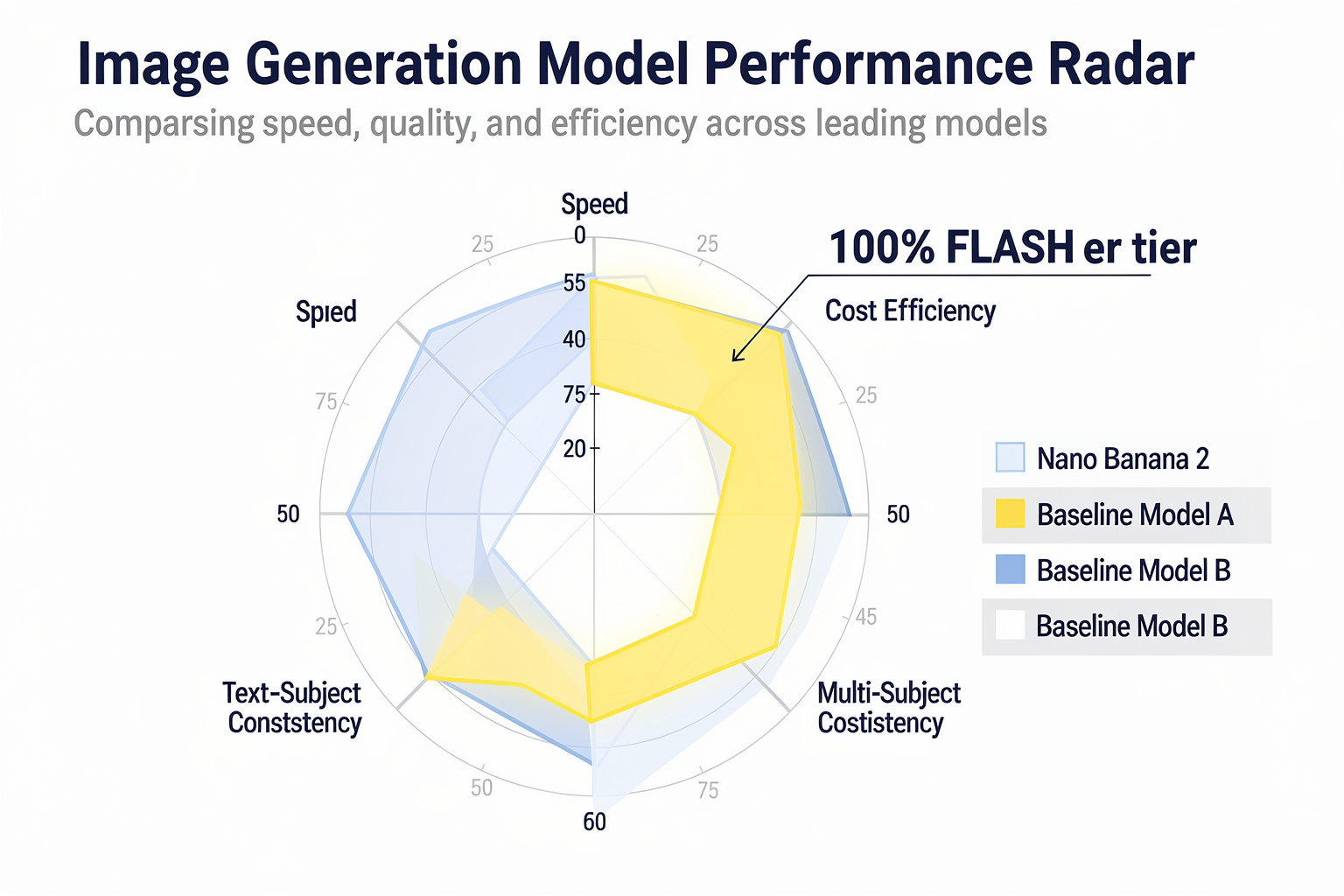
To fully appreciate the impact of Google’s latest visual model, we must look closely at its core architecture and operational metrics. Officially designated as Gemini 3.1 Flash Image (and widely known in developer circles as Nano Banana 2), this model is designed to bridge the gap between high-fidelity image synthesis and real-time operational efficiency.
Historically, developers had to make a compromise: choose a "Pro" tier model for crisp details and accurate text, or choose a "Flash" tier model for speed and cost-efficiency at the expense of visual quality. Nano Banana 2 eliminates this trade-off by bringing the advanced reasoning, spatial intelligence, and multi-subject consistency of Google’s Gemini ecosystem directly into a high-speed, cost-effective image generation pipeline.
Core Architecture and Key Advancements
Unlike standard diffusion models that operate in isolation from broader semantic understanding, Nano Banana 2 leverages the foundational reasoning of the Gemini 3.1 Flash architecture. This allows the model to "understand" prompt nuances, complex spatial relations, and multi-subject layouts far better than its predecessor, Nano Banana Pro.
The model boasts several key technical leaps:
- Native 4K Output: The model generates and edits images at native 4K resolution, bypassing the need for computationally expensive external upscalers that often distort original textures.
- Advanced Text Legibility: It natively renders legible, contextually accurate text within generated images, solving a long-standing hurdle for marketing, social media, and UI prototyping applications.
- Multi-Subject Consistency: It excels at maintaining character, style, and object continuity across different scenes and prompts, a critical feature for storyboarding and coherent brand campaigns.
- Native SynthID Watermarking: To meet strict enterprise compliance and safety standards, every image generated or edited with Nano Banana 2 automatically includes an invisible, tamper-resistant SynthID digital watermark to identify it as AI-generated without compromising visual quality.
Comparative Specifications: Nano Banana 2 vs. Nano Banana Pro
To understand how Nano Banana 2 redefines the efficiency frontier for developers and enterprises, let's examine how its key specifications stack up against the previous generation benchmark:
| Feature / Metric | Nano Banana 2 (Gemini 3.1 Flash Image) | Nano Banana Pro (Predecessor) | Enterprise Impact |
|---|---|---|---|
| Generation Speed | ~4x Faster (Flash-tier latency) | Baseline Speed | Enables real-time user experiences and interactive apps. |
| Operational Cost | ~50% Cost Reduction (Roughly half price) | Baseline Cost | Drastically lowers the barrier for high-volume production. |
| Output Resolution | Native 4K support | Standard Resolution | Crisp, production-ready assets without post-upscaling. |
| Content Safety | SynthID Watermarking (Built-in) | Manual / Post-process | Instant, tamper-resistant IP and compliance tracking. |
| Input / Output | Multimodal (Text and images in/out) | Limited Multimodality | Simplified image-to-image editing and inpainting. |
Real-World Performance & Efficiency Analysis
The metrics in the table highlight a significant engineering feat: Google has managed to cut operational costs by roughly 50% per image while simultaneously accelerating generation speeds by four times (4x) compared to Nano Banana Pro.
For developers building high-throughput consumer applications—such as personalized e-commerce avatars, dynamic ad-generation platforms, or interactive gaming assets—this cost-to-performance ratio is a game-changer. High latency and steep API costs have historically prevented companies from integrating real-time image generation into live user workflows. By optimizing the inference pipeline down to Flash-tier speeds, Nano Banana 2 makes on-the-fly visual generation practically viable.
Furthermore, because the model handles both text and image inputs natively, complex workflows like image inpainting, outpainting, and multi-layered editing no longer require multiple model round-trips. A single API call can specify an existing image, point out localized modifications via text, and output a highly consistent 4K edit in seconds.
Orchestrating Multimodal Workflows at Scale
As visual AI models become faster and more accessible, the challenge shifts from pure generation to systemic orchestration. Modern business applications rarely rely on image generation alone; they require unified pipelines that link voice agents, text-based chatbots, customer data, and visual generation together.
This is where advanced communications infrastructure becomes critical. Platforms like CallMissed allow developers to seamlessly orchestrate complex, multi-model workflows. Using CallMissed’s unified API gateway—which grants access to over 300+ LLMs alongside high-performance speech-to-text (supporting 22 Indian languages) and text-to-speech APIs—enterprises can build sophisticated AI communication flows. For example, a customer could interact with a CallMissed-powered voice agent to describe a custom product, and the backend could trigger Nano Banana 2 via API to instantly generate and send a 4K visual mockup to the user's WhatsApp chatbot in real-time. By pairing fast visual models with robust communication backbones, businesses can deliver cohesive, multimodal user experiences at a fraction of the historical cost.
Under the Hood: Deep Architecture and Visual Intelligence

To truly appreciate how Gemini 3.1 Flash Image (codenamed Nano Banana 2) has redefined the state of the art in generative media, one must look beneath the pixels and peer into its underlying architecture. Historically, AI image generation was a fragmented process. Standard diffusion pipelines relied on isolated text encoders (such as T5 or CLIP) to convert prompts into embeddings, which were then passed to a separate U-Net or transformer architecture to map out pixels.
Nano Banana 2 fundamentally shatters this paradigm. By integrating the deep cognitive reasoning capabilities of the Gemini 3.1 ecosystem directly into the visual synthesis engine, Google has delivered a model that does not just match keywords to pixels—it deeply comprehends the semantic structure of the prompt before a single grain of latent noise is cleared.
The Unified Multimodal Transformer Paradigm
At the core of Nano Banana 2's architecture is a unified multimodal transformer. Unlike traditional generative models that suffer from a "cognitive disconnect" between the language encoder and the image generator, this model processes text and images as cohesive, intertwined inputs.
- Native Multimodal Understanding: Because the model inherits the core transformer architecture of the Gemini 3.1 Flash LLM, it treats visual elements as tokens of equal weight to text tokens. This deep integration allows the model to display "Pro-level" reasoning.
- Bidirectional Prompt Comprehension: The system can analyze complex spatial relationships, abstract metaphors, and highly specific style guidelines. It understands the physical properties of objects in a scene, such as gravity, light reflection, and material texture, translating them into highly realistic visuals.
- Advanced Editing and Refinement: Because the input/output pipeline natively supports both text and images, developers can pass an existing image, specify a modification via text, and receive a pixel-perfect edit in milliseconds.
This deep architectural intelligence is why the model maintains unprecedented multi-subject consistency. In previous generation models, prompting for "a red apple sitting next to a blue banana" would often result in color bleeding, creating a purple mess or swapping the colors entirely. Nano Banana 2's unified reasoning layer ensures that distinct subjects retain their unique attributes, even in highly crowded or complex compositions.
Blazing Speed and Unprecedented Cost Efficiency
In the enterprise space, intelligence is only as valuable as its deployment cost. Google built the Gemini 3.1 Flash family with speed and scalability in mind, and the Flash Image model is no exception.
- 4x Speed Increase: Nano Banana 2 is approximately four times faster than its predecessor, Nano Banana Pro. This drastic reduction in latency makes it highly suitable for real-time applications, such as dynamic web asset generation, live gaming environments, and instant visual communication.
- 50% Cost Reduction: Operational costs have been slashed, with the model costing roughly half as much per image as Nano Banana Pro. This shift democratizes high-fidelity image generation for startups and large-scale enterprises alike.
- Flash-Tier Quantization: The speed and cost breakthroughs are achieved through aggressive architectural optimizations, including advanced weight quantization and distilled attention mechanisms. These allow the model to run with a incredibly compact memory footprint without degrading visual fidelity.
For developers seeking to build complex workflows around these fast models, integration is key. This is where modern AI communication platforms bridge the gap. For instance, CallMissed's multi-model API gateway allows developers to access over 300+ LLMs seamlessly. By pairing high-speed, cost-effective vision engines like Nano Banana 2 with CallMissed's real-time communication tools, businesses can orchestrate complex, visually rich customer interactions—such as automatically generating custom visual mockups or structural diagrams during a live chat or support call—at a fraction of legacy operational costs.
Solving the Legacy Challenges: Legible Text and Native 4K
Beyond speed, Nano Banana 2 addresses the two historical pain points of AI-generated imagery: illegible "gibberish" text and upscaling artifacts.
- Legible Text Rendering: By leveraging the advanced language capabilities of the Gemini 3.1 backend, the model excels at rendering crisp, legible, and contextually accurate typography within images. Whether generating a restaurant menu, a storefront sign, or a product label, Nano Banana 2 accurately spells out requested text, aligning it with the perspective and lighting of the surrounding environment.
- Native 4K Output: Most legacy models generate images at lower resolutions (typically 512x512 or 1024x1024 pixels) and rely on separate post-processing upscalers, which often introduce unwanted blurriness or strange structural artifacts. Nano Banana 2 bypasses this step, generating high-fidelity images up to native 4K resolution directly from the latent space, preserving intricate textures, fine lines, and subtle gradients.
Enterprise-Grade Security and Provenance via SynthID
As generative AI enters mainstream business operations, the questions of copyright, authenticity, and compliance have taken center stage. Google has addressed these concerns head-on at the architectural level.
Every image created or modified using the Gemini 3.1 Flash Image model automatically includes an invisible digital watermark powered by Google's SynthID. Unlike traditional metadata tags or visible watermarks that can be easily cropped out or stripped away, SynthID is embedded directly into the pixel value distribution of the image.
This watermark remains detectable even if the image is heavily edited, compressed, resized, or screenshotted. Crucially, this invisible watermark does not degrade the visual quality, color accuracy, or resolution of the output. It provides enterprises with a robust, tamper-resistant method of proving AI authorship, ensuring compliance with global transparency standards while protecting digital assets from unauthorized duplication or manipulation.
The Flash Advantage: Redefining Speed and Operational Cost
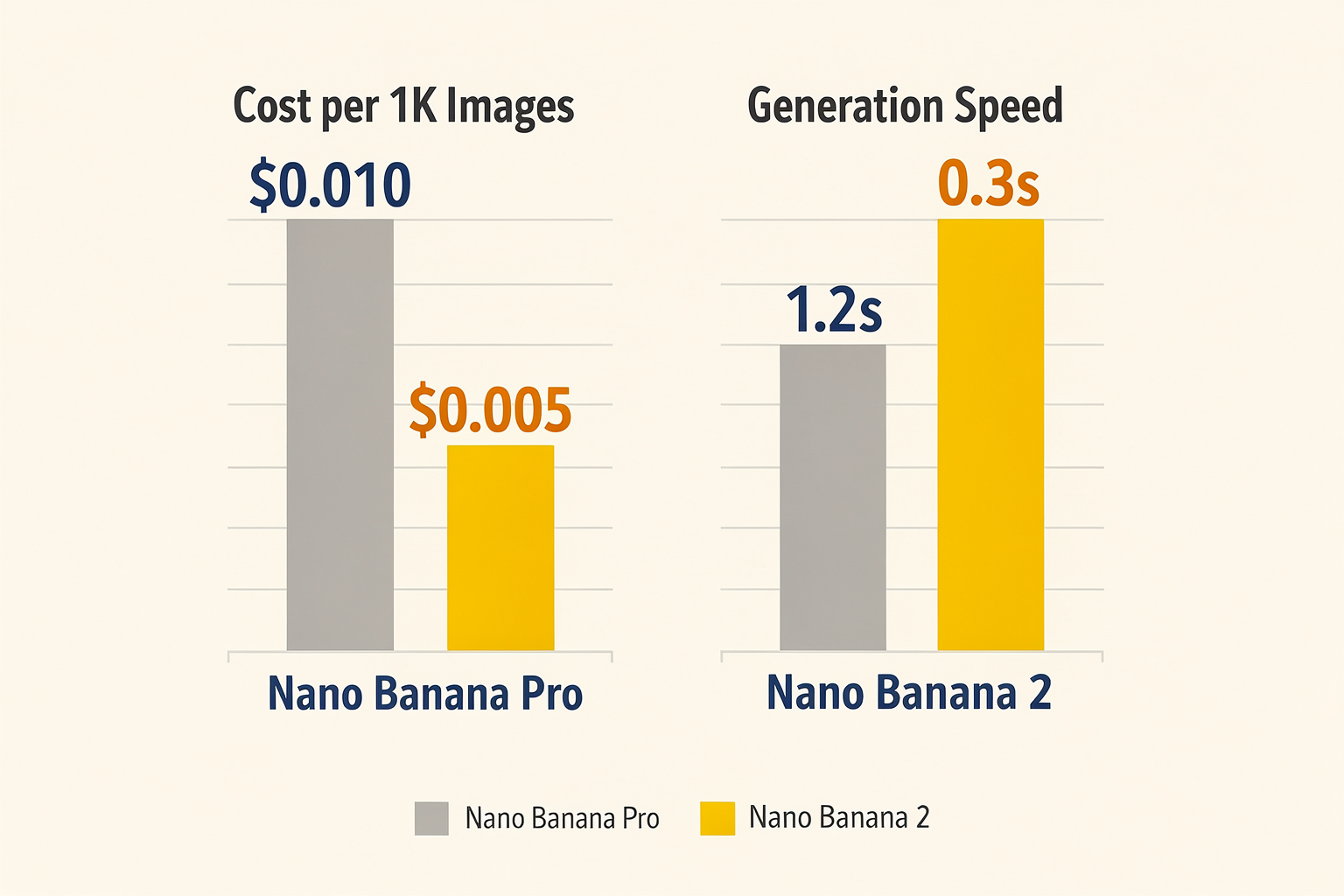
For years, enterprise adoption of generative AI for imagery has been bottlenecked by a frustrating trade-off: computational latency versus visual fidelity. If an organization required Pro-level output—such as precise multi-subject consistency, legible text rendering, and high-resolution details—they had to accept slow generation speeds and high API costs. Conversely, choosing faster, cheaper models meant sacrificing image quality, resulting in distorted features and illegible text.
With the release of Gemini 3.1 Flash Image (Nano Banana 2), Google has systematically dismantled this compromise. By bringing Pro-tier reasoning, native 4K output, and unmatched intelligence to a highly optimized architecture, Nano Banana 2 establishes a new benchmark for speed, operational efficiency, and cost-effectiveness.
The 4x Velocity Leap: Why Milliseconds Matter in Production
In consumer-facing applications, latency is the ultimate killer of user experience. Whether it is an e-commerce platform dynamically generating customized product mockups or a gaming application rendering assets on the fly, a delay of several seconds leads to user drop-offs and lower engagement.
Nano Banana 2 solves this bottleneck by delivering generation and editing workflows that are approximately four times faster than its predecessor, Nano Banana Pro.
This dramatic speed improvement redefines what is possible with real-time image pipelines:
- Interactive Design Loops: Graphic designers and marketing teams can iterate on complex edits in near-real-time, eliminating the workflow interruptions associated with older, heavier models.
- On-the-Fly Personalization: Platforms can generate tailored marketing banners or personalized user avatars instantly during a live web session, matching the speed of modern web delivery.
- Rapid Prototyping at Scale: Creative agencies can generate dozens of concept variations in the time it previously took to render a single, high-fidelity draft.
By achieving "Flash-tier" speeds without degrading visual output, Nano Banana 2 transitions AI image generation from a asynchronous background task to a synchronous, real-time feature.
Halving the Cost of Creative Scale
For enterprises looking to scale their creative pipelines, speed is only half of the equation; the underlying compute costs can quickly become prohibitive when processing millions of images. Nano Banana 2 changes the economic math of generative AI by costing roughly half as much per image as Nano Banana Pro.
This 50% reduction in API pricing has massive implications for operational budgets:
- High-Volume Catalog Generation: For global e-commerce brands managing hundreds of thousands of SKUs, generating custom background variations for every product listing goes from a multi-million-dollar infrastructure expense to a highly viable, low-cost marketing strategy.
- Dynamic Social Campaigns: Marketing teams can scale hyper-targeted visual campaigns across hundreds of demographic segments without risking budget overruns.
- Low-Risk A/B Testing: Product managers can continuously test multiple visual assets simultaneously, knowing that the cost of generating new variations is no longer a limiting factor.
By democratizing access to high-fidelity, low-latency image generation, Google is enabling organizations of all sizes to transition their visual pipelines entirely to the cloud.
Architectural Efficiency and Multi-Model Synergies
How does Nano Banana 2 achieve these cost and speed milestones while simultaneously improving image quality features like native 4K rendering and multi-subject consistency? The answer lies in the unified architecture of the Gemini 3.1 Flash ecosystem.
Rather than treating image generation as an isolated task, Google built Nano Banana 2 to leverage the core reasoning, intelligence, and native multimodal capabilities of Gemini 3.1. Through advanced hardware-software co-design on Google’s proprietary TPUs and sophisticated model distillation techniques, the model minimizes the parameters required to achieve elite visual outputs.
This focus on structural efficiency mirrors the wider industry shift toward specialized, multi-model architectures. Organizations are realizing that deploying massive, general-purpose models for every task is economically unsustainable.
For developers and enterprises navigating this complex ecosystem, managing these specialized models requires robust backend infrastructure. Platforms like CallMissed are simplifying this transition. While Nano Banana 2 redefines efficiency in the visual realm, CallMissed provides businesses with unified access to a multi-model API gateway supporting 300+ LLMs, advanced Speech-to-Text APIs native to 22 Indian languages, and production-ready voice agents. This enables developers to orchestrate high-speed image generation pipelines alongside ultra-low-latency, multilingual communication workflows from a single, centralized platform.
Built-In Security with SynthID: Protection Without Overhead
In high-volume production environments, security, compliance, and IP protection cannot be treated as slow, post-processing steps. To address the growing need for digital provenance and brand safety, Nano Banana 2 features native integration with Google’s SynthID.
Every image created or modified using Gemini 3.1 Flash Image models automatically includes an invisible digital watermark. SynthID watermarks are embedded directly into the pixels of the image, making them:
- Imperceptible to the Human Eye: The watermarks do not compromise the visual fidelity, color accuracy, or clarity of the native 4K output.
- Resilient to Modifications: Even if the image is cropped, resized, compressed, or heavily edited, the watermark remains detectable by authorized verification systems.
- Zero Latency Penalty: Because SynthID is built directly into the generation process itself, it adds no computational overhead, ensuring that Nano Banana 2 maintains its 4x speed advantage.
As global regulations around AI-generated content tighten, having a fast, cost-effective model that natively handles verification and digital watermarking provides enterprises with crucial peace of mind without impacting their bottom line.
Key Capabilities: Text Legibility and Multi-Subject Consistency
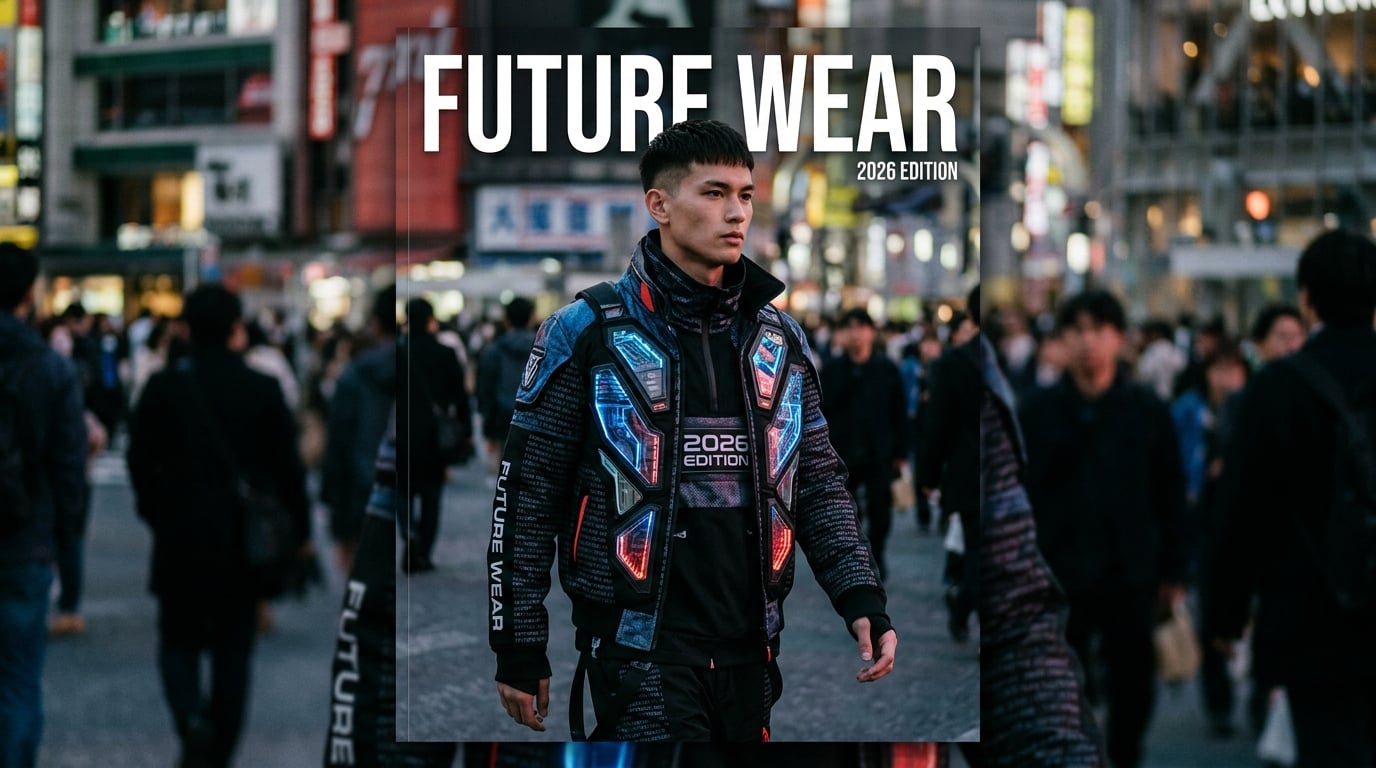
When analyzing what sets Nano Banana 2 (technically known as Gemini 3.1 Flash Image) apart from legacy text-to-image models, two perennial pain points of generative AI come to the forefront: typography rendering and complex scene layout. For years, AI image generators struggled to spell simple words or maintain separation between multiple distinct characters or objects in a single frame.
By inheriting the multimodal reasoning of Google’s Gemini 3.1 Flash ecosystem, Nano Banana 2 fundamentally changes the game. It delivers Pro-level visual fidelity, exceptional text legibility, and remarkable multi-subject consistency—all while operating at the ultra-high speeds and low costs characteristic of the Flash model tier.
Pixel-Perfect Text Legibility
Historically, generating an image containing readable text was an exercise in frustration. Users often ended up with scrambled, runic characters or bizarre gibberish. Nano Banana 2 overcomes this limitation by integrating deep linguistic reasoning directly into its visual generation pipeline.
The model's text legibility capabilities enable it to render crisp, clean, and orthographically correct typography across a wide array of artistic styles. Whether you are generating a retro neon sign, a modern corporate logo, a book cover, or a busy street scene filled with billboards, the text aligns perfectly with the specified font style, perspective, and lighting.
Key advancements in typography handling include:
- Contextual Spelling: The model accurately spells complex phrases, brand names, and slogans without dropping letters or merging characters.
- Perspective and Warp Alignment: Text is not merely pasted onto the image as a 2D overlay; it bends, curves, and casts shadows realistically based on the 3D geometry of the generated environment.
- Diverse Font Stylization: From elegant cursive calligraphy to bold, industrial block lettering, the model understands stylistic prompts and renders them with high artistic consistency.
This breakthrough is a massive win for marketing teams, UI/UX designers, and content creators who previously had to spend hours in post-production software manually clean up warped AI text.
Masterful Multi-Subject Consistency and Spatial Reasoning
Another common pitfall for traditional generative models is "attribute bleeding." If you prompt an older model to draw "a cat wearing a red collar sitting next to a dog wearing a blue scarf," there is a high probability the cat will end up with the blue scarf or the dog will inherit the red collar.
Nano Banana 2 mitigates this issue through advanced spatial reasoning and multi-subject consistency. By leveraging the underlying cognitive power of Gemini 3.1 Flash, the model treats each subject in a prompt as a distinct entity with its own set of independent descriptors. This allows creators to build highly complex, narrative-driven scenes containing multiple characters, objects, and background elements without key details bleeding into one another.
This high-level consistency manifests in several ways:
- Strict Attribute Separation: The model successfully isolates colors, clothing, textures, and accessories to their respective subjects.
- Spatial and Relative Positioning: It accurately interprets spatial prepositions such as "to the left of," "suspended above," "nestled behind," or "in the foreground," creating highly structured compositions that match the user’s exact intent.
- Proportional Scalability: Multiple subjects are rendered with realistic relative sizing, avoiding the awkward scaling issues that often break immersion in synthetic media.
Bridging the Gap: Real-World Multimodal Workflows
In a production environment, image generation does not happen in a vacuum. To build truly immersive digital experiences, developers and enterprises must bridge the gap between high-fidelity visuals, natural language processing, and automated voice communications.
This is where advanced communication infrastructures enter the picture. By using platforms like CallMissed, developers can deploy AI voice agents and WhatsApp chatbots that interact with users in 22 regional Indian languages, seamlessly backed by an LLM inference gateway supporting over 300 models.
For instance, an e-commerce brand could use CallMissed to power an automated WhatsApp sales assistant. When a customer describes their dream custom t-shirt design via voice or text, the system can instantly call the Nano Banana 2 API to generate a high-resolution, perfectly spelled mockup of the apparel, sending it back to the customer's chat in seconds. This level of cross-functional multimodal automation is what makes the current era of AI communication so powerful.
Speed, Scale, and Responsible Deployment
Perhaps the most impressive aspect of Nano Banana 2’s feature set is that these Pro-tier capabilities do not require Pro-tier budgets or processing times.
According to technical benchmarks, Nano Banana 2 is approximately four times faster and costs roughly half as much per image as its predecessor, Nano Banana Pro. It supports native 4K resolution outputs, meaning creators can scale these highly legible, multi-subject compositions for large-format print and high-definition digital displays without relying on muddy upscaling tools.
Furthermore, Google has built robust safety protocols into this high-speed pipeline. Every single image generated or edited using the Gemini 3.1 Flash Image models includes an invisible, tamper-resistant SynthID digital watermark. This ensures that even as synthetic imagery becomes indistinguishable from real photography, businesses and developers can maintain transparency, adhere to compliance standards, and clearly identify AI-generated content across the web.
Safety and Security: Invisible Watermarking via SynthID
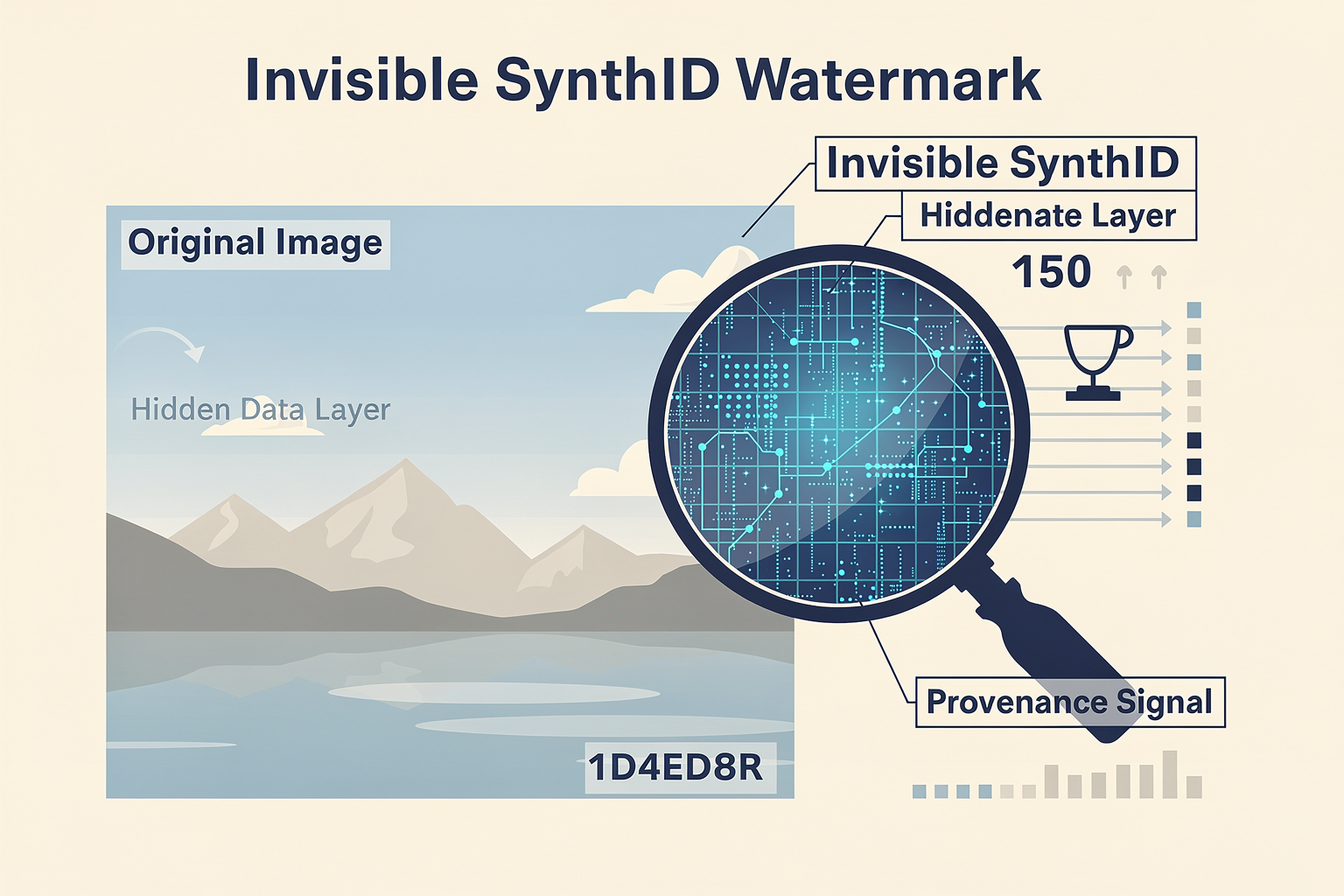
In the rapidly advancing landscape of generative AI, visual realism is no longer the final frontier—trust is. As models like Gemini 3.1 Flash Image (popularly known as Nano Banana 2) push the boundaries of visual synthesis with native 4K output, exceptional text rendering, and multi-subject consistency, the line between authentic photography and synthetic media has virtually vanished.
To address the profound ethical, legal, and security challenges of this new era, Google has integrated defense mechanisms directly into the model’s generation pipeline. Chief among these safety features is the native implementation of SynthID—Google DeepMind's state-of-the-art technology for watermarking and identifying AI-generated content. By embedding an invisible, highly resilient digital watermark into every output, Nano Banana 2 sets a new industry standard for responsible AI deployment.
The Architecture of SynthID: How Invisible Watermarking Works
Traditional methods of labeling AI-generated media typically rely on metadata. While metadata standards like the C2PA (Coalition for Content Provenance and Authenticity) are valuable, they suffer from a fundamental vulnerability: they can be easily stripped out. A simple screenshot, a format conversion (e.g., converting a PNG to a WebP), or uploading an image to a social media platform that scrubs metadata is enough to erase any trace of an image's AI origins.
SynthID solves this vulnerability by bypassing metadata altogether. Instead, it embeds the watermark directly into the pixel data of the image.
- Pixel-Level Embedding: SynthID uses two deep learning models—one for embedding and one for detection—that have been trained together. The embedding model makes subtle, mathematically precise adjustments to the pixels of the generated image.
- Visual Imperceptibility: These pixel alterations are carefully calibrated to align with human visual perception. To the human eye, the watermark is completely invisible; the image retains its "Pro-level" intelligence, sharp textures, high dynamic range, and color fidelity.
- The Detection Phase: When an image is run through Google’s SynthID detection tool, the companion model analyzes the pixel patterns to identify the unique signature. Rather than giving a simplistic binary answer, the detector provides a confidence score indicating the likelihood that the image was generated or edited by Gemini 3.1 Flash Image.
Unmatched Resilience Against Image Manipulation
For a digital watermark to be effective in the real world, it must survive the chaos of internet distribution. Bad actors and casual users alike constantly alter images, often inadvertently stripping away security features.
SynthID was designed from the ground up to be highly robust. Google’s testing demonstrates that the digital watermark embedded by Nano Banana 2 remains highly detectable even after undergoing severe post-processing modifications:
- Heavy Compression: Even when compressed into low-quality JPEG formats for fast web loading, the structural pixel changes remain intact.
- Cropping and Resizing: Users can crop out parts of the image or scale the dimensions up or down without destroying the signature.
- Color and Contrast Adjustments: Applying filters, changing brightness, or shifting color balances does not alter the underlying watermark pattern enough to trick the detector.
- Adding Noise or Blurring: Even when adversarial noise is added to the image to deliberately confuse AI detectors, SynthID maintains a remarkably high detection accuracy.
This level of resilience makes Nano Banana 2 an incredibly safe choice for enterprise applications where content attribution and brand safety are paramount.
Enterprise Compliance and Brand Safety
For modern businesses, deploying AI image generation tools comes with a unique set of liabilities. Brands must navigate copyright concerns, avoid accidental misinformation, and ensure compliance with emerging global AI regulations (such as the EU AI Act), which mandate the clear labeling of synthetic media.
By standardizing SynthID across all creations and edits, Nano Banana 2 provides enterprises with a turn-key compliance solution. Organizations can confidently scale their creative production, knowing that their synthetic assets are transparently and permanently marked as AI-generated.
This is particularly crucial for organizations managing complex, automated customer experiences. For instance, businesses deploying cutting-edge communication infrastructures via platforms like CallMissed—which seamlessly routes API requests to over 300+ LLMs and multimodal engines—can utilize Nano Banana 2 to dynamically generate visual assets for messaging campaigns, digital receipts, or interactive customer portals. Because CallMissed enables developers to build secure, multi-lingual, and multi-modal AI systems, pairing its robust infrastructure with Nano Banana 2’s built-in SynthID protection ensures that all automated customer touchpoints remain ethically compliant, transparent, and completely secure against brand spoofing.
Comprehensive Safety Filters and Guardrails
While SynthID serves as the primary post-generation security layer, Nano Banana 2 also features advanced pre-generation guardrails. Built on the core safety principles of the Gemini ecosystem, the model includes real-time content moderation filters designed to block the creation of harmful content before a single pixel is rendered.
These safety guardrails are continuously updated to prevent:
- Non-Consensual Deepfakes: Restricting the generation of photorealistic images depicting real, public, or private individuals without consent.
- Hate Speech and Harassment: Blocking prompts intended to generate discriminatory, violent, or abusive imagery.
- Misinformation Campaigns: Preventing the creation of deceptive political imagery or simulated historical events designed to mislead the public.
- Intellectual Property Protection: Filtering prompts that attempt to directly copy copyrighted characters or corporate trademarks, safeguarding businesses from potential litigation.
By combining proactive content filtering with the reactive, permanent traceability of SynthID, Google has transformed Nano Banana 2 from a mere creative powerhouse into one of the most commercially viable and secure image models available on the market today. As generative AI continues to integrate deeper into business operations, this dual-layered security framework will likely become the benchmark that all competing models are measured against.
Performance Benchmarks: How It Beats the Field
When Google released the original Nano Banana Pro, it set a high benchmark for creative control. However, in enterprise settings, image generation models have traditionally been constrained by a frustrating trade-off: you could have high-fidelity, high-resolution images, or you could have rapid generation speeds and low API costs—but rarely both.
Enter Nano Banana 2 (officially known as Gemini 3.1 Flash Image). This model fundamentally disrupts this paradigm by bringing Pro-level intelligence, native high-resolution output, and enhanced creative precision down to the hyper-efficient Flash tier.
The definitive benchmarks demonstrate exactly how Nano Banana 2 outperforms the field across speed, cost, and visual fidelity.
The Raw Speed and Cost Breakthroughs
For production-grade applications—such as dynamic ad generation, real-time gaming assets, or automated content creation workflows—latency is the ultimate bottleneck.
According to performance data, Nano Banana 2 is approximately four times faster than its predecessor, Nano Banana Pro. This 4x speedup is accompanied by a massive economic advantage: it costs roughly half as much per image to run.
This represents an unprecedented leap in efficiency. In a standard enterprise pipeline processing millions of images per month, cutting latency by 75% while slashing inference bills by 50% shifts image generation from an expensive batch process to an instantaneous, real-time feature.
This matches the broader trend of developers demanding faster, more flexible AI pipelines. Platforms like CallMissed make it easier to capitalize on these leaps by offering a unified API gateway to over 300+ LLMs and specialized AI models. When models like Gemini 3.1 Flash Image lower the barrier to entry for multimodal applications, infrastructure layers that seamlessly route traffic, handle Speech-to-Text in 22 regional languages, and manage voice agents become vital for building responsive, end-to-end user experiences.
Image Resolution and Visual Fidelity Benchmarks
Beyond raw speed, Nano Banana 2 redefines what "Flash-tier" models can visually output. Historically, fast models compromised on spatial detail and text formatting. Nano Banana 2 shatters these limitations through several key architectural benchmarks:
- Native 4K Resolution Support: Instead of relying on clumsy post-processing upscalers that introduce unwanted artifacts, Nano Banana 2 supports high-fidelity native 4K image generation. This ensures ultra-sharp details directly from the inference stage.
- Multi-Subject Consistency: Maintaining thematic and physical consistency across multiple characters or objects has been a notorious pain point in diffusion pipelines. Nano Banana 2 utilizes Gemini 3.1's advanced reasoning capabilities to track relationships between multiple subjects in a single frame, ensuring realistic proportions, lighting, and depth.
- Legible Text Rendering: One of the clearest indicators of an image model's spatial intelligence is its ability to render text. Nano Banana 2 excels at embedding sharp, legible, and contextually accurate text into images—ranging from product labels and billboards to complex UI mockups.
Leveraging Gemini 3.1 Reasoning and Multi-Modal Inputs
Nano Banana 2 is not just an isolated image generation model; it is built on the backbone of the Gemini 3.1 Flash architecture. This means it inherits the core cognitive and reasoning capabilities of Google's flagship multimodal ecosystem.
- Multimodal Input/Output Capability: The model accepts both text prompts and existing images as inputs (supporting a flexible "Text and images in, image out" workflow). This enables seamless, high-speed image-to-image editing, style transfers, and visual reasoning tasks. It processes these inputs with deep conceptual awareness, meaning it understands "why" an edit is being requested, rather than just performing pixel-level alterations blindly.
- Invisible SynthID Digital Watermarking: Security and provenance are major concerns for enterprise deployments. Gemini 3.1 Flash Image models natively integrate Google's SynthID invisible digital watermarks directly into the generation process. Benchmarks show that SynthID provides robust identification of AI-generated content without degrading image fidelity, pixel clarity, or slowing down generation speeds.
Comparative Field Analysis
To understand how Nano Banana 2 stands against the current landscape of image generation models, let’s compare it across key technical vectors:
| Model | Generation Speed | Cost Index | Max Native Resolution | Primary Strength |
|---|---|---|---|---|
| Nano Banana 2 (Gemini 3.1 Flash) | Ultra-Fast (4x faster than Pro) | Low (~50% cheaper than Pro) | Native 4K | Superior text legibility & multi-subject consistency |
| Nano Banana Pro | Moderate (1x baseline) | High (2x baseline) | 1080p / 2K | Complex creative styling |
| Leading Pro-Tier Competitors | Slow to Moderate | High | up to 2K (native) | Extremely artistic texture |
| Standard Flash-Tier Competitors | Fast | Low | 1024 x 1024 | Simple speed-focused tasks |
This comparison highlights that Nano Banana 2 successfully bridges the gap. It delivers the speed and cost efficiency of a lightweight "Flash" model, yet matches or exceeds the visual fidelity, text rendering, and resolution of premium, resource-heavy alternatives.
Enterprise Outlook
Ultimately, Nano Banana 2 establishes a new standard for what developers can expect from production AI. By combining the cognitive depth of Gemini 3.1's reasoning with highly optimized image generation pipelines, it eliminates the artificial barrier between "fast and cheap" and "high-quality."
For companies looking to build the next generation of interactive, multimodal applications—whether that involves deploying intelligent voice agents that generate visuals on the fly, or building multi-lingual platforms that serve global markets—leveraging cutting-edge models through robust communication infrastructures like CallMissed is the key to scaling without friction. Nano Banana 2 isn't just a marginal upgrade; it is a blueprint for the future of scalable visual AI.
Pros and Cons (TABLE)
To truly appreciate how Google’s Gemini 3.1 Flash Image (popularly known as Nano Banana 2) has redefined the landscape of generative AI, we must analyze its real-world performance trade-offs. While the predecessor, Nano Banana Pro, laid the groundwork for high-fidelity visual outputs, it often struggled with the high latency and prohibitive costs that prevent enterprise-scale adoption.
Nano Banana 2 addresses these pain points head-on. By merging the reasoning capabilities of the Gemini 3.1 Flash ecosystem with advanced image-generation pipelines, Google has created an engine optimized for speed, precision, and cost-efficiency. Below is a comprehensive breakdown of the core pros, cons, and performance metrics of this breakthrough model.
| Metric / Dimension | Gemini 3.1 Flash Image (Nano Banana 2) | Core Advantages (Pros) | Key Trade-offs (Cons) | Practical Application |
|---|---|---|---|---|
| Speed & Latency | ~4x faster generation times than Nano Banana Pro | Sub-second rendering; perfect for real-time user experiences and interactive UI elements. | Extremely complex, nested prompts can occasionally drop micro-details in the background. | Instant dynamic mockups, live conversational visual assistants. |
| Cost Efficiency | ~50% cheaper per image compared to predecessor | Drastically lowers the barrier to entry for high-volume batch generations and startups. | High-frequency API spikes still require robust token/rate-limit management. | Programmatic ad creation, large-scale e-commerce asset generation. |
| Output Quality | Native 4K resolution support | Ultra-crisp lines, professional-grade fidelity, and multi-subject visual consistency. | Native 4K generation increases system overhead for on-premise pipeline integrations. | Premium digital banners, print-ready marketing materials. |
| Text Legibility | Specialized text-rendering neural layers | Unprecedented spelling accuracy and clean font rendering embedded directly in images. | Highly stylized, abstract, or cursive text may still exhibit minor skewing or warping. | Localized promotional banners, personalized infographics. |
| Safety & Tracking | Integrated Google SynthID digital watermarking | Invisible, tamper-resistant watermarks protect intellectual property and guarantee origin. | Strict content moderation filters can occasionally flag benign, edge-case creative prompts. | Enterprise compliance, brand-safe marketing campaigns. |
Analyzing the Pros: Why Nano Banana 2 Leads the Field
#### 1. Unmatched Speed and Cost Dynamics
The standout achievement of Gemini 3.1 Flash Image is its operational efficiency. Operating at four times the speed of Nano Banana Pro while cutting per-image API costs in half, this model transitions AI image generation from a slow, batch-oriented process into a real-time utility. For enterprises, this means the financial risk of experimenting with personalized visual content drops significantly, allowing developers to run large-scale A/B tests on creative assets without blowing past their budgets.
#### 2. Superior Text Rendering and Multi-Subject Consistency
Historically, AI image generators have treated text as a secondary, often scrambled, visual texture. Nano Banana 2 overcomes this by leveraging the underlying multi-modal intelligence of Gemini 3.1. It understands semantic context, allowing it to render legible, correctly spelled English and multilingual text directly onto signs, labels, and digital interfaces. Furthermore, its ability to maintain multi-subject consistency ensures that if a user requests a sequence of images featuring the same character or product in different settings, the visual identity remains stable.
#### 3. Native 4K Resolution and Enterprise-Grade Safety
Rather than relying on resource-heavy upscaling models that often introduce artificial artifacts, Nano Banana 2 generates images with native 4K clarity. This is paired with Google's SynthID technology—an invisible, robust digital watermark embedded directly into the pixels. SynthID cannot be removed by basic cropping, resizing, or color adjustments, giving enterprises a critical layer of compliance and security to prove AI origin and protect creative assets.
Understanding the Cons: Where Nano Banana 2 Demands Caution
#### 1. The "Flash" Latency Trade-Off
To achieve its blistering speed, Gemini 3.1 Flash Image utilizes a highly optimized neural architecture. While this is a massive benefit for 95% of business use cases, it can occasionally lead to minor trade-offs in highly abstract, multi-layered compositions. If you input a prompt containing dozens of unique, hyper-specific background elements, the model may deprioritize the rendering of distant objects to maintain its sub-second latency targets.
#### 2. Strict Content Moderation Guardrails
Because Nano Banana 2 is built with enterprise safety at its core, Google’s safety filters are exceptionally robust. While this prevents the generation of deepfakes and copyrighted material, creative agencies working on edgy or highly stylized fantasy campaigns may find the filters overly sensitive. Developers must carefully craft prompts to avoid triggering false-positive blocks on benign words that the system flags as potentially risky.
The Developer's Dilemma: Orchestrating Visual and Conversational Workflows
While having access to a lightning-fast, highly legible image generation model like Nano Banana 2 is a massive win, the true challenge lies in integrating these visuals into user-facing production systems. For instance, generating a personalized product recommendation image in real-time is useless if you cannot deliver it instantly to a customer via their preferred communication channel.
This is where unified communication infrastructures bridge the gap. Platforms like CallMissed allow developers to orchestrate these cutting-edge AI capabilities seamlessly. While CallMissed is renowned for its low-latency AI voice agents, WhatsApp chatbots, and robust Speech-to-Text APIs supporting 22 regional Indian languages, its multi-model LLM gateway (supporting over 300+ models) allows businesses to trigger visual generation workflows programmatically.
By pairing the real-time visual output of Nano Banana 2 with CallMissed's multi-channel messaging infrastructure, brands can deploy automated customer service agents that don't just speak or text—they can instantly generate and send personalized, native-4K visual receipts, customized event invitations, or interactive infographics directly to a user's WhatsApp chat in seconds. This synergy turns raw generative power into practical, high-impact customer experiences.
Comparison with Alternatives (TABLE)
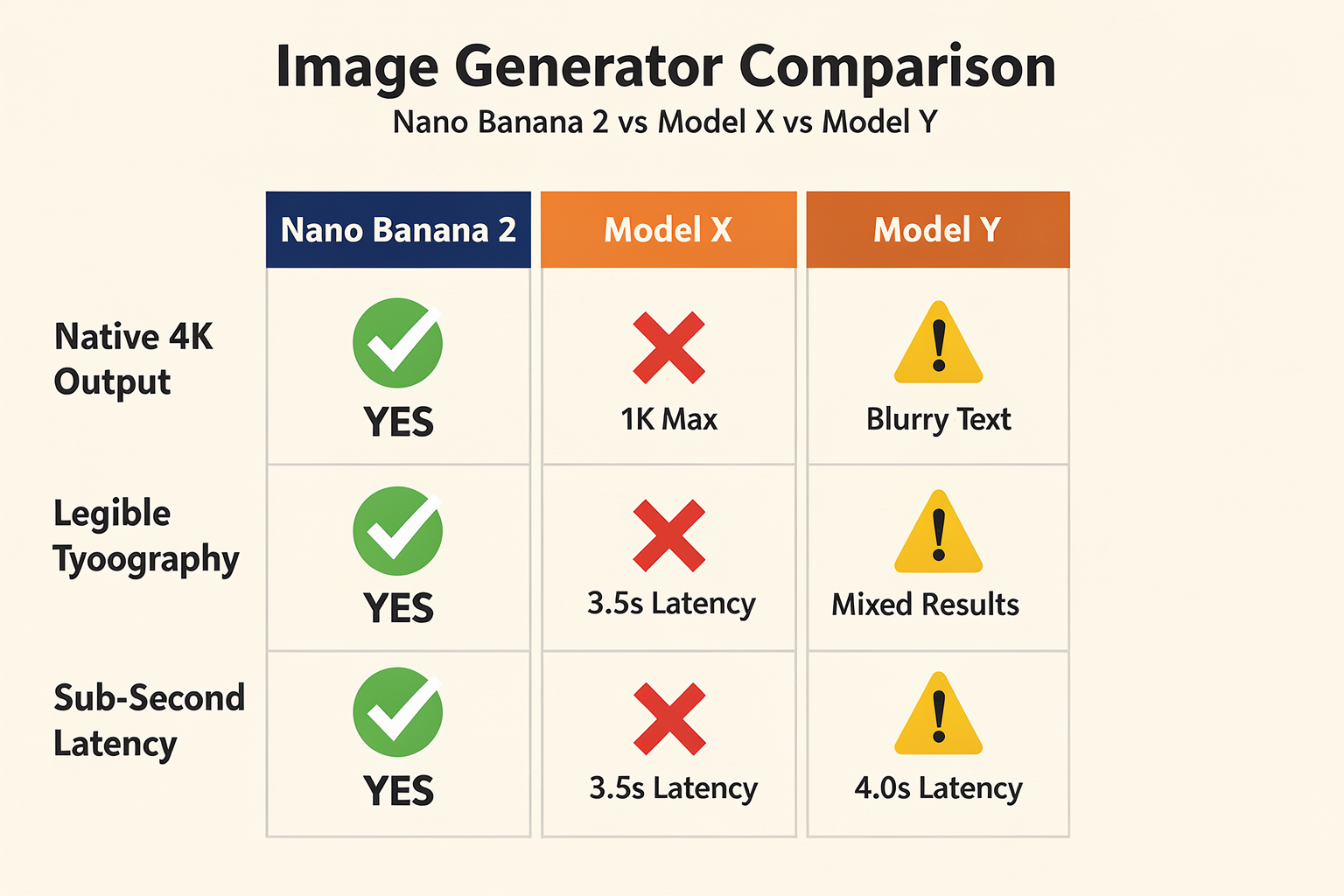
To truly appreciate the engineering leap behind Gemini 3.1 Flash Image—affectionately dubbed Nano Banana 2—it must be evaluated against the broader generative AI landscape. The market has shifted away from simply producing artistic, stylized images to demanding functional, enterprise-grade assets. Modern workflows require ultra-low latency, legible typographical rendering, cost efficiency at scale, and bulletproof safety features.
In this comparative analysis, we benchmark Nano Banana 2 against its predecessor, Nano Banana Pro, alongside industry benchmarks including OpenAI’s DALL-E 3, Midjourney v6, and Black Forest Labs’ Flux.1 (Schnell).
| Model Name | Generation Speed | Max Resolution | Cost Efficiency | Key Strengths |
|---|---|---|---|---|
| Gemini 3.1 Flash Image (Nano Banana 2) | Ultra-Fast (Flash-tier) | Native 4K | Extremely High (~50% of Pro) | Legible text, multi-subject consistency, SynthID watermarking |
| Nano Banana Pro | Moderate | Native 2K / 4K | Medium | Intricate creative styling, deep prompt compliance |
| DALL-E 3 | Moderate | 1024 x 1024 | Low (High API cost) | Exceptionally simple prompt adherence via ChatGPT |
| Midjourney v6 | Slow (Batch-based) | Up to 2K (Upscaled) | Subscription-based | Unrivaled photorealism, complex cinematic textures |
| Flux.1 (Schnell) | Fast (Distilled) | Up to 2K | Low (Self-hosted) | Strong anatomy, open-weights versatility |
Architectural Speed and Cost Efficiency
For developers building user-facing applications, latency and API costs are the primary barriers to scale. This is the exact bottleneck Google targeted with the Gemini 3.1 Flash architecture.
Nano Banana 2 is approximately four times faster than its predecessor, Nano Banana Pro, while simultaneously cutting generation costs roughly in half. In high-throughput environments—such as dynamic ad generation or real-time gaming assets—this cost reduction changes the economics of AI imaging.
While open-weights models like Flux.1 (Schnell) offer competitive speeds when hosted on dedicated local hardware, they require significant upfront infrastructure investment. On the proprietary API front, DALL-E 3 remains comparatively slow and expensive, making it difficult to deploy for real-time, interactive applications. Nano Banana 2 delivers "Pro-level" quality at a fraction of the time and cost, establishing a new Pareto frontier for the industry.
Text Legibility and Multi-Subject Consistency
Historically, AI image generators struggled with rendering coherent text, often producing unreadable, alien-like glyphs. Nano Banana 2 solves this by pulling directly from the deep semantic reasoning capabilities of the broader Gemini ecosystem. It understands not just the visual structure of letters, but the contextual meaning of the words it is asked to render.
Furthermore, Nano Banana 2 introduces robust multi-subject consistency. In creative workflows—such as generating a sequential storyboard or a multi-panel marketing campaign—prior models struggled to keep characters, objects, and backgrounds visually uniform across multiple generations. Nano Banana 2 excels at keeping core subjects consistent across different angles, lighting setups, and environments, outperforming DALL-E 3 and matching the complex prompt-adherence capabilities of Midjourney v6 without the associated rendering lag.
Resolution and Enterprise Safety Features
While many platforms rely on post-processing upscalers to reach high resolutions, Nano Banana 2 generates images natively at up to 4K resolution. This native generation prevents the artifacting and "waxy" textures often introduced by secondary upscaling networks, ensuring that fine details—such as fabric textures, hair, and complex user interface elements—remain sharp and professional.
Importantly for enterprise applications, Google has fully integrated SynthID digital watermarking directly into the generation pipeline of Gemini 3.1 Flash Image. Unlike metadata-based tags that can be easily stripped, SynthID embeds an invisible, tamper-resistant watermark directly into the image pixels. Even if the image is cropped, compressed, or heavily edited, the watermark remains detectable. This provides a crucial layer of provenance and safety, giving enterprise legal teams peace of mind when deploying AI-generated visuals at scale.
Unified Workflows and Multimodal Integration
In production environments, image generation does not happen in a vacuum. It is typically one step in a larger conversational or analytical workflow. Having to juggle separate APIs for text models, speech recognition, and image generation adds unnecessary complexity and latency.
This is where advanced communication infrastructure platforms like CallMissed become invaluable. CallMissed acts as an intelligent API gateway supporting over 300+ LLMs, alongside specialized tools like Speech-to-Text (supporting 22 Indian languages) and Text-to-Speech APIs. By integrating Nano Banana 2 into a unified ecosystem like CallMissed, developers can build incredibly sophisticated systems.
For instance, an automated customer service voice agent built on CallMissed can handle an incoming call, transcribe a user's verbal product customization request, process the logic through a fast text model, and instantly call the Gemini 3.1 Flash Image API to generate and text back a native 4K product mockup to the user's phone in seconds. By bypassing fragmented infrastructure, businesses can unlock the true speed of "Flash-tier" models.
Real-World Applications: From Marketing to Enterprise

The transition of generative AI from a novelty tool in creative sandboxes to a core driver of enterprise ROI requires three things: speed, cost-efficiency, and absolute reliability. While earlier image generation models delivered stunning visuals, they often stumbled on enterprise requirements like precise text rendering, high-resolution output, and predictable pricing.
With Gemini 3.1 Flash Image (Nano Banana 2), Google has directly addressed these enterprise pain points. By operating at four times the speed and half the cost of its predecessor, Nano Banana Pro, while maintaining native 4K output and Pro-level intelligence, this model is reshaping workflows across industries. From high-velocity marketing to secure corporate environments, here is how organizations are deploying Nano Banana 2 in the real world.
1. Dynamic, Hyper-Localized Marketing Campaigns
Modern marketing demands personalization at a scale that manual design teams cannot support. Nano Banana 2 allows brands to generate and edit high-fidelity marketing assets instantly, adapting creative materials to specific demographics, regions, or real-time trends.
- Multi-Subject Consistency: Marketing teams can maintain brand guidelines by keeping key subjects (such as a recurring mascot or a specific product packaging design) identical across hundreds of different background scenes and seasonal contexts.
- Legible Text Rendering: Unlike older models that produced garbled text, Nano Banana 2 natively renders crisp, readable copy directly onto billboards, product labels, or social media overlays within the generated image.
- Cost-Efficient Variations: Because the model cuts generation costs by roughly 50% compared to Pro-tier models, running massive A/B tests with thousands of visual variations is now financially viable for mid-sized brands.
To maximize the impact of these localized visual campaigns, forward-thinking enterprises are pairing them with conversational AI. For example, brands using CallMissed to deploy multilingual AI voice agents across 22 regional Indian languages can dynamically generate corresponding visual ad campaigns using Nano Banana 2, ensuring that both the voice interactions and the visual marketing speak directly to local cultures in their native languages.
2. Next-Generation E-Commerce and Digital Showrooms
In e-commerce, product imagery directly correlates with conversion rates. Traditional photoshoot pipelines are slow, expensive, and rigid. Nano Banana 2 introduces a paradigm shift by serving as an automated, high-fidelity virtual studio.
- Native 4K Product Staging: Retailers can upload a basic photo of a product and use Gemini 3.1 Flash Image's advanced image-to-image capabilities to place that product in premium, high-resolution 4K environments—such as a modern living room or a sunny beach—without losing the intricate details of the product itself.
- Interactive Inpainting and Editing: If an e-commerce platform wants to let customers visualize a piece of furniture in different colors or fabrics, Nano Banana 2 can execute these precise edits in seconds. Its flash-tier speed means these changes can happen in real time on the customer-facing website.
- Context-Aware Scene Generation: The model leverages the deep reasoning and intelligence of the Gemini ecosystem, allowing it to understand complex prompts like "a minimalist kitchen setting during golden hour, reflecting soft light off the metallic surface of the blender."
3. Compliant and Secure Enterprise Content Operations
For large enterprises, legal compliance and brand safety are just as important as visual quality. Google has built Nano Banana 2 with enterprise-grade safety and tracking mechanisms baked directly into the model’s core.
- Invisible SynthID Watermarking: Every image generated or edited using Gemini 3.1 Flash Image automatically includes an invisible SynthID digital watermark. This watermark remains detectable even if the image is cropped, compressed, or heavily edited, allowing enterprises to maintain clear tracking of AI-generated assets and protect themselves against copyright and authenticity disputes.
- Consistent Brand Safety Safeguards: Backed by Google’s rigorous safety filters, the model reduces the risk of generating inappropriate, copyrighted, or off-brand imagery, giving legal and compliance teams peace of mind when integrating the API into automated internal workflows.
Managing these enterprise pipelines often requires orchestrating multiple AI capabilities at once. Platforms like CallMissed simplify this complexity by providing a unified multi-model API gateway. Developers can route text prompts through specialized LLMs for brand-safety screening and creative refinement before passing the optimized prompt to Nano Banana 2 for final image generation, establishing a seamless, secure, and fully automated creative pipeline.
4. Rapid UI/UX Prototyping and Wireframing
Design and product development teams are leveraging Nano Banana 2 to radically accelerate the brainstorming and wireframing phases of software development.
Because the model excels at rendering legible text and maintaining spatial logic, designers can generate incredibly detailed mockups of mobile applications, website landing pages, and dashboard interfaces. Instead of spending hours building static mockups in vector design tools, teams can simply prompt Nano Banana 2 to "generate a clean, dark-mode dashboard for a financial analytics app showing a bar chart, a line graph, and a legible navigation menu."
Within seconds, the team has a high-fidelity visual concept that they can present to stakeholders for immediate feedback, cutting down the initial design phase from days to minutes.
Frequently Asked Questions
What is Gemini 3.1 Flash Image and how does it relate to Nano Banana 2?
How much faster and cheaper is Nano Banana 2 compared to its predecessor?
What are the key technical features of the Gemini 3.1 Flash Image model?
Does Gemini 3.1 Flash Image include built-in watermarking for AI-generated content?
What input and output modalities does Nano Banana 2 support for developers?
How can developers integrate Nano Banana 2 into production-ready commercial applications?
Looking Ahead: The Future of Google's Visual Intelligence
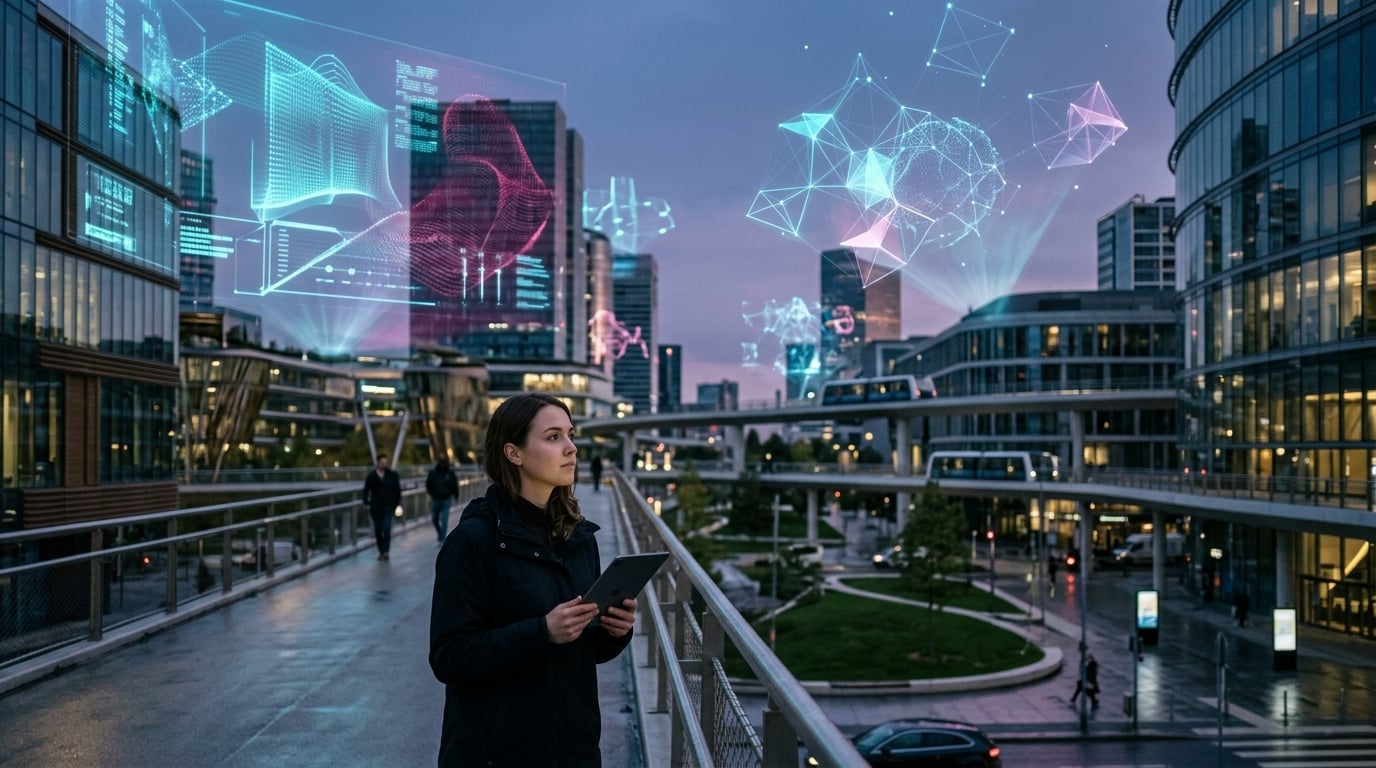
The launch of Nano Banana 2 (Gemini 3.1 Flash Image) marks a decisive turning point in how we conceptualize, generate, and interact with digital media. By merging the speed and cost efficiency of a lightweight model with the deep reasoning and high-fidelity output traditionally reserved for massive proprietary giants, Google has done more than just release a faster image generator. They have fundamentally rewritten the playbook for visual AI.
As we look toward the horizon of Google’s visual intelligence ecosystem, we see a future where static text-to-image prompts are a relic of the past. Instead, the industry is moving rapidly toward continuous, context-aware, and agentic visual workflows that blend seamlessly with voice, text, and environmental data.
The Convergence of Reasoning and Generation
Historically, AI image models operated in a cognitive vacuum. They were exceptional at pattern matching and aesthetic composition, but notoriously poor at logical reasoning, spatial arrangement, and rendering legible text. When asked to generate a complex scene featuring multiple subjects interacting in highly specific ways, older models frequently hallucinated overlapping limbs, ignored positioning directives, or rendered garbled, alien-like lettering.
Nano Banana 2 changes this paradigm by embedding the native multimodal reasoning of the Gemini 3.1 architecture directly into the generative loop. This integration allows the model to "think" about the spatial relationship of objects before rendering them. In practice, this delivers:
- True Multi-Subject Consistency: The model maintains the distinct visual identities of multiple distinct characters or objects within a single frame, preventing their features from bleeding into one another.
- Flawless Typographic Rendering: By utilizing the underlying language intelligence of Gemini 3.1, the model renders highly legible, contextually accurate text directly onto physical surfaces within the image, such as signs, labels, or digital screens.
- Profound Spatial Awareness: Complex compositional prompts—such as "a red coffee mug placed precisely three inches to the left of a blue leather notebook, with a soft shadow cast to the right"—are executed with surgical precision.
This convergence of cognitive reasoning and creative generation hints at a future where Google's visual models will not just draw what we ask, but truly understand the physics, logic, and context of the scenes they are creating.
Real-Time Visual Agents and Multi-Sensory UX
The remarkable performance metrics of Nano Banana 2—operating at roughly four times the speed and half the cost per image of its predecessor, Nano Banana Pro—open up entirely new avenues for real-time applications. We are moving away from batch-processing workflows where a user waits 15 seconds for a grid of images, and toward dynamic, interactive visual agents that generate and edit assets on the fly.
In an enterprise environment, this speed allows visual intelligence to be woven into real-time customer experiences. For example, an e-commerce platform can dynamically alter product imagery to match a shopper’s local weather, cultural context, or aesthetic preferences in milliseconds.
For organizations building these next-generation interfaces, the real magic happens when you couple visual power with auditory and textual intelligence. By leveraging unified communication infrastructures like CallMissed, developers can feed real-time visual streams from Gemini 3.1 Flash Image directly into conversational workflows. This enables agentic systems that can simultaneously see, interpret, and speak—orchestrating interactions through CallMissed’s LLM gateway (which supports over 300+ models) and its robust Speech-to-Text and Text-to-Speech APIs that natively support 22 regional Indian languages. When visual generation becomes this fast and affordable, it becomes a natural extension of real-time communication.
Securing the Synthetic Web: SynthID and Digital Provenance
As generative visual models reach a level of fidelity where synthetic images are indistinguishable from real photographs, the question of safety and authenticity becomes paramount. Google has taken a proactive stance on this front by building SynthID directly into the core of Gemini 3.1 Flash Image.
SynthID embeds an invisible, imperceptible digital watermark directly into the pixels of every image generated or edited by the model. Unlike traditional metadata, which can be easily stripped, or visible watermarks, which can be cropped out, SynthID survives significant post-processing modifications, including:
- Heavy file compression and format conversions.
- Resizing, cropping, and rotation of the image canvas.
- Color adjustments, filters, and brightness modifications.
By embedding digital provenance directly into the model's output, Google is setting a new industry standard for responsible AI deployment. As regulatory bodies worldwide demand stricter safeguards against deepfakes and misinformation, this built-in watermarking infrastructure ensures that enterprises can deploy visual AI at scale without exposing themselves to compliance or reputational risks.
Dematerializing the Pro vs. Flash Divide
For years, developers faced a harsh compromise: choose a "Pro" model for high-fidelity, production-grade output, or settle for a "Flash" model to maintain viable speeds and operating budgets. Nano Banana 2 effectively dissolves this barrier. By delivering native 4K resolution, impeccable text rendering, and high-fidelity editing features at a fraction of the cost, Google has democratized professional-grade visual generation.
This economic shift means that startups and mid-sized enterprises are no longer priced out of building sophisticated visual applications. It levels the playing field, allowing developers to run millions of visual generation and editing cycles daily without exhausting their cloud budgets.
Whether you are orchestrating complex, automated customer support loops or building highly personalized, immersive marketing engines, the future lies in platforms that unify these modal touchpoints. Platforms like CallMissed make this integration effortless, allowing enterprise developers to seamlessly link voice agent infrastructures and automated chat channels directly with downstream, high-fidelity visual models like Nano Banana 2 without writing complex, fragmented pipeline code.
As Google continues to iterate on its Gemini ecosystem, the line between seeing, thinking, and creating will continue to blur. Nano Banana 2 is not just a milestone in image generation; it is a preview of a highly integrated, multi-sensory digital world.
Conclusion
The arrival of Nano Banana 2 (Gemini 3.1 Flash Image) marks a decisive moment in the evolution of generative AI, proving that developers no longer have to compromise between Pro-level quality and Flash-tier speed. By seamlessly blending deep visual reasoning with rapid execution, Google has set a new benchmark for multimodal applications.
Here are the key takeaways from this breakthrough:
- Pro-Level Fidelity at Flash Speed: Nano Banana 2 delivers stunning native 4K resolution, robust multi-subject consistency, and incredibly crisp, legible text rendering.
- Unrivaled Cost Efficiency: It operates roughly four times faster than its predecessor at approximately half the cost per image, making high-end visual generation accessible at scale.
- Built-in Security and Safety: The native integration of Google's invisible SynthID digital watermarking ensures that AI-generated assets remain identifiable and safe for enterprise deployment.
Looking ahead, we are rapidly moving toward a future where ultra-fast image generation and complex reasoning merge into single, unified user experiences. We will soon see digital assistants that don't just talk, but instantly visualize concepts, design interfaces, and modify graphics in real-time during live customer interactions.
To explore how AI communication is evolving, check out CallMissed — an AI infrastructure platform powering voice agents and multilingual chatbots for businesses. How will your organization leverage these near-instantaneous multimodal capabilities to redefine your customer experience?
Related Posts
Ready to automate customer conversations?
Launch AI voice agents and WhatsApp bots with CallMissed — one API, 22+ Indian languages.