

Mistral Medium 3.5 Review: One Model, Three Product Lines


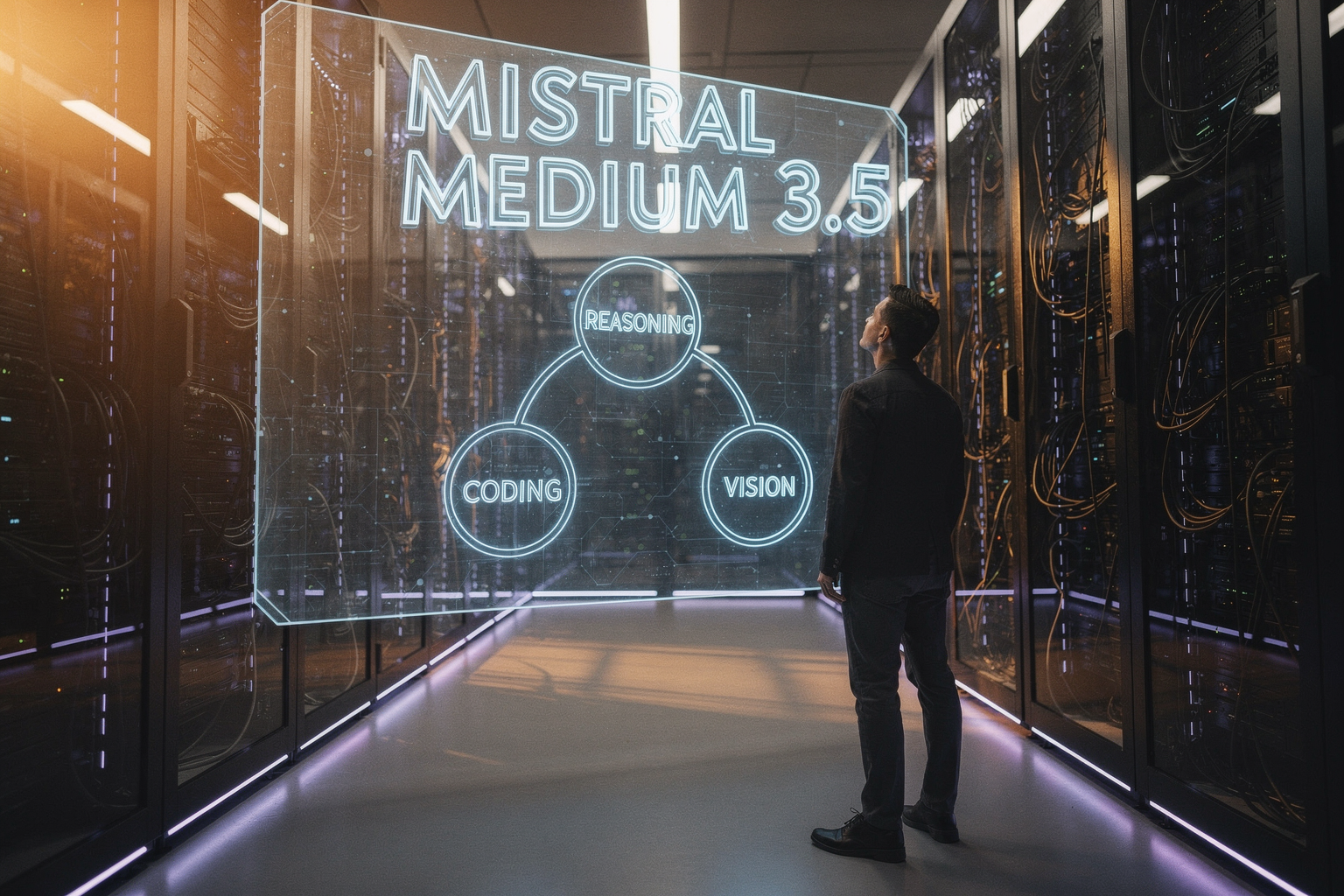
What if a single AI model could seamlessly replace three highly specialized LLMs—handling complex coding, deep logical reasoning, and everyday multimodal...
Mistral Medium 3.5 Review: One Model, Three Product Lines
What if a single AI model could seamlessly replace three highly specialized LLMs—handling complex coding, deep logical reasoning, and everyday multimodal chat—while simultaneously cutting your infrastructure costs in half? In the rapidly evolving landscape of generative AI, developer teams have long grappled with the complexity of "model sprawl." To build a competent AI agent, architects have traditionally been forced to route conversational requests to one model, intense coding tasks to a second, and multi-step logical reasoning to a third. This fragmented approach not only inflates latency but also drives up API integration costs and engineering overhead.
Mistral AI is fundamentally challenging this status quo. With the release of its latest flagship model, the Paris-based AI pioneer has introduced a unified solution that consolidates three distinct product lines into one. This Mistral Medium 3.5 Review takes an in-depth look at this remarkable 128B dense model and explores how it successfully merges what used to be entirely separate model weights into a single, highly optimized engine.
Specifically, Mistral Medium 3.5 is designed to replace three specialized predecessors: the conversational Mistral Medium 3.1, the reasoning-heavy Magistral (previously powering Le Chat's advanced cognitive tasks), and the developer-centric Devstral 2 (the engine behind their coding agent, Vibe). By folding these three distinct workflows—chat, deep reasoning, and specialized code generation—into a single 128-billion parameter architecture, Mistral is offering a "one-stop-shop" for frontier-class performance.
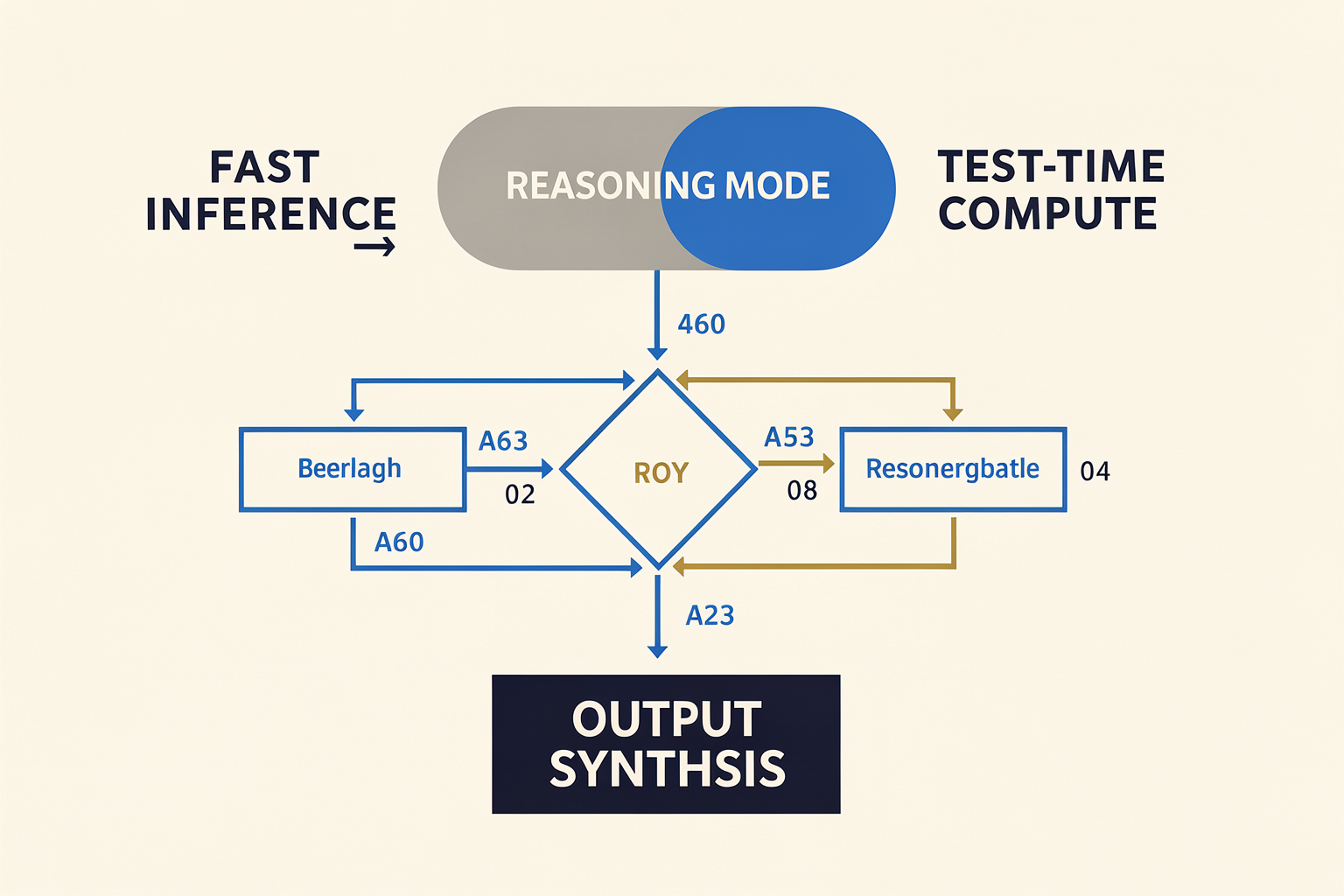
But why does this matter so much today? As we navigate a year where autonomous AI agents are transitioning from novelty proof-of-concepts to mission-critical production systems, reliability is everything. Mistral Medium 3.5 has been engineered specifically for "long-horizon tasks, calling multiple tools reliably, and producing structured output that downstream systems can digest without breaking," as highlighted in its recent integration into Microsoft’s Copilot Studio. With an active reasoning toggle that allows developers to trigger deeper test-time compute on demand, the model provides the flexibility to scale cognitive power exactly when a task demands it—such as during complex math, logical deduction, or code debugging—and conserve resources when handling simpler conversational interactions.
For enterprises looking to build next-generation communication tools, matching the right model to the right task is crucial. Multilingual, high-performance platforms like CallMissed solve this by allowing developers to integrate Mistral Medium 3.5 alongside over 300 other LLMs, providing a robust infrastructure to deploy intelligent voice agents and chatbots without complex, multi-provider code overhauls.
In this Mistral Medium 3.5 Review, we will put Mistral’s "three-in-one" claim to the test. We will analyze the model's core architecture, dive deep into the mechanics of its test-time compute reasoning toggle, and review its performance across industry-standard benchmarks like coding and vision tasks. Finally, we will assess the economic reality of Mistral's pricing model to help you determine if this consolidated 128B powerhouse is the ultimate engine to fuel your production-grade AI agents.
Introduction
The artificial intelligence landscape has undergone a massive paradigm shift. For years, the industry operated under a philosophy of hyper-specialization. Developers and enterprise architects were forced to maintain highly fragmented AI pipelines: deploying one model for general instruction-following, another highly specialized model for complex codebase generation, and yet another resource-heavy model for deep mathematical reasoning. This fragmented approach introduced massive architectural overhead, high latency, and complex API routing tables that hindered production-grade agentic workflows.
Mistral AI has disrupted this status quo with the release of Mistral Medium 3.5. Positioned as a frontier-class, multimodal 128B dense model, Mistral Medium 3.5 achieves a remarkable feat: it consolidates three previously distinct product lines into a single, highly optimized set of weights. By merging what used to be separate architectures for chat, deep reasoning, and specialized code generation, Mistral is offering a "one model, three jobs" solution that delivers state-of-the-art capabilities at half the operational cost of its predecessors.
This comprehensive review explores how Mistral Medium 3.5 redefines open-weight frontier modeling, analyzes its underlying architecture, and details how it simplifies the deployment of next-generation AI agents.
The End of Pipeline Fragmentation: One Model, Three Product Lines
Historically, developers relying on Mistral's ecosystem had to navigate a complex matrix of models depending on their specific task requirements. If you were building a conversational agent, you utilized Mistral Medium 3.1 or Magistral. If your focus was automated software engineering, you had to integrate Devstral 2 into your coding workflows.
Mistral Medium 3.5 completely unifies this fragmented landscape. Under the hood of this single 128B dense model, Mistral has successfully folded three primary workflows:
- Conversational Intelligence & Instruction-Following: It natively replaces Mistral Medium 3.1 and Magistral inside Mistral’s flagship conversational platform, Le Chat. It exhibits highly refined instruction-following capabilities, nuanced tone control, and excellent multi-turn dialogue management.
- Advanced Code Generation: It replaces Devstral 2 in Mistral's specialized coding agent, Vibe. With a highly competitive coding index, Medium 3.5 handles complex syntax, multi-file code editing, and architectural design with ease.
- Deep System-2 Reasoning: By introducing a dedicated reasoning toggle, the model can allocate deeper test-time compute to unpack highly complex, multi-step logical problems, mathematical proofs, and analytical queries.
By folding these distinct capabilities into a single model, enterprises no longer need to orchestrate complex routing layers to send coding tasks to one API and reasoning tasks to another.
Core Architectural Breakthroughs
Mistral Medium 3.5 is not just an incremental update; it is a ground-up consolidation of Mistral's best engineering practices. Several core technical pillars set this model apart:
- Dense 128B Parameter Architecture: Unlike Mistral's famous Mixture-of-Experts (MoE) models, Medium 3.5 utilizes a dense parameter structure. This dense layout ensures highly stable, predictable performance across highly diverse tasks without the routing anomalies sometimes associated with MoE setups.
- Native Multimodality (Vision-to-Text): The model natively supports both text and image inputs, outputting high-fidelity text. This allows users to feed complex charts, technical schematics, or UI screenshots directly into the model for debugging, analysis, or translation into code.
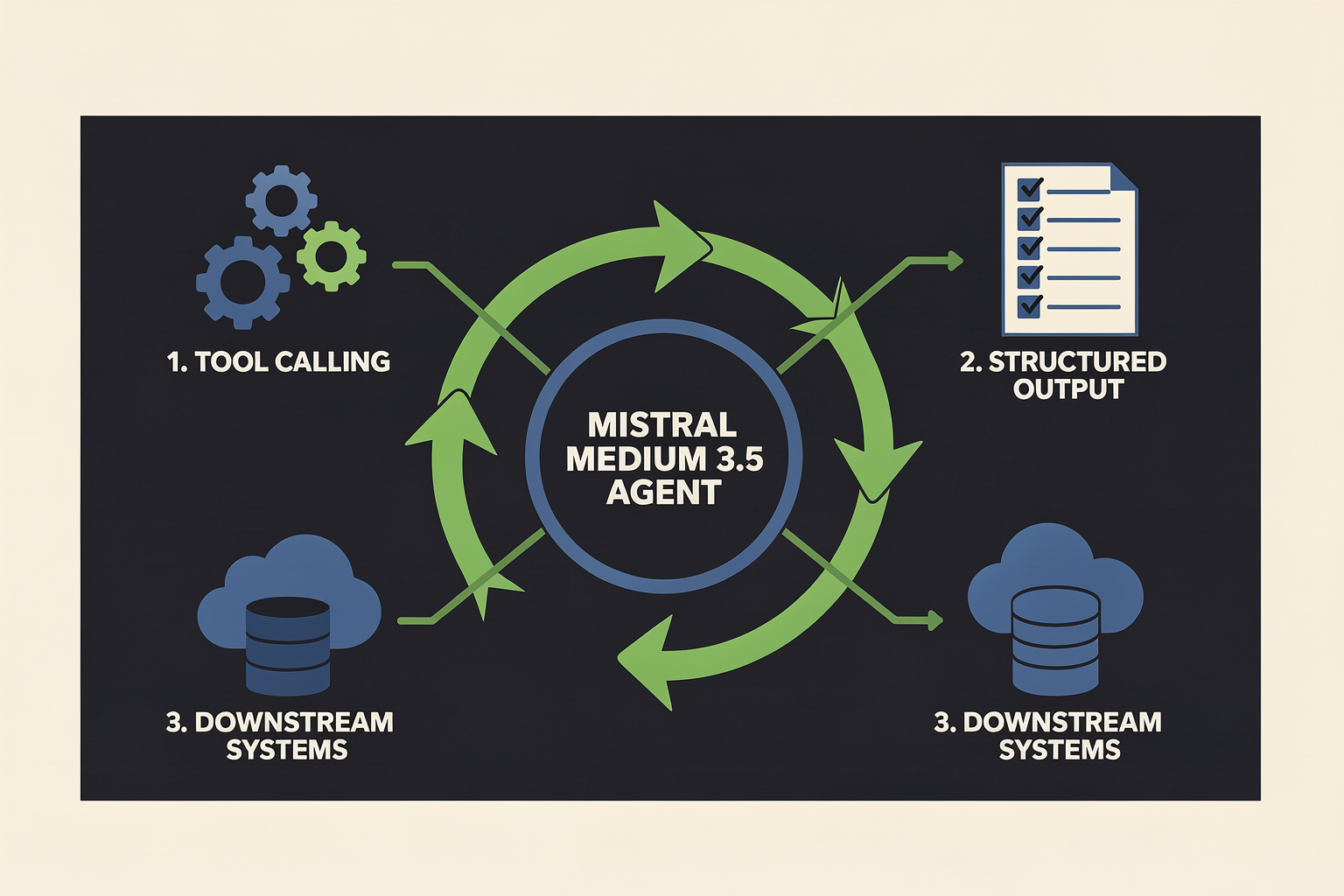
- Native Tool Calling and Structured Output: Built specifically for long-horizon agentic workflows, the model reliably calls external APIs, executes multi-step tool sequences, and guarantees structured JSON outputs. This reliability makes it a premier choice for integration into enterprise orchestration frameworks like Microsoft Copilot Studio.
- 128k Context Window: With a massive context length, the model can ingest extensive documentation, codebases, or legal transcripts, maintaining high retrieval accuracy across the entire context window.
Redefining Enterprise Deployment and Accessibility
Deploying a 128B dense model at scale requires robust, high-throughput infrastructure. As businesses transition from prototype to production, the choice of inference platform becomes critical.
Modern communications and AI routing platforms are adapting rapidly to support this unified model class. For instance, CallMissed enables seamless integration of frontier models like Mistral Medium 3.5 into production-ready business workflows. Through CallMissed’s multi-model API gateway, developers can query over 300+ LLMs—including Mistral’s latest releases—while effortlessly coupling them with specialized communication tools. This allows organizations to build highly intelligent AI voice agents, deploy multilingual chatbots with native Speech-to-Text (supporting 22 Indian languages), and automate customer touchpoints using ultra-low latency infrastructure.
By simplifying the backend infrastructure, platforms like CallMissed complement Mistral's unified model approach—ensuring that developers can easily harness the reasoning, coding, and conversational power of Mistral Medium 3.5 without managing complex, multi-vendor integrations.
The Economic Equation: "Half the Price"
Beyond its technical capabilities, the most compelling aspect of Mistral Medium 3.5 is its economic efficiency. Mistral has positioned this flagship model as a highly cost-effective alternative to proprietary frontier models, offering its unified capabilities at approximately half the price of comparable legacy pipelines.
By consolidating chat, code, and reasoning into one set of weights, organizations significantly reduce their hosting complexity, cooling requirements, and API overhead. Instead of paying premium rates for multiple specialized APIs, developers can standardize on a single, highly efficient 128B model that handles every phase of an enterprise application's lifecycle.
In the sections that follow, we will conduct a deep-dive review of Mistral Medium 3.5, putting its reasoning toggle, coding proficiency, and agentic capabilities to the test to see if it truly lives up to its "one model, three jobs" promise.
Overview & Specifications (TABLE)
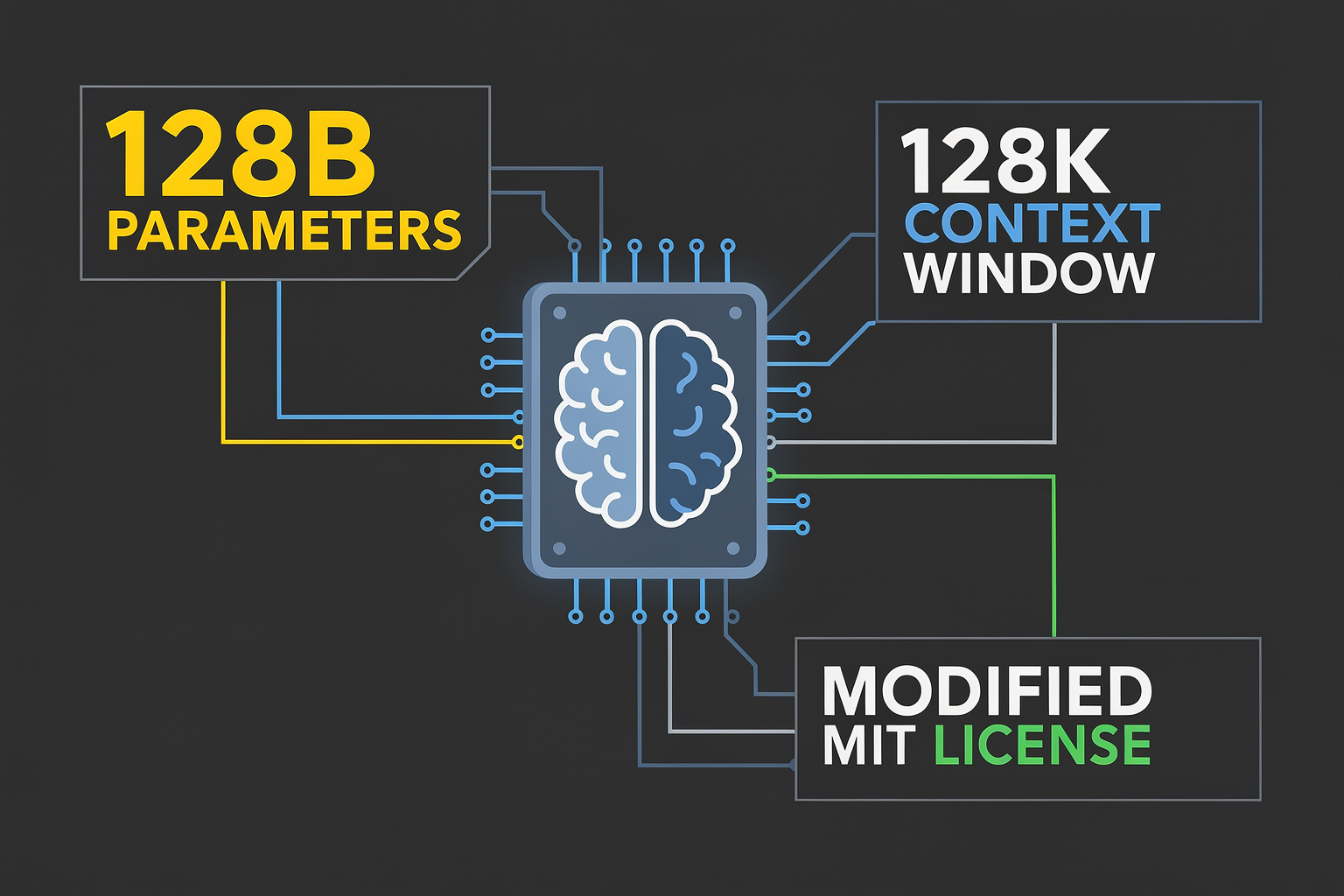
Mistral AI has systematically redefined its portfolio with the launch of Mistral Medium 3.5, a frontier-class model that executes a bold architectural consolidation. Previously, developers and enterprises had to juggle multiple specialized models depending on the task: Mistral Medium 3.1 handled general-purpose instruction and high-quality chat, Magistral acted as the reasoning engine behind advanced queries in Mistral's Le Chat interface, and Devstral 2 served as the dedicated backbone for complex coding workflows within their coding agent, Vibe.
With the debut of Mistral Medium 3.5, these three product lines have been folded into a single, unified 128B dense parameter model. This integration represents a major shift in Mistral’s product philosophy—moving away from hyper-specialized, disjointed weights and moving toward a single multi-capable engine designed for complex, long-horizon tasks, agentic tool-use, coding, and vision-based multimodal analysis.
Below is a detailed breakdown of the technical specifications, architectural parameters, and replacement paths for Mistral Medium 3.5.
| Technical Specification | Detail & Configuration | Operational & Developer Impact |
|---|---|---|
| Model Size & Class | 128 Billion Parameters (Dense) | Unified weights eliminate routing overhead inherent in Mixture-of-Experts (MoE) systems. |
| Supported Modalities | Multimodal (Text & Image Inputs, Text Output) | Powers vision-to-code pipelines, complex chart analysis, and visual document parsing. |
| Legacy Models Replaced | Mistral Medium 3.1, Magistral, Devstral 2 | Consolidates code generation, advanced reasoning, and conversation into one API. |
| Reasoning Mechanics | Adaptive Test-Time Compute (Reasoning Toggle) | Scales computational depth on-demand for rigorous logic, math, and debugging tasks. |
| Optimized Environments | Microsoft Copilot Studio, Vibe Coding Agent, Le Chat | Native agentic infrastructure optimized for multi-turn planning and secure tool calling. |
Unifying Three Distinct Workloads Into One Model
To understand the engineering achievement of Mistral Medium 3.5, it is essential to analyze the workloads it consolidates. Traditionally, large language model providers optimized performance by training separate models for distinct verticals. This approach forced developers to build intricate routing middleware to direct prompts to the most cost-effective and capable model.
Mistral Medium 3.5 eliminates this operational complexity by unifying three core capabilities:
- Frontier-Class General Instruction & Multimodality: Replacing Mistral Medium 3.1, the 3.5 iteration introduces native vision capabilities. It processes complex layouts, technical diagrams, and visual inputs, generating highly structured text outputs (such as strict JSON) that are easily consumed by downstream software applications.
- Deep Reasoning & Logic: By replacing Magistral, Medium 3.5 features a built-in reasoning toggle. This enables developers to dynamically scale up test-time compute. When activated, the model allocates deeper internal generation steps to solve complex mathematical proofs, execute multi-step logic, and evaluate intricate edge cases.
- Advanced Code Generation: Taking over the duties of Devstral 2 in the Vibe coding environment, Mistral Medium 3.5 scores exceptionally high on code execution benchmarks. It excels at writing syntactically correct code, translating legacy codebases, and debugging deeply nested software architectures.
By bundling these capabilities into a single set of 128B weights, Mistral has created a versatile Swiss Army knife for enterprise workflows, cutting deployment overhead and simplifying prompt management.
Architectural Strengths: Dense vs. Mixture-of-Experts (MoE)
Unlike Mistral's previous flagship releases that relied on Mixture-of-Experts (MoE) architectures—such as Mixtral 8x22B—Mistral Medium 3.5 is a dense 128B model. While MoE architectures offer inference speed advantages by only activating a fraction of their total parameters per token, dense models excel in deep context retention, steady token throughput, and cross-domain task synthesis.
For agentic workflows, where a model must maintain a coherent plan across dozens of tool calls, dense models provide highly reliable outputs. Mistral Medium 3.5 has been specifically tuned for long-horizon tasks. When integrated into platforms like Microsoft Copilot Studio, it demonstrates high reliability in calling external APIs, executing database queries, and maintaining state over extended execution paths.
This stability is vital for enterprise applications. For example, developers using multi-model API gateways can deploy Medium 3.5 to handle complex orchestration tasks that demand absolute precision. Communication platforms like CallMissed allow businesses to deploy these agentic capabilities directly into production environments. By utilizing CallMissed’s unified inference infrastructure—which supports over 300+ models—enterprises can route intricate user interactions, multi-lingual translation, and custom tool calling to Mistral Medium 3.5, ensuring that automated customer interactions remain context-aware and accurate.
The Economic Equation: "One Model, Half the Price"
Beyond its architectural consolidation, the defining market advantage of Mistral Medium 3.5 is its pricing structure. By streamlining its training pipelines and optimizing the dense 128B inference engine, Mistral AI is offering this unified model at approximately half the price of its previous-generation frontier models.
This drastic reduction in token cost fundamentally alters the economics of agentic deployment. Building production-grade autonomous agents has historically been cost-prohibitive due to the thousands of tokens consumed during multi-turn reasoning loops, internal chain-of-thought processing, and repeated system prompt evaluations. By cutting token costs in half while simultaneously upgrading reasoning, vision, and coding performance, Mistral Medium 3.5 makes high-frequency agentic loops commercially viable for startups and enterprise developers alike.
The Evolution: Merging Three Product Lines into One
The Fragmentation of Specialized AI Models
Until recently, software architects and enterprise developers faced a persistent operational bottleneck: model fragmentation. To build a truly comprehensive AI assistant, developers had to design complex, brittle routing middleware. If a user needed to draft a technical email, the system routed the query to a conversational model. If the user asked to debug a Python script, the system swapped the context to a dedicated code-generation model. If a multi-step financial analysis was required, yet another high-compute reasoning model had to be invoked.
This approach presented three distinct challenges:
- High Latency: Routing requests between different model APIs introduced significant overhead, degrading the user experience.
- State Synchronization Failures: Passing conversational state, system prompts, and context windows across disparate model architectures often resulted in "context drift" or lost instructions.
- Inflated API Overhead: Maintaining active API keys, rate limits, and billing pipelines for three or four separate specialized models escalated enterprise operational costs.
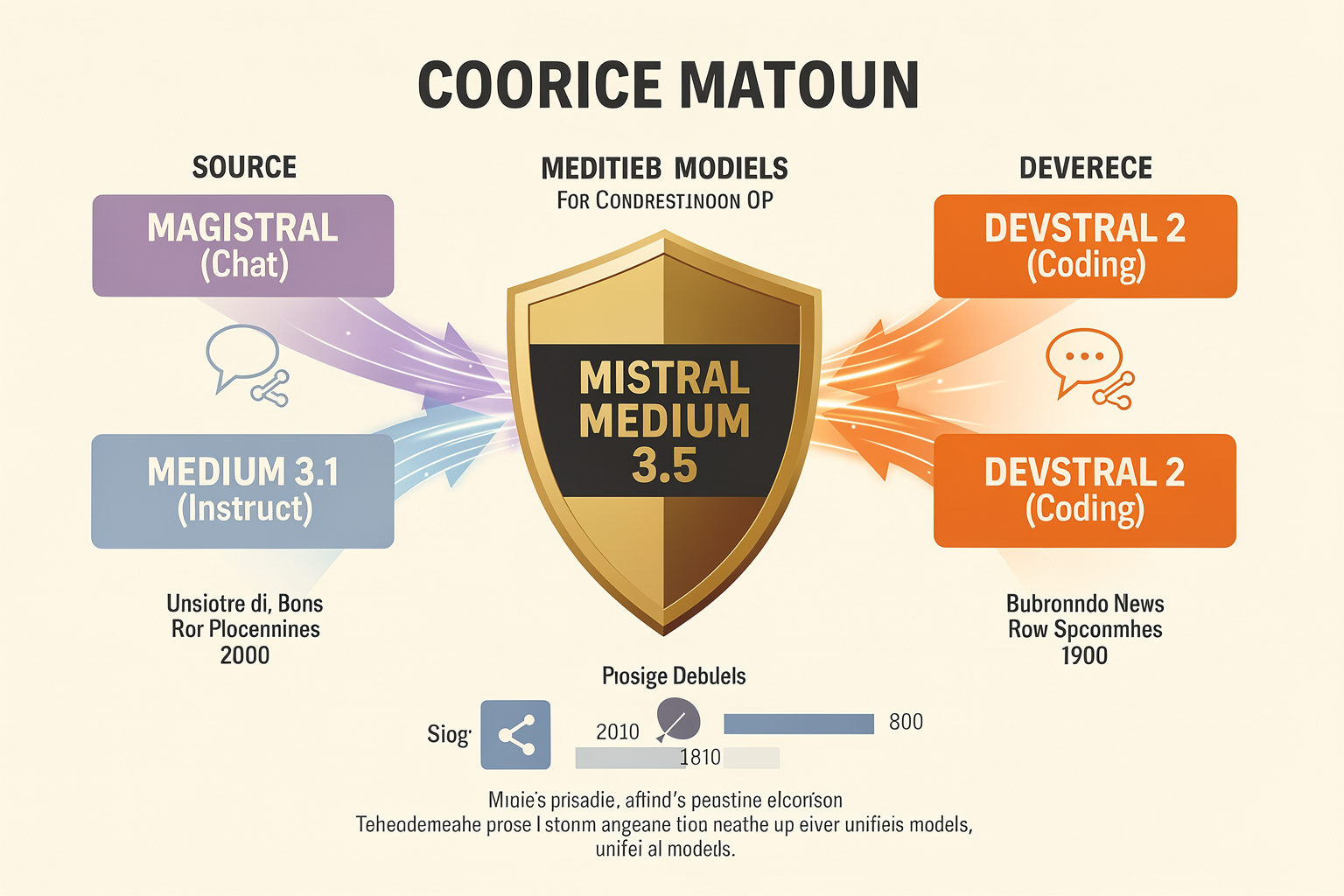
Mistral AI recognized this friction. With the release of Mistral Medium 3.5, they have pioneered a "great consolidation"—folding three previously separate product lines into a single, highly optimized 128B dense model.
Mistral's Great Consolidation: What Is Being Replaced?
To appreciate the architectural leap of Mistral Medium 3.5, it is essential to understand the specific, specialized models it deprecates and unifies. According to official release documentation, Mistral has retired three distinct product streams to make way for this unified flagship:
- The Conversational Line (Mistral Medium 3.1 & Magistral): Previously, general-purpose chat, customer support, and instruction-following tasks were handled by Mistral Medium 3.1 and the specialized Magistral model, which powered Mistral's consumer-facing platform, Le Chat. These models excelled at multi-turn dialogue and natural language understanding but lacked deep technical capabilities.
- The Developer Line (Devstral 2): For software engineering, code generation, and automated testing, Mistral deployed Devstral 2. This model was a dedicated coding engine that powered their internal developer-agent platform, Vibe.
- The Reasoning and Agentic Workflows: Complex logical deduction, multi-tool orchestration, and long-horizon tasks were historically offloaded to specialized agentic frameworks or heavier, test-time compute pipelines.
Mistral Medium 3.5 merges all three capabilities into a single weight-set. It completely replaces Medium 3.1 and Magistral in Le Chat, while simultaneously replacing Devstral 2 in the Vibe coding agent. Developers no longer need to choose between a chat model, a coding model, and a reasoning model—Mistral Medium 3.5 executes all three roles natively.
One Model, Three Jobs: How the Unified Architecture Works
Merging text, code, and logical reasoning into a single 128B parameter dense model is a major engineering feat. Mistral achieved this by optimizing Medium 3.5 for three distinct workflow categories, which are accessible through unified API calls:
1. Advanced Coding and Syntax Execution
By absorbing the DNA of Devstral 2, Mistral Medium 3.5 has emerged as a premier coding model, achieving an impressive 35.4 score on the Kilo Code index. It supports syntax generation, refactoring, and real-time debugging across dozens of programming languages. Because coding is integrated natively into the core weights, the model can seamlessly transition from explaining a high-level architectural concept in natural language to generating clean, production-ready code blocks within the same conversational turn.
2. Multi-Step Reasoning with a Dedicated "Reasoning Toggle"
One of the most innovative features of Mistral Medium 3.5 is its reasoning mode, which leverages a test-time compute toggle. When complex mathematical calculations, scientific analysis, or deep logical chains are required, developers can activate this toggle. This instructs the model to allocate additional internal compute resources to "think" through the problem step-by-step before generating an output. This eliminates the need for external Chain-of-Thought (CoT) prompting frameworks, delivering superior logical accuracy out of the box.
3. Agentic Tool Calling and Vision Integration
To act as a true autonomous agent, a model must do more than write text; it must interact with its environment. Mistral Medium 3.5 natively supports multimodal vision capabilities, enabling it to process both text and image inputs. Furthermore, it is engineered for long-horizon tasks, meaning it can reliably call multiple external tools, execute APIs, and output structured, downstream-compatible data (such as JSON) without losing its place in a complex workflow.
Simplifying the Enterprise Infrastructure Stack
For enterprises building conversational applications, the consolidation represented by Mistral Medium 3.5 simplifies the backend stack. However, even with a single model, deploying and orchestrating these capabilities at scale requires a robust infrastructure layer.
This is where advanced communication platforms bridge the gap. For example, CallMissed provides a production-ready AI communication infrastructure that allows developers to seamlessly deploy models like Mistral Medium 3.5. Through its unified API gateway, developers can access over 300+ LLMs, allowing them to route user queries directly to Medium 3.5's reasoning engine when deep logic is required.
Furthermore, by combining Mistral's advanced agentic capabilities with CallMissed's specialized Speech-to-Text APIs (which support 22 Indian languages) and Text-to-Speech infrastructure, enterprises can build hyper-intelligent, multilingual voice agents. This setup can handle complex customer calls 24/7, reliably calling database tools and explaining technical billing issues in real time.
The Economic and Operational Impact of Unification
By folding three product lines into one, Mistral AI has fundamentally altered the economics of enterprise AI. Historically, utilizing specialized reasoning or coding models carried a heavy premium. Mistral Medium 3.5 disrupts this paradigm by offering its unified capabilities at half the price of its predecessor, Medium 3.1.
This dramatic price reduction, combined with the operational simplicity of managing a single set of API keys, makes high-performance agentic workflows accessible to startups and enterprises alike. Developers can now build systems that read architectural diagrams (using Vision), reason through system dependencies (using the Reasoning Toggle), write the integration scripts (using the Coding Engine), and explain the changes to a client—all powered by a single, cost-effective model.
Design & Build Quality
Architectural Consolidation: The 128B Dense Blueprint
For a software artifact, "design and build quality" refers to its code architecture, resource utilization, and operational stability. In the context of Mistral Medium 3.5, Mistral AI has executed a radical architectural consolidation. Rather than maintaining fragmented pathways for separate specialized tasks, they have engineered a single 128-billion parameter dense model designed to natively handle reasoning, coding, vision, and agentic workflows.
This represents a significant departure from Mistral’s highly popularized Mixture-of-Experts (MoE) design philosophy seen in the Mixtral series. By opting for a massive 128B dense weight distribution, Mistral ensures that every parameter is activated for every token, providing a deeply cohesive semantic representation space. This structural choice minimizes the routing anomalies and token-skipping weaknesses sometimes observed in MoE structures, resulting in exceptional structural integrity for high-complexity, multi-turn interactions.
The "build quality" of this model is further evidenced by its role as an administrative consolidator. Mistral Medium 3.5 officially replaces three distinct legacy product lines:
- Mistral Medium 3.1 (the previous general-purpose instruction model)
- Magistral (the specialized conversational model deployed inside their Le Chat platform)
- Devstral 2 (the highly specific developer code-generation model that powered their coding agent, Vibe)
Folding these disparate weight sets into a unified 128B dense matrix represents a masterpiece of cross-domain distillation and alignment training, ensuring that general instruction-following capabilities do not degrade when executing heavy-duty software engineering tasks.
Dual-Engine Dynamics: The Test-Time Compute Toggle
One of the most innovative design characteristics of Mistral Medium 3.5 is its architectural support for a reasoning mode driven by test-time compute. Typically, LLMs process tokens statically, spending the exact same computational energy on easy words as they do on complex logical puzzles. Mistral Medium 3.5 introduces a paradigm shift in how the model executes:
- Standard Mode: Operates as a highly responsive, low-latency instruction-following and coding tool, optimized for rapid iteration.
- Reasoning Mode: Dynamically scales test-time compute, allowing the underlying layers to engage in deeper internal planning, self-correction, and logical verification before emitting the final response token.
This dual-mode execution is baked directly into the model's design. It allows developers to dictate the performance-to-cost ratio programmatically. If a task requires straightforward translation or basic syntax completion, the standard inference pathway is utilized. If the agent encounters a complex multi-file debugging challenge or a mathematical theorem, activating the reasoning toggle forces the model to engage its deeper computational pathways, vastly reducing hallucinations and structural logical failures.
Multimodal and Agentic Framework Integration
A foundational element of Mistral Medium 3.5's build quality is its native multimodal architecture. Unlike earlier iterations that relied on separate visual adapter wrappers, Medium 3.5 incorporates vision processing directly into its unified neural network. This allows for seamless, low-latency interleaved processing of text and image inputs. This is critical for modern agentic workflows where a model must read a UI screenshot, parse system design diagrams, and write executable code in a single, continuous forward pass.
Furthermore, the model has been structurally hardened for tool calling and agentic dependability. According to integration telemetry—including its high-profile inclusion in Microsoft Copilot Studio—Mistral Medium 3.5 is specifically optimized for:
- Long-horizon execution: Managing context across prolonged multi-step agent operations without losing track of the original system prompt.
- Deterministic tool calling: Reliably translating user instructions into precise APIs, structured JSON schemas, and function parameters.
- Downstream parseability: Emitting rigorously structured output that programmatic parsers can digest without throwing formatting errors.
Deploying and scaling a massive 128B parameter dense model presents substantial infrastructure challenges, demanding robust GPU coordination and optimized inference pipelines. For teams looking to evaluate Mistral Medium 3.5's capabilities alongside other foundational architectures, platforms like CallMissed provide a powerful solution. CallMissed’s unified multi-model API gateway allows developers to access over 300+ LLMs, facilitating seamless switching between Mistral Medium 3.5 and other specialized engines without demanding complex code overhauls. This infrastructure support ensures that the raw power of Medium 3.5's design can be easily integrated into production-ready conversational and agentic systems.
Memory Footprint and the 128K Context Window
Beyond its internal parameter organization, the physical "build" specifications of Mistral Medium 3.5 present concrete operational considerations for machine learning engineers. With a native 128,000-token context window, the model is designed to easily ingest entire code repositories, extensive API documentation, or multi-page technical manuals.
However, keeping a 128B dense model in high-performance memory requires a thoughtful infrastructure footprint. At standard 16-bit precision (FP16), loading the model weights alone demands roughly 256 GB of VRAM, excluding the KV cache overhead required to handle long context sequences. To make this model highly accessible for production environments, Mistral’s architecture has been built with quantization robustness in mind. It retains remarkable precision and structural coherence even when quantized down to INT8 or FP8 configurations, lowering the barrier to entry for enterprise deployments on standard HGX or PCIe GPU clusters.
This resilience to quantization is a testament to the model's uniform weight distribution. In many MoE models, quantizing gating routers can introduce erratic behavior and severe performance degradation. Because Mistral Medium 3.5 utilizes a continuous dense pipeline, the signal degradation across layers remains highly predictable during compression. This makes it an exceptionally durable asset for high-throughput, latency-sensitive pipelines where FP8 precision is mandatory to meet service-level agreements (SLAs).
Performance & Features: Coding, Reasoning, and Vision
Mistral AI’s release of Mistral Medium 3.5 represents a major paradigm shift in how large language models are engineered, packaged, and deployed. Rather than forcing developers and enterprises to juggle specialized, fragmented variants—such as Devstral 2 for software engineering, Magistral for deep reasoning, or Medium 3.1 for general chat—Mistral has unified these distinct capabilities into a single, powerhouse dense 128B parameter model. This architectural consolidation eliminates the friction of routing queries to different specialized API endpoints, offering a comprehensive engine capable of handling multimodal inputs, advanced logic, and deep software engineering tasks concurrently.
By folding three separate product lines into one set of weights, Mistral has managed to optimize the model specifically for long-horizon tasks, agentic workflows, and tool execution, all while slashing operational costs in half.
The Reasoning Toggle: Unleashing Deeper Test-Time Compute
One of the defining innovations of Mistral Medium 3.5 is its integrated reasoning toggle. Historically, developers had to choose between fast, conversational chat models and slow, highly analytical reasoning models. Mistral Medium 3.5 bridges this gap by introducing a native reasoning mode that dynamically leverages test-time compute.
When the reasoning toggle is activated, the model does not simply output the first high-probability tokens. Instead, it engages in an internal "thought process," generating chain-of-thought sequences that evaluate multiple paths to a solution before presenting the final answer. This is critical for:
- Multi-step logic formulation: Breaking down complex mathematical, financial, or legal problems into verifiable sub-steps.
- Long-horizon task management: Staying on track over extended agentic runs without losing the core context or drifting from the original objective.
- Reliable tool calling: Double-checking its own parameters and syntax before executing APIs, which drastically reduces hallucinated arguments in automated workflows.
This deeper analytical layer directly addresses the needs of enterprise agents built inside environments like Microsoft's Copilot Studio. In these setups, executing complex multi-turn workflows with upstream and downstream enterprise systems requires flawless execution of tool calls and structured outputs.
Coding Excellence: Replacing Devstral 2
For software development workflows, Mistral Medium 3.5 acts as a direct successor to specialized code-generation models. It officially replaces Devstral 2 within Mistral's coding agent, Vibe, and represents a massive leap forward in autonomous code generation.
With a 35.4 Coding Index score on Kilo Code, the 128B parameter architecture exhibits an acute understanding of syntax, system design, and debugging across dozens of programming languages. Key coding features include:
- Structured JSON Outputs: Generating perfectly formatted code, schemas, and configurations that can be piped directly into downstream database systems or CI/CD pipelines without parsing errors.
- Long-Context Codebase Understanding: Thanks to its expansive 128k context window, developers can feed entire multi-file repositories, library documentations, or system logs directly into a single prompt.
- Autonomous Debugging and Refactoring: Rather than just writing isolated code snippets, Medium 3.5 can analyze execution errors, trace bugs across complex microservices architectures, and propose optimized, secure refactoring pathways.
This makes it a formidable engine for software engineering agents that operate independently over long horizons, translating natural language requirements into production-ready software systems.
Native Multimodal Vision Capabilities
Adding a visual dimension to its reasoning and coding prowess, Mistral Medium 3.5 is natively multimodal, supporting text and image inputs with rich text outputs. By blending visual comprehension with its massive 128B parameter logic engine, Medium 3.5 handles visual tasks that traditional text-only models fail to grasp:
- Document and Chart Parsing: Transcribing and interpreting dense corporate PDFs, hand-written notes, invoices, and complex financial charts.
- UI/UX Prototyping: Converting whiteboard wireframes or screenshot mockups directly into functional frontend code (such as React or HTML/CSS).
- Spatial and Technical Analysis: Analyzing architectural schematics, flowcharts, and system diagrams to diagnose bottlenecks or verify compliance.
Instead of using a separate visual model to caption images before passing them to an LLM, Medium 3.5 processes pixels and tokens in a shared semantic space, preserving fine-grained details and spatial relationships.
Integrating Frontier Power into Business Workflows
Deploying a 128B model like Mistral Medium 3.5 in production requires robust infrastructure that can manage high-throughput multimodal inputs and ultra-low latency requirements. For enterprises looking to build next-generation communication tools, leveraging specialized API layers is essential.
Platforms like CallMissed make integrating models of this caliber incredibly straightforward. Through CallMissed's multi-model API gateway, developers can seamlessly deploy and switch between 300+ LLMs, allowing businesses to route intensive coding and reasoning tasks to Mistral Medium 3.5 while utilizing smaller, faster models for real-time conversational tasks. Furthermore, by pairing Mistral's deep reasoning with CallMissed's advanced Speech-to-Text and Text-to-Speech APIs (which natively support 22 Indian languages), enterprises can build highly intelligent, voice-driven AI agents. These agents are capable of understanding complex user requests, analyzing visual inputs, and responding naturally in real time, making them invaluable for global customer support and automated operations.
Agentic Capabilities & Copilot Studio Integration
The Evolution of Agentic AI: Why Mistral Medium 3.5 is Different
As the AI industry shifts from simple conversational chat interfaces to autonomous, task-oriented agents, the requirements for underlying Large Language Models (LLMs) have fundamentally changed. Standard models often struggle with "long-horizon" tasks—complex workflows that require planning, memory, self-correction, and multiple sequential steps. To solve this, developers have historically had to stitch together different specialized models for coding, reasoning, and vision, resulting in high latency, complex orchestration, and ballooning API costs.
Mistral Medium 3.5 addresses this bottleneck by folding these capabilities into a single, cohesive 128B dense model. By unifying reasoning, coding, and multimodal vision processing under one set of weights, Mistral has built a frontier-class model specifically optimized for agentic workflows. Instead of acting as a passive responder, Mistral Medium 3.5 is designed to act as an active controller that can orchestrate tools, reason through roadblocks, and interact with external databases or APIs to achieve a defined objective.
Reliable Tool Calling and Structured Outputs
An AI agent is only as good as its ability to interact with the digital world. This interaction relies heavily on two capabilities: function calling (tool use) and structured output generation.
In agentic architectures, the LLM must read a user's prompt, determine which external tools (such as database search, CRM systems, or web scrapers) are required, and format a precise payload for those tools. If the model generates syntactically incorrect JSON or references a non-existent parameter, the downstream software fails, and the agentic loop breaks.
Mistral Medium 3.5 is specifically engineered to overcome these common failure points:
- Reliable Multi-Tool Calling: The model can parse complex system instructions and call multiple tools simultaneously or sequentially without losing track of the broader task context.
- Strict Structured Output Parsing: It produces highly predictable, schema-compliant JSON outputs that downstream software can easily parse. This minimizes the risk of system crashes during complex database writes or API transactions.
- Test-Time Compute (Reasoning Toggle): When confronted with ambiguous or highly complex planning phases, developers can leverage Mistral’s reasoning toggle. This allows the model to dedicate more compute resources to thinking through steps before executing tool calls, drastically reducing logical errors in multi-step workflows.
Microsoft Copilot Studio Integration: Enterprise-Grade Orchestration
Recognizing Mistral Medium 3.5’s enterprise-grade agentic potential, Microsoft integrated the model directly into the Microsoft Copilot Studio model lineup. This integration allows enterprises to leverage Mistral’s capabilities within a secure, low-code authoring environment.
In Copilot Studio, developers can deploy Mistral Medium 3.5 to power custom copilots and autonomous agents. According to Microsoft, the model was selected specifically because it excels at "long-horizon tasks, calling multiple tools reliably, and producing structured output that downstream software can easily parse."
By combining Copilot Studio’s robust integration ecosystem with Mistral Medium 3.5’s cognitive flexibility, businesses can build agents that:
- Orchestrate Cross-Functional Workflows: Read customer emails, query internal inventory systems, draft response options, and update CRM records automatically.
- Act as Specialized Coding Agents: Leveraging Mistral Medium 3.5’s enhanced coding capabilities (which replaced Devstral 2 in Mistral's own coding agent, Vibe), developers can build agents that write, test, and debug code directly within enterprise repositories.
- Process Multimodal Data: Analyze visual data—such as architecture diagrams, financial charts, or PDF invoices—and convert that visual input into structured execution plans for legacy software systems.
From Backend Logic to Customer-Facing Communication
While frameworks like Copilot Studio are exceptional for internal enterprise workflows and Microsoft-centric environments, real-world deployment often requires a more flexible, communication-focused infrastructure. If an agent needs to communicate its decisions to a human customer via phone, SMS, or WhatsApp, the underlying model must be paired with low-latency communication networks.
This is where specialized platforms like CallMissed bridge the gap. While Mistral Medium 3.5 acts as the high-powered "brain" capable of complex reasoning and tool calling, platforms like CallMissed provide the production-ready infrastructure to turn these cognitive capabilities into real-time voice and text agents.
For instance, developers can use CallMissed’s multi-model API gateway to route complex customer queries to Mistral Medium 3.5. If a customer calls with a complicated multi-part issue, CallMissed’s Speech-to-Text (supporting 22 Indian languages) converts the audio to text, Mistral Medium 3.5 reasons through the ticket, calls the necessary API tools to resolve the issue, and CallMissed's Text-to-Speech delivers a human-like voice response back to the caller in milliseconds. This integration ensures that the intelligence of Mistral's 128B dense architecture is never bottlenecked by latency or communication channel constraints.
Designing Resilient Agentic Workflows: Best Practices
To get the most out of Mistral Medium 3.5’s agentic capabilities, developers should follow a structured implementation strategy:
- Define Strict JSON Schemas: Always provide the model with explicit, strict JSON schemas for both tool parameters and expected outputs. Mistral Medium 3.5 is optimized to adhere to these rules, but explicit definition guarantees high-fidelity outputs.
- Incorporate Human-in-the-Loop (HITL) for Critical Actions: For high-impact actions—such as processing payments or deleting database records—configure the agent to output a "pending approval" structured state, allowing a human supervisor to verify the tool call before execution.
- Optimize the Context Window: Mistral Medium 3.5 features a generous 128k context window, but to keep latency minimal in real-time environments, use prompt caching and trim unnecessary historical data from the conversational buffer where possible.
- Leverage Multi-Model Routing: Not every task requires a 128B dense model. Use a hybrid routing strategy: route simple queries to smaller, faster models, and escalate complex reasoning, multi-step planning, and multi-tool orchestration to Mistral Medium 3.5.
Real-World Developer Workflows

In the fast-evolving landscape of generative AI, developer workflows have historically been plagued by "model fragmentation." To build a sophisticated, production-ready AI application, engineers often had to orchestrate a complex pipeline: routing code synthesis tasks to dedicated coding models like Devstral 2, sending deep analytical queries to reasoning engines like Magistral, and handling standard dialogue via generalist chat models. This multi-model approach introduced significant latency, ballooned API management overhead, and made prompt engineering a fragmented nightmare.
With the release of Mistral Medium 3.5, Mistral AI has fundamentally shifted this paradigm. By folding three distinct product lines—chat, reasoning, and code—into a single 128B dense model, developers can now consolidate their backend architecture. Let’s dive deep into how real-world developer workflows are being transformed by this unified, frontier-class model.
Streamlining the AI Architecture Stack
Before Mistral Medium 3.5, a standard enterprise agentic workflow resembled a distributed system puzzle. For instance, an automated customer support system would receive a user query, determine if it required code execution, mathematical reasoning, or conversational empathy, and then route the request to the respective model.
By consolidating these capabilities into a single 128B dense model, developers can eliminate complex routing middleware entirely. The inclusion of a reasoning toggle allows developers to dynamically scale up compute at test-time for hard reasoning problems without switching endpoints. This means a single API connection can handle standard transactional interactions, activate deep reasoning when complex calculations are detected, and write code snippets on the fly.
For developers building omni-channel communication stacks, this consolidation is a game-changer. Platforms like CallMissed make integrating these multimodal capabilities seamless, allowing engineering teams to access Mistral Medium 3.5 alongside over 300+ other LLMs through a single, unified API gateway. This eliminates vendor lock-in and allows developers to easily transition their infrastructure to single-model consolidated architectures.
Executing Long-Horizon Agentic Workflows
One of the primary bottlenecks in agentic workflows is "hallucination during tool execution." If an AI agent fails to output valid JSON or misses a parameter when calling an external API, the entire automation loop breaks. Mistral Medium 3.5 was specifically engineered to address this, optimized for long-horizon tasks and highly reliable multi-tool calling.
In a typical developer workflow—such as an automated DevOps pipeline that monitors server logs, diagnoses issues, and deploys hotfixes—the model must execute several sequential actions:
- Parse and Analyze: Read raw log files or structured JSON reports.
- Root Cause Diagnosis: Identify the root cause of an anomaly using its built-in reasoning capabilities.
- External Integration: Call external APIs (such as Datadog, Jira, or GitHub) to fetch system metrics or codebase files.
- Code Generation and Structure: Generate a patch, verify the code syntax, and structure the deployment request.
Because Mistral Medium 3.5 replaces Devstral 2 (previously used in Mistral’s coding agent, Vibe) and Magistral, it retains state-of-the-art coding capabilities alongside highly structured JSON generation. This ensures that downstream database or API integrations receive perfectly formatted schemas every single time, drastically reducing execution failures in production pipelines.
Multimodal Debugging and Vision Integration
The addition of native vision capabilities to Mistral Medium 3.5 opens up highly efficient visual-to-code workflows. In front-end web development, QA engineers and developers can automate visual regression testing by passing UI screenshots directly to the model alongside the corresponding codebase.
For example, a developer can build a workflow where a visual bug report automatically triggers an analysis:
- The developer uploads a screenshot of a broken UI component.
- Mistral Medium 3.5 reviews the screenshot, identifies the misplaced CSS element, and reasons through the underlying DOM structure.
- The model generates the exact code patch required to fix it, drawing from its unified coding weights.
This entire loop is executed within a single model call, drastically reducing the token overhead and latency associated with sending images to one model and code to another.
Cost and Infrastructure Efficiency at Scale
In enterprise environments, the total cost of ownership (TCO) of AI infrastructure is a critical metric. Running multiple specialized models requires maintaining distinct prompt databases, fine-tuning configurations, and API keys.
Mistral Medium 3.5 addresses this by offering "One Model, Three Jobs, Half the Price." By cutting API costs in half compared to maintaining separate enterprise-grade pipelines, developers can allocate their token budgets toward longer context windows and deeper agentic loops. This economic efficiency makes it viable to build highly conversational, localized, and context-aware systems.
When deploying these models for real-time customer engagement, local language support is just as critical as raw reasoning. By pairing Mistral Medium 3.5's reasoning power with CallMissed's native Speech-to-Text and Text-to-Speech APIs (which support 22 regional Indian languages), developers can build localized, context-aware voice agents that understand complex customer intents and execute automated workflows seamlessly in real-time.
Ultimately, Mistral Medium 3.5 is not just an incremental update; it represents a functional shift toward consolidated, highly reliable developer workflows that make AI agents more robust, cheaper to run, and far easier to maintain.
Pros and Cons (TABLE)
Evaluating a model as ambitious as Mistral Medium 3.5 requires looking past standard benchmark scores and analyzing how it behaves in real-world deployment. By merging three previously distinct product lines—general instruction-following (replacing Magistral and Mistral Medium 3.1), advanced coding (replacing Devstral 2), and deep reasoning—into a single 128B dense model, Mistral AI has fundamentally shifted its product architecture.
This consolidation brings undeniable operational advantages, but it also introduces specific architecture-level trade-offs that developers must navigate. Below, we break down the definitive pros and cons of implementing Mistral Medium 3.5 in production pipelines.
The Trade-off Matrix: Mistral Medium 3.5 at a Glance
| Feature Category | Key Advantages (Pros) | Key Limitations (Cons) | Production Impact |
|---|---|---|---|
| Model Architecture | Consolidates three specialized workflows into a single 128B dense weight set. | At 128B parameters, the dense structure requires substantial VRAM for self-hosting compared to MoEs. | Simplifies pipeline maintenance but raises local hardware requirements. |
| Pricing & Economics | Offered at 50% of the cost of its predecessor, delivering frontier-class capabilities affordably. | Activating the reasoning toggle increases "test-time compute," which can scale up API bills. | Drastically lowers standard chat/coding costs, but heavy reasoning usage must be monitored. |
| Agentic Workflows | Built natively for long-horizon tasks, reliable tool-calling, and structured JSON outputs. | Complex multi-tool execution paths can introduce sequential processing delays. | Perfect for complex system orchestration, especially within Microsoft Copilot Studio. |
| Modality & Inputs | Natively multimodal; supports high-resolution image and text inputs. | Text-only output; lacks native image, audio, or video generation capabilities. | Excellent for vision-to-code or document analysis, but restricted to text-based delivery. |
Unpacking the Pros: Why Mistral Medium 3.5 Excels
The primary advantage of Mistral Medium 3.5 lies in its incredible versatility. By folding specialized models like Devstral 2 directly into its core weights, Mistral AI has created an engine that transitions seamlessly between writing complex Python scripts, parsing visual diagrams, and conducting multi-step logical deductions.
- The Power of the Reasoning Toggle: Instead of forcing developers to deploy a completely different model for complex tasks, Mistral Medium 3.5 introduces an on-demand reasoning mode. This toggle leverages "test-time compute"—allowing the model to generate internal chains of thought before delivering a final answer. This makes it highly competitive with specialized reasoning models on the market.
- 50% Cost Reduction: Mistral AI disrupted its own pricing tier by offering this unified model at half the cost of previous iterations. This economic efficiency allows enterprises to run intensive, agentic tasks without blowing through their operational budgets.
- Superb Agentic Orchestration: Designed with tool-calling and structured outputs at its core, Medium 3.5 has been heavily optimized for long-horizon workflows. Its integration into platforms like Microsoft Copilot Studio proves its readiness for enterprise-grade autonomous agents that must reliably query databases, execute APIs, and format downstream data.
For developers seeking to integrate these capabilities, using a multi-model gateway is highly beneficial. Platforms like CallMissed make it incredibly simple to leverage Mistral Medium 3.5's versatile API alongside 300+ other LLMs, allowing engineering teams to route complex reasoning tasks to Medium 3.5 while using lighter models for simpler interactions.
Understanding the Cons: Where the Bottlenecks Lie
Despite its frontier-class capabilities, Mistral Medium 3.5 is not a one-size-fits-all solution, and certain architectural decisions may present hurdles depending on your use case.
- Heavy Dense Footprint: Unlike Mistral's famous Mixture of Experts (MoE) architectures (such as Mixtral 8x22B), which only activate a fraction of their parameters per token, Medium 3.5 is a fully dense 128B model. This means every single forward pass utilizes all 128 billion parameters. For enterprises looking to self-host on-premise, this demands massive GPU memory allocations (typically multiple high-end enterprise GPUs like H100s or A100s), making local deployment cost-prohibitive for smaller operations.
- Latency Trade-offs in Reasoning Mode: While the test-time compute reasoning toggle dramatically boosts accuracy on complex math and logic, it comes at the cost of speed. Generating hidden reasoning tokens takes time, which can result in a higher Time-to-First-Token (TTFT) and slower overall throughput.
- No Multimodal Output: While the model natively handles complex image inputs (perfect for scanning user-uploaded documents, flowcharts, or UI mockups), it remains text-out only. If your application requires native audio processing or image generation, you will still need to pair Mistral Medium 3.5 with secondary specialized models.
When building real-time interactive systems—such as conversational AI voice agents or WhatsApp chatbots—handling these latency spikes in reasoning mode is critical. To maintain natural, sub-second responses, developers often use CallMissed's low-latency Speech-to-Text and Text-to-Speech infrastructure, dynamically routing conversational turns to fast, lightweight models and reserving Mistral Medium 3.5's heavy-duty 128B reasoning engine strictly for complex back-end operations.
Comparison with Alternatives (TABLE)
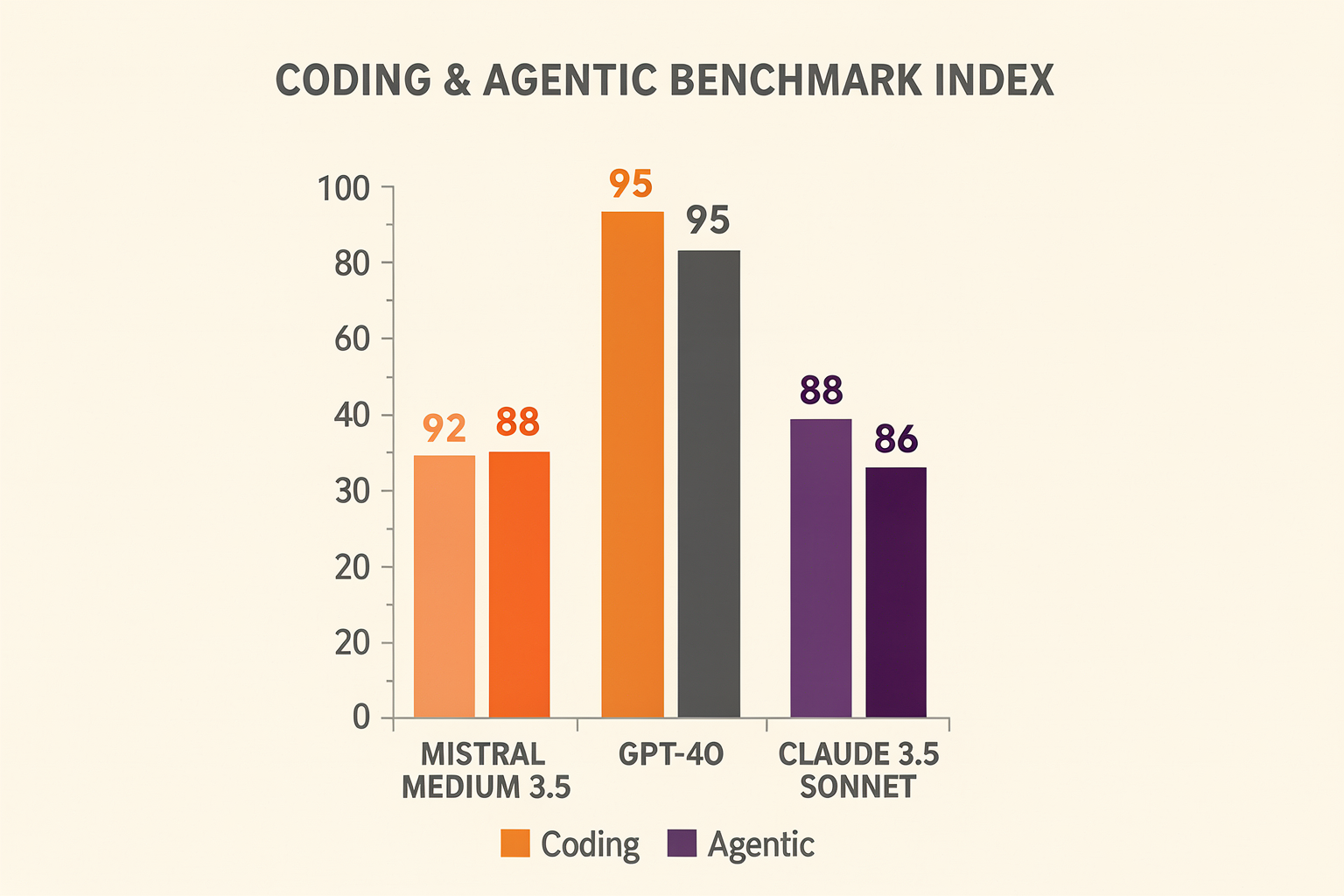
The arrival of Mistral Medium 3.5 has forced developers and enterprises to re-evaluate their model selection strategies. By folding what used to be three separate product lines—conversational AI, advanced reasoning, and specialized code generation—into a single 128B dense model, Mistral AI is challenging the industry trend of deploying highly fragmented, specialized models for different tasks.
To help you navigate this shifting landscape, we have benchmarked Mistral Medium 3.5 against the leading proprietary and open-weights models currently dominating production environments.
| Model | Size & Architecture | Key Strengths | Context Window | Test-Time Compute / Reasoning Mode |
|---|---|---|---|---|
| Mistral Medium 3.5 | 128B Dense (Multimodal) | Cost-effective tool-use, multi-step agentic workflows, structured JSON output | 128K tokens | Yes (via a dedicated reasoning toggle) |
| Claude 3.5 Sonnet | Proprietary MoE | State-of-the-art coding benchmarks, nuanced instruction following, vision accuracy | 200K tokens | Native reasoning (no explicit toggle) |
| GPT-4o | Proprietary MoE | Extreme speed, highly conversational voice capabilities, broad multimodal tasks | 128K tokens | Native reasoning (complemented by o1/o3 series) |
| Llama 3.3 70B | 70B Dense (Open-Weights) | Highly accessible for self-hosting, strong general knowledge, robust chat instruction | 128K tokens | No native toggle (requires external prompting frameworks) |
| Gemini 1.5 Pro | Proprietary MoE | Massive context processing, native video processing, deep research assistance | 2M tokens | Native structured reasoning |
Architectural Tradeoffs: Dense vs. Mixture of Experts (MoE)
When comparing Mistral Medium 3.5 to alternatives like Claude 3.5 Sonnet or GPT-4o, the first major differentiator is architecture. Mistral has chosen a 128B dense parameter model for its flagship. In a dense model, every single parameter is activated for every token generated. This contrasts sharply with Mixture of Experts (MoE) architectures, which route tokens to specific sub-networks (or "experts"), keeping active parameter counts lower during inference to save on compute costs.
The dense architecture of Mistral Medium 3.5 provides it with an incredibly cohesive semantic understanding. There are no routing errors or sudden drop-offs in quality when a prompt spans multiple domains, such as a task requiring simultaneous code generation, translation, and logical reasoning. However, dense models of this size traditionally demand significant hardware to run. Mistral has mitigated this barrier by offering Mistral Medium 3.5 at half the price of its predecessor, making 128B dense inference economically competitive with lighter, closed-source MoE alternatives.
Tool Calling and Agentic Reliability in Production
For developers building real-time autonomous systems, raw benchmark scores on academic datasets matter far less than tool-calling reliability and structured output consistency. Mistral Medium 3.5 is explicitly optimized for "long-horizon tasks," which require an agent to plan, execute multiple API calls sequentially, and cleanly handle errors.
In real-world communication systems, this is where the differences become stark:
- Mistral Medium 3.5: Consistently outputs valid, structured JSON without failing or dropping key variables during deep nested tool-calling operations.
- Claude 3.5 Sonnet: Offers incredible performance on code execution but can occasionally over-explain its reasoning instead of returning pure structured objects unless strict system prompt constraints are applied.
- Llama 3.3 70B: While highly capable, it requires more aggressive prompt engineering to prevent hallucinated tool arguments in complex, multi-step workflows.
To operationalize these capabilities, businesses are increasingly looking to multi-model architectures. Platforms like CallMissed make it incredibly simple to leverage these differences by giving developers access to over 300+ LLMs—including the complete Mistral suite—through a single, unified API gateway. This allows you to route high-complexity reasoning and agentic workflows to Mistral Medium 3.5 while using lighter, faster models for basic routing tasks, optimizing both performance and cost.
The Power of the Reasoning Toggle (Test-Time Compute)
One of the most innovative features of Mistral Medium 3.5 is the integration of its reasoning toggle. Unlike typical models that process every prompt with a fixed amount of computation, the reasoning toggle allows developers to trigger "test-time compute." When activated, the model allocates deeper internal search and planning steps before emitting its first token.
This places Mistral Medium 3.5 in direct competition with specialized reasoning models like OpenAI’s o1 and o3 series. However, while OpenAI segregates its reasoning capabilities into entirely separate models (demanding separate API endpoints, higher costs, and sacrificing standard multimodal inputs), Mistral integrates this feature directly into the Medium 3.5 weights. This means a single model can handle standard, low-latency chat, transition into deep visual analysis, and then deploy test-time compute for complex logical parsing on demand.
Maximizing ROI in Communication Infrastructure
When evaluating these models for customer-facing communication systems, latency and regional accessibility are critical. If you are building automated phone systems, voice assistants, or WhatsApp chatbots, a model must respond within milliseconds to feel natural to the human ear.
By integrating Mistral Medium 3.5’s high-reasoning capabilities with a communications-first infrastructure like CallMissed, you can deploy production-ready voice agents that handle complex customer issues 24/7. CallMissed combines these advanced LLM capabilities with ultra-low-latency Speech-to-Text APIs supporting 22 Indian regional languages natively, ensuring that your agentic workflows are not just smart, but accessible to a global audience.
Ultimately, if your primary need is processing massive multi-hour video files or millions of lines of document text, Gemini 1.5 Pro’s 2-million context window remains unmatched. However, for balanced agentic workflows, complex coding tasks, and robust multi-step reasoning at a highly competitive price point, Mistral Medium 3.5 represents an incredibly versatile, consolidated alternative to the closed-source giants.
Frequently Asked Questions
What is Mistral Medium 3.5 and how does its architecture differ from its predecessors?
What are the three product lines folded into the single Mistral Medium 3.5 model?
Does Mistral Medium 3.5 support multimodal inputs like vision and images?
How does Mistral Medium 3.5 perform in agentic workflows and tool-calling environments?
What is the reasoning toggle in Mistral Medium 3.5 and how does it work?
Where can developers access Mistral Medium 3.5, and what is its cost structure?
The Future of Unified Frontier Models

The Shift from Specialization to Universal Consolidation
For the past few years, the artificial intelligence landscape has been characterized by hyper-specialization. Developers looking to build cutting-edge applications had to orchestrate complex ensembles of fine-tuned models: one for code generation, another for mathematical reasoning, and a separate conversational model for general user interaction. Mistral AI’s introduction of Mistral Medium 3.5 represents a fundamental paradigm shift. By folding three distinct product lines—formerly split across Devstral 2, Magistral, and earlier chat-focused variants—into a single 128B dense model, Mistral is proving that the future belongs to unified, multi-modal, and versatile frontier architectures.
This consolidation drastically simplifies the AI lifecycle. Instead of maintaining distinct API pipelines and dealing with the varying latency, context windows, and pricing of different specialized models, developers can now deploy a single set of weights. With Mistral Medium 3.5, users get high-tier performance across coding (boasting a 35.4 Coding Index on Kilo Code), advanced visual reasoning, and tool use, all accessible via a unified framework. This approach lowers the barrier to entry for building sophisticated, multi-step agentic systems, pointing towards a future where "one model to rule them all" is no longer a compromise, but the optimal architectural choice.
Dynamic Reasoning and Test-Time Compute: The New Standard
One of the most defining characteristics of the next generation of LLMs is the decoupling of training-time compute from test-time compute. Historically, a model’s intelligence was capped by its pre-training parameters. Now, unified frontier models like Mistral Medium 3.5 introduce native reasoning toggles. This allows the system to allocate deeper test-time compute dynamically when faced with complex, long-horizon tasks, such as multi-step coding debugging or mathematical proofs, while remaining fast and cost-effective for standard conversational requests.
By offering this "reasoning mode," Mistral Medium 3.5 changes how we think about model efficiency. Instead of paying a premium for a massive, slow model to handle trivial tasks, or struggling with a lightweight model failing on complex logic, enterprises can scale compute dynamically. The key benefits of this shift include:
- Optimized Cost-to-Performance Ratio: Run standard queries at high speeds without paying a premium for heavy reasoning compute, scaling up only when logical depth is required.
- Reduced Orchestration Overhead: Eliminate the need to build complex routing middleware that tries to guess whether a user query requires a basic chat model or a specialized reasoning model.
- Increased Reliability in Long-Horizon Tasks: Test-time compute allows the model to "think" and self-correct before outputting, drastically improving accuracy in multi-step agentic workflows.
Simplifying the Enterprise AI Infrastructure Stack
As companies transition from experimental sandboxes to production-grade AI deployments, infrastructure complexity remains a massive bottleneck. Managing different prompt templates, token limits, and API endpoints for a dozen different models is highly inefficient. Unified models help streamline this architecture, allowing enterprises to run lean, robust, and cost-effective software stacks.
To transition successfully to this new consolidated paradigm, forward-looking enterprises are following a structured deployment strategy:
- Audit Existing Pipelines: Identify where specialized legacy models (such as separate coding, chat, and vision APIs) can be consolidated into a single frontier model.
- Leverage Multi-Model Gateways: Use unified APIs to test the consolidated models against legacy baselines without rewriting application-level code.
- Implement Guardrails and Tooling: Configure structured JSON outputs to feed downstream enterprise applications reliably, capitalizing on the enhanced tool-calling capabilities of unified models.
This is where advanced orchestration platforms become indispensable. For instance, CallMissed—an AI communication infrastructure platform—enables developers to query over 300+ LLMs through a single unified inference gateway. As frontier models like Mistral Medium 3.5 consolidate multiple capabilities into one, platforms like CallMissed allow businesses to seamlessly swap out legacy, fragmented pipelines for these new unified architectures without changing a single line of application code. This flexibility ensures that businesses can immediately leverage Mistral’s cost-efficient, high-performance reasoning capabilities as soon as they are released.
The Era of Autonomous, Multilingual Voice and Vision Agents
The integration of native vision and agentic capabilities within a single 128B dense architecture unlocks unprecedented opportunities for real-time interaction. Unified models do not just process text; they comprehend visual data, reason through complex workflows, and execute tool-based commands in a continuous feedback loop. This convergence of modalities is paving the way for highly autonomous agents capable of managing complex customer service, technical support, and backend operations.
When combined with robust communication infrastructure, the potential of these models is fully realized. For example, by integrating unified models like Mistral Medium 3.5 with CallMissed’s Speech-to-Text and Text-to-Speech APIs, developers can deploy conversational voice agents that understand context, analyze visual screenshots sent by users via messaging apps, and resolve customer issues in real time. Because CallMissed supports 22 Indian languages natively, businesses can localize these highly advanced, agentic workflows, translating the reasoning power of frontier LLMs into natural, localized voice and chatbot experiences for diverse global audiences.
Looking Ahead: The Evolution of Dense vs. Sparse Architectures
The success of Mistral Medium 3.5 as a 128B dense model raises fascinating questions about the future of AI architecture design. While Mixture-of-Experts (MoE) models continue to offer high throughput by activating only a fraction of their parameters per token, dense models remain highly favored for their consistent, predictable performance across diverse domains.
In the coming years, we can expect to see further hybridization. Future frontier models will likely combine the raw, multi-disciplinary power of dense architectures with dynamic, sparse routing layers that activate specialized reasoning blocks on demand. This will drive down costs even further while elevating capabilities to a level where AI agents can autonomously plan, code, verify, and execute entire software development or customer operations lifecycles with minimal human oversight. Mistral Medium 3.5 is not just an incremental upgrade; it is a blueprint for the consolidated, highly capable, and accessible future of artificial intelligence.
Conclusion
Mistral Medium 3.5 represents a significant shift in how AI developers approach model deployment, trading fragmented, specialized architectures for a singular, highly efficient powerhouse. By folding what used to be three distinct product lines—chat, reasoning, and coding—into a single 128B dense model, Mistral AI has redefined the standard for multimodal, agentic performance.
Key takeaways from this release include:
- Streamlined Architecture: Merging chat, advanced reasoning (via test-time compute), and high-level coding capabilities into one set of weights, replacing separate predecessors like Magistral and Devstral 2.
- Agentic Excellence: Superior reliability in executing long-horizon tasks, calling multiple tools, and parsing structured outputs for downstream applications.
- Cost Efficiency: Delivering all of these frontier-class capabilities at half the price of previous iterations, making production-grade deployment highly accessible.
Looking ahead, we can expect to see more model providers abandon the trend of hyper-fragmentation in favor of unified, dense foundational models that simplify infrastructure complexity. This evolution will make deploying complex, multi-agent workflows vastly more practical and cost-effective across enterprises.
To explore how AI communication is evolving, check out CallMissed — an AI infrastructure platform powering voice agents and multilingual chatbots for businesses. As models like Mistral Medium 3.5 lower the barrier to complex, multi-tool reasoning, how will your organization leverage these unified agentic capabilities to transform your customer interactions?
Related Posts


Ready to automate customer conversations?
Launch AI voice agents and WhatsApp bots with CallMissed — one API, 22+ Indian languages.