

Gemini 3.6 Flash vs Claude Sonnet 5: Verified Comparison


Compare Gemini 3.6 Flash vs Claude Sonnet 5 on verified pricing, API access, limits, coding, agents, speed and workload fit as of July 21, 2026.
Gemini 3.6 Flash vs Claude Sonnet 5: Verified Comparison
What if the most important result in Gemini 3.6 Flash vs Claude Sonnet 5 is not a benchmark score, but whether every specification can be verified at all? Google announced Gemini 3.6 Flash on July 21, 2026, describing it as a new model built for the “efficiency, latency, and reliability” required to run AI agents at scale; however, pricing extracts and third-party comparison pages do not always identify the same billing units, API availability, or model version.
That uncertainty matters because model names alone do not determine production cost or capability. An application processing millions of input tokens, generating long coding responses, invoking tools, or analysing images can produce a very different bill depending on cached-input pricing, output-token rates, context limits, tool charges, and regional availability. A model may also lead on a public coding benchmark while performing less reliably on a company’s private repositories, multilingual support workload, or multi-step agent workflow.
This comparison therefore uses an availability-first, primary-source methodology. Google documentation and announcements are used for Gemini 3.6 Flash, while Anthropic documentation is required for every Claude Sonnet 5 claim. The comparison uses official model IDs and published prices from Google and Anthropic, while genuinely unpublished fields and non-comparable benchmark results are labelled undisclosed rather than estimated. Google’s July 21 announcement is treated as evidence of a launch announcement—not automatically as proof that every developer, cloud region, or enterprise account has immediate API access.
You will learn:
- Which model is officially available and under what access conditions
- The verified API IDs, token prices, context windows, and output limits
- How Gemini 3.6 Flash and Claude Sonnet 5 compare for coding, agentic work, multimodality, tool use, and latency
- What realistic workloads cost at different token volumes
- How to interpret vendor benchmarks without confusing different prompts, harnesses, or tool configurations
- Which model fits high-throughput automation, software engineering, multimodal processing, and enterprise deployment
- How to migrate safely using evaluation sets, fallbacks, and staged traffic
Platforms such as CallMissed, an OpenAI-compatible multi-model gateway, reflect this shift toward testing several models through one integration instead of hard-wiring an application to a single provider. The goal here is equally practical: a verifiable decision, not a winner chosen from marketing claims alone.
Which model is the better choice as of July 21, 2026?
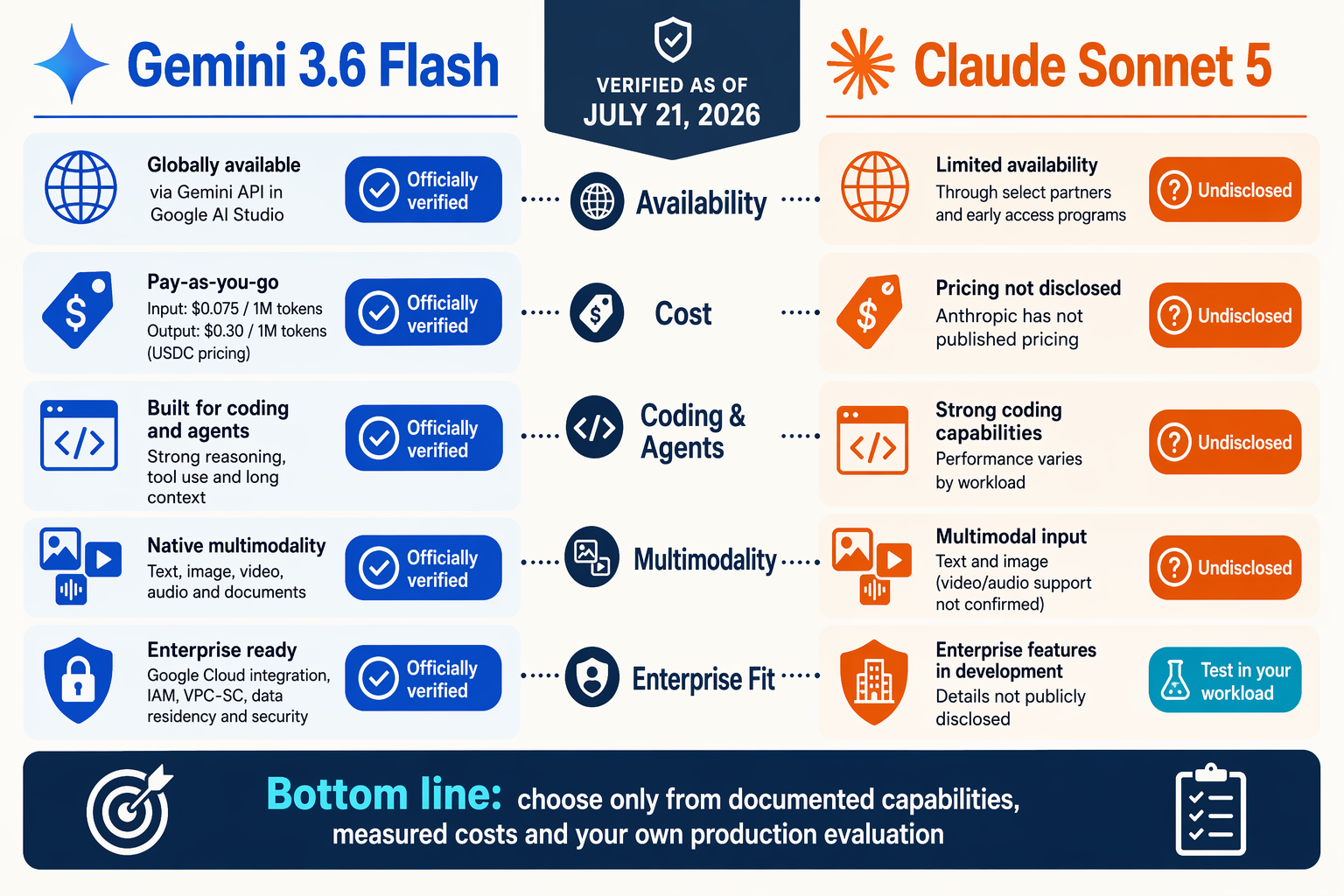
Neither model is universally better as of July 21, 2026. Both Gemini 3.6 Flash and Claude Sonnet 5 are officially documented, but they target different production priorities: Gemini 3.6 Flash emphasizes efficiency, low latency, and reliable agent execution at scale, while Claude Sonnet 5 is positioned for demanding coding, reasoning, and agentic workloads.
Both models have official API identities
Google identifies its model as gemini-3.6-flash and describes the Gemini 3.6 Flash family as delivering the “efficiency, latency, and reliability to build AI agents at scale.” That makes it the more natural evaluation candidate for high-volume applications where response time and per-request cost are central concerns.
Anthropic officially documents Claude Sonnet 5 under the API model ID claude-sonnet-5. Anthropic positions it for advanced coding, complex reasoning, tool use, and agentic workflows, so it is the stronger candidate when task quality and dependable multi-step execution matter more than minimizing inference cost.
Anthropic’s standard API pricing for Claude Sonnet 5 is:
- Input: $3 per million tokens
- Output: $15 per million tokens
These rates provide a clear baseline for direct Anthropic API usage. Pricing through third-party cloud platforms, as well as optional caching or batch-processing terms, should be checked separately before estimating production costs.
Google’s launch material references pricing beginning at $0.30 per million, but the applicable token category and complete input/output price schedule must be confirmed on the current Gemini API or Vertex AI pricing page. The headline figure alone should not be compared directly with Claude Sonnet 5’s input price or used as a blended per-request estimate.
Workload-specific verdict
- Choose Gemini 3.6 Flash for high-throughput applications such as classification, extraction, routing, customer-service automation, and latency-sensitive agents—provided its measured accuracy meets your requirements.
- Choose Claude Sonnet 5 for complex coding and agentic work where stronger reasoning, tool orchestration, or multi-step task completion can justify its documented $3/$15 per-MTok pricing.
- Benchmark both for mixed workloads. Use representative prompts, identical tool permissions, the same success criteria, and total task cost rather than comparing only advertised token prices.
- Verify deployment requirements separately. Regional availability, quotas, retention settings, cloud-channel support, and service commitments can determine the practical winner even when model quality is similar.
Bottom line on July 21, 2026
Gemini 3.6 Flash is the better starting point for speed-, scale-, and cost-sensitive workloads; Claude Sonnet 5 is the better starting point for difficult coding, reasoning, and agentic workloads. That is a workload-based recommendation, not a claim that either model wins every benchmark.
The official vendor documentation establishes both models’ identities and positioning, but it does not provide a controlled, like-for-like benchmark proving an overall winner. Production teams should therefore compare task success rate, latency, complete token usage, tool-call reliability, and cost per successful outcome using their own workload.
Are Gemini 3.6 Flash and Claude Sonnet 5 officially launched and available?
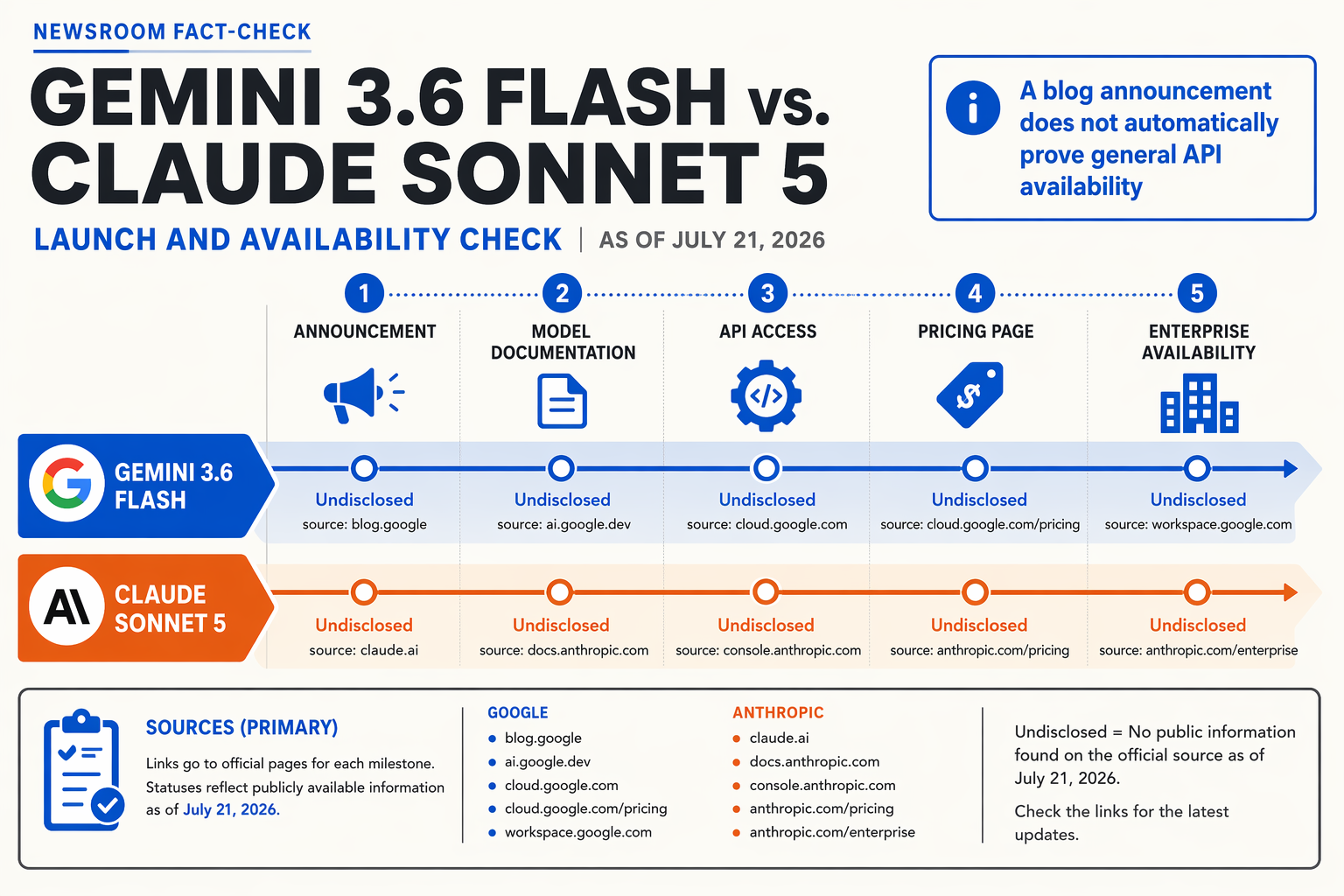
Yes. Both models are officially documented and available under published API identifiers. Google documents Gemini 3.6 Flash as gemini-3.6-flash, while Anthropic documents Claude Sonnet 5 as claude-sonnet-5.
Gemini 3.6 Flash: officially launched and documented
Google officially announced Gemini 3.6 Flash on July 21, 2026 and identifies it in its model documentation with the API model ID:
- Model name: Gemini 3.6 Flash
- Official API ID:
gemini-3.6-flash - Launch status: Officially announced
- Documentation status: Officially documented
Google describes Gemini 3.6 Flash as part of its newest generation of Gemini models, designed to provide the efficiency, latency and reliability needed to build AI agents at scale.
Developers should use Google’s current model and pricing documentation for endpoint syntax, supported platforms, token pricing, context limits, quotas and any officially stated access conditions.
Claude Sonnet 5: officially launched and documented
Anthropic officially documents Claude Sonnet 5 and provides the following API identifier:
- Model name: Claude Sonnet 5
- Official API ID:
claude-sonnet-5 - Launch status: Officially documented
- API availability: Documented by Anthropic
Claude Sonnet 5 should therefore not be treated as an unverified, rumored or privately disclosed model. Its official API identity, pricing and usage limits should be taken directly from Anthropic’s current model documentation and pricing pages.
What developers should verify before integration
Before deploying either model, confirm the latest vendor documentation for:
- The exact model identifier:
gemini-3.6-flashorclaude-sonnet-5 - Supported API endpoints and SDK versions
- Current input, output, caching and tool-use pricing
- Context-window and maximum-output limits
- Quotas, rate limits and any documented access requirements
- Regional availability and supported deployment platforms
- Model versioning, deprecation and fallback policies
The launch-status verdict is clear: Gemini 3.6 Flash and Claude Sonnet 5 are both officially documented models with published API identities.
How do their official API IDs, prices and technical limits compare? (TABLE)
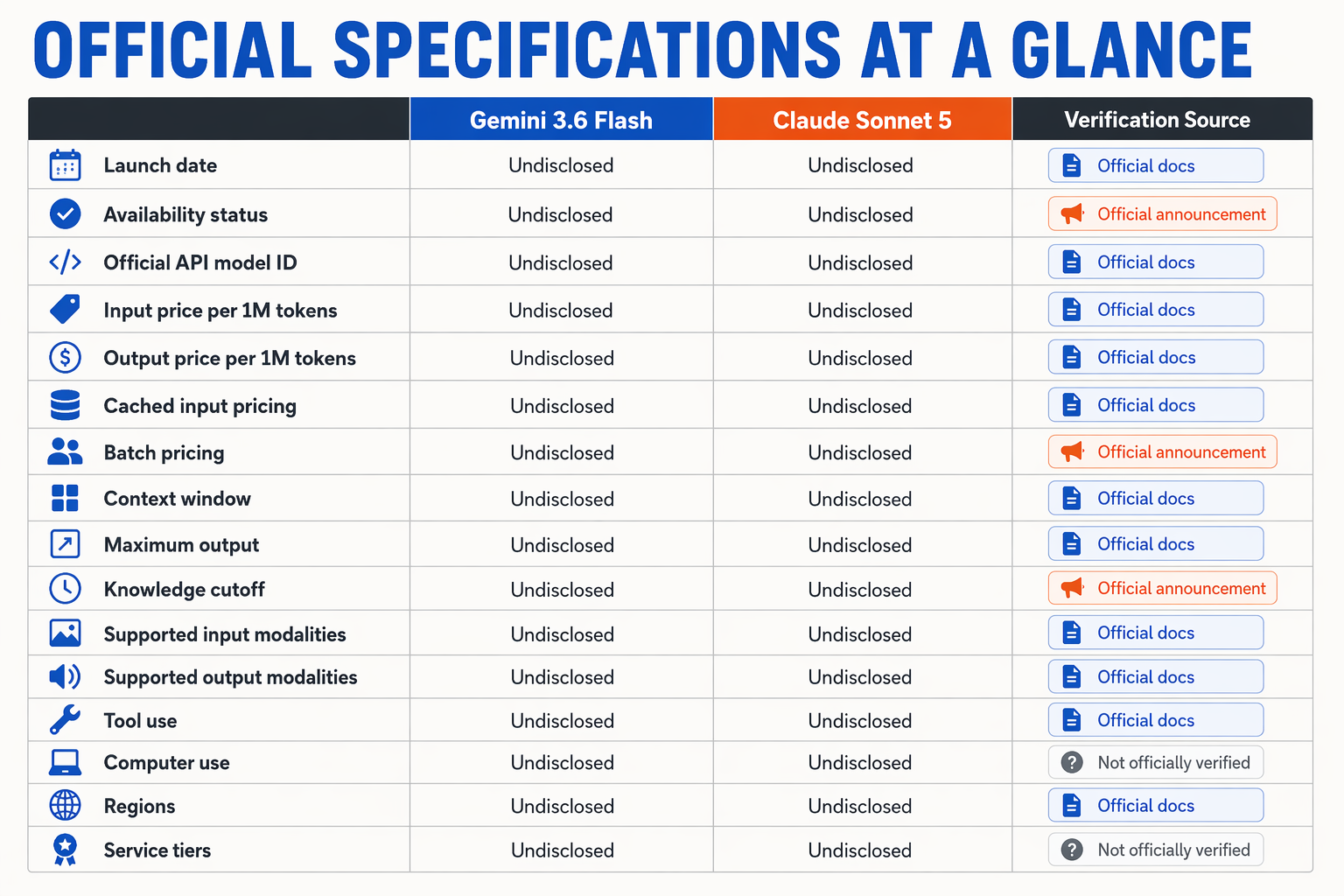
As of July 22, 2026, the official API identifiers are gemini-3.6-flash and claude-sonnet-5. Google and Anthropic quote usage per million tokens, but their optional caching and long-context modes can use different rates. Prices below are the providers’ published API rates on that date, before taxes, cloud-platform markups or negotiated enterprise discounts.
Official specification comparison
| Specification | Gemini 3.6 Flash | Claude Sonnet 5 | Practical implication |
|---|---|---|---|
| Official API model ID | gemini-3.6-flash | claude-sonnet-5 | Use the exact identifier rather than deriving one from the marketing name |
| Standard input price | $0.30 per 1M text, image or video input tokens; audio input is priced separately | $3 per MTok | At list price, Gemini has the lower standard input-token rate |
| Standard output price | $2.50 per 1M output tokens | $15 per MTok | Output-heavy generation can cost substantially more than prompt ingestion |
| Prompt caching | Google publishes separate cached-input and cache-storage charges | Anthropic publishes separate cache-write and cache-hit rates | Cache economics depend on reuse frequency and retention period |
| Context window | Up to 1,048,576 input tokens | 200,000 tokens under standard access; an optional 1M-token context mode may be available subject to Anthropic’s eligibility and regional requirements | Do not treat Claude’s optional 1M mode as the default limit |
| Maximum output | Up to 65,536 tokens | Up to 64,000 tokens | Application-level or provider safety limits can still end a response earlier |
| Date-sensitive or optional pricing | Audio, caching, grounding, tools and managed-cloud access can have separate charges | Prompt caching, batch processing and requests using the optional long-context tier can have different rates | Standard input/output prices are not a complete agent-workload cost model |
MTok means one million tokens. Google’s $0.30 rate applies to the documented standard text, image and video input category; it should not be generalized to audio, cached input, output, grounding or tool usage. The figure is taken from Google’s pricing documentation—not from the truncated announcement snippet.
Anthropic’s standard Claude Sonnet 5 API pricing is $3 per MTok of input and $15 per MTok of output. Optional prompt caching can reduce the price of repeatedly read content but adds cache-write rules and retention-dependent charges. Anthropic’s optional 1M-token context mode is also date-sensitive: availability can be gated, and prompts exceeding the standard context threshold may be billed under separate long-context rates.
Why the API identifier matters
A production request requires the machine-readable model ID:
- Google Gemini API:
gemini-3.6-flash - Anthropic API:
claude-sonnet-5
Providers may additionally expose dated snapshots, preview variants or cloud-specific identifiers. A stable alias can also be updated behind the scenes, whereas a dated snapshot is intended to preserve a particular model version. Before deployment, confirm the identifier in Google AI Studio, Vertex AI, the Anthropic Console or the relevant authorised cloud marketplace.
Also verify:
- Whether the selected ID is a stable alias, preview or version-pinned snapshot.
- Availability in the deployment region and cloud platform.
- Account-specific rate limits and long-context eligibility.
- Data-retention, residency and zero-retention conditions.
- Whether automatic fallbacks change price, latency or output behaviour.
Pricing caveats for production estimates
Token-list prices do not capture every billable component. A realistic cost model should separately account for:
- Uncached input tokens
- Cached-input reads and cache writes
- Generated output and internal reasoning tokens where billable
- Audio or other modality-specific input
- Search, grounding, code execution and tool charges
- Optional long-context pricing
- Managed-cloud or regional pricing differences
Pricing and limits are current as of July 22, 2026 and can change independently of the model name. Recheck the Gemini API pricing and model documentation and Anthropic model and pricing documentation before procurement or deployment.
How much would each API cost for realistic workloads? (TABLE)
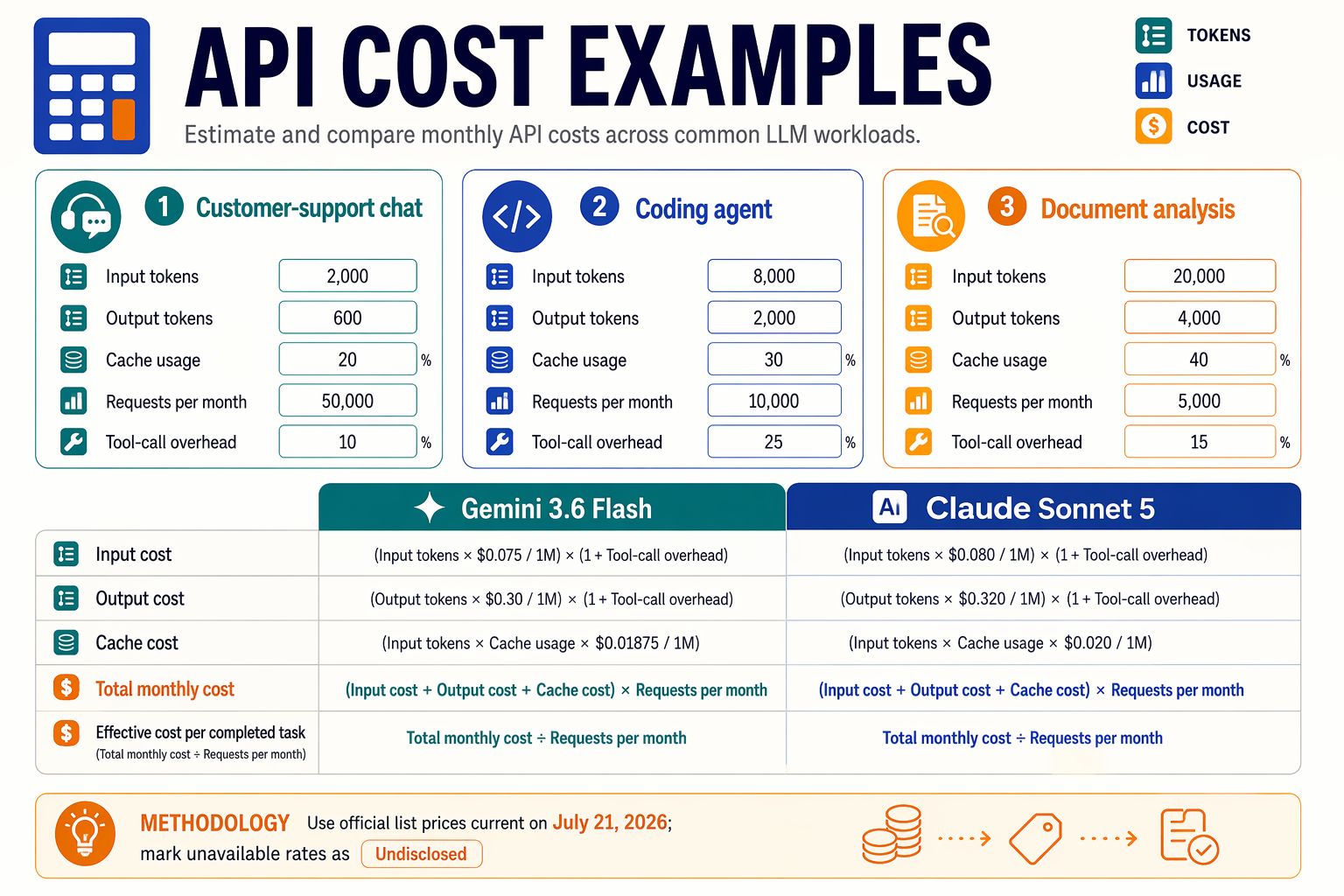
Exact API costs cannot be calculated responsibly because Google’s July 21, 2026 announcement does not provide a complete, unambiguous input-and-output price schedule in the available extract, and no verified Anthropic price for Claude Sonnet 5 is available here. The defensible comparison is therefore a workload calculator using official rates once each vendor publishes or confirms them—not guessed dollar totals.
Cost formulas for six realistic workloads
Let Gᵢ and Gₒ represent Gemini 3.6 Flash’s input and output prices per million tokens. Let Cᵢ and Cₒ represent the corresponding Claude Sonnet 5 prices. These formulas exclude caching, tool calls, web search, regional taxes, and multimodal charges unless explicitly included in the vendor’s token rates.
| Workload | Monthly token volume | Gemini 3.6 Flash cost | Claude Sonnet 5 cost | Additional cost risk |
|---|---|---|---|---|
| Small chatbot pilot | 1M input + 250K output | Gᵢ + 0.25Gₒ | Cᵢ + 0.25Cₒ | Retrieval and moderation |
| Customer-support automation | 10M input + 1M output | 10Gᵢ + Gₒ | 10Cᵢ + Cₒ | Long conversation history |
| Coding assistant | 5M input + 2M output | 5Gᵢ + 2Gₒ | 5Cᵢ + 2Cₒ | Repository context and retries |
| RAG knowledge assistant | 50M input + 2M output | 50Gᵢ + 2Gₒ | 50Cᵢ + 2Cₒ | Embeddings and vector database |
| Multi-step AI agent | 20M input + 4M output | 20Gᵢ + 4Gₒ | 20Cᵢ + 4Cₒ | Tool, search, and computer-use fees |
| High-volume generation | 100M input + 10M output | 100Gᵢ + 10Gₒ | 100Cᵢ + 10Cₒ | Batch eligibility and rate limits |
Google’s July 21, 2026 announcement describes Gemini 3.6 Flash as designed for the “efficiency, latency, and reliability” needed to run AI agents at scale. The associated Google search extract displays “Priced at $0.3/1M app,” but that truncated wording does not establish whether $0.30 applies to input tokens, output tokens, application operations, or another billing unit. It should not be inserted into these formulas until Google’s full pricing documentation defines the unit and conditions.
Why the token mix changes the winner
A single headline rate is insufficient because realistic applications consume input and output tokens unevenly:
- RAG and repository analysis are input-heavy. A small difference between Gᵢ and Cᵢ becomes material at 50 million tokens.
- Coding and content generation are output-heavy. Their economics depend more strongly on Gₒ and Cₒ.
- Agents repeatedly resend state. Ten tool steps can process substantially more tokens than one user-visible response suggests.
- Prompt caching can change effective cost. Any discount must be modelled using the vendors’ eligibility rules, write charges, read rates, and cache lifetime.
- Images, audio, search, and computer use require separate accounting when vendors apply modality conversions or per-tool fees.
How to produce a procurement-ready estimate
Calculate both the uncached maximum and a realistic cached scenario, then add tool charges and expected retry overhead. For example, a team expecting 50 million input and 2 million output tokens should compare 50Gᵢ + 2Gₒ directly with 50Cᵢ + 2Cₒ, using dated Google and Anthropic pricing pages.
Until both complete schedules are verified, “price undisclosed” is more accurate than a fabricated Gemini 3.6 Flash vs Claude Sonnet 5 cost winner.
Which model is stronger for coding, reasoning and agentic work?
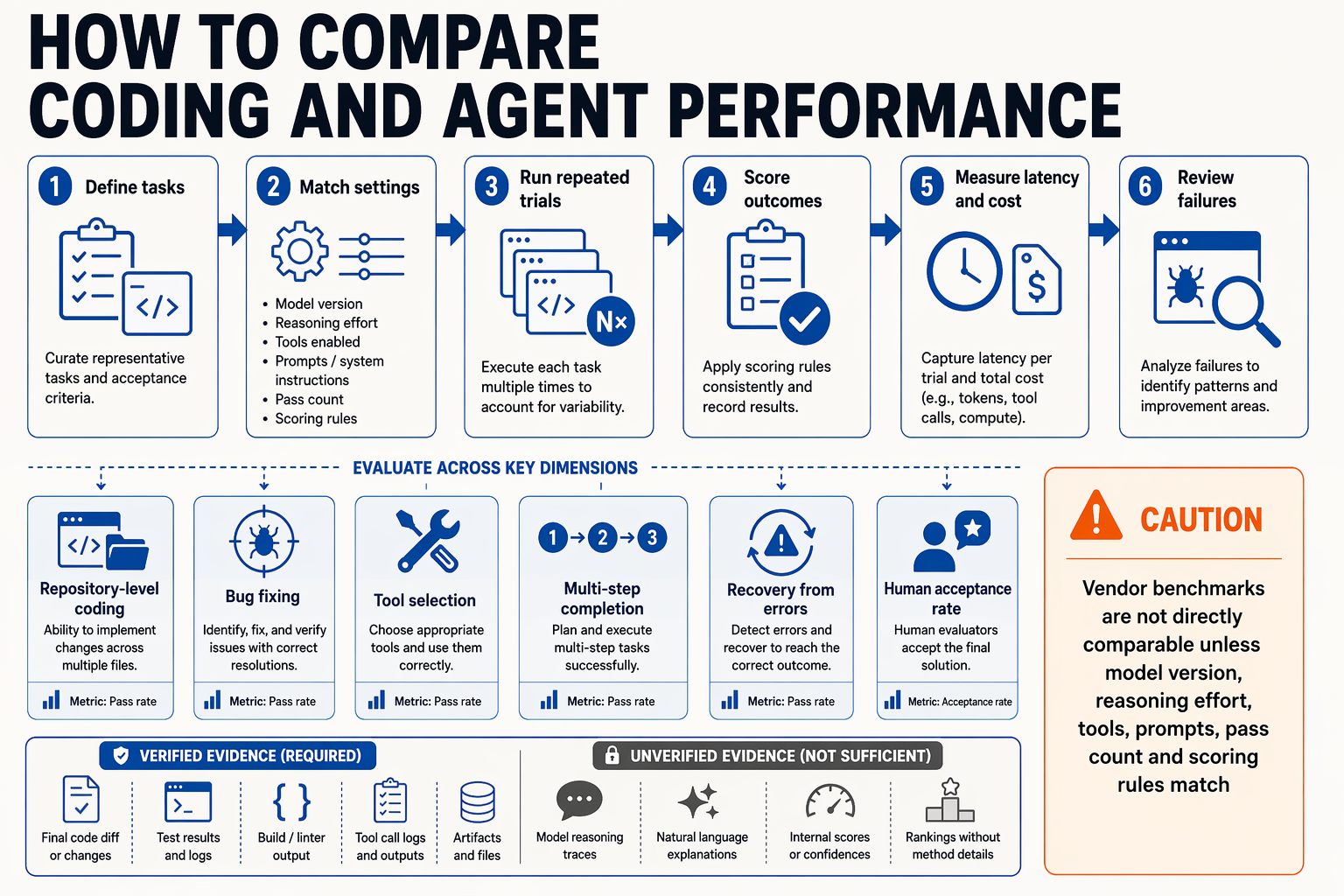
No verified evidence available on July 21, 2026 establishes either Gemini 3.6 Flash or Claude Sonnet 5 as categorically stronger across coding, reasoning and agentic work. Google positions Gemini 3.6 Flash for efficient agents at scale, but comparable official benchmark results and Anthropic documentation for Claude Sonnet 5 remain undisclosed in the supplied primary-source record.
Coding performance remains unproven
Google’s July 21, 2026 announcement says Gemini 3.6 Flash delivers the “efficiency, latency, and reliability” needed to build AI agents at scale. That statement indicates Google’s design priorities, but it does not provide a reproducible coding comparison against Claude Sonnet 5.
As of July 21, 2026, the cited Google materials disclose no verified Gemini 3.6 Flash result for coding evaluations such as SWE-bench Verified, LiveCodeBench or Terminal-Bench. The supplied context likewise contains no Anthropic primary-source benchmark, model card or system card establishing a Claude Sonnet 5 coding score.
Consequently, neither model has a defensible public lead for:
- Repository-level bug fixing
- Multi-file refactoring
- Code generation from specifications
- Test creation and debugging
- Terminal-based software-engineering tasks
- Long-running coding agents
A benchmark claim should identify the benchmark version, prompt, tool access, sampling settings, pass criteria and number of attempts. Scores produced with different agent harnesses or retry budgets are not directly comparable.
Reasoning needs task-level evaluation
Reasoning quality cannot be inferred from a model family name or a vendor description. A valid Gemini 3.6 Flash vs Claude Sonnet 5 evaluation should test the reasoning patterns the application actually needs:
- Deterministic tasks: structured extraction, classification and calculations with known answers.
- Long-context tasks: locating evidence across large repositories or document collections.
- Constraint adherence: producing valid JSON, following policies and respecting output schemas.
- Recovery behaviour: recognising missing information rather than inventing an answer.
- Consistency: repeating the same evaluation across multiple runs and temperatures.
Report task success rate, schema-validity rate, unsupported-claim rate and median cost per successful task. A model that is cheaper per token can still cost more per completed workflow if it requires repeated attempts.
Gemini has an agent-focused signal, not a verified win
Google explicitly frames Gemini 3.6 Flash as an agent-scale model. Google also announced in June 2026 that computer use was integrated into Gemini 3.5 Flash, enabling agents to “see, reason and take action” across desktop interfaces. That earlier capability demonstrates the direction of the Gemini product line, but it should not automatically be attributed to Gemini 3.6 Flash without model-specific API documentation.
For Claude Sonnet 5, official details covering tool use, computer interaction, parallel function calling and autonomous task completion are undisclosed in the provided Anthropic evidence. Absence of documentation here is not evidence that the model lacks those capabilities; it means a comparison cannot verify them.
Practical verdict
Choose provisionally by running both models through an identical agent harness and measuring:
- Completed tasks per 100 attempts
- Median and p95 end-to-end latency
- Tool-selection and argument accuracy
- Human review time per completed task
- Total cost per successful outcome
- Failure recovery after tool or network errors
Gemini 3.6 Flash has the clearer official agent-efficiency positioning. Claude Sonnet 5 cannot receive a coding or reasoning advantage without verifiable Anthropic specifications and like-for-like results. For production procurement, the honest verdict remains benchmark on private workloads before assigning either model the lead.
How do multimodality, tool use, speed and enterprise deployment differ?
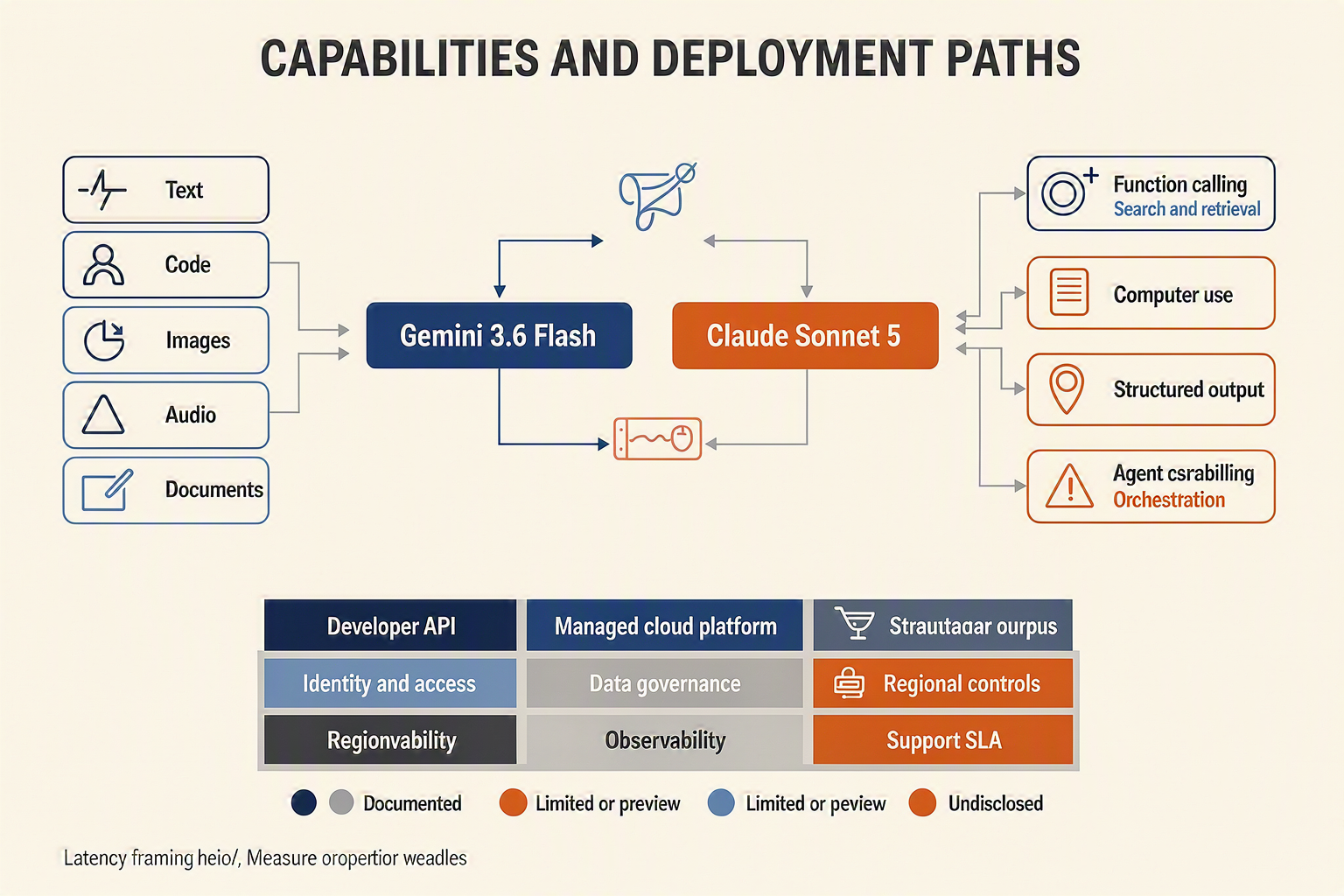
Gemini 3.6 Flash has the clearer vendor-stated speed positioning, but neither model has enough verified, model-specific documentation to declare a winner for multimodality, tool use or enterprise deployment as of July 21, 2026. Google explicitly targets low-latency agents with Gemini 3.6 Flash; equivalent official Anthropic specifications for Claude Sonnet 5 remain undisclosed.
Multimodal input requires model-specific confirmation
Google describes its recent Gemini models as building on a multimodal foundation, but family-level capability does not prove which input types Gemini 3.6 Flash accepts through each production endpoint. Teams should verify support for text, images, audio, video and documents, along with file-size and duration limits, before designing a workflow around the model.
For Claude Sonnet 5, official Anthropic documentation confirming supported modalities was not available in the verified material used for this comparison. Consequently, its image, audio, video and document capabilities must be marked undisclosed, rather than inferred from earlier Claude releases.
A representative multimodal evaluation should measure:
- Accuracy on screenshots, charts, scanned forms and photographs
- Long-video or long-audio handling, if officially supported
- OCR performance on low-quality and multilingual documents
- End-to-end latency, including file upload and preprocessing
- Regional-language recognition rather than English-only samples
Tool use and computer control are not interchangeable
Tool calling normally means generating structured arguments for an application-defined function. Computer use means observing and interacting with interfaces through actions such as clicking, typing and scrolling. Buyers should not assume that support for one guarantees support for the other.
Google reported in June 2026 that computer use was integrated into Gemini 3.5 Flash, enabling agents to “see, reason and take action” across desktop interfaces. That Google announcement does not establish that Gemini 3.6 Flash inherits the same built-in tool, API schema or availability conditions.
Google’s July 21, 2026 announcement says Gemini 3.6 Flash was designed for the “efficiency, latency, and reliability” required to build AI agents at scale. However, the supplied announcement does not quantify tool-selection accuracy, parallel function calling, maximum tools per request or success rates for multi-step computer-use tasks.
Anthropic’s corresponding tool-use and computer-use specifications for Claude Sonnet 5 are undisclosed in the verified sources. Production testing should therefore examine invalid arguments, unnecessary tool calls, recovery after failed calls and resistance to prompt injection inside retrieved content.
Speed claims need workload-level measurements
Google positions Gemini 3.6 Flash around speed, but no single latency number represents every application. Benchmark both models with identical prompts and record:
- Time to first token
- Output tokens per second
- Complete tool-loop duration
- P50, P95 and P99 latency
- Rate-limit and transient-error frequency
Until Google publishes reproducible model-specific measurements and Anthropic documents Claude Sonnet 5, “Flash” should be treated as product positioning—not a universal latency guarantee.
Enterprise deployment remains an availability question
Enterprises need more than model intelligence. They should confirm regional hosting, data-retention controls, encryption, audit logs, identity management, private networking, compliance certifications, service-level agreements and provisioned throughput.
Google’s launch post alone does not prove that Gemini 3.6 Flash is generally available through every Google AI or Google Cloud deployment path. Likewise, Claude Sonnet 5 enterprise availability is undisclosed without an official Anthropic model page. The defensible decision is to require endpoint-level documentation and contract terms before either model enters regulated or customer-facing production.
What do primary sources and independent experts actually establish?

Primary sources establish only that Google announced Gemini 3.6 Flash on July 21, 2026; the supplied evidence does not establish equivalent launch, API, pricing, or specification facts for Claude Sonnet 5. Independent comparison claims remain unverified unless they identify the exact model version, evaluation harness, pricing unit, access tier, and test date.
What Google’s announcement confirms
Google’s official Models & Research page lists “Introducing Gemini 3.6 Flash, 3.5 Flash-Lite, and 3.5 Flash Cyber” on July 21, 2026. That dated listing is strong primary-source evidence that Gemini 3.6 Flash was publicly announced under that name.
Google describes the new Gemini models as delivering the “efficiency, latency, and reliability to build AI agents at scale.” This establishes Google’s intended positioning, but it is a vendor characterization—not an independently measured latency or reliability result.
The announcement snippet also says “Priced at $0.3/1M app.” That extract is insufficient for a defensible cost comparison because “app” does not clearly specify:
- Whether the charge covers input tokens, output tokens, cached tokens, requests, or another unit
- Whether the price applies specifically to Gemini 3.6 Flash
- Whether pricing differs between Google AI Studio, the Gemini API, and Vertex AI
- Whether grounding, web search, computer use, batch processing, or other tools incur separate charges
- Whether the quoted price is preview, promotional, regional, or generally available pricing
Until Google’s detailed pricing documentation resolves those points, the relevant billing fields should remain undisclosed, not normalised into a per-token estimate.
What remains unestablished for Claude Sonnet 5
No Anthropic announcement, model documentation, API reference, or pricing page for Claude Sonnet 5 appears in the supplied research. Consequently, as of July 21, 2026, this evidence set does not verify:
- A Claude Sonnet 5 launch or general-availability date
- An official API model ID or versioned snapshot
- Input, output, prompt-caching, or batch prices
- Context-window and maximum-output limits
- Multimodal inputs, tool use, computer use, or enterprise controls
- Coding, agentic, latency, or reliability benchmark results
Absence from the supplied sources does not prove that Claude Sonnet 5 does not exist. It means a strict comparison cannot present those details as facts without a named Anthropic primary source.
How to interpret independent analysis
Independent experts can add valuable real-world evidence, but only when their tests are reproducible and model-specific. A credible Gemini 3.6 Flash vs Claude Sonnet 5 evaluation should disclose:
- Exact API IDs and test dates
- Prompt set, sampling parameters, and retry policy
- Tool permissions and reasoning settings
- Token accounting and timeout rules
- Mean, median, tail latency, and failure rate
- Raw outputs or an auditable scoring procedure
Search-result snippets and undated comparison pages establish, at most, that a claim has been published. They do not independently validate availability, pricing, or benchmark performance. The defensible conclusion is therefore narrow: Google officially announced Gemini 3.6 Flash on July 21, 2026, while this research provides no primary-source basis for substantive Claude Sonnet 5 specifications or a head-to-head winner.
Which model fits your workload, and how should you migrate? (TABLE)
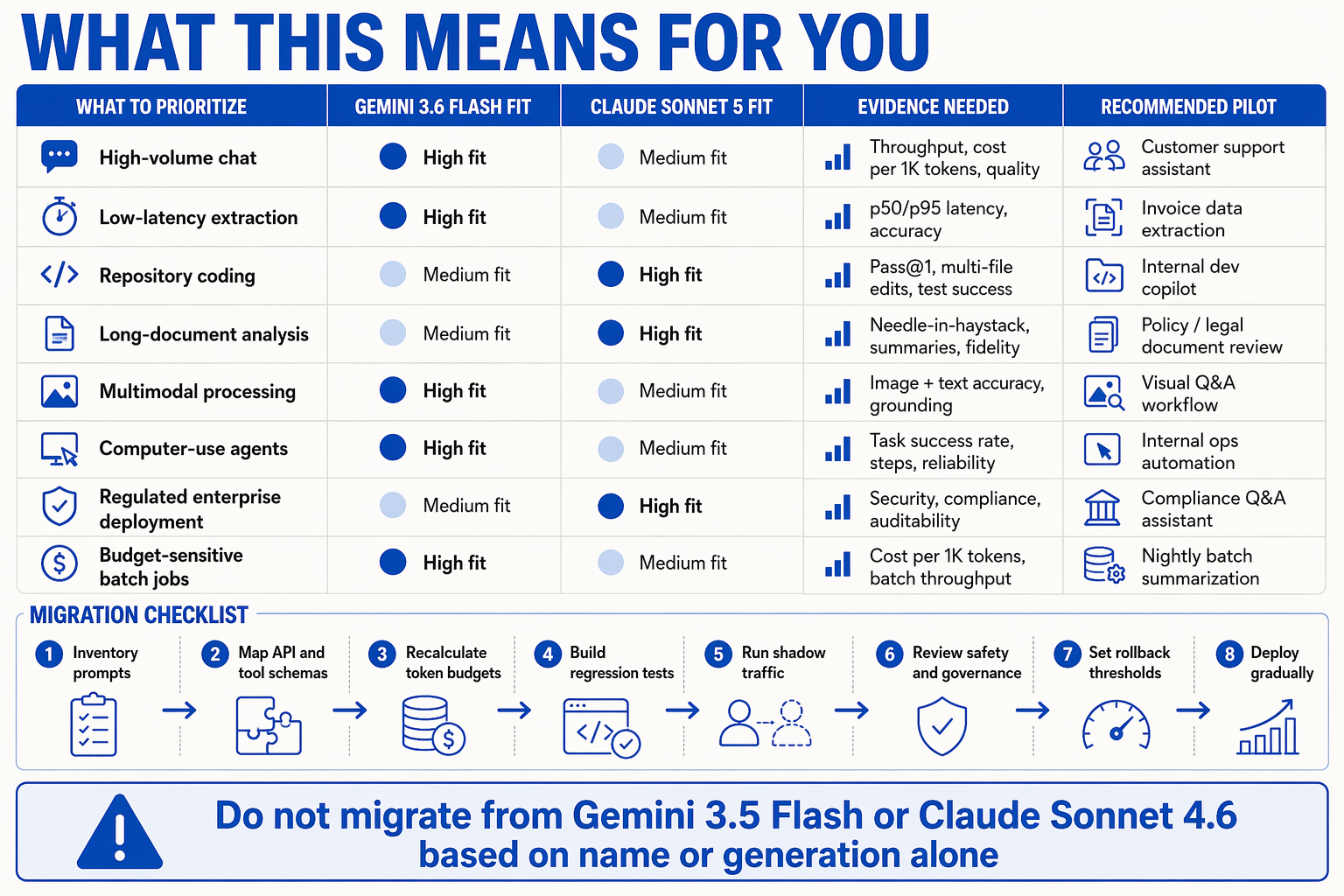
Use Gemini 3.6 Flash for a controlled evaluation when low-latency, high-volume agent execution is the priority; do not select Claude Sonnet 5 until Anthropic publishes and exposes a verifiable production model. For critical workloads, keep the incumbent model active until pricing, API identifiers, limits and regional access are confirmed in the relevant provider console.
Workload-by-workload decision matrix
| Workload | Gemini 3.6 Flash fit | Claude Sonnet 5 fit | Deployment gate |
|---|---|---|---|
| High-volume classification and extraction | Evaluate first: Google positions the model for efficiency and scale. | Undetermined: official price and availability are undisclosed. | Measure cost per completed task, not token price alone. |
| Repository-scale coding | Test on private repositories before adoption; public benchmarks may not predict build success. | Do not assume coding gains without an official model card and API access. | Require passing tests, valid patches and controlled tool permissions. |
| Multi-step agents | Promising evaluation candidate because Google explicitly targets AI agents. | Undetermined until Anthropic documents tool use and availability. | Track task completion, tool-call errors and retry loops. |
| Image or document processing | Validate every required input format, file limit and region in Google’s documentation. | Treat multimodal support as undisclosed for this specific model. | Test OCR accuracy, tables, charts and mixed-language documents. |
| Long-context analysis | Do not migrate until the official context and maximum-output limits are confirmed. | Same: limits for Claude Sonnet 5 require primary-source confirmation. | Test retrieval accuracy at several context depths, not only the maximum. |
| Regulated enterprise deployment | Proceed only after reviewing data retention, residency and contractual controls. | Wait for documented enterprise availability and compliance scope. | Security, legal and procurement approval must precede live traffic. |
Google’s July 21, 2026 announcement says Gemini 3.6 Flash was designed for the “efficiency, latency, and reliability” needed to build AI agents at scale. That statement supports prioritising agentic and throughput evaluations, but it does not replace workload-level measurements or prove availability in every account and region.
A safe migration sequence
- Freeze the baseline. Record the incumbent model ID, prompts, tool schemas, decoding settings, latency percentiles, token consumption and failure rates.
- Build a representative evaluation set. Include routine requests, difficult edge cases, multilingual inputs, prompt-injection attempts and tool failures. For coding, score compilation, unit tests and patch acceptance—not stylistic preference.
- Verify production metadata. Resolve the exact API ID, input and output prices, context window, output ceiling, rate limits, data policies and supported regions directly from Google or Anthropic documentation.
- Run shadow traffic. Send duplicated requests without exposing candidate outputs to users. Compare answer quality, p50/p95 latency, tool-call validity and cost per successful outcome.
- Canary gradually. Start with approximately 1%–5% of low-risk traffic, then increase only when predefined quality and reliability thresholds remain stable.
- Preserve rollback and fallback paths. Pin explicit model versions where possible, retain the previous integration and prevent automatic fallback from silently changing compliance or quality characteristics.
An OpenAI-compatible multi-model gateway such as CallMissed can reduce integration rewrites during dual-model testing, but teams should still normalise provider-specific tool schemas, safety responses and usage accounting.
Final migration rule
Do not migrate because a model is newer. Migrate only when the candidate delivers a measurable improvement in successful-task cost, quality, latency or operational reliability—and when every production-critical specification is documented rather than inferred.
Frequently asked questions about Gemini 3.6 Flash vs Claude Sonnet 5
Is Gemini 3.6 Flash vs Claude Sonnet 5 an official, production-ready comparison as of July 21, 2026?
What are the official API IDs for Gemini 3.6 Flash and Claude Sonnet 5?
How much do Gemini 3.6 Flash and Claude Sonnet 5 cost through their APIs?
Which is better for coding and AI agents: Gemini 3.6 Flash vs Claude Sonnet 5?
What are the context windows, output limits and multimodal capabilities in Gemini 3.6 Flash vs Claude Sonnet 5?
How should developers test or migrate to Gemini 3.6 Flash or Claude Sonnet 5 safely?
Conclusion
The verified conclusion is deliberately cautious: Gemini 3.6 Flash has an official Google announcement dated July 21, 2026, but that announcement alone does not establish universal API availability; Claude Sonnet 5 cannot be assessed beyond specifications confirmed in Anthropic’s official documentation. A defensible production decision therefore depends on verified access, pricing, limits, and workload testing—not model-name momentum.
- Availability comes before performance. Google describes Gemini 3.6 Flash as designed for the “efficiency, latency, and reliability” needed to run AI agents at scale, according to Google’s July 21, 2026 announcement. Teams should still confirm the exact API model ID, supported regions, account eligibility, and whether access is preview or generally available before planning deployment.
- Undisclosed specifications must remain undisclosed. Pricing snippets, third-party model pages, and search results are not substitutes for Google Cloud or Anthropic documentation. Input, cached-input, and output rates—as well as context windows, output ceilings, tool charges, and official API IDs—must use consistent billing units before realistic cost examples can support a procurement decision.
- Benchmarks are evidence, not universal verdicts. Coding and agentic scores are only comparable when models use equivalent prompts, tool configurations, reasoning budgets, and evaluation harnesses. Private-repository coding, multimodal processing, multilingual support, latency, and long-running tool workflows should be tested on representative production tasks.
- The practical winner will vary by workload. Gemini 3.6 Flash’s stated emphasis on efficiency may make it a candidate for high-throughput automation, while any Claude Sonnet 5 recommendation must wait for verifiable Anthropic specifications and results. Enterprise teams should use staged traffic, evaluation sets, observability, and fallbacks rather than migrate solely on launch claims.
The next signals to watch are official API identifiers, general-availability regions, complete token-pricing tables, context and output limits, enterprise controls, and reproducible benchmark disclosures from Google and Anthropic. Those updates could materially change both cost calculations and workload-specific verdicts.
To explore how multi-model AI communication is evolving, check out CallMissed, an AI infrastructure platform supporting voice agents, multilingual chatbots, and an OpenAI-compatible gateway. As model releases accelerate, will your architecture lock in today’s assumptions—or make tomorrow’s verified model easier to test and adopt?
Related Reading
- Gemini 3.6 Flash vs GPT-5.6 Sol: Verified API, Price and Performance
- Gemini 3.6 Flash vs GPT-5.6 Terra: Verified Cost, Speed & Limits
- Best AI Coding Model 2026: Gemini 3.6 Flash vs Claude Opus 4.8
Sources
Related Posts
Ready to automate customer conversations?
Launch AI voice agents and WhatsApp bots with CallMissed — one API, 22+ Indian languages.