

Gemini 3.6 Flash vs Claude Opus 4.8: Price, Speed, Limits and Best Uses


Compare Gemini 3.6 Flash vs Claude Opus 4.8 on verified pricing, limits, speed, tools and use cases to select the right API model.
Gemini 3.6 Flash vs Claude Opus 4.8: Price, Speed, Limits and Best Uses
What if the faster, cheaper model is sufficient for most production traffic—but the premium model saves money by completing difficult tasks correctly the first time? Gemini 3.6 Flash vs Claude Opus 4.8 is not simply a contest between Google and Anthropic; it is a practical decision about latency, reasoning depth, multimodal input, agent reliability and cost per successful task.
The timing matters. Google made Gemini 3.6 Flash generally available on July 21, 2026, according to the Gemini API release notes, with the stable API ID gemini-3.6-flash and no announced shutdown date. Google describes Gemini 3.6 Flash as delivering “sustained frontier-level intelligence” while optimizing for higher speed and lower cost—positioning it for interactive applications, high-volume automation and agentic workflows.
Anthropic positions Claude Opus 4.8 as its premium model for long-context handling, honesty and image processing, according to the Claude Platform model overview. Anthropic’s official documentation also supports output of up to 300,000 tokens through the output-300k-2026-03-24 beta header, a potentially decisive capability for large codebases, extensive reports and long-running agents. Anthropic’s current pricing page lists standard Claude Opus 4.8 pricing at $5 per million input tokens and $25 per million output tokens. Its optional fast mode is priced separately at $10 input and $50 output per million tokens, so the two modes must not be conflated.
What this comparison will establish
This guide evaluates the two models strictly one against one, using information current as of July 21, 2026. It will compare:
- Verified availability and production API identifiers
- Official input and output token pricing
- Context-window and maximum-output limits
- Text, image, audio and other multimodal capabilities
- Coding, reasoning, UI generation and agent benchmarks, where methodologies are directly comparable
- Tool use, latency and enterprise controls
- Cost per task, rather than token price alone
- Best-fit workloads and selection criteria
The central question is not which model is universally “better.” It is whether Gemini 3.6 Flash’s speed-and-cost orientation outweighs Claude Opus 4.8’s premium reasoning and unusually large output capacity for your workload. For developers who want to test models without maintaining separate provider integrations, an OpenAI-compatible gateway such as CallMissed can expose multiple model families through one API and billing layer.
The verdict will therefore be task-specific: Gemini 3.6 Flash is the natural candidate for responsive, high-throughput systems, while Claude Opus 4.8 merits consideration when complex reasoning, sustained generation or demanding coding work justifies a higher per-token cost.
Which model should you choose: Gemini 3.6 Flash or Claude Opus 4.8?
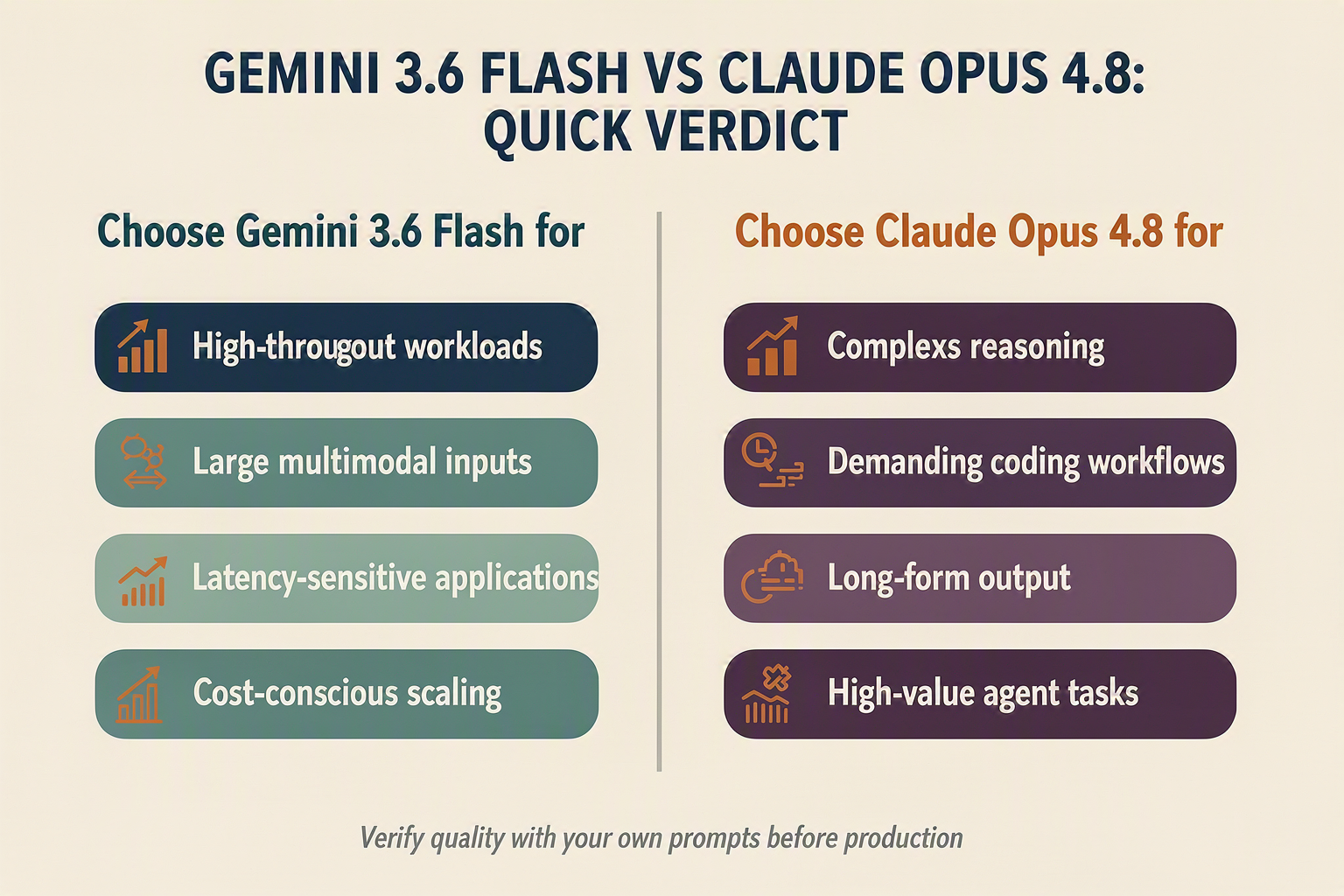
When comparing Gemini 3.6 Flash vs Claude Opus 4.8, choose Gemini 3.6 Flash for latency-sensitive, high-volume applications where responsiveness and token efficiency matter most. Choose Claude Opus 4.8 for complex reasoning, sustained agent work or exceptionally large outputs when a higher inference cost is justified by better task completion.
The short verdict
For most routine production traffic, Gemini 3.6 Flash is the stronger default candidate. Claude Opus 4.8 is better suited to difficult tasks or escalation paths where errors, retries and human review cost more than the additional tokens.
This is a task-specific starting point, not proof that either model is universally faster, smarter or more reliable. Google positions Gemini 3.6 Flash as a speed-and-cost-oriented model with “sustained frontier-level intelligence,” but that is vendor positioning rather than an independent performance measurement. Google made the stable gemini-3.6-flash API model generally available on July 21, 2026, and its deprecation documentation lists no announced shutdown date as of July 22, 2026.
Anthropic’s standard API pricing for Claude Opus 4.8 is $5 per million input tokens and $25 per million output tokens. At standard rates, one million input tokens plus one million output tokens would cost $30, before caching, batch discounts or other pricing adjustments. The higher $10 input and $50 output per million tokens rates apply to Anthropic’s optional fast mode, not standard inference.
Choose Gemini 3.6 Flash when
In a Gemini 3.6 Flash vs Claude Opus 4.8 evaluation, start with Gemini 3.6 Flash when:
- Response time directly affects the user experience, such as in support assistants, conversational interfaces, search and interactive automation.
- The application processes large request volumes, making small differences in per-request cost significant at scale.
- Agents perform frequent, bounded actions such as classification, extraction, routing, summarization or tool selection.
- You want a stable production identifier. Google lists
gemini-3.6-flashas generally available rather than experimental. - Your workload is multimodal or agentic, and Google’s speed-and-cost positioning matches your operational priorities.
These points identify where Gemini 3.6 Flash is likely to fit—not where it has automatically demonstrated better performance. Test latency, accuracy and tool-use reliability under your own concurrency limits before committing production traffic.
Choose Claude Opus 4.8 when
Choose Claude Opus 4.8 when your workload prioritizes demanding reasoning, sustained agent behavior or output capacity:
- A failed answer is more expensive than additional inference, particularly for complex coding, research synthesis or multi-stage decisions.
- Agents must maintain and revise complex plans across many steps rather than complete short, repetitive actions.
- The workflow benefits from the long-context handling, image processing and reliability qualities Anthropic emphasizes for the model.
- You need extremely long generated responses. Anthropic documents outputs of up to 300,000 tokens with the
output-300k-2026-03-24beta enabled on supported API surfaces. - Human review, retries and downstream corrections dominate total cost, making cost per successful task more useful than cost per token.
Use the standard $5/$25 per million-token pricing for initial cost estimates unless you deliberately enable fast mode. Fast mode doubles those rates to $10/$50 and should be evaluated separately based on whether its latency benefits justify the premium.
Use a routing strategy when the workload is mixed
The Gemini 3.6 Flash vs Claude Opus 4.8 decision does not need to be exclusive. For mixed workloads, a practical architecture is to send routine traffic to Gemini 3.6 Flash and escalate difficult cases to Claude Opus 4.8:
- Route routine extraction, summarization, classification and support requests to Gemini 3.6 Flash.
- Detect uncertainty, failed validation, repeated tool errors or unusually complex prompts.
- Escalate those cases to Claude Opus 4.8.
- Reserve Claude’s optional fast mode for cases where measured latency requirements justify its higher price.
- Compare successful completion rate, end-to-end latency, retries, human-review time and total cost—not benchmark scores alone.
The final choice should remain provisional until both models are tested with the same prompts, tool definitions, context, concurrency and acceptance criteria. Vendor documentation establishes availability, pricing, limits and intended positioning; measured performance on your workload determines the economically correct model.
Are Gemini 3.6 Flash and Claude Opus 4.8 officially available as of July 21, 2026?
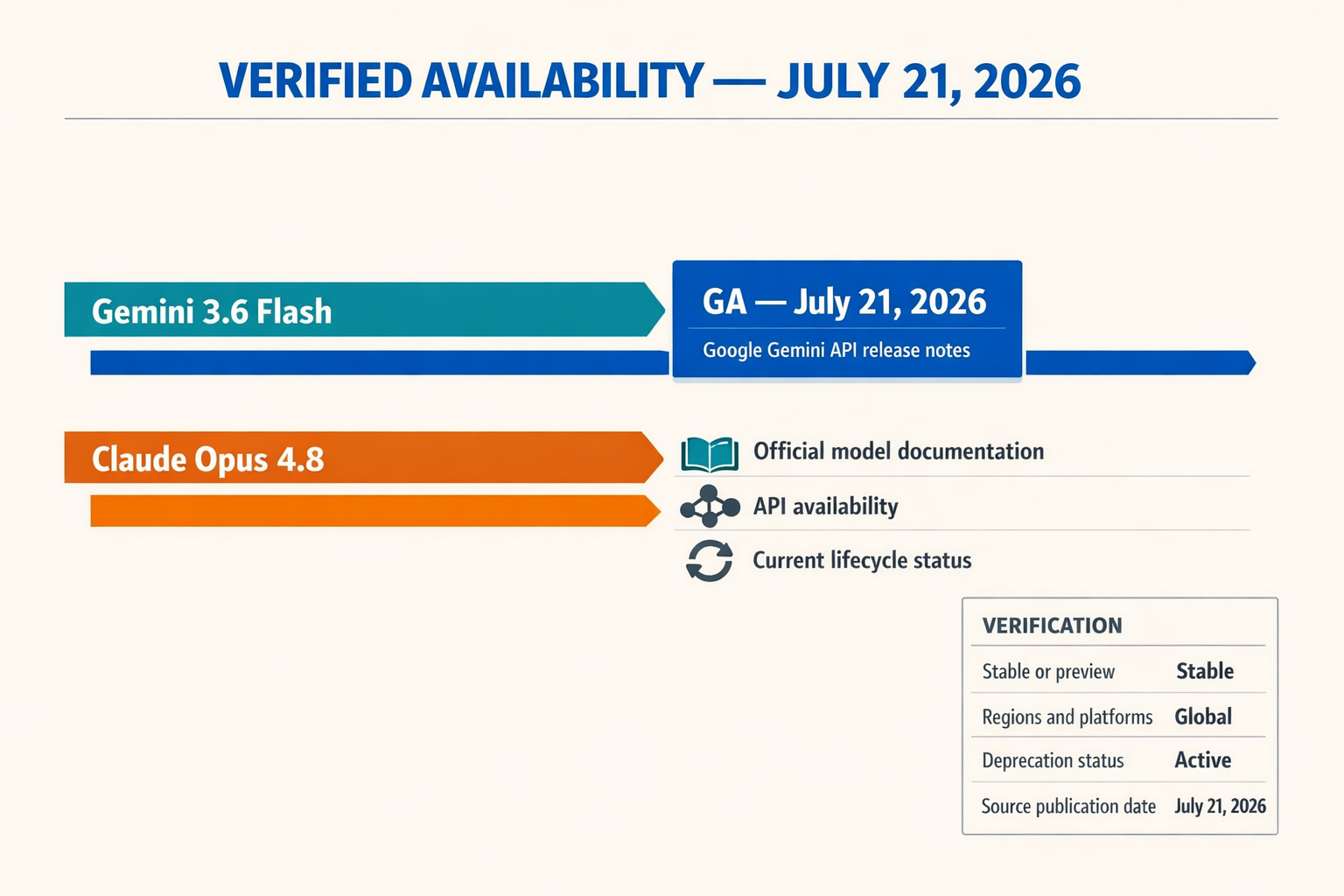
Yes, both models are officially available as of July 21, 2026, but the evidence differs. Google explicitly labels Gemini 3.6 Flash as generally available with a stable API identifier, while Anthropic’s official model and pricing documentation lists Claude Opus 4.8 as an available Claude Platform model without using the same dated GA terminology in the supplied sources.
Gemini 3.6 Flash has an explicit GA record
Google provides an unusually clear availability trail for Gemini 3.6 Flash:
- Google’s Gemini API release notes state that Gemini 3.6 Flash became generally available on July 21, 2026.
- The documented stable model ID is
gemini-3.6-flash. - Google’s Gemini deprecations page lists July 21, 2026 as the release date and says that no shutdown date has been announced.
- Google describes Gemini 3.6 Flash as providing “sustained frontier-level intelligence” at higher speed and lower cost for real-world and agentic tasks.
- Google recommends its Google GenAI SDK, describing the official libraries as production-ready and maintained for popular programming languages.
These records distinguish a stable production model from a preview, experimental release or dated alias. That distinction affects operational planning: Google’s pricing documentation says Gemini 2.0 Flash was deprecated and shut down on June 1, 2026, demonstrating that older Gemini identifiers cannot be assumed to remain callable indefinitely.
Claude Opus 4.8 is documented as a current platform model
Anthropic’s official documentation establishes Claude Opus 4.8 as a current commercial model in two ways:
- The Claude Platform models overview lists Claude Opus 4.8 and highlights long-context handling, honesty and image processing.
- The Claude Platform pricing documentation lists Claude Opus 4.8 at $10 per million input tokens and $50 per million output tokens.
- Anthropic documents an optional maximum output of 300,000 tokens when requests use the
output-300k-2026-03-24beta header.
However, the supplied primary-source extracts do not provide a dated “generally available” announcement or an exact production API identifier for Claude Opus 4.8. A reliable comparison should therefore not infer an API ID from Anthropic’s display name. Developers should copy the current identifier directly from Anthropic’s model overview, API console or official SDK before deployment.
What “officially available” should mean in production
Before placing either model into production, verify four separate details:
- Model status: stable, generally available, preview or beta.
- Exact API ID: display names and request identifiers are not interchangeable.
- Feature conditions: Claude Opus 4.8’s 300,000-token output requires a dated beta header.
- Lifecycle notice: release availability does not guarantee indefinite support.
The evidence is strongest and most explicit for Gemini 3.6 Flash, because Google publishes its GA date, stable ID and lifecycle status together. Claude Opus 4.8 is also officially documented and priced for Claude Platform use, but its special 300,000-token output mode remains beta-gated, and the exact request ID should be confirmed from Anthropic’s live documentation rather than copied from an unofficial comparison.
How do their API IDs, pricing, context windows and output limits compare? (TABLE)
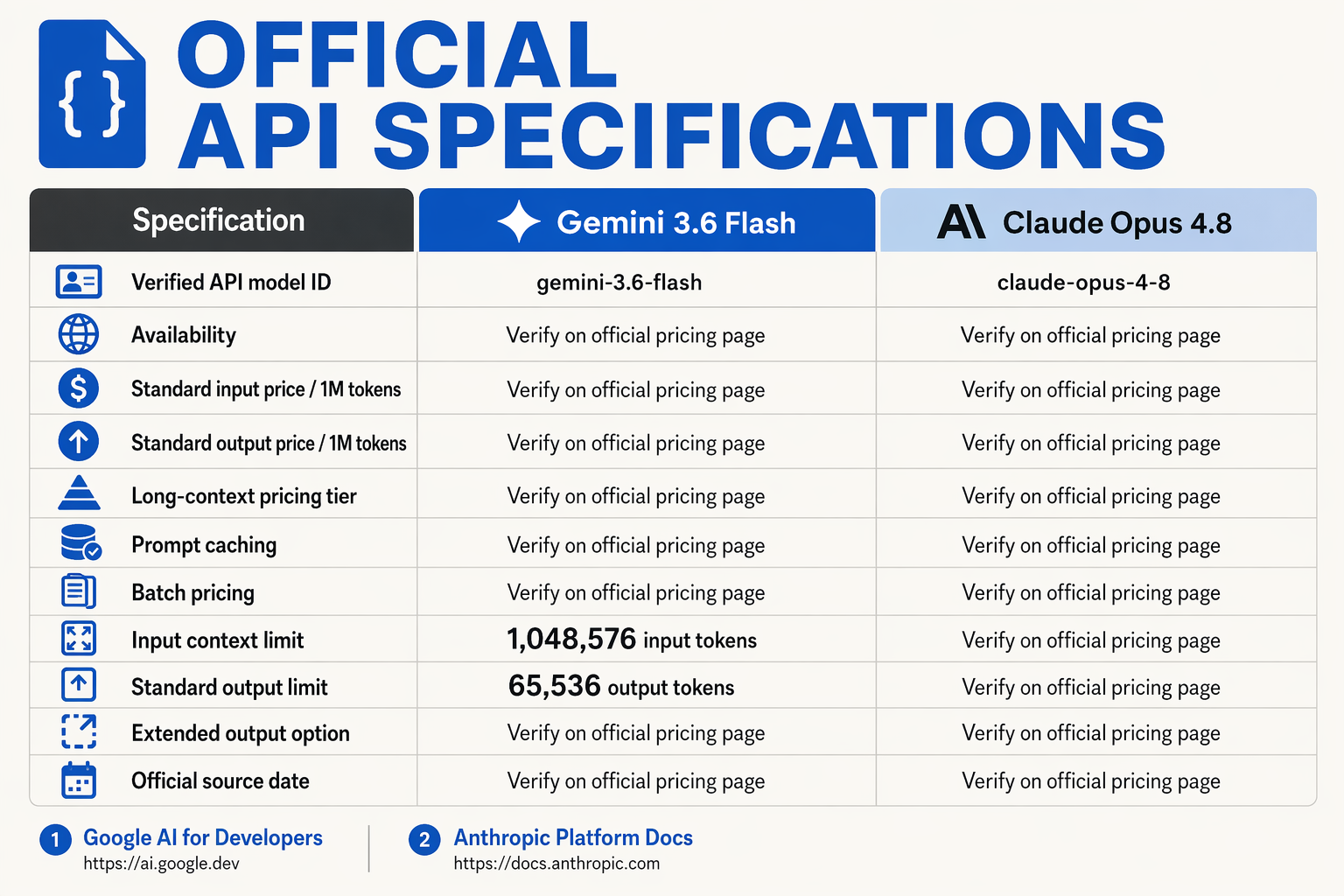
The verified picture as of July 22, 2026 is uneven: Google confirms Gemini 3.6 Flash’s production API ID and general availability, while Anthropic documents Claude Opus 4.8’s API ID, standard pricing, optional fast-mode pricing and beta-gated 300,000-token output ceiling. Specifications not established by the reviewed first-party documentation are marked not verified rather than inferred from earlier models.
Specification comparison
| Attribute | Gemini 3.6 Flash | Claude Opus 4.8 | Practical impact |
|---|---|---|---|
| Availability | Generally available from July 21, 2026 | Listed on the Claude Platform model overview | Confirm regional, account and API-surface access before deployment |
| Production API ID | gemini-3.6-flash | claude-opus-4-8 | Use these exact identifiers rather than constructing IDs from display names |
| Standard input price | Not verified in the reviewed Google documentation | $5 per 1 million tokens | Claude’s standard rate costs $0.25 for 50,000 uncached input tokens |
| Standard output price | Not verified in the reviewed Google documentation | $25 per 1 million tokens | Claude’s standard rate costs $0.375 for 15,000 generated tokens |
| Optional fast-mode input price | Not verified in the reviewed Google documentation | $10 per 1 million tokens | Fast mode charges a premium and must not be confused with standard pricing |
| Optional fast-mode output price | Not verified in the reviewed Google documentation | $50 per 1 million tokens | The same 15,000-token output costs $0.75 in fast mode |
| Context window | Not verified in the reviewed first-party documentation | Not verified in the reviewed first-party documentation | Context capacity and maximum generated output are separate limits |
| Maximum output | Not verified in the reviewed first-party documentation | Up to 300,000 tokens with beta header output-300k-2026-03-24 on supported API surfaces | Claude’s 300K ceiling is an optional beta capability, not an unconditional default |
What the official sources establish
Google’s Gemini API release notes state that Gemini 3.6 Flash became generally available on July 21, 2026. Google’s deprecations documentation identifies the stable production model as gemini-3.6-flash. That stable ID is preferable to preview aliases in production integrations.
Anthropic’s model documentation identifies Claude Opus 4.8 as claude-opus-4-8. Its standard API pricing is $5 per million input tokens and $25 per million output tokens. Anthropic separately prices optional fast mode at $10 per million input tokens and $50 per million output tokens.
At standard rates, a request consuming 50,000 uncached input tokens and generating 15,000 output tokens costs $0.625 before caching, batch discounts, tool charges or other adjustments:
- Input: 50,000 × $5 / 1,000,000 = $0.25
- Output: 15,000 × $25 / 1,000,000 = $0.375
- Total: $0.625
For the same token volumes in optional fast mode:
- Input: 50,000 × $10 / 1,000,000 = $0.50
- Output: 15,000 × $50 / 1,000,000 = $0.75
- Total: $1.25
Fast-mode rates should therefore be modeled separately rather than presented as Claude Opus 4.8’s default price.
Important limit caveats
Anthropic documents up to 300,000 output tokens for Claude Opus 4.8 when the output-300k-2026-03-24 beta header is supplied on a supported API surface. Availability can depend on the endpoint, account and beta access, so 300,000 tokens should not be treated as the model’s unconditional default output limit.
Likewise, prices, context windows or output limits from earlier Gemini Flash releases must not be carried forward to Gemini 3.6 Flash without explicit current Google documentation. For production procurement and benchmarking, record the pricing-page revision, exact model ID, API surface, response metadata and enabled beta headers so stable specifications are not silently mixed with optional or preview capabilities.
Which model performs better for coding, reasoning, agents and UI generation?
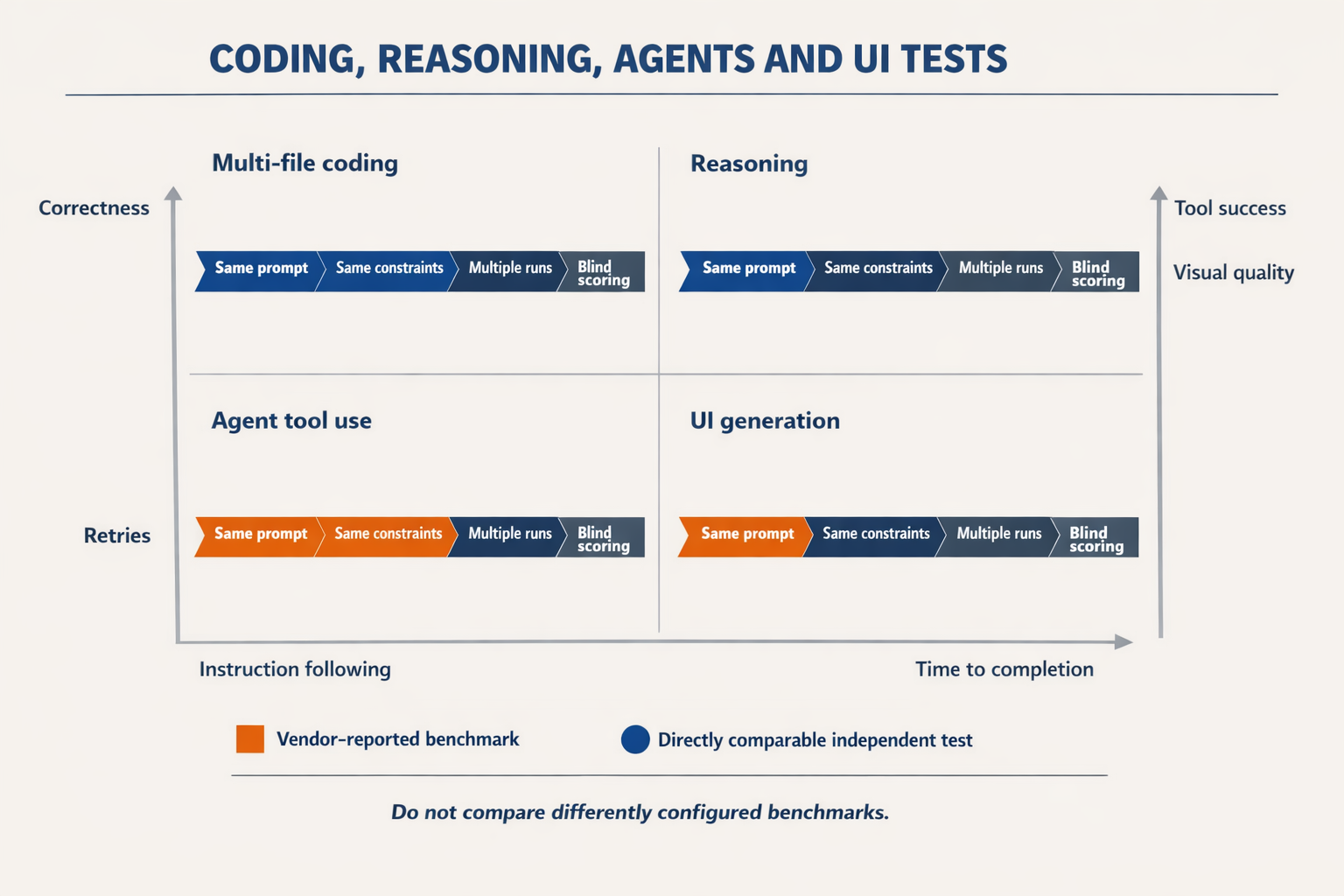
No verified evidence establishes that Gemini 3.6 Flash or Claude Opus 4.8 performs better overall across coding, reasoning, agents and UI generation. As of July 21, 2026, Google and Anthropic provide useful product positioning, but the supplied primary sources contain no directly comparable benchmark run under identical prompts, tools, token budgets and scoring rules.
Coding and complex reasoning
Neither vendor publishes a matched coding or reasoning evaluation that supports declaring a winner. Anthropic positions Claude Opus 4.8 around long-context handling, honesty and image processing, according to the Claude Platform model overview. These characteristics may be relevant to repository analysis, constraint-heavy reasoning and code review, but they do not prove higher task accuracy.
Anthropic also documents support for outputs of up to 300,000 tokens when developers use the output-300k-2026-03-24 beta header. This beta-gated ceiling could accommodate unusually long code, migration plans or technical reports; however, output capacity is not a measure of correctness, maintainability or reasoning quality.
Google describes Gemini 3.6 Flash as delivering “sustained frontier-level intelligence” at higher speed and lower cost, according to Google AI for Developers. Google also says the model is optimized for real-world tasks. These are vendor positioning statements rather than head-to-head evidence against Claude Opus 4.8.
A controlled coding test should measure:
- Build and test pass rates
- Defects introduced during multi-file edits
- Constraint retention over long prompts
- Human review time per accepted change
- End-to-end latency and token cost
- Performance after retries or corrective feedback
Agent workflows require application-level testing
Google explicitly positions Gemini 3.6 Flash for agentic workflows, making it a logical candidate to test for tool-driven applications. The documentation provided does not, however, demonstrate that Gemini 3.6 Flash completes agent tasks more reliably or quickly than Claude Opus 4.8 under matched conditions.
Agent evaluations should track complete outcomes rather than persuasive intermediate responses:
- Task-completion rate
- Tool-selection and argument accuracy
- Recovery from failed calls
- Steps, tokens and retries per success
- End-to-end latency
- Human-intervention rate
A two-tier routing design—testing Gemini 3.6 Flash for routine, latency-sensitive actions and Claude Opus 4.8 for long-context escalations—is a hypothesis worth validating, not an evidence-backed performance hierarchy. Teams using an OpenAI-compatible multi-model gateway such as CallMissed can run this type of routing experiment without maintaining entirely separate application interfaces.
UI generation has no documented winner
The available primary sources include no matched UI-generation benchmark covering build success, visual similarity, responsiveness or accessibility. Claude Opus 4.8’s documented image-processing capability makes screenshot-to-interface tasks a relevant test case, while Gemini 3.6 Flash’s stated speed and cost orientation makes rapid preview loops another reasonable hypothesis to evaluate.
A fair UI test should use identical prompts, screenshots, frameworks and runtime environments, then score:
- Compilation and functional correctness
- Screenshot similarity across viewport sizes
- Responsive behavior and accessibility violations
- Prompt-to-preview latency
- Cost and retries per accepted interface
The defensible verdict is therefore “test both for the target workload.” Gemini 3.6 Flash’s documented strengths are speed, lower cost and agentic-workflow positioning; Claude Opus 4.8’s documented strengths are long-context handling, honesty, image processing and beta-gated 300,000-token output. None of those claims alone establishes superior coding, reasoning, agent or UI performance.
How much does each model cost per real-world task?
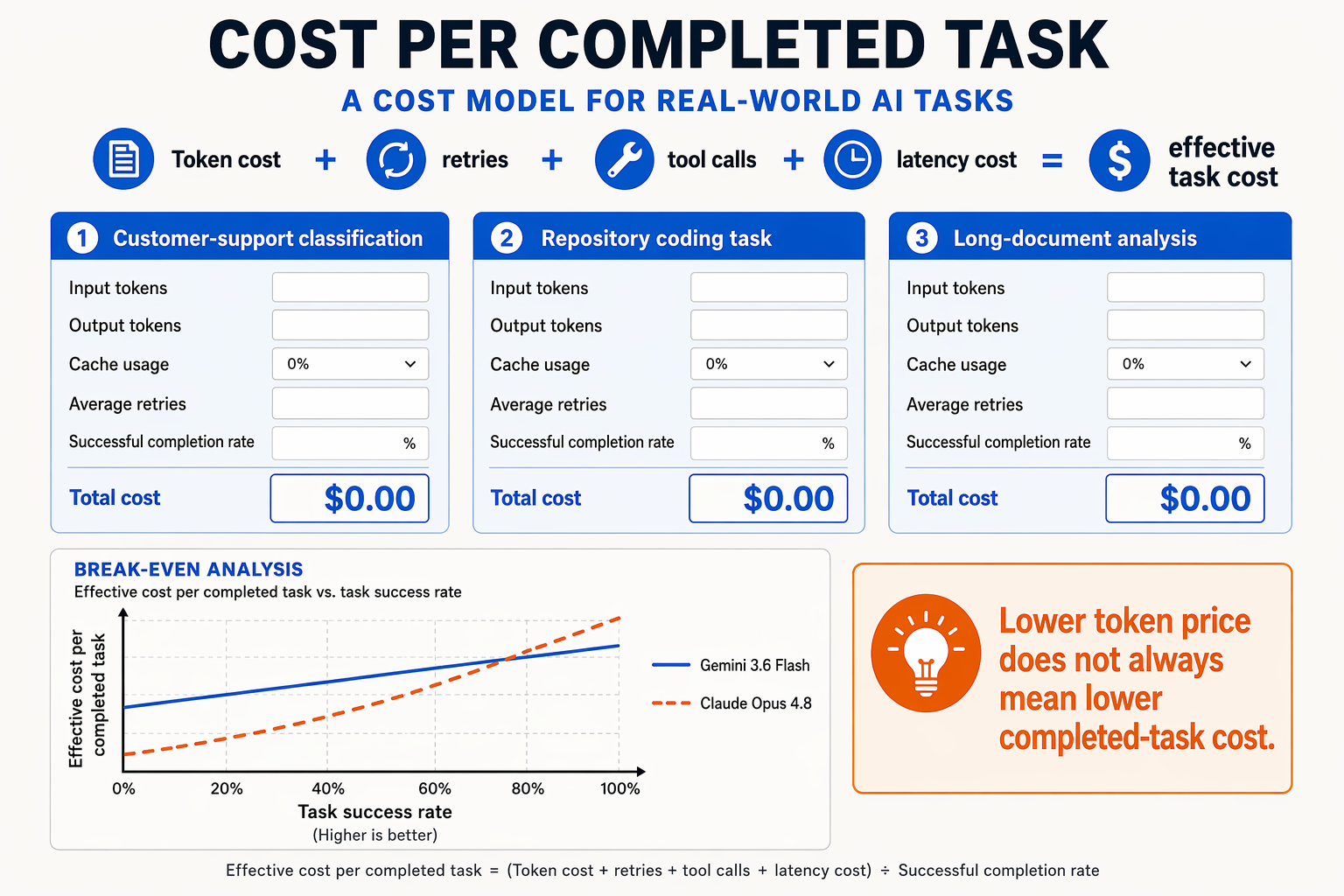
Claude Opus 4.8 costs $0.045 for a 2,000-input/500-output-token interaction, $0.75 for summarizing a 50,000-token document into 5,000 tokens, and $2.00 for a coding task using 100,000 input and 20,000 output tokens. Gemini 3.6 Flash’s equivalent cost should be calculated from Google’s current model-specific pricing page; the verified material available here does not expose its numeric rates, so substituting Gemini 3.5 Flash prices would be misleading.
Cost formula and assumptions
Anthropic’s official Claude Platform pricing documentation lists Claude Opus 4.8 at $10 per million input tokens and $50 per million output tokens as of July 21, 2026. Therefore:
Claude cost = (input tokens × $10 ÷ 1,000,000) + (output tokens × $50 ÷ 1,000,000)
For Gemini, use the same formula with the official Gemini 3.6 Flash input and output rates shown in Google’s Gemini Developer API pricing documentation:
Gemini cost = (input tokens × Gemini input rate ÷ 1,000,000) + (output tokens × Gemini output rate ÷ 1,000,000)
These examples cover standard token processing only. They exclude caching discounts, batch pricing, web-search grounding, code execution, storage, third-party tools, network charges and provider-specific taxes.
Claude Opus 4.8 task-cost scenarios
The following workloads are illustrative token budgets, not vendor benchmark measurements:
- Customer-support response: 2,000 input + 500 output tokens costs $0.045, or $45 per 1,000 interactions.
- Long-document summary: 50,000 input + 5,000 output tokens costs $0.75 per document.
- Repository-level coding task: 100,000 input + 20,000 output tokens costs $2.00 per attempt.
- Large research report: 200,000 input + 100,000 output tokens costs $7.00 per report.
- Maximum-scale generation: 300,000 output tokens alone would cost $15.00, before counting the prompt.
Anthropic states that Claude Opus 4.8 can produce up to 300,000 output tokens when requests use the output-300k-2026-03-24 beta header. That capacity is valuable, but output-heavy workflows become expensive because Claude output tokens cost five times as much as input tokens.
Why cost per successful task matters more
A lower token price does not guarantee the lowest production cost. The useful metric is:
Cost per successful task = total cost of attempts, validation, tool calls and human correction ÷ successful completions
Suppose one Claude attempt costs $2.00 and the same task costs $0.40 on Gemini. Gemini remains cheaper through four attempts; at five attempts, both reach $2.00. Conversely, if both complete the task reliably on the first attempt, the lower-priced model has the clear economic advantage.
Teams should therefore measure:
- First-pass success rate
- Average retries per completed task
- Output-token consumption
- Tool-call and verification costs
- Human review minutes
Google describes Gemini 3.6 Flash as optimized for “higher speed and lower cost,” making it the expected cost leader for high-volume traffic. Claude Opus 4.8 can still be economical for difficult coding, agentic or long-form tasks when stronger first-pass completion avoids repeated generations. Before budgeting, verify the live gemini-3.6-flash rates directly in Google’s official pricing documentation rather than reusing Gemini 3.5 Flash figures from older comparisons.
How do multimodality, tool use, latency and enterprise controls differ? (TABLE)
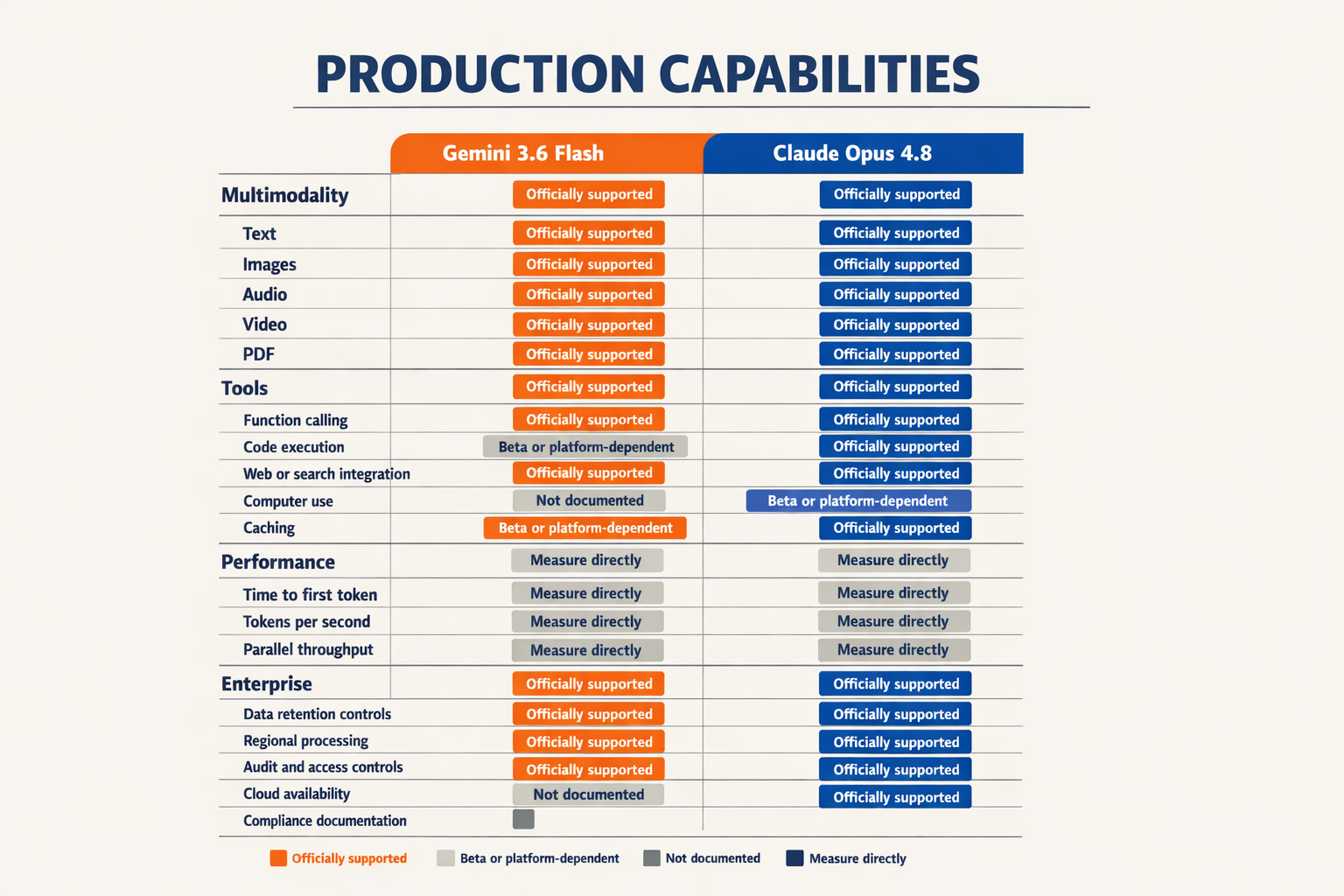
Gemini 3.6 Flash has the clearer advantage for latency-sensitive, multimodal agent workflows, while Claude Opus 4.8 is better documented here for image understanding and exceptionally long text generation. However, neither vendor’s cited documentation provides directly comparable latency percentiles, tool-call success rates or a complete enterprise-control matrix, so those differences require workload-specific testing.
Capability comparison as of July 21, 2026
| Capability | Gemini 3.6 Flash | Claude Opus 4.8 | Practical implication |
|---|---|---|---|
| Multimodal processing | Google positions Gemini 3.6 Flash for “real-world tasks,” but the cited model-page extract does not enumerate its complete input-modality matrix. | Anthropic explicitly highlights image processing alongside long-context handling and honesty. | Verify required formats—such as images, audio, video or documents—against the current API documentation before deployment. |
| Model output | The available Google source does not establish non-text output support or the maximum output length. | Anthropic documents text output of up to 300,000 tokens with the output-300k-2026-03-24 beta header. | Claude Opus 4.8 has the documented advantage for extremely long reports, code generation and agent transcripts. |
| Tool and agent use | Google says Gemini 3.6 Flash is designed for agentic workflows and real-world tasks. | The supplied Anthropic sources do not provide a directly comparable tool-use specification or success-rate benchmark. | Gemini has explicit agent-oriented positioning, but production reliability must be measured with the same tools, prompts and retry policy. |
| Latency positioning | Google describes Gemini 3.6 Flash as operating at a “higher speed and lower cost.” | Anthropic positions Claude Opus 4.8 as a premium model rather than a latency-optimized model. | Gemini is the stronger default candidate for interactive assistants, routing and high-volume automation; this is positioning, not a shared benchmark. |
| Production SDKs | Google recommends the Google GenAI SDK, describing its official libraries as production-ready. | Claude Opus 4.8 is delivered through the Claude Platform API; no comparable SDK detail appears in the supplied source extract. | SDK maturity matters for streaming, tool schemas, retries and observability, but model quality should be evaluated separately. |
| Enterprise controls | Controls depend on the selected Google deployment environment and contract, not merely the gemini-3.6-flash model ID. | Controls likewise depend on the Claude Platform or another approved deployment channel. | Compare retention, regional processing, encryption, identity, audit logging and contractual terms at the platform level. |
What “faster” does—and does not—prove
Google’s claim that Gemini 3.6 Flash provides “sustained frontier-level intelligence” at higher speed and lower cost is a vendor description, not a cross-vendor latency benchmark. The cited sources disclose no matching measurements for time to first token, tokens per second or p95 end-to-end latency.
A defensible evaluation should therefore measure:
- Time to first token for chat and voice interactions
- p50 and p95 completion latency, including tool execution
- Tool-call validity and task-completion rate
- Retries, timeouts and malformed structured outputs
- Cost per successfully completed task, not merely per-token pricing
Enterprise due diligence
Enterprise controls should not be inferred from model intelligence or API naming. Before choosing either model, obtain written confirmation of:
- Data-retention and training-use policies
- Regional processing and data-residency options
- Single sign-on, role-based access and audit logs
- Encryption and key-management support
- Service-level commitments and incident procedures
The practical split is clear: start with Gemini 3.6 Flash when responsiveness and agent throughput dominate; test Claude Opus 4.8 when image interpretation, sustained reasoning or very long generated outputs could improve task completion enough to justify premium processing.
Which model fits your workload and deployment priorities? (TABLE)
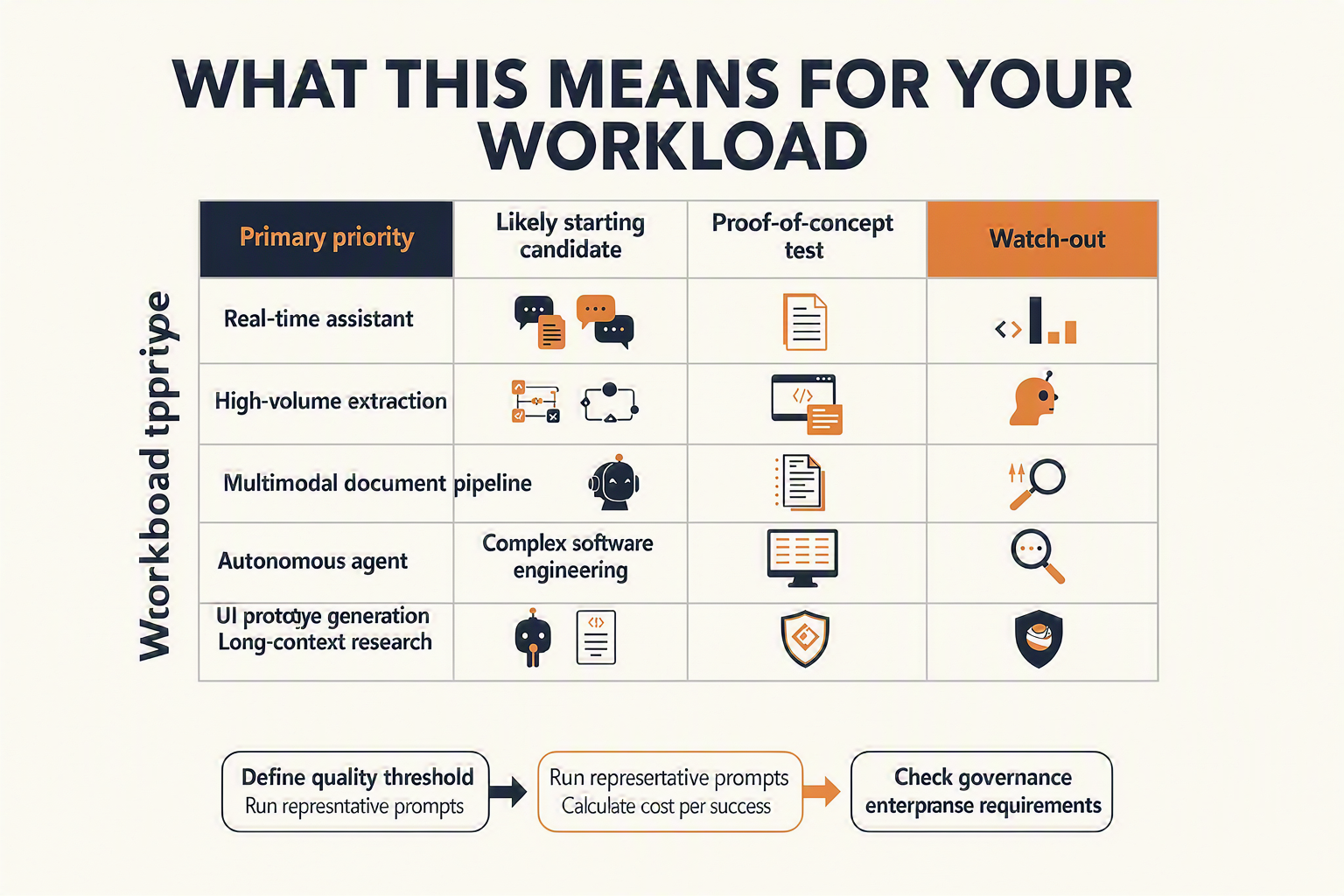
Choose between Gemini 3.6 Flash and Claude Opus 4.8 using verified deployment facts—availability, API identifiers, output limits and official pricing—then test both on representative tasks. The available primary-source material does not provide directly comparable evidence proving either model better for coding, reasoning, image analysis or agent reliability.
Workload and deployment matrix
| Workload or priority | Gemini 3.6 Flash | Claude Opus 4.8 | Evidence-based decision |
|---|---|---|---|
| Production availability | Google released the stable gemini-3.6-flash API model at GA on July 21, 2026 | Listed in Anthropic’s Claude Platform model documentation | Both are documented options; confirm regional and account availability |
| API lifecycle | Google listed no announced shutdown date as of July 21, 2026 | Check Anthropic’s current model documentation for the production API identifier and lifecycle policy | Prefer documented production IDs over aliases or previews |
| Token cost | Use Google’s current Gemini Developer API pricing page; no Gemini 3.6 Flash rate is quoted in the supplied source extract | Anthropic lists $10 per million input tokens and $50 per million output tokens | Calculate cost using expected input and output volumes |
| Very large generated outputs | Keep responses within Google’s documented output limit for the deployed endpoint | Supports up to 300,000 output tokens with the output-300k-2026-03-24 beta header | Claude has the documented 300,000-token option; test beta-feature operations |
| Coding and multi-step reasoning | Google positions the model for “frontier-level intelligence” and real-world tasks | Anthropic positions Claude Opus 4.8 for long-context handling | Run repository-specific coding and reasoning tests; no categorical winner is established |
| Agent workflows | Google describes Gemini 3.6 Flash as designed for agentic, real-world tasks at higher speed and lower cost | Evaluate tool execution, state recovery and instruction adherence in your agent stack | Treat Google’s statement as vendor positioning, not comparative proof |
| Image analysis | Validate supported inputs and accuracy on representative images | Anthropic explicitly highlights image processing in its model overview | Test both on the actual document, chart or visual workload |
Google’s Gemini API release notes state that Gemini 3.6 Flash became generally available on July 21, 2026, under the stable API ID gemini-3.6-flash. Google’s higher-speed and lower-cost language describes its own product positioning; it does not demonstrate that Gemini 3.6 Flash is faster or cheaper than Claude Opus 4.8 for every prompt.
Anthropic’s model overview states that Claude Opus 4.8 supports outputs of up to 300,000 tokens when the output-300k-2026-03-24 beta header is enabled. Teams relying on that capability should validate streaming duration, timeouts, retries, storage limits and beta-feature governance.
Use task-specific evidence for quality decisions
Build an evaluation set from real production requests rather than inferring quality from model descriptions. For coding, reasoning, visual analysis and agents, record:
- Successful-task rate against explicit acceptance criteria
- P50 and P95 end-to-end latency
- Tool-call correctness and recovery after failures
- Human-review minutes per accepted result
- Input and output tokens per task
- Total cost per successful task
A routing layer can then assign traffic based on measured outcomes rather than a predetermined winner. For example, an OpenAI-compatible gateway such as CallMissed can help teams evaluate and route across multiple models without maintaining a separate integration for each provider.
The final choice should follow the evidence: deploy the model that meets the workload’s quality threshold at the lower operational cost, while treating vendor-stated coding, reasoning, image and agent capabilities as hypotheses to test—not proof of comparative superiority.
What do the official claims and available evidence actually prove?
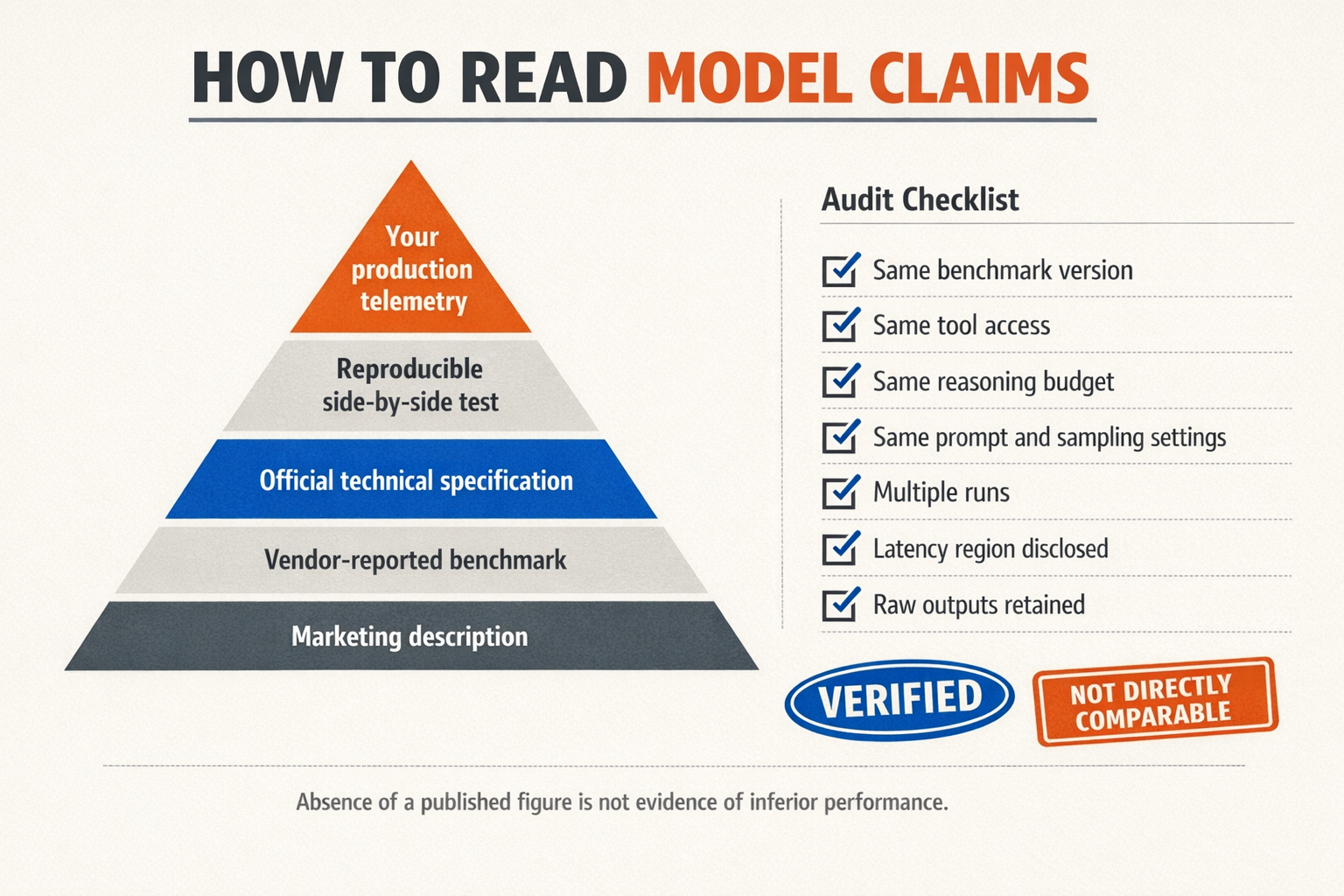
Official sources prove that Gemini 3.6 Flash and Claude Opus 4.8 are deployable models with documented features, limits, and prices. They do not prove that either model is universally faster, more accurate, more capable at reasoning, or cheaper per successful task.
What the primary sources establish
The strongest verifiable conclusions as of July 21, 2026, are:
- Gemini 3.6 Flash is generally available. Google’s Gemini API release notes state that Gemini 3.6 Flash became generally available on July 21, 2026, under the stable API ID
gemini-3.6-flash. - No Gemini 3.6 Flash shutdown date has been announced. Google’s Gemini deprecations documentation listed
gemini-3.6-flashwith a launch date of July 21, 2026, and “No shutdown date announced.” - Google positions Gemini 3.6 Flash around speed and cost. Google describes the model as delivering “sustained frontier-level intelligence” at higher speed and lower cost for real-world and agentic tasks. This is official product positioning, not an independently measured comparison against Claude Opus 4.8.
- Claude Opus 4.8 offers an unusually large optional output limit. Anthropic’s Claude Platform model overview documents support for up to 300,000 output tokens through the
output-300k-2026-03-24beta header. - Anthropic documents specific capability priorities. Anthropic highlights long-context handling, honesty, and image processing for Claude Opus 4.8. These descriptions establish intended capabilities, but they are not direct cross-vendor benchmark results.
- Claude Opus 4.8 carries premium official token pricing. Anthropic’s pricing documentation listed Claude Opus 4.8 at $10 per million input tokens and $50 per million output tokens as referenced on July 21, 2026.
These records establish availability, product configuration, vendor pricing, and documented behavior. They do not establish identical performance across regions, prompt types, reasoning settings, providers, or concurrency levels.
What remains unproven
The available primary-source evidence does not justify several broader claims:
- “Flash” does not guarantee lower application latency. Network distance, tool calls, reasoning configuration, rate limits, prompt size, and output length can dominate total response time.
- A 300,000-token output ceiling does not prove higher answer quality. Claude Opus 4.8’s optional mode supports extremely long artifacts, but it is beta-gated and can materially increase generation time and token cost.
- Lower token prices do not guarantee lower cost per completed task. Retries, validation failures, tool loops, caching, and human review affect the final cost of an accepted result.
- Vendor descriptions do not prove coding or reasoning superiority. A valid conclusion requires controlled, directly comparable tests using the same prompts, tools, reasoning budgets, sampling settings, and scoring criteria.
- Multimodal support does not establish equal multimodal accuracy. Image acceptance alone does not demonstrate reliable interpretation of small text, dense diagrams, charts, or spatial relationships.
Evidence-quality checks for buyers
Before making a production decision, verify:
- The exact stable API ID, rather than a preview alias.
- The pricing page’s effective date, token tier, caching rules, and batch discounts.
- Whether a limit is standard or requires a beta header.
- Whether benchmark results are vendor-reported, independently reproduced, and methodologically comparable.
- Whether latency means time to first token or total time to an accepted result.
Freshness also matters: Google’s pricing documentation says Gemini 2.0 Flash was shut down on June 1, 2026, showing how quickly older comparison pages can become inaccurate. The defensible conclusion is therefore narrow: Google officially positions Gemini 3.6 Flash for higher speed and lower cost, while Anthropic officially documents Claude Opus 4.8’s long-context, image-processing, honesty, and optional 300,000-token output capabilities. Neither source proves cross-vendor superiority in reasoning, coding, latency, or production task quality; controlled testing must establish those outcomes.
Frequently asked questions about Gemini 3.6 Flash vs Claude Opus 4.8
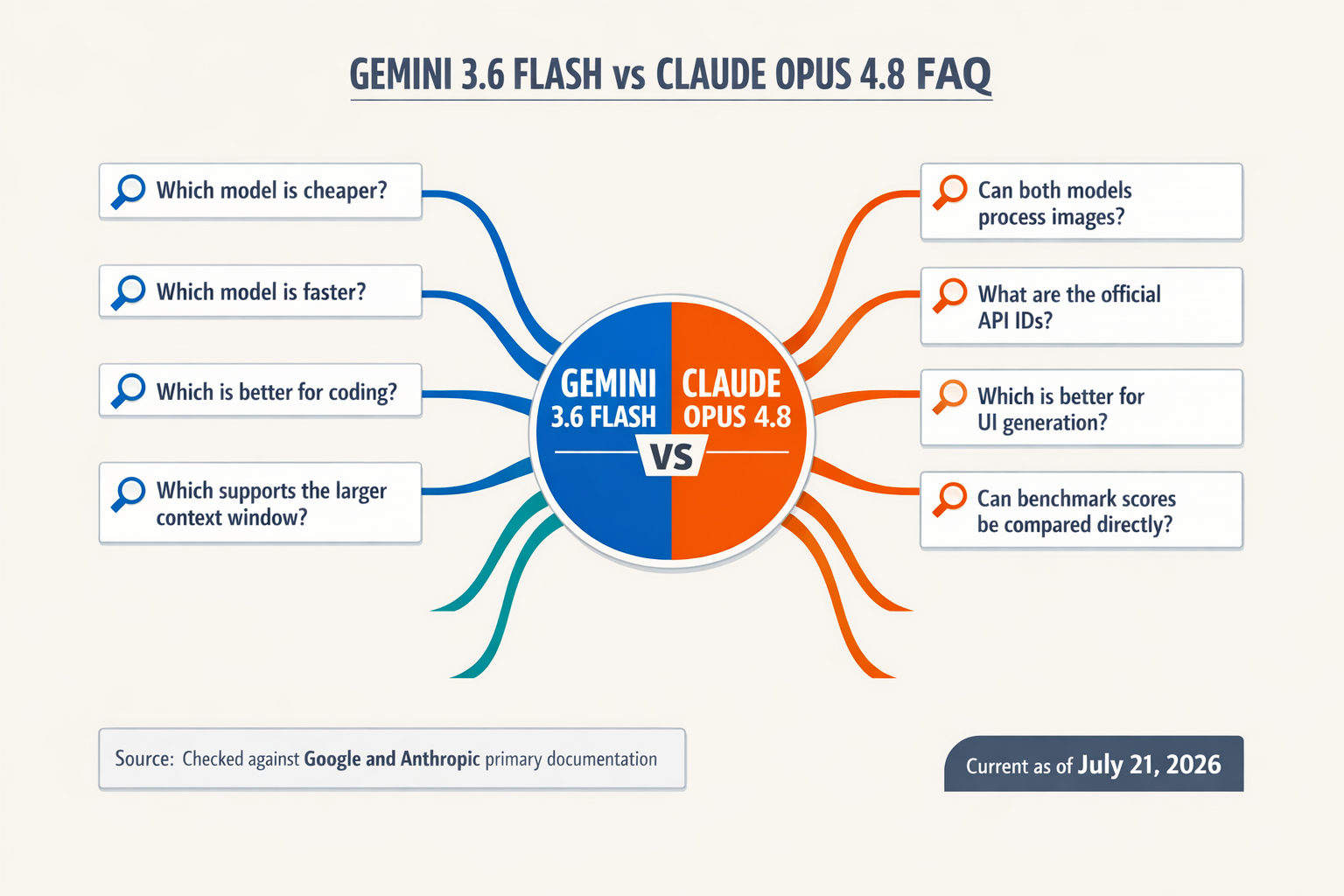
Is Gemini 3.6 Flash vs Claude Opus 4.8 a fair comparison for production applications?
What are the production API IDs for Gemini 3.6 Flash and Claude Opus 4.8?
gemini-3.6-flash, and Google’s deprecation page listed no announced shutdown date as of July 21, 2026. For Claude Opus 4.8, developers should copy the exact current model identifier from Anthropic’s official Models overview or API response rather than deriving an ID from the product name, because aliases and dated model snapshots can differ across platforms.How much does Gemini 3.6 Flash vs Claude Opus 4.8 cost through the official APIs?
Which model supports longer outputs, Gemini 3.6 Flash or Claude Opus 4.8?
output-300k-2026-03-24 beta header, making it particularly relevant to extensive reports, large code-generation jobs and long-running agents. That figure is a maximum-output allowance—not automatically the context-window size—and beta access, latency, cost and truncation behavior should be validated before production deployment.Is Gemini 3.6 Flash vs Claude Opus 4.8 better for multimodal AI and tool-using agents?
Which model should developers choose for coding, reasoning and UI generation?
Conclusion
The practical verdict is workload-specific: Gemini 3.6 Flash is the stronger fit for responsive, high-throughput production traffic, while Claude Opus 4.8 is the premium option when difficult reasoning, sustained generation or demanding coding tasks can justify higher token costs. The right metric is therefore cost per successful task, not price or benchmark position in isolation.
- Availability is verified and production-ready. Google’s Gemini API release notes state that Gemini 3.6 Flash became generally available on July 21, 2026, under the stable API ID
gemini-3.6-flash; Google’s deprecation documentation lists no announced shutdown date as of that date.
- The models optimize for different operating priorities. Google describes Gemini 3.6 Flash as providing “sustained frontier-level intelligence” at higher speed and lower cost, making it a natural candidate for interactive applications, large-scale automation and latency-sensitive agents. Anthropic positions Claude Opus 4.8 around premium reasoning, long-context handling, honesty and image processing.
- Claude Opus 4.8 carries a substantial premium. Anthropic’s official pricing documentation listed Claude Opus 4.8 at $10 per million input tokens and $50 per million output tokens as of July 21, 2026. Those rates mean teams should test whether higher first-pass accuracy reduces retries, human review and failed agent runs enough to offset the per-token difference.
- Output requirements can decide the comparison immediately. Anthropic’s model documentation supports up to 300,000 output tokens for Claude Opus 4.8 through the
output-300k-2026-03-24beta header. That exceptional allowance matters for extensive reports, large code-generation jobs and long-running workflows, although production teams must account for the beta requirement and potentially significant output cost.
The next releases may shift this balance, so watch for official pricing revisions, context and output-limit changes, deprecation notices, latency data and directly comparable coding or agent benchmarks. Vendor-reported results should remain separate from independent testing, and real prompts should be evaluated with retry rates, completion quality and human-review time included.
Teams that want to test multiple model families without maintaining separate integrations can explore CallMissed, an AI communication infrastructure platform offering an OpenAI-compatible multi-model gateway alongside voice agents and multilingual chatbots.
For your workload, is the cheaper model truly less expensive—or does the premium model complete enough difficult tasks correctly on the first attempt to win on total cost?
Related Reading
- Gemini 3.6 Flash vs GPT-5.6 Luna: Price, Speed and Limits
- Gemini 3.5 Flash-Lite vs GPT-5.6 Sol: Price, Speed and Workload Fit (2026)
- Gemini 3.5 Flash-Lite vs GPT-5.6 Terra: Official API, Price, Limits & Use Cases
Sources
Related Posts
Ready to automate customer conversations?
Launch AI voice agents and WhatsApp bots with CallMissed — one API, 22+ Indian languages.