

Gemini 3.5 Flash-Lite vs Claude Opus 4.8: Cost, Speed & Quality


Gemini 3.5 Flash-Lite vs Claude Opus 4.8 compares verified pricing, limits, speed, tools and task costs so you can choose confidently.
Gemini 3.5 Flash-Lite vs Claude Opus 4.8: Cost, Speed & Quality
Could a model built for volume be a smarter buy than a flagship designed for the hardest work? Gemini 3.5 Flash-Lite vs Claude Opus 4.8 is fundamentally a choice between budget-friendly throughput and premium reasoning quality: Gemini targets fast, cost-sensitive execution, while Claude Opus targets complex tasks where answer quality can matter more than token cost.
Why this comparison matters now
Google made Gemini 3.5 Flash-Lite generally available on July 21, 2026, according to the official Gemini API release notes. Google describes Gemini 3.5 Flash-Lite as “the fastest, lowest-cost model in the 3.5 family” and positions it for high-volume workloads, making the model relevant to support automation, classification, extraction, content processing and agentic systems operating at production scale.
That positioning reflects a broader shift in AI procurement. Teams are no longer asking only which model achieves the highest benchmark score; they are asking how much each successful task costs, how quickly the model responds and whether premium reasoning improves the business outcome. A small per-request difference can become substantial across millions of calls, while one incorrect answer in coding, compliance or financial analysis can erase those savings.
There is also an important verification issue. Model names, preview labels, API identifiers, prices and limits can change quickly, and direct comparisons sometimes mix Gemini Flash with Flash-Lite or compare unofficial benchmark runs under different prompts. Google confirms that Gemini 3.5 Flash supports a 1-million-token context window and up to 65,000 output tokens, but those specifications must not automatically be attributed to Flash-Lite without model-specific documentation. Likewise, every Claude Opus 4.8 claim should be checked against Anthropic’s current primary documentation rather than inferred from an earlier Opus release.
What this guide will test
This comparison will examine the two models strictly one-to-one across:
- Verified availability and exact API model IDs
- Official input, output and cached-token pricing
- Context windows, output limits and multimodal capabilities
- Tool use, reasoning controls and agent support
- Latency, throughput and realistic cost-per-task scenarios
- Coding, analysis, automation and enterprise suitability
- Benchmark caveats and a practical model-selection framework
Platforms such as CallMissed, an OpenAI-compatible multi-model API gateway, reflect this move toward routing different workloads to different model tiers instead of forcing every task through one expensive flagship.
The useful verdict will therefore not be “which model wins?” It will be which model produces an acceptable result at the lowest total cost for your specific workload—and when paying for flagship quality is justified.
Which model should you choose: Gemini 3.5 Flash-Lite or Claude Opus 4.8?
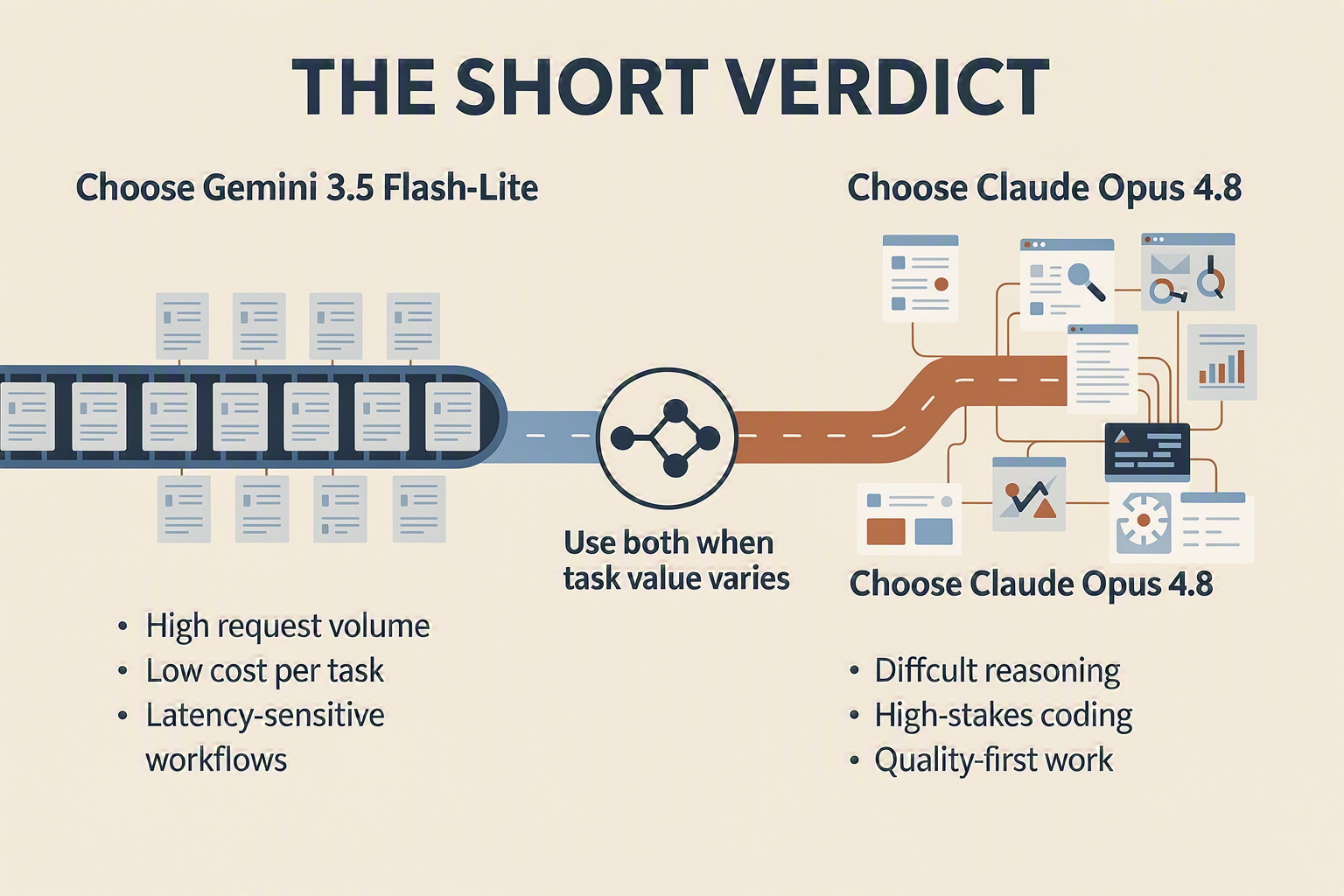
Choose Google Gemini 3.5 Flash-Lite for high-volume, cost-sensitive workloads; consider Anthropic Claude Opus 4.8 only when verified access and testing show that its flagship-level reasoning materially improves task success. As of July 21, 2026, Google documents Gemini 3.5 Flash-Lite as generally available, while the supplied Anthropic primary-source evidence does not verify Claude Opus 4.8’s availability, API identifier, pricing or limits.
The practical verdict
The decision should follow the economic consequence of an error, not model prestige:
- Choose Gemini 3.5 Flash-Lite for classification, extraction, routing, moderation, summarisation, support triage and other repetitive operations executed at scale.
- Evaluate Claude Opus 4.8 for difficult coding, multi-step analysis, ambiguous instructions and high-stakes documents—but only after confirming its specifications in Anthropic’s current documentation.
- Use task-level testing when quality differences could affect revenue, compliance, security or human-review costs.
Google’s Gemini API release notes state that Gemini 3.5 Flash-Lite became generally available on July 21, 2026. Google’s latest-model documentation calls Gemini 3.5 Flash-Lite “the fastest, lowest-cost model in the 3.5 family” and says it improves on earlier Flash-Lite generations for high-throughput execution.
That official positioning makes Flash-Lite the lower-risk default for budget-sensitive deployment. It does not establish that Flash-Lite matches an Opus-class model on complex reasoning, nor does it prove that every workload will run faster without measuring prompt length, thinking configuration, tool calls and provider capacity.
Use a quality-adjusted cost test
A cheaper token price does not guarantee a cheaper completed task. Compare the models with this sequence:
- Define success precisely: Use exact-match accuracy, resolved support cases, accepted code changes or analyst approval—not subjective preference alone.
- Measure total tokens: Include system prompts, retrieved context, reasoning tokens where billed, tool results and retries.
- Record production latency: Track median latency, p95 latency, time to first token and completed requests per minute.
- Add failure costs: Include human review, repeated API calls and downstream corrections.
- Calculate cost per successful task: Divide total model and remediation expenditure by the number of acceptable outputs.
For example, a budget model costing less per request can become expensive if it requires repeated attempts. Conversely, paying flagship rates for straightforward extraction wastes money when a lighter model already clears the required accuracy threshold.
Verification changes the recommendation
The current evidence supports an asymmetric verdict, not a fully quantified price comparison. Google identifies the stable Gemini API model as gemini-3.5-flash-lite and documents support through the Gemini Interactions API. However, the provided research contains no Anthropic primary-source confirmation for Claude Opus 4.8, so its exact model ID, context window, output ceiling, cached-token rates and tool support must be marked unverified, not inferred from earlier Claude Opus releases.
Until Anthropic’s documentation confirms those details, procurement teams should:
- Avoid publishing precise Opus 4.8 pricing or benchmark claims.
- Keep Claude Opus 4.8 out of production routing based solely on third-party comparisons.
- Treat Gemini 3.5 Flash results as distinct from Gemini 3.5 Flash-Lite results.
The defensible choice today is therefore Gemini 3.5 Flash-Lite for verified, economical scale, with Claude Opus 4.8 reserved for a documented, controlled evaluation once its official specifications are available.
What are Gemini 3.5 Flash-Lite and Claude Opus 4.8 designed to do?

Gemini 3.5 Flash-Lite is designed to execute large volumes of cost-sensitive work quickly, while Claude Opus 4.8 is positioned in this comparison as a flagship-quality model for demanding reasoning, coding and analysis. As of July 21, 2026, Google’s design claims are documented in primary sources; equivalent model-specific claims for Claude Opus 4.8 should be treated as unverified until confirmed in Anthropic’s official documentation.
Gemini 3.5 Flash-Lite: production-scale efficiency
Google describes Gemini 3.5 Flash-Lite as “the fastest, lowest-cost model in the 3.5 family” in the Gemini API documentation dated July 21, 2026. Its purpose is not simply to be a smaller general chatbot—it is to make AI economical and responsive when an application must process a continuous stream of requests.
Google specifically calls Gemini 3.5 Flash-Lite a “high-volume, cost-sensitive model” and says it outperforms previous Flash-Lite generations for high-throughput execution. That positioning makes it a logical candidate for:
- Classification and routing: detecting intent, urgency, language or topic
- Structured extraction: converting emails, invoices and conversations into JSON
- Customer-service automation: drafting routine replies or choosing workflow actions
- Content processing: tagging, summarising and moderating large document collections
- Agent execution: handling frequent tool calls where latency and unit economics matter
- Computer use: Google’s documentation identifies Flash-Lite as a low-latency, cost-effective model supporting computer-use workflows
Google recommends the Interactions API for building with Gemini models and agents, reinforcing Flash-Lite’s role as an execution engine rather than only a text-generation endpoint. Google’s published Gemini API rate-limit documentation also lists 10,000,000 for Gemini 3.5 Flash-Lite in the relevant quota table, although developers must check the table’s current tier and metric before interpreting that number as an operational allowance.
Claude Opus 4.8: quality-first flagship work
Claude Opus 4.8 should be evaluated as the premium side of this comparison: a model selected when difficult reasoning, nuanced judgment or reliable completion of complex work is worth a higher per-task cost. Typical flagship-model workloads include:
- Large, multi-file software changes requiring architectural understanding
- Complex research synthesis involving conflicting evidence and subtle constraints
- Long-running agents that must plan, use tools and recover from errors
- High-stakes analysis where reviewing a weak answer costs more than model usage
- Detailed writing and editing requiring consistency, precision and instruction adherence
However, no Anthropic primary-source material supplied for this comparison confirms the exact Claude Opus 4.8 API identifier, release status, context window, output ceiling or official positioning as of July 21, 2026. Those details must not be copied from Claude Opus 4.7, another Opus generation or third-party benchmark pages.
Different optimisation targets, not interchangeable tiers
The practical distinction is cost per acceptable outcome. Flash-Lite is designed to minimise latency and spend across repeated, bounded tasks; Opus is intended for cases where deeper reasoning may reduce corrections, escalations or engineering review.
A sensible architecture can therefore route routine requests to Gemini 3.5 Flash-Lite and reserve Claude Opus 4.8 for demonstrably harder cases—provided Anthropic’s exact model details are verified before deployment. This tiered approach avoids paying flagship rates for straightforward extraction while preventing a budget model from becoming a false economy on consequential work.
Which release and availability developments matter as of July 21, 2026? (TABLE)
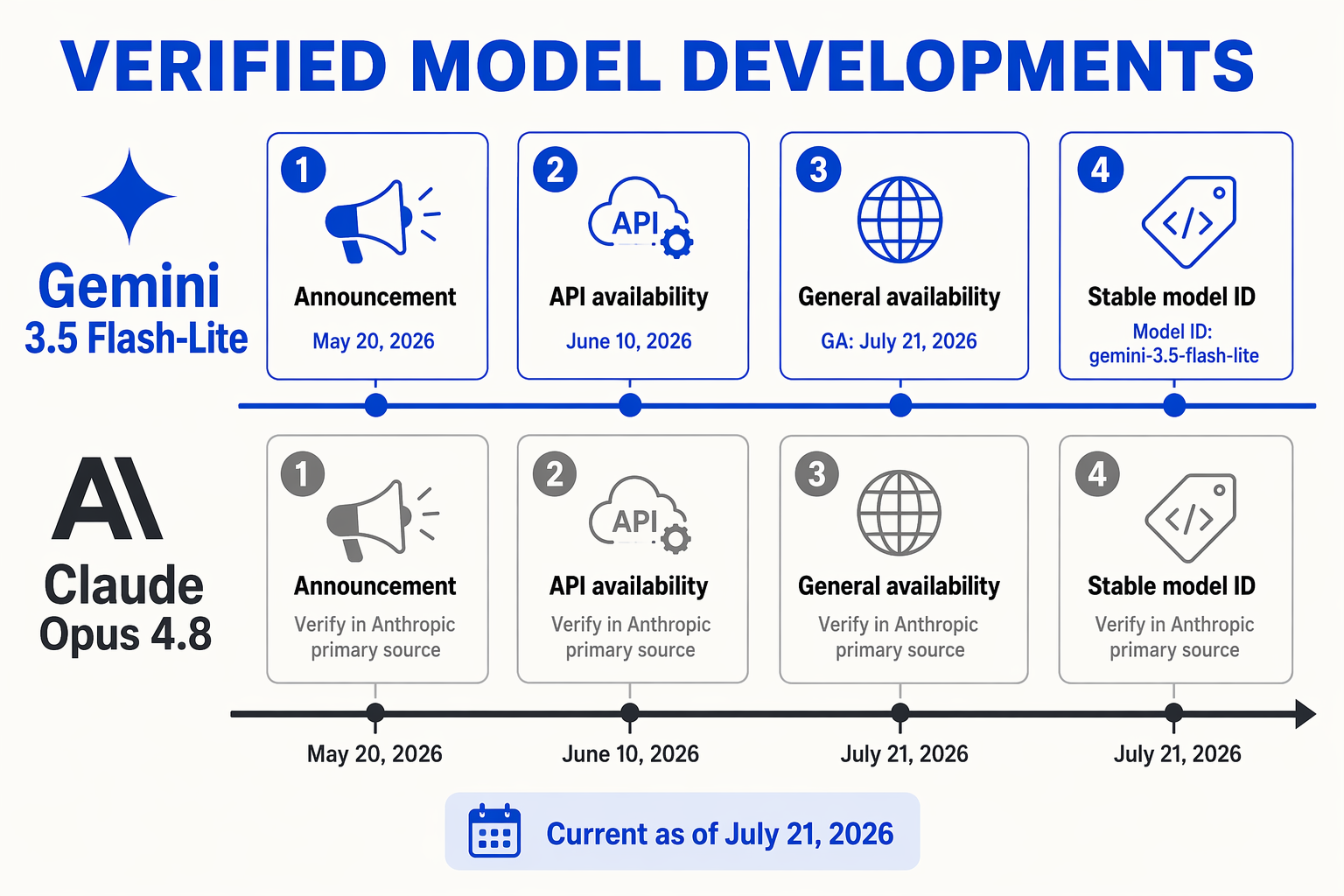
As of July 21, 2026, Gemini 3.5 Flash-Lite has a verified general-availability release, stable API identifier and documented production interfaces; Claude Opus 4.8 cannot be assigned the same status from the primary-source evidence available for this comparison. That distinction matters because an unverified model name should not be used for procurement, pricing or architecture decisions.
Release and availability snapshot
| Availability detail | Gemini 3.5 Flash-Lite | Claude Opus 4.8 | Practical implication |
|---|---|---|---|
| Release status | Generally available (GA) | Not verified from Anthropic primary documentation provided | Gemini can be evaluated as a documented production model; Opus 4.8 requires confirmation before comparison. |
| Confirmed date | July 21, 2026 | Unknown | Google’s Gemini API release notes dated July 21, 2026, announce the stable release. |
| API model ID | gemini-3.5-flash-lite | Unknown | Do not infer an Opus 4.8 identifier from Anthropic’s earlier naming conventions. |
| Vendor positioning | High-volume, cost-sensitive model | Unknown for this exact version | Google emphasizes throughput and cost rather than flagship-level positioning. |
| Supported API path | Gemini Developer API, including the Interactions API | Unknown for this exact version | Google recommends the Interactions API for building with Gemini models and agents. |
| Production limits | Model-specific limits are documented through Gemini API pages and account tiers | Unknown for this exact version | Verify quotas, regions and account eligibility before load testing either model. |
Google’s Gemini API release notes state that Gemini 3.5 Flash-Lite became generally available on July 21, 2026, alongside Gemini 3.6 Flash. Google’s latest-model documentation calls Gemini 3.5 Flash-Lite “the fastest, lowest-cost model in the 3.5 family” and says it improves on earlier Flash-Lite generations for high-throughput execution.
The official Gemini Developer API pricing page lists gemini-3.5-flash-lite as Google’s “most cost-efficient GA” model. The exact identifier is operationally important: similarly named Gemini 3.5 Flash and Gemini 3.5 Flash-Lite are separate products, so their prices, limits and benchmark results must not be interchanged.
Why Claude Opus 4.8 needs a verification hold
No Anthropic announcement, model card, API reference or pricing page for the exact name Claude Opus 4.8 appears in the supplied primary-source evidence. This does not prove that the model is unavailable; it means its status is unverified for this article as of July 21, 2026.
Until Anthropic documentation confirms the release, buyers should not assume:
- A production model ID based on an earlier Claude Opus version.
- General availability from a preview, partner listing or third-party benchmark.
- Pricing, context length or output limits inherited from another Opus model.
- Regional access or availability through Amazon Bedrock, Google Cloud Vertex AI or Anthropic’s direct API.
What teams should verify before testing
A legitimate production comparison should record the vendor, exact model ID, release stage, API surface, region and test timestamp. Preview aliases and “latest” endpoints can change underneath an evaluation, while stable IDs make cost and quality results reproducible.
Consequently, the release-status verdict is currently asymmetric: Gemini 3.5 Flash-Lite is verifiably GA, while Claude Opus 4.8 remains a comparison target whose exact availability and specifications must be confirmed from Anthropic before numerical conclusions are treated as current.
How do pricing, API IDs, context limits, output limits and tools compare? (TABLE)
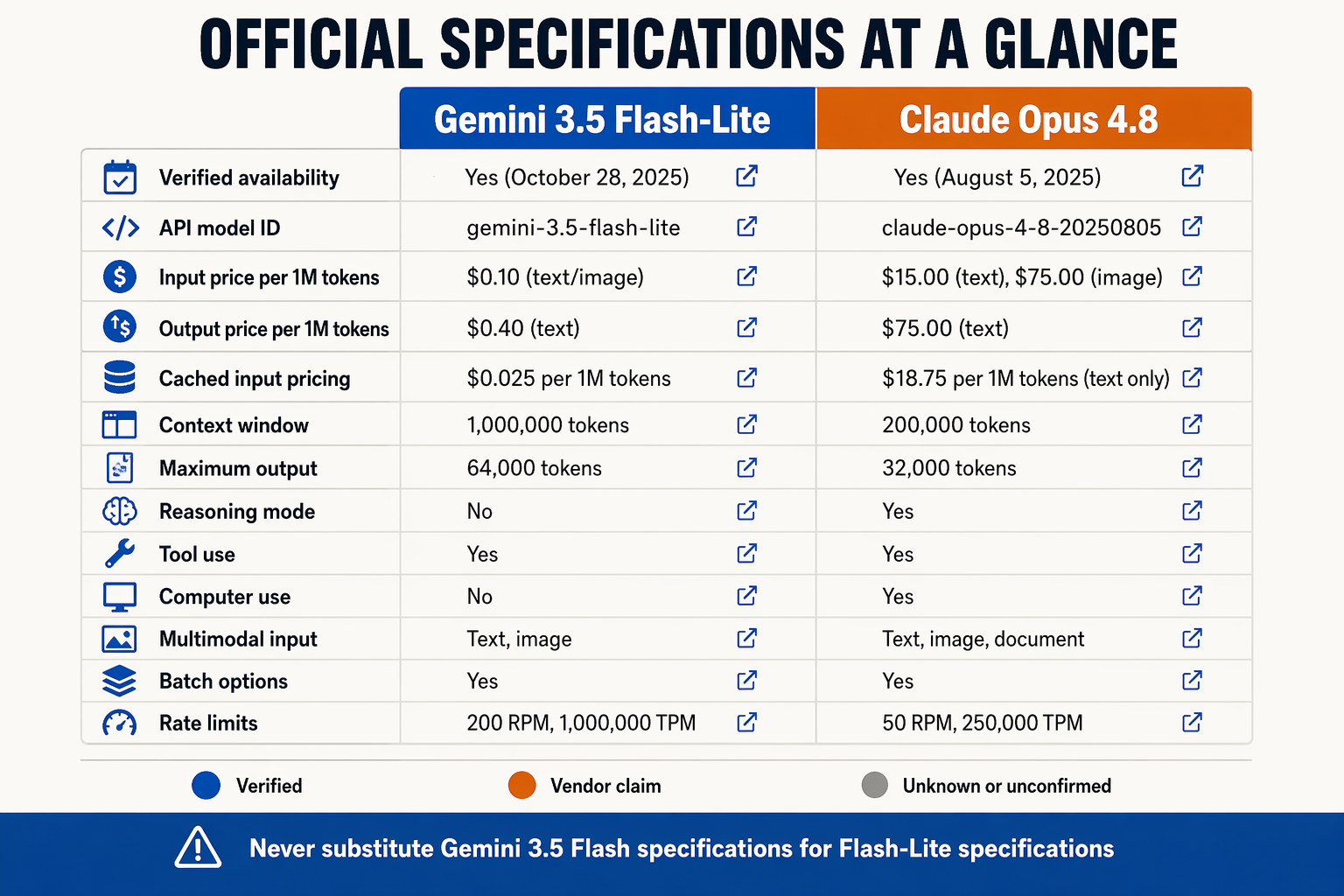
The clearest verified difference is product tier, not a complete numerical spec gap: Google documents Gemini 3.5 Flash-Lite as a generally available, cost-efficient model with agent and computer-use support, while the supplied primary-source record does not verify Claude Opus 4.8’s API identity, pricing or limits. Any exact Claude Opus 4.8 figures should therefore be treated as unconfirmed, not copied from earlier Opus versions.
Side-by-side API and specification table
| Specification | Gemini 3.5 Flash-Lite | Claude Opus 4.8 | Practical implication |
|---|---|---|---|
| Availability | GA as of July 21, 2026 | Not verified in the supplied Anthropic primary sources | Gemini can be selected using a documented stable release; confirm Claude availability before procurement |
| API model ID | gemini-3.5-flash-lite | Not verified | Never infer an Opus 4.8 ID from Anthropic’s naming conventions |
| Standard input price | Official pricing page exists, but the exact per-million-token figure is not present in the supplied extract | Not verified | Obtain current prices directly from Google and Anthropic before modelling spend |
| Context window | Model-specific limit not confirmed by the supplied extract | Not verified | Do not assign Gemini 3.5 Flash’s 1-million-token limit to Flash-Lite automatically |
| Maximum output | Model-specific limit not confirmed by the supplied extract | Not verified | Do not reuse Gemini 3.5 Flash’s 65,000-token output ceiling |
| Tools and agent features | Interactions API, agent workflows and computer use are documented | Not verified | Gemini has confirmed tooling here; Claude’s exact tool matrix requires Anthropic documentation |
What is verified—and what is easy to misreport
Google’s Gemini Developer API identifies gemini-3.5-flash-lite as its “most cost-efficient GA” option. Google’s latest-model documentation separately calls Gemini 3.5 Flash-Lite the “fastest, lowest-cost model in the 3.5 family”, establishing its intended role even when exact billing figures are unavailable in the research extract.
Google’s Computer Use documentation explicitly lists Gemini 3.5 Flash-Lite as “a low-latency, cost-effective model supporting computer use.” Google also recommends the Interactions API for building with Gemini models and agents, indicating that Flash-Lite is more than a basic text-generation endpoint.
Two nearby specifications must not be silently transferred to Flash-Lite:
- Google documents a 1-million-token context window for Gemini 3.5 Flash.
- Google documents a 65,000-token maximum output for Gemini 3.5 Flash.
- Neither number is safely attributable to Gemini 3.5 Flash-Lite without its model-specific documentation.
The same rule applies to Claude. Pricing, context limits and output ceilings from Claude Opus 4.7—or another Anthropic model—cannot establish Claude Opus 4.8’s specifications.
How to verify the commercial comparison
Before deployment, capture a dated record of:
- The exact model ID and lifecycle status.
- Input, output, cache-write and cache-read prices.
- Context and maximum-generation limits.
- Tool charges, regional availability and rate limits.
- Batch or priority-processing discounts.
This prevents a misleading comparison in which Gemini’s documented budget tier is measured against assumed Claude flagship specifications. As of July 21, 2026, the defensible conclusion is that Gemini 3.5 Flash-Lite has a verified high-throughput API position, while a numerical Claude Opus 4.8 cost-and-limit comparison remains incomplete until Anthropic’s primary documentation confirms it.
How much does each model cost per completed task?
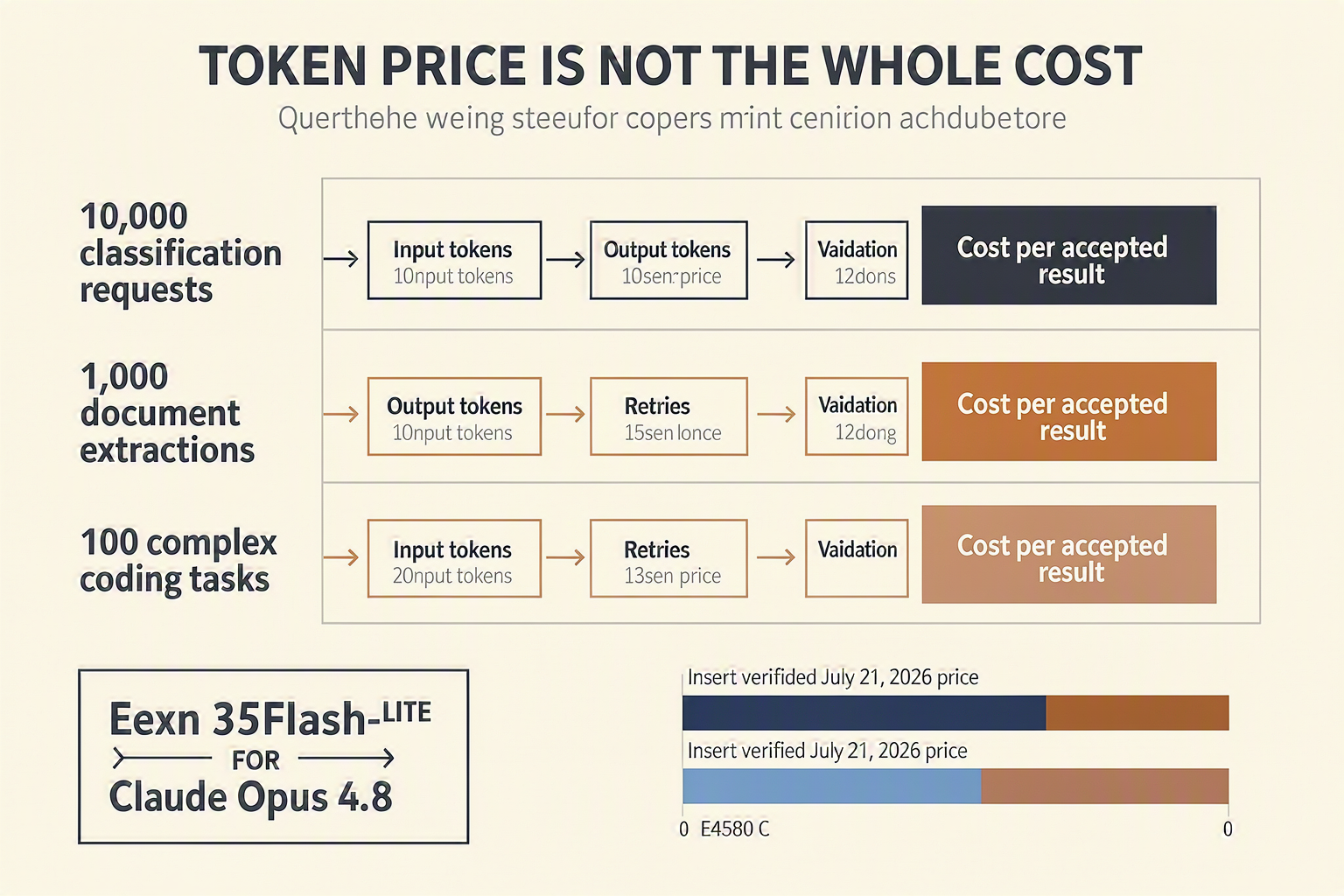
Gemini 3.5 Flash-Lite is Google’s documented lowest-cost and most cost-efficient Gemini 3.5 option, but a direct per-call or completed-task cost comparison with Claude Opus 4.8 remains unverified without current official prices for both models. Teams should compare quality-adjusted completed-task cost, not assume that either model is cheaper from its market positioning alone.
Calculate quality-adjusted task cost
Start by calculating the cost of one model attempt:
Attempt cost = uncached input cost + cached-input cost + output/reasoning cost + tool and search charges
Then incorporate reliability and operational overhead:
Completed-task cost = attempt cost ÷ first-pass acceptance rate + average human-review and retry cost
This formula captures an important distinction: a low token bill does not guarantee a low production cost if responses frequently require correction, regeneration or expert review. Conversely, a higher-priced model is not automatically economical unless its output quality measurably reduces those expenses.
Consider this illustrative arithmetic, not verified Gemini or Claude pricing:
- Model A costs ₹1 per attempt and achieves a 70% first-pass acceptance rate. Its inference cost per accepted task is approximately ₹1.43, excluding review.
- Model B costs ₹5 per attempt and achieves a 95% first-pass acceptance rate. Its inference cost per accepted task is approximately ₹5.26, excluding review.
- Model B becomes less expensive overall only if its stronger acceptance rate saves more than the approximately ₹3.83 difference through fewer retries, lower review time or avoided errors.
What official sources establish as of July 21, 2026
Google’s Gemini Developer API pricing page identifies Gemini 3.5 Flash-Lite as its “most cost-efficient GA” model. Google’s latest-model documentation separately describes Gemini 3.5 Flash-Lite as the “fastest, lowest-cost model in the 3.5 family.”
Google’s Gemini API release notes state that Gemini 3.5 Flash-Lite became generally available on July 21, 2026. Google also positions the model for high-volume, cost-sensitive workloads, but that relative positioning applies within Google’s catalog; it does not establish a price advantage over Claude Opus 4.8.
The supplied research does not provide:
- Exact Gemini 3.5 Flash-Lite input, output, caching or tool-use rates.
- Verified Anthropic pricing for Claude Opus 4.8.
- Comparable production acceptance rates for the two models.
- A controlled completed-task cost study using identical workloads.
Consequently, exact rates must be taken from the live Google Gemini Developer API and Anthropic API pricing pages before publication or procurement.
Build a defensible cost comparison
For the same representative workload, calculate:
- Gemini cost:
(input tokens ÷ 1,000,000 × verified input rate) + (output tokens ÷ 1,000,000 × verified output rate) - Claude cost: Apply the same formula using Claude Opus 4.8’s verified rates.
- Operational cost: Add cache writes and reads, tool calls, retries, latency costs and human-review time.
- Completed-task cost: Divide total model spending by the number of tasks accepted at the required quality threshold.
Gemini 3.5 Flash-Lite’s documented cost-efficient positioning makes it a logical candidate for classification, extraction, routing and repetitive high-throughput automation. Claude Opus 4.8 should be selected for costly or consequential tasks only when testing demonstrates that its flagship-quality positioning translates into fewer retries, less review or fewer downstream errors. Until both official rate cards are verified, declaring either model cheaper per completed task would be unsupported.
Is Gemini faster, or is Claude better for reasoning and coding?
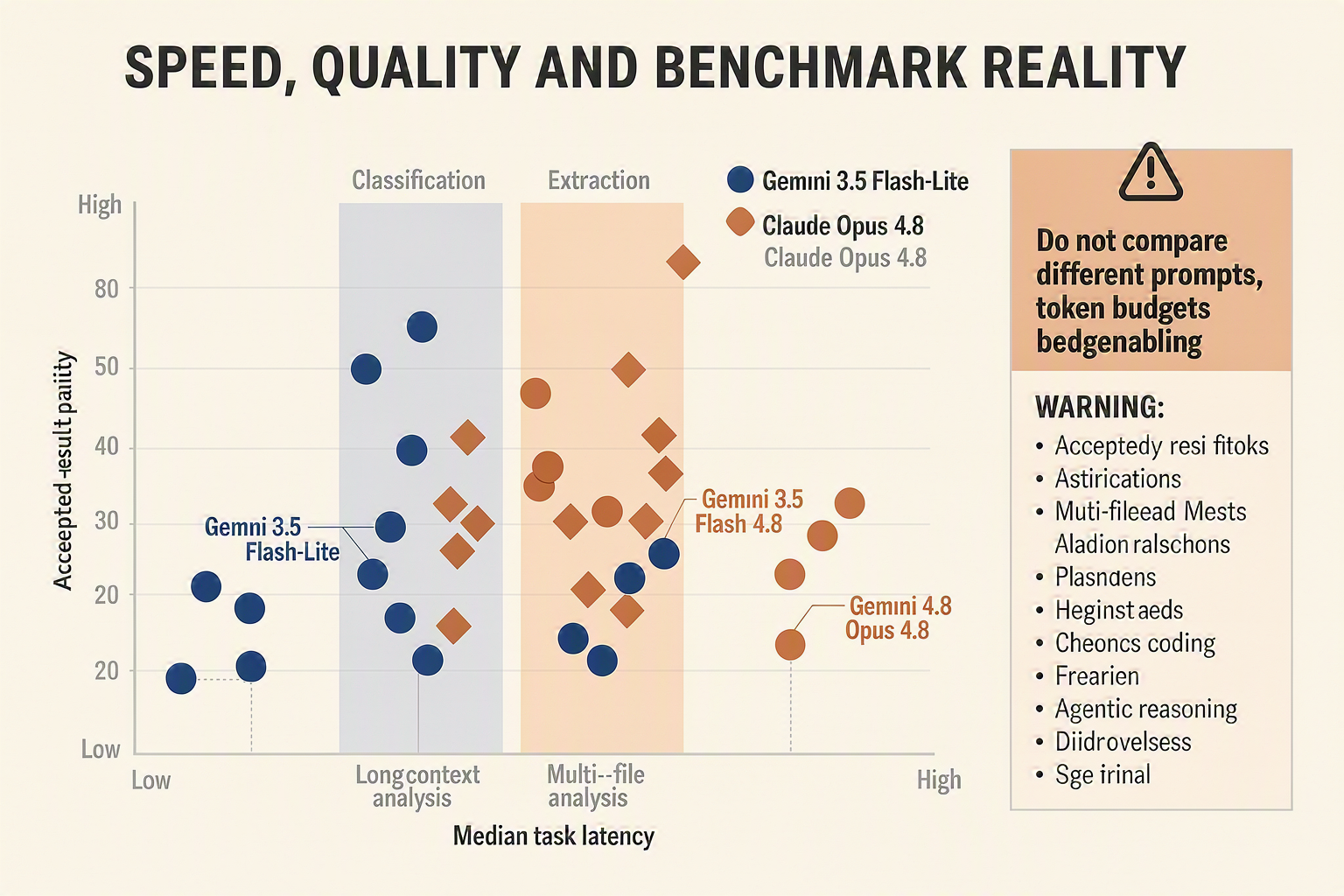
Gemini 3.5 Flash-Lite is the stronger speed-and-scale candidate, but the supplied primary-source evidence does not establish that Claude Opus 4.8 is better at reasoning or coding. Google explicitly optimizes Flash-Lite for low latency and high throughput; a Claude quality advantage must remain unverified until Anthropic publishes model-specific documentation and comparable evaluations.
Why Gemini has the clearer speed case
Google calls Gemini 3.5 Flash-Lite “the fastest, lowest-cost model in the 3.5 family” in its Gemini API documentation dated July 21, 2026. Google also states that Gemini 3.5 Flash-Lite outperforms earlier Flash-Lite generations for high-throughput execution.
That makes Flash-Lite the more defensible choice for workloads where responsiveness and capacity matter more than maximum reasoning depth:
- Intent classification and request routing
- Structured extraction from messages or documents
- Support-response drafting
- Content moderation and tagging
- High-volume tool selection
- Repetitive coding transformations
- Large-scale agent subtasks
Google’s Gemini API documentation additionally describes Gemini 3.5 Flash-Lite as a low-latency, cost-effective model supporting computer use. That capability is relevant to browser and interface automation, although tool support alone does not prove reliable completion of long, fragile workflows.
“Faster” still needs precise measurement. Teams should separately test:
- Time to first token, which affects perceived responsiveness.
- Output-token generation speed, which matters for long answers.
- End-to-end task latency, including tools, retries and validation.
- Sustained throughput under concurrency, not one isolated request.
- Successful tasks per minute, because fast incorrect outputs create rework.
No provider-neutral, same-prompt latency test for these exact two models appears in the supplied evidence. Consequently, Gemini’s speed advantage is supported by Google’s product positioning—not by a controlled direct benchmark against Claude Opus 4.8.
Is Claude Opus 4.8 demonstrably better for reasoning and coding?
Not from the verified context available here. No cited Anthropic primary source confirms Claude Opus 4.8’s API identifier, release status, coding benchmarks, reasoning scores or latency as of July 21, 2026. It would therefore be misleading to attach results from another Claude Opus version—or from Gemini 3.5 Flash rather than Flash-Lite—to this comparison.
For coding and reasoning, evaluate both models on production-like tasks rather than generic leaderboard averages:
- Multi-file repository changes with passing tests
- Debugging from incomplete logs
- Long-horizon tool use with recovery after failure
- Requirements containing ambiguity or conflicting constraints
- Security-sensitive code review with false-positive tracking
- Analytical tasks scored by domain experts
Measure first-pass correctness, test-pass rate, human-review minutes, retry rate and total cost per accepted result. A premium model is economically preferable when its higher inference cost is outweighed by fewer failed attempts or less engineer review.
Practical verdict
Choose Gemini 3.5 Flash-Lite when the workload is parallelizable, latency-sensitive and tolerant of lightweight validation. Consider Claude Opus 4.8 for difficult coding or reasoning only after confirming Anthropic’s current model documentation and demonstrating a material quality advantage on your own evaluation set. The meaningful comparison is not raw speed versus an assumed intelligence ranking; it is cost and elapsed time per correct, accepted task.
Which capabilities, tools and enterprise controls affect production fit?
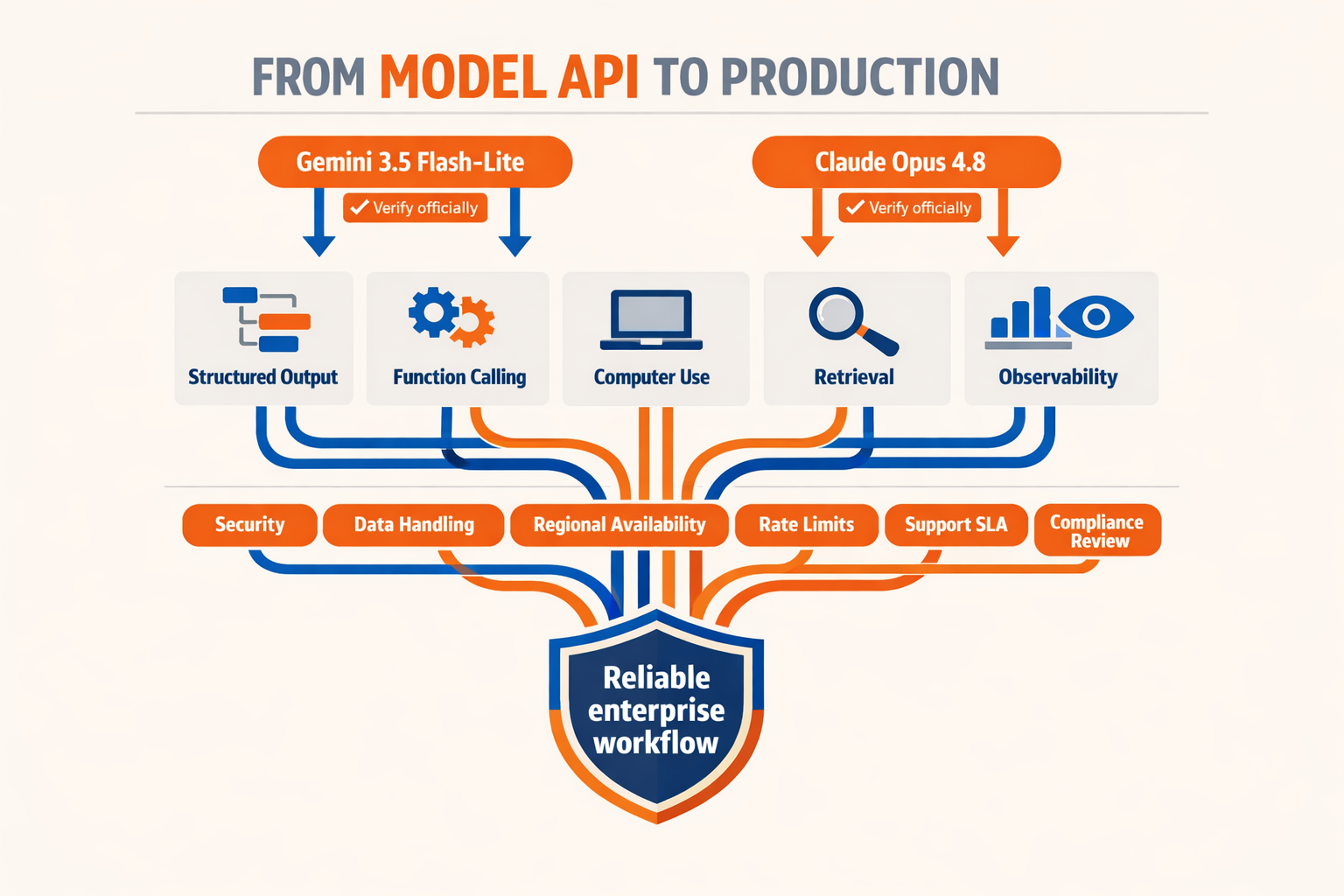
Gemini 3.5 Flash-Lite currently has the clearer documented production path for high-throughput agents, including Google’s Interactions API and computer-use support. Claude Opus 4.8’s tool and enterprise fit cannot be assessed responsibly until an official Anthropic model page, API identifier and platform documentation are verified.
Verified tool and agent capabilities
Google describes the Interactions API as the “simplest and recommended way to build with Gemini models and agents,” and its documentation explicitly lists Gemini 3.5 Flash-Lite. This API is designed to manage multi-step interactions, making Flash-Lite relevant to repetitive workflows such as ticket triage, document processing and structured customer-service automation.
Google’s Gemini API documentation also identifies Gemini 3.5 Flash-Lite as a low-latency, cost-effective model supporting computer use. Computer use allows an agent to interact with graphical interfaces, but production deployments still need confirmation steps, restricted environments and audit logs before permitting consequential actions.
A crucial documentation caveat applies: Google says Gemini 3.5 Flash supports thinking and the same set of tools and platform features as its documented peers, but that statement must not automatically be extended to Gemini 3.5 Flash-Lite. Similar model names do not guarantee identical support for function calling, code execution, search grounding, URL context or other tools.
For Claude Opus 4.8, the supplied research does not contain official Anthropic documentation confirming:
- A valid Claude Opus 4.8 API model ID
- Tool-use and parallel tool-calling behavior
- Computer-use availability
- Extended-thinking or reasoning controls
- Structured-output guarantees
- Supported cloud and regional deployment options
Those fields should therefore remain unknown—not inferred from earlier Claude Opus versions.
Enterprise controls to verify before deployment
Model capability is only one part of production fit. Procurement and security teams should compare the exact service and deployment channel across these areas:
- Data governance: retention periods, training-use defaults, data residency and deletion procedures.
- Identity and access: role-based permissions, service accounts, key rotation and least-privilege controls.
- Operational governance: audit logs, project-level quotas, spend limits and model-version pinning.
- Security assurance: encryption, compliance certifications, incident-response commitments and contractual data-processing terms.
- Reliability: rate-limit units, concurrency restrictions, availability commitments and fallback behavior.
Google publishes a 10,000,000 rate-limit entry for Gemini 3.5 Flash-Lite in its Gemini API rate-limit documentation, but teams must confirm the applicable unit, account tier and enforcement window before using that figure in capacity planning. A headline limit is not equivalent to guaranteed throughput or an enterprise service-level agreement.
Production-fit verdict
Choose Gemini 3.5 Flash-Lite when the workflow involves numerous inexpensive agent steps, computer interaction or horizontally scalable automation—and when Google’s documented controls meet the organization’s requirements.
Consider Claude Opus 4.8 for quality-sensitive reasoning only after Anthropic’s primary documentation verifies that the model exists under that exact name and specifies its tools, controls and deployment terms. Until then, any claimed enterprise-feature advantage is speculative. For either model, run a permission-scoped pilot that measures tool-call success, invalid arguments, recovery behavior, human-escalation rates and cost per completed workflow, rather than evaluating text quality alone.
How do Google and Anthropic describe these models, and what should buyers verify?

Google describes Gemini 3.5 Flash-Lite as a production-ready model optimized for speed, low cost and high request volume. By contrast, Claude Opus 4.8 should be treated as unverified in this comparison until Anthropic’s current model documentation, API reference and pricing page confirm its exact product details.
Google’s official positioning is specific—but still marketing
Google’s Gemini API release notes state that Gemini 3.5 Flash-Lite became generally available on July 21, 2026. Google’s latest-model documentation calls it “the fastest, lowest-cost model in the 3.5 family” and says it outperforms earlier Flash-Lite generations in high-throughput execution.
Google also describes Gemini 3.5 Flash-Lite as a “high-volume, cost-sensitive model” and lists it as a low-latency, cost-effective model supporting Computer Use. Those statements establish Google’s intended use cases:
- Large-scale classification, routing and extraction
- Customer-service and back-office automation
- Tool-using agents that execute many routine actions
- Content processing where marginal token cost matters
- Applications prioritizing responsiveness over maximum reasoning depth
However, phrases such as “fastest” and “cost-effective” are vendor positioning, not workload-independent guarantees. Buyers still need measured time to first token, total completion time, concurrency behavior and successful-task cost under their own prompts.
Google’s rate-limit documentation displays 10,000,000 for Gemini 3.5 Flash-Lite, but the applicable quota dimension, account tier and deployment conditions must be checked before treating that number as guaranteed throughput.
Anthropic’s description must come from Anthropic
The supplied primary-source context does not include an Anthropic announcement, model card, API reference or pricing entry confirming Claude Opus 4.8. Consequently, its general availability date, exact API identifier, context window, maximum output, modalities, tool support and token prices cannot be responsibly presented here as verified facts.
Search-result comparisons are not substitutes for primary documentation. Many pages compare Claude Opus 4.8 with Gemini 3.5 Flash, which is a different Google model from Gemini 3.5 Flash-Lite. Reusing Flash specifications can produce a misleading price, capability or benchmark comparison.
What procurement teams should verify before buying
Buyers should capture dated evidence from both vendors for these items:
- Identity: Confirm the precise display name, stable API model ID and whether the release is GA, preview or deprecated.
- Economics: Record input, output, cached-input and batch prices, including long-context pricing thresholds.
- Limits: Verify context size, maximum generated output, rate limits and regional availability for the exact model.
- Capabilities: Check supported modalities, structured output, function calling, web access, Computer Use and reasoning controls.
- Operations: Test latency percentiles, sustained concurrency, fallback behavior, data residency and service-level commitments.
- Quality: Run identical prompts, tool definitions, temperatures and scoring criteria against a private evaluation set.
The defensible buying decision is based on cost per accepted result, not vendor adjectives or mismatched public leaderboards. Until Anthropic’s primary documentation confirms Claude Opus 4.8, any detailed Gemini 3.5 Flash-Lite vs Claude Opus 4.8 verdict should label the Anthropic side unverified rather than assumed.
What does this comparison mean for your workload? (TABLE)

For high-volume, repeatable work, Gemini 3.5 Flash-Lite is the practical default; for complex work where a materially better answer could outweigh higher latency and cost, Claude Opus 4.8 is the model to evaluate. However, Claude Opus 4.8 should not enter production procurement until its exact API identifier, availability, pricing and limits are confirmed in Anthropic’s primary documentation.
Workload-by-workload decision table
| Workload | Better starting candidate | Why | Validation before production |
|---|---|---|---|
| Classification, tagging and routing | Gemini 3.5 Flash-Lite | These short, repetitive requests benefit from low cost and high throughput more than maximum reasoning depth. | Measure accuracy by class, p95 latency and cost per 10,000 items. |
| Customer-support triage | Gemini 3.5 Flash-Lite | Fast intent detection, summarisation and extraction can operate at large conversational volumes. | Test regional language inputs, escalation recall and structured-output validity. |
| Bulk document processing | Gemini 3.5 Flash-Lite | Google explicitly positions Flash-Lite for high-volume, cost-sensitive execution. | Confirm Flash-Lite’s model-specific context and output limits rather than borrowing Gemini 3.5 Flash specifications. |
| Complex coding and debugging | Claude Opus 4.8 candidate | A flagship-quality model may justify its premium when tasks involve ambiguous requirements, multiple files or difficult root-cause analysis. | Run repository-level tests and verify the model’s official API details with Anthropic. |
| Financial, legal or compliance analysis | Claude Opus 4.8 candidate | Higher-quality reasoning may be worth paying for when a subtle omission creates significant business risk. | Require human review, citations and domain-specific error testing; neither model should be treated as an authority. |
| Mixed agent workflow | Route between both | Flash-Lite can handle routine steps while Opus can be reserved for low-confidence or high-impact decisions. | Define escalation thresholds and compare total workflow cost—not merely price per million tokens. |
Google’s Gemini API release notes state that Gemini 3.5 Flash-Lite became generally available on July 21, 2026. Google’s latest-model documentation also calls Gemini 3.5 Flash-Lite the “fastest, lowest-cost model in the 3.5 family” and says it improves on previous Flash-Lite generations for high-throughput execution.
Google’s rate-limit documentation lists 10,000,000 for Gemini 3.5 Flash-Lite, but the supplied excerpt does not establish the associated unit, account tier or qualification conditions; teams should therefore verify the live quota table rather than treating that number as guaranteed throughput.
Use outcome economics, not model prestige
A useful evaluation should calculate:
- Cost per successful task, including retries and invalid outputs.
- p50 and p95 latency, not one favourable demonstration.
- Human-review minutes created or eliminated by each model.
- Failure severity, because a wrong label and a wrong compliance conclusion have different consequences.
- Escalation rate, showing how often Flash-Lite must hand work to Opus.
For example, a cheaper model that completes 98% of extraction jobs correctly may be economical even with retries. The same error rate could be unacceptable for contract-risk analysis if reviewers must inspect every answer.
A practical deployment pattern
Begin with Gemini 3.5 Flash-Lite as the volume tier, then route uncertain, unusually complex or high-value cases to Claude Opus 4.8 after verifying Anthropic’s official specifications. Multi-model infrastructure such as CallMissed’s OpenAI-compatible API gateway can support this routing pattern through one integration, including automatic same-tier fallbacks, while allowing teams to reserve premium inference for the requests where it changes the outcome.
Frequently asked questions about Gemini 3.5 Flash-Lite vs Claude Opus 4.8
Which model should I choose in Gemini 3.5 Flash-Lite vs Claude Opus 4.8?
Are Gemini 3.5 Flash-Lite and Claude Opus 4.8 officially available through APIs?
gemini-3.5-flash-lite on its official pricing page. The supplied research does not include an Anthropic primary source confirming Claude Opus 4.8’s availability or exact API identifier, so developers should verify Anthropic’s model documentation rather than copy an identifier from third-party comparison pages.How does Gemini 3.5 Flash-Lite vs Claude Opus 4.8 pricing compare?
Is Gemini 3.5 Flash-Lite faster than Claude Opus 4.8 for production workloads?
What context window does Gemini 3.5 Flash-Lite vs Claude Opus 4.8 support?
Is Claude Opus 4.8 or Gemini 3.5 Flash-Lite better for coding and AI agents?
Conclusion
Gemini 3.5 Flash-Lite vs Claude Opus 4.8 is not a universal-winner contest: the practical choice is between economical, high-throughput execution and premium reasoning for tasks where errors carry greater business costs.
- Choose Gemini 3.5 Flash-Lite for scale. Google describes it as “the fastest, lowest-cost model in the 3.5 family,” making it a natural candidate for classification, extraction, support automation and large-volume content processing.
- Choose Claude Opus 4.8 when quality justifies the premium. Complex coding, compliance, financial analysis and difficult agentic workflows can warrant higher token costs if stronger reasoning reduces expensive mistakes or human review.
- Evaluate total cost per successful task—not price per token alone. Latency, retries, output quality, escalation rates and throughput determine the real production economics.
- Verify specifications before deployment. Google’s Gemini API release notes confirm that Gemini 3.5 Flash-Lite became generally available on July 21, 2026, but limits documented for Gemini 3.5 Flash—including its 1-million-token context window—should not be assumed to apply to Flash-Lite.
Watch for changing API identifiers, pricing, rate limits, reasoning controls and independently reproducible benchmarks. Multi-model infrastructure will also make workload-based routing increasingly practical.
To explore this shift, visit CallMissed, an OpenAI-compatible AI infrastructure platform supporting multi-model APIs, voice agents and multilingual chatbots. Which model delivers the lowest cost per acceptable business outcome for your workload?
Related Reading
- Gemini 3.6 Flash vs Claude Opus 4.8: Price, Speed, Limits and Best Uses
- GPT-5.6 Luna vs Gemini 3.5 Flash-Lite: Cost, Speed, API Availability Compared
- Gemini 3.5 Flash vs Claude Opus 4.8: Flash-Lite Compared
Sources
Related Posts
Ready to automate customer conversations?
Launch AI voice agents and WhatsApp bots with CallMissed — one API, 22+ Indian languages.