

Claude Opus 4.8 vs Qwen3.8-Max: July 2026 Comparison


Compare Claude Opus 4.8 vs Qwen3.8-Max on access, reasoning, coding, agents, context, pricing, deployment, and enterprise fit in July 2026.
Claude Opus 4.8 vs Qwen3.8-Max: July 2026 Comparison
Can 2.4 trillion parameters tell you which AI model will perform better? No—and that is precisely why a careful Claude Opus 4.8 vs Qwen3.8-Max comparison matters. Parameter count describes architectural scale, not real-world reasoning quality, coding reliability, agent performance, latency, cost, or deployability.
As of July 20, 2026, Anthropic officially positions Claude Opus 4.8 as a frontier model for complex agentic coding and enterprise workloads. Anthropic reports that Claude Opus 4.8 scored 84% on Online-Mind2Web, a benchmark designed to evaluate browser agents completing tasks on real websites. Anthropic’s Claude Platform documentation also recommends Opus 4.8 for workloads requiring its highest level of capability and says existing Claude Opus 4.7 integrations can migrate without breaking API changes.
The Qwen side requires more caution. Qwen3.8-Max is being discussed as a newly previewed 2.4-trillion-parameter Alibaba Qwen model, but the supplied research does not include an official Qwen or Alibaba announcement confirming its final model name, architecture, release status, benchmark results, context window, API pricing, or open-weight licence. Until those details appear in official Qwen documentation, any comparison must distinguish verified specifications from preview claims.
Why this comparison matters now
The two models potentially represent contrasting approaches to frontier AI:
- Claude Opus 4.8 is an available, closed model delivered through Anthropic’s managed platform, with documented enterprise and agentic capabilities.
- Qwen3.8-Max may extend Alibaba’s Qwen ecosystem at substantially greater reported scale, but its production availability and open-weight intentions remain undisclosed in the evidence currently available.
- Model size alone cannot establish superiority. A smaller or sparsely activated model can outperform a larger system depending on training data, post-training, inference-time reasoning, tool use, and benchmark design.
- Deployment terms matter as much as intelligence. Enterprises must consider data governance, regional availability, predictable pricing, latency, safety controls, and whether self-hosting is permitted.
This comparison will examine reasoning quality, coding, browser and computer-use agents, multimodality, context limits, pricing, benchmarks, deployment options, and enterprise fit. It will also provide workload-specific guidance rather than forcing a universal winner where the evidence does not support one.
For developers evaluating models through unified infrastructure, platforms such as CallMissed’s OpenAI-compatible AI gateway reflect the broader shift toward accessing multiple model providers through one integration with same-tier fallbacks.
The central question is therefore not whether 2.4 trillion is bigger than an undisclosed parameter count. It is whether Qwen3.8-Max can translate its reported scale into independently documented performance—and whether Claude Opus 4.8’s proven agent capabilities justify its closed, API-first deployment model for your workload.
Which should you choose in July 2026? Claude Opus 4.8 is documented and available; treat Qwen3.8-Max claims as provisional until Alibaba confirms them
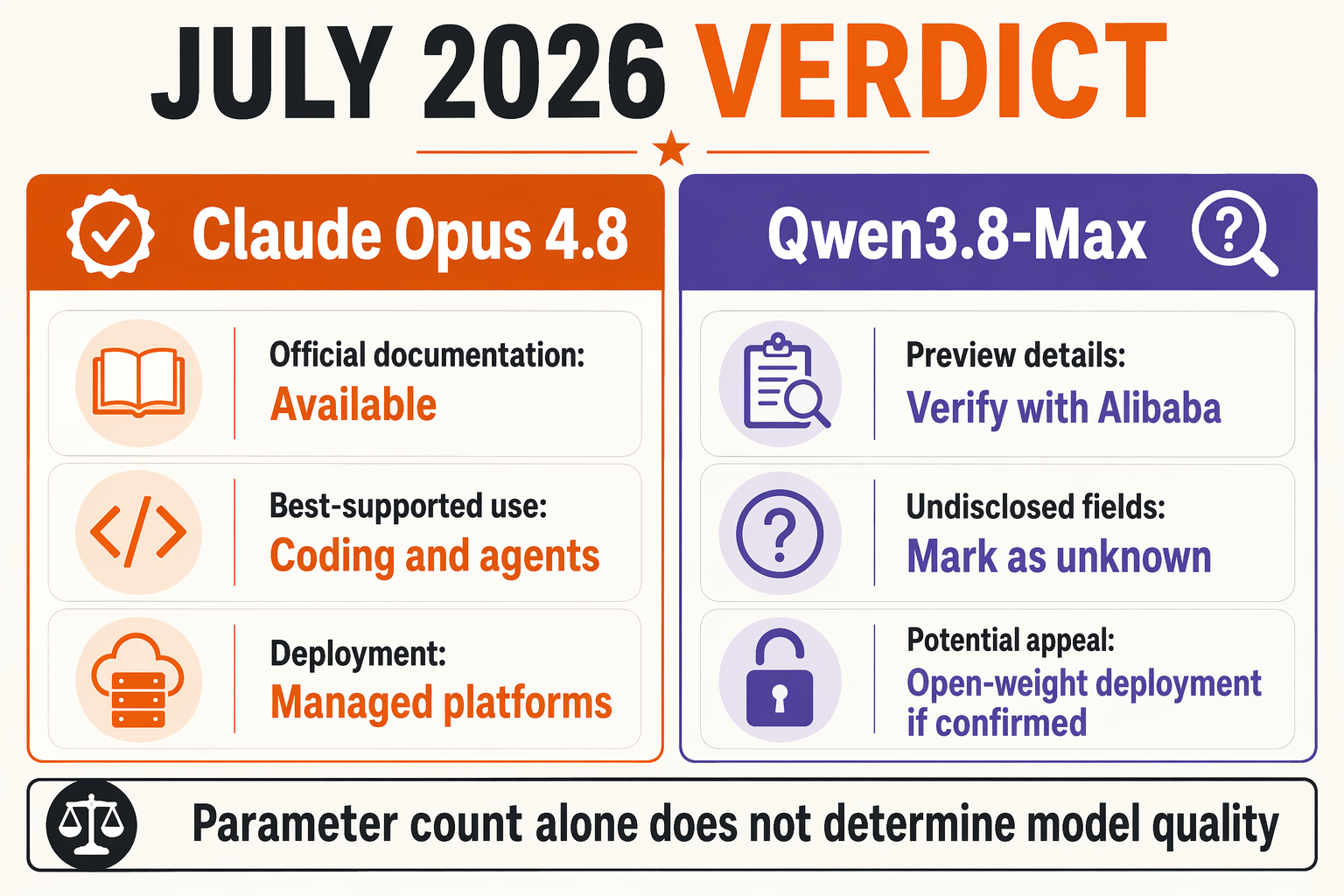
Choose Claude Opus 4.8 for production deployments in July 2026; monitor Qwen3.8-Max rather than treating it as a shipping alternative. Claude Opus 4.8 has official documentation, API availability, migration guidance, and published evaluation results, whereas essential Qwen3.8-Max details remain unconfirmed by Alibaba or the Qwen team.
The evidence supports an availability verdict—not a final quality verdict
As of July 20, 2026, the official-source record is materially different for the two models:
- Claude Opus 4.8: Anthropic documents the model for complex agentic coding, browser interaction, and enterprise work.
- Qwen3.8-Max: The reported 2.4-trillion-parameter scale remains a preview claim in the supplied evidence, without an official Qwen model card, Alibaba Cloud API listing, technical report, or repository.
- Open-weight status: Unknown. Earlier open Qwen releases do not prove that Qwen3.8-Max will publish weights or permit self-hosting.
- Architecture: Unknown. Alibaba has not confirmed whether 2.4 trillion refers to total parameters, how many parameters are active per token, or whether the model uses a mixture-of-experts design.
This asymmetry does not establish that Claude Opus 4.8 has greater underlying intelligence. It establishes that Claude is currently the model enterprises can evaluate, contract for, integrate, and govern using documented information.
Why Claude Opus 4.8 is the practical choice now
Anthropic’s Claude Platform documentation recommends Claude Opus 4.8 for workloads requiring its “highest level of capability,” particularly complex agentic coding and enterprise tasks. Anthropic also says existing Claude Opus 4.7 applications can migrate to Opus 4.8 with no breaking API changes, reducing adoption risk for current customers.
Anthropic reported in 2026 that Claude Opus 4.8 scored 84% on Online-Mind2Web, a benchmark measuring browser agents on real websites. That result is useful evidence for computer-use workflows, although organizations should still test the model on their own websites, permissions, tools, and failure conditions.
Choose Claude Opus 4.8 now when you need:
- A documented production API with defined integration and migration paths.
- Agentic coding and browser automation supported by published first-party evaluations.
- Enterprise procurement readiness, including identifiable platform documentation and safety materials.
- Immediate workload testing rather than architecture-based speculation.
When waiting for Qwen3.8-Max makes sense
Qwen3.8-Max could become compelling if Alibaba confirms favorable deployment terms, strong multilingual performance, competitive economics, or downloadable weights. Teams focused on Chinese-language workloads, Alibaba Cloud infrastructure, private deployment, or model customization should therefore keep it on their evaluation roadmap.
Before making a decision, wait for Alibaba or the official Qwen team to publish:
- The final model name and release status
- Total versus active parameter count
- Context window and multimodal inputs
- Independent or reproducible benchmark results
- API regions, latency, quotas, and pricing
- Weight availability, licence terms, and hardware requirements
The responsible July 2026 verdict is consequently straightforward: deploy and evaluate Claude Opus 4.8 where a frontier model is needed now, but reserve judgment on comparative quality until Qwen3.8-Max receives official specifications and testable access.
What are Claude Opus 4.8 and Qwen3.8-Max, and which names and claims do official sources confirm?
Claude Opus 4.8 is an officially documented Anthropic model, while “Qwen3.8-Max” and its reported 2.4-trillion-parameter scale are not confirmed by the official Qwen or Alibaba materials available for this July 20, 2026 review. The names should therefore be treated differently: one identifies a released product; the other remains a preview label pending primary-source verification.
What Anthropic officially confirms about Claude Opus 4.8
Anthropic consistently uses the exact name Claude Opus 4.8 across its product announcement, Claude product page, Claude Platform documentation, model overview, migration guide, and pricing documentation. These official sources confirm that:
- Claude Opus 4.8 builds on Claude Opus 4.7 and is intended for complex agentic coding and enterprise work.
- Anthropic describes Claude Opus 4.8 as the strongest computer-use and browser-agent model it had tested at launch.
- Anthropic’s official Claude Opus 4.8 announcement, accessed July 20, 2026, reports an 84% score on Online-Mind2Web.
- Anthropic’s model overview recommends Opus 4.8 when a workload requires the company’s highest level of capability.
- Anthropic’s migration guide states that existing Opus 4.7 code faces no breaking API changes when moving to Opus 4.8 and should show strong out-of-the-box performance with existing prompts and evaluations.
- The model is delivered through Anthropic’s managed Claude Platform; Anthropic has not presented Opus 4.8 as an open-weight release.
Anthropic’s claim that the model has “noticeably better judgment” is a vendor characterization rather than an independent benchmark result. It is still useful for understanding the intended improvement—asking clarifying questions, detecting mistakes, and challenging unsound plans—but should be validated on each organization’s own tasks.
What remains unverified about Qwen3.8-Max
The supplied evidence contains no official Qwen or Alibaba announcement, model card, repository, API documentation, technical report, or pricing page for a product named Qwen3.8-Max. Consequently, this comparison cannot yet present the following as established facts:
- Final model name: “Qwen3.8-Max” may be a preview designation rather than the shipping name.
- Parameter count: The reported 2.4 trillion parameters lacks primary-source confirmation in the available research.
- Architecture: It is unknown whether 2.4 trillion would mean total parameters, active parameters, a mixture-of-experts system, or another measurement.
- Release model: Alibaba has not confirmed here whether Qwen3.8-Max will be API-only, open-weight, privately deployable, or offered in multiple forms.
- Performance: No officially verified reasoning, coding, agent, multilingual, or multimodal benchmark scores are available in the supplied sources.
- Commercial details: Context length, regional availability, licence, inference pricing, safety controls, and release date remain undisclosed.
How to read the comparison
Throughout this article, “confirmed” means supported by an official Anthropic, Qwen, or Alibaba source. “Preview claim” means the detail is circulating but lacks matching primary documentation. “Unknown” is not evidence of a missing capability or weakness; it means the evidence is insufficient.
Most importantly, even official confirmation of 2.4 trillion parameters would describe scale—not prove that Qwen3.8-Max has better reasoning, coding, latency, efficiency, or agent reliability than Claude Opus 4.8.
What are the key July 2026 differences in availability, weights, context, modalities, pricing, and deployment? (TABLE)
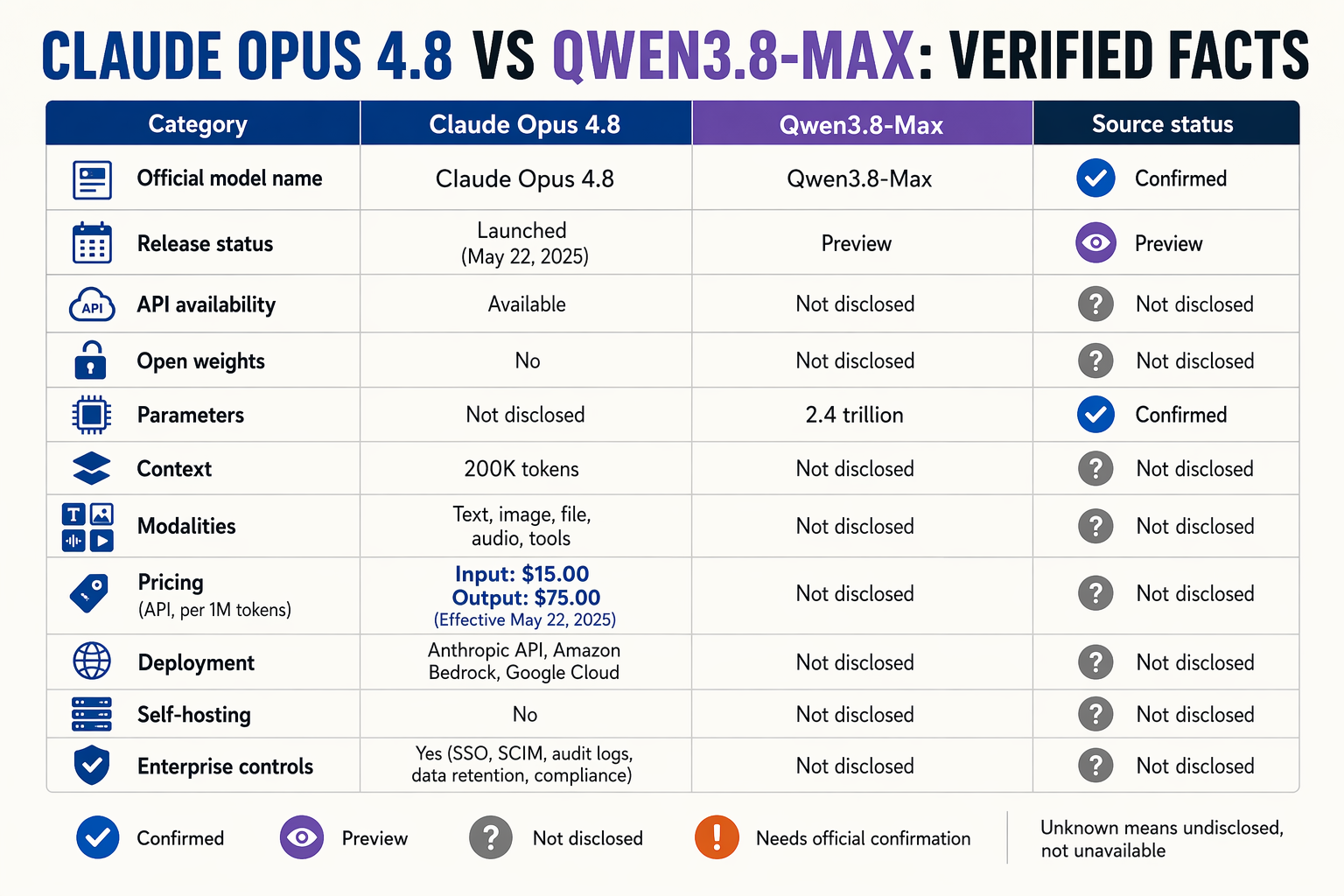
As of July 20, 2026, Claude Opus 4.8 is a documented, production-accessible model, whereas Qwen3.8-Max remains an unverified preview name in the supplied research. Consequently, Claude’s availability and API terms can inform procurement decisions now; Qwen3.8-Max’s reported 2.4-trillion-parameter scale cannot yet establish its weights, cost, context window, or deployability.
Specification and deployment comparison
| Category | Claude Opus 4.8 | Qwen3.8-Max | July 2026 implication |
|---|---|---|---|
| Official status and availability | Officially announced by Anthropic and available through the managed Claude Platform | No official Qwen or Alibaba release page confirming the model name or production availability in the supplied evidence | Claude can enter technical evaluation now; Qwen3.8-Max should remain on a watchlist |
| Parameters and weights | Parameter count undisclosed; proprietary model weights are not offered for self-hosting | Reported at 2.4 trillion parameters, but architecture, active parameters, downloadable weights, and licence remain unconfirmed | Do not equate reported total parameters with quality, speed, or memory requirements |
| Context window | The exact Opus 4.8 context limit is not established by the supplied official extracts and should be checked against the current Anthropic model documentation | Not disclosed by an official Qwen source | Avoid designing long-context workflows around assumed limits |
| Modalities and agents | Anthropic documents Opus 4.8 for complex agentic coding, enterprise work, computer use, and browser agents | Supported input and output modalities, tool calling, computer use, and agent interfaces are unconfirmed | Claude has documented agent-oriented functionality; a modality comparison is premature |
| Pricing | Anthropic’s July 2026 pricing extract lists $5 per million tokens and $6.25 per million tokens in its Opus 4.8 pricing row; teams should verify the associated input, caching, and output columns before modelling costs | API, batch, cached-token, and hosted inference prices are undisclosed | Only Claude currently supports evidence-based budgeting |
| Deployment model | Closed, managed API through the Claude Platform; Anthropic says Opus 4.7 integrations can migrate without breaking API changes | Managed API regions, Alibaba Cloud availability, open-weight plans, licence, and self-hosting requirements are unknown | Claude offers a defined migration path; Qwen deployment planning must wait for official documentation |
What buyers can conclude today
The table creates a clear operational distinction:
- Claude Opus 4.8 is evaluable, not fully transparent. Anthropic publishes its intended workloads, platform documentation, migration guidance, and pricing structure, but does not disclose model weights or parameter count.
- Qwen3.8-Max is potentially significant, not procurement-ready. The reported 2.4-trillion-parameter figure needs confirmation from Qwen or Alibaba, alongside details about active parameters, architecture, serving endpoints, licence terms, and regional availability.
- Unknown does not mean absent. Qwen3.8-Max may eventually support long context, multimodal inputs, tool use, or open-weight deployment, but none should be presented as fact before official publication.
Due diligence before deployment
Enterprise teams should require the following before treating the previewed Qwen model as a deployable alternative:
- An official Qwen model card and exact model identifier
- Confirmation of total versus active parameter count
- Context limits, modality support, and tool-calling specifications
- API pricing, rate limits, service regions, and data-retention terms
- Weight availability, licence conditions, and hardware requirements
- Reproducible benchmarks using identical prompts and reasoning budgets
For July 2026 planning, the defensible conclusion is narrow: Claude Opus 4.8 has documented commercial availability, while Qwen3.8-Max still has material specification gaps. That is an availability verdict—not a final verdict on intelligence or value.
How do reasoning, coding, agents, multimodality, context, and speed compare without mistaking 2.4 trillion parameters for proof of superiority?
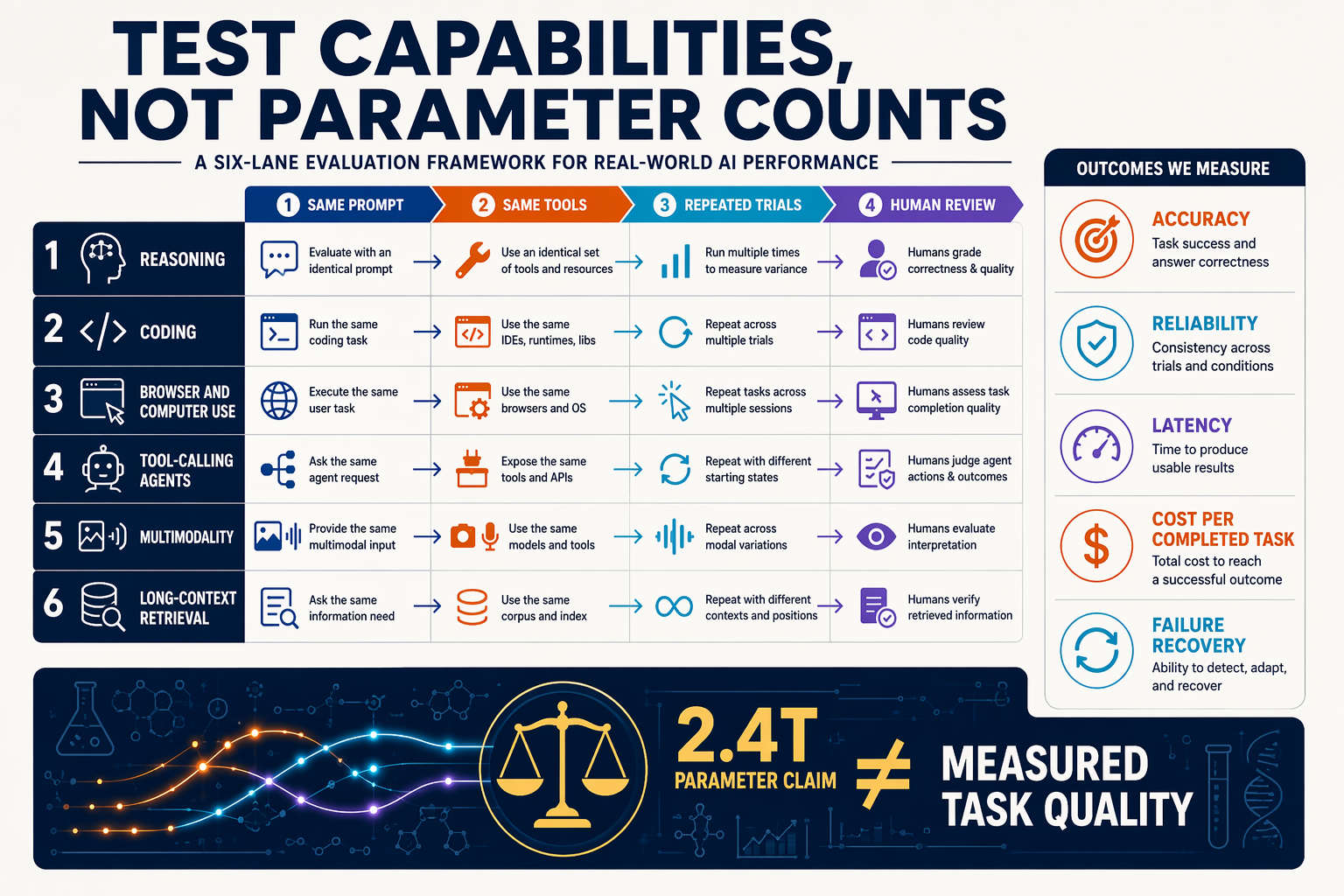
Claude Opus 4.8 currently has the stronger evidence base for reasoning, coding, and agentic work, while Qwen3.8-Max remains impossible to assess reliably from its reported 2.4-trillion-parameter scale alone. As of July 20, 2026, official Qwen or Alibaba materials have not disclosed enough information to compare Qwen3.8-Max’s quality, multimodality, context window, or speed on equal terms.
Reasoning and coding
Anthropic describes Claude Opus 4.8 as its model for work requiring the “highest level of capability,” particularly complex agentic coding and enterprise workloads. Anthropic’s Claude Opus page says the model exercises better judgment in Claude Code by asking relevant questions, identifying its own mistakes, and challenging unsound plans.
Those qualities matter because coding performance is not merely code completion. A useful evaluation should measure whether a model can:
- Understand a repository and its dependencies
- Plan multi-file changes before editing
- Execute tools and interpret failures
- Detect regressions through tests
- Recover from an incorrect approach
- Explain assumptions requiring human approval
No official Qwen or Alibaba source available as of July 20, 2026 provides equivalent Qwen3.8-Max coding benchmarks, reasoning-mode details, or repository-level evaluations. Its reported 2.4 trillion parameters could represent total parameters rather than parameters activated per token; without an architecture disclosure, even the computational implications remain unknown.
Browser and software agents
Agent performance is the clearest documented advantage for Claude Opus 4.8—not because of size, but because Anthropic has published a task-level result.
Claude Opus 4.8 scored 84% on Online-Mind2Web, according to Anthropic’s July 2026 launch materials. Online-Mind2Web evaluates agents interacting with real websites, making the result more informative for browser automation than a conventional question-answer benchmark.
However, one score does not prove universal agent superiority. Enterprises should also test authentication flows, dynamic interfaces, tool-call accuracy, recovery from changed page layouts, and the frequency of irreversible mistakes. Qwen3.8-Max has no officially disclosed comparable browser-agent result in the supplied evidence.
Multimodality and context
A defensible comparison must mark unsupported fields as unknown, rather than filling them with specifications from earlier Qwen models.
- Claude Opus 4.8: Anthropic’s official documentation confirms its enterprise and agentic positioning, but the supplied evidence does not specify a context-window figure or complete modality matrix.
- Qwen3.8-Max: Official context length, supported input types, image or video capabilities, structured-output support, and tool-use limits remain undisclosed.
- Migration: Anthropic says existing Claude Opus 4.7 code can move to Claude Opus 4.8 with no breaking API changes, reducing adoption friction for current Claude users.
Speed and the parameter-count trap
There is currently no verified basis for claiming Qwen3.8-Max is faster or slower than Claude Opus 4.8. Comparisons involving Qwen3.7 or earlier Qwen models cannot be transferred to an unconfirmed Qwen3.8-Max configuration.
Real speed depends on more than model size:
- Time to first token
- Output tokens per second
- Reasoning-token consumption
- Batching and provider load
- Tool-call round trips
- Total time to a correct result
The practical conclusion is asymmetric: Claude Opus 4.8 can be evaluated from an available API and published agent evidence; Qwen3.8-Max should remain “unverified” until Alibaba documents the model and independent teams can reproduce its results.
How could closed API access versus possible open-weight availability affect cost, privacy, customization, and enterprise adoption?

Claude Opus 4.8 offers the predictability of a managed production API, while possible open-weight availability for Qwen3.8-Max could offer more control over deployment, data and customization. However, Alibaba has not yet confirmed Qwen3.8-Max’s licence or open-weight release terms, so any sovereignty or cost advantage remains hypothetical.
Cost: published API rates versus uncertain infrastructure costs
A closed API turns model infrastructure into metered operating expenditure. Anthropic’s Claude Platform pricing page listed two figures—$5 per million tokens and $6.25 per million tokens—in the Claude Opus 4.8 row as of July 2026. The supplied pricing extract does not identify those figures as input, output, caching or other rates, so buyers should verify the current column labels and all prompt-caching, batch-processing and volume terms directly in Anthropic’s documentation.
Managed access removes the need to purchase accelerators, provision inference clusters or maintain model-serving software. Recurring charges can still become substantial for high-volume agentic workflows, especially when applications repeatedly process long contexts or invoke multiple tools.
If Alibaba releases Qwen3.8-Max under a commercially usable open-weight licence, organizations might be able to choose private infrastructure, sovereign clouds or third-party inference providers. Open weights would not automatically mean lower costs. The previewed 2.4-trillion-parameter figure does not disclose active parameters per token, architecture, memory requirements or achievable throughput, and parameter count alone cannot establish deployment cost or model quality.
A credible comparison should include:
- API charges, including every documented token, caching, batch and tool-related rate.
- Infrastructure expenditure, including accelerators, networking, storage, power and redundancy.
- Engineering costs for serving, quantization, monitoring, security and upgrades.
- Utilization rates, because idle self-hosted capacity can erase apparent savings.
Alibaba has not officially disclosed Qwen3.8-Max pricing, active parameter count or minimum hardware requirements, preventing a defensible total-cost calculation.
Privacy and data governance
Claude Opus 4.8 processes workloads through Anthropic’s managed service or an authorized purchasing channel. Enterprises must therefore evaluate the applicable data-retention terms, processing locations, contractual protections and compliance controls.
A confirmed open-weight Qwen3.8-Max release could support on-premises or sovereign-cloud deployment, potentially keeping prompts, retrieved documents and outputs within an organization’s chosen security boundary. This can matter for healthcare, finance, government and intellectual-property workloads. However, self-hosting does not guarantee privacy: application logs, vector databases, observability platforms, backups and administrator permissions remain possible exposure points.
Customization versus operational responsibility
Claude Opus 4.8 can be adapted through system prompts, retrieval-augmented generation, tool use and application-layer guardrails, while Anthropic manages the underlying weights and serving stack. A genuinely open-weight Qwen3.8-Max could potentially enable:
- Domain-specific fine-tuning or distillation.
- Quantization and hardware-specific optimization.
- Organization-controlled safety policies.
- Deployment without sending production prompts to an external API.
Those freedoms also transfer responsibility for evaluations, abuse prevention, patching, uptime and model security to the deploying organization.
Enterprise adoption depends on confirmed terms
Claude Opus 4.8 currently presents lower procurement uncertainty because Anthropic documents production API access and migration behavior. Anthropic’s migration guide says existing Claude Opus 4.7 code can move to Opus 4.8 with “no breaking API changes.”
Qwen3.8-Max may become attractive for enterprises prioritizing sovereignty and deep customization, but adoption decisions should wait for official Alibaba documentation covering weights, licensing, hosting options, pricing and infrastructure requirements.
What do official benchmarks, system cards, vendor claims, and independent experts actually establish?
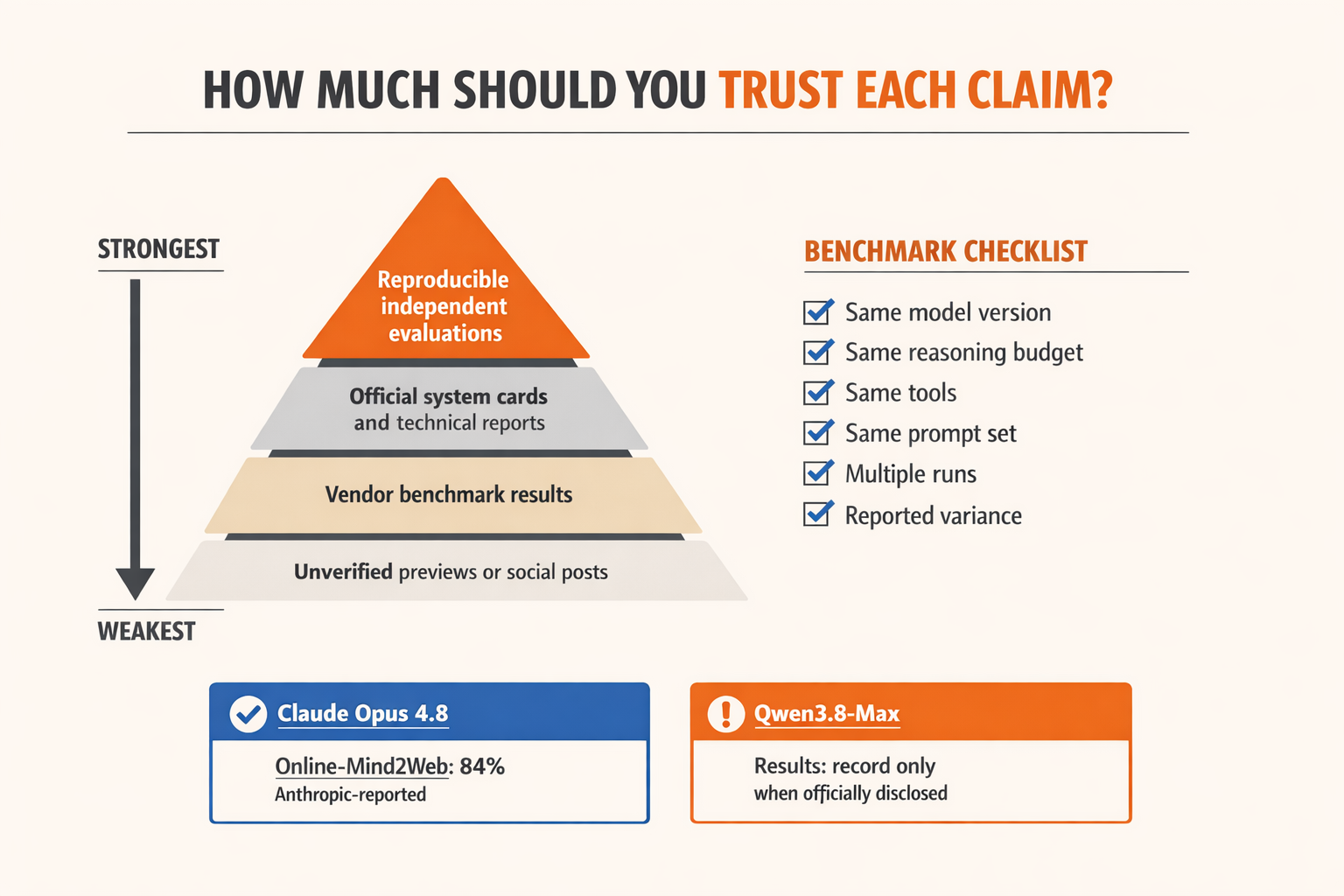
Official evidence currently supports claims about Claude Opus 4.8’s browser-agent performance and production readiness, but it does not support a benchmark-based verdict over Qwen3.8-Max. As of July 20, 2026, no verified official Qwen/Alibaba benchmark package or comparable independent evaluation for the previewed model appears in the supplied research.
What Anthropic’s evidence establishes
Anthropic describes Claude Opus 4.8 as the “strongest computer-use and browser-agent model we’ve tested.” That wording is a vendor claim, but Anthropic attaches a concrete result to it.
Claude Opus 4.8 scored 84% on Online-Mind2Web, according to Anthropic’s July 2026 launch announcement. Online-Mind2Web evaluates whether an agent can navigate real websites and complete tasks, making the result relevant to browser automation, research workflows, back-office operations, and web-based customer support.
Anthropic’s official documentation also provides several forms of operational evidence:
- Claude Platform documentation recommends Claude Opus 4.8 for complex agentic coding and enterprise work requiring Anthropic’s highest capability tier.
- Anthropic says the model shows improved judgment in Claude Code, including asking clarifying questions, detecting its own mistakes, and challenging unsound plans.
- Anthropic’s migration guide says existing Claude Opus 4.7 code can move to Opus 4.8 with no breaking API changes, although teams should still rerun their own evaluations.
- Anthropic’s Transparency Hub documents external safety testing, but safety assessments should not be interpreted as proof of superior general reasoning or coding performance.
These sources establish that Claude Opus 4.8 is documented, testable, and supported for production use. They do not prove that it wins every browser task, coding repository, language, or enterprise workflow.
What the Qwen3.8-Max evidence does not yet establish
The reported 2.4-trillion-parameter scale of Qwen3.8-Max is not a benchmark result. Without official Qwen or Alibaba documentation, the preview claim cannot reveal how many parameters are activated per token, what post-training was used, or how inference-time reasoning is configured.
A defensible comparison therefore requires Qwen/Alibaba to publish:
- Reproducible benchmark scores, including evaluation settings, reasoning budgets, tool access, and contamination controls.
- Architecture details, especially whether 2.4 trillion refers to total or active parameters in a mixture-of-experts system.
- A model or system card covering safety testing, limitations, multilingual behavior, and deployment conditions.
- Independent replications on coding, reasoning, agentic, multilingual, and long-context tasks.
How much weight should readers give the claims?
The evidence hierarchy is straightforward:
- Official benchmark with disclosed methodology: useful, but still vendor-reported.
- System-card or transparency evaluation: valuable for understanding safety boundaries and failure modes.
- Independent, reproducible testing: stronger evidence of performance across environments.
- Parameter count or preview commentary: insufficient for ranking models.
No named independent expert evaluation of Qwen3.8-Max is included in the available evidence, so claiming that it matches or exceeds Claude Opus 4.8 would be premature. The current conclusion is narrower: Anthropic has supplied one significant agent benchmark and production documentation; Qwen3.8-Max remains evidentially unranked until Alibaba publishes verifiable results.
What does Claude Opus 4.8 vs Qwen3.8-Max mean for your workload? (TABLE)
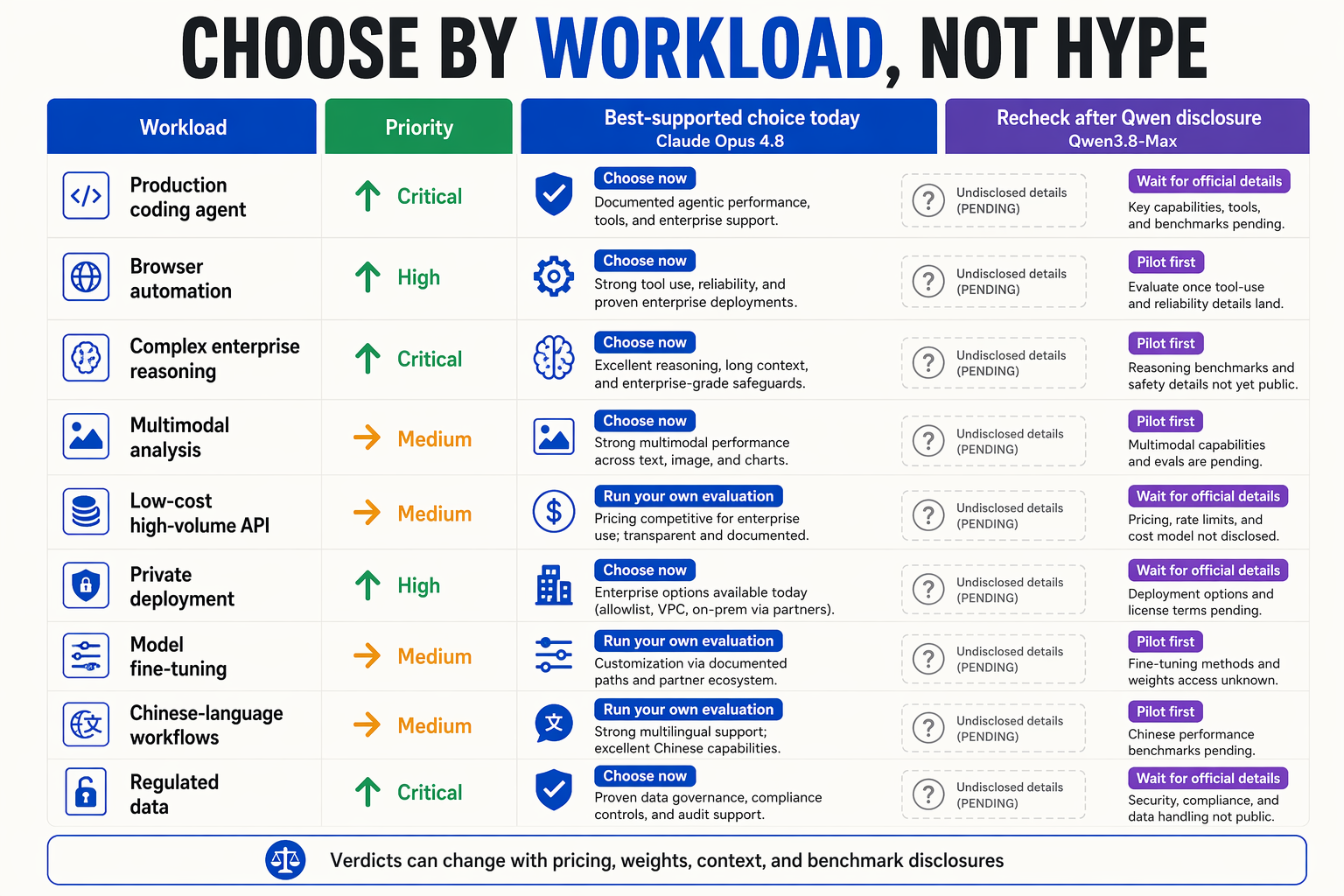
For Claude Opus 4.8 vs Qwen3.8-Max, choose Claude Opus 4.8 for documented production deployments and complex agentic work. Treat Qwen3.8-Max as a controlled preview-testing candidate only until Alibaba Cloud or the Qwen team confirms its architecture, access, pricing, context window, licensing, and benchmarks—and independent evaluations become available.
Workload-specific decision table
| Workload | Practical choice now | Source-grounded rationale | What to evaluate |
|---|---|---|---|
| Browser automation and computer use | Claude Opus 4.8 | Anthropic reported an 84% Online-Mind2Web score in July 2026. This is a vendor-reported browser-agent result, not proof of performance on your websites or workflows. | End-to-end completion rate, UI-change recovery, p95 latency, retries, human intervention, and cost per completed task |
| Complex agentic coding | Claude Opus 4.8 | Anthropic’s Claude Platform documentation recommends Claude Opus 4.8 for complex agentic coding and enterprise work. Anthropic also says it catches mistakes and challenges unsound plans in Claude Code. | Repository-level correctness, regression rate, tool-call accuracy, security findings, reviewer time, and cost per accepted change |
| Existing Claude Opus deployment | Migrate and regression-test | Anthropic’s migration guide says Claude Opus 4.7 integrations can move to Claude Opus 4.8 with no breaking API changes. Migration still requires workload-specific testing. | Prompt behaviour, output schemas, safety responses, tool use, latency, and total usage cost |
| Production managed API | Claude Opus 4.8 | Claude Opus 4.8 has documented availability through the managed Claude Platform. Official Qwen3.8-Max endpoints, regions, quotas, pricing, and service terms remain unknown from the available evidence. | Regional availability, rate limits, uptime terms, observability, data handling, support, and cost predictability |
| Self-hosted or sovereign deployment | Wait for official Qwen disclosure | The reported 2.4-trillion-parameter figure does not establish downloadable weights, active parameter count, architecture, licence rights, quantisation support, performance, or infrastructure requirements. Parameter count alone is not a quality measure. | Weight access, licence, GPU memory, throughput, serving stack, security controls, and total cost of ownership |
| Multilingual or China-oriented applications | Benchmark both if Qwen access opens | The wider Qwen family makes Qwen3.8-Max relevant for evaluation, but its official language scores, context limit, modalities, regional endpoints, and moderation behaviour remain unconfirmed. | Chinese and domain-language accuracy, dialect coverage, moderation, latency, residency, endpoint availability, and cost |
| Regulated enterprise agents | Claude initially; reassess Qwen later | Anthropic documents Claude Opus 4.8 as an enterprise-oriented managed model. Official Qwen3.8-Max retention, governance, security, licensing, and contractual terms have not yet been established in the available sources. | Audit logs, retention controls, residency, contractual safeguards, escalation paths, access controls, and human approval |
| Research and preview testing | Test Qwen3.8-Max in a controlled environment | Qwen3.8-Max may warrant early evaluation, but preview claims should not be treated as production specifications. Keep it away from sensitive data and critical workflows until access and governance terms are documented. | Reproducibility, benchmark contamination, output quality, context handling, failure modes, access stability, and data terms |
Turn Claude Opus 4.8 vs Qwen3.8-Max into a real evaluation
A model’s reported parameter count cannot establish reasoning quality, speed, deployability, or operating cost. Compare Claude Opus 4.8 vs Qwen3.8-Max with representative business tasks rather than headline specifications:
- Gather 100–500 real tasks, including ambiguous requests, tool failures, long-context inputs, multilingual prompts, and adversarial cases.
- Measure task completion, factual accuracy, tool-call correctness, p95 latency, cost per successful task, and human-intervention rate.
- Evaluate multi-step agents separately because small per-step error rates can compound across long trajectories.
- Test vendor-reported benchmark claims against your own workflows; do not assume an 84% Online-Mind2Web result predicts performance on your sites.
- Mark every undisclosed Qwen3.8-Max field as unknown. Do not assume it is open-weight, inexpensive, self-hostable, unlimited, or technically equivalent to an earlier Qwen release.
- Compare complete operating costs, including tokens, caching, retries, tools, hosting, monitoring, security, and engineering overhead.
- Require official documentation for architecture, active parameters, context length, modalities, API access, pricing, licensing, retention, and regional availability before production approval.
Workload verdict
The practical Claude Opus 4.8 vs Qwen3.8-Max decision is straightforward in July 2026: choose Claude Opus 4.8 when deployment must begin now and documented managed access, browser-agent evidence, complex coding guidance, or migration continuity matters.
Keep Qwen3.8-Max in controlled preview testing until Alibaba Cloud or the Qwen team publishes verifiable architecture, access, pricing, context, licensing, governance, and benchmark details. The reported 2.4T parameter count must not be used as evidence of superior quality.
A provider-neutral abstraction layer can reduce future switching costs, but it should not replace model-specific testing. Make the final selection using workload-representative evaluations, operational requirements, verified vendor documentation, and—when available—credible independent benchmarks.
Frequently asked questions about Claude Opus 4.8 vs Qwen3.8-Max
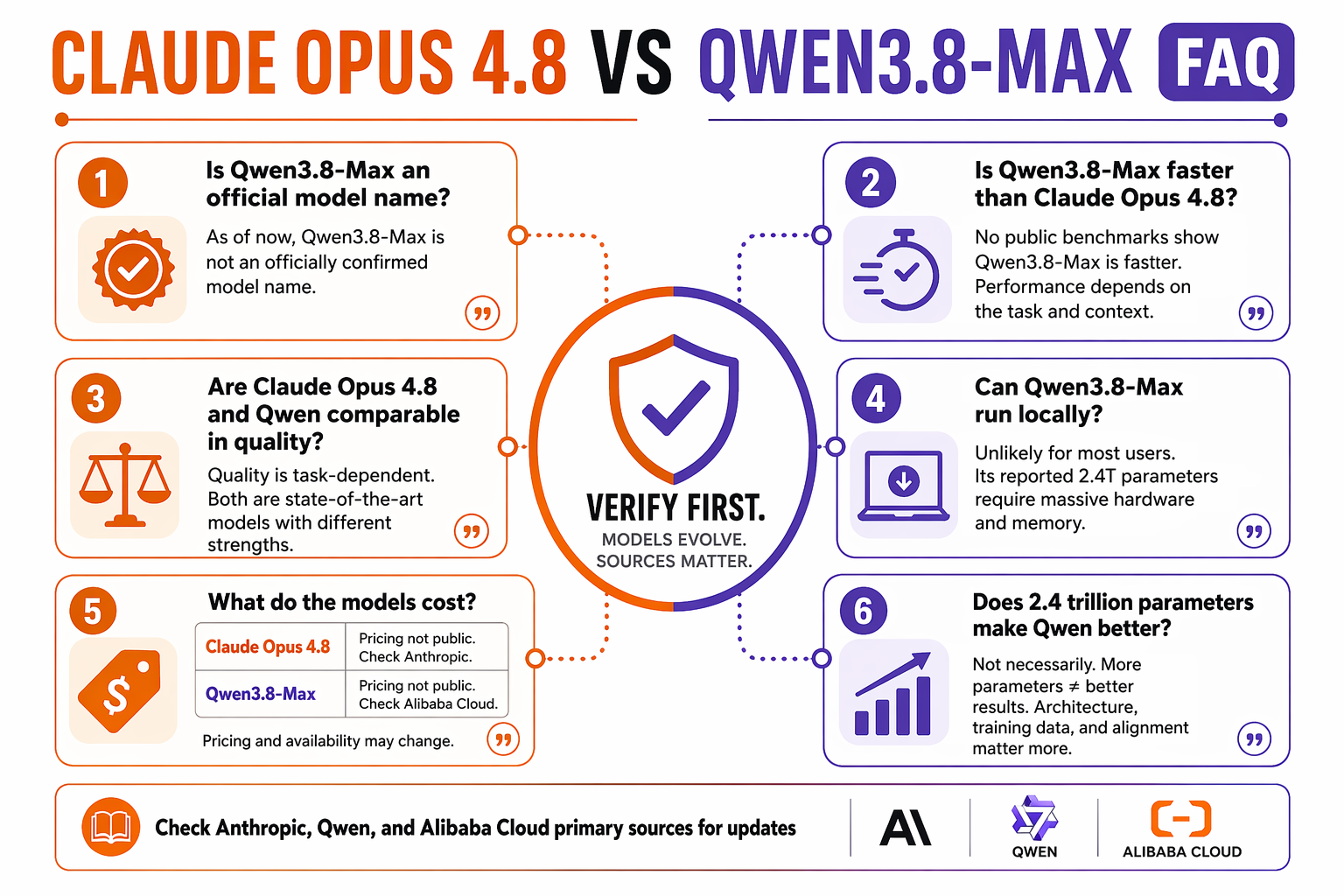
Model status and capabilities
What is the main difference in the Claude Opus 4.8 vs Qwen3.8-Max comparison?
Is Qwen3.8-Max officially confirmed as a 2.4-trillion-parameter model?
Which model has better reasoning quality, Claude Opus 4.8 or Qwen3.8-Max?
Performance, pricing, and deployment
Is Claude Opus 4.8 vs Qwen3.8-Max better for coding and AI agents?
How do Claude Opus 4.8 vs Qwen3.8-Max pricing, context windows, and multimodal features compare?
Can enterprises self-host Qwen3.8-Max instead of using the Claude API?
Conclusion
The Claude Opus 4.8 vs Qwen3.8-Max comparison has a clear July 2026 conclusion: Claude is the evidence-backed production choice today, while Qwen3.8-Max remains a potentially significant but insufficiently documented preview. Its reported 2.4-trillion-parameter scale cannot substitute for verified performance and deployment data.
- Claude Opus 4.8 is available and documented. Anthropic positions the closed API model for complex agentic coding and enterprise workloads, with migration from Claude Opus 4.7 requiring no breaking API changes.
- Browser-agent performance is a demonstrated strength. Anthropic reported in July 2026 that Claude Opus 4.8 achieved 84% on Online-Mind2Web.
- Qwen3.8-Max remains unverified. Official Qwen or Alibaba sources have not yet confirmed its final name, architecture, benchmarks, context window, pricing, availability, or open-weight licence.
- Workload fit matters more than parameter count. Buyers should compare reasoning, coding reliability, latency, governance, regional access, multimodality, and total deployment cost using their own evaluations.
What happens next depends on whether Alibaba publishes reproducible benchmarks, API terms, model documentation, and deployment options—and whether independent testing validates the preview claims.
To explore how multi-model AI communication is evolving, check out CallMissed, an AI infrastructure platform supporting voice agents, multilingual chatbots, and OpenAI-compatible model access. When Qwen3.8-Max becomes verifiable, will its real-world results justify its extraordinary reported scale?
Related Reading
- Claude Fable 5 vs Qwen3.7 Max: July 2026 Facts on the Qwen3.8-Max Preview
- Claude Sonnet 5 vs Qwen3.8-Max: July 2026 Availability, Price and Benchmark Reality
- GPT-5.6 Sol vs Qwen3.8-Max: Verified July 2026 Comparison
Sources
Ready to automate customer conversations?
Launch AI voice agents and WhatsApp bots with CallMissed — one API, 22+ Indian languages.