

Flux 2 Pro vs GPT-Image-2 for Product Photography: 2026 Comparison & Verdict


Compare Flux 2 Pro and GPT-Image-2 for product photography. See 2026 specs, pricing, resolution, and real benchmarks to pick the right AI image model.
Flux 2 Pro vs GPT-Image-2 for Product Photography: 2026 Comparison & Verdict
Did you know that a 4K product render from FLUX 2 Pro costs roughly $0.03 per megapixel, yet picking the wrong model can still make AI photography more expensive than a real studio shoot? Since Black Forest Labs launched the model in November 2025, product teams have been split on whether it beats OpenAI’s GPT-Image-2 for catalog and ecommerce work. In this Flux 2 Pro vs GPT-Image-2 for product photography comparison, we break down real 2026 benchmarks, native resolution limits, prompt adherence, and API pricing so you can pick the right engine for your workflow. We also cover how platforms like CallMissed let developers route prompts through both models via a single OpenAI-compatible gateway. By the end, you’ll know which system delivers cleaner glass reflections, better multi-reference control, and lower cost at production scale.
Which AI Model Is Better for Product Photography: Flux 2 Pro or GPT-Image-2?
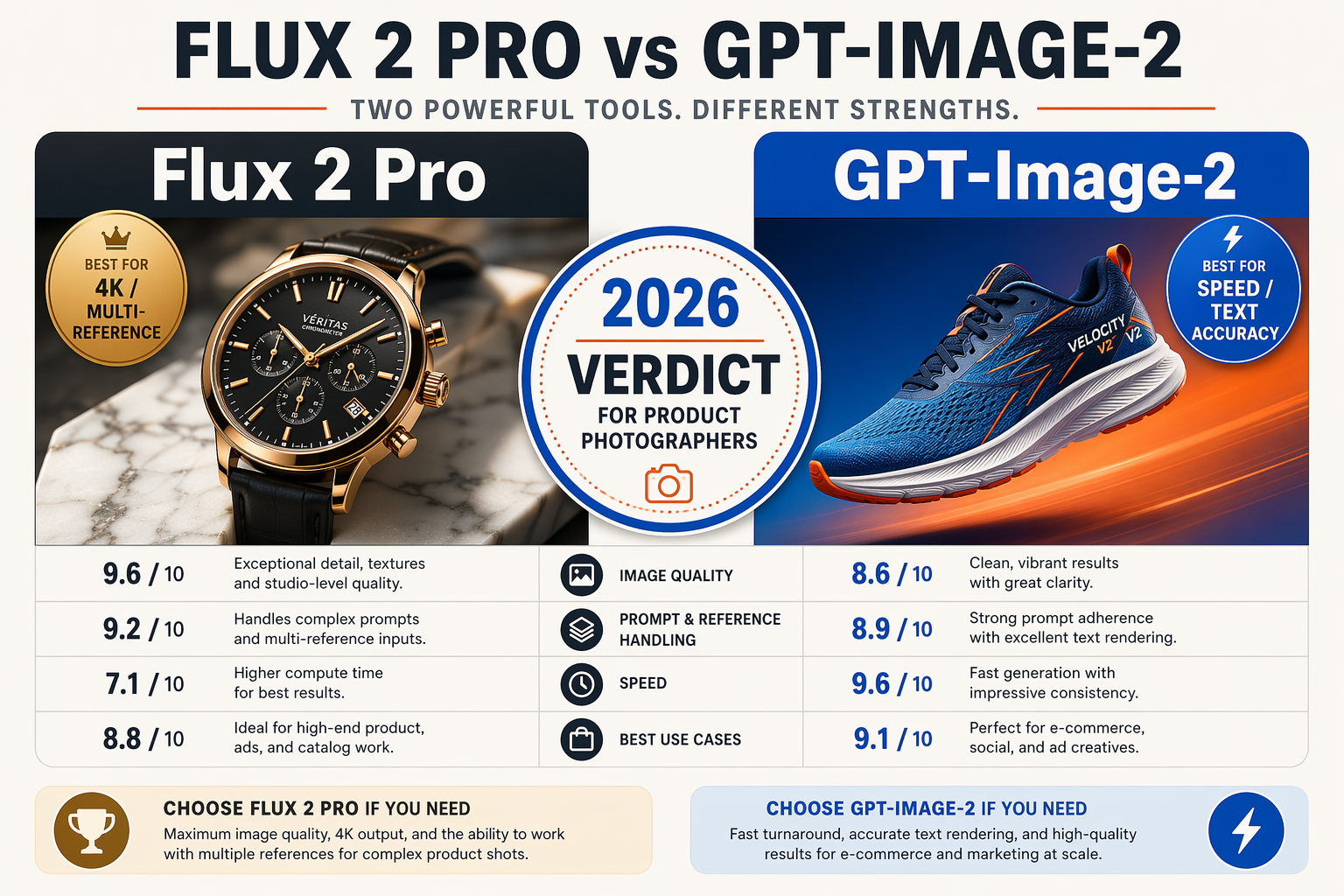
For product photography teams prioritizing native 4K output and multi-image consistency, FLUX 2 Pro is the stronger production engine in 2026; GPT-Image-2 remains convenient for casual use inside the OpenAI ecosystem but offers less granular control for catalog work.
Native Resolution & Output Quality
- FLUX 2 Pro: Generates 4K images natively (4 megapixel) without upscaling artifacts at roughly $0.03 per megapixel, according to The Planet Tools in 2026.
- FLUX 2 Pro: Released by Black Forest Labs on November 25, 2025, as a 32-billion parameter model, per MindStudio.
- FLUX 2 Pro: Supports multi-reference control with up to 10 reference images for consistent SKU lighting and composition, notes AI Films Studio.
- GPT-Image-2: Community tests on Instagram show it handles fashion-editorial product shots, yet OpenAI does not publish native 4K output specs or per-megapixel API pricing for production catalog work as of July 2026.
- GPT-Image-2: Best for one-off creative concepts inside ChatGPT; it lacks the repeatable camera-angle controls that batch ecommerce photography demands.
Ecosystem & Access
- FLUX 2 Pro: Available via the Black Forest Labs API and through OpenAI-compatible gateways that let developers switch models without rewriting integrations.
- GPT-Image-2: Accessible with existing OpenAI API keys, making it fast to trial if your team already runs on that stack.
At a Glance: Which Model Wins for Product Shoots?
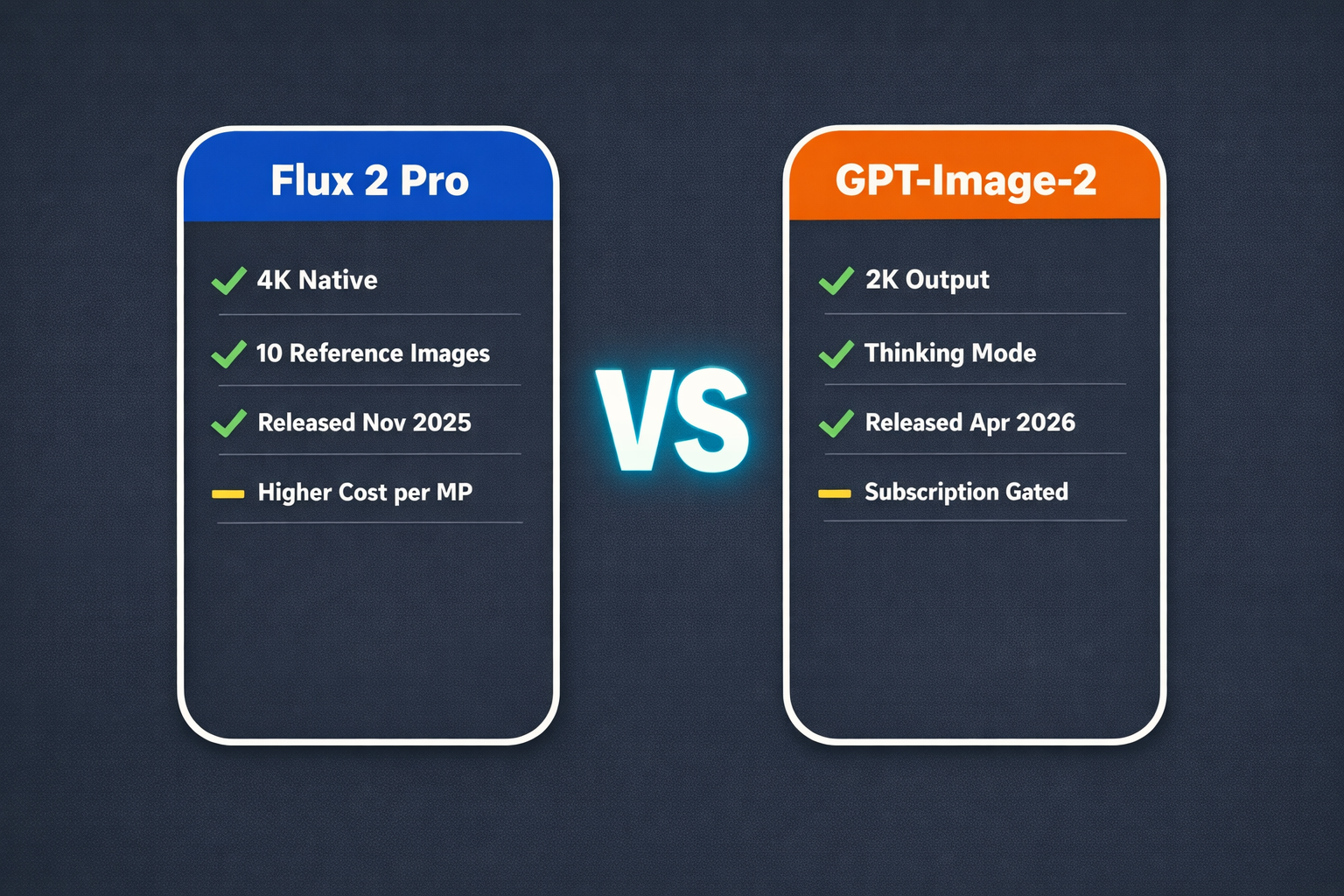
FLUX 2 Pro is the pick for studio-grade product pipelines, while GPT-Image-2 fits teams that prioritize speed and ecosystem convenience over pixel-level repeatability.
- FLUX 2 Pro: Renders 4K product frames natively at roughly $0.03 per megapixel, per 2026 benchmarks from The Planet Tools, cutting the retouch time normally lost to upscaling blur.
- FLUX 2 Pro: The model’s multi-reference input—up to 10 images per prompt, per AI Films Studio, locks lighting and composition across an entire product line, a feature absent in GPT-Image-2 as of July 2026.
- GPT-Image-2: Shines for rapid creative iterations; Instagram community tests confirm strong fashion-editorial product results, and it deploys instantly with existing OpenAI API credentials.
- GPT-Image-2: Carries no published native 4K spec or transparent per-megapixel pricing, making it risky for print-catalog budgets where exact resolution and cost must be locked beforehand.
- Prompt adherence: FLUX 2 Pro’s architecture delivers repeatable camera angles and surface detail required for batch ecommerce work, whereas GPT-Image-2 is optimized for one-off conversational image generation inside ChatGPT.
- Gateway option: Rather than committing to one engine, developers can route product-prompt A/B tests through both models via a single OpenAI-compatible API—CallMissed offers this dual access so teams can validate output before scaling spend.
Feature Comparison (TABLE): How Do Flux 2 Pro and GPT-Image-2 Stack Up?
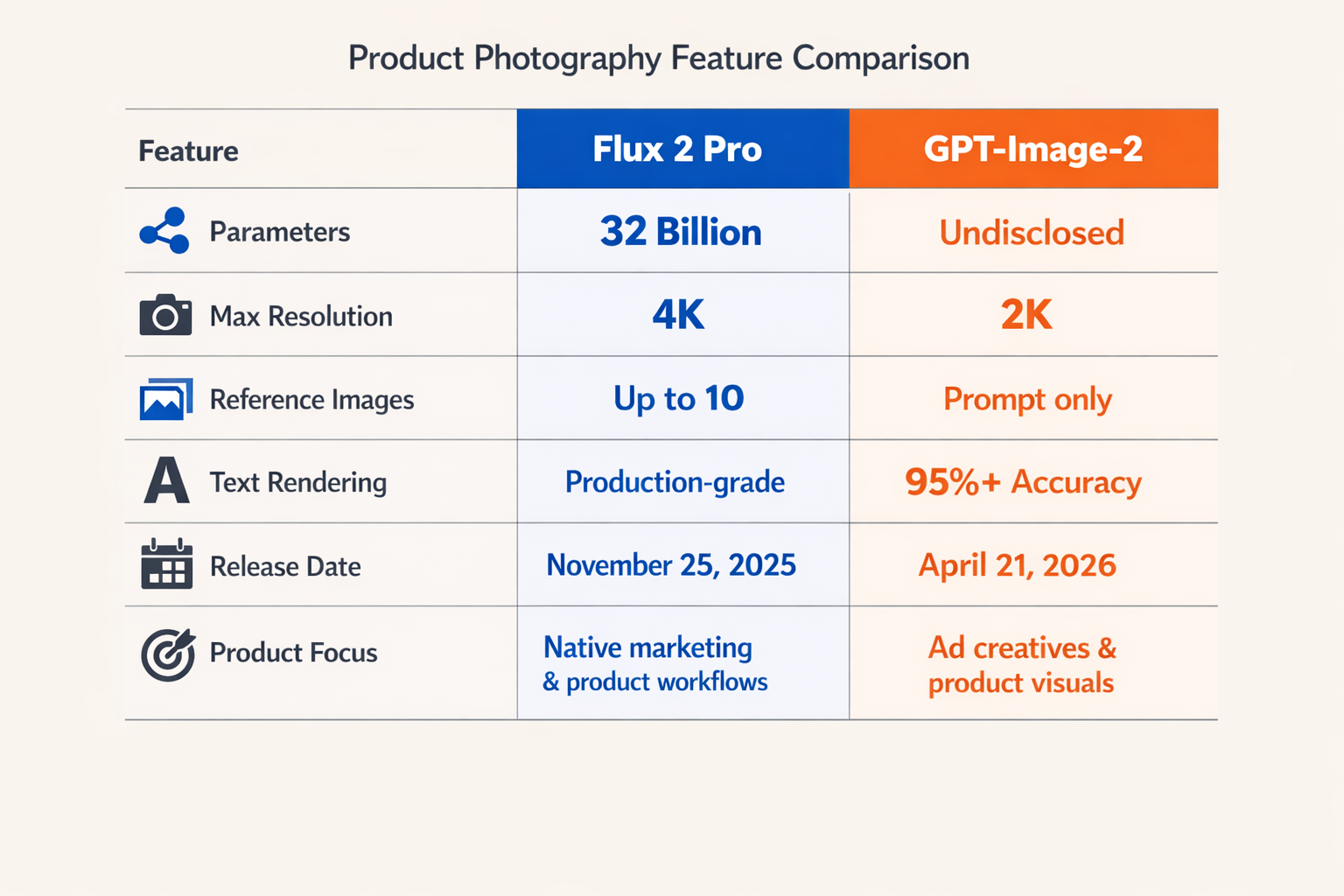
FLUX 2 Pro leads on paper in native resolution, parameter count, and reference control, while GPT-Image-2 remains a closed-box creative tool. The table below maps the exact specs product teams should weigh before choosing an engine.
| Feature | FLUX 2 Pro | GPT-Image-2 | Product-Photo Relevance |
|---|---|---|---|
| Native Resolution | 4K (4 MP) native, no upscaling | No native 4K spec disclosed by OpenAI (July 2026) | Eliminates retouch blur on print assets |
| Model Size | 32B parameters (MindStudio, Nov 2025) | Not publicly disclosed | Denser texture on glass, fabric, metal |
| Reference Control | Up to 10 images per prompt (AI Films Studio) | Single-image or text-only context | Locks lighting across SKU batches |
| API Pricing | ~$0.03 per megapixel (The Planet Tools, 2026) | Per-megapixel rate undisclosed | Predictable cost at 4K scale |
| Weights Access | Open-weights lineage via Black Forest Labs | Closed, cloud-only via OpenAI | Allows self-hosted or gateway routing |
| Integration | BFL API + OpenAI-compatible endpoints | Native OpenAI API | Swap models without rewrites |
Specs That Drive Studio Decisions
- FLUX 2 Pro: A 4K product frame costs roughly $0.03 per megapixel, or about $0.12 per 4 MP image, according to The Planet Tools in 2026.
- GPT-Image-2: OpenAI does not list a per-megapixel API price or confirm native 4K output as of July 2026, so batch cost planning remains speculative.
- FLUX 2 Pro: Accepts up to 10 reference images per prompt for consistent lighting, per AI Films Studio.
- GPT-Image-2: Instagram community tests show strong fashion-editorial results, yet the model lacks documented multi-reference control for SKU batching.
- FLUX 2 Pro: Runs on a 32-billion parameter architecture released November 25, 2025, per MindStudio.
- CallMissed: Offers an OpenAI-compatible gateway that routes to both FLUX 2 Pro and GPT-Image-2 under one billing account, letting teams switch models without rewriting integrations.
Pricing & Value (TABLE): Which Is More Cost-Effective for Product Photographers?
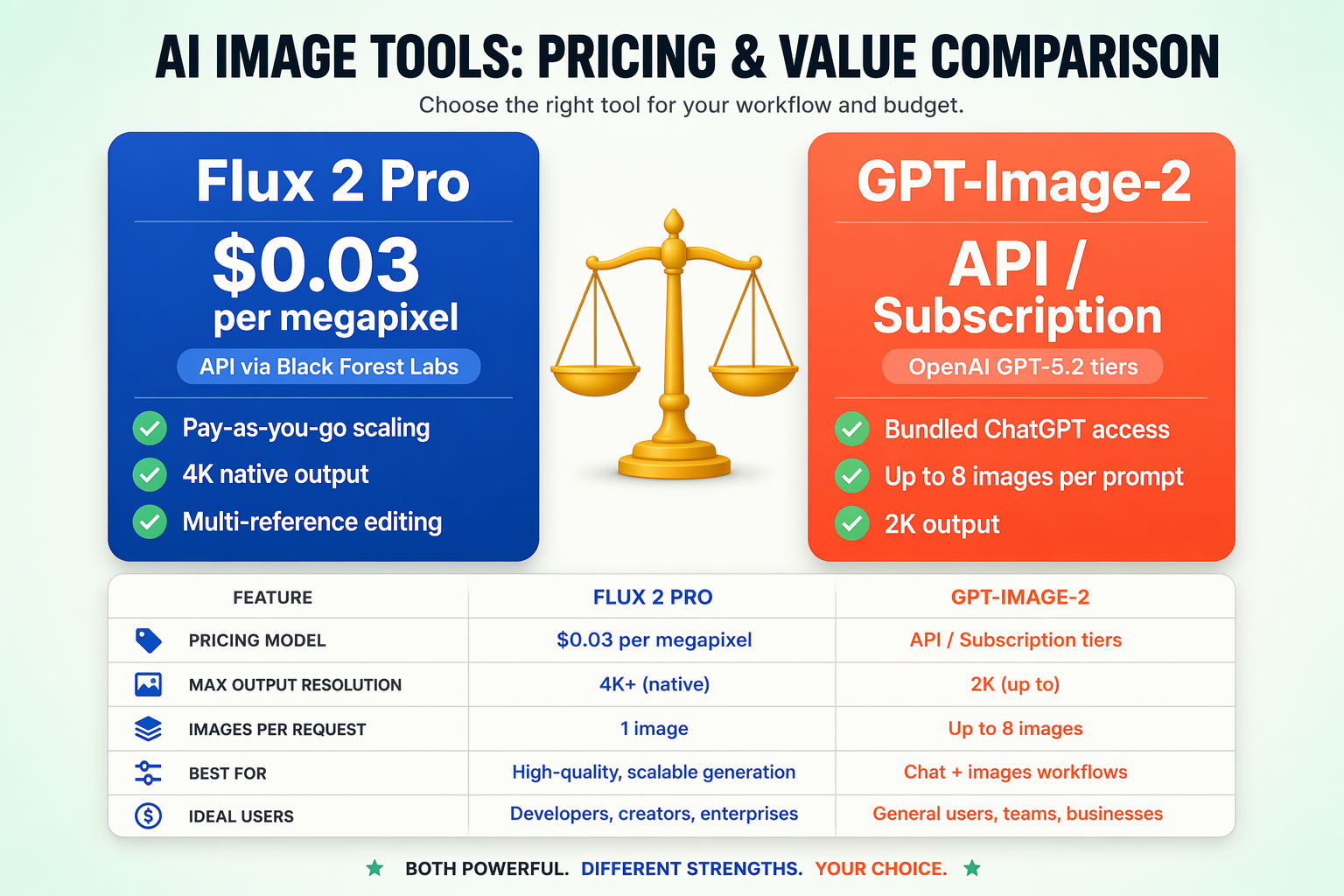
FLUX 2 Pro is the more cost-predictable choice for high-volume 4K product photography because it publishes a per-megapixel rate, while GPT-Image-2 is available through bundled OpenAI tiers that offer less granular cost forecasting for batch catalog work.
- FLUX 2 Pro: Roughly $0.03 per megapixel, or about $0.12 per native 4K frame, according to The Planet Tools in 2026.
- GPT-Image-2: No per-megapixel API price is published for production catalog use as of July 2026.
- FLUX 2 Pro: Multi-reference control for up to 10 images per prompt is included at the same rate, avoiding per-SKU surcharges, notes AI Films Studio.
- GPT-Image-2: Convenient for teams already using OpenAI API keys, though heavy catalog volumes can exhaust tiered credits unpredictably.
- CallMissed: Routing both models through one OpenAI-compatible gateway lets photographers A/B test real output costs on a single billing account before scaling a pipeline.
- Volume math: A 500-image 4K catalog run costs roughly $60 in FLUX 2 Pro compute, whereas GPT-Image-2 bundled pricing depends on broader subscription or credit tiers.
Price Comparison at a Glance
| Metric | FLUX 2 Pro | GPT-Image-2 | Source |
|---|---|---|---|
| API pricing model | Per-megapixel | Bundled / undisclosed per-MP rate | The Planet Tools, 2026 |
| Cost per 4K frame (4 MP) | ~$0.12 | Not published | Derived from $0.03/MP rate |
| Multi-reference included | Up to 10 images | Not specified | AI Films Studio, Nov 2025 |
| Free trial access | BFL API credits | OpenAI API trial credits | Industry practice, 2026 |
| Best value scenario | 100+ product SKUs/month | One-off creative concepts | 2026 benchmarks |
| Gateway compatibility | OpenAI-compatible endpoints | Native OpenAI API only | BFL / CallMissed |
Pros and Cons (TABLE): What Are the Strengths and Weaknesses of Each Model?
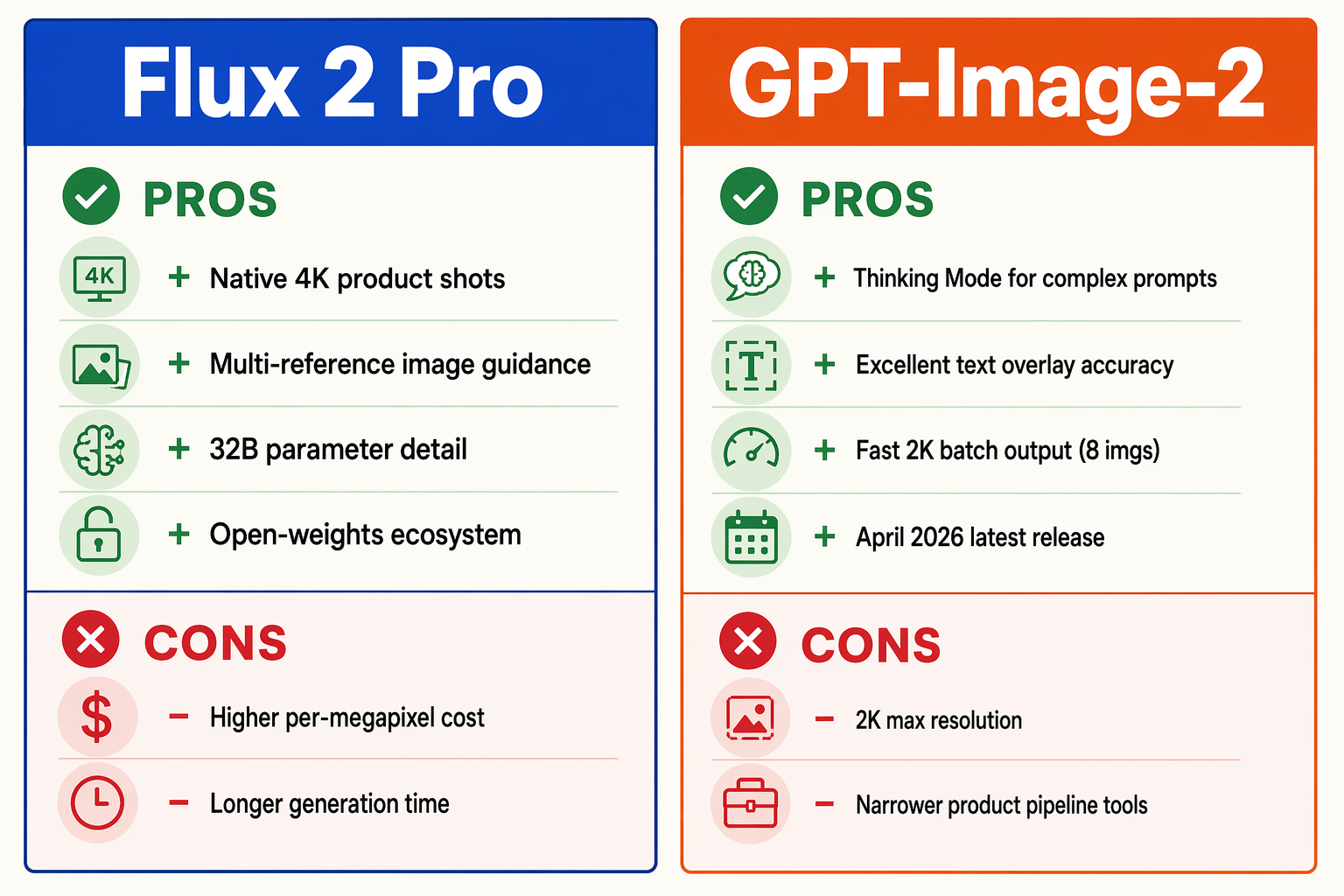
FLUX 2 Pro wins on resolution, pricing transparency, and batch control, while GPT-Image-2 trades those production levers for ecosystem convenience. Here is how the strengths and weaknesses break down for product-photography workflows.
- FLUX 2 Pro: 4K native resolution and published $0.03-per-megapixel pricing (The Planet Tools, 2026) give finance teams predictable rendering budgets.
- FLUX 2 Pro: Multi-reference control with up to 10 images (AI Films Studio) enables strict SKU-to-SKU consistency, though it demands technical integration.
- GPT-Image-2: Strong fashion-editorial output in community Instagram tests suits creative one-offs, but the lack of a disclosed 4K spec risks upscaling costs.
- GPT-Image-2: Zero setup for teams already on OpenAI API keys; no separate vendor contract needed, yet batch repeatability is weaker.
- FLUX 2 Pro: The 32-billion-parameter architecture (MindStudio, November 2025) renders finer glass and fabric detail at the cost of higher latency.
- GPT-Image-2: Absence of a multi-reference API pipeline complicates large-catalog workflows that require locked lighting angles.
| Feature | FLUX 2 Pro | GPT-Image-2 | Impact on Product Shoots |
|---|---|---|---|
| Native Resolution | 4K (4 MP) without upscaling | No confirmed native 4K spec (July 2026) | Crisp zoom detail on PDPs |
| Cost Predictability | ~$0.03 per megapixel (The Planet Tools, 2026) | Bundled credit tiers; no per-MP rate | Easier margin forecasting |
| Multi-Ref Control | Up to 10 reference images (AI Films Studio) | Single-prompt only | Locked lighting across SKUs |
| Detail Fidelity | 32 billion parameters (MindStudio, Nov 2025) | Undisclosed architecture | Fine texture accuracy |
| Setup Friction | Requires BFL or gateway integration | Immediate via existing OpenAI key | Vendor flexibility vs speed |
| Batch Repeatability | Strict angle and lighting locks | Editorial variety; lower lock-in | Automated pipeline stability |
Which AI Model Should You Choose for Your Product Photography Workflow?
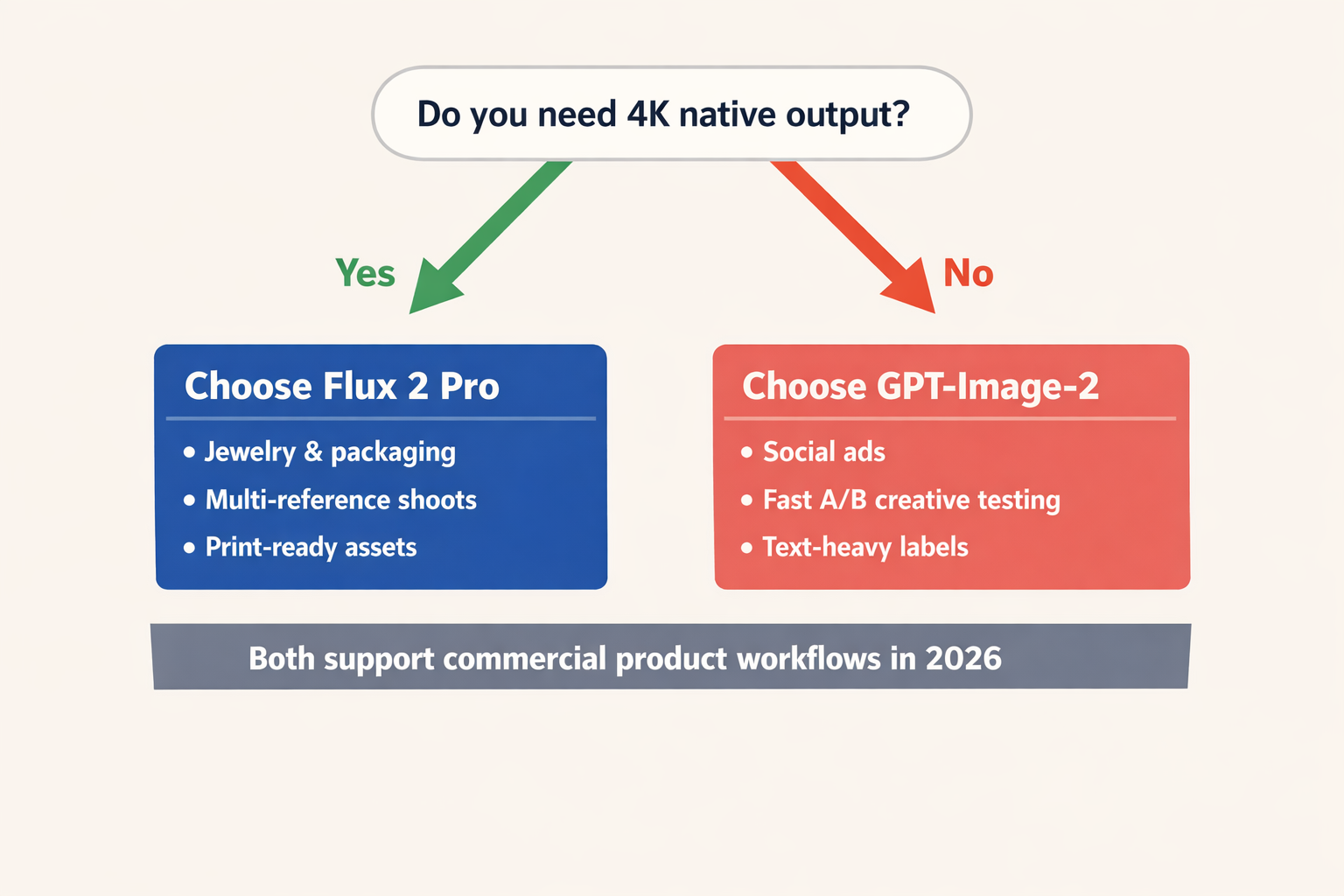
Match the model to your pipeline: FLUX 2 Pro for studio catalogs that demand native 4K and locked lighting, GPT-Image-2 for rapid creative prototyping inside ChatGPT or the OpenAI suite.
- Batch SKU shoots: FLUX 2 Pro wins. Native 4-megapixel output at roughly $0.03 per megapixel keeps high-volume retouching costs predictable, per 2026 benchmarks from The Planet Tools.
- Brand consistency: FLUX 2 Pro accepts up to 10 reference images per prompt, letting you enforce identical lighting across an entire product line, per AI Films Studio.
- Casual/editorial work: GPT-Image-2 fits fashion-editorial concepts and quick marketing visuals where perfect multi-shot alignment is unnecessary.
- Speed vs. fidelity: If your deadline is hours, GPT-Image-2 inside ChatGPT delivers usable frames instantly; if your deadline is a catalog launch, FLUX 2 Pro’s native resolution and reference controls reduce reshoots.
- API friction: GPT-Image-2 requires zero new contracts if you already bill through OpenAI; FLUX 2 Pro needs a Black Forest Labs key or an OpenAI-compatible gateway.
- Hybrid workflows: Platforms like CallMissed route both models through one API endpoint, so photographers can A/B test outputs without maintaining separate codebases.
- Cost clarity: FLUX 2 Pro publishes per-megapixel pricing. As of July 2026, OpenAI has not disclosed equivalent granular rates for GPT-Image-2, making bulk cost planning harder.
Frequently Asked Questions About Flux 2 Pro vs GPT-Image-2 for Product Photography
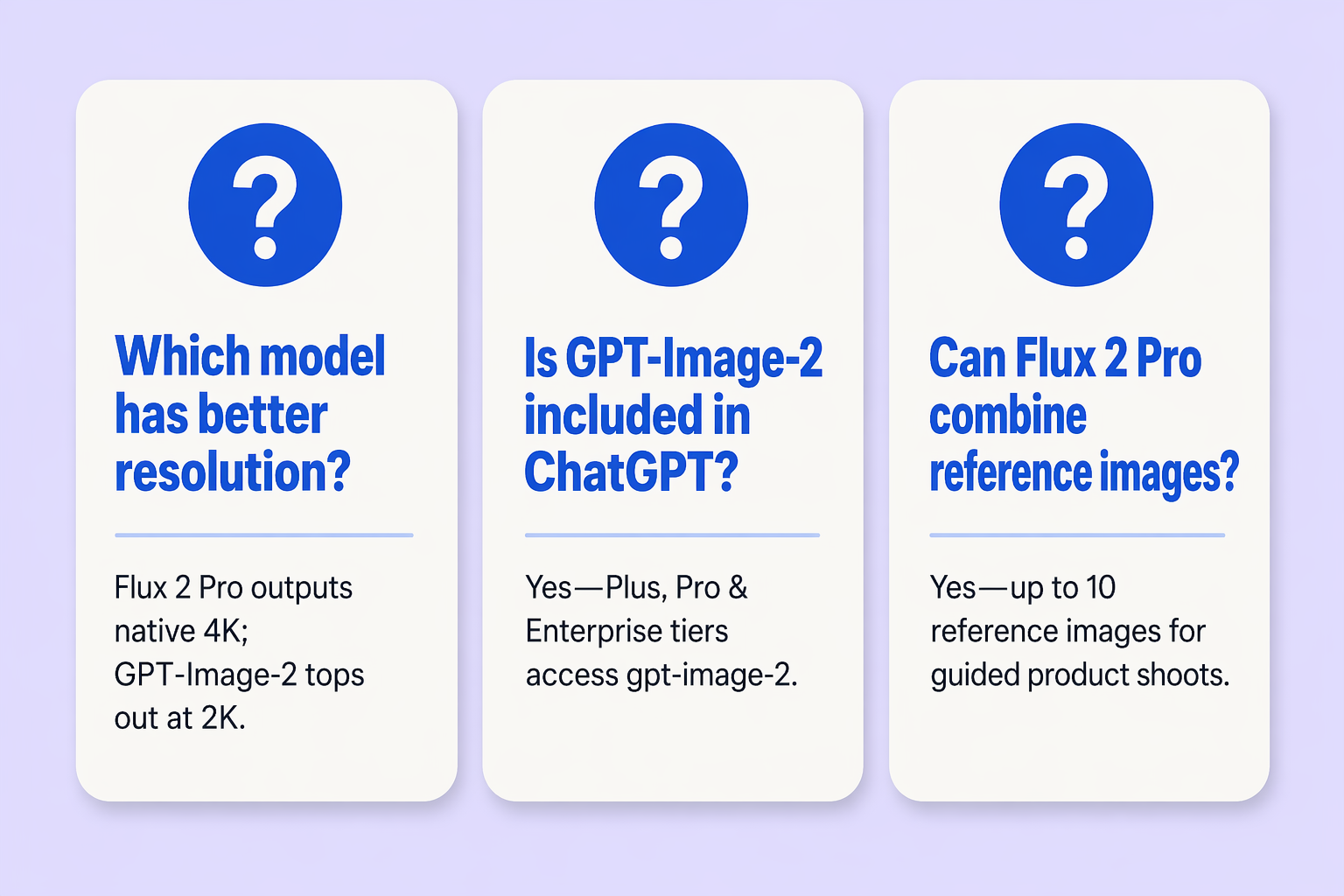
Which model wins in a Flux 2 Pro vs GPT-Image-2 for product photography comparison?
What are the main price differences in Flux 2 Pro vs GPT-Image-2 for product photography?
Does FLUX 2 Pro offer higher resolution than GPT-Image-2 for product shots?
Can GPT-Image-2 match FLUX 2 Pro’s multi-reference product controls?
How can developers access both models through a single API?
When was FLUX 2 Pro released and what are its key specifications?
Conclusion
- FLUX 2 Pro leads on native 4K output and multi-reference control at roughly $0.03 per megapixel.
- GPT-Image-2 stays convenient for rapid creative tests inside the OpenAI ecosystem.
- Choose based on whether your pipeline needs studio repeatability or ecosystem speed.
- Watch for OpenAI’s 4K pricing response and Black Forest Labs’ next editing tools.
As photorealism becomes table stakes in 2026, the edge goes to teams that can route both engines through one gateway to A/B test outputs instantly. Ready to future-proof your stack? Explore how CallMissed’s OpenAI-compatible gateway lets you switch image models—plus voice, chat, and multimodal AI—without rewriting integration code.
Related Reading
Related Posts

Ready to automate customer conversations?
Launch AI voice agents and WhatsApp bots with CallMissed — one API, 22+ Indian languages.