

ChatGPT 5.6 release date: July 9 rollout reported



ChatGPT 5.6 release date update: GPT-5.6 Sol, Terra and Luna are in preview, with July 9 public rollout now reported.
ChatGPT 5.6 release date: July 9 rollout reported
If you are searching for the ChatGPT 5.6 release date, the current factual answer is: GPT-5.6 is already in limited preview, but OpenAI has not announced an exact general-availability date as of July 7, 2026.
OpenAI previewed GPT-5.6 Sol, GPT-5.6 Terra, and GPT-5.6 Luna on June 26, 2026. OpenAI’s public materials say broader availability is planned in the coming weeks, but they do not give a specific GA day, ChatGPT rollout schedule, API pricing page, or universal access date yet.
That distinction matters for searchers asking “when will ChatGPT 5.6 models be launched?” The best answer is not “there is no GPT-5.6”; it is: the preview is live, general availability is expected soon, and the exact ChatGPT 5.6 launch date is still unconfirmed.
For businesses planning AI workflows, customer support automation, or OpenAI-compatible integrations, the practical move is to track OpenAI’s official blog, help center, API documentation, model list, and safety/deployment updates rather than building roadmaps around third-party estimates. Platforms such as CallMissed’s OpenAI-compatible gateway are part of the shift toward flexible, multi-model AI infrastructure, where teams can adopt new supported models without rewriting every workflow.
Introduction

If you are searching for the ChatGPT 5.6 release date, the answer as of July 8, 2026 is: OpenAI previewed GPT-5.6 Sol, GPT-5.6 Terra, and GPT-5.6 Luna on June 26, 2026, and multiple reports now say the public rollout starts Thursday, July 9, 2026.
However, OpenAI’s official materials still describe GPT-5.6 in preview terms and refer to broader availability rather than a fully confirmed general availability launch. For that reason, the most accurate wording is: reported July 9 rollout, not a fully confirmed final GA date, unless OpenAI updates its official blog, help center, API documentation, or release notes.
The short answer:
- GPT-5.6 Sol, Terra, and Luna were previewed on June 26, 2026
- Multiple reports now point to a Thursday, July 9, 2026 public rollout
- OpenAI official pages still use preview / broader availability wording
- The GPT-5.6 public release date should be treated as reported until OpenAI confirms it directly
- Users and developers should monitor OpenAI’s official blog, help pages, API docs, and model documentation for final rollout details
What OpenAI has confirmed so far
The key confirmed event remains the OpenAI GPT-5.6 announcement on June 26, 2026, when OpenAI previewed three GPT-5.6 variants:
- GPT-5.6 Sol
- GPT-5.6 Terra
- GPT-5.6 Luna
That preview established GPT-5.6 as a real model family, not a rumor. The newer July 9 reporting suggests the next step may be a broader ChatGPT 5.6 rollout beginning this week.
The important distinction is that a reported rollout date is not the same as a fully documented general availability milestone. Until OpenAI updates its official release notes or API documentation, details such as final access tiers, API model names, regional availability, pricing, rate limits, enterprise deployment timing, and feature differences between Sol, Terra, and Luna may still change.
July 9 rollout: what to watch
If the reported GPT-5.6 public release date holds, Thursday, July 9, 2026 may mark the start of broader access rather than instant availability for every ChatGPT user, API developer, enterprise account, and region at the same time.
Users should watch for official updates in:
- The OpenAI blog
- The OpenAI Help Center
- The OpenAI API documentation
- The OpenAI model documentation
- ChatGPT product release notes
- Enterprise admin notices
- API pricing and rate-limit pages
Developers should also check whether OpenAI lists final model identifiers for GPT-5.6 Sol, GPT-5.6 Terra, and GPT-5.6 Luna, because preview names and production API names can differ.
Why the release date matters for business users
The interest in the ChatGPT 5.6 release date is practical, not just speculative. Since ChatGPT launched publicly on November 30, 2022, major model updates have affected how companies plan automation, customer support, sales workflows, coding, analytics, content generation, and AI agents.
For many teams, the GPT-5.6 rollout could influence:
- Cost planning
- Latency expectations
- Accuracy testing
- Compliance reviews
- Vendor selection
- AI infrastructure decisions
- Roadmaps for chatbots, copilots, and agentic workflows
That is why business leaders are asking a more operational question: should we wait for ChatGPT 5.6 before investing in AI systems?
The short business answer: prepare for GPT-5.6, but test by workload
Because GPT-5.6 has already been previewed and a July 9 rollout is now widely reported, businesses should prepare for near-term testing. But teams should avoid assuming that one GPT-5.6 variant will be best for every use case.
A better approach is to test GPT-5.6 Sol, Terra, and Luna by workload:
- Use customer support prompts to test answer quality, tone, escalation handling, and latency
- Use coding tasks to compare reasoning, debugging, refactoring, and tool-use behavior
- Use analytics workflows to test structured outputs, numerical consistency, and retrieval quality
- Use sales and marketing workflows to test style control, personalization, and hallucination resistance
- Use agentic workflows to test planning, function calling, memory, and multi-step reliability
Developers should design systems that can switch models quickly as access expands. If Sol, Terra, or Luna becomes the best fit for a workflow, teams should be able to test and adopt it without rewriting core infrastructure.
For example, companies using OpenAI-compatible gateways can design applications around standard API patterns instead of locking every workflow to one model version. Platforms such as CallMissed’s developer API gateway reflect this broader shift: developers can access multiple categories of models — including LLM chat, speech-to-text, text-to-speech, image generation, and web search — through a single OpenAI-compatible interface.
What this explainer will cover
This article will separate confirmed information from reported rollout details by looking at:
- What OpenAI has announced about the GPT-5.6 preview
- Why July 9, 2026 is now being reported as the ChatGPT 5.6 rollout date
- How GPT-5.6 Sol, Terra, and Luna fit into the release
- Where to watch for official GPT-5.6 release notes
- How users and developers can test GPT-5.6 by workload
The key takeaway: OpenAI previewed GPT-5.6 Sol, Terra, and Luna on June 26, 2026, and multiple reports now say the public rollout starts Thursday, July 9, 2026. Until OpenAI confirms the final details in official materials, treat July 9 as the reported ChatGPT 5.6 release date and watch OpenAI’s official channels for confirmation.
Background & Context
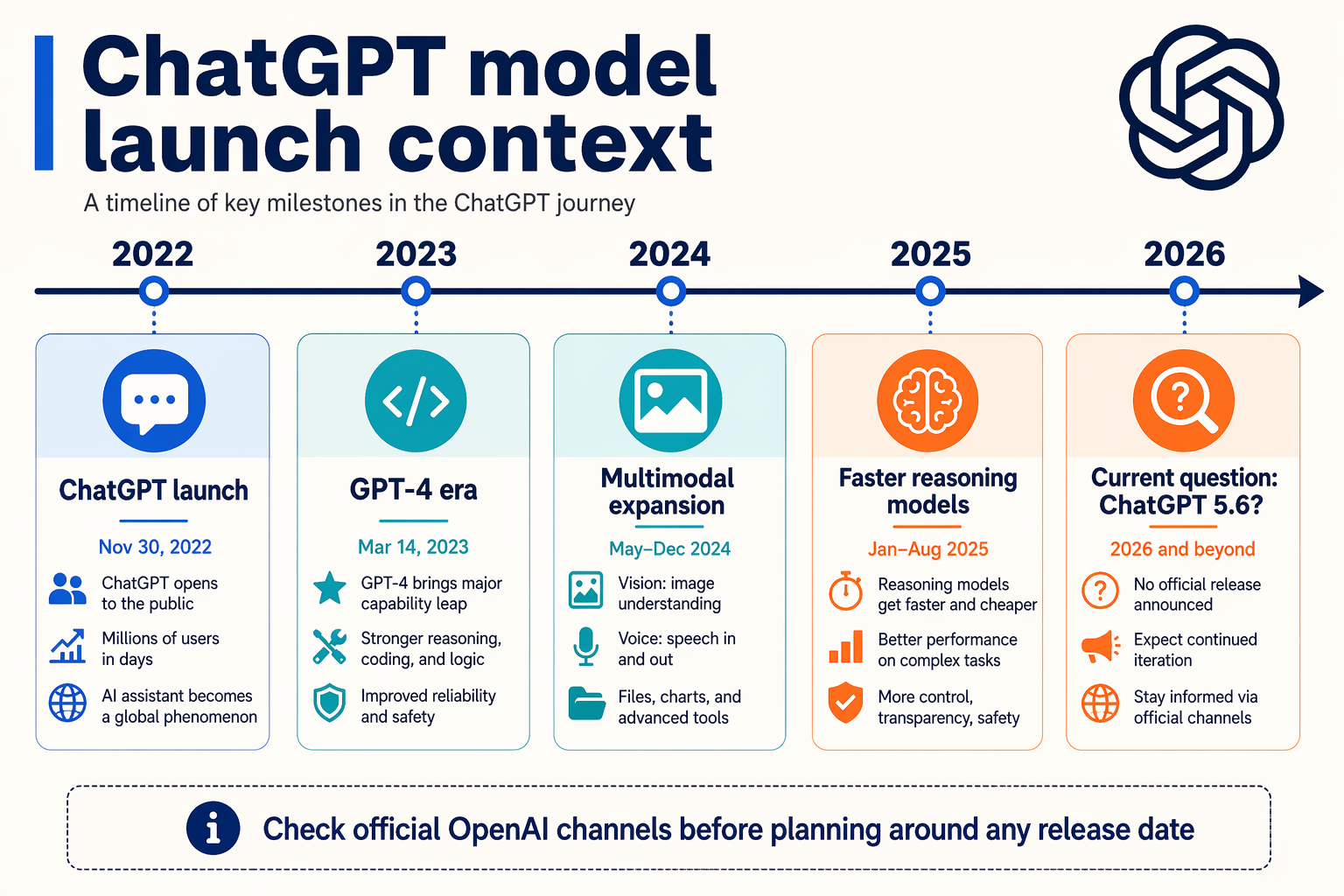
Why “ChatGPT 5.6” is being searched
The phrase “ChatGPT 5.6” sounds plausible because software users are trained to expect version numbers: 4.0, 4.1, 5.0, 5.5, 5.6, and so on. But frontier AI model naming does not always follow normal software-release logic. OpenAI has used names such as GPT-4, GPT-4 Turbo, GPT-4o, and other product labels that reflect capability, modality, or deployment strategy — not always a simple decimal sequence.
That is why a search term can become popular before a product actually exists. In AI, demand for a model name often comes from:
- Rumor cycles on social media and forums
- SEO articles predicting future launches
- Developer speculation based on API model lists
- Enterprise buyers trying to time procurement decisions
- Users assuming “5.6” must follow earlier numbered models
The important distinction is this: a searched term is not the same as an announced product.
ChatGPT became business infrastructure quickly
The reason model-launch speculation matters is that ChatGPT moved from consumer curiosity to business infrastructure at unusual speed. OpenAI launched ChatGPT publicly on November 30, 2022. UBS estimated that it reached 100 million monthly active users in January 2023, making it one of the fastest-growing consumer applications reported at the time.
That adoption changed expectations across industries. Businesses began using generative AI for:
- Customer support automation
- Sales and lead qualification
- Internal knowledge search
- Marketing and content workflows
- Coding, analytics, and operations
- Voice, chat, and multilingual customer engagement
McKinsey’s 2024 global AI survey showed the shift had moved well beyond experimentation: 72% of organizations had adopted AI in at least one business function, up from 55% one year earlier. Against that backdrop, questions about “ChatGPT 5.6” are really questions about when the next capability jump may arrive — and whether businesses should wait for it.
OpenAI launches are usually visible through official channels
Historically, major OpenAI model updates have not been subtle. For example, GPT-4 was announced on March 14, 2023, and GPT-4o was announced on May 13, 2024. These launches came with official communication: blog posts, product demonstrations, documentation updates, model names, and eventually API availability details.
For a model like “ChatGPT 5.6” to be considered real for planning purposes, businesses should expect to see at least some of the following:
- An OpenAI blog post or product announcement
- A confirmed model identifier in API documentation
- A ChatGPT plan or enterprise availability update
- Pricing, rate-limit, or usage details
- Developer migration notes or deprecation notices
- Coverage from primary sources, not only reposted speculation
Without those signals, “ChatGPT 5.6” should be treated as an unconfirmed search phrase rather than a launchable product.
The practical context for businesses
For business users and AI customers, the background is simple: model releases are important, but roadmaps should not depend on unofficial version numbers. A future model may improve reasoning, speed, multimodal capability, context length, tool use, cost efficiency, or reliability — but until OpenAI confirms the name and release plan, those benefits are hypothetical.
The safer planning approach is to separate:
- Confirmed AI capabilities available today
- Officially announced upcoming changes
- Speculation about future model names
- Vendor-neutral architecture decisions that keep options open
That context helps explain why “when will ChatGPT 5.6 launch?” is the wrong first question. The better question is: what official evidence exists, and how should my business stay flexible if a new model does arrive?
Key Developments (TABLE)
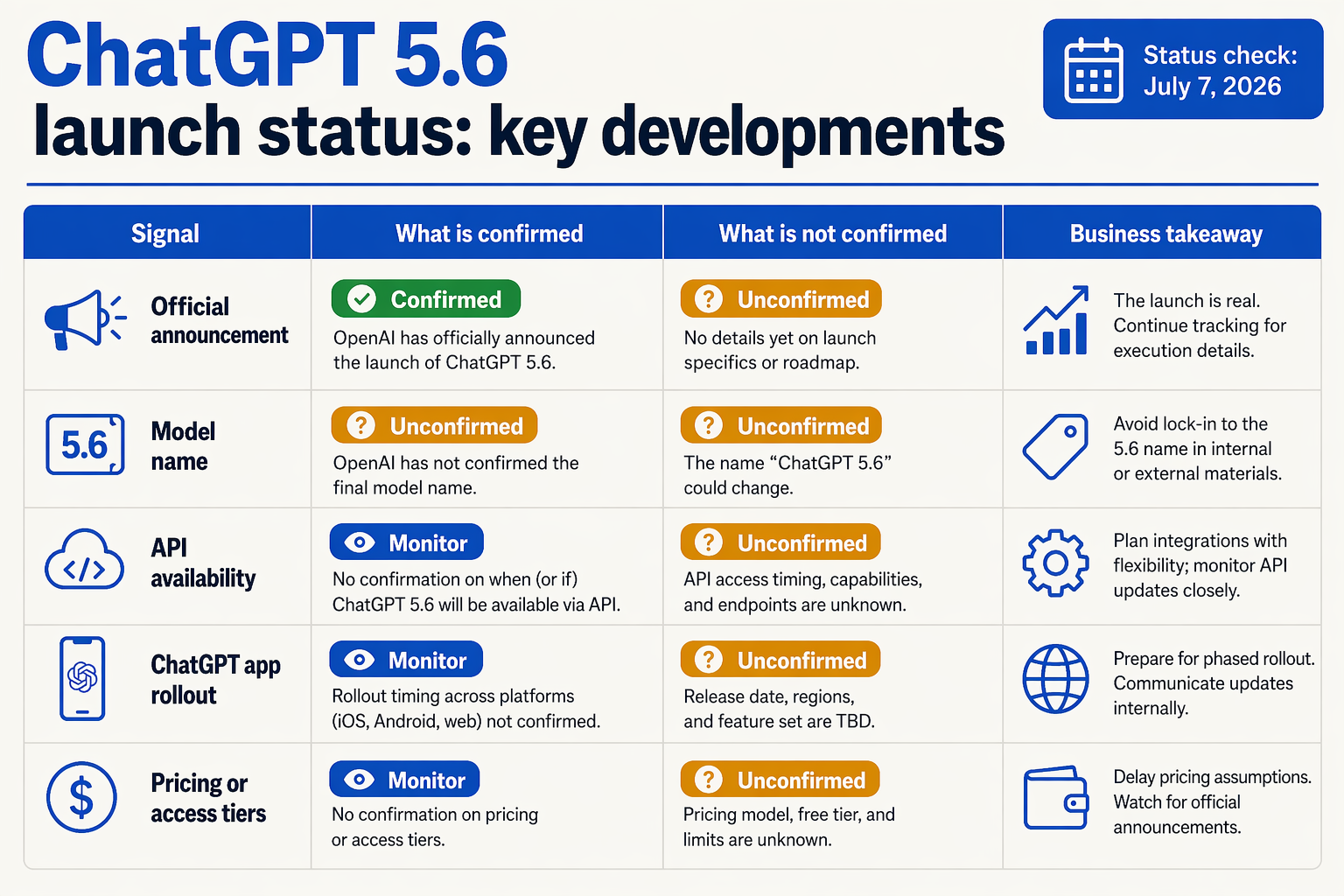
The key change since July 7 is that the story has moved from a broad rumor to a reported dated rollout. As of July 8, 2026, third-party reports say a public ChatGPT 5.6 rollout is expected on Thursday, July 9, 2026. That is still different from a full OpenAI launch announcement: buyers and developers should distinguish between official OpenAI preview/help-center material and external reporting about timing.
| Development | Current status as of July 8, 2026 | Source or signal to verify | Why it matters for businesses |
|---|---|---|---|
| June 26 preview | Official preview signal reported/visible in OpenAI materials | OpenAI preview material and Help Center references | Stronger than a rumor, but not the same as full general availability |
| Reported public rollout date | Third-party reports point to Thursday, July 9, 2026 | July 8 media/reporting; confirm against OpenAI blog and release notes | Useful planning signal, but teams should avoid customer-facing commitments until OpenAI confirms |
| Official OpenAI launch status | Preview/help-center status, not yet a full launch package | OpenAI blog, ChatGPT release notes, Help Center, API docs | A public help article or preview does not automatically mean API availability, pricing, or enterprise readiness |
| API model availability | No confirmed public “5.6” API model identifier yet | OpenAI API model list and developer documentation | Developers should not hard-code 5.6 assumptions until the model appears in official API docs |
| Pricing or plan changes | No confirmed public 5.6 pricing page yet | OpenAI pricing page and enterprise announcements | Finance teams still lack a reliable cost basis for budgeting |
| Sol | Expected to be affected by the 5.6 rollout, but verify in-product behavior | OpenAI Help Center / ChatGPT model picker after rollout | Teams using Sol should regression-test prompts, outputs, latency, and policy behavior |
| Terra | Expected to be affected by the 5.6 rollout, but not confirmed as a separate API model | OpenAI Help Center / ChatGPT release notes | Treat Terra changes as a ChatGPT experience update unless OpenAI publishes API documentation |
| Luna | Expected to be affected by the 5.6 rollout, with details still dependent on OpenAI confirmation | OpenAI Help Center / in-app release notes | Support and operations teams should monitor user-facing behavior before updating workflows |
The practical signal: official documentation beats rollout rumors
For AI buyers and developers, the most important distinction is now between a reported rollout date and a confirmed OpenAI release. The July 9 date may be useful for monitoring, but it should not be treated as final until OpenAI publishes durable documentation.
Before treating any ChatGPT 5.6 claim as operationally reliable, check whether it includes at least one of these concrete signals:
- A named model in OpenAI’s official API model list
- A dated post on the OpenAI blog
- A product update in ChatGPT release notes
- A Help Center article that clearly describes availability, eligibility, and limitations
- A pricing reference on an official OpenAI pricing page
- A formal enterprise or developer announcement
- A documented deprecation or migration notice
If the only evidence is third-party reporting, social posts, screenshots, or search-driven articles, treat the claim as reported but not confirmed.
What businesses should do before July 9
If the reported Thursday rollout happens, the first business impact will likely be practical testing rather than immediate migration. Teams using ChatGPT in production workflows should prepare a short validation checklist:
- Check access — confirm whether ChatGPT 5.6 appears in the relevant workspace, plan, or model picker.
- Test Sol, Terra, and Luna separately — compare outputs against existing workflows before assuming behavior is unchanged.
- Monitor API docs — do not assume ChatGPT availability means API availability.
- Review pricing and limits — wait for official plan, rate-limit, and billing details.
- Document changes — capture before-and-after results for compliance, support, and QA teams.
The safest planning approach remains: watch July 9 closely, but make production decisions only from OpenAI’s official release notes, Help Center, API documentation, and pricing pages.
Is ChatGPT 5.6 an official model name?

GPT-5.6 is now an official OpenAI preview model family as of July 7, 2026. OpenAI has previewed GPT-5.6 Sol, GPT-5.6 Terra, and GPT-5.6 Luna, which means the name is no longer just a rumor, search trend, or speculative version number.
However, that does not automatically mean there is a confirmed ChatGPT 5.6 release date for broad public access. The important distinction is:
- GPT-5.6 preview: official, but limited or staged
- ChatGPT 5.6 general availability: not yet confirmed with an exact public rollout date
- API availability, pricing, limits, and migration details: should be checked against OpenAI’s current documentation before planning production use
In other words, GPT-5.6 is official as a preview, but the timing for when most ChatGPT users, teams, developers, and enterprises can rely on it as a generally available model remains unconfirmed.
Why the naming still needs careful reading
The confusion is understandable because people often use “ChatGPT 5.6” and “GPT-5.6” interchangeably. They are related, but they are not always the same thing.
GPT-5.6 refers to the underlying model family or model variants. ChatGPT 5.6 is a user-facing way people may describe that model appearing inside ChatGPT. OpenAI can preview a model family before it becomes broadly available in ChatGPT, before it appears in every workspace, or before it is ready for stable API use.
That is why a preview announcement can be real while the broader release date remains uncertain. A model can move through several stages, including:
- Research preview
- Limited developer preview
- Selected ChatGPT rollout
- Team or Enterprise testing
- API availability
- General availability
- Pricing, rate-limit, and migration documentation
So the correct reading is not “ChatGPT 5.6 is fake.” It is: GPT-5.6 is official in preview, but ChatGPT 5.6 general availability has not been pinned to a confirmed date.
What GPT-5.6 Sol, Terra, and Luna likely signal
The previewed names — Sol, Terra, and Luna — suggest that OpenAI is presenting GPT-5.6 as more than a single flat model label. These names may represent different model variants, capability profiles, deployment tiers, or testing tracks.
For business users, the safest assumption is that each variant may differ in areas such as:
- Reasoning depth
- Speed and latency
- Multimodal capabilities
- Cost profile
- Context handling
- Tool use
- Enterprise readiness
- Availability by plan or region
Until OpenAI publishes full documentation for each variant, avoid assuming that Sol, Terra, and Luna are interchangeable. A preview label confirms existence, but production planning still depends on the details: access rules, stability, pricing, limits, data controls, and migration guidance.
What would confirm the ChatGPT 5.6 release date?
For the ChatGPT 5.6 release date to be confirmed, OpenAI would need to publish a clear availability signal, such as:
- “GPT-5.6 is now available in ChatGPT”
- “GPT-5.6 is rolling out to Plus, Pro, Team, or Enterprise users”
- “GPT-5.6 Sol, Terra, or Luna is available in the API”
- “General availability begins on a specific date”
- “Model name:
gpt-5.6or variant-specific API IDs” - “Pricing, rate limits, and migration guidance for GPT-5.6”
Until those details are public, treat the preview as real but the launch calendar as unsettled.
Practical rule for business users
If your team is tracking GPT-5.6 for procurement, automation, customer support, or product development, separate the question into three parts:
- Is GPT-5.6 official? Yes, as a preview.
- Is ChatGPT 5.6 broadly available to all users? Not confirmed as of July 7, 2026.
- Is there a confirmed ChatGPT 5.6 release date for general availability? Not yet.
That means you can begin evaluating the preview news, but you should not anchor launch plans, support workflows, or vendor commitments to GPT-5.6 until OpenAI confirms access, pricing, limits, and rollout timing.
The best approach is to design for flexibility: keep using currently available models, monitor OpenAI’s official release notes and API documentation, test GPT-5.6 only where access is explicitly supported, and prepare an upgrade path for when the preview becomes generally available.
How OpenAI model launches usually roll out
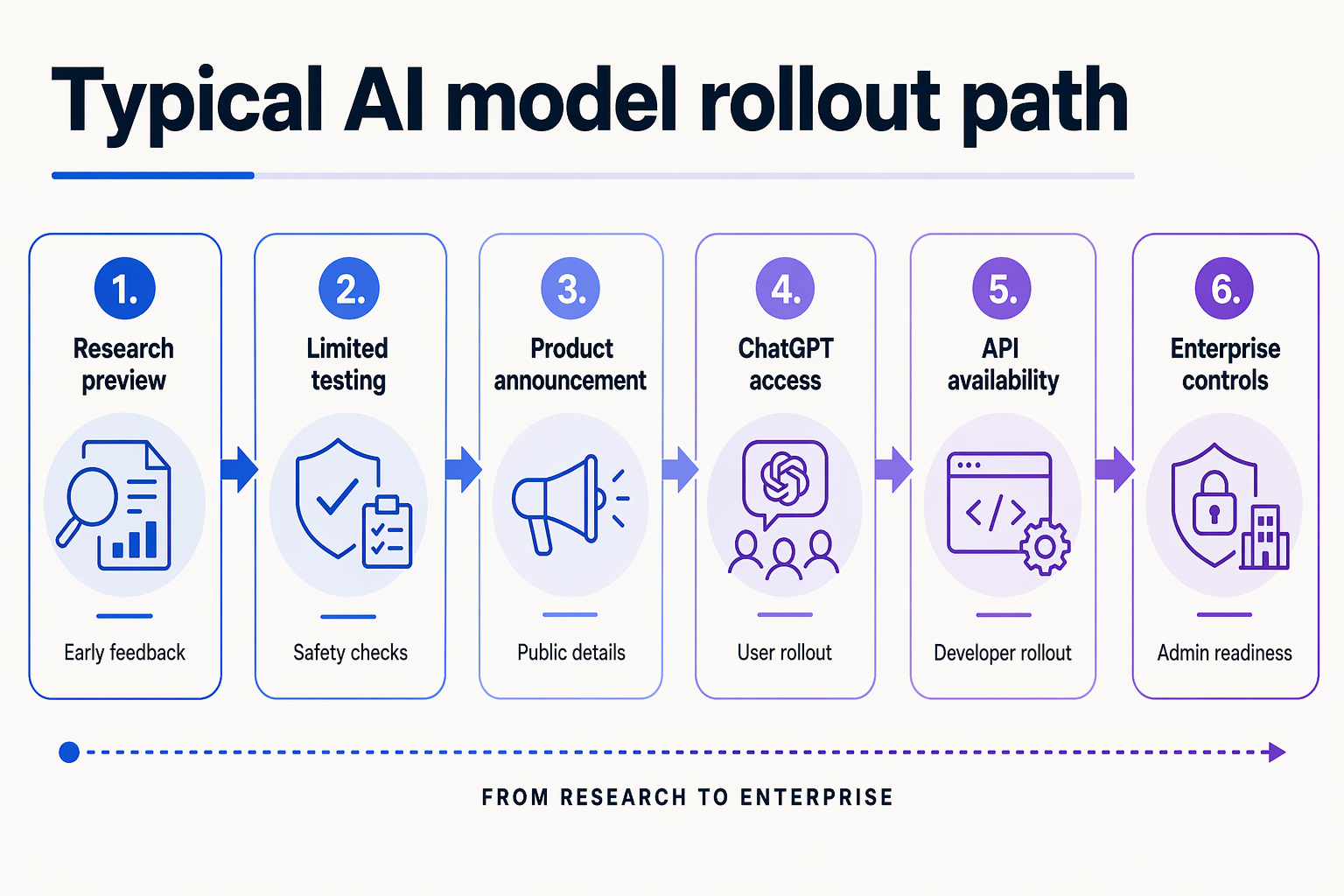
Model launches are usually a sequence, not a single switch
OpenAI model releases typically roll out in stages, which is why a rumored name like “ChatGPT 5.6” should not be treated as real until it appears in official channels. Historically, OpenAI has announced major models through a mix of:
- OpenAI blog posts explaining capabilities and availability
- ChatGPT product updates showing which users get access first
- API documentation listing model names, endpoints, pricing, and limits
- Safety/system cards describing evaluations, risks, and mitigations
- Developer announcements covering migration paths and deprecations
For example, ChatGPT launched publicly on November 30, 2022, and quickly became a mainstream product rather than a developer-only tool. UBS later estimated it reached 100 million monthly active users in January 2023, which explains why every new model launch now attracts business attention far beyond the AI research community.
What usually happens before businesses can actually use a new model
A model can be “announced” before it is fully usable everywhere. Business teams should distinguish between marketing launch, ChatGPT availability, and API production readiness.
A typical rollout may look like this:
- Research or product announcement: OpenAI publishes a blog post describing the model and headline capabilities.
- Limited access: The model may first appear for selected users, paid ChatGPT plans, enterprise customers, or developers.
- API model ID appears: Developers can see the exact model name in OpenAI’s API documentation, such as a versioned identifier.
- Pricing and rate limits are published: This is the point where businesses can estimate cost and capacity.
- Tooling support follows: Features such as function calling, structured outputs, vision, speech, or file handling may arrive at different times.
- Older models get migration guidance: OpenAI may later publish retirement or deprecation timelines for previous models.
That is why “launched” can mean different things. A model might be available in ChatGPT but not yet in the API. Or it may be available to developers but not enabled for every plan, region, or enterprise workspace.
Official signals matter more than version-number speculation
OpenAI does not always follow a simple numbering pattern that outsiders can predict. Major public releases have included names such as GPT-4, GPT-4 Turbo, and GPT-4o, where the “o” in GPT-4o stood for “omni.” That naming history shows why assuming a neat “5.5 → 5.6 → 5.7” sequence can be misleading.
Before treating any ChatGPT 5.6 claim as credible, look for these official signals:
- The model name appears on openai.com
- It is listed in the OpenAI API model documentation
- OpenAI publishes pricing
- OpenAI provides release notes or a system card
- ChatGPT plan pages mention availability for Free, Plus, Team, Enterprise, or Edu
- Developers can test it using a documented model ID
If those signals are absent, the safest assumption is that the model is not officially launched.
Why this rollout pattern matters for AI customers
For business users, the practical issue is not just “when is the model coming?” but when can we depend on it in production? McKinsey’s 2024 global AI survey found that 72% of organizations had adopted AI in at least one business function, which means model changes now affect real workflows: support automation, sales qualification, analytics, coding, and multilingual customer engagement.
This is also why many teams prefer flexible AI infrastructure instead of hard-coding their roadmap to one rumored model name. Solutions like CallMissed’s OpenAI-compatible gateway let developers work across multiple supported models through one integration, with same-tier fallbacks where available. That approach helps businesses adopt useful AI now while staying ready for future OpenAI launches if and when they become official.
What signals to watch before a ChatGPT 5.6 launch
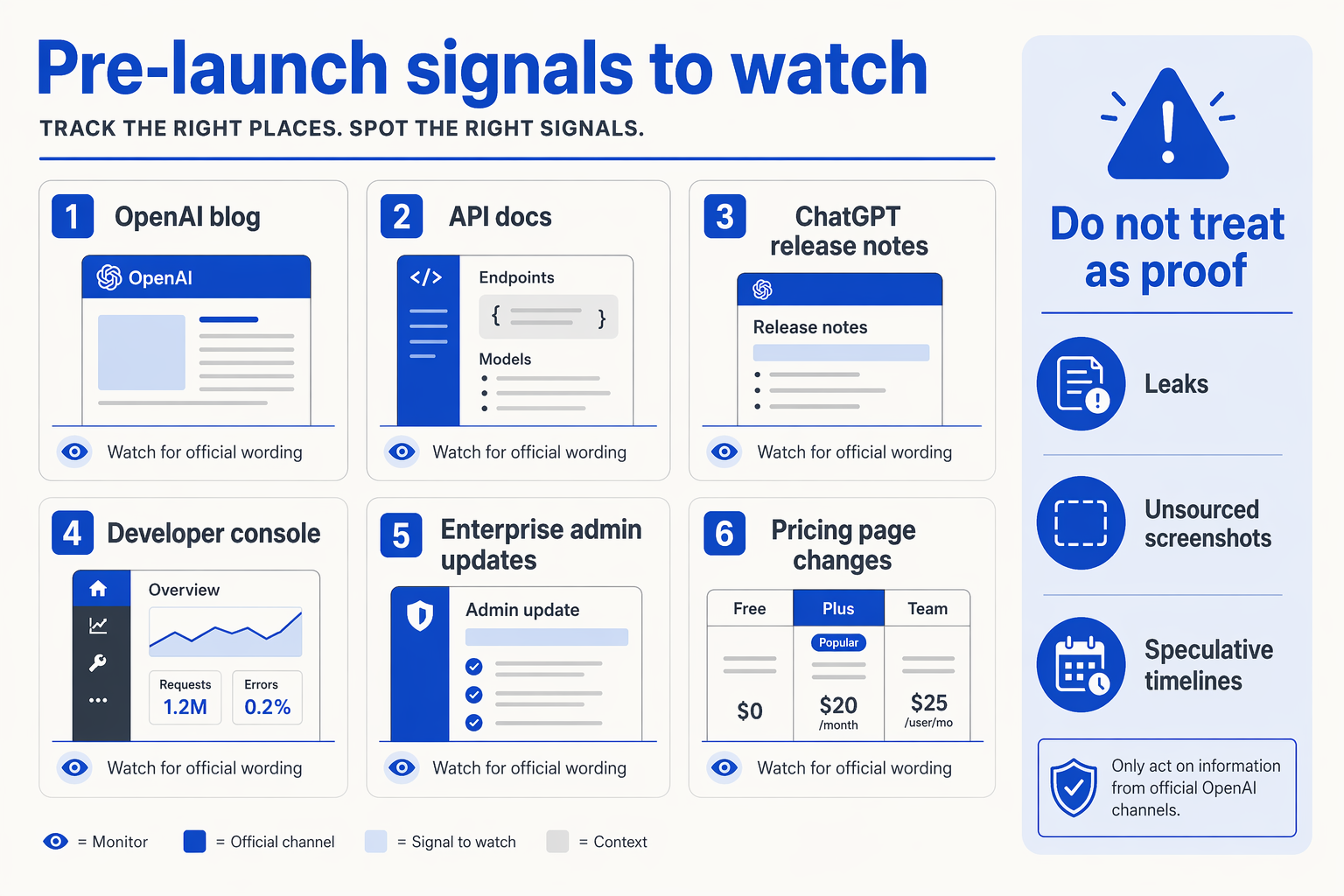
Start with official OpenAI channels, not rumor timelines
Before treating any ChatGPT 5.6 launch date as credible, check whether the model appears in OpenAI’s own public channels. As of July 7, 2026, the important fact remains unchanged: OpenAI has not announced a ChatGPT 5.6 model, release window, API name, pricing page, waitlist, or enterprise rollout.
The strongest launch signals usually come from:
- OpenAI blog or newsroom post
A real model launch is typically accompanied by a public explanation of capabilities, availability, safety work, and product access.
- OpenAI API documentation
For developers, the decisive signal is whether a new model appears in the official API model list, documentation, or migration guides.
- ChatGPT product release notes
If a model is available inside ChatGPT, OpenAI usually documents changes to the consumer, Plus, Team, Enterprise, or Edu experience.
- Pricing and rate-limit pages
Business users should look for concrete details: token pricing, context limits, tool support, latency expectations, and availability by plan.
- System cards or safety documentation
Major frontier model releases often include safety, evaluation, or preparedness information. Absence of such documentation is a reason to be cautious.
Watch for developer-specific clues
For AI customers and engineering teams, a launch is not real operationally until it can be planned, tested, and governed. Useful developer signals include:
- A stable API model identifier, not just a marketing name
- SDK or documentation updates showing how to call the model
- Deprecation notices for older models, which often indicate a roadmap shift
- Benchmark or evaluation disclosures from OpenAI rather than third-party speculation
- Enterprise controls, such as data retention settings, admin access, audit logs, or compliance notes
- Regional availability, especially if your business has data-residency or sector-specific requirements
This is especially important because AI adoption is already mainstream. McKinsey’s 2024 global AI survey found that 72% of organizations had adopted AI in at least one business function, up from 55% a year earlier. When adoption is that widespread, model-launch rumors can affect budgets, procurement, and product timelines — even before anything official exists.
Separate weak signals from meaningful evidence
Not every “ChatGPT 5.6 coming soon” post deserves attention. Treat these as weak signals unless backed by official documentation:
- Viral screenshots without source links
- SEO pages predicting dates without citations
- Social media posts claiming private access
- “Leaked” model names not visible in OpenAI documentation
- YouTube thumbnails or forum threads using speculative version numbers
- Vendor pages that mention compatibility before OpenAI has confirmed the model
By contrast, meaningful evidence looks specific and verifiable: a dated OpenAI announcement, a documented API model name, published pricing, rollout details by plan, or migration instructions for developers.
Business takeaway: prepare for change without waiting for “5.6”
The practical move is not to freeze AI projects until ChatGPT 5.6 appears. ChatGPT itself became a business priority quickly after its November 30, 2022 launch, with UBS estimating 100 million monthly active users by January 2023. That history shows how fast adoption can move — but it also shows why businesses need flexible infrastructure.
For example, teams using an OpenAI-compatible gateway such as CallMissed can design applications to work across supported LLMs, speech-to-text, text-to-speech, image, and search models through one integration pattern. That does not predict a ChatGPT 5.6 launch; it simply reduces dependency on any single unconfirmed model roadmap.
Impact & Implications
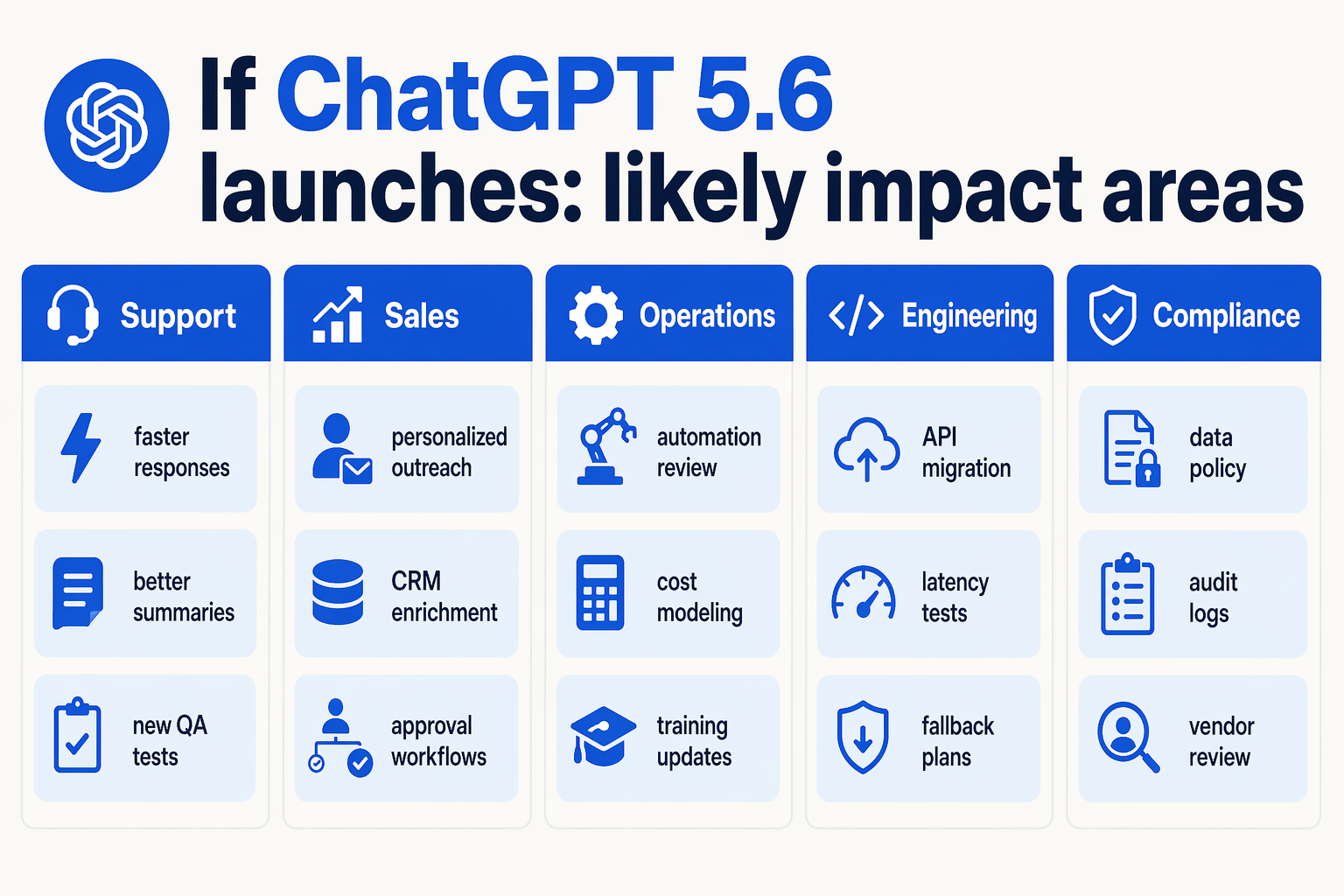
Why an unconfirmed “ChatGPT 5.6” still affects business planning
Even without an official launch date, the search interest around ChatGPT 5.6 signals something important: businesses now treat model upgrades as operational events, not just product news. Since ChatGPT launched publicly on November 30, 2022, AI release cycles have influenced software roadmaps, customer-support automation, analytics workflows, marketing operations, and procurement decisions.
The adoption curve explains why. UBS estimated that ChatGPT reached 100 million monthly active users in January 2023, while McKinsey’s 2024 global AI survey found that 72% of organizations had adopted AI in at least one business function, up from 55% a year earlier. When a rumored model name trends, many teams immediately ask whether they should pause projects, renegotiate contracts, or wait for better capabilities.
The practical answer: do not delay production AI plans for a model that OpenAI has not confirmed.
The biggest risk is roadmap paralysis
For business users, the danger is not missing “ChatGPT 5.6.” The bigger risk is postponing valuable automation because of speculative release timelines.
Teams waiting for an unannounced model may delay:
- Customer support automation that could reduce response times today
- Sales and lead qualification workflows across chat, voice, and WhatsApp
- Internal knowledge assistants using existing retrieval-augmented generation systems
- Developer productivity tools for code review, documentation, and testing
- Multilingual voice and chat experiences for regional markets
A better approach is to build around capability requirements, not version numbers. For example: “We need lower latency for voice agents,” “We need better Hindi and Tamil support,” or “We need a cheaper model for high-volume classification.” Those requirements can be tested against available models now and upgraded later if a stronger model is released.
What AI buyers should do instead
Instead of asking only “when will ChatGPT 5.6 launch?”, businesses should ask more operational questions:
- Can our architecture switch models without rewriting the app?
Model abstraction matters because OpenAI, Anthropic, Google, Meta, Mistral, and others update model families on different timelines.
- Do we have evaluation benchmarks?
Track accuracy, latency, hallucination rate, cost per task, language quality, and escalation rate before and after any model change.
- Are we dependent on one provider?
A single-model setup can create pricing, availability, and migration risks.
- Can we separate model choice from business workflow?
Your CRM, WhatsApp inbox, voice agent, or support bot should not need a full rebuild every time a model changes.
This is where infrastructure choices matter. Solutions like CallMissed’s OpenAI-compatible gateway let developers access multiple LLM, speech-to-text, text-to-speech, image, and search models behind one API pattern, with automatic same-tier fallbacks. For Indian businesses, CallMissed’s support for 22 Indian languages across speech workflows is especially relevant when AI adoption needs to reach customers beyond English-speaking segments.
Procurement teams should update their AI checklists
The absence of a confirmed ChatGPT 5.6 launch date should push procurement teams toward more resilient buying criteria. Useful vendor questions include:
- Does the platform support multiple model providers?
- Is pricing transparent and usage-based?
- Can we export logs, prompts, and evaluation results?
- Are there fallback options during outages or rate limits?
- Does the system support the languages and channels our customers actually use?
The bottom line for decision-makers
As of July 7, 2026, there is no official ChatGPT 5.6 model or release date. But the implication is clear: businesses should stop planning around rumored version numbers and start investing in flexible AI infrastructure, measurable evaluations, and upgrade-ready workflows. That way, if a future OpenAI model does arrive, adoption becomes a controlled upgrade — not a strategic scramble.
Expert Opinions

What AI experts are likely to agree on
The strongest expert consensus is not about a hidden date — it is about evidence standards. For a model launch to be credible, AI teams should look for official OpenAI signals, not social posts, scraped screenshots, or version-number speculation.
As of July 7, 2026, the key fact remains unchanged: OpenAI has not publicly announced a ChatGPT 5.6 model, release window, waitlist, pricing page, or API availability date. That makes any precise “ChatGPT 5.6 launch date” claim unreliable unless it links to OpenAI’s own blog, documentation, release notes, or API model list.
Experts typically advise business users to separate three things:
- Product branding — what appears inside ChatGPT for consumers.
- API model IDs — what developers can actually call in production.
- Capability changes — measurable improvements in reasoning, latency, cost, tool use, voice, or multimodal performance.
That distinction matters because businesses do not deploy rumors; they deploy available model endpoints with pricing, limits, terms, and reliability guarantees.
Why “5.6” should not drive procurement decisions
The search interest around “ChatGPT 5.6” is understandable. ChatGPT became a mainstream business tool extremely quickly: it launched publicly on November 30, 2022, and UBS estimated it reached 100 million monthly active users in January 2023. Since then, model releases have influenced customer support automation, coding workflows, sales operations, research, and analytics.
But expert buyers usually avoid locking procurement plans to a speculative version label. A model named “5.6” could mean many things — or nothing at all — unless OpenAI confirms it. The more useful questions are:
- Will the model be available in the API or only in ChatGPT?
- What are the input/output prices and rate limits?
- Does it improve measurable business outcomes?
- Is it better for voice, coding, reasoning, multilingual tasks, or tool use?
- Will existing models be deprecated or repriced?
- Can we switch models without rebuilding workflows?
This is especially important because enterprise AI adoption is already widespread. McKinsey’s 2024 global AI survey found that 72% of organizations had adopted AI in at least one business function, up from 55% a year earlier. For those teams, waiting indefinitely for an unconfirmed model can slow real automation gains.
Practical expert advice for businesses
Most AI infrastructure specialists would recommend a capability-first roadmap:
- Build now on stable, documented models rather than waiting for an unconfirmed release.
- Track official OpenAI sources for model names, pricing, and deprecation notices.
- Benchmark with your own tasks, not only public leaderboards.
- Design for model flexibility so teams can upgrade when a better model is actually available.
- Avoid vendor lock-in at the workflow level, especially for customer-facing systems.
This is where multi-model infrastructure becomes practical. Solutions like CallMissed’s OpenAI-compatible gateway let developers access multiple supported models through one integration pattern, with automatic same-tier fallbacks. For Indian businesses, the added advantage is that platforms such as CallMissed also support AI voice and chat workflows across 22 Indian languages, which can matter more operationally than a future model number.
Bottom line from the expert view
The expert answer is simple: do not treat ChatGPT 5.6 as a real launch until OpenAI confirms it. Plan around documented models, measurable performance, and flexible architecture. If ChatGPT 5.6 is eventually announced, businesses that have already built adaptable AI systems will be in the best position to test, compare, and adopt it quickly.
What This Means For You (TABLE)
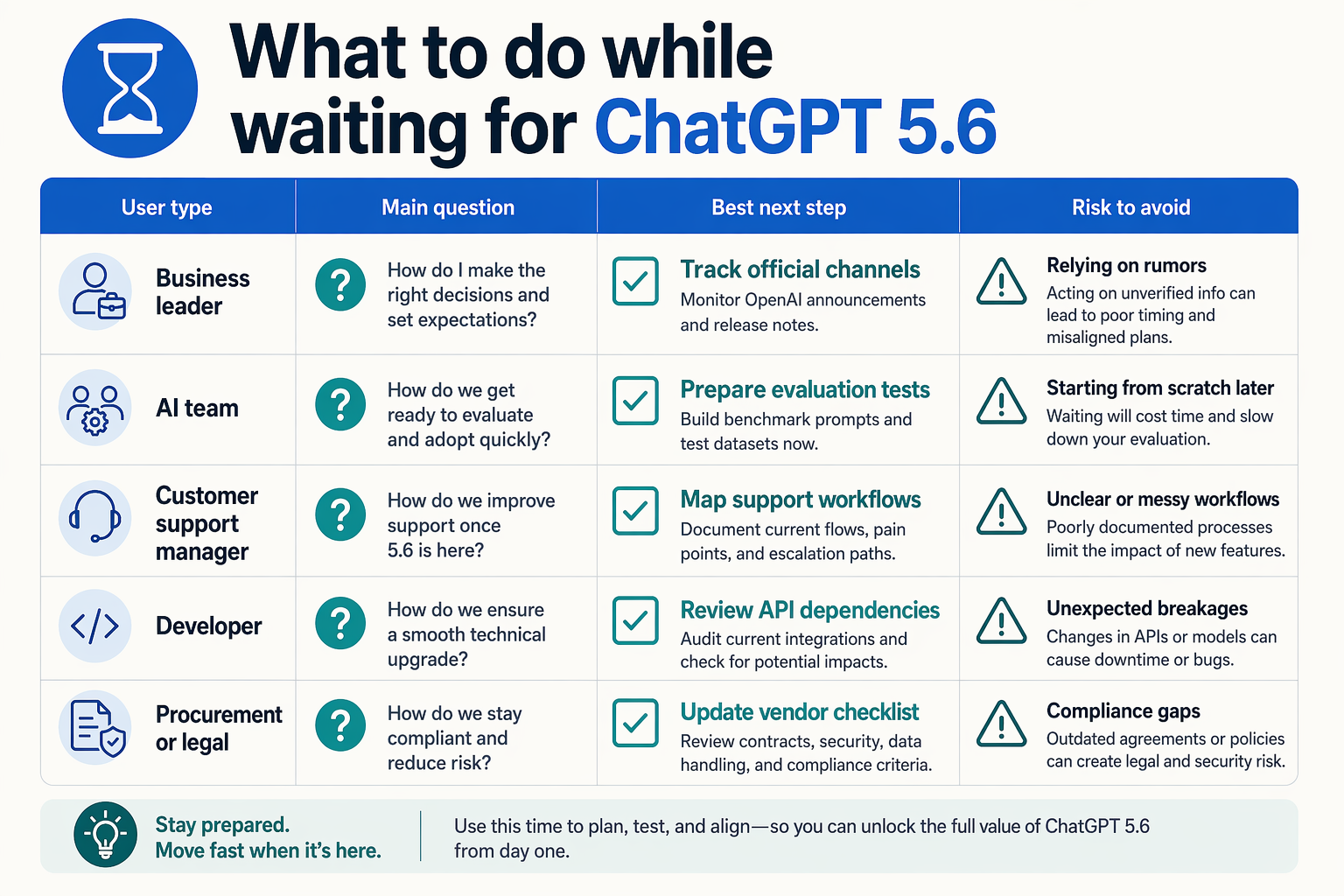
Practical takeaway: plan for capability, not a rumored version number
For business users, the absence of a confirmed ChatGPT 5.6 launch date as of July 7, 2026 should change how you plan AI projects. Instead of waiting for a model that OpenAI has not announced, evaluate what your workflows need today: better reasoning, lower latency, voice automation, multilingual support, compliance controls, or cheaper inference.
AI adoption is already mainstream. McKinsey reported that 72% of organizations used AI in at least one business function in 2024, up from 55% the year before. And ChatGPT’s growth — 100 million monthly active users by January 2023, according to UBS estimates — shows why model-release rumors spread quickly. But business decisions should be anchored in confirmed documentation, not search trends.
| If you are… | What “no ChatGPT 5.6 date” means | What to do now | Signal to watch |
|---|---|---|---|
| Business leader | Do not delay automation projects for an unconfirmed model name | Build around measurable outcomes: cost per ticket, resolution time, lead response rate | OpenAI blog, enterprise announcements, pricing pages |
| Developer / CTO | Avoid hard-coding your roadmap to “5.6” | Use abstraction layers, model routing, and fallback logic | API model list, release notes, deprecation notices |
| Customer support team | Better models may help later, but current AI can already reduce repetitive workload | Start with FAQs, order updates, appointment scheduling, and escalation flows | New voice, tool-use, and context-window updates |
| Indian SMB | Waiting may slow adoption in WhatsApp, voice, and regional-language support | Prioritize Hindi, Tamil, Telugu, Bengali, Marathi, and other local-language use cases | Multilingual STT/TTS benchmarks and WhatsApp Business updates |
| Procurement / finance team | Rumored launches should not drive budget assumptions | Budget for flexible pay-as-you-go AI usage rather than one fixed model | Official pricing changes and model availability |
| AI product team | “Latest model” is less important than reliability, latency, and integrations | Test multiple models against your own prompts and customer data patterns | Eval results, latency reports, API stability updates |
The safest AI strategy in 2026
A sensible approach is to separate model speculation from infrastructure readiness. If OpenAI eventually launches a model that people call ChatGPT 5.6, businesses that already have flexible AI plumbing will be able to test it faster. Teams locked into a single model, single prompt format, or single vendor-specific workflow may need more rework.
Use this checklist:
- Track official sources only — OpenAI’s blog, docs, API model list, and release notes.
- Benchmark on your own tasks — sales calls, support chats, document search, coding, or analytics.
- Design for model switching — assume models, prices, and context limits will keep changing.
- Avoid launch-date dependencies — do not make Q3/Q4 plans depend on an unannounced “5.6”.
- Measure business impact — automation rate, CSAT, conversion lift, and cost per interaction matter more than version labels.
Why flexible platforms matter
This is where multi-model infrastructure becomes practical. Solutions like CallMissed’s OpenAI-compatible gateway let developers access LLM chat, speech-to-text, text-to-speech, image generation, and web search through one API pattern, with fallback options across supported models. For Indian businesses, the added value is regional: CallMissed supports STT and TTS across 22 Indian languages, useful for teams serving customers beyond English-only channels.
So the bottom line is simple: do not wait for ChatGPT 5.6 to be “launched” before moving forward. Wait for official confirmation before believing the name — but start building AI systems that can adapt whenever the next confirmed model arrives.
Frequently Asked Questions
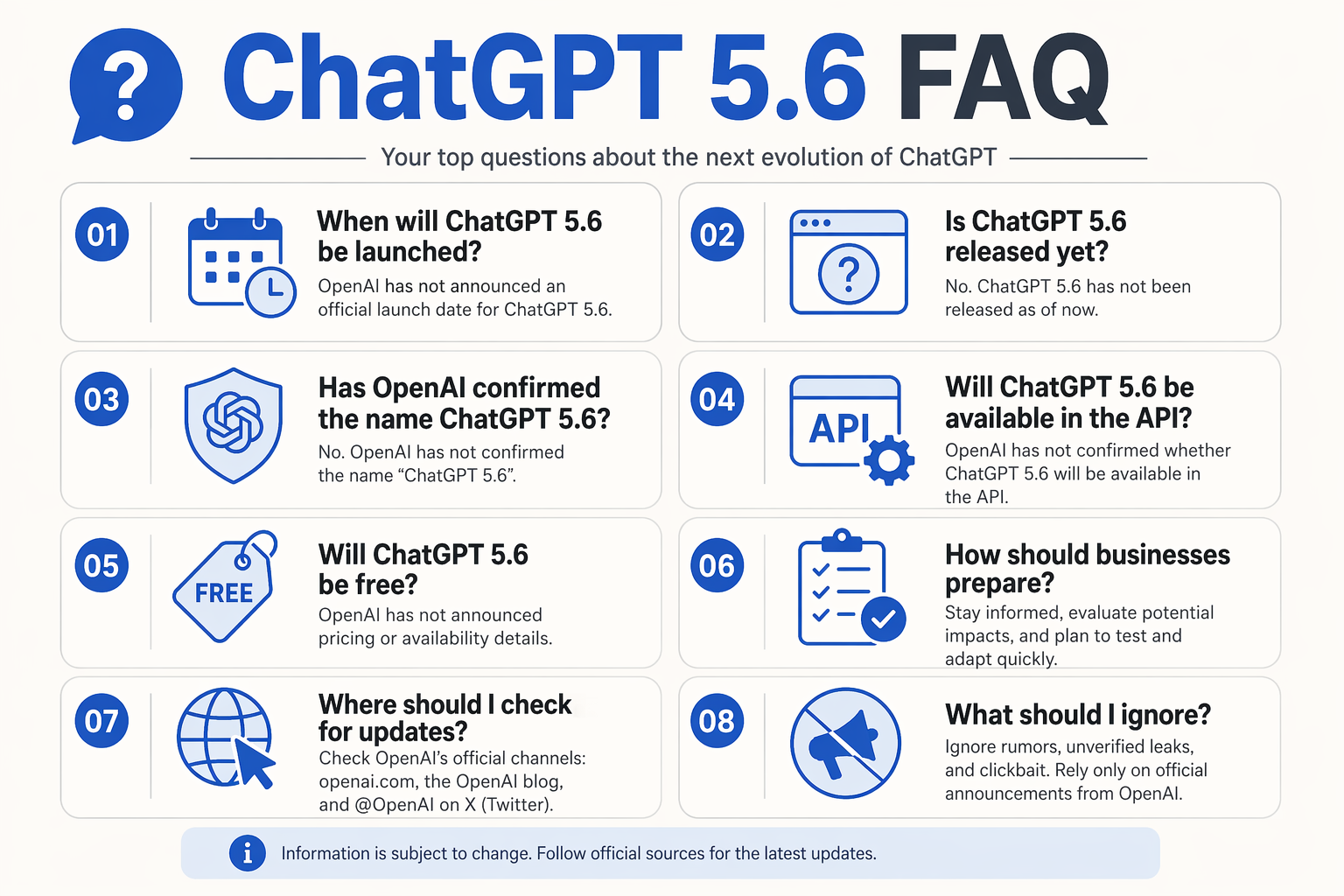
Is ChatGPT 5.6 launching on Thursday, July 9?
Is July 9 official or just reported?
Are all ChatGPT 5.6 models — Sol, Terra, and Luna — included in the July 9 rollout?
Which ChatGPT 5.6 model should I try first?
How should developers prepare for a possible ChatGPT 5.6 rollout?
Should businesses wait for ChatGPT 5.6 before launching AI workflows?
Conclusion
The bottom line: there is no confirmed ChatGPT 5.6 release date as of July 7, 2026. For business users, developers, and AI buyers, the safest approach is to separate official signals from search-driven speculation.
Key takeaways:
- OpenAI has not announced ChatGPT 5.6 — no launch date, API model name, pricing page, waitlist, or enterprise rollout has been published.
- Version numbers can be misleading unless they appear in OpenAI’s official blog, documentation, release notes, or API model list.
- Businesses should avoid delaying AI adoption while waiting for an unconfirmed model; practical gains can come from flexible, model-agnostic infrastructure today.
- Roadmaps should be built around adaptability, including fallbacks, provider flexibility, and clear upgrade paths when new models do become available.
Looking ahead, watch OpenAI’s official blog, API documentation, model deprecation notices, enterprise announcements, and developer release notes before treating any “ChatGPT 5.6 launch” claim as real.
To explore how AI communication is evolving, check out CallMissed — an AI infrastructure platform powering voice agents, WhatsApp automation, and multilingual chatbots for businesses. The better question may be: are you ready to benefit from the next model update whenever it arrives?
Related Reading
Ready to automate customer conversations?
Launch AI voice agents and WhatsApp bots with CallMissed — one API, 22+ Indian languages.