

Anthropic's Claude Sonnet 5 Undercuts GPT-5.5 on Price: The 2026 AI Agent Price War Is Here



Discover how Anthropic's newly launched Claude Sonnet 5 undercuts OpenAI's GPT-5.5 on price, offering a 49% blended token discount and elite agentic features.
Anthropic's Claude Sonnet 5 Undercuts GPT-5.5 on Price: The 2026 AI Agent Price War Is Here
Could a single API update slash your enterprise AI operational costs overnight? Today, Anthropic did exactly that by launching Claude Sonnet 5, firing a massive shot across the bow of the AI industry and officially igniting the 2026 AI agent price war. As autonomous AI agents transition from novel experiments to production-grade digital workforces, the cost of compute has become the ultimate bottleneck for businesses looking to scale.
Anthropic's newly released model directly targets this pain point, aggressively undercutting major rivals like OpenAI's GPT-5.5 and Google's Gemini 3.1 Pro. While GPT-5.5 set a formidable benchmark at $5 per million input tokens and $30 per million output tokens, the sheer volume of tokens required for true agentic workflows—which rely heavily on continuous reasoning loops, multi-step planning, and parallel tool execution—frequently resulted in eye-watering enterprise bills. By launching Claude Sonnet 5 with robust, "beefed-up" agentic capabilities at a fraction of the cost of GPT-5.5 (and even Anthropic's own Opus 4.8), the barrier to deploying highly autonomous software agents has been thoroughly demolished.
This aggressive pricing strategy is set to accelerate the adoption of agentic workflows across every major sector, from customer support to automated software development. For enterprises navigating this rapidly shifting landscape, platforms like CallMissed make it seamless to capitalize on these price drops instantly, allowing developers to switch between over 300 LLMs—including the newly released Claude Sonnet 5—to power multilingual voice agents and WhatsApp chatbots without rebuilding their core infrastructure.
In this article, we will dissect the economics of this new AI paradigm. We will break down the exact performance-to-price benchmarks of Claude Sonnet 5 versus GPT-5.5, examine how this price war impacts developers running high-frequency API calls, and predict who will win the race to provide the most cost-effective "digital brain" of 2026.
Introduction: Anthropic Shakes Up the AI Pricing Wars with Claude Sonnet 5

The Dawn of the 2026 AI Agent Price War
The global landscape of enterprise artificial intelligence has reached a critical economic tipping point. Anthropic has disrupted the industry's baseline by launching Claude Sonnet 5. Positioned as a direct, highly capable alternative to OpenAI's flagship GPT-5.5 and Google's Gemini 3.1 Pro, Sonnet 5 arrives with a primary mission: delivering state-of-the-art "agentic" capabilities without the premium enterprise price tag.
For companies operating at scale, the cost of compute is no longer a minor line item; it is the defining factor of product viability. By aggressively pricing Claude Sonnet 5 below GPT-5.5—which maintains a benchmark rate of $5.00 per million input tokens and $30.00 per million output tokens—Anthropic is triggering an intense race to the bottom. While ultra-lightweight models like Google's Gemini 3.5 Flash remain cheaper for basic retrieval tasks, Sonnet 5 provides the deep reasoning and continuous execution power required for complex digital workforces at a fraction of standard frontier model costs.
Why Token Economics Dictate the Agentic Era
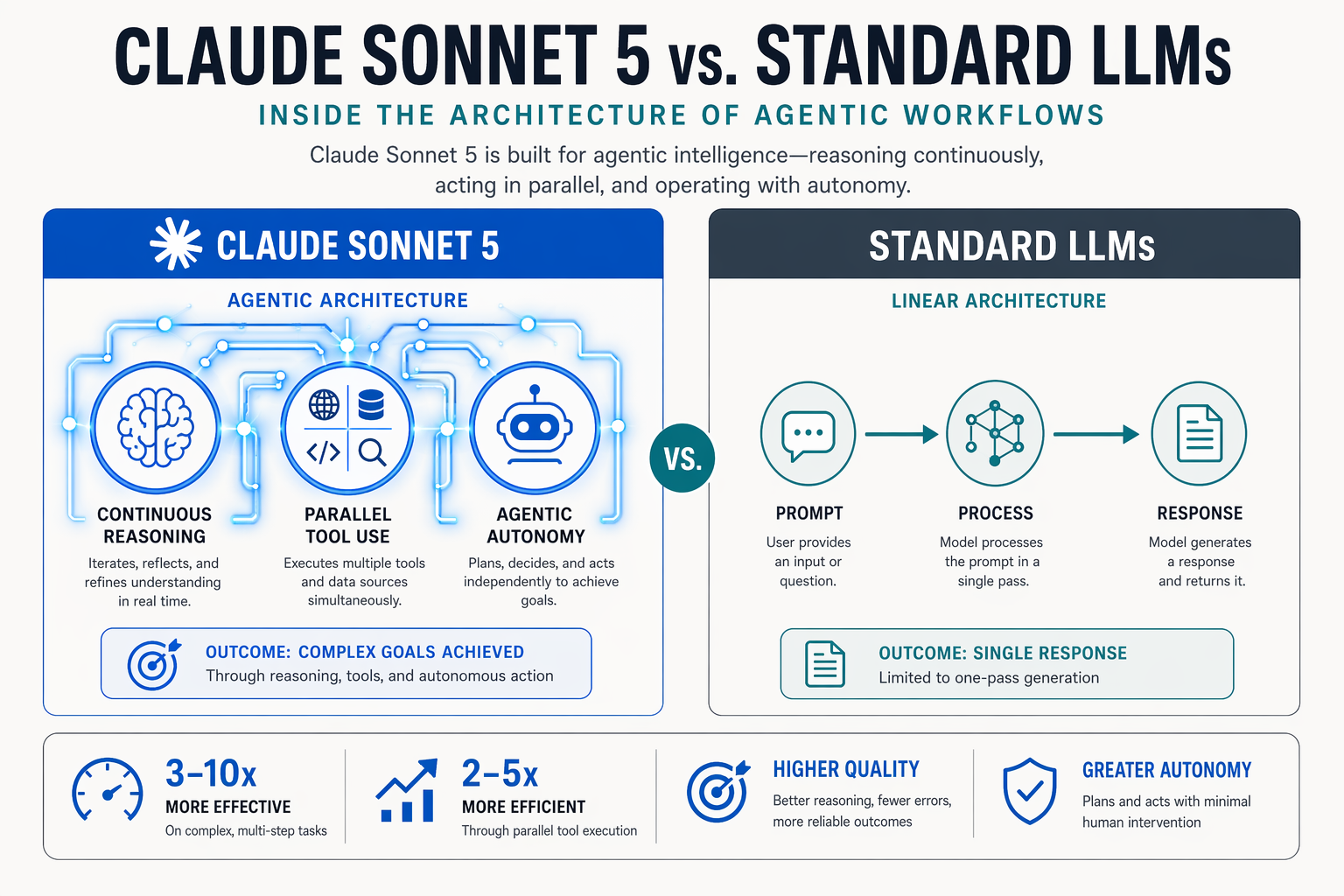
To understand why Anthropic’s pricing move is so significant, we must look at how AI system architectures have evolved. We are rapidly transitioning from simple, single-turn prompts to autonomous agentic workflows. These digital agents do not just answer questions; they operate in continuous reasoning loops, execute parallel tool calls, and run automated self-correction cycles.
This operational model demands a massive volume of tokens:
- Multi-step planning: Agents must constantly ingest historical state context, inflating input token usage.
- Parallel tool execution: Calling external APIs and databases requires multiple round-trips of structured data.
- High-effort reasoning: Next-generation models must "think" before they act, generating extensive chain-of-thought tokens.
At GPT-5.5's rates, a complex, multi-hour agent workflow can quickly rack up unsustainable operational bills. In contrast, Anthropic's pricing strategy for the Sonnet line has historically sliced input costs by roughly 1.7× compared to OpenAI (with prior models like Sonnet 4.6 sitting at $3.00 input / $15.00 output per million tokens). By continuing this aggressive undercutting with Claude Sonnet 5, Anthropic makes high-frequency API calls economically viable for mainstream enterprise applications.
Capitalizing on the Shift with Flexible Infrastructure
For modern enterprises, the primary challenge is architectural agility. Committing to a single LLM provider risks lock-in to an inefficient pricing tier when a competitor drops rates overnight. This is where modern AI communication infrastructure becomes essential.
Platforms like CallMissed allow developers to capitalize on these rapid pricing shifts instantly. By providing a unified, production-ready gateway to over 300 LLMs, CallMissed enables businesses to route workflows dynamically. Whether you are deploying highly responsive, multilingual voice agents supporting 22 regional Indian languages or managing complex WhatsApp chatbots, you can switch the underlying "brain" to Claude Sonnet 5 without rewriting your application's core codebase. This ensures that as the 2026 pricing wars heat up, your operations remain both state-of-the-art and highly cost-optimized.
Background & Context: The LLM Landscape of 2026
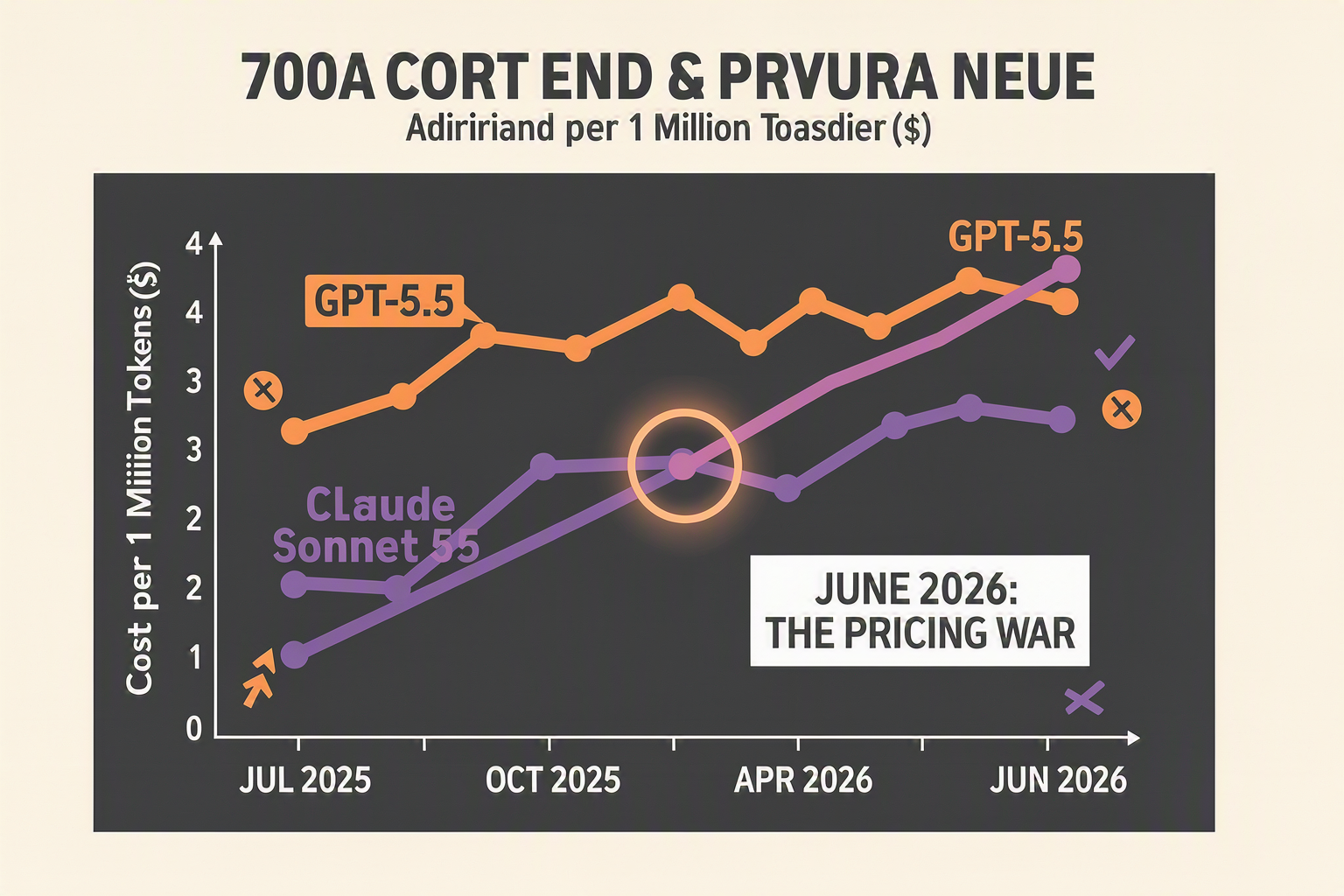
As we progress through 2026, the artificial intelligence landscape has undergone a fundamental architectural shift. The era of the static, single-prompt chatbot has given way to agentic AI—autonomous digital workforces capable of chain-of-thought reasoning, multi-step planning, and executing complex operations across external APIs. However, this transition has introduced a massive economic hurdle: the "agentic tax."
Unlike traditional question-answering interactions, an autonomous AI agent operates in continuous loops. A single user query can trigger dozens of internal reasoning cycles, parallel tool calls, and memory retrievals. This translates to an exponential explosion in token consumption. Under the pricing models of early 2026, deploying these agentic workforces at scale was a luxury reserved for tech giants. For instance, OpenAI's GPT-5.5 established a high benchmark of quality, but at $5.00 per million input tokens and $30.00 per million output tokens, a fleet of active agents running 24/7 could easily rack up thousands of dollars in daily API costs.
To understand how we arrived at this pricing bottleneck, it is helpful to look at the three core dynamics shaping the 2026 LLM landscape:
- The Cost of Reasoning: Flagship models like Claude Opus 4.7 historically commanded premium rates of $15.00 per million input and $75.00 per million output tokens, forcing developers to ration deep-reasoning tasks due to sheer expense.
- The Rise of Mid-Tier Workhorses: To mitigate these costs, developers increasingly turned to models like Claude Sonnet 4.6 (priced at $3.00/$15.00 per million tokens), which offered a 1.7x input cost advantage over GPT-5.5 but lacked the advanced native reasoning required for highly autonomous loops.
- Parallelization Demands: Modern enterprise agents require continuous parallel tool execution, native reasoning modes, and high-frequency API calls, quickly compounding the baseline rates of premium models.
This structural fragmentation is precisely why modern architecture favors flexibility over vendor lock-in. Because LLM pricing and performance benchmarks shift rapidly, relying on a single model provider introduces immense operational risk. Platforms like CallMissed address this vulnerability by providing a multi-model API gateway. By enabling developers to access over 300 LLMs natively, CallMissed allows companies to instantly swap underlying models—shifting from GPT-5.5 to the cheaper Claude Sonnet 5—to power things like voice agents and WhatsApp chatbots without rebuilding their orchestration layer.
This is the highly volatile backdrop against which Claude Sonnet 5 arrives. It is not just another incremental model update; it is a tactical strike on the economic foundations of the LLM market. By providing next-generation agentic execution, faster speeds, and beefed-up reasoning at a price point that aggressively undercuts both GPT-5.5 and Gemini 3.1 Pro, Anthropic is forcing a recalculation of the cost-to-benefit ratio for every developer building autonomous systems in 2026.
Key Developments: Claude Sonnet 5 vs. GPT-5.5 Pricing and Features (TABLE)
The Economic Reality of Agentic Workflows
The launch of Claude Sonnet 5 fundamentally rewrites the cost-benefit analysis for enterprise AI developers. For the first half of 2026, OpenAI’s GPT-5.5 stood as the benchmark for agentic execution. However, its premium price tag of $5.00 per million input tokens and $30.00 per million output tokens has posed a significant financial barrier for businesses running high-frequency, continuous loop operations.
With Claude Sonnet 5, Anthropic offers a massive course correction, delivering highly advanced agentic capabilities at a fraction of the cost. To put this in perspective, the table below outlines the current pricing and feature landscape of the leading frontier models as of June 2026.
| Model | Input Price (per 1M) | Output Price (per 1M) | Core Agentic Strengths | Primary Enterprise Use Case |
|---|---|---|---|---|
| Claude Sonnet 5 | $3.00 | $15.00 | Multi-step planning, rapid tool execution, high context-recall | Scalable AI agents, autonomous coding, customer support |
| GPT-5.5 | $5.00 | $30.00 | Parallel tool calling, native deep reasoning, advanced math | Complex logic-heavy reasoning, multi-agent negotiation |
| Gemini 3.1 Pro | $4.50 | $18.00 | Millions-token context window, native multimodal processing | Long-document analysis, video processing, large codebase ingestion |
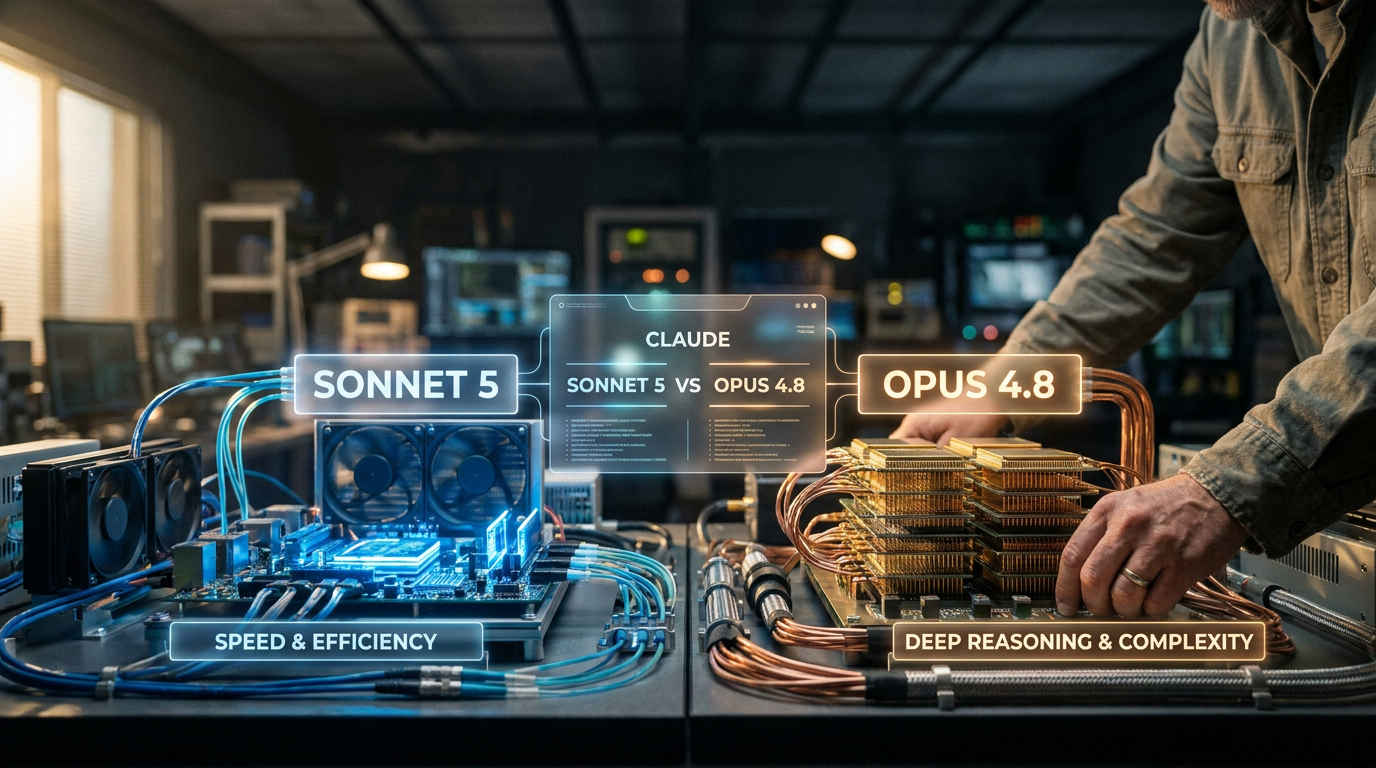
| Claude Opus 4.8 | $15.00 | $75.00 | Maximum cognitive synthesis, extreme accuracy, nuanced tone | High-stakes legal, medical research, regulatory compliance |
| Gemini 3.5 Flash | $0.075 | $0.30 | Ultra-low latency, basic tool routing, cheap context caching | High-volume simple chats, real-time simple translations |
Breaking Down the "Agentic Tax"
The true value of Claude Sonnet 5’s pricing becomes clear when calculating the "agentic tax"—the cumulative cost of continuous reasoning loops. Unlike standard single-prompt chatbots, autonomous AI agents operate in cycles: they plan, call tools, analyze outputs, self-correct, and repeat. A single customer resolution path can easily consume hundreds of thousands of tokens over dozens of API calls.
At GPT-5.5 rates, a complex multi-agent system running 100,000 tasks per day can quickly run up unsustainable operational bills. By pricing Claude Sonnet 5 at $3.00 per million input tokens and $15.00 per million output tokens, Anthropic is offering a 40% discount on inputs and a 50% discount on outputs compared to GPT-5.5. In production-grade environments, this represents a near-halving of the direct API cost.
For enterprises looking to capitalize on these shifting dynamics, platforms like CallMissed offer the ideal integration layer. Through CallMissed’s unified API gateway, developers can instantly route tasks to over 300 LLMs, allowing them to hot-swap their backend models to Claude Sonnet 5. This ensures that high-volume customer touchpoints—such as automated WhatsApp chatbots or real-time voice agents—can leverage the latest cost efficiencies without requiring a complete rewrite of the application's underlying code.
Furthermore, because Claude Sonnet 5 matches or exceeds GPT-5.5 on standard agentic benchmarks like tool call accuracy and coding proficiency, developers no longer have to choose between financial viability and state-of-the-art capability.
In-Depth Analysis: Performance, Speed, and Agentic Capabilities
Latency and Throughput: The Speed Vital to Real-Time Agents
While slashing API pricing is a massive win for enterprise budgets, a cheaper model is practically useless for autonomous agents if it cannot deliver responses in near real-time. In high-frequency environments—like voice-based customer support or live-chat troubleshooting—latency is the ultimate metric.
Claude Sonnet 5 drastically improves upon its predecessors by optimizing both Time-to-First-Token (TTFT) and overall output throughput. Historically, Anthropic’s models struggled to match the snappy response times of OpenAI's flagship offerings. However, Sonnet 5 achieves ultra-low latency, narrowing the gap with GPT-5.5 to milliseconds. This speed boost is crucial for developers running agentic loops where one agent’s output immediately becomes another's input. When a workflow requires five or six sequential LLM calls to resolve a single user query, even a 200ms delay per turn can break the illusion of natural conversation.
Tool Use, Parallel Execution, and Native Reasoning
To function as a true "digital employee," an AI model must do more than write text; it must interact with databases, call external APIs, and execute code. This requires robust tool use (function calling) and native reasoning.
- GPT-5.5's Advantage: OpenAI's flagship model continues to lead in complex, multi-layered environments due to its highly optimized native reasoning mode and seamless support for high-volume parallel tool calls. GPT-5.5 can evaluate multiple external tools simultaneously, aggregate the data, and execute a response in a single turn.
- Claude Sonnet 5's Counter: Anthropic has closed this functional gap by drastically upgrading Sonnet 5’s multi-step planning and state tracking. Sonnet 5 exhibits a remarkable reduction in "hallucination loops"—the frustrating cycle where an agent repeatedly attempts the same failing tool call. Its enhanced context handling allows it to remember past failures within a session and pivot to alternative solutions autonomously.
The Real-World Impact on Conversational Infrastructure
For businesses running conversational AI at scale, these technical improvements translate directly to customer satisfaction. If an AI voice agent stutters or loses track of the conversation flow during a database lookup, the customer experience plummets.
This is where integrating advanced models into a unified communications stack becomes critical. Utilizing platforms like CallMissed, developers can deploy Claude Sonnet 5 as the cognitive engine behind multi-turn WhatsApp chatbots and real-time voice agents. By pairing Sonnet 5’s low-latency reasoning with CallMissed’s ultra-fast Speech-to-Text APIs (which natively support 22 Indian regional languages), enterprises can deliver highly localized, human-like voice interactions. Because CallMissed allows seamless model-switching across 300+ LLMs, developers can route simple queries to cheaper, faster models, while routing complex, multi-step problem-solving directly to Claude Sonnet 5—all without rewriting a single line of their core integration code.
Impact & Implications: How Anthropic's Price Cut Reshapes the Enterprise AI Market

The Economic Reality of Agentic Workflows
The launch of Claude Sonnet 5 marks a structural shift in how enterprises architect their AI strategies. Up to this point, the primary bottleneck to deploying fully autonomous AI agents has not been their capability, but their operating cost. Unlike traditional chat interfaces where a user exchanges a few prompts with a model, autonomous agents operate in continuous loops. They execute multi-step planning, run parallel tool calls, retrieve external data, and self-correct—often generating thousands of silent "thought" tokens behind the scenes for every single user-facing response.
When running on OpenAI’s GPT-5.5 at its standard $5.00/M input and $30.00/M output token rates, or Google's Gemini 3.1 Pro, these iterative reasoning loops accumulate staggering bills at scale. By aggressively undercutting these price points, Anthropic has drastically lowered the cost-of-service for high-frequency agentic workflows, fundamentally reshaping enterprise margins.
Key Structural Shifts in the Enterprise AI Market
The arrival of Claude Sonnet 5 will ripple across the enterprise landscape in three distinct ways:
- The Demise of "Model Lock-in": Enterprises are transitioning away from single-provider ecosystems. To maximize ROI, developers are adopting dynamic routing, sending basic classification tasks to ultra-cheap models while reserving complex, multi-step agentic reasoning for cost-efficient intelligence engines like Claude Sonnet 5.
- The Viability of "Always-On" Digital Workforces: At previous price points, deploying hundreds of autonomous agents to audit code, monitor system logs, or handle customer support 24/7 was financially prohibitive for mid-market companies. Sonnet 5’s pricing structure makes large-scale agentic deployments economically viable for the first time.
- Pressure on Competitors to Price-Cut: Anthropic's move forces OpenAI and Google to defend their market share. This pricing pressure will likely accelerate the commoditization of frontier LLM intelligence, benefiting enterprise buyers who can leverage cheaper compute across the board.
Agility via Multi-Model Infrastructure
To capitalize on this shifting economic landscape, enterprises must remain infrastructure-agile. Rebuilding an entire agentic pipeline every time a provider cuts prices is highly inefficient.
This is where AI communication platforms like CallMissed play a pivotal role. By offering a unified infrastructure that supports LLM inference across more than 300 models, CallMissed allows companies to instantly route their workloads to the most cost-effective model. Whether power-steering complex, multilingual customer conversations or orchestrating automated WhatsApp workflows, developers can switch their underlying "digital brains" to Claude Sonnet 5 without refactoring code.
Redefining the ROI of Enterprise AI
Ultimately, Anthropic's pricing strategy shifts the enterprise AI conversation from theoretical capability to raw return on investment. When intelligence becomes this affordable, the competitive advantage belongs to organizations that can deploy it fastest. By combining Claude Sonnet 5’s aggressive cost-efficiency with flexible, multi-model platforms like CallMissed, businesses are uniquely positioned to scale their automated operations while maintaining healthy, sustainable margins.
Expert Opinions: What the AI Industry Is Saying
A Paradigm Shift in Enterprise AI Budgets
As news of Claude Sonnet 5’s aggressive pricing spreads across the tech sector, industry analysts, CTOs, and developers are pointing to a fundamental shift in how enterprise AI is budgeted. For the past few years, the focus has been strictly on maximizing benchmark performance. In 2026, however, the conversation has pivoted decisively toward compute unit economics.
Industry analysts at platforms like Future AGI note that while OpenAI’s GPT-5.5 continues to offer advanced native reasoning modes, its steep cost of $5.00 per million input tokens and $30.00 per million output tokens makes continuous-loop agentic workflows prohibitively expensive at scale. With Claude Sonnet 5 offering a blended token cost that is roughly 49% cheaper than GPT-5.5, developers are realizing they can run twice as many agentic iterations for the same budget.
What the Experts Are Saying
Prominent voices across the AI infrastructure space have highlighted several key implications of this launch:
- The Demise of Single-Provider Monopolies: Tech leads are moving away from committing to a single LLM provider. The launch of Sonnet 5 proves that the leading model of today can be economically outmatched tomorrow. Multi-model flexibility is now a strategic necessity rather than a luxury.
- The Realization of "Agentic" Viability: According to cost analysis tests, complex multi-step planning tasks that previously generated eye-watering API bills are finally financially viable. Industry experts emphasize that Sonnet 5’s pricing makes "always-on" autonomous software agents practical for mid-sized enterprises, not just Fortune 500 companies.
- The Speed-to-Price Benchmark: Analysts from Artificial Analysis point out that Claude Sonnet 5 successfully delivers high-effort agentic execution at a fraction of the cost of legacy models like Claude Opus 4.8, proving that algorithmic efficiency optimizations are outpacing raw parameter growth.
Infrastructure Adaptability as a Competitive Edge
For companies deploying these models in production, the immediate challenge is agility. Software architects argue that the businesses winning the 2026 AI race are those capable of hot-swapping their underlying models the moment a pricing disruption occurs.
This is where adaptive communication infrastructure becomes critical. Platforms like CallMissed are already enabling enterprises to instantly capitalize on these market shifts. By providing a unified multi-model API gateway, CallMissed allows developers to switch their real-time customer voice agents and WhatsApp chatbots to Claude Sonnet 5 seamlessly. This means businesses can immediately pocket the ~50% token savings without undergoing weeks of pipeline redevelopment or risking customer-facing downtime.
Ultimately, the consensus among AI industry leaders is clear: Anthropic has successfully commoditized high-tier reasoning. While OpenAI may still hold a slight edge in highly specialized parallel tool-calling scenarios, Claude Sonnet 5 has established itself as the pragmatic, cost-effective default "digital brain" for the next generation of scalable autonomous software.
What This Means For You: Recommended Models by Use Case (TABLE)
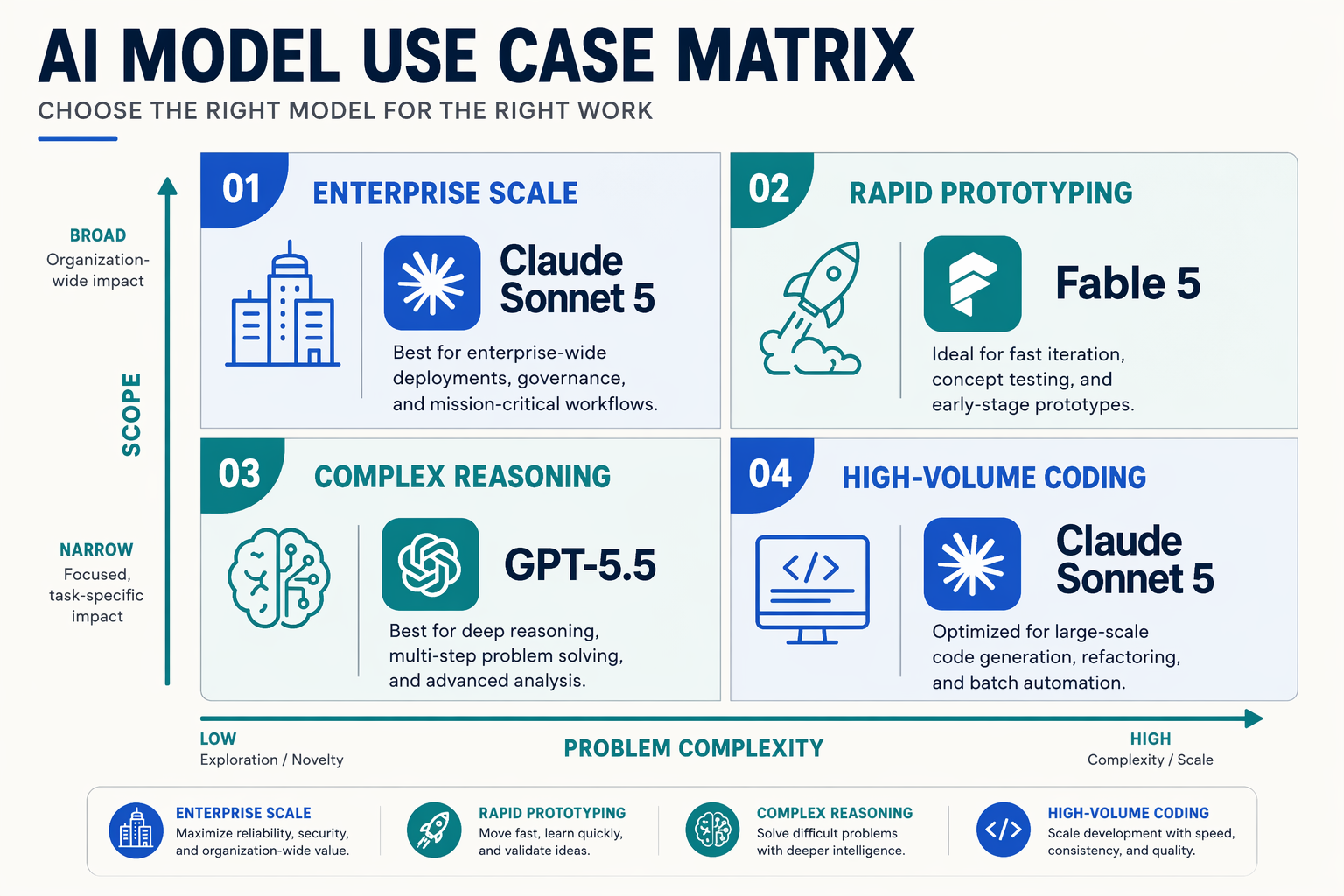
With the launch of Claude Sonnet 5 shaking up the 2026 LLM landscape, the era of relying on a single, monolithic AI model for every corporate task is officially over. Today's enterprise architectures favor a hybrid, multi-model approach. To maximize ROI, you must match your specific workload requirements—such as token volume, reasoning depth, and latency constraints—with the model that offers the best cost-to-performance ratio.
To help you navigate these choices, the comparison table below outlines the recommended models across primary business use cases, highlighting where Anthropic's new release fits best and where competitors still hold ground.
| Use Case | Recommended LLM | Pricing (per 1M Tokens) | Primary Advantage | Alternative |
|---|---|---|---|---|
| Agentic Workflows | Claude Sonnet 5 | ~$3.00 In / ~$15.00 Out | High-frequency reasoning loop efficiency | GPT-5.5 |
| Complex Logic / Tool Use | GPT-5.5 | $5.00 In / $30.00 Out | Native reasoning & parallel tool calls | Claude Sonnet 5 |
| High-Volume Triage | Gemini 3.5 Flash | <$0.10 In / <$0.40 Out | Sub-second latency, ultra-low cost | Claude Haiku 5 |
| Nuanced Creative/Legal | Claude Opus 4.8 | $15.00 In / $75.00 Out | Maximum contextual nuance and logic | GPT-5.5 |
Key Takeaways by Business Scenario
#### 1. Agentic Workflows & Multi-Step Automation
For autonomous agents that constantly call APIs, evaluate their own code, and run in loops, Claude Sonnet 5 is the undisputed winner. Because agentic workflows are highly token-intensive, deploying them on GPT-5.5 at $5/$30 per million tokens can quickly become cost-prohibitive. Sonnet 5's aggressive pricing undercuts GPT-5.5 significantly, allowing enterprises to scale digital workforces without exponentially increasing their monthly API expenditures.
#### 2. Advanced Tool Execution & Parallel Function Calling
If your application relies heavily on executing multiple complex tool calls simultaneously, GPT-5.5 remains highly competitive. Its native reasoning mode and robust parallel tool integration help mitigate errors in complex, multi-layered operations. However, for most standard integrations, the price premium over Sonnet 5 is difficult to justify.
#### 3. Real-Time Customer Interactions
For customer support channels, selecting the right model is a balancing act between conversational intelligence and operational cost. Platforms like CallMissed allow companies to implement these models seamlessly. By utilizing CallMissed’s unified API gateway, you can deploy multilingual voice agents that support 22 regional Indian languages natively.
This infrastructure lets you dynamically route simple, high-volume customer queries to ultra-cheap models like Gemini 3.5 Flash for instant triage, while instantly escalating complex, multi-step issues to Claude Sonnet 5—ensuring you never pay premium rates for basic inquiries.
#### 4. Heavyweight Analytical Research
For deep-dive legal analysis, academic research, or complex financial forecasting where absolute precision is paramount, Anthropic’s flagship Claude Opus 4.8 remains the gold standard. While its higher pricing ($15.00 input / $75.00 output per million tokens) makes it too expensive for run-of-the-mill automation, its unmatched grasp of subtle nuance is highly valuable for low-frequency, high-stakes tasks.
Frequently Asked Questions About Claude Sonnet 5
How much does Claude Sonnet 5 cost compared to OpenAI's GPT-5.5?
What makes Claude Sonnet 5 better for building autonomous AI agents?
Is Claude Sonnet 5 cheaper than Anthropic's own Opus models?
How can businesses integrate Claude Sonnet 5 into customer communication workflows?
How does Claude Sonnet 5 compare to Google's Gemini 3.1 Pro on pricing?
Does Claude Sonnet 5 support parallel tool calling and advanced reasoning?
Conclusion
The launch of Claude Sonnet 5 marks a defining moment in the democratization of autonomous AI, officially kicking off the 2026 AI agent price war. As enterprises look to deploy digital workforces at scale, the economics of compute have fundamentally shifted.
Key takeaways from this pricing shake-up include:
- Disruptive Pricing: Claude Sonnet 5 aggressively undercuts GPT-5.5's benchmark rate of $5.00/million input and $30.00/million output tokens.
- Agentic Scalability: Lower token barriers directly solve the financial bottleneck of token-heavy, multi-step reasoning loops and parallel tool execution.
- Infrastructure Agility: Succeeding in this landscape requires the architectural flexibility to swap LLMs dynamically to optimize both performance and operational budgets.
Moving forward, expect rivals to respond with further cuts, driving the cost of agentic workflows down even further. To explore how AI communication is evolving and instantly leverage these cost savings, check out CallMissed — an AI infrastructure platform powering voice agents and multilingual chatbots for businesses. As the price war intensifies, how will your organization leverage this newly affordable intelligence to scale your operations?
Related Posts

Ready to automate customer conversations?
Launch AI voice agents and WhatsApp bots with CallMissed — one API, 22+ Indian languages.