

AI Agents Are Becoming the New Digital Workforce: What Enterprises Need to Know in 2026


What if your next high-performing hire wasn’t a human, but an autonomous software entity capable of managing complex business processes entirely on its...
AI Agents Are Becoming the New Digital Workforce: What Enterprises Need to Know in 2026
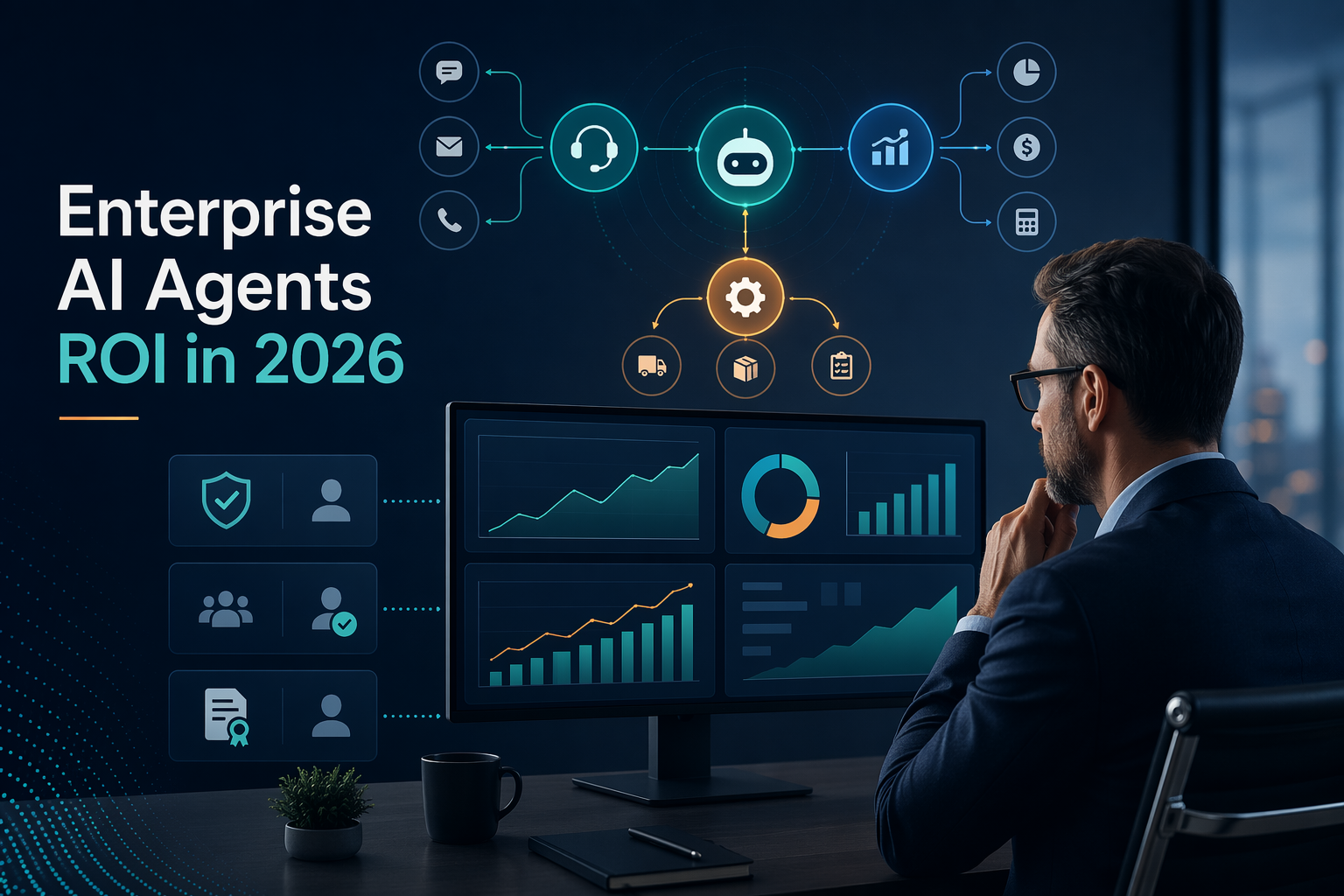
What if your next high-performing hire wasn’t a human, but an autonomous software entity capable of managing complex business processes entirely on its own? In 2026, this is no longer a futuristic concept. For the past two years, enterprises treated artificial intelligence primarily as a passive assistant—a tool to answer questions, draft emails, or summarize documents. Today, we are witnessing a monumental paradigm shift as AI agents are becoming the new digital workforce, moving rapidly from static, human-guided automation to true goal-driven autonomy.
This transformation matters right now because the economic and operational incentives have become impossible to ignore. Industry surveys reveal a massive spike in enterprise adoption, with a majority of large organizations already piloting or scaling autonomous agent systems. Unlike traditional software that relies on rigid, predefined rules, today’s AI agents can comprehend a broad objective, semi-autonomously develop a multi-step execution plan, and take actions across diverse software environments on a business's behalf. They learn, adapt, and make intelligent decisions in real time, operating 24/7 to reduce overhead and eliminate operational bottlenecks. For businesses looking to scale these capabilities, platforms like CallMissed are already bridging the gap, enabling enterprises to seamlessly deploy production-ready AI voice agents and multilingual chatbots that act as the front line of this new digital workforce.
However, transitioning to an agent-integrated enterprise requires more than just deploying new software. It demands a fundamental shift in how organizations operate, manage, and govern their teams. In this article, we will explore how AI agents are reshaping workforce development in 2026, the critical differences between traditional automation and agentic autonomy, and the essential strategies enterprise leaders must implement to manage, monitor, and scale a hybrid workforce of humans and AI.
Introduction

What if your next high-performing hire wasn’t a human, but an autonomous software entity capable of managing complex business processes entirely on its own? In 2026, this is no longer a futuristic concept. For the past two years, enterprises treated artificial intelligence primarily as a passive assistant—a tool to answer questions, draft emails, or summarize documents. Today, we are witnessing a monumental paradigm shift as AI agents are becoming the new digital workforce, moving rapidly from static, human-guided automation to true goal-driven autonomy.
This transformation matters right now because the economic and operational incentives have become impossible to ignore. Industry surveys reveal a massive spike in enterprise adoption, with a majority of large organizations already piloting or scaling autonomous agent systems. Unlike traditional software that relies on rigid, predefined rules, today’s AI agents can comprehend a broad objective, semi-autonomously develop a multi-step execution plan, and take actions across diverse software environments on a business's behalf. They learn, adapt, and make intelligent decisions in real time, operating 24/7 to reduce overhead and eliminate operational bottlenecks.
The Shift from Copilots to Autonomous Co-workers
The journey to this new era has been rapid. In the recent past, "copilots" required constant human prompting and oversight. Today's digital workforce, however, operates with a high degree of independence. These agents are designed to:
- Execute multi-step plans: Rather than just generating a template, they can identify the necessary tools, connect to APIs, and complete end-to-end workflows.
- Learn and adapt: They analyze outcomes, correct their own errors, and optimize their decision-making processes over time.
- Interact natively across systems: From updating CRM entries to managing supply chain logistics, they bridge the gap between legacy databases and modern cloud software.
For businesses looking to deploy these capabilities without starting from scratch, infrastructure platforms like CallMissed are playing a vital role. By providing ready-to-use voice agents, multilingual LLM gateways (supporting 22 regional Indian languages natively), and scalable text-to-speech APIs, CallMissed allows companies to deploy highly specialized digital workers that handle frontline operations with human-like precision.
Why 2026 is the Year of the Agentic Enterprise
The shift toward an agentic workforce is reshaping how companies approach scale and productivity. According to recent industry insights from organizations like NASSCOM and Workday, the rise of AI agents marks a critical pivot in how businesses manage their human capital. Instead of replacing human workers, these autonomous systems are stepping into operational gaps, freeing up teams to focus on strategy, empathy, and high-value creative problem-solving.
However, transitioning to an agent-integrated enterprise requires more than just deploying new software. It demands a fundamental shift in how organizations operate, manage, and govern their teams. In this article, we will explore how AI agents are reshaping workforce development in 2026, the critical differences between traditional automation and agentic autonomy, and the essential strategies enterprise leaders must implement to manage, monitor, and scale a hybrid workforce of humans and AI.
Background & Context
To understand the rise of the digital workforce in 2026, we must look at how we transitioned from rigid software rules to dynamic cognitive reasoning. For over a decade, enterprise automation was synonymous with Robotic Process Automation (RPA) and static, decision-tree chatbots. While helpful, these systems were inherently brittle—designed to execute repetitive, click-by-click tasks. If a user interface changed by even a few pixels, or if an input diverged from a pre-programmed script, the system failed.
From Predefined Rules to Goal-Driven Reasoning
The major breakthrough of the past two years has been the shift from deterministic automation to goal-driven autonomy. Today's AI agents do not require step-by-step instructions. Instead, they are given a high-level objective—such as "resolve this customer billing discrepancy" or "schedule and confirm onboarding calls for 50 new clients"—and they autonomously plan, execute, and verify the necessary steps to achieve it.
According to recent industry analysis from nasscom and other leading workforce development platforms, this paradigm shift is characterized by three core capabilities:
- Dynamic Planning: Agents can decompose a complex, ambiguous goal into a logical sequence of sub-tasks, adapting the plan on the fly.
- Tool Use and Integration: Rather than just generating text, agents can read and write to databases, call external APIs, navigate enterprise software (like CRM and ERP systems), and send emails.
- Self-Correction: If an agent encounters an error (e.g., an API timeout or an unexpected database response), it can analyze the failure, adjust its strategy, and try an alternative path without human intervention.
The Infrastructure Powering the Shift
This rapid evolution has been accelerated by massive upgrades in underlying AI infrastructure. In the past, deploying a capable agent required stitching together fragmented models, custom integration pipelines, and expensive hardware.
In 2026, the barrier to entry has collapsed. Developers now leverage advanced middleware and unified platform APIs to build, orchestrate, and deploy these agents at scale. For example, platforms like CallMissed enable enterprises to connect their agentic workflows directly to voice and chat channels, offering access to over 300+ LLMs, state-of-the-art Speech-to-Text (including native support for 22 regional Indian languages), and ultra-low-latency Text-to-Speech. This infrastructural maturity allows a digital worker to transition seamlessly from back-office data processing to front-office client communication.
Why Enterprises Are Scaling Agents in 2026
The pressure on enterprise leaders to adopt this technology is fueled by measurable business metrics. According to industry surveys, a majority of large organizations are actively piloting or scaling agentic deployments. As highlighted by Workday and leading digital transformation firms, the economic incentives are clear:
- True 24/7 Availability: AI agents do not suffer from fatigue, timezone limitations, or burnouts, ensuring continuous operational throughput.
- Infinite Scalability: A company can scale its digital workforce from 10 to 10,000 active agents instantly to handle seasonal demand spikes without hiring overhead.
- Cross-Functional Capability: Modern agents are no longer siloed; an agent managing customer support can seamlessly coordinate with logistics, inventory, and finance agents to resolve complex, cross-departmental operations.
As we navigate this transition, the core challenge for enterprises is no longer if they should adopt AI agents, but rather how to effectively integrate and manage this new breed of digital worker alongside their human counterparts.
Key Developments (TABLE)
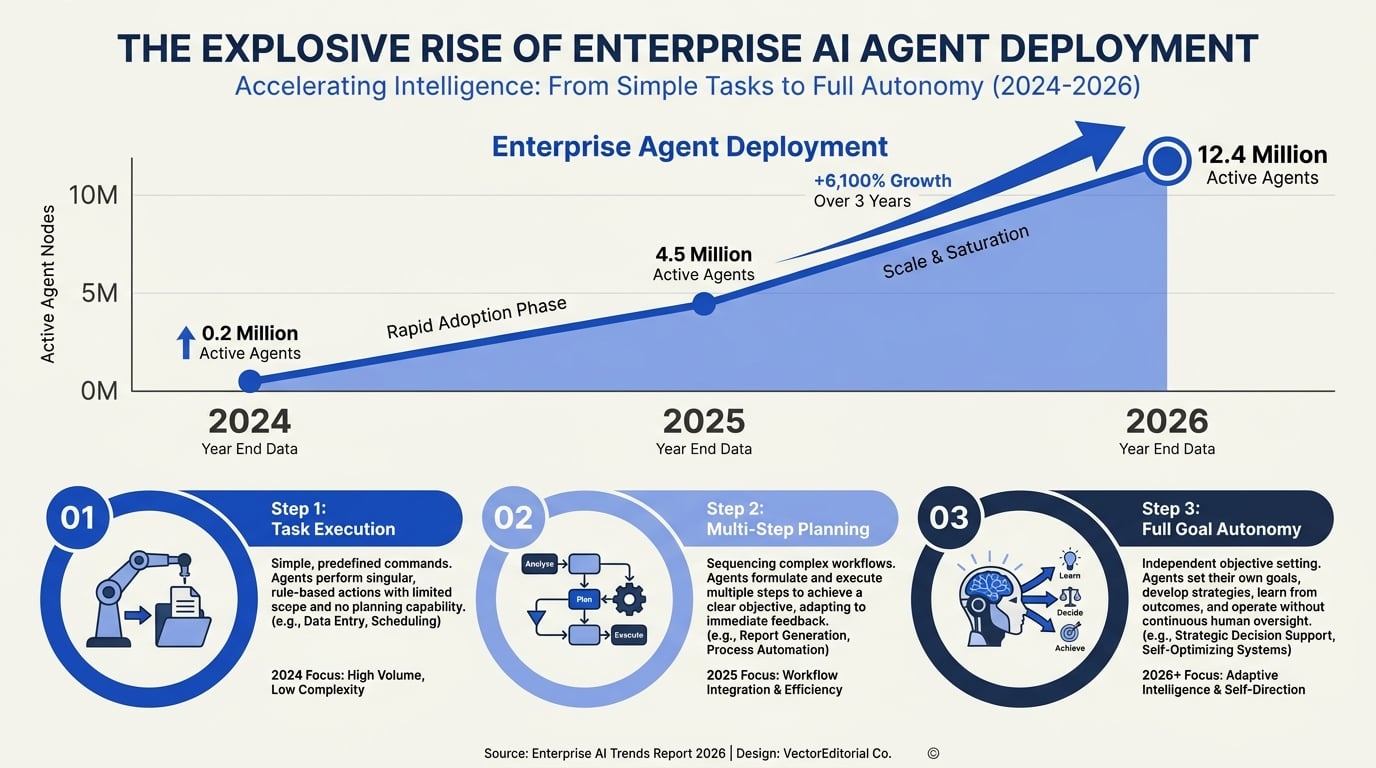
The evolution of the digital workforce has accelerated dramatically over the past two years. In the early days of generative AI, systems were largely transactional—requiring constant prompting, oversight, and manual verification. By 2026, key breakthroughs in reasoning capabilities, tool use protocols, and long-horizon planning have allowed AI agents to operate as independent contributors within complex enterprise environments. Instead of waiting for human instruction, today's agents analyze a high-level goal, break it down into sequential tasks, utilize external APIs, and execute workflows autonomously.
This rapid transition is best understood by analyzing the technical paradigm shift across different generations of digital automation. The table below outlines how key developments have transformed passive AI tools into a proactive, autonomous digital workforce:
| Evolution Stage | Primary Action Model | Tool Integration | Human Dependency | Enterprise Impact (2026) |
|---|---|---|---|---|
| Traditional RPA | Predefined rules | Closed APIs & UI scraping | High (requires strict templates) | High maintenance, fragile workflows |
| Copilots & Assistants | Prompt-and-response | Single-app focus | Moderate (requires human validation) | Incremental productivity gains |
| Autonomous Agents | Goal-driven planning | Multi-app & custom APIs | Low (operates semi-autonomously) | Wide deployment in support & operations |
| Multi-Agent Systems | Collaborative division | Cross-system ecosystems | Minimal (exception handling only) | Full-scale workflow orchestration |
Critical Drivers of the Agentic Shift
Three primary technological milestones have propelled autonomous AI agents into the enterprise mainstream:
- Cross-Platform Tool Use (Function Calling): Modern agents are no longer confined to a single browser window. They possess the capability to read and write to SQL databases, navigate internal CRMs like Salesforce, and execute third-party API calls. This enables them to bridge software silos without requiring human middleware.
- Multi-Model Orchestration: Rather than relying on a single monolithic model for every task, enterprise-grade agent deployments now leverage specialized routing. For instance, platforms like CallMissed enable developers to leverage a multi-model API gateway, seamlessly switching between 300+ LLMs depending on the complexity of the task, cost constraints, or latency requirements.
- Natively Multilingual Speech and Text: To truly act as a global workforce, agents must communicate fluidly across cultural boundaries. Recent developments in high-fidelity Text-to-Speech (TTS) and Speech-to-Text (STT) APIs—including CallMissed's native support for 22 Indian languages—have unlocked deep localization. This allows autonomous voice agents to handle complex customer support, billing, and scheduling queries over phone calls and WhatsApp chatbots 24/7, matching human-level empathy, speed, and accuracy.
As organizations migrate from early-stage pilots to scaling these autonomous systems, understanding these core developmental tiers is vital for structuring hybrid human-agent teams.
In-Depth Analysis
From Rigid Workflows to Goal-Driven Autonomy
To understand why AI agents represent such a monumental shift in 2026, we must analyze how they differ from traditional automation. For years, enterprises relied on Robotic Process Automation (RPA) to handle repetitive tasks. While useful, RPA is inherently fragile; it operates on rigid, "if-this-then-that" rules. If a database schema changes or a software interface shifts by even a single pixel, the automation breaks.
AI agents, by contrast, possess goal-driven autonomy. Instead of following a hardcoded path, an agent is given a high-level objective—such as "reconcile the Q3 shipping discrepancies" or "onboard the new enterprise client." The agent then:
- Perceives the digital environment by gathering unstructured data from emails, PDFs, and internal databases.
- Formulates a multi-step plan by breaking down the macro goal into logical, sequential tasks.
- Executes actions using APIs, databases, and communication channels, dynamically self-correcting if it encounters an unexpected error or API timeout.
The Cognitive Architecture of a Modern Agent
In 2026, the blueprint for a production-grade digital worker relies on a sophisticated three-part cognitive architecture:
- The Reasoning Engine (LLM Core): This serves as the brain of the agent. Rather than relying on a single monolithic model, enterprise agents frequently switch between models depending on task complexity. Infrastructure platforms like CallMissed facilitate this by offering a unified gateway to over 300+ LLMs, enabling developers to route simpler logic tasks to faster, cost-efficient models while reserving frontier models for complex analytical reasoning.
- Memory Systems: Agents utilize short-term memory (in-context learning within an active session) and long-term memory (vector databases storing historical interactions) to maintain continuity. This ensures that an agent resolving a customer dispute today remembers the context of an email exchange from three weeks ago.
- Tool Integration and Actuators: An agent without tools is just a chatbot. In modern enterprise deployments, agents are equipped with secure APIs to write SQL queries, update CRM pipelines, dispatch WhatsApp updates, or trigger voice calls natively using advanced Text-to-Speech APIs.
The Shift in Workforce Dynamics
The transition to an agentic workforce is fundamentally altering the cost structure of enterprise operations. Industry data shows that early adopters are seeing up to a 70% reduction in cognitive friction for complex multi-step workflows. Because these agents operate 24/7 without fatigue, companies can scale their operations infinitely without a linear increase in operational headcount.
However, this transition is not about completely replacing human labor; instead, it redefines the human role. Human employees are rapidly transitioning into "Agent Managers" or "Guardrail Editors"—overseeing agent pipelines, handling highly sensitive edge-case escalations, and fine-tuning the objective functions that govern agent behavior. The operational challenge for 2026 is no longer about proving whether AI agents can do the work, but about orchestrating, monitoring, and managing this hybrid human-AI ecosystem at scale.
Impact & Implications
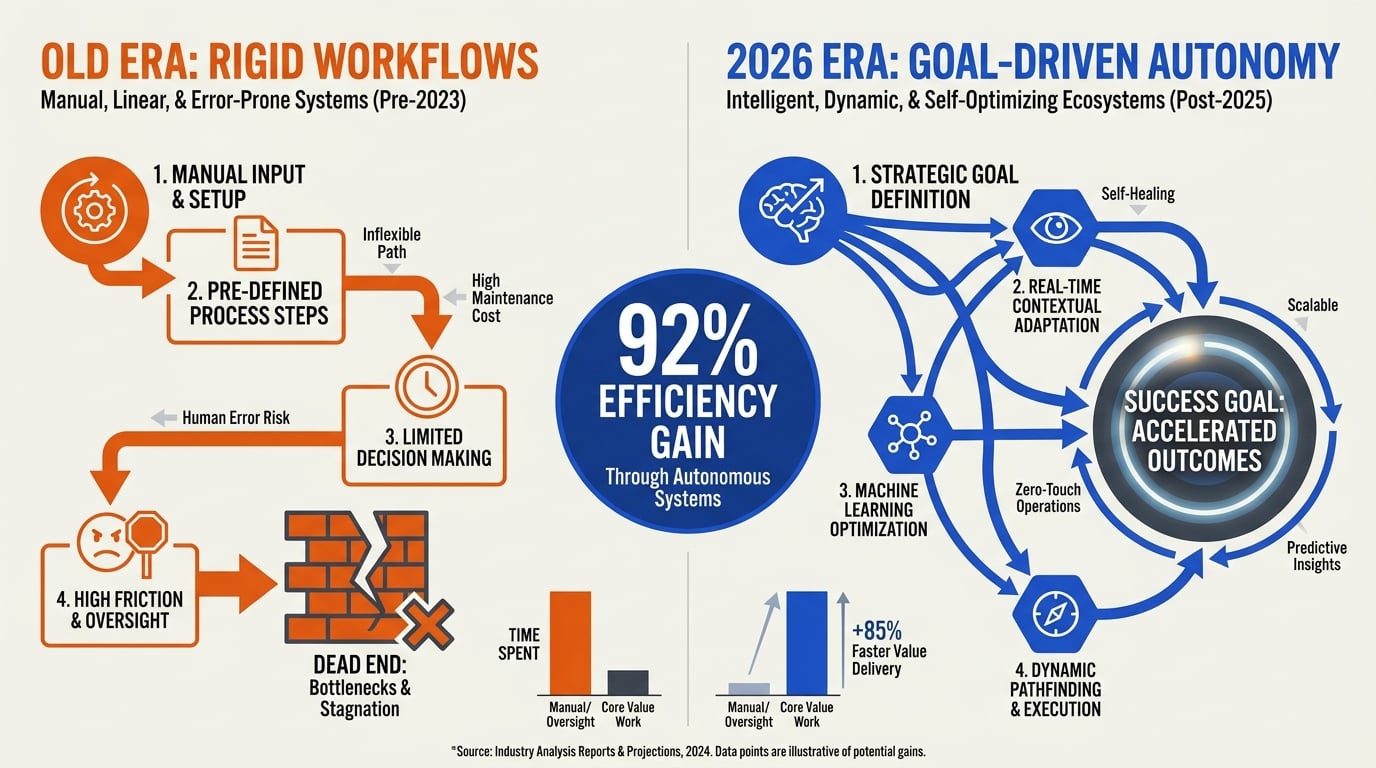
The rise of AI agents as a digital workforce is not merely an upgrade to existing software suites; it represents a profound restructuring of the modern enterprise. As organizations scale their autonomous agent deployments in 2026, the implications ripple across human capital, operational economics, and corporate governance. We are moving rapidly from a paradigm of human-led task execution to one of human-guided agent orchestration.
Redefining Human Roles: From "Doers" to "Directors"
The most immediate impact of this transition is the shifting nature of human labor. As AI agents assume responsibility for multi-step, goal-driven execution, human employees are transitioning into supervisory roles.
- Strategic Orchestration: Instead of spending hours copy-pasting data across systems or manually drafting outreach emails, human workers now act as "agent managers"—setting high-level objectives, defining parameters, and auditing outputs.
- High-Value Problem Solving: With routine workflows fully delegated to autonomous agents, human cognitive capacity is freed up to tackle complex edge cases, build client relationships, and drive creative innovation.
- Workforce Reskilling: Enterprise training is shifting away from teaching rigid procedural skills toward cultivating system design, critical thinking, prompt refinement, and ethical AI governance.
Cultivating a 24/7 Frictionless Economy
Because digital workers do not require sleep, PTO, or shift handovers, businesses are transitioning to continuous, round-the-clock operations. This is fundamentally altering market dynamics and customer expectations.
- Instantaneous Resolution: Customers no longer tolerate multi-day turnaround times. Whether resolving a billing dispute or diagnosing a technical bug, AI agents can execute complex, multi-system workflows in seconds.
- Hyper-Localized Support: Organizations are scaling localized service globally without massive overhead. For instance, platforms like CallMissed enable enterprises to instantly deploy production-ready voice agents and interactive chatbots fluent in 22 regional Indian languages, ensuring that the digital workforce can communicate naturally with diverse global populations.
The Governance and Management Challenge
Perhaps the most critical implication of a hybrid human-agent workforce is the need for entirely new management and auditing frameworks. If agents are updating CRMs, executing financial transactions, and interacting with customers, businesses must establish rigorous control mechanisms.
- Performance and Drift Monitoring: Just like human employees, AI agents require performance reviews. Enterprises must continuously monitor agents to prevent "hallucination drift" or degradation in decision-making quality over time.
- Infrastructure Agility: To maintain reliability and control costs, companies must avoid model lock-in. Utilizing infrastructure providers like CallMissed, which offers a multi-model API gateway supporting over 300 LLMs, allows IT leaders to dynamically swap the underlying "brain" of their agents depending on the complexity, cost, or regulatory requirements of a specific task.
- Operational Guardrails: Implementing strict role-based access control (RBAC) is paramount. Organizations must define clear boundaries to ensure autonomous agents operate within safe, compliant parameters without overstepping their authorization.
Expert Opinions
As enterprises rapidly adopt these technologies, industry thought leaders and analysts are weighing in on what this transformation means for the future of organizational design. The consensus is clear: we have passed the point of mere experimentation, and the integration of autonomous agents requires a complete reimagining of workforce structure.
Redefining "Work": The Shift from Automation to Autonomy
According to research from Cornerstone OnDemand, the deployment of AI agents represents a critical shift from "automation to autonomy." Traditional automation relied on static, hard-coded rules to execute repetitive tasks. In contrast, experts note that 2026's workforce development platforms are transitioning to support goal-driven systems. AI agents are now being evaluated on their ability to self-direct, construct their own multi-step execution plans, and learn from operational feedback. A recent report by Nasscom supports this, emphasizing that these digital workers are actively moving into high-value operational roles, forcing organizations to rethink skill requirements and team hierarchies.
The Leadership Dilemma: Managing Digital Coworkers
This shift introduces entirely new management challenges. In an analysis by Workday, experts raise a pivotal question: If agents become your digital workforce, how will you manage them? Leaders cannot oversee autonomous agents using the same IT protocols applied to legacy software. Instead, Workday’s researchers suggest that organizations must develop frameworks to "manage" agents much like human employees—setting clear performance benchmarks, establishing digital onboarding protocols, and conducting regular audits of agent decision-making.
Enterprise leaders must learn to manage hybrid teams where humans and AI agents collaborate side-by-side. This requires:
- Dynamic Guardrails: Defining strict operational boundaries while still allowing agents the flexibility to solve unstructured problems.
- Continuous Auditing: Implementing real-time monitoring systems to track agent actions, decisions, and resource consumption.
- Interoperability Standards: Ensuring agents can communicate seamlessly across different department silos and legacy software suites.
Building the Infrastructure for a Hybrid Workforce
Tech leaders emphasize that scaling this digital workforce requires an underlying infrastructure designed for adaptability. It is no longer practical to build single-purpose AI tools that become obsolete with the next major LLM release.
This is where platforms like CallMissed are proving essential for modern enterprise strategy. By providing a production-ready infrastructure, CallMissed allows companies to seamlessly deploy autonomous voice agents and multilingual chatbots capable of handling complex customer-facing workflows. With access to over 300 LLMs through a single API gateway and native Speech-to-Text support for 22 regional Indian languages, CallMissed enables organizations to scale their digital workforce globally while ensuring localized precision.
Ultimately, experts agree that the competitive edge in 2026 belongs to businesses that view AI agents not as a replacement for human talent, but as an enabling force that frees human workers to focus on high-level strategy, empathy, and innovation.
What This Means For You (TABLE)
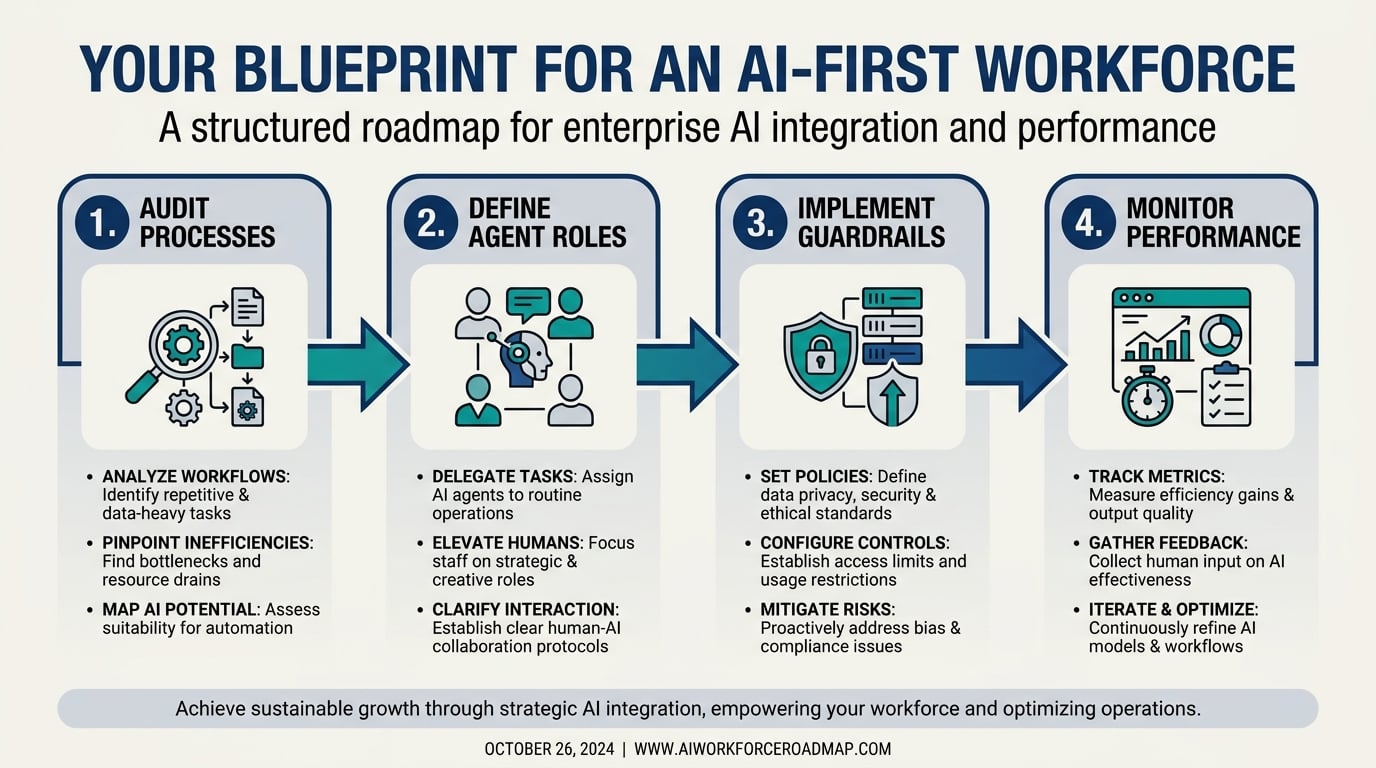
As we navigate the landscape of 2026, the rise of AI agents marks a critical turning point for businesses of all sizes. The transition from passive AI assistants to a highly autonomous digital workforce means that organizational structures must adapt rapidly. This evolution is no longer a pilot project restricted to elite tech firms; industry data shows that a vast majority of large enterprises are actively scaling agentic systems to handle core operational pipelines.
For leaders, managers, and individual contributors, this shift fundamentally changes the daily nature of work, requiring a move from task execution to strategic oversight. To understand how this paradigm shift directly impacts your organization, let us look at how key operational roles are transforming:
| Organizational Role | Traditional Focus (Pre-2026) | Agentic Shift (2026) | Primary Benefit & KPI Impact |
|---|---|---|---|
| C-Suite & Executives | Monitoring static KPIs & managing manual labor costs | Architecting hybrid team structures & scaling digital workforces | Rapid market expansion & up to 40% reduction in operational overhead |
| IT & Developers | Writing rigid API integrations & custom automation scripts | Orchestrating multi-model agents & managing prompt/agent governance | 10x faster deployment of autonomous workflows |
| Operations & HR | Staffing peak hours & managing repetitive support queues | Upskilling employees to supervise agents & auditing AI-driven actions | Elimination of 24/7 staffing bottlenecks & lower team burnout |
| Customer Support | Resolving basic Tier-1 FAQs manually via phone or chat | Stepping in as expert escalations for complex, empathetic cases | First-contact resolution rates soaring past 90% |
Navigating the Transition to Agentic Autonomy
Transitioning to this hybrid model requires a structured blueprint. To successfully integrate AI agents into your daily operations without causing disruption, organizations should focus on three critical pillars:
- Redefine Employee Roles: Instead of viewing AI agents as a threat to headcount, position them as "force multipliers." Employees who previously spent hours on manual triage should be upskilled to act as agent supervisors—reviewing complex edge cases, auditing agent performance, and refining system instructions.
- Implement Robust Governance Frameworks: As autonomous agents begin taking real-world actions—such as processing refunds, modifying database entries, or updating CRM systems—maintaining data security and transaction guardrails is paramount. Organizations must establish clear "human-in-the-loop" thresholds for high-risk decisions.
- Leverage Specialized Infrastructure: Attempting to build autonomous voice and chat agents entirely from scratch can lead to severe integration bottlenecks and soaring development costs. Using production-ready infrastructure allows enterprises to scale seamlessly. For instance, platforms like CallMissed enable businesses to deploy highly specialized AI voice agents and WhatsApp chatbots that can handle tier-1 customer support natively. With support for over 300+ LLMs and 22 regional Indian languages, these platforms offload repetitive communication workflows instantly, allowing human staff to focus on high-value operations.
By embracing these operational shifts, companies can capitalize on the 24/7 availability and low operational overhead of AI agents, turning what was once a technical experiment into a permanent competitive advantage.
Frequently Asked Questions
Why are AI agents becoming the new digital workforce in 2026?
What is the technical difference between RPA and an autonomous AI agent?
How can businesses safely implement AI agents as their digital workforce without losing operational control?
Do AI agents require constant coding and technical upkeep to remain functional?
What roles are AI agents currently augmenting or replacing in the enterprise?
What are the primary security and privacy risks when deploying AI agents as a digital workforce?
Conclusion
As the digital workforce continues to evolve, enterprises must shift their focus from simple tool adoption to strategic workforce integration. Here are the key takeaways to remember:
- Shift to Goal-Driven Autonomy: AI agents have transitioned from passive assistants to active digital workers capable of independent, multi-step execution.
- Surging Enterprise Adoption: Driven by undeniable economic incentives, large organizations are rapidly scaling autonomous systems to eliminate operational bottlenecks and enable 24/7 productivity.
- Managing the Hybrid Workforce: Integrating these systems successfully requires a fundamental shift in how leaders manage, monitor, and govern collaborative human-AI teams.
Looking forward, the competitive edge will belong to organizations that can seamlessly orchestrate these hybrid environments. To explore how AI communication is evolving and start deploying your own digital workforce, check out CallMissed — an AI infrastructure platform powering autonomous voice agents and multilingual chatbots. How will your organization prepare to lead and manage its new digital team?
Related Posts

Ready to automate customer conversations?
Launch AI voice agents and WhatsApp bots with CallMissed — one API, 22+ Indian languages.