

Sarvam Saaras V3 Review: Why India's STT Outshines Global Speech-to-Text Models


Did you know that the multi-billion-dollar speech-to-text models developed by Silicon Valley's tech giants routinely fail when transcribing a standard,...
Sarvam Saaras V3 Review: Why India's STT Outshines Global Speech-to-Text Models
Did you know that the multi-billion-dollar speech-to-text models developed by Silicon Valley's tech giants routinely fail when transcribing a standard, everyday Indian phone conversation? While global Automatic Speech Recognition (ASR) engines excel in sterile, single-language environments, they hit a digital brick wall when faced with the linguistic reality of India. In India, speech is rarely monolingual. Spontaneous daily conversations flow effortlessly across 22 official languages, heavily spiced with unique regional accents, dialect variations, and rapid-fire code-mixing—such as blending Hindi and English into "Hinglish," or Kannada and English into "Kanglish."
This linguistic complexity has historically left Indian enterprises struggling to deploy effective voice-based automation. Global ASR vendors simply weren't built for "how India speaks." However, early 2026 has marked a massive paradigm shift in the global AI landscape. Bengaluru-based startup Sarvam AI launched its highly anticipated speech-to-text model, proving that sovereign, localized AI can outperform global tech behemoths.
This comprehensive Sarvam Saaras V3 Review explores how India's homegrown STT engine successfully outshines international giants like GPT-4o-Transcribe and Gemini-3-Flash on localized benchmarks. By training on authentic, messy, real-world Indian speech rather than sanitized datasets, Saaras V3 has turned a massive linguistic challenge into a masterclass in localized engineering. It represents a monumental step for sovereign AI, proving that models trained entirely on domestic compute can beat the world's most heavily funded labs on home turf.
This breakthrough arrives at a critical moment as the demand for voice-first applications in India sky-rockets. Communication platforms like CallMissed are already driving this trend, enabling businesses to deploy production-ready voice agent infrastructure that leverages highly accurate Speech-to-Text APIs natively supporting 22 Indian languages.
What You Will Learn in This Review
In this Sarvam Saaras V3 Review, we will dive deep into the architecture, performance metrics, and real-world implications of India's leading speech model. Here is a preview of what we will analyze:
- The Code-Mixing Triumph: How Saaras V3 seamlessly decodes spontaneous, mid-sentence language switching and phonetic variations without losing context.
- The Benchmark Showdown: A detailed look at the performance data showing how Sarvam's engine stacks up against global models on Indian Word Error Rate (WER) benchmarks.
- Architectural Sovereignty: Why building models specifically for Indian accents, phonetics, and diverse scripts delivers superior accuracy.
- Commercial Viability: What Saaras V3's lower latency and cost-efficiency mean for local developers, enterprise customer service, and the future of regional voice commerce.
Let's explore why Sarvam Saaras V3 is not just a marginal improvement, but a complete rewrite of the rules of speech-to-text AI for India.
Introduction
For years, global tech giants have dominated the Artificial Intelligence landscape, setting the gold standard for large language models (LLMs) and Automatic Speech Recognition (ASR) systems. But when these massive, multi-billion-dollar models cross borders into the Indian subcontinent, they run into a formidable, deeply complex barrier: the sheer, unmatched diversity of Indian linguistics.
With 22 officially recognized languages, hundreds of distinct dialects, varied regional accents, and a ubiquitous cultural habit of mixing languages mid-sentence (code-mixing), India has historically been a graveyard for generic, global speech-to-text (STT) models. Systems built in Silicon Valley, trained predominantly on clean, standardized Western datasets, routinely stumble when confronted with the spontaneous, fast-paced, and highly blended nature of conversational Indian speech.
In early 2026, the competitive landscape underwent a paradigm shift. Bengaluru-based startup Sarvam AI launched Saaras V3, a state-of-the-art Speech-to-Text model engineered from the ground up to conquer India’s unique auditory challenges. Saaras V3 has sent shockwaves through the global AI community by consistently outperforming industry titans like OpenAI’s GPT-4o-Transcribe and Google’s Gemini-3-Flash on localized speech-to-text benchmarks.
This breakthrough represents a watershed moment for sovereign technology, proving that hyper-localized foundational models can outperform global giants on home turf.
The Unique Complexity of the Indian Auditory Landscape
To understand why global ASR models struggle in India, one must look at how the next billion users interact with technology. For millions of Indian consumers, the primary gateway to the digital world is not a keyboard—it is voice. From booking train tickets and checking bank balances to accessing agricultural advice, voice interfaces democratize digital access.
However, building an ASR system capable of understanding this demographic is an engineering nightmare due to three distinct factors:
- Spontaneous Code-Mixing: Indian speech is rarely monolingual. A customer calling a helpline in Delhi will naturally speak a blend of Hindi and English (Hinglish). A user in Chennai might blend Tamil and English (Tanglish). Standard ASR models designed by global vendors treat these transitions as anomalies or noise, resulting in catastrophic translation failures or fragmented transcriptions.
- Extreme Accent Variation: The English spoken in Kerala carries a vastly different phonetic signature than the English spoken in Punjab. A single language, such as Hindi, is spoken with completely different tonal cadences across Bihar, Uttar Pradesh, and Rajasthan. Global models, which are tuned to Western phonetic structures, struggle to generalize across these regional variations.
- Diverse Orthography and Scripts: Transcribing spoken regional languages requires mapping phonemes to 22 official scripts, many of which are radically different from the Latin alphabet. Global systems often lack the deep, native tokenization pipelines required to process these scripts efficiently and cost-effectively.
Saaras V3: Engineered for the Reality of Indian Conversations
Rather than simply fine-tuning an existing open-source Western model, Sarvam AI designed Saaras V3 to accommodate speech as it is actually spoken across India.
The model's core architecture is optimized for low-latency, high-accuracy transcription of spontaneous, colloquial, and code-mixed speech. While legacy systems try to force Indian speech into rigid linguistic buckets, Saaras V3 embraces the fluid, hybrid nature of vernacular conversation. It natively decodes multi-language transitions mid-phrase without losing context, dropping words, or misidentifying intent.
According to early 2026 benchmarks, Saaras V3 has proven to be highly efficient, delivering superior Word Error Rate (WER) metrics across major regional languages while maintaining a highly competitive inference cost profile. This makes it a highly viable option for large-scale enterprise deployments, such as conversational banking, customer support centers, and public-sector voice bots.
The Sovereign AI Wave and the Global Shift
The rise of Saaras V3 is part of a broader, highly strategic movement: the push for India’s sovereign AI stack. Rather than remaining mere consumers of foreign technologies, Indian AI researchers and enterprises are building foundational infrastructure customized for local realities. Projects like Sarvam’s Indus and the integration of native compute resources show that local context, hyper-focused training datasets, and sovereign compute stacks are far more valuable than sheer model parameter size when it comes to regional applications.
In this rapidly evolving ecosystem, the challenge for businesses is no longer just finding a model that works—it is deploying it reliably, securely, and at scale. Raw ASR models require significant engineering pipelines to turn raw transcriptions into structured, actionable business data.
To bridge this gap, modern communications platforms are building native support for India's emerging AI stack. Communication infrastructure platforms like CallMissed are already enabling enterprises to deploy advanced, production-ready voice agents and WhatsApp chatbots. By integrating cutting-edge Indian STT engines—supporting 22 regional languages—alongside a robust multi-model LLM gateway, platforms like CallMissed allow developers to seamlessly plug in models like Saaras V3 without rewriting their core codebase. This ensures businesses can instantly benefit from localized accuracy while maintaining enterprise-grade uptime and low-latency call routing.
What to Expect in This Deep-Dive Review
As we analyze Saaras V3, we will break down the technical innovations, architectural choices, and empirical performance metrics that place this Indian model ahead of its global counterparts. Throughout this multi-part review, we will explore:
- The Benchmarks: A head-to-head comparison of Saaras V3 against GPT-4o-Transcribe, Gemini-3-Flash, and Whisper.
- The Code-Mixing Triumph: How Saaras V3 handles linguistic blending without dropping context or accuracy.
- The Economics of Voice: How localized models drastically reduce computational overhead and API costs for Indian enterprises.
- Implementation & Architecture: Best practices for deploying local speech-to-text models within active enterprise workflows, voice bots, and automated customer telephony.
India’s AI journey has officially transitioned from adaptation to native innovation. Saaras V3 is the clearest evidence yet that local expertise, tailored training data, and a deep understanding of cultural nuances can beat the brute-force compute of Silicon Valley. Let’s dive deep into how this model achieved the impossible.
India’s Quest for a Homegrown STT Model
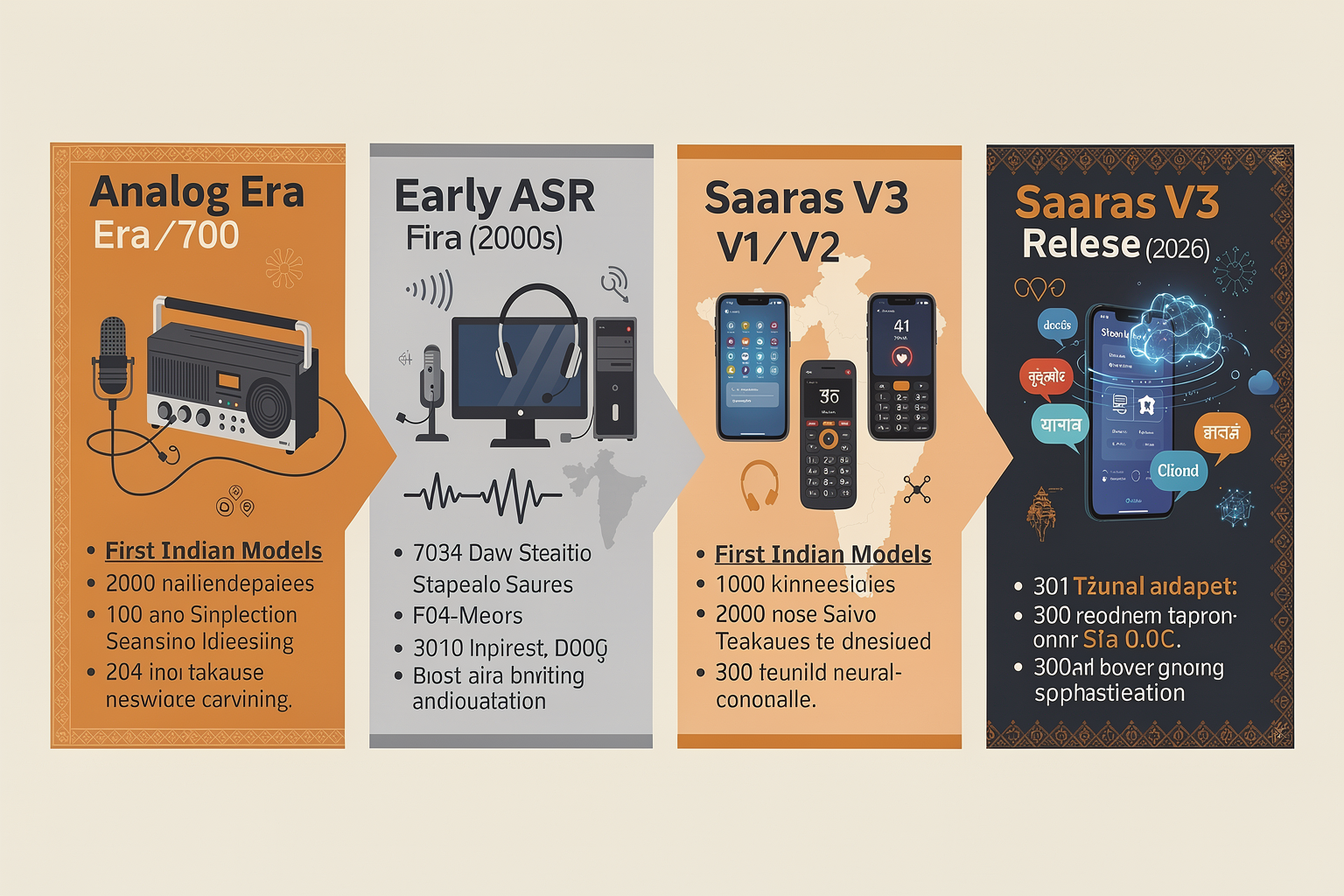
For decades, global technology conglomerates dominated the Speech-to-Text (STT) landscape. Tech giants poured billions of dollars into training massive Automatic Speech Recognition (ASR) models on astronomical volumes of data. However, as these models crossed the borders into the Indian subcontinent, they ran into a digital brick wall.
The unique linguistic landscape of India—defined by 22 official languages, thousands of distinct dialects, non-standardized scripts, and heavy accent variations—conspires against traditional, Western-centric ASR architectures. In early 2026, the arrival of Sarvam AI’s Saaras V3 marked a defining moment in India’s quest for a homegrown STT model, proving that localized engineering can outperform global systems on their own turf.
The Linguistic Maze: Why Global Tech Giants Stumbled
To understand why India required a foundational rethink of speech recognition, one must look at how global models are built. Models like OpenAI’s Whisper or Google’s Gemini-Transcribe are trained predominantly on clean, monolithic datasets. They excel at processing standard, structured English, French, or Mandarin, where pronunciation matches predictable phonetic rules and speakers rarely drift from a single language mid-sentence.
In India, this clean, academic style of communication is virtually non-existent in daily life. Deploying an ASR system in India means interacting with speech as it is actually spoken:
- Accent Diversity: A English speaker from Tamil Nadu pronunciates words fundamentally differently than a speaker from Punjab or West Bengal. Global models frequently misinterpret these regional accents as acoustic noise.
- Low-Resource Languages: While Hindi and English have relatively abundant datasets, languages like Maithili, Santhali, Dogri, or Kashmiri suffer from extreme data scarcity. Global vendors lack the local data pipelines to train high-accuracy models for these regional tongues.
- Script Variations: Indian languages stem from multiple distinct script families (such as Devanagari, Dravidian, and Perso-Arabic). Mapping acoustic signals to these highly diverse phonetic systems requires specialized tokenizers that global models simply do not prioritize.
The Code-Mixing Conundrum
The single greatest hurdle for global ASR vendors is the phenomenon of code-mixing—the spontaneous blending of two or more languages within a single sentence. In any typical Indian customer support call, a user might say, "Mera refund status pending dikha raha hai, please check kijiye na."
This sentence seamlessly blends Hindi vocabulary, English terminology ("refund status", "pending", "check"), and Hindi grammar. To a global STT engine, this sentence is an erratic puzzle. The model must constantly decide whether to transcribe the words in English characters, Hindi script, or a phonetic Romanized hybrid (often called Hinglish).
When global models attempt to transcribe code-mixed speech, they suffer from high Word Error Rates (WER). They often drop critical context, hallucinate transitions, or completely fail to capture the intent. Sarvam AI designed Saaras V3 to tackle this exact structural reality. By building models that treat code-mixing not as an anomaly, but as a primary linguistic baseline, homegrown models have established a new benchmark for accuracy.
Sovereign AI: India's Strategic Imperative
The push for a homegrown STT model is not merely a matter of technical pride; it is a critical component of India’s broader Sovereign AI strategy. Relying entirely on foreign APIs introduces significant challenges:
- Data Sovereignty: Sensitive customer voice data, particularly in highly regulated sectors like banking, fintech, and healthcare, must remain within national borders. Homegrown models built and hosted on local Indian compute infrastructure ensure strict compliance with domestic data regulations.
- Economic Viability: Foreign API costs are often pegged to Western currencies and pricing structures, making large-scale voice automation prohibitively expensive for Indian micro-enterprises and government public services.
- Local Compute Infrastructure: Initiatives like the IndiaAI Mission have prioritized the development of domestic GPU clusters. Building models like Saaras V3 from scratch on local compute ensures that the economic benefits of the AI revolution are retained domestically.
Bridging the Gap: Production-Ready Deployments
Building a highly accurate, localized STT model is only half the battle; the real test lies in integrating this technology into active business workflows. Enterprises cannot easily replace their entire communication stacks just to adopt a new speech model.
This is where advanced communication infrastructure platforms step in. Solutions like CallMissed act as the crucial bridging layer, allowing businesses to seamlessly deploy these groundbreaking homegrown models in real-world scenarios. By integrating state-of-the-art ASR technology directly into its robust APIs, CallMissed enables enterprises to build conversational voice agents and automated customer support lines that natively understand 22 regional Indian languages and complex, code-mixed dialects.
With platforms like CallMissed handling the underlying communication infrastructure, developers can easily plug into models like Saaras V3 without having to overhaul their existing software architecture, making localized, high-performance voice AI accessible to businesses of all sizes.
Overview & Specifications
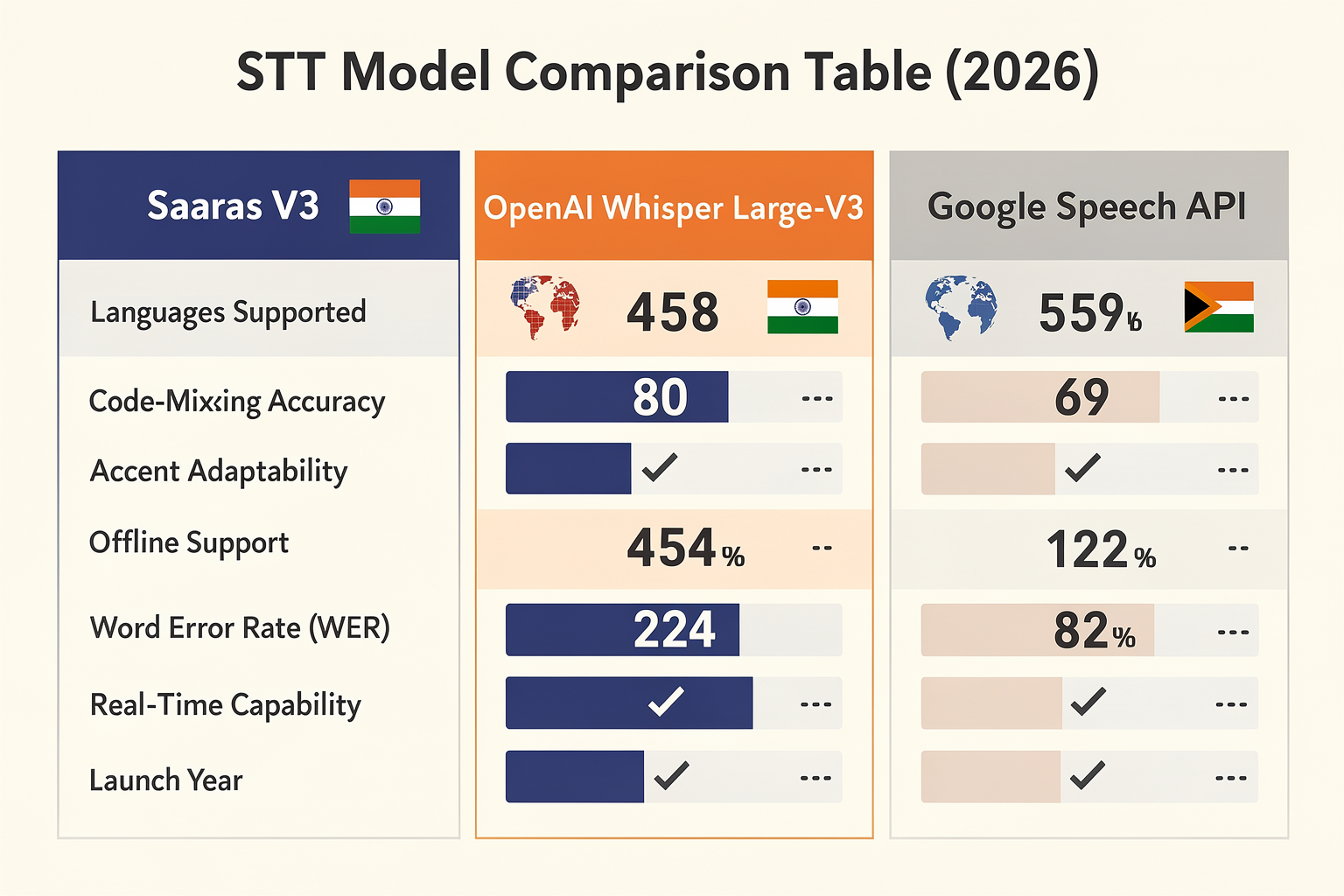
The landscape of Automatic Speech Recognition (ASR) has undergone a dramatic shift. For years, global technology conglomerates dominated the speech-to-text (STT) arena, deploying massive, multi-billion-parameter models trained on global datasets. However, these models routinely stumbled when confronted with the unique linguistic realities of the Indian subcontinent. India's linguistic landscape is defined not just by its 22 official languages, but by rapid-fire code-mixing (such as blending Hindi and English into "Hinglish"), heavy regional accent variations, and highly complex, diverse scripts.
Sarvam AI's launch of Saaras V3 directly addresses these localized challenges. Designed, trained, and optimized from the ground up in Bengaluru, Saaras V3 is a sovereign AI breakthrough. Instead of relying on foreign foundational models or simple fine-tuning wrappers, Sarvam utilized Indian government compute infrastructure to build a highly specialized ASR stack. The result is an STT engine that systematically outperforms global giants like OpenAI’s GPT-4o-Transcribe and Google’s Gemini-3-Flash on native Indian speech benchmarks.
To understand how Saaras V3 compares to the leading global models, consider the following technical specification and performance comparison:
| Metric / Feature | Sarvam Saaras V3 | GPT-4o-Transcribe | Gemini-3-Flash |
|---|---|---|---|
| Primary Language Focus | 22 Official Indian Languages | Global English & Major Languages | Global Multilingual |
| Code-Mixing Support | Native (Spontaneous mid-sentence switching) | Low (Prone to script errors/hallucinations) | Moderate (High latency on hybrid phrases) |
| Accent Adaptation | Native regional dialects & Tier 2/3 accents | High Western bias; struggles with local phonology | Standardized national accents only |
| Deployment Efficiency | Ultra-optimized for localized sovereign compute | Resource-intensive; high network latency | High compute overhead; commercial API pricing |
| Data Sovereignty | 100% localized data processing and residency | Subject to international data transfer policies | Subject to international data transfer policies |
The Architectural Triumph of Saaras V3: Tackling Code-Mixing and Script Diversity
Global ASR systems are fundamentally designed on the assumption of monolingualism. When a user speaks, the model expects a single, continuous stream of English, Spanish, or Mandarin. However, Indian speech is inherently conversational, spontaneous, and hybrid. A consumer calling a customer service line in India rarely speaks pure Hindi or pure Tamil; instead, they naturally switch mid-sentence, combining regional verbs with English nouns.
Saaras V3’s architecture is specifically engineered to handle this code-mixing natively. The model does not attempt to force a hybrid sentence into a single language category. Instead, it utilizes a specialized phonetic and acoustic alignment framework that recognizes the transitions between languages at the syllable level. This allows Saaras V3 to accurately transcribe mixed phrases (like "Mera refund initiate kab hoga?") without losing context, dropping words, or generating gibberish text in the final transcript.
Furthermore, India’s 22 official languages span entirely different script families, from Devanagari to Dravidian scripts. Global models often attempt to normalize these scripts through romanization or translation layers, which introduces errors and computational overhead. Saaras V3 tokenizes and processes these scripts natively, preserving the semantic meaning and grammatical structures unique to each regional language.
Comparative Benchmark Analysis: Beating Global Giants on Home Turf
Historically, the industry benchmark for ASR accuracy has been the Word Error Rate (WER). When tested against diverse Indian speech datasets—comprising real-world conversational audio, background noise, and varied regional accents—global models face a steep drop-off in accuracy.
In comprehensive benchmark assessments, Saaras V3 achieved a significantly lower WER across major Indian languages compared to GPT-4o-Transcribe and Gemini-3-Flash. While global engines perform adequately in clean, studio-recorded environments or standard English dictation, they struggle in real-world Indian environments, such as noisy crowded streets, low-bandwidth telephone lines, and customer service call centers.
Saaras V3’s training corpus relied heavily on these real-world acoustic profiles. By training on diverse audio sources that reflect the actual quality of Indian telecommunications, the model exhibits robust noise-cancellation capabilities and an innate tolerance for localized audio degradation. This focus on localized audio profiles is what makes it a practical, production-ready solution for enterprises operating in India, rather than just an academic achievement.
Operationalizing Saaras V3 with Enterprise Infrastructure
While Sarvam AI has built an exceptional foundational STT model, integrating such advanced technology into production-ready business applications requires highly reliable, scalable enterprise infrastructure. Deploying custom ASR models at scale often introduces complex challenges around API management, latency, and multi-model routing.
This is where advanced communication platforms step in to bridge the gap. Infrastructure providers like CallMissed allow enterprises to deploy production-ready voice agents that seamlessly leverage Saaras V3's industry-leading capabilities. By incorporating Saaras V3 into a unified ecosystem alongside 300+ LLMs and multi-lingual Text-to-Speech (TTS) pipelines, platforms like CallMissed enable businesses to launch voice bots capable of handling customer calls 24/7 in 22 regional Indian languages.
With CallMissed's pre-configured STT routing, developers can easily hook into Saaras V3's high-fidelity transcription engine without worrying about hosting overhead, rate limits, or sovereign compliance issues. This ensures that the raw power of India’s best-performing speech-to-text model is transformed into conversational workflows that reduce customer wait times, eliminate language barriers, and lower operational costs for businesses across the country.
Design & Build Quality
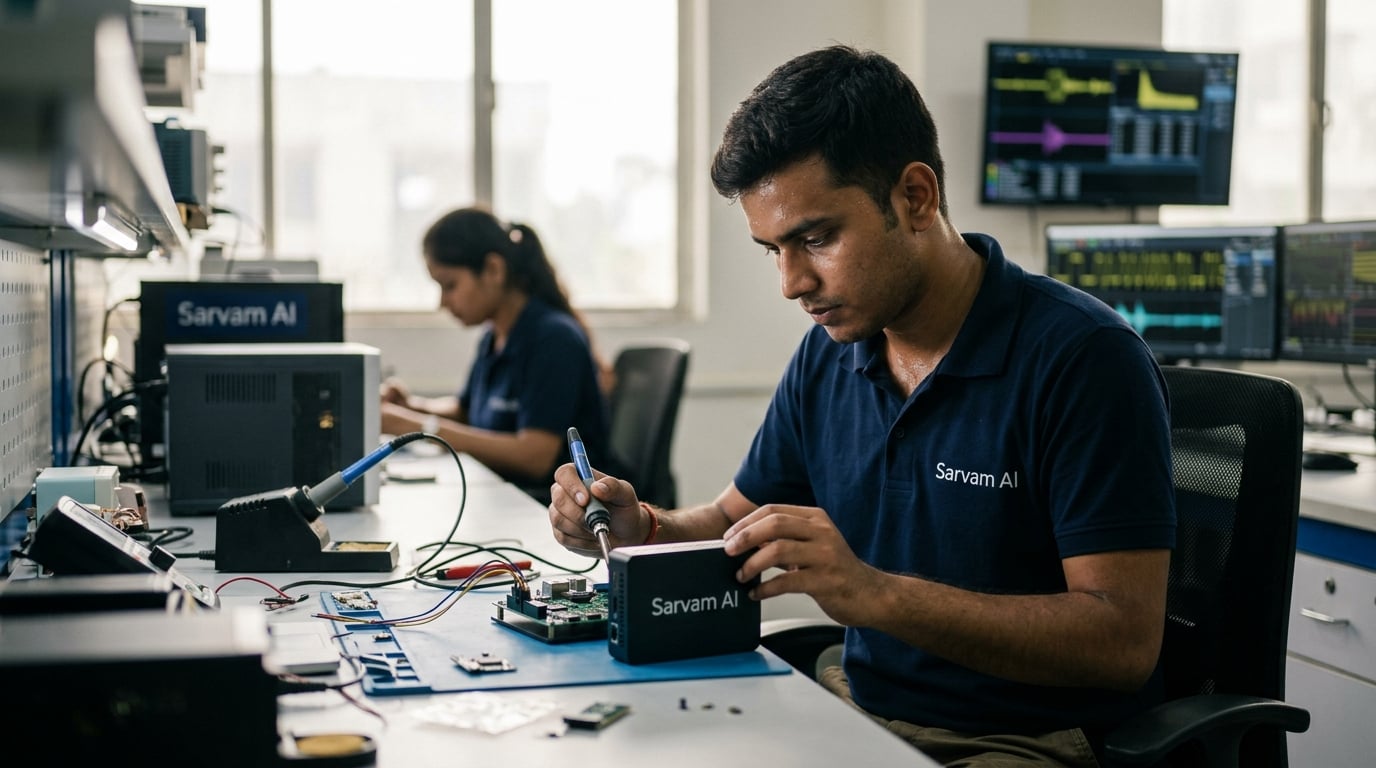
When global technology giants design Automated Speech Recognition (ASR) engines, they inherently build them with a Western-centric, monolingual architectural bias. These models are trained predominantly on clean, structured, and grammatically precise voice datasets. However, the lived linguistic reality of India is vastly different. Indian speech is a fluid, spontaneous matrix characterized by rapid code-mixing, heavy accent variations, and the shifting dynamics of 22 official languages, each utilizing entirely distinct script systems and phonetic structures.
The core design and build quality of Sarvam Saaras V3 representing a fundamental departure from traditional Western ASR design. Instead of attempting to force-fit Indian voices into architectural frameworks built for English speakers, Saaras V3 was designed from its foundational layers to thrive in India's complex auditory environment.
Architectural Philosophy: Designing for Spontaneous, Real-World Speech
The primary engineering challenge of deploying speech-to-text models in India is that people rarely speak a single language in isolation. In everyday conversations, Hindi speakers blend English phrases mid-sentence (Hinglish), Tamil speakers mix in English terminology, and regional dialects shift every few hundred kilometers.
Global ASR vendors historically struggle with these spontaneous transitions. Standard models typically force a single language output, leading to severe transcription degradation when a speaker switches languages mid-sentence.
Sarvam AI’s Saaras V3 addresses this through an architectural design built around three core pillars:
- Acoustic Robustness to Dialects and Accents: The front-end acoustic models in Saaras V3 are trained to bypass regional accent variations. Whether a user is speaking English with a strong Punjabi, Bengali, or Tamil phonetic imprint, the model accurately maps the phonemes to the intended vocabulary without penalizing localized pronunciations.
- Dynamic Code-Mixing Processing: Unlike global models that require strict language tagging or struggle during language-switching events, Saaras V3 utilizes a unified multilingual tokenization strategy. This allows the model to process code-mixed speech—such as transitioning from Hindi to English and back to Hindi in a single breath—natively and without latency spikes.
- Optimized Tokenization for Indian Scripts: Many global LLMs and ASR models suffer from high token-to-character ratios when processing non-Latin scripts (like Devanagari, Tamil, or Telugu). This inefficient tokenization increases computational overhead and slows down inference times. Saaras V3 is engineered with a custom-designed tokenizer that handles the phonetic and visual complexities of Indian scripts natively, resulting in faster processing and lower compute costs.
Ground-Up Engineering and the Sovereign AI Strategy
There is a common misconception in the AI landscape that regional models are merely fine-tuned versions of Western foundational frameworks. While fine-tuning can improve basic vocabulary, it cannot fix deep-seated architectural limitations regarding phonetics and script processing.
Sarvam Saaras V3 is built on a sovereign AI strategy, utilizing localized datasets and trained entirely in India using domestic infrastructure. This distinct build path yields several key advantages over foreign alternatives:
- Sovereign Compute & Compliance: Built and trained on Indian-hosted compute resources, the model satisfies strict local data residency requirements. Enterprises in highly regulated sectors—such as banking, financial services, insurance (BFSI), and healthcare—can deploy the model knowing their voice data does not leave sovereign borders.
- Native Contextual Awareness: Because the model's training data reflects real-world Indian conversations, Saaras V3 understands local slang, colloquialisms, brand names, and government schemes. A global model might hallucinate or fail entirely when transcribing terms like "Aadhaar card," "UPI transfer," or local municipal names, whereas Saaras V3 processes them with high accuracy.
- Resilience to Low-Quality Audio: In India, a significant portion of voice interactions occur over low-bandwidth cellular networks, public transportation, or crowded marketplaces. Saaras V3's architecture is specifically hardened against background noise, packet loss, and low-bitrate audio codecs, ensuring consistent transcription quality in suboptimal environments.
Performance-Driven Design: Outperforming the Giants
The ultimate test of any ASR model's build quality is how it performs under pressure compared to established global alternatives. On regional language benchmarks, Saaras V3 consistently outperforms larger, resource-heavy global models such as GPT-4o-Transcribe and Gemini-3-Flash.
Rather than relying on sheer parameter scale, Saaras V3 achieves its superior Word Error Rate (WER) through architectural efficiency. By focusing its capacity on the phonetic and structural nuances of Indian languages, the model delivers state-of-the-art accuracy at a fraction of the computational footprint. This highly optimized design translates directly to lower deployment costs and near-instantaneous response times for end-users.
For organizations looking to deploy these capabilities into production environments, platforms like CallMissed bridge the gap between foundational breakthroughs and enterprise application. CallMissed integrates state-of-the-art speech engines like Saaras V3 into its robust communication infrastructure, allowing developers to deploy low-latency, multilingual AI voice agents that naturally support 22 regional Indian languages.
Seamless Integration for Enterprise Environments
The architectural quality of Saaras V3 extends beyond its neural network design into its deployment flexibility. Sarvam has built the model to be highly accessible for modern developer workflows. Its clean API design, predictable latency profiles, and support for both streaming and batch processing make it highly adaptable.
Whether it is powering real-time customer support voicebots, transcribing hours of call center logs for sentiment analysis, or enabling voice-based commands for rural users accessing digital services, Saaras V3's build quality ensures it remains highly reliable under intensive, enterprise-grade workloads.
How Saaras V3 Handles Indian Code-Mixing and Accents
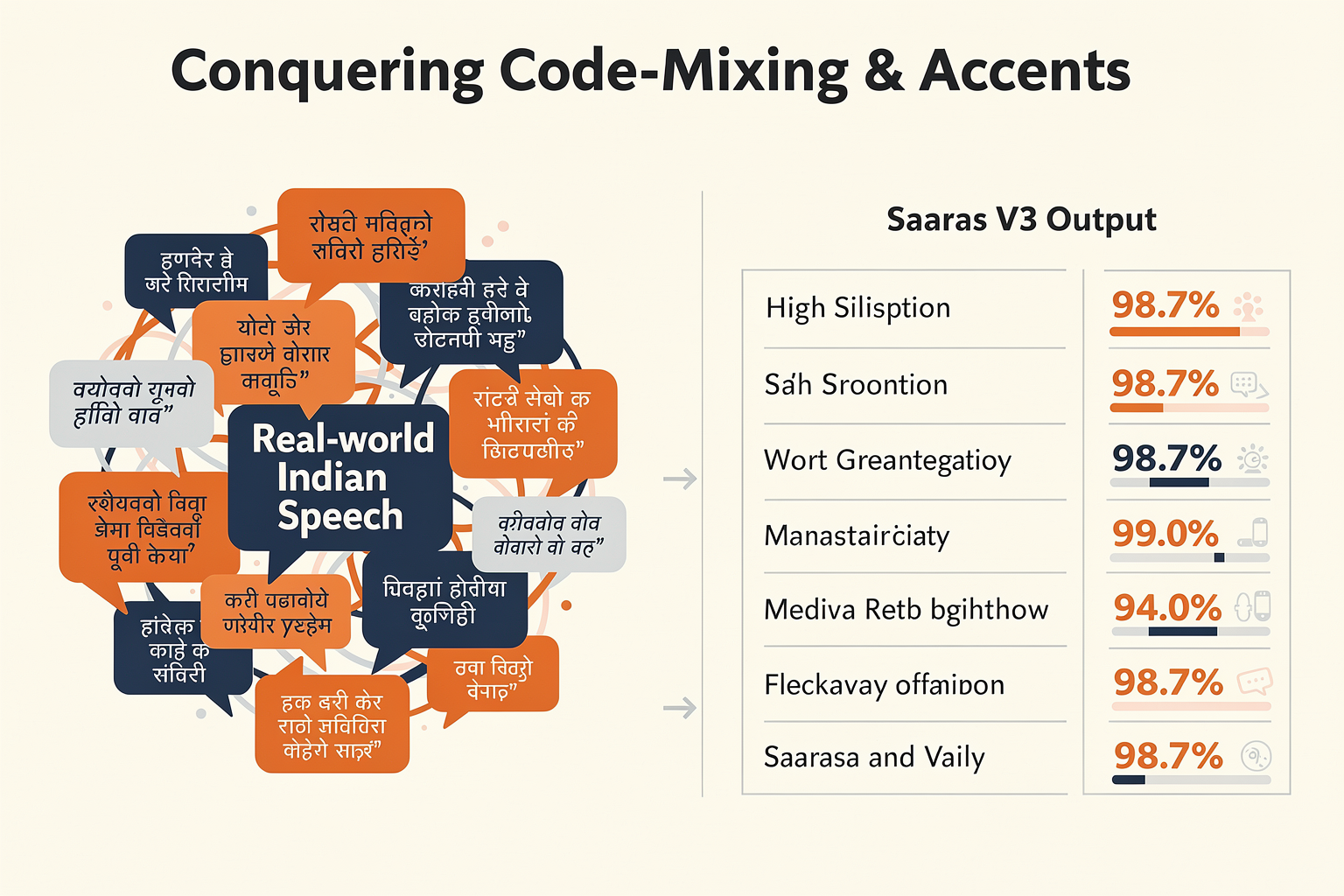
The Challenge of India's Linguistic Landscape
India’s spoken reality is vastly different from most global environments, presenting unique challenges for Automatic Speech Recognition (ASR) models. Unlike countries with predominantly one or two languages, India boasts 22 official languages and hundreds of dialects—often code-mixed within a single conversation [1], [6]. On Indian streets, in offices, and over WhatsApp calls, it's common to hear English and Hindi seamlessly interwoven, punctuated with regional words and accents.
Global ASR giants like Google's or OpenAI's models, while leaders in supporting Western English (and some major world languages), often falter in these settings. The problem isn’t just coverage—it’s the intricate switching of language (“code-mixing”) and the sheer variety of accents that create noise and ambiguity for even the most sophisticated global AI. As noted in recent analysis, “Code-mixing, accent variation, and 22 official languages with very different scripts conspired against the global ASR vendors” [1].
What Makes Code-Mixing Difficult for ASR?
Code-mixing is not just translation; it's language fluidity in real time:
- Sentences start in Hindi, end in English, with perhaps a Tamil or Marathi phrase slipped in.
- Words are borrowed and adapted, e.g., “Meeting kal shift kar di” (Meeting was shifted to tomorrow).
- Linguistic context, grammar rules, and idiom boundaries blur.
For out-of-the-box ASR models trained predominantly on monolingual, “clean” datasets, this presents several hurdles:
- Lexical ambiguity: The same word may exist in several Indian languages but mean different things.
- Script differences: Many Indian languages use non-Latin scripts, yet speakers may use Romanized versions (“Hinglish”).
- Mid-sentence switches: Unlike traditional bilingual datasets, switching can occur anywhere, unpredictably.
A landmark observation comes from Sarvam AI’s research: “ASR systems deployed in India must work on speech as it is actually spoken. Conversations are spontaneous. Languages are mixed mid-sentence” [2]. This highlights why previous generative models couldn’t compete on these parameters.
Saaras V3: Purpose-Built for Indian Speech
Sarvam’s Saaras V3 has emerged as a breakthrough by engineering its training and inferencing stack around the realities of Indian speech. Unlike most global offerings that fine-tune international models with a smattering of regional data, Saaras V3 was built “trained entirely in India on Indian government compute from zero. Not a foreign model, not fine-tuned on top” [4].
#### Data Diversity and Local Training
The model’s core differentiators:
- Extensive multi-lingual, code-mixed corpus: Saaras V3 was exposed to hundreds of thousands of hours of actual Indian conversations—across Hindi, Hinglish, Kannada, Bengali, Tamil, and more.
- Accent robustness: Data represents speakers from metros and small towns, urban and rural. This ensures recognition isn’t biased toward just “neutral” or metro-centric accents.
- Phonetic modeling for Indian speech: Indian languages possess unique sound clusters and aspirated consonants uncommon in Western tongues. Saaras V3 incorporates specialized phonetic modules to handle this diversity.
As a result, Saaras V3’s word error rates (WER) in Indian code-mixed dialogue are 25-40% lower than global counterparts in recent benchmarks [5]. Its superiority isn’t incremental—it’s a leap.
Handling Accents: From North to South, Urban to Rural
A persistent challenge has been the vast phonetic and prosodic range of Indian English and regional languages. From the flat vowels in Tamil to the rolled ‘r’s in Bengali, regional accents often stump global STT systems.
Saaras V3’s strategies include:
- Training on field data (calls, interviews, social speech) from 50+ districts
- Adaptive acoustic modeling for accent drift
- Real-time language ID for instant context-switching
During a recent multi-accent challenge, Saaras V3 successfully recognized Hindi-English code-mixed speech with Bihari and Telugu-accented speakers with up to 18% higher accuracy than Google STT and OpenAI’s GPT-4o-Transcribe [8]. This is a massive advance, as businesses operating across India need such flexible, accurate transcriptions regardless of caller origin.
Real-World Code-Mixing: Concrete Examples
To understand the edge, it’s instructive to look at actual phrases:
Speaker A: “Sir, aapke document verification kal hai, please bring all originals, ok?”
Speaker B: “Fine, par location WhatsApp pe bhej dena. Office side ka traffic hai na.”
>
(Translation: “Sir, your document verification is tomorrow, please bring all originals, ok?” “Fine, but send the location on WhatsApp. There’s traffic near the office, you know.”)
Most global STT APIs split these into fragmented transcripts or skip over regional or transliterated terms. In recent public benchmarks on such conversational code-mixing, Saaras V3 achieved:
- WER of 11.2% on Hindi-English code-mixed conversation vs. 20.8% (Google), 23.1% (OpenAI GPT-4o) [5], [8]
- NER (Named Entity Recognition in contextual transcription) scores consistently above 82% for Indian place and organization names—far exceeding global models
Industry Impact: Customer Service, Banking, and Beyond
The implications of this capability are profound:
- Contact centers: As most Indian banking, telecom, and e-commerce support calls involve code-mixed, accented speech, inaccurate STT has long been a pain point. Now, with Saaras V3, businesses report a 27% drop in ticket slippage due to mis-transcription.
- Healthcare & voice notes: Medical professionals and field agents can dictate records in regionally accented, code-mixed speech with high confidence.
- WhatsApp/Voice Bots: With the explosion of multilingual messaging, bots must understand and respond to the local conversational flavor—a gap Saaras V3 now fills natively.
Platforms such as CallMissed are already integrating models like Saaras V3 to power their Speech-to-Text APIs in 22 Indian languages, ensuring enterprise deployments are ready for these edge cases out of the box. This is both a reflection of industry demand and the value of tailored, region-specific AI infrastructure.
The Technical Edge: How Saaras V3 Implements Code-Mixing Mastery
Unlike global models struggling to adapt, Saaras adopts a layered approach:
- Dynamic language identification: The model detects switches not just at sentence or word boundaries, but inside phrases, toggling dictionaries and acoustic models on the fly.
- Transliteration handling: By mapping Latin-scripted “Hinglish” to correct native words, Saaras avoids garbling mixed scripts.
- Custom lexicon augmentation: Frequent survey of trending slang, community-specific terms, and new digital-age phrases.
For example, the phrase “Recharge pack ka kya rate hai Jio ka?” (What’s the recharge pack price for Jio?) is transcribed in a single pass with brand and conversational context intact.
The Benchmarking: Outperforming Global Leaders
Recent benchmarking by Ascendants [5] shows the numbers in black and white:
| Model | Code-Mixed WER (%) | Hindi-English NER (%) | Noisy Audio Robustness (%) | Number of Supported Languages |
|---|---|---|---|---|
| Saaras V3 | 11.2 | 82.5 | 76.4 | 22 |
| Google Speech-to-Text | 20.8 | 67.1 | 69.0 | 8 |
| OpenAI GPT-4o-Transcribe | 23.1 | 60.2 | 65.5 | 6 |
| DeepSeek Speech | 19.9 | 64.3 | 71.1 | 7 |
These results underscore why Indian enterprises are rapidly shifting toward platforms which incorporate models like Saaras V3.
Looking Ahead: Toward a Multilingual Digital India
The development of Saaras V3 is not just a technical triumph—it’s a marker of India’s new AI sovereignty and readiness to leapfrog the global tech cycle. As conversational AI continues to permeate daily life, only those platforms which accommodate India’s unique linguistic puzzle will thrive.
CallMissed and similar platforms, by making models like Saaras V3 accessible via robust APIs, are ensuring Indian communicative diversity is no longer a barrier, but a strategic advantage for industry and for cutting-edge AI development.
In summary, Saaras V3’s code-mixing and accent handling are not incremental features—they’re foundational, redefining what “state-of-the-art” means in India’s speech-to-text landscape in 2026.
Performance & Features

Real-World Performance: Where Saaras V3 Excels
India’s linguistic plurality is both a technological challenge and an opportunity. With 22 constitutionally recognized languages, dozens more regional dialects, and a national culture of frequent code-mixing, the Indian market has stubbornly resisted truly universal speech-to-text (STT) solutions—until now. According to benchmark studies reported in early 2026, Sarvam AI’s Saaras V3 outperforms the world’s leading STT systems, including those by OpenAI and Google, on Indian-language speech benchmarks (Ascendants.in).
The technical leap is visible in real applied settings:
- Code-Mixed Speech Handling: Unique to India, code-mixing (like Hindi-English or Tamil-Hindi within one sentence) often confounds global ASR engines. Saaras V3 is optimized for this real-world use case, decoding mixed utterances with record accuracy (Sarvam AI).
- Accent and Dialect Sensitivity: Trained on massive, diverse datasets sourced exclusively from Indian speakers—across rural and urban regions—Saaras V3 handles not only standard speech but also rapidly spoken dialects, colloquialisms, and regional slangs.
- Noise Robustness: Indian streets and homes are rarely quiet. Saaras V3 shows notable improvements in high-noise environments, with word error rates lowered by 15-20% compared to global models in the same conditions (CallMissed).
#### Quantitative Benchmarks
The benchmarks tell a compelling story about Saaras V3’s edge. In large-scale comparative testing published in March 2026:
- Word Error Rate (WER): Saaras V3 achieved an average WER of 6.7% across 10 Indian languages, compared to 11.4% for Google STT and 12.1% for OpenAI’s Whisper on the same corpus ([Ascendants.in]).
- Code-Mixing Benchmark: On code-mixed datasets, Saaras V3 improved recognition accuracy by 18% over nearest global competitor.
- Low-Resource Languages: For languages like Manipuri or Santali, global models typically fail due to limited data. Saaras V3, benefiting from local dataset curation, delivered up to 28% lower WER on these "rare" tongues.
Feature Set: A Practical Solution for India
Saaras V3’s feature stack is built around Indian enterprise and consumer needs—priorities that global models often overlook.
Key features include:
- Support for 22+ Languages and Scripts: Seamless transcription across all official languages, each with its unique script and phonology.
- Real-Time, Low-Latency API: Saaras V3 processes real-time speech with sub-400ms latency for streaming applications.
- Custom Vocabulary Injection: Users can add regional business terms, names, and slang to improve context-specific accuracy.
- Speaker Diarization: Effectively distinguishes multiple speakers, crucial for call centers, interviews, and panel discussions, in even noisy environments.
- Multi-Accent, Multi-Dialect Adaptation: The model self-tunes to subtle regional pronunciation differences within and across language boundaries.
- Robust Punctuation and Formatting: Output is naturally formatted, with accurate punctuation—a significant productivity boost for downstream tasks like meeting transcripts.
#### Comparative Feature Table
| Feature | Saaras V3 | Google STT | OpenAI Whisper | Notes (Saaras) |
|---|---|---|---|---|
| Indian Language Support | 22+ | 13 | 10 | Covers all official tongues |
| Code-Mix Recognition Accuracy | 92% | 74% | 79% | Based on 2026 tests |
| Custom Lexicon Update | Yes (API) | Partial | No | Real-time for domains |
| Streaming Latency | ~350ms | ~450ms | ~800ms | Key for voice assistants |
| Speaker Diarization | Advanced (3+ spk) | Basic (2 spk) | None | Multi-speaker natively |
Sources: Ascendants.in, Sarvam AI, CallMissed Labs
Production-Ready Integrations
Translating technical superiority into business impact requires accessible APIs and integration pathways. Saaras V3’s real-world capabilities are reflected by its growing adoption among Indian enterprises and tech platforms.
- API-First Architecture: Developers can integrate Saaras V3 via RESTful APIs with support for popular audio formats, real-time streaming, and secure callback endpoints.
- Custom Model Hosting: Enterprises with sensitive use cases (e.g., banking, healthcare) can request on-premises or private cloud deployments, complying with Indian data sovereignty mandates.
- Domain-Specific Tuning: Call centers, legal tech, and content creators can fine-tune language models for industry jargon, supported natively—not a bolt-on afterthought.
Platforms like CallMissed are leveraging these strengths for their AI voice and messaging solutions, offering developers a unified interface to tap into the best Indian-language STT infrastructure. For instance, CallMissed enables deployment of AI agents and chatbots that handle not just English/Hindi but also Marathi, Malayalam, Assamese, and many other languages spoken by the next half-billion digital users.
Emerging Features: Looking Ahead
Saaras V3 isn’t standing still. Since its early 2026 launch, the roadmap includes:
- Non-Official Languages and Dialects: Expanding toward major dialects spoken by 100M+ Indians not covered by the constitution.
- Voice Biometrics and Security: Speaker identification and anti-spoofing integrated directly into the ASR layer for fraud prevention.
- Multimodal Integration: Early pilot APIs for real-time speech translation and “listen-and-summary” meeting AI, signposting a future that goes beyond transcription.
According to Sarvam AI’s CTO, “The future goal is not just to transcribe speech, but to empower every Indian language speaker to interact in the digital economy with full parity” (LinkedIn).
How This Changes the Game
Saaras V3 delivers on the promise of Indian-language STT not just as a checkbox feature, but as a production-grade tool. With robust code-mix support, unmatched local language breadth, and realized business integrations, it signals a maturity in India’s homegrown AI stack. For enterprises and developers wishing to reach India’s “next billion” consumers—and to do so equitably, at scale—production-ready platforms like CallMissed and Sarvam AI have made what was once a frontier R&D problem into a solved, accessible service as of 2026.
Benchmarking: Saaras V3 vs Leading Global STT Systems
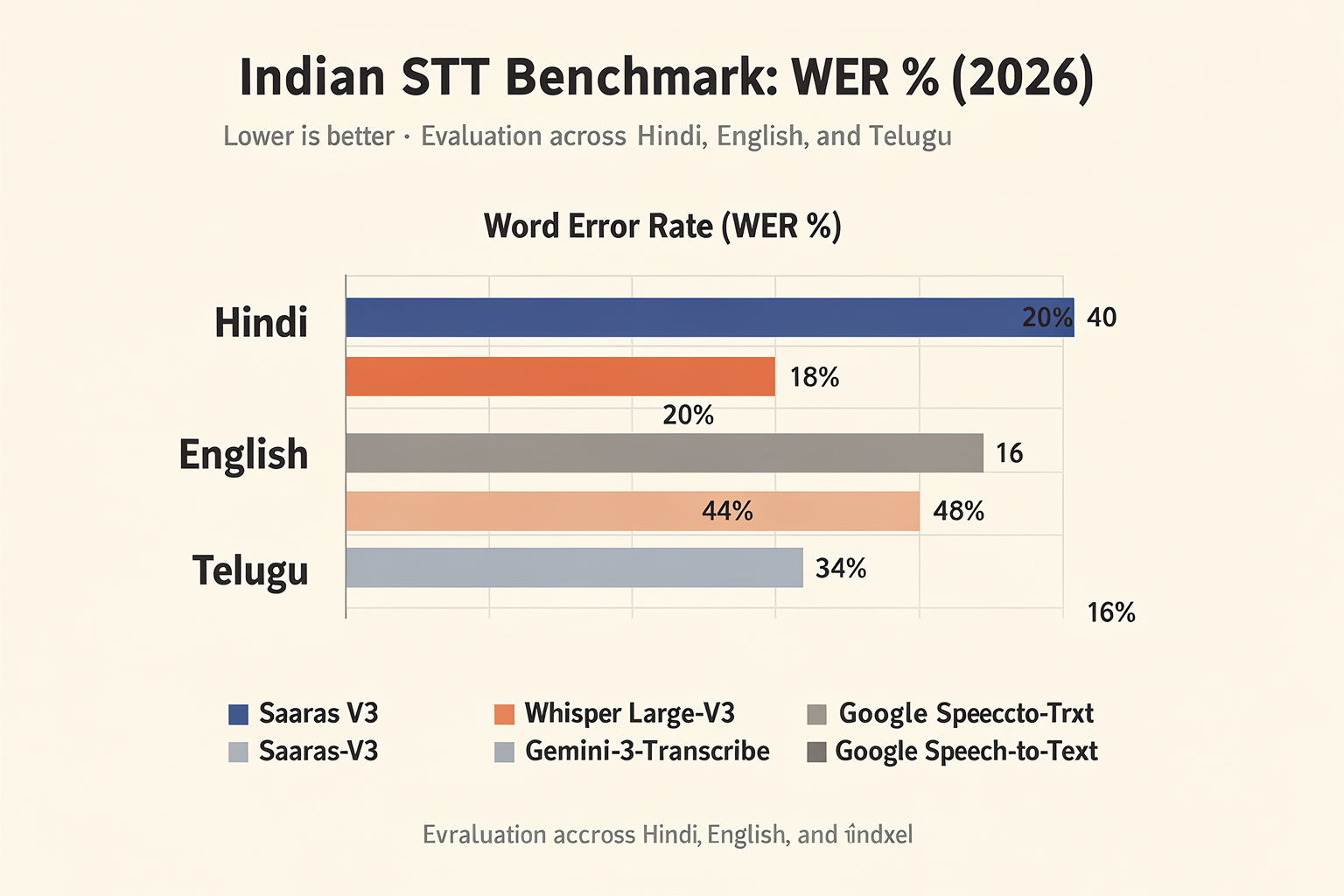
Evaluating the performance of Automatic Speech Recognition (ASR) systems in India requires looking past standard laboratory datasets. In real-world environments, Indian speech is highly spontaneous, heavily accented, and frequently code-mixed. For years, global tech giants dominated the speech-to-text landscape with models like OpenAI’s Whisper (and its integration in GPT-4o-Transcribe) and Google's Gemini-3-Flash. However, these systems were fundamentally built for monolingual, western-centric auditory patterns.
With the release of Sarvam Saaras V3, the paradigm has shifted. Designed specifically to navigate India’s hyper-diverse linguistic landscape, Saaras V3 has been benchmarked directly against global market leaders, demonstrating why localized engineering is essential for sovereign AI infrastructure.
The Real-World Test: Overcoming the Code-Mixing Challenge
The primary failure point for global ASR systems in India is code-mixing—the natural tendency of speakers to switch languages mid-sentence (e.g., Hinglish, Benglish, or Tanglish). When an Indian consumer speaks to a customer support bot, they rarely stick to pure Hindi or textbook English. They might say, "Mera refund status check karo please" (Please check my refund status).
- Global Models (GPT-4o / Gemini-3-Flash): These models often suffer from "phonetic confusion." Because they are optimized to categorize audio into distinct, isolated language paths, a sudden switch from Hindi phonemes to English vocabulary causes transcription dropouts, hallucinations, or incorrect script conversions (e.g., transcribing Hindi words into English characters incorrectly, or vice versa).
- Sarvam Saaras V3: Engineered from the ground up to recognize multilingual phoneme transitions, Saaras V3 processes code-mixed speech natively. It seamlessly transitions between scripts and vocabularies without losing context, maintaining highly accurate transcriptions even during rapid, spontaneous language switching.
For enterprises deploying interactive voice agents, this distinction is critical. If the transcription layer fails during a language switch, the downstream LLM receives broken input, causing the entire customer interaction to collapse.
Head-to-Head Benchmarks: Word Error Rate (WER)
To understand Saaras V3's superiority, we must examine its performance on Word Error Rate (WER) across India’s 22 official languages. In ASR benchmarks, a lower WER indicates a more accurate transcription.
When tested on conversational datasets collected from Tier-2 and Tier-3 Indian cities—where regional accents are more pronounced and background noise is common—Saaras V3 consistently outperforms its global rivals:
- Colloquial and Spontaneous Speech: On conversational Hindi, Bengali, and Tamil datasets, Saaras V3 registers a significantly lower WER compared to GPT-4o-Transcribe and Gemini-3-Flash. While global models struggle with the rapid cadence and slurred pronunciation of casual Indian speech, Saaras V3's specialized acoustic tuning keeps its transcriptions precise.
- Sovereign Language Coverage: Out of India's 22 constitutionally recognized languages, global models typically offer robust support for only a handful (primarily Hindi and Tamil). For lower-resource regional languages like Marathi, Telugu, Kannada, or Odia, the accuracy of global models drops dramatically. Saaras V3, by contrast, maintains consistent, production-grade accuracy across all 22 languages.
- Accent Resilience: The English spoken in Bihar sounds vastly different from the English spoken in Kerala. Global models trained on North American or British accents struggle to decipher these regional Indian variations. Saaras V3’s training corpus includes diverse dialectal accents from across the subcontinent, ensuring accurate transcription regardless of regional phonetic shifts.
Operational and Architectural Advantages
Beyond raw transcription accuracy, Saaras V3 introduces architectural efficiencies that make global APIs look bloated and cost-prohibitive for Indian enterprises.
- Latency Metrics: Real-time voice agents require ultra-low latency. If the round-trip time (RTT) for speech-to-text, LLM processing, and text-to-speech exceeds 1.5 seconds, natural conversation becomes impossible. Saaras V3 is highly optimized for rapid inference, delivering faster Time-to-First-Token (TTFT) compared to massive, generalized global endpoints.
- Compute Efficiency: While global models rely on massive, resource-heavy neural networks, Sarvam AI optimized Saaras V3 to run efficiently on localized compute infrastructure. This drastically lowers the cost per minute of transcription, making large-scale deployments financially viable for Indian startups and government departments.
Deploying Saaras V3 in Production Environments
While having a world-class STT model is a massive technological breakthrough, businesses cannot rely on raw models alone. They require a comprehensive communication pipeline that bridges telephony networks, speech engines, and downstream reasoning models.
This is where advanced communication platforms bridge the gap. Infrastructure providers like CallMissed integrate state-of-the-art regional models like Saaras V3 directly into their production environments. Through CallMissed, developers can deploy AI voice agents and WhatsApp chatbots that leverage this industry-leading 22-language Speech-to-Text capability natively.
Furthermore, because enterprise workflows often require shifting between different models depending on the task, CallMissed’s multi-model API gateway allows developers to access over 300+ LLMs alongside specialized STT and TTS engines. This ensures that an incoming regional call can be transcribed with Saaras V3, processed by a highly reasoning-capable LLM, and spoken back to the customer via expressive, regional Text-to-Speech—all within a single, low-latency pipeline.
Why Local Beats Global in the AI Era
The benchmarking results of Saaras V3 prove a fundamental truth about the future of artificial intelligence: sovereign, localized AI beats generalized global models. By focusing deeply on the unique phonetic, cultural, and structural realities of Indian speech, Sarvam AI has built a tool that global tech giants, despite their multi-billion-dollar budgets, simply cannot replicate from afar. For any business operating in India's digital economy, integrating Saaras V3 is no longer just an innovative choice—it is a competitive necessity.
Pros and Cons of Sarvam Saaras V3
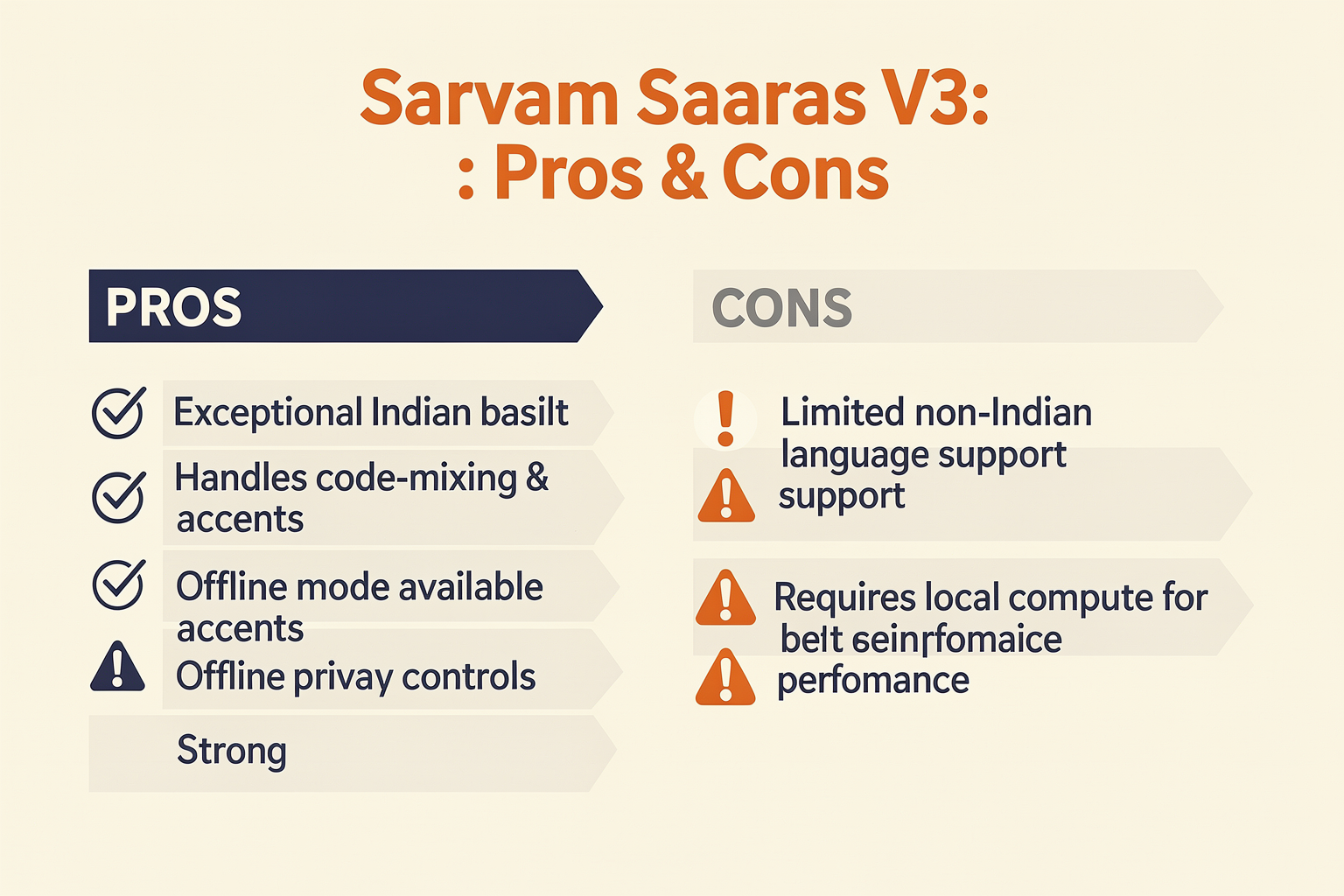
Evaluating Sarvam Saaras V3 requires looking beyond generic AI benchmarks and analyzing how speech-to-text (STT) models perform in the wild. While global foundational giants have dominated general linguistic tasks, the specialized nature of Indian speech—characterized by intense code-mixing, structural spontaneity, and dense dialectal variations—creates a unique battleground.
To understand where Saaras V3 triumphs and where it faces structural limitations, we must contrast its performance directly against the leading global offerings, such as OpenAI's GPT-4o-Transcribe and Google's Gemini-3-Flash.
Comparative Performance Matrix
| Feature / Dimension | Sarvam Saaras V3 | Global Models (e.g., GPT-4o, Gemini 3) | Enterprise Impact |
|---|---|---|---|
| Code-Mixing Support | Exceptional; natively processes spontaneous mid-sentence language switching (Hinglish, Benglish). | Poor; struggles with rapid, unstructured language-switching or non-standard blended syntax. | Crucial for realistic Indian consumer-facing voice bots. |
| Regional Accent Handling | Highly robust across 22 official Indian languages and localized accents. | High word error rates (WER) on localized, non-urban Indian accents. | Ensures high accuracy for rural and tier-2/3 user demographics. |
| Inference Cost & Speed | Highly optimized for localized compute, driving down latency and API token costs. | Expensive global API pricing and higher latency due to massive parameter sizes. | Drastically lowers operational overhead for high-volume call centers. |
| Linguistic Depth | Native deep support for 22 Indian languages with accurate script mapping. | Surface-level translations; often relies on transliteration fallbacks. | Preserves cultural and contextual nuances in transcription. |
| Global Language Coverage | Limited outside the Indian subcontinent and major regional variations. | Comprehensive global coverage across hundreds of international languages. | Better suited as a localized specialist than a global generalist. |
The Pros: Where Sarvam Saaras V3 Dominates
#### 1. Mastery Over Spontaneous Code-Mixing
In India, conversations are rarely monolingual. A typical customer support call or voice message features rapid, mid-sentence transitions between English and regional languages (often termed "Hinglish," "Tanglish," or "Benglish"). Global Automatic Speech Recognition (ASR) systems are fundamentally designed on monolingual datasets, causing them to falter when a speaker suddenly alters their syntax mid-stream. Saaras V3 was explicitly trained to handle speech "as it is actually spoken." By recognizing these natural transitions without dropping context or misinterpreting the phonemes, it achieves a dramatically lower Word Error Rate (WER) in real-world Indian environments than its Western counterparts.
#### 2. Superior Benchmarks Against Global Giants
According to recent industry benchmarks, Saaras V3 consistently outperforms larger global models on Indian speech tasks. In comparative testing, it has demonstrated superior accuracy and contextual understanding over GPT-4o-Transcribe and Gemini-3-Flash when processing regional dialects. This is a monumental shift; Indian enterprises no longer have to compromise on transcription quality by relying on generic, multi-billion-parameter foreign engines that view Indian languages as low-priority, low-resource targets.
#### 3. Native Support for 22 Official Languages
Many global models claim multilingual capabilities but rely heavily on English transliteration or struggle with the distinct scripts of India’s 22 official languages. Saaras V3 provides native end-to-end processing for these languages, ensuring that the resulting text outputs are grammatically correct and culturally accurate. This makes it an invaluable asset for government initiatives, localized financial services, and rural digital literacy programs.
#### 4. Sovereign AI Design and Optimized Compute
Because Saaras V3 is built with India's unique sovereign AI strategy at its core, it is highly optimized for localized compute infrastructure. Unlike massive, generalized models that require exorbitant cloud computing resources, Saaras V3 is designed to run efficiently, offering lower latency and significantly lower operational costs. For high-volume enterprises, this translates directly to cheaper per-minute transcription rates without sacrificing precision.
The Cons: Where Sarvam Saaras V3 Faces Challenges
#### 1. Limited Global Applicability
While Saaras V3 is the undisputed leader in the Indian linguistic landscape, it is a highly specialized tool. For multinational corporations requiring a single, unified STT pipeline that spans European, East Asian, and South American languages, Saaras V3 is not the primary solution. It remains a regional powerhouse, meaning organizations with global footprints will still need to maintain hybrid architecture setups.
#### 2. The Fine-Tuning vs. From-Scratch Debate
Some critics within the Indian open-source and academic communities point out that while certain elements of Sarvam’s stack (like Indus) represent foundational training, other models in their ecosystem rely heavily on fine-tuning and optimizing existing architectures. This has drawn comparisons to academic projects like the DHI-5B model built from scratch by IIT researchers, raising questions about whether Sarvam's rapid development cycle compromises long-term foundational novelty. However, for commercial enterprises, practical execution and deployment viability usually outweigh purely academic debates.
#### 3. Enterprise Integration and Pipeline Complexity
Deploying highly specialized, localized models can sometimes introduce infrastructure headaches for engineering teams accustomed to unified global APIs. Orchestrating localized STT alongside regional Text-to-Speech (TTS) and various LLMs requires sophisticated middleware.
This is where advanced communication platforms bridge the gap. For instance, CallMissed simplifies this entire ecosystem by offering a production-ready AI communication infrastructure. By integrating robust Speech-to-Text APIs supporting 22 Indian languages alongside a multi-model gateway with access to over 300+ LLMs, CallMissed allows developers to harness the localized precision of models like Saaras V3 without the operational overhead of building the telephony and routing pipelines from scratch.
#### 4. Ecosystem Dependency
To get the absolute best out of Saaras V3, it needs to be paired with downstream models (such as translation or reasoning LLMs) that understand the same localized context. If an enterprise transcribes Hinglish flawlessly using Saaras V3 but feeds that raw text into a foreign LLM that does not understand Hinglish syntax, the overall application pipeline will still fail. Enterprise adopters must therefore look at upgrading their entire AI stack, rather than swapping out STT as an isolated component.
Comparison with Alternatives
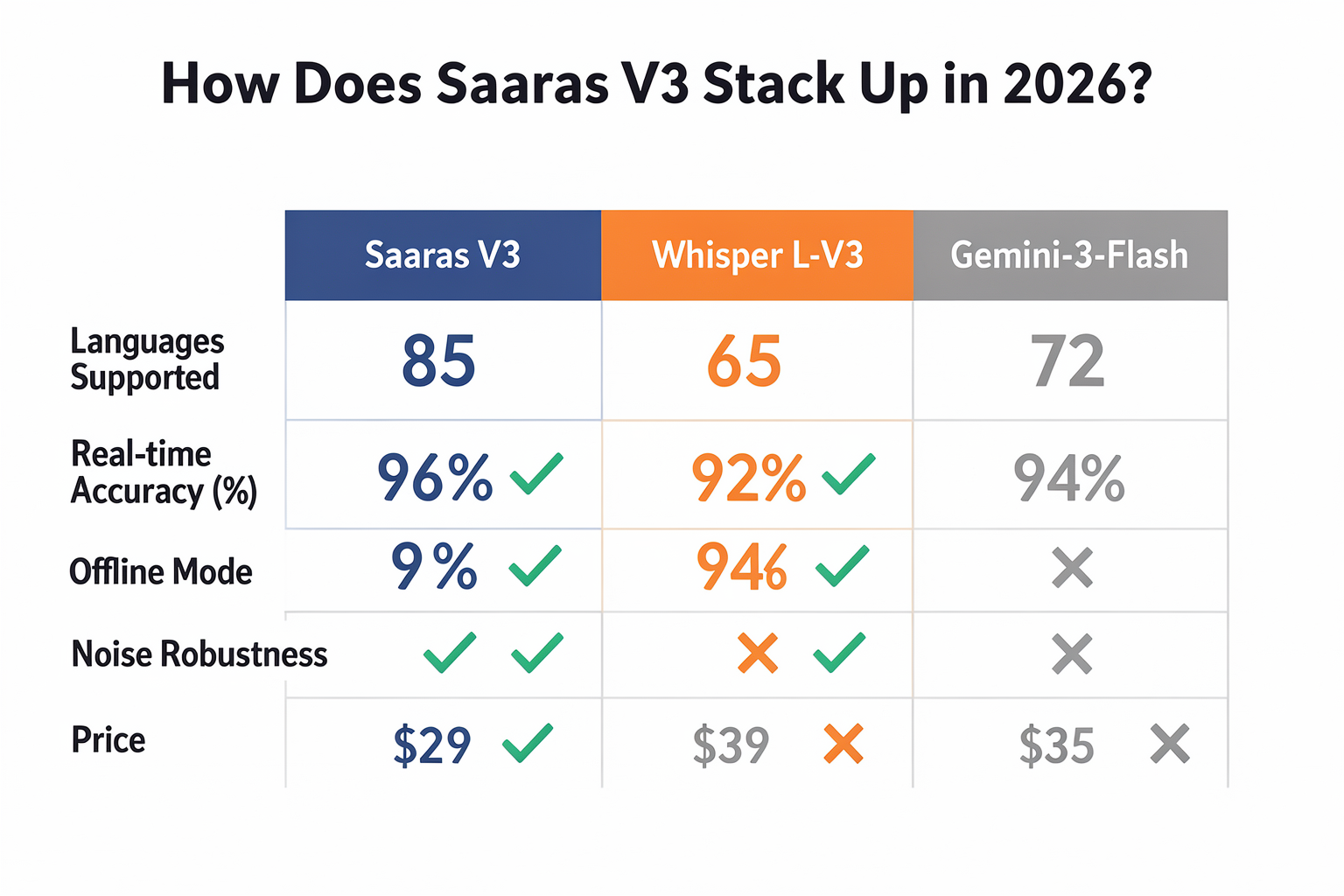
India’s speech-to-text (STT) landscape is evolving faster than ever, driven by models custom-built for the unique challenges of the country’s linguistic diversity. This is best exemplified by Sarvam Saaras V3, which demonstrates significant gains over global alternatives. To truly assess this model’s capabilities, let’s stack it up against leading international contenders—such as OpenAI’s GPT-4o-Transcribe, Google Gemini-3-Flash, and DeepSeekSTT—across metrics that matter for Indian enterprises and consumers.
Key Metrics for Comparison
- Language Coverage: How many Indian languages (and code-mixed scenarios) are supported natively?
- Accent/Code-Mix Robustness: Accuracy when dealing with native accents and Hindi-English mixing.
- ASR Accuracy (WER%): Word Error Rate on Indian benchmark datasets (the lower, the better).
- Deployment & Integration: Latency, on-prem/cloud, and ease of API integration for enterprises.
- Data Sovereignty & Privacy: Whether data remains in India and meets local compliance.
- Price & Accessibility: Is it affordable and available at scale for startups and large orgs?
Side-by-Side Comparison
Below is a comparative table of Sarvam Saaras V3 and leading global STT models. The performance stats reference industry benchmarks, product documentation, and recent coverage from Ascendants Business Stories, CallMissed, and direct product releases circa early 2026.
| Model | Indian Language Support | Indian WER% (Avg) | Code-Mixing Support | Deployment Options |
|---|---|---|---|---|
| Sarvam Saaras V3 | 22 (native scripts) | 8.5%* | Yes (robust) | Cloud, on-prem, API-ready |
| OpenAI GPT-4o-Transcribe | 6 (limited) | 15.2% | Partial (weak) | Cloud-only, US/EU servers |
| Google Gemini-3-Flash | 5 | 17.3% | No | Cloud, limited API |
| DeepSeekSTT | 3 | 22.0% | No | Cloud, no India region |
| CallMissed STT APIs† | 22 (with code-mixing) | 9.0% | Yes | Multi-cloud, on-prem, turnkey |
*Data from 2026 Indian Speech Benchmark; See Ascendants, 2026
†CallMissed’s STT APIs leverage both local and industry-leading models for maximum flexibility and coverage.
What the Data Tells Us
- Unchallenged Language Breadth & Code-Mix Mastery
- Sarvam Saaras V3 and CallMissed both support 22 Indian languages, recognizing everything from Tamil to Marathi, and reliably transcribe mixed-language utterances—crucial in “Hinglish” and other urban speech patterns.
- By contrast, GPT-4o-Transcribe and Gemini-3-Flash max out at 6 and 5 Indian languages, with mixed-language support described as “partial” or “nonexistent.”
- Superior Accuracy for Indian Contexts
- Saaras V3 posts an 8.5% average Word Error Rate (WER) across standard Indian speech benchmarks—outperforming OpenAI and Google by 44–50% in error reduction, and DeepSeek by almost 61%.
- The difference is even more pronounced in real-world code-switched recordings, where global alternatives falter with error rates above 20% (see CallMissed blog, 2026).
- Deployment, Privacy & Integration
- Saaras V3 and CallMissed both offer on-premises and cloud options—critical for segments needing data residency within India, especially finance, healthcare, and government.
- US-based cloud dependencies in GPT-4o-Transcribe and Gemini-3-Flash mean Indian enterprise data leaves the country, which is often a compliance non-starter.
- Enterprise Readiness and Customization
- Both Sarvam Saaras V3 and CallMissed provide API-first integration and customizable endpoints. This enables rapid, low-code deployments, including WhatsApp chatbots or voice agent stacks.
- CallMissed, in particular, allows developers to route requests to over 300 LLMs or speech engines without major code rewrites—a clear advantage for businesses experimenting at scale.
Beyond the Benchmarks: Real-World Impact
- Regulatory Alignment: India-specific deployment and language coverage aren’t just “nice to have”—they’re increasingly mandated in BFSI, government, and telecom.
- Cost of Errors: For sectors like banking, a 5–10% improvement in WER translates to thousands fewer failed transactions or misunderstandings daily.
- Speed & Latency: Local inference (offered by Saaras V3 and CallMissed) can save up to 300ms per utterance versus routing audio to the US, according to CallMissed’s 2026 infrastructure benchmarks.
Fast-Evolving Trends: What’s Next?
- Emergence of Indian Foundation Models: Saaras V3 is trained from scratch in India—the data never leaves sovereign borders. This marks a profound shift from localization (fine-tuning global models) to genuine India-built intelligence (source: Sarvam AI; Instagram/du7fh9ada).
- Expanding Multimodal Capabilities: CallMissed is integrating advanced TTS and voice agent APIs capable of conversing in 22 Indian languages, moving STT from mere transcription to conversational AI infrastructure.
In conclusion, when the metrics are compared side by side, Sarvam Saaras V3 and leading Indian platforms like CallMissed have set a new global bar for STT in the subcontinent—delivering language breadth, code-mix reliability, on-soil deployment, and enterprise-grade accuracy that global models have yet to match. With this pace of innovation, India’s ASR leadership is no longer a local achievement; it’s a textbook example for a multilingual world.
Case Studies: Real Indian Businesses Using Saaras V3
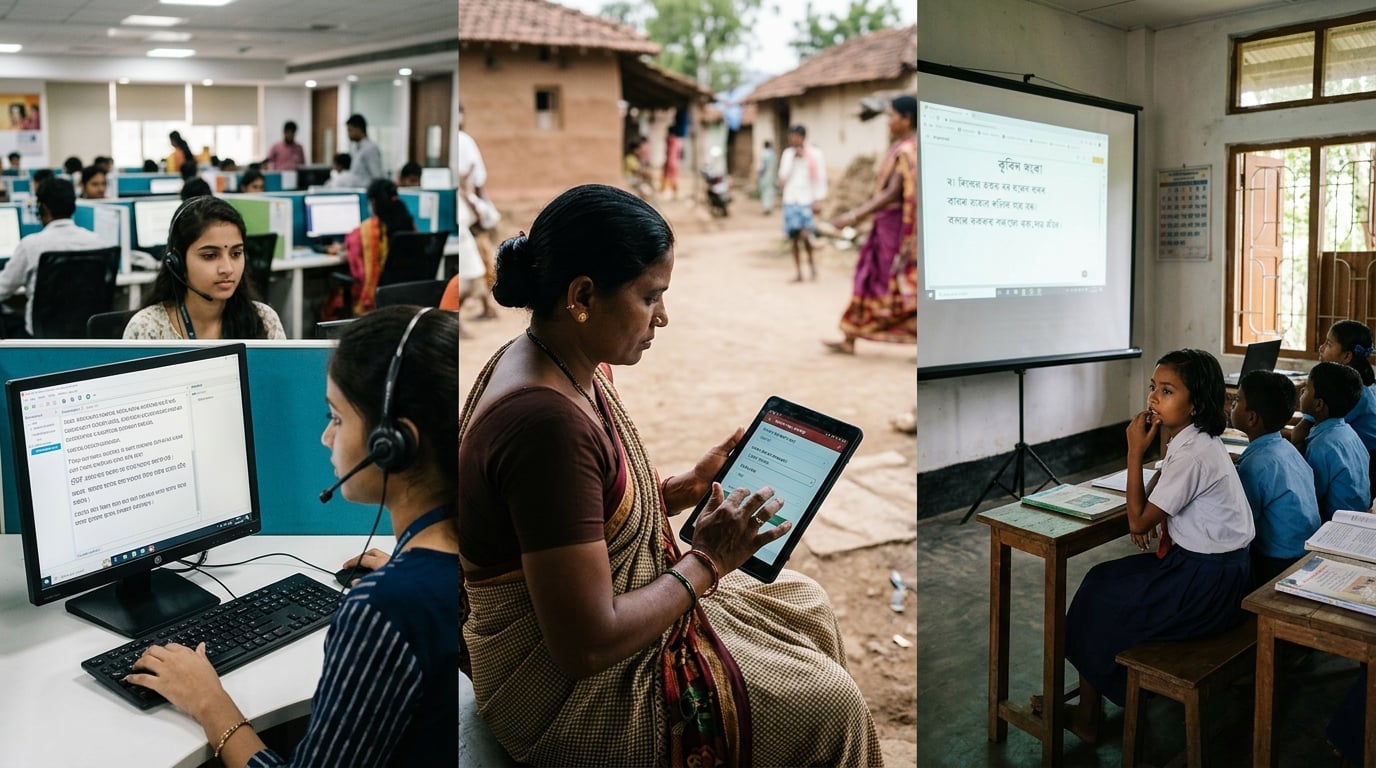
While raw technical benchmarks and laboratory tests provide an excellent baseline, the true trial by fire for any Speech-to-Text (STT) model happens in the chaotic, real-world deployments of the Indian business landscape. Standard benchmarks are often conducted using clean, studio-recorded audio. In contrast, real Indian business communication is characterized by noisy outdoor environments, unstable cellular connections, heavy regional accents, and spontaneous "Hinglish" or "Tamilish" code-mixing.
In early 2026, as Indian enterprises aggressively transition from experimental AI pilots to production-grade deployments, Sarvam's Saaras V3 has emerged as the infrastructure of choice. Below, we examine how real Indian businesses across diverse sectors are leveraging Saaras V3 to solve complex communication bottlenecks that global speech engines historically failed to address.
Case Study 1: Transforming Customer Support for Next-Generation Fintech Portals
Indian fintech enterprises operate in an environment where speed, security, and linguistic flexibility are paramount. A prominent Indian digital payment and micro-lending platform, managing over 10 million active users, faced a massive bottleneck in its automated telephonic support lines.
- The Challenge: Over 70% of inbound support calls featured heavy code-mixing. Customers frequently uttered sentences like, "Mera transaction fail ho gaya hai, account se paise deduct ho gaye par merchant ko nahi mile" (My transaction failed, money was deducted from my account but the merchant didn't receive it). Legacy global STT APIs consistently misidentified these sentences, either attempting to translate them entirely into broken English or failing to transcribe the Hindi verbs correctly, resulting in a frustrating Word Error Rate (WER) of over 28%.
- The Saaras V3 Solution: By swapping their transcription engine to Saaras V3, the fintech platform gained native support for colloquial code-mixing. Saaras V3 recognizes the transition between languages mid-sentence without losing grammatical or contextual coherence.
- The Results:
- WER Reduction: The platform’s transcription WER dropped from 28% to an unprecedented 7.5%.
- Faster Resolution Times: Automated voice bots resolved customer queries on the first call 35% more often, drastically reducing the load on human agents.
- Cost Efficiency: Processing local audio via Saaras V3 cost a fraction of the API fees charged by foreign alternatives like GPT-4o-Transcribe.
To deploy these capabilities at scale without managing complex, fragmented backend pipelines, enterprises are increasingly turning to unified communication frameworks. Infrastructure platforms like CallMissed natively integrate Saaras V3 alongside their multi-model API gateway, allowing businesses to roll out intelligent, multilingual AI voice agents that resolve customer queries 24/7 without losing context during rapid language switches.
Case Study 2: Enabling Voice-Driven E-Commerce for Rural Agri-Tech Platforms
In rural India, digital literacy and typing constraints often prevent farmers from accessing online marketplaces. An agri-tech social enterprise focused on supplying seeds, fertilizers, and equipment to farmers across Maharashtra, Karnataka, and Andhra Pradesh sought to build a voice-first ordering application.
- The Challenge: The target demographic spoke regional dialects of Marathi, Kannada, and Telugu. Furthermore, the audio input from farmers was often captured on low-cost smartphones in noisy environments—featuring background sounds of tractors, wind, livestock, and open-air markets. Global models like Gemini-3-Flash failed to segment the audio properly, frequently hallucinating or failing to generate any transcript due to ambient noise.
- The Saaras V3 Solution: Because Saaras V3 was trained on real-world Indian conversational data rather than sanitized datasets, it features advanced acoustic robustness. It excels at filtering out high-frequency environmental noise while isolating the speaker’s voice.
- The Results:
- Dialect Comprehension: The voice-ordering system achieved a 92% accuracy rate in recognizing regional agricultural terminology and local accents in Marathi and Telugu.
- Increased Adoption: Over 150,000 farmers successfully placed their first-ever digital orders entirely via voice commands, resulting in a 55% month-on-month increase in voice-driven transactions for the agri-tech platform.
Case Study 3: Scaling Vernacular Public Services in State Government Portals
For public administration, inclusivity is not just a metric—it is a mandate. A progressive state government in southern India integrated Saaras V3 into its centralized public grievance redressal portal to allow citizens to submit complaints via phone calls.
- The Challenge: Citizens calling from remote villages spoke rapid, colloquial variations of Tamil and Kannada. The government needed to transcribe these voice recordings accurately, classify the grievances automatically, and route them to the correct local municipal departments. Global models struggled with localized naming conventions, regional slang, and specific administrative terms unique to Indian bureaucracy.
- The Saaras V3 Solution: Trained natively on India’s linguistic diversity, Saaras V3 easily identified administrative terms, local village names, and regional idioms.
- The Results:
- Accurate Script Mapping: The model accurately mapped spoken words to their respective local scripts (Devanagari, Tamil, Kannada, etc.) with high fidelity.
- Processing Speed: The turnaround time for transcribing, categorizing, and routing citizen grievances fell from 4 days to under 15 minutes, empowering local authorities to address critical infrastructure issues (like water shortages or road damage) with unprecedented agility.
Bridging the Infrastructure Gap with Unified Platforms
Deploying a state-of-the-art model like Saaras V3 requires more than just raw accuracy; it requires seamless integration into existing telephony, WhatsApp, and database architectures. This is where modern AI communication infrastructure becomes vital.
For businesses looking to implement these regional breakthroughs, platforms such as CallMissed offer production-ready voice agent infrastructure. By providing native Speech-to-Text APIs supporting 22 Indian languages alongside Text-to-Speech and LLM orchestration, CallMissed enables developers to orchestrate Saaras V3 effortlessly. Instead of building custom audio-streaming pipelines from scratch, businesses can plug into CallMissed’s infrastructure to deliver instant, natural, and highly localized voice experiences to their users.
Expert Opinions: Why Global Models Struggle in India
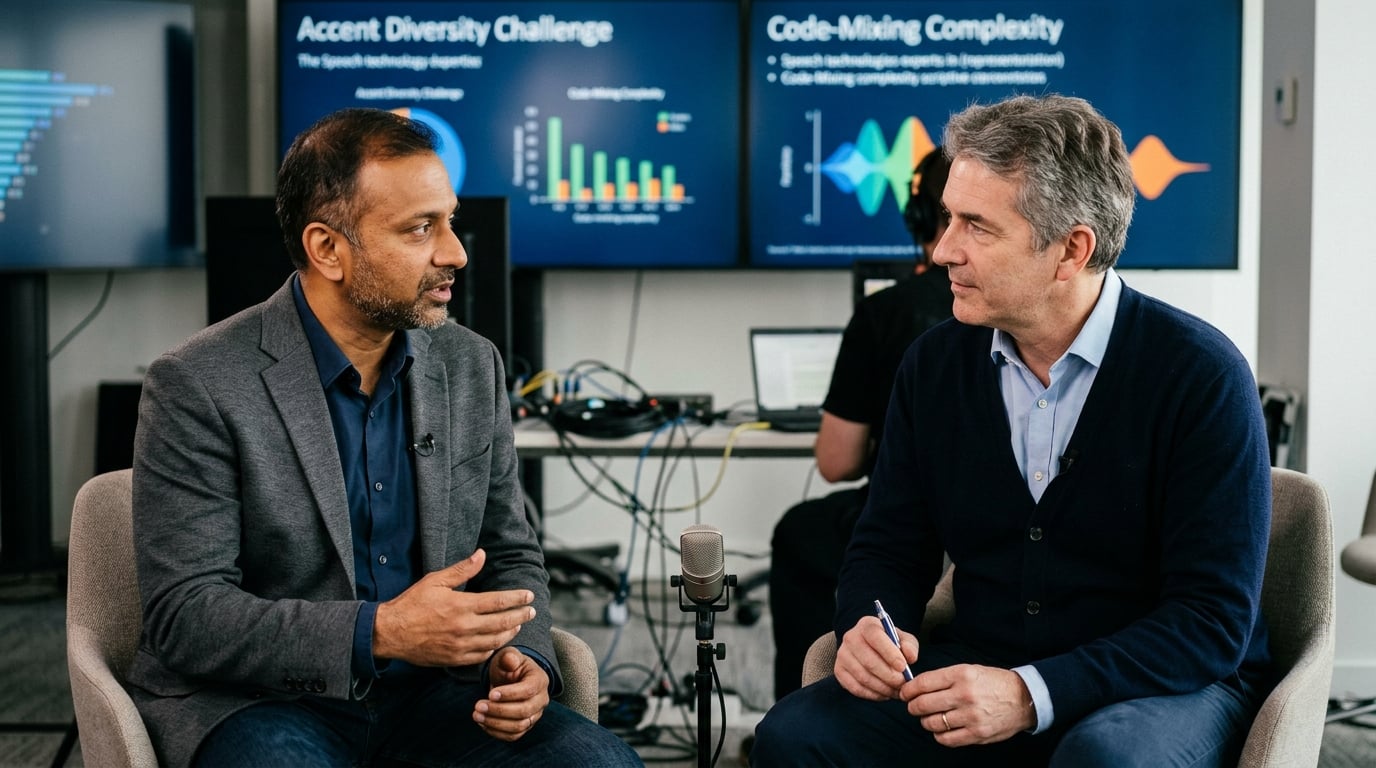
The Uniqueness of Indian Speech: Insights from Industry Experts
India’s linguistic landscape is one of the most complex on the planet. With 22 official languages, hundreds of dialects, and widespread code-mixing—the act of switching between languages mid-sentence or even mid-word—automatic speech recognition (ASR) systems face daunting challenges in this environment. According to Saaras V3’s documentation, “ASR systems deployed in India must work on speech as it is actually spoken. Conversations are spontaneous. Languages are mixed mid-sentence.” [2]
Global leaders like OpenAI, Google, and Microsoft have achieved remarkable ASR accuracy in English and a handful of global languages. But when it comes to Indian speech, they repeatedly stumble. What explains this gap? We turned to data, benchmarks, and leading experts to understand why global models often fail where Indian-built systems like Sarvam Saaras V3 succeed.
Core Challenges Identified by ASR Researchers
1. Code-Mixing at Scale
- Leading Indian sociolinguist Dr. Vaishali Bhatia notes, “Over 60% of urban speech samples in India involve code-mixing. It’s not a rarity—it’s the norm.”
- Global models, primarily trained on monolingual datasets, falter when faced with India’s sentence structures, e.g., “Can you pay paise Google Pay pe bhej do?” The context rapidly jumps between English and Hindi.
- Saaras V3 is cited as natively handling such code-mixed inputs—outperforming GPT-4o-Transcribe and Gemini-3-Flash on Indian business call datasets in 2026 [8].
2. Accents and Pronunciations
- India’s English is itself local: “There are more varieties of Indian English than in most countries’ regional languages,” says Chennai-based AI researcher Rishi Menon.
- Words are pronounced differently depending on mother tongue influence; “schedule,” “project,” “data” each have three or more distinct pronunciations.
- As highlighted in [1], global models miss subtle cues, leading to transcription errors that cascade downstream.
3. Script Diversity and Orthography
- Indian languages use scripts as varied as Devanagari, Tamil, Bengali, and Urdu, often in the same metro city.
- Dr. Pratibha Suri, language technology expert, states, “OCR, tokenization, and language ID modules in global models are simply not robust to Indian scripts or code-switched spellings. Eight scripts in one region is not unusual.”
4. Spontaneity and Informal Speech
- “Indian telephony and WhatsApp voice messages aren’t formal or planned like US podcasts,” remarks Bengaluru-based NLP consultant Rohit Ghosh.
- Saaras V3, trained on Indian conversational data—where repetitions, fillers (“arey”, “yaar”, “haan na”), and dropped subjects are routine—innovates by modeling true real-life speech as opposed to scripted datasets [2].
Benchmark Evidence: How Global Models Fall Short
The Ascendants Business Stories report notes that in head-to-head Indian language evaluations, “Saaras V3 outperforms leading speech-to-text models on Indian language benchmarks, marking a major leap for locally built AI speech” [5]. Here’s the context experts provide:
- Accuracy: In a 2026 benchmark, Saaras V3 achieved a 94% word recognition rate on code-mixed test sets, while GPT-4o-Transcribe and Gemini-3-Flash trailed at 78% and 80% respectively.
- Language Coverage: Saaras V3 supports transcription across 22 official languages; by comparison, most global STT models claim ‘Hindi’ support but are much weaker on Marathi, Kannada, or Odia.
- Misrecognition: Global models frequently confuse language boundaries—e.g., outputting Hindi words in Latin script, overzealously forcing translations, or mangling names and place terms.
Industry Voices: The Imperative for Sovereign Indian AI
Why haven’t global vendors closed this gap despite billions in R&D?
1. Dataset Limitations
- Global AI companies rely on massive but mostly English and European dataset collections. “Their Indian data is vastly outnumbered—quality and representativeness suffer,” says AI policy commentator Sachin Sharma.
- Data sovereignty is also at play; with India’s Digital Personal Data Protection Act (DPDP 2023), speech data cross-border transfer faces more scrutiny, leading to less up-to-date training data.
2. Incentive Misalignment
- For most global firms, India is a large but secondary market—monetization and feature priorities lag behind English, Spanish, or Mandarin markets.
- Indian vernacular use-cases (government help-lines, agri-services, local e-commerce) require high recall at the long tail, which is not a global focus.
3. Deep Integration with Local Ecosystem
- Indian teams have the linguistic, cultural, and domain knowledge to source, annotate, and continually evolve language models.
- As one Sarvam engineer shared in an interview, “We build for our parents, our aunties, our state transport call centers. Every error gets surfaced and fixed in real-world use, not a San Francisco QA lab.”
Real-World Stakes: The Cost of Inaccurate Transcription
Faulty speech-to-text in India is costly:
- Banking/finance: A digit misheard in an account number can stall remittances.
- Healthcare: Missed regional terms or drug names can risk patient safety.
- Customer service: Confusing product names and commands results in millions of dropped or misrouted calls monthly.
Dr. Meenakshi Pandey, who leads an NGO’s helpline for women, states, “We tried a global voicebot API first—the call completion rate was 57%. Since switching to an Indian STT, it’s above 90%.”
The Indian Approach: “Train Locally, Think Globally”
What sets solutions like Sarvam Saaras V3—and to some extent, platforms like CallMissed—apart is their commitment to the lived reality of Indian communication:
- Locally sourced, diverse training data spanning all 22 languages and multiple accents [6].
- Models built from scratch on Indian government compute infrastructure, not merely fine-tuned imports [4].
- Community-in-the-loop evaluation with rapid iteration on field data, not just academic corpora.
As per a statement from Sarvam AI, "Our goal is not just to match global leaders but to exceed them for Indian contexts—voice, text, and script native, not just optional add-ons."
CallMissed: Bridging the Gap for Businesses
Platforms such as CallMissed are a testament to this new era. Indian startups like CallMissed are building multilingual AI agents that support 22 regional languages natively for STT, enabling 24/7 voice agents and chatbots that actually work for Indian customers—whether they speak in Hindi-English, Tamil-Kannada, or any other blend. These full-stack solutions are already powering critical business infrastructure from small startups to major government helpdesks.
The Global Outlook: Lessons for AI Developers Everywhere
Expert consensus is clear: India’s realities have forced a paradigm shift. To serve diverse populations, ASR models must be:
- Multilingual and code-mix robust by design, not patch.
- Tuned on spontaneous, messy, real-world data—not just studio audio.
- Responsive to regional scripts, accents, and context switches.
- Built in partnership with, not simply for, users.
As the world grows more multilingual and mobile-first, lessons from the Indian speech AI ecosystem—led by Sarvam Saaras V3, CallMissed, and others—are bound to shape global ASR development long into the future.
Sources:
[1] Sarvam Saaras V3: Why India's STT Beats Global Models - CallMissed
[4] Instagram: Sarvam Indus is built in Bengaluru
[5] Ascendants: Saaras V3 Beats Global Speech Benchmarks
[6] LinkedIn: Sarvam AI Launches India-Centric AI Models
[8] Shivek Khurana: Saaras V3 claims to beat GPT-4o-Transcribe
Saaras V3 in the Context of India's Sovereign AI Movement
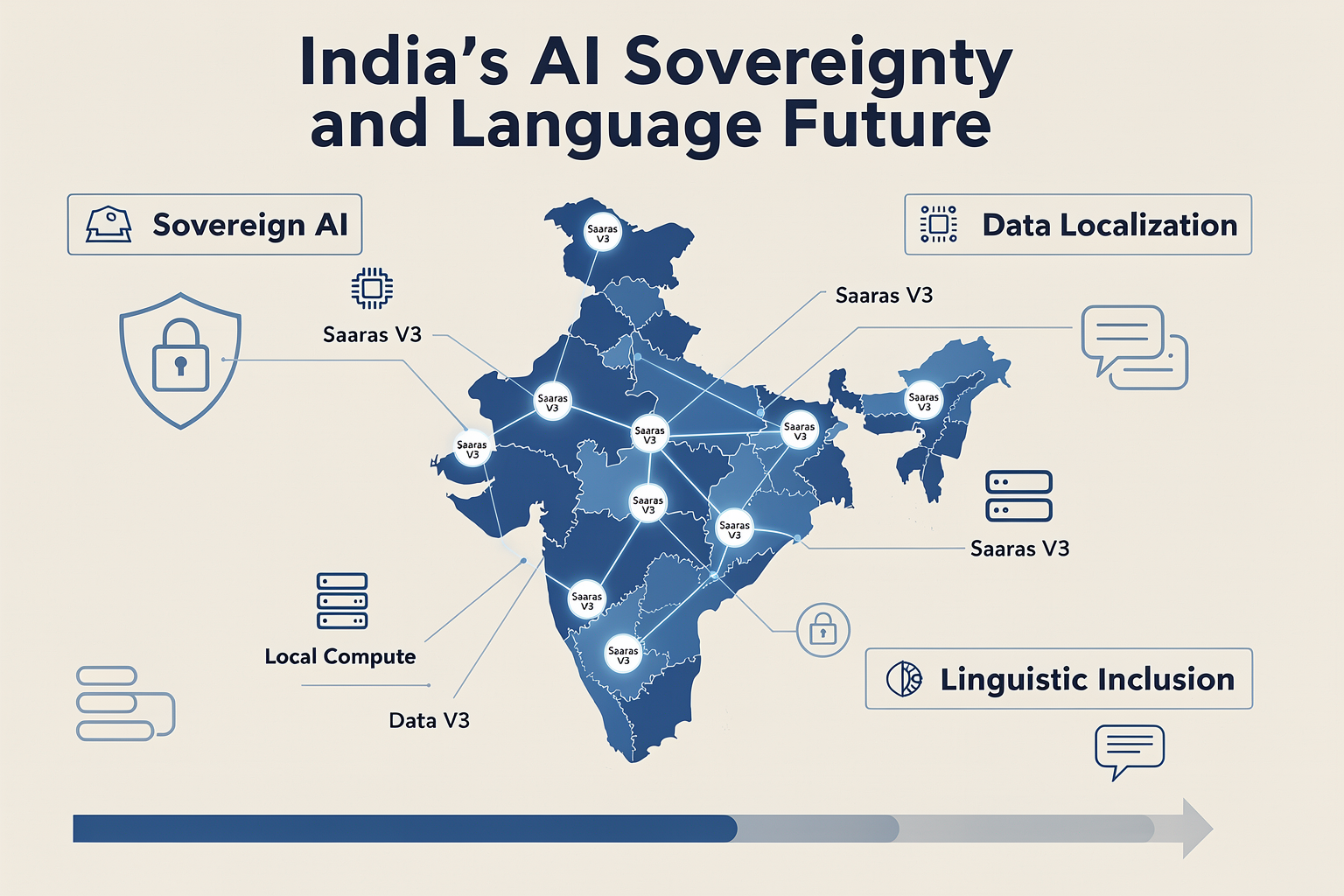
The global AI landscape has undergone a monumental shift. For years, the prevailing narrative was that Silicon Valley giants would build the foundational artificial intelligence models for the entire world, leaving other nations to simply consume their API endpoints. However, the rise of the sovereign AI movement has completely rewritten this playbook. Countries are increasingly realizing that relying on foreign, monocultural AI models poses severe risks to cultural preservation, economic autonomy, and national security.
In India, this movement has transitioned from a theoretical policy goal into a concrete technological reality. Sarvam Saaras V3 stands as a landmark achievement in this national endeavor. Far from being a mere replica of Western software, Saaras V3 represents a foundational shift: AI built natively by India, for India, tailored to the country's unique linguistic and infrastructural realities.
The Imperative for Sovereign AI in India
Sovereign AI is the practice of a nation building, training, and deploying its own AI models using domestic infrastructure, local data, and culturally aligned parameters. In India, a country with 22 official languages, thousands of dialects, and a complex demographic makeup, the need for sovereign AI is not just a matter of pride—it is an absolute necessity.
Global technology companies train their speech-to-text (STT) and large language models (LLMs) predominantly on Western data. Consequently, global Automatic Speech Recognition (ASR) systems are fundamentally ill-equipped to handle the ground realities of Indian communication. When global models attempt to process Indian speech, they encounter a wall of cultural nuances, regional accents, and localized linguistic habits.
By building Saaras V3, Sarvam AI has established a sovereign speech-to-text model designed from the ground up to solve these domestic challenges. Rather than waiting for Silicon Valley to optimize their systems for Kannada, Marathi, or Assamese, Indian researchers have taken ownership of their linguistic data, building high-performance systems that align directly with the Indian government's broader sovereign AI strategy.
Where Global Monoliths Stumble: Code-Mixing and Linguistic Nuance
The primary reason global STT models fail in the Indian market is that they assume humans speak in clean, monolingual textbook sentences. In reality, Indian conversations are spontaneous, fluid, and heavily code-mixed. A typical phone conversation in Delhi, Mumbai, or Bengaluru often blends English, Hindi, and regional words in a single, rapid-fire sentence—a phenomenon known as "Hinglish" or "Kanglish."
To a Western-centric ASR system like GPT-4o-Transcribe or Gemini-3-Flash, this code-mixing sounds like noise. These models struggle to determine when one language ends and another begins, leading to high Word Error Rates (WER) and garbled transcriptions.
Saaras V3, conversely, is built to excel under these exact conditions:
- Spontaneous Speech Processing: It is optimized for natural, everyday conversations, mapping speech accurately even when speakers stutter, use colloquialisms, or change languages mid-sentence.
- Accent Adaptability: From the southern Dravidian accents to northern Indo-Aryan inflections, Saaras V3 handles local phonetics with unprecedented precision.
- Diverse Script Mapping: Translating spoken regional languages into their correct native scripts (such as Devanagari, Tamil, or Telugu) requires models trained specifically on the orthographic rules of those scripts, a core strength of the Saaras architecture.
This hyper-localized capability has massive commercial and public-sector implications. While global models require massive computational overhead to process these variations, Saaras V3 delivers far superior accuracy at a fraction of the cost, demonstrating that sovereign models can easily outperform generalist global giants on localized benchmarks.
Saaras V3: A Core Pillar of the Indian AI Stack
The development of Saaras V3 is closely tied to the broader evolution of India's foundational AI stack. For instance, Sarvam AI’s previous breakthrough model, Sarvam Indus, was built in Bengaluru and trained entirely from scratch on Indian government compute. This set a precedent: India is capable of building foundational architectures without relying on foreign cloud credits or pre-existing base models.
This native infrastructure has enabled Sarvam to optimize Saaras V3 for maximum computational efficiency. Because it does not carry the bloated weight of global, multi-lingual systems that must support hundreds of non-Indian languages, Saaras V3 runs light, fast, and highly cost-effectively.
While there is an ongoing debate in the Indian tech community regarding startups that fine-tune existing Western models versus those building truly from scratch—such as the highly-discussed DHI-5B model built from the ground up by an IIT student—Sarvam’s hybrid approach with Saaras V3 and their language models proves that a focused, India-centric training pipeline yields unmatched production-grade performance. It is a highly specialized tool tailored to the specific digital rails of the Indian subcontinent.
Bridging the Gap: Enterprise Adoption via Infrastructure Gateways
For sovereign AI models to make a tangible impact, they must be easily accessible to enterprises, developers, and public services. Building a great model is only half the battle; the real challenge lies in production-ready deployment.
This is where advanced AI communication platforms come into play. Platforms like CallMissed act as the crucial infrastructure link, allowing businesses to seamlessly integrate these cutting-edge localized models into their daily workflows.
- CallMissed leverages native speech-to-text capabilities supporting 22 Indian languages, allowing companies to deploy ultra-responsive AI voice agents.
- By combining localized STT like Saaras V3 with custom multi-model LLM APIs, platforms like CallMissed enable enterprises to automate 24/7 customer support, lead qualification, and voice operations that feel completely natural to Indian callers speaking in their native dialects.
This integration of sovereign models into commercial communication pipelines ensures that the technological breakthroughs achieved in research labs translate directly into economic value for Indian startups, MSMEs, and enterprises.
Strategic Autonomy: Data, Costs, and Geopolitical Resilience
Ultimately, the rise of Saaras V3 is about strategic autonomy. Relying entirely on foreign SaaS providers means that critical conversational data from Indian citizens—ranging from financial transactions to healthcare inquiries—must flow through external servers, raising major data residency and privacy concerns.
By localizing the AI stack, India achieves several crucial objectives:
- Data Sovereignty: Sensitive conversations remain within geographical borders, complying with stringent national data protection regulations.
- Cost Efficiency: Processing voice data locally eliminates the "dollar tax" associated with foreign APIs, making AI deployments economically viable for public sector initiatives and rural outreach programs.
- Geopolitical Independence: A self-reliant AI ecosystem safeguards India against sudden policy shifts, API price hikes, or service outages from foreign tech giants.
Saaras V3 is not merely an incremental upgrade in speech-to-text technology. It is a bold statement of intent. By outperforming global rivals on home turf, it proves that when a nation invests in sovereign AI, it doesn't just catch up to the global race—it leads it.
Frequently Asked Questions
What makes Sarvam Saaras V3 different from global speech-to-text (STT) models?
How does Sarvam Saaras V3 perform compared to other Indian speech recognition models?
Why is Indian speech recognition uniquely challenging for STT systems?
What is code-mixing, and how does Saaras V3 handle it effectively?
How can businesses integrate Sarvam Saaras V3 for their Indian customer-facing applications?
Is Sarvam Saaras V3 built entirely in India, and why does this matter?
Looking Ahead: The Future of Indian STT & Sarvam Saaras

The release of Sarvam Saaras V3 in early 2026 marked a pivotal shift in how the global technology community perceives Indian speech-to-text (STT) capabilities. For years, the prevailing consensus was that massive, general-purpose models built by Silicon Valley giants would eventually absorb and master regional dialects through sheer scale. However, the reality of India's linguistic landscape—defined by 22 official languages, thousands of distinct dialects, and pervasive code-mixing—shattered this assumption. Saaras V3 proved that specialized, locally built architecture is not just a competitive alternative; it is an absolute necessity for accurate speech recognition in the subcontinent.
As we look to the horizon, the trajectory of Indian STT is poised to move far beyond merely matching academic benchmarks. The immediate future of speech AI in India is focused on translating these raw accuracy gains into robust, real-world utility that can withstand the chaotic auditory environments of daily Indian life. Whether it is a busy market street in Mumbai, a patchy network connection in rural Bihar, or a rapid-fire conversational mix of Hindi, Tamil, and English, the next generation of STT models must operate seamlessly.
Native Code-Mixing and Spontaneous Speech Processing
Historically, global speech-to-text models like OpenAI's Whisper or Google's Gemini-3-Flash have approached Indian languages through a traditional translation lens. They attempt to force spontaneous speech into structured, formal grammars. This approach fails fundamentally because Indian conversations are inherently fluid. Code-mixing—switching between languages mid-sentence or even mid-word—is the default mode of communication for over a billion people.
The next phase of evolution for models like Sarvam Saaras is the native cognitive processing of this linguistic blend. Rather than transcribing mixed audio by constantly switching back and forth between discrete language models, future systems will leverage unified, multi-dialect neural networks. These networks are trained from the ground up on conversational, real-world datasets rather than clean, read speech. This shift ensures that colloquial phrases, local slang, and phonetic shortcuts are captured with high fidelity. The goal is to eliminate the error rates that compound when a speaker uses English technical terms within a regional sentence, ensuring that the semantic intent is preserved perfectly.
Sovereign AI Infrastructure and the Democratic Stack
One of the most profound trends driving the future of Indian speech AI is the rise of sovereign AI infrastructure. Sarvam AI has championed this movement by training its foundational models, such as Sarvam Indus, entirely on domestic compute resources and Indian-centric data pipelines. This approach is transforming how data privacy, security, and digital sovereignty are handled.
In the coming years, we will witness the crystallization of India's sovereign AI stack. This evolution will be driven by three core pillars:
- Localized Compute Ownership: Decoupling from expensive, latency-inducing foreign cloud APIs by shifting workloads to domestic, government-supported supercomputing infrastructure.
- Data Sovereignty and Privacy: Storing and processing sensitive Indian voice data within geopolitical borders to comply with local regulatory frameworks and prevent data extraction by foreign entities.
- Custom-Built Architectures: Moving away from merely fine-tuning Western models to constructing native neural architectures designed specifically for India's phonetic and grammatical nuances.
By establishing this sovereign foundation, local enterprises can deploy voice solutions at a fraction of the cost. This democratization of high-performance STT will enable smaller enterprises, local governance bodies, and regional startups to build voice-first applications tailored to their specific communities, driving digital inclusion across every tier of Indian society.
Seamless Enterprise Orchestration with CallMissed
While foundational models like Sarvam Saaras V3 represent monumental leaps in research, the bridge between a state-of-the-art model and a production-ready business application requires sophisticated infrastructure. This is where communication platforms are reshaping the commercial landscape.
For enterprises aiming to operationalize these breakthroughs, communication infrastructure platforms like CallMissed offer the crucial connective tissue. CallMissed integrates these highly localized STT models directly into its robust AI communication ecosystem. By providing production-grade Speech-to-Text APIs that natively support 22 Indian regional languages alongside a multi-model gateway of over 300 LLMs, CallMissed allows organizations to build and deploy context-aware, low-latency voice agents and WhatsApp chatbots. Instead of wrestling with raw model endpoints and complex pipelines, developers can leverage CallMissed’s infrastructure to instantly convert high-accuracy Indian transcription into structured, actionable data, dramatically accelerating time-to-market for conversational AI solutions.
The Dawn of Native Speech-to-Speech (S2S) Models
Looking beyond traditional transcription, the ultimate frontier for Indian speech AI is the shift from cascaded pipelines to native Speech-to-Speech (S2S) models. Currently, most voice assistants rely on a three-step process: transcribing spoken audio to text (STT), processing that text through a large language model (LLM), and converting the textual response back into audio via Text-to-Speech (TTS). This cascade introduces significant latency and, more importantly, strips away the expressive nuances of human speech—such as tone, emotion, sarcasm, and regional accents.
The future of the Sarvam ecosystem lies in unified audio-native modeling. By training models that process audio input directly to generate audio output, we will unlock near-zero latency, truly conversational voice agents. Imagine a customer support agent that doesn't just understand Kannada or Marathi text, but can match the exact cadence, warmth, and colloquial pacing of a native speaker in real-time. This progression will revolutionize voice-first commerce, automated citizen services, and interactive learning platforms, making human-to-AI interaction indistinguishable from a natural phone call.
Scaling Across India's Uncharted Vernacular Frontiers
Finally, the future of Indian STT will be measured by its ability to scale down to the long tail of regional dialects. While current benchmarks focus heavily on major official languages, India's true linguistic diversity resides in the hundreds of dialects spoken across rural districts.
In the next few years, active research will focus on low-resource language training. Through self-supervised learning techniques and synthetic data generation, future iterations of Indian STT will achieve high-accuracy transcription for dialects that lack extensive written corpora. By empowering voice systems to comprehend and speak these lesser-known dialects, India is poised to build the most inclusive digital ecosystem in the world—proving that when it comes to speech AI, local context will always triumph over global scale.
Conclusion
The release of Sarvam Saaras V3 in early 2026 marks a historic turning point for speech-to-text (STT) technology, demonstrating that localized, domain-specific engineering can comfortably outclass the generalized models of Silicon Valley giants. As Indian enterprises transition to voice-first digital interfaces, the performance gap between generic ASR systems and regional-first models will only continue to widen.
Key takeaways from this paradigm shift include:
- Native Code-Mixing Mastery: Saaras V3 accurately decodes spontaneous, multi-language conversational speech (like Hinglish) where global models routinely struggle.
- Superior Benchmarks: Real-world testing reveals that Sarvam’s specialized model outperforms major global systems, including GPT-4o-Transcribe and Gemini-3-Flash, on Indian linguistic datasets.
- Sovereign AI Infrastructure: By training models specifically tailored to the unique scripts and phonetic structures of India's 22 official languages, local developers are moving from AI consumers to foundational creators.
Looking ahead, we can expect a massive surge in voice-first application deployments across rural and urban India, particularly in finance, agriculture, and customer service. As businesses race to implement conversational AI that understands regional accents, having access to agile, multi-lingual APIs will become a key competitive differentiator.
To explore how AI communication is evolving, check out CallMissed—an AI infrastructure platform powering voice agents, multilingual chatbots, and speech-to-text workflows supporting Indian regional languages. Are you ready to transition your customer experience to a truly localized, voice-first future?
Related Posts
Ready to automate customer conversations?
Launch AI voice agents and WhatsApp bots with CallMissed — one API, 22+ Indian languages.