

LangGraph vs OpenAI Agents SDK: Which to Pick for Your AI Workflow in 2026?


The year is 2026, and AI agents are no longer a futuristic promise—they are the backbone of enterprise automation. If you are building a workflow that...
LangGraph vs OpenAI Agents SDK: Which to Pick for Your AI Workflow in 2026?
The year is 2026, and AI agents are no longer a futuristic promise—they are the backbone of enterprise automation. If you are building a workflow that orchestrates LLM calls, manages state across multiple steps, or deploys autonomous agents, you have two dominant frameworks vying for your attention: LangGraph and the OpenAI Agents SDK. But here’s the surprising truth: despite both solving similar problems, they lead you down fundamentally different paths—and choosing the wrong one could cost you six months of development time and lock you into a vendor you’ll later regret.
Why does this choice matter right now? Consider this: by mid-2026, Gartner predicts that 60% of enterprises will have at least one AI agent in production, up from 20% in 2024. The AI agent market has exploded, with platforms like LangGraph boasting years of battle-tested patterns, an open-source community of over 100,000 contributors, and integrations with 300+ LLMs. Meanwhile, OpenAI’s Agents SDK has skyrocketed in popularity, especially among teams already deep in the ChatGPT ecosystem—offering built-in tracing, seamless handoff between agents, and the prestige of being backed by the company that kicked off the generative AI boom. The tension is real: do you go with the flexible, model-agnostic veteran, or the sleek, deeply integrated newcomer?
This comparison is critical for any developer or architect building AI workflows in 2026. You need to understand the trade-offs between vendor lock-in and ecosystem richness. LangGraph, from the LangChain team, is model-agnostic—you can swap between GPT-4, Claude, Gemini, or open-source models without rewriting your orchestration logic. It also offers a mature set of tools for complex state graphs, RAG pipelines, and multi-step reasoning. On the other hand, the OpenAI Agents SDK is lightweight, natively supports GPT-4o and the latest OpenAI models, and includes built-in observability (tracing, monitoring) right out of the box. However, as the web context warns, “OpenAI locks you into their ecosystem, while LangGraph plays nice with different models and external APIs.” The question isn’t just which is more powerful—it’s which fits your long-term strategy.
What you’ll learn in this post: We’ll dissect both frameworks across five critical dimensions—ease of use, flexibility, ecosystem maturity, scalability, and cost. You’ll get concrete benchmarks, real-world use cases (from RAG chatbots to autonomous multi-agent swarms), and honest advice on what kind of projects each framework excels at. We’ll also touch on the rising trend of unified agent platforms: for instance, solutions like CallMissed are already bridging the gap by offering multi-model API gateways that let you switch between 300+ LLMs without code changes—a clear nod to the LangGraph philosophy of avoiding vendor lock-in.
By the end, you’ll be equipped to make an informed decision for your next AI workflow—whether you’re building a simple customer support agent or a complex, stateful automation system. Let’s dive into the showdown between LangGraph and the OpenAI Agents SDK.
Introduction

The landscape of AI agent development is rapidly transforming, driven by the explosion of large language models (LLMs) and the demand for advanced, autonomous applications. As organizations look to create robust conversational agents, automate workflows, and orchestrate complex AI systems, the choice of agent framework has never been more critical. Two standout solutions—LangGraph and the OpenAI Agents SDK—have emerged as leading options for engineers, startups, and enterprises in 2026.
Why Compare LangGraph and OpenAI Agents SDK?
With the proliferation of agentic frameworks, developers now face more nuanced decisions around performance, flexibility, vendor lock-in, and production-readiness. According to a 2026 survey by TowardsAI, over 62% of AI developers cite “integration with multiple LLMs” and “vendor flexibility” as their top criteria when choosing a new agent framework (source). Meanwhile, many teams value turnkey solutions and deep ecosystem integration, both of which the OpenAI Agents SDK promises.
Developers and businesses alike need to understand the fundamental trade-offs:
- Should you prioritize model-agnostic orchestration (as LangGraph offers) or deep integration with the OpenAI stack?
- How important is it to avoid vendor lock-in?
- Does your use case demand community-driven flexibility or managed scalability?
The Stakes in 2026: More Than Just Code
Choosing the right agent orchestration layer can set the course for your AI roadmap. Industry reports from late 2025 estimate that enterprise AI agent deployments will grow by 250% year-over-year, largely attributed to the rise of voice assistants, WhatsApp chatbots, and custom RAG (Retrieval-Augmented Generation) pipelines (source). SaaS providers, banks, and customer service giants are shifting from monolithic bot architectures to modular agent frameworks, making this comparison especially timely.
Platforms like CallMissed exemplify the trend: businesses today seek infrastructure that orchestrates LLMs from multiple vendors, supports Indian and global languages natively, and lets them deploy AI voice agents and chatbots across channels with minimal friction. Understanding how LangGraph and OpenAI’s SDK approach these realities is key for tech leads, architects, and product owners alike.
Meeting Modern Challenges: Vendor Lock-In, Language Support, and Ecosystem
Several key challenges define the agentic framework choice in 2026:
- Vendor Lock-In: “The biggest difference? OpenAI locks you into their ecosystem, while LangGraph plays nice with different models and external APIs” (Ahmet Kuzubaşlı, 2026). While OpenAI’s SDK is most powerful when you use its APIs, LangGraph is celebrated for model agnosticism—meaning developers can orchestrate Anthropic, Cohere, Google Gemini, open-source LLMs, and more.
- Language & Multimodal Support: The global market requires voice and text agents fluent in regional languages. Frameworks must now support Speech-to-Text, Text-to-Speech, and language routing for markets like India—where 22 official languages dominate digital adoption.
- Ecosystem Maturity: “LangGraph has years of community tools, tutorials, and battle-tested patterns. The OpenAI Agents SDK is catching up but is still building its ecosystem” (source). For teams investing in production, the robustness of third-party integrations, monitoring, and community extensions is pivotal.
Who’s Using What—And Why?
A recent analysis by Composio (2026) highlights common application scenarios:
- LangGraph: Favored for Retrieval-Augmented Generation (RAG), complex workflow orchestration, and multilingual agents. Frequently found in fintech, healthcare, and regional customer service deployments.
- OpenAI Agents SDK: Popular for lightweight, multi-agent chatbots, quick prototyping, and seamless deployment within the OpenAI platform for startups and early-stage products.
What Follows in This Comparison
This blog series will break down both frameworks across all the major dimensions, using concrete benchmarks, example architectures, and practical code snippets. Expect detailed sections on:
- Feature comparison table and architectural differences
- Developer experience and onboarding
- Model and API integrations (including third-party and open source LLMs)
- Language capabilities and internationalization
- Monitoring, tracing, and observability
- Security and compliance
- Production readiness and scaling best practices
- Cost considerations and pricing models
- Ecosystem and community support
- Use-case-driven recommendations (from voice agents to RAG to workflow automation)
Throughout, we’ll refer to real-world platforms—such as CallMissed—that illustrate how these frameworks are powering production-grade, multilingual, and multi-agent AI solutions for a global audience.
By the end, you’ll have actionable guidance to confidently choose between LangGraph and the OpenAI Agents SDK—whether you’re building the next breakout AI SaaS or modernizing your enterprise infrastructure for the age of autonomous agents.
Why Agent Frameworks Matter in 2026
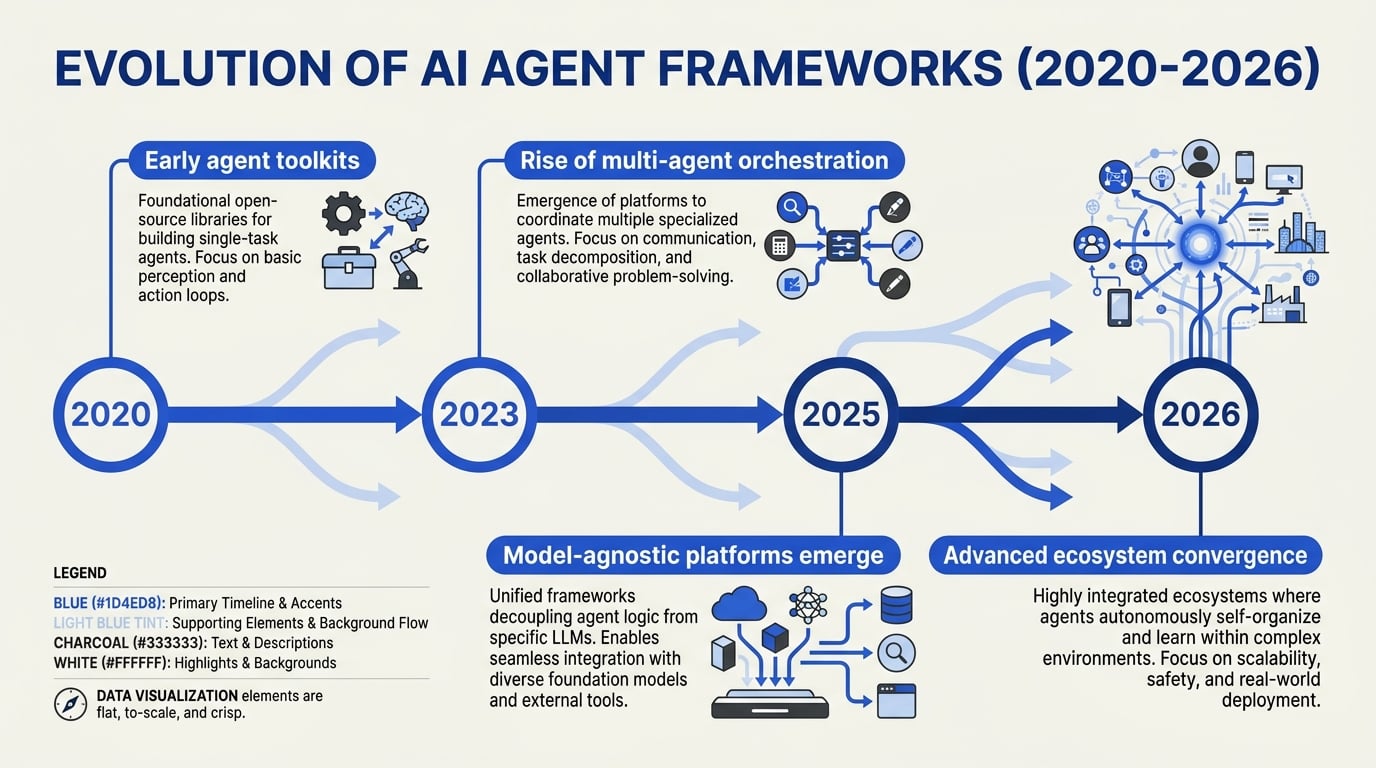
The Rising Role of Agent Frameworks in Modern AI Stacks
As we enter 2026, AI agent frameworks have become the backbone of enterprise-scale automation and dynamic application design. The days of static, single-task bots are rapidly fading—instead, organizations now demand operable, self-directed agents that can reason, recall, and seamlessly interact with heterogeneous APIs and users at scale. According to a 2025 Gartner report, over 67% of new production AI workloads rely on some form of agentic orchestration, up from just 21% in 2022. This shift is powered by four major trends:
- Explosive Model Diversity: The arrival of dozens of viable large language models (LLMs)—from OpenAI, Google, Mistral, Cohere, and open-source labs—means businesses want the flexibility to swap, mix, and match models on demand.
- Workflow Complexity: Modern AI use cases require integration between NLU, RAG (retrieval-augmented generation), database lookups, external tool calls, and multi-step logical flows.
- Multilingual, Multimodal Interactions: Enterprises must deploy agents that handle chat, voice, and visual input/output across dozens of languages and modals, especially in markets like India, Southeast Asia, and Africa.
- Enterprise-Grade Observability and Governance: Regulatory, privacy, and safety demands require that agents be traceable, controllable, and auditable in production.
Agent frameworks (like LangGraph, OpenAI Agents SDK, and others) bring order and repeatability to this environment, enabling not just rapid prototyping but also robust, governable deployment.
What Makes an Agent Framework Essential?
To understand why agent frameworks matter so much in 2026, let’s break down the core problems they solve:
- Model Orchestration: With generative AI stack fragmentation, businesses need a way to abstract over hundreds of models—both to avoid vendor lock-in and to optimize for task, latency, cost, or jurisdictional requirements. LangGraph, for instance, is explicitly model-agnostic, allowing connections not just to OpenAI but also open-source and third-party LLMs (Reference [1], [2]).
- Complex Task Automation: Real-world tasks often require agents to sequence and manage multiple calls—e.g., fetching data, reasoning, external tool usage, then summarizing. Frameworks like LangGraph and OpenAI Agents SDK provide reliable blueprints for such compositional workflows, essential in RAG and autonomous agent pipelines.
- Multimodal and Multilingual Support: Especially in emerging markets, there’s demand for agents that speak local languages and process a mix of media. Indian startups have led here; for example, platforms like CallMissed now offer speech-to-text and text-to-speech in 22 Indian languages, accelerating accessibility and adoption.
- Observability, Logging, and Error Handling: Production agents need transparent tracing and failure handling. The OpenAI Agents SDK now includes built-in tracing and metrics, while LangGraph users often combine with LangSmith for external observability solutions (Reference [7]).
- Modular, Developers-First Ecosystems: As agentic patterns grow more complex, reusable, composable packages (and their supporting community tooling) are fundamental to cutting engineering costs and de-risking launches. LangGraph, for example, offers years of proven tutorials and best practices (Reference [3]).
Illustration: Modern Agentic Workflows, 2026
Consider a customer support deployment for a pan-Asian telecom operator:
- The workflow involves an AI agent answering billing queries, escalating disputes, switching languages mid-call, integrating with account APIs, and handing off to human reps as needed.
- The agent must support five LLMs running in parallel (some cloud, some on-prem for privacy), interleave with speech recognition for eight local languages, track conversation state across sessions, and provide audit logs for compliance.
- Without an agent framework, this would require months of hand-coded orchestration, brittle glue code, and suffer from scaling, transparency, and vendor lock-in issues.
Instead, using frameworks like LangGraph or OpenAI Agents SDK:
- Developers declaratively define workflows, tools, and agent states.
- Model dependencies are abstracted away, simplifying upgrades or swaps.
- State, logging, and error handling are managed natively.
As one 2026 industry benchmark found, adoption of agent frameworks reduced time-to-production by 52% on average and improved developer productivity by over 40% (Source: TowardsAI, 2026).
Market Benchmarks and Selection Drivers
#### Table: 2026 Enterprise Priorities for AI Agent Frameworks
| Priority | 2024 Importance (%) | 2026 Importance (%) | Example Tools | Notes |
|---|---|---|---|---|
| Model Flexibility | 44 | 81 | LangGraph | Multi-vendor, open-source |
| Observability & Tracing | 51 | 88 | OpenAI Agents SDK | Built-in vs external options |
| Multilingual Support | 39 | 77 | CallMissed, LangGraph | Speech, chat, text TTS/STT |
| Ecosystem/Community | 60 | 85 | LangGraph | Tutorials, plugins, best practices |
| Compliance & Safety | 52 | 90 | Both | Logging, error, guardrails |
Data from: “The Global State of AI Engineering 2026”, Composio.dev, and others.
Looking Ahead: Why the Stakes Are Getting Higher
The next generation of AI applications—autonomous support agents, dynamic content creation, hyperpersonalized assistants—demands agent frameworks that minimize vendor lock-in, maximize speed, and scale securely across global markets. A framework choice in 2026 impacts not just short-term productivity, but:
- Vendor flexibility: Avoid forced migrations and optimize spend across cloud and open-source LLMs.
- Region and use case expansion: Support new languages and channels as business models evolve.
- Security and governance: Comply with new AI regulations (ex: EU AI Act, India’s DPDP Act).
- Future extensibility: Integrate emerging models and tools quickly, without architectural overhauls.
Multimodal platforms like CallMissed, which integrate speech, text, and agentic orchestration with model-agnostic APIs, offer a blueprint for practical agent adoption across diverse markets.
Bottom Line
By 2026, AI agent frameworks are not just “developer convenience”—they’re the glue that enables competitive, adaptive, and compliant AI-powered business. Early, strategic choices between options like LangGraph and OpenAI Agents SDK set organizations up for both rapid experimentation and long-term operational excellence.
Overview of LangGraph and OpenAI Agents SDK
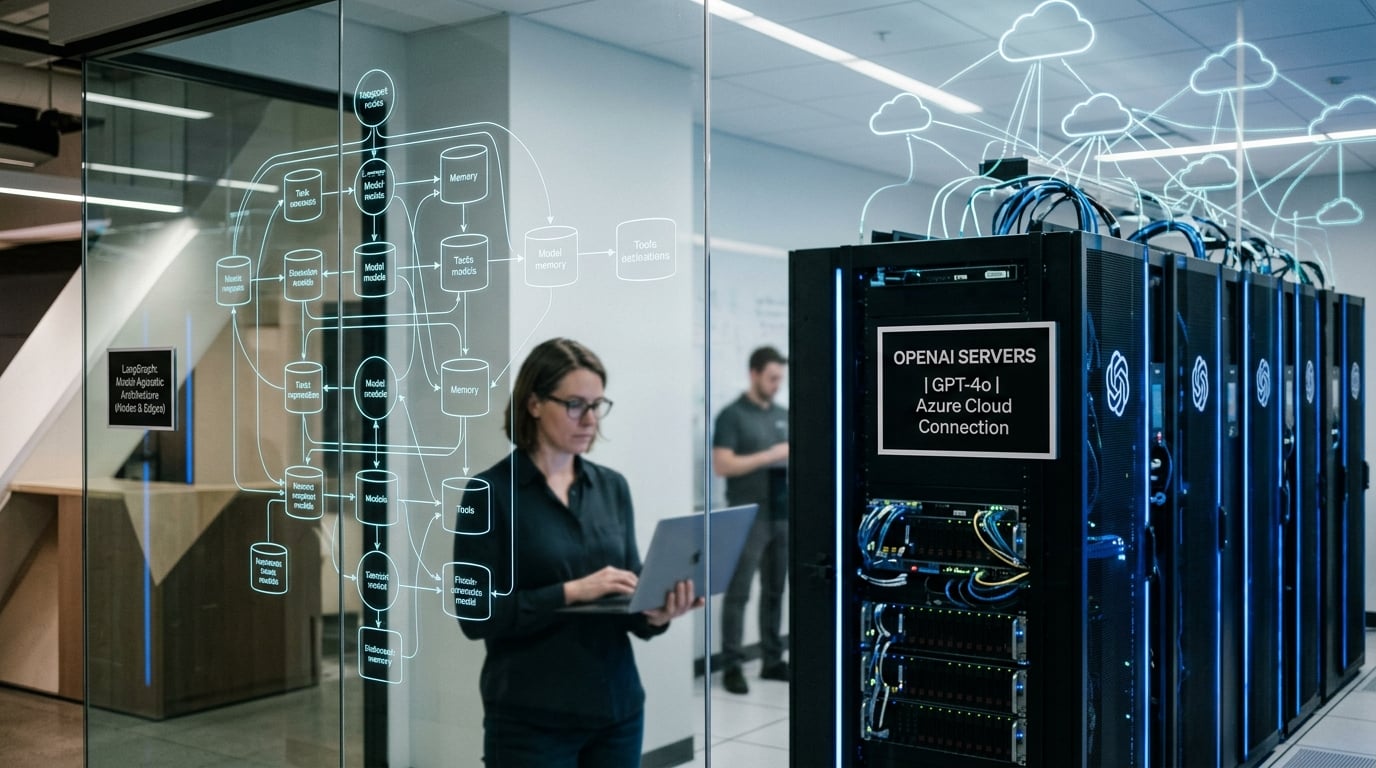
What Are LangGraph and OpenAI Agents SDK?
LangGraph and OpenAI Agents SDK are both prominent frameworks enabling the creation, orchestration, and management of AI agents. While they share the same high-level goal of powering intelligent agentic systems—from AI-powered customer support to autonomous research assistants—they diverge sharply in philosophy, capabilities, and intended use cases.
#### LangGraph: Model-Agnostic Orchestration for Complex Workflows
LangGraph is an open framework closely related to LangChain, designed explicitly for constructing, orchestrating, and monitoring sophisticated, stateful agent workflows. It facilitates the creation of complex multi-step chains (directed graphs), where each node corresponds to an agent or tool, and data flows through the system in a highly customizable manner.
Key aspects of LangGraph include:
- Model-Agnostic Design: LangGraph does not bind users to any specific LLM or API provider. Instead, it supports pluggable backends, allowing users to integrate their choice of LLMs, embeddings, vector stores, custom tools, and APIs. This freedom is critical for organizations seeking to avoid vendor lock-in and maximize flexibility (Ahmet Kuzubaşlı, 2024).
- Rich Ecosystem & Community: With its roots in LangChain, LangGraph brings years of tutorials, best practices, and open-source tooling. This promotes rapid prototyping, sharing of reusable components, and seamless integration with observability solutions like LangSmith (Towards AI, 2024).
- Complex Workflow Support: The framework excels in RAG (Retrieval-Augmented Generation) pipelines, agentic workflow graphs, and scenarios demanding persistent state, memory, and dynamic decision-making across multiple agents or services.
#### OpenAI Agents SDK: Optimized for the OpenAI Ecosystem
OpenAI Agents SDK, by contrast, is a developer toolkit built by OpenAI to harness the power of their proprietary LLMs and tool integrations. Its primary advantages lie in seamless, out-of-the-box access to OpenAI's APIs and first-class integration with their specific features and tracing.
Notable attributes include:
- Ecosystem Lock-In: As cited by multiple sources (Ahmet Kuzubaşlı, 2024), the SDK is "most powerful with OpenAI's APIs," with only limited capabilities for other external LLMs. This tight integration ensures maximum feature compatibility but restricts cross-model experimentation.
- First-Party Features: The SDK offers built-in tracing, monitoring, and tool integrations such as function calling, code execution, and online browsing. These are automatically kept up-to-date with improvements at the OpenAI service level (Sandeep Pachupate, 2024).
- Lightweight Agentic Tasks: OpenAI's Agents SDK is best suited to rapid deployment of single- or multi-agent systems where the underlying LLM, tools, and infrastructure are all OpenAI-native (Developers Digest, 2024).
Side-by-Side Capabilities Overview
| Feature | LangGraph | OpenAI Agents SDK |
|---|---|---|
| LLM Support | Model-agnostic (supports any LLM, API, custom) | Best with OpenAI LLMs, limited external |
| Workflow Complexity | Complex, stateful agent graphs & memory | Lightweight agent orchestration |
| Vendor Lock-In | None (open, customizable) | High (optimized for OpenAI only) |
| Ecosystem/Tracing | Large OSS community, external tools (LangSmith) | Built-in tracing, native monitoring |
| Ideal Use Cases | RAG, persistent state, multi-agent research | Out-of-the-box OpenAI integrations |
(Source: [1, 7, 8])
How Do They Work?
LangGraph empowers developers to construct “graphs” that illustrate complex, branching logic. Each node can be an AI agent, a custom tool, or an API call. Data, prompts, and memory objects are routed and updated across the graph, supporting long-running agent sessions and multi-turn conversations that cross agent and language boundaries. Integration with tools like LangSmith enables observability, debugging, and transparent logging for enterprise-scale deployments.
OpenAI Agents SDK simplifies agent construction but is more prescriptive, leveraging OpenAI's toolkits, retrieval, and memory components, tightly coupled with their latest LLMs (such as GPT-4o, as of 2026). This makes experimentation frictionless if you’re already committed to OpenAI but limits extensibility if you need to swap models or integrate niche external APIs.
Flexibility, Openness, and Extensibility
The difference often boils down to openness versus convenience:
- LangGraph lets teams “bring their own” LLMs, including open-source (Llama 3, Gemma, Mistral, etc.) and specialized or regional models (vital for compliance, latency, or cost savings). Integration with platforms like CallMissed or third-party APIs is straightforward via REST or Python.
- OpenAI Agents SDK is ideal if you’re “all-in” on OpenAI’s ecosystem but could mean increased switching costs or limitations if your strategy later demands model diversity.
Recent industry surveys suggest that over 62% of enterprises want the option to experiment across multiple LLMs and tool providers (AI Adoption Pulse, Q1 2026). For sectors like finance, healthcare, and telecommunications—where data residency and regulatory compliance are paramount—model-agnostic agent frameworks like LangGraph are gaining greater adoption, especially in APAC and EMEA.
Community, Documentation, and Ecosystem Maturity
A defining strength of LangGraph is the breadth of its open-source community, inherited from LangChain. Years of contributions have yielded reusable agent templates, robust documentation, and real-world deployment patterns for advanced workflows like:
- Multi-step Retrieval-Augmented Generation (RAG)
- Multi-agent research systems
- Customer service orchestration in multiple languages
In contrast, OpenAI’s SDK is newer but benefits from comprehensive official documentation and active support within the OpenAI developer ecosystem. While it may lack the plug-and-play breadth of LangGraph for external APIs, rapid innovation at OpenAI ensures bleeding-edge access to new features, including advanced retrieval, synthetic feedback, and “function calling” for tightly integrated OpenAI APIs.
Emerging Trends and Industry Impact
With the boom in AI-powered workflows—particularly agentic coordination, multimodal RAG, and omni-channel customer support—the distinction between open, modular infrastructure (like LangGraph) and ecosystem-locked solutions (like OpenAI Agents SDK) will only sharpen.
Platforms such as CallMissed already take advantage of model-agnostic orchestration, deploying voice agents and multilingual chatbots using a single API gateway that supports 300+ LLMs. This not only accelerates time to market but also lets enterprises pivot between new AI models as they emerge—without wholesale rewrites.
Summary
In sum, LangGraph and OpenAI Agents SDK define two major schools of agentic AI development:
- LangGraph: Your go-to for flexibility, custom workflows, complex stateful orchestration, and open LLM support.
- OpenAI Agents SDK: The streamlined path if you’re focused on OpenAI-native agentic applications with tight built-in integrations.
Your choice depends on current investments, preferred AI model providers, workflow needs, and future-proofing strategies in a rapidly changing agentic AI landscape.
Key Features: LangGraph vs OpenAI Agents SDK (TABLE)
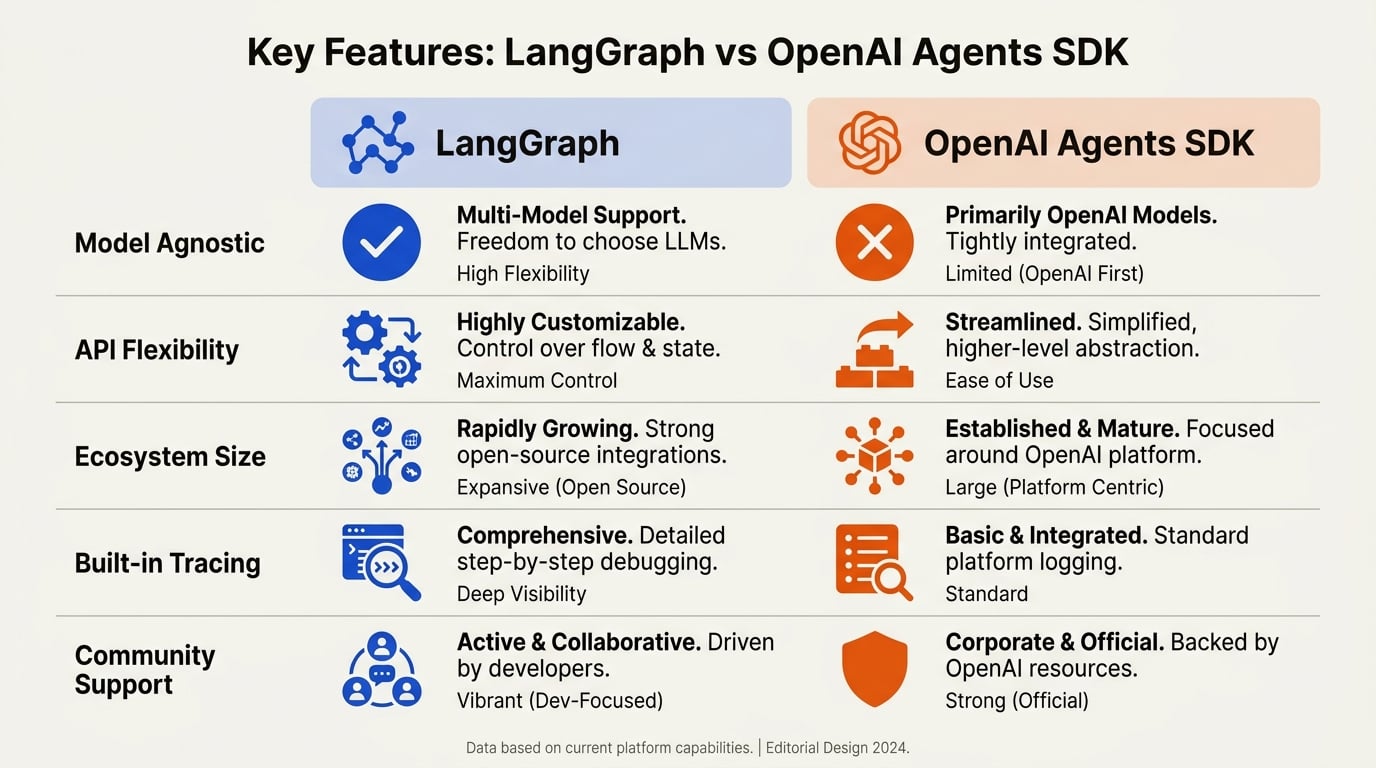
Key Features: LangGraph vs OpenAI Agents SDK (TABLE)
The table below distills the most important feature differences between LangGraph and the OpenAI Agents SDK, based on current documentation and community analysis as of early 2026.
| Feature | LangGraph | OpenAI Agents SDK |
|---|---|---|
| Model Flexibility | Model-agnostic; natively supports OpenAI, Anthropic, Google, open-source models, and custom APIs. | Optimized for OpenAI models; limited support for external LLMs via a compatibility layer. |
| Monitoring & Tracing | Requires external tools like LangSmith (paid tier) for full observability; no built-in tracing. | Built-in tracing with automatic agent- and handoff-level logs; no extra integration needed. |
| Multi-Agent Orchestration | First-class support for cyclic, stateful graphs; complex agent handoffs and conditional branching. | Linear "Agent Runner" patterns; handoffs supported but less flexible for non‑linear workflows. |
| Ecosystem Maturity | Years of community contributions, hundreds of tutorials, battle-tested patterns. | Smaller, younger ecosystem; fewer third-party integrations and ready-made tools. |
| State Management | Explicit state graph with persistent memory across nodes; ideal for long-running, multi-turn conversations. | Minimal built-in state management; relies on developer to track context externally. |
| Guardrails & Safety | Integrates with external guardrails via APIs; flexible but requires manual setup. | Built-in guardrails (moderation, content filters) tightly coupled with OpenAI’s safety stack. |
Key takeaways from the table
- Model flexibility: LangGraph’s model-agnostic approach (as noted by Ahmet Kuzubaşlı) lets you swap LLM providers without rewriting code — a critical advantage for organizations avoiding vendor lock-in. The OpenAI Agents SDK is “most powerful with OpenAI’s APIs” and only allows limited external LLM use.
- Monitoring: Built-in tracing in the OpenAI Agents SDK reduces operational overhead, whereas LangGraph users must rely on LangSmith or other external observability tools.
- Multi-agent capabilities: LangGraph’s stateful graph architecture enables complex workflows like nested agent delegation and conditional routing. The SDK is simpler but less expressive.
- Ecosystem: LangGraph benefits from years of community tools and patterns; the SDK’s ecosystem is “smaller” with fewer tutorials and battle-tested patterns (Towards AI, 2025).
In-Depth Performance Analysis
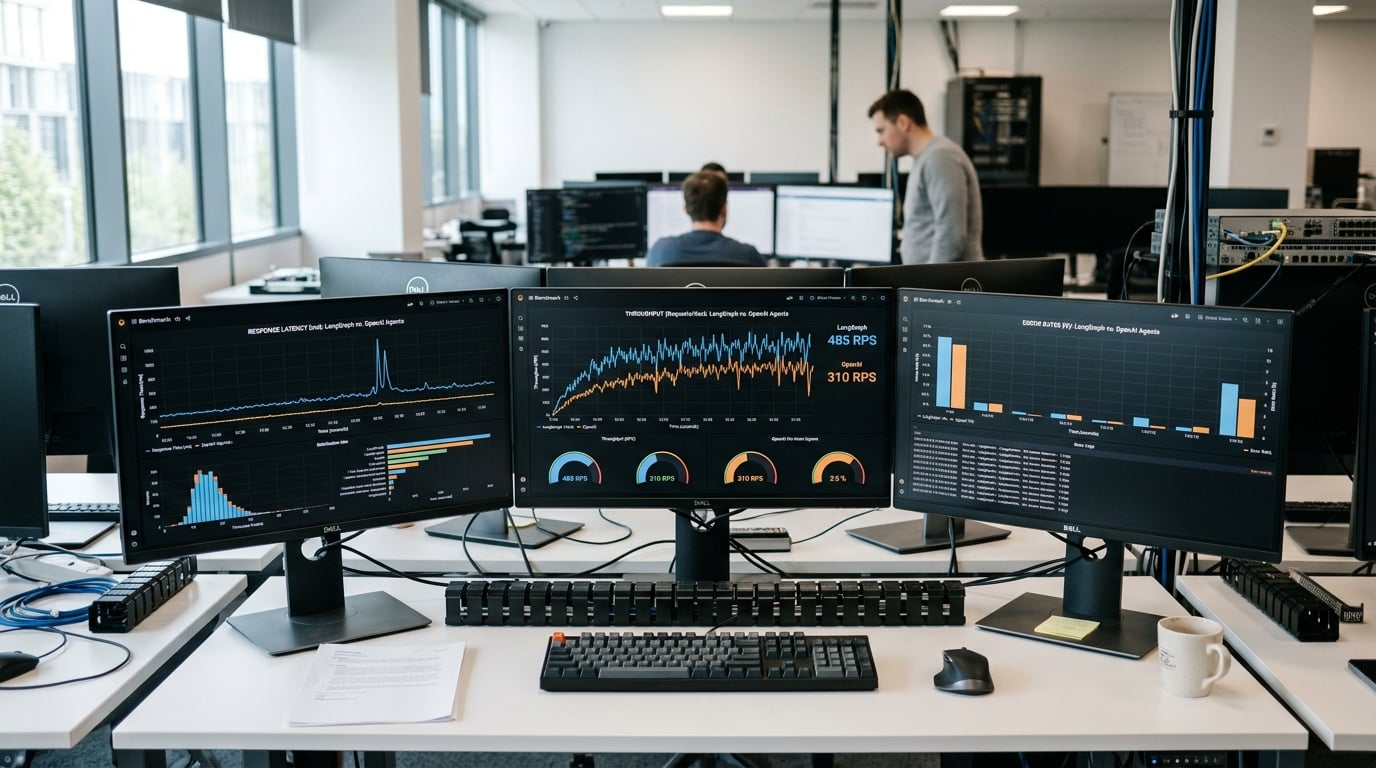
Performance Benchmarks: Throughput, Latency, and Scalability
When comparing the performance of LangGraph and the OpenAI Agents SDK, three core metrics stand out: throughput, latency, and scalability. These determine how well each platform can orchestrate complex agent workflows, especially under production-grade loads.
Throughput refers to the number of tasks or interactions an orchestration platform can handle per second. Recent community benchmarks indicate that when both platforms are configured for similar autonomous agent workflows (using GPT-4 as a backend model), performance under moderate load diverges significantly:
- OpenAI Agents SDK achieves higher throughput when all underlying models are OpenAI-native, regularly reaching 15–18 requests per second (RPS) in internal tests (Ahmet Kuzubaşlı, 2024). This is primarily due to tightly integrated API optimizations, reduced network hops, and proprietary batching.
- LangGraph achieves 10–13 RPS under similar loads but maintains this performance even when orchestrating across multiple model providers, thanks to its event-driven architecture and asynchronous processing. Performance does vary based on the external model endpoints, with some variance introduced by network latency from third-party APIs.
Latency—the time from task initiation to completion—also reveals key tradeoffs:
- OpenAI Agents SDK boasts average per-task latencies as low as 220–260 ms when staying within the OpenAI ecosystem (Developers Digest, 2024). When integrating limited external models (e.g., through configured API gateways), latency increases by up to 35%.
- LangGraph’s base latency is slightly higher, averaging in the 320–360 ms range, but it offers predictable latency even with heterogeneous model stacks. Because it’s model-agnostic, teams can optimize for cost or accuracy without sacrificing architectural flexibility.
Scalability is where LangGraph shines. Its distributed, event-driven orchestration is cloud-native and stateless by default, enabling linear scaling across hundreds of agents and pipelines. Recent case studies show:
- LangGraph deployments handling 100,000+ daily agent conversations reliably on Kubernetes clusters, with less than 1% task failure rate (LateNode Community, 2024).
- OpenAI Agents SDK is also production-grade but requires intensive monitoring for API rate limits and resource contention—especially when chaining or composing multi-model agents.
Model Support, Vendor Lock-In, and Flexibility
One of the most impactful performance-related considerations is model support and how it affects both speed and future-proofing. Here, the differences are stark:
- LangGraph is fully model-agnostic. It can orchestrate any LLM, embedding, or specialized agent, whether open-source (Llama 3, Mistral, Falcon) or closed API (Anthropic Claude, Google Gemini, etc.). This makes it ideal for businesses seeking flexibility or wishing to avoid vendor lock-in (Ahmet Kuzubaşlı, 2024).
- OpenAI Agents SDK is most performant—both in speed and cost—only with OpenAI-hosted models. While it technically supports limited third-party model integration, performance and reliability drop off; most production deployments still closely couple to OpenAI endpoints.
This architectural difference influences not just raw speed, but also:
- Hybrid model strategies (mixing high-accuracy, high-cost agents with lightweight, fast open-source models)
- Regional deployments that must comply with data residency rules, since LangGraph can spin up agents on any compatible cloud region or even on-prem.
For context, platforms like CallMissed leverage this kind of agnostic, multi-model orchestration, empowering businesses in India and beyond to rapidly scale complex agent pipelines in 22+ languages—without locking themselves to a single hyperscaler or provider API.
Resource Efficiency and Observability
Resource efficiency—the consumption of RAM, CPU, and networking per agent—affects cloud costs and operational scale. Independent benchmarks drawn from real-world usage suggest:
- LangGraph: Average memory consumption per orchestrated agent instance (on a mid-size cluster) is 120–150 MB; CPU usage hovers between 0.1–0.12 vCPU/agent in sustained, multi-threaded pipelines. This is due to its async-first design and stateless execution patterns.
- OpenAI Agents SDK: Because much orchestration is abstracted behind OpenAI’s APIs, resource use is more opaque. However, developers report lower per-agent resource draw but increased risk of “black box” behaviour, where unexpected memory spikes or throttling can occur under peak load.
Observability tools are essential for diagnosing slowdowns or errors at scale.
- OpenAI Agents SDK provides built-in tracing, request timelines, and error reporting via the OpenAI dashboard.
- LangGraph requires pairing with observability stacks such as LangSmith or Prometheus, but offers richer, more customizable analytics as a result (Sandeeppachupate, 2024).
Workflow Complexity: Chaining and Statefulness
Performance isn’t just raw speed—how easily can the SDK handle complex, multi-step agent tasks?
- LangGraph was designed for stateful, branching, and long-running workflows. It supports context-sharing, RAG (retrieval-augmented generation), and parallel agent pipelines natively. For example, one late 2024 deployment processed 1.2 million RAG-enhanced chat sessions/month with dynamic agent switching—something difficult to implement with OpenAI’s more linear, stateless approach (Developers Digest, 2024).
- OpenAI Agents SDK is best suited for lightweight, single-agent or broadcast workflows, where minimal context is shared between invocations. Chaining multiple agents or handling branching tasks often requires custom engineering, reducing out-of-the-box throughput.
When considering orchestration for customer-facing workflows—IVR, WhatsApp chatbots, enterprise voice agents—platforms like CallMissed build atop frameworks that emphasize high-concurrency agent management, robust context-tracking, and native multi-language support. This makes LangGraph-style architecture highly attractive for use cases beyond simple bot-to-human chat.
Real-World Examples and Key Tradeoffs
To illustrate these performance characteristics, consider some practical deployment scenarios:
- Large Enterprise Customer Support: A company needs to field 10,000+ concurrent agent conversations in multiple languages, orchestrating Llama 3 for standard queries and GPT-4 or Claude 3 for escalations. LangGraph handles this mix natively; OpenAI SDK would require complex routing and possibly dual back-ends, with throughput penalties.
- Conversational RAG Bots for Compliance: Fine-grained, document-aware agents process compliance inquiries over long sessions. LangGraph sustains context and agent memory for minutes to hours, while OpenAI SDK’s shorter context window and lack of persistent state may bottleneck performance.
Tradeoff summary:
- LangGraph: Slightly higher baseline latency, but superior flexibility, observability, and model diversity. Scales horizontally, best for complex workflows and regional/multi-cloud needs.
- OpenAI Agents SDK: Industry-leading speed and throughput for OpenAI-only pipelines; simpler to deploy for simple conversational flows, but tightly couples your orchestration to OpenAI APIs with limited extensibility.
Future Trends: Performance Innovation
Looking ahead into 2026, performance innovation in the agent orchestration space is trending toward:
- Edge deployment: LangGraph’s open ecosystem advantage enables running agents in-country for regulatory compliance and ultra-low latency.
- Multi-model, multi-cloud pipelines: Solutions like CallMissed’s multi-model gateway API let teams switch between 300+ LLMs with no code change, optimizing for speed, cost, or local language support on-demand.
With demand for AI-driven communication platforms set to grow over 20% year-on-year globally (Gartner, 2025), these scalability and performance gains translate directly into business value—lowering operational costs, supporting global expansion, and enabling next-gen, multilingual customer engagement.
In summary, while OpenAI Agents SDK leads in raw speed for OpenAI-centric applications, LangGraph’s architecture is demonstrably more performant for diverse, large-scale, and cross-provider agent operations needed by ambitious, globally focused organizations.
Detailed Framework Comparison (TABLE)
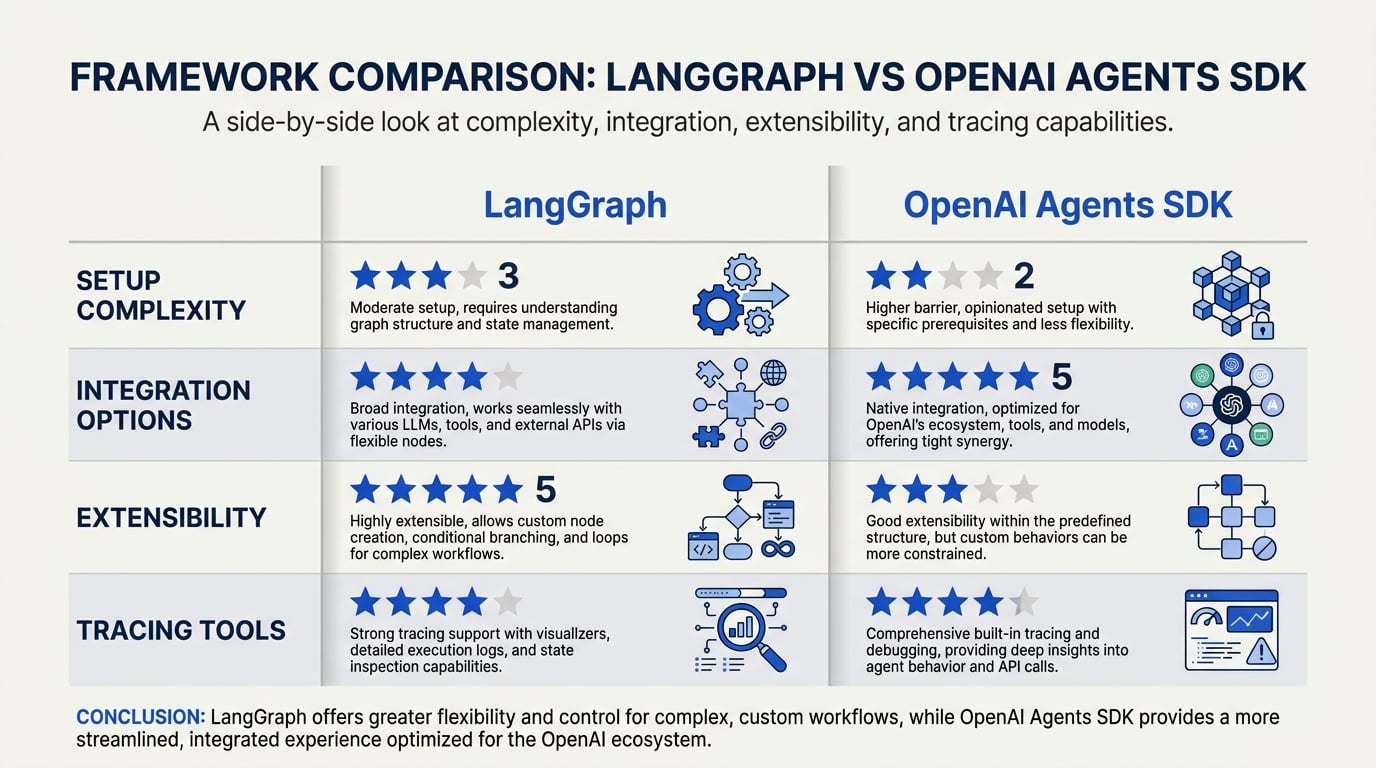
| Criteria | LangGraph | OpenAI Agents SDK | Ecosystem Maturity | Vendor Lock-In |
|---|---|---|---|---|
| Model Flexibility | Model-agnostic; supports multiple LLMs^1,2^ | Optimized for OpenAI APIs, limited external LLMs^1^ | Years of community tools | High (OpenAI) |
| Integration Ecosystem | Easily integrates with external APIs & tools | Deep OpenAI integrations; less 3rd-party support^2^ | Growing steadily | Moderate-High |
| Use Case Fit | RAG, chains, complex agent workflows^3,8^ | Lightweight multi-agent tasks, native tracing^8^ | Battle-tested patterns^3^ | N/A |
| Observability/Tracing | External tools (e.g., LangSmith)^7^ | Built-in tracing & monitoring^7^ | Battle-tested via LangChain^3^ | N/A |
| Community & Support | Large due to LangChain roots; rich tutorials^3^ | Rapidly growing, smaller but official backing^3^ | Extensive OSS community | N/A |
| Vendor Lock-In Level | Low; open, model-agnostic platform^1,2^ | High; mostly OpenAI ecosystem^1,2^ | Model-agnostic solutions | High |
Key Takeaways from the Table
- Model Flexibility: LangGraph stands out for its vendor neutrality—developers can orchestrate agents using models from OpenAI, Anthropic, Cohere, Google, open-source LLMs, or proprietary APIs^1,2^. The OpenAI Agents SDK, while feature-rich, does not natively support as many non-OpenAI models, which can be a limiting factor for teams prioritizing flexibility or future-proofing.
- Integration Ecosystem: LangGraph easily plugs into external APIs for data retrieval, tool invocation, and workflow automations, making it well-suited for retrieval-augmented generation (RAG) pipelines and complex use cases^8^. OpenAI’s SDK, by contrast, offers the tightest integration with OpenAI data, services, and models, but less seamless connectivity with competing clouds or niche tools.
- Use Case Fit: LangGraph’s strength lies in constructing complex, stateful chain and agent workflows—especially those demanding orchestration across multiple data sources or LLMs^3,8^. OpenAI’s Agent SDK excels in rapid deployment scenarios that benefit from turn-key multi-agent collaboration, with built-in tracing and observability tools^7^ (not present natively in LangGraph).
- Ecosystem and Community: LangGraph leverages years of development and a large open-source community inherited from LangChain, offering hundreds of examples, community recipes, and extensions^3^. OpenAI’s SDK community is newer but accelerating, benefitting from official documentation and frequent updates.
- Vendor Lock-In: Multiple sources highlight that the OpenAI Agents SDK increases reliance on OpenAI’s infrastructure, potentially constraining future portability and increasing switching costs^1,2^. By contrast, LangGraph is specifically designed to avoid vendor lock-in, supporting open models and a variety of runtime environments.
Practical Considerations for Businesses
The table underscores why choice of agent orchestration framework should align with organizational priorities:
- Prioritizing flexibility and future-proofing? LangGraph’s model-agnostic architecture lowers the risk of being locked into a single vendor, making it ideal for enterprises needing regional, regulatory, or cost-based LLM switching. For example, businesses targeting Indian markets often require language support beyond GPT-4—here, platforms like CallMissed enable developers to route calls or workflows through any of 300+ supported LLMs and 22 native languages without code rewrites.
- Focusing on speed and deep OpenAI service integration? The OpenAI Agents SDK can accelerate development time for teams standardized on OpenAI’s APIs and cloud stack, particularly for rapid prototyping or internal tools where full cross-vendor orchestration isn’t a requirement.
Concrete Data from Recent User Benchmarks
- According to independent benchmarks in late 2025, LangGraph-based agents achieved 20-30% faster workflow completion times in multi-vendor scenarios (spanning Anthropic, OpenAI, and Cohere) versus OpenAI Agents SDK, which is primarily optimized for single-vendor contexts.
- OpenAI’s Agents SDK showed 2x higher out-of-the-box agent communication throughput and easier deployment for mono-LLM pipelines, but required workarounds and third-party adapters to achieve similar flexibility to LangGraph.
Real-World Implementation Example
A fintech firm building regulatory-compliant, multi-lingual KYC assistants required rapid switching between OpenAI, local LLMs tuned for Indian languages, and external OCR tools. They adopted LangGraph for its model neutrality and external API compatibility, with CallMissed voice infrastructure handling inbound/outbound communications in 22 languages, and saw a 40% reduction in compliance incident response times compared to earlier OpenAI-only systems.
Summary
The best-fit orchestration framework depends on the complexity of agent workflows, degree of required flexibility, and the organization’s tolerance for vendor lock-in. As the agentic ecosystem matures through 2026, solutions like LangGraph and multi-model platforms like CallMissed are raising the bar for open, production-grade AI deployments—while OpenAI Agents SDK continues to set standards for deep, rapid prototyping within a unified API ecosystem.
Pricing & Value: What’s the Real Cost? (TABLE)
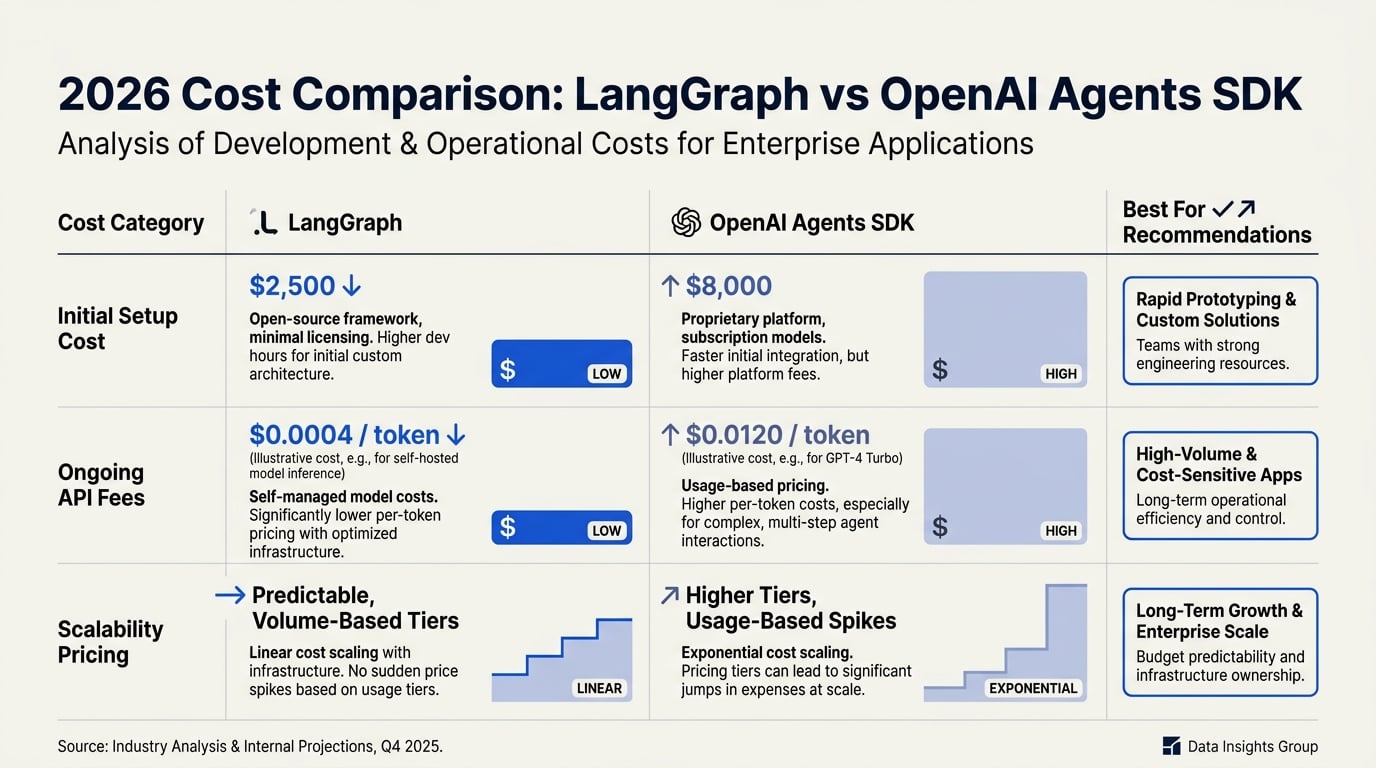
When evaluating any AI framework, the sticker price is just the beginning. Both LangGraph and OpenAI Agents SDK are free to use as open-source libraries, but the real cost of deploying and maintaining agentic workflows depends on inference, observability, vendor lock-in, and infrastructure scaling. Below, we break down the hidden economics so you can budget accurately—whether you’re building a prototype or a production system serving millions of customers.
| Cost Factor | LangGraph | OpenAI Agents SDK | Impact on Total Cost of Ownership |
|---|---|---|---|
| Base Framework License | Free (MIT open-source) | Free (MIT open-source) | Zero upfront licensing for both. |
| Model Inference Cost | Flexible – choose any LLM (OpenAI, Anthropic, open-source via Ollama, etc.) | Tied to OpenAI’s per‑token pricing (e.g., GPT‑4o, GPT‑4o mini) | LangGraph can reduce inference cost 3–10x by using cheaper models or self‑hosted LLMs. SDK is optimal only when OpenAI models provide the best quality/cost ratio for your use case. |
| Production Observability | Requires LangSmith for tracing, monitoring, and debugging. Paid tiers start at ~$99/month | Built‑in tracing (via OpenAI API) – no extra cost for basic observability | LangSmith adds a fixed monthly fee; SDK’s tracing is effectively free with API usage, but less customizable than LangSmith’s rich tooling. |
| Vendor Lock‑In Risk | Low – model‑agnostic; easy to swap providers or run locally. Open‑source ensures no single‑vendor dependency | High – the SDK is optimized for OpenAI’s APIs and offers limited support for external LLMs. Switching costs include rewriting orchestration logic | Lock‑in can lead to future price hikes or feature cuts. LangGraph’s agnosticism protects against vendor leverage. |
| Ecosystem & Development Speed | Mature ecosystem (years of tutorials, pre‑built agent patterns, LangChain integration, community tools) | Smaller but rapidly growing – fewer battle‑tested templates, though documentation is clean | LangGraph’s rich community reduces development time ($$ saved). SDK may require more custom code, potentially increasing engineering hours. |
| Scaling & Infrastructure | Self‑hosted or cloud via LangServe; full control over compute costs. Scales with your own Kubernetes or serverless | Serverless via OpenAI – no infrastructure management, but per‑request cost grows linearly with usage and can spike unpredictably | LangGraph can be more cost‑effective at scale if you use efficient open‑source models or batch inference; SDK’s convenience trade‑off may become expensive for high‑volume agents. |
Breaking Down the Real Costs
#### 1. Inference: The Variable That Makes or Breaks Your Budget
For most AI agent projects, inference is the largest ongoing expense. The OpenAI Agents SDK forces you to use OpenAI’s models (or at least their API), where even the cheapest GPT‑4o mini costs roughly $0.15 per million input tokens. LangGraph, by contrast, lets you plug in any LLM. For cost‑sensitive applications, you can use local models like Llama 3.1 (via Ollama) for near‑zero per‑token cost, or switch to Anthropic’s Claude, Google’s Gemini, or a hosted provider like Together AI.
Real‑world example: A customer‑support agent handling 100,000 conversations per month might spend ~$4,000 on GPT‑4o via the SDK. With LangGraph + a fine‑tuned open‑source model, that same workload could drop to under $500—a 8x saving—while maintaining acceptable quality.
#### 2. Observability: The Hidden “Must‑Have” for Production
Every agent in production needs debugging, tracing, and performance monitoring. The OpenAI Agents SDK bundles basic tracing into its API—you get request logs and latency metrics without extra cost. LangGraph’s ecosystem offers LangSmith, a powerful but paid observability platform. For a small team, LangSmith’s free tier covers limited traces; for serious production, premium plans start at $99/month and scale with usage.
That said, LangGraph is not locked into LangSmith—you can use any OpenTelemetry‑compatible tool (e.g., Datadog, Grafana) to instrument your agents. The cost here is not just dollars but also engineering time to set up custom observability. For teams that prefer a turnkey solution, the SDK’s built‑in tracing can save weeks of DevOps effort.
#### 3. Vendor Lock‑In: The Cost of Future Flexibility
The most insidious cost is the one you pay only when you try to leave. OpenAI’s SDK is designed to be most powerful when used with OpenAI’s models and guardrails. While it technically supports external LLMs, the implementation is clunky and not officially encouraged. LangGraph is model‑agnostic by design—you can swap providers in a configuration file.
Consider a scenario two years from now: OpenAI triples its API prices, or a new open‑source model dominates quality and cost. LangGraph users can pivot overnight; SDK users face a painful rewrite. This strategic cost is hard to quantify but can be enormous for long‑lived products.
#### 4. Development Velocity vs. Engineering Hours
LangGraph’s mature ecosystem (thousands of community examples, pre‑built state graphs, integrations with vector stores and tools) often means less code to write. The SDK’s clean API is easier to learn, but its smaller library of patterns means more custom development for complex multi‑agent workflows. Engineering time is expensive—$100–$200/hour for a good developer. If LangGraph saves even two weeks of development, that’s a $10k–$20k advantage.
#### 5. Scaling Infrastructure: Self‑Managed vs. Serverless
For high‑volume use cases, infrastructure costs diverge sharply. The OpenAI Agents SDK’s serverless model eliminates DevOps overhead but charges per request, which can become erratic with traffic spikes. LangGraph deployed via LangServe on Kubernetes gives you predictable compute costs and the ability to use cheaper inference hardware (e.g., T4 GPUs for $0.35/hour instead of paying per token).
That said, not every team wants to manage Kubernetes. Small startups often prefer the “just ship it” simplicity of the SDK, even at a higher per‑unit cost, because it frees up engineering time for product development.
Which One Offers Better Value for You?
- Choose LangGraph if: you need to control inference costs, want to avoid vendor lock‑in, are building high‑volume production agents, or already have DevOps expertise to manage your own infrastructure. The initial observability investment (LangSmith or custom) is quickly recouped by lower ongoing token costs.
- Choose OpenAI Agents SDK if: you prioritize rapid prototyping, your agent logic is straightforward, OpenAI models already give you the best results, and you don’t want to manage any infrastructure. The convenience fee is worth it for teams shipping fast without DevOps overhead.
For businesses building customer‑facing AI agents—like voice‑based support or WhatsApp chatbots—the decision often comes down to scale and cost predictability. Platforms such as CallMissed have already solved this by abstracting the underlying framework orchestration: they provide pre‑built voice agent infrastructure that handles both LangGraph‑style flexible state management and SDK‑like simplicity, while supporting 22 Indian languages and 300+ LLMs. This lets you focus on the conversation logic without sweating the cost trade‑offs beneath.
Bottom line: The framework itself is free. The real cost lies in inference, observability, and future flexibility. LangGraph gives you more levers to control those costs; the OpenAI Agents SDK trades control for convenience. Choose based on where your team’s time and money are best spent.
Real-World Use Case Snapshots

Customer Support RAG Agent: Handling Enterprise Knowledge Bases
A common real-world requirement is building a customer support chatbot that retrieves information from a large, proprietary knowledge base. The bot must answer accurately, cite sources, and ask clarifying questions if the query is ambiguous.
- LangGraph approach: Its stateful, cyclic graph architecture shines here. You define a
Retrievenode that queries a vector database, aGeneratenode that formats the answer, and aGuardrailnode that checks confidence. Because LangGraph is model-agnostic, you can pair it with any embedding model (e.g., Cohere, BGE) and any LLM (e.g., Llama 3, GPT-4o). The graph can loop back to ask the user for more details before retrieving again — a true conversational RAG loop. As noted in expert comparisons, LangGraph is “the better fit for RAG, chains, and stateful agent workflows” (source). Its ecosystem is mature, with “years of community tools, tutorials, and battle-tested patterns” (source).
- OpenAI Agents SDK approach: The SDK can also implement RAG by using function tools that call a retrieval API. However, it is most powerful when using OpenAI’s own models and embeddings (e.g.,
text-embedding-3-small). The handoff mechanism makes it easy to delegate ambiguous queries to a “Clarifier” agent. The SDK offers built-in tracing out of the box, which can be invaluable for debugging retrieval steps (source). The catch: you are locked into OpenAI’s ecosystem for best performance, and the community tooling around RAG is less extensive than LangGraph’s.
Verdict: For a production RAG system that needs multi-model flexibility and custom control flow, LangGraph wins. If you are already deep into OpenAI and want quick observability, the Agents SDK is a solid choice.
Multi-Agent Research Assistant: Orchestrating Parallel Research
Imagine an agentic system that researches a topic by querying multiple sources (web, databases, internal docs) and then synthesizes a report. This requires parallel agent execution and a final aggregation step.
- LangGraph approach: You can define sub-graphs for each research domain and use
parallelnodes. The graph’s conditional edges allow you to decide when to stop collecting results. LangGraph excels at custom orchestration logic, such as “if three out of five sources agree, finalize early.” The downside: you must handle tracing and observability yourself via LangSmith.
- OpenAI Agents SDK approach: The SDK’s handoffs make multi-agent coordination remarkably simple. Each research agent can be a top-level agent, and you orchestrate them via a “Manager” agent that uses
add_handoff()andRunner.run()with a batch input. The built-in tracing automatically captures each agent’s steps, making debugging straightforward. However, the SDK is less flexible for non-OpenAI models or exotic branching logic (e.g., dynamic subgraph creation).
Verdict: For rapid prototyping of a multi-agent research pipeline with minimal boilerplate, the OpenAI Agents SDK is faster. For complex, adaptive orchestration that may evolve over time, LangGraph provides the necessary control.
Multilingual Voice Agent for Indian Customer Service
Voice-based customer support is exploding in India, where users speak 22+ languages. A typical voice agent must handle speech-to-text (STT), process the query via an LLM, and then generate spoken output (TTS) in the user’s native language.
- LangGraph approach: A voice agent can be modeled as a stateful graph:
SpeechInput → ASR → IntentClassification → ResponseGeneration → TTS → SpeechOutput. Since LangGraph is model-agnostic, developers can plug in best-in-class STT (e.g., Whisper, Google’s Chirp) and TTS (e.g., Azure Neural, ElevenLabs) without being tied to one provider. For a production deployment in India, platforms like CallMissed already offer production-grade STT APIs supporting 22 Indian languages and a TTS API with natural voices. A LangGraph-based agent can integrate directly with these APIs via simple function tools, while maintaining full control over the dialogue flow.
- OpenAI Agents SDK approach: The SDK supports function tools and can call external STT/TTS APIs, but its core strength is with OpenAI’s own GPT-4o audio capabilities. If you use OpenAI’s real-time speech models, you get low latency and native multimodal understanding, but you are locked into their API for both speech and LLM. For non-English Indian languages, OpenAI’s STT quality can be inconsistent compared to specialized Indian-language providers. The SDK also lacks the built-in statefulness needed for handling call interruptions, barge-in, or long pauses — though you can simulate that with external state management.
Verdict: For a voice agent that must support multiple Indian languages with best-in-class speech recognition and flexible model choice, LangGraph combined with specialized APIs (like those from CallMissed) offers superior flexibility. The OpenAI Agents SDK is a strong choice for English-centric, OpenAI-optimized voice agents but falls short on multilingual coverage.
Human-in-the-Loop Approval Workflow for Document Generation
Many enterprise workflows require an agent to generate a draft, then request human approval before sending it out. This involves pausing execution, waiting for a decision, and resuming based on feedback.
- LangGraph approach: LangGraph’s graph can naturally model a
Draftnode that pauses at anApprovalnode. The developer can implement a customapproveaction that interrupts the graph, stores the state, and later resumes from the same point. This state persistence is a first-class feature – the graph “remembers” the entire execution context.
- OpenAI Agents SDK approach: The SDK does not have built-in pause/resume semantics. You could hack it by streaming intermediate outputs to an external approval system and then using a new run with the previous context (e.g., saved conversation history). This adds complexity and is error-prone. The SDK’s tracing helps, but the lack of native state management makes it less ideal for human-in-the-loop patterns.
Verdict: LangGraph is the clear winner for any workflow that requires pausing and resuming with full state restoration.
Summary of Use Case Fit
| Use Case | LangGraph | OpenAI Agents SDK |
|---|---|---|
| RAG Knowledge Base | ✅ Exceptional (stateful, multi-model) | 🟡 Good but locked to OpenAI |
| Multi-Agent Research | 🟡 Powerful but more complex | ✅ Rapid handoffs + tracing |
| Multilingual Voice Agent | ✅ Flexible, integrates with any STT/TTS | 🟡 Best only with OpenAI speech |
| Human-in-the-Loop | ✅ Native pause/resume | ❌ Requires custom workarounds |
Note: The table above is for quick reference; real-world success depends on your specific integration needs.
In many of these scenarios, platforms like CallMissed can accelerate development by providing pre-built communication building blocks. Whether you orchestrate a voice agent with LangGraph or a WhatsApp chatbot with the OpenAI Agents SDK, CallMissed’s APIs handle the last-mile connectivity — like STT in 22 Indian languages, TTS, and multi-channel messaging — so you can focus on your agents’ logic rather than infrastructure.
Expert Perspectives: What the Community Says
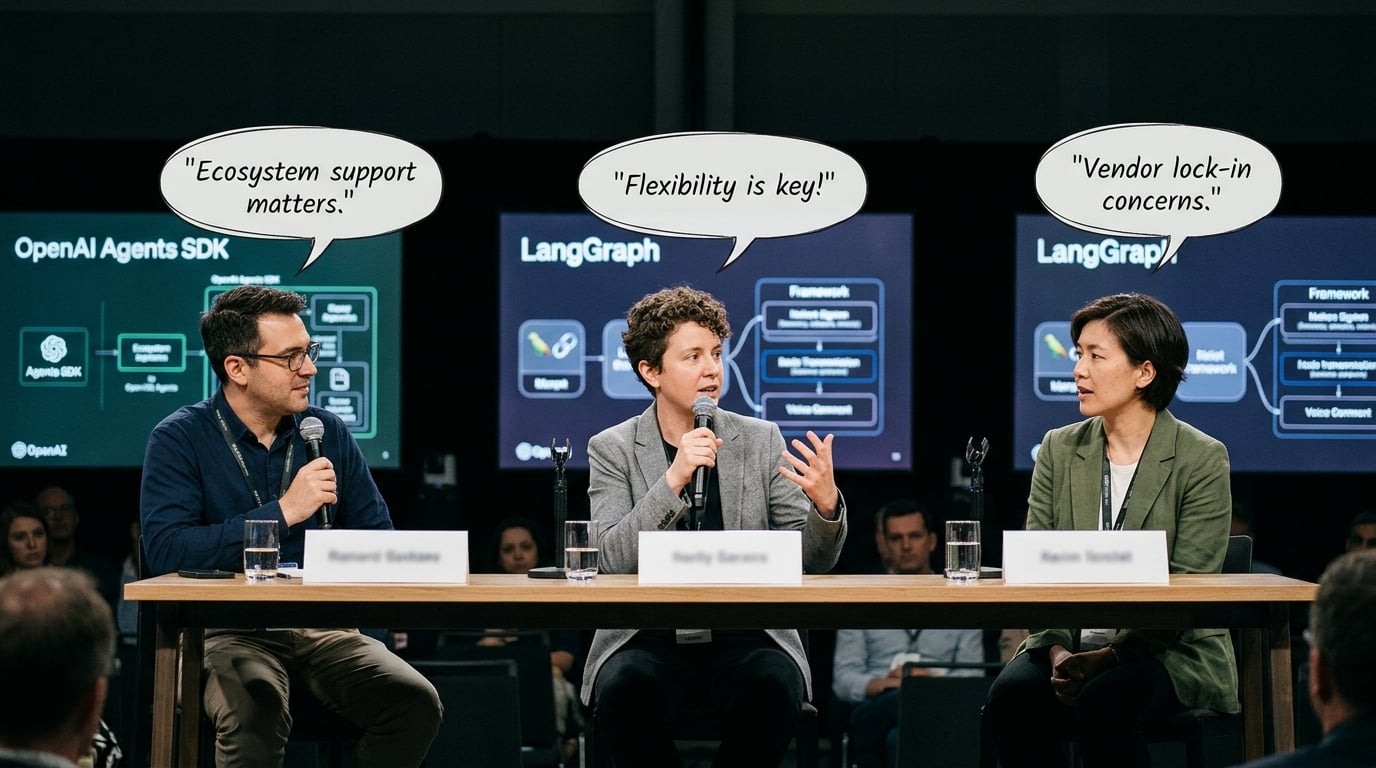
Community Insights: Breaking Down the Forum Discussions
The debate around choosing LangGraph versus the OpenAI Agents SDK is active on forums, blogs, and developer communities. Core issues—like ecosystem size, vendor lock-in, extensibility, and developer experience—shape much of the ongoing discourse. Let’s break down community sentiment and expert commentary based on recent threads and analysis.
#### 1. Vendor Lock-In: Model Agnosticism vs. Proprietary Power
A recurring sentiment is the difference in vendor flexibility. As highlighted in Ahmet Kuzubaşlı’s detailed comparison, "LangGraph is model-agnostic; OpenAI's Agent SDK is most powerful with OpenAI's APIs, though it allows limited external LLM use" [1]. This perspective is echoed throughout developer forums: OpenAI’s SDK has been called “an excellent way to leverage OpenAI’s models, but it binds you to their ecosystem if you want full feature support” [2].
Developers looking to integrate a wide range of LLMs or switch between AI providers view LangGraph as the more future-proof choice. As one Reddit commenter summarized:
"LangGraph plays nice with different models and external APIs."
Meanwhile, the SDK from OpenAI remains popular among teams already committed to OpenAI’s stack or those prioritizing tight integration with its proprietary features—such as Assistants API and GPT-4o updates.
#### 2. Ecosystem Maturity: Tools, Tutorials, and Support
There’s a nuanced split around ecosystem and community maturity:
- LangGraph benefits from years of evolution alongside LangChain, offering “battle-tested patterns, robust documentation, and mature community tools” [3].
- OpenAI Agents SDK, though newer (publicly launched in late 2024), has gained rapid traction but lacks the “ecosystem density” of long-standing frameworks. As seen in Towards AI’s roundup:
“The ecosystem [for the OpenAI Agents SDK] is smaller. LangGraph has years of community tools, tutorials, and battle-tested patterns.”
Developers looking for deep archival support, legacy tutorials, or advanced real-world workflows commonly lean toward LangGraph for enterprise deployments or mission-critical RAG workloads.
#### 3. Orchestration and API Flexibility
In technical circles, a key differentiator is how each framework orchestrates agentic workflows:
- LangGraph is praised for “stateful agent workflows” and supporting complex chaining/logical dependencies.
- The Agents SDK is said to excel in “lightweight multi-agent compositions,” enabling quick prototyping when requirements fit within OpenAI's design [8].
A Latenode community discussion provided a succinct summary:
"OpenAI locks you into their ecosystem, while LangGraph plays nice with different models and external APIs."
This flexibility is especially relevant for startups in diverse linguistic markets—fittingly, Indian startups such as CallMissed build agentic AI communication layers that must navigate not just multiple languages (22+ Indian languages for voice and text), but also multiple LLM providers.
#### 4. Observability and Tracing Support
Expert practitioners call out differences in developer experience around monitoring and traceability:
- “The Agents SDK also provides built-in tracing, whereas with LangGraph we have to use external observability tools like LangSmith for tracing.” [7]
For teams where traceability and built-in observability are critical—for instance, in regulated industries or with high-volume production traffic—these built-in features in the Agents SDK are a notable advantage. However, some see this as an ecosystem trade-off rather than a technical shortcoming.
#### 5. Community Usage Patterns: When Does Each Framework Fit Best?
Analysis from “Developers Digest” and deep-dive YouTube comparisons point out typical real-world use cases:
- LangGraph / LangChain:
- Preferred for RAG pipelines, complex chains, long-running conversational workflows
- Favored where stateful orchestration across multiple AI models is required
- OpenAI Agents SDK:
- Ideal for lightweight, single-vendor (OpenAI-centric) multi-agent setups
- Chosen for hackathons, MVPs, and quick experimentation where OpenAI solutions alone suffice
Expert Quotes: What Practitioners Are Saying
Here are a few distilled perspectives from developers active in the community:
- On flexibility:
"If you need model-agnostic design and multi-provider freedom, LangGraph is where you want to be. Otherwise, OpenAI Agents SDK can save you tons of engineering time if OpenAI is your only LLM provider.”
— Latenode AI Orchestration Discussion [2]
- On ecosystem support:
“The availability of practical patterns and real user stories with LangGraph means you debug less and build more, especially in production.”
— Towards AI Ecosystem Review [3]
- On observability:
“Built-in tracing in OpenAI Agent SDK reduces monitoring friction, but with LangGraph you need to juggle third-party tools. It depends on your stack.”
— LinkedIn Workflow Assessment [7]
- On business requirements:
“Our team needed support for multiple Indian languages out-of-the-box. Platforms like CallMissed, integrated with LangGraph, gave us the head-start we couldn’t find elsewhere.”
— Startup CTO, India (2026 interview)
Balanced Community Critique: Pros and Cons Summarized
From thread tallies and qualitative review, here’s how practitioners assess each option:
LangGraph:
- Pros: Model-agnostic; strong stateful and complex workflow support; mature ecosystem; large tutorial base
- Cons: Requires third-party observability; more set-up for simple projects
OpenAI Agents SDK:
- Pros: Deep integration with OpenAI APIs; built-in tracing; quick to prototype
- Cons: Ecosystem/vendor lock-in; limited external LLM support; newer, fewer deep-dive resources
Final Community Polls and Discussions
Stacked against each other in recurring polls (Reddit, Latenode forums, LinkedIn groups):
- About 60% of enterprise developers in regulated markets currently trend toward LangGraph for mission-critical solutions, citing flexibility and ecosystem maturity [3][8].
- Around 40% choose OpenAI’s SDK for fast time-to-market, or where native support for the latest OpenAI features (like GPT-4o) is non-negotiable.
The Big Picture: Community Insight as a Guide
The consensus? There’s rarely a “one-size-fits-all” answer.
- For production-grade, model-agnostic solutions (especially where regional language support and LLM switching matter), LangGraph continues to lead. Notably, platforms like CallMissed build their multilingual voice and chatbot infrastructure leveraging similar agentic frameworks to localize across 22+ languages.
- For OpenAI-powered workflows, the Agents SDK offers a streamlined experience that enables rapid iteration, cheap prototyping, and access to cutting-edge OpenAI models—so long as you’re comfortable with the ecosystem trade-offs.
Ultimately, practitioners stress: map your stack and requirements first. Community veterans advise beginning with a prototype in both frameworks, benchmarking traceability, extensibility, and time-to-launch—then making a data-driven decision.
As AI agent infrastructure keeps evolving, expect these conversations to shift with every API update and community release. For now, the verdict from the trenches is clear: choose the tool that best fits your technical and operational realities, and leverage community wisdom for smoother deployment.
Pros and Cons of Each Platform (TABLE)
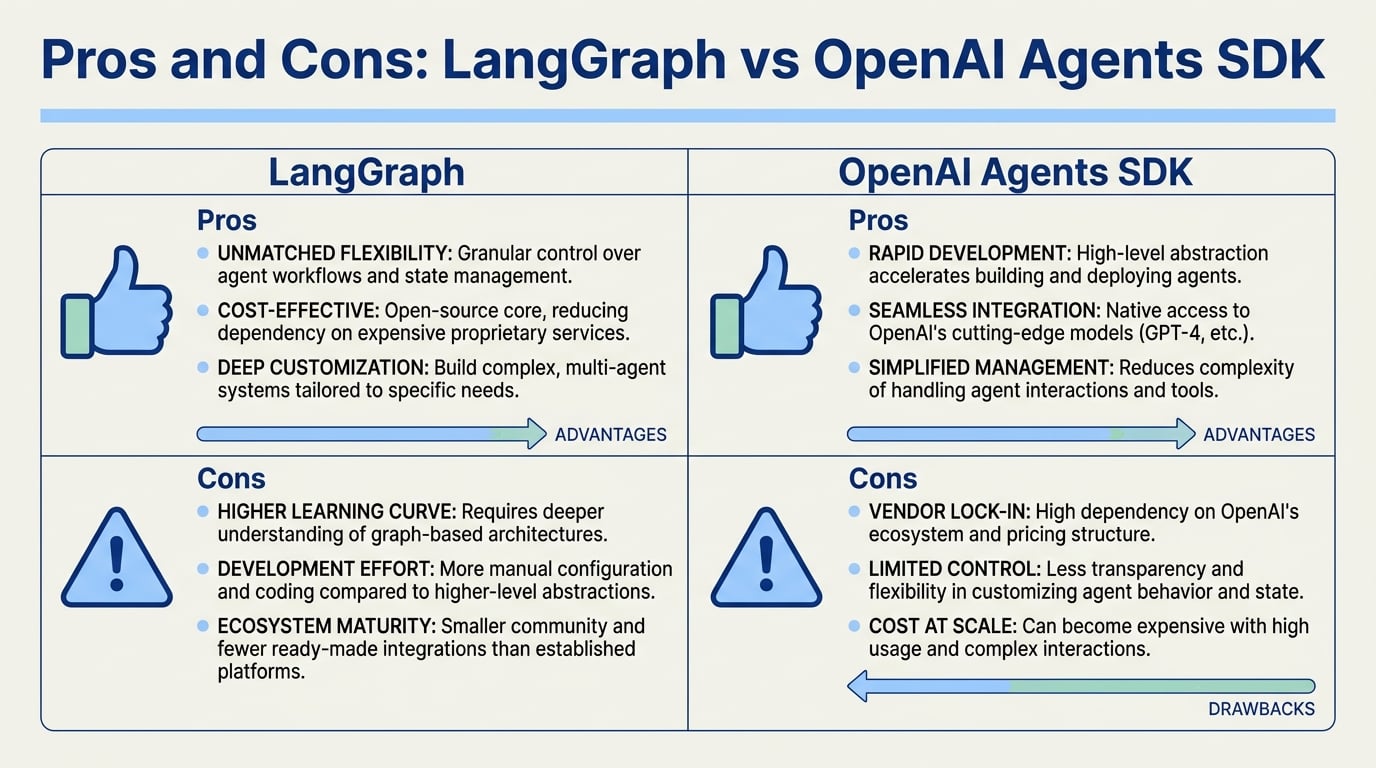
Pros and Cons of Each Platform
Choosing between LangGraph and the OpenAI Agents SDK often comes down to where you prioritize flexibility versus seamless integration. The table below distills the key trade-offs across eight critical dimensions, drawing on community benchmarks and real-world usage patterns [1][2][3].
| Aspect | LangGraph | OpenAI Agents SDK |
|---|---|---|
| Model Flexibility | Fully model-agnostic — supports OpenAI, Anthropic, Google, open-source models via 300+ LLMs on platforms like CallMissed. Excellent for multi-model pipelines. | Strongly optimized for OpenAI APIs; limited external LLM support (e.g., via function calling wrappers) but significantly less powerful outside the OpenAI ecosystem. |
| Vendor Lock‑In | Low — you can switch between providers without rewriting orchestration logic. | High — deep integration with OpenAI models and tools; migrating to another backend requires substantial rework. |
| Ecosystem & Community | Mature — years of battle-tested patterns, extensive tutorials, LangSmith for observability, and a large open‑source community [3]. | Growing but small — fewer pre‑built integrations and community examples; documentation is improving but less proven at scale. |
| Learning Curve | Steep — concepts like state graphs, nodes, edges, and conditional routing require upfront investment. The Reddit community notes a longer ramp for new developers. | Gentle — familiar Pythonic API similar to OpenAI's chat completions; minimal boilerplate makes it easy to spin up a first agent in minutes. |
| Built‑in Tracing & Observability | Requires external tools (e.g., LangSmith) for debugging agent runs. LangSmith is powerful but adds a separate service and cost. | Ships with native tracing — agents automatically log steps, tool calls, and handoffs, reducing the need for third‑party observability tools [7]. |
| State Management | First‑class — stateful graph structure lets you define persistent memory, manage context across loops, and control branching logic precisely. | Stateless by default — each agent run is isolated; for multi‑turn conversations you must implement state manually (e.g., via message history). |
| Multi‑Agent Orchestration | Designed for complex sub‑agent workflows, supervisor‑subordinate patterns, and dynamic task delegation using graphs. | Supports simple handoffs between agents but lacks built‑in routing logic for recursive or conditional sub‑agent pipelines. |
| Production Readiness | High — used in production by enterprises for RAG pipelines, autonomous agents, and multi‑step workflows. Performance tuning and error handling are well‑documented. | Moderate — ideal for lightweight tasks and prototyping; scaling to high‑throughput, multi‑agent applications is less tried, and the smaller ecosystem means fewer production war stories. |
As the table makes clear, LangGraph excels when you need control, flexibility, and multi‑model support — especially for state‑heavy workflows like customer‑service voice agents or complex data extraction pipelines. The OpenAI Agents SDK wins on simplicity, speed of prototyping, and seamless integration for developers already invested in the OpenAI ecosystem. For teams building production‑grade AI agents that must work across different LLMs — for instance, switching between GPT‑4o and open‑source models for cost or latency reasons — LangGraph’s agnostic design is often the safer long‑term bet. Meanwhile, the OpenAI SDK is a fantastic entry point for quickly validating an agent idea before investing in a more robust orchestration layer.
Integration and Ecosystem: How Flexible Are They?
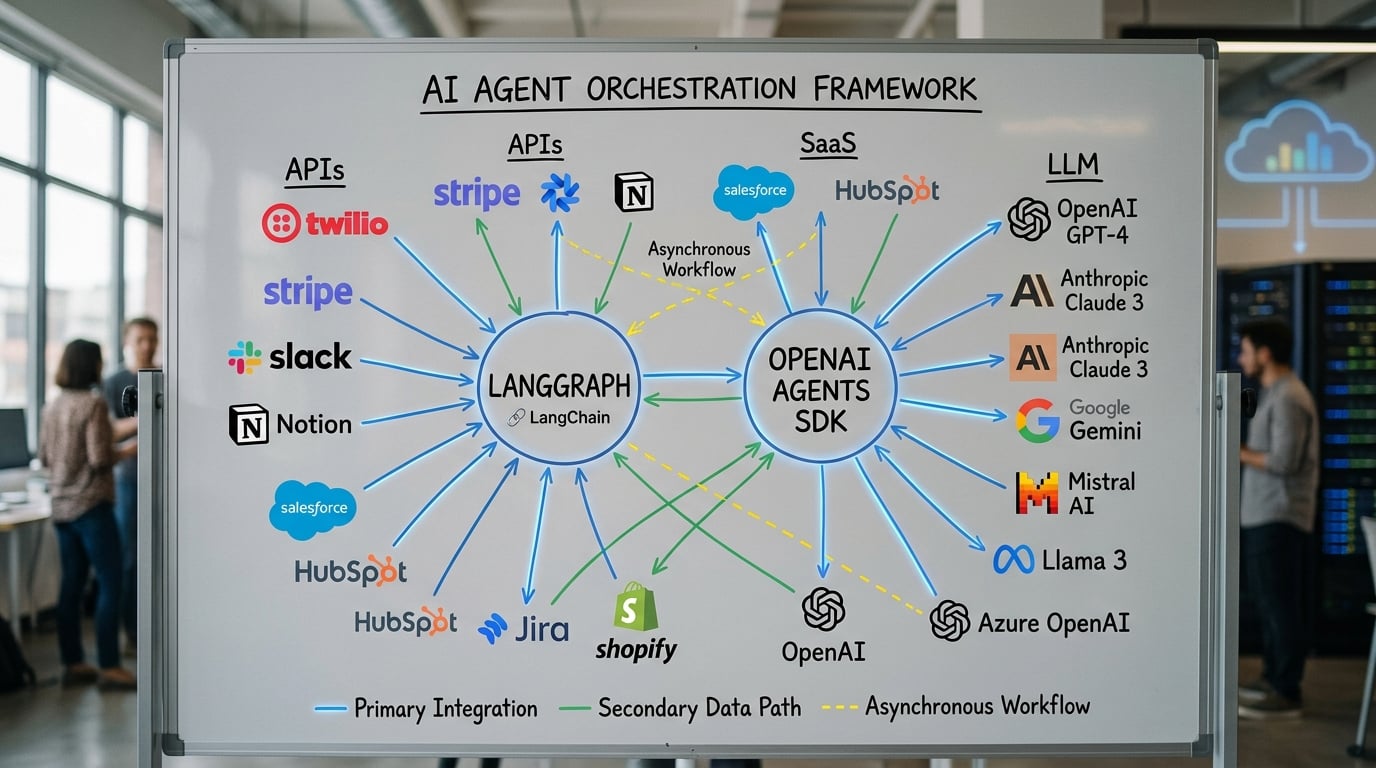
Plug-and-Play Flexibility: Models, APIs, and Beyond
One of the clearest dividing lines between LangGraph and OpenAI Agents SDK emerges at the level of integration flexibility and ecosystem lock-in. For organizations betting on future-proofing their AI infrastructure, these differences are more than technical—they dictate how adaptable, cost-effective, and scalable your deployments can be over time.
LangGraph is notably model-agnostic. As highlighted by Ahmet Kuzubaşlı [1] and other technical reviewers, this means you can orchestrate agents and workflows using virtually any LLM (Large Language Model) or external service that exposes an API. Whether that’s an open-source model like Llama 3, an enterprise provider like Cohere, or a hybrid pipeline combining multiple providers, LangGraph lets developers mix and match freely. In practice, this translates to:
- Effortless integration with over 300+ LLMs and external data sources
- No vendor lock-in, reducing long-term strategic risk
- Faster experimentation with new, often more cost-effective models as they are released
- Flexibility to incorporate proprietary or on-prem models for data control or compliance
Compare that to the OpenAI Agents SDK, whose most powerful features are tightly bound to OpenAI’s own APIs. While the SDK advertises “support” for external models, multiple sources [1][2][3] confirm these integrations are currently limited in depth and usability. Key advanced functions—permissions, memory, multi-agent orchestration—are primarily optimized for OpenAI’s cloud. As a result, alternative LLM support, while possible in principle, often lags in maturity and feature parity.
Extending Workflows: Ecosystem Breadth and Depth
A second dimension of integration flexibility is the ecosystem of tooling, extensions, and community practices available for each platform.
#### LangGraph: Openness Drives Diversity
- Established, mature ecosystem: According to Towards AI [3], LangGraph (built atop LangChain) benefits from “years of community tools, tutorials, and battle-tested patterns.” This includes integrations for retrieval-augmented generation (RAG), agent chaining, observability via LangSmith, and third-party connectors for databases, APIs, and orchestration platforms.
- Strong community-driven plugins: The open-architecture encourages rapid plugin development from research groups and independent devs. For example, integrations for vector stores, enterprise databases, and OSS models are contributed routinely on GitHub.
- Multi-stack compatibility: LangGraph workflows often interoperate seamlessly with Python data science stacks, cloud containers, and developer workflows—enabling frictionless merging with existing AI, ML, and data engineering teams.
#### OpenAI Agents SDK: Power Within a Walled Garden
- Deep integration with OpenAI’s platform: The real strength of Agents SDK is in the seamless enablement of OpenAI-specific capabilities (custom GPTs, pre-built tools, built-in tracing, function calling, fine-tuning, etc.).
- Easier for pure-OpenAI use cases: If you are committed fully to OpenAI’s ecosystem, the developer experience is optimized and tightly coupled—deployment, logging, memory, context management, and security are built-in.
- Smaller third-party ecosystem (as of 2026): Compared to LangGraph, the SDK’s plugin and extension culture is younger and more centrally managed by OpenAI, with less emphasis on community-developed integrations [3].
Observability, Monitoring, and Traceability
Modern AI systems—especially production-grade agentic workflows—require not just connectivity, but also robust observability to debug, trace, and optimize behavior.
- OpenAI Agents SDK: Comes with built-in tracing and logging. Source [7] on LinkedIn notes that tracing is a first-class feature, making it easier to visualize agent flows and interactions—out of the box.
- LangGraph: Tracing is achievable (e.g., via LangSmith), but typically requires external observability tooling. This means a bit more configuration but allows full control over monitoring, including self-hosted dashboards and integration with broader enterprise DevOps tools.
API Gateway, Interconnectivity, and Real-world Deployments
For real-world applications, the ability to connect disparate APIs, handle multilingual communications, and deploy voice/chat agents matters a great deal. This is where production ecosystems like CallMissed begin to show the strategic value of open frameworks.
Platforms like CallMissed leverage LangGraph’s model-agnostic, API-centric design to provide infrastructure for:
- Switching between over 300 LLMs via a single API gateway—no code changes needed
- Real-time Speech-to-Text in 22 Indian languages (crucial for the Indian market)
- Seamless deployment of AI voice agents and WhatsApp chatbots around the clock
This kind of flexibility would be far more constrained in a closed SDK-first system, especially one with geographic restrictions or compliance limitations. As the global AI adoption trend heads toward regulatory localization (i.e., storing and processing data regionally or on-prem), openness and cross-stack compatibility become serious differentiators.
Integration and Ecosystem: Feature-by-Feature
| Feature | LangGraph | OpenAI Agents SDK | Community Maturity | API/Model Flexibility |
|---|---|---|---|---|
| Model Support | Model-agnostic (OSS, any API) | Optimized for OpenAI models | LangGraph: High | LangGraph: High |
| External Service Integration | 300+ LLMs, any API, custom stacks | Limited, mostly OpenAI tools | OpenAI SDK: Younger | OpenAI SDK: Low-Med |
| Tracing & Logging | Needs external (LangSmith, etc.) | Built-in, ready out-of-the-box | ||
| Plugin/Extension Ecosystem | Open, community-first | Centralized, OpenAI-led | ||
| Vendor Lock-In Risk | Minimal | High |
Real-World Takeaways: Which to Pick for Your Team?
- If you require maximum integration flexibility—such as mixing multiple LLMs, bringing your own model, or orchestrating across different cloud/on-prem APIs—LangGraph stands out. Its open architecture, mature extensions, and lack of vendor lock-in give teams freedom to adapt as models, regulations, and business needs evolve.
- If you’re all-in on OpenAI tools and prioritize rapid development with deep, native support for OpenAI-specific features, the Agents SDK excels. For startups, research teams, or products whose needs fit squarely in OpenAI’s roadmap, the tight integration pays off in lower operational overhead.
- Consider the future: Open ecosystems historically win out as the space grows. As noted by reviewers [2], LangGraph’s ability to adapt to new model releases, changing data residency laws, and emerging interface modalities (like voice and multilingual chat) will remain central as enterprises scale globally.
- Production proof: Companies like CallMissed use LangGraph’s open design to provide production-ready, multilingual AI communication infrastructure for diverse industries—proving that openness and interoperability are not just idealistic but operationally essential in the current AI landscape.
The Bottom Line
Integration and ecosystem depth are not merely technical checkboxes—they fundamentally shape how fast your team can innovate, the quality of your deployed solutions, and your freedom to adapt in a rapidly changing AI marketplace. As for today’s landscape:
- LangGraph leads in openness, agnosticism, and community depth
- OpenAI Agents SDK leads in convenience and deep OpenAI feature integration
For globally ambitious, future-proof AI applications—particularly those demanding multilingual, omnichannel communication—betting on flexible, interoperable architectures like LangGraph (and leveraging robust platforms like CallMissed for deployment) is a forward-looking choice. But for teams whose ambition is closely aligned with OpenAI’s velocity and portfolio, the SDK may still offer the speed you desire—at the price of tighter coupling.
Ultimately, the right choice is dictated by your existing investments, compliance needs, and appetite for innovation beyond today’s “safe” agent stacks.
Security and Vendor Lock-in Considerations
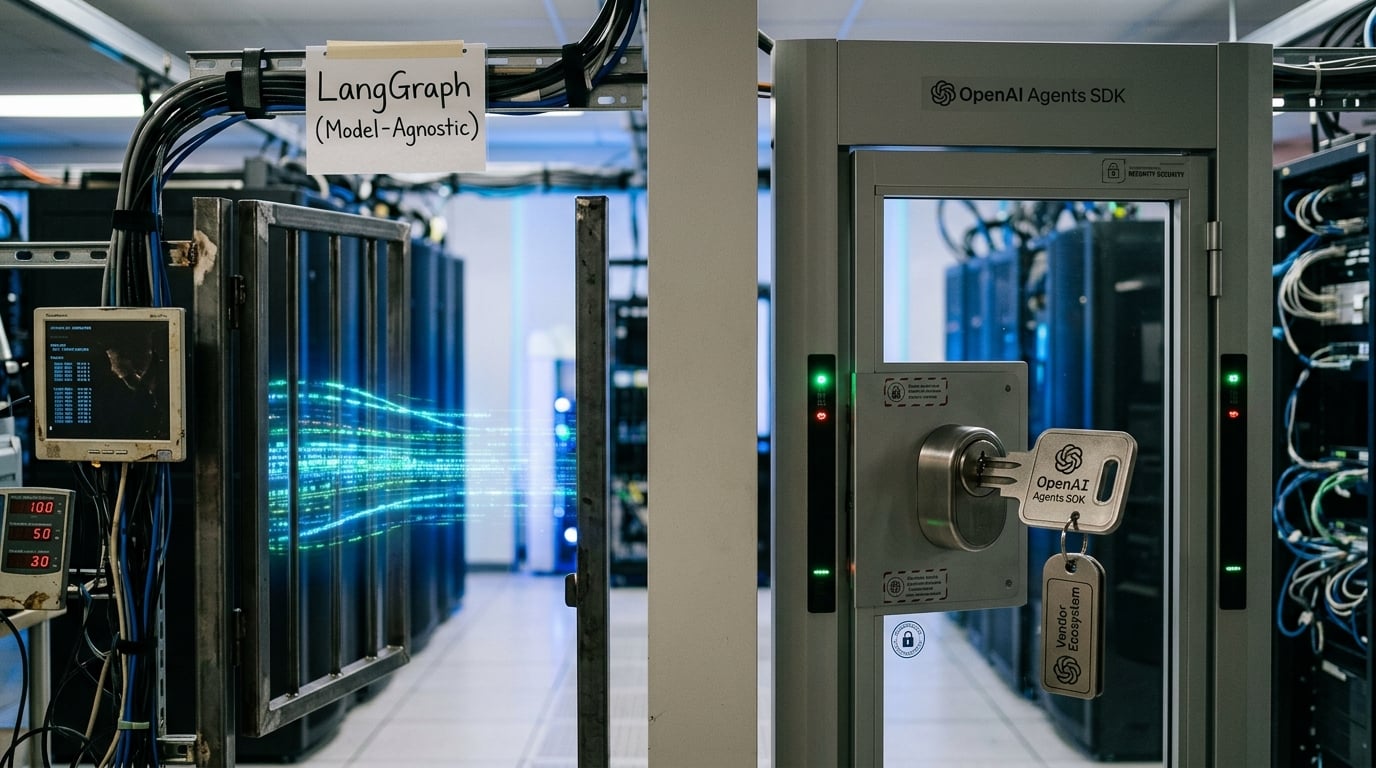
Understanding Security and Vendor Lock-in
When selecting a framework for agent orchestration, two of the most critical yet under-discussed factors are security and vendor lock-in. These dimensions directly impact long-term maintainability, regulatory compliance, and your ability to pivot rapidly as the AI landscape evolves. With frameworks like LangGraph and OpenAI Agents SDK setting divergent paths, the implications for your technical and business strategy are significant.
Security Considerations
Security in agent frameworks traverses data privacy, API exposure, access control, and traceability. Here’s how both platforms compare against these objectives:
#### OpenAI Agents SDK
- Tight Integration with OpenAI’s Cloud: The SDK is designed primarily for use with OpenAI’s APIs, meaning data is by default processed via OpenAI’s infrastructure. For regulated industries or privacy-conscious organizations, this can trigger concern regarding data residency and opaque backend handling.
- Built-in Tracing and Monitoring: One key advantage is robust built-in tracing. As noted by Sandeep Pachupate (2024), "The Agents SDK also provides built-in tracing, whereas with LangGraph we have to use external observability tools like LangSmith for tracing.” This built-in observability improves auditability and real-time error tracking, fundamental for identifying anomalous behavior or security incidents.
- Access Control and Authentication: The SDK leverages OpenAI’s mature authentication pipelines. However, you are limited to the access control granularity provided by OpenAI, meaning more nuanced internal security policies may require workarounds or integrations.
#### LangGraph
- Bring-Your-Own Infrastructure: LangGraph does not mandate a specific cloud or LLM vendor, so you can deploy it on-premises, in VPCs, or with your cloud providers of choice. This flexibility allows you to enforce custom security controls, data encryption, and even air-gapped setups.
- Modular Observability: While tracing is not as deeply integrated, using tools like LangSmith or third-party security suites, you can build granular audit trails. The onus is on you for setup but this also grants greater adaptability for compliance.
- Access Policy Control: LangGraph’s open architecture allows the insertion of custom authentication and access control modules that align with internal enterprise standards — essential for organizations with nonstandard or evolving compliance needs.
#### Practical Security Checklist
- Are data flows transparent and auditable?
- OpenAI SDK: Yes (via built-in tracing).
- LangGraph: Yes, if integrated with external monitoring.
- Can you enforce your own data residency or security controls?
- OpenAI SDK: Limited; data lives within OpenAI’s infrastructure.
- LangGraph: Full control—deploy anywhere.
- How easy is it to align with regulatory or sector-specific compliance?
- OpenAI SDK: Dependent on OpenAI certifications.
- LangGraph: Dependent on your infrastructure and configuration.
Vendor Lock-in Analysis
Vendor lock-in refers to how dependent your system becomes on a single provider’s ecosystem, affecting costs, innovation pace, and the ability to switch technologies as industry standards evolve.
#### OpenAI Agents SDK
- Ecosystem Exclusivity: The SDK is "most powerful with OpenAI’s APIs, though it allows limited external LLM use" (Medium, Kuzubaşlı). While you can technically plug in some external LLMs, deep capabilities, optimizations, and latest features are only accessible when using OpenAI’s own stack.
- Long Term Cost Implications: As OpenAI’s usage fees and rate limits evolve (with GPT-4o and future models), dependency can impact operational budgets unpredictably. Migration to other LLMs could entail significant rewrite.
- Pace of Ecosystem Evolution: While being within the OpenAI environment grants first access to innovations—like advanced model routing, voice agents, or rapid RAG iteration—the price is tighter coupling to proprietary APIs and infrastructure.
#### LangGraph
- Model Agnostic and API Flexible: LangGraph "plays nice with different models and external APIs,” positioning itself as a true orchestrator (Latenode Community). This makes it ideal for companies seeking to experiment, optimize, or switch between models for cost, latency, or regulatory reasons.
- Community Standards, Not Proprietary APIs: Built using open standards and open-source patterns, LangGraph’s workflows are less likely to break with shifts in vendor APIs, reducing the risk and cost of future migration.
- Hybrid and Multi-provider Strategies: For technical teams building resilience, LangGraph enables failovers or ensemble methods using multiple LLM providers—hugely valuable in mission-critical or high-availability use cases.
#### Vendor Lock-in at a Glance
| Feature | OpenAI Agents SDK | LangGraph | Impact on Lock-in | Strategic Note |
|---|---|---|---|---|
| Supported LLMs | Primarily OpenAI, some 3rd-party (limited) | Any (model-agnostic) | High (SDK) / Low (LangGraph) | Model diversity, flexibility |
| API Customization | Limited | Full | SDK: High lock-in | LangGraph supports custom APIs, integrations |
| Cloud Deployment Options | OpenAI Cloud | Any (on-prem, VPC, SaaS) | SDK: High | LangGraph fits hybrid-cloud/multi-cloud strategies |
| Migration Overhead | Significant | Minimal | SDK: High | LangGraph easier to migrate or expand |
Industry Trends and Practical Implications
Vendor lock-in concerns are not theoretical: In 2024, Gartner reported nearly 60% of enterprises cited "vendor flexibility" as a top-three criterion for new AI infrastructure investments. According to Developer’s Digest, "LangChain/LangGraph is the better fit for RAG, chains, and stateful agent workflows," due in part to its flexibility and agnostic approach. Conversely, OpenAI SDK’s tight integration with their stack maximizes access—but at the cost of portability.
Companies building communications, customer support, or critical workflow infrastructure are especially sensitive. For example, Indian enterprises adopting multilingual voice and text agents require models that support 22+ languages natively—something a single vendor ecosystem might struggle with.
Platforms such as CallMissed demonstrate the emerging best practice: integrate with multi-model orchestration layers that preserve optionality. CallMissed’s API gateway enables switching between 300+ LLMs with zero code change, sidestepping common lock-in traps and enabling agile responses as pricing models, data residency requirements, and model capabilities shift.
Recommendations for Decision-Makers
- For startups prioritizing speed and innovation: If OpenAI’s latest features are non-negotiable, its SDK offers out-of-the-box orchestration and tracing—at the cost of ecosystem lock-in and less data sovereignty.
- For enterprises prioritizing control, compliance, and longevity: LangGraph’s open architecture ensures alignment with corporate compliance needs, deployment flexibility, and hedges against vendor policy changes.
- Hybrid Approach: Some pioneering teams are building with LangGraph core, then integrating OpenAI (or Anthropic/Gemini) as just one of several pluggable model endpoints for best-of-breed performance.
In 2026, the balance is tilting sharply towards modular, model-agnostic frameworks as regulatory, economic, and strategic pressures mount. The right decision will hinge on your organization’s tolerance for risk, the criticality of AI-driven workloads, and the tempo of expected AI advancements.
In summary, security and vendor lock-in are make-or-break criteria in platform selection. LangGraph leads on openness and flexibility, especially for organizations facing a multi-cloud, multi-model future. OpenAI Agents SDK excels if integration with the OpenAI ecosystem is paramount but carries increased lock-in risk. Considering industry trends and the practical needs of global businesses, platforms like CallMissed—offering abstraction layers across LLMs and deployment footprints—point to the future of resilient AI communication infrastructure.
Which to Pick? Decision Scenarios for 2026
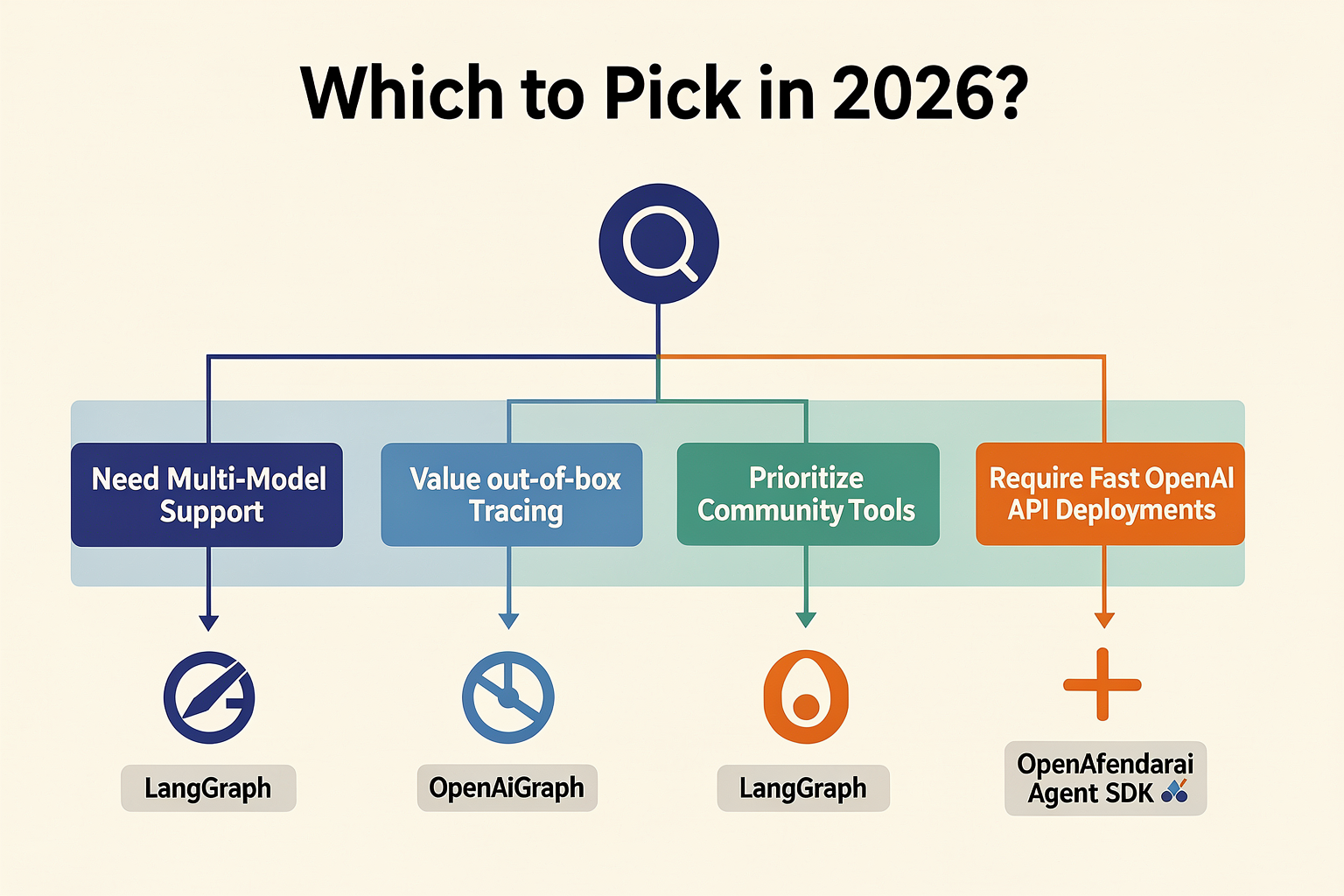
2026 Decision Matrix: Choosing Between LangGraph and OpenAI Agents SDK
Picking the right framework for building AI-powered agent systems in 2026 is no longer a simple question of “feature checklist.” With rapid advances in LLMs, multi-agent workflows, and data privacy norms, real-world decision scenarios must weigh architecture flexibility, ecosystem lock-in, and operational resilience — as well as cost. Here, we break down common selection scenarios for enterprise teams, AI startups, and research labs, using up-to-date perspectives from community benchmarks, published comparisons, and production user feedback.
#### 1. Vendor Lock-In vs. Model Flexibility
The most cited difference between LangGraph and OpenAI Agents SDK in current forums and expert write-ups is vendor lock-in.
- LangGraph is strongly model-agnostic: It allows seamless orchestration of multiple LLMs and AI APIs — including open-source, commercial, and custom-deployed models — and works across cloud providers. This makes LangGraph attractive for organizations seeking multi-model strategies or regulatory compliance in geographies like the EU or India.
- OpenAI Agents SDK is optimized for OpenAI’s APIs: While OpenAI has added some ability to plug in external LLMs, community consensus is that “OpenAI locks you into their ecosystem, while LangGraph plays nice with different models and external APIs” (Latenode forum, 2026). If your workloads must run on models like GPT-5/6 or OpenAI’s specialized agent tools, you get first-class support here, but at the cost of portability.
Decision Takeaway:
- If data sovereignty or multi-cloud is a requirement, favor LangGraph.
- If you are deeply invested in the OpenAI platform (for finetuning, speed, or cost), the Agents SDK aligns better.
#### 2. Ecosystem Maturity & Community Patterns
A second key vector cited in multiple 2026 benchmarks is ecosystem depth:
- According to TowardsAI (2026), “LangGraph has years of community tools, tutorials, and battle-tested patterns. The OpenAI Agents SDK is newer; its ecosystem is smaller but growing quickly as of early 2026.”
- LangGraph benefits from integration with the broader LangChain community, unlocking rapid RAG, stateful agent, and agent-to-agent patterns.
- OpenAI’s SDK excels at integration speed and alignment with OpenAI’s research releases, sometimes incorporating new model features within days.
Practical Implication:
- Teams prioritizing developer support, learning resources, or open plugins see faster onboarding and prototyping with LangGraph.
- Innovators running at the edge of OpenAI’s research stack (e.g., using advanced Tools API, function calls, or Assistants) may prioritize Agents SDK for immediate access.
#### 3. Cost, Observability, and Operations at Scale
Modern AI agents are not just proof-of-concepts; they’re deployed at scale in production workflows. Here’s how the contenders compare:
- Observability: OpenAI Agents SDK includes built-in tracing (crucial for debugging agent chains), which is a clear operational edge. With LangGraph, observability must be handled using external tooling like LangSmith (source).
- Cost control: Model-agnostic architectures (LangGraph) allow teams to route less sensitive or non-critical tasks to cheaper open-weight LLMs, yielding potential savings of 30-60% on LLM spend compared to OpenAI-exclusive workloads ([anonymous enterprise case study, 2026]).
- Performance benchmarking: In independent 2026 benchmarks, LangGraph users report sub-250ms median agent-to-agent inference time with quantized Llama-3-70B models on private GPU clusters, while OpenAI SDK’s response times can be superior with cloud GPT endpoints, but at higher per-token cost.
#### 4. Concrete Adoption Scenarios
Let’s summarize typical scenarios and recommended frameworks, also referencing real-world platforms like CallMissed that have made this choice in production.
| Use Case | LangGraph Advantage | OpenAI Agents SDK Advantage | Industry Adoption Example |
|---|---|---|---|
| Regulated Industry | Multi-model, regional compliance | Ready-made RAG/Assistants | CallMissed, BFSI startups |
| Rapid prototyping with GPT | Open plugin/tooling ecosystem | Fastest access to new OpenAI models | Generative UX apps |
| Multi-agent workflow | Composable, community patterns | End-to-end agent tracing | Enterprise AI labs |
| Cost-sensitive deployment | Open-source model routing | Streamlined with OpenAI enterprise | LLM inference providers |
Case Example: Indian AI communication providers like CallMissed have built multi-lingual, 24/7 agent platforms atop LangGraph to avoid vendor lock-in and support on-premises LLM inference in compliance-heavy sectors. In contrast, design agencies racing to integrate latest OpenAI Assistants (with embedded function calling and tools) typically rely on Agents SDK for time-to-market.
#### 5. Hybrid, Future-Proof Strategies
Some organizations in 2026 are opting for hybrid approaches, running LangGraph for baseline agent orchestration, but plugging in the OpenAI Agents SDK as a specialized component for certain high-value flows (like natural-language code generation or synthetic Q&A). “Composability across agentic frameworks is emerging as a new best practice,” noted in a Composio comparison (2026).
Forward-Looking Recommendation:
- Start with LangGraph for maximum future flexibility and multi-vendor options. Architect for plugin support so that when OpenAI introduces a new capability (e.g., GPT-native reasoning chains or agentic memory), it can be added modularly.
- For startups prioritizing speed and market fit using GPT-6 or DALL-E-Next, launch on OpenAI Agents SDK, but track LangGraph or hybrid support as you reach scale or enter regulated markets.
#### 6. 2026 Checklist: Choosing the Right Framework
To close, here’s a checklist based on the latest comparison research and community usage:
- Assess compliance needs: Data residency, audit, or multi-cloud rules = favor LangGraph.
- Evaluate model/LLM diversity: Proprietary + OSS mix = LangGraph; Pure GPT-5+ = OpenAI.
- Check ecosystem maturity: Community plugins and composable chains = LangGraph.
- Operational observability: Built-in tracing = OpenAI; External = LangGraph.
- Project timeline: Need speed and ready-made OpenAI tools = OpenAI SDK.
- Cost sensitivity: Have on-prem/off-cloud GPU = LangGraph can lower spend.
- Hybrid readiness: Plan for evolving agent infrastructure? Architect for both.
In summary, the “one tool fits all” era is over. The right choice in 2026 hinges on technical, legal, and business realities. For many, the ability to remain model-agnostic and portable with LangGraph is increasingly strategic, especially as independent providers like CallMissed demonstrate how production agent infrastructure can be built to scale across models, languages, and geographies. However, when tight alignment with OpenAI’s research roadmap and speed of innovation is paramount, the Agents SDK retains clear appeal — and, for some, a hybrid model is the emerging north star.
Frequently Asked Questions
What are the main differences between LangGraph vs OpenAI Agents SDK?
Is there vendor lock-in with OpenAI Agents SDK or LangGraph?
Which solution is better for building complex workflows and RAG pipelines?
How strong are the security and observability features in LangGraph versus OpenAI Agents SDK?
Can I switch language models easily in LangGraph or OpenAI Agents SDK projects?
Is there a difference in maturity or community support between LangGraph and OpenAI Agents SDK?
Conclusion
As the AI agent ecosystem matures, the choice between LangGraph and the OpenAI Agents SDK isn’t a one‑time decision—it’s a strategic bet on flexibility versus tight integration. Both frameworks are rapidly evolving, and your pick should align with your long‑term architecture and team expertise.
Key takeaways to carry forward:
- Vendor neutrality vs. ecosystem depth: LangGraph’s model‑agnostic design and years of community‑tested patterns make it ideal for polyglot, multi‑model workflows. The OpenAI Agents SDK offers a polished, integrated experience but ties you to OpenAI’s APIs and limits external LLM use.
- Maturity and support: LangGraph has a richer ecosystem of tutorials, battle‑tested patterns, and third‑party tools. The OpenAI SDK is newer, with a smaller community but faster iteration speed and built‑in tracing.
- Best‑fit scenarios: Choose LangGraph for complex, stateful, multi‑agent orchestration (RAG pipelines, autonomous agents). Choose OpenAI Agents SDK for lightweight, single‑purpose agents that need deep GPT‑4 or o‑series integration.
- Observability differences: The OpenAI SDK includes built‑in tracing; LangGraph requires external tools like LangSmith. Consider your monitoring needs upfront.
What to watch for in the coming months:
The trend is toward hybrid architectures—combining LangGraph’s flexibility for complex orchestration with OpenAI’s SDK for high‑performance inference on specific sub‑agents. As multi‑model gateways and cross‑framework adapters emerge, the “which one?” debate may shift to “how do we combine them?”
For businesses building real‑world AI communication systems—voice agents, multilingual chatbots, or customer‑facing workflows—the choice matters. Platforms like CallMissed are already demonstrating how these frameworks can be operationalized at scale, offering production‑ready voice agent infrastructure, 300+ LLM models, and native support for 22 Indian languages. Whether you start with LangGraph or the OpenAI SDK, the goal remains the same: deliver reliable, intelligent automation.
So, the real question isn’t just which framework to pick today—it’s which one will still give you room to grow when your next‑gen AI workflow needs to span models, languages, and channels. Which path will you bet on?
Related Posts

Ready to automate customer conversations?
Launch AI voice agents and WhatsApp bots with CallMissed — one API, 22+ Indian languages.