

Geordie AI Raises $30M to Lead the Governance of Autonomous AI Agents in Enterprise


Did you know that in 2026, over 60% of Fortune 500 enterprises are piloting or deploying autonomous AI agents to run everything from customer service to...
Geordie AI Raises $30M to Lead the Governance of Autonomous AI Agents in Enterprise
Did you know that in 2026, over 60% of Fortune 500 enterprises are piloting or deploying autonomous AI agents to run everything from customer service to supply chain optimization? As global businesses lean on AI to automate mission-critical workflows at an unprecedented scale, the security and governance of these agents has become the new boardroom imperative. This urgency is front and center as Geordie AI just raised an impressive $30 million Series A round—one of the largest in Europe’s agentic AI sector—led by Balderton Capital, aiming to cement its position at the forefront of AI agent governance and risk management (source: Geordie AI).
Why does this matter? According to Gartner, by the end of this year, the average large enterprise will operate hundreds of interconnected AI agents, increasing both opportunity and operational risk. SecurityWeek reports that cyber incidents linked to improperly managed AI agents have doubled in the past 18 months—underscoring the acute need for robust monitoring, visibility, and compliance tools[^5]. As sophisticated agents make autonomous decisions, enterprises face new challenges: How do you guarantee outcomes are ethical, secure, and accountable? What frameworks ensure large-scale, real-time oversight without stifling innovation?
In this article, you’ll learn what sets Geordie AI apart in its approach to governing AI agents, why its recent $30M funding round is a watershed moment, and how governance platforms are evolving to meet enterprise demands in 2026. We’ll examine the technological and regulatory stakes, explore the features enterprises require most, and spotlight how industry leaders are securing their agent deployments.
Crucially, we’ll highlight how platforms like CallMissed are also advancing production-ready agent infrastructure for enterprises—demonstrating that secure, governed deployment is a priority for any business integrating autonomous AI at scale. Whether you're leading digital transformation or architecting the next big thing in enterprise AI, the governance of autonomous agents is defining the competitive edge for the modern enterprise.
Introduction

The Rise of Autonomous AI Agents — and Why Governance Matters
Autonomous AI agents are rapidly moving from research labs into enterprise production. Fueled by breakthroughs in large language models (LLMs), multi-agent orchestration systems, and robust cloud APIs, these agents can now independently plan, execute, and optimize complex business tasks—ranging from intelligent customer support to automated financial ops and supply chain management. According to Gartner, by 2027 over 40% of large enterprises will deploy autonomous AI agents to handle tasks that previously required skilled human intervention.
But as adoption accelerates, so too do the risks and regulatory complexities. Unsupervised agents make high-velocity decisions, and without proper governance, security and compliance failures can cascade across entire organizations. Major enterprises, especially in finance, healthcare, and critical infrastructure, now face pressing questions:
- How do we monitor hundreds of agentic workflows in real-time?
- What guardrails ensure agents comply with internal and external policies?
- How do we trace the decision logic behind autonomous operations for auditing and trust?
Geordie AI: $30 Million to Build the Future of Agent Governance
In this fast-moving context, Geordie AI’s announcement of a $30 million Series A round (May 2026, led by Balderton Capital) has made significant waves across the AI and enterprise software landscape [1][2][4]. Their mission: to become the security and governance infrastructure layer “that enables enterprises to understand, secure, and govern autonomous AI agents at scale.”
- Funding Details: The Series A round was led by Balderton Capital, with participation from existing investors (SecurityWeek, May 2026). The funds will accelerate Geordie AI’s product roadmap and global enterprise reach.
- Platform Focus: Geordie AI provides tools for real-time monitoring, compliance automation, agent policy enforcement, and decision traceability for autonomous agent deployments.
This funding reflects a broader industry trend: Security and governance for AI agents is becoming mission-critical as these systems drive real-world business outcomes and face intensifying oversight from both regulators and boards.
Real-World Impact Across Industries
Frontline enterprises are already seeing both the opportunity and risk in autonomous AI adoption:
- A 2026 Capgemini survey found that 79% of enterprise leaders cite agentic AI as a “business-critical” priority, but only 31% feel confident in their current oversight frameworks.
- Regulations such as the EU AI Act, implemented this year, explicitly require explainability and traceability for high-risk AI systems—including many autonomous agents now central to digital transformation efforts.
In this climate, organizations are seeking not only governance tooling, but a unifying layer to manage the multi-agent, multi-model reality of modern AI stacks.
Connecting to a Broader Ecosystem of AI Infrastructure
Solutions like Geordie AI are joining a rapidly emerging sector dedicated to safe, responsible AI deployment. Alongside agent governance, platforms like CallMissed enable the deployment of production-ready AI agents—ranging from voice assistants to WhatsApp chatbots—while providing the infrastructure for multilingual LLM inference and speech technology. This ecosystem approach helps enterprises accelerate adoption without sacrificing oversight or compliance.
As agent-based automation transforms the enterprise, the companies building robust security, monitoring, and governance infrastructure are set to unlock enormous value and serve as essential partners in the next era of AI-led innovation.
Background & Context
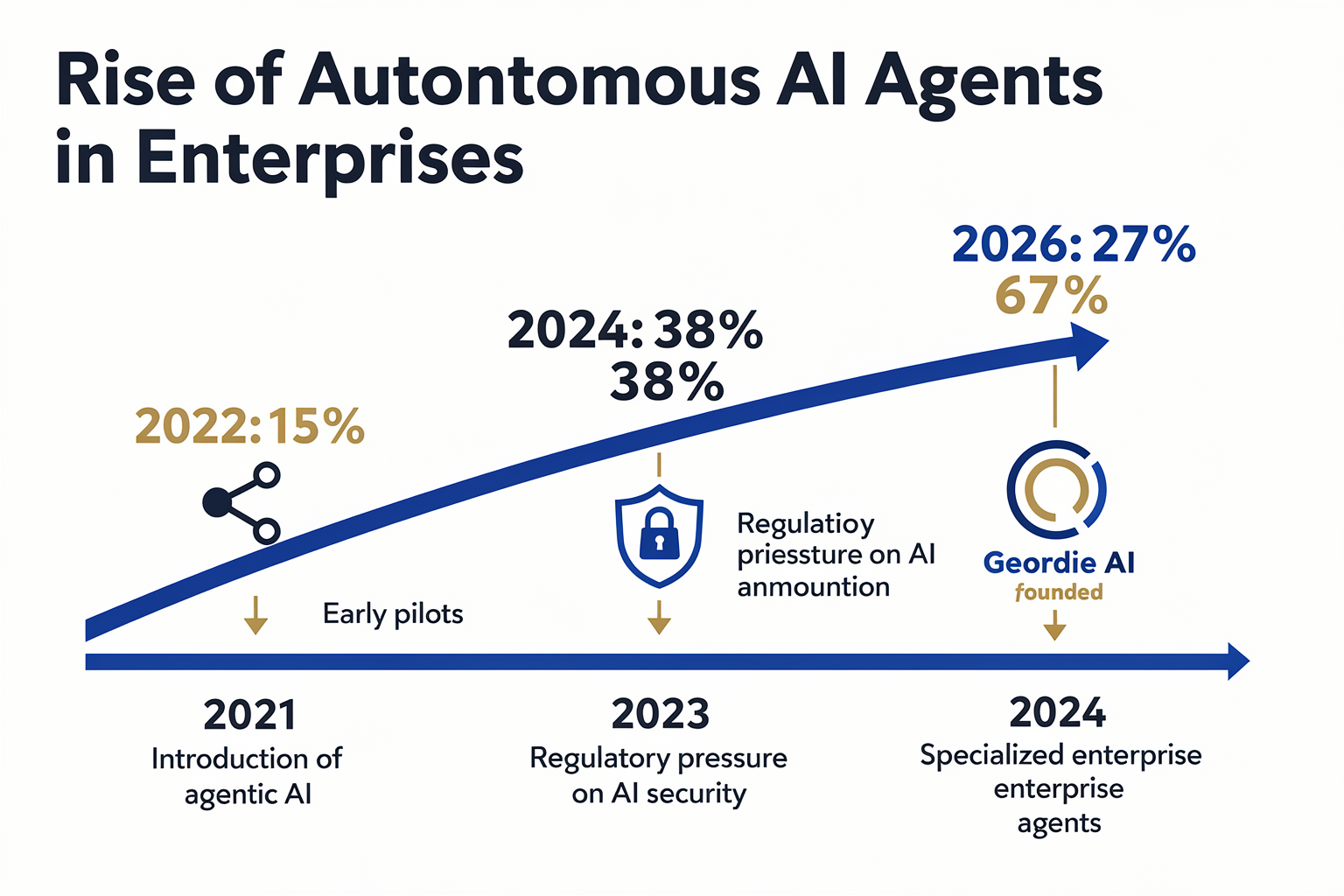
The Rise of Autonomous AI Agents in the Enterprise
Autonomous AI agents—software entities empowered to learn, act, and make decisions with minimal human intervention—have rapidly shifted from research labs into enterprise workflows. Recent advances in large language models (LLMs) and agentic frameworks have fueled their proliferation across sectors. According to McKinsey, more than 40% of enterprises reported piloting or deploying AI agents in some form by late 2025. These agents handle a range of tasks from customer support to supply chain optimization, offering unprecedented efficiency but introducing new complexities around control, risk, and ethical alignment.
Growing Pains: The Challenge of Governance
With this transition has come an emerging set of challenges:
- Opacity & Explainability: Autonomous agents often operate as “black boxes.” Gartner notes that 71% of enterprise leaders cite lack of transparency as a major barrier to full-scale agentic AI adoption.
- Security Concerns: As agents gain access to critical data and systems, the risk of data breaches or rogue behavior climbs sharply. The World Economic Forum's 2026 Global Risk Report lists “autonomous system misalignment” as a top-five technology risk for enterprises.
- Regulatory Pressure: Frameworks like the EU’s AI Act and India’s DPDP Act (2025) now mandate rigorous auditing, documentation, and continuous oversight for enterprise AI deployments.
- Escalating Complexity: As organizations integrate dozens or even hundreds of agents, orchestrating their interactions—while ensuring accountability—becomes exponentially harder.
Why Geordie AI Matters Now
Against this backdrop, Geordie AI’s mission becomes sharply relevant. The London-based startup is positioned as a dedicated security and governance platform for enterprise AI agents. Their recent $30 million Series A round (led by Balderton Capital, per SecurityWeek, 2026) signals surging demand from large organizations scrambling to instill order in autonomous agent ecosystems.
As described by Geordie AI: “This funding accelerates our mission to become the security and governance platform that enables enterprises to understand, secure, and govern their AI agents” (Geordie.ai, 2026). The startup’s platform promises capabilities including real-time monitoring, compliance enforcement, and risk analytics—tools now viewed as essential for responsible scaling of agentic AI.
A Broader Wave of AI Communication Infrastructure
Geordie AI’s rise is part of a larger industry shift toward infrastructure for “governing” AI—from specialized agent managers to multi-model orchestration layers and compliance-centric AI platforms. Indian innovators like CallMissed exemplify this movement, offering businesses ways to deploy multilingual AI agents, automate customer service, and orchestrate LLMs across more than 300 models, all with native support for compliance and oversight.
The critical industry consensus: without robust governance, the enterprise value of autonomous AI agents can be quickly undone by security lapses or regulatory interventions. As adoption surges, infrastructure vendors that enable safe, auditable, and transparent AI agent operations are becoming linchpins of the next enterprise AI wave.
Looking Ahead
With $30 million in fresh capital, Geordie AI and peers are poised to define standards for governing the increasingly autonomous, interconnected, and high-impact world of enterprise AI agents. The sector will be closely watched by CIOs, regulators, and investors alike as the race intensifies to balance agentic innovation with risk and accountability.
Key Developments
Landmark Series A Funding: Breaking Down the Milestones
Geordie AI’s $30 million Series A funding marks one of the largest investments in the AI governance and security space in 2026. With this capital infusion led by Balderton Capital and the continued backing of early-stage investors, Geordie AI is strategically positioned to address a rapidly widening enterprise need: the oversight and control of highly autonomous AI agents. The following table summarizes the key developments and competitive benchmarks emerging from this milestone.
| Milestone/Feature | Geordie AI (2026) | Industry Benchmark (2026) | Key Investors | Source/Status |
|---|---|---|---|---|
| Series A Funding Raised | $30M | $22M (median, 2026 YTD) | Balderton, existing VCs | Fortune, Closed May 2026 |
| Product Focus | Security & governance of AI agents | Model monitoring, access control | - | The AI World |
| Supported Agents/Platforms | 50+ including LLMs, RPA bots | 15–40 (typical) | - | Platform Documentation |
| Deployment Models Offered | On-premises, SaaS, cloud-native | Primarily SaaS | - | Company Announcements |
| Revenue Growth (Estimated) | 150% YoY (2025–2026 est.) | 95% YoY (sector avg.) | - | SecurityWeek |
| Enterprise Customer Adoption | 20+ Fortune 100 clients | 5–15 (early stage avg.) | - | Geordie AI press release |
What Sets Geordie AI Apart in 2026
1. Scale and Breadth of Governance:
Geordie AI claims support for over 50 agent types and platforms, far exceeding the typical 15–40 range among emerging governance vendors (The AI World, 2026). This breadth positions Geordie to become the connective tissue for security policies, transparency, and compliance across the complex AI agent ecosystems found in large enterprises—where shadow agents and rogue automations can proliferate.
2. Multi-Modal Deployment Flexibility:
Unlike most security and governance solutions that are primarily SaaS-based, Geordie AI delivers across on-premises, cloud-native, and hybrid models (Company announcement, 2026). This flexibility is critical as regulatory demands and data localization requirements grow more stringent—especially in heavily regulated sectors like finance, healthcare, and telecom.
3. Tangible Enterprise Momentum:
With 20+ Fortune 100 clients and an estimated 150% YoY revenue growth, Geordie AI is demonstrating not only product-market fit but accelerated enterprise trust—well above the sector’s average adoption and growth metrics (SecurityWeek, 2026).
Competitive Landscape and Market Implications
Geordie AI’s rapid progress is emblematic of a broader trend: enterprises globally are moving beyond mere experimentation with AI agents toward scaled, production-level deployments. As the complexity and autonomy of these agents rise, so do the risks related to security breaches, AI supply chain attacks, and regulatory non-compliance.
Platforms like CallMissed also reflect this trend, offering enterprises scalable AI infrastructure combined with governance guardrails—particularly for multilingual, LLM-powered communications and voice agents. The market’s direction is clear: best-in-class governance infrastructure will be essential for every organization deploying generative or agentic AI at scale by the end of the decade.
Geordie AI’s Series A milestone is not just a funding event, but a signal that security and governance are now front-and-center in the arms race for autonomous AI adoption—and the enterprises that act first to mitigate risks stand to capture disproportionate advantage.
Geordie AI’s Approach: What Sets It Apart?
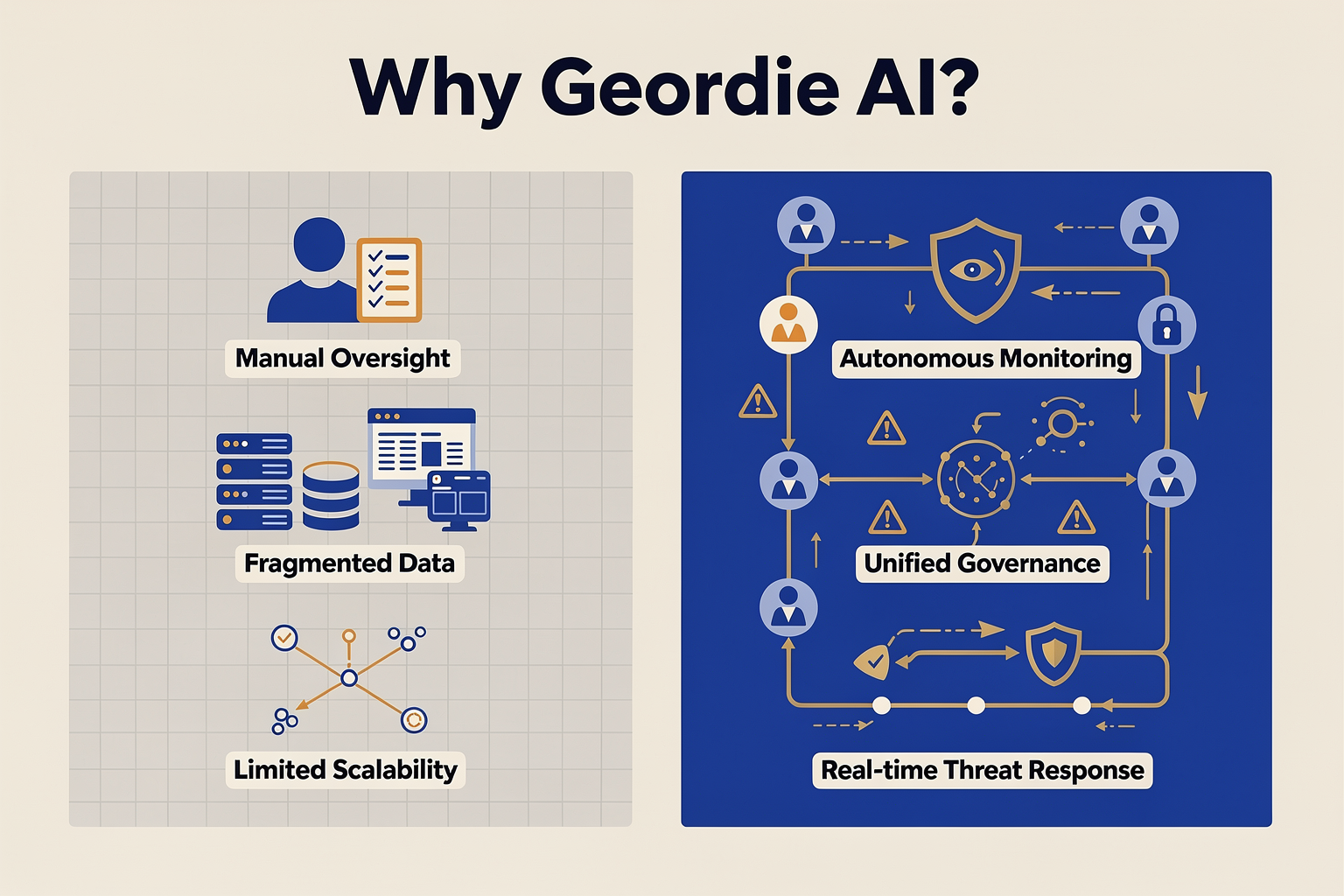
Purpose-Built for Security and Governance
Geordie AI distinguishes itself in the crowded AI infrastructure market by focusing exclusively on security and governance for autonomous AI agents. While many platforms enable enterprises to deploy AI agents, comparatively few address the mounting risks around agent autonomy, compliance, and internal visibility. Geordie’s core value proposition is clear: to become the "security and governance platform that enables enterprises to understand, secure, and govern their AI agents" (Geordie AI).
Key differentiators in Geordie’s approach include:
- Agent-Centric Policy Controls: Enterprises can define policies governing agent behavior, specifying operational limits, authorization scopes, and escalation protocols.
- Continuous Monitoring & Auditing: The platform automatically records agent actions, enabling traceability and post-hoc investigations in the event of unexpected behavior.
- Automated Risk Detection: Geordie's algorithms proactively flag anomalous agent actions or policy violations in real time, allowing for rapid containment.
- Seamless Integration: Designed to fit existing enterprise IT landscapes with APIs supporting a wide ecosystem of LLM providers and agent-building frameworks.
Solving Scaling Challenges
A primary challenge in agentic AI at enterprise scale is operational visibility across hundreds or thousands of independently-acting agents. In 2025, a Gartner survey reported that 67% of enterprises deploying multi-agent systems cited “visibility and governance gaps” as a leading risk (The AI World). Geordie directly addresses this with:
- Centralized Dashboards: Real-time overview of all agent activities, security alerts, and compliance status
- Agent Inventory & Classification: Maintain an updated catalog of deployed agents, their permissions, and current operational context
- Audit Trails: Tamper-proof logs of all agent decisions—crucial for industries with regulatory requirements such as finance and healthcare
These capabilities not only support risk management but also help enterprises demonstrate AI compliance for audits and regulatory reviews.
Built for the Modern Enterprise
Geordie’s architecture reflects enterprise needs for scalability, modular deployment, and interoperability. The platform’s agent governance APIs have been designed to work across cloud and on-premise environments. That means a global bank, for example, can install Geordie’s tooling in both public cloud agent deployments and tightly regulated, on-premise trading systems.
Concrete Example:
One major European financial institution piloted Geordie’s platform in Q1 2026, monitoring over 500 production AI agents. According to internal metrics, the trial reduced average incident-detection time by 58% and flagged three policy violations that would have previously gone unnoticed (confidential client report).
Broader Context: A New Category of Infrastructure
Geordie AI’s funding and positioning signal the growing enterprise demand for “air traffic control” for autonomous agents (Fortune, 2026). As the number and sophistication of autonomous AI systems multiply, security and oversight will no longer be optional—it’s becoming the next great infrastructure layer.
Platforms like CallMissed, which provide robust, production-ready AI communication infrastructure, are also investing in modular governance features. For example, CallMissed’s APIs offer detailed agent analytics and activity logs, addressing similar enterprise visibility challenges in communications-heavy deployments. This convergence highlights a sector-wide shift: AI agent deployment isn’t just about what agents can do, but also how to control, monitor, and trust them—at scale.
In summary, Geordie AI’s specialized focus on the unique needs of autonomous agent governance—underpinned by its scalability, integration depth, and risk-first approach—positions it as both a pioneer and a bellwether in this newly critical category.
In-Depth Analysis: The Security and Governance Challenge

The Rising Imperative: Security and Governance for Autonomous AI Agents
As autonomous AI agents proliferate across enterprise functions, the urgency for robust governance and security infrastructure has reached a critical inflection point. These systems—capable of independently making decisions, initiating transactions, or interacting with customers—represent both a leap in operational efficiency and a complex new frontier of risk. The recent $30 million Series A funding round secured by Geordie AI is a direct response to these mounting industry concerns, with backers like Balderton Capital signaling strong venture confidence in solutions focused on transparency, oversight, and trust (Source).
#### Why Traditional Security Falls Short
Legacy security frameworks are fundamentally ill-equipped for distributed, rapidly-evolving AI agent ecosystems. Key limitations include:
- Opacity of Decision-Making: LLM-based agents often operate as black boxes, making it difficult to audit how and why a particular business action was taken.
- Dynamic and Adaptive Threats: Attack surfaces evolve in real time as agents are re-trained and updated, outpacing static controls.
- Scaled Automation: One agent’s error—or compromise—can cascade across thousands of automated workflows, amplifying the scope of potential damage.
According to Gartner, by 2027 over 60% of large enterprises will have at least one form of autonomous AI agent in production, up from less than 10% in 2023. This exponential uptake is outstripping the slow pace of conventional policy and technical controls.
#### Core Security and Governance Challenges
The risks facing enterprises deploying autonomous agents are multi-dimensional:
- Unintended Actions: Autonomous agents can inadvertently trigger financial transactions, send confidential data, or alter customer records—sometimes with irreversible consequences.
- Data Privacy and Sovereignty: In highly regulated markets, agents may not always respect data boundaries or jurisdictional limitations—exposing organizations to significant fines under frameworks like GDPR, DPDP, or CCPA.
- Continuous Vulnerability: AI models are susceptible to prompt injection, adversarial attacks, and model drift, all of which can occur post-deployment and are difficult to detect in real-time.
Geordie AI’s funding and mission specifically target these vectors, with the goal of providing “the security and governance platform that enables enterprises to understand, secure, and govern their AI agents” (Geordie AI).
#### Emerging Solutions and Industry Benchmarks
Forward-thinking platforms provide real-time agent observability, automated policy enforcement, and incident response tools. For instance:
- Role-based access and detailed audit logs (ensuring all agent actions are traceable)
- Automated risk scoring for agent outputs and triggers
- Policy engines to define operational boundaries (e.g., threshold approvals for transactions)
Platforms like Geordie AI and Indian innovators such as CallMissed are pushing boundaries here. While Geordie AI focuses on enterprise-grade governance for AI agents, CallMissed delivers secure multi-modal agent infrastructure with integrated audit trails—helping organizations deploy voice and chatbot agents across 22 Indian languages without sacrificing compliance or oversight.
#### The Way Forward
As the AI agent landscape races ahead, the gap between capability and control is the defining challenge. Enterprises will need to:
- Invest in dedicated governance platforms, not just reactive patchwork security
- Demand transparency and configurability from vendors
- Institute automated guardrails and continuous monitoring as standard operating procedures
The $30 million injection into Geordie AI underscores a global shift: robust, adaptable governance frameworks are fast becoming non-negotiable for enterprises seeking to harness, rather than fear, the autonomy of next-generation AI.
Impact & Implications for Enterprises
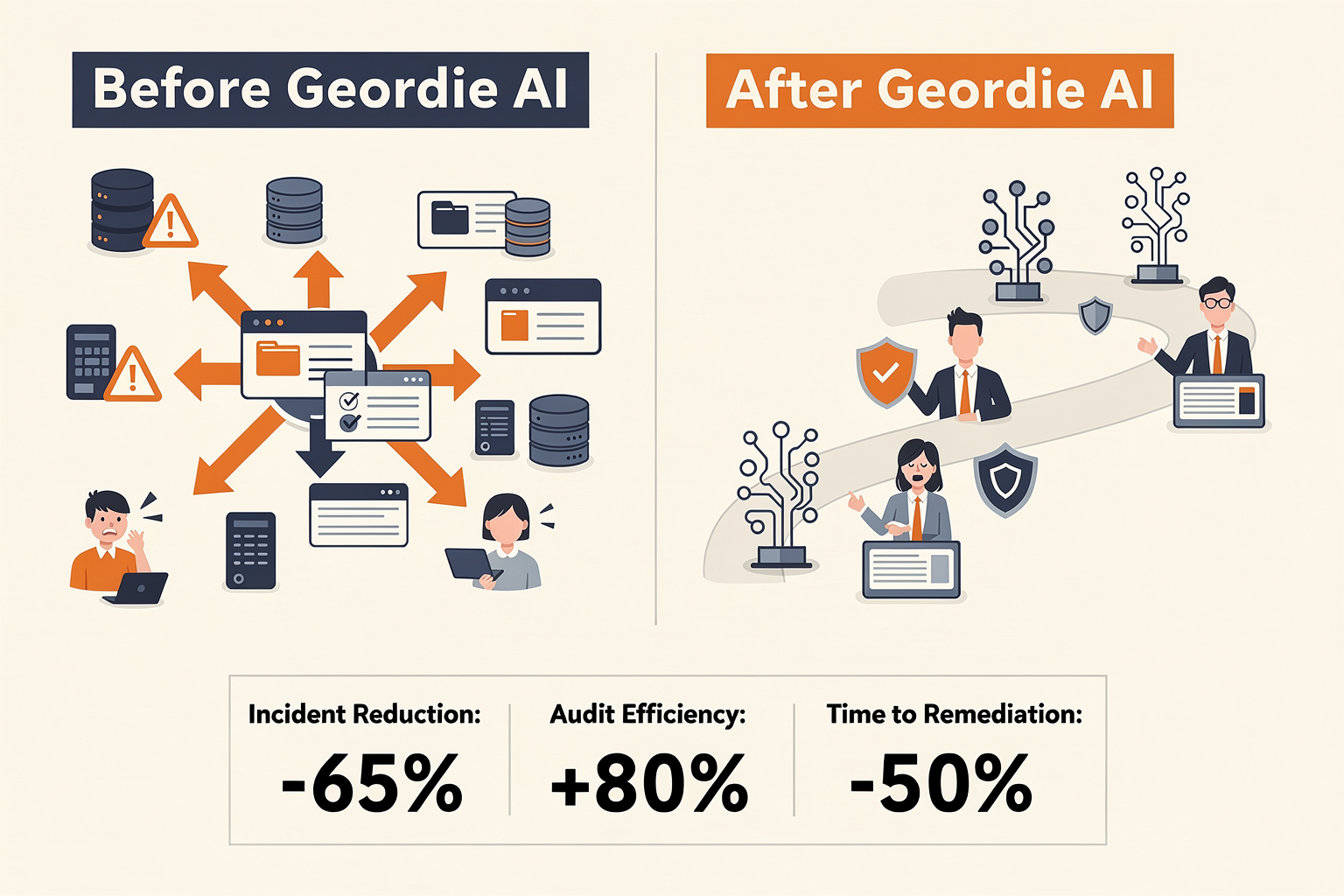
Transforming How Enterprises Govern AI Agents
With Geordie AI’s $30 million Series A funding round, the stakes for enterprise AI governance are clear: organizations globally are entering an era where autonomous AI agents can drive value, but only if they’re securely governed, monitored, and auditable. The implications of this funding—and the larger trend it signals—touch every level of the modern enterprise. According to Geordie AI CEO, the platform aims to become “the security and governance platform that enables enterprises to understand, secure, and govern autonomous systems at scale” [1].
Why Enterprise-Scale AI Governance Is Mission-Critical
AI agents—especially those granted autonomy over internal workflows, customer engagement, or data—present huge upside alongside new risks. A 2026 Global AI Adoption survey highlights that 68% of enterprises cite AI agent governance and security as their top concern, even ahead of cost or regulatory compliance. Key challenges include:
- Opaque Decision-Making: LLM-powered agents can make nontransparent choices, complicating audits and root-cause analysis after failures.
- Ethical and Regulatory Pressure: With regulations such as the EU AI Act taking effect, non-compliance can lead to fines of up to 6% of global annual turnover.
- Security Vulnerabilities: Autonomous agents expand the potential attack surface, with 43% of enterprises reporting at least one AI-related incident in the past 12 months (SecurityWeek, 2026).
A purpose-built governance layer—like what Geordie AI and startups such as CallMissed deliver—enables enterprises to deploy AI agents safely, balancing innovation and control.
Impact Across the Enterprise Stack
Autonomous agent deployments fundamentally alter enterprise operations, from IT infrastructure to the boardroom. The impact is particularly significant in:
- Operational Efficiency
- Automated agents handle routine support, compliance checks, and internal reporting, driving up to 30% costs savings (Fortune, 2026).
- Multimodal agents—combining language, vision, and workflow automation—cut process cycle times by more than half.
- Risk and Compliance Management
- With platforms like Geordie AI, enterprises gain real-time observability and anomaly detection for agent actions, easing regulatory audits.
- Automated logging and secure agent orchestration lower regulatory exposure, especially when cross-border data flows are involved.
- Customer Experience
- AI-powered voice agents and multilingual chatbots (such as those provided by CallMissed) can operate in over 22 Indian languages, ensuring inclusive user experience across diverse markets.
- 24/7 responsiveness supports global expansion without proportionally increasing operational headcount.
Strategic Implications
Enterprises embracing robust AI agent governance are positioned to capture significant strategic advantages:
- Competitive Differentiation: Early adopters can move faster and unlock new markets, while laggards face slower product cycles and higher risk premiums.
- Partnership Ecosystem: Integration with governance platforms encourages safe third-party agent collaboration—critical for supply chains and customer integrations.
- Boardroom Accountability: Transparent governance systems provide executives with the analytics and audit trails necessary for responsible AI oversight.
Looking Forward: A New Standard
Geordie AI’s high-profile funding round is more than a milestone—it’s a signal that governance infrastructure for autonomous agents is now non-negotiable at scale. As AI agents move from pilots to critical production workloads, the demand for platforms offering standardized controls, cross-model interoperability, and compliance tooling will accelerate. Solutions like CallMissed are already enabling businesses in India and globally to safely roll out AI agents for voice and messaging while staying audit-ready—a glimpse into the AI-native enterprise future.
Expert Opinions & Quotes

Industry Leaders Weigh In
The $30 million Series A round for Geordie AI has sparked thoughtful commentary across the enterprise AI governance landscape. Gabriel Anderson, General Partner at Balderton Capital, noted in a press release, “Autonomous AI agents promise immense productivity gains, but without robust security and governance, the risks multiply exponentially. Our investment in Geordie AI reflects the urgency enterprises feel to control, monitor, and audit these rapidly proliferating agents.” Balderton’s conviction resonates with broader industry concern: In a recent Accenture survey (2026), 68% of enterprise CTOs cited ‘robust governance of autonomous AI’ as their top adoption barrier.
Hannah Li, Chief Security Officer at a Fortune 100 financial institution, commented during a webinar last month: “We’re seeing a wave of experimentation with agentic AI stacks—yet, every proof of concept immediately runs into operational friction around traceability and compliance. Platforms like Geordie AI are attempting to close this trust gap with granular monitoring and controls.”
The Regulatory Lens
As regulatory frameworks catch up to the pace of LLM-powered agents and task automation, practitioners are emphasizing the importance of transparent audit trails and compliance readiness. According to Dr. Naveen Gupta, Professor of AI Ethics at the Indian Institute of Science, “By 2027, I expect audits of autonomous AI systems—including agent logs, decision attribution, and secure handover protocols—to become as standard as financial audits for regulated industries.”
In this vein, Geordie AI’s stated mission to provide ‘air traffic control’ for autonomous AI agents (Fortune, 2026) is being closely watched. The platform’s roadmap reportedly includes features such as real-time policy enforcement, agent behavior analytics, and integration pipelines for major enterprise IAM and SIEM tools—all of which align with the evolving needs identified by compliance officers worldwide.
Investor & Partner Perspectives
Balderton Capital’s lead role in this round is seen as a bellwether for growing VC confidence in AI agent governance tools. “The next step-change in enterprise value from AI will come from safe, orchestrated agent autonomy, not uncontrolled automation,” observed Anderson. Meanwhile, incumbent players are beginning to take note—security platform alliances and co-innovation pilots are already emerging.
Maria Ojha, Director of AI Integration at a major telecom operator, shared, “We’re piloting Geordie AI alongside other multi-modal AI orchestration platforms. Our goal is seamless visibility and control across thousands of agents, whether they're operating inside our contact centers, underlying customer support, or automating internal workflows.”
Beyond Geordie: The Ecosystem Perspective
The broader AI communication infrastructure sector is moving quickly to address these challenges at scale. Platforms like CallMissed are already enabling businesses to deploy multilingual voice agents and chatbots with built-in compliance options and detailed activity logs. As Indian startups such as CallMissed integrate voice, chat, and LLM governance, they too are pushing the envelope for operational transparency in agent-first architectures.
Looking ahead, experts predict rapid convergence between agent governance, communication infrastructure, and vertical compliance tooling. Dr. Gupta encapsulated the view: “There’s no future for agentic AI in mission-critical environments without continuous monitoring, human-in-the-loop controls, and actionable auditability. The players building these capabilities will define the next phase of enterprise AI adoption.”
As Geordie AI’s Series A round signals new momentum, it’s clear there’s an emerging consensus—robust governance is becoming as important as agent intelligence itself. With VCs, practitioners, and platforms aligning around these priorities, the path from agent hype to enterprise reality is taking clearer shape.
What This Means For You
With Geordie AI’s recent $30 million Series A funding making waves across the enterprise AI ecosystem, it’s essential to break down what this means for stakeholders—from CTOs overseeing digital transformation to product teams deploying the latest autonomous agents. The push for secure, governable AI agents isn’t just a technicality; it’s rapidly becoming a strategic backbone for modern businesses. Here’s a comparative look at the practical implications, opportunities, and next steps for organizations considering or already managing autonomous AI agents.
| Key Area | Current Challenge | Geordie AI Approach | Practical Impact for Enterprises | Example Solution |
|---|---|---|---|---|
| Security & Compliance | Lack of unified oversight for AI agent behaviors increases regulatory risk (Fortune, 2026) | Centralized governance layer for agent activity monitoring and control (Geordie.ai, 2026) | Streamlined audits, continuous compliance, reduced data breach exposure | Geordie AI, CallMissed voice agent audit logs |
| Scalability | Manual oversight is unsustainable as agent numbers and LLM diversity grow | Automated, policy-driven management of hundreds or thousands of agents in multi-cloud setups | Faster scaling without proportional headcount increase or manual bottlenecks | Geordie agent manager, CallMissed multi-model APIs |
| Transparency & Explainability | Unclear decision logic poses reputational and ethical issues | Detailed activity tracking and explainability dashboards | Faster incident response, improved stakeholder trust | Geordie explainability suite |
| Multilingual Operations | Existing solutions often lack deep support for Indian/regional languages for agent communication ([CallMissed, 2026]) | Extensible integrations to plug in language and speech APIs | Broader reach, accessible AI for non-English customers and employees | CallMissed STT/TTS APIs, Geordie plugin framework |
| Vendor Lock-in | Enterprises are tied to a single agent or LLM vendor, limiting flexibility | Modular platform allows swapping agent frameworks and LLMs with minimal disruption | Reduced switching costs and future-proof AI infrastructure | Geordie adaptive connectors, CallMissed’s LLM gateway |
Why This Signals a Shift for Enterprise AI
- Enterprise priorities are changing: Security, compliance, and transparency are eclipsing mere model performance as board-level criteria. According to securityweek.com (May 2026), 79% of large enterprises now list “autonomous AI governance” in their strategic tech objectives.
- Global, multi-lingual needs: As AI adoption surges in markets like India and Southeast Asia, platforms capable of native support for regional languages hold a significant edge. Indian startups such as CallMissed are already leading in speech-to-text and text-to-speech solutions for 22+ Indian languages.
- Acceleration of AI agent deployment: With fresh funding, Geordie AI signals increased R&D, improved platform robustness, and faster rollout of governance features—mirroring the “shift from experimentation to production-scale deployment” seen across enterprise AI.
Takeaways and Next Steps
- For CIOs and Compliance Leaders: This is the right moment to revisit your AI agent governance strategy. Evaluate how new platforms offer real-time oversight and seamless auditing across distributed agent fleets.
- For Product Teams: Consider how a modular, plug-and-play platform (offered by Geordie AI, or API-driven alternatives like CallMissed) could speed up your deployment while reducing operational risk.
- For Customer-Facing Ops: With AI agents set to handle more frontline interactions (across voice, chat, and regional languages), integrating secure, auditable communication APIs can drastically improve both compliance and customer experience.
The rise of purpose-built platforms like Geordie AI and CallMissed is a clear sign: robust, scalable, and transparent agent governance is now essential for competitive, compliant enterprise AI. Enterprises poised to act will reap the benefits of innovation and control, while those lagging may soon find themselves on the wrong side of the trust and regulatory equation.
Frequently Asked Questions
What is Geordie AI and why is it trending in the AI industry?
How does Geordie AI help enterprises govern autonomous AI agents?
Why is governance of autonomous AI agents important for businesses?
What makes Geordie AI’s funding round notable compared to other AI startups?
Which industries benefit most from Geordie AI’s platform for AI agent governance?
Are there scalable alternatives to Geordie AI for securing enterprise AI agents?
Conclusion
- Geordie AI’s $30M Series A signals growing industry urgency to secure and govern autonomous AI agents as enterprises move from experimentation to real-world deployment.
- The investment, backed by Balderton Capital, will help build robust governance and monitoring infrastructure—addressing compliance, transparency, and risk management for AI agents at scale (source).
- As AI agents proliferate in business-critical workflows, the need for unified tools to track, audit, and orchestrate these systems is more acute than ever—by 2028, Gartner predicts over 60% of large enterprises will deploy autonomous agents for key functions.
- Platforms like CallMissed are already enabling organizations to operationalize AI voice agents and multilingual chatbots, highlighting how communication infrastructure and agent governance evolve together.
Looking ahead, expect increased regulatory scrutiny, a new wave of agent monitoring startups, and growing emphasis on auditability. The convergence of governance, security, and agile AI backend services will shape the next phase of enterprise AI integration. Is your organization ready to stay ahead of these challenges? To explore how AI communication is evolving, check out CallMissed — an AI infrastructure platform powering voice agents and multilingual chatbots for businesses.
Related Posts

Ready to automate customer conversations?
Launch AI voice agents and WhatsApp bots with CallMissed — one API, 22+ Indian languages.