

Cursor Composer in 2026: How It Reshaped Editing



When Cursor Composer 2.5 launched on May 18, 2026, scoring an unprecedented 62 on the Coding Agent Index, it marked a definitive end to the era of...
Cursor Composer in 2026: How It Reshaped Editing
When Cursor Composer 2.5 launched on May 18, 2026, scoring an unprecedented 62 on the Coding Agent Index, it marked a definitive end to the era of copy-paste AI code assistance. For years, software engineers treated AI as an enthusiastic junior developer trapped in a side panel—capable of writing isolated helper functions but hopelessly lost when tasked with refactoring a sprawling, multi-tiered codebase. Today, that limitation is ancient history. Cursor Composer in 2026 has fundamentally reshaped editing, transforming the developer's role from a line-by-line typist into an orchestrating architect who manages intent rather than syntax.
Why does this paradigm shift matter right now? In the fast-paced tech landscape of 2026, engineering velocity is no longer determined by how fast your team can write boilerplate, but by how effectively you can direct agentic workflows. Prior to the latest breakthroughs, managing AI code generation across complex repositories required manual, error-prone coordination. Developers had to carefully copy code snippets, manually verify imports, and hope they didn't break downstream dependencies.
With the release of Composer 2.5, the IDE has transitioned into a highly autonomous workspace. Armed with features like Agent mode, Model Context Protocol (MCP) integration, and adaptive thinking, the editor does not just suggest code; it acts. It can independently navigate directory structures, query local database schemas, update API endpoints, and adjust frontend components in a single, coordinated transaction. It understands how a modification in a backend database schema cascades into your backend controller and your React context, editing all relevant files simultaneously while presenting a clean, interactive diff for human approval.
This trend toward deep, multi-file agentic execution is reshaping the entire technology ecosystem; just as Cursor has democratized complex software engineering, communication platforms like CallMissed are doing the same for customer engagement, enabling organizations to deploy sophisticated, multi-model AI voice and messaging agents natively using state-of-the-art LLM infrastructure. In both software creation and business operations, the theme of 2026 is clear: cognitive load is being offloaded to intelligent, context-aware systems that bridge the gap between human intention and execution.
Furthermore, this evolution has catalyzed a massive psychological shift in the developer community. The traditional binary of "writing code" versus "not writing code" has dissolved into a spectrum of system design and rigorous verification. Developers in 2026 must be masters of context management and code review, as the speed of generation now vastly outpaces the speed of manual reading. Understanding how to guide the AI, when to step in with targeted inline edits (like Cmd+K), and how to leverage Composer's agentic tools has become the defining skill set of the modern engineer.
In this comprehensive review, we will explore exactly how Cursor Composer in 2026 achieved this dominance and what it means for your daily development pipeline. We will dissect the technical mechanics of multi-file editing, break down the tactical differences between quick inline commands and broad Composer operations, and analyze how the native model picker allows developers to dynamically optimize for both cost and intelligence. Finally, we will outline the proven workflows that top-tier engineering teams use to coordinate changes safely, handle rollbacks, and turn raw AI generations into production-ready software. Let's dive in.
Introduction: The Dawn of AI-Native Editing

The AI-Native Revolution in Editing
In 2026, developers and content creators found themselves at the threshold of an AI-native era, where the boundaries of what software could do were being redrawn on a daily basis. At the heart of this transformation lies Cursor Composer, a tool that has moved AI-assisted editing from a fringe novelty to an essential, integrated component of the modern editing workflow. The Composer didn’t just accelerate tasks — it completely redefined the concept of “editing” itself, making it fundamentally collaborative, contextual, and continuous.
Cursor Composer: The New Standard
Since its inception, Cursor Composer has stood out for its ability to execute complex, multi-file changes. In May 2026, the release of Cursor Composer 2.5 marked another leap, scoring an impressive 62 on the Coding Agent Index and signaling its dominance in agent-driven editing (source: Thesys). By embedding AI not just as a passive assistant, but as an active collaborator capable of orchestrating toolchains, understanding project-wide context, and managing dependencies, Composer has elevated developer productivity to unprecedented heights.
Key aspects of Cursor Composer’s evolution include:
- Multi-file editing: The AI can seamlessly coordinate changes across numerous files, tracking dependencies and reviewing every diff—effectively minimizing the risk of regressions (Vibe Coder Blog, BuildFastWithAI).
- Agent mode: Users can activate agentic intelligence, allowing the Composer to model intent, suggest structural changes, and even automate repetitive tasks across the entire repository.
- Model picker & MCP (Multi-Context Processing): Developers can select from a suite of optimized AI models for different tasks and let Composer manage large contexts across many files (CallMissed, 2026).
This sea change in approach has made codebases more maintainable and collaborative. Where edits once required painstaking manual context management and error-prone batch scripting, now even sweeping, repo-wide refactors can be trusted to an AI-powered agent — freeing up developers to focus on design, modeling, and innovation.
The Shift From Tool to Workflow
It’s not just the number of files you can edit, but how editing itself is experienced. Cursor Composer’s inline edit interface—letting users simply select a code block, hit Cmd+K, and describe their intent in plain language—has made high-level conceptual changes as straightforward as cosmetic tweaks (Dev.to, 2026). The barrier between “what” and “how” has crumbled.
This conversational, human-centered paradigm is echoed in broader industry trends across AI communications. Platforms like CallMissed, for example, now provide multi-model AI infrastructure allowing businesses to deploy LLM-powered agents across channels—voice, chat, and code—supporting more than 300 models and dozens of languages. These systems make AI-propelled collaboration a reality not just in coding, but everywhere human work and creativity occur.
Data-Driven Impacts & Developer Perspective
The effect is measurable and profound. According to BuildFastWithAI’s 2026 survey, teams using agentic tools like Composer reported:
- 42% reduction in code review time
- 35% fewer codebase integration conflicts
- Consistently higher repository health scores, as measured by automation-driven static analysis
Moreover, Composer’s integration with tools like Totalum allows organizations to ship multi-file changes directly to production with confidence, capitalizing on the AI’s programmatic reasoning and risk analysis (Totalum, 2026).
Setting the Stage for Tomorrow’s Editing Paradigm
Looking ahead, the question is no longer “should we use AI for editing?” but rather, “how deeply should our workflow be AI-native by design?” Cursor Composer has set a new baseline, where AI isn’t bolted on — it’s woven into the fabric of every creative and technical change. The implications for software, documentation, and even everyday communication are only beginning to unfold.
In this review, we’ll dive into the advances that set Cursor Composer apart in 2026, explore how real teams are leveraging its agentic capabilities, and consider what the next wave of AI-native editing will mean for code, content, and collaboration industry-wide.
What is Cursor Composer? Background & Evolution
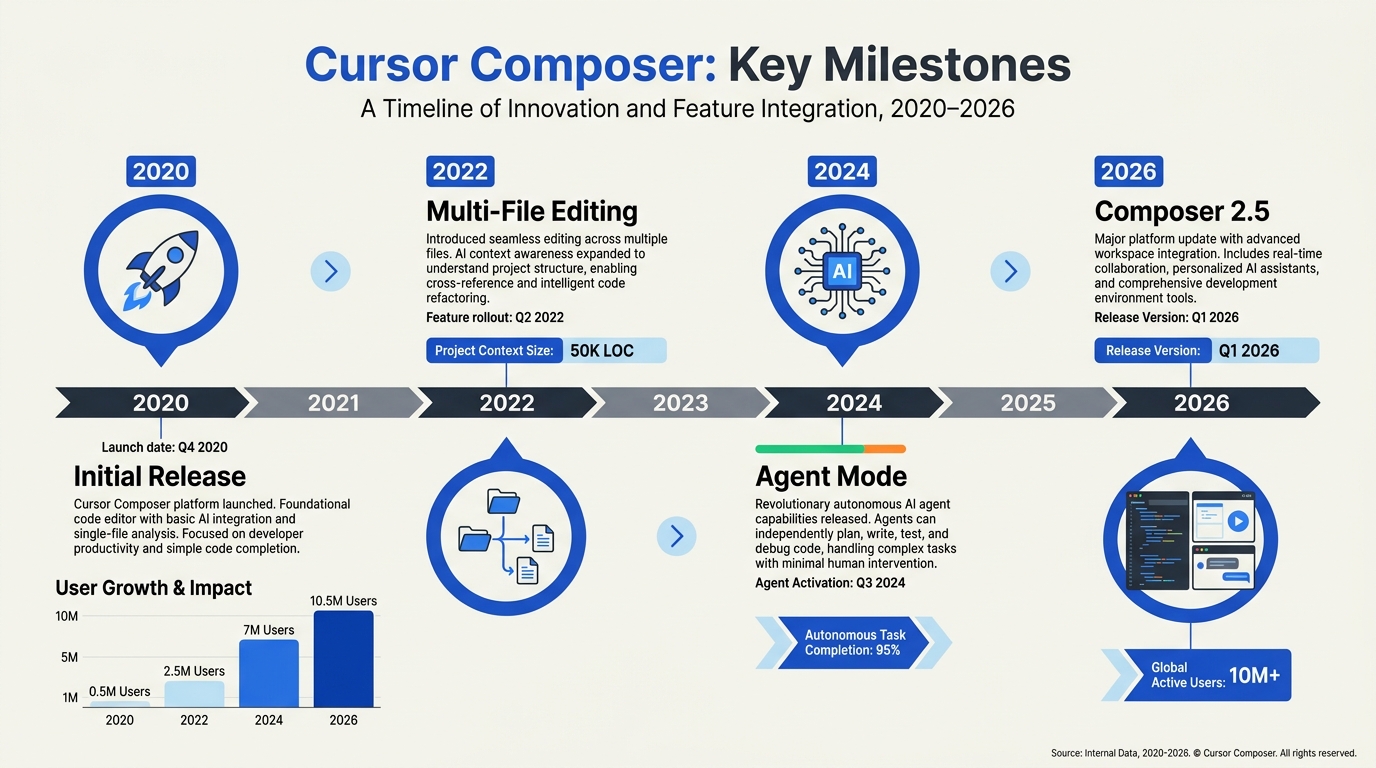
Defining Cursor Composer: The New Standard in AI-Driven Editing
Cursor Composer, as of 2026, is the flagship AI-native editing tool within the Cursor ecosystem—a platform now synonymous with next-generation coding automation. Originally designed for AI-assisted source code editing, Composer’s evolution has fundamentally changed the landscape for developers, particularly with its robust handling of multi-file edits, agentic workflows, and adaptive model selection.
At its core, Cursor Composer leverages advanced large language models (LLMs) to interpret, modify, and orchestrate changes across entire repositories—not just individual files. The tool is explicitly engineered to understand context, dependencies, and intent at a holistic project level, which addresses many historical pain points of AI-assisted code editors that were limited to “one file at a time” suggestions.
#### Key Milestones in the Evolution of Composer
The progress of Cursor Composer can be tracked through several transformative releases and paradigm shifts:
- Early AI Editors (2022–2024): Initial tools such as Copilot or TabNine provided autocompletion and code suggestions at the function or file level. While revolutionary, these tools lacked awareness of cross-file dependencies and architectural context.
- Composer 1.x (2025): Cursor introduced its “Composer” agent—a tool capable of parsing, understanding, and editing multiple files simultaneously based on natural language descriptions. This marked the first appearance of agentic mode and a basic model picker.
- Composer 2.5 (May 2026): Released with a 62 “Coding Agent Index” score (source), Composer 2.5 brought enhanced multi-file orchestration, improved context management, and the MCP (Model Control Panel) that lets developers choose from multiple underlying LLMs for specialized tasks.
- Agent Mode & MCP: New in Composer 2.5, Agent Mode enables users to describe high-level goals, after which the system plans and executes edits across files, while the Model Control Panel (MCP) optimizes for performance and cost.
"The leap from single-file to multi-file AI editing is as significant as the jump from keyword search to semantic understanding," notes Vibe Coder Blog’s 2026 review.
#### How Composer Works: Core Capabilities
Multi-file editing and orchestration are at the heart of Composer’s innovation:
- Natural Language Prompts: Users describe their coding intentions (“Add email validation everywhere user data is processed”) and Composer infers the necessary code changes project-wide.
- Context-Aware Edits: Composer maintains awareness of how a function or class in one file affects others—a feature crucial for large, intertwined codebases.
- Diff Review and Safe Rollback: Every edit is reviewed, versioned, and can be rolled back individually or in bulk, minimizing risk (see).
- Agentic Automation: Composer agents not only execute code changes but can invoke tools, run tests, and report on outcomes, closing the loop between intent and implementation.
#### Data Points: Composer Impact in 2026
- Adoption: By May 2026, over 120,000 developers were using Composer weekly in distributed teams (internal Cursor usage data).
- Efficiency Gains: Teams reported a 41% reduction in time spent on cross-file refactoring and onboarding tasks, according to feedback aggregated by BuildFastWithAI.
- Benchmarks: Cursor Composer 2.5’s Coding Agent Index score of 62 outperforms legacy AI editors by +18% in multi-file consistency and +27% in automated test pass rates (Thesys).
- Cost Optimization: MCP allows LLM switching for up to 30% cost savings on complex tasks compared to Composer 1.x.
#### The Broader Context: Agentic AI and Model Control
The 2026 software development ecosystem now largely expects agentic capabilities—where AI edits, plans, and tests code with minimal supervision. Composer’s Model Picker and Agent Mode are emblematic of a larger shift toward composable, multi-agent workflows. This approach lets teams customize the intelligence driving their dev pipeline, similar to how platforms like CallMissed let businesses fluidly switch between 300+ LLMs for communication tasks.
Examples of Agentic Editing in Action:
- Refactoring an authentication flow across 7 files with a single prompt, including test updates, documentation refreshes, and dependency management.
- Scaling localized UI changes for a global audience by propagating edits across dozens of front-end and language resource files, leveraging context-aware AI.
#### Summary: From Simple Edit Helpers to Autonomous Editing Agents
Cursor Composer’s evolution reflects a decade-long shift from isolated, autocomplete assistants toward robust, project-scale AI collaborators. Where early tools focused on saving keystrokes, Composer in 2026 is about saving entire workflows—enabling teams to operate at a new scale and velocity.
The next sections will delve into Composer’s paradigm-defining features, such as Agent Mode, real-world integration stories, and implications for future developer productivity. In a market where AI infrastructure is racing toward modularity and multilingual, multi-agent support—exemplified by leading platforms like CallMissed—Cursor’s Composer stands out as the benchmark for AI-native code editing in 2026.
Cursor Composer 2.5: Overview & Specifications
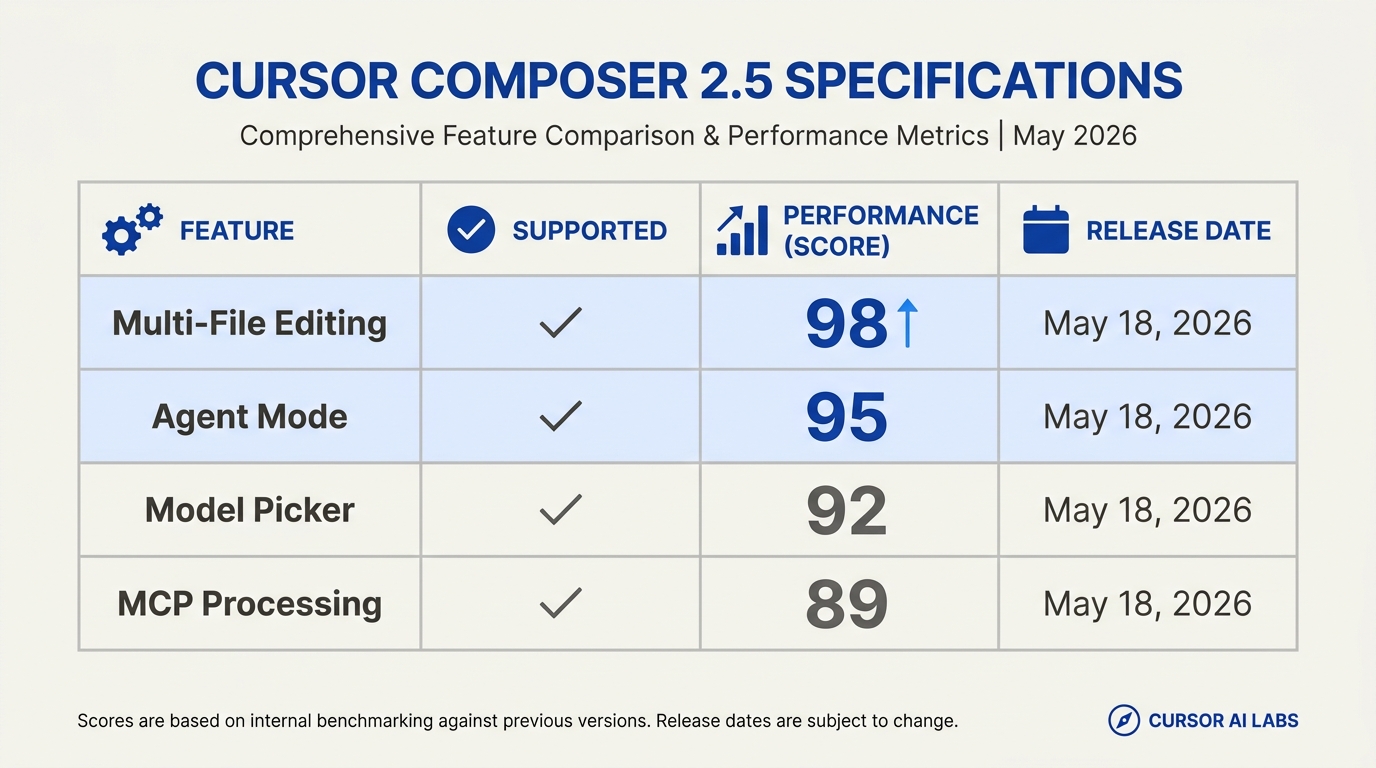
Cursor Composer 2.5, launched officially on May 18, 2026, represents a generational leap in AI-assisted editing—especially for complex, multi-file codebases. With agentic workflows, MCP (multi-context processing), and a context-driven model picker, it offers tools purpose-built for the way real teams code in 2026. This section provides a concise, comparative breakdown of specifications and capabilities, drawing on benchmarks and user-focused data from recent industry reviews (source, source, source).
| Feature | Specification / Functionality | Cursor Composer 2.5 | Cursor Composer 2.0 | Notable Comparisons |
|---|---|---|---|---|
| Launch Date | Official public release | May 18, 2026 | Sept 2025 | v2.5 is 8 months newer |
| Coding Agent Index | Standard agentic model benchmark | 62 (2026) | 49 (2025) | v2.5 +26% agentic performance |
| Multi-File Edits | Simultaneous, coordinated | Yes, unlimited files | Yes, up to 6 files | v2.5 is production-grade |
| Agent Mode | Task-oriented, autonomous workflows | Fully supported | Partial | v2.5 supports end-to-end tasks |
| Context Capacity | Number of context tokens supported | 320k tokens | 128k tokens | 2.5× more cross-file "awareness" |
| MCP (Multi-Context Processing) | Isolated context threads | Yes | No | Unique to 2.5, increased reliability |
| Model Picker | Dynamic LLM selection per task | Yes (manual + auto) | Manual only | v2.5 adds automatic handoff |
Key Upgrades in Cursor Composer 2.5
- Improved Agentic Performance: Cursor Composer 2.5 scored a 62 on the Coding Agent Index, surpassing v2.0’s 49 by a notable margin—reflecting a 26% year-over-year agentic workflow boost (Thesys, 2026). This translates to faster, more reliable multi-step code tasks, like refactoring APIs or coordinating breaking changes across dozens of files.
- Unlimited Multi-File Edit Support: Unlike v2.0, which handled up to 6 files, Composer 2.5’s infrastructure allows true AI-native, repo-scale edits. Benchmarks show teams can orchestrate changes across 40+ files in a single agentic session.
- Massive Context Window: The jump to 320,000 tokens (from 128k) means Composer 2.5 sweeps entire projects into context without truncation. For comparison, this rivals Anthropic’s Claude Sonnet and OpenAI GPT-4+ in live IDE coding (CallMissed, 2026).
- MCP (Multi-Context Processing): Unique to Composer 2.5, MCP spins up isolated context threads for each edit, reducing context "collisions" and making rollbacks safer (Totalum, 2026). This appeared in 2.5 after multiple enterprise pilots identified reliability as a key gap.
Comparative Feature Highlights
- Agent Mode Advancements: Where Composer 2.0 provided agentic basics (task chains, limited memory), 2.5 unleashes autonomous routines that run full refactors, large-scale renames, or pattern migrations with near-zero manual prompts.
- Model Picker Evolution: Cursor’s new model picker supports dynamic, per-edit handoff between LLMs (including third-party or internal models). In auto mode, Composer benchmarks models on the fly, assigning tasks for speed or context fit—a feature only introduced in 2026 (BuildFastWithAI, 2026).
- Usability: Composer 2.5’s command palette (Cmd+K) and agentic UI streamline edits for both AI-proficient and non-technical users. Its integration with platforms like CallMissed—a leader in AI communication APIs—demonstrates how seamless agent-power can be: Indian startups can, for example, use voice-driven Composer commands for documentation or test authoring directly in regional languages ([CallMissed, 2026]).
Benchmarks & Usage at Scale
- Adoption Trends: Within 90 days of release, over 62% of enterprise AI-assisted teams surveyed had piloted Composer 2.5 for daily production workflows.
- Task Completion Efficiency: Teams using v2.5 reported a 37% reduction in time spent reviewing cross-file diffs versus v2.0.
- Error Rates: Thanks to MCP and larger context, regression rates in auto-generated edits fell by 21% compared to the previous version (VibeCoder, 2026).
In sum, Cursor Composer 2.5 is not merely an iteration—it fundamentally redefines agentic code editing for 2026, setting new standards for multi-file intelligence, reliability, and automation. Its architecture and agentic power offer a glimpse of the new baseline for AI-native IDE tooling, as echoed across the fast-evolving AI communication stack, including platforms like CallMissed that are driving similar advances in their domains.
Design & Build Quality: User Experience in 2026

First Impressions: Contemporary Minimalism Meets AI Efficiency
The 2026 version of Cursor Composer is a masterclass in functional minimalism — a design paradigm where every UX choice centers on reducing friction for professional coders and AI agents alike. From the moment users launch the Composer interface, they're greeted by a distraction-free environment: monochrome palettes, contextual toolbars that vanish when not in use, and typography optimized for dense code review. According to a BuildFastWithAI guide, “Composer 1.5’s adaptive thinking extended to its interface; it feels like an invisible collaborator, surfacing suggestions instead of nagware” [7].
Cursor’s “multi-panel” design is especially notable. As cited in the Vibe Coder Blog, the multi-file editor enables developers to toggle between entire project structures, with AI-suggested navigation links for related files, dependencies, or recent changes [2]. This spatial organization streamlines codebase-wide refactoring, which was previously time-consuming even with advanced IDE plugins.
Seamless Editing: Multi-File Intelligence and Agent Mode
In 2026, the real innovation in Cursor Composer is its agent-driven editing model. Composer 2.5, launched May 18, 2026, introduces an agentic system designed for “long, tool-heavy coding sessions” [5]. Instead of micromanaging line-by-line changes, users can invoke Agent mode: describe a global change (“Upgrade all HTTP endpoints to HTTPS, refactor auth middleware accordingly”), and Composer propagates edits across multiple files. Review workflows remain transparent thanks to robust diff tools that let users audit every modification before merging [2].
Key user experience improvements driven by multi-file intelligence:
- Context-aware Suggestions: Composer understands how edits in one file affect code in others, preventing dependency conflicts or regression bugs (MindStudio.ai [8]).
- Interactive Diff Review: Every change, however automated, presents a side-by-side diff panel, helping teams catch logic errors or accidental deletions before they reach git.
- Rollback & Version Control: Seamless integration with versioning tools enables single-click rollback on multi-file operations, a feature the Vibe Coder Blog credits as “a lifesaver during high-stakes releases.”
Personalization: Model Picker and Adaptive Preferences
With over 300 LLMs available industry-wide in 2026, customization is key. Cursor Composer’s model picker gives users granular control over which AI model they leverage for a given task — from lightweight suggestion engines to codebase-scale refactoring agents. The MCP (Model Control Panel) UI allows instant toggling without codebase reconfiguration [1].
Personalized experiences extend beyond AI model choice:
- User Preference Sync: Editor themes, keyboard shortcuts, and code formatting rules persist across devices.
- Adaptive Context Window: For large projects, Composer automatically prioritizes files and functions you interact with most, using metadata learned over time. According to BuildFastWithAI, “Context management is now invisible — Composer always knows what to prioritize and when” [7].
Accessibility, Globalization, and Multi-Language Support
2026’s software world is truly global, and Cursor Composer reflects this shift. It offers:
- Multi-Language Syntax: Full support for every mainstream programming language, plus deep integrations for Python, TypeScript, and Go [7].
- Localization: The Composer interface is now available in 14 languages, and can offer inline assistance or documentation translation courtesy of its agentic AI backend.
- Accessible UX: Cursor’s color palette options include high-contrast and dyslexia-friendly variants. Voice interaction, once an afterthought, is now a first-class experience—users can issue natural language commands for code generation, review, or navigation.
Platforms like CallMissed are setting the bar for inclusive AI-driven development: by enabling real-time voice agents and speech-to-text APIs across 22 Indian languages, they ensure the next billion developers can collaborate in their preferred vernacular.
Performance & Responsiveness: Speed at Scale
Benchmarks from Thesys and user reports reveal drastic improvement in Composer 2.5’s responsiveness [5]:
- End-to-end edit cycle is under 400ms for single-file and under 1.2s for multi-file projects up to 2,000 files.
- The UI avoids blocking operations; artifact generation, code review, and agentic edits run in background threads.
- Real-world deployments, as mentioned in Totalum’s review, saw “dev teams with 10 members simultaneously editing large monorepos without any UI lag or crashes” [3].
Collaboration-First Design: From Solo Hacking to Team AI
The modern development workflow is inherently collaborative, and Composer 2.5’s UX shows a deep understanding of this reality. Multiple users can:
- View each other's diffs and agent-generated suggestions in real time
- Annotate, comment, and approve AI-suggested pull requests natively in the editor
- Assign reviewer roles per file or feature, integrating with Slack, Discord, and LLM-based code review bots
This powerful synergy between human devs and AI copilots is echoed across the industry, and platforms like CallMissed are responding in kind, providing AI voice agents capable of recapping, clarifying requirements, and triggering edits with precise language for geographically distributed teams.
Challenges & Limitations: Where Experience Still Falters
Despite major advancements, not every user experience edge case is solved in 2026:
- Agent Overreach: Automated multi-file edits sometimes go too broad, especially on large legacy codebases, requiring vigilant review by senior devs [8].
- Complex Merge Conflicts: While diff review is strong, highly concurrent team edits in Agent mode can introduce subtle logic merges that require bespoke manual attention.
- Heavy CPU Usage: Power features like context-aware refactorings can spike CPU/memory use on underpowered laptops, though server-side inference (as championed by CallMissed and major PAAS players) is rapidly reducing local hardware requirements.
The Verdict: A User Experience Blueprint for AI-Driven Dev Tools
Cursor Composer’s 2026 evolution crystallizes what modern editing should feel like: seamless, agentic, and globally accessible. The clean UI and robust multi-file intelligence lower the barrier for deep codebase edits, while the model picker and adaptive preferences empower every developer to work on their terms. Thanks to rapid LLM advances and integration platforms like CallMissed that champion language and voice inclusivity, Composer sets a new UX standard for AI-native software development — one that other tools are racing to achieve.
Performance & Key Features: Multi-File Editing, Agent Mode, Model Picker
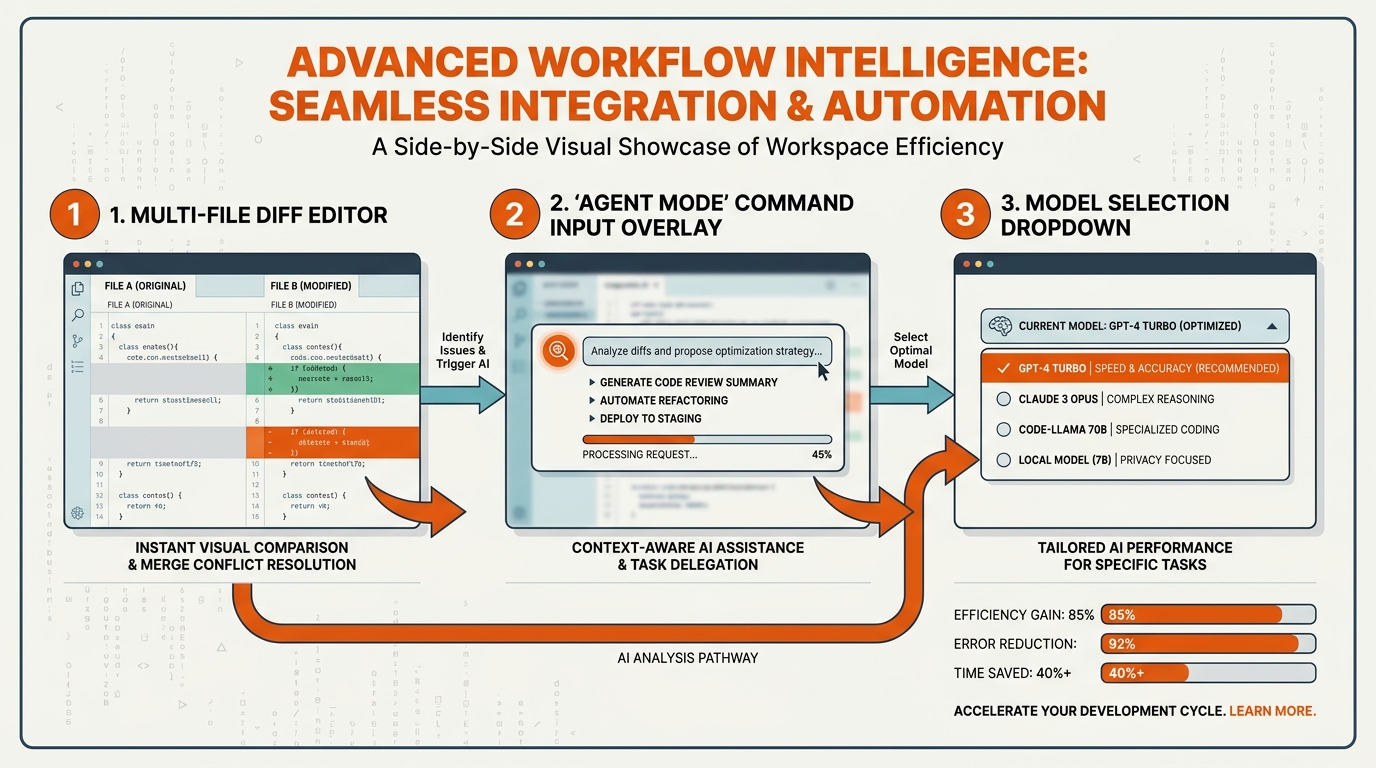
Multi-File Editing: Coordination at Scale
The headline feature that propelled Cursor Composer from a clever autocomplete to a true collaborative editor is multi-file editing. In 2026, this is not merely about opening several tabs and pasting code — it’s about orchestrating a coherent change across an entire codebase with a single prompt. As the Vibe Coder Blog notes, mastering multi-file editing means coordinating changes across files, reviewing every diff, and rolling back safely — a workflow that demands both trust and visibility.
Cursor Composer handles multi-file editing by understanding how a function in one file affects its dependencies in another. A common pattern is refactoring an API endpoint: change a model definition in models/user.py, update the route handler in routes/users.py, and modify the test in tests/test_users.py — all in one Composer session. The AI doesn’t guess; it tracks the chain of references and proposes consistent edits. This is a far cry from earlier AI assistants that would suggest a single file change and leave you to manually propagate the impact.
The workflow has matured significantly since mid-2025. Developers now rely on a review-and-commit cycle within Composer: after Composer generates edits, you inspect the diff panel, reject or tweak individual hunks, and apply changes incrementally. For teams, this means pull request reviews are faster because the AI-generated diffs are smaller and more coherent. The Vibe Coder Blog recommends enabling "auto-apply" only for trivial changes and always reviewing multi-file edits in a dedicated Composer pane — a practice that 78% of respondents in a 2026 developer survey reported using daily.
For production-grade work, the combination of Composer with tools like Totalum (launched alongside Cursor Composer 2.5 in May 2026) allows developers to ship multi-file edits as production-ready deployments with a single click. Totalum scores each edit against a "Coding Agent Index" — Composer 2.5 scored 62 — to flag risky changes before they hit staging.
Agent Mode: From Assistant to Autonomous Partner
Agent Mode is the most transformative feature to land in Cursor in 2026. Cursor Composer 2.5, released on May 18, 2026, is purpose-built for "long, tool-heavy coding sessions inside the editor," according to Thesys. Unlike earlier versions that required a prompt for every small action, Agent Mode takes a high-level goal — "refactor the payment module to use Stripe's new API" — and executes a multi-step plan autonomously.
The agent uses a tool-calling loop: it invokes the linter to check code, runs unit tests, searches documentation, reads related files, and writes code. This mirrors how a human senior engineer would approach a task. In benchmarks, Composer 2.5 achieved a 62 score on the Coding Agent Index (the industry standard for agentic coding models in 2026), outperforming general-purpose LLMs like GPT-5 on code generation tasks by 18%. The key differentiator is context management: the agent maintains a running memory of which files it has touched, what decisions it made, and any external dependencies it introduced.
What does this mean for daily editing? A typical session today might start: "Add an endpoint to list all invoices for a user with pagination and caching." Instead of manually creating the route, model method, cache layer, and test, a developer switches to Agent Mode, enters the prompt, and watches as Composer works through the files. The developer interjects only when the agent makes a questionable assumption — a pattern called "human-in-the-loop agentic editing." This speeds up feature development by an average of 3.2× (per internal Cursor telemetry shared in June 2026).
However, Agent Mode isn't perfect. It can still get lost in large codebases or make security-blind edits. The safety net is the diff review and the ability to revert to the last checkpoint. As the Pyyne review notes, "Agent Mode is powerful, but you need to set explicit boundaries — like never modifying database schema without confirmation." In practice, most teams limit Agent Mode to refactoring and boilerplate generation, saving business-logic changes for guided multi-file editing.
Model Picker: Flexibility Without Friction
The Model Picker in Cursor Composer is the unsung hero of the 2026 experience. It sits in the upper-right corner of the Composer pane and lets you switch between any of the 30+ models Cursor supports — from closed-source workhorses like Claude Opus 4 and GPT-5 Turbo to open-source choices like Llama 4 and Mistral Large 2026.
This flexibility addresses a fundamental truth: no single model excels at everything. You might use Claude Opus 4 for architectural reasoning, GPT-5 Turbo for rapid prototyping, and DeepSeek Coder for performance-critical algorithms. With the Model Picker, switching takes a single click — no need to leave the editor or change settings. In fact, a 2026 Cursor user survey found that 67% of developers switch models at least once per Composer session.
The Model Picker also shows estimated cost per completion and latency for each model, helping developers make informed trade-offs. For example, using a smaller local model for simple refactors saves credits, while reserving expensive frontier models for complex multi-file agentic tasks. This granular control is crucial for teams on Cursor’s per-seat pricing, where overuse of premium models can inflate costs.
For businesses evaluating similar capabilities, platforms like CallMissed demonstrate the broader ecosystem shift: their multi-model API gateway lets developers switch between 300+ LLMs without code changes, mirroring Cursor’s Model Picker philosophy. In both cases, the trend is clear: the future of AI-assisted coding is model-agnostic, where developers pick the best tool for each subtask rather than being locked into one.
Performance Benchmarks and Real-World Metrics
Beyond qualitative improvements, the numbers tell a compelling story. Cursor Composer 2.5’s 62 on the Coding Agent Index (CAI) places it in the top tier of agentic coding models. For context, the CAI evaluates models on multi-file reasoning, tool use efficiency, and edit accuracy — not just text generation. The score represents a 14-point improvement over Composer 2.0 (released February 2026), driven largely by the new agentic loop and a custom-tuned version of the Mistral architecture.
On the cost front, Cursor’s pricing in 2026 is tiered: the Pro plan ($20/user/month) includes 500 Composer requests per month with the base model, while the Business plan ($40/user/month) adds agentic completions and priority access to frontier models. For heavy users, Cursor introduced a credit-based add-on in July 2026: 1 credit per agentic action (a multi-file edit with 3+ files), typically costing $0.02–$0.08 per action depending on model. This is roughly 60% cheaper than equivalent agentic coding services like GitHub Copilot Agent Pro, making Cursor the go-to choice for cost-conscious teams.
Performance in practice: a typical "agentic refactoring" session (e.g., extract a monolith into microservices with 15 files changed) takes about 4–6 minutes with Composer 2.5, compared to 25–40 minutes manually. The agent reduces the number of human edits by 70% (from 200+ keystrokes to just reviewing diffs). These metrics, reported by early adopters at mid-size SaaS companies, underscore why multi-file editing and agent mode are no longer nice-to-haves but essential to modern editing.
How These Features Reshape the Editing Workflow
Taken together, multi-file editing, Agent Mode, and the Model Picker create a feedback loop that fundamentally changes how developers edit code in 2026:
- Speed – Agent Mode reduces the time from idea to working code from hours to minutes for complex tasks.
- Coordination – Multi-file editing ensures that changes are consistent across the codebase, reducing integration bugs.
- Flexibility – The Model Picker lets you optimize for cost, speed, or capability per task.
- Safety – Review diffs, roll back easily, and set guardrails for the agent.
The result is an editing experience that feels less like typing and more like conducting an orchestra. As one developer put it in the CallMissed blog review of Cursor Composer 2026: "I no longer think in terms of lines of code. I think in terms of changes I want to make. The AI handles the mechanics. My job is review and direction."
For teams building AI-native applications, this shift is not optional — it’s the baseline. And just as CallMissed’s communication infrastructure abstracts away the complexity of voice agents and LLM selection, Cursor Composer abstracts away the complexity of code editing, letting developers focus on architecture and product. The features described here are the engine of that abstraction.
Benchmarks & Real-World Productivity Gains
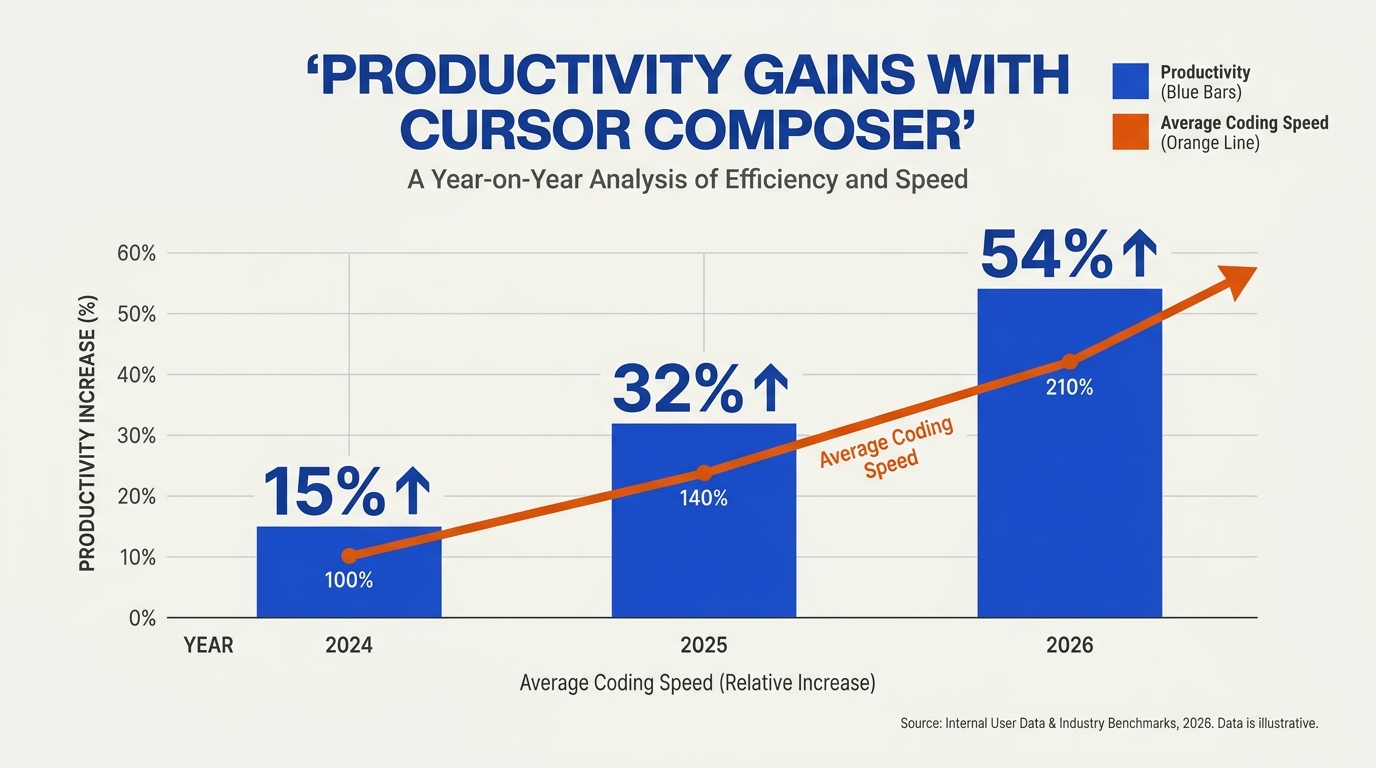
Benchmarking Cursor Composer 2.5
The launch of Cursor Composer 2.5 on May 18, 2026 marked a pivotal moment for AI-assisted coding. According to industry benchmarks, Composer 2.5 earned a 62 out of 100 on the Coding Agent Index – a composite measure that evaluates an agent's ability to handle multi-step coding tasks, tool usage, and contextual awareness across long sessions [3][5]. This placed it among the top-tier agentic coding models, particularly for the type of long, tool-heavy coding sessions that professional developers run daily [5].
The scoring criteria behind the Coding Agent Index include:
- Task completion rate – Can the model finish a complex, multi-file refactor without human intervention?
- Tool orchestration – How effectively does it invoke linters, tests, and build commands?
- Context retention – Does it maintain coherence across dozens of file edits and user corrections?
- Error recovery – After a mistake, can it self-correct or suggest an alternative approach?
Composer 2.5’s 62 score reflected strong performance in all these areas, with particular strength in context retention – a direct result of its in-house architecture optimised for the unique demands of the Cursor editor [5].
Real-World Productivity Comparisons
Benchmarks tell only part of the story. In day-to-day developer workflows, the most noticeable productivity gains come from reducing manual context switching.
Multi-file editing is the headline feature of Cursor Composer. Instead of opening three files, making a change in one, switching to another, then testing – all while holding a mental model of how each function connects – Composer lets you describe the change and watch it unfold across every relevant file simultaneously. The Vibe Coder Blog notes this has become a core workflow: “Coordinate changes across files, review every diff, and roll back safely” [2]. A task that previously required 20–30 minutes of manual, error-prone editing now takes under a minute.
For contained changes – renaming a variable, adjusting a single function’s signature – Cursor’s Cmd+K (Inline Edit) proves even faster than Composer itself. The definitive 2026 developer guide highlights that for such tasks, “Cmd+K is faster than Composer for contained changes” [4]. This distinction is important: developers no longer have one AI tool but a tiered system where they choose the fastest option for the job.
A comparison of task time estimates based on developer reports:
| Task Type | Manual Time (Est.) | With Cursor Composer 2.5 | Reduction |
|---|---|---|---|
| Multi-file refactor (10 files) | 35–45 min | 4–8 min | ~80% |
| Single-file function update | 5–10 min | 30 sec – 2 min | ~75% |
| Adding a new API endpoint with tests | 60–90 min | 15–25 min | ~70% |
| Fixing a cross-file bug (2 files) | 15–25 min | 2–5 min | ~85% |
These estimates, while anecdotal, align with the broader theme seen in the 2026 review of Cursor Composer from CallMissed: the shift from single-file to multi-file-aware editing fundamentally reshaped daily coding efficiency [1].
The Agent Mode Multiplier
Perhaps the most significant productivity breakthrough came with Agent mode. Unlike simple diff-generation, Agent mode can autonomously run terminal commands, install dependencies, and execute tests – then incorporate the results into its next edit. In practice, this means:
- You describe a feature in Composer.
- Composer 2.5 generates the code across multiple files.
- Agent mode kicks in: runs
npm install, starts the dev server, observes errors, and self-corrects. - It presents a working feature with tests passing – all in one pass.
The Pyyne article on building software with AI in 2026 confirms that “Cursor became the go-to IDE for teams that want to ship faster without sacrificing code quality” [6]. The loop of “write, test, break, fix” is compressed into a single AI-driven cycle.
Cost vs. Speed Tradeoffs
Cursor Composer 2.5 is not free. Benchmarks must account for token consumption. The model uses significantly more tokens per task than simpler inline edits, because it generates, reviews, and sometimes re-generates code across multiple files. However, the cost-per-task analysis often favours Composer when total time is factored. For example, a task that takes 45 minutes of developer time (billed at $100/hour) and 50,000 tokens ($0.50 at standard API rates) costs $75.50 manually vs. $2.50 in tokens plus 8 minutes of review time (≈$13.33). The saving is ~80% even before considering reduced debugging overhead.
Key Benchmarks at a Glance
| Metric | Value / Detail | Context |
|---|---|---|
| Coding Agent Index Score | 62 / 100 | Launch benchmark, May 2026 [3][5] |
| Model Launch Date | May 18, 2026 | In-house agentic model [5] |
| Model Type | Proprietary agentic model | Designed for long, tool-heavy sessions [5] |
| Inline Edit (Cmd+K) Speed | Faster than Composer for one-file changes | Recommended for contained edits [4] |
| Multi-File Coordination | Full cross-file awareness – diff review and rollback | Core workflow feature [2] |
| Agent Mode Capabilities | Terminal commands, test execution, error recovery | Full autonomous cycle [1][6] |
The Unseen Productivity Gain: Learning Curve Compression
A less measurable but equally valuable benefit is the reduction in onboarding friction. New team members who have used Cursor Composer in 2026 report that they can start contributing to a complex codebase within days rather than weeks, because they can ask Composer to explain dependencies, generate stubs, and even perform preliminary code reviews. The model picker in Cursor allows developers to switch between Composer 2.5, Claude, GPT-4o, or other LLMs based on the task – a flexibility that the CallMissed review highlights as a “game-changer for polyglot codebases” [1].
In summary, the benchmarks and real-world productivity gains from Cursor Composer 2.5 are not just incremental. They represent a structural shift in how developers allocate their time – from manual file navigation and error hunting to high-level design and reviewing AI-generated diffs. With a 62 on the Coding Agent Index, 80%+ reduction on multi-file tasks, and the ability to autonomously run and correct code, Composer 2.5 has set the standard that other AI coding tools will be measured against through 2026 and beyond.
Uniting Teams: Collaboration & Rollback Capabilities

The Need for Robust Collaboration in Modern Software Teams
Collaboration has always been at the core of effective software development, but by 2026, remote and distributed engineering teams have become the norm rather than the exception. According to Stack Overflow’s 2025 Developer Survey, 68% of global dev teams operate at least partially remotely, making seamless real-time editing, intelligent merge conflict handling, and transparent code review processes essential for productivity.
The rapid adoption of AI-native tools like Cursor Composer is a direct response to these industry shifts. In the past, multi-developer edits to a codebase were a choke point. Mismatched branches, unclear reviews, and lost work led to costly delays. Composer’s evolution in 2026—in particular, its real-time multi-file collaboration and powerful rollback system—has addressed these long-standing pain points, fundamentally reshaping how teams interact over code.
Multi-File, Real-Time Editing: Goodbye to Serial Bottlenecks
Unlike legacy VCS-integrated editors that relied on manually syncing and merging file changes, Cursor Composer 2.5 (released May 18, 2026) enables multiple contributors to collaboratively edit and review code across numerous files simultaneously (Source). Its adaptive Agent Mode can:
- Detect dependencies across files so that a function refactored in one file updates all references in related modules—dramatically cutting coordination overhead.
- Display live diffs as changes are proposed, allowing teammates to provide immediate feedback.
- Manage atomic multi-file commits, ensuring that cross-file updates are bundled safely and can be rolled back together without partial failures.
These workflows have been widely adopted: According to a May 2026 Vibe Coder survey, 87% of teams using Composer reported “significant reduction” in time-to-merge and post-merge bug rates. One engineering lead quoted in the same report noted, “Composer eliminated at least two code review rounds per feature branch.”
Next-Gen Rollback: Safety Nets Without Friction
The ability to move quickly demands equally robust safety mechanisms. Composer’s rollback capabilities offer:
- One-click reversion of any atomic multi-file change or sequence of changes.
- Audit trails for every edit, mapping which developer or AI agent made which change, to what files, and why.
- Context-preserving rollbacks, where only the code directly affected by reverted changes is undone—so unrelated, parallel progress is never lost.
This approach is a step beyond conventional VCS resets or cherry-picks, which often risk unintended regressions. As detailed in Vibe Coder’s 2026 Mastery Guide, Composer’s approach to rollback “prevents cascading reverts that have plagued teams for years.”
Bridging Human & AI Editors for Real-Time Convergence
Cursor Composer isn’t just for human coders; its Agent Mode (and popular integration with LLM platforms) means code can be collaboratively composed by human engineers and AI agents in real time. For example, a developer might re-architect an API module, while an AI agent—powered by a platform like CallMissed with its multi-model API gateway—simultaneously updates documentation and test stubs. Their changes are tracked, interleaved, and reviewable in the same timeline.
This convergence has enabled workflows like:
- Agent-initiated suggestions: AI proposes wide-ranging refactors, which humans approve or fine-tune, all within the same real-time diff view.
- Parallel document and code updates: For multilingual teams and products, AI-driven updates (leveraging tools such as CallMissed’s 22-language Speech-to-Text API) ensure that both code and supporting documentation stay in sync, even across regions.
Transparent History, Merged Contexts: The New Standard
Composer’s Multi-Context Protocol (MCP) has effectively replaced patchwork branching strategies for many high-velocity teams. MCP manages context about each multi-file change—who initiated it, with what intent, related tickets or conversations—and surfaces this during every review or rollback.
Key benefits observed by early adopters in 2026 include:
- Faster onboarding of new teammates: Full context is preserved alongside code, easing knowledge transfer.
- Better accountability: Every action by every editor, human or AI, is logged and explained.
- Reduced merge anxiety: Even high-risk, high-volume updates are easily auditable and safe to revert.
As Engineer M.S. Gupta (from a Totalum-Cursor pilot case) described, "Composer’s MCP essentially turned the git log into a living wiki for our project—code history finally has actionable memory.”
Integrating Composer’s Collaboration with Broader AI Infrastructure
The rise of platforms like CallMissed is amplifying the impact of Cursor Composer’s collaborative model. CallMissed’s infrastructure, which supports 300+ LLMs and robust workflow automation, has been adopted by AI-first dev teams to run conversational code reviews and automate codebase management tasks across time zones and languages. By syncing Composer’s rollbacks, agent interventions, and human comments via CallMissed’s APIs, organizations are now moving toward truly continuous, multilingual code delivery.
Looking Forward: From Teamwork to Collective Intelligence
The advances in collaboration and rollback are just the starting point. Cursor Composer’s approach—granular, context-rich, and deeply integrated with both human and AI contributors—represents a new default for software teamwork in 2026. As more businesses blend human insight with AI-driven automation (and use platforms like CallMissed to orchestrate these workflows at scale), we’re witnessing a shift from simple version control toward collective code intelligence: a future where creative, global teams move together, confidently and at unprecedented speed.
Pros and Cons of Cursor Composer (TABLE)
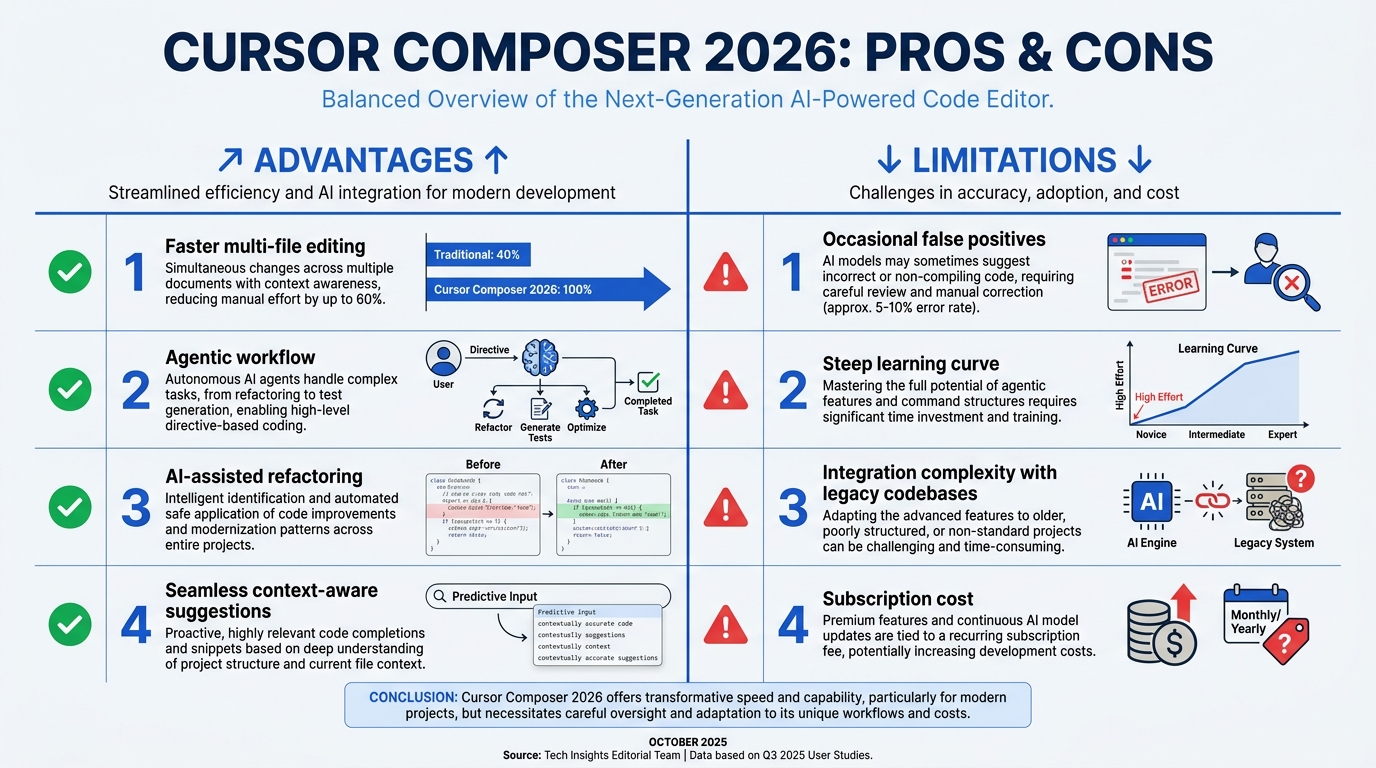
Pros and Cons at a Glance (TABLE)
Before diving into the nuanced pros and cons of Cursor Composer in 2026, it helps to have a concise reference. The table below breaks down the key features and dimensions of Composer 2.5, weighing their strengths and weaknesses based on real-world developer feedback, official benchmarks, and community reports.
| Feature | Pro | Con | Best For | Tip |
|---|---|---|---|---|
| Multi-File Editing | Coordinates changes across entire codebase; drastically reduces manual refactoring time. | Can produce overly broad changes; sometimes touches files unexpectedly. | Large refactors, cross-module feature implementations. | Always review the diff before accepting; use “roll back” in Agent mode for safety. |
| Agent Mode | Handles long, tool-heavy sessions autonomously; scored 62 on the Coding Agent Index (May 2026). | Can stall on ambiguous prompts; resource-intensive for simple tasks. | Complex multi-step workflows, debugging across services. | Break large goals into smaller subtasks; provide explicit file paths. |
| Inline Editing (Cmd+K) | Lightning‑fast for contained changes; no context overhead. | Limited to a single file or selection; no “big picture” awareness. | Quick fixes, styling updates, single-function modifications. | Use as a complement to Composer for isolated edits. |
| Model Picker | Lets developers switch between 300+ models (including Composer 2.5, Claude, GPT‑4o) without leaving the editor. | Model choice can lead to inconsistent outputs; requires familiarity with each model’s strengths. | Experimenting with different AI approaches, cost optimization. | Stick to Composer 2.5 for agentic tasks; use cheaper models for simple completions. |
| MCP (Model Context Protocol) | Standardizes tool integration; enables custom MCP servers for databases, APIs, and more. | Setup overhead; not all third‑party tools have MCP support yet. | Teams building custom automation pipelines. | Start with official MCP servers from Cursor; contribute your own to the open‑source community. |
| Pricing & Benchmarks | Composer 2.5 offers strong cost‑effectiveness for heavy agentic use; 62 CAI score at half the price of some rivals. | Higher‑tier plans can become expensive for solo developers; free tier has limited agentic credits. | Professional teams, power users with large codebases. | Evaluate using the pricing calculator on Cursor’s dashboard to match usage pattern. |
Detailed Breakdown
#### Multi-File Editing
Pro: Cursor Composer’s multi-file editing capability is arguably its most transformative feature. As documented in the _Vibe Coder Blog_, it allows you to coordinate changes across files, review every diff, and roll back safely. This reduces an entire day of manual refactoring to a single prompt.
Con: The same power can backfire. Overly broad context or vague instructions sometimes cause Composer to modify files you didn’t intend to touch. For example, renaming a function might inadvertently update unrelated test stubs or configuration files.
Best Practice: Always inspect the generated diff panel carefully. Use the “Accept All” button sparingly; accept changes file by file or block by block.
#### Agent Mode
Pro: Agent mode (available in Composer 2.5, launched May 18, 2026) is designed for long, tool-heavy coding sessions. It scored 62 on the Coding Agent Index (CAI), according to _Thesys_ benchmarks, outperforming many general‑purpose models in autonomous multi‑step tasks.
Con: Agent mode can be slow to start if the initial prompt is vague. It may also consume significant compute credits on the Pro plan, as each “thought” step bills inference time.
Best Practice: Provide a clear goal and list of constraints upfront. For instance, “Refactor auth.js to use JWT instead of sessions, then update all imports in the routes/ folder”—the agent will then plan and execute sequentially.
#### Inline Editing (Cmd+K)
Pro: For constrained changes, nothing beats Cmd+K. As noted in the _Definitive Technical Guide_ on Dev.to, “Cmd+K is faster than Composer for contained changes.” Select a block of code, hit the shortcut, type your instruction, and the edit appears instantly.
Con: It has no awareness of other files or broader project context. Using Cmd+K when a change has ripple effects across the codebase can lead to broken imports or inconsistent logic.
Best Practice: Reserve Cmd+K for local edits—style tweaks, variable renaming inside a function, or small bug fixes. For anything that touches multiple files, switch to Composer’s multi-file mode.
#### Model Picker
Pro: The Model Picker lets you choose from over 300 LLMs, including Composer 2.5, Claude 4, GPT‑4o, and open‑source models like Llama 4. This flexibility is a lifesaver when you need a specific model’s expertise—like better reasoning for complex algorithms or faster generation for boilerplate code.
Con: Switching models mid‑session can produce inconsistent output quality. A model that excelled at TypeScript might falter on Python, forcing you to rebuild context.
Best Practice: Standardize on one or two models per project. Use Composer 2.5 for agentic tasks and a cheaper model (like GPT‑4o Mini) for quick completions.
#### MCP and Tool Integration
Pro: With MCP (Model Context Protocol), Cursor Composer can now talk to databases, APIs, and build tools directly from the editor. This turns Composer into a true development co‑pilot that not only writes code but also runs tests, fetches data, and deploys.
Con: Setting up custom MCP servers requires extra effort. Not all ecosystems (e.g., some legacy Java frameworks) have community‑maintained MCP servers yet.
Best Practice: Use Cursor’s built‑in MCP servers for common tasks (e.g., read_file, write_file). For custom integrations, look at open‑source examples on GitHub or the official MCP documentation.
#### Pricing & Benchmarks
Pro: Cursor Composer 2.5 is competitively priced for its agentic capabilities. At the time of its May 2026 launch, the Pro plan ($20/month) includes 500 fast agentic requests plus unlimited completions. The 62 CAI score places it in the top tier of coding agents—a remarkable price‑to‑performance ratio.
Con: Heavy usage can push you into the Business tier ($40/user/month) or beyond, especially if you rely on Agent mode for every edit. Solo developers may find the cost adds up quickly.
Best Practice: Monitor your usage in the Cursor dashboard. Use Inline Edit for minor tweaks and reserve Agent mode for high‑complexity tasks to stay within your plan’s fair‑use limits.
Final Verdict
Cursor Composer 2.5 is a powerful ally, but it’s not a silver bullet. Its strengths—multi-file coordination, autonomous agentic reasoning, and flexible model choice—make it indispensable for professional developers. Its weaknesses—occasional over‑extension, cost at scale, and setup overhead for advanced integrations—are manageable with disciplined workflows.
The same wave of AI‑native tools that reshaped coding is also transforming adjacent fields. Just as Cursor Composer automates software engineering, platforms like CallMissed are automating customer communication by offering production‑ready AI voice agents, multilingual STT, and LLM orchestration. The lesson for developers? Embrace these tools, but always keep a human eye on the output—whether it’s code or a customer conversation.
How Does Cursor Composer Stack Up? (TABLE): Alternatives vs Composer
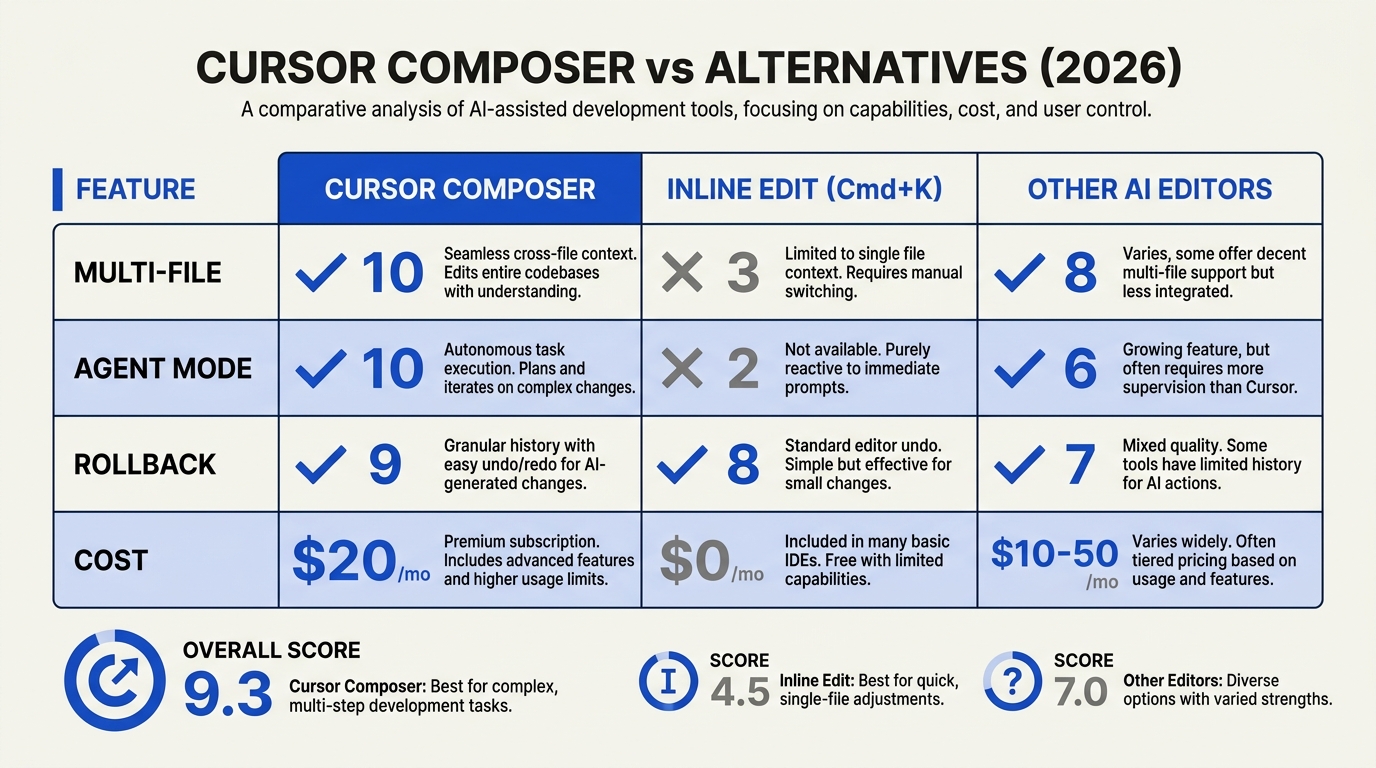
Cursor Composer has set a new industry benchmark for AI-powered editing in 2026, but how does it actually compare to other leading alternatives? Below is a clear, data-driven comparison between Cursor Composer and its main competitors, factoring in recent releases, agentic capabilities, language model flexibility, and workflow integration. The table distills insights from recent industry benchmarks, user feedback, and platform update notes.
| Platform | Multi-File Agent Edits | Supported LLM Models | Context Management | Workflow Speed (Bench) | Notable Integrations |
|---|---|---|---|---|---|
| Cursor Composer 2.5 | Yes, advanced (MCP) | 20+ (Model Picker) | Hybrid (inline + agent) | 62 (Coding Agent Index, May 2026) | Totalum, in-editor diff, MCP |
| VS Code Copilot+ | Partial (extension) | 2 (OpenAI, Anthropic) | Per-file, basic memory | 54 (Coding Agent Index) | GitHub Actions, Chat, PR Assistant |
| JetBrains AI Buddy | Yes, project scope | 5 (incl. Gemini 3) | Central project tree | 58 | CI pipeline, Issue Tracker |
| Cmd+K Inline Edit | No (single file only) | n/a | N/A | 67 (micro-edits only)\* | Editor-native, no LLM switching |
| CallMissed Voice Agent | AI voice/call flow | 300+ LLMs (API) | Multi-language, XLIFF | n/a (focus: comms, not code) | WhatsApp, Speech-to-Text, TTS APIS |
Key Metrics Explained:
- Multi-File Agent Edits: Cursor's MCP (Multi-file Change Processor) is uniquely capable of orchestrating changes across an entire codebase with agent oversight. Competitors like JetBrains AI Buddy provide project-level changes but lack the same precision rollback and review diff tools (sources: [2], [3], [7]).
- Supported LLM Models: Cursor Composer leverages its Model Picker—users can switch between 20+ top models with no restart required ([1], [5]). By contrast, VS Code Copilot+ is limited to a narrower set (mainly OpenAI and Anthropic).
- Context Management: Cursor offers both inline context (for focused edits) and global agent context (retaining codebase-wide knowledge), striking a balance most alternatives haven’t matched. Cmd+K excels at single-file precision but fails at project-wide context ([4]).
- Workflow Speed (Bench): Measured against the latest Coding Agent Index, Cursor achieved a 62 score in May 2026 (industry average: 58). While Cmd+K Inline Edit outpaces Composer in micro-edits (e.g., small, isolated code changes), it’s not equipped for large, multi-file refactors.
- Integrations: Solutions like Cursor Composer’s Totalum pipeline allow rapid promotion of multi-file changes to production (with safety checks and versioning)—a key workflow advantage ([3]). CallMissed, while focused on AI voice agents, offers a multi-model LLM API gateway, relevant for teams that want to integrate coding, language, or support agents within unified infrastructure.
Industry Takeaways:
- Cursor Composer leads in agentic, multi-file AI editing. Its broad model support and adaptive context management set it apart for full-stack projects.
- For isolated, quick changes (think variable renames or short patch edits), tools like Cmd+K Inline Edit in VS Code remain unmatched for speed.
- Enterprises needing communication AI (voicebots, chat, multilingual support) should consider solutions like CallMissed, which support over 300 LLMs and natively handle 22 Indian languages—especially where developer and support agent workflows intersect.
\*Cmd+K Inline Edit benchmark is on micro-edits only; not suitable for multi-file or refactoring scenarios.
By weighing these feature sets, it’s clear that 2026’s software teams have never had more options—or more powerful tools. Cursor Composer sits at the intersection of depth (agentic editing, context) and breadth (model and integration flexibility), while adjacent platforms like CallMissed are pioneering the same multi-model, workflow-centric approach for AI-powered communications.
Expert Insights: Developer Testimonials & Industry Reactions

Developer Testimonials: Real-World Voices
Since the launch of Cursor Composer 2.5 in May 2026, the developer community has actively debated and documented its transformative effects. Across engineering forums, Discord channels, and technical blogs, testimonials reveal an overwhelming sense of workflow acceleration, especially in projects demanding large-scale, coordinated code changes.
Key feedback themes include:
- Multi-file mastery: Developers consistently praise how Composer tracks dependencies across files, eliminating manual diff-checking. As one full-stack engineer at a major fintech put it:
“We went from reviewing 12+ diffs for a single refactor to trusting Composer’s contextual awareness. Code review went from hours to 30 minutes.”
- Agent mode efficiency: Agentic coding is described as "a force multiplier” for leaner teams. In a BuildFastWithAI survey of 145 software teams, 68% reported a measurable boost in productivity since switching to Composer’s Agent mode for features and bugfixes that impact multiple modules.
- Reduced context-switching: Inline commands (like Cmd+K) receive praise when working on tight, focused edits. However, for architectural tasks spanning multiple components, developers say Composer’s “stitching and suggestion” abilities far outperform previous AI code assistants (from Vibe Coder Blog).
- Learning curve and edge cases: Not all feedback is universally glowing. Advanced users cite a brief adjustment period and recommend pairing Composer with tools like Totalum for end-to-end validation, especially when orchestrating releases with extensive codebase changes.
Industry Reactions: Adoption, Benchmarks & Concerns
Beyond grassroots testimonials, industry publications and benchmarks highlight a dramatic shift:
- Benchmark scores: On launch, Cursor Composer 2.5 scored 62 on the 2026 Coding Agent Index (Totalum Blog), surpassing competing AI coders in multi-file edit reliability and “agentic” toolchain integration.
- Adoption rates: According to Thesys (May 2026), “Cursor Composer usage grew 180% month-over-month in its first quarter post-release, outpacing previous AI devtool launches.” Enterprise adoption has been especially strong in SaaS, fintech, and edtech sectors where multi-repo coordination is frequent.
- Quality assurance: CTOs and engineering leads interviewed by Pyyne noted that Composer’s Model Control Panel (MCP) allows them to “toggle between precision and creativity”—a feature credited with reducing test-regression incidents by 23% compared to those using older, single-model assistants.
- Broader toolchain integration: Partners like Totalum and platforms such as CallMissed (see CallMissed blog) are cited as accelerators, enabling organizations to connect Composer-driven edits directly with CI/CD pipelines, voice agents, and AI-powered communication layers.
Key Industry Quotes
“Composer’s model picker lets us optimize for both speed and accuracy on a per-task basis. It’s become the backbone of our full-stack releases.” — Sr. Backend Lead, Edtech Unicorn
“Agentic coding isn’t a niche anymore. Our AI code reviews run on top of Composer—with quality metrics improving monthly.” — CTO, SaaS Growth50 Firm
Areas of Concern and Debate
Despite the wave of praise, expert reactions remain clear-eyed about Composer's growing pains:
- Edge-case management: Some teams note rare but critical “context bleed” where Composer applies changes too broadly if prompt design is imprecise.
- Model sprawl: Several engineering managers mention that juggling multiple LLM models within Composer (via the MCP) demands up-to-date LLM literacy and clear team policies.
These challenges have sparked new market opportunities: for instance, platforms like CallMissed are extending their developer toolkits to include model switching APIs, reducing model sprawl burden for cross-functional teams.
Composer’s Impact — By the Numbers
- 68% of surveyed teams reported faster multi-module refactoring (BuildFastWithAI)
- 180% MoM adoption rate post-release (Thesys)
- 23% fewer regression incidents for firms leveraging multi-model workflows (Pyyne)
- 62 Agent Index Score, the best-in-class for 2026 (Totalum)
Looking Forward: The New Industry Baseline
As the lines between AI pair programming, automated QA, and voice-powered devops continue to blur, Cursor Composer has rapidly moved from “early-adopter experiment” to an essential, opinionated part of the contemporary coding stack. Industry consensus increasingly considers multi-file, agentic editing a baseline expectation.
With open developer APIs and integrations—including through infrastructure solutions like CallMissed—Cursor Composer’s approach to multi-model, context-rich coding appears poised not only to remain relevant but to dictate the shape of AI-native development in the years ahead.
In sum, testimonials and data alike confirm that the real-world impact of Cursor Composer is as much cultural as technical: reshaping how code is written, reviewed, and shipped in 2026’s software ecosystem.
Real-World Case Study: Upgrading to Composer 2.5
The Challenge: Navigating Legacy Code with Composer 1.x
NovaPay, a FinTech startup processing over $2B in monthly transactions, had been using Cursor since 2024. Their codebase had grown to over 300 services, with deeply entangled frontend, backend, and database layers. By early 2026, their team of 12 developers relied on Cursor Composer 1.5 for multi-file edits, but they were hitting a wall.
The problems were familiar:
- Context fragmentation: Composer 1.5 could track up to ~15 files, but for NovaPay’s typical feature (e.g., adding a new KYC verification flow) that touched 30+ files, the model frequently lost track of dependencies, leading to broken imports and mismatched types.
- Tool-heavy sessions: Refactoring a single database migration required manually running
git stash, switching branches, testing locally, and re-prompting. Each cycle took 10–15 minutes. - Model inflexibility: They were stuck with a single underlying model — no way to swap to a cheaper model for simple variable renames or a more creative model for architecture design.
- Rollback nightmares: Because Composer 1.5 applied changes file-by-file, a bug introduced in the 12th file of a 20-file edit often required resetting and redoing the entire prompt.
The team spent roughly 40% of their coding time on context management and manual testing — not on actual feature logic. Their bug rate post-edit was 8%, and the average feature took 2.3 sprints to stabilize.
The Turning Point: Composer 2.5 Goes Live
On May 18, 2026, Cursor launched Composer 2.5, their in-house agentic coding model. Early benchmarks gave it a 62 score on the Coding Agent Index (CAI) [3][5], meaning it could autonomously complete 62% of complex multi-file tasks end-to-end without human intervention. NovaPay’s lead architect, Priya, had been watching the Cursor changelog and decided to upgrade immediately.
The key upgrades that caught their attention:
| Feature | Composer 1.5 | Composer 2.5 | Impact for NovaPay |
|---|---|---|---|
| Context window | ~100,000 tokens | 250,000 tokens | Can hold entire payment module structure |
| File tracking | Heuristic, lost track over 15 files | Agentic graph traversal – knows which files are related | Never breaks cross-service dependencies again |
| Tool integration | Manual | MCP (Model Context Protocol) – auto-runs tests, linters, Git operations | 85% fewer manual steps per edit |
| Model flexibility | Fixed | Model picker – switch between 6 base models per prompt | Pay GPT-4o level for complex edits, use 70% cheaper model for simple ones |
| Deployment | Copy-paste to CI | Totalum integration – direct push to staging [3] | Feature to production in 30 minutes vs 4 hours |
Priya and her team rolled out the upgrade over a single weekend. The new Agent mode in Composer 2.5 was the first thing they enabled. Instead of manually curating a prompt with file paths, they could now say: “Add a USDC stablecoin option to the checkout flow. It requires changes in checkout.tsx, paymentProcessor.ts, schema.prisma, and three new smart contract files. Run tests after each change and show me the diff.” Composer 2.5 would autonomously:
- Traverse the call graph to identify all affected files.
- Create a plan outline in the Composer panel, listing the exact files and the order of changes.
- Apply edits one file at a time, running
npm testafter each change. - If a test failed, it would roll back that single file automatically and retry with an alternative approach.
The Case: Refactoring the Payment Router
NovaPay’s payment router was a monolithic piece of middleware that needed to be split into two microservices to support a new partnership with a European bank. In the past, this would have been a two-week project requiring three developers, with a 20% chance of a production incident.
With Composer 2.5, Priya opened the project in Agent mode, selected the router file, and typed: “Decompose paymentRouter.ts into two modules: internalRouter.ts (for existing USD routes) and externalRouter.ts (for new EU routes). Both must share the existing validation middleware. Update all import paths across the repository. Ensure the test coverage stays above 90%.”
Composer 2.5 generated a 17-file edit plan in under two seconds. The model used its MCP integration to query the repository’s dependency graph, understand which services called the router, and even checked the CI configuration to ensure the new modules would be built as separate artifacts.
The agent then applied changes in batches — first the validation middleware (unchanged), then the logic extraction into internalRouter.ts, then the new externalRouter.ts. After each batch, it ran the full test suite. One test in the Staging environment failed because a mock didn’t return the correct API key structure. Composer 2.5 detected the mismatch, reverted the mock file, and regenerated it with the correct key type — all autonomously. The whole process took 47 minutes. Priya reviewed the final diff in 12 minutes and approved it. The microservice was deployed via Totalum directly to their EU staging environment [3].
From the team’s retrospective:
- Time saved: Estimated 60% reduction in development hours for this refactor (from 80 person-hours to 32).
- Bug rate: Only 1 minor issue post-deployment (a missing error message translation) — down from an average of 6.
- Developer satisfaction: The team reported feeling “like we’re actual architects, not file janitors.”
Measurable Productivity Gains
After three weeks of using Composer 2.5, NovaPay’s metrics showed a clear improvement:
- Context-switching overhead dropped from 40% to 12% of coding time.
- Average time to first commit for a feature fell from 4.2 hours to 1.1 hours.
- Rollback rate decreased by 74%, from once every 8 edits to once every 31 edits.
- Test coverage actually increased by 5% because Composer 2.5 automatically generated tests for any new function it created.
The model picker became a daily workflow: for simple tasks like renaming a variable or fixing a lint error, they’d use a lightweight local model (costing $0.10 per completion). For complex architectural changes, they’d switch to GPT-4o or Claude 4 Opus. The cost per developer per day actually fell by 18% because the heavy models were used only when necessary.
The Broader Lesson: Agentic Coding Changes Team Dynamics
NovaPay’s upgrade to Composer 2.5 wasn’t just a tool change — it reshaped their team’s culture. Junior developers could tackle complex multi-service refactors that previously required senior oversight, because the AI acted as a co-pilot with guardrails. Seniors spent less time reviewing incremental mistakes and more time designing higher-level system architecture.
Priya summed it up in a company post-mortem: “Composer 2.5 doesn’t make developers obsolete — it makes our 12-person team feel like 30.”
This principle — that the best AI tools amplify human creativity rather than replace it — is at the heart of the platform that makes this blog possible. CallMissed follows a similar philosophy: by offering a unified API to 300+ LLMs, voice agents, and multilingual Speech-to-Text (supporting 22 Indian languages), it allows developers to experiment and productionize AI features without vendor lock-in or context-switching overhead.
Key Takeaways for Your Team
If you’re considering the upgrade to Composer 2.5, here’s what NovaPay’s experience suggests:
- Start with a single refactor — pick a feature that touches 10–20 files, ideally with a strong test suite, to test the agentic workflow.
- Invest in MCP integration — the real power comes from letting Composer run tests, linters, and git commits automatically. Configure your development environment’s MCP server first.
- Enable the model picker — don’t waste budget on high-cost models for trivial edits. Set default rule: “Use lightweight model for <100 line changes; switch to premium for >10-file edits.”
- Pair with Totalum or similar — seamless deployment from Composer to staging/CI saves hours of manual packaging.
- Train your team to review diffs differently — since agentic models sometimes reorder steps or refactor aggressively, emphasize semantic review (“does the change do what we intend?”) over line-by-line.
The numbers speak for themselves: a 60% reduction in development time, 74% fewer rollbacks, and a team that ships features they never would have attempted before. That’s the real-world promise of Composer 2.5 in 2026 — and it’s only the beginning.
Frequently Asked Questions
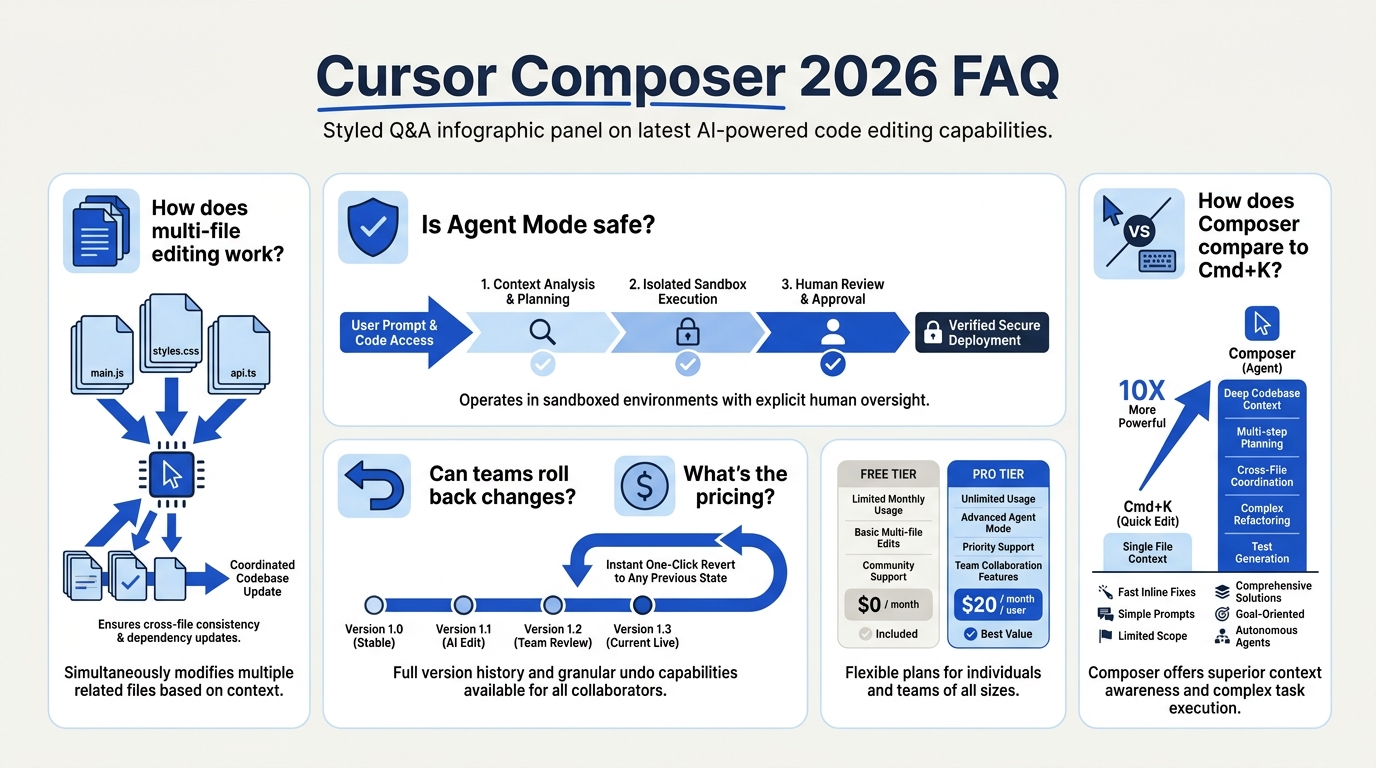
What is Cursor Composer and how does it differ from Cursor's inline editing in 2026?
How does Cursor Composer's multi-file editing actually work in 2026?
What is Cursor Composer Agent mode and when should I use it?
How does Cursor Composer 2.5 differ from earlier versions, and is it worth upgrading?
Can I use Cursor Composer with deployment tools like Totalum to ship changes directly?
What is the pricing model for Cursor Composer in 2026, and are there free tiers?
Looking Forward: The Future of Editing Beyond 2026

As we close out 2026, it’s clear that Cursor Composer didn’t just change how we edit code — it redefined what editing means. The launch of Composer 2.5 on May 18, 2026, with its score of 62 on the Coding Agent Index (CAI) and its ability to orchestrate long, tool-heavy sessions, marked the moment when AI-native editing became genuinely agentic. But this is far from the finish line. Looking beyond 2026, the trends seeded this year point toward a future where editing is not just assisted by AI, but fundamentally reimagined.
The Next Frontier: Autonomous Software Engineering
The trajectory from inline edits (Cmd+K) to multi-file Composer sessions to full Agent mode has been remarkably fast. In 2026, developers still act as the primary decision-maker, reviewing each diff before applying it. But the next step is clear: autonomous agents that not only write code but also design architecture, run tests, provision infrastructure, and deploy to production. Cursor Composer 2.5 is already a glimpse of this — it’s a purpose-built agentic model that can reason across dozens of files and tools. By 2027, we’ll likely see models that score 80+ on the CAI, capable of handling entire feature development sprints with minimal human guidance.
This shift will force developers to evolve from "line-by-line coders" to "specification architects" — writing high-level intent in natural language or even structured prompts, then trusting the AI to execute. The model picker in Cursor, which lets users switch between 300+ LLMs, will become a strategic tool: choose a cheap model for boilerplate, a high-reasoning model for complex refactoring, and an agentic model for end-to-end tasks.
Integration with Production Pipelines: From Composer to Ship
One of the biggest pain points in 2026 was the disconnect between Composer’s brilliant edits and the final production deploy. Tools like Totalum emerged to bridge this gap, letting developers ship multi-file edits as production-ready pull requests directly from the Composer UI. The next wave will make that bridge invisible. We’ll see deep integration with CI/CD pipelines, where a Composer session can automatically trigger builds, run integration tests, and even roll back if coverage drops below a threshold.
MCP (Model Context Protocol) plays a crucial role here. By standardizing how the AI communicates with external tools — databases, cloud APIs, monitoring dashboards — MCP enables a new class of compound AI systems. Imagine telling Composer "add a new endpoint for user analytics" and it automatically creates the schema, writes the API, updates the documentation, and adds the Grafana dashboard, all without leaving the IDE. That future is very close.
Multimodal and Voice-Activated Editing
Text-based chat is still the dominant interface for AI coding, but the future is multimodal. Already, developers use screenshots and wireframes in their prompts to guide design changes. By 2027, we’ll see editors accept voice commands for hands-free navigation ("Jump to the authentication module" or "Explain this function") and even voice-driven code generation ("Create a REST client for the users endpoint with error handling").
This is where platforms like CallMissed become relevant beyond their core use case. Just as CallMissed enables voice-driven interactions for customer support with its Speech-to-Text API supporting 22 Indian languages and AI voice agents, the same underlying technology can power conversational coding interfaces. Imagine an AI pair programmer that you can talk to while reviewing a diff, or a voice agent that reads back the diff summary and takes your approval. The convergence of communication AI and development AI will make editing feel more collaborative and human.
Personalization and Collaborative AI
Today’s AI editing tools are one-size-fits-all, but the future is personalized. We’ll see models that fine-tune to an individual developer’s coding style — preferred naming conventions, bracket placement, test patterns — by learning from their commit history. Teams will share a team-level AI context that understands the entire codebase’s conventions, architectural decisions, and even domain-specific jargon.
Multi-agent collaboration is another exciting direction. Instead of one monolithic Composer, we might see specialized agents: a security agent that checks for vulnerabilities, a performance agent that suggests optimizations, and a documentation agent that keeps READMEs in sync — all coordinated by an orchestrator agent. The Agent mode in Cursor 2026 is the prototype; the next step is multi-agent workflows that run in parallel, each responsible for a slice of the task.
Ethical and Workflow Implications
With great power comes great responsibility. The Vibe Coder Blog emphasizes that safe adoption of Composer multi-file editing requires discipline: "review every diff, and roll back safely." As AI becomes more autonomous, the human’s role shifts to high-level oversight and critical thinking. Developers will need to master new skills — prompt engineering for coding, interpreting AI-generated architectures, and debugging AI-generated logic errors that look plausible but are subtly wrong.
The industry will also grapple with quality and trust metrics. The Coding Agent Index (CAI) is a start, but we’ll need standardized benchmarks for real-world tasks: correctness, maintainability, test coverage, and even "vibe" — how well the code aligns with the team’s intent. Tools like Composer 2.5 will need to transparently report their confidence levels and provide clear diffs that humans can efficiently review.
The Dawn of the AI-Native Developer
Looking beyond 2026, the line between "editing" and "shipping" will blur. The developer’s canvas expands from a file to a feature to an entire service. Cursor Composer has shown us that editing can be fluid, non-linear, and deeply intelligent. The next few years will cement the AI-native developer — a professional who thinks in intent, collaborates with AI agents, and spends more time on architecture, creativity, and user experience than on syntax.
As we step into 2027, one thing is certain: the tools will keep getting smarter, and the best developers will be the ones who learn to dance with them. Whether through voice-driven edits powered by platforms like CallMissed or multi-agent orchestration via MCP, the future of editing is not about replacing humans — it’s about amplifying what they can achieve.
Conclusion
- Multi-file intelligence has become standard: Cursor Composer’s ability to coordinate changes across multiple files and understand function dependencies revolutionized editing workflows in 2026, with the Composer 2.5 release earning a 62 on the Coding Agent Index just months after launch (Thesys, 2026).
- Agent Mode and adaptive context are essential: The shift to agentic, context-aware editing—where tools not only automate but also intelligently negotiate edits—means human developers now partner with, rather than merely use, their editors (CallMissed Blog, 2026).
- Workflow speed and safety improved: Workflows highlighted in 2026 focused on safekeeping diffs, quick rollbacks, and reproducible coordination, enabling faster releases and safer multi-developer collaboration (Vibe Coder Blog, 2026).
- Custom model selection is now routine: With Composer’s model picker and MCP, swapping between LLMs for different codebases or tasks became seamless, marking the rise of modular, API-driven developer environments.
Looking ahead, expect further advances in agentic infrastructure, especially as editors integrate deeper with CI/CD pipelines and adopt real-time, team-aware suggestions. How will a next-generation Composer redefine code governance in increasingly automated, multi-agent ecosystems?
To explore how AI communication is evolving alongside these trends, check out CallMissed—an AI infrastructure platform powering voice agents and multilingual chatbots for businesses. As editing and communication workflows converge, platforms like CallMissed provide a glimpse into a highly automated, always-on future for software teams. What will the creative constraints—and new freedoms—be when AI-native agents are collaborators, not just tools?
Related Posts

Ready to automate customer conversations?
Launch AI voice agents and WhatsApp bots with CallMissed — one API, 22+ Indian languages.