
US Grows Anxious Over AI: Trump Administration Orders OpenAI to Delay GPT-5.6 Rollout



Update on GPT-5.6 delay reports, OpenAI's June 26 preview, safety review language, and the reported July 9, 2026 public rollout timeline.
US Grows Anxious Over AI: Trump Administration Orders OpenAI to Delay GPT-5.6 Rollout
Can the federal government successfully pause the rapid march of artificial intelligence, or is the regulatory genie already out of the bottle?
In an unprecedented move that has sent shockwaves through Silicon Valley, the Trump administration has officially intervened in the commercial AI race, ordering OpenAI CEO Sam Altman to halt the public rollout of the highly anticipated GPT-5.6 model. This directive marks a historic turning point: for the first time, a US administration has actively stepped in to delay a major commercial LLM release over national security apprehensions. As reports confirm that the US grows anxious over AI, the White House has instructed OpenAI to stagger the release, restricting early access exclusively to a small, government-approved group of trusted partners.
This dramatic intervention follows weeks of intense, closed-door debates within the administration regarding the safety and potential risks of next-generation frontier models. Coming shortly after federal scrutiny began tightening around other industry leaders like Anthropic, the government’s demand underscores a fundamental shift in policy. Washington is no longer content to let tech giants self-regulate. GPT-5.6 represents a massive leap forward in reasoning, autonomous agentic capabilities, and raw computational power—advancements that federal agencies worry could be weaponized or disrupt critical infrastructure if deployed without rigorous state oversight.
For businesses and developers, this regulatory bottleneck introduces a new layer of uncertainty. While enterprise teams rely on stable, multi-model infrastructure platforms like CallMissed to build and scale regional AI voice agents without worrying about backend disruptions, the sudden throttling of foundational models shows that future AI access is increasingly tied to geopolitical gatekeeping.
In this article, we will unpack the specific security concerns driving the White House's sudden intervention, explore how the delayed rollout of GPT-5.6 impacts the competitive landscape, and examine what this new era of state-monitored AI means for the future of enterprise software development.
Introduction: The Government Intervenes in OpenAI's Next Frontier

The boundary between private AI innovation and state supervision is becoming harder to draw. As of July 8, 2026, the debate around OpenAI’s anticipated GPT 5.6 rollout now sits at the intersection of two competing narratives: OpenAI’s own June 26 preview, which framed the model in terms of staged access, safety testing, and product readiness, and separate media reports suggesting that federal scrutiny from the Trump administration has contributed to a more cautious launch timeline.
In other words, the GPT 5.6 delay should be read carefully. OpenAI has not publicly described the rollout as being “ordered” to stop by the White House. However, reports from outlets including The Information and The Verge have described pressure from federal officials, including requests that early access be limited to a smaller group of vetted partners before any broader public deployment. Those reports now sit alongside expectations of a reported July 9 rollout, making the next phase less a simple product launch and more a test case for how frontier AI systems may be introduced under heightened political and national security scrutiny.
The Dynamics of Federal Intervention
The current situation is not just about one model. It reflects a broader tightening around frontier AI deployment, especially when new systems are believed to introduce significant capability jumps. Key elements of this development include:
- Reported National Security Scrutiny: Federal concerns reportedly center on whether a model of GPT 5.6’s caliber could introduce new risks around cyber operations, automated reasoning, sensitive data handling, or misuse at scale.
- Official vs. Reported Framing: OpenAI’s June 26 preview emphasized controlled access and safety evaluation, while media reports have separately characterized the rollout as being shaped by pressure from the Trump administration.
- Staggered Release Expectations: Rather than a sudden, unrestricted public API launch, GPT 5.6 appears positioned for a more limited and phased release path, with early access likely concentrated among selected partners.
- Wider Frontier Model Oversight: The scrutiny around GPT 5.6 follows a growing pattern of federal attention on major AI laboratories, suggesting that Washington is increasingly focused on how and when the most capable models reach the market.
Mitigating Regulatory Risk in Enterprise AI
For enterprise developers and businesses, the uncertainty around GPT 5.6 highlights a practical problem: AI product roadmaps can be disrupted when access to a single frontier model depends on shifting regulatory, political, or safety-review timelines. Even when a model is technically ready, public availability may depend on factors outside a company’s control.
That is why forward-looking teams are moving toward platform flexibility. By using advanced communication and AI infrastructure providers like CallMissed, businesses can reduce their dependence on any single LLM vendor. CallMissed’s unified API gateway gives developers access to 300+ LLMs, Speech-to-Text APIs, and multilingual voice agents. If a highly anticipated model faces a delayed or limited rollout, developers using CallMissed can route workflows to alternative top-tier models without rewriting core application logic.
As the industry watches whether the reported July 9 GPT 5.6 rollout proceeds as expected, the bigger question is no longer just what the model can do. It is whether frontier AI launches have entered a new era where technical capability, national security review, and federal pressure all shape the path from preview to public deployment.
Background & Context: The Path to GPT-5.6 and Shifting Federal Oversight

The Evolution of the Frontier: From GPT-4 to GPT-5.6
The journey to GPT-5.6 represents a major inflection point in the generative AI timeline. While previous iterations focused primarily on scaling parameter sizes and refining conversational nuances, GPT-5.6 is engineered to deliver unprecedented agentic capabilities, advanced multi-step reasoning, and highly autonomous problem-solving skills. Because of these rapid advancements, frontier AI models have transitioned from being viewed as commercial software upgrades to matters of critical national security.
Historically, the relationship between Silicon Valley and Washington has been characterized by a "hands-off" approach to software development. However, as AI capabilities have scaled exponentially, federal anxiety has grown. The current Trump administration has significantly tightened its grip on frontier AI labs, shifting from passive observation to active intervention. This is not an isolated incident; the order follows a pattern of heightened oversight, including recent regulatory friction surrounding Anthropic's AI systems.
Inside the Federal Intervention: Why the Delay?
According to recent reports, the White House actively intervened in OpenAI's launch schedule, instructing CEO Sam Altman to postpone the public rollout of GPT-5.6. Instead of a wide commercial release, the administration has requested a staggered release framework. This mandate restricts initial access to a small, highly vetted group of government-approved partners.
Key factors driving this unprecedented intervention include:
- National Security Apprehensions: Federal officials are deeply concerned that the raw reasoning power of GPT-5.6 could be exploited by geopolitical adversaries or malicious actors if released globally without exhaustive containment testing.
- Internal Policy Debates: Reports indicate that intense debates within the administration over how restrictive this safety framework should be actually delayed the formal order to OpenAI for several weeks.
- Proactive Auditing: Government agencies want to thoroughly test the model's capabilities in simulated environments to establish strict guardrails before it becomes accessible to the general public.
Navigating a Volatile Regulatory Landscape
For enterprises and developers, this sudden regulatory friction highlights a critical vulnerability in the modern AI tech stack: over-reliance on a single frontier model. When the launch of a highly anticipated model like GPT-5.6 is abruptly halted or restricted by federal mandates, businesses relying on cutting-edge APIs face unexpected integration roadblocks.
To mitigate these geopolitical and regulatory risks, forward-thinking enterprises are shifting toward multi-model architectures. Platforms like CallMissed are crucial in this shifting landscape, offering a unified LLM inference gateway that connects developers to over 300+ models. By decoupling application logic from a single provider, CallMissed enables businesses to seamlessly failover or transition to alternative open-source or proprietary models if a specific frontier release is delayed by government intervention.
Ultimately, the delay of GPT-5.6 marks a new era where national boundaries and federal oversight will dictate the pace of AI deployment, forcing the industry to prioritize flexibility and redundancy in their AI infrastructure.
Key Developments
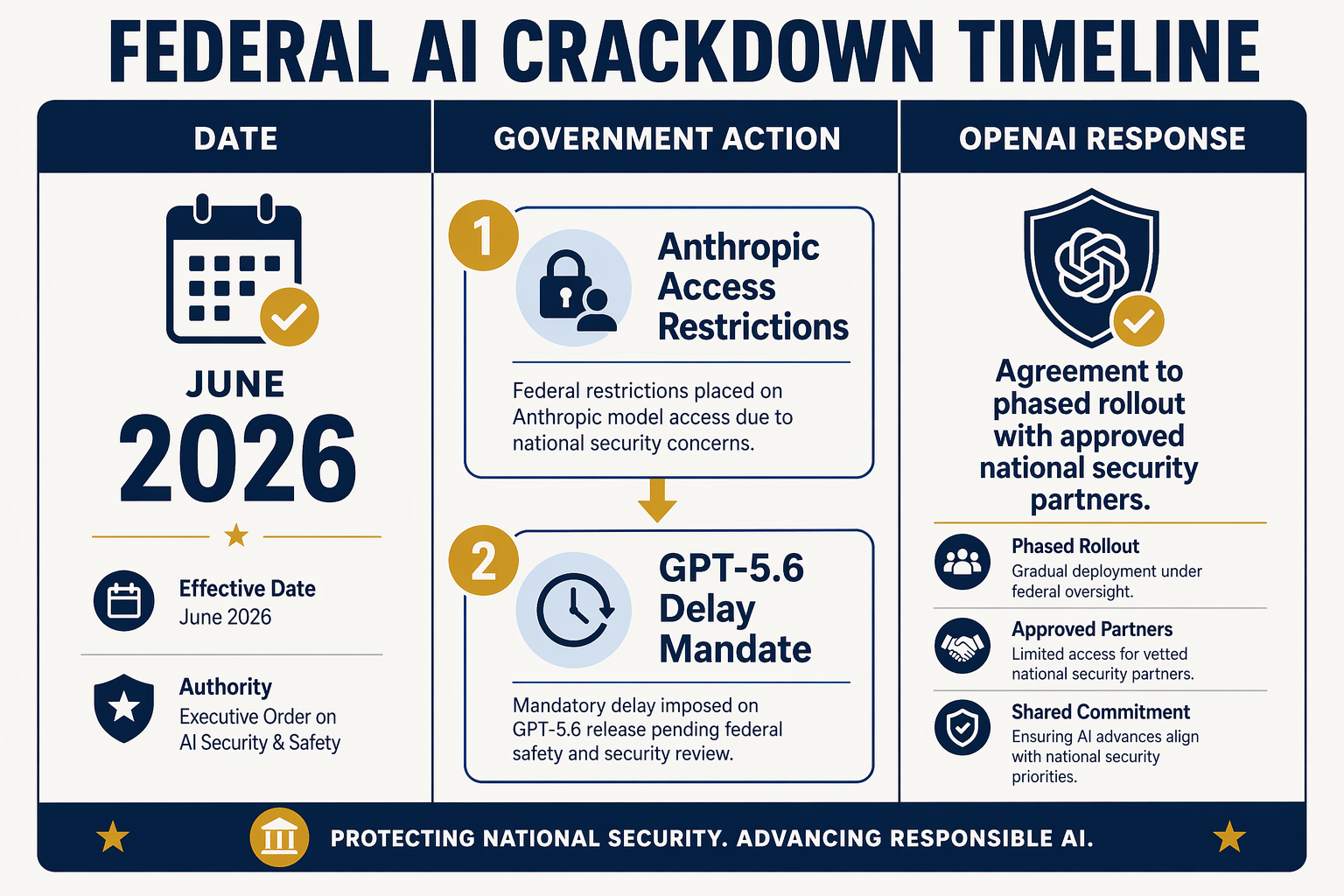
The sudden intervention by the US government to halt the broad release of OpenAI’s GPT-5.6 marks a historic turning point in the relationship between Silicon Valley and Washington. For weeks, intense internal debates within the Trump administration stalled the directive as officials hammered out a restrictive oversight framework. Ultimately, the administration issued a formal request to OpenAI CEO Sam Altman to restrict the initial rollout of the model to a select, government-approved circle of trusted partners.
The timeline of these events and the resulting structural changes to OpenAI's deployment strategy highlight a growing government anxiety over uncontrollable, highly advanced AI systems. The table below outlines the core milestones, decisions, and security-driven catalysts that have shaped this high-stakes standoff.
| Milestone / Event | Key Decision / Action | Target Audience / Scope | Primary Drivers & Concerns |
|---|---|---|---|
| Initial Rollout Delay | OpenAI postpones the public launch of GPT-5.6 following federal intervention. | Global developers and enterprise consumers | Unresolved security implications and systemic model risks. |
| White House Intervention | Administration orders OpenAI to restrict early access to the model. | Government-approved partners and security researchers | Protection of national security infrastructure and strategic tech boundaries. |
| Policy Debate Stall | Internal administration debates delay the official order by several weeks. | Federal policymakers and OpenAI leadership | Disputes over how restrictive the monitoring and compliance framework should be. |
| Staggered Release Strategy | Transition to a phased, controlled deployment model. | Limited trusted partners first; broader public later | Vulnerability testing, deepfake prevention, and red-teaming. |
| Industry-Wide Scrutiny | Federal oversight tightens across the entire frontier AI landscape. | Leading labs (OpenAI, Anthropic, etc.) | Prevention of intellectual property theft and unauthorized external access. |
Balancing Innovation Against Regulatory Friction
This unprecedented delay highlights a fundamental friction: the tech sector's drive for rapid, iterative deployment versus the federal government’s responsibility to mitigate societal and geopolitical risks. By ordering a staggered release, the administration is attempting to establish a buffer zone. During this trial phase, approved security partners will rigorously test GPT-5.6 for vulnerabilities, autonomous capabilities, and dual-use risks (such as cyberwarfare or biochemical engineering assistance) before the general public gains access.
For enterprises and developers, this regulatory friction introduces a new layer of volatility. Relying on a single, highly anticipated model release is no longer a viable business strategy when political and regulatory interventions can delay deployments indefinitely.
To navigate this landscape of uncertainty, forward-thinking organizations are diversifying their AI infrastructure. Infrastructure platforms like CallMissed help businesses bypass these bottlenecks. By offering a multi-model API gateway that supports over 300+ LLMs alongside production-ready voice agent infrastructure, CallMissed enables developers to pivot seamlessly between alternative proprietary and open-source models. If a primary frontier model like GPT-5.6 is delayed or restricted by federal mandates, businesses utilizing CallMissed can transition to other robust models without rewriting their core codebase—ensuring operational resilience in an increasingly regulated AI era.
In-Depth Analysis: Why the US Government Demanded a Pause

The US government’s decision to intervene in the launch of OpenAI's GPT-5.6 represents a historic shift in how Washington regulates artificial intelligence. Historically, AI laboratories operated under a framework of voluntary commitments and self-regulation. However, as frontier models demonstrate increasingly sophisticated reasoning, planning, and autonomous capabilities, the Trump administration has stepped in, ordering CEO Sam Altman to stagger the model's rollout and limit initial access to a select group of government-approved partners.
National Security and the Regulatory Tug-of-War
At the heart of the government's intervention are deep-seated anxieties regarding the national security implications of next-generation AI. Reports indicate that the Trump administration’s order followed weeks of intense internal debates within the White House. Officials clashed over exactly how restrictive the oversight framework should be, which delayed the official directive to OpenAI for weeks.
The primary driver behind the delay is the need to thoroughly vet GPT-5.6 for critical vulnerabilities, focusing on key areas:
- Sovereign Security Risks: Ensuring the model cannot be leveraged for advanced cyberwarfare, biochemical engineering, or automated espionage.
- Infrastructure Safeguards: Reviewing the model's capabilities in interacting with physical systems and critical digital infrastructure.
- Controlled Red-Teaming: Allowing federal agencies and highly vetted, trusted partners to stress-test the model before it is exposed to the general public or foreign adversaries.
By restricting the early release of GPT-5.6 to a small, pre-approved circle, the administration aims to establish a buffer zone where the model's unexpected emergent behaviors can be identified and neutralized.
A Growing Trend of Federal Gatekeeping
This is not an isolated incident. The intervention comes on the heels of previous federal actions restricting other prominent AI labs, such as Anthropic. Together, these moves signal that the US government is transitioning from a passive observer to an active gatekeeper of frontier AI.
For the broader technology ecosystem, this escalating regulatory friction introduces a major layer of operational uncertainty. Enterprises that rely heavily on a single, bleeding-edge model risk having their product roadmaps derailed by sudden federal interventions.
To mitigate this volatility, forward-looking businesses are increasingly turning to robust, multi-model infrastructure. Platforms like CallMissed are already helping organizations navigate this landscape by offering unified access to over 300+ LLMs. If a flagship model like GPT-5.6 faces unexpected government delays, developers using CallMissed's multi-model API gateway can seamlessly switch to alternative high-performing models without rewriting their core codebase, ensuring zero downtime for critical business communication tools.
The Precedent of "Staggered Releases"
By forcing OpenAI to comply with a staggered release schedule, the US government is setting a new industry standard. No longer can AI giants unilaterally decide when a paradigm-shifting model is ready for global consumption. Instead, future LLM deployments will likely require a government-certified, phased rollout—a compromise that attempts to balance rapid technological innovation with stringent national security protocols.
Impact & Implications: Valuation, Competitors, and the AI Race
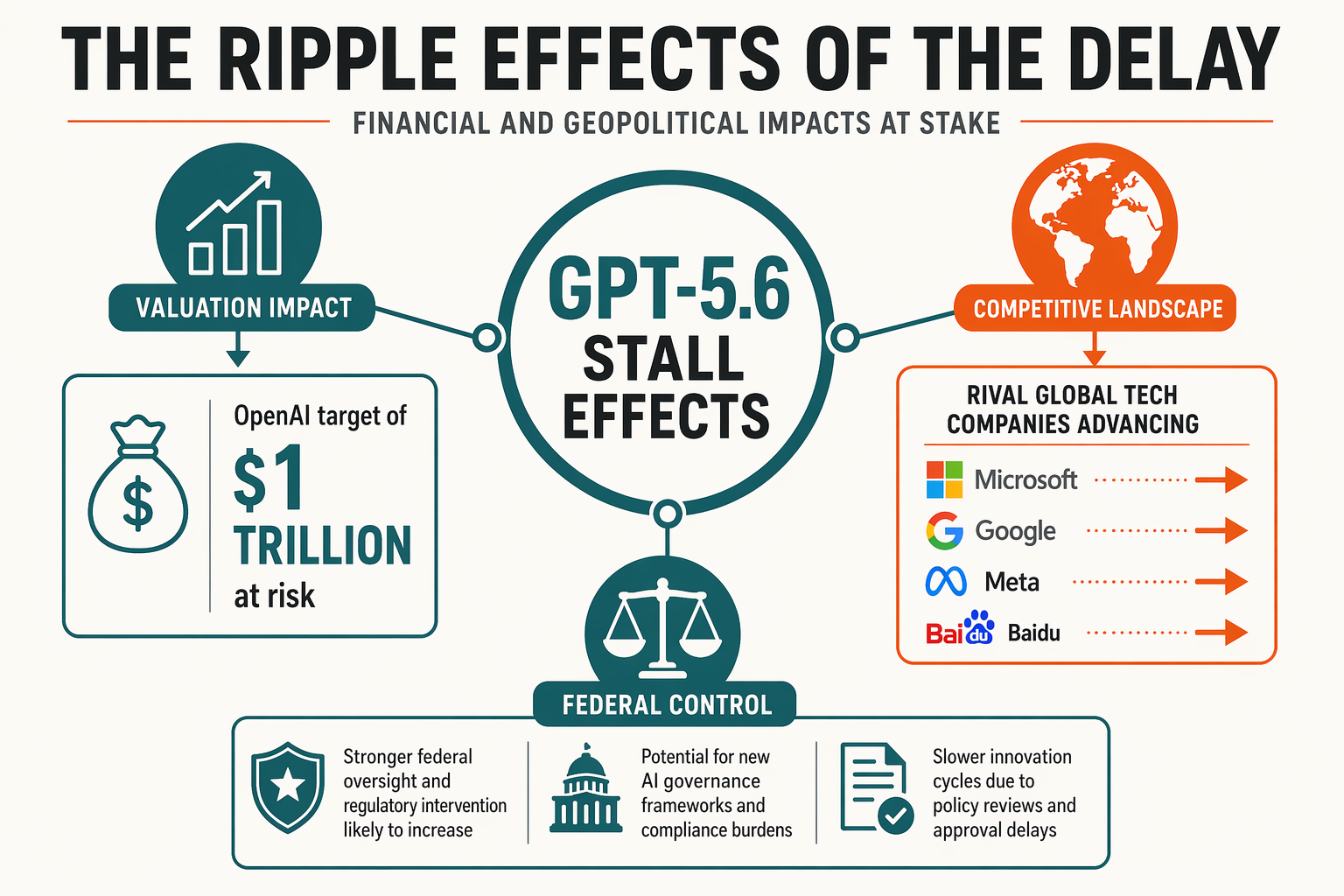
The unprecedented government intervention in OpenAI’s release schedule carries profound consequences for the commercial AI market, company valuations, and the broader geopolitical tech race. By forcing Sam Altman to stagger the deployment of GPT-5.6, the US government has signaled that national security will now actively dictate the pace of commercial AI commercialization.
The Stalled Momentum: Impact on OpenAI’s Edge
For OpenAI, timing is everything. The company has historically maintained its dominant market position by consistently shipping state-of-the-art models ahead of its rivals. Forcing a delay on GPT-5.6—and restricting its early access to a select group of government-approved partners—severely disrupts OpenAI’s product roadmap.
This delay introduces several critical challenges for the AI giant:
- Slower Enterprise Feedback Loops: Restricting the model to a small circle of trusted partners prevents OpenAI from gathering the massive, diverse datasets generated by widespread public beta testing, which are essential for refining model behavior and eliminating bugs.
- Monetization Bottlenecks: Enterprise clients willing to pay premium rates for next-generation capabilities may grow impatient, impacting OpenAI's projected revenue pipelines.
- Valuation Pressures: As a venture-backed entity with an eye-watering valuation, OpenAI relies on continuous technological breakthroughs to justify its capital-intensive infrastructure. Government-mandated pauses could cool investor enthusiasm.
A Window of Opportunity for Competitors
While OpenAI navigates these regulatory roadblocks, competitors are poised to capitalize on the delay. Although the US government previously restricted Anthropic’s AI deployment, other major players like Google and open-source ecosystems (such as Meta’s LLaMA) may exploit this window to close the performance gap. If commercial enterprises cannot access GPT-5.6, they will actively look elsewhere to power their next-generation software.
To mitigate the risks of these sudden regulatory bottlenecks and model dependencies, forward-thinking enterprises are increasingly diversifying their AI infrastructure. Platforms like CallMissed address this vulnerability directly through their multi-model API gateway. By enabling developers to seamlessly switch between 300+ LLMs without rewriting code, CallMissed ensures that businesses remain agile and operational, even when a flagship model like GPT-5.6 is abruptly sidelined by federal intervention.
Geopolitical Dilemma: Security vs. Global Leadership
The Trump administration’s decision highlights a growing tension in Washington: the desire to maintain US dominance in frontier AI versus deep-seated anxiety over potential security threats.
While administration officials argue that staggering the release of GPT-5.6 is a necessary precaution to prevent weaponization or critical infrastructure vulnerabilities, critics warn of a counter-productive outcome. If American AI laboratories are heavily restricted, foreign adversaries—particularly those in China—who operate without similar regulatory constraints may accelerate their own development, potentially overtaking US firms in the global AI race. This creates a highly complex regulatory landscape where tech CEOs must now treat Washington as a primary stakeholder in their product launch cycles.
Expert Opinions: Security Safeguard or Innovation Roadblock?
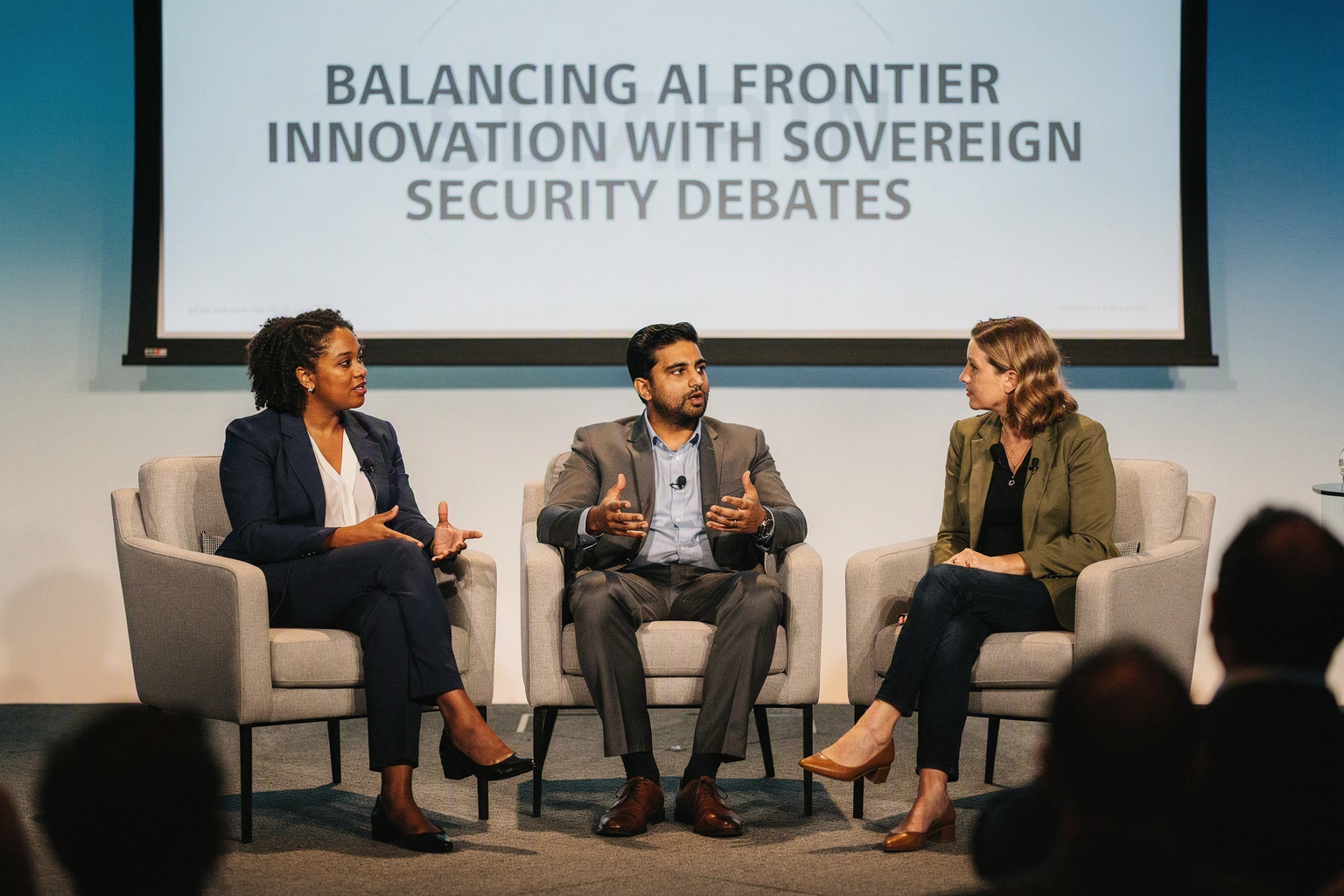
The unprecedented move by the White House to halt the wide release of GPT 5.6 has deeply divided the global technology community. As OpenAI complies with the federal request to limit early access to a select group of government-approved partners, a fierce debate has ignited: is this intervention a critical national security safeguard, or a regulatory roadblock that will cripple American technological leadership?
The Case for Security: A Crucial Shield Against Unknown Risks
Proponents of the government's intervention argue that the sheer cognitive and autonomous capabilities of next-generation models like GPT 5.6 warrant extreme caution. National security experts point out that frontier LLMs are no longer just conversational tools; they are sophisticated engines capable of complex reasoning, automated cyber-operations, and potentially weaponizable code generation.
According to reports, the Trump administration engaged in intense internal debates for weeks over how restrictive this safety framework should be before officially ordering the delay. Advocates for this cautious approach suggest that:
- Vulnerability Red-Teaming: Restricting early access to a trusted, vetted cohort allows for rigorous stress-testing against national security threats before public exposure.
- Preventing Proliferation: A staggered rollout prevents adversarial nation-states from immediately exploiting or reverse-engineering the model's advanced capabilities.
- Establishing Federal Oversight: As AI systems edge closer to human-level reasoning, some level of government oversight is deemed inevitable to protect critical infrastructure from autonomous system failures.
The Case for Innovation: Handing the Advantage to Competitors
Conversely, a significant faction of Silicon Valley executives, researchers, and open-source advocates view the delay as a dangerous precedent. They argue that bureaucratic bottlenecks do not stop progress—they merely shift the center of gravity away from Western developers.
Critics highlight several key concerns:
- The Global AI Race: While American companies are ordered to delay their rollouts, state-funded competitors in rival nations face no such regulatory hurdles, potentially closing the technological gap.
- Stifled Commercial Growth: Thousands of startups and enterprises that planned their product roadmaps around the expected capabilities of GPT 5.6 are now left in strategic limbo.
- Market Centralization: Limiting access to "approved partners" naturally favors massive tech conglomerates and established defense contractors, squeezing out smaller, highly innovative developers.
Building Resilience in an Era of Regulatory Uncertainty
For enterprises navigating this shifting geopolitical landscape, relying on a single AI model has become a significant business vulnerability. When regulatory mandates can delay a flagship model's release overnight, architectural flexibility is paramount.
To mitigate these risks, forward-thinking organizations are turning to multi-model ecosystems. Communication platforms like CallMissed address this exact vulnerability. By offering a unified API gateway that connects to over 300+ LLMs, CallMissed enables developers to seamlessly pivot between models. If a primary model is restricted or delayed by government intervention, businesses can instantly reroute their AI voice agents, multilingual chatbots, and customer workflows to alternative high-performing LLMs without rewriting their core infrastructure.
Ultimately, whether this delay is viewed as a vital safety check or an innovation killer, it signals a new era: the age of unregulated, rapid-fire AI deployment is officially over.
What This Means For You
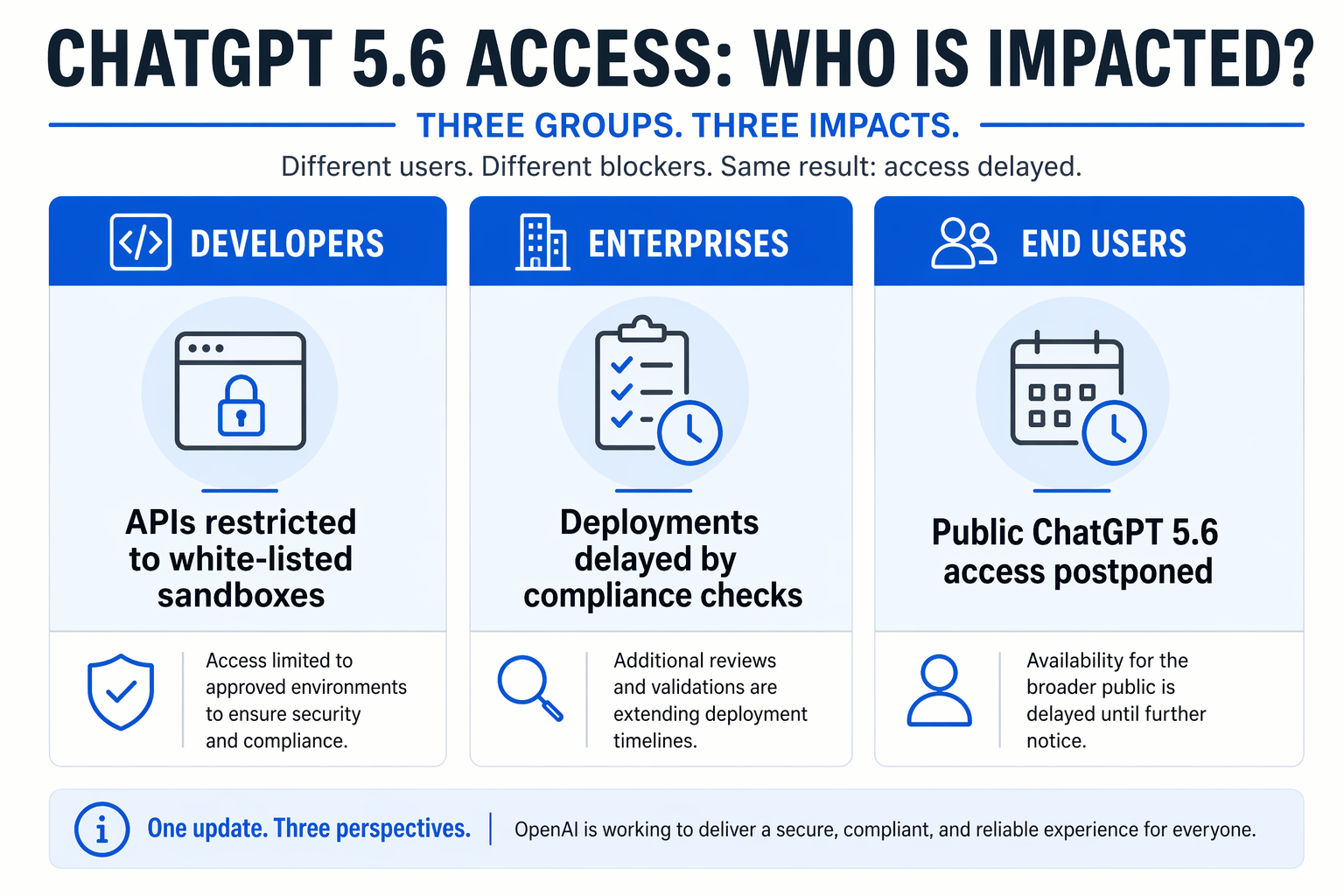
The sudden intervention by the U.S. government to delay OpenAI's GPT-5.6 rollout sends a clear message to the global tech ecosystem: frontier AI is now treated with the same regulatory gravity as national security infrastructure. For developers, enterprise leaders, and startups, this regulatory bottleneck represents a fundamental shift in how AI-driven products must be planned and deployed.
To help you navigate this shifting landscape, the table below breaks down exactly how the delayed rollout impacts different sectors and how to adapt your strategy.
| Impacted Group | Immediate Impact of Delay | Strategic Risk | Actionable Mitigation Strategy |
|---|---|---|---|
| Enterprise Leaders | Postponed access to next-generation agentic reasoning capabilities. | Competitors leveraging localized, open-source models may close the performance gap. | Focus on optimizing current pipelines with custom fine-tuning and hybrid cloud architectures. |
| AI Startups | Extended waitlists and delayed launch timelines for "GPT-5.6-native" apps. | Missed product-market fit windows; investor anxiety over frozen roadmaps. | Build model-agnostic applications; leverage existing state-of-the-art models as fallback options. |
| GovTech Developers | Prioritized early access, but under strict federal auditing guidelines. | High compliance overhead; prolonged vetting cycles before public production. | Focus on strict data provenance, private cloud hosting, and rigorous guardrail testing. |
| SMBs & Agencies | Extended dependency on current-gen API limits and pricing structures. | Stagnant operational efficiency gains while waiting for cheaper, faster reasoning. | Utilize unified API platforms to dynamically route tasks to the most cost-effective current LLM. |
The Death of Single-Model Dependency
This regulatory intervention highlights the extreme vulnerability of building a business on a single AI provider's API. When your entire operational roadmap relies on the release of a single, centralized model, a single government directive can instantly freeze your product pipeline.
Agility is the new currency. To avoid getting bottlenecked by geopolitical and regulatory delays, engineering teams are rapidly shifting toward multi-model redundancy. By designing software architectures that can dynamically swap between proprietary engines and robust open-source alternatives, businesses insulate themselves from vendor-specific disruptions.
Building Regulatory Resilience with CallMissed
Navigating this unpredictable landscape requires an infrastructure layer that isn't locked into a single ecosystem. This is where platforms like CallMissed provide a crucial buffer.
Instead of waiting indefinitely for GPT-5.6's restricted release, developers can leverage CallMissed's multi-model API gateway. This infrastructure allows you to access over 300+ LLMs, enabling your applications to seamlessly failover to alternative high-performance models without requiring a complete rewrite of your codebase.
Furthermore, for global enterprises seeking to bypass Western regulatory logjams, CallMissed provides local-first solutions, including production-ready AI voice agents and advanced Speech-to-Text APIs supporting 22 Indian regional languages natively. By decoupling your core application logic from the launch timelines of any single Silicon Valley lab, you maintain operational continuity, no matter how anxious governments become over the future of frontier AI.
Frequently Asked Questions
Why did the US government order OpenAI and Sam Altman to delay the GPT 5.6 rollout?
Who is allowed to access OpenAI's GPT 5.6 during this restricted launch phase?
How does the GPT 5.6 rollout delay impact businesses looking to integrate advanced AI models?
How long did the White House debate before ordering the GPT 5.6 rollout delay?
Are other major artificial intelligence companies facing similar government restrictions?
When is the public release date for OpenAI's GPT 5.6 now expected?
Conclusion
The Trump administration's intervention in the release of GPT-5.6 marks a major turning point in tech regulation, proving that geopolitical and national security concerns now directly govern the deployment of frontier AI.
As the industry adapts to this new era of state-monitored technology, here are the key takeaways to watch:
- Direct Federal Oversight: Regulatory intervention has shifted from theoretical policy debates to active enforcement, directly dictating product release timelines.
- A "Security-First" Standard: Frontier models must now undergo rigorous safety vetting with government-approved partners before achieving wide-scale public distribution.
- The Need for Model Redundancy: Enterprise dependency on a single AI provider carries risk; businesses must design adaptable systems capable of switching models if flagship rollouts face sudden regulatory delays.
Moving forward, the industry must watch how other AI giants navigate this tightening landscape. Will these government-enforced delays slow the pace of global innovation, or will they ultimately build the necessary trust for safer, more resilient enterprise adoption?
To explore how the landscape of AI communication is evolving amidst these shifting regulatory trends, check out CallMissed—an AI communication infrastructure platform powering robust voice agents and multilingual chatbots designed to keep businesses agile, compliant, and ahead of the curve.
Discussion
Related Posts



Ready to automate customer conversations?
Launch AI voice agents and WhatsApp bots with CallMissed — one API, 22+ Indian languages.