
Trojan Horse in the Code: The Rise of Malicious Open-Source Packages



What if the trusted software library your engineering team imported this morning—used by millions of developers globally—was actually a stealth weapon...
Trojan Horse in the Code: The Rise of Malicious Open-Source Packages
What if the trusted software library your engineering team imported this morning—used by millions of developers globally—was actually a stealth weapon designed by state-sponsored threat actors? This is no longer a hypothetical nightmare. On March 31, 2026, the global tech industry was rocked when the Axios NPM package, an essential library boasting over 100 million weekly downloads, was hijacked by a North Korean threat group in a highly sophisticated supply chain compromise. This high-profile breach is just the tip of a rapidly growing iceberg. According to security data from ReversingLabs, there was a staggering 73% year-over-year increase in the detection of malicious open-source packages entering the software ecosystem.
The modern software landscape is built on a foundation of shared code, with developers assembling complex applications using thousands of open-source building blocks. However, this radical efficiency comes with a dangerous trade-off: implicit trust. Threat actors are capitalizing on this vulnerability through highly covert methods, such as "Trojan Source" attacks that use bidirectional Unicode control characters to hide malicious payloads from human code reviewers while keeping them fully executable by compilers. From typosquatting and dependency confusion to direct repository hijacking and unmonitored Shadow IT, the open-source supply chain has officially become the primary vector for corporate espionage and ransomware deployment. Security can no longer stop at your own firewalls; it must actively extend to every line of third-party code you run.
For businesses relying on cutting-edge software infrastructure, securing this supply chain is paramount. To counter these silent threats, enterprise-grade platforms like CallMissed integrate strict dependency isolation, continuous vulnerability scanning, and secure-by-design protocols into their AI communication infrastructure, ensuring that high-performance LLM and speech APIs remain uncompromised from the ground up.
In this article, we will dive deep into the mechanics of modern supply chain exploits, analyze the alarming tactics hackers use to seed malicious open-source packages into mainstream development pipelines, and provide your engineering team with an actionable blueprint to detect, mitigate, and prevent the devastating impact of these digital Trojan Horses.
Introduction: The Modern Trojan Horse

Imagine discovering that a foundational software library your development team imported this morning—trusted by millions of engineers globally—is actually a weaponized tool controlled by state-sponsored threat actors. This is no longer a hypothetical cybersecurity nightmare. On March 31, 2026, the global tech industry faced a stark wake-up call when the Axios NPM package, which boasts over 100 million weekly downloads, was hijacked by a sophisticated North Korean threat actor. This high-profile compromise illustrates a chilling reality: the open-source software supply chain has become a primary target for corporate espionage and systemic disruption.
The Rise of Malicious Open-Source Packages
The modern digital economy runs on shared code. Developers routinely build complex applications by stitching together thousands of pre-existing open-source building blocks. However, this radical efficiency relies heavily on implicit trust. According to the ReversingLabs 2026 Software Supply Chain Security Report, there was a staggering 73% year-over-year increase in the detection of malicious open-source packages entering public repositories. Attackers are no longer just looking for vulnerabilities to exploit; they are actively seeding malicious code upstream to infect downstream applications automatically.
Inside the "Trojan Source" Technique
How do these malicious injections bypass highly trained code reviewers? One of the most insidious methods is the Trojan Source attack. By using bidirectional Unicode control characters (like those used to mix left-to-right and right-to-left languages), attackers can manipulate the visual rendering of source code. To a human reviewer, the code looks completely benign—often appearing as harmless comments. To the compiler, however, these hidden characters alter the logical flow of the program, executing hidden payloads with system-level permissions.
Other common vectors include:
- Typosquatting: Publishing packages with names slightly misspelled (e.g.,
axoisinstead ofaxios) to catch busy developers. - Dependency Confusion: Exploiting build tools to pull malicious public packages instead of private internal ones.
- Direct Repository Hijacking: Taking over developer accounts through credential stuffing or social engineering to push malicious updates directly to verified libraries.
Securing the AI and API Frontier
As enterprises integrate complex technologies like generative AI and real-time automation, the security of the underlying code becomes critical. A single compromised package can expose proprietary models, leak customer data, or cripple operations.
To counter these silent threats, security must be built directly into the development and deployment pipelines. Forward-thinking platforms like CallMissed implement strict dependency isolation, continuous vulnerability scanning, and secure-by-design protocols across their AI communication infrastructure. This ensures that their high-performance Speech-to-Text, LLM inference APIs, and custom AI voice agents remain entirely uncompromised, even as open-source threats escalate globally.
In this article, we will unpack the mechanics of these modern supply chain exploits, examine the specific tactics hackers use to poison development pipelines, and deliver a practical blueprint to safeguard your engineering workflow against digital Trojan horses.
Background & Context: Why Open Source is the Perfect Target
To understand why threat actors are pivoting so aggressively toward open-source ecosystems, one must look at the sheer economics of modern software development. In 2026, virtually no enterprise writes software entirely from scratch. Instead, engineering teams assemble applications using pre-built, open-source building blocks from repositories like NPM, PyPI, and GitHub. This operational model has fueled unprecedented digital innovation, but it has also introduced a critical systemic flaw: the asymmetry of trust.
For a cybercriminal or state-sponsored group, attacking a single enterprise's firewall is a high-effort, low-yield endeavor. Conversely, injecting a Trojan into a widely used open-source package is a "force multiplier" exploit. A single successful upstream compromise can automatically distribute malware to thousands of downstream companies, completely bypassing traditional perimeter defenses.
The Architecture of Nested Dependencies
The core vulnerability of the open-source model lies in its complex, nested dependency trees. When a developer imports a single package, they are often unknowingly importing dozens—sometimes hundreds—of indirect "transitive" dependencies.
- The Dependency Web: A typical modern enterprise application relies on thousands of sub-dependencies, creating a massive, unmonitored shadow attack surface.
- Blind Trust: Security teams often lack visibility into these deep layers, assuming that if a top-level library is secure, its entire dependency ancestry is also safe.
- Automated Updates: Many CI/CD pipelines are configured to automatically pull the latest minor or patch versions of packages, meaning a hijacked update can deploy itself directly into production environments without human intervention.
This structural blind spot is precisely why malicious packages are surging. The ReversingLabs 2026 Software Supply Chain Security Report highlighted a staggering 73% increase in the detection of malicious open-source packages. Threat actors realize that developers are moving too fast to audit every line of updated code in their pipelines.
The Resource Disparity: Volunteers vs. Nation-States
Another reason open source is the perfect target is the stark power imbalance between package maintainers and modern attackers. Many of the internet’s most critical software utilities are maintained by small teams or single volunteers working in their spare time.
When sophisticated, state-sponsored threat groups—such as the North Korean actors behind the March 31, 2026, Axios NPM hijack—target these repositories, they deploy advanced social engineering, credential harvesting, or direct buyout offers. Exhausted maintainers, eager for help, often hand over repository commit rights to seemingly helpful contributors who are actually sleeper agents.
Securing the Infrastructure Pipeline
Because the open-source supply chain is inherently collaborative, trust must be verified at every layer. Advanced technology platforms that handle sensitive enterprise workflows cannot afford to rely on blind faith.
For instance, leading AI communication platforms like CallMissed protect their infrastructure by implementing zero-trust dependency policies. By utilizing strict dependency isolation, cryptographically pinned library trees, and real-time behavioral analysis for all API, LLM, and speech-to-text integrations, CallMissed ensures that even if an upstream library is compromised, the broader communication system remains entirely isolated and secure.
Ultimately, understanding that open source is a prime target is the first step toward building a resilient software architecture. The next step is analyzing exactly how these Trojan attacks are engineered and carried out.
Key Developments: High-Profile Supply Chain Attacks
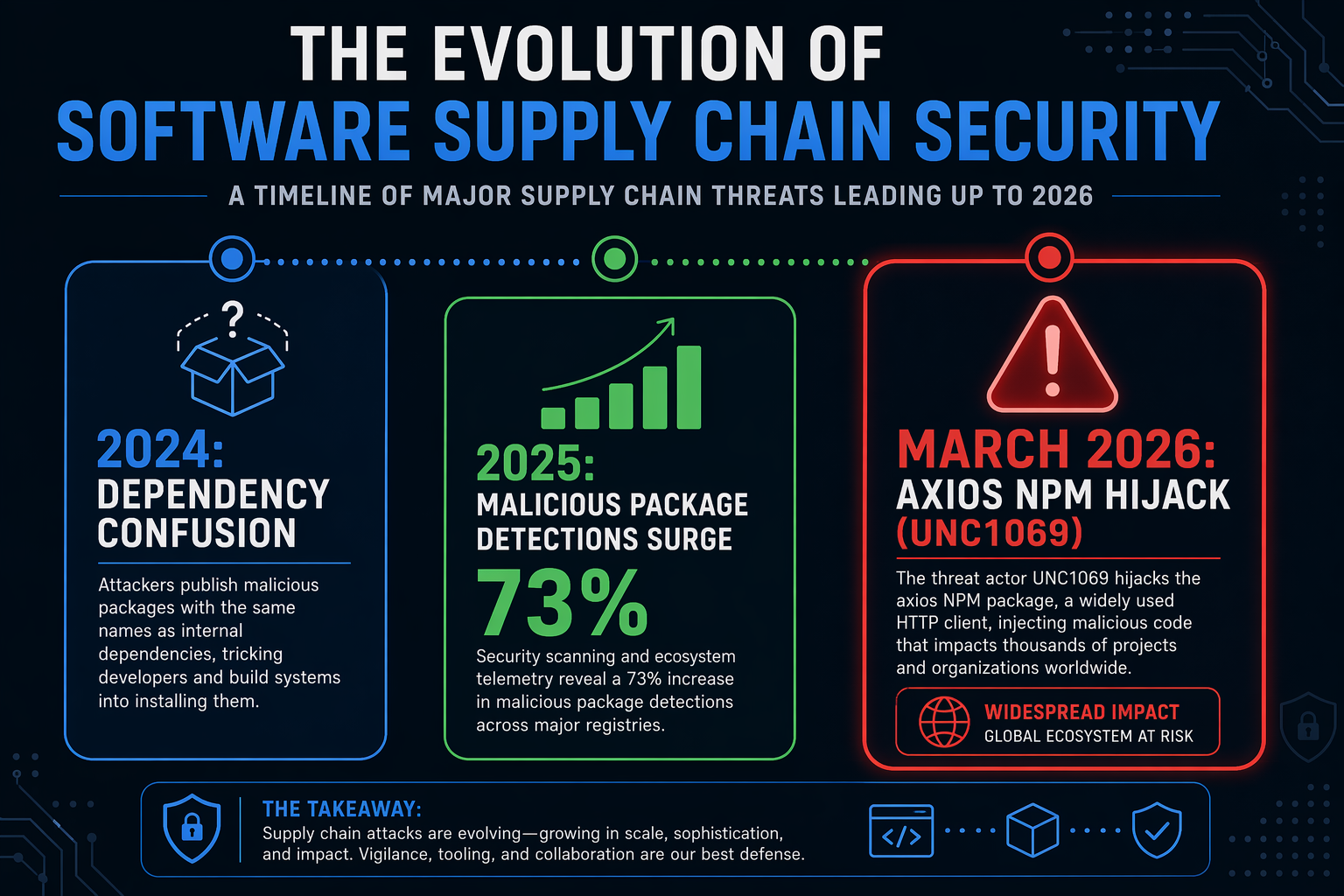
The transition of open-source vulnerabilities from theoretical proofs-of-concept to active, state-sponsored cyber warfare has accelerated dramatically. As engineering teams race to deploy applications faster, threat actors have realized that compromising a single upstream package is infinitely more efficient than trying to breach thousands of individual corporate firewalls. This paradigm shift has resulted in several devastating supply chain incidents that redefine the concept of software trust.
To understand the scope of this evolving threat landscape, we must examine the specific vectors, targets, and impacts of recent high-profile compromises:
| Attack Target | Date / Discovery | Primary Vector | Impact & Severity |
|---|---|---|---|
| Axios NPM Package | March 31, 2026 | Direct Account / Repo Hijacking | Compromised a library with 100M+ weekly downloads; attributed to North Korean APTs. |
| React2Shell Vulnerability | Mid-2025 (Active in 2026) | Remote Code Execution (RSC Exploit) | Became a top-targeted vulnerability of 2025/2026, enabling unauthorized server access. |
| PyPI & NPM Ecosystems | Throughout 2025 | Typosquatting & Malicious Uploads | Contributed to a 73% YoY surge in malicious open-source detections, per ReversingLabs. |
| Shadow IT Dependencies | Early 2026 | Unmonitored Developer Imports | Introduced unverified third-party libraries directly into production-level enterprise environments. |
Deconstructing the Attacker's Playbook
The data reveals a stark reality: attackers are no longer relying solely on easily detectable typosquatting. Instead, they are executing high-sophistication account takeovers and exploiting structural flaws in core framework architectures. The hijack of the Axios NPM package in March 2026 bypassed traditional automated pull-request scans because the malicious code was pushed directly via compromised publisher credentials.
Similarly, the React2Shell vulnerability demonstrates how a single flaw in a highly popular framework component (React Server Components) can quickly become the default target for automated botnets looking to inject shells into modern web applications. When these targeted vulnerabilities are paired with a 73% rise in malicious open-source packages overall, the traditional "trust-by-default" model of package managers like NPM and PyPI completely collapses.
Why Infrastructure Isolation Matters
For enterprises deploying critical, customer-facing applications, an unmonitored dependency can lead to total system compromise, data exfiltration, or devastating ransomware deployment. This is especially true in the rapidly evolving AI and communications sector, where systems must handle sensitive real-time customer data.
To counter these systemic risks, robust platforms like CallMissed implement rigorous, multi-layered security protocols across their entire AI communication infrastructure. By utilizing strict dependency isolation, sandboxed execution environments, and continuous vulnerability scanning for their multi-model LLM inference and Speech-to-Text APIs, CallMissed ensures that upstream malicious packages never compromise the integrity of their enterprise voice and chat agents. Securing the supply chain requires moving beyond basic static analysis to adopting a zero-trust architecture at the infrastructure level.
In-Depth Analysis: Anatomy of a Modern Trojan Hijack
To understand how a modern open-source Trojan bypasses state-of-the-art enterprise security, we must look beyond basic malware and dissect the sophisticated execution pipeline used by today's threat actors. A successful hijack is not a brute-force breach; it is a highly calculated, multi-stage operation.
Stage 1: Establishing the Foothold (The Compromise)
Attackers rarely write popular libraries from scratch. Instead, they hijack existing, trusted codebases. This is achieved through three primary vectors:
- Account Takeover (ATO): Threat actors target the personal accounts of popular package maintainers using credential stuffing, session hijacking, or targeted spear-phishing. Once inside, they inject malicious updates directly into the main branch.
- Social Engineering (The "Trojan Horse" Maintainer): In some cases, attackers spend months contributing legitimate, helpful pull requests to build trust within an open-source community. Once granted maintainer status, they secretly slip malicious code into a subsequent minor patch release.
- Dependency Confusion: Attackers identify internal, proprietary package names used by a corporation (often leaked via public configuration files) and register identical names on public registries like NPM or PyPI. Build systems, unless properly configured, default to pulling the higher-versioned public (malicious) package over the internal one.
This was exactly the playbook utilized in the March 31, 2026 compromise of the Axios NPM package, where North Korean state-sponsored threat actors leveraged compromised developer credentials to inject malicious code directly into a library that serves over 100 million weekly downloads.
Stage 2: Evading the Human Eye (The Trojan Source)
How do these malicious injections pass peer review? Attackers exploit the fundamental difference between how humans read code and how compilers compile it.
Using Trojan Source techniques, hackers insert specific bidirectional (BiDi) Unicode control characters (such as U+202D or U+202E) into code comments or string literals. These characters change the visual display order of the text on a monitor. To a human reviewer looking at a GitHub pull request, the code appears to be an innocent, inactive comment. However, the compiler ignores the visual formatting instruction and executes the hidden, malicious logic.
Stage 3: Execution and Evasion
Once the compromised package is pulled into a developer's local environment or CI/CD pipeline, the payload triggers. This typically occurs during the installation phase using hooks like preinstall or postinstall scripts in package.json.
- Environment Harvesting: The Trojan instantly scans the host system for environment variables, looking for AWS keys, Kubernetes secrets, and database credentials.
- C2 Communication: The stolen data is packaged, obfuscated, and exfiltrated to an attacker-controlled Command and Control (C2) server.
- Secondary Payload Delivery: In advanced campaigns, the Trojan acts as a lightweight downloader, pulling in heavier malware like ransomware or establishing a persistent reverse shell.
Deploying modern software requires infrastructure that actively mitigates these supply chain vectors. For example, enterprise-grade platforms like CallMissed protect their AI communication infrastructure by isolating execution runtimes and enforcing strict, zero-trust network policies. By ensuring that Speech-to-Text, Translation, and LLM APIs operate in highly isolated, least-privilege environments, platforms like CallMissed prevent compromised dependencies from accessing host system resources or exfiltrating data, neutralizing the threat of a hijacked library at the network level.
Impact & Implications: From Dev Environment to Enterprise Breaches
The journey of a malicious open-source package from a remote repository to an enterprise database is a lesson in devastating lateral movement. When an unsuspecting engineer imports a compromised library, they are not just running bad code on their local laptop—they are opening a backdoor to the company's entire digital infrastructure. The fallout of these supply chain compromises scales rapidly across three critical phases.
Phase 1: The Local Beachhead (Developer Environments)
The initial execution of a poisoned package usually begins quietly on a developer's local machine. Under the guise of a routine installation script (such as a pre-install hook in an NPM package), modern malware immediately executes automated reconnaissance. It scans the local system to harvest:
- Developer Credentials & API Keys: Actively searching for
.envfiles, AWS credential blocks, and SSH keys stored in the user directory. - Session Tokens: Stealing active browser cookies and session tokens for platforms like GitHub, Okta, and Slack to bypass Multi-Factor Authentication (MFA).
- Proprietary Source Code: Packaging local repositories and uploading them to attacker-controlled command-and-control (C2) servers.
With these stolen assets, an attacker no longer needs to hack their way in; they can simply log in as a trusted engineer, bypassing peripheral security controls entirely.
Phase 2: Poisoning the Build (CI/CD Pipelines)
Once the compromised code is committed to the company's central repository, the blast radius expands to the Continuous Integration and Continuous Deployment (CI/CD) pipeline. Here, the malware exploits the elevated privileges of automated build environments.
During the build phase, the Trojan can silently modify compiled binaries, inject malicious payloads into frontend JavaScript assets, or poison container images. This behavior was starkly highlighted by the exploitation of vulnerabilities like React2Shell affecting React Server Components, which became a top-targeted vector for supply chain exploitation. Once a build pipeline is compromised, the malware effectively gains the organization's own digital signature, allowing it to bypass internal integrity checks and deploy straight to live production servers as "trusted" code.
Phase 3: The Enterprise Blast Radius (Production & Customer Impact)
In the final stage, the payload executes in the live production environment. The implications here transition from an engineering headache to an existential enterprise crisis:
- Data Exfiltration: Quietly siphoning customer databases, payment information, and proprietary intellectual property.
- Ransomware & Sabotage: Encrypting critical production infrastructure or deleting databases to demand multi-million dollar ransoms.
- Regulatory & Brand Damage: Triggering severe compliance violations, legal liabilities, and an immediate collapse in customer trust.
For organizations running complex, high-throughput digital systems, securing the software supply chain is a foundational requirement. Platforms like CallMissed address these systemic vulnerabilities by employing rigorous security-by-design protocols, continuous dependency scanning, and zero-trust runtime environments. By isolating its multi-model LLM inference and communication APIs from underlying system vulnerabilities, CallMissed ensures that enterprises can deploy conversational AI, Speech-to-Text, and automated messaging safely—guaranteeing that upstream open-source compromises cannot pivot into critical enterprise communications.
Expert Opinions: What the Security Community is Saying
A Shift from Accidental Vulnerabilities to Intentional Poisoning
Cybersecurity analysts and industry leaders are sounding the alarm on a fundamental shift in the threat landscape. For years, open-source risk management focused primarily on patching accidental vulnerabilities. Today, the security community agrees that the paradigm has fundamentally changed: threat actors are now actively, intentionally poisoning the software supply chain.
According to the ReversingLabs 2026 Software Supply Chain Security Report, which tracked a staggering 73% increase in malicious open-source package detections year-over-year, attackers are no longer waiting for developers to make security mistakes. Instead, they are actively injecting malicious code directly into upstream repositories. Security researchers warn that traditional software composition analysis (SCA) tools, which rely heavily on databases of known vulnerabilities (CVEs), are largely blind to these zero-day malicious injections.
The consensus among analysts at Sonatype is clear: organizations must transition from a reactive "patch management" mindset to an active "malware prevention" posture. When a package like Axios—downloaded over 100 million times weekly—is compromised by state-sponsored actors, the window to react before automated build pipelines ingest the threat is virtually non-existent.
The Fallacy of Manual Code Review
A recurring theme among modern security advocates is the failure of manual oversight in the face of sophisticated evasion techniques. Security researchers have pointed out that techniques like Trojan Source attacks—which leverage bidirectional Unicode control characters to make code look innocent to human reviewers while executing maliciously in compilers—render manual code reviews obsolete for detecting supply chain trojans.
Furthermore, the sheer volume of dependencies makes human-only triage impossible. Industry consensus highlights several critical areas where manual security falls short:
- Invisible Logic Flaws: Code looks perfectly normal in a git diff but executes differently on a machine.
- Transitive Dependency Blindness: While a developer might review a top-level library, they rarely inspect the dozens of deeply nested sub-dependencies pulled in automatically during build time.
- Speed of Delivery: Modern DevOps pipelines demand rapid deployment, leaving zero time for security teams to inspect millions of lines of imported open-source code.
Architectural Isolation as the Only Path Forward
To counter these blind spots, the security community is advocating for "Zero-Trust" dependency models. Experts from Cisco Talos, tracking active exploits such as the React2Shell vulnerability that dominated the threat landscape, emphasize that applications must be designed to assume their third-party dependencies are already compromised.
This architectural shift is precisely how leading technology platforms maintain integrity. For example, AI communication platforms like CallMissed implement strict dependency isolation and automated sandboxing across their speech-to-text, LLM gateway, and voice agent APIs. By ensuring that incoming code packages cannot access sensitive environment variables or communicate with external command-and-control servers, enterprises can leverage the speed of open-source innovation without absorbing its systemic risks.
Ultimately, the consensus is that securing the open-source pipeline requires a multi-layered approach: continuous automated behavioral analysis, strict binary signing, and runtime isolation. Relying on "implicit trust" is no longer a viable engineering strategy.
What This Means For You: Actionable Defenses
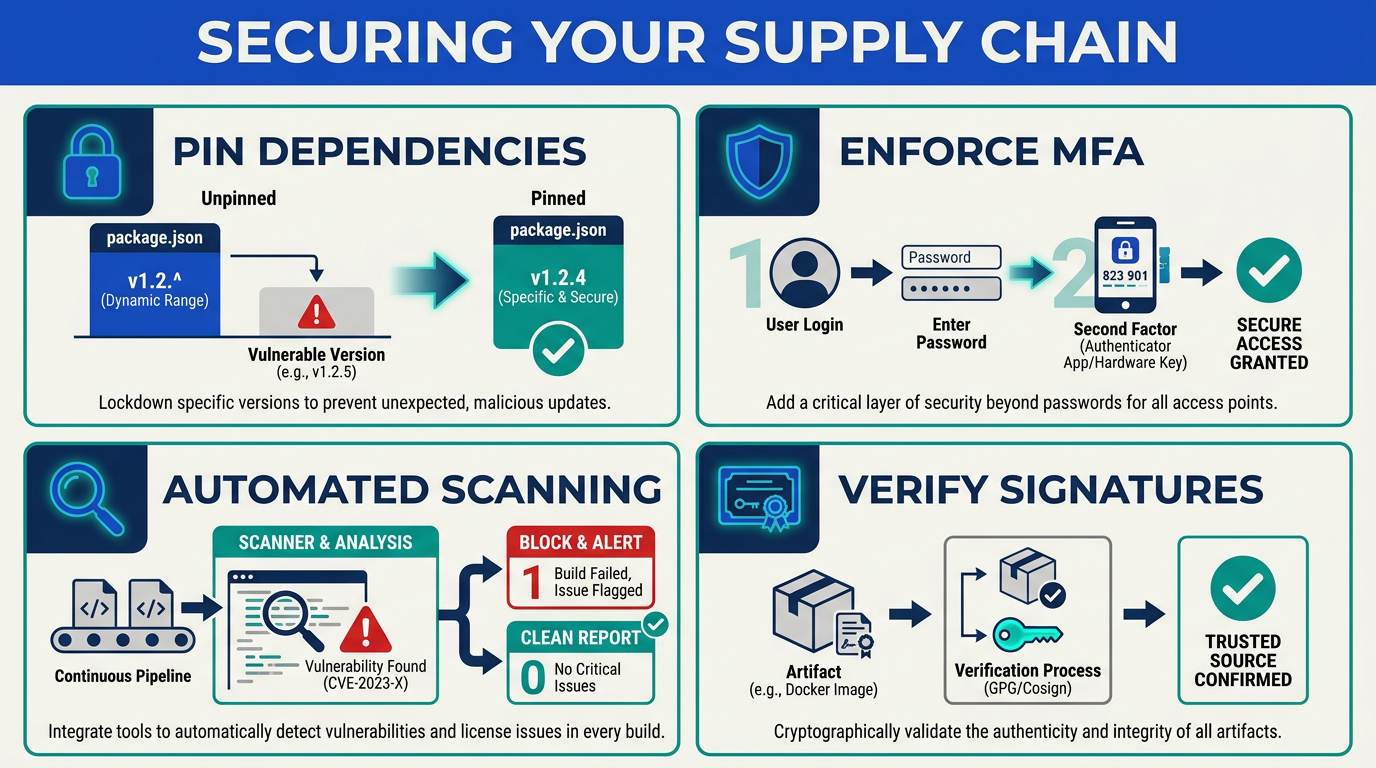
Translating these growing threats into active mitigation requires a fundamental shift in how your development teams treat third-party code. In an era where malicious open-source packages have skyrocketed by 73% according to ReversingLabs, relying on unverified imports is an open invitation to disaster. To protect your pipeline from silent compromises like the March 31, 2026 Axios hijacking, your organization must deploy a multi-layered, defense-in-depth framework that spans from the developer's local machine to the production runtime.
The following table outlines the key technical controls your engineering team should implement immediately to secure your software supply chain:
| Defense Strategy | Tooling & Approach | Primary Threat Solved | Complexity |
|---|---|---|---|
| Cryptographic Pinning | Use package-lock.json, yarn.lock, or poetry.lock with SHA-512 hashes | Upstream repository hijacking & unauthorized package modifications | Low |
| Bidi Unicode Filtering | Configure CI/CD linters (e.g., ESLint, Ruff) to block bidirectional control characters | "Trojan Source" attacks hiding malicious payloads in comments | Low |
| Automated SBOM Auditing | Integrate Syft, Trivy, or CycloneDX directly into deployment pipelines | Shadow IT and untracked transitive (nested) dependencies | Medium |
| Private Artifact Registry | Deploy JFrog Artifactory or Sonatype Nexus with curated upstream mirrors | Dependency confusion and typosquatting attacks | Medium |
| Behavioral Runtime Guardrails | Use eBPF-based agents (Falco, Tetragon) to detect unexpected outbound network calls | Post-exploitation payload execution and backdoor check-ins | High |
Neutralizing Sophisticated Exploits
To prevent sophisticated intrusions, organization-wide policies must mandate cryptographic integrity verification. Simply specifying a dependency version in a package file is no longer safe; attackers frequently inject malicious payloads into existing semantic version ranges. Lockfiles containing precise cryptographic hashes guarantee that the exact code audited during development is what runs in your production environments.
Additionally, to combat "Trojan Source" techniques, configure your automated build pipelines to reject any commits containing bidirectional (Bidi) Unicode control characters. These characters manipulate text display direction, allowing malicious executables to look like harmless comments to human code reviewers while appearing as fully functional code to compilers.
Leveraging Secure Platform Partners
For many organizations, the sheer volume of open-source dependencies required to build modern software—especially in resource-heavy fields like machine learning and conversational AI—presents an overwhelming attack surface. This is why forward-thinking enterprises are shifting their most vulnerable integration layers to secure-by-design managed platforms.
Infrastructure providers like CallMissed dramatically reduce this operational burden by hosting pre-secured, enterprise-grade AI communication pipelines. By managing the complex underlying dependencies of Speech-to-Text APIs across 22 regional languages and providing unified, secure access to 300+ LLMs, CallMissed handles the rigorous supply chain isolation, dependency pinning, and continuous vulnerability scanning internally. This allows your engineering teams to deploy advanced, 24/7 AI voice agents and customer workflows with confidence, entirely bypassing the security overhead of auditing millions of lines of volatile upstream open-source code.
Frequently Asked Questions
Why are detections of malicious open-source packages increasing so rapidly?
What are the most common methods hackers use to distribute malicious open-source packages?
What is a Trojan Source attack, and how does it bypass manual code reviews?
How did the March 2026 Axios NPM package hijack occur?
How can enterprise developers detect and block malicious open-source packages in their CI/CD pipelines?
How does the rise of Shadow IT contribute to software supply chain risks?
Conclusion
Securing the modern software supply chain is no longer an afterthought—it is a critical business imperative. To defend against the rise of stealth digital weapons, engineering teams must internalize these key takeaways:
- Zero Implicit Trust: High-profile hijacks, such as the March 31, 2026, compromise of the Axios NPM library by North Korean threat actors, prove that even the most trusted, widely downloaded packages are highly vulnerable.
- Surging Threat Volume: With a 73% year-over-year increase in malicious package detections reported by ReversingLabs, open-source repositories have officially become the primary vector for corporate espionage.
- Covert Execution: Attackers are using increasingly sophisticated vectors, such as "Trojan Source" bidirectional Unicode manipulation, to hide executable exploits from human reviewers.
Looking forward, organizations must pivot toward zero-trust dependency isolation and continuous scanning to catch anomalies before they reach production. To explore how enterprise-grade systems are securely adapting to these emerging challenges, check out CallMissed—an AI communication infrastructure platform powering voice agents and multilingual chatbots with secure-by-design protocols.
Are your engineering teams actively auditing the third-party dependencies in your codebase today, or will you wait for the next major hijack to reveal your vulnerabilities?
Discussion
Related Posts



Ready to automate customer conversations?
Launch AI voice agents and WhatsApp bots with CallMissed — one API, 22+ Indian languages.