
The Hugging Face Ecosystem in 2026: The New Standard for Enterprise and Open-Source AI



Explore the Hugging Face ecosystem 2026: open-weight models, enterprise catalogs, Microsoft Foundry, trending papers and secure AI deployment.
The Hugging Face Ecosystem in 2026: The New Standard for Enterprise and Open-Source AI
Did you know that a single collaborative platform now hosts over 2 million machine learning models, datasets, and AI applications? In 2026, this mind-boggling scale has turned what was once a repository for open-source enthusiasts into the undisputed gravity well of global artificial intelligence. The Hugging Face Ecosystem in 2026 has officially matured from the "GitHub of AI" into the foundational operating system for both agile startups and Fortune 500 enterprises alike.
This transformation did not happen overnight. Fueled by a phenomenal 367% revenue growth during its breakout years, the platform has capitalized on its massive valuation to build an unshakeable infrastructure. Today, building modern AI applications without leveraging Hugging Face means voluntarily giving up unparalleled speed, developer flexibility, and community support. The platform is no longer just a place to download weights; it is a comprehensive suite of fine-tuning pipelines, dataset curation tools, spaces for instant deployment, and robust enterprise security layers.
Why the Hugging Face Ecosystem Dictates Enterprise Strategy Today
The shift toward open-source and hybrid AI architectures has forced corporate IT departments to integrate Hugging Face directly into their secure development lifecycles. For example, as we approach June 2026, enterprise teams are actively migrating legacy "Hugging Face" repositories in JFrog Artifactory to the newly standardized "Machine Learning" repository layout. This transition highlights how deeply embedded Hugging Face's model distribution protocols have become within secure, enterprise-grade DevSecOps pipelines.
At the same time, the geographic and technical diversification of AI has exploded. According to the recent State of Open Source on Hugging Face: Spring 2026 report, we are witnessing a massive surge in regional LLMs, highly specialized domain-specific models, and lightweight architectures optimized for edge devices. For companies seeking to capitalize on this wave without managing complex hosting environments, communication platforms like CallMissed leverage these open-source breakthroughs to power multilingual AI voice agents and WhatsApp chatbots using a multi-model gateway of over 300+ LLMs.
What You Will Learn in This Guide
Whether you are an AI engineer optimizing inference speeds, an enterprise architect mapping out your next-generation tech stack, or a product leader evaluating open-source versus proprietary APIs, this guide will serve as your roadmap.
In the following sections, we will break down:
- The 2026 Core Infrastructure: A deep dive into the latest Transformers libraries, Hugging Face Hub capabilities, and python-driven deployment workflows.
- Enterprise Security and Integrations: How organizations are safely managing open-source assets using tools like JFrog Artifactory and private Hugging Face Spaces.
- The Open-Source Shift: Crucial insights from the Spring 2026 data on where the global ML community is heading and how small, specialized models are outperforming generalized giants.
- Optimizing the Stack: Best practices for fine-tuning, dataset management, and integrating your Hugging Face pipeline with high-performance downstream inference APIs.
Let’s explore how the open-source revolution has redefined the boundaries of what is possible in enterprise AI.
Introduction: The Center of the Open-Source AI Universe in 2026
In July 2026, the Hugging Face ecosystem 2026 is one of the primary ways developers discover, evaluate, customize, and deploy open and open-weight AI. Hugging Face now reports more than 2 million models on the Hub, alongside extensive collections of datasets and AI applications called Spaces [4]. That scale is a platform fact; its broader significance is that the Hub has become a practical distribution and collaboration layer for modern machine learning.
Often described as the “GitHub equivalent for AI” [7], Hugging Face has evolved from a chatbot startup into infrastructure used by independent developers, researchers, startups, and large enterprises. Its repositories make model weights, configuration files, documentation, datasets, demos, and deployment options accessible through a shared interface.
The result is not that every AI project depends on Hugging Face or that open models have eliminated proprietary systems. Rather, the Hugging Face ecosystem 2026 gives organizations a widely adopted alternative to building exclusively with closed, vendor-controlled APIs. Teams can compare models, inspect licenses and model cards, run evaluations, fine-tune selected architectures, and choose between local, cloud, and managed deployment paths.
The State of Open-Source AI in Spring 2026
Hugging Face’s State of Open Source on Hugging Face: Spring 2026 report documents how development and participation are changing across the platform [1]. The report’s observations point to three important trends:
- AI development is becoming more geographically distributed. Model and dataset creation is increasingly visible across Europe, Asia, Latin America, and other regions outside the traditional concentration of US technology hubs. This includes more resources designed for local languages, cultures, regulations, and use cases.
- Smaller, specialized models are gaining practical importance. Large frontier models remain influential, but Hub activity also reflects strong demand for compact models that are easier to fine-tune, run locally, and deploy on constrained hardware. Models in roughly the 1B-to-8B-parameter range can offer lower latency, greater data control, and more predictable infrastructure costs for focused tasks.
- Multimodal development is expanding rapidly. The open-source community is publishing more systems that work across text, images, audio, video, and structured inputs. Speech models, vision-language models, document-understanding systems, and multimodal agents are now prominent parts of the Hub rather than isolated research categories.
These are reported platform trends, not proof that one model size or modality is best for every organization. Their practical implication is that the Hugging Face ecosystem 2026 offers more deployment choices than a simple contest between the largest language models.
The platform’s current position was built during an earlier period of rapid commercial expansion. Hugging Face reported 367% revenue growth during its 2022–2023 growth phase [6]. That historical figure should not be treated as a current growth rate, but it helps explain how the company gained the resources and enterprise relationships needed to expand its hosting, security, collaboration, and managed-inference products.
From Developer Playground to Enterprise Infrastructure
Hugging Face first became widely known as a place where researchers and developers could share transformer models and Python code [2]. By July 2026, its role is substantially broader. Organizations can use the Hub as a model registry, connect repositories to automated evaluation and deployment workflows, control access to private assets, and incorporate model artifacts into existing governance processes.
This enterprise adoption also changes how models must be managed. A downloaded model is not merely a code dependency: it can include weights, configuration files, custom code, licenses, training information, and security risks. Production teams therefore need version control, access policies, provenance records, vulnerability checks, evaluation gates, and reproducible deployment procedures.
JFrog’s transition from legacy Hugging Face repositories in Artifactory to its newer Machine Learning repository structure illustrates this shift [5]. The announced migration timeline extended through the first half of 2026. The platform fact is that JFrog created a repository type designed for machine-learning artifacts; the interpretation is that enterprise toolchains are increasingly treating models as governed software-supply-chain assets rather than informal research downloads.
The Hugging Face ecosystem 2026 supports this workflow by combining model discovery with documentation, versioned repositories, metadata, community discussion, and deployment integrations. Enterprises can begin with an existing architecture instead of training every system from the ground up, but they still need to validate licenses, data handling, model behavior, security, and total operating cost before production use.
Bridging Open-Source Power and Production: The Role of CallMissed
Hugging Face supplies many of the building blocks for AI applications, including model repositories, datasets, libraries, demos, and inference services. It does not remove every production challenge. A model that works in a notebook may still require containerization, autoscaling, observability, fallback logic, latency optimization, safety controls, and integration with business systems.
CallMissed addresses that downstream layer for conversational applications. Its production infrastructure provides an LLM inference gateway with native support for more than 300 models, allowing developers to connect models to operational voice and messaging workflows without independently managing every deployment component.
For speech-based use cases, CallMissed also provides recognition capabilities across 22 regional Indian languages. These services can be combined with voice agents, WhatsApp chatbots, and Text-to-Speech engines to build localized customer communication systems.
This relationship should be understood as complementary rather than interchangeable. Hugging Face is a broad model-development and distribution platform; CallMissed is focused on converting AI capabilities into deployable communication experiences. By pairing resources from the Hugging Face ecosystem 2026 with production APIs and orchestration, teams can move from model evaluation to a working conversational service more efficiently.
What We Will Cover in This Guide
This guide explains the components, workflows, and governance practices needed to use Hugging Face effectively in 2026. The following sections will cover:
- Core Libraries and the Hub: How
transformers,datasets, model repositories, model cards, and versioning work together [2]. - Model Selection and Evaluation: How to compare architectures, licenses, benchmarks, hardware requirements, and task-specific performance.
- Fine-Tuning and Customization: How to adapt open and open-weight models to private datasets and specialized business requirements.
- Multimodal and Small-Model Workflows: How to work with compact language models, vision-language systems, and speech models.
- The Enterprise Stack: How Spaces, Inference Endpoints, private repositories, access controls, and model supply-chain practices support production deployment.
- The Practical Developer’s Playbook: Python-based implementation patterns for building, testing, and operating real-world AI systems [2].
Hugging Face has made AI development more accessible, collaborative, and portable. Understanding the Hugging Face ecosystem 2026 allows organizations to benefit from that openness while still applying the security, evaluation, compliance, and reliability standards required in production.
Background & Context: The Rise of Hugging Face to AI Dominance
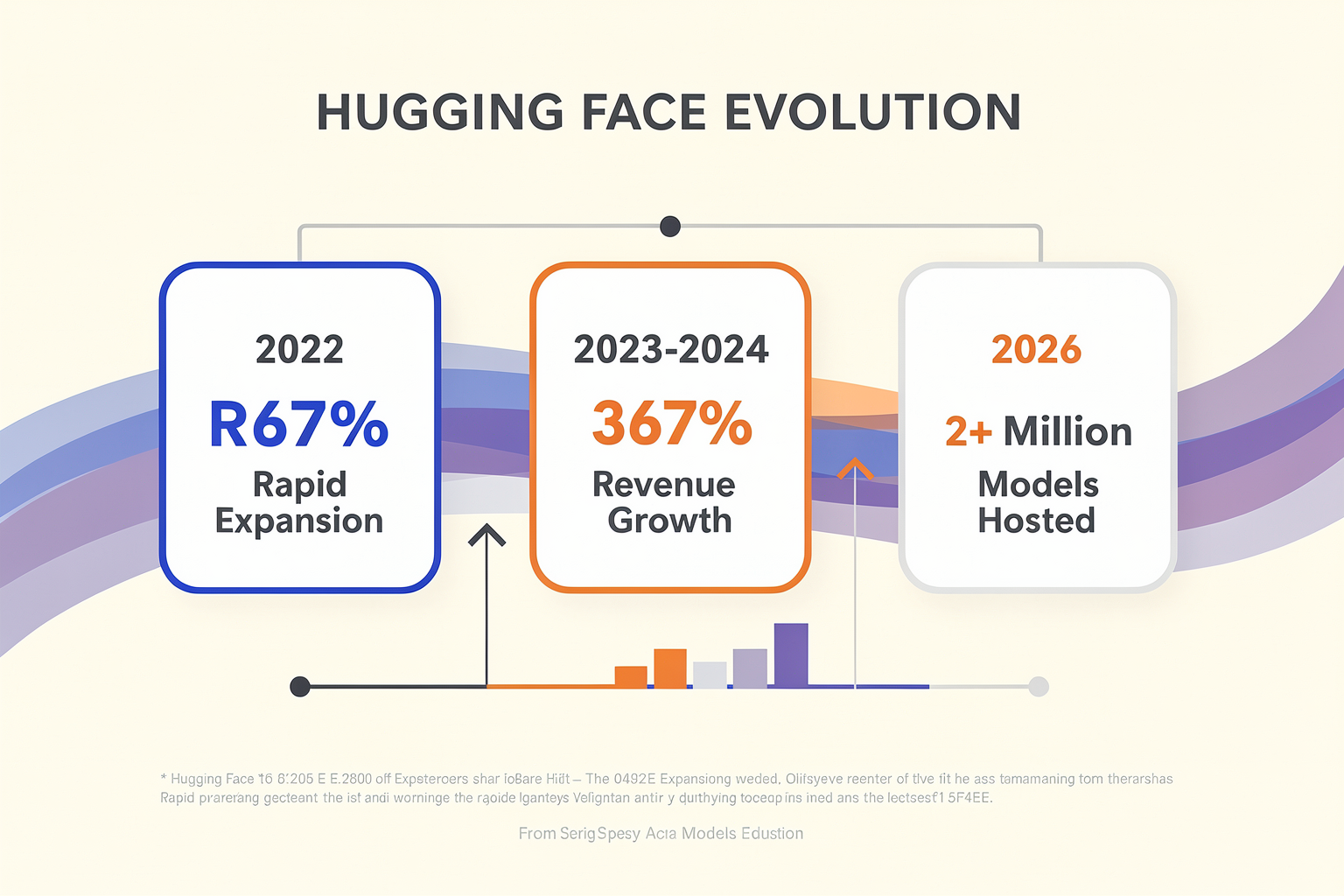
To understand the state of artificial intelligence in 2026, one must understand Hugging Face. What began in 2016 as a conversational chatbot startup has transformed into the undisputed gravity well of the global machine learning ecosystem. Often referred to as the "GitHub of AI", Hugging Face has democratized access to state-of-the-art models, transitioning from a repository of open-source projects into the foundational infrastructure powering modern enterprise AI.
As of Spring 2026, Hugging Face hosts an astonishing 2 million+ models, datasets, and AI applications (Spaces). It serves as the primary distribution hub where researchers, global tech giants, startups, and hobbyists publish their breakthroughs and build upon each other's work. The platform's rise is not just a story of community goodwill; it is backed by explosive economic scaling. For instance, between 2022 and 2023, Hugging Face experienced a massive 367% revenue growth, signaling a profound market shift toward open-source, flexible AI development that has only accelerated over the last few years.
From Conversational Playpen to Global Repository
The journey of Hugging Face is rooted in a pivotal realization: the developer community needed unified tooling to interact with complex deep learning architectures.
- The Transformer Revolution: In 2017, Google introduced the Transformer architecture. Hugging Face quickly capitalized on this by releasing the open-source
transformerslibrary, which abstracted away the immense complexity of implementing these neural networks in PyTorch and TensorFlow. - Standardization of ML Pipelines: By providing a unified API for thousands of pre-trained models, Hugging Face eliminated the need for developers to write boilerplate code. Finding, loading, and fine-tuning an NLP or computer vision model went from weeks of engineering to just a few lines of Python.
- The Rise of Spaces and Datasets: To make models truly useful, Hugging Face introduced Datasets—standardizing data loading and preprocessing—and Spaces, which allowed developers to build and share interactive web demos of their models instantly using Streamlit and Gradio.
This unique combination of model sharing, structured data, and rapid prototyping democratized AI. It broke the monopoly that a handful of closed-source tech giants held over high-performing foundation models.
The Pillars of Hugging Face’s Dominance
Hugging Face’s dominance is anchored on three core pillars that facilitate the entire machine learning lifecycle:
- The Hub (Model Registry): Acting as a centralized directory, the Hugging Face Hub permits immediate access to both massive foundation models (like Meta’s LLaMA series and Mistral) and highly specialized, domain-specific networks fine-tuned for medical diagnostics, legal analysis, or financial forecasting.
- Open Source Collaboration: The community-centric model encourages a continuous feedback loop. A model released on Monday can be fine-tuned, optimized, quantized, and republished by a developer across the globe by Wednesday.
- Production-Ready Integrations: Deploying open-source models once required sophisticated DevOps pipelines. Today, Hugging Face provides robust tooling for serverless endpoints, optimized hardware integration, and seamless scaling.
This ease of deployment is exactly why advanced communication architectures leverage the ecosystem. For example, platforms like CallMissed integrate deep pipeline abstractions to seamlessly manage LLM inference across over 300+ models. By utilizing Hugging Face's foundational frameworks, developers can easily plug in fine-tuned models tailored for specific operational needs—such as real-time customer support or automated voice agents—without worrying about the underlying complex infrastructure.
Transitioning to Enterprise-Grade Security and Governance
As Hugging Face became an indispensable asset for enterprise software stacks, the demands on the platform shifted from casual exploration to rigorous compliance, security, and enterprise-grade repository management. This transition is highly evident in how global development pipelines handle machine learning packages today.
For example, major enterprise artifact repositories have had to restructure their integrations to treat machine learning models as distinct, secure assets. A major industry milestone is occurring in June 2026, where legacy "Hugging Face" repositories in JFrog Artifactory must be completely migrated to the newly optimized "Machine Learning" repository layout. This migration is crucial for organizations to ensure secure caching, proxying, and scanning of large model weights, treating them with the same security parameters as standard binary code.
This shift underscores a broader industry movement: Hugging Face is no longer a sandbox. It is an integral component of modern CI/CD pipelines, subject to strict data governance, vulnerability scanning, and provenance tracking.
Democratization and the Global AI Shift
The State of Open Source on Hugging Face: Spring 2026 report highlights a vital macroeconomic trend: the democratization of AI is reshaping global technology leadership. While closed-source models remain heavily concentrated in a few geographic hubs, open-source models are highly decentralized.
Startups and institutions worldwide are utilizing Hugging Face to bypass the prohibitive costs of training foundation models from scratch. Instead, they leverage the hub to:
- Access pre-trained multilingual architectures that natively understand regional dialects.
- Fine-tune smaller, highly efficient models (such as 3B to 8B parameter models) that run on cost-effective, localized hardware.
- Participate in global collaborative efforts to democratize AI tooling outside of traditional big-tech monopolies.
By lowering the barrier to entry, Hugging Face has laid the groundwork for specialized communication stacks. Startups across diverse regions can now deploy AI voice agents and chatbots that operate natively in dozens of regional languages, scaling their operational reach globally without sacrificing performance or incurring astronomical cloud compute fees.
Key Developments: Milestone Shifts Shaping 2026
The Hugging Face ecosystem 2026 has moved beyond a simple model-sharing hub into the default discovery, evaluation, and distribution layer for open-source and enterprise AI. As of July 2026, the most important shifts are no longer just “more models” or “larger checkpoints.” The real change is how organizations discover credible open-weight models, deploy them on managed enterprise compute, and secure them through governed internal catalogs.
For engineering teams, the priority is to treat Hugging Face as both an innovation source and a production supply chain. The platform’s scale—now commonly discussed at the 2 million+ models, datasets, and Spaces level—creates opportunity, but also demands stronger curation, policy enforcement, and deployment discipline.
| Shift Dimension | Key Milestone / July 2026 Signal | Ecosystem Impact | Strategic Action Required |
|---|---|---|---|
| Open-Source AI Direction | State of Open Source on Hugging Face: Spring 2026 | Reinforces Hugging Face as the public signal layer for where open-source AI is moving: open-weight LLMs, multimodal models, agent tooling, datasets, and evaluation workflows. | Use the Spring 2026 open-source trends as a planning input for model selection, governance, and roadmap prioritization. |
| Discovery & Research Signals | Trending Papers as a discovery surface | Hugging Face is increasingly used to connect papers, models, datasets, demos, and community validation in one workflow. | Monitor trending papers alongside model cards, demos, and benchmark claims before adopting new architectures. |
| Enterprise Deployment | Microsoft Foundry Managed Compute with Hugging Face models | Hugging Face models are becoming easier to deploy inside managed enterprise cloud environments, reducing the gap between open-weight experimentation and governed production use. | Map approved Hugging Face models to enterprise cloud controls, private endpoints, access policies, and cost governance. |
| Open-Weight Model Catalogs | Growth of enterprise-curated open-weight catalogs | Companies are moving from ad hoc Hub downloads to approved internal catalogs of LLMs, embedding models, speech models, vision models, and domain-specific models. | Build an internal model registry with approval status, license review, eval results, security scans, and deployment patterns. |
| Regional & Domain Models | Expansion of localized, multilingual, and industry-specific models | The Hugging Face ecosystem 2026 is increasingly shaped by models optimized for local languages, regulated industries, and task-specific workflows. | Prioritize specialized regional and domain models where they outperform general-purpose frontier models on cost, latency, or accuracy. |
| Secure Enterprise Distribution | Post-June 2026 focus on standardized ML artifact management | Enterprises are tightening controls around model caching, scanning, provenance, and distribution through tools such as JFrog Artifactory and standardized machine learning repository layouts. | Audit model supply chains, migrate legacy repository layouts, enforce signed artifacts where possible, and restrict production pulls to approved sources. |
The July 2026 Shift: From Model Hub to Enterprise AI Supply Chain
The defining change in the Hugging Face ecosystem 2026 is that the Hub is now part of the enterprise AI supply chain. Teams still use it to discover open-source models, but production adoption increasingly depends on governance: license review, security scanning, artifact caching, reproducible evaluation, and controlled deployment.
The State of Open Source on Hugging Face: Spring 2026 reflects this maturation. Open-source AI is no longer evaluated only by model size or leaderboard placement. Enterprises now care about whether a model has clear documentation, active community validation, usable deployment formats, transparent licensing, and measurable performance on real business tasks.
This is why internal curation has become mandatory. With the platform operating at massive scale across models, datasets, and Spaces, organizations cannot allow every team to pull arbitrary checkpoints directly into production. Instead, the winning pattern is an approved model catalog: a governed internal registry of open-weight models that have passed evaluation, security, and legal review.
Trending Papers Are Becoming a Practical Discovery Layer
One of the most important search and discovery changes is the rise of trending papers as a practical entry point into the Hugging Face ecosystem. For developers, the workflow increasingly looks like this: identify a trending paper, inspect the linked model or dataset, test the demo or Space, review community discussion, and then benchmark the model internally.
This shortens the path from research to implementation. Instead of waiting for vendor announcements or manually tracking academic repositories, teams can watch which papers are gaining attention and see whether usable artifacts already exist on Hugging Face.
However, trending does not equal production-ready. Engineering teams should treat trending papers as an early signal, not a final approval mechanism. Before adopting any model, teams should validate licensing, model card quality, dataset provenance, inference requirements, safety behavior, and performance against internal benchmarks.
Managed Compute Is Pulling Hugging Face Models Into the Enterprise Cloud
A major July 2026 trend is the tighter connection between Hugging Face models and managed enterprise compute environments. The emergence of Microsoft Foundry Managed Compute with Hugging Face models reflects a broader shift: enterprises want access to open-weight innovation without giving up the governance, identity, networking, monitoring, and cost controls of their cloud platforms.
This matters because many organizations are no longer comfortable with unmanaged model downloads, especially for regulated workloads. They want open-weight flexibility, but they also need private networking, role-based access control, logging, endpoint governance, and predictable deployment operations.
For platform teams, the strategic move is to define which Hugging Face models can be deployed through managed compute, which require private hosting, and which should remain experimental only. This turns the Hugging Face ecosystem 2026 into a structured source of deployable AI components rather than an uncontrolled research sandbox.
Secure Distribution and Internal Model Catalogs Are Now Core Requirements
Secure enterprise distribution is now one of the most important operational themes. The June 2026 migration pressure around standardized machine learning repository layouts, including JFrog Artifactory workflows, highlighted a broader reality: model artifacts need the same rigor as software packages and container images.
Large model files, tokenizer assets, datasets, adapters, and quantized variants must be cached, scanned, versioned, and distributed through trusted internal channels. Enterprises should avoid direct production dependency on public model pulls where availability, provenance, or policy compliance cannot be guaranteed.
A mature internal catalog should include:
- Approved model versions and deployment formats
- License and usage restrictions
- Security scan status
- Evaluation results and known limitations
- Recommended inference infrastructure
- Ownership and support contacts
- Retirement or replacement plans
This approach reduces risk while still preserving the innovation advantage of open-source AI.
Regional, Domain, and Multi-Model Architectures Define the Next Phase
The Hugging Face ecosystem 2026 is also becoming more regional and domain-specific. Instead of relying on one general-purpose model for every workflow, enterprises are combining specialized models: regional language models, speech-to-text systems, translation models, embedding models, rerankers, vision models, and industry-tuned LLMs.
This is especially important for customer-facing applications, contact centers, compliance workflows, and multilingual automation. A smaller domain model may outperform a larger general model when the task requires local language nuance, industry terminology, or lower-latency inference.
For teams building production AI systems, the architectural pattern is clear: use Hugging Face for discovery and experimentation, then route approved models through a secure orchestration layer. Platforms like CallMissed help teams operationalize this multi-model approach by connecting applications to the right model for the right task without forcing constant rewrites of the application stack. This lets enterprises combine open-source innovation, managed deployment, and production-grade communication workflows in a controlled way.
In-Depth Analysis: Behind the 2 Million Model Milestone
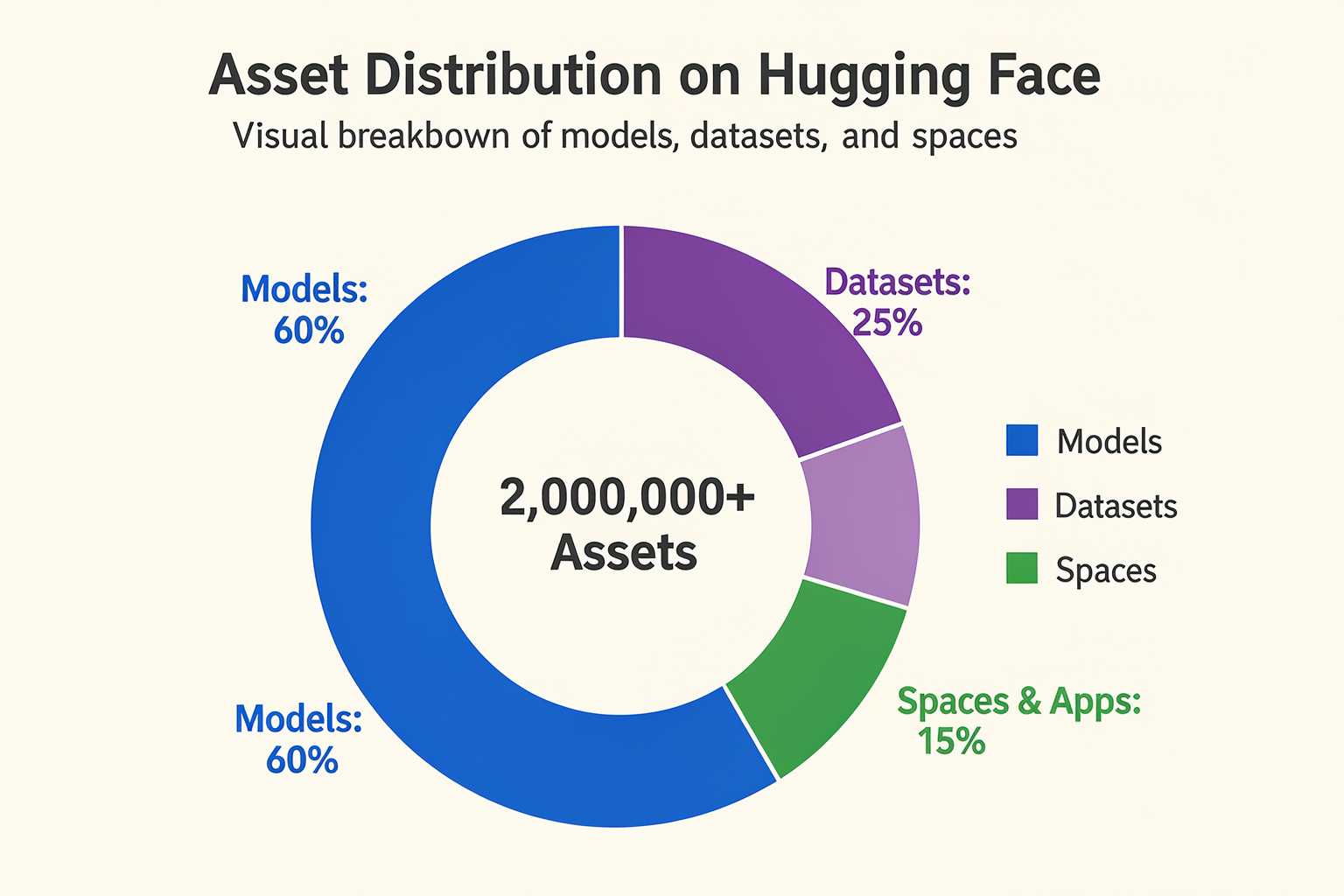
The crossing of the 2 million model milestone on Hugging Face in early 2026 represents far more than just a numerical triumph; it marks a fundamental shift in the architecture of modern artificial intelligence. What began as a repository for transformer-based NLP models has evolved into the central nervous system of global machine learning. Supported by a staggering 367% revenue growth in the early scaling years of 2022–2023, Hugging Face has successfully converted its cultural dominance into enterprise-grade infrastructure.
To understand how the ecosystem reached 2 million models, datasets, and applications, we must look behind the sheer volume and analyze the underlying technical, geographical, and institutional drivers shaping open-source AI today.
1. The Proliferation of Fine-Tuning and Model Merging
The exponential curve leading to 2 million models was not driven by massive tech conglomerates training monolithic foundation models from scratch. Instead, it was catalyzed by the democratization of model adaptation. Several key technical breakthroughs have made it possible for individual developers and small teams to generate, optimize, and share highly specialized models:
- Parameter-Efficient Fine-Tuning (PEFT): Methods like LoRA (Low-Rank Adaptation) and QLoRA have slashed the hardware barriers to model customization. Developers no longer need clusters of H100s to align a model; they can fine-tune a 7-billion parameter model on consumer-grade hardware in a few hours, resulting in millions of lightweight adapter weights uploaded to the registry.
- Model Merging (Mergekit): The rise of mathematical model merging has allowed builders to combine the strengths of different models (e.g., merging a highly creative writing model with a mathematically rigorous reasoning model) without any active training or backpropagation. This has sparked a creative explosion, with community members uploading thousands of unique hybrids daily.
- Domain-Specific Optimization: We are seeing a shift from general-purpose assistants to hyper-focused micro-models. Hugging Face now hosts hundreds of thousands of models engineered solely for legal document parsing, clinical medical transcription, localized tax code analysis, and legacy software refactoring.
2. The Geographical and Multilingual Shift
According to the State of Open Source on Hugging Face: Spring 2026 report, the geographical distribution of AI development has decentralized rapidly. No longer is open-source development concentrated solely in Silicon Valley or Western Europe.
Emerging developer communities across Asia, Latin America, and Africa are actively customizing open-source weights to solve hyper-local challenges. Because proprietary API providers often underserve regional languages and dialects, the open-source community has stepped in. As of 2026, Hugging Face hosts thousands of models fine-tuned for low-resource languages, regional dialects, and local cultural contexts.
For developers building real-world communication applications, however, navigating this massive repository of regional models presents integration challenges. This is where advanced middleware and communication platforms are stepping in. For example, unified platforms like CallMissed bridge this gap for enterprises by leveraging these open-source breakthroughs, offering production-ready Speech-to-Text APIs supporting 22 Indian languages natively alongside 300+ pre-integrated LLMs. This allows developers to tap into the power of the open-source multilingual explosion without the operational headache of hosting and optimizing raw weights themselves.
3. Enterprise Integration and the Move to Production
As Hugging Face models have permeated the enterprise, the requirement for robust software supply chain management has grown. Big tech and traditional enterprises are no longer treating Hugging Face as a mere playground; it is now viewed as an upstream dependency.
This maturation is highly visible in how enterprise registry tools are adapting. For instance, before June 2026, every legacy "Hugging Face" repository within JFrog Artifactory must be migrated to the new, highly optimized "Machine Learning" repository layout. This migration reflects a broader industry trend: the standardization of machine learning models as first-class software artifacts. Organizations are now demanding:
- Security Scanning: Automated provenance tracking, vulnerability scanning, and license compliance audits for every downloaded pickle or Safetensors file.
- Local Caching and Air-Gapping: The ability to proxy the Hugging Face Hub within secure corporate networks to ensure developer velocity does not compromise data privacy.
- Model Versioning Control: Treating model weights with the same semantic versioning rigor as standard API libraries.
4. Navigating the "Paradox of Choice" in 2026
With over 2 million models available, the modern developer faces a classic paradox of choice. Finding the optimal model for a specific business case—balancing latency, cost, and task-specific accuracy—has become a discipline in its own right.
To combat this, the community has shifted toward automated benchmarking and routing. Instead of manually testing dozens of models, developers are utilizing LLM routing systems that dynamically direct queries to the most cost-effective, high-performing model in real-time.
Furthermore, the rise of multi-model developer APIs has simplified this landscape. Solutions like CallMissed provide a crucial layer of abstraction, allowing businesses to swap, test, and run inference across more than 300 LLMs through a single API gateway. This infrastructure layer ensures that whether a developer is utilizing a cutting-edge model fresh off the Hugging Face trending list or a battle-tested enterprise standard, they can transition between them seamlessly without code changes.
Ultimately, the 2 million model milestone is a testament to the power of open, collaborative science. By lowering the barriers to entry, providing standardized tools like transformers and diffusers, and fostering a culture of radical sharing, Hugging Face has ensured that the future of AI remains decentralized, customizable, and accessible to builders worldwide.
Enterprise Scaling: The June 2026 JFrog Artifactory Migration
As the calendar turns to June 2026, enterprise IT, DevOps, and Platform Engineering teams face an immediate, business-critical milestone: the mandatory migration of Hugging Face repositories within JFrog Artifactory. For years, organizations treated machine learning (ML) models as secondary software artifacts, often pulling directly from Hugging Face's public registry. However, with Hugging Face now hosting over 2 million models, datasets, and spaces, AI models have officially become core components of the enterprise software supply chain.
To handle this explosive scale, JFrog introduced a dedicated Machine Learning repository layout, deprecating the legacy "Hugging Face" repository structure. Every organization utilizing these legacy configurations must complete their migration to the new, optimized layout by the end of June 2026 to prevent critical build failures, broken CI/CD pipelines, and developer workflow interruptions.
The Shift to Native ML Repository Layouts
In the early stages of Hugging Face adoption, enterprise proxying was relatively rudimentary. Huge model files—often spanning several gigabytes in formats like PyTorch .bin or Safetensors—were treated identically to standard, small-footprint software packages (such as npm or PyPI binaries). This legacy approach led to severe bottlenecks:
- Inefficient metadata indexing: Massive model directories choked standard database indexes, resulting in slow search queries.
- Coarse caching logic: Legacy configurations struggled to cache partial, multi-gigabyte chunked downloads. This frequently triggered rate-limiting from public registries during concurrent CI/CD runs.
- Poor file visibility: Platform administrators lacked clear visibility into whether stored binaries were model weights, training datasets, or standard python libraries.
The new Machine Learning repository layout in Artifactory natively understands the anatomy of modern ML artifacts. It introduces optimized block-level storage, enhances chunked caching specifically for large model weights, and provides native metadata parsing for Hugging Face-specific files (such as config.json and model card markdowns).
Step-by-Step Migration Strategy
To ensure a seamless transition ahead of the June 2026 deprecation deadline, enterprise platform teams should execute a structured migration plan.
- Inventory Legacy Repositories
Generate a complete audit of all existing JFrog Artifactory repositories that utilize the legacy "Hugging Face" layout. System administrators can use the JFrog REST API to locate repositories of type huggingface and identify their associated user access groups.
- Provision the New "Machine Learning" Repositories
Create replacement repositories utilizing the new native "Machine Learning" package type. Best practice dictates setting up a three-tier architecture:
- Local Repositories: For proprietary, in-house trained models and custom-tuned weights.
- Remote Repositories: Acting as a caching proxy pointing directly to
https://huggingface.co/to cache external models locally. - Virtual Repositories: Aggregating both local and remote ML repositories under a single, unified endpoint URL for developer convenience.
- Configure Advanced Remote Caching Rules
Within the new remote repository settings, configure optimized chunk-size limits. This ensures that large model weights are streamed and cached reliably, even over unstable network routes, reducing the risk of aborted downloads midway through a deployment.
- Execute Data Sync and Metadata Migration
Migrate cached model artifacts from the legacy repository to the new ML layout. JFrog provides a migration utility script designed specifically for this transition. Running this script ensures that existing access logs, custom properties, and security metadata are preserved without forcing developers to re-download gigabytes of models from scratch.
- Update Developer and CI/CD Clients
Developers must update their local environment configurations to target the new virtual repository. Typically, this involves updating the HF_ENDPOINT environment variable in python environments:
export HF_ENDPOINT="https://artifactory.yourcompany.com/artifactory/api/ml/virtual-hf-repo"Any Hugging Face Hub CLI or Transformers library calls will now automatically route through the newly optimized repository layout.
Balancing On-Premise Storage with API Gateways
While establishing a robust, self-hosted cache for proprietary model weights is necessary for internal model development, it comes with immense administrative overhead. Managing multi-gigabyte models in JFrog Artifactory, configuring GPU-enabled deployment endpoints, and maintaining high availability for local inference clusters requires significant engineering hours.
Because of this, many forward-thinking enterprises are adopting a hybrid model. For proprietary, fine-tuned models containing sensitive intellectual property, they rely on the newly migrated JFrog Artifactory ML repositories. However, for general-purpose LLM tasks, agentic workflows, and fast prototyping, they bypass the local hosting headache entirely.
By integrating specialized communication platforms like CallMissed, developers can instantly connect to a multi-model API gateway. CallMissed grants direct access to more than 300+ LLMs without requiring teams to manage local proxy repositories, maintain heavy local weights, or configure complex model hosting infrastructures. This hybrid strategy allows enterprises to maintain strict data governance over proprietary IP while leveraging highly optimized, external managed APIs for broader AI applications.
Security and Compliance Benefits of the New Layout
The June 2026 migration is not merely a structural change; it is a major upgrade for enterprise AI security and compliance. By utilizing the native Machine Learning repository layout, organizations can leverage deep-packet security scanning (via JFrog Xray) designed specifically for AI assets:
- Malicious Code Scanning: Legacy repositories struggled to scan serialized ML files. The new layout allows tools to scan PyTorch
.binfiles for arbitrary code execution vulnerabilities (such as malicious pickle exploits) and enforce the use of safer formats like Safetensors. - License Compliance Policies: Organizations can automatically block models that carry restrictive licenses (e.g., non-commercial licenses like CC-BY-NC) before developers mistakenly integrate them into commercial software products.
- PII and Dataset Auditing: The new structure allows automated tools to parse Hugging Face datasets, scanning for potential Personally Identifiable Information (PII) leaks or copyrighted material prior to utilizing them in training pipelines.
By executing this migration before the June deadline, enterprises ensure their AI development pipelines remain secure, compliant, and highly performant as the open-source AI ecosystem continues to mature.
Technical Innovations: Transformers, Fine-Tuning, and Style LoRAs in 2026

The technical landscape of machine learning has undergone a massive paradigm shift. No longer just a registry for pre-trained weights, Hugging Face has cemented itself as the standard execution and development environment for modern AI. Hosting over 2 million models, datasets, and AI applications as of 2026, the platform has successfully democratized access to state-of-the-art research.
At the heart of this revolution are rapid iterations in the foundational transformers library, highly optimized parameter-efficient fine-tuning (PEFT) methodologies, and the explosive rise of Style LoRAs (Low-Rank Adaptations) for both generative media and LLMs. For developers, ignoring these structural changes means leaving substantial speed, flexibility, and community power on the table.
The Next-Gen Transformers Library: Native Optimization and Agentic Workflows
In 2026, the transformers library is far more than a simple model-loading utility. It has evolved into an execution engine deeply integrated with hardware-acceleration backends and native quantization frameworks.
Key technical innovations within the 2026 transformer ecosystem include:
- Native Quantization and FP4/NF4 Support: Standard model pipelines now support 4-bit and 8-bit precision out of the box without requiring external third-party libraries. This allows developers to run massive models (such as 70B parameter variants) on consumer-grade hardware or smaller cloud instances.
- FlashAttention-3 Integration: Deep integration with FlashAttention-3 and custom Triton kernels has reduced memory footprints during inference by up to 50%, enabling ultra-long context windows (often exceeding 128k tokens) to be processed with minimal latency.
- Agentic Orchestration: The library now includes native abstractions for agentic workflows. Instead of relying solely on heavy external frameworks, developers can use Hugging Face’s lightweight native tools to build reasoning loops, tool-calling mechanisms, and self-correcting code-execution environments.
These optimization milestones have made it possible to move models seamlessly from Hugging Face Hub research spaces straight into high-throughput production environments.
Advanced Fine-Tuning: From Monolithic Models to PEFT and QLoRA
The era of full-parameter fine-tuning for enterprises has largely been superseded by Parameter-Efficient Fine-Tuning (PEFT). As LLMs grew in size, retraining billions of weights became economically unfeasible for most organizations. In response, Hugging Face's PEFT library has become the gold standard for model adaptation.
In 2026, QLoRA (Quantized Low-Rank Adaptation) is the default method for tailoring models to niche domains. By freezing a highly quantized base model (typically in 4-bit precision) and training a small set of adapter weights, developers can achieve performance on par with full-parameter tuning at a fraction of the compute cost.
Furthermore, enterprise data governance has matured alongside these training techniques. As enterprises scale their custom adapter pipelines, security and compliance have become top priorities. For example, before the June 2026 deprecation of legacy setups, organizations migrating to the new JFrog Artifactory Machine Learning repository layout began systematically scanning and managing their Hugging Face model artifacts. This allows developers to securely pull base models, apply custom local QLoRA adapters, and deploy compliant, sandboxed applications without risk of data leakage.
Style LoRAs and Diffusion Adapters: Aesthetic and Behavioral Precision
While LoRAs initially gained popularity in the image generation community (particularly for styling Stable Diffusion and Flux models), 2026 has seen the technology expand aggressively into text, audio, and conversational AI.
Style LoRAs function as modular "personality jackets" or "aesthetic layers" that can be hot-swapped onto a base model in milliseconds. Technically, this works by injecting low-rank matrices into the attention layers of the transformer network.
This modular architecture yields significant advantages:
- Storage Efficiency: Instead of storing multiple 70GB base model checkpoints for different clients or use cases, an organization can store a single base model and fifty distinct 100MB LoRA adapters.
- Dynamic Swapping: Modern inference engines can dynamically load different LoRAs on a per-request basis. A single GPU cluster can serve a customer service agent style, a creative writing style, or a technical coding style simultaneously.
- Cross-Modal Styling: Style LoRAs are no longer limited to text or images. In 2026, they are widely used in Text-to-Speech (TTS) models to alter vocal tone, accent, and emotional inflection dynamically without retraining the core synthesis engine.
Bridging the Gap to Production Infrastructure
While Hugging Face provides the building blocks—the models, datasets, and training libraries—translating these modular innovations into a consumer-facing application requires robust, low-latency infrastructure. Managing hundreds of custom LoRAs, switching between different base LLMs, and integrating real-time speech services can introduce massive engineering overhead.
This is where advanced communication platforms step in. Infrastructure providers like CallMissed bridge this gap by offering developer-friendly APIs designed to handle the complexity of modern multi-model environments. With CallMissed’s LLM inference gateway, developers can seamlessly leverage over 300+ open-source models, combining them with high-performance Speech-to-Text APIs supporting 22 regional Indian languages. By marrying the modular agility of Hugging Face's PEFT and Style LoRAs with CallMissed's production-ready voice agent infrastructure, businesses can deploy hyper-personalized, ultra-low-latency AI agents that communicate naturally across diverse global languages.
Global AI Hub: Mapping the Geography of Open-Source Contributors
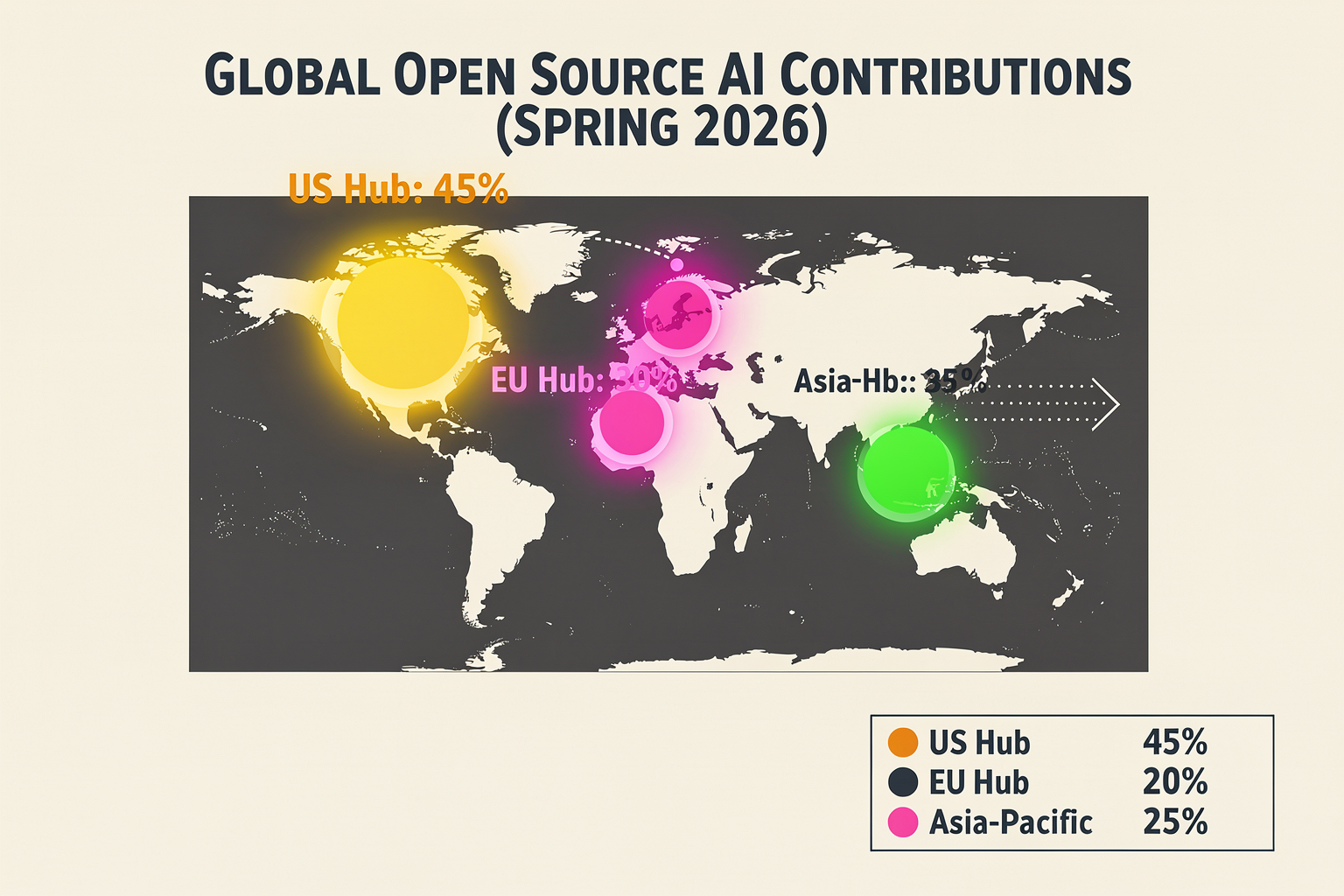
In the early days of modern deep learning, the AI landscape was heavily centralized, dominated by a handful of tech giants in Silicon Valley and elite Western research institutions. By Spring 2026, that dynamic has been completely upended. Hugging Face now serves as the undisputed global distribution hub for the machine learning community, hosting more than 2 million models, datasets, and AI applications. This massive growth is fueled not by a select few, but by a highly decentralized, global network of open-source contributors.
The Decentralization of AI: Beyond Silicon Valley
According to the State of Open Source on Hugging Face: Spring 2026 report, the geographic footprint of active contributors has expanded dramatically. Sovereign AI initiatives—where nations seek to build, control, and run their own foundational models—have turned Hugging Face into a geopolitical tapestry of innovation.
- Europe: Driven by strict data privacy regulations and a desire for digital sovereignty, European contributors (led by hubs in France, Germany, and the UK) are contributing high-efficiency, highly compliant open-source models that rival proprietary alternatives.
- Asia-Pacific: Led by massive developer communities in India, China, and Japan, the APAC region has become the fastest-growing source of model uploads. Developers here are heavily focused on optimizing models for edge devices and deploying highly localized language LLMs.
- Latin America and Africa: Emerging developer ecosystems in these regions are leveraging Hugging Face to bypass expensive proprietary APIs, building lightweight, specialized models tailored to local infrastructure limitations and regional socio-economic challenges.
The Multilingual Explosion and Localized Innovation
One of the most profound impacts of this geographic shift is the explosion of multilingual datasets and regional language models. In the past, AI progress was fundamentally bottlenecked by English-centric training data. Today, global contributors are mapping localized dialects, colloquialisms, and regional speech patterns directly onto the Hugging Face hub.
This localized push is where the open-source community meets real-world commercial execution. For instance, developers are combining regional LLMs from Hugging Face with production-grade communication infrastructure to build highly localized customer service tools. Platforms like CallMissed leverage this exact multilingual shift, offering Speech-to-Text APIs that support 22 Indian languages natively. By connecting open-source model breakthroughs with robust enterprise communication tools, global developers can rapidly convert regional models into production-ready voice and chatbot agents that speak the local language of their customers.
Community-Driven Sovereign AI and Cross-Border Collaboration
The rise of decentralized AI is not just about local deployment; it is about cross-border collaboration. Through Hugging Face Spaces and shared dataset repositories, a developer in Bengaluru can fine-tune a model initialized by a team in Paris, using a dataset curated by researchers in Nairobi.
This global pipeline has democratized access to state-of-the-art AI. The rapid growth of the platform—which saw a staggering 367% revenue growth during its scaling phase and has only accelerated since—proves that open-source is no longer a hobbyist playground. It is the core engine of global enterprise AI, allowing organizations worldwide to bypass the vendor lock-in of single-provider closed models.
Structuring Infrastructure for Global Scale
As the geographic footprint of Hugging Face contributors expands, enterprise infrastructure is evolving to keep pace. Global organizations must now manage diverse models across multiple regions while maintaining compliance, speed, and reliability.
This has led to critical updates in how enterprise environments mirror and store Hugging Face repositories. For example, the June 2026 migration deadline requires all legacy Hugging Face repositories in JFrog Artifactory to transition to the new "Machine Learning" repository layout. This layout standardizes how global enterprises cache, secure, and deploy open-source models across localized data centers, preventing latency issues and ensuring strict regional compliance.
Ultimately, mapping the geography of Hugging Face in 2026 reveals a clear truth: the future of AI is decentralized, multilingual, and highly collaborative. By lowering the barrier to entry for global builders, the platform ensures that the next major breakthrough in AI is just as likely to come from an independent developer in an emerging market as it is from a legacy enterprise lab.
Impact & Implications: Democratizing AI and Challenging Big Tech
The rise of Hugging Face to a central repository hosting more than 2 million models, datasets, and web applications by mid-2026 has triggered a fundamental power shift in the global technology landscape. No longer just a collaborative playground for machine learning researchers, the platform has matured into what developers widely refer to as the "GitHub equivalent for AI."
By providing a decentralized infrastructure where anyone can upload, fine-tune, and deploy models, Hugging Face is actively de-monopolizing artificial intelligence. This shift directly challenges the walled gardens of Big Tech, transitioning AI from a proprietary commodity controlled by a handful of corporate boardrooms into a highly accessible global utility.
Challenging the Closed-Source Hegemony
For years, the narrative surrounding advanced AI was defined by massive capital expenditures and closed-source APIs. The prevailing belief was that cutting-edge capabilities could only be achieved and maintained by multi-trillion-dollar conglomerates with proprietary computing clusters.
The open-source ecosystem has aggressively dismantled this assumption. According to Hugging Face’s State of Open Source: Spring 2026 report, the gap between proprietary frontier models and open-weights alternatives has effectively closed for the vast majority of enterprise use cases.
This democratization offers several critical advantages to developers and enterprises alike:
- Cost Efficiency: Running optimized open-source models locally or on dedicated cloud instances eliminates the unpredictable, volume-based API pricing of closed-source providers.
- Data Sovereignty: Organizations no longer have to ship sensitive customer data to third-party servers, keeping intellectual property and user privacy securely within their own virtual private clouds (VPCs).
- Unprecedented Customization: Instead of relying on generic system prompts, developers can download base models, inspect their architectures, and perform deep fine-tuning using domain-specific datasets.
This open-access paradigm has transformed how modern software architectures are built. For instance, communication platforms like CallMissed leverage this democratized ecosystem to offer multi-model API gateways. By integrating with Hugging Face’s massive library, infrastructure providers can allow developers to switch seamlessly between 300+ LLMs without rewriting a single line of application code, ensuring businesses are never locked into a single AI provider's ecosystem.
Globalizing AI Beyond Silicon Valley
Historically, proprietary foundation models have suffered from severe Western and English-centric biases, reflecting the data and geographical priorities of the Silicon Valley giants that built them. Hugging Face has democratized AI geographically, allowing developers from emerging markets to build models tailored to their specific cultural, regulatory, and linguistic realities.
The democratization of training datasets has fueled a massive surge in localized AI. Communities across Asia, Africa, and Latin America are leveraging the platform to publish highly specialized, regional language models.
This localized approach has profound real-world implications:
- Linguistic Inclusivity: Communities are building high-accuracy models for low-resource languages that mainstream corporate players ignore.
- Regulatory Compliance: Localized models can be trained on datasets that comply directly with regional sovereignty laws, such as the EU AI Act or regional data protection guidelines.
- Hyper-Local Contextualization: From agricultural advice in regional dialects to local legal compliance, open-source models understand regional nuances far better than generalized global models.
We see the practical output of this global shift in everyday communication tools. Communication infrastructure startups, such as CallMissed, utilize these open-source datasets and localized models to build highly accurate speech-to-text and text-to-speech pipelines that natively support 22 regional Indian languages. This level of localized capability would be impossible if developers were forced to rely solely on the generic, English-heavy API endpoints offered by major global tech conglomerates.
Enterprise-Grade Open Source: The Shift to Production
A common historical critique of open-source AI was that it was "great for research, but too unstable for enterprise production." In 2026, that argument is entirely obsolete. The infrastructure supporting open-source AI has undergone rigorous industrialization, characterized by enterprise-grade integrations and strict security standards.
A prime example of this maturation is the widespread integration of machine learning registries into standard enterprise DevSecOps pipelines. For instance, the June 2026 migration deadline for legacy Hugging Face repositories in JFrog Artifactory to the standardized, secure "Machine Learning" repository layout illustrates how deeply AI models have been woven into the standard software supply chain. Enterprises can now scan models for malicious code, track licenses, and manage model binaries using the exact same compliance frameworks they use for standard software packages.
Furthermore, Hugging Face's historical financial foundation—marked by a 367% revenue growth run-rate earlier in its scaling phase—has allowed it to build robust, compliant, and highly reliable enterprise tooling. By offering secure "Spaces" for deployment, hardware partnerships with major chipmakers for one-click optimized inference, and rigorous data-handling guarantees, the platform has made adopting open-source AI a low-risk, high-reward strategy for Fortune 500 companies.
Ultimately, the democratization of AI through Hugging Face in 2026 is doing more than just lowering software development costs. It is shifting the balance of power. By transforming artificial intelligence from a highly guarded corporate secret into a shared, collaborative, and globally distributed resource, the open-source movement is ensuring that the future of digital intelligence belongs to the global developer community, rather than a select group of tech monopolies.
Expert Opinions: Industry Leaders on the Future of Hugging Face

As Hugging Face cements its position as the ultimate gravity well for machine learning, the platform has evolved from a popular repository for researchers into the bedrock of modern enterprise AI. Boasting a catalog of over 2 million models, datasets, and Web applications, the ecosystem represents the largest collaborative engineering effort in human history. To understand where this momentum is carrying the industry, we must look to the developers, venture capitalists, and enterprise architects who are actively shaping the future of the platform.
The Shift from Monoliths to Open-Source Decentralization
According to findings from the State of Open Source on Hugging Face: Spring 2026 report, the competitive landscape has fundamentally shifted away from proprietary, closed-source monoliths. Industry leaders note that the geographic and technical decentralization of model development is accelerating at an unprecedented pace.
Instead of relying on a single, massive API from a legacy provider, developers are increasingly leveraging Hugging Face to orchestrate chains of smaller, highly specialized, and localized models.
- Geographic Diversification: Community-driven consortia across Europe, Asia, and Latin America are contributing highly localized models to Hugging Face, bypassing the cultural and linguistic biases of early foundational models.
- Hyper-Specialization: Rather than deploying a 100-billion-parameter model for simple classification, teams are utilizing quantization techniques to run 3-billion-parameter models directly on edge devices, pulling weights directly from the Hugging Face Hub.
- The Power of Fine-Tuning: The democratization of fine-tuning pipelines has allowed mid-market enterprises to build proprietary IP on top of open weights, ensuring they maintain complete ownership of their data.
Enterprise Maturation: The June 2026 DevSecOps Transition
One of the most telling indicators of Hugging Face’s enterprise integration is how the cybersecurity and software supply chain sectors are adapting to its scale. A prime example is the collaboration between Hugging Face and JFrog.
Industry architects are highly focused on the upcoming June 2026 deadline, which mandates that every legacy "Hugging Face" repository within JFrog Artifactory be migrated to the new, structured "Machine Learning" repository layout.
This is not merely a cosmetic file-path update; it represents a major turning point in how corporate IT departments govern machine learning assets:
- Strict Dependency Mapping: ML models are now treated with the same rigorous vulnerability scanning, licensing compliance, and access controls as traditional software packages (like npm or PyPI).
- Mitigating Supply Chain Risks: With over 2 million assets on the platform, security leaders warn that "model poisoning" and malicious serialization (e.g., hidden payloads in unpickled weights) are real threats. The transition to Safetensors and standardized enterprise repository layouts is a critical step in securing the global AI supply chain.
- Auditable AI Pipelines: Financial and healthcare institutions can now trace a model's lineage from its raw Hugging Face dataset, through fine-tuning, to its deployment in locked-down, air-gapped production environments.
Navigating the Multi-Model Wilderness
With millions of options at their fingertips, developers in 2026 face a new challenge: choice paralysis. Selecting, benchmarking, and maintaining infrastructure for dozens of different models from Hugging Face is an operational bottleneck.
To solve this, industry experts point toward abstraction layers and unified API gateways as the standard architectural pattern for 2026. Rather than hard-coding specific model APIs into their applications, developers are adopting platforms that handle the underlying complexity dynamically.
For instance, modern communication infrastructures like CallMissed are solving this challenge by integrating a multi-model API gateway directly into their platforms. This allows developers to toggle between 300+ LLMs—many of which are sourced directly from the latest open-source breakthroughs on Hugging Face—without modifying a single line of application code. By decoupling the application logic from the underlying model architecture, businesses can swap out models instantly as better alternatives are uploaded to the Hugging Face Hub.
The Economics of Sustainable Open Source
Hugging Face's financial trajectory has proven the skeptics wrong. While early critics questioned how a repository hosting free models could survive, the platform's incredible 367% revenue growth between 2022 and 2023 laid a highly stable foundation for its 2026 monetization strategy.
Venture capitalists and market analysts point to Hugging Face's multi-pronged revenue model as a blueprint for the open-source era:
- Compute-as-a-Service: Hugging Face Spaces and Inference Endpoints allow developers to prototype and deploy models with a single click, turning compute resources into a highly profitable utility.
- The Enterprise Hub: Large organizations pay premium subscription fees for private instances, advanced collaboration tools, and enhanced security compliance boundaries.
- Hardware Partnerships: By collaborating closely with chipmakers (including NVIDIA, AMD, and Intel), Hugging Face ensures that models hosted on their platform are automatically optimized for the latest silicon architectures, capturing engineering mindshare at the hardware level.
This commercial success ensures that Hugging Face remains an independent, neutral territory in the AI wars, serving as a vital counterweight to the oligopoly of big-tech cloud providers.
Localized Intelligence and the Future of Voice
As the Spring 2026 report highlights, one of the fastest-growing segments on the Hugging Face Hub is localized multilingual models. In regions like India, Southeast Asia, and Africa, community developers are bypassing traditional text-based interfaces to build voice-first applications.
This localization trend is highly relevant for businesses operating in highly diverse linguistic markets. For example, developers are taking specialized speech-to-text and text-to-speech models from Hugging Face and deploying them inside production-ready systems.
Platforms like CallMissed leverage these precise advancements, utilizing state-of-the-art multilingual speech models to power AI voice agents that natively support 22 Indian regional languages. This seamless transition from a raw model repository on Hugging Face to an active, voice-driven customer service agent showcases the true economic value of the open-source pipeline in 2026.
Ultimately, industry leaders agree that Hugging Face is no longer just a tool for machine learning engineers—it is the digital town square where the future of computing is negotiated, built, and distributed daily.
What This Means For You: Actionable Insights for Builders
As we cross into mid-2026, the Hugging Face ecosystem has evolved from a friendly repository for NLP transformers into the undeniable, mission-critical infrastructure for global AI development. Hosting over 2 million models, datasets, and AI applications, the platform represents the absolute center of gravity for the machine learning community. For builders, developers, and enterprise architects, the question is no longer if you should use Hugging Face, but how to orchestrate its massive library of open-source models to build secure, scalable, and cost-effective production applications.
Navigating this vast ecosystem requires a fundamental shift from passive model consumption to active, strategic engineering. Builders must balance raw model performance with licensing compliance, deployment latency, and cloud infrastructure costs. Below, we break down the definitive blueprint for utilizing Hugging Face in 2026, detailing actionable strategies for engineering teams.
The Shift to Multi-Model Orchestration & Unified APIs
In 2026, relying on a single, proprietary monolithic model is an operational anti-pattern. Smart engineering teams are building multi-model architectures—routing specialized, lightweight open-source models for specific tasks (like classification, translation, or text extraction) and reserving larger, expensive LLMs only for complex reasoning. Hugging Face is the primary enabler of this trend, offering highly optimized, task-specific models that can run at a fraction of the cost of commercial APIs.
However, managing the lifecycle, token limits, and rate limits of dozens of different models can quickly become an integration nightmare. To bypass this complexity, forward-thinking developers are pairing Hugging Face’s repository richness with robust communication and middleware infrastructures. For instance, platforms like CallMissed provide a production-ready, multi-model API gateway that allows developers to access and switch between over 300+ LLMs dynamically. By decoupling application code from the underlying model provider, teams can benchmark Hugging Face models, test them in real-time, and implement seamless fallback mechanisms without rewriting a single line of code.
Enterprise Compliance and the June 2026 JFrog Migration
As open-source models increasingly power core enterprise features, security and package management have taken center stage. Enterprise environments cannot afford to pull unverified dependencies directly from public repositories. In response, tools like JFrog Artifactory have formalized how organizations cache, scan, and proxy Hugging Face assets.
If you are an enterprise builder, there is a critical deadline on your immediate horizon: before June 2026, all legacy "Hugging Face" repositories within JFrog Artifactory must be migrated to the new, official "Machine Learning" repository layout. This migration is crucial for ensuring security scanning, licensing compliance, and high availability of models. Failing to execute this migration will result in broken CI/CD pipelines and blocked production deployments. Organizations must audit their Artifactory instances immediately, transition their caching proxies, and ensure that every model pulled from Hugging Face is subjected to vulnerability scanning (such as looking for malicious pickle files or unverified model weights).
The Actionable Builder's Roadmap
To help your team navigate these choices, we have compiled a strategic matrix mapping out key deployment scenarios, optimal Hugging Face tooling, best practices, and expected outcomes.
| Development Goal | Recommended HF Toolchain | Implementation Best Practice | Expected Business Outcome |
|---|---|---|---|
| Real-Time Voice & Chat | Transformers, TGI (Text Generation Inference) | Quantize models to 4-bit (AWQ/GPTQ) for sub-100ms time-to-first-token. | 70% reduction in hosting costs; natural conversational flows. |
| Domain Fine-Tuning | PEFT (LoRA/QLoRA) & SFTTrainer | Freeze base weights; only train low-rank adapters on clean, curated datasets. | Highly specialized models matching closed-source performance on niche tasks. |
| Global Regional AI | Multilingual datasets & regional LLMs | Validate tokenizers for non-English script efficiency to prevent token bloat. | Native localization across diverse, non-English speaking markets. |
| Enterprise Compliance | JFrog ML Repository & Private Hub | Complete the June 2026 migration to secure cache registries; automate dependency scans. | Zero-trust AI pipelines with 100% compliance and zero external data leaks. |
| High-Throughput Apps | vLLM integration & HF Spaces | Deploy on serverless GPU endpoints; scale dynamically based on concurrent requests. | Seamless scaling during traffic spikes without provisioning idle GPUs. |
Overcoming the Multilingual Tokenizer Hurdle
Building applications for a global audience in 2026 means addressing localization head-on. While Hugging Face hosts thousands of multilingual models, many of them suffer from "token bloat" when processing non-Latin scripts. In languages like Hindi, Arabic, or Tamil, standard tokenizers can split a single word into 5 to 10 tokens, exponentially increasing latency and API costs.
Builders must carefully select models with custom, linguistically optimized tokenizers. In regions like India, where localized AI is expanding rapidly, pairing these open-source models with dedicated audio infrastructure is essential. This is where specialized platforms like CallMissed step in, offering lightning-fast Speech-to-Text APIs supporting 22 Indian regional languages natively. By combining Hugging Face's localized text LLMs with CallMissed's specialized voice infrastructure, developers can deploy highly responsive, multilingual voice bots and customer service agents that communicate naturally in local dialects.
Success in the 2026 AI landscape belongs to those who view Hugging Face not just as a model playground, but as a critical node in an interconnected, secure, and multi-modal ecosystem. By prioritizing the Artifactory June 2026 migration, leveraging multi-model API layers, optimizing tokenizers for regional markets, and utilizing quantized open-source models, your engineering team can build faster, safer, and far more cost-effectively than ever before.
Frequently Asked Questions
What is the overall scale of the Hugging Face ecosystem 2026?
What changed in July 2026 for enterprise teams using Hugging Face models?
Why do enterprises care about open-weight model catalogs in the Hugging Face ecosystem 2026?
How do Microsoft Foundry and Hugging Face integrations help enterprise AI teams?
How should builders evaluate trending papers and models on Hugging Face?
What are the dominant technical trends in the Hugging Face ecosystem 2026?
How can enterprises securely manage Hugging Face models in 2026?
How does the Hugging Face ecosystem 2026 support multilingual voice applications?
How do developers choose between Hugging Face serverless APIs and self-hosting?
How can API gateways like CallMissed help teams avoid AI vendor lock-in?
Conclusion
As we navigate mid-2026, Hugging Face has solidified its position not just as an open-source hub, but as the foundational infrastructure powering the modern AI enterprise. With over 2 million models, datasets, and applications hosted globally, the platform represents a democratic shift that allows businesses of all sizes to build, fine-tune, and deploy state-of-the-art AI without being locked into proprietary walled gardens.
To succeed in this rapidly evolving landscape, keep these key takeaways in mind:
- The GitHub of Machine Learning: Hugging Face remains the undisputed central distribution hub, bridging the gap between cutting-edge academic AI research and production-ready enterprise applications.
- Enterprise-Grade Maturation: Sandbox experimentation has evolved into secure, standardized enterprise workflows, as seen in critical repository layout updates and deep integrations with platforms like JFrog Artifactory.
- The Multi-Model Era: Organizations are moving away from single monolithic LLMs, instead leveraging diverse, specialized, and highly localized open-weights models to optimize both performance and operational costs.
Looking ahead, the next major trend to watch is how seamlessly organizations can orchestrate these diverse models in real-time, low-latency environments. Success in this new paradigm will belong to companies that successfully bridge the gap between open-source LLM power and real-world customer-facing channels.
To explore how these cutting-edge open-source breakthroughs are already transforming real-world communication, check out CallMissed—an AI communication infrastructure platform powering advanced voice agents and multilingual chatbots for modern businesses.
As Hugging Face continues to democratize access to the world's best models, how will your organization leverage this open ecosystem to build more customizable and scalable AI solutions today?
Discussion
Related Posts


Ready to automate customer conversations?
Launch AI voice agents and WhatsApp bots with CallMissed — one API, 22+ Indian languages.