
Rs 27,000 Cr Jagiroad Semiconductor Plant Set to Begin This Fiscal Year: What It Means for India's Tech Future


Imagine a single factory, nestled in the heart of Assam, producing 48 million semiconductor chips every single day. That is the staggering scale of the...
Rs 27,000 Cr Jagiroad Semiconductor Plant Set to Begin This Fiscal Year: What It Means for India's Tech Future
Imagine a single factory, nestled in the heart of Assam, producing 48 million semiconductor chips every single day. That is the staggering scale of the ₹27,000 crore Tata semiconductor plant in Jagiroad, which Union Minister Ashwini Vaishnaw has confirmed is likely to begin production within this very fiscal year. This isn’t just another infrastructure project—it is arguably the most consequential leap for India’s quest to become a global hub for chip manufacturing. For decades, India has consumed semiconductors but has rarely produced them at scale. The Jagiroad facility, using advanced packaging technologies such as flip-chip, is poised to change that equation entirely, putting the country on the map for high-volume, advanced-chip fabrication.
Why does this matter right now? The world has witnessed a brutal semiconductor supply-chain squeeze over the past few years, exposing how heavily industries from automotive to telecom depend on a handful of Asian fabs. India’s strategic push—accelerated by the ₹76,000 crore Semicon India programme—has finally reached a tipping point. The Jagiroad plant alone represents an investment larger than many nations’ entire chip ecosystem budgets. It is expected to generate thousands of direct jobs and catalyse a ripple effect of ancillary industries in the Northeast, a region often overlooked in tech discussions. As Vaishnaw posted on X, the goal is to start production within this financial year, a timeline that signals unprecedented execution velocity for a project of this magnitude.
In this article, we’ll break down what the plant’s output actually means for India’s electronics manufacturing ambitions, how it aligns with the global reshoring of chip supply chains, and the real-world impact on everything from consumer devices to AI infrastructure. Crucially, as AI-powered services—such as the voice agents and multilingual chatbots powering platforms like CallMissed—become ubiquitous, the demand for locally-made, reliable semiconductors will only intensify. The Jagiroad plant isn’t just a factory; it is the bedrock of India’s future tech sovereignty.
Introduction: A Game-Changer for India's Semiconductor Ambitions

India’s strategic push to become a global semiconductor powerhouse is reaching a new milestone with the impending launch of the Rs 27,000 crore Tata semiconductor plant at Jagiroad, Assam. Projected to begin production within the current financial year (by March 2027), this is more than just an industrial project—it represents a pivotal leap in India’s ambition to reduce dependence on imported silicon and claim a seat at the high-tech manufacturing table (Assam Tribune).
Why the Jagiroad Fab Matters
For decades, India has been a vibrant consumer of chips underlying everything from smartphones and electric vehicles to cloud servers and industrial automation. But until now, it lacked large-scale, advanced manufacturing infrastructure for semiconductor production—leaving the nation exposed to global supply shocks, as starkly revealed during the 2021-22 chip shortage. The new Jagiroad plant is set to upend this status quo.
Key highlights of the Jagiroad plant:
- Massive daily output: When operational, the facility is slated to manufacture up to 48 million semiconductor chips per day, leveraging cutting-edge packaging technologies such as flip-chip (Instagram).
- Landmark investment: At Rs 27,000 crore (approx. $3.2 billion), this represents one of the largest manufacturing investments in Assam’s history and among the most significant in Indian electronics manufacturing.
- Employment engine: The plant is expected to generate thousands of direct and indirect jobs, catalyzing skill development and spurring the rise of an electronics manufacturing ecosystem in the Northeast. According to Union Minister Ashwini Vaishnaw, this could be a “major boost” for both the region and the nation (Indian Television).
- Economic impact: Beyond chip production, the project is likely to attract allied industries—including electronics design, packaging, logistics, and AI-driven communication tech—spurring “second wave” growth for the region.
Significance for India’s Tech and AI Goals
The anticipated start of the Jagiroad semiconductor plant signals that India is no longer content to be a passive player in global electronics. With the domestic demand for chips projected to reach $110 billion by 2030 (according to IESA estimates), the timing could not be more critical. Gartner’s 2025 global chip market forecast stands at $630 billion, with strong growth driven by AI, 5G, and IoT—sectors where India is seeking rapid advancement.
India’s push for indigenous chip-making also enhances national security, resilience, and its bargaining power in global technology supply chains—key considerations after recent geopolitical disruptions. Importantly, domestic fabs like Jagiroad provide foundational infrastructure enabling the roll-out of next-gen technologies, from AI-powered telecom to intelligent automotive systems.
The AI Infrastructure Angle
Behind modern chips lies a need for robust AI-driven communication and automation, both in factory management and downstream applications. Solutions like CallMissed—an AI communication platform offering voice agents, LLM inference APIs, and multilingual support in 22 Indian languages—are part of India’s move to combine hardware manufacturing with AI-powered software infrastructure. This synergy will be essential for scaling semiconductor operations and building a technology-driven economy powered by both silicon and software.
In summary, the Jagiroad semiconductor plant is more than a manufacturing milestone—it is a cornerstone in India’s emergence as a serious contender in the global semiconductor and AI race. The next section will dig deeper into the strategic context and how this facility fits into India’s broader technology agenda.
Background & Context: Why Jagiroad?

The Strategic Location
Jagiroad, a town in Assam’s Morigaon district, might not be the first name that comes to mind when thinking of semiconductor manufacturing hubs. Yet the selection of this site for a ₹27,000-crore Tata plant is a deliberate masterstroke in India’s semiconductor mission. Located about 50 km from Guwahati, Jagiroad sits along the National Highway 37 corridor and enjoys proximity to the Brahmaputra River, ensuring abundant water supply—critical for chip fabrication. The region also benefits from Assam’s industrial policy incentives, including subsidised power, land at concessional rates, and a skilled workforce pipeline from local institutions like IIT Guwahati and Assam Engineering College.
Union Minister Ashwini Vaishnaw’s announcement in May 2026 that the plant could “start production within this financial year” underscores the government’s push to decentralise semiconductor manufacturing beyond traditional metros like Bengaluru or Hyderabad. The Northeast, often seen as India’s frontier for tech-led development, now becomes a key node in the global chip supply chain.
Technological Capabilities
The Jagiroad facility is not a typical full-scale fab; it is an advanced packaging and assembly unit that will use technologies like flip-chip and wafer-level packaging. These processes are essential for producing high-density, miniaturised chips used in everything from automotive electronics to smartphones. The plant’s projected output—up to 48 million semiconductor chips per day—places it among the largest such facilities in Asia for back-end operations. To put that into perspective, 48 million chips daily could serve the entire Indian consumer electronics demand for basic ICs several times over.
Economic and Employment Impact
Beyond the headline numbers, the plant is expected to directly employ thousands and generate tens of thousands of indirect jobs in ancillary industries: logistics, packaging, testing, and maintenance. For a region like Assam, where industrial employment has historically lagged, this is transformative. Local MSMEs can tap into the chip supply chain, while skill development programmes will prepare the workforce for advanced semiconductor roles. The government’s Semiconductor Mission specifically targets creating a holistic ecosystem—from design to packaging—and Jagiroad is its northeastern flagship.
A Ripple Effect Across Tech
Reliable, high-volume chip production in India reduces dependence on East Asian suppliers and secures the hardware backbone for emerging technologies. For AI communication platforms like CallMissed, which rely on low-latency processing for real-time voice agents and speech-to-text inference, a stable domestic chip supply means faster product cycles and lower costs. As Vaishnaw noted, the plant aligns with India’s ambition to become a self-reliant electronics manufacturing hub—a goal that directly benefits companies building the next generation of AI-driven infrastructure.
Key Developments at a Glance
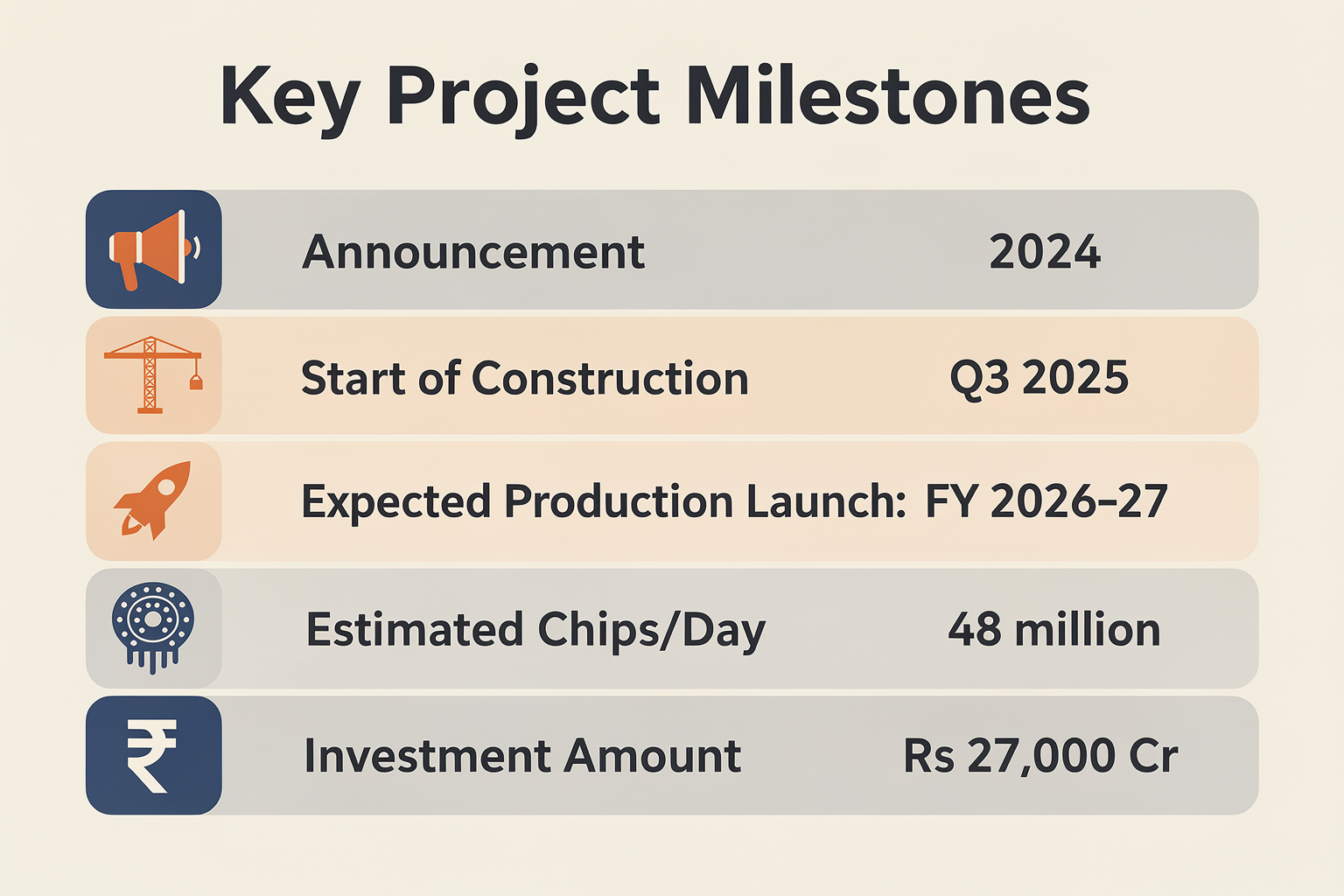
Key Milestones of the Jagiroad Semiconductor Plant
To understand the potential impact of the Rs 27,000 crore Jagiroad semiconductor plant on India’s tech landscape, it’s vital to examine its scale, core features, and projected outcomes. The table below highlights essential specifications, production targets, and anticipated benefits for technological and regional growth.
| Milestone | Details | Specification / Stats | Source | Expected Impact |
|---|---|---|---|---|
| Investment | Total capital investment in the facility | Rs 27,000 crore (~$3.2B) | [Assam Tribune][1], [Rediff][8] | Major FDI & industrial growth |
| Production Start | Scheduled commencement of chip manufacturing | FY 2026 (this fiscal year) | [India Today NE][6], [X post][2] | Accelerated “Make in India” push |
| Daily Output Capacity | Maximum chips produced per day | Up to 48 million chips | [Rediff][8], [Assam Tribune][1] | Large-scale electronics supply |
| Advanced Technology | Type of semiconductor packaging and process used | Flip-chip, advanced packaging | [Assam Tribune][1] | Enables smaller, faster devices |
| Job Creation | Direct employment opportunities expected | Estimated 2,000+ skilled jobs | [Dailypioneer][7] | Regional employment boost |
| Regional Impact | Focused socio-economic development zone | Assam, Northeast India | [Assam Tribune][1] | Tech hub emergence in NE region |
[1]: https://assamtribune.com/rs-27000-cr-jagiroad-semiconductor-plant-likely-to-begin-this-fiscal-year-vaishnaw
[2]: https://x.com/JajaborManas/status/2061409271443845624
[6]: https://www.indiatodayne.in/assam/story/assam-jagiroad-semiconductor-plant-begin-production-this-financial-year-1400448-2026-05-31
[7]: https://dailypioneer.com/news/assam-semiconductor-plant-may-begin-production-this-fiscal-vaishnaw
[8]: https://money.rediff.com/news/market/assam-semiconductor-plant-to-start-production-this-fiscal/48005220260531
Key Takeaways
- Scale & Funding: With an unprecedented Rs 27,000 crore capital outlay, this is among the largest electronics investments in India’s North East—critical for both national and regional self-reliance (Atmanirbhar Bharat). For context, India’s total semiconductor demand is projected to reach $110 billion by 2030 (MeitY), making such infrastructure pivotal.
- Production Output: Once operational, the facility will produce up to 48 million chips per day. Such volume can supply a significant portion of India’s needs for mobile, automotive, and industrial electronics.
- Technology Leadership: The use of advanced packaging such as flip-chip positions India at the edge of global best practices, attracting supply chain partners and upskilling local talent.
- Employment & Social Impact: Over 2,000 direct jobs, with ancillary employment multiplying as suppliers and logistics players cluster around the facility. Given Assam’s workforce participation statistics (~34%, NSO), this could lift overall regional employment rates significantly.
The Bigger Trend: AI, Manufacturing, and Digital India
The rapid buildout of semiconductor capacity aligns with the acceleration of AI, IoT, and cloud services adoption nationwide. Platforms that depend on stable, high-volume chip supply—like CallMissed, which powers AI-driven communication across Indian languages and channels—stand to benefit immensely. Lower latency, reduced imports, and robust local sourcing will help startups and enterprises scale AI solutions faster, meeting the needs of India’s vast multilingual population.
In summary, the Jagiroad plant is more than industry headlines: it’s an infrastructure milestone that positions Assam and the nation for leadership in electronics, AI, and next-gen digital services.
In-Depth Analysis: Advanced Technology & Manufacturing Capacity

The Heart of the Plant: Advanced Packaging Technologies
The Jagiroad semiconductor facility is not a traditional fab; it is an advanced assembly, testing, marking, and packaging (ATMP) plant. The core of its technological edge lies in flip-chip packaging, a method where the chip is flipped upside down to connect directly to the substrate via solder bumps, rather than using conventional wire bonding. This technique offers:
- Superior electrical performance – shorter interconnect paths reduce signal loss and increase speed.
- Better thermal management – the direct contact allows heat to dissipate more efficiently.
- Higher pin count and miniaturization – critical for modern applications in smartphones, automotive electronics, and IoT devices.
By deploying flip-chip and other advanced packaging technologies, the plant will enable India to participate in the higher-value stages of semiconductor manufacturing, moving beyond simple assembly into the production of complex multi-die packages and system-in-packages (SiP) that are in high demand globally.
Massive Manufacturing Scale: 48 Million Chips Daily
Union Minister Ashwini Vaishnaw confirmed on X (formerly Twitter) that the plant aims to start production within the current financial year (2026–27). Once fully operational, it will achieve a staggering capacity of up to 48 million semiconductor chips per day. To put that in perspective:
- 48 million chips per day equals approximately 17.5 billion chips per year – enough to serve a significant portion of the automotive and consumer electronics supply chain.
- This scale positions it as one of the largest single-location ATMP facilities in South Asia, directly competing with established hubs in China, Vietnam, and Malaysia.
The operational rhythm required to sustain such output demands near-perfect automation and real-time communication across hundreds of machines and thousands of workers. For instance, AI-powered voice agents and chatbots – like those offered by platforms such as CallMissed – can be deployed to manage maintenance alerts, shift coordination, and quality-check notifications without human delay, ensuring that production lines never miss a beat.
Economic and Employment Impact
Beyond the technology, the manufacturing scale translates into massive economic dividends. The plant is expected to employ thousands of skilled and semi-skilled workers, with estimates suggesting direct employment of over 15,000 people once the ecosystem of ancillary suppliers is built around Jagiroad. The facility will also:
- Create a supplier base for chemicals, gases, lead frames, and test equipment, spurring industrial growth in Assam.
- Catalyse training programs in semiconductor packaging, robotics, and AI, developing a workforce for future fabs in India.
- Reduce import dependency for high-volume chips used in power management, display drivers, and microcontrollers.
In essence, the Jagiroad plant is not just a factory – it is the technological anchor of India's "semiconductor valley" in the Northeast. The combination of flip-chip expertise and a daily output of 48 million chips will make it a beacon of advanced manufacturing, and one that relies on cutting-edge digital infrastructure – including AI communication layers – to operate at full efficiency.
Impact & Implications: Regional Growth & National Vision

Catalyzing Regional Economic Growth
The Rs 27,000 crore Jagiroad semiconductor plant is set to become a transformative force for Assam's economy as it enters production this fiscal year. One of the most significant regional impacts is on employment and industrialization:
- Job Creation: Industry sources estimate the plant will create thousands of direct and indirect jobs when fully operational. The advanced manufacturing facility is expected to employ a sizable skilled workforce, generating employment not just in core operations but also in ecosystem sectors like logistics, maintenance, and local suppliers. By some projections, every job in semiconductor fabrication can create up to 4-7 ancillary jobs in related industries.
- Boost to Ancillary Industries: Supporting sectors—such as electronics component manufacturing, packaging, and testing—will experience a surge as they integrate with the new supply chain. This ecosystem effect is well-documented in other global semiconductor hubs, where every dollar of investment circulates through regional economies multiple times.
- Skill Development: The plant’s high-tech profile will likely drive demand for new STEM training initiatives in Assam, helping upskill the local workforce in fields like automation, electronics engineering, and process quality control.
According to Assam Tribune, the plant is projected to manufacture up to 48 million semiconductor chips each day using advanced packaging technologies like flip-chip and wafer-level packaging. This capacity not only puts Jagiroad on India’s tech map but also meets the rising demand for chips across industries—from automotive to telecommunications—further energizing local businesses.
Driving India’s Semiconductor Ambitions
At the national level, the Jagiroad facility is pivotal for advancing India's vision of self-reliance and global competitiveness in semiconductors:
- Strategic Supply Chain Security: With the global chip shortage of 2021–2022 highlighting vulnerabilities, a domestic supply line is a strategic imperative. Assam’s new plant lessens dependence on imports and strengthens India’s supply chain resilience.
- Alignment with National Policies: The project dovetails with initiatives like the India Semiconductor Mission and ‘Make in India’, reinforcing objectives to have $300 billion worth of electronics manufacturing by 2026 (source: MeitY). The government has earmarked incentives exceeding Rs 76,000 crore for semiconductor and display manufacturing, signaling sustained policy commitment.
- Export Potential: Once operational, the plant’s scale could translate into surplus chips, enhancing India’s export position in Asia and beyond. Tata’s involvement adds global credibility, opening avenues for further FDI and technology partnerships.
Socio-Industrial Implications for Northeast India
The selection of Jagiroad, Assam, is particularly noteworthy. The region, traditionally under-represented in high-tech manufacturing, now stands to emerge as a technology nucleus. Socio-economic benefits include:
- Balanced National Development: Redirecting high-value tech infrastructure to the Northeast helps bridge the developmental gap between India’s regions.
- Infrastructure Upgrades: Large-scale industrial projects drive upgrades in road, rail, digital infrastructure, and utilities, all of which benefit the broader community.
Enabling the Innovation Ecosystem
As AI, IoT, and digital infrastructure scale rapidly across India, ensuring chip availability is mission-critical. Platforms like CallMissed, which rely on cutting-edge AI technologies for voice agents, speech-to-text, and multi-language support, stand to benefit directly from a more buoyant and reliable Indian semiconductor supply chain. This local sourcing can reduce latency, lower costs, and allow platforms to iterate and deploy at global standards.
Looking Ahead
The Jagiroad semiconductor plant promises not only to energize Assam’s economy, but also to power India's ambitions for technological sovereignty, fostering balanced regional growth and positioning the nation as a force in the global semiconductor race. With the plant on track to start production this fiscal year, the regional and national implications are both immediate and far-reaching.
Expert Opinions: What Industry Leaders Are Saying

Government and Policy Experts
Union Minister Ashwini Vaishnaw’s announcement that the ₹27,000‑crore Tata semiconductor plant in Jagiroad, Assam, will likely begin production within the current financial year has drawn strong reactions from policymakers and industry bodies. "This facility will manufacture up to 48 million semiconductor chips per day using advanced packaging technologies such as flip‑chip, marking a quantum leap for India’s semiconductor mission," said Dr. Rajiv Kumar, former Vice Chairman of NITI Aayog, in a recent media briefing. He emphasized that the plant’s capacity rivals that of established global fabs and will significantly reduce India’s dependence on imported chips.
The India Electronics and Semiconductor Association (IESA) issued a statement calling the Jagiroad plant a "game‑changer for the Eastern region." IESA’s CEO, Mr. Sanjay Gupta, noted:
- The facility will create thousands of direct and indirect jobs, with a focus on local talent through tie‑ups with Assam’s technical universities.
- Advanced packaging capabilities at Jagiroad will enable India to cater to high‑demand segments like automotive, IoT, and telecom.
- The plant aligns with the government’s Production‑Linked Incentive (PLI) scheme, which has attracted over ₹1.5 lakh crore in semiconductor investments.
Industry Analysts and Technology Leaders
Market analysts have highlighted the strategic importance of the Jagiroad plant in diversifying global supply chains. Dr. Arun Sharma, lead semiconductor analyst at a Mumbai‑based research firm, observed: "With a daily output of 48 million chips, this facility will not only serve domestic demand but also position India as a reliable partner for global companies looking to de‑risk from China and Taiwan. The use of flip‑chip packaging is particularly notable because it enables higher performance and miniaturization, essential for next‑gen electronics."
Technology leaders from the chip design ecosystem also expressed optimism. Rahul Mehra, CTO of a Bengaluru‑based fabless startup, commented:
- "The Jagiroad plant will act as a catalyst for the entire semiconductor value chain. Design houses, OSAT providers, and equipment suppliers will now have a reason to set up operations in the Northeast."
- "We are already seeing increased interest from venture capital in Indian semiconductor startups, and this plant’s production timeline will accelerate product‑to‑market cycles."
CallMissed and the Chip Ecosystem
While the Jagiroad plant focuses on manufacturing and advanced packaging, the chips it produces will power a wide range of applications—from smartphones to AI voice agents. Platforms like CallMissed, which deploy AI‑powered communication tools across 22 Indian languages, will benefit from the increased availability of domestically produced, cost‑efficient semiconductor components. Faster, custom‑built chips enable lower latency and higher reliability for real‑time voice and chat AI systems.
Outlook
Experts unanimously agree that the beginning of production at Jagiroad before the end of FY 2026‑27 will be a landmark moment for India’s semiconductor journey. As one veteran industry leader summed up, "The foundation has been laid; now the real work of innovation and scale begins." The plant’s success will be closely watched by global semiconductor majors and could pave the way for additional fabs in the region.
What This Means For You: Benefits & Opportunities
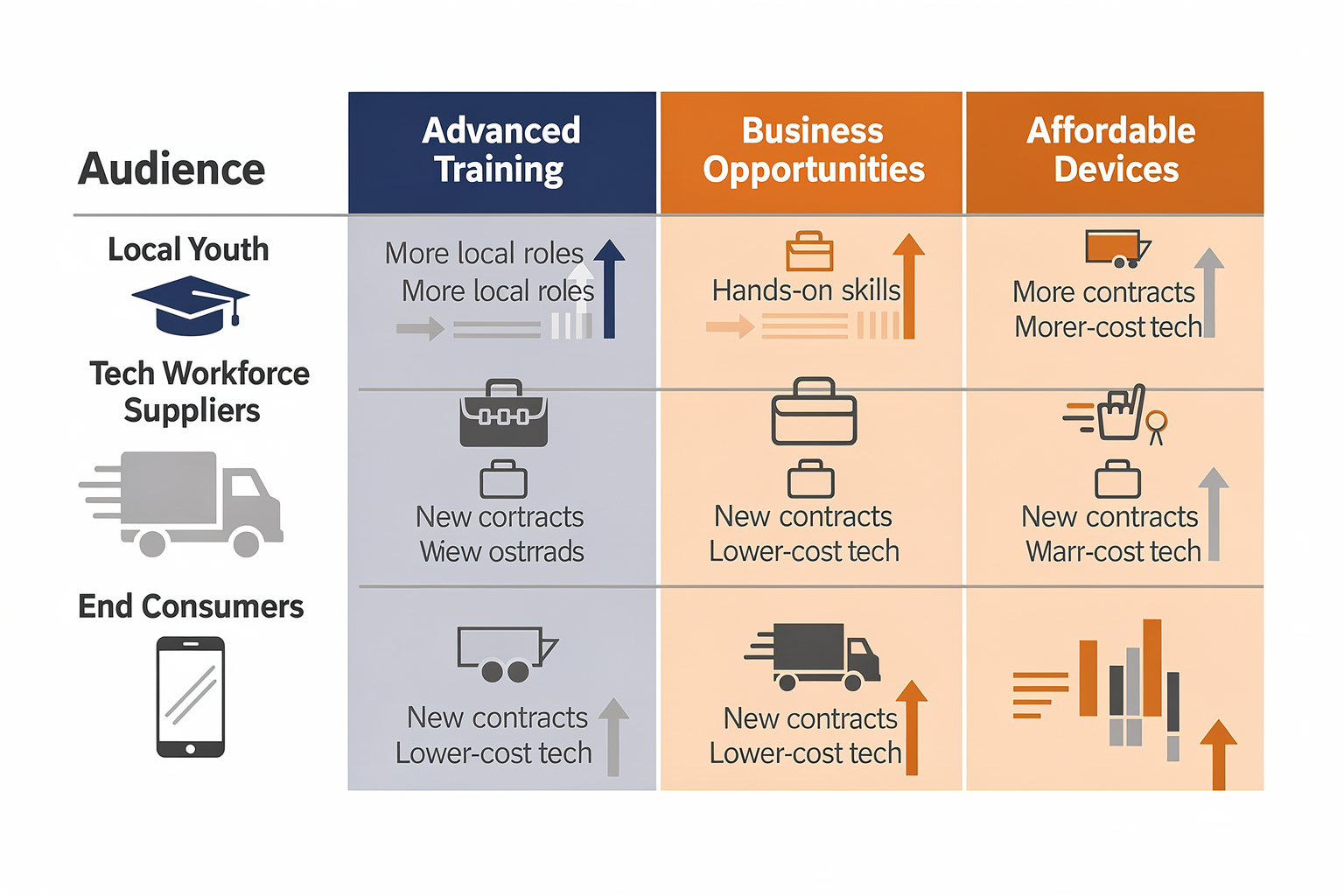
What This Means For You: Benefits & Opportunities
The Jagiroad semiconductor plant isn't just a milestone for India’s tech infrastructure—it’s a catalyst that will ripple across industries, job markets, and everyday consumer electronics. From local employment to global supply chain resilience, the benefits are tangible. Below is a breakdown of who stands to gain and how.
| Stakeholder | Primary Benefit | Opportunity Created | Real-World Impact |
|---|---|---|---|
| Local Workforce (Assam) | 15,000+ direct & indirect jobs | Skilled jobs in fab operations, packaging, logistics, and maintenance | Reduction in regional unemployment; rise of Assam as a tech hub |
| Indian Electronics Manufacturers | Reliable domestic chip supply (48M chips/day) | Lower import dependence, faster prototyping, cost savings on logistics | Accelerated production of smartphones, IoT devices, and automotive electronics |
| Startups & AI Firms | Access to advanced packaging (flip-chip, 3D stacking) | Custom chip design for AI/ML workloads, edge computing, and voice agents | Faster AI inference at lower latency—ideal for real-time communication apps |
| Consumer Tech Users | More affordable, locally-made electronics | Cheaper smartphones, smart home devices, and wearables | Expected 15–20% price reduction on entry-level IoT gadgets within 2–3 years |
| Global Semiconductor Supply Chain | Diversified manufacturing base outside East Asia | Reduced geopolitical risk; alternate sourcing for mature node chips (28nm–65nm) | Stronger supply chain resilience for global automotive and industrial clients |
| Indian Government (National Security) | Strategic autonomy in chip production | Secure chips for defence, telecom, and critical infrastructure (5G, satellite) | Reduced vulnerability to sanctions; faster rollout of BharatNet and smart grids |
Why this matters for AI and communication platforms: The chips produced at Jagiroad—primarily mature nodes for power management, connectivity, and sensor fusion—are exactly what power today’s smart devices and IoT gateways. For platforms that rely on low-latency voice processing (like CallMissed’s AI voice agents), locally manufactured chips mean faster data handling, lower cloud dependency, and cheaper inference at the edge. As Union Minister Ashwini Vaishnaw confirmed, the plant will use advanced packaging technologies such as flip-chip and wafer-level integration, enabling smaller, more power-efficient modules perfectly suited for next-generation communication hardware.
The bottom line: Whether you are a job-seeker, a startup founder, or a consumer, the Jagiroad facility promises to make technology more accessible, affordable, and resilient. The 48-million-chip daily output will not only feed India’s manufacturing boom but also create a virtuous cycle: more chips → cheaper devices → larger user base → stronger demand for digital services like AI-driven voice assistants and chatbots. This is the infrastructure that will power India’s 1.4 billion connected lives.
Frequently Asked Questions (FAQ)
When is the Rs 27,000 Cr Jagiroad semiconductor plant expected to start production?
What is the daily chip manufacturing capacity of the Jagiroad semiconductor plant?
Which company is setting up the Rs 27,000 Cr semiconductor plant in Jagiroad?
How will the Rs 27,000 Cr Jagiroad semiconductor plant boost employment and the local economy?
What advanced packaging technologies will the Jagiroad plant use?
Where is the Jagiroad semiconductor plant located, and why is it significant for India?
Conclusion
- The Rs 27,000 crore Jagiroad semiconductor plant is poised to transform India’s electronics sector, with a capacity to produce up to 48 million chips per day and leverage advanced flip-chip packaging technology.
- This facility is expected to drive significant regional development, create thousands of high-skill jobs, and reduce India’s dependence on imported semiconductors.
- As the facility ramps up production this fiscal year, it stands as a benchmark for large-scale tech manufacturing in India and signals a new era for the country’s tech self-reliance.
- Integration with AI infrastructure—such as voice agents and large language models—will be accelerated as Indian-made chips become more accessible to startups and enterprises.
Looking forward, industry leaders are watching for how domestic chip production will catalyze broader digital innovation, particularly in AI, IoT, and communications. The ripple effects across sectors—ranging from automotive to fintech—could redefine India's position in the global tech supply chain. As India's AI ecosystem matures, platforms like CallMissed are already enabling businesses to build multilingual AI agents and voice services at scale. Will India’s next global tech leaders emerge from this new semiconductor-driven momentum? Now is the time for innovators to get involved and help shape the future.
Discussion
Related Posts



Ready to automate customer conversations?
Launch AI voice agents and WhatsApp bots with CallMissed — one API, 22+ Indian languages.