
OpenAI to Release GPT-5.6 in Limited Preview Following US Government Request for Staggered Launch



For the first time in the generative AI era, the public rollout of a flagship artificial intelligence model has been slowed not by technical limitations,...
OpenAI to Release GPT-5.6 in Limited Preview Following US Government Request for Staggered Launch
For the first time in the generative AI era, the public rollout of a flagship artificial intelligence model has been slowed not by technical limitations, but by the direct intervention of the White House. Following a security request from the Trump administration, OpenAI has agreed to postpone the wide release of its highly anticipated GPT-5.6 family—which includes the advanced Sol, Terra, and Luna models. In a recent internal Q&A, CEO Sam Altman confirmed to employees that OpenAI to Release GPT-5.6 in Limited Preview Following US Government Request for Staggered Launch, confining initial access to a small, government-vetted group of trusted enterprise partners.
This unprecedented move represents the first live application of a June 2 executive order that established a voluntary 30-day government review window for frontier AI systems. Under this new framework, future enterprise access to GPT-5.6 will require federal vetting, signaling a massive shift in how Silicon Valley deploys bleeding-edge technology. For businesses, this sudden regulatory bottleneck underscores the high risk of single-provider dependency. To stay agile, forward-thinking enterprises are leveraging platforms like CallMissed, which offer unified infrastructure to seamlessly switch between 300+ alternative LLMs when a primary provider faces unexpected regulatory delays.
Why does this matter right now? This decision marks a permanent transition from the "move fast and break things" era of AI development to one of strict geopolitical oversight, national security anxiety, and sovereign gatekeeping. How the industry adapts to this government-vetted landscape will decide the pace of global automation. In this article, we will unpack the mechanics of this staggered rollout, examine the capabilities of the Sol, Terra, and Luna models, and analyze how this new era of federal oversight will redefine enterprise AI adoption and global compliance.
Introduction: The Staggered Arrival of GPT-5.6
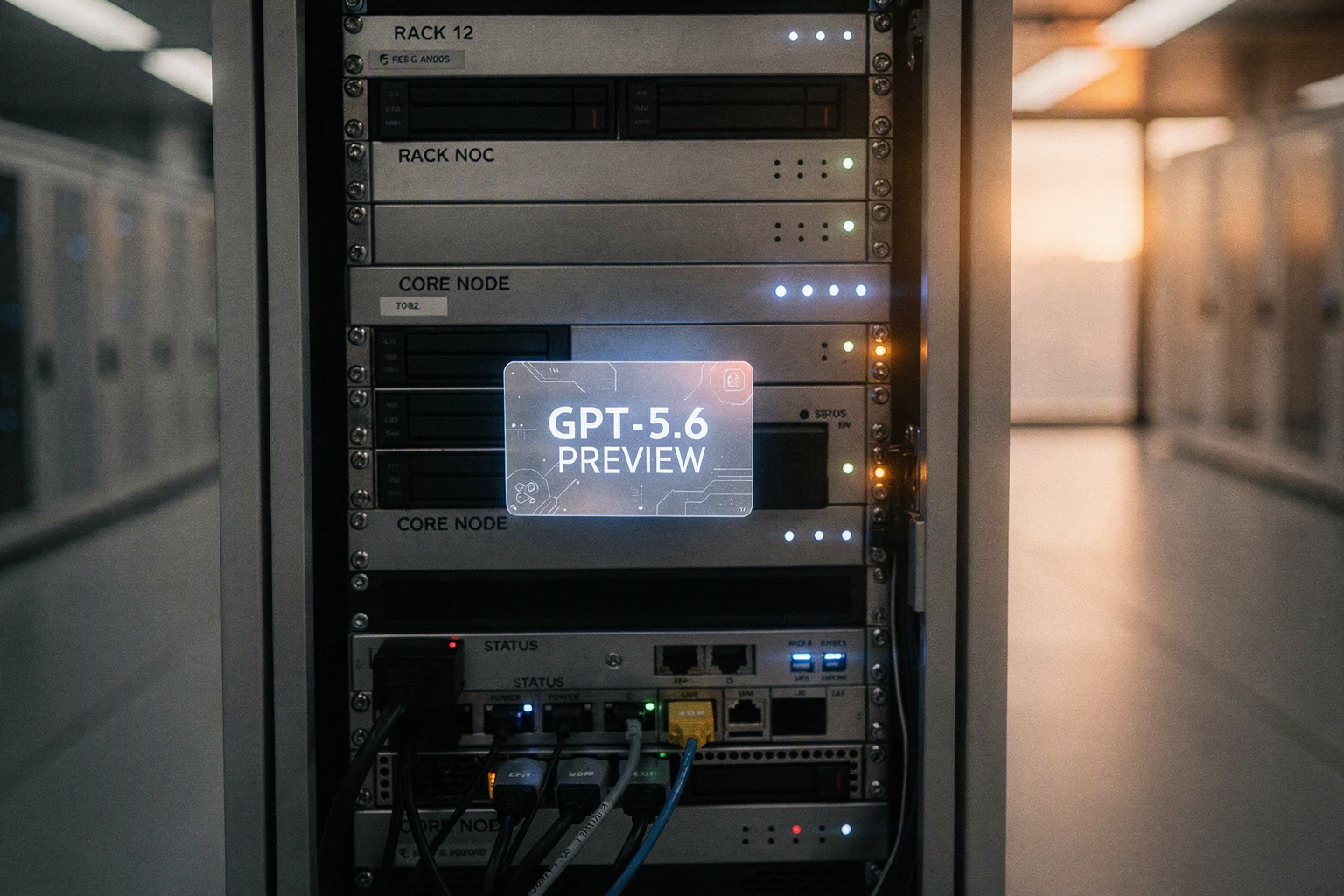
The landscape of artificial intelligence is entering an unprecedented era of geopolitical oversight. In a move that marks a fundamental shift in how frontier AI models are brought to market, OpenAI has announced a highly restricted, staggered release of its next-generation model family, GPT-5.6. Rather than the broad, public rollouts of the past, GPT-5.6 will initially launch in a "limited preview" reserved exclusively for a select group of partners vetted and approved by the US government.
This sudden change in strategy comes directly at the request of the Trump administration, citing deep-seated national security concerns over the unprecedented capabilities of the new architecture.
The Framework of Controlled Access
According to reports from The Information and The Financial Times, OpenAI CEO Sam Altman confirmed to employees in an internal Q&A that the staggered launch is a direct response to federal anxieties. This marks the first live application of a June 2 executive order, which established a voluntary 30-day government review window for highly advanced AI systems.
Under this new cooperative framework, the rollout is characterized by several key constraints:
- Vetted Enterprise Access: The US government will actively approve which enterprise partners are granted access to the preview.
- The GPT-5.6 Trio: The release consists of a series of three distinct models named Sol, Terra, and Luna, each designed to target specific operational scales and modalities.
- Staggered Deployment: Rather than a global API switch-on, the deployment will crawl through successive phases of security and impact evaluations.
A Shift from Permissionless Innovation to Strategic Gatekeeping
For years, the tech industry operated under a philosophy of rapid, public iteration. The containment of GPT-5.6 signals that the era of "permissionless innovation" for frontier models has officially drawn to a close. As governments realize the dual-use potential of advanced cognitive agents—ranging from critical cyber-defense applications to economic restructuring—frontier AI is being treated with the same gravity as defense technology.
While these highly restricted, state-vetted models remain locked behind bureaucratic review processes, enterprises cannot afford to pause their automation strategies. To avoid the bottleneck of geopolitical delays, forward-thinking companies are increasingly building on resilient, multi-model architectures. Platforms like CallMissed help businesses maintain agility by offering an AI communication infrastructure with an API gateway connected to over 300+ LLMs. By providing multi-model flexibility alongside advanced Speech-to-Text supporting 22 Indian languages and turnkey voice agents, CallMissed ensures that enterprise communication infrastructure remains uninterrupted, even as frontier models face political headwinds.
Ultimately, the restricted debut of GPT-5.6: Sol, Terra, and Luna raises critical questions about the future of global tech competitiveness. As we analyze the details of this staggered launch, we must look at how government-vetted gatekeeping will rewrite the playbook for developers, startups, and multinational corporations alike.
Background & Context: The June 2 Executive Order
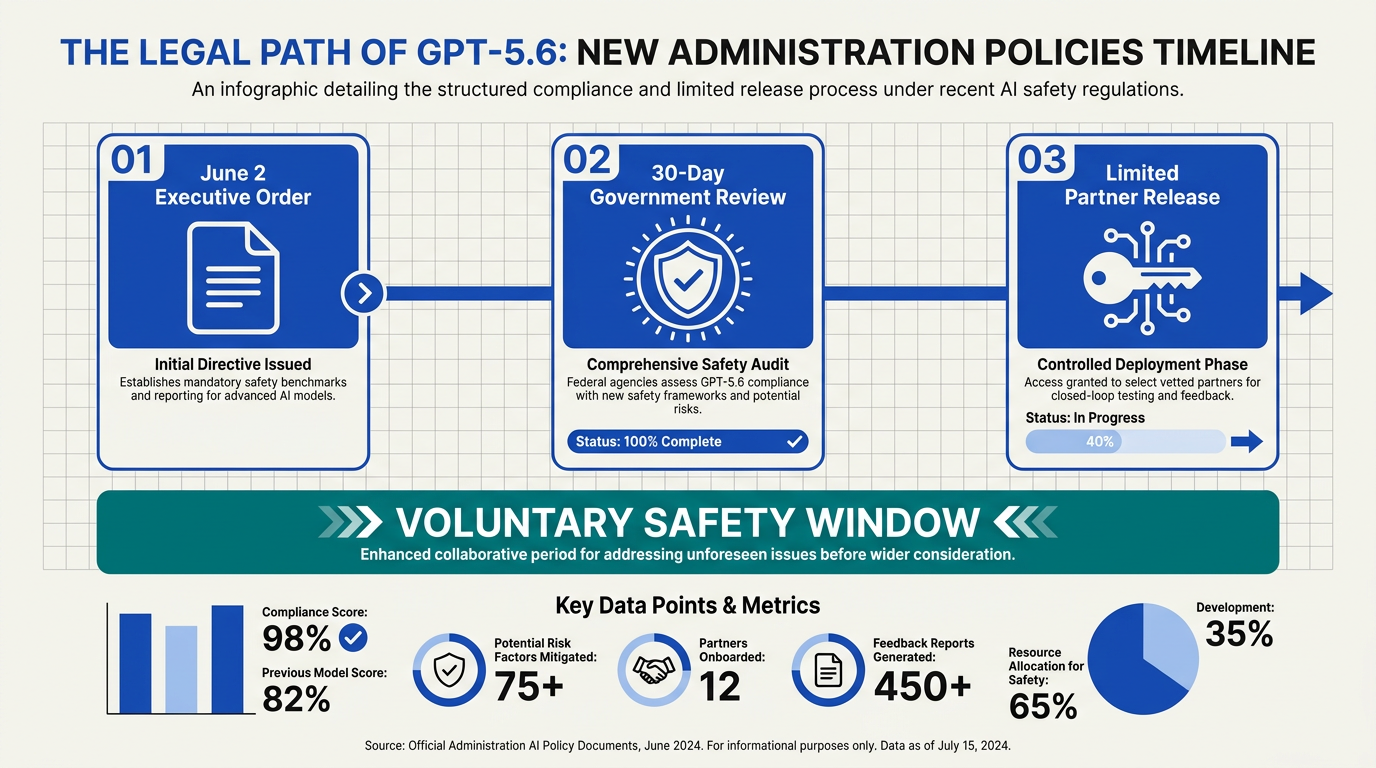
The sudden shift in OpenAI’s release strategy for GPT-5.6 is not an isolated corporate decision, but the direct result of a landmark policy shift in Washington. The legal and regulatory backdrop for this unprecedented delay is a highly focused Executive Order enacted on June 2, 2026. Designed to balance rapid technological innovation with national security, this order has fundamentally altered the deployment pipeline for frontier artificial intelligence models.
The Genesis of the June 2 Executive Order
The June 2 Executive Order established a voluntary 30-day government review window specifically targeted at next-generation, highly capable AI models. Under this framework, developers of frontier models are requested to submit their systems to federal agencies for comprehensive security vetting before a public or broad commercial rollout.
The primary objectives of this review window include:
- Preventive Red-Teaming: Evaluating the model's potential to assist in cyberwarfare, biological engineering, or critical infrastructure disruption.
- National Security Alignment: Ensuring that highly advanced reasoning capabilities do not bypass export controls or fall into the hands of foreign adversaries.
- Controlled Proliferation: Establishing structured, phased access pathways rather than immediate, unchecked global releases.
GPT-5.6: The First Live Test Case
OpenAI’s GPT-5.6 series—which includes the newly announced models Sol, Terra, and Luna—is the very first technological suite to undergo this formal review process. Following the Trump administration's request to stagger the rollout, OpenAI complied by halting its plans for a wide, immediate enterprise launch.
Instead, CEO Sam Altman informed employees during an internal Q&A that GPT-5.6 would launch strictly as a "limited preview." Under this compromise, the federal government is actively vetting and approving the specific enterprise partners and developers granted early access. This marks a massive transition from a market-driven distribution model to a federally regulated authorization model.
Navigating the New Era of Sovereign AI
For enterprises and developers, this regulatory intervention introduces immediate operational friction. Companies that previously built their roadmaps around the instant availability of OpenAI’s latest models must now plan for bureaucratic delays, compliance vetting, and potential access restrictions.
To mitigate these sudden bottlenecks, forward-looking engineering teams are increasingly moving away from single-model dependency. Unified communication and AI infrastructure platforms like CallMissed are playing a vital role in this new landscape. By providing developers with a multi-model API gateway that connects to over 300+ LLMs, CallMissed allows businesses to maintain service continuity. If a frontier model like GPT-5.6 Sol or Luna is delayed due to government review, enterprises can effortlessly pivot to alternative, compliant models without rewriting their core codebase.
As the 30-day review period for GPT-5.6 plays out, it sets a powerful precedent. The June 2 Executive Order has made one thing clear: the era of friction-free, instantaneous global rollouts for frontier AI is officially over.
Key Developments in the GPT-5.6 Rollout
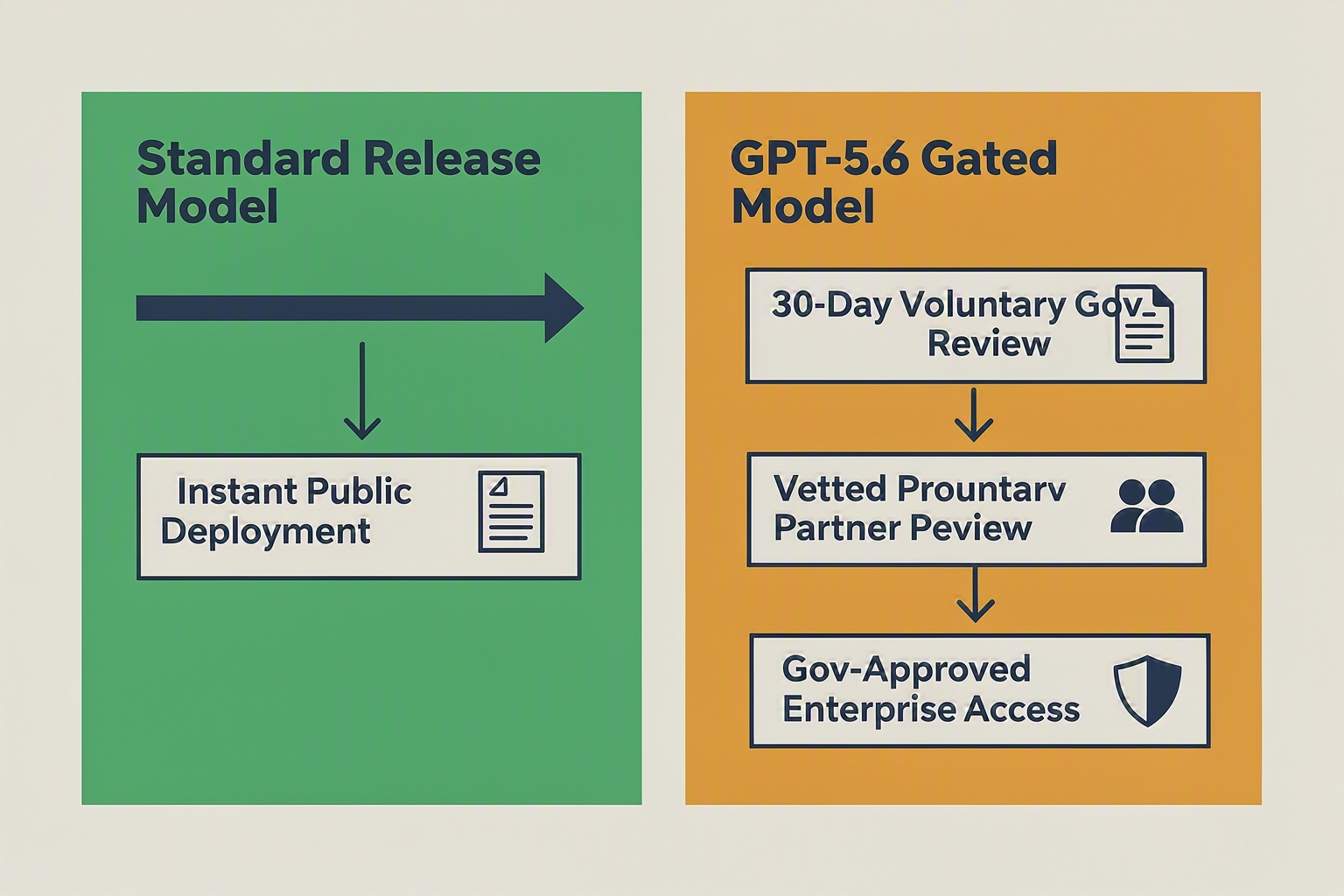
The geopolitical and regulatory framework surrounding artificial intelligence has officially shifted from theoretical discourse to active enforcement. Complying with a direct request from the Trump administration, OpenAI has pivoted its upcoming GPT-5.6 release from a wide-scale public launch to a highly managed, staggered rollout. This paradigm shift represents the first practical application of the June 2 executive order, which establishes a voluntary 30-day government safety review window for frontier models.
To understand how this unprecedented regulatory gatekeeping affects the deployment of next-generation AI, we can analyze the structural rollout of OpenAI's new model series—comprising Sol, Terra, and Luna—and the specific compliance hurdles they face.
| Model / Phase | Technical Focus | Regulatory Framework | Initial Access Group |
|---|---|---|---|
| GPT-5.6: Sol | Advanced logic, reasoning, and deep scientific compute. | Full 30-day federal security review. | Vetted research partners and defense agencies. |
| GPT-5.6: Terra | Mid-tier multimodal processing and general enterprise workflows. | Subject to federal risk-assessment guidelines. | Pre-approved enterprise partners. |
| GPT-5.6: Luna | Low-latency, highly optimized edge computing and agentic tasks. | Fast-tracked under voluntary safety auditing. | Limited developer preview and trusted integrators. |
| Review Window | Voluntary 30-day evaluation of national security risks. | Mandated under the June 2 Executive Order. | US federal agencies and OpenAI’s Safety Board. |
| Enterprise Access | Multi-stage commercial release following federal audits. | Delayed indefinitely for unvetted commercial pools. | Pre-cleared domestic enterprises only. |
This structured delay highlights a growing operational challenge for enterprises that rely on a single AI vendor. When frontier models are suddenly bottlenecked by national regulatory bodies, organizations must possess the infrastructure to pivot.
Communication platforms like CallMissed address this risk directly; CallMissed’s multi-model API gateway allows developers to seamlessly switch between 300+ LLMs without rewriting their core codebase. Whether deploying voice agents or complex conversational workflows, businesses using such infrastructure can maintain operational continuity even when flagship models like GPT-5.6 face regulatory delays.
During an internal company Q&A reported by The Information, OpenAI CEO Sam Altman confirmed to staff that the US government would actively be "approving" which enterprise clients gain access to the GPT-5.6 preview. For developers, this means the era of immediate, permissionless API access to state-of-the-art models is narrowing.
Key takeaways from this development include:
- The Rise of Sovereign AI Audits: Voluntary frameworks are rapidly transitioning into mandatory checkpoints for any model exceeding critical compute thresholds.
- Geopolitical Staging: The US government's anxiety over rapid AI capabilities means that national security concerns now dictate commercial release schedules.
- Infrastructure Agility as a Necessity: Relying on a single model series leaves businesses vulnerable to regulatory freezes, making multi-model strategies and fallback protocols essential.
The staggered rollout of the GPT-5.6 family underscores a broader trend: the commercialization of generative AI is no longer dictated solely by technological readiness, but by sovereign safety approvals and national security considerations.
In-Depth Analysis: Meet Sol, Terra, and Luna

OpenAI’s decision to split the GPT-5.6 release into a structured series of distinct models—namely Sol, Terra, and Luna—signals a profound shift in how frontier AI is packaged, secured, and delivered. Under pressure from the Trump administration to stagger the rollout over national security concerns, the San Francisco-based AI giant has pivoted away from the singular, massive monolithic releases of the past. Instead, this modular trio represents a specialized hierarchy of capabilities designed to comply with rigorous government vetting under the June 2 executive order.
While OpenAI has kept exact technical specifications under tight wraps, early reports from insiders and developers vetted by the US government outline how these three models are strategically segmented:
- Sol (The Analytical Core): Positioned as the flagship powerhouse of the GPT-5.6 suite, Sol is designed for heavy-duty cognitive processing, deep reasoning, and complex mathematics. It is the model most closely scrutinized by federal regulators due to its advanced planning capabilities and potential dual-use applications in scientific research and cybersecurity.
- Terra (The Enterprise Workhorse): Optimized for grounded, real-world utility, Terra is built for massive data processing, retrieval-augmented generation (RAG) at scale, and contextual business automation. It is engineered to balance high token throughput with exceptional accuracy, making it the primary target for early enterprise pilots.
- Luna (The Edge & Interaction Specialist): Designed for low-latency, real-time conversational tasks, Luna excels in lightweight execution and fluid verbal reasoning. It represents OpenAI's push toward seamless, agentic workflows that require immediate, cost-effective responses.
Government Vetting and the New Compliance Bottleneck
The staggered release of Sol, Terra, and Luna is the first real-world application of the voluntary 30-day government review window established earlier this month on June 2. Under this framework, OpenAI cannot simply push these models to the public API. Instead, access is restricted to a "limited preview" of select partners approved directly by federal authorities.
For enterprise leaders, this introduces a massive layer of regulatory uncertainty. Waiting for government clearance to access GPT-5.6 means development timelines could be delayed indefinitely.
To mitigate these risks, forward-thinking organizations are diversifying their AI tech stacks. Rather than bottlenecking their entire roadmap on a single restricted model, businesses are leveraging multi-model infrastructure. Platforms like CallMissed are solving this challenge by offering a unified API gateway that lets developers seamlessly switch between 300+ alternative LLMs. This architecture ensures that if a model like Sol or Terra is locked behind a security clearance queue, developers can easily route their tasks to other high-performing, globally available models without rewriting a single line of codebase.
What This Means for the AI Ecosystem
The introduction of Sol, Terra, and Luna proves that the era of immediate, permissionless access to frontier AI is drawing to a close. By dividing GPT-5.6 into specialized models, OpenAI can selectively graduate less sensitive tiers (like Luna) to broader public previews while keeping high-reasoning engines (like Sol) behind federal firewalls. For developers, navigating this new landscape will require a highly flexible, multi-model approach to maintain momentum in a highly regulated market.
Impact & Implications: National Security vs. Rapid Innovation
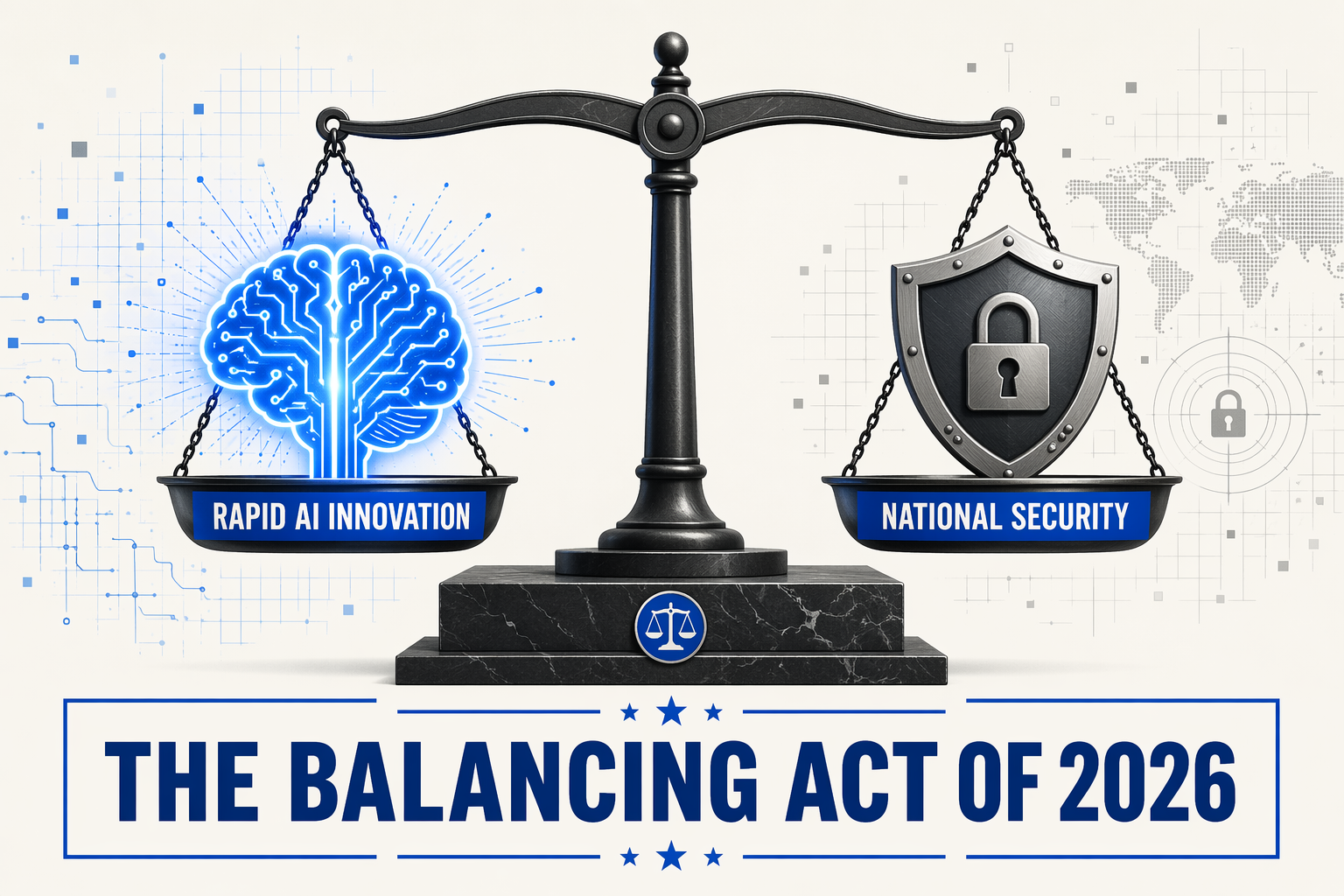
The unprecedented intervention of the US government in the rollout of GPT-5.6 marks a historic turning point in the history of artificial intelligence. By subjecting OpenAI’s newest models—Sol, Terra, and Luna—to a state-sanctioned, staggered release, the administration has signaled that frontier AI is no longer just a commercial product; it is a critical asset tied directly to national security.
This shifting landscape presents a complex tug-of-war between safeguarding public infrastructure and maintaining the breakneck speed of global technological progress.
The National Security Imperative
The primary catalyst for this unprecedented delay is the US government’s concern over the dual-use capabilities of next-generation AI. GPT-5.6 represents a massive leap in reasoning, planning, and autonomous execution. Under the legal framework of the June 2 Executive Order—which established a 30-day voluntary government review window—the administration is treating these models with the same caution historically reserved for advanced cryptography or aerospace engineering.
Federal agencies are prioritizing defense against several key vulnerabilities:
- Sovereign Cyber Defense: Preventing the automated discovery of zero-day exploits in national infrastructure.
- Information Integrity: Limiting the risk of state-sponsored, highly realistic, and hyper-targeted influence campaigns.
- Controlled Access: Ensuring that the highly capable Sol, Terra, and Luna models do not fall into the hands of foreign adversaries or rogue organizations.
The Innovation Bottleneck for Enterprises
While national security is a valid defense, the tech sector is raising alarms about the economic consequences of a permissioned AI ecosystem. Historically, the rapid growth of the digital economy has relied on permissionless innovation. Forcing enterprises to undergo government vetting before accessing GPT-5.6 APIs introduces a layer of bureaucracy that could stifle development.
For startups and mid-market enterprises, the implications are particularly challenging. Vetting processes naturally favor well-capitalized tech giants with established compliance departments, threatening to leave smaller, more agile players behind. Furthermore, global competitors operating in regions with fewer regulatory hurdles may move faster, potentially eroding the competitive edge of US-aligned tech ecosystems.
Navigating a Multi-Model Future
As regulatory oversight of frontier models intensifies, businesses can no longer rely on a single, centralized AI provider. If a core model is delayed, restricted, or subject to sudden geopolitical policy changes, an enterprise’s entire operational workflow could grind to a halt.
To build resilience, forward-thinking organizations are adopting multi-model architectures. Platforms like CallMissed are playing an increasingly vital role in this new landscape. By providing an infrastructure that supports over 300+ LLMs alongside specialized Speech-to-Text and Text-to-Speech engines, CallMissed allows companies to design highly adaptable communication workflows. If access to a frontier model like GPT-5.6 is delayed by regulatory reviews, developers can seamlessly redirect their voice agents and WhatsApp chatbots to other state-of-the-art open-source or proprietary models without rewriting their core codebase.
Ultimately, the staggered rollout of GPT-5.6 serves as a wake-up call. The future of AI integration belongs to enterprises that build flexible, model-agnostic systems capable of adapting to both technological breakthroughs and geopolitical shifts.
Expert Opinions: Industry Reactions to Government Oversight

The unprecedented decision to stall and stagger the rollout of OpenAI’s GPT-5.6 series—comprising the Sol, Terra, and Luna models—has sent shockwaves through the technology sector. Driven by a request from the Trump administration under the framework of a June 2 executive order, which established a voluntary 30-day government review window, this move represents a fundamental shift in how frontier AI is governed. Industry experts, policy analysts, and enterprise leaders are actively debating what this new era of state-vetted AI means for global innovation.
The Security vs. Velocity Debate
Many national security analysts argue that the staggered release is a necessary safeguard. As LLMs approach agentic capabilities capable of executing complex, multi-step tasks, the potential for misuse in cybersecurity, synthetic biology, and critical infrastructure grows exponentially. Proponents of the government's intervention believe that vetting enterprise clients before granting access to high-tier models like Sol and Terra prevents adversarial states or malicious actors from weaponizing advanced intelligence.
However, Silicon Valley veterans and AI researchers warn of "bureaucratic drag." Critics argue that forcing a private company to submit user lists for state approval sets a troubling precedent that could stifle the rapid deployment of competitive commercial solutions. There is widespread concern that a prolonged government approval process will slow down the integration of generative AI into productivity software, healthcare, and customer service.
Navigating a Fragmented LLM Landscape
For enterprises, the immediate fallout of this decision is a sharp increase in operational uncertainty. Organizations that were planning to build next-generation applications entirely on OpenAI's latest frontier models must now navigate complex compliance hurdles and the very real possibility of delayed access.
To mitigate these risks, industry architects are advising companies to shift toward multi-model and model-agnostic strategies. Rather than tying their entire product roadmap to a single, heavily regulated LLM provider, businesses are looking to platforms that offer architectural flexibility. For instance, communication infrastructure platforms like CallMissed are already helping businesses adapt to this shift. By providing an LLM gateway that supports 300+ models, CallMissed allows developers to dynamically route tasks to alternative, highly capable open-source or proprietary models if access to frontier models like GPT-5.6 becomes restricted or delayed by regulatory bodies.
A New Paradigm for Global AI Competition
This development also carries profound geopolitical implications. While the US government aims to secure its technological edge by vetting users, some experts worry this could inadvertently hand an advantage to international competitors operating under fewer domestic constraints. If US businesses face months of vetting to access frontier models, they may lag behind global counterparts who face fewer hurdles.
Ultimately, the limited preview of GPT-5.6 signals that the era of unfettered, immediate access to cutting-edge AI is drawing to a close. As government oversight shifts from theoretical policy to active gatekeeping, the tech sector must adapt. Success will belong to the enterprises that build resilient, multi-model workflows capable of pivoting instantly as regulatory boundaries continue to shift.
What This Means For You: Access & Timelines
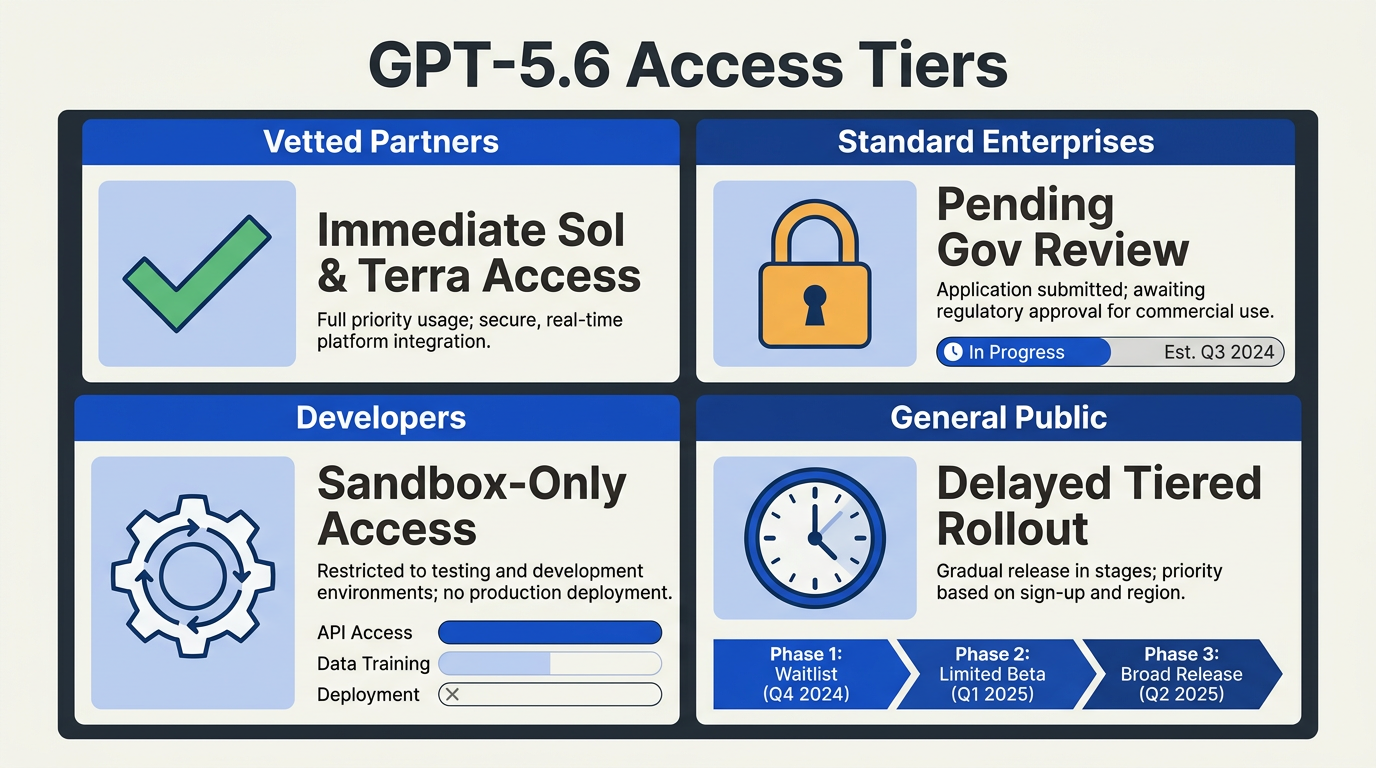
The sudden shift toward a staggered launch means developers and enterprises can no longer expect the immediate, wide-scale API releases typical of previous OpenAI rollouts. Under the legal framework established by the June 2 executive order—which introduces a voluntary 30-day government security review window—the deployment of the GPT-5.6 lineup (consisting of the Sol, Terra, and Luna models) will be heavily segmented based on regulatory vetting.
For organizations planning their AI pipelines, understanding this timeline is critical to avoiding costly development bottlenecks. The rollout is categorized into distinct access tiers, each requiring different levels of compliance and federal clearance.
| Tier / Model | Intended Use Case | Vetting & Approval | Expected Timeline |
|---|---|---|---|
| GPT-5.6 Sol | High-security, defense, and select enterprise partners | Direct US government clearance & vetting | Immediate (Strict Limited Preview) |
| GPT-5.6 Terra | Core commercial enterprise & heavy data processing | Voluntary 30-day government review | Staggered throughout Q3 2026 |
| GPT-5.6 Luna | Standard developer APIs & ChatGPT Plus users | Standard OpenAI safety alignment protocols | Anticipated Late Q4 2026 / Early 2027 |
| GPT-4o / o1 Family | General developer ecosystem & SMBs | Standard automated safety filters | Available immediately without delay |
Key Implications for Developers and Enterprises
The transition to a state-vetted deployment model introduces several strategic hurdles that businesses must navigate immediately:
- The Compliance Bottleneck: To obtain early access to the powerhouse Sol and Terra models, enterprise applications must survive a rigorous security review. If your application handles sensitive infrastructure, healthcare, or financial data, expect a prolonged compliance verification process.
- The Access Disadvantage: Small-to-medium-sized businesses (SMBs) are effectively locked out of the initial preview. If you rely solely on OpenAI’s frontier models, your product roadmap for the second half of 2026 could be delayed by several months while government-vetted corporations gain a competitive edge.
- The Mandate for Redundancy: Relying on a single AI provider is now a high-risk operational strategy.
Because accessing GPT-5.6 directly will require navigating government waitlists, building a model-agnostic infrastructure is no longer optional—it is a necessity. This is where unified communication platforms like CallMissed become invaluable. CallMissed’s LLM inference gateway allows developers to easily route their workloads across 300+ alternative models, including advanced local and open-source models, without rewriting their codebase.
By leveraging CallMissed, you can build production-ready voice agents, multilingual chatbots, and workflows that seamlessly transition from legacy models to the GPT-5.6 series the very moment your access tier is approved. Adapting your development cycle to this new staggered reality ensures that national security reviews do not stall your company's operational momentum.
Frequently Asked Questions
Why is OpenAI delaying the broad release of GPT-5.6?
What are the different models included in the GPT-5.6 release?
What legal mechanism allows the US government to restrict the launch of these models?
How can enterprise developers gain access to GPT-5.6 for their applications?
Who is eligible to participate in the limited preview of the new OpenAI models?
How will this staggered rollout affect the wider AI industry?
Conclusion
The staggered rollout of GPT-5.6 marks a historic turning point where national security interests and frontier AI development directly collide. Here are the key takeaways from this unprecedented move:
- Increased State Oversight: Government vetting of models like Sol, Terra, and Luna signals that future LLM releases will prioritize regulatory compliance over rapid, open-access deployment.
- Security Over Speed: The Trump administration’s intervention, leveraging the June 2 executive order, establishes a new precedent for federal review of highly capable models before public access.
- Enterprise Adaptability: Businesses must pivot toward flexible, multi-model architectures to safeguard against delayed access to state-of-the-art systems.
Moving forward, watch for how this voluntary 30-day review framework impacts global AI competitiveness. Will these safety bottlenecks slow commercial momentum, or will they establish a more secure foundation for enterprise integration?
To explore how AI communication is evolving amidst these shifts, check out CallMissed—an AI infrastructure platform powering voice agents and multilingual chatbots for businesses. By maintaining access to a broad ecosystem of over 300 models, platforms like CallMissed ensure your communication infrastructure remains resilient, no matter how the regulatory landscape of frontier AI shifts.
Discussion
Related Posts



Ready to automate customer conversations?
Launch AI voice agents and WhatsApp bots with CallMissed — one API, 22+ Indian languages.