
OpenAI GPT-5.6: What We Know So Far About the Next-Generation Model



Could OpenAI’s next massive leap in artificial intelligence be hiding in plain sight within its own developer logs? While the global tech community is...
OpenAI GPT-5.6: What We Know So Far About the Next-Generation Model
Could OpenAI’s next massive leap in artificial intelligence be hiding in plain sight within its own developer logs? While the global tech community is still actively deploying the recently launched GPT-5.5, a series of intriguing leaks in internal Codex traces and project infrastructure has set the AI industry ablaze with speculation surrounding an imminent OpenAI GPT-5.6 release. This comes at a highly competitive juncture in June 2026; with Anthropic pushing its highly "honest" Opus 4.8 and Zhipu’s GLM-5.2 already outpacing GPT-5.5 in specific reasoning benchmarks, the pressure on OpenAI to maintain its market dominance has never been higher.
This emerging model matters immensely to developers and enterprises alike. Today’s AI applications are rapidly transitioning from passive chatbots to fully autonomous agents capable of managing complex workflows. Although OpenAI has not yet updated its official API documentation, pricing tiers, or developer release notes to include GPT-5.6, the leaked system identifiers point toward a model engineered specifically to power these highly agentic applications. Industry insiders expect substantial leaps in tool-use precision, significantly longer context-window handling, and faster inference speeds. Additionally, technical traces suggest that GPT-5.6 is the first model trained using a redesigned post-incident reward audit pipeline, aimed at delivering unprecedented accuracy in coding, data analysis, and multi-step research.
As businesses prepare for this next wave of autonomous technology, infrastructure agility will be the key differentiator. Platforms like CallMissed are already leading this trend, offering unified APIs that will allow organizations to deploy OpenAI GPT-5.6 alongside over 300 other LLMs, voice agents, and multilingual tools without rewriting their codebase.
In this post, we will separate the concrete facts from the speculative rumors surrounding OpenAI GPT-5.6. We will explore the technical details behind the Codex leaks, analyze how its rumored capabilities stack up against the competition, and outline how you can prepare your development pipeline for the next generation of agentic AI.
Introduction: The Buzz Around OpenAI's Leaked GPT-5.6
The artificial intelligence landscape in late June 2026 is moving at a breakneck pace. While enterprises are still actively scaling deployments of OpenAI's recently released GPT-5.5, the developer community has been set ablaze by a series of unexpected leaks pointing to an imminent successor: OpenAI GPT-5.6. What began as quiet speculation on developer forums has quickly gained traction as technical traces of the unreleased model surfaced directly within OpenAI’s own infrastructure.
The Codex Leak and the Paper Trail
The rumors surrounding GPT-5.6 transitioned from speculative chatter to highly credible technical analysis when a gpt-5.6 model identifier briefly surfaced in internal Codex logs and project traces. According to analysis by WaveSpeed AI and the handyAI Substack, these system-level leaks suggest that OpenAI is already conducting active canary testing of the model.
Crucially, technical logs indicate that GPT-5.6 is the first model version built using a redesigned post-incident reward audit pipeline—a corrective training methodology implemented following a previous system anomaly (referred to by insiders as the "goblin incident"). This updated pipeline is expected to yield unprecedented precision, particularly in complex coding, multi-step reasoning, and deep-dive research tasks.
Why the Pressure is on OpenAI
This leak arrives at a critical competitive juncture. OpenAI is facing intense pressure from global rivals who are rapidly closing the capability gap:
- Zhipu's GLM-5.2 has recently made waves in the developer community, outperforming GPT-5.5 in specific logical reasoning and mathematical benchmarks.
- Anthropic's Opus 4.8 is being actively pushed to enterprise clients, positioning itself as a highly "honest," reliable, and steerable model for critical workflows.
To maintain its market dominance, OpenAI needs a model that does not just offer incremental speed improvements, but one that natively excels at autonomous, multi-step agentic workflows.
Anticipated Agentic Capabilities
While OpenAI has not yet published official API documentation, pricing tiers, or developer release notes as of June 26, 2026, the leaked traces and industry insider reports point to several key architectural improvements:
- Advanced Tool-Use Precision: Built to function as an autonomous agent that can reliably call external APIs, execute code, and self-correct errors mid-workflow.
- Longer Context-Window Handling: Expected to comfortably process massive document stacks without losing instructional adherence over long token ranges.
- Optimized Inference Speed: Fine-tuned token-generation pipelines aimed at reducing the latency that often bottlenecks real-time agentic applications.
Preparing Your AI Infrastructure
As developers wait for the official API drop, the lesson of 2026 is clear: building hard-coded integrations tied to a single LLM is an architectural liability. Forward-looking businesses are leveraging flexible communication infrastructure to remain model-agnostic.
Platforms like CallMissed are already enabling this agility. By offering unified APIs that support over 300+ LLMs alongside advanced voice agents and Speech-to-Text APIs (which natively support 22 regional Indian languages), CallMissed allows organizations to seamlessly route workflows to OpenAI GPT-5.6 the moment it launches, without rewriting their underlying codebase.
Background & Context: From GPT-5.5 to the Canary Leak
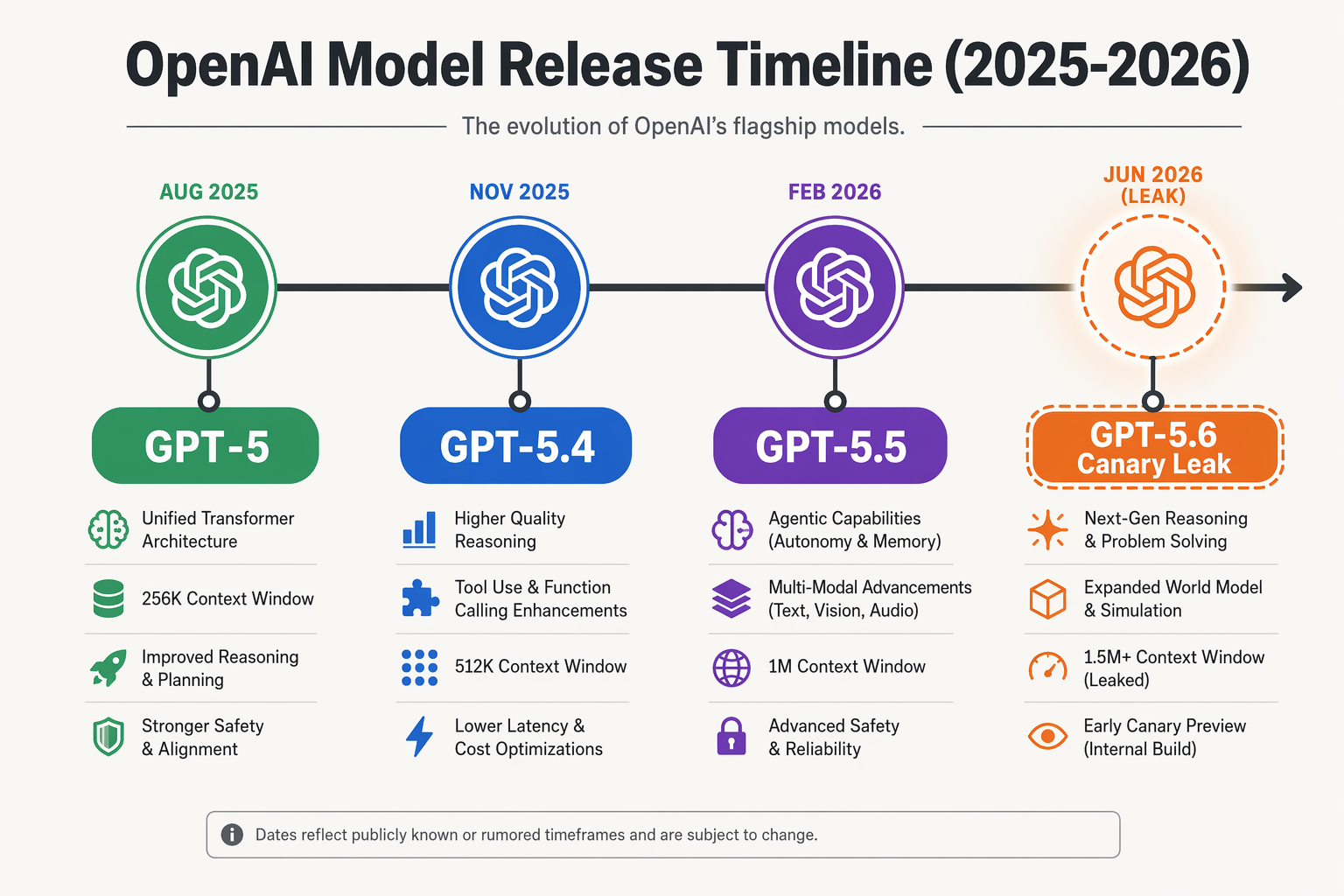
To understand the momentum building behind OpenAI GPT-5.6, we must first look at the state of the frontier model market in mid-2026. OpenAI’s official flagship, GPT-5.5, was launched as a highly capable engine designed to tackle complex tasks like professional coding, scientific research, and advanced data analysis. Yet, the competitive window in AI has shrunk to months, if not weeks. With Zhipu AI’s recently launched GLM-5.2 outperforming GPT-5.5 on key mathematical and logical reasoning benchmarks, and Anthropic actively pushing its safety-optimized Opus 4.8, OpenAI faced immediate pressure to reclaim undisputed technical dominance.
Anatomy of the Canary Leak
The first concrete evidence of a successor did not arrive via an official OpenAI keynote, but through what developers call a "canary leak." In early June 2026, developers monitoring network requests and Codex trace logs discovered unexpected model identifiers—specifically gpt-5.6 and gpt-5.6-preview—briefly surfacing in OpenAI's internal project infrastructure.
While OpenAI's engineering team quickly scrubbed these references from public-facing developer consoles, the paper trail left behind in those system logs revealed critical details about the model's development:
- Active Internal Evaluation: The model identifier was being routed through active internal testing environments, suggesting OpenAI is in the final stages of red-teaming, alignment tuning, and system optimization.
- The Post-Goblin-Incident Pipeline: According to technical reports from WaveSpeed AI, GPT-5.6 is the first model architecture trained using a redesigned post-incident reward audit pipeline. This pipeline was created to address the "goblin incident"—a system vulnerability in previous training runs that caused models to experience logic loops and sudden degradation during long-context reasoning.
- Agent-First Architecture: Metadata embedded in the leak suggests the model is optimized for persistent, multi-step agentic execution, moving far beyond standard single-turn text generation.
What is (and Isn’t) Official
It is crucial for enterprise decision-makers to separate developer leaks from official product availability. As of today, June 26, 2026, OpenAI’s developer portal, pricing tables, and public release notes contain no official API endpoints or technical documentation for GPT-5.6. For now, GPT-5.5 remains the officially supported state-of-the-art model.
However, the tech industry is already preparing for an imminent shift. For organizations building autonomous agents, avoiding vendor lock-in during these rapid release cycles is vital. Communication infrastructure platforms like CallMissed solve this issue by offering a unified API gateway that supports over 300 LLMs. By decoupling the underlying model from the application layer, developers can continue running stable workflows on GPT-5.5 today, while remaining fully prepared to swap in GPT-5.6 the moment its API is officially provisioned.
The transition from GPT-5.5 to the leaked GPT-5.6 represents more than a minor version bump; it signifies a structural pivot from "knowledge retrieval" to "autonomous execution." In the next section, we will analyze the rumored technical specifications of GPT-5.6 to see how it plans to deliver on these agentic promises.
Key Developments: Timeline of Leaks and Rumors
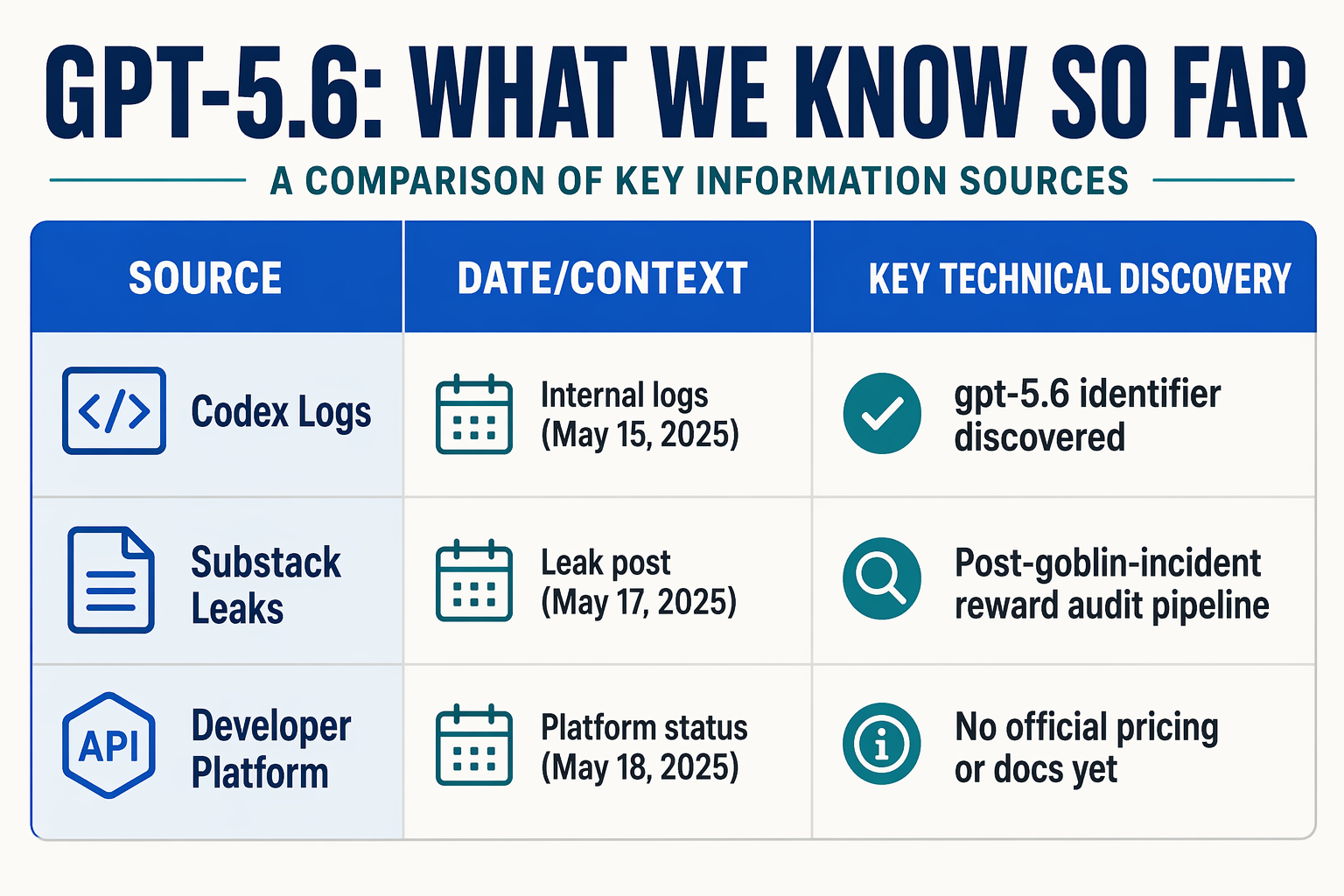
Tracking the Paper Trail of GPT-5.6 Leaks
The road to OpenAI’s next major release has been marked by a distinct trail of digital breadcrumbs. While OpenAI has historically managed to keep its major product launches tightly under wraps, the highly competitive landscape of mid-2026 has resulted in an accelerated cycle of internal testing, leading to a series of high-profile infrastructure leaks. Rumors of GPT-5.6 moved rapidly from speculative developer forums to verifiable technical discussions as engineers spotted concrete evidence of the model within internal testing environments.
To understand how we arrived at the current state of anticipation, it is crucial to examine the timeline of discoveries, competitive pressures, and technical revelations that have surfaced over the past few weeks.
| Date | Event / Leak | Primary Source | Key Technical Revelation |
|---|---|---|---|
| Early June 2026 | Codex Log Discovery | HandyAI Substack / Reddit | An unreleased gpt-5.6 identifier briefly appeared in internal Codex logs and testing pipelines. |
| Mid-June 2026 | Training Pipeline Leak | WaveSpeed AI | Technical details revealed GPT-5.6 is trained on a redesigned "post-goblin-incident" reward audit pipeline. |
| Mid-June 2026 | Competitive Push | Zhipu GLM-5.2 Launch | Zhipu's GLM-5.2 outperformed GPT-5.5 on reasoning benchmarks, intensifying pressure on OpenAI. |
| June 2026 (Current) | Developer Community Hype | Reddit /r/OpenAI | Speculation shifts to an imminent "GPT-5.6 Preview" drop, potentially bypassing a "GPT-5.5 Turbo" naming scheme. |
| June 26, 2026 | Document Status Check | OpenAI API Portal | No official API pricing, release notes, or integration documentation has been published yet. |
Contextualizing the Rumor Mill
The timeline highlights a clear pattern: OpenAI is facing intense, multi-front pressure. The release of Zhipu’s GLM-5.2—which demonstrated superior reasoning capabilities compared to the flagship GPT-5.5—alongside Anthropic's push toward a more "honest" Opus 4.8, has forced OpenAI to accelerate its pipeline.
The most intriguing technical revelation from these leaks is the mention of a redesigned post-incident reward audit pipeline. Industry analysts suggest this refers to a fundamental overhaul of OpenAI’s reinforcement learning from human feedback (RLHF) mechanisms following a series of alignment and edge-case failures (referred to in developer circles as the "goblin incident"). This new training pipeline is designed to eliminate model hallucinations and drastically improve multi-step logical reasoning, making GPT-5.6 highly optimized for fully autonomous agentic workflows.
For enterprises, staying ahead of this rapid cycle of model releases is a massive architectural challenge. Rather than rebuilding API wrappers and testing infrastructure for every new iteration, many forward-thinking teams are utilizing unified communication and AI platforms. Systems like CallMissed enable developers to transition seamlessly between over 300 LLMs, including GPT-5.5, GLM-5.2, and eventually GPT-5.6, via a single integrated API. This strategy ensures that when OpenAI officially drops the API keys for its next-generation model, businesses can deploy it instantly without operational downtime.
In-Depth Analysis: What Makes GPT-5.6 Different?

While GPT-5.5 set a new baseline for enterprise intelligence upon its recent release, the technical leaks surrounding OpenAI GPT-5.6 point to a model designed for a completely different paradigm. Rather than simply scaling up parameter size, GPT-5.6 appears engineered to shift AI from a passive conversationalist to a highly active, fully autonomous agent.
Based on the Codex traces and architectural rumors circulating in late June 2026, several core differences set GPT-5.6 apart from its predecessor and its fiercest market rivals.
The Redesigned Post-Incident Reward Audit Pipeline
One of the most fascinating technical revelations from the WaveSpeed AI analysis of the leaked logs is that GPT-5.6 is the first OpenAI model trained with a newly redesigned reward audit pipeline. Developed following an internal system anomaly colloquially dubbed the "goblin incident," this training framework aims to eliminate "reward hacking"—a common issue where models optimize to please human evaluators or exploit benchmark shortcuts rather than delivering logically correct code or factual analysis.
For developers, this structural shift translates to:
- Drastically reduced hallucination rates in complex, multi-file code generation and deep software debugging.
- Objective self-correction, allowing the model to audit its own reasoning steps internally before outputting a final response.
- Verifiable research synthesis that prioritizes factual ground truth over speculative filler.
Agentic Architecture: Tool-Use and Long-Context Retention
In June 2026, the enterprise landscape is rapidly moving past simple chat interfaces; the focus has shifted entirely to agentic AI—systems that can independently call APIs, query databases, and execute multi-step workflows. While GPT-5.5 handles standard reasoning exceptionally well, GPT-5.6 is rumored to introduce architectural enhancements specifically optimized for agentic operations:
- State-Tracking in Extended Contexts: Current models struggle to remember their original instructions during long, multi-hour agent loops. GPT-5.6 is expected to feature upgraded memory mechanisms to maintain instruction fidelity across hundreds of sequential tool calls.
- Ultra-Low Latency Inference: To act as a real-time voice agent or background automation script, processing speed is critical. Leaked benchmarks hint at optimized attention mechanisms that deliver significantly faster inference speeds, cutting down token-generation times.
- Deterministic Tool Output: Improved function-calling capabilities ensure that the model formats API payloads with absolute precision, preventing runtime execution failures.
Navigating a Highly Competitive Landscape
The pressure on OpenAI to deploy GPT-5.6 is immense. Anthropic is actively capturing market share with its highly "honest" Opus 4.8, while Zhipu’s newly announced GLM-5.2 has already surpassed GPT-5.5 in specific localized reasoning benchmarks.
Because the LLM landscape is shifting so rapidly, relying on a single model is a massive risk for modern enterprises. Platforms like CallMissed offer the perfect solution to this volatility. By utilizing CallMissed’s unified API infrastructure, developers can easily deploy voice agents and LLMs across 300+ models. This ensures that when GPT-5.6 officially drops, businesses can immediately integrate it alongside GLM-5.2 or Opus 4.8, keeping their communication pipelines agile, resilient, and cutting-edge.
Impact & Implications: Fueling the Next Wave of Agentic AI
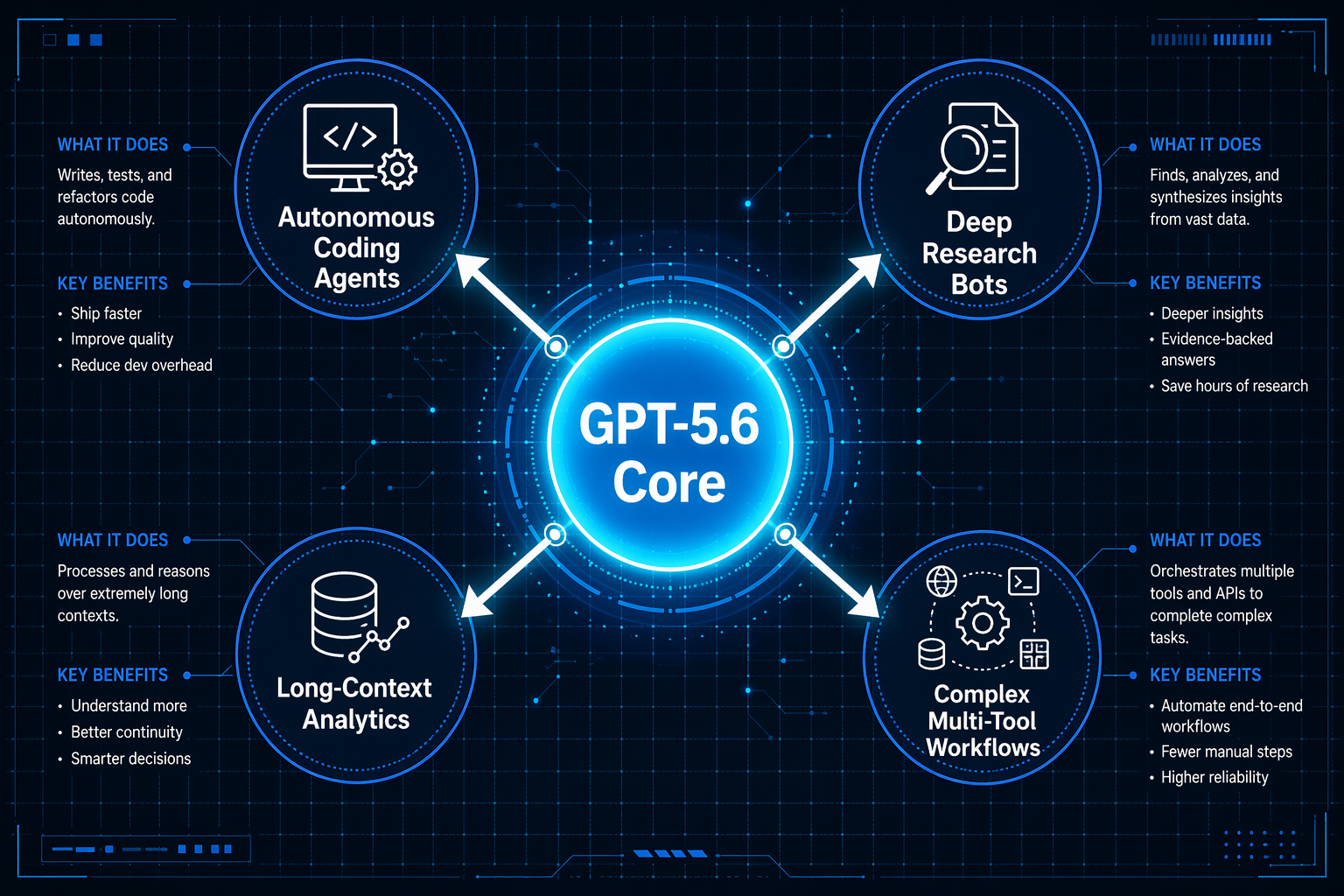
The true promise of OpenAI GPT-5.6 lies not just in writing better essays or debugging simple scripts, but in driving the industry-wide transition toward Agentic AI. For years, artificial intelligence has operated primarily in a passive, reactive mode—waiting for a user prompt, generating a response, and ending the interaction. However, as of June 2026, the paradigm is shifting. Businesses are demanding autonomous agents that can plan multi-step workflows, execute complex APIs, and self-correct when errors occur.
The technical enhancements leaked in GPT-5.6’s Codex traces suggest this model is engineered precisely to be the primary engine for this next generation of agentic workflows.
Native Tool-Use and the Reward Audit Pipeline
One of the biggest bottlenecks for autonomous agents has been reliable tool execution. When an LLM is tasked with calling external APIs, building queries, or navigating database schemas, even a minor syntax error can derail an entire workflow.
- Enhanced Precision: GPT-5.6 is rumored to leverage a post-goblin-incident reward audit pipeline, specifically redesigned to train the model on precise tool-use validation and edge-case handling.
- Fewer Hallucinations in Execution: Rather than blindly generating code, the model is built to pre-evaluate its intended actions, significantly reducing hallucination rates during API interactions.
- Self-Correction Loops: If an external system returns an error, GPT-5.6 can autonomously analyze the error log, adjust its parameters, and retry the execution without requiring human intervention.
Overcoming the Multi-Step Reasoning Bottleneck
To execute long-running tasks—such as conducting deep market research or managing customer support lifecycles—agents require massive context windows and incredibly fast inference speeds. While competitors like Anthropic’s Opus 4.8 and Zhipu’s GLM-5.2 have set high benchmarks in honest reasoning, the rumored architecture of GPT-5.6 directly addresses the speed-to-accuracy ratio.
- State Retention: With longer context-window handling, agents powered by GPT-5.6 can maintain the state of complex conversations and system logs over hours of continuous interaction.
- Low-Latency Decision Making: Faster inference speeds mean that multi-turn agentic loops, which often require 5 to 10 sequential LLM calls behind the scenes, can now execute in seconds rather than minutes.
Scaling Agents Across Enterprise Ecosystems
As organizations prepare to deploy these highly capable agents, the underlying infrastructure must remain agile. Transitioning to agentic workflows requires more than just a powerful model; it requires seamless integration with communication channels and legacy systems.
This is where advanced communication infrastructure becomes critical. Platforms like CallMissed are already enabling enterprises to build and deploy production-ready AI voice agents and WhatsApp chatbots. By utilizing CallMissed’s unified API gateway, which supports over 300 LLMs, businesses can seamlessly integrate next-generation models like OpenAI GPT-5.6 into their existing voice and chat workflows without rewriting their core codebases. This ensures that when GPT-5.6 officially launches, developers can immediately leverage its advanced reasoning capabilities to power real-time, multilingual customer interactions across 22 regional Indian languages.
Expert Opinions: Incremental Step or Paradigm Shift?

As the developer community dissects the leaked Codex traces, a polarizing debate has emerged among AI researchers, enterprise architects, and industry analysts: Is OpenAI GPT-5.6 a revolutionary paradigm shift in agentic intelligence, or is it simply a highly optimized incremental update?
With OpenAI yet to release official documentation, pricing, or release notes, the industry is left to evaluate the model’s potential based on its architectural leaks and the aggressive competitive landscape of late June 2026.
The "Hype vs. Substance" Debate
Many skeptics argue that GPT-5.6 might represent a branding maneuver rather than a foundational leap. On developer forums like Reddit, some insiders suggest that OpenAI's naming convention is highly dependent on market reception. The prevailing theory is that if the upcoming preview generates massive industry momentum, OpenAI will officially brand it as GPT-5.6; if the reception is lukewarm, the technical improvements might simply be rolled out as "GPT-5.5 Turbo" within standard release notes.
Under this "incremental" view, the model is seen as a rapid, necessary patch to address the aggressive benchmarks set by competitors like Zhipu’s GLM-5.2 and Anthropic's Opus 4.8. Rather than introducing a completely new architecture, it serves to optimize inference speeds, extend the context window, and lower operating costs for enterprise developers deploying high-volume API calls.
The Case for a Paradigm Shift: The Post-Incident Reward Pipeline
Conversely, many AI researchers believe GPT-5.6 is a monumental structural evolution, specifically pointing to its training methodology. According to reports from WaveSpeed AI, GPT-5.6 is the first model engineered using a redesigned post-incident reward audit pipeline.
This change is not trivial. Experts suggest this pipeline represents a fundamental shift in how OpenAI trains its models through Reinforcement Learning from Human Feedback (RLHF). By auditing rewards post-incident, the model learns to self-correct during complex, multi-step agentic workflows. This solves a major bottleneck in agentic AI: "hallucination compounding," where a minor error in step one of a coding or research task causes the entire automated workflow to fail.
If these architectural rumors hold true, GPT-5.6 will deliver:
- Unprecedented Tool-Use Precision: The ability to call external APIs, query databases, and execute code sequences with near-zero failure rates.
- True Autonomy: The transition from passive, prompt-based assistance to proactive problem-solving where the agent can audit and debug its own output.
- Highly Honest Outputs: Aligning closely with Anthropic's emphasis on "honest" models, reducing overconfident but incorrect assertions in professional and medical use cases.
Navigating the Architectural Shifting Sands
Whether GPT-5.6 is a minor iteration or a massive leap, the rapid succession of model releases highlights a core challenge for modern enterprises: avoiding vendor lock-in. A model that leads the market today may be surpassed tomorrow by a surprise drop from a competitor.
This is where infrastructure agility becomes crucial. Forward-thinking organizations are bypassing the debate entirely by leveraging multi-model platforms like CallMissed. By utilizing CallMissed's unified AI infrastructure, developers can seamlessly route queries across 300+ LLMs. When GPT-5.6 officially launches, CallMissed users can instantly benchmark its agentic capabilities alongside existing voice agents, Speech-to-Text pipelines, and regional language models without undergoing costly codebase rewrites. This ensures that no matter which way the industry shifts, your business remains at the cutting edge.
What This Means For You: Actionable Takeaways for Businesses & Developers
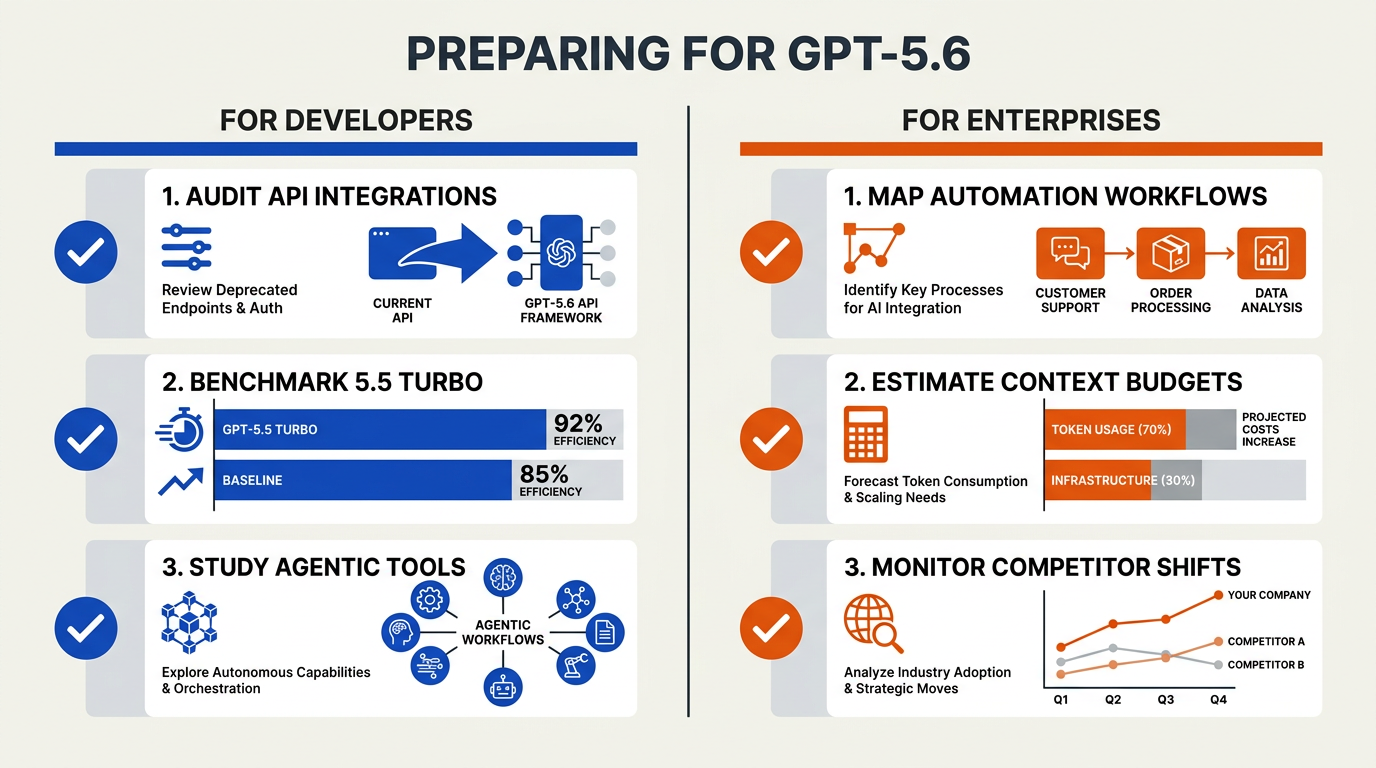
The rapid transition from GPT-5.5 to the leaked GPT-5.6 architecture underscores a vital reality for modern engineering teams: AI infrastructure must be built for agility, not locked into a single provider. With Anthropic’s Opus 4.8 emphasizing strict honesty and Zhipu’s GLM-5.2 outperforming existing models on key reasoning benchmarks, developers cannot afford to hardcode their applications to a single API.
To capitalize on the next wave of agentic AI without risking system downtime or costly refactoring, businesses must adopt an adaptable, model-agnostic development framework. The key to preparation lies in shifting away from basic prompt-response paradigms and moving toward robust tool-use orchestration, dynamic context management, and multi-model failovers.
The table below outlines the critical preparation strategies for developers and enterprise architects as they brace for the official launch of GPT-5.6.
| Strategy | Core Objective | Developer Action | CallMissed Integration |
|---|---|---|---|
| Decouple LLM Dependencies | Eliminate vendor lock-in to dynamically route queries between OpenAI, Anthropic, and open-source models. | Build wrapper classes or use unified API gateways rather than calling direct OpenAI endpoints. | Use CallMissed’s multi-model gateway to switch between 300+ LLMs without changing a single line of codebase. |
| Standardize Tool Schemas | Prepare agentic pipelines for GPT-5.6’s advanced, multi-step tool-use and function-calling. | Define strict JSON schemas for external APIs and utilize validation libraries (e.g., Pydantic) to handle outputs. | Deploy production-ready voice and chat agents that seamlessly bind tools to real-time communication channels. |
| Optimize Context Pipelines | Handle longer context windows efficiently without ballooning token costs or latency. | Implement semantic caching and prompt-compression techniques to minimize the payload sent to the model. | Leverage optimized infrastructure that maintains low-latency speech-to-text and text-to-speech workflows. |
| Implement Multi-Model Routing | Ensure high availability by automatically routing tasks based on cost, latency, and capability. | Write fallback logic that routes complex reasoning to GPT-5.6 and high-speed, simple tasks to lighter models. | Leverage unified routing to instantly fall back to alternative models if OpenAI API limits are throttled. |
Designing for the Agentic Era
Preparing for GPT-5.6 requires a fundamental shift in how we evaluate model outputs. Because GPT-5.6 is rumored to be the first model trained on OpenAI's post-incident reward audit pipeline, its behavioral alignment will heavily favor safe, highly precise execution of code and data workflows.
Developers should immediately start auditing their current agentic prompts. If your system relies on "jailbreak-prone" or highly unstructured prompts, the stricter safety guardrails of GPT-5.6 may trigger unexpected refusals. Transitioning to structured, few-shot prompting and system-level role definitions today will make your transition to the new model seamless.
For enterprises looking to operationalize these next-gen capabilities, platforms like CallMissed provide the necessary communication infrastructure. Whether you are building multilingual customer support agents that require local dialect support across 22 Indian languages, or automating high-throughput WhatsApp chatbots, maintaining a flexible AI backend ensures you can deploy GPT-5.6 the minute the API keys become publicly available.
Frequently Asked Questions
Below, we answer some of the most frequently asked questions regarding the rumored GPT-5.6 model, its leaked technical specifications, and how the AI landscape in June 2026 is shifting in response to these developments.
Has OpenAI GPT-5.6 been officially released by OpenAI?
What are the key technical upgrades expected in the upcoming GPT-5.6 model?
How does OpenAI GPT-5.6 compare to competing models like Zhipu GLM-5.2 and Anthropic Opus 4.8?
What evidence sparked the rumors of an imminent GPT-5.6 launch?
gpt-5.6 model identifier briefly surfaced in OpenAI's internal Codex traces and project infrastructure logs. AI industry watchdogs and developer communities quickly documented these canary traces, noting that such infrastructure updates historically precede public preview releases by only a few weeks. This timeline aligns perfectly with the competitive landscape of late June 2026, as OpenAI seeks to counter recent major releases from rival laboratories.Is there any official pricing or API documentation available for GPT-5.6 yet?
How can developers easily transition their applications to use new models when they launch?
By maintaining an agile, model-agnostic infrastructure, your business will be fully prepared to capitalize on GPT-5.6 the moment it officially drops.
Conclusion
As the AI landscape rapidly transitions from simple chat interfaces to fully autonomous systems, the leaked traces of OpenAI’s GPT-5.6 signal a massive shift in how we build and deploy AI. To prepare for this next wave, keep these key takeaways in mind:
- Designed for Agents: Built specifically to power complex, multi-step autonomous workflows with superior tool-use precision and longer context windows.
- Robust Technical Roots: Code traces indicate training via a redesigned post-incident reward audit pipeline to significantly improve coding and reasoning.
- Imminent Launch: Although official API documentation and pricing are still pending in late June 2026, Codex log leaks suggest a public release is just around the corner.
Moving forward, watch closely to see if GPT-5.6's enhanced reasoning and faster inference can successfully outpace fierce competition from Anthropic and Zhipu. Will this model finally deliver the level of trust and accuracy required for truly hands-off enterprise automation?
To explore how AI communication is evolving, check out CallMissed — an AI infrastructure platform powering voice agents and multilingual chatbots for businesses.
Discussion
Related Posts



Ready to automate customer conversations?
Launch AI voice agents and WhatsApp bots with CallMissed — one API, 22+ Indian languages.